HOW AH CHEE FOUND SANTA CLAUS
Reading edition
IT was Christmas Eve. In the big Chinatown of San Francisco little Ah Chee and her brother Ah Gong were eagerly drinking in the words of the old Chinese story-teller as he sat on the streets and told stories for any one who cared to listen and to give him a few pennies. It was getting late, and the sea wind blew roughly through the narrow streets, and made the dear little Chinese noses so cold; but then Ah Chee did not mind, for the old man had been telling them the most wonderful tale,—something about Christmas—the ’Melican Clismas—and he had said something about it being a little Baby’s birthday, and that almost everybody in the world celebrated it. She pondered over it, in her vague little Chinese way, and thought it very queer that they should make such an ado about just a baby.
The old man did not understand it very well himself, but he remembered that when he used to be cook for an American family once, a long time ago, the children had hung up their stockings on this particular night, and had some kind of a tree with beautiful things on it. They called it a Christmas tree, he remembered, and how pleased he had been when there were found to be some packages for him on that same tree. They had told him then that Santa Claus had put them there, and he could never forget the thrill of surprise and pleasure he felt at the thought that this mysterious Santa Claus, whoever he might be, should have remembered him when he had never even seen him.
And now the story was finished, and the old man went on down the street, and entered a shop where he would smoke opium and forget all about Christmas. But little Ah Chee did not forget. She sat scraping her little sandals against the pavement, thinking it all over. Her mo chun was upstairs in the poor little rooms, sewing by the dim light which struggled through the lattice, and wishing that she were not so poor, for she had to work very hard, and often they did not have enough to eat. The rice was almost gone now, and there were only a few leaves of chah (tea) left.
A Chinese mother loves her children very dearly, and always tries to gratify their every wish; so it made her feel badly to think she could not give them embroidered shoms (blouses), and sandals, instead of the plain dark ones they always had to wear. The children had had their rice early to-night, and had gone out in the street to play “hawk catching young chickens,” they said.
She did not know the story-teller had been there, but she would not have objected if she had known, for he was a kind old man, and if she could have spared the time from her sewing she also would have listened; for a Chinese woman is like a child in many things. She had heard some one say this was the American Christmas, but to her all days were alike,—just work, that was all.
Meanwhile Ah Chee was filled with a curious longing to run away from the picturesque Chinatown, just for a little while, to see if she could not find out something more about this wonderful Santa Claus. She would give anything in the world to see him, only—she had nothing to give. All the trinkets the poor little child owned were a mud pagoda and a bit of painted wood she called a doll.
Once during the Chinese New Year her dear mo chun had taken them for a walk outside of Chinatown, and she had seen the wonderful shop-windows of the Americans. How different they were from the Chinese! She had also seen some beautiful things that her mother had said were dolls. She had never forgotten it, and had even dreamed of holding one of these wonderful things in her arms. But it could only be a dream,—no such happiness was for her,—for it was all they could do to get enough rice to eat, without buying American dolls.
“Ah Gong!” she cried, fired with a sudden and bold resolution, “Ah Gong! you likee take a walk with sisteh?”
Ah Gong was at that moment busily engaged in eating a dried herring, which the kind-hearted owner of the shop next door had given him; but that fact did not in the least interfere with his desire to see new sights. His sparkling Chinese eyes fairly danced out of his head at the mere prospect.
“Yes, I likee,” he replied, with his mouth full of herring. “What foh you takee walk? Where you go?”
She took hold of the end of his queue, and pulling him toward her, whispered in his ear the magic words: “We go see Clismas! we catch ’em Sanny Claw.”
This announcement was almost too much for Ah Gong, and his little celestial brain could not take in so much happiness all at once, so he stared at her a moment until he had swallowed the bite of herring, and then gasped out: “But Ah Gong ’flaid Sanny Claw spit fieh (fire) on us; allee samee heap big dlagon.”
Ah Chee had to giggle at this, with her ever-ready Chinese giggle, but putting her long sateen sleeve round him in a protecting manner she answered him in the kindest tone: “Oh, no! ’Melican Sanny Claw heap good man—allee samee joss; we go find him; come along!”
So they started in the growing darkness, with the sweet faith of a child in their hearts. They knew not where to go, nor which way to turn, but only had the one thought—just to find the ’Melican Clismas. When they had disappeared, the shopkeeper believed they had gone home for the night, and gave them no more thought; the tired mother upstairs supposed that they were in the shop, as they often went in there and played until late, because it was bright, and the man was kind to them.
They knew they could not find Santa Claus in Chinatown, so the first thing to do was to get out of the Chinese section, and into one of the great thoroughfares of the city. On they went, past the joss house, where they had once been with their mother to burn pretty candles before the joss, and they looked up with childish admiration at the big round lanterns which hung on the balcony, and tried to read the Chinese letters at the door. Sometime, perhaps when the moon festival came, or the Chinese New Year, it might be that mo chun would take them again, if she had money enough to buy any more pretty candles. The good joss liked pretty candles.
There were many lovely things to be seen in Chinatown, but to-night they were going somewhere else. It did not occur to them that they might get lost, or that their dear mother might be uneasy. They were too much excited over what the story-teller had told them to worry over anything, so they toddled on, their hearts full of expectation. They had no idea what Christmas would be like when they should find it, or whether it would be alive, but they could wait. How very queer it seemed when they had left the narrow crooked streets of Chinatown, with its smell of incense and its balconies and lanterns, and found themselves on a great wide street full of people, so full of people that the heart of the motherly little Ah Chee almost failed her, and she clasped her arm protectingly around the body of her fat baby brother, and whispered words of encouragement in his little brown ear.
Many people, in the hurry of their Christmas shopping, gave a passing thought of wonder that the two little Chinese children should be in the dense crowd alone, but thought perhaps their parents were following them; and so, with a smile at the dimpled tea-rose face and sparkling eyes of the Chinese maiden they passed on, to the brightness and good cheer of their own comfortable homes. There were so many street cars, with bells clanging, carriages dashing past, and so much noise and confusion that they were both frightened. Even the brave little heart of Ah Chee beat violently under the padded warmth of her dark blue blouse, and for a moment she almost feared they would not find Santa Claus. But just then a voice said something, and a big policeman picked her up, and smiled at her, saying: “Where are you going, little one? Where is mamma?”
The timid little voice of Ah Chee replied, “Mo chun, she at home; can you tell me,” she eagerly questioned, “where Sanny Claw is?”
“Why, yes, to be sure; he is in there.”
In there,—could it be possible they were so near the wonderful being and had not known it?
They saw a very large store, with great crowds of people, big and little, jostling each other in their efforts to
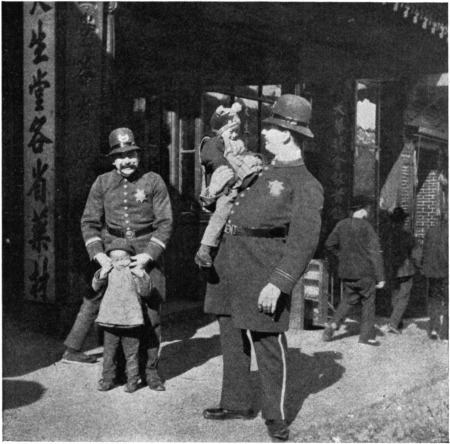
“Where are you going, little one?”
get in. So all these people were hunting Santa Claus. Ah Chee in her childish eagerness slipped, and would have fallen, had she not been caught in some one’s arms. The arms belonged to a richly dressed lady, who looked down with indifference at the pathetic picture of the two little children, and was about to draw her skirts aside and pass on, when the little Christ-child must have put a thought into her worldly heart, for she turned and looked again into the wistful little faces.
They must have seen some sympathy in her face, for Ah Chee said hesitatingly, “Oh, if you please, we likee see Sanny Claw; could you show us?”
For a moment she hesitated. What would her aristocratic friends think if they saw her taking two dirty Chinese children into the elegant shop?
“Why didn’t your father bring you?” she said.
“My fatheh—he die; we no got fatheh.”
Something in the pleading little face, and the quiver in the little red mouths, and the despair in the great oblique eyes must have touched the woman’s heart beneath all its worldly coating. With sudden decision she grasped the two little trembling hands, and throwing all her old false pride to the Christmas winds, stepped boldly into the shop, where all was elegance and warmth and light and beauty.
To her it was an old story. She had long since lost the spirit of Christmas, and the old legend of Santa Claus brought no ecstasy to her, for there were no children at her home to hang up their stockings. The little Chinese children were all eyes now, and forgot their poverty and the bleak darkness of their home as they looked for the first time at all this sparkling beauty. At last they found him—the “ ‘Melican Sanny Claw!” To the lady it was nothing,—such an old, old story,—but to the two little Chinese children it was the perfect and blissful realization of a dream, the one beautiful event in two little barren lives. And now—they actually stood face to face with Santa Claus. Little Ah Gong was glad to see that he was not spitting fire, like the Chinese dragon, and felt quite reassured.
Santa was standing by a sparkling tree all covered with pretty candles, such as they had burned for the joss, and on top of the tree was a great shining star.
“What is that?” said Ah Gong, pointing with his chubby forefinger to the star.
“That? It is the star of Bethlehem,” said the pretty lady, with a queer catch in her voice, while for the first time in her life she realized a little of the true meaning of the star.
They did not understand, and clung closer to each other as they neared the wonderful Santa Claus. He must have come from a very cold country, for he was dressed all in fur, from head to foot, and had rosy cheeks and long white whiskers.
“See,” whispered the little girl to her brother, “it is the heap good ’Melican Santa; do you see him?”
“Yes—yes—I see him; I no ’flaid now,” he said, edging closer to him.
The beautiful lady was whispering to Santa Claus—actually whispering. What a brave lady she must be, and they wondered vaguely what she could have to say to him. And, wonder of wonders! Santa came right up to them, and putting out his big warm hand, clasped the trembling little cold hands of the two children, and said: “What do you want me to bring you?”
Was there ever anything so wonderful? That he should notice them, and speak to them? Their eyes almost danced out of their heads at this unexpected question. It had never occurred to their innocent little hearts that he would bring them anything, because they were only Chinese, and the Chinese did not believe in Santa Claus; they only believed in the Moon Rabbit.
As he spoke, visions of wonderful things flitted through their minds,—things they dared not name. The lady said to Ah Chee: “Tell him, dear; he would like to give you something.”
Before the child thought, she had spoken the words: “Could you—oh, could you—bling me—a—doll?”
“A doll? Why, yes; of course you shall have a doll,” he said, as the lady looked at him in a meaning way. And then all the boy in little Ah Gong’s repressed nature broke forth, and he hurriedly gasped: “A knife—I likee knife.”
The lady smiled at Santa again, and he said: “And what else, my little man?”
“I likee led (red) wagon—”
“No—no—” whispered the timid sister, “that too muchee—Santa no likee give so muchee.”
Some more mysterious whispering went on, and Santa produced from his fur pocket a little book and pencil, and wrote down a great many things. Ah Chee did not know what he could be writing—perhaps a letter to his wife at the North Pole, but she did not care; she only knew she was going to get what she had longed for all her little lonely life,—a doll,—and her motherly heart warmed and thrilled at the happy thought.
“And what would your mamma like?” he was saying now.
“Oh,—my mo chun; let me see,—I think she likee wahm (warm) shom (blouse) and—that’s all light; you must not give too muchee; you so good—you so good,” she sobbed.
Her little starved soul was running over with the joy of Christmas—the new joy, which she had never before tasted.
“You shall not be forgotten, neither shall your mother. Good-by, and merry Christmas!” he said; and then, after showing the excited children all the beautiful toys in the shop, the lady went out with them once more into the crowded streets.
The air was full of Christmas cheer, and every one was smiling and happy, as they hurried along with their arms full of mysterious packages and called out Christmas greetings to each other.
“Do you know where you live, children?” the lady now said.
Fortunately Ah Chee remembered the number and place of their home, so the lady put them into a carriage and seated herself beside them. They waited in the carriage awhile, till a man came out of the shop and placed many bundles of various shapes and sizes in with them. It was so dark they could not see them, but at last, after rattling over the cobblestones for a time, they saw that they had entered Chinatown, and once again the odor of the incense greeted them.
Soon the carriage stopped right in front of their door, and they could see the pale face of mo chun peeping from the lattice.
The lady told the driver to wait, while she went with the children up the dark stairway. Mo chun was never so surprised in her life as she was when the excited children rushed in, pulling the lady after them. She had begun to be frightened, and was just going down to the shop to see what was the matter, when they arrived, breathless and happy. She was very much embarrassed to have the rich and beautiful lady come into her poor little home, but almost as much excited and pleased over the gifts as the children, and to see the purse of gold that Santa had brought her. She had not dreamed there was such kindness in the whole big world, or such plenty and happiness.
It was enough to cure any amount of heartaches to note the rapture in the eyes of Ah Chee as she hugged the wonderful doll to her motherly little heart, and to see the boyish delight with which Ah Gong displayed his knife and red wagon. There were many other gifts, yet they had never even thought there were such things in the world. Mo chun did not know how to thank the kind lady, who had, with one gift from her jewelled hands, lifted her and her children from poverty to comfort. She could only make her a cup of delicious Chinese tea, and thank her in her pretty little Chinese way; but in her heart she thanked her, and the beautiful lady understood, and for the first time in her life realized the true meaning of Christmas.