HO CHIN’S FOURTH OF JULY
Reading edition
HO CHIN was ten years old, and had never had a Fourth of July. Just think of it! Ho Chin was the son of the Chinese Consul, and his rank placed him so far above the ordinary Chinese boys that he was very much looked up to, and respected by them. Ho Chin did not live in one of the small, dark, opium-scented rooms in which the rest of the Chinese children lived, but in the elegant Consulate with its large rooms and marble stairway; but, after all, he was just a boy, and liked the things that boys liked. He attended a very select American school, and dressed in American style. In fact, nothing was too good for Ho Chin—the eldest son of a Consul. But you know, sometimes he almost wished he was a common boy, and could run and play, and have the perfect freedom of the street boy.
Now at school he had of late heard of nothing but the Fourth of July. “What is the Fourth of July?” he finally ventured to ask.
And Johnny Moore replied, only too glad to be the first one to divulge all its wonders, “Why, it’s—it’s—fire-crackers, you know, and flags and soldiers, and popcorn and peanuts, and—and—everything. It’s the best time of the year; say, it’s just bully! Didn’t you ever see one?”
“No,” gasped the delighted Ho Chin. “Oh, do you think my papa would let me?” And from that time on he could hardly study, his mind was so taken up with this new subject, and he acted so strangely at home that his mama, who was a beautiful Chinese lady and loved her handsome boy, was very much worried over the change in him. He would leave his tea and rice untasted, and rush from the table most unexpectedly. Why? Because he had heard a faint whistle outside, from some of his American boy friends, and he was eager to get out to them, to talk about the wonderful event which was coming so near.
The more he thought of it, the more he decided in his mind that he had better not tell his father about it, because if he told him and should be refused—if— Oh, he could not bear the thought. He knew that his father had never allowed him alone on the Chinese streets, for wise fathers always accompany their children. For who could tell when the child of a wealthy and noted man might be kidnapped? And the timid little Chinese mother was never really happy when he was out of her sight.
So the time flew by. The Consul was called to a distant part of the state on official business, and when Ho Chin awoke in the gray dawn of the early morning his first thought was: “Well, I can’t tell papa when he is not here, and I know if I told mama she would not let me go. What will I do? I can’t miss it.
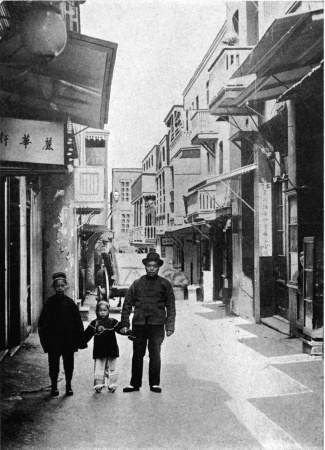
Through the narrow streets
The boys will think I am a coward if I don’t go, and—I have some money of my own.”
So saying, he crept out of bed, and astonished the servants by his early demand for breakfast. He knew his dainty mama would not leave her apartments for some time, for it took so long for the maids to dress her hair, and manicure her finger-nails, and array her in her rich silks; so, avoiding the eyes of the servants, he crept stealthily down the long marble stairway, jingling the money in his pocket as he went, and out through the narrow streets, whistling merrily, in the perfect delight of freedom. He knew he was not doing right, but here he was, at the gate of Johnny’s house, and there was Johnny himself, just running out at the door, cap in hand. His face wore a look of delight as he saw the Chinese boy, and he yelled: “How’d you get here?”
“Oh, I just came; nobody knows it—and say! Let’s begin! I’ve got some money; let’s go to old Sing Chew, he’s got a whole store full of fire-crackers.”
Johnny’s mama, looking out of the window, remarked to her husband, “So they allowed him to come, after all. Well, I’m glad of that, for he seems such a dear little fellow.”
Ho Chin was as happy as it is possible for a boy to be, when he found himself in the wonderful store. Old Sing Chew was awfully busy, but not so busy that he could not see the son of the Consul, and hastened to attend to his wants.
“How is it that you come alone? I neveh see you come unless your ho chun bling you,” he said.
The boy replied, “Oh, I am a big boy now, and I like to have a good time on the Fourth of July. This is my friend!—he goes with me.” And the old man believed him, and admired the beautiful command the boy had of the English language.
It seemed a wonderful thing to Johnny that any one boy could have so much money to spend. It seemed great wealth to him, because he had only twenty-five cents for his fire-crackers, but the young Ho was as generous as could be, and they left the store with all they could carry.
What a pleasure to be a boy on the streets, where all was noise and confusion and incessant popping of fire-crackers. One boy threw a bunch under a horse’s feet, and he ran away and frightened a lot of people. There were crowds of boys—boys everywhere, and a good many Chinese boys, but only those of the lower class. What would his papa think if he should meet him now, his hands and face all black with powder, and a wild and reckless air about him, which did not seem at all like the quiet little fellow his papa knew.
Finally the great parade approached. He had only seen Chinese parades, with the great green dragon, and it had always frightened him; but there was no dragon in this parade. There were soldiers,—oh, so many hundreds of them!—with their bright uniforms glittering in the sun, and their spirited horses prancing and keeping time to the music of the many bands. Many of the horses became scared at the noise, and Ho Chin, being a boy, thought it great fun to see them stand on their hind legs and prance, and act as if they would run over everybody. He did not feel afraid, and he liked to hear the big drums; they sounded beautiful to him, almost as beautiful as the Chinese “tom-toms.” There were so many fine things about that parade that little Ho did not realize until after it had passed that he was hungry. He mentioned the fact to Johnny, and, strange to say, Johnny was hungry too. They were a long distance from home; what should they do?
“If I had any money left we could go into a restaurant and have our dinner,” said the wary Johnny.
“Oh, could we?” said Ho. “Well, we will go then, for I have plenty of money.”
Johnny did not need any urging, you may be sure, and many people in the restaurant were amused to see the two little friends seated at the table with their fire-crackers on a chair beside them. Still more amused was the waiter, who brought them such a mixture as he had never before served for lunch. It was dreadful! but it did not seem so to the two hungry boys, who, with mouths full, were so interested in talking that they did not even see the waiter. Little Ho Chin paid the bill with a kingly air, and they strutted out to pop their crackers for the rest of the day. They were having a fine time,—but what of the little Chinese mother?
When her toilet was completed she inquired for her boy, as she knew he was to have a holiday to-day, and was told that he had breakfasted earlier than he had ever done before, and they had not seen him since. They supposed he had gone to her apartments. She had the whole house searched, and was frightened almost to death. She burned her incense before the god, and murmured: “Oh, good joss! protect my boy, and bring him to me.”
At that moment her boy had just blown off his coat-tail with a bunch of fire-crackers, and it was lucky that he had not been blown to pieces. The mother could only wait till the day wore on, as her husband was not there to advise her, and Chinese women are so helpless.
After this day of delight the dark night fell, and not until then was the little Ho reminded that his mother would be worried, and he must go home. His fire-crackers were all gone, he was tired, and so covered with powder and dirt that one would never have recognized him as the elegantly dressed little boy who had left home in the early morning. “But,” he reflected, “I have had the finest time of my life; I will never forget it.”
It must be admitted, though, that his conscience hurt him very badly as he wended his way home. He wondered if his father could have come home unexpectedly. There was no way out of it; he must go and face it. He almost felt as if he would like to run away to some place where there were no fathers and mothers, and where it was always the Fourth of July all the year round.
He entered the great iron door, and had reached the top of the marble stairway, his heart beating with fear. He almost wished now he had not gone. The silence was so intense that he could almost hear his heart beat—he feared the worst. But now he heard a rustle of silken garments, and there came through the portieres—his mother!
With wide-open black eyes he gazed at her. Oh, what would she do? what would she say?—he stood trembling and speechless; and she?—Why, she was just a mother, after all, and with one great sob she took him in her arms and showered kisses on his handsome but very dirty face. He could feel her tender heart beating through the silken blouse, and she clasped him closer as she murmured: “The good joss has brought him back to me—my brave and beautiful little Ho.”
And he whispered, “Mother—forgive me! but it was all so lovely, and—I just love the Fourth of July!”
And she, being a mother, forgave him.