THE FINDING OF SING HO
Reading edition
LITTLE SING HO did not look very happy as he stood out on the pavement in front of his home. He had intended taking a beautiful walk, and had his umbrella already over his head, preparatory to starting, when his mo chun appeared on the scene, and said: “Where you going, hai tong (baby)?”
Now Sing Ho did not like to be called hai tong, for he felt that he was almost a big man, so he replied: “I going foh walk, down stleet.”
“No, no! you too small; you stay home now, and maybe bimeby mo chun take you,” she said; and then she hurried into the house to see if the rice was burning. When she had disappeared he stood there for a moment, with the gay umbrella over him, looking very much displeased.
He was only four years old, it is true, but do you know, he often thought he knew more than his dear mother. Now Sing Ho was the only child, and had always been loved and petted, and had never been denied anything in his short little life. He remembered many walks he had taken with his father and mother, and he had always had such a good time that he thought it would be still better if he could take a walk all alone. He had just seen two of his little friends, with their queer little Chinese caps on,
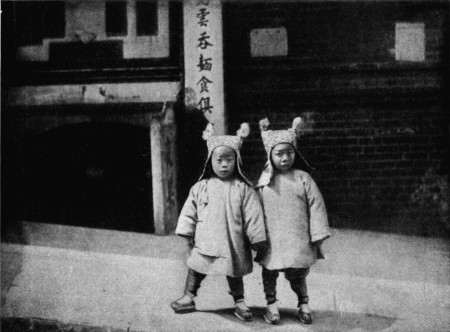
Two of his little friends, with their queer little Chinese caps on
and they had said they were going for a walk, so why not he?
He knew his mo chun was very busy, embroidering a blouse for him to wear on the New Year, and the San Nin (New Year) would be here to-morrow. So he thought in his baby way that he would take advantage of his mama, and only walk down the street a little way, and she would never know. He was too small to realize that it is a very difficult matter for even grown-up persons to find their way through the narrow and tortuous streets of the big Chinatown of San Francisco. He could not be expected to know these things.
So he wandered on, and soon forgot his fear in watching the beautiful things all around him. Chinatown was in holiday attire, and as far as the eye could reach the narrow streets were a perfect mass of bloom and beauty. On both sides of the streets were ranged great stands of the China lily and fragrant almond blossom, with delicate shades of pink.
Someway he found it very hard to get past the store windows, as they seemed to have so many things in them that boys like, and he forgot everything in the delight of gazing at them, and pressed his eager little round face right up against the glass in some places, and poked his cunning little nose into a fragrant bunch of lilies, to inhale their sweetness. Mo chun had some lilies at home, but not so many nor such beautiful ones as these. At every door were strange Chinese letters, and he looked longingly at great bunches of peacock feathers with their many eyes, and the gaudy rosettes of red paper which are everywhere on the New Year. Almost every one that he met carried a brown paper parcel of pork and an onion, or some kind of funny looking lettuce, for the Chinese love pork better than the Americans love turkey, and it had to be a very poor person indeed who did not feel able to buy himself a piece of pork on the New Year.
Chinamen of all kinds were thronging the streets, and so many children, too, were toddling along with some older person, that no one noticed that the little boy was alone.
He believed he had only to walk back just a little way and he would be at home. He did not know that he had made several turns, and that it would be impossible for him to find his way back alone.
Naughty little Sing Ho! There were so many American people, too, in the shops, buying curious and beautiful things. On both sides of the street were rows of great dragon lanterns. He looked at them in childish wonder, longing for the great swaying globes. Suddenly he felt something hit him on the arm, and, looking upward, saw far above him some beautiful Chinese ladies on a balcony; and what is this that they have thrown down? Something very near to the heart of a boy,—a bright bunch of fire-crackers!
He was smiling now without any difficulty. Just then he heard a woman’s shrill, high-pitched voice speaking to him from the latticed window above him, saying: “Little boy! little boy! where is your mo chun?”
“She at home,” he replied, and then hesitatingly faltered, “Ngo pa ngo tong cho lu lok” (I am afraid I have lost my way).
He was crying now, and presented a very mournful appearance to the gaze of the passer-by. These ladies above him were those of the tiny “golden lily feet,” and very wealthy and aristocratic, so they could not leave their rooms and come down to him, as that was not their custom. If it had been the next day they could have done so, for on every day of the week of San Nin they were permitted to leave their homes and go anywhere they pleased.
“Ni kiu mat meng a?” (what is your name?) they asked.
“My name? Sing Ho,” he cried.
“You come up,” they called down to him, pointing meanwhile to a dark and narrow stairway which led up from the street.
“It so dark—Sing Ho ’flaid to go alone—I want mo chun—boo, hoo,” he wailed, in a pitiful little voice.
“But you must come. We find mo chun; we give you heap plenty fiah-clackeh (fire-cracker), plenty nice little cake; come on!”
Baby though he was, he remembered that his mother had always warned him against strangers, and told him never to allow any one to persuade him to go with them. But finally he decided that this was very different, and that anything would be better than being lost on the street.
“All light!” he sobbed, and started in great fear up the narrow stairway. Ugh! how dark it was! and he trembled, as his little sandalled feet crept hesitatingly on. When he at last reached the end of the stairway he found himself in a dark and narrow hall thick with the fumes of opium.
Where were the beautiful ladies?—and the little cakes? Nothing was to be seen but the gaunt figures of Chinamen gliding stealthily to and fro in the narrow hall. There were many doors on either side the hallway, and in each door was a small, square lattice into which the men would speak some queer words in Chinese, when the door would be cautiously opened, and he would enter. When the doors opened little Sing Ho caught glimpses of many Chinamen with cards in their hands, seated around some tables and calling out in a loud voice strange Chinese words which he could not understand. In some of the rooms he could see men reclining on bamboo couches and smoking opium. Oh, if his mother could see him now, as he stood there alone, and trembling in the half-darkness!
Just then his dear and beautiful little mother had put the last stitch in the blouse she was embroidering, and proudly held it out to the admiring gaze of her sister, who lived with her.
“He is playing outside; I go get him,” she said; and with a smile on her lips she opened the door and called him.
“Sing Ho! Sing Ho!”
No reply.
“Why, that is strange,” she thought. “Maybe he come in the house and go to sleep.”
She hurried into the small bedroom and looked eagerly at the couch. No, there was no samen jai there. She was trembling now, with a nameless fear. Her pretty face grew pale, and the little brown nervous fingers were like ice.
Her boy—her baby—the honored one of the house of Sing, whose birth had crowned her with glory. Why, he must be there; he could not be gone from her—and yet—where was he? Her little tender baby boy who had never been from her side; the little brown face, naughty, sometimes, it is true, but always, to the mother, the dearest of things in all the big world.
Without stopping to change her house-robes she rushed down the street, and to the store of her husband, Sing Kee. He was just going down into the cellar after some tubs of preserved ginger, when he was startled by seeing his wife appear before him. The cat, that had always been loved and petted by little Sing Ho, lay sunning itself at the entrance, and Sing Kee looked up with a very serious face, for he knew that no little matter would bring his wife thus unexpectedly to his place of business. She surely would not be going on the street the day before the New Year.
“What’s the matter?” he asked in Chinese. She could hardly reply for the wild throbbing of her tender heart.
“My baby—my precious pearl—he lost! I no can find him; he gone—I no know where.”
And then she hid her face in her trembling brown hands and wept in the wildest grief. The poor father was terrified, for he knew what a big place Chinatown was, and how easily a little child could be lost or stolen, or hidden away, and no one would ever see it again. He knew the underground passages and dark opium dens which were thick around them, and his heart almost broke as he listened to her story. She had little to tell. It was only that he had wanted to take a walk, and she had told him he must not go, believing that he would obey her, as he always had.
They started through the streets now, in search of him, their eager eyes gazing in all directions. Two of his little playmates stood on a doorstep, and they inquired of them if they had seen him. Yes, they had seen him early in the afternoon. He had passed them, carrying his umbrella.
The distracted parents searched until the dark night fell and the great dragon lanterns were lighted in the balcony of the joss house near by.
The joss house!—there was an idea! Why had they not thought of it before? They would go there at once, and supplicate the god, that they might find their baby. They ascended the long flights of stairs until they were right in the room with the joss. There were little bowls of ashes full of punks, to be burned before the god, and the odor of incense filled the air as they lighted them and waved them before the joss.
Sing Kee threw many of the little carved prayer-sticks into the air, too, and when they fell, looked at them eagerly, evidently seeing something about them which pleased him, for he smiled, and said to the timid little mother: “They say we find him to-mollow—we go home now.”
They went home, but it was not home to-night without the dear little round, saucy face on the hard pillow, the patter of the little sandalled feet on the floors, and the click of the little chopsticks. There was no sleep for them that night. They had told the Chinatown police of their loss, but no clue had yet been reported.
Early next morning they started out again, on their weary search. It was the first day of the New Year, but they had not dreamed they would celebrate it in this way, as with heavy hearts they picked their way through the narrow streets, glancing in every direction, and up at the flower-laden balconies, with the candles burning for the joss.
Meanwhile the little Sing Ho had stood in fright, and looked around him, in the darkness of the hallway. Where were the pretty ladies? Had he only dreamed he saw them?
Suddenly he heard a high-pitched but sweet voice somewhere above him, saying: “Where are you, little boy? Come up the other stairs.”
The other stairs? where were they? He had supposed that he was at the top now, but on looking around he saw still another flight of steps, and gladly running to them he started on upward again, as fast as his tired little legs could carry him. When he reached the top, some one opened a door, cautiously, and calling out “Yap loi le!” (Come in!) reached out a beautiful jewelled hand, and drew him softly within the room.
Oh, how lovely it all was! There was a chatter of women’s voices in high-bred, nasal tones, and the room was warm, and smelled of incense. One very pretty little lady drew him to her as tenderly as a mother, and said to him in the sweetest tones: “Do not fear, little one! I will find mo chun for you. Where do you live?”
“Why, I live with mo chun and ho chun,” he said.
“Where do they live?” she inquired.
“I no know—they live at my home—and mo chun she make me velly pletty blouse.”
Poor little boy! so he could not give them any clue, then, by which they might find his parents. Well, they would have to wait, and do the best they could under the circumstances. They tried to make him forget his sorrow for a while, and showed him many wonderful things. In the centre of the room was a table, all arranged for the New Year, and on it were great bowls of China lilies, and Chinese lemons and oranges. Then there was a polished tray, holding all kinds of candy and nuts. The windows were a perfect mass of lily and almond blossom, and peacock’s feathers were everywhere staring, with their green eyes. Outside was the balcony, from which the ladies had first spoken to the little lost boy, and on it were many big dragon lanterns, whose soft light fell upon the flowers, and made it look like fairyland.
They served tea out on the balcony, and gave Sing Ho the dearest little cup, and cakes, and plenty of watermelon seed to nibble at, and everything that he loved, except—his dear mama. When the breezes began to blow too roughly and sway the dragon lanterns, they decided to put the little stranger to bed. This was the worst moment of all. How could he go to bed without his dear mother’s kiss? Oh, how his lonely little heart ached and ached, and he just had to let the big tears come, and roll down his cheeks. He didn’t want to be rude to the pretty lady, but—there was no one like his mo chun. Finally he did go to sleep, though, and when he awoke it was the first day of the New Year.
He was waited upon like a little king, with a big bowl of rice and ivory chopsticks, nice hot tea, and little almond cakes—everything that one could wish, but—it did not take the ache out of his heart. After breakfast he and the beautiful lady went
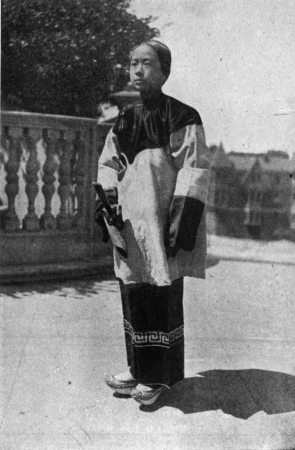
His own beautiful mo chun
out on the balcony, and sat there for hours, looking down at the crowd.
The streets were thronged now, and there was an incessant noise of fireworks. The New Year had begun in earnest. The lady was going to take him for a walk that afternoon, but they would sit on the balcony now, and watch the crowds beneath. There were so many children, and all dressed in their richest robes. It made the heart of little Sing Ho ache to see the richly embroidered blouses, so like his own, and if he had not been naughty and run away he might even now be walking along down there, wearing the blouse, and holding the hand of his own beautiful mo chun.
His own beautiful mo chun?—Why—why—he rubbed his eyes and stared down into the street. Was he dreaming?
“Mo chun! Mo chun!” he screamed, in his shrill baby voice; for down on the street beneath the balcony hurried a pale but pretty little Chinese woman, her searching gaze going in every direction.
“It is my mo chun! Stop!” he cried; and the Chinese lady on the balcony threw down her painted fan and hit the little mother of Sing Ho right on the head. Glancing upward in surprise, the mother looked straight into the eyes of her precious pearl, her little Sing Ho! Oh, the rapture and the mother-love that shone in her face now! How the light came back into her eyes, and the red lips smiled, and the red rose bloomed in her cheeks as she reached out her arms to the balcony and sobbed: “Hai tong! hai tong (baby! baby)!”
The father, who had gone on in front of her, Chinese fashion, was called back, and together they ascended the same steps which had so frightened their baby boy. As it was the New Year week it was perfectly proper that they should both enter the rooms of the Chinese ladies, and what a happy time that was!
Every one soon became acquainted, through the medium of a little child, and very soon they were all having a New Year’s cup of tea and other dainties, and were laughing and chatting away as if they had known each other always.
When they went home Sing Ho was given so many beautiful things that his little arms were full, and ho chun said as they entered the door of their own home: “I knew we would find him, because the prayer-sticks said so.”