APPENDIX H. APPLICATION TO AND REPLIES FROM THE LOCAL HONORARY SECRETARIES OF THE SOCIETY OF TELEGRAPH ENGINEERS AND CERTAIN OTHER DISTINGUISHED FOREIGN AUTHORITIES.
Reading edition
In accordance with a resolution passed by the delegates at the meeting on October 27, 1879, the following circular was prepared by the Secretary, and issued to the gentlemen named in the appended table.
30, Great George Street,
Westminster, S.W.
October 31st, 1879
Dear Sir,—At the invitation of the Meteorological Society, delegates have been nominated by the following societies:—Royal Institute of British Architects, Society of Telegraph Engineers, Physical Society, Meteorological Society, to consider the present modes of erecting lightning conductors, and improvements therein.
At the last meeting I was instructed to ask you to have the kindness to furnish the conference with copies of such papers or reports as may be convenient, and as are generally accepted as authoritative in your country.
Yours very truly,
G. J. SYMONS.
Name. Country. Date of Reply.
Allen, J. Argentine Republic
Aparicio, Don José Spain
Aylmer, J. France
Burton, C. Bolivia
Cantoni, J. Italy
Collette, J. M. Netherlands Nov. 7th.
Cracknell, E. C. New South Wales
Dakers, J. Canada
D’Amico, E. Italy Nov. 16, Dec. 8.
Delarge, F. Belgium
Field, S. D. W. America
Jamieson, A. Mediterranean
Karsten, G. Schleswig-Holstein Nov. 13.
Madsen, C. L. Denmark Nov. 5, Dec. 7.
Melsens, F. Belgium Nov. 6, Dec. 4.
Michel, F. France
Morris, J. Japan
Myers, Gen. United States Dec. 13.
Nielsen, C. Norway Dec. 1.
Preece, J. R. Persia
Siemens, W. Germany
Teale, F. G. India Dec. 12.
Todd, C. South Australia
Ward, G. G. United States Dec. 9.
(176)The following are abstracts of the replies received:—
Nov. 5th, Copenhagen.—Mr. C. L. Madsen acknowledging receipt of letter and promising further reply.
Nov. 6th, Belgium.—M. Melsens acknowledging receipt, and promising full reply.
Nov. 7th, La Haye.—Mr. J. M. Collette acknowledging receipt of circular and stating that lightning conductors are not in common use in Holland, that there are no official and scarcely any other publications upon the subject. Those who have to erect conductors upon public buildings usually rely upon the rules adopted in countries where the use of lightning conductors is more general.
Nov. 13th, Kiel, Schleswig-Holstein.—Dr. Karsten forwarding copy of the latest edition of his work on lightning conductors (See Abstracts of Printed Documents, pages (114) and (119).)
Nov. 16th, Rome.—Sig. E. D’Amico acknowledged receipt.
Dec. 1st, Christiana.—M. C. Nielsen acknowledging receipt, and forwarding copy of paper by Prof. Mohn on “Lynildens Farlighed i Norgi.” (See Abstracts, page (106) which he states is the only paper on the subject printed in Norway.)
Dec 4th, Belgium.—Letter from M. Melsens, sending series of his works. (See Appendix G.; Catalogue and Appendix F. pages (137) to (141).)
Dec. 7th, Copenhagen.—Mr. C. L. Madsen writes:
“In continuation of my letter of 5th ult, I have great pleasure in forwarding a copy (enclosed) of ‘Regulations for the Arrangement and Construction of Lightning Conductors for Military and Public Buildings in Denmark, as adopted by the Royal Engineers, 1869,’ which I have translated from the Danish original, and obtained the permission to place at the disposal of the Conference. The rules laid down in this paper are generally accepted as authoritative in Denmark, and have been followed in the erection of Lightning Conductors on the new Royal Theatre in Copenhagen.
“I beg to add that in case a printed report is to be published by the Conference, I shall feel much obliged by having a few copies sent to me, and that I shall have great pleasure in continuing to have my attention directed to the subject.”
REGULATIONS for the Arrangement and Construction of Lightning Conductors for Military and Public Buildings in DENMARK, as adopted by the Royal Engineers, 1869.
(Translated from Danish.)
To obtain a perfect system of lightning conductors it is necessary to observe:
1. That the lightning conductor must be more exposed to the stroke of lightning than the building itself.
(177)2. That the lightning, after having struck the conductor, shall traverse the conducting wire to the earth more readily than through any other neighbouring object.
3. That the lightning conductor is not destroyed by the stroke of lightning.
A. Arrangement.
On the highest points of the building are placed iron rods, of such a length and number that no part of the building lies farther from the perpendicular line through the point of the rod, than twice the height of the point above the place of the rod. The lower ends of the rods are connected to a metallic conductor, top conductor, which follows the upper line of the building. From the top conductor, or from the rods, and at least from each three of these, conducting wires are led down the roof and outer wall (best on the weather-side), and thence one foot under the earth, until about ten feet from the building. Here the wires are connected to the earth plate in a well, the bottom of which well must reach a couple of feet under the lowest standing of the ground water. Each well, with its plate, ought at the utmost to serve three conducting wires. If necessary to employ more wells than one, the plates of these are joined up through a special conductor, the earth conductor, one foot under the surface of the earth. Great care must be taken that the earth plate is properly placed in ground water, that more or less communicates with the ocean—a condition which, in our country, will hardly present insurmountable difficulties.
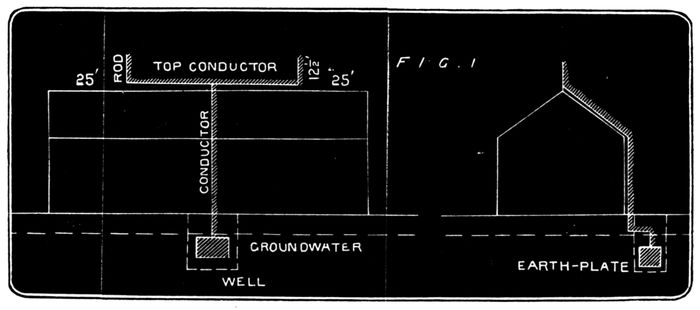
Figure 1 shows a system of lightning conductors for a building 100 feet long, with gable roof.
Note 1.—If the roof is covered with metal, the conductors ought in several places to be connected to it; but, on the other hand, they must be kept, electrically, as distant from all other parts of the building as possible, especially from the metallic parts of it.
Note 2.—If ground water is found at a considerable depth, under a dry layer of sand, a second plate, besides the general earth plate, ought to be placed just beneath the surface of the earth, the latter being made temporarily conductive by rain.
Note 3.—As to powder magazines, which of course must be constructed (178)of bricks or wood, the lightning conductors must not, without inevitable necessity, be placed on the building itself, but, retaining the above-mentioned dispositions in the main points (the top conductor excepted), they ought to be placed on masts, about ten feet from the magazine.
Figure 2 shows a system of lightning conductor for a powder magazine, a hundred feet in length, with gable roof.
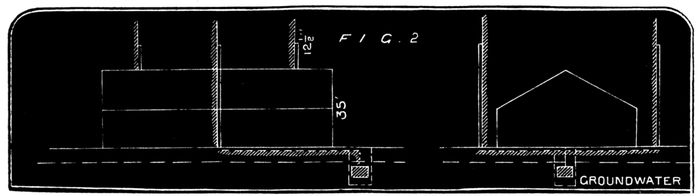
End and Side elevation.
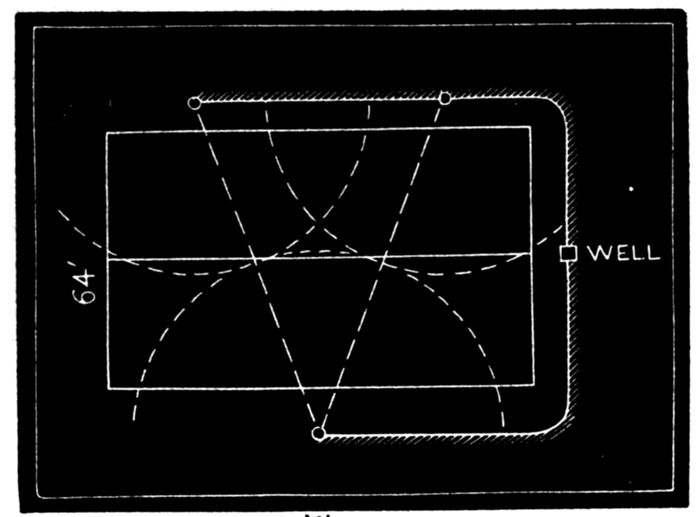
Plan.
B. Construction.
The point ought to consist of a solid copper cylinder, ¾ inch diameter, 6 inches high, conically pointed, the top angle being about 30 degrees, and with gilt top. At the lower end a nut is applied, by which the point is screwed and afterwards soldered to the end of the rod. Most conveniently the rod is formed of round iron, which, like the rest of the conductor above earth, if constructed of iron, is painted over or galvanized. Under earth only galvanized iron is suitable. The upper diameter of the rod is ¾ inch; 12 feet farther down, 1½ inch. The length is properly varying between 10 and 16 feet. It is to be preferred to use a greater number of low rods rather than fewer high ones. The conductor, as also the top and earth conductors, may consist of an iron bar, of ⅓ square inch section, consequently 9/16 inch in the square side, or ⅝ inch in diameter. Only for very great lengths will it be necessary, on account of the increased resistance of the conductor, to use thicker bars. In place of iron, copper may be used, the section of which need only to be ⅒ square inch. The conductors must be of as short a length, and with as few bends as possible; and the latter must be rounded at their angle points. They ought not to be bolted or spiked to the building, but, in view of changes of form occasioned by temperature or other (179)reasons, they must rest in hooks, or be kept up by cramps that are fastened in wood or brick, far from the metallic parts of the building. It is of the utmost necessity that the conductor be continuous in its whole extent, from the point to the earth plate. Links of chains or cables are to be rejected. For this reason the number of joints must be limited, and a constant contact of the respective ends, extending over one or two square inches, procured by bolts or rivets and soldering. The metal should be filed on the contact sides, so as to clear it from oxide, this being an insulator, and the soldering made with tin. The earth plate may consist of galvanized iron or copper. It ought to have at least a surface of 10 square feet in water, or 5 square feet area, if to serve one conductor; for each conductor in addition 50 per cent. must be added to the area. To diminish the circumference of the well, the plate may be given a cruciform transverse section; if then, for instance, the plate reaches 2½ feet down into the water, the wings need only have the length of 6 inches. The well is constructed in the usual manner by digging or boring. In order to preserve the conductor from breaking, as the plate might press deeper into the ground, a beam is placed across the well’s upper part on which the horizontal part of the conductor rests. Inspection of the lightning conductor must be effected once a year, and, besides, when circumstances demand it, for instance, after a stroke of lightning. The inspection must especially have the purpose:
1. To examine whether the metallic continuity remains perfect; to verify this a galvanometer is inserted, and a galvanic current led through the conductor; and
2. To examine whether the conductivity to ground water is in order. The earth plate being placed in a well, instead of being buried in the ground, will greatly facilitate this examination.
Dec. 8th, Rome.—Sig. D’Amico sent a copy of a letter received from Professor Tacchini, Director of the Central Meteorological Office, in answer to the communication made to him of the circular dated October 31st. The following translation has been kindly made by Professor T. Hayter Lewis:—
Meteorological Central Office, Rome.
November 27th, 1879.
Lightning Rods in use in Italy.
Although I have not sufficient material for giving a complete answer to the request made in your letter, as noted in the margin, yet I think that the accompanying notice as to the system in use in Rome for fixing lightning rods may be useful to the Director General.
1. The conductor of the lightning rod is constructed of iron, 17 millimetres (c. ⅔rds. inch) diameter. The upper terminal or receiver is 4·5 metres (14 feet 9 inches) high, with a copper point 0·50 (c. 1 foot 8 inches), gilt from 0·25 (c. 10 inches), fixed on a pilaster of masonry 2 metres (c. 6 feet 6 inches) high, and 60 centimetres (c. 2 (180)feet) wide. Each terminal is intended to protect a horizontal superficies of radius double its height.
2. In order to obtain a conductor as long as required, pieces of 5½ metres (c. 18 feet) are united by a holdfast of brass. The fastening of the conductor to the walls and roofs is made by little pieces of marble of the annexed form, connected with the fabric.
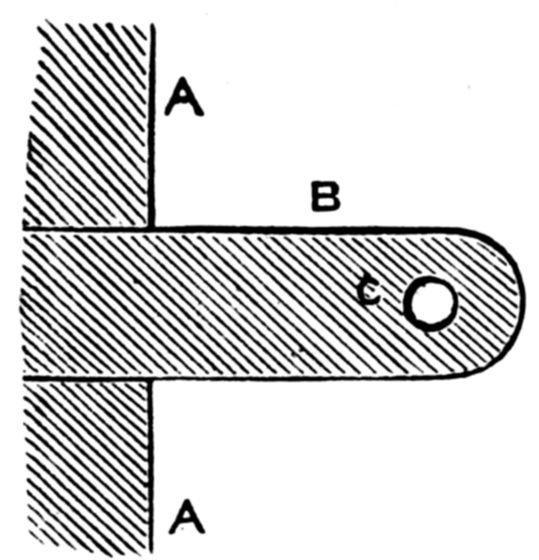
A—Wall or roof.
B—Little piece of marble.
C—Hole through which the conductor passes.
3. It is the custom to connect the conductor with masses of iron, and other metals in the building to be protected, avoiding the water pipes. (Referring probably to Terra Cotta pipes. T. H. Lewis.)
4. In addition to the upper terminal and chief receiver, it is usual to fix secondary points according to the form of the building.
5. The discharger or lower terminal (in contact with the earth) is made of copper rod, 12 millimetres (c. ½ inch) square, at least 6 metres (c. 20 feet) long, in 3 strips with points of copper arranged in the manner shown—

D—Conductor.
E—Lower terminal or discharger with points of copper.
6. The discharger is introduced into a ditch or well excavated in moist ground, vertically or horizontally, according to the circumstances of the locality. The diameter of the well should be 0·80 metres (c. 2 feet 8 inches), filled with carbon, and covered with earth.
7. In an ordinary building we employ a discharger to each 3 points.
8. In this manner were made all the lightning rods of P. Secchi, by Signor Lerigi Morea, maker of them in Rome.
9. In some cases P. Secchi has made use, for the conductor, of the thicker wire used for the Telegraph.
10. We may observe that, in other Italian cities, the same rules are adopted for the construction of lightning rods, as I myself have verified. Only, in some localities, in place of putting points of copper to the lower terminal the latter is terminated by a copper band.
P. TACCHINI,
The Director.
(181)Dec. 9th, New York.—Mr. G. G. Ward acknowledges receipt, states that the only papers of any value upon lightning conductors, published in America and known to him are:—(A) a paper by Prof. Henry; (B) a treatise by Prof. Phin; (C) a pamphlet by David Brooks; (D) a practical treatise by H. Spang. The writer furnished copies of Nos. B and D, and all four will be found noticed in the Abstracts of Printed Documents. See pages (99) (102) (117) and (112.)
Dec. 12th, Calcutta.—Mr. F. G. Teale acknowledging receipt of circular and forwarding copies of two papers accepted as authoritative in India, viz:—(1) R. S. Brough on Protection of Buildings from Lightning, and (2) W. P. Johnston on the Lightning Conductors at Dum Dum. (See Abstracts, pages (117) and (132).)
Dec. 13th, Washington, U.S.A.—Lieut. Kilbourne acknowledges receipt on behalf of Gen. Myers, enclosing copy of paper by Prof. Henry, and stating that the works of Spang and Phin are considered authoritative.
(183)