APPENDIX F. ABSTRACTS OF PRINTED DOCUMENTS.
Reading edition
FRENCH OFFICIAL PUBLICATIONS.
Preliminary Note.
In 1784, the attention of the French Government having been directed to the desirability of protecting the powder magazines of the kingdom from damage by lightning by the employment of conductors, a system of construction was proposed by two officers of the Engineers and Artillery. This system was referred by the Minister of War to the Academy of Sciences for consideration and report. From time to time subsequently other proposals of a like nature, and other inventions and improvements in the construction of lightning rods were considered by the Academy, and reported upon by various Committees.
At the request of the Conference, I have endeavoured, in the following pages, to give in as condensed a form as possible an accurate abstract of their contents, and to avoid, in all cases, the expression of any opinion, either adverse or concurrent, upon the principles or suggestions contained in them.
E. E. DYMOND.
REPORT made to the ACADEMY OF SCIENCES, by Franklin, Leroy, Coulomb, de la Place, and Rochon.
24th April, 1784.
Certain proposals for erecting lightning rods for protecting the powder magazines at Marseilles having been submitted to the Academy for their opinion, a committee, consisting of the above-named, was appointed to examine and report.
They begin by enunciating the theory which should regulate the erection of conductors, and they lay down the following rules:—
1. The extent of the building should first be ascertained to decide whether one or more conductors should be used. Electrical experiments had not yet made known anything of the extent to which the action of the point of the conductor reached. But since buildings had been supplied with conductors many observations had shown that those parts of them which were more than 45 feet French (48 English) from the point of the conductor had been struck by lightning.
2. When there are many points or arrows on the building they should be connected together and also connected with all parts of the roof which are covered with lead, and also connected with the (52)weathercocks or ornamental metal points so as to form one metallic system with the conducting bars.
3. It is not less important that these bars should be thoroughly joined together; for a solution of continuity in them produces a resistance to the passage of the electricity according to the extent of their separation.
4. It is necessary that the bars should communicate thoroughly with moist earth or, better still, with water.
As to the height of the points they should be at least 12 or 15 feet (13 to 16 feet English), or even more if the building is a large one. It is certain that the higher they are the wider the extent of their action. They should be 2 inches (2·2 English) square at the base and greater in proportion as their height exceeds 15 feet (16 English). If the conducting bars are 8 or 10 lines (or, say 1 inch) square, it will be more than enough. No case had occurred in which iron bars of this size had been in any way damaged or altered by the passage of lightning.
The reporters then proceed to examine the two proposals for protecting the powder magazines at Marseilles, sent in by M. Ravel de Puy Contal and M. Pierron. They were both for the same building which was 31 toises long and 8 toises wide (about 198 by 51 English feet). The first provided for the erection of three points on the ridge of the roof, and of four others, one at each angle of the building; the second had also three points on the ridge, but the other four were alternated on the two sides of the roof, and iron bars were carried all along and connected with all the points. The manner in which the terminals were fastened to the roof and the conducting bars fastened together and led to the water was the same in each proposal.
The reporters remark concerning the second that the conducting bars laid horizontally along the roof would involve a great and unnecessary expense, but the points should be retained, only instead of placing them alternately they should be set up so that each of them was half way between the middle and the end of the roof, and instead of connecting these points by bars along the length of the roof, they should be connected with the one connecting the three points on the ridge by bars joining it perpendicularly.
As to the method proposed for joining the several parts together the reporters cannot help thinking that in their desire to make thoroughly good connections MM. Pierron and de Ravel had proposed a plan involving too much difficulty and superfluous expense [It seems to have been proposed to screw the bars into each other], and they recommend instead of this to make at the base of each point, immediately above its insertion into the roof, a circular flange about 2 inches in diameter and 2 lines thick, with a hole half an inch in diameter in the middle and at the ends of each conducting bar to make a similar flange and to bolt the flanges together with a sheet of lead between them. Crutches should be fixed on the roof to carry the conducting bars. The points should be fixed three on the ridge and two on each side of the roof half way between the point in the middle and that at each end. These four should be connected with the conducting rods running along the ridge and should overtop the ridge by at (53)least 6 feet (6 feet 5 inches English). By this arrangement all parts of the roof would be well protected.
The reporters highly approve of the way in which the conducting bars are connected with water by being led into the sea, but if at the other end of the building there is sufficient earth on the surface, and the soil is not entirely rock the conductor from the point placed at that end might be led into it. It is recommended that the points of copper should be screwed to the terminals for convenience of removal when necessary.
REPORT made to the NATIONAL INSTITUTE, by Leroy, La Place, and Coulomb, on a Lightning Rod for Powder Magazines proposed by Regnier.
6 Nivose, Year 8 (23rd December, 1789.)
The reporters think it desirable to make some general observations on lightning rods, the rather that it appears that some persons have had fears as to the certainty of their effect.
It is impossible to reject the theory upon which Franklin had proceeded in providing lightning rods for the purpose of protecting buildings from damage by lightning. Still, as the theory needed to be confirmed by facts, it might at first have been doubted whether the lightning rods were really effectual; but now that observation, and experiment had proved the truth of the theory there was no longer any room to question their utility. It may even be remarked that observations had not only proved that they were effective when well constructed, but that they conducted the lightning down without accidents, even when they had some defects, which might have caused one to doubt their efficacy. The defects alluded to were a blunted point and a break in the continuity of the conductor. With reference to these two cases observations have shown—1st. That although the points have been blunted, they still attract the lightning from the clouds to themselves in preference to the surrounding objects. 2nd. That although the several parts of the conductor are not thoroughly joined together, the lightning will still, if the break be not too considerable, pass along the conductor without accident.
In support of the first proposition they quote the observations of Doctor Rittenhouse, of Philadelphia, who had examined several of the points in that city, and had found them melted, showing clearly that they had been struck by lightning, and probably more than once, as it had been shown by many observations that where, from local circumstances (not then fully ascertained,) lightning had struck in certain places or on certain buildings, it was not uncommon to see it strike again; and a number of observations of a different sort had shown that lightning was attracted by metals on buildings even when they were but slightly pointed, such as tin weathercocks, or iron crosses, and even plain sheets of iron.
One of the most striking examples in support of the second proposition, was the case of an American ship, reported in the Phil. Trans. for 1770. During the night, in the midst of a storm, the crew (54)reported that there was a stream of fire in the rigging, just above the middle of the lightning conductor. The captain saw a stream of fire, sometimes in sparks, and sometimes only a steady light; and on examining the conductor next morning, found that one of the links of its chain was broken. Fortunately the two pieces, being kept in place by the fastening to the shrouds, were only about three quarters of an inch apart. These two broken ends formed a sort of points, and on its passage between them the lightning had become visible. But this was all; no shock was felt, nor anything which caused any suspicion that the fracture of the conductor had in any way hindered the passage of the lightning. Franklin also had shown by experiment that in a lightning rod where the upper end was only connected with the part entering the ground by a very fine brass wire, although the wire was melted by the passage of the lightning, it still was conducted from top to bottom without any damage to the house; and in other instances metallic wires, though partly melted by the lightning, had still served as conductors. But it is not contended from these examples that a very exact and continuous connection of all the different parts should be dispensed with.
The lightning rod proposed by Regnier consisted of a piece of wood, coated with resin, rising 2 metres (6 feet 7 inches) above the roof, and having fixed on its top a sort of inverted funnel of copper, at the upper end of which was fixed the point. To the lower edge of the funnel were fastened ropes formed of twenty-seven annealed iron wires well bound together, which were, at a suitable distance, connected with iron bars, fastened to masts, and leading to moist earth. The point had a small piece of platinum at its upper end.
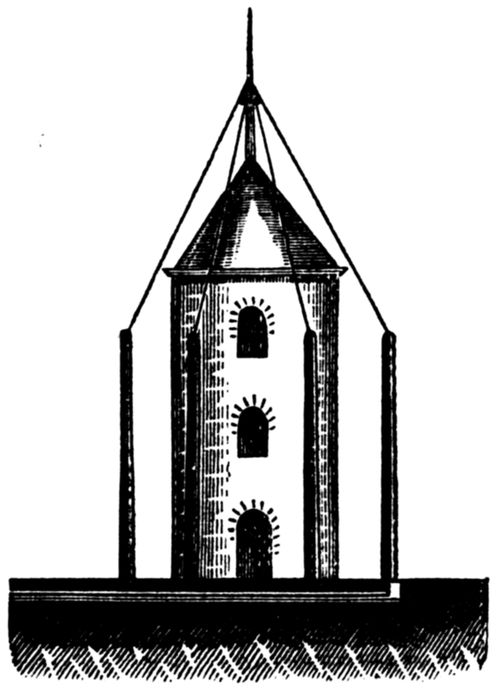
The reporters observe that the wooden support may be employed by way of extra precaution, though there was no known instance of lightning leaving metal for wood; but it should be strong enough to resist the wind. They approve of the method proposed for connecting (55)the point with the metal bars, metallic ropes being very suitable for this purpose, and keeping them well away from the building was quite right; but they add that the metallic bars should not only communicate with moist earth, but also with water in wells or otherwise.
INSTRUCTIONS for erecting Lightning Rods for Powder Magazines, adopted by the Fortifications Committee.
25th August, 1807.
A lightning rod is an electrical conductor terminating in a point and carried down to the common receiver. It may be regarded as a metallic tree, and divided into (1) the upper terminal, (2) the trunk, and (3) the roots.
1. The upper terminal is a very pointed, conical or pyramidal spike of metal having a base 3 or 4 centimetres (1½ inches) in radius. The point is of gold or platinum, soldered to a copper rod 1 or 2 metres long (3 feet 3 inches to 6 feet 7 inches). This rod is joined to the rest of the upper terminal, which is of iron, either by solder, a screw, or a pin. It is important that all the parts of the upper terminal should be joined with care so as to prevent fracture; at the bottom of the terminal are several feet by which it can be leaded to the vault or bolted to the framing of the roof. Several devices for giving some play to the terminal so as to diminish the effect of vibration have been proposed, but it is better to make the terminal strong enough to resist. At the bottom of the terminal is joined the piece connecting with the conductor; this ought to be very complete and continuous, especially at the point of junction with the terminal. Frequently the terminal is enlarged at this point to facilitate the passage of the lightning. To preserve the terminal from rust it is sometimes gilded—it has been proposed to tin it—more frequently it is merely painted; experience shows that this is sufficient. Instead of making the whole terminal conical or pyramidal, a square bar of iron, finished with a point of copper tipped with gold or platinum, is sometimes used. This plan may usually be adopted without danger, but they are more liable to be broken or bent by vibration.
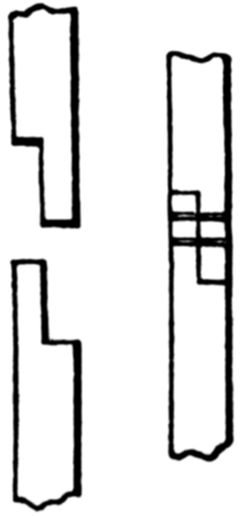
FIG: 1.

FIG: 2.
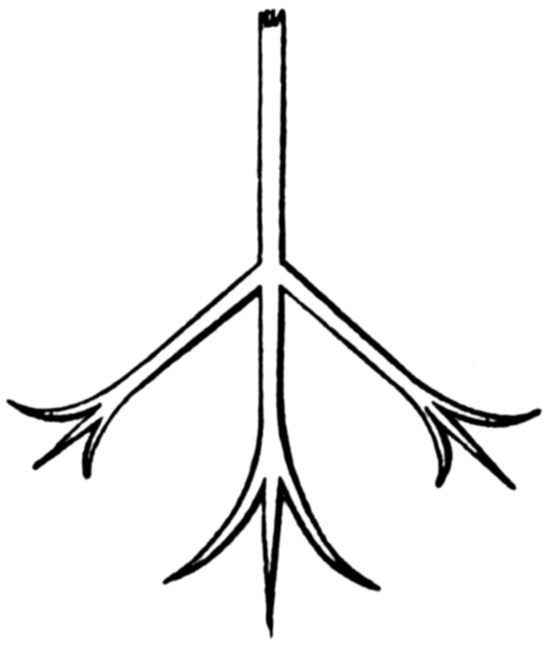
FIG: 3.
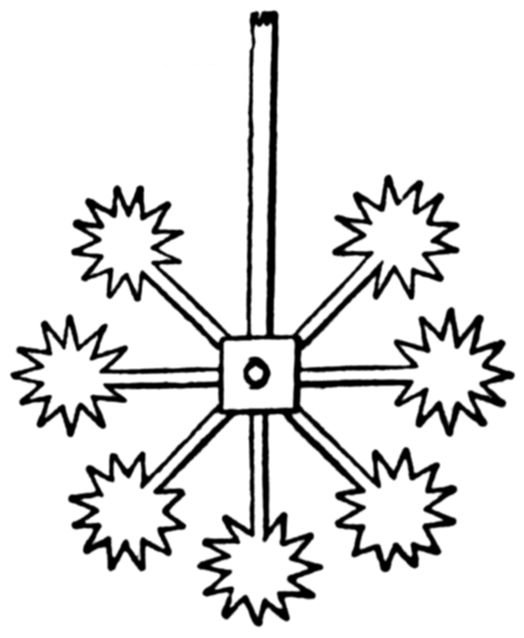
FIG: 4.
2. The trunk or conductor is made of iron bars 13 to 20 millimetres square (½ to ¾ inch) notched at the ends and bolted together (56)with a plate of lead between the two (Fig. 1). For powder magazines a bar of 27 millimetres (1 inch) square is recommended. They follow the outline of the roof, cornice, and wall, and each bar is fixed by a half collar (Fig. 2) or cramp placed in the middle of the bar or as far as possible from the junction of two bars. Instead of the iron bars ropes of copper or iron wire, or even of hemp, may be used; these last may be used provisionally, but for permanent conductors they have no advantage either in economy or conductivity. The copper rope conducts the lightning better, but its smaller size and cylindrical form, by diminishing its absolute and relative surface, counterbalances its superior conductivity. The great and real advantage of metallic, and especially of copper ropes, is in their continuity and their flexibility. The conductor is led down to the surface of the ground where it is bent and led parallel to the surface towards a pit full of water, or deep enough to allow the end of the conductor to rest in damp earth; from 2 metres (6 feet 6 inches) above the ground to the pits the conductor is enclosed in a channel or trough like the fuse of a mine, the object of this is to protect the conductor from the dampness of the soil and from contacts. These would be unimportant so long as there is a perfect connection between the point of the conductor and the common reservoir, but this continuity may be destroyed by degradation of the conductor, and it is chiefly at the joints that this discontinuity is to be feared. When the conductor has to be buried it should be in an oaken trough, well put together and tarred or charred or surrounded by powdered charcoal so that the metal cannot be rusted by infiltrations or humidity; in some soils it is better to make the subterranean part of the conductor of lead, taking care by increasing the surface to make up for its inferior conductivity. Sometimes water pipes may be made use of, but only when they serve to lead water away and when they terminate in an isolated reservoir. It is important to lead the conductor far away from water pipes carrying water to public fountains or into the interior of houses.
3. If the conductor leads to a well full of water the roots (Fig. 3) need not be more than a few spindles terminated in points and long enough to be always immersed. When the conductor only leads to a bed of earth it is supplied with a system of roots (Fig. 4), having for its object the multiplication of the points for the escape of the lightning, and these are increased in number according as the soil is a less good conductor. The pits should be some distance from the foundations of the building, so that the lightning may not damage them, and it is important, by all possible means, to increase the natural humidity of the soil. When the wells cannot be closed it is necessary that the conductor should be insulated and plunged deeply in the water for fear that the communication of the electricity to the well-chains or pump-rods might cause accidents or alarm. After some other instructions it is added that the dispersal of the electricity in the common reservoir is, next to the continuity of the conductor, that which most deserves the attention of the physicist and the engineer.
It has been remarked that a point extended its sphere of activity as far as 10 metres (32 feet 9 inches), that beyond this distance its effect became less sensible, and that when the points were too near together (57)they neutralised one another. So upon a building of a given size it is necessary to set up so many that all parts shall be covered by their spheres of attraction, which should meet and not overlap each other. Lightning in passing from a cloud to the earth does not always take a vertical direction, it sometimes follows the path of the rain drops, which is inclined by the wind, so when a magazine is very lofty, or on an elevated spot it is not useless to fix horizontal or inclined points on the gables or angles. In some places the magazines are dominated by other buildings; in these cases the neighbouring buildings should be protected, or the magazines should have horizontal points towards them. If the ramparts dominate the magazine it will be prudent to set upon them a lightning rod on a mast. Trees are only struck by lightning because their tops serve as points but their trunks are bad conductors, hence it is prudent not to have plantations, especially of lofty trees near magazines. However many points may be set up on a magazine they should all be connected together, and all joined to the principal conductor, and it would be well to have more than one principal conductor so that if one loses its continuity the lightning may have a path by the other. Stone, wood, and gunpowder are bad conductors, and pieces of metal may without danger be used in the inside of magazines, provided they are connected with the principal conductor by branch conductors of suitable size: still it is prudent to keep the metal outside.
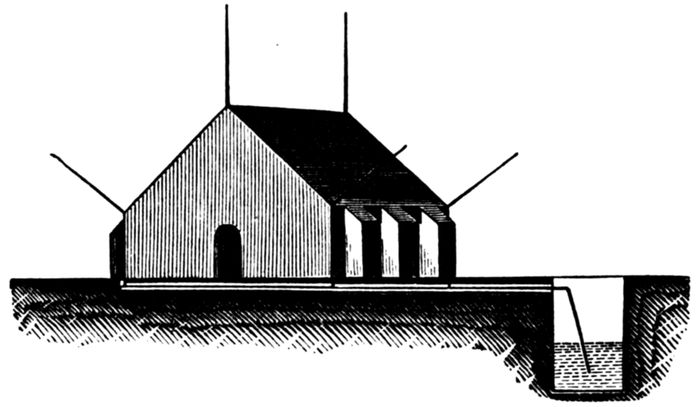
Reference is then made to “Regnier’s System of Lightning Rods,” Appendix F., p. 53, which is thought to be much too expensive.
REPORT on the foregoing Instructions made by La Place, Rochon, Charles, Montgolfier, and Gay Lussac to the National Institute.
2nd November, 1807.
The reporters say that experience has taught that the point of a lightning rod 4 or 5 metres (13 to 16⅓ feet) does not effectually protect a space round it greater than one having a radius of 10 to 12 metres (32¾ to 39¼ feet). That when there are points or considerable masses of metal on a building having a lightning rod it is absolutely (58)necessary to connect them by branches with the principal conductor. That it is not less important that the metallic bars should be thoroughly well connected together so that the electricity may find no resistance in its path from the point to the common receiver. And lastly, that it is necessary that the conductor should have a perfect communication with moist earth, or better, with water. They then proceed to discuss the instructions, or that part of them which relates to the construction of the lightning rods. They recommend the use of gilded copper points, notwithstanding the doubt concerning them which had been raised in consequence of their deterioration by oxidation, and their being blunted by lightning. They say that experience has shown that an iron rod 20 millimetres (·8 inch) square is more than sufficient to carry the most violent discharge of lightning, and that it is consequently needless to make them larger, as recommended in the Instructions; that it is only at the joints that there is any cause for fear because, in spite of the insertion of the piece of lead, the contact is not perfect; that it would be easy by enlarging the bars at their junctions to increase the number of points of contact, and by lengthening the bars to make fewer joints. That in this respect the use of iron wire ropes would be very advantageous, but they fear that the ropes would be easily destroyed, and that the use of copper wire rope instead of iron would be too expensive.
When the conductor reaches the ground too much care cannot be exercised in making a free communication between it and the soil. It is upon this that its good effect principally depends, for houses have been struck although provided with a conductor, because it only communicated with a very dry soil. M. Patterson, of Philadelphia, in the fourth volume of the American Phil. Trans., has published a means of making a good contact which seems useful. He proposes to lay the conductor in a bed of galena worked into a paste with melted sulphur. The galena is a good conductor, and would have the advantage of protecting the iron from the damp. He has also proposed a simple means of providing for the easy dispersion of the electric fluid in cases where the soil is not very damp, which consists in making a hole in the ground and filling it with charcoal, into which the conductor is plunged. But M. Guyton used the conducting power of charcoal for this purpose more than thirty years ago, and it has been applied in many ways. Charcoal, like galena, is a good conductor, and this property renders its employment desirable in cases where the soil is dry.
Upon the proposal to fix inclined or horizontal points they think that vertical points will suffice; and with reference to the Regnier system, they remark that it would certainly be very expensive, and that it would not be necessary to adopt it until the usual system had been found insufficient.
(59)
INSTRUCTIONS about LIGHTNING RODS adopted by the Academy of Sciences.
First Part, 23rd April, 1823.
Prepared by a Committee consisting of MM. Poisson, Lefevre-Gineau, Girard, Dulong, Fresnel, and Gay Lussac.
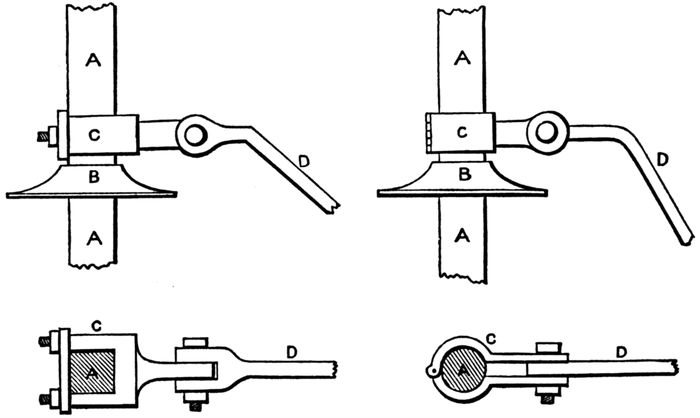
After some theoretical remarks the Committee describe the conductor they recommend, giving the name of tige (upper terminal) to the part rising into the air above the roof, and that of conductor to that part extending from the upper terminal to the ground. The upper terminal is a square or round bar of iron tapering from base to summit. If from 7 to 9 metres (23 feet to 29 feet 6 inches) high, which is the smallest height to be used on large buildings, it should be 54 to 60 millimetres (2·1 to 2·3 inches) square or diameter at the base, if 10 metres (32 feet 9 inches) high, it should be 63 millimetres (2·5 inches). About fifty-five centimetres (1 foot 9½ inches) of the upper end is cut off and replaced by a point of copper either gilded at the end or tipped with a little piece of platinum. At the lower end of the terminal (A), 8 centimetres (3·15 inches) above the roof, is fixed a base (B) to throw off the rain which would run down the terminal, and above this base the terminal is clasped by a collar (C), as shown in the drawing, to which is bolted the conductor (D). The engraving shows the modification of the arrangement as adapted to both round and square terminals. The conductor is a bar of iron 15 to 20 millimetres (·59 to ·79 inches) square, joined firmly to the upper terminal by bolting it tightly between the two ears of the collar. The best way of joining the bars together is shown in figure 1, p. 55. It is to be held up at a distance of 12 to 15 centimetres (4·7 to 5·9 inches) from the roof by crutches, and to be kept at a like distance from the walls of the building. At 50 or 55 centimetres (19·6 to 21·6 inches) below the surface it is turned away perpendicularly from the wall for a distance of 4 or 5 metres (13 feet 1 inch to 16 (60)feet 5 inches) if it does not sooner meet with water. To avoid rusting the rod is carried in a trench filled with charcoal, and then turned down a well so as to have at least 65 centimetres (25·7 inches) in the water when at its lowest level, where it terminates in three or four branches to facilitate the exit of the electricity from the conductor.
If there is no well convenient, a pit should be made 13 to 16 centimetres (5·1 to 6·3 inches) in diameter, and 3 to 5 metres (9 feet 10 inches to 16 feet 4 inches) deep, down the middle of which the conductor should be led and the hole filled with charcoal tightly rammed. As the iron bars forming the conductor are not easily bent to follow the lines of the building a metallic rope may be used. It is made of four strands, each composed of 15 iron wires, and forming a rope of 16 or 18 millimetres (·62 to ·7 inches) in diameter. Each strand is tarred separately, and the whole also well tarred when put together. It is attached to the upper terminal in the same way as the bars by pinching between the ears of the collar (c). At 2 metres (6 feet 7 inches) above the ground it is joined to the bars which form the earth connection by being pinned into a socket formed at the end of the first bar. Ropes of copper or brass wire may be used, and they need not be more than 16 millimetres (·62 inches) in diameter.
It is necessary to connect any considerable metallic masses (lead roofs, metal gutters, or tie rods) with the conductor, because if this be not done, and the conductor be broken, or have a bad earth connection, the lightning may leave the conductor for the metallic mass.
Modifications of this form of conductor for use on churches, ships, and powder magazines (for the latter carrying the conductors on masts is recommended) are then described.
The report says that the terminal of a conductor protects efficiently a circular space round its base, having a radius equal to twice its height; but that it is prudent to estimate that a conductor on a church spire only protects a circle having a radius equal to the height of the conductor.
The conductor should go the shortest way to earth. It should be on the side most exposed to the weather, especially on spires.
Second Part, 18th December, 1854. Prepared by a Committee consisting of MM. Becquerel, Babinet, Duhamel, Despretz, Cagnard de Latour, and Pouillet.
Notwithstanding the considerable advance in knowledge since 1823, the instructions of that date have no need to be altered, at least in their essential principles; but the methods of construction of buildings having materially altered, and metal having largely replaced wood and stone, buildings had, so to speak, become metallic masses, which would have incomparably greater attraction for thunder clouds. The Palais d’industrie in the Champs Elysees, for example, nearly 3 hectares (7·4 acres) in extent, and 40 metres (131 feet) in height had everywhere enormous masses of iron, brass, and zinc.
The company undertaking the building had sought the advice of the (61)Academy as to the means to be employed to protect it from lightning, and it had been found necessary to revise the instructions of 1823, in order to introduce such modifications as were necessary.
Quoting the passage referring to the connecting of metallic masses with the conductor, the Committee think that the time had come to enter into fuller details on this point.
Formerly the use of metal was almost restricted to ridges, gutters, and tie rods; now metal was used everywhere, and what is important, in large surfaces and great masses; and this new system realised on a large scale the first objection to lightning rods—it attracts the lightning.
When this objection was applied to lightning rods, it had only the appearance of truth, but when applied to the masses of metal then used in buildings, it was not only specious, but true, and founded upon well established laws; these buildings do attract the lightning, and render its effects more disastrous.
In the case of two buildings alike in size and shape, situated on the same soil, one made of wood and stone as formerly, the other with much metal as now, and both without lightning rods—if the conditions are such that the lightning must discharge itself, it will always strike the latter, and never the former; in the same way as on bringing to the conductor of an electrical machine a ball of wood or stone, and one of metal, it is always the latter which will receive the spark. Lightning rods, therefore, are so much the more indispensable as the buildings contain greater surfaces and greater masses of metal.
The nature of the soil must be taken into account, as well as the buildings and other objects upon it. A dry soil, with a subsoil of dry sand, chalk, or granite, does not attract the lightning, because it is a bad conductor. Unless when accidentally wetted the buildings on it participate to some extent in this immunity, at least if they are not built in the modern style, and are not very large. But if there are at a moderate depth underneath this dry ground, large metallic veins, vast caverns, sheets of water, or only abundant springs—these will attract the lightning, which will destroy everything in its path unless protected. If the wet or metallic strata are very deep, the danger of an explosion is diminished by the difficulty of passing the intervening envelope, and by the weakening of the action of the cloud by the increase of distance.
On the 19th April, 1827, the packet boat New York was twice struck by lightning. On the first occasion, having no conductor, it received considerable damage; on the second, the conductor was fixed; it was made of a pointed bar of iron, 1·2 metre (about 4 feet) long, and 11 millimetres (·43 inch) diameter at the base, and a surveyor’s chain about 40 metres (131 feet) long, forming a connection between the foot of the rod and the sea; the chain was made of iron wire 6 millimetres (·24 inch) in diameter; the links were 45 centimetres (17·7 inches) long, ending in loops, and joined together by two round rings. When struck the chain was dispersed in burning fragments and globules, which set the deck on fire in many places, notwithstanding the hail upon it and the rain which fell heavily; the bar at the top was melted for a length of 30 centimetres (11·8 inches) (62)from the point, and down to a diameter of 6 millimetres (·2 inches). The rest of the rod remained with about 8 centimetres (3·1 inches) of the chain attached to it, the longest piece of chain found was less than 1 metre (3 feet 3 inches) long, and was blistered as by fire.
On the 13th June, 1854, the Jupiter was struck by lightning. The conductors were in place; that of the mainmast which was struck went 2 metres (6 feet 6 inches) into the sea, and had at its end a ball 2 kilos in weight. After being struck the conductor had disappeared and the pieces of it were scattered everywhere. The conductor, about 70 metres (230 feet) long, was a cable of three strands formed of sixty brass wires, each one half or two-thirds of a millimetre (·019 or ·026 inches) thick. The cable was mostly in bits no bigger than pins, but there were some pieces a few decimetres long, these had been turned violet colour as by fire, and those first touched were still burning hot.
These two examples show that a conductor may be destroyed, but they also show that it is not useless even then, since it will have received the discharge and directed it, and so prevented greater mischief. The Jupiter received no damage; whilst not far off, a Turkish vessel, which also had a conductor (but the chain of which did not reach the water) having been struck by lightning in the same storm, had a hole more than 30 centimetres (11·8 inches) deep, and almost such as would have been made by a cannon ball, in her side just above the copper, and near the water line.
The question is, are such accidents to conductors inevitable, or are they the result of faulty construction? All the facts established in the accounts of lightning and its phenomena, leave no doubt on this point. All the lightning rods which have been destroyed were of bad materials, insufficient, badly constructed, not in accordance with the principles which theory has deduced from experience.
The conductor of the New York had several faults; its upper terminal was too small, and too much drawn out; its conductor had much too small a sectional area; and the use of a chain in such cases should be strictly excluded.
There is no example known in which lightning has been able to melt iron rods 2 centimetres (·78 inch) in diameter, or 3 square centimetres (1·18 inch) in section; and copper may be used in still smaller sizes.
The conductor of the Jupiter, although better than the former, had also a radical defect. The fragments of the conductor which were examined bore but few traces of fusion, and none of these traces extended to the entire thickness of the cable; they were also limited to a group of some of the sixty wires of which it was composed. This seemed to show that the discharge was not carried equally by all the wires, and that those wires which it followed being insufficient to carry it, were the ones melted, and the others were broken or volatilised with explosion. Hence the breaking of the cable and dispersion of fragments of some decimetres in length, which, though too hot to be touched, were not hot enough to set wood on fire. This explanation, however, raises a singular question, whether, in a cable of similar wires twisted and bound together, the lightning can choose (63)some wires in preference to the rest, even when the whole of them are hardly sufficient to give it a free passage.
Undoubtedly, yes; at any rate under certain conditions. No doubt if at both ends of the cable, for the length of a decimetre, the wires first tinned separately are afterwards soldered together, so as to make a sort of metallic cylinder, electricity, whether natural or artificial, having to pass along the cable, will not show a preference for one wire over another; but where this is not done—if at the two ends, or, more generally, at the two points of junction with other conductors, the wires are isolated by layers of dust or oxide—if, in addition, the cable only touches the terminals by its outside wires, then things happen very differently. The electricity takes those wires that are in contact with the terminal; these reduced to few in number become incapable of carrying it; and the whole cable broken by the explosion exhibits the phenomena shown in the case of the Jupiter.
The deficiency in each case was due to one cause—insufficiency of sectional area. In the first case the insufficiency is apparent, the iron wires 6 millimetres (·24 inch) thick were nine or ten times too small; in the second, the insufficiency is more hidden, it results from badly made junctions.
The two most fundamental rules for the construction of the rod and conductors are—1st. That they shall have a sufficient sectional area. 2nd. That they shall be continuous and without a break from the point of the upper terminal to the common receiver (the earth). But this continuity may in strictness be interpreted in two ways: it may be said that two pieces of metal in contact form a sufficiently continuous connection; and it may be said, on the other hand, that most frequently this simple contact is no more than a break in consequence of oxidation and the interposition of foreign bodies.
The instruction of 1823, without adopting the first interpretation, does not appear to have sufficiently recommended the second, which should exclusively regulate all construction of lightning rods. No doubt it is possible, by taking great care, to join and bolt together two pieces of iron or copper closely enough to make a practically continuous conductor, but when there are many joints we fear that evil might arise from the negligence of workmen, and still more from the chemical alteration of the surfaces, the deposition of foreign matter, and the mechanical dislocation produced by time and repeated shocks.
Hence, the three following practical rules should always be observed:—1. To reduce as much as possible the number of the joints. 2. To make all the joints with hard solder, and they should be upon surfaces of at least 10 centimetres (3·9 inches) square, and further strengthened by straps and bolts. 3. Not to make the upper terminal so gradually pointed as usual. The upper terminal of iron should be not less than 2 centimetres (·78 inch) diameter, the end should be filed down and a screw tapped 1 centimetre (·39 inch) high and 1 centimetre diameter, and to this a cone of platinum 2 centimetres diameter and 4 centimetres (1·5 inch) high, and consequently having an angle at the point of 28° or 30° should be fitted, screwed, and carefully soldered.
(64)In other respects the instructions of 1823 should be followed; no fact which leads to a modification of the general rules there proposed 1, for the sectional area of the conductors; 2, for the method of fastening to buildings; 3, for the method of making the earth connection, has since come to light.
The subject, however, is not exhausted, there still remains the important and difficult question: what is the circle of protection afforded by a well constructed lightning rod? The opinion generally received at the end of the last century was that the circle of protection had a radius of twice the height of the terminal, and the instruction of 1823 adopted this opinion, but with some restrictions as in the case of spires. It is important to remember that these rules rest upon a more or less arbitrary basis, and this is said not to condemn them, but only to prevent there being attached to them a value which they do not possess.
More observations are required, and it is only with reserve that these rules are admitted. They are neither general nor absolute, they depend upon a variety of circumstances, and especially on the materials of the buildings. For example, the radius of the circle of protection, which would be sufficient for a building having only wood tiles or slate on its upper portion, would not be sufficient for a building in which the covering or the framing of the roof was of metal. In the former case the active portion of the thunder cloud, although further from the lightning rod than from the roof, would exert a greater action on the rod, whilst in the latter the action on the rod and on the roof would be almost equal at an equal distance.
A special note upon ships, and another on the Palais de l’Exposition close the report.
Special Report for the New Buildings of the Louvre, 18 December, 1854, by the same Committee.
Referring to the subject of the earth connection the Committee say; in the earliest instructions, it is said that the conductors should communicate with the water in a river, a pond, or wells, or at least with moist earth. This rule, although quite correct in itself, frequently leads to erroneous practice. It is sometimes thought that lightning is extinguished by water, as fire is; and when water is scarce the conductors are plunged into a well-cemented cistern. This is a most dangerous mistake; the conductor should be in connection with the common receiver, that is, the great water-bearing strata (nappes d’eau,) of much greater extent than the thunder cloud. At other times where wells are possible but costly, advantage is taken of the alternative allowed by the instructions. Instead of wells the conductors are put in connection with the earth, without being careful to see that it preserves sufficient moisture in times of drought when storms are most to be expected, and without being careful to see that the moist connection is sufficiently large. They specially note this latter error, as it appears to be still more common than the former. They do not hesitate to say that recourse should never be had to this method of connection with the common receiver. They (65)recommend that in default of rivers or very large ponds, the conductor should always be connected by large surfaces with the inexhaustible subterranean water-bearing strata.
Secondly, where these strata are at a moderate depth below the surface, the Committee consider it necessary to make use of a conductor with two branches, the principal to descend to the subterranean water; the secondary, leaving it at the ground level, is put in connection with the surface. And for this reason; after great droughts thunder clouds exert but a feeble influence upon a dry, badly conducting soil. All their energy is felt by the subterranean waters; and the electricity will be carried by the principal branch. On the other hand, after a summer shower, when the surface soil gets moist, it is at once made a good conductor. It is that which is affected by the thunder cloud: while, at the same time, it screens the subterranean water from electrical influence. In such a case it is indispensable that the surface of the ground should be in direct connection with the conductor; and this the secondary branch supplies.
There is a final question how the conductors should be connected with the various metallic portions of the building. The ridges are throughout of iron; but the interior arrangements require that, in some portions of the building, there should be, properly speaking, only one floor, whilst in other parts there are six. Each floor may be regarded as a great metallic network, composed of several strong plate girders, crossed by numerous joists analagous to rails, while these are, in their turn, crossed by a multitude of smaller iron rods; and the meshes of this network are filled with tiles. In enquiring into the effect of a thunder storm upon those portions where there are six such floors one above the other, it is easy to see that if the roof were a great continuous sheet of metal, it would take up the whole electrical energy of the cloud, at any rate, as far as the floors underneath it are concerned. In this case it would be amply sufficient if the covering were well connected with the lightning rods. But in this case the roof is metallic, only in a very small portion; it may be said that the ridges only form a network with very large meshes, and, consequently, is an insufficient shield, through which the upper floor may still receive a considerable shock. Therefore the Committee propose the following arrangements:—1st. The principal pieces of each floor should be put in connection with the conductor. 2nd. It is very desirable that all the joists of the upper floors should be connected together by a rod bolted, and, if possible, soldered to each, which rod should be connected with the conductors. 3rd. It seems probable that, in general, the roof frames are in good connection with each other, and, consequently, it would suffice if all the upper terminals are connected with them. If, however, it happens either by changes of level in the gutters, or from other causes that the connections become doubtful special iron connections must be made. 4th. The zinc gutters and ridges should be connected with the lightning rods.
(66)
REPORT on the points of upper terminals made by Messrs. Delieul, by a Committee consisting of MM. Becquerel, Babinet, Duhamel, Despretz, Cagniard de Latour, Regnault, de Senarmont, and Pouillet.
5th March, 1855.
The committee examined the points presented by Messrs. Delieul, one of platinum, made exactly as described in the report of the previous 18th December; the other, a cone similar in form, size, and external appearance, but rather less costly, being made of a cap of platinum, fixed with hard solder upon the conical end of the iron rod. It was thought that this second arrangement would not practically be inferior to the other; but it must be made by a skilful workman, who knows how to insure that the solder should take to the whole of the surfaces brought together. They see no objection to the substitution of palladium, or gold or silver of a standard of ·950 for the platinum. But all these metals are costly; few workmen know how to work in them, or at least to employ that precision, and take that minute care, which are indispensable to success. These reasons have raised again a proposition that was discussed in the former commission, which consists in making the points of copper. The copper point is 2 centimetres (·78 inch) in diameter, like the upper part of the iron rod, to which it is screwed and brazed; its length is about 20 centimetres (7·87 inches), and it terminates in a cone 3 or 4 centimetres (1·1 or 1·5 inches) high.
They see no reason why this should not be used with almost the same confidence as the preceding forms. If there is ground to fear that it may undergo changes from atmospheric influences, this is counterbalanced by certain advantages. 1st, copper is with palladium, gold, and silver, among the best conductors of heat and electricity; and the point of the cone will be much less heated than the platinum point; and 2nd, the terminal, with a copper point, is much less expensive, and can be made everywhere.
On the report being put to the vote M. Despretz could not approve the proposal to employ copper points, fearing that the deposition of carbonate or some other badly conducting matter would diminish the efficacy of the lightning rod.
INSTRUCTIONS upon LIGHTNING RODS for POWDER MAGAZINES, by a Committee consisting of MM. Becquerel, Babinet, Duhamel, Fizeau, Edm Becquerel, Regnault, le Maréchal Vaillant, and Pouillet.
14th January, 1867.
After referring to some general principles, and to the construction of lightning rods recommended in the reports of the earlier Committees: the Committee recommend, that the upper terminal including the copper point should be from 3 to 5 metres (9 feet 10 inches to 16 feet 5 inches) high; that the junction of the conductor and the upper terminal, and also the several joints of the conductor, should be (67)covered with solder, and insist very strongly upon the necessity of communication with the nappe d’eau souterraine, which they define as “the water level in neighbouring wells which never dry up, and which retain at least 50 centimetres (19·68 inches) in depth of water in the most unfavourable seasons.”
The special arrangements to be adopted in setting up lightning rods for powder magazines are: not to fix them on the building itself but outside the surrounding walls. For each large sized magazine (27·89 metres, by 20 metres, and 11 metres high, equal to 91 feet 6 inches by 65 feet 7 inches, and 36 feet high) there should be three conductors—two near the ends of the long side of the enclosing wall most exposed to storms, and the third in the middle of the opposite side. The upper terminals should be only 5 metres (16 feet 5 inches) high, and should be raised on a pier, a mast, or other support 15 metres (49 feet 2 inches) high, down which the conductor should be led to the ground. There should be a circuit which the Committee call circuit de ceinture carried entirely round the enclosing wall to which each conductor should be joined, and a conductor should be carried from the most convenient point of this circuit to the underground water. For middle sized magazines two terminals and supports, and for small magazines one terminal and support will suffice; but in all cases there should be a circuit de ceinture. This need not be deep below the surface, nor covered over; it may even be in an open gutter, but a conductor must be led from it to the underground water, even if in order to do this it is necessary to carry the conductor several hundred metres or several kilometres. It need not, however, be made of bars and carried all the way in a trench, but it may be made of six wires 6 or 7 millimetres (about ·25 inches) in diameter, and carried on posts like telegraph wires, except that they need not be insulated.
INSTRUCTIONS by the Committee consisting of MM. Alphand, Belgrand, Fizeau, Comte du Moncel, Ed. Becquerel, Desains, Ch. Sainte Claire-Deville, Duc, Ballu, Magne, Davioud, Felix Lucas, and R. Francisque Michel, appointed to inspect the Lightning Rods on the Municipal Buildings of Paris.
20th May, 1875.
The Committee find that platinum tips are useless, and recommend instead that the point of the terminal should be made of pure copper, 50 centimetres (19·7 inches) long, and terminating in a cone, forming an angle of 30°. This should be scarfed, pinned, and soldered to the end of the terminal. The terminal should be of wrought iron in one length, and where possible galvanized; but on no account painted. The connection with the conductor should be by a piece fitted and bolted; and, lastly, the whole joint should be well covered with solder.
The Committee consider that on an ordinary building a terminal will effectively protect a cone, having the point for its apex, and a base whose radius is 1·75 of its height. But in practice the terminals (68)may be much farther apart, if there is a circuit des faites. This is defined as a metallic conductor, which extends without break over the ridges of all the buildings which it is intended to protect, and which is joined by metallic contact to all the upper terminals and to the conductor, and consequently to the underground water which alone forms the common reservoir. All pieces of metal of any considerable size should be connected with the conductor.
If the conductor is made of iron bars, they should be galvanized if possible, and the joints should be fitted, bolted, and finally covered with solder. If the bars cannot be galvanized, they should be well painted. The Committee recommend the employment, especially in the circuit des faites, of an arrangement for compensating for the lengthening and shortening of the bars by the variations of temperature. This is made by inserting in the circuit a curved band of copper which will yield to the movement of the rods. If the conductor is made of galvanized iron wire rope, each wire should be 2·5 or 3 millimetres (·09 to ·11 inch) in diameter, and there should be such a number of them that the sum of their sectional areas shall be equal to one-fifth more than that of a bar of iron 20 millimetres (·78 inch) square. The rope should be all in one piece, and the joints with the terminal and earth connection should be covered with solder.
The supports should not be insulated, and there should be as few as possible of them. At the underground end of the conductor should be fixed a large sheet or hollow cylinder of metal, and this should be always, even in the greatest droughts, plunged at least 1 metre (3 feet 3 inches) into the subterranean water. If from any cause this water cannot be reached, the conductor may be joined to one of the main water-pipes of the city; but if the conductor cannot be led either to the subterranean water or to a main water-pipe, no lightning-rod should be erected. It would do more harm than good.
In the case of buildings of any importance, two or more conductors leading to the subterranean water should be employed. It should be so arranged that the underground part and the earth connection may be easily inspected and cleaned from rust, and the whole should be inspected and cleaned at least once a year, at the end of the autumn. The Committee is of opinion that it would be better to put all the lightning-rod work in the hands of special workmen, under the control of an agent appointed by the administration, and not to trust it to the blacksmiths and locksmiths usually employed. The Committee lastly recommend that they should be permanently appointed, and meet every year after the inspection, to report and decide upon the steps to be taken to remedy any defects that may be discovered.
REPORT by the joint Secretary (Francisque Michel) of the Lightning Rod Committee to the Prefect of the Department of the Seine.
This report gives a detailed description of the state of the lightning rods attached to the public buildings of Paris.
In most cases the upper terminals were of great length, some of them as much as 9 metres (nearly 30 feet) in height; the conductors (69)were in almost all cases of iron, either in bars or wire rope; the earth connections were of various kinds and extent.
The report frequently states that the points were blunted; that the upper terminals and the conducting rods were deeply rusted; that especially at the joints the conductors were seriously deficient; and that the underground portion was greatly deteriorated by rust.
A description is given of an accident from lightning to the church of St. Sulpice; but this building had no lightning rod. In the case of the church of St. Clotilde there are five upper terminals, two on the two spires, the remaining three along the ridge of the main roof. The building was amply protected as far as its length was concerned, but the transept was not so thoroughly protected. The five terminals were joined to a conductor which went round the building, and was connected with the ground. A second conductor led from one of the terminals to the ground, where it terminated in a second pit. The conductors were made of iron rods 18 millimetres (·71 inch) in diameter, joined by collars and pinned and the whole covered with paint. They terminated in distributors plunged in the underground water in walled pits. They were supported by insulated collars. The building has an iron roof. The church had been struck by lightning at least four times since the lightning rods had been erected. The first time, twelve years ago, the lightning struck the rod placed on the transept, and carried away the platinum tip of the copper point. Since then the rod has received another discharge, and the copper point is bent to the S.W. In January, 1872 or 1873, the lightning struck the western tower, and shattered one of the stones above one of the windows of the staircase.
“One of the platinum tips is gone, and many are blunted. The conductivity of the conductor is very bad, and the joints are very much damaged: hence the accident to the tower. The greater number of the glass insulators are broken, or gone altogether.”
In the case of the church of St. Eloi, which had one terminal on the spire, one conductor, formed of iron wire rope 2 centimetres (·78 inch) in diameter, joined at 3 metres (9 feet 10 inches) above the ground to an iron rod 25 millimetres (·97 inch) in diameter, which entered the ground and ended without branches in a pit filled with charcoal. The soil was dry and calcareous. The conductor was made up of many lengths of rope, old pieces apparently having been used; the joints were in bad condition, and needed soldering. The underground part was deeply rusted.
“In September, 1874, lightning struck the spire, twisted the conductor, broke the terminal, threw down the part above the cross, and made great cracks in the apse.”
During the building of the Mairie of the 20th Arrondissement, the lightning struck a fir-pole in the scaffolding. It did not do any damage, being carried away by the chain attached to the pole, from which it took all the rust, and being thence conducted by some pieces of iron roof framing lying on the ground.
There are several other accounts of accidents, but they are mostly represented by the foregoing examples.
(70)
INSTRUCTIONS as to the application of LIGHTNING CONDUCTORS for protection of POWDER MAGAZINES, ETC.
Issued with Army Circulars, dated May 1st, 1875.
(Abstracted by Prof. T. Hayter Lewis, F.S.A.)
1. The principles adopted by Sir W. S. Harris, as shown in the Appendices A and B, to this paper, still held to be sound.
2. The terminating plane of action of lightning is sometimes beneath the surface of earth, which, if moist, forms good medium for diffusion of electricity.
3. Dry soil is to be regarded as non-conducting matter.
4. Therefore conductor to be taken into soil permanently damp.
5–6. Underground magazines are usually in dry soil, and should
therefore be fitted with conductors as in the case of similar magazines above ground.
8–9. Casemated batteries of modern construction, with magazines in basement should have conductors on the parapet or terreplein from end to end of battery, attached to vertical conductor into earth. Flagstaff should have conductor. In large works there should be several points 5 feet above top of building. Iron verandahs and railings are good conductors when with good earth connections.
10. Iron buildings are good conductors. But if covered with asphalte, concrete, &c., rods or points must be provided projecting above asphalte, &c., and with good earth connections. Iron shields should be connected with conductors.
11. Copper is recommended as best conductor; it is not liable to corrosion, and very durable.
12. But if exposed to injury, or likely to be stolen or corroded, copper may be replaced by iron, provision being made for its smaller conductivity—viz., ⅕th that of copper.
13. Copper rods to be ½ inch diameter; copper tubes to be ⅝ × ⅛ inch thick; copper bands to be 1½ × ⅛ inch thick.
14. If the conductor be of iron, solid rods to be 1 inch diameter; solid bands to be 2 inches wide × ⅜ inch.
15–16. The fusing temperature of copper is 1994° Faht.; whereas that of iron is 2786° Faht. So far there is a marked advantage over copper. But it rusts easily, and then the electrical resistance is immensely increased. Roughly speaking, an equal conducting power may be obtained either in iron or copper for the same cost, the number of iron conductors being greater in proportion to the less cost, and the more conductors being the better.
17–19. Expansion and contraction are to be carefully provided against; e.g. by suitable bends at intervals in long lines of horizontal conductors and by bearing collars, allowing of slip in vertical lines.
20. Soldered or welded joints are desirable, but not absolutely necessary.
21. Gives engravings of connections recommended by Sir W. S. Harris, where soldered joints cannot be used, and which fulfil the conditions specified in sections 17–19.
(71)22. Soldered or welded joints to be used where discharge is possible with unsoldered joints, and likely to ignite dust or inflammable substances near.
23. Iron may be connected by similar joints as for copper, or by screw joints as for gas pipes. No white lead to be used, it being a bad conductor.
24. Iron flat bands may be connected by rivets or screws, working in slots, to provide for expansion, each surface in contact being at least six times the sectional area of band.
25. Copper bands to be similarly connected. Joints between different metals may be soldered, screwed, or rivetted, the extent of surface in contact being regulated by the dimensions of the metal of the least conducting power. Access of moisture to surfaces in contact must be prevented, on account of local galvanic action and decomposition.
26. No precise limit can be fixed to protecting power of conductors. In England the limit is usually assumed as being the radius of the height from ground. It may be sufficiently correct for practical purposes, but cannot always be relied upon.
27. Conductors do not attract lightning; they only diminish the resistance due to the air. Even a change in the nature of the soil -over which a cloud passes may produce a discharge.
28. One angle of a building may receive a discharge, though another angle have a conductor. So every prominent part of a building containing explosive material should have a conductor.
29. In buildings of uniform height, provide a solid rod 5 feet above it at each end, and at each 45 feet in length; if the conductor be of iron the top should be gilt.
30. Buildings not over 20 feet long to have one vertical conductor at end, and a horizontal conductor on ridge.
31. If 20 to 40 feet long to have one vertical conductor in centre, and one along ridge, as last.
32. If 40 feet long to have two vertical conductors; if 100 feet long three conductors; in both cases with conductor along ridge.
33. Similar principles to be adopted in larger and more complicated buildings.
34. Each prominent part should have a conductor. The value of three or four points to terminals is not apparent unless the points are widely separated.
35. Conductors are to be connected horizontally, e.g., by ridge or eaves, which, when of metal, should be invariably connected with conductor. All metal surfaces whatever to be also so connected.
36. Sir W. S. Harris considers the relative conductivity of the several metals as being—of lead 1, tin 2, iron 2½, zinc 4, copper 12. So lead cannot be altogether depended on.
37. Avoid long lengths of horizontal conductors without earth contacts, as the currents might leave the conductor, and pass to earth, causing danger. Avoid sharp angles.
38. Good earth connections most important. Conductors are to be led into springs or wells or earth permanently wet. Not into watertight tanks. Shingle, dry sand, or dry mould are not sufficient. (72)Provide several earth connections in all large systems of conductors as a precaution.
39. Lead conductors into ground in trenches 18 inches deep. Not less than 30 feet of metal to be in contact with moist earth.
40. Lead a flow of water over trenches if possible, e.g., from rain water pipes.
41. Trenches in rocky or dry soil to be 30 to 120 feet long, so as to obtain all moisture possible.
42. Connections in trenches may be of old iron, forming continuous metallic surface, the trenches to be filled with cinders or coal ashes. Water pipes form excellent earth connections, but gas pipes are dangerous.
43–44. Frequently inspect conductors, especially as to joints connecting different metals and defects in iron from rust.
45–46. Galvanize iron, care being taken that the coating is good.
47. Great care to be taken in case of contact of zinc coating with other metals, especially copper.
April 8th, 1875.
FRED. E. CHAPMAN.
Inspector General of Fortifications.
Appendix A.—By the late Sir W. Snow Harris, F.R.S.
1. The earth’s surface and clouds are the terminating surfaces of electric actions, and buildings, &c., are only points, as it were, of earth’s surface in which the whole action vanishes.
2. Electricity when confined to substances resisting its progress, as air, glass, dry wood, stones, &c., exerts a terribly explosive power.
3. But when confined to bodies, such as metals, offering small resistance, its violent expansion or disruptive action is greatly reduced or avoided altogether, and becomes a continuous current comparatively quiescent. But if body be small, as wire, it may be heated or fused. Resistance is so small that a shock has traversed copper wire at the rate of 576,000 miles a second; resistance increases with length and diminishes with area of section of conductor.
4. So a building metallic in all its parts, or a man in armour is safe.
5. So endeavour to bring buildings into the same passive or non-resisting state as if of metal.
6. So conducting channels of copper should be systematically applied to walls, either in plates united in series one over another, not less than 3½ inches wide and 1/16th and ⅛th of an inch thick, or of stout copper pipe not less than 3/16ths of an inch thick, and 1½ to 2 inches diameter, fixed to building by braces or copper nails or clamps. Terminals to be solid metal rods, projecting above to a moderate and convenient height. Earth connections to be by one or two branches, leading out about a foot below ground—if possible into moist ground, but if dry, use old iron or other metallic chains so as to expose a large metallic surface.
7. All metals in roof, &c., of building to be connected with main conductors; any prominent chimney to have a pointed conductor taken along it to metals of roof.
8. An electrical discharge never leaves a perfect conductor to pass (73)to a very bad one, so the apprehension of lateral discharge is absurd. Furious discharges have fallen on the conductors to the masts of H.M. ships, and passed through copper bolts in bottom without injury even to persons leaning against the conductors.
9. Metallic bodies have no specific attraction for electricity more than wood or stone have; all matter is indifferent so far as regards a specific attraction. Lightning falls indiscriminately upon trees, rocks and buildings, whether with metals about them or not; e.g., at Plymouth Dockyard in May, 1841, a granite chimney, 120 feet high, without any metal in it, was struck, and yet it was within 300 feet of a clock-tower of equal height, having metal weathercock, a dome covered with metal and large conductor along it to ground. The damage ceased where the chimney passed through a massive metallic roof, having a conductor from it to the ground. Here the lightning fell on a building, which, according to the popular idea, held no “invitation” in preference to a structure which did hold such “invitation.”
10. If efficient conductors provide free and uninterrupted course for electrical discharge, it will follow that course without danger to general structure; if not, then this irresistible agency will find a course for itself and shake all imperfect conducting matter in pieces in doing so. The great object is to provide a line or lines of small resistance in given directions, less than the resistance in any other line of the building. The conductor no more attracts lightning than a gutter or water pipe attracts a flow of water.
11. It follows that a magazine if of metal would be safer than if built in the usual way. Metallic gutters and ridges, with continuous metallic communications to earth, are unobjectionable.
Note.—It is as wrong to isolate conductors from buildings by glass or resin, as it would be to place rain water pipes 10 feet from the building from which they should carry off the water.
An instance is given of an iron conductor which was placed 10 feet from a house, the latter being, notwithstanding, struck at the point nearest to the conductor, which was untouched.
12. Pointed terminations tend to break the force of lightning when it falls on them. Before explosion a large amount of discharge passes off through pointed conductors.
Pointed conductors should be solid copper rods, about ¾ inch diameter, and a foot long, united by brazing to the conducting tube. It is not necessary to gild the points, or form them of platinum. Sometimes even, this would be detrimental, as platinum has only half the conducting power of copper. The oxidations of the surface of conductor is of little moment; and in case of copper very trifling. In any case the conducting surface is better than the bad—or non-conducting air. The electric telegraph wires work well, though enclosed by gutta percha or other non-conducting matter. It is sufficient if the terminal solid rod be even roughly pointed. But even a ball, a foot diameter, would be a point as opposed to 1,000 acres of charged clouds.
Note.—Experience contradicts the idea that the conductor protects a certain area. The foremast of a ship has been struck, though the mainmast has been protected by conductor.
(74)13. Copper linings to doors and windows of magazines, are not objectionable, but useless for keeping out lightning. They should be connected with the general system of conductors.
Appendix B.—As to Solid or Hollow Conductors. By Sir W. Snow Harris, F.R.S.
1. A given quantity of electricity melts the same quantity of metal, whether in a solid or hollow form. So far it is immaterial which form the conductor has. But supposing the mass of metal to be so large that the heating effect may be neglected. It is proved that the greater the surface, the less is its intensity or power at any point, the intensity approaching the second power or square of the surface inversely. It is important to give the charge free room of expansion by increasing the surface of conductor, so as to reduce the mechanical activity of shock to the least possible. Rectangular flat bars may be employed.
2. A rain water pipe communicating with main conductor, should have earth connection. All imperfect substances, as masonry, and ship masts, transmit a certain portion of electricity without explosive action. One great use of the conductor is to relieve the wood or masonry of the quantity it cannot discharge without explosion.
3. Conductors of small iron rod or wire are very objectionable. They commonly rust at the joints, and have fallen to pieces, and often been knocked to pieces by lightning. Iron may, certainly, be employed with advantage, but should be galvanized. Zinc is an even better conductor than iron; and being spread over the surface is not open to the objection of making a conductor of two metals of unequal conducting power. A good and efficient conductor might be formed of galvanized iron. It should be of wrought iron, galvanized, of 2 inches diameter, with screwed joints of extra thickness. Copper tubing is, however, always to be preferred.
4. In dry or rocky soil, complete the conductor by leading old iron chains out from the walls in several directions, or by leading a flow of water over them. Fortunately a thunder storm is usually attended by heavy rains. The iron chains should extend 30 to 50 feet, and be a foot or 18 inches under ground. The termination in a large surface of moist earth would be preferable to that in a well, as the action is a superficial one of expansion in all directions. In the tin leaf coatings of the electrical jar, the charge is not influenced by the thickness of metal.
W. SNOW HARRIS.
REPORT ON THE DESTRUCTION BY LIGHTNING OF A GUNPOWDER STORE AT BRUNTCLIFFE, YORKSHIRE. By Major Y. D. Majendie, R.A.
(Abstracted by G. J. Symons, F.R.S.)
The Gunpowder exploded at 4.30 p.m. on August 6th, 1878, during the greatest intensity of a violent thunderstorm. The building, was brick, with brick arched roof, length 9 feet, width 5 feet, height (75)6 feet (internal dimensions). The store had a uniform thickness of three bricks, and was furnished at the one end with an iron door, at the other end with a lightning conductor. The conductor consisted of a copper wire rope, 10 gauge copper wire, the rope being 7/16 inch thick, having four points at the top (one large one in the centre, and three smaller ones round it), it extended to about 13 feet above the top of the building, and about the same length was carried into the ground and terminated in a drain. The conductor had been erected in 1876, by Mr. John Bisby, of Leeds, and was fixed to a pole distant about 2 inches from the end of the building opposite to that in which the iron door was fixed, it was not connected with the iron door in any way. No one was near the store when the powder exploded, and it seems probable that the earth connection of the conductor was bad, that the mass of iron in the door offered at least an equally good path—and that the gunpowder was ignited by a flash passing between, the two imperfect conductors.
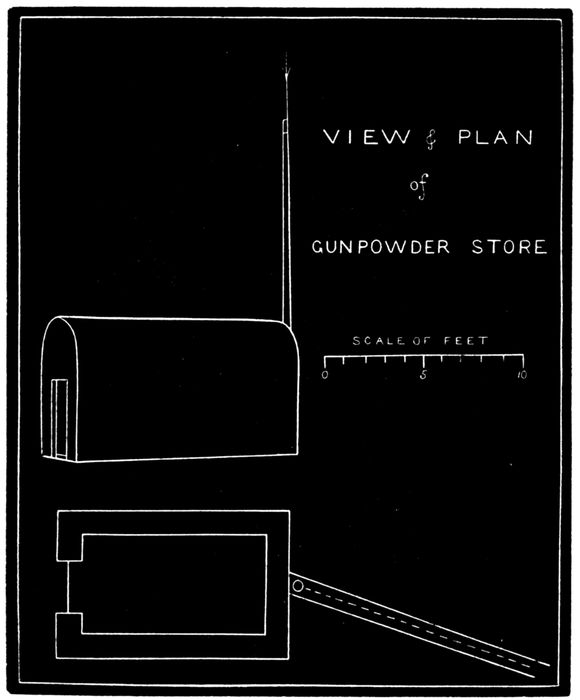
“The only structural damage effected was produced by the impingement of bricks, which striking with great force, had in a few instances, partially penetrated or displaced brick work in the dwelling-houses and buildings, and a portion of the iron of an iron church was broken by a piece of projected débris. A brick was driven through a window in one of the houses at three hundred yards, and broke a bedstead. As far as I have been able to discover no other structural injury was occasioned.”
(76)This accident appears to suggest several conclusions:—
“In the first place it appears to me to afford a striking confirmation of the principle which has been repeatedly and emphatically enunciated by Sir William Snow Harris and other authorities on the subject of lightning conductors, that in order to secure an efficient protection for a given building, all the metal of the building, and as far as possible the whole of the structure itself, should be brought into actual connection with the system of conduction; in other words, that the general conducting power of the mass of the edifice should be completed, and all attractive and prominent parts allied in one protective combination, so as to “bring the whole” (as it has been expressed by Sir William Snow Harris) “as nearly as may be into that passive or non-resisting state which it would assume, supposing the whole were a mass of metal.” In the present case, assuming the conductor itself to have been efficient, a point which there seems no sufficient reason for doubting, the system of conduction was obviously defective. Not only was the whole length of the building left unprotected, the conductor having been on a pole at one end, and carefully insulated from the building, but the iron door which was at the opposite end, was absolutely unconnected therewith, and was not itself supplied with any earth connection.”
“It appears clear, therefore, that even what may be deemed per se an efficient lightning conductor, i.e. a conductor, which considered alone, offers a path of little or no resistance even to a powerful electric current, does not afford a reliable protection to a building unless it be scientifically applied, and with due regard to those principles upon which the more eminent authorities on electrical science are agreed. To a disregard of these principles, especially in respect of the iron door being left out of the system of conduction, and unconnected therewith, I believe the present accident may be attributed.”
REPORTS OF COMMITTEES ON THE POWDER MAGAZINES AT PURFLEET.
(Phil. Trans., 1773, p. 42, and 1778, Part I., p. 232.)
(Abstracted by Prof. W. G. Adams, F.R.S.)
Report of a Committee consisting of the Hon. Henry Cavendish, Dr. Watson, Dr. Franklin, Mr. J. Robertson, Mr. Wilson, and Mr. Delaval, appointed by the Royal Society, “to consider of a method for securing the powder magazine at Purfleet.”
A powder mill at Brescia having blown up in consequence of being struck by lightning, the Board of Ordnance applied to Mr. B. Wilson to know in what way the powder magazine could be protected. He recommended that a blunt conductor should be employed, whereas Dr. Franklin recommended a pointed conductor. The Committee met and Dr. Franklin read a paper on the subject, and the report of the Committee was in conformity with Dr. Franklin’s views.
The Committee went to Purfleet and examined the buildings. They found that the barrels of powder, when the magazines were full, (77)lay piled on each other up to the spring of the arches; on each barrel were four copper hoops, which with vertical iron bars formed broken conductors within the building. These iron bars were ordered to be removed.
The Committee advised that at each end of each magazine a well should be dug in or through the chalk, so deep as to have in it at least four feet of standing water. From the bottom of this water should arise a piece of leaden pipe to or near to the surface of the ground, where it should be strongly joined to the end of an upright iron bar, an inch and a half in diameter, fastened to the wall by leaden straps, and extending ten feet above the ridge of the building, tapering from the ridge upwards to a sharp point, the upper twelve inches of copper, the iron to be painted.
Lead was mentioned for the underground part as less liable to rust, in the form of a pipe as giving greater stiffness for the substance, and iron for the part above ground as stronger, and less likely to be cut away. The pieces of which the bar may be composed should be screwed strongly into each other by a close joint with a thin plate of lead between the shoulders. Each rod in passing above the ridge should be strongly and closely connected by iron or lead, or both, with the leaden coping of the roof, so making metallic communication between the two bars of each building.
It was also advised that two wells be dug within twelve feet of the doors, one to the north of the north building and the other to the south of the south building, and that metallic communications be made between the water in them and the leaden coping of the roof.
The Board house stood 150 yards from the magazines, on elevated ground, and was a “lofty building with a pointed hip-roof, the copings of lead down to the gutters, from which leaden pipes descend at each end of the building into the water of wells of forty feet deep, for the purpose of conveying water forced up by engines to a cistern in the roof.”
As to the Board-house, they thought it already well furnished with conductors by the several leaden communications above-mentioned from the point of the roof down into the water, and that by its height and proximity it may be some security to the building below it; they therefore proposed no other conductor for that building, and only advised erecting a pointed iron rod on the summit, similar to those before described and communicating with those conductors.
Mr. Wilson dissented from that part of the Report which recommended that each conductor should be pointed, because, he says, “by points we solicit the lightning, and may promote the mischief by drawing the charges from charged clouds, which would not discharge at all on the building if there were no points on the conductors.” By experiments made and appealed to at the Committee the difference in the effects between pointed and blunted conductors is as twelve to one. Mr. Wilson states that, “A thunder cloud, therefore, if it acted at 1200 yards distance upon a point, would require a blunted end to be brought within the distance of 100 yards, and beyond those limits would pass over it without affecting it at all.” He also says, “The longer the conductors are above the building, the more danger is to be (78)apprehended from them. I have always considered pointed conductors as being unsafe by their great readiness to collect the lightning in too powerful a manner.”
Mr. Wilson adds an account of an accident to St. Paul’s Church, and some curious reasoning on it in support of his own views. (See Phil. Trans. 1773, p. 59–61.)
On the 15th of May, 1777, the Board House at Purfleet was struck by lightning, and some of the brickwork damaged (See Phil. Tran., 1778, Pt. I., p. 232). About 6 p.m., after heavy rain through the day, a heavy cloud hung over the house for some time, and Mr. Nickson, who watched it from the house and gives the account, says he suspected that some of the conductors might find employment from it. He had not been long at the window before a violent flash of lightning and clap of thunder came together. The lightning struck one of the iron cramps that hold the coping, and made a dent in the lead of the cramp and the stone adjoining it, throwing some stone down and slightly disturbing about a cubic foot of brickwork at A. The iron cramp was situated over a plate of lead, and the ends of it, inserted in the stone, came within 7 inches of that plate, which communicated with the gutter, and served as a fillet to it; this gutter was part of the main conductor of the building. The lightning struck through the stone, &c., to the corner of the plate, fusing a very small portion of it. From this point no farther effect of the lightning could be traced. At the distance of seven feet and a-half from the place struck, a large leaden pipe went down from the gutter to a cistern of water in the yard. It is remarkable that the surface of one of the hip-rafters, four inches and a-half in diameter, covered with lead (communicating with the gutter), and reaching within twenty-eight inches of the place struck, seems not to have been at all affected. The distance from the point of the conductor on the house to the part struck was forty-six feet.
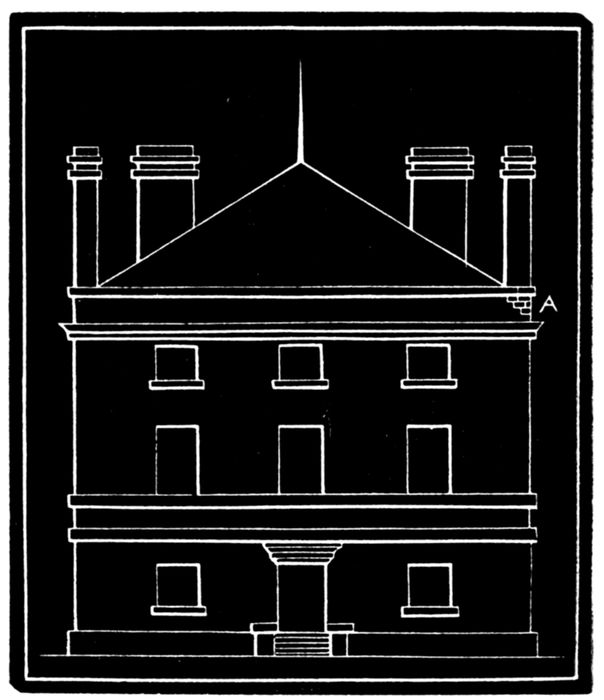
A fresh Committee of the Royal Society, consisting of Mr. Henly, (79)Mr. Lane, Mr. Nairne, and Mr. Planta, recommended a channel to be made from cramp to cramp round the parapet, filled with lead, and connected in four places with the main conductor on the roof of the building.
Mr. Wilson again dissented from their report, and attributed the hanging of a heavy cloud over the house (it being calm at the time) to the presence of the pointed lightning conductor.
An account of Mr. Wilson’s elaborate series of experiments at the Pantheon on a long cylinder to illustrate the effects of pointed and rounded conductors occupies seventy pages of the Philosophical Transactions; and another Committee of the Royal Society, consisting of Sir John Pringle, Dr. Watson, Henry Cavendish, W. Henly, Bishop Horsley, T. Lane, Lord Mahon, E. Nairne, and Dr. Priestley, report in favour of having additional conductors ten feet high, with copper eighteen inches long, finely tapered and acutely pointed placed upon the magazines. They conclude that “elevated rods are preferable to low conductors terminated in rounded ends, knobs, or balls of metal,” conceiving that, the experiments and reasons, made and alleged to the contrary by Mr. Wilson, are inconclusive.
Mr. Wilson’s objections are again urged by Dr. Musgrave, but called in question by Mr. Nairne (see Phil. Trans., 1778, Pt. 2, p. 823), who makes a series of experiments to illustrate the advantage of pointed conductors.
Both Mr. Wilson’s and Mr. Nairne’s experiments agree in showing that “pointed conductors draw off the electricity from a cloud at a much greater distance than those which are blunted.” Mr. Wilson objecting that this draws the charged cloud from a greater distance; and Mr. Nairne concluding that “a charged body is exhausted of more of the fluid by a pointed than by a blunted conductor,” and so is not likely to cause so much damage since it discharges itself more gradually.
EXPERIMENTS AND OBSERVATIONS ON ELECTRICITY.
By Benjamin Franklin. Fifth edition. London, 1774.
(Abstracted by Prof. T. Hayter Lewis, F.S.A.)
The author shows that pointed bodies draw off electricity much more effectually than blunt ones.
When the land is hot, “the lower air is rarified and rises; the cooler, denser air above, descends.”
The clouds meet over the heated place, “and if some are electrified and others not, lightning and thunder succeed, and showers fall.”
“As electrified clouds pass over a country, high hills and trees, towers, spires, masts, chimneys, &c., as so many points, draw the electrical fire and the whole cloud discharges there.”
Therefore it is dangerous to take shelter under a tree. It is safer to be in the open fields, especially if the clothes are wet.
Metals are fused, possibly without heat; the lightning creating a violent repulsion of the particles of the metal it passes through.
[He afterwards admits this opinion to be erroneous.]
(80)Describes experiments with sharp-pointed metallic bodies, and says: “May not the knowledge of this power of points be of use to mankind in preserving houses, churches, ships, &c., from the stroke of lightning, by fixing on their highest parts upright rods of iron, made sharp as a needle, and gilt, to prevent rusting; and from the feet of these rods lead iron wire down the outside of the building into the ground; or down one of the shrouds of a ship and her side till it reaches the water.”
“Would not pointed rods probably draw the electrical fire silently out of a cloud before it came nigh enough to strike, and thereby secure us from that most sudden and terrible mischief?”
He mentions the case of the topmast heads of a ship being struck, but having flames upon them like very large torches before the stroke.
He thinks that if there had been a good wire conductor from the heads to the sea there would have been no stroke or damage.
He records the experiments on the 10th of May, 1752, at Marly, of M. D’Alibard, who placed upon an electrical body a pointed bar of iron 40 feet high. In a thunder storm sparks of fire were attracted from it.
Again, at Paris, on the 18th of May, with the same result, by M. de Lor, with a bar of iron 99 feet high upon a cake of resin 3 inches thick and 2 feet square.
Similarly in London in July, 1752, by Mr. Canton.
He refers to other experiments.
He experimented in 1752 with a kite of thin silk (as being able to bear the wet), having a very sharp-pointed wire fixed to its top, above which it rose about a foot. The kite was raised by twine, the part in the hand being made of silk and kept quite dry.
The pointed wire will draw the electric fire from thunder clouds, and when the rain has wet (sic) the kite and twine, so that it conducts the electric fire freely, they will be electrified, and the electric fire will stream out plentifully on the approach of the knuckle.
“Spirits may be kindled, &c., as with a rubbed glass or tube, and thereby the sameness of the electric matter with that of the lightning be completely demonstrated.”
September, 1752. He erected “an iron rod to draw the lightning into his house in order to experiment on it.”
After many experiments, he concluded that “the clouds of a thunderstorm are most commonly in a negative state of electricity, but sometimes in a positive state.” The latter, he believed, rare.
“So that, for the most part, in thunderstrokes, it is the earth that strikes into the clouds, and not the clouds into the earth.”
In the contrary (rare) case the cloud was, “I conjecture, compressed by the driving winds or some other means, so that part of what it had absorbed was forced out, and formed an electric atmosphere round it in its denser state, so communicated positive electricity to my rod.”
“The electric fluid, moving to restore the equilibrium between the cloud and the earth, takes, in its way, all the conductors it can find (v. page 132 of Franklin’s book)—as metals, damp walls, moist (81)wood, &c.—and will go considerably out of a direct course for the sake of the assistance of a good conductor.”
“Explosions only happen when the conductors cannot discharge it as fast as they receive it, by reason of their being incomplete, disunited, or too small, or not of the best materials for conducting.”
He supposes that a wire ¼ inch diameter will conduct the electricity of any one stroke of lightning ever known.
Iron is the best material, as least liable to fuse.
“Pointed rods erected on buildings and communicating with moist earth would either prevent a stroke, or, if not prevented, would conduct it so that the building should suffer no damage.
He gives instances of a small wire acting as conductor and saving the building, though the wire, being too small, was utterly destroyed.
His theory as to the crooked course of lightning is as follows:
“Who knows but that there may be, as the ancients thought, a region of this fire (electric) above our atmosphere, prevented by our air and its own too great distance of attraction from joining our earth. Yet some of it be low enough to attach itself to our highest clouds,” which thence become electrified, &c.
“I am still at a loss about the manner in which clouds become charged with electricity, no hypothesis I have yet formed perfectly satisfying me.”
He describes how he and others have been struck down by electric shocks without feeling pain or sustaining permanent injury.
For protecting powder magazines, erect a mast not far from it, and 15 or 20 feet above the top of it, with a thick iron rod fastened to it, reaching down till it comes to water.
“In buildings the rod may be fastened to the walls, chimneys, &c., with staples of iron. The lightning will not leave the rod (a good conductor) to pass into the wall (a bad conductor) through these staples. It would rather, if anywhere in the wall, pass out of it into the rod to get more readily into the earth.”
If the building be very extensive, two or more rods may be placed at different parts for greater security.
It is well not to sit near the chimney, or gilt objects, during a thunderstorm.
AN ESSAY on the cause of LIGHTNING, and the manner by which the thunder clouds become possessed of their electricity, deduced from known facts and properties of that matter, to which are added plain directions for constructing and erecting safe conductors. By John Simmons. 8vo. 1775.
(Abstracted by Prof. T. Hayter Lewis, F.S.A.)
“As on the earth the operation necessary for the excitation and collection of the electric fluid is attrition.” ... “So we may rationally conclude that attrition is the means of excitation and collection of electric matter in the clouds as well as on the earth.”
By metallic conductors buildings may be preserved from the effects of lightning
(82)Electricity ascends from the earth to the clouds by means of moist air.
“A conductor is a continuation of metal from a certain height above the highest part of a building to moist earth or water” ... “for easy and safe passage of lightning.”
Metal is the best of all conductors.
The author quotes from Franklin “buildings that have their roofs covered with lead and spouts of lead continued from roof into ground to carry off the water, are never hurt by lightning when it falls on such a building.”
The conductor may be made of any metal, and flat or round.
But nowhere less than ¾ inch diameter except at terminal.
But iron rusts, so copper or lead should be used. Lead is best, used in strips 4 inches wide and ⅒th inch thick.
Good earth contact required in moist earth (going therein at least 5 feet) or water.
The several lengths of the conductor must be well in contact by being screwed, if of iron; soldered, if of lead.
The upper terminal to be iron or copper rod 9 or 10 feet long, ¾ inch diameter, and 2 to 5 feet above top of highest chimney or other part of building.
It should be pointed as this attracts electricity better.
Lead roofs to be connected with conductor. (Examples given of house and ship struck.)
No building or object is known to have been struck by lightning within 50 feet of a proper conductor. But a tree has been shivered within 52 feet, so we may conclude that protecting influence extends to 50 feet horizontally in every direction from the point of conductor.
In gunpowder stores, conductors are not to be fixed to the buildings, but at (say) 12 feet away, fastened to a standard, the top being as high above the building as it can be conveniently.
No metal on sides or roof of the building is to be exposed to the lightning so as to attract it.
A TREATISE on ATMOSPHERIC ELECTRICITY.
By John Murray. 1830.
(Abstracted by Prof. W. G. Adams, F.R.S.)
In Chapter V., on lightning identified with electricity, the author speaks of fire-balls and the Aurora Borealis, and ascribes the formation of shooting stars to electrical action. He does not believe they come from distant space into our atmosphere, but regards them as concretions formed by a flash of lightning darting through gaseous media and atmospheric air expanded by heat, carrying metallic dust and earthy particles ejected from volcanoes, or carried up by evaporation or other causes, and diffused over an immense surface in the upper regions of the air. “The lightning carries, like a ploughshare, the accumulated matter in its progress, and, by the powerful (83)electrical attraction thus excited, these particles will be drawn into the vortex of the lightning instantaneously; for, the lightning finally encountering an electricity of an opposite kind, an explosion ensues, and the collected mass is instantaneously fused and agglutinated, while the meteorite thus formed tumbles to the ground.... We therefore do not see the necessity of considering meteoric stones extra atmospheric.”
In this way John Murray goes on page after page, but the above will probably be sufficient notice of his work.
The following are the conditions he lays down for a good conductor:—
1. A finely pointed summit to offer an unresisting entrance.
2. A sufficient length to anticipate, as it were, the descending electricity, and receive it on its summit before it could reach any part of the building.
3. A superior conducting power in the material of the rod to facilitate its passage to the earth.
4. A sufficient thickness to prevent its fusion, which, however, will greatly depend on the resistance it has encountered in entering the conductor. And, finally
5. A safe conduction to a well or moist surface below ground.
He says: “Let the wires below ground in contact with moisture pass through a cylinder of zinc before they diverge to form the root, the copper wires will in this case always remain free from any oxidation.”
HARRIS’S LIGHTNING CONDUCTORS. REPORT to the Committee upon Mr. Snow Harris's and other Lightning Conductors.
(February 11th, 1840. Parliamentary Paper. Fcap. folio).
(Abstracted by Professor W. E. Ayrton).