APPENDIX F. ABSTRACTS OF PRINTED DOCUMENTS. (continued 3)
Reading edition
ATMOSPHERIC ELECTRICITY. By David Brooks. Philadelphia. 1878. 8vo.
(Abstracted by W. H. Preece, C.E.)
A pamphlet by a distinguished American telegraph engineer, giving his view on the magnitude and origin of atmospheric electricity, which he attributes principally to the friction of air on ice in the Polar regions, and which circulates southwards in the higher regions of the air, and northwards in the crust of the earth. Hence also Aurora Borealis which is always preceded by high winds and most frequent when the earth is covered with snow.
Thunderclouds are usually about 2 miles high and from 13 to 23 miles thick. Lightning is much less frequent in mountainous than in plain countries. Copper lightning conductors are often applied to iron ships and iron buildings, but absurdly, as they are in such cases superfluous.
The author advocates immense earth plates where there are no gas- and water-pipes, which he calls the best lightning rods ever erected, because they are electrically in perfect connection with the earth. The track of a railway makes a capital earth. He has never known an accident where proper conductors were used, whereas he has known many accidents from imperfectly and improperly constructed lightning rods, though of the latest and most approved patents.
CATALOGUE Messrs. A. Collin et Fils, Article PARATONNERRES. Paris. 4to.
(Abstracted by Prof. T. Hayter Lewis, F.S.A.)
The authors state that a Municipal Commission has recommended, to the exclusion of all other points, copper about ¾ inch diameter, terminating in a cone of 30°.
As to the area protected Messrs. Collin refer to the reports of the Academy in 1823 and 1854, admitting, as a limit of protected area, (118)a circumference of which the radius equals double the height of the upper terminal for slightly elevated buildings, and simply the height for towers, &c., but this rule is badly defined.
The authors quote formulæ based upon the assumed altitude of the storm cloud, but state them to be unreliable.
The Academy in 1854 reports that an electrified cloud is equally attracted at equal distances by a metallic part of the roof and by the terminal of the conductor.
Exposed points of pinnacles, &c., are to be united to main conductors.
If copper be too expensive use iron wire.
The conductors are to be supported at about 10 centimetres (4 ins.) from walls and roofs.
The Academy recommends them to be isolated on glass or porcelain, but the New Commission rejects this, and suggests that all metallic parts be united to the conductor,—also recommends that wells be sunk to water level, as earth connections.
But this would often entail a depth of 20 to 100 metres, or even more. So the conductors may be sunk into moist earth and surrounded with coke, and if necessary, may terminate in a sheet of copper.
A good earth is very important. Connection with water mains advised.
The authors have fixed 8,000 lightning conductors on their principle without failure.
They give engravings of the various parts.
They engrave a diagram of a powder magazine which they propose to protect by a tall isolated lightning conductor fixed at a distance from it, and at such a height as that it will be included in a cone whose radius is equal to the height of the conductor.
THE SCIENTIFIC AMERICAN, NOVEMBER 1st, 1879.
(Abstracted by Alfred J. Frost.)
We learn that a lightning rod company in Cincinatti has patented a system of lightning protection, which consists of an iron rod running along the ridge of the building with points at each end projecting upwards. It is supported upon large glass insulators, and has no electrical connection with the building, and no rod running to the ground. It is said that there are many public buildings in Iowa which have been provided with this system of lightning rods.
Professor Macomber, of the Iowa Agricultural College, in reply to an inquiry, says that it would be possible that a house insulated with a glass foundation could be struck by lightning, but adds, “By insulating a building the tendency to be struck by lightning would be very much lessened, and the severity of the shock much decreased. Practical illustrations of this can easily be obtained by means of an electrical machine. A spark can be made to pass from the machine to an insulated body, although the force of the shock will be much less than (119)when not insulated. Practically, it would be almost impossible to insulate a building, because after rain commenced to fall it would wet it so that communication with the earth would be established.”
REMARKS ON THE ATMOSPHERIC ELECTRICITY AND ON THE ACTION OF LIGHTNING CONDUCTORS. By Prof. Dr. G. Karsten. 2nd edition. Kiel, 1879.
(Abstracted by H. Van der Broek.)
The author of this pamphlet, Prof. Dr. G. Karsten, states that thunderstorms are particularly dangerous in Schleswig-Holstein. He attributes that fact to the scarcity of woods in that province, not more than five per cent. of the surface being wooded; whilst in the Prussian empire the proportion of woods is twenty-three per cent.
Woods promote a uniform dampness of the atmosphere and lessen the up-current of air, which up-current contributes considerably to the formation of thunderstorms; and the woods thus cause the discharges of the electricity to take place principally between the clouds.
We do not yet know with certainty what the causes of atmospheric electricity are, but we do know under what conditions or circumstances thunderstorms may occur.
Thunderstorms are only formed when a violent condensation of the rarified particles of water, which the atmosphere contains, takes place. Such a sudden condensation, and the consequent formation of a thunderstorm, may occur when two different masses of air—the one moist and warm, the other dry and cold—intermix rapidly. The former of these currents we call the South, or Equatorial current, the latter the North, or Polar current. If these currents penetrate each other, or intermix slowly, long continued falls of snow and rain ensue; if they mix rapidly thunderstorms are formed during the warmer seasons, and sometimes also during the colder seasons.
The Schleswig-Holstein Provincial Fire Insurance Association alone paid, in sixteen years, the sum of £102,832 (an average of £6,427) for damages caused by lightning. This province loses altogether £12,500 per annum through fires caused by lightning.
The author’s very interesting remarks on the construction of lightning conductors are briefly summarised in the following general rules:
1. Copper and iron form the best materials for lightning conductors; lead and zinc may be used for secondary conductors. (Nebenleitungen.)
2. If the conductor be constructed of iron, it should weigh from 1,200 to 3,400 grammes per metre (2½ lbs. to 7 lbs. per yard), according to its length; a copper conductor should weigh, under the same circumstances, from 250 to 600 grammes per metre (½ lb. to 1¼ lbs. per yard).
3. The conductor must be connected with all the projecting corners and pointed parts of the building.
4. There must be no sharp curves or bends in the conductor.
5. The conductor must be connected with all the large and (120)extensive masses of metal that may be about the building. This connection may be made by wires leading towards the rod, as well as in the direction of the earth contact.
6. The rods must be surmounted by good points, which must not be liable to be fused by the discharges of the electricity.
7. The height of the rods must be in proportion to the size and shape of the buildings; but it is better to erect several short rods than one extraordinarily long one.
8. In making the connection with the earth all sharp curves must be avoided.
9. The underground part of the conductor must be made of galvanized metal, so as to minimise the effects of oxidation, or, in case a layer of coke is used, to prevent the action of the sulphur.
10. The earth-contact should terminate in a plate, which, if possible, should always be immersed in water. If this can be so arranged the plate must have a surface ⅒th of a square metre (1 foot square) for conductors for small buildings, whilst a plate of a surface of 2 square metres (5 feet square) will be sufficient for conductors for the largest buildings.
11. Where a permanent contact with water cannot be established, several plates of a larger size must be used, and laid in a stratum of coke.
12. In the case of very large buildings, provided with several rods and secondary conductors, several earth-contacts should be made which should be connected with each other.
With reference to the upper terminal point, the author remarks, in an appendix to the second edition of his pamphlet, that it should be made of a conical form of a basis of from 20 to 30 millimetres (0·8 in. to 1·2 in.), and of a length of 150 millimetres (6 inches); it must consist of pure copper and be gilded. It is useful to provide it with a platinum needle 15 millimetres (half an inch) long, and about 4 millimetres (0·2 inch) thick at its base; or with a cone of chemically pure silver, the proportion between whose base and height must be as 2 : 3.
LIGHTNING CONDUCTORS. By Richard Anderson, London, 1879.
(Abstracted by Prof. T. Hayter Lewis, F.S.A.)
Historical Facts—
The following are brief references to some of the principal facts recorded in this volume:—
1600 A.D. Dr. Gilbert showed that magnetic and electrical phenomena were emanations of one force.
1650. Otto Von Guericke constructed a little electrical machine (mainly of a ball of sulphur on a revolving axis).
Sir I. Newton constructed a machine of glass, but used it merely for amusement.
(121)1675. The polarity of a ship’s compass was found to be reversed by a stroke of lightning.
1708. Dr. Wall said that the light and crackling of rubbed amber seemed in some degree to resemble lightning and thunder.
1709. F. Hauksbee, F.R.S., showed the similarity between the electric flash and lightning.
1720. S. Gray, F.R.S., showed this by experiment, but was discredited.
1745. The first great step in this science was made at Leyden, by J. N. Allamand and P. van Musschenbroek, who discovered the properties of the Leyden jar. The priority of this invention disputed by Dr. Winckler, of Leipzig; a mania for experiments arose. Louis XV. tried them, unsuccessfully, on 180 of his Guards; but with perfect success on 700 Carthusian Monks.
1746. Dr. Franklin, of Philadelphia, saw some electrical experiments, and in
1747 received a glass tube and some books on electricity from London; then began to make experiments; sold his business, bought apparatus and made electricity his study. Discovered that electricity passed most easily and quickly through sharply pointed metals; that it was positive and negative; and that lightning and electricity were identical. He sent these results to the Royal Society, who refused to allow them to appear in their Transactions; he then published them in a pamphlet. It was not appreciated in England, but met with great applause in France, and was also translated into German, Italian and Latin.
1747. The subject was taken up in England in a thoroughly practical manner. Dr. Watson, Mr. Folkes, Lord C. Cavendish, Dr. Bevis, &c., experimented on a wire stretched across the Thames. The charge was found to come back by the water. The same result followed through moist earth. A gun was fired at a distance of four miles; the passage of the charge appearing to be instantaneous.
New experiments were made by Dr. Watson with glass rods, 2 and 3 feet long and 1 inch diameter. These showed that the rods, &c., contained electricity only as a sponge holds water.
1752. Experiments by Messrs. Dalibard and De Lor, at Marly-la-Ville, near Paris, in May, described.
1752. July. Franklin tried his Kite successfully, then his fame was established, and he erected, on his own house, the first lightning rod.
1753. Prof. Richmann, St. Petersburg, was killed whilst experimenting. The use of conductors opposed, violently in France, by Abbé Nollet.
1755. An earthquake at Massachusets, was laid to the charge of the numerous lightning conductors. Franklin pushed their use by means of his publication, “Poor Richard,” which had an enormous circulation; particulars given showing success of lightning conductors.
1762. The first lightning conductor used in England, and Dr. Watson asked to send in designs for lightning rods for ships. He did so, but in an unpractical way, and they were disused.
1764. St. Bride’s steeple struck.
(122)1769. The Dean and Chapter asked Royal Society for advice as to protecting St. Paul’s. Committee of Royal Society disagreed as to whether rods should be pointed. Pointed rods were used.
1769. The first conductor fixed to a public building in Europe was to a church steeple in Hamburg.
De Saussure, at Geneva, had some difficulty in explaining to the citizens that his conductors were not dangerous to his neighbours. There was a great fear, generally, as to their use, e.g., a lightning rod was erected, secretly, by the Priests at the Cathedral of Siena, and excited great terror in the townsmen when discovered, but a terrific stroke of lightning left the tower uninjured.
1772. Dr. Ingenhousz’s experiments.
1774. The University of Padua protected by conductors.
1777. A building at Purfleet was struck though it had a conductor, but this was shown to be defective.
Sir J. Pringle had to resign his Presidency of the Royal Society because he advocated points, but experiments were made and ended in favour of points.
1778. The Venetians decreed that lightning rods should be erected throughout the Republic.
1819. Electro-magnetism discovered by Œrsted.
1822. Sir W. S. Harris took up the question of providing good conductors for ships, and afterwards made a list of 250 accidents to ships in 40 years; also of 200 seamen killed or wounded in that time. At this time no importance was attached to the subject in England, except in the case of Sir W. S. Harris. He insisted on the necessity of lightning rods. A commission of inquiry was appointed by H.M. Government to investigate the best method of applying lightning rods to H.M.’s ships, and they reported (in 80 pages folio) that lightning rods were rather new fangled things, but might be tried, without special harm to anybody. So most ships were fitted with them after Sir W. S. Harris’s design. He was knighted in 1847. An iron built ship, metal rigged, is as well protected from lightning as Solomon’s Temple. Harris combated the opinion of those who said that lightning rods attracted lightning.
Even in 1826 a government engineer recommended, on this ground, that all lightning rods should be pulled down, and, in 1838, the Governor-General of India ordered this by the advice of his “scientific officers.” This was not countermanded until several buildings had been destroyed.
Army circulars are now regularly issued, containing Sir W. S. Harris’s suggestions. (These quoted by Mr. Anderson).
Sir C. Barry suggested that Sir W. S. Harris should design lightning conductors for new Houses of Parliament. He reported in 1855. He used conductors of 2 inch copper tubes, ⅛th-inch thick, to towers and other elevated parts, secured to masonry by metal staples. The cost was £2,314.
As to conductors, Le Roy recommended that they should rise not less than 15 feet above chimney and summit of any edifice.
Mr. Anderson gives technical names of parts of lightning rods in different countries. Chains first used, and gave rise to many accidents. (123)Tin and lead conductors tried; lead especially, from its easy application to sharp curves, &c., but it is liable to be broken, and is a bad conductor; so it went out of use.
Some particular buildings are constantly under attack from lightning, e.g., Church of Rosenberg in Carinthia, not standing in a very high position, but greviously damaged in 1730, &c.; rebuilt in 1778, with lightning rod, and not injured since. Some of these effects may be explained on meteorological grounds: the height and thickness of the charged clouds only slightly varying, perhaps, in districts where there are prevailing winds. The height of clouds sometimes enormous. Instances are given of their being 15,000 to 25,000 feet above the sea. But sometimes clouds are almost flat on the earth, two instances are given of this. A remarkable and often fatal discharge is the “return stroke,” always less violent than the direct stroke, but often very powerful, and caused by the inductive action exerted by a thunder-cloud. Men and animals are charged with opposite electricity to the cloud. When the latter is discharged by the recombination of its electricity with that of the ground, the induction ceases, and all bodies charged by induction return to a neutral condition. Hence the dangerous “return stroke.” Lord Mahon first demonstrated this by experiment. As to origin of atmospheric electricity, De Saussure considered it due to the evaporation of water by the sun’s heat. Peltier (1765–1845) considered the earth itself to be one immense reservoir of electricity. As light comes from the sun, so electricity is generated by heat from the interior of the globe. No electricity is produced by atmosphere, nor held by it, except temporarily.
There is no recorded case in which a well made lightning rod, with “good earth,” did not do its duty.
In 1822 there was an extraordinary number of thunder storms in France, so lightning rods were ordered by Minister of Interior for all public buildings, and he applied to the Academy of Sciences for advice. 1823. A Committee (Gray Lussac, &c.) reported. They laid it down, as a rule, that a lightning rod protected a circular area, having a radius of double the height of the rod; and they said nothing about regular inspection of lightning rods. So disasters occurred, and another Committee was appointed (Pouillet, &c.). They reported 1854. The theory as to the protected area was abandoned. It was recommended that lightning rods should have as few joints as possible. The joints to be well soldered, the points to be of copper (not platinum), and not to be very finely pointed. The rods to be of copper, not iron. The Louvre was well protected by lightning rods, but slightly injured, 1854. Another Committee was appointed, and, 1855, Pouillet again reported on its behalf. It recommended that the points (always of copper) should be thicker, and the rod to have a never-failing connection with water or moist earth, 1866. Several French powder magazines were struck though provided with lightning rods, and the Minister of War asked the Academy for another report. Another Committee (Becquerel, &c.) was appointed, and, 1867, Pouillet again reported. He defines lightning as an immense electric spark passing from one cloud to another, or from (124)cloud to earth, to restore equilibrium. The best protection for a building would be iron rods surrounding it on all sides, and passing deep into ground. Conductors should be inspected every year.
The conductor now remains essentially as Franklin invented it. Of the inner nature of “lightning” we are utterly ignorant. The first conductors were always of iron as being cheap.
Sir H. Davy pointed out the different conducting powers of different metals. Becquerel, Lenz, Ohm, and Pouillet made similar investigations, with the following results:—
Silver. Copper. Lead. Tin. Iron. Iron = 1 Copper =
Davy 109·1 100 69·1 14·6 6·85
Becquerel 73·5 100 8·3 15·5 15·8 6·33
Lenz 136·25 100 14·62 30·84 17·74 5·64
Ohm 35·60 100 9·7 16·8 17·4 5·75
Pouillet 81·26 100 18·2 to 15·6 5·49 to 6·41
(The difference being owing, probably, to the greater or less purity of the Metals.)
1815. Brass wire rope generally used in Bavaria, but a steeple was struck down though with a brass wire conductor 1 inch diameter. The real defect was “bad earth,” but attributed to bad form of conductor; so this was abandoned. Brass not a reliable metal, and often destroyed by smoke. Purity of copper essential.
Professor Matthiessens’ experiments shewed that the conductivity of copper varied from—
Pure 100·
to Australian 88·86
Russian 59·34
and Spanish, Rio Tinto 14·24
Hotel de Ville, Brussels, lightning rods designed by Professor Melsens on the principle of a great number of small ones in preference to one of large size, and covering building with network of metal, having many points and many earth contacts. He considers that the relation of section to surface of the lightning rod has a marked and definite, though unknown, result.
Author describes weathercocks and methods of fixing them.
Lightning rods generally—methods used in France: Terminal rods, usually of wrought iron, galvanized; their height depends on the size and area of building it protects. This is generally to be considered (125)to be within a cone of revolution, of which the radius = height of rod above ridge × 1·75.
Points described. The conductors are of iron, rebated, soldered, and bolted at joints, with lead between. Bent plates of copper introduced to provide against contraction and expansion. In large buildings, metallic connections are formed on ridge by iron bars-¾ in. × ¾ in.
Precautions are taken against the destruction of iron underground, viz., by enclosing it in vertical sprints of wood, tarred or creosoted, rising a few inches above ground, or by a coating of tar or by a wrapper of sheet lead. The earth connection is a trough filled with broken charcoal, through which the conductor passes, ending in several branches, or in a grating between layers of charcoal. Galvanized iron cables sometimes used, and (rarely) copper of ½ in. diameter.
America. Gutters and water pipes, &c., used where possible. If the roof be of wood, slate, &c., a conductor is laid along ridge, and connected with gutters and rain water pipes. If these latter be less than 3 in. diameter, the conductor is often extended from roof down the side of building close to the pipe. All metal chimney caps, railings, water and gas pipes, and other large or long pieces of metal, inside and out, are connected with conductor. The upper terminal usually projects 4 ft. above chimney or other highest part of building. It is a round rod, 7/16th in. diameter, hammered out to join it to conductor. A building 25 ft. wide and broad has one terminal in centre and one at each end. In larger buildings, one terminal to each 20 ft. of roof. Not always pointed.
Steeples have horizontal conductors at every 20 feet, connected with vertical conductors, to provide against discharge in centre, caused by deflection of discharge in the air by rain. Conductors are fixed to buildings by iron staples or straps; the earth connections are similar to ours. Also are used iron pipes, about 3 in. diameter and 10 ft. long, placed vertically in moist earth and carefully connected with conductor.
Newall’s system: Copper conductors are the best, and in the end, cheapest. Terminal rods are usually 3 to 5 ft. long, and ⅝th to ¾ in. diameter, branching out at top.
German “reception rod” described as being of iron, 10 to 30 ft. long; the area of protection theory discredited. The electric fire, seeking its nearest path to earth, is not to be diverged from it to the rod. These high rods of no use except, e.g., near high trees, and are often dangerous from being blown down. Barns containing new hay are likely to be struck, as hay sends out stream of warm air.
Designs explained for protecting private houses by short terminal points to chimneys, gables, &c. A copper rope at least ⅝th in. diameter should be used; a copper rod, ½ in. diameter, has never been fused, so far as is known. In chimneys of manufactories, where rope is liable to corrosion, a greater thickness should be used.
Laughton-en-le-Morthen steeple injured, though with lightning rod, but this was only a small, thin copper tube, ⅞th in. external diameter, and 1/32 in. thick; weighing 8oz. per foot, or equal to a rod about 0·12 in. (126)diameter, the joints were corroded, and the earth contact was imperfect. Nevertheless, only one buttress was injured. It is of little consequence whether the conductor be inside or outside, if it be carried to earth by the shortest route. At first it was more generally put inside in France, but this was given up for fear of accidents. But it is beyond controversy that a good conductor is absolutely harmless to all surrounding objects, and a man might lean against a copper half-inch rod, carrying off a heavy stroke of lightning into “good earth,” without being aware of its passing.
It is useless and dangerous to isolate conductors from buildings. All masses of metal should be connected with conductors.
Prof. Clerk Maxwell’s theory described (as to disconnecting the conductors, &c., from the earth): He states that it is not necessary to connect masses of metal, as engine tanks, &c., if entirely within the building, unless a conductor as, e.g., telegraph wire, water or gas pipe come into the building from outside, then they must be connected with conductor.
List of accidents from lightning, also deaths or injuries in England and Wales, Prussia, United States, Sweden and Austria.
Particulars of damage to St. George’s Church, Leicester, 1846, and to West-end Church, Southampton. Also, to Merton College, Oxford, and St. Bride’s Church, Fleet Street, none of these having lightning rods.
Wrexham Church struck, this had a copper conductor, but it was too small and the earth contact was doubtful.
List of buildings struck at home and abroad from 1589 to September, 1879, the authorities for the statements being given.
List of powder magazines struck between 1732 and 1878.
Earth Connections. Franklin’s report, 1772, strongly urges the importance of this, in speaking of the powder magazine at Purfleet. In ordinary cases, moist earth is sufficient, but in such a case as this he recommends that a well should be dug at each end of magazine, with 3 to 4 ft. of water in it.
The importance of “good earth” is shewn by numerous accidents to buildings, as, e.g., in 1779, the church of St. Mary, Genoa, and, in 1872, the cathedral of Alatri, in which latter case, the discharge left moist earth to pass off by a water pipe, which it broke; but the church was uninjured. Also at Clevedon Church, where the conductor passed into a drain which was dry, but the stroke merely injured one buttress and passed off by gas and water pipes.
Mr. Anderson states that earth contacts must be large. That it is important that metal work be connected with lightning rod in at least two parts, to realize a closed metallic circuit, and so offer entry and exit. The earth contacts of the eight conductors of the Hotel de Ville, Brussels, described, viz., their being enclosed in an iron box, 8 in. × 3 in. × 3½ in., with three series of conductors (details given): one passing into a well, another to the gas main, the third to water main.
In ordinary buildings, the grating, with charcoal, coke, or cinders, &c., as before described, may be sufficient; but with large buildings, contact with water is absolutely necessary.
(127)Periodical inspection. Author strongly urges this because conductors deteriorate from action of wind and weather above ground; the “earth” often becomes bad, owing to new drains, &c.; buildings may be altered in regard of the quantity and position of metals. An instance is given of damage to a building owing to the change of position of iron safe. Conductors are often displaced by workmen; and the number and position of new gas and water mains, new trees, &c., also influence the power of conductors.
Appendix. This contains a very full list of books relating to lightning conductors.
REPORT upon LIGHTNING DISCHARGES in the Province of Schleswig-Holstein. By Dr. Leonhard Weber. 1880. 8vo.
(Abstracted by Alexander Siemens).
The serious damage caused in Schleswig-Holstein by lightning led to an official inquiry into the subject, the following is an abstract of the first report of the commission.
It is stated that trees, by their gradual but uninterrupted discharge of electricity, have a dispersing effect upon thunder-clouds, and tend to lessen the energy of lightning. In six cases out of the twelve examined, houses with trees close by, were struck, but not so heavily as in another case where the building had no protection whatever. Trees do not, however, afford complete protection to neighbouring buildings, their conductive capacities not being sufficient to convey, in the immeasurably short time required, such heavy discharges of electricity as lightning flashes. This is instanced by their being often wholly, or partially, destroyed by the current, or, as occurred in four cases, by their passing it over to better conductors, buildings, &c.
If a thunder-cloud passed over a perfectly plane surface, the discharge would take place in a vertical line between earth and cloud, but prominent objects, such as isolated trees, buildings, lightning conductors, and iron pumps, reaching down to underground water, act as attractive points, and divert the discharge, the path of which is also influenced by any conductors which happen to come between them and the thunder-cloud, such influence depending upon the capacity of the conductors. So that, generally an electric discharge chooses that path which, taking the distance into account, offers the best means of conduction.
It is frequently found that inflammable material is struck by lightning without being ignited, on account, it is presumed, of the short duration of discharge not allowing the material to become sufficiently hot to burn, but whether the duration of discharge is dependent upon the nature of the charge of the thunder-cloud, or solely upon the condition of the objects struck, has not been ascertained. The latter is, however, not without influence, as in two of the four cases which resulted in fire, the cause was presumably due to newly gathered hay stored at the top of the houses struck, and in the other two cases to trees, which were struck at the same time, the hay and the trees being bad conductors, and prolonging the duration of discharge.
(128)Four cases are given of buildings having lightning conductors being struck.
The first case is that of a windmill, the conductor of which terminated in a sheet of metal placed in a well near the building. The discharge was exceedingly heavy, but beyond the platinum point being almost entirely fused, no other damage was done.
The second is that of a house with two separate lightning conductors, each ending in a copper plate, spirally coiled up, and laid in underground water. One of the conductors was struck, and the lightning passed from it, and, running horizontally along the thatched roof of the house, descended by the other, causing no damage.
The third case refers to a church and, adjoining it, a school building. A portion of the discharge was diverted from the conductor by an anchor in the church wall three metres off (which it magnetized), and forced its way through the ceiling of the school-house to a number of gas brackets, which were turned up towards the ceiling. It was ascertained that the ground floor of the house was completely under water, and well connected to earth through the gas mains and an iron pump, a good continuous conductor thus being formed.
Accordingly, the report recommends that lightning conductors should be connected to the large masses of metal, such as gas and water mains, which are found in our houses.
In the fourth instance a church had a lightning conductor, which was connected to the top of two large iron supports running through the steeple to the nave, and which terminated in a coiled earth-plate, 1 sq. metre (11 sq. ft.), supposed to lie in water 7 metres (23 ft.) underground. The lightning struck the conductor and, passing to the iron supports, sprang from one through the outer wall, close to an iron window frame, and from the other across the stucco ceiling, going to earth 100 feet off through the altar gilding, which it blackened. It was subsequently found that the copper earth-plate was only ⅓ metre (1 ft. 1 in. sq.), and that it was buried loosely round the rod in dry sand, the rod itself reaching 2 to 3 metres further down, and just touching water without an earth-plate, and also that the two supports had no earth connection, thus forming a great danger instead of a safeguard to the church.
DIE KONSTRUKTION und ANLEGUNG DER BLITZABLEITER zum Schutze aller Arten VON GEBÄUDEN SEESCHIFFEN und TELEGRAFEN STATIONEN. Von Dr. Otto Buchner. Weimar. 1867. 8vo.
(Abstracted by R. Van der Broek.)
The book is divided into two parts:
1. General, or Introductory, and
2. Practical.
The first, or Introductory part, is sub-divided into:
1. Historical and statistical notes;
(129)2. The theory of atmospheric electricity, and of the lightning conductor; and
3. A chapter on natural lightning conductors.
The great philosopher, Lichtenberg, of Gottingen, said in the year 1794: “People are struck and their dwellings are destroyed by lightning because they will have it so. It does not matter to us whether parsimony, carelessness, ignorance, or anything else is the cause of this.” The author asserts that this dictum may be equally applied to the present generation.
Professor J. H. Winkler, of Leipzig, discovered, in the year 1746, that electricity is the principal cause of thunderstorms.
The first lightning conductor in Germany was erected 1769, at Hamburg, on the steeple of the Jacobi Church.
Between the years 1835 and 1863, a period of 19 years, 2238 persons were killed by lightning in France. The maximum in one year (1835) was 111 and the minimum 48. The total number of persons struck by lightning amounted to 6714; of this large number 1700 persons would have escaped, if they had been careful to avoid the neighbourhood of trees, whilst the storms were raging. The greatest number of the accidents caused by lightning occur during the months of July and August; not a single fatal case is on record for the months of November, December, January, and February. The annual average number of persons killed by lightning was 3 in Belgium, 22 in England, and 10 in Sweden. In the low-lying Departments of France the average is 2 or 3; the average increases rapidly for the Mountainous Departments to 24, 28, 38, 44, and (in Auvergne) 48. The per centage of males in France is 67, females 10, and in the remaining cases the sex was not stated. In Prussia the proportion is 184 males to 105 females, in Sweden 5 males to 3 females.
The largest number of persons killed by one discharge is 8 or 9.
The author states that the return shock is only mechanical in its effects.
Professor Müller lays down the following conditions for lightning conductors:—
1. The rod must end in a very sharp point.
2. There must be no want of continuity between the extreme point and the earth contact: and
3. The different parts of the conductor must be of the requisite dimensions.
In practice we find that the first mentioned condition is incorrect, as sharp points are too liable to be fused.
The rod must be made of a pyramidal or a conical form. Short rods of not above 2 metres (6 feet 7 inches) in length may be made of a cylindrical form. The best form of rod is one tapering from a base of from 50 to 60 millimetres (2 inches to 2·4 inches) in diameter to a diameter of not less than 14 millimetres (0·56 inches). As it is difficult to fix rods of a height of 10 metres (33 feet), it is better to erect one long rod, and several shorter ones on different parts of the roof and connect them together. The principal rod should have a (130)height of from 2½ to 3 metres (8 to 10 feet) and the secondary rods (Nebenstangen) should be at least 1 metre (3 feet 3 inches) high.
The form of point universally used in Germany is a strongly firegilded copper cone.
Kuhn advocates the use of chemically pure silver for the points. His arguments in favour of this metal are incontrovertible. The conducting power of silver is 1·36; that of pure copper being 1. The fusibility of silver (1,000 c.) is sufficiently high for the purpose. The atmosphere, unless it contains sulphur in a gaseous or a liquid form, has no effect on silver. Silver is cheaper than platinum, and not more expensive than a gilded copper cone, and it can be easily soldered to other metals.
The point should be screwed on, as well as soldered to the rod. All other but the conical form of point should be rejected.
The best material for the earth contact is galvanised iron.
As regards the protection of sea-going vessels, Snow Harris’s arrangement, converting, as it were, the vessel into one mass of metal, is perfect.
The first practicable lightning conductor for the protection of telegraph wires was constructed by Steinheil in 1846. His arrangement was somewhat modified by Breguet and Fardely. Meiszner introduced a real improvement.
On the Prussian railway telegraphs two “point-systems” are in use, one for small stations, and the other for larger stations.
It is desirable that all lightning conductors be examined once a year. The metallic connection throughout must be perfect, the point must be kept free from rust, and the earth contact must be good. The whole circuit should also be tested by means of a battery and a galvanometer.
EARTH CONNECTIONS OF LIGHTNING CONDUCTORS. By Lieut.-Col. Stotherd, R.E.
(Journal of the Society of Telegraph Engineers, May 12, 1875.)
(Abstracted by W. H. Preece, C.E.)
Arguing from the case of a powder magazine at East London, Cape of Good Hope, when the iron conductor was led into a cemented water-tank, frequently dry, and where it was destroyed, the author raises two questions:
1. Should such tanks be used for earth?
2. Is iron the proper metal to use?
He gives a decided negative reply to the first, and advocates the use of galvanized iron properly protected from atmospheric action. He suggests rods 1 inch in diameter, or bands 2in. × ⅜in. thick.
In the discussion which followed it was mentioned that the ground about Torquay is so insulated that plates had to be carried out to sea to secure a good earth for the telegraph there, and that of the numerous churches which had been inspected, there was not a single conductor that could be passed. It was pointed out that when copper conductors were fixed with iron wall-eyes—a frequent thing—galvanic (131)currents were set up, and the conductor destroyed at the ground line.
It was stated that the earth connection of a supposed perfect conductor was found to be equal to a resistance of 1,000 Ohms.
Mr. Preece, Major Malcolm, R.E., Dr. Mann, Mr. Pidgeon, Mr. Kempe, Mr. Graves, Mr. Spagnoletti, and Mr. Latimer Clark, took part in the discussion.
REMARKS on some PRACTICAL points connected with the construction of LIGHTNING CONDUCTORS. By R. J. Mann, M.D., F.R.A.S. (Quarterly Journal Meteor. Soc., October, 1875).
(Abstracted by G. J. Symons, F.R.S.)
States that there are certain principles accepted as established facts, e.g., that conductors should be of metal of high conductivity, and of adequate dimensions. That in 1854 the French electricians held that a “quadrangular iron bar ¾ in. diameter, was sufficient in conducting power for all purposes.” Since then, wire ropes, owing to their pliability, have nearly superseded solid rods, and copper has been preferred to iron because of its higher conducting power and less liability to oxidise. But provided that the iron be galvanized, and of five times the sectional area of a copper conductor, considers the metal immaterial.
Author states that the resistance of a conductor increases with its length, therefore sectional area of conductor must be increased for lofty buildings. Modern French electricians employ copper rope 0·4 to 0·8 in. diameter. M. R. Francisque Michel considers galvanized iron wire rope 0·8 in. diameter sufficient for all ordinary cases. Copper wire rope 0·5 in. diameter (6¾ oz. per foot) recently applied to St. Paul’s Cathedral.
Importance of perfect earth connection strongly insisted upon, but it is matter of some difficulty, and the oxidation of the earth terminals, and their inefficiency doubtless lead to most of the reported failures of lightning conductors. Author quotes Pouillet and Becquerel, as saying, that for the efficient discharge of the lightning, which could be carried by a copper rod 0·8 in. diameter, contact must be obtained with 1,200 square yards of moist earth, but this large requirement can only easily be obtained in towns by connection with the water mains. Various modes of obtaining adequate earth contact by iron harrows, Callaud’s grapnel in basket of coke, &c., described.
Explains the rationale of testing goodness of earth currents by the galvanometer. Calls attention to the destruction of upper terminals of conductors to factory chimneys by the emission of sulphurous fumes, and suggests that they might be cased in lead.
Calls attention to the importance of every joint being made absolutely perfect.
Urges the superiority of points for upper terminals, owing to their facilitating silent discharge, and rendering lateral discharges from the conductor less probable.
(132)Thinks that multiple points of copper kept fairly sharp and clean are, on the whole, the best upper terminals.
Considers that all large masses of metal in a building should be connected with the conductor; but quotes M. Callaud, who holds the opposite view. Dr. Mann, however, points out that if the conductor be efficient and perfect, the accidents which M. Callaud contemplates, and on which he bases his arguments, could not occur.
Calls attention to the ready path afforded by the column of heated smoke discharged by chimneys, and hence alludes to the placing of a coronal conductor, as well as a multiple point on important chimneys.
Suggests the utilization of rain water pipes, by perfecting their joints, and securing a good earth connection at their base.
ON THE PROTECTION OF BUILDINGS FROM LIGHTNING. By R. S. Brough, 4to, Mussoorie, 1878.
(Abstracted by W. H. Preece, C.E.)
A carefully prepared theoretical and practical paper, adapted for use in India. Author advocates the use of iron from its higher temperature of fusion, and greater specific heat than copper, its long protection from decay by galvanization and its cheapness. He prefers wire cables from the absence of joints in them. He gives precise instructions for the formation of a good earth, and advocates periodic electrical tests.
LIGHTNING CONDUCTORS. By Professors Ayrton and Perry. (Journal Society of Telegraph Engineers. Vol. V., 1876, p. 412.)
(Abstracted by W. H. Preece, C.E.)
The authors controvert Clark Maxwell’s views that a building would be perfectly protected from lightning by being enclosed in a network, or cage of wires, without the use of the earth. They object to the application of the laws of static electricity alone to such a case. Current induction intervenes, and this is not subject to the screening action of a cage. Hence, though a metallic cage may assist the protection of a house, it does not do so perfectly.
ON THE PROPER FORM OF LIGHTNING CONDUCTORS. By W. H. Preece, C.E. (British Association Report, 1880).
(Abstracted by G. J. Symons, F.R.S.)
Author states that ever since lightning conductors have been used, there have been disputes as to whether the discharge passes over the surface of conductors or through their mass. Snow Harris, Henry, Melsens, and Guillemin have held that it passed over the surface; Faraday held the opposite view.
The arguments in favour of the surface form are, in the opinion of the author, deductions from exploded theories, from imperfect experiments, or from erroneous interpretations of well ascertained facts. (133)No direct experiments have ever been made to solve the question, as far as the author knows. Quantities of electricity, that is static discharges from condensers, are in incessant use for telegraphic purposes, and are found to follow exactly Ohm’s laws, even with the most delicate apparatus. The knowledge of the flow of electricity through conductors, of the retarding influence of electrostatic capacity upon this flow, and of the distribution of charge, has become so much greater of late years through the great extension of submarine telegraphy and the labours of Sir William Thomson, Clerk Maxwell, and others, that the author questions if any English electrician would now be found to argue in favour of the surface form. Nevertheless, as ribbons and tubes still continue to be used, and it appeared very desirable to settle the question experimentally, the author determined to try and do so.
First Experiments, June 28, 1880.
Dr. Warren de la Rue, who is always ready to place his splendidly equipped laboratory at the service of science, not only allowed the author to use his enormous battery and his various appliances, but aided him by his advice, and assisted him in conducting the experiments.
Copper conductors, 30 feet long, of precisely the same mass, (a) drawn into a solid cylinder, (b) made into a thin tube, and (c) rolled into a thin ribbon, were first of all obtained. The source of electricity was 3,240 chloride of silver cells. The charge was accumulated in a condenser of a capacity of 42·8 microfarads. It was discharged through platinum wire of ·0125 diameter, of different lengths. The sudden discharge of such a large quantity of electricity as that contained by 42·8 mf. raised to a potential of 3,317[5] volts is very difficult to measure. It partakes very much of the character of lightning. In fact, the difference of potential per unit length of air is probably greater than that of ordinary lightning itself. It completely deflagrates 2½ inches of the platinum wire, but by increasing the length of the wire it could be made to reproduce all the different phases of heat which are indicated by the various shades of red until we reach white heat, fusion, and deflagration. Hence the character of the deflagration, which is (by its scattered particles) faithfully recorded on a white card to which the wire is attached, is a fairly approximate measure of the charge that has passed, while the length of wire, raised to a dull red heat, is a better one, for any variation in the strength of the current within moderate limits is faithfully recorded by the change of colour.
Experiment 1.—Similar charges were passed through the ribbon, tube, and wire, and in each case 2½ inches of wire were deflagrated. No difference whatever could be detected in the character of the deflagration.
Experiment 2.—Ten inches of wire were taken and similar charges passed through. In each case the wire was raised to very bright redness, bordering on the fusing point, and in two cases the wire broke. In each case the wire knuckled up into wrinkles, and gave (134)evidence of powerful mechanical disturbance. The same wire was not used a second time. No difference could be detected in the effect through the different conductors.
Experiment 3.—Silver wire of the same diameter and length was used, and similar charges transmitted through it. Redness was barely visible, but the behaviour of the wire was similar in each case.
The conclusion arrived at unhesitatingly was, that change of form produced no difference whatever in the character of the discharge, and that it depended simply on mass.
Second Experiments, July 19, 1880.
As it might be urged that the length of conductor tested was so short, and its resistance so small that considerable variations might occur and yet be invisible, similar lengths (30 feet) of lead—a very bad conductor, its resistance being twelve times that of copper—were obtained, drawn as a wire, made as a tube, and rolled as a ribbon, each being of similar weight.
Experiment 4.—Charges from the same condenser, 42·8 mf., but with 3,280 cells, were passed through, and the discharges observed on 6 inches of platinum wire 0·0125 inch diameter, which in each case was heated to bright redness. No variation whatever could be detected, whether the wire, the tube, or the ribbon were used.
Experiment 5.—In order to form some idea as to how closely any variation in the character of the discharge could be estimated, a long piece of platinum wire was used, and the length adjusted until just visible redness was obtained; then a diminution of 10 per cent. (3 feet) produced a marked change to dull redness, and further excisions raised the temperature to brighter and still brighter red.
The conclusion arrived at was that any change in resistance of 5 per cent. would have been clearly and easily discernible.
It therefore appears proved that the discharges of electricity of high potentials obey the laws of Ohm, and are not affected by change of form. Hence, extent of surface does not favour lightning discharges. No more efficient lightning conductor than a cylindrical rod or a wire rope can therefore be devised.
ÉTABLISSEMENT DE LA FORMULE RELATIVE AU RAYON D’ACTION DES PARATONNERRES. Par Emile Lacoine. (L’Electricité, October, 1880.)
(Abstracted by G. J. Symons, F.R.S.)
This author gives a formula for determining the area protected, which he considers to vary with the height of the storm cloud, and the elevation of the ground. He states that the mean elevation of the storm clouds at Constantinople is as low as about 325 feet. He says that conductors placed near the extremities of a building have their radius of protection diminished, and therefore recommends a line conductor running round the building. (The circuit des faites of the Paris Municipal Commission, see ante page 68).
He says that his formula leads to nearly the same results as have hitherto been adopted, but he gives three examples, the results of which are—length of conductor being 1·00, radius protected is respectively 3·80, 1·10, and 2·20.
(135)
ON THE SPACE PROTECTED BY A LIGHTNING CONDUCTOR. By W. H. Preece, C.E. (Phil. Mag., Dec., 1880.)
(Abstracted by G. J. Symons, F.R.S.)
In the early part of this paper the author discusses the distribution of electricity in the space between the storm cloud and the earth’s surface, and points out that the air in an electric field is in a state of tension or strain; and this strain increases along the lines of force with the electromotive force producing it until a limit is reached, when a rent or split occurs in the air along the line of least resistance—which is disruptive discharge, or lightning.
Since the resistance which the air or any other dielectric opposes to this breaking strain is thus limited, there must be a certain rate of fall of potential per unit length which corresponds to this resistance. It follows, therefore, that the number of equipotential surfaces per unit length can represent this limit, or rather the stress which leads to disruptive discharge. Hence we can represent this limit by a length. We can produce disruptive discharge either by approaching the electrified surfaces producing the electric field near to each other, or by increasing the quantity of electricity present upon them; for in each case we should increase the electromotive force and close up, as it were, the equipotential surfaces beyond the limit of resistance. Of course this limit of resistance varies with every dielectric; but we are now dealing only with air at ordinary pressures. It appears from the experiments of Drs. Warren de la Rue and Hugo Müller that the electromotive force determining disruptive discharge in air is about 40,000 volts per centimetre, except for very thin layers of air.
If we take into consideration a flat portion of the earth’s surface, and assume a highly charged thunder-cloud floating at some finite distance above it, they would, together with the air, form an electrified system. There would be an electric field; and if we take a small portion of this system, it would be uniform.
If the cloud gradually approached the earth’s surface, the field would become more intense, the equipotential surfaces would gradually close up, the tension of the air would increase until at last the limit of resistance of the air would be reached; disruptive discharge would take place, with its attendant thunder and lightning.
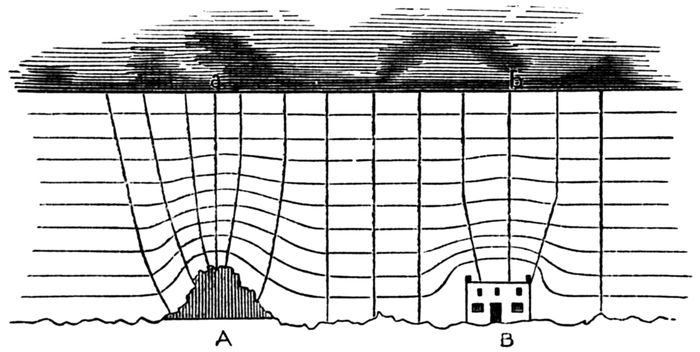
Fig. 1.
(136)If the earth-surface be not flat but have a hill or a building, as A or B, upon it, then the lines of force and equipotential planes will be distorted, as shown in fig. 1. If the hill or building be so high as to make the distance HD equal to the limit of resistance (fig. 2), then we shall again have disruptive discharge.
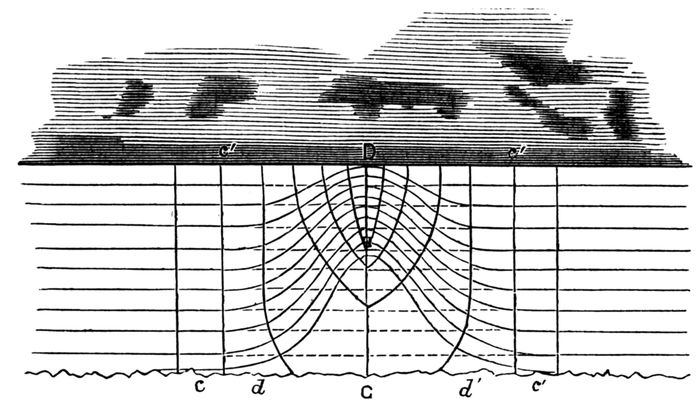
Fig. 2.
If instead of a hill or building we erect a solid rod of metal, G H, then the field will be distorted as shown in fig. 2. Now it is quite evident that whatever be the relative distance of the cloud and earth, or whatever be the motion of the cloud, there must be a space d d´ along which the lines of force must be longer than c c´ or H D; and hence there must be a circle described around G as a centre which is less subject to disruptive discharge than the space outside the circle; and hence this area may be said to be protected by the rod G H. The same reasoning applies to each equipotential plane; and as each circle diminishes in radius as we ascend, it follows that the rod virtually protects a cone of space whose height is the rod, and whose base is the circle described by the radius G c. It is important to find out what this radius is.
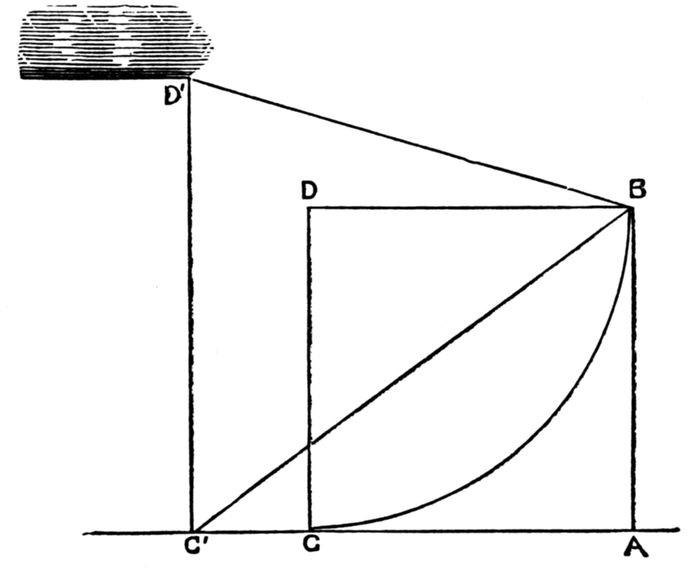
Fig. 3.
(137)Let us assume that a thunder-cloud is approaching the rod A B (fig. 3) from above, and that it has reached a point D´ where the distance D´ B is equal to the perpendicular height D´ C´. It is evident that if the potential at D´ be increased until the striking-distance be attained, the line of discharge will be along D´ C´ or D´ B, and that the length A C´ is under protection. Now the nearer the point D´ is to D the shorter will be the length A C´ under protection; but the minimum length will be A C, since the cloud would never descend lower than the perpendicular distance D C.
Supposing, however, that the cloud had actually descended to D when the discharge took place. Then the latter would strike to the nearest point; and any point within the circumference of the portion of the circle B C (whose radius is D B) would be at a less distance from D than either the point B or the point C.
“Hence a lightning-rod protects a conic space whose height is the length of the rod, whose base is a circle having its radius equal to the height of the rod, and whose side is the quadrant of a circle whose radius is equal to the height of the rod.”
Upon this rule the author makes the following concluding remarks:
“I have carefully examined every record of accident that I could examine, and I have not yet found one case where damage was inflicted inside this cone when the building was properly protected. There are many cases where the pinnacles of the same turret of a church have been struck where one has had a rod attached to it; but it is clear that the other pinnacles were outside the cone; and therefore, for protection, each pinnacle should have had its own rod. It is evident also that every prominent point of a building should have its rod, and that the higher the rod the greater is the space protected.”
SHORT ACCOUNT of the STRIKING BY LIGHTNING of the RAILWAY TERMINUS at ANTWERP, on the 10th of JULY, 1865. By M. Melsens, Member of the Royal Academy of Belgium.
(Abstracted by R. Van der Broek.)
On the date mentioned, between three and four o’clock in the afternoon, a violent storm burst over Antwerp, during which the lightning struck the Railway Terminus, without, however, occasioning any other damage than the perforation of a single hole in one of the glass squares of the roof.
The author states that the effect of the discharge on this square of glass, which was about 4mm (0·2in.) thick, was remarkable; it appeared as if it had been traversed by a projectile from below, the perforation, viewed from above, being broken and chipped, whilst viewed from below it showed a clean edge. The sinuosities caused by the chipping on the upper surface had rounded edges, and the glass appeared to have been subjected to incipient fusion. Not a single fragment of glass was found on the glass squares or in the gutters of the roof.
The author arrives at the following conclusions: The square of glass was pierced in the same manner as any square of similar nature and dimensions, placed in identical circumstances, would be, were it (138)traversed by a spherical projectile fired at a low velocity from a firearm. The fracture resembled one that would be produced by a missile thrown from below, that is to say, from the earth to the sky.
The form of the opening indicated that the earth was positively electrified.
The author notices that, according to M. F. Duprez, negative electricity generally shows itself in abnormal conditions of the atmosphere, during storms, rains, &c., and when the wind blows from the western quarters between N. and S. Now, on the day in question, it rained and the wind blew from the west.
The author publicly thanks M. Ruhmkorff for his skilful and disinterested co-operation in proving the correctness of his (the author’s) view of the distribution of the electricity at the Antwerp discharge. M. Ruhmkorff has, at request, pierced squares of ordinary glass about 1mm (0·04in.) thick by the discharge of his great induction apparatus charged by a powerful Leyden battery.
ON LIGHTNING PROTECTORS WITH POINTS, CONDUCTORS, and MULTIPLE EARTH CONNECTIONS, a detailed Description of the Lightning Protector erected on the Town Hall of Brussels in 1865, with an Account of the Principles adopted in the Construction, by M. Melsens, Member of the Royal Academy of Sciences of Belgium.
(Abstracted by R. Van der Broek.)
As the author states in his preliminary observations that it is impossible to give a complete condensed description of the Lightning Protector, which he erected on the Town Hall at Brussels, we will merely draw attention to a number of facts, regarding the system followed, some of them, we believe, of a novel description.
M. Daniel Colladon, the author states, has observed that as a rule lightning does not strike a single part or prominent point of the objects that are struck or destroyed by it; and that, in the majority of cases, it does not strike in the form of a single spark, but in the form of a sheet with one or more principal centres of intensity. The correctness of this observation, the author considers fully borne out by the ravages which the electric discharge committed on the Town Hall at Brussels, on the 10th September, 1863. He gives an elaborate description of the effects of the flash on the building. It is interesting to note that the ravages principally took place at the side exposed to the west north-west wind, which was blowing at the time the building was struck.
In the ensuing winter the Municipal Council of Brussels took into consideration the necessity of protecting the Town Hall against a similar disaster, and the author was requested to superintend the erection of lightning protectors on the building.
The characteristics of the author’s system, as exemplified by the lightning protectors erected on the Brussels Town Hall, may be briefly summarised as follows:—
1. The points are very numerous—of three kinds; some long, sharp, and gilded, others of middling length, made of iron; (139)and finally some small and very sharp, consisting of copper.
2. The points are replaced by aigrettes (brushes of points diverging from a common base).
3. The conductor is not insulated.
4. The connections are simple and unchangeable, the joints are each embedded in a mass of zinc.
5. The surface exposed to the air is considerable.
6. The conductor consists of thin, and numerous wires, which are very flexible, so as easily to be led round all the corners of the buildings.
7. The conductor is made of galvanised iron.
8. The earth connections are multiple: firstly, a well within which a large surface of metal is plunged; and, secondly, two enormous networks of metal pipes, offering an immense contact surface with the earth. One of these networks is in direct communication with all the reservoirs and all the water sources of the environs of Brussels and also in indirect communication with two rivers and two canals.
The author has arrived at the conclusion that the height of the rod is a secondary question, as the radius of protection has not been determined by irrefutable proofs, and as that length is, in comparison with the distance and the extent of the thunder-clouds, so small a factor that it may safely be neglected. The author states that he has been greatly gratified to meet with the same opinion in a paper which Mr. W. H. Preece published in Vol. I., No. 3, page 366, of the Journal of the Society of Telegraph Engineers for 1872: “When we consider the distance of the cloud and the area of its surface, the height of a building vanishes in the general figure.”
The author points out that M. Perrot has endeavoured to demonstrate by experiment that the neutralizing area of a lightning protector surmounted by a crown of sharp points is far more extensive than that of an ordinary protector. M Perrott further thought, and MM. Babinet and Gavarret shared his opinion, that it is sufficient to shelter the ordinary protector from discharges of lightning by arming it with numerous, long, sharp, and well conducting divergent points. M. Gavarret after having repeated Mr. Perrott’s experiments, found the results so conclusive that he wrote to the author in the beginning of 1865: “It is at the present time no longer permitted to erect lightning protectors with single points.”
The metal of which the points are made must be a very good conductor. With regard to their conductivity, the metals follow each other in the following order: copper, silver, iron, platinum. No metals are used but those which resist fusion. The author rejected platinum and silver: the former because it fuses very readily by the electric discharge; and the latter, because it has, in his opinion, no advantage over copper.
The conductor, although galvanized, received several coats of paint; but the points (aigrettes) of course remained metallic. With regard to the general principle of connecting the protector with any masses of metal which may be about the building, the author has ever since (140)1865 endeavoured to demonstrate, that it is not sufficient, as might at first sight be supposed, to form that connection at one single point; there must be at least two points of contact, so as always to ensure a closed metallic circuit.
The contact with the water presents a surface of about ten square metres (12 sq. yds.), bringing both surfaces of the cylinder into account.
With regard to the earth connection, the author quotes M. Perrot, who remarks that with the ordinary protector the surface immerged offers a resistance at least 10,000 times greater than the conductor itself; it is therefore necessary to increase the surface of the earth-plate as much as possible.
In order to retard as much as possible the oxidation of the cylinder, the author introduced two hectolitres (6 bushels) of lime into the well, thus rendering the water alkaline.
DE L’APPLICATION du RHE-ÉLECTROMÈTRE aux PARATONNERRES DES TÉLÉGRAPHES. Par M. Melsens.
(Abstracted by R. Van der Broek.)
In this pamphlet the author describes in § 1 an apparatus to show the presence of atmospheric electricity in telegraph wires.
In §§ 2 and 4 he explains how the apparatus is joined up in the Belgian telegraph offices.
§ 3 contains a résumé of observations made at the government telegraph offices between June, 1875, and March, 1876.
The author states in this paragraph that, on the 19th of June, 1875, the Rheo-Electrometer at the office at Louvain, showed a deflection of 85° East, although there was not the slighest appearance of atmospheric electricity. The fact was, that at the time a thunder storm was raging at Beverloo, distant from Louvain about 40 kilometres (25 miles).
TROISIÈME NOTE sur les PARATONNERRES. Par M. Melsens.
(Abstracted by R. Van der Broek.)
On the 3rd of July, 1874, the church of Ste. Croix, at Ixelles, was struck by lightning. The building was provided with a lightning protector, which was constructed as follows: The point consisted of a platinum cone of about 30° (the form officially adopted in France in 1855), all the supports of the protector were soldered with zinc. This was attached to the steeple, and rose to 53 metres or 174 feet above the pavement. It consisted of an iron rod 18 mm. (0·71 in.) in diameter (M. E. Sacré’s system). The conductor passed from the principal roof along the roofs, descending to a point near a pump, behind the vestry, where the well (W) was situate. There is an abundance of water in the well, which is about 7 m. (23 ft.) deep. The conductor terminated in the well, by a cast-iron plate 0·65 m. (2 ft. 1 in.) by 0·50 m. (1ft. 8 in.), thus presenting a surface of 0·654 ⬜ m. (7 sq. ft.). A little in front of the transept there is a supplementary rod B 5·25 m. (17 ft. 3 in.) high, 11 m. (36 ft.) distant from (141)the point (c in diagram) which was struck; and 22 m. (72 ft.) distant from that point there was a second rod D, whose height was 9 m. (29½ ft.) above the top of the roof.
The damage to the church was trifling, but the author contends that the fact of the church having been struck at all, proves that a building armed with a protector constructed on the usual principle is not completely protected.
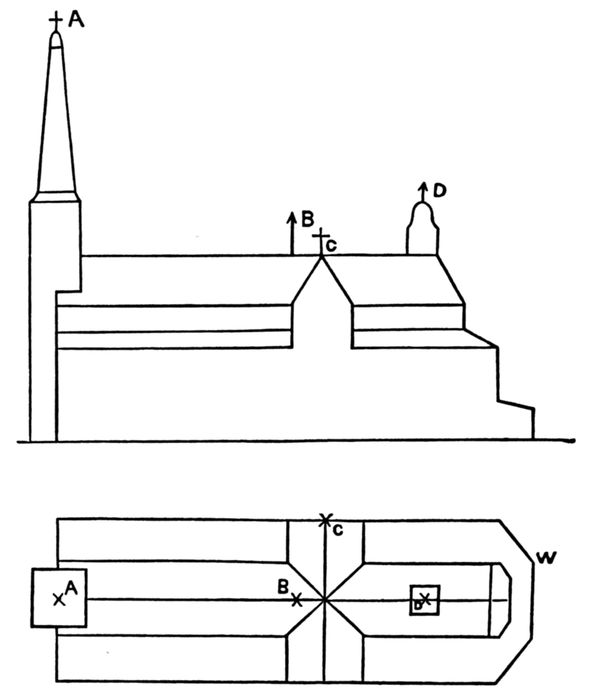
A. Principal conductor on steeple.
B. D. Two supplementary receiving rods.
C. Stone cross at end of transept, which was struck,
W. Well in which conductor made earth connection.
QUATRIÈME NOTE sur les PARATONNERRES. Par M. Melsens.
(Abstracted by R. Van der Broek.)
This treats § 1 of observations on the distribution of the spark of electric batteries and machines over numerous metallic conductors of different sections, lengths, and nature, and on the passage of electricity of tension in bad conductors.
§ 2. Effects of soldered joints on the conductivity and the resistance of conductors. Interrupted lightning protectors.
§ 3. The distribution of sparks from Holtz’s machine and Ruhmkorff’s coil over two conductors outwardly identical, but one of iron and the other of copper. Comparative resistance to fusion and rupture for iron and copper conductors. Identical damage produced by discharges in several homogeneous and solid conductors.
(143)