APPENDIX F. ABSTRACTS OF PRINTED DOCUMENTS. (continued 2)
Reading edition
Instances are given of ships not provided with lightning conductors being struck and damaged, whilst others lying near, and provided with conductors, were not injured. The question of lightning conductors attracting lightning considered, and evidence shown to the contrary. Lateral discharge from a lightning conductor considered. Evidence against it, if only the conductor were continuous and of sufficient size. Faraday considered that a man leaning against one of Harris’s conductors when the electricity descended would not be hurt. Proposition to place a globe of glass on the head of the mast in place of a lightning conductor considered, and the conclusion arrived at that it would do harm.
Wheatstone stated that “in the Report of the Committee of the Academy of Sciences of Paris, appointed to investigate the utility of lightning conductors, there is no instance on record of an iron rod of ½ inch in diameter being fused or even made red-hot by a flash.”
Mechanical objections to lightning conductors on ships considered and discussed. Decided that the application of Mr. Harris’s conductor tended rather to strengthen than weaken the mast and spars. Then (84)follows a large number of letters, giving accounts of accidents from lightning to ships, &c.
Decision arrived at that on the whole Mr. Harris’s conductor is the best of those examined.
THE DIFFERENCE between LEYDEN DISCHARGES and LIGHTNING FLASHES. By C. V. Walker, Hon. Sec. Lon. Electrical Soc. London. 1842.
(Abstracted by Prof. T. Hayter Lewis, F.S.A.)
The author alludes to the experiments of Franklin, &c.
The distance to the lower surface of clouds, observed by Le Gentil and others, shows an average of 1000 to 2000 feet, whereas the greatest length of spark with a large machine is 3 to 4 feet.
The inductive action bears some inverse ratio to the distance.
Leaves of trees have a remarkable property of silently drawing off electricity.
He gives the particulars of a large number of experiments, with arguments thereon, to prove the theory of the difference between Leyden discharges and lightning.
Quotes examples of lightning on conductors and buildings to show that the conductor takes part only of the charge, the remainder taking other paths. Contiguous semi-insulated bodies must not be left unconnected with the lightning rod.
He quotes, with approval, the advice of Faraday, viz., to tie together with a metallic connection all contiguous readily-conducting bodies.
Cites numerous other opinions to the same effect, viz., that all metallic parts of a building should be connected with the conductor.
He sums up by stating “that the Leyden charge differs considerably not so much in nature as in degree from that of the cloud, inasmuch as the proximity of the coatings in the one case is infinitely small compared with the distance in the other,” &c.
He expresses great confidence in Sir W. S. Harris’s system for protecting ships.
THE EFFECT OF A LIGHTNING FLASH on the steeple of BRIXTON CHURCH, and OBSERVATIONS ON LIGHTNING CONDUCTORS GENERALLY. By C. V. Walker. London. 1842.
(Abstracted by Prof. T. Hayter Lewis, F.S.A.)
The author refers to Faraday’s experiments, as shewing instances of lateral discharge, and says, “unless precautions are taken to prevent its proceeding from a lightning conductor, that instrument literally invites the enemy within doors.”
He gives detail of the accident at Brixton, there being no lightning conductor.
(85)The stroke did much damage to the steeple and then passed off harmlessly by the metal gutters and rain-water pipes.
One side of the steeple was drenched with wet and carried off part of the stroke.
He quotes examples of the apparently protective action of high trees.
Lofty trees near lofty buildings would materially mitigate, if not prevent, the violence of the stroke.
The accident at Brixton shows that the lightning takes not simply the shortest, but, in addition, the largest path.
Had the steeple been provided with a lightning conductor outside, passing near the clock face or the bells, or water pipe, it is more than probable that a flash would pass from it to these vicinal conductors.
If outside the tower the danger would be greater. He recommends that the metal cross on the steeple be replaced by a stone one, and that the present iron rain water-pipes be connected by copper rods or plates, which are also to be connected with the lead work of roof.
The bells are also to be connected with each other and with the conductor.
Every bolt-clamp or other piece of metal within “striking distance” of the conductor, unless in direct communication with it, is liable to cause lateral discharge.
The odour developed by lightning was, at Brixton, decidedly sulphurous, as a piece of stone which was shattered by the stroke retained the odour of sulphur distinctly for several hours.
ON THE NATURE OF THUNDERSTORMS; and on the means of protecting buildings and shipping against the destructive effects of lightning. By W. Snow Harris, F.R.S. 1843.
(Abstracted by Prof. Ayrton.)
The backstroke may do injury, that is, a person may be killed in consequence of a flash of lightning passing between the clouds and the earth at some distance from the person.
In the Phil. Trans. for 1787, Mr. Brydone writes to the President of the Royal Society, and mentions the case of two men riding in two carts, the front one drawn by two horses, these horses and the man driving them were killed;, the man on the hinder cart and a shepherd at a distance, saw the occurrence and heard a report but observed no lightning.
A metallic screen appears to protect the interior from the action of a current, as well as from static induction.
Dr. Franklin found he could not destroy a wet rat by artificial electricity, although he could a dry one.
The first lightning conductor was erected in England at Payneshill, by Dr. Watson, in 1762.
The lightning conductor should expose a large surface, and should be united with all the great masses of metal in its vicinity. For stationary elevations the conductor should consist of solid or tubular rods or flat plates of metal. We must consider the mechanical action (86)the lightning may produce on the conductor, as well as any possible heating action. Sir W. Snow Harris mentions that there were no signs of fusion in the fragments of the linked brass rod, at Charles Church, Plymouth, torn to pieces in 1824, or in the small pieces of the conductor at the Hotel des Invalides, at Paris, consisting of a strand of twenty iron wires, and which was smashed in 1839.
He says the benefical effect of superficial conductors appears to depend on the removal of the electrical particles further out of the sphere of each other’s influences.
“Thus we find,” says Sir W. Snow Harris, “in a variety of cases of damage by lightning that the passing charge, in striking on large expanded sheets of metal has become comparatively tranquil, and has been traced no further, whilst in striking on large masses of metal exposing but a small surface, it has assumed an intensely active state.”
He goes on to state that the resistance of the conductor must be kept as low as possible, and as neither the resistance nor the heat developed is increased by rolling the wire out into a flat surface, he argues that “there is, consequently, no disadvantage in giving a lightning rod as much superficial capacity as possible, as regards conducting power, whilst, on the contrary, the diminished intensity attendant on it is very advantageous: this effect of superficial conductors appears to depend on the removal of the electrical particles further out of the sphere of each other’s influence.”
What quantity of metal is requisite for a lightning rod? He concludes from the results of a number of accidents that “a copper rod ¾ inch diameter, or an equal quantity of copper under any other form, would withstand the heating effect of any discharge of lightning which has yet come within the experience of mankind.”
Practical deductions.—“From the various enquiries contained in the first 123 pages of this book, we arrive at the following deductions:—
“1st. Copper is the best kind of metal for a conductor.
“2nd. The quantity of metal should not be less than that represented by the section of a solid cylinder ½ inch diameter.
“3rd. The metal should be placed under as great an extent of surface as is consistent with strength, and should be perfectly continuous.
“4th. The conductor should involve in its course the principal detached masses of metal in the building.
“5th. It should be placed as close as possible to the walls which are to be defended, and not at a distance from them, and be carried at once directly into the ground.
“6th. It should be attached to the most prominent points of the building, and if the length be very considerable its dimensions should be increased.
“Lastly. In extensive ranges of buildings, all the most prominent parts should have long pointed rods projecting freely into the air, and the greater the range of building the higher they should be.
“In particular cases, in which expense must necessarily be considered, wrought iron tubing may be employed; it should not, however, be less than 2 inches in diameter, and 3/10ths of an inch in thickness.”
Insulating the lightning conductor from the building is quite valueless.
(87)The method of fixing lightning conductors to ships is explained at considerable length.
Range over which the protecting power of the lightning rod extends.—Great doubts exists as to the answer to this question, since in many cases one portion of a building has been struck while a lightning rod in good condition existed close by.
For example, the powder magazine at Bayonne was 56 feet long, 36 feet wide, covered with thick vaulted masonry and a sloping roof with gable ends, protected by plates of lead; the gutters were also of lead, and there were the usual spouts for discharging the rain. The lightning rod projected about 20 feet above the building, and was attached to the lead of the roof by a metallic socket through which it passed, and which was soldered to one of the lead coverings. Instead of being carried, however, directly into the earth at the foot of the wall, it was turned outward at about 2 feet from the ground, and being bent at right angles, was continued on semi-insulating posts of wood into a trench filled with charcoal, distant 33 feet from the wall.
On the 23rd of February, 1829, the building was struck, the point of the conductor melted, and the leaden plates by which it was attached to the wood posts at the foot of the wall, were more or less torn and perforated by holes. No damage, however, ensued to the building in the course of the conductor. At the south-west corner, a sheet of lead covering the gable end was torn out immediately over a point where two stones of the cornice were united by an iron cramp.
Sir W. Snow Harris considers the possibility of this damage having arisen “from the conductor (in consequence of being continued at so great a distance from the building) not offering a sufficiently easy line of transit for the discharge to the earth,” but he rejects this explanation and concludes that the damage arose from the lightning striking the building in two points.
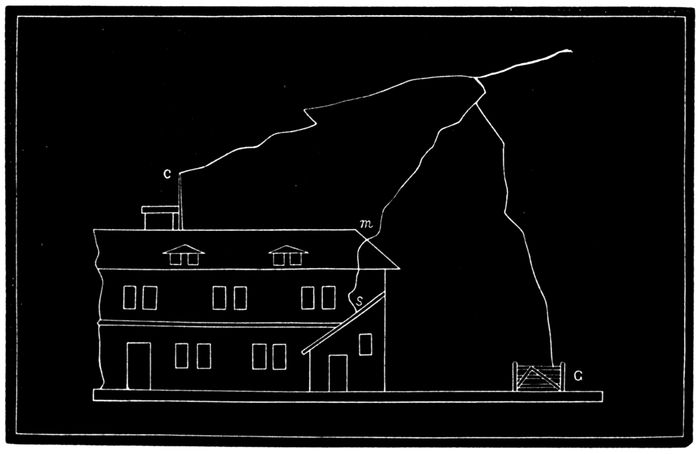
Again, the Heckingham poorhouse, although armed with eight pointed lightning rods, was struck, in 1787, at a point m, 70 feet from the nearest conductor c.
(88)
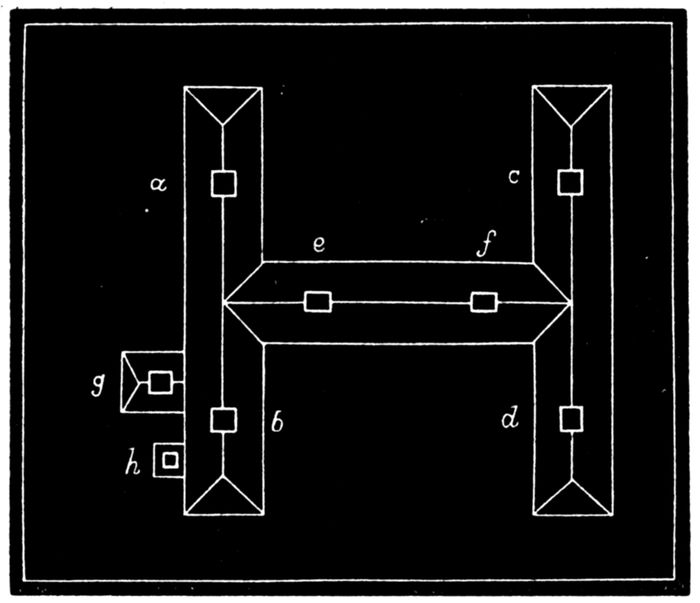
The squares at a, b, c, d, e, f, g, h, indicate chimneys to which lightning conductors were attached. The centre range was 108 feet long, the flanks each about 160 feet long: the details of the lightning conductors are not given. One portion of the lightning discharge struck one of the conductors and was carried off by it without damage to the building, one portion struck the building at the point m and also the shed at s, doing some damage, and a third portion struck the ground immediately in front of the building near a gate, G.
The ship Ætna was struck in 1830 by several heavy electrical discharges when at Corfu. These for the most part passed down a chain conductor attached to the mainmast. One of the discharges, however, struck the ship near the bow, and exploded about 12 feet above the forecastle close to the foremast, knocking people down, &c.
The Board-house at Purfleet was a lofty building with a pointed roof, well leaded and connected by lead gutters and pipes with the earth, and with wells 40 feet deep for the purpose of conveying water forced up to a cistern on the roof. It was, therefore, only thought necessary to add an iron spike about 10 feet long to the middle of the highest part of the roof. The building, however, in 1777, was struck and slightly damaged at a point 46 feet from the conductor.
Several other examples illustrating how small an area a lightning rod protects follow.
Sir W. Snow Harris further concludes that experience shows that lightning will not leap from a lightning rod to a piece of insulated or semi-insulated metal near it, although a discharge may take place between the rod and a distant metallic mass in connection with the earth, but not otherwise in connection with the rod.
He lastly considers the question, formerly much debated as to whether a lightning rod attached to a house will attract to the house a discharge that otherwise would not have struck it, and he concludes that there is no foundation for the erroneous impression that the existence of a lightning conductor can ever cause damage.
(89)
AN ACCOUNT of the CHIMNEY of the EDINBURGH GAS WORKS. By G. Buchanan, C.E., F.R.S.E.
[Proceedings of the Royal Scottish Society of Arts, 1850–51.]
(Abstracted by G. J. Symons, F.R.S.)
This chimney has a total height of 341½ feet (329 feet above ground), it is circular; at the top the internal diameter is 11 feet 4 inches, and the external 13 feet 10 inches; and at the bottom, internal diameter 20 feet, external 26 feet 3 inches.
Respecting the conductor Faraday was consulted, and replied as follows:—
“The conductor should be of ½ inch copper rod, and should rise above the top of the chimney by a quantity equal to the width of the chimney at the top. The lengths of rod should be well joined metallically to each other, and this is perhaps best done by screwing the ends into a copper socket. The connection at the bottom should be good; if there are any pump pipes at hand going into a well they would be useful in that respect. As respects electrical conduction, no advantage is gained by expanding the rod horizontally into a strap or tube—surface does nothing, the solid section is the essential element.[4] There is no occasion for insulation (of the conductor) for this reason. A flash of lightning has an intensity that enables it to break through many hundred yards (perhaps miles) of air, and therefore an insulation of six inches or one foot in length could have no power in preventing its leap to the brickwork, supposing that the conductor were not able to carry it away. Again, six inches or one foot is so little that it is equivalent almost to nothing. A very feeble electricity could break through that barrier, and a flash that could not break through five or ten feet could do no harm to the chimney.
“A very great point is to have no insulated masses of metal. If, therefore, hoops are put round the chimney, each should be connected metallically with the conductor, otherwise a flash might strike a hoop at a corner on the opposite side to the conductor, and then on the other side on passing to the conductor, from the nearest part of the hoop there might be an explosion, and the chimney injured there or even broken through. Again, no rods or ties of metal should be wrought into the chimney parallel to its length, and therefore to the conductor, and then be left unconnected with it.”
In answer to some further inquiry, Professor Faraday again wrote:—
“The rod may be close along the brick or stone, it makes no difference. There will be no need of rod on each side of the building, but let the cast-iron hoop and the others you speak of be connected with the rod, and it will be in those places at least, as if there were rods on every side of the chimney.
“¾ rod is no doubt better than ½ inch, and except for expense I like it better. But ½ inch has never yet failed. A rod at Coutt’s (90)brewery has been put up at 1½ inch diameter—but they did not mind expense. The Nelson column in London has ½ inch rod, ¾ is better.
“I do not know of any case of harm from hoop-iron inclosed in the building, but if not in connection with the conductor, I should not like it; even then it might cause harm if the lightning took the end furthest from the conductor.”
The following paragraph states what was done:—
“The electric conductor stands 6 feet above the iron top-plate, ⅝-inch round copper, made fast to stone and brickwork with 7⅞-inch copper holdfasts let 4 inches into the masonry or brickwork, with a head on the inside and an eye on the outside to receive the rod as it was carried up. By these holdfasts an ascent can easily be made to the top by a small tackle suspended to the holdfasts. The conductor is metallically connected to all the ironwork on the stalk—the plate on the top, projecting cope, malleable iron hoops, bolts on the top of stone pedestal, and also the ascending chain. The rod descends into a well about 10 feet from the foundation, and is immersed about 8 feet deep in water, and the end turned up 2 feet in a horizontal direction, and flattened.”
PAPERS relative to SHIPWRECKS BY LIGHTNING, as prepared by Sir Snow Harris, and presented by him to the Admiralty.
(August 5th, 1854. Parliamentary Paper. Fcap. folio).
(Abstracted by Professor W. E. Ayrton).
Number of merchant ships destroyed by lightning, loss to the country. Application of lightning conductors to ships in 1820. Mode of applying them. Mechanical difficulties; how overcome. The saving to the Exchequer which has resulted.
Long account of various ships in the Royal Navy not provided with lightning conductors, struck by lightning and damaged. Loss of life and injury that has resulted. Long account of ships provided with lightning conductors, and so preserved.
Sir Snow Harris states that “although his system of lightning conductors ought to guard against all those violent and regular shocks of lightning falling within the ordinary experience of mankind, it is not to be expected that the system could guard against every possible kind of atmospheric electrical discharge, be the circumstances what they may, such as thunderbolts, fire-balls; nor is it expected that it should guard against meteorolites, or against sweeping electrical action mixed up with convulsions of nature; nor can it quiet those minor electrical effects producing electric glow; nor can it always obviate that tremendous concussion and expansion of the atmosphere in cases in which a thunder-cloud discharges its lightning in a dense explosion on the masts, and which may rupture, or mechanically tear to pieces, frangible matter.”
(91)
STATISTICS OF BUILDINGS AND SHIPS STRUCK BY LIGHTNING. By F. Duprez, Member of the Academy.
[Académie Royale de Belgique, Extrait du Tome 31 des Mémoires, 5th December, 1857.]
(Abstracted by Professor T. Hayter Lewis, F.S.A.)
M. Duprez refers to the Report of a Committee of the Institute of France. (Vide Comptes rendus, 1852–6.)
He divides the subject into the following heads:—
1. The frequency with which lightning rods are struck.
2. Their terminal points and the effects of the stroke on them.
3. The conductors and their ground connections.
4. The protective power of the lightning rods.
1. Concerning the frequency with which lightning conductors are struck by lightning.
The author cites 144 cases of lightning rods having been struck. Of these seventeen were struck two or three times, so that the total number of electric discharges on them was 168, as far as recorded.
But very many cases are not recorded at all, e.g., from 1793 to 1813 only two cases were noted. The great number of lightning rods struck would seem at first to support the idea that they attract lightning.
But we must compare the number of rods struck with those fixed, and we find from a communication made in 1777 to the Academy of Berlin, that, even then, a large number were fixed to the most important edifices of N. Italy and England.
The same in 1784 to those in the ports of France and to the ships in the said ports.
In 1794 the fortresses of Russia were ordered to be so protected.
In 1769 there were 166 edifices in Hamburg alone, and 104 in its environs, with conductors.
If the number of conductors were so great in the last century, we must conclude that the number of those struck must be very inconsiderable as compared with those fixed.
In Hamburg, e.g., not one rod is recorded as having been struck.
In 1785, Ingen-Housz reports that of all the lightning rods placed by his direction on the Austrian powder magazines and other buildings only one had been struck.
In 1772, Franklin wrote, that during the twenty years in the course of which lightning rods had been fixed in America he knew of five cases only in which these rods had been struck.
Sir W. S. Harris reports in 1854, as the results of twenty-two years’ experience, that the number of vessels struck unprotected by lightning rods, as compared with that of vessels protected by his plan, was as three to two.
The above show that the idea of danger from lightning rods is not well founded.
Besides which it must be remembered that they are frequently placed in the most exposed positions, e.g., of the 144 rods struck, (92)seventy-four were on ships, and fifteen others on buildings which had been struck before.
One would think that the number of terminals placed on a building would diminish the chances of their being struck, but it does not seem to be so; e.g., twelve buildings in the first list had many terminals communicating with a common conductor or different conductors.
Yet the lightning struck, with explosive effect, one or other of the rods of these buildings.
And in each of two cases the lightning struck at once the three rods fixed to a building.
Of the 144 cases above cited:—
74 were to lightning rods fixed on ships
30 were to lightning rods fixed on towers
9 were to lightning rods fixed on powder magazines
31 were to lightning rods fixed on ordinary buildings.
144
In forty-four cases where one of Sir W. S. Harris’ conductors was fixed to each mast of a ship, the mainmast was struck twenty-seven times; the foremast was struck fourteen times; the mizen was struck twice; both the main and foremast twice.
2. As to the points of the lightning rods struck, and the effect produced on them.
(Sir W. Snow Harris’s system as adopted in the British Royal Navy since 1830 is described. They are formed of bands of copper let into the masts. They have no upper terminals or points, and fifty-five are included in the list already quoted of 144 lightning rods struck.)
Of the eighty-nine cases remaining in the list, only fifty-one are recorded as having their upper terminals ended with points.
Of these, thirty had their points melted to a greater or less extent; six of them were of copper or brass; five were of copper gilt or iron gilt; one was of brass silvered; and four were of platinum. The others are not distinctly described, and the sizes seldom given.
One of brass was 25·4 centimetres (c. 10 inches) long, and 5 millimetres (⅕th inch) diameter at its base, and was melted for ¼th of its length.
One of copper was 24 centimetres (c. 9½ inches) long, and 9 millimetres (c. ⅓rd inch) diameter at base, and was almost all melted.
One of platinum was 8 centimetres (c. 3 inches) long, and 1 centimetre (c. ⅓rd inch) diameter at base. This was melted for a length of 5 or 6 millimetres (c. ⅕th inch.)
It results from the above facts that the points of the lightning rods have been much too slender.
The Institute of France recommends, therefore, for the points 2 centimetres diameter (c. ¼th inch) at base, and only 4 centimetres (c. 1½ inches) high, with an angle of opening of 28 to 30 degrees.
It has been urged, especially in Germany, against the employment of pointed upper terminals that these points are fused by the (93)lightning, this fusion being regarded as dangerous on account of its action on inflammable substances near.
As to this, the author cites three cases of buildings set on fire, though protected by lightning rods. But the precise cause of the fire was not ascertained.
Several observations show that the melted metal trickled down the side of the lightning rod.
At Strasbourg the metal was pressed down on one side, and had bent like wax softened by heat. At other times the lightning disperses the melted metal in all directions. (Examples quoted.)
With these facts before us we cannot altogether deny that some danger may arise from the fusion of the metal at the point of the terminal. But this danger can be much lessened, if not removed, by adopting the size, etc., of the lightning rods recommended by the Institute of France.
Besides fusion, the points sometimes show distinct traces of mechanical action caused by lightning.
The author quotes six examples of this where the points had been curved.
This shows the necessity of strengthening the points of the upper terminals. The curvature arises, probably, from the points being much heated by the lightning, and acted on by the wind.
One case is noted of a point which had the appearance of having been struck violently by a hammer.
Also of one in which the base of a point, where it was screwed to the rest of the upper terminal, was split for a length of 11 millimetres (c. ½ inch).
Also of a platinum point screwed on the upper terminal (copper), and retained by a pin, where the stroke tore away the pin, the point falling intact at the foot of the lightning rod.
3. Of Conductors of lightning rods struck, and their contact with the ground.
The author refers to forty-one cases of lightning rods struck when not on Harris’s principle.
Of these, 5 were of copper bands soldered together; 5 were of copper wire either as rope or chain; 1 was made of bands of sheet iron; 11 were of bars of iron joined by screws or by solder; 3 had pieces of lead between the parts where they were screwed together; 3 were of simple iron wire, or of rope or chain of iron wire; 3 were of iron joined together by hooks; 12 are described as chains (metal not specified); 1 is described merely as a conductor.
The dimensions of the above are seldom given.
The largest bands reported are 16 centimetres (c. 6¼ inches) in width.
The largest bars reported are 55 centimetres (c. 2¼ inches) in width and 15 centimetres (c. ½ inch) in thickness.
The description of the earth connection is also imperfect.
Of eighty-nine lightning rods described as struck, only twelve are noted as having their ends in running water or wells, and one in damp soil.
Fifteen simply entered the ground, it being noted expressly of six of these that it was dry.
(94)In three cases were the lightning rods were struck the author found that the part at the base and in the damp earth had terminated in a plate of lead, protected above the ground by a wooden enclosure.
Three conductors of ships did not communicate with the sea.
Twenty-three cases are noted of ordinary conductors (not on Sir W. S. Harris’s principle).
The lightning melted, or reduced almost to powder, three.
The first was on a house, and was of copper wire, the diameter not known, ending with a chain of iron buried in the earth.
The second was on a ship’s mainmast, and was of iron wire 6 millimetres (c. ¼ inch), diameter, 46 centimetres (c. 18 inches) long, folded at their extremities, and united by rings.
The third (also to a ship) was a rope of three strands formed in the whole of 60 brass wires, each being one half to two-thirds of a millimetre thick.
The two last conductors had their ends in the sea.
The parts of these conductors, in place of being soldered or screwed together, were joined merely by hooks and rings like a surveyor’s chain. Evidently a bad form as their contact is imperfect.
In three other conductors, whose different parts were screwed together with lead between them, the stroke melted the lead.
This shows the danger of lead from its fusibility, in addition to its less conducting power.
The author gives examples of this, wherein a leaden pipe, 8 centimetres (c. 3¼ inches) external diameter, and 13 millimetres (c. ½ inch) thick, was melted.
He quotes Arago as calling attention to the importance of the form of the bends in conductors, abrupt bends being dangerous.
Two examples are quoted to prove this, the conductors having been broken by the lightning stroke at a sudden bend.
To provide lest the lightning, after having struck the lightning rods, should abandon them for larger masses of metal near them, these masses should be made to communicate with the conductors.
Cases are cited where the lightning quitted the conductor and struck metallic bodies near. Also, in respect of painting conductors, the author quotes a case where part of a bell wire adjoined a lead pipe which communicated with the conductor. Part of the wire was painted in oil colour, the other part not. The latter was melted, the first not, but the paint (though otherwise uninjured) had ceased to adhere to it.
Three examples are cited of danger from conductors ending in watertight tanks.
In one case the stroke broke the conductor.
In another it left the conductor and injured the building.
In the third it merely melted the point of the upper terminal.
Nevertheless, it often happens that the lightning, in spite of imperfect communication with the earth, disperses itself inoffensively.
Out of fifteen cases of lightning rods struck, in which the conductors were simply buried, more or less, in the soil, they carried off the stroke in eleven without the buildings being injured, or any trace (95)being left of it, except that the ground was upheaved where the latter was too dry.
The French Institute, in their report on the protection of the Louvre, considered it necessary to employ, under certain circumstances, a conductor with two branches, the one descending into a subterranean source of water, the other communicating simply with the surface of the earth.
On the other hand, Arago thought that conductors need not enter the ground, but communicate only with a metallic surface lying on the ground.
This view is confirmed by the cases which the author mentions where the surface of the earth being wetted by rain formed a conductor.
Nevertheless, the two branches are desirable, in case one should fail.
Fifty-five conductors on Sir W. S. Harris’s system are recorded as having been struck, but the damage was quite trivial.
Two electrical phenomena are to be noted as sometimes occurring when a lightning rod is struck.
First, when a conductor is formed of metallic plates a peculiar noise is heard like water pouring on a fire.
Second (independently of the form of the conductor), electric sparks are emitted from bodies near. The author cites example at Berne, 1815.
4. Protective agency of lightning rods.
Out of 168 cases of lightning rods struck (vide page 91) there are only twenty-seven (c. ⅙th) in which the buildings or ships have not been preserved, and of this sixth many of the conductors were imperfect; e.g., four terminated in earth which was unusually dry, and two of them were of insufficient size.
Another was formed of pieces having their ends hooked.
Two conductors ended in watertight tanks.
Another was in the form of a surveyor’s chain, the parts not being, consequently, in close contact.
Others were badly jointed, or had imperfect communication with the ground or with the sea.
In two cases the stroke broke the conductor at points where its direction was abruptly changed.
In two other cases the lightning left the conductors struck, and fell upon buildings near without causing damage to those on which the rods were fixed.
In the instance of a lightning rod fixed to the mainmast of the Jupiter (1854), the conductor was made of sixty brass wires, one half to two-thirds of a millimetre (0·02 inch) thick, and was broken by the stroke into thousands of pieces. The Institute Committee concluded that the lightning was not conducted by all the wires of the conductor. Those which it followed were insufficient to transmit it; some were melted, some broken. The Committee recommended, therefore, that each metallic wire be tinned separately at the extremity of the conductor, and soldered thereto for a length of about a decimeter (c. 0·4 inch), so as to form a metallic cylinder.
(96)In the last six cases the particulars of the lightning rods are not given sufficiently to show the cause of their failure, but five are described as being of chain or ropes of metal wire.
It results from the above facts that when the lightning rods have proved insufficient protection, their failure has been owing to defects in their construction; it is rather surprising to find how well buildings and ships have been protected, even when the lightning rods have not been well constructed.
In every one of the fifty-five cases where Sir W. S. Harris’s rods were fixed they have protected the ships, except that not having points some slight damage has sometimes occurred to the tops of the masts.
This shows their superiority over ropes or chains.
Arago thought that lightning rods were protection against ordinary lightning, but not when it assumed the form of fire-balls. The author cites several examples to show that this opinion was not well founded.
He considers a perfectly constructed lightning rod to be a perfect safeguard.
But he adds that the lightning stroke produces electric disturbances in its vicinity, although the building be intact.
He cites an example of this in respect of a prison whose inmates (300) experienced a great enfeebling of their muscular power during some seconds.
Very few records exist relating to the area of action of lightning rods, and the elements for determining their protective power are slight. The author gives a table showing the heights of points, horizontal distances, &c., in certain cases, and cites four instances of ships whose foremasts were struck although the mainmasts had lightning rods, and one where the mizen was struck though the fore and mainmasts were protected.
TABLE GIVEN BY M. DUPREZ.
In Metres. In English Feet.
1st Case. 2nd Case. 3rd Case. 4th Case. 1st Case. 2nd Case. 3rd Case. 4th Case.
Length of upper terminal, or height of point above that portion of the building on which the upper terminal was fixed. 1·5 3·4 1·5 2·3 5 11 5 8
Vertical height of point above the place struck. 1·5 7·6 6·7 71·2 5 25 22 232
Horizontal distance of place struck from the base of upper terminal. 15·2 7·3 17·4 59·9 50 24 57 197
These instances show that we should be misled in considering, as being protected, a circular space whose radius was double the height of the lightning rod.
The protected radius appears to be only equal to double the simple height of the upper terminal above any required point, and reckoned horizontally from a point vertically under the conductor.
(97)[It will be observed that M. Duprez here contradicts himself in two consecutive sentences, and in a subsequent part of his work (p. 30) of the Memoir, he again says: “Aucun des cas indiqués dans le numéro précédent n’infirme la règle généralement admise, savoir que la sphère d’action d’un paratonnerre s’étend, dans toutes les circonstances, à un espace circulaire d’un rayon égal au double de la longeur de la tige, c’est-a-dire de la hauteur de la pointe au-dessus de la partie du bâtiment sur laquelle la tige est fixée.”
But the table given by M. Duprez gives two instances in which the stroke fell within the radius of once the height.—Ed.]
RESUMÉ.
In the paragraphs which the author numbers 1, 2, 3, 4, and 6, he refers to former statements as to the proportion of lightning rods struck, &c. (Vide page 91, &c.)
5. There being several terminals on an edifice does not seem to diminish the chances of each being struck.
7. In vessels, when the three masts have lightning rods, the mainmast is most frequently struck.
8. Refers to Sir W. S. Harris’s lightning rods as being without terminal rods or points.
9. The points of ordinary lightning rods have been made too slight.
10. Out of fifty-one cases of lightning strokes, thirty points have been more or less melted; and the fusion is not without danger to the buildings.
11. The lightning often leaves traces of mechanical action more or less decided.
12. Refers to defective constructions of ordinary lightning rods.
13. Lead plates in conductors composed of bars joined together are dangerous.
14. So are abrupt bends.
15. Conductors should communicate with the masses of metal near.
16. And must not end in watertight tanks. But
17. Conductors often protect buildings, though the ground connections are imperfect.
18. It is well for a conductor to have two branches, viz., one in water, and the other on the surface of the ground.
19, 23. Refers to the complete efficiency of Sir W. S. Harris’s conductors.
20. Mentions the noise, electric sparks, &c., given off during a stroke, as before stated (page 95).
21. Mentions the efficacy of lightning rods generally.
22. Their failure being owing to defective construction.
24. There is no proof that the electricity being in the form of a ball has been the cause of any conductor’s inefficiency.
25. The lightning rarely bursts on a building or ship without striking the lightning rod placed on it. Exceptions have, however, occurred in ten cases, as here described. But
26. None of these instances invalidate the rule generally admitted, (98)that the protective action of the lightning rod extends, under all circumstances, to a circular space whose radius is equal to double the length of the upper terminal, i.e., the height of the point above the part of the building on which the upper terminal is fixed.
ON ATMOSPHERIC ELECTRICITY.
By Reuben Phillips. London, 1863.
(Abstracted by W. H. Preece, C.E.)
This is a pamphlet of seven chapters, and fifty-seven pages, written to ventilate the author’s own notions of the nature of electricity and its production in the atmosphere. He considers electricity to be two fluids of a species of substance, consisting of separated subsidiary atoms. “Electricity is comparable to a flying bullet; the vis vivâ of the bullet is like electrical intensity, and the mass of the bullet answers to the quantity of electricity.” What the subsidiary atoms are like he does not say.
Chapter I. is a fair resumé of what is known of the electricity evolved by the friction of wet steam against solids in the hydro-electric machine. He agrees with Faraday that the cause of the evolution of electricity by the liberation of confined steam, is not evaporation, but the friction of the water particles against the sides of the jet-piece or orifice. Pure gases do not excite electricity; but impure air, when compressed does, from the friction against the orifice of those particles of water which are suddenly condensed by the cooling influence of the expanding air.
Chapter II. is an attempt to show that electricity is evolved by the friction of “gaseous matter” against water, or vice versâ. Ordinarily the issuing vapour in the hydro-electric machine is positively, and the boiler negatively, electrified; but cases occur where this is reversed. According to the author, water by friction against gaseous matter or air, becomes positively electrified.
Chapter III. applies this theory to thunder clouds, which are formed by the rapid inter-mixture of masses of the atmosphere thrown into circulation by heat. There are some capital descriptions of thunder clouds. They are often accompanied by whirlwinds, and always by rain. It is the friction of the whirlwind on the drops of rain that developes electricity—the rain being positively, and the air negatively, electrified. Hail is due to the ascending current of air carrying the drops of water to the region of snow and frost! His notions are somewhat hazy, thus:—“Much of the positive electricity is conveyed to the earth by the lightning; but the corresponding negative electricity from being carried upwards with the vertical wind, cannot so easily escape to the earth, so that the storm cloud contains, on the whole, more negative electricity than positive electricity” (p. 38.)
Chapter V. contains the author’s explanation of fire-balls, which he supposes to be a “glowing discharge,” preparatory to the final spark or flash of lightning. “Probably most of the shooting stars are merely electrical fire-balls high up in the atmosphere”(!)
(99)Chapter VI. is devoted to the Aurora Borealis, which plays about the magnetic pole, and is an electrical phenomena of the upper strata of the atmosphere; and Chapter VII. is an attempt to explain the auroral light as “probably produced by the collision of the subsidiary atoms when they are in the act of electro-apposition.”
The pamphlet is said to be a condensed account of the discoveries of the author in matters connected with atmospheric electricity—discoveries which were described in papers handed to the Royal Society, but which that Society did not read. The Royal Society were wise.
LE COUP DE FOUDRE DE L’ILE DU RHIN PRES DE STRASBOURG. Par M. F. Hugueny. 4to. Paris. 1869.
(Abstracted by G. J. Symons, F.R.S.)
A very full account of an accident by ball lightning. The facts are set out as clearly as possible, the authority is given for every statement, and most carefully engraved plans and engravings are given of all the necessary details. It does not bear upon the question of lightning conductors except in that it shows that a discharge of globular lightning traversed a horizontal distance of 919 yards, passed in front, but below the top, of a building which had three good conductors upon it and struck a chestnut tree, which was by no means the highest tree in the locality.
DIRECTIONS FOR CONSTRUCTING LIGHTNING RODS. From “Essays on Meteorology,” by Professor Joseph Henry.
(Smithsonian Miscellaneous Collections. 8vo., 1871.)
(Abstracted by A. J. Frost).
1. The rod should consist of round iron, of not less than ¾ of an inch in diameter. A larger size is preferable to a smaller one (ordinary gas pipe may be employed). Other forms of rod, such as flat or twisted, will conduct the lightning, and in most cases answer sufficiently well. They tend, however, to give off lateral sparks from the sharp edges at the moment of the passage of the electricity through them, which might, in some cases, set fire to very combustible materials.
2. It should be throughout its whole length in perfect metallic continuity, either by screwing the parts firmly together or by welding.
3. The rod should be covered with a coating of black paint.
4. It should be terminated above with a single point, the cone of which should be encased with platinum not less than 1/20 inch in thickness.
5. The shorter and more direct the rod is in its course to the earth the better; acute angles should be avoided.
6. It should be fastened to the house by iron eyes, which may be insulated by cylinders of glass; this, however, is not absolutely necessary.
(100)7. The connection to the earth should be as perfect as possible—in cities nothing is better for this purpose than to unite it to the gas or water pipes. When a connection cannot be formed in this way the rod should terminate in a well containing water, or if this is not practicable it should terminate in a plate of iron, or some other metal buried in moist ground. It should, before it descends to the earth, be bent, so as to pass off nearly at right angles to the side of the house, and be buried in a trench, surrounded with powdered charcoal.
8. The rod should, in preference, be placed on the west side of the house, and on chimnies where a current of heated air ascends during the summer season.
9. A single rod may be placed on small houses, and its elevation should be at least half of the distance to which its protection is expected to extend.
10. Metallic roofs should be united with the lightning rods.
11. As a general rule, large masses of metal within the building, particularly those which have perpendicular elevation, ought to be connected with the rod.
ON LIGHTNING AND LIGHTNING CONDUCTORS. By W. H. Preece, Mem. Inst. C.E.
(Journal of the Society of Telegraph Engineers, 27 November, 1872.)
(Abstracted by Prof. T. Hayter Lewis, F.S.A.)
The author refers to the Escurial having been on fire seven times—four of them certainly from lightning; yet no lightning conductor is fixed even now.
The average deaths from lightning in England are eighteen per annum; in France, ninety-five.
From January 1, to July 31, 1872, 9·26 per cent. of instruments, of different forms, used in the telegraph offices, were injured by lightning.
Electricity is force, not matter, and Current is a well-defined term which implies a transference of electricity from one place to another.
Thunderstorms differ only in degree from the phenomena which cause the ordinary snapping sparks from the machine.
In any case there must be two conducting masses in opposite electrical states, separated by a non-conductor or dielectric.
The light is the effect of the discharge, and is simply incandescent matter. It indicates the path of the discharge and nothing more.
Death by lightning is painless.
Potential is that function of electricity which determines its motion from one point to another.
The path of electrical discharge is prepared beforehand by induction.
The particles of air, &c., are in a state of “tottering equilibrium.” A moving ship, a man on horseback may destroy this, and we have a discharge with all the effects of light, heat, and mechanical energy.
It is very doubtful whether thunder-clouds are themselves the (101)sources of electricity, producing thunder and lightning; they are more probably, mere accumulators as the coatings of a Leyden jar.
Clouds have been known to be absent during a discharge.
Moreover, the charge of a Leyden jar exists not in the coatings but in the dielectric separating them.
So the discharge exists in the air and not in the clouds.
Sheet lightning is a mere reflection of forked.
Evidence proves that some such phenomena as ball or globular lightning exists, and an explanation of it has been given by C. Varley.
Discharge is invariably through the line of least resistance. It may be through metals, bricks, trees, animals, and not always in a single track; it is often divided into two, three, or even four lines.
Thus, an electrical discharge in air, is simply a discharge between two electrified conductors, of such different potentials as to break the resistance of the dielectric separating them.
There is nothing hidden, mysterious, or unknown in it.
A ship is a prominent object; generally a conductor, and reduces the line of resistance between the sea (inner coating) and the cloud (exterior coating of the condenser) determining discharge.
Trees, buildings (except tall spires, &c.) are less prominent.
The effects of lightning experienced on telegraph wires, poles, and instruments by direct discharge are less numerous than those by induction, and seldom destructive.
There were only two cases in the past season where line wires (No. 8 iron, diameter 0·170 inch) were absolutely fused.
Accumulation of a charge upon a cloud converts it into a powerful inducing body.
It induces in the wire an opposite electrical state. Discharge takes place. The cloud suddenly loses its coercive power. The wire recovers its neutral condition, and produces a powerful current in opposite direction.
Wires are affected although buried two feet underground. Unprotected poles are often destroyed. In one case, twenty successive poles were so.
Instruments have had their cases burst out, wood-work has been burnt, and the wires of electro-magnets, &c., been fused.
Clouds are not perfect conductors, so do not part with all their discharge at once. There may be several successive discharges.
Protection.—Sir. W. S. Harris’s system approved.
Houses.—Unnecessary expense is often incurred in protecting them.
A warm flue, terminating in a metal grate, is a dangerous conductor, as it ends in the room and not in earth: hence so many accidents indoors. A lightning conductor should expose a prominent metallic point, and offer a path of little or no resistance thence to earth.
Hitherto expensive plates or ropes have been used for this. But the author thinks galvanized iron wire ¼ inch diameter amply sufficient for any dwelling house.
Telegraphic poles, protected by lightning conductors of No. 8 wire (½ the above size), have never been injured.
In one case, fifteen per cent. of unprotected poles have been struck.
But no case of damage has occurred for many years since the poles (102)were earth-wired. The cross-arms are often damaged as far as the earth wires, never below.
The author can conceive no case in which ½ inch standard galvanized iron wire is not ample.
The conductor should be solid and continuous from the gilded or platinum point to the ground.
Joints should be well soldered. Chains and linked rods should not be used.
Earth connections should be formed with iron gas- or water-mains, or be several feet in coke, or in a well.
Each conductor should make a separate earth.
All masses of metal in the line of probable discharge are to be connected with conductor.
Conductors should be examined periodically, they should not be insulated, nor be near soft metal gas-pipes, nor bent in acute angles.
The area of protection appears to be that of a cone, whose radius is equal to the height of the conductor.
One conductor is enough for small houses, but each stack of chimneys should have one in connection with the main conductor.
Lead roofs and iron pipes are easily made into protectors for buildings.
Details given for protecting telegraph apparatus.
The telegraph companies abandoned the use of protectors. The Post Office re-introduced them with good results. The Indian telegraph apparatus is protected, and accidents scarcely ever occur.
Prevention.—Points prevent the accumulation of charges. But with very tall conductors—as to spires—a current results constantly in one direction, producing electrolytic action and destruction of conductor, as proved by one at Llandaff Cathedral.
So earth should be made with large masses of metal, as gas- or water-mains.
Galvanised iron fastenings should not be used to secure copper conductors to buildings, as galvanic action would be set up.
Appendix.—Letters quoted from Mr. Latimer Clark and Dr. Faraday as to damage to underground wires from lightning.
The Discussion on Mr. Preece’s paper was conducted by Prof. Abel, Capt D. Galton, Mr. G. J. Symons, who referred to Dr. Franklin’s suggestion as to cold fusion, Prof. Ayrton, who entered at length into the system of prevention used with the Indian telegraphs, Sir W. Thomson, and Mr. Latimer Clark.
Mr. Preece replied, more especially alluding to the phenomena of fire balls.
LIGHTNING RODS AND HOW TO CONSTRUCT THEM.——By John Phin, C.E. New York. 1873.
(Abstracted by W. H. Preece, C.E.)
The author is not an electrician nor a patentee, but the Editor of an engineering paper called the Technologist. The book is written chiefly to counteract the machinations of a great nuisance in the United (103)States, called the “lightning rod man.” The Author thinks a good rod as important as a fire insurance policy. Every case of injury that he has examined was due to defective rods, or to the absence of them. The lightning rod is an American invention. He mentions several cases of marked immunity from accident due to proper conductors, notably St. Paul’s and the Monument, London; the Cathedral, Geneva; and St. Mark’s, Venice.
The lightning rod should form the path of least resistance, and it may be of iron or of copper. If of iron he prefers a flat bar 1 inch by ¼ inch, weighing 13 ounces per foot, or No. 00 copper, weighing 6½ ounces per foot. He also advocates copper rope.
He thoroughly believes in the conduction through the mass of the metal, and quotes (p. 12) several experiments in support of that view.
He believes in a good earth and in connecting all waterspouts, eaves, gutters, and metal work generally with the earth and with the conductor; he thinks one good rod enough, and sees no reason why lightning rods should not be painted, indeed, thinks it better to do so, for they become less unsightly; he has no faith in points, nor in gilding, or platinising; he recommends instead cast iron caps to chimneys; he discards insulation as absurd, and suggests that rods may be tacked, or stapled, or strapped to buildings, although he prefers staples; recommends strongly that wet earth should be reached, and that as large a metal surface as possible should be exposed to the ground and embedded in coke; he does not like any connections with the gas pipes.
He suggests that iron conductors may be welded or have merely butt joints, but recommends solder with copper, after being bound with fine wire.
He adduces the fact that Mr. Brooks, of Philadelphia, measured the resistance of three rods attached to three buildings that had been damaged, and found the average to be above the resistance of one hundred miles of telegraph wire.
TRAITÉ DES PARATONNERES, &c. Par A. Callaud. Paris. 1874. Royal 8vo.
(Abstracted by Latimer Clark, C.E.)
This work consists of 171 pages. It commences with a short history of the subject, which occupies the first chapter. The remaining nineteen chapters treat successively of the collecting points and their mode of action; the conducting rods and the methods of attachment to different classes of building, and their connection with the earth, with concluding observations.
The second chapter treats of the height of conductors and the area protected, in which he follows the usual rules, and recommends lofty rods, their office being not only to safeguard the building, but to withdraw electricity silently from the air and thus prevent strokes of lightning or diminish their violence.
In Chapter III., after citing the opinions of many other writers, he (104)strongly advocates protectors furnished with sharp points of platina, or some inoxydisable metal, securely screwed and soldered on to copper rods, and condemns points of iron or copper. Throughout the work he treats cost as a secondary consideration and considers it false economy to spare any expense necessary to ensure the thorough perfection of the whole system.
In Chapters IV., V., and VI. he gives drawings of connections and of various forms of weathercocks.
In Chapter VII. he recommends multiple points, especially in mountainous countries and where storms are prevalent. He also points out that many buildings are naturally protected by the metal roofs and ornaments belonging to them. So long as these are connected with the ground, he prefers that the projecting rod should be of round iron of considerable length and in one piece, and the conducting cable should wind round it as a collar, and be strongly attached to it by set screws and soldering. He does not advise that all the masses of metal within a building should be connected with a conductor, especially if they are in proximity with human beings, but with a well-made conductor he considers it safer to leave them isolated. (Chapter IX.)
For the conductor he recommends Gay Lussac’s construction, viz., a rod of iron about ⅝ inch square, carried by iron supports, or a twisted cable of iron wires having a diameter of ⅝ inch to ¾ inch, well tarred or galvanised, 6 or 8 feet from the soil these are securely united to an iron bar ⅝ inch to 1 inch diameter. If of copper they may be smaller. Has seen rods of copper of ⅜ inch effectually protect churches, but regards this as a minimum size for a length of 80 feet and ¾ inch as a maximum. The single wires of the cords may have a diameter of 1 millimetre; the joints are made by splicing the strands together and soldering them. (He recommends conductors of straw in some cases for country use. Chapter X.)
The conductor is led along the ground in a channel of half drain tiles, surrounded with coke and terminates in a copper grapnel embedded in a basket of coke. (Chapter XIII.)
Chapters XIV., XV., and XVI. gives details of the construction of lightning conductors for tall chimneys, powder magazines, and ships.
In Chapter XVIII. he gives numerous examples of the utility of conductors, and in Chapter XIX. he gives a resumé of his instructions, again insisting on the perfect continuity of the connections and the perfection of all the parts; these instructions are also embodied in a note read before the Academie des Sciences, in 1862, a copy of which is given at page 167 of M. Callaud’s work.
BLITZABLEITER-ANLAGEN. PROF. C. ZENGER’S SYMMETRISCHE BLITZABLEITER. C. Korte and Co., Prague.
(Abstracted by G. J. Symons, F.R.S.)
This is really a trade circular, but it gives, in a compact form, the considerations which have induced Prof. Zenger to propose his new system, and a description of the mode in which it is carried out. In (105)the first place it may be well to reprint from the Meteorological Magazine, Vol. VIII. (1873), page 155, the report of the paper read by Prof. Zenger at the British Association Meeting.
PROF. ZENGER, ON THE ACTION OF SYMMETRICAL CONDUCTORS AND LIGHTNING CONDUCTORS.
Professor Zenger read a paper, on this subject, illustrating it with the well-known experiment in physics of placing two insulated hemispheres of brass plate in contact with another insulated sphere of brass. If the former were charged with electricity and removed from the inner brass sphere, there was found no trace of electricity on its surface. The electricity was shown to be accumulated on the surface of the outer spherical conductor, with equal tension in every point of the surface. Professor Zenger showed that if the outer hemispheres were replaced by two circular wires, no action whatever in the inner conductor was found. He said it was easy to see that this simple experiment might prove useful in regard to the construction of electric apparatus and of lightning conductors to protect buildings, and even whole cities, from the destructive action of atmospheric lightning. He had, therefore, endeavoured to ascertain the effects if any other form of a symmetrically-arranged conductor were used, instead of a circular form. In the first instance, he had tried the parabolic wires joined to the electroscope; next, a rectangular wire with five different openings. If placed exactly in the middle of the rectangular wire, no action was observed; if placed eccentrically, however, there was small but increasing action; and if he placed a needle or another sharp-pointed instrument between the protecting wire and the electroscope, he still better observed the different action produced by placing the electroscope in an eccentrical position. He therefore thought that it was possible by symmetrical wires placed on buildings, or over whole cities, so to procure an entire protection from atmospherical electricity. If the electric clouds should even enter between the objects protected and the protecting wires, their activity would be greatly diminished, for the wires would become immediately charged, and nearly all the electricity accumulated on their surface without any danger to the protected buildings.
Mr. Glaisher, who had taken the chair in the temporary absence of the president, said their thanks were due to Professor Zenger for his communication upon a subject so important. What they wanted to know was the distance at which buildings were protected by a lightning conductor, and Professor Zenger’s assertion that the sections of a globe were as effective as the whole globe itself, would be an important addition to scientific knowledge if proved to be so.
Professor Clerk-Maxwell, who said he had paid some attention to the subject of shielding bodies from electrical action by means of the wire, feared that the form that Professor Zenger had given them would be rather difficult to work out mathematically.
Professor Zenger said that the correspondent of the Engineer newspaper had just informed him that the instrument hut of the Atlantic Telegraph Company at Valencia was protected by wires on the principle he had just mentioned, and the plan of protecting the hut had been devised by Mr. Cromwell Varley.
We now pass on to Messrs. Korte’s paper, which refers entirely to the application of this symmetrical principle to buildings. They begin by claiming that Prof. Zenger’s system is the only one based upon scientific investigations and practical experiments, and that although far better than the primitive arrangements generally adopted it costs no more. They urge that the conductors should be symmetrically arranged, and yet they say that they should lead to the side of the house most exposed to the weather. They recommend that the upper terminal should be a long oval of gilt brass, something like a blunt spear-head, and that, in ordinary cases, a single (106)copper rod of 0·20 inch diameter (not a rope of that size) will be sufficient; it is to be taken through porcelain insulators, and the earth terminal is to be a copper plate nearly ¼ of an inch thick, buried from 6 to 9 feet deep in coke.
PROTECTION OF LIFE AND PROPERTY FROM LIGHTNING. By W. McGregor. Bedford, 1875. 8vo. 43 pages.
(Abstracted by Latimer Clark, C.E.)
Mr. McGregor does not give any new facts in connection with lightning, but discusses the theory and action of conductors, and quotes numerous opinions from other writers, with practical suggestions and precautions to be observed in fixing conductors.
Among the principal opinions adduced are the following:—
1. Professor Jenkin’s statement, that if a conductor be armed with a point, the electricity passes into the air rapidly in times of excitement by induction, and so equalises the tension of the surrounding atmosphere as to mitigate, or, in some cases, to prevent the discharge of lightning.
2. De la Rive’s observation that a slight break of continuity in a conductor is filled by a succession of brilliant sparks during a storm, though there be no lightning; that blunt points or balls are equally effective when struck, but are more usually accompanied by explosion than by continuous discharge.
3. The opinions of De la Rive, Dr. Mann, and Preece, that a conductor practically protects a conical space—of which the radius is about double the height—and that the conductor should therefore extend to some height above the building.
4. Ganot’s opinions that a conductor should terminate in a point or points, have sufficient sectional area, be thoroughly connected with the earth, and be connected with lateral metallic surfaces of large extent if it passes near them; either iron or copper may be used, and existing rain and water pipes, &c., may be utilised; but the joints should be made carefully and tested. Chimneys with soot act as dangerous conductors, and should therefore be protected.
The author does not give any precise directions as to the best form or size of conductors.
LYNILDENS FARLIGHED I NORGE. By H. Mohn, Kristiania. 1875.
(Abstracted by C. Terkelsen.)
The author, having been specially commissioned to enquire into and investigate the danger of lightning in Norway, found that lighthouses, telegraph stations, and other much exposed buildings, which were provided with conductors, did not by far suffer so much as churches, which in the most cases were unprotected.
Out of about 100 churches reported to have been struck by lightning, only three were provided with lightning conductors: on the first, Kongsberg, (107)the conductor was in good order, and the church was comparatively uninjured; the second church, Fossnes, built of wood, had a conductor, but made of zinc wire, which melted, and of course left the church unprotected; on the third, Brónó (struck 17th October, 1872), the wire had rusted, where it joins the earth, and the church was destroyed.
The author gives a full description of the different cases.
Of 100 churches struck by lightning, fifty-six were totally destroyed, and had to be rebuilt; twenty-four of that number were churches built of stone, twenty-nine of wood; the building material of the remaining three is unknown. It would thus appear that stone buildings are almost as much exposed to be damaged by lightning as wooden ones. Of the above-named churches only one can be said to have been saved by a lightning conductor, viz., Kongsberg. In 1820 the lightning struck the church, set fire to a great part of the wood-work, and did other damage. The tower was then covered with sheet iron. In 1852 the lightning struck the tower again, which, however, then was provided with a conductor consisting of two thin copper plates, 2½ inches wide, fastened on the north and south side of the tower, and both beginning with the iron rod, on which the vane is fastened; but this rod did not end in a point, but in a gilt cross. The conductors were carried down the brickwork of the church to the field, and across the market place, and ended in an old water-butt. When the concussion took place one of the lightning conductors was disabled; but no material injury was done to the tower. In 1872, July 16th, the lightning struck a farmhouse about 700 feet from the above-mentioned church; the farmhouse being about thirty feet, and the tower about 150 feet high.
The construction of a lightning conductor ought to be as follows: It consists of the following three chief parts. (1) The receiver; (2) the conductor; (3) the earth connection. The receiver consists of a copper point 8 inches long and ¾ inch thick; which is screwed into an iron rod, 1½ to 2 inches thick. The screw must fit well and the flats of the copper and iron fittings must be well connected and afterwards soldered round the joint to prevent water and air from rusting the iron. There are various ways of fastening the receiver to the building, but the engineer is generally guided by circumstances. The conductor may be made of iron or copper in the shape of rods or wire twisted like rope. If made of iron rods they should be round and ⅝ to ¾ inch thick; if iron wire-rope is used the thickness must be equal to a rod of ¾ inch; if made of copper the rod must be at least ¼ inch thick, or if made of copper wire-rope ⅜ inch. In both cases the conductor is put in metallic connection with the receiver, and then guided into earth.
The earth connection is merely a continuation of the conductor and must be buried as deep as possible in the earth, and reach the water, if it is to be found.
The end which reaches the water may be constructed in various ways, according to circumstances, but it is of the greatest importance that the earth conductor never gets dry. If there is great difficulty in getting at the water, the earth conductor may be constructed in (108)the following manner. It is made of copper, and has joined to it as many branches as are thought necessary. Each branch has rivetted or soldered to it a copper plate 1 or 2 feet square; they are carried as far away from the building as possible, and buried deep into the earth. Besides this there must be laid an extra conductor, perfectly metallically connected with the chief conductor just under the surface of the earth, alongside of it, out from the building, with as many branches, and as long, as possible. This conductor becomes efficient, as soon as the surface of the earth gets wet through rain, which generally falls during a thunderstorm.
LECTURE DELIVERED BEFORE THE SOCIETY OF ARTS, 28th April, 1875. By R. J. Mann, M.D.
(Abstracted by E. E. Dymond, F.M.S.)
Draws attention in the first place to certain established principles.
Different powers of various substances for conducting electricity.
Electrical induction.
In dull fine weather the surface of the earth negative, the surrounding air commonly positive, the surface of the sea positive.
How a thunder storm begins, gradually approaching cloud, lightning between it and earth. According to Delisle and Petit, a lightning stroke may extend 9 or 10 miles, but for ordinary circumstances the striking distance varies between 650 and 6,500 feet. The lightning stroke follows the line of least resistance, and invariably falls upon the most prominent conducting substance, and passes through substances affording an easy way and offering small resistance without disturbing their molecular condition; shatters bad conductors; heats, sometimes melts, good but insufficient ones.
Describes the various forms of lightning—flash, diffused, sheet, and ball.
A continuous rod of good conducting metal must be carried from the top of the building to the ground. Describes varying carrying capacities of iron, zinc, or copper; recommends from his experience in South Africa, 42–strand rope of 1/16th inch galvanised iron wire.
The disintegrating energy is mainly expended on the extremities of the conductor.
In Natal he used to enclose the top of the rope in a tube of stout zinc, finished at the top by a gilded ball of wood, and he opened the strands of the wire above it into a brush. The French electricians strongly recommend a cluster of points.
The earth contact must be good and damp. The French system of Callaud described.
Gay Lussac recommended that all large metallic masses should be brought into connection with the conductor, and the conductor not insulated from the building. M. Callaud, on the contrary, adopts insulating supports for the conductor, and condemns the connecting of metals in the building.
The metals used in the construction of the buildings may be utilised as conductors; rain pipes, metal ventilating pipes, but not soft metal gas pipes.
(109)
ON THE PROTECTION OF BUILDINGS FROM LIGHTNING. By Professor J. Clerk Maxwell, F.R.S.
(Reprinted from the Report of the British Association for the Advancement of Science, 1876.)
Most of those who have given directions for the construction of lightning conductors have paid great attention to the upper and lower extremities of the conductor. They recommend that the upper extremity of the conductor should extend somewhat above the highest part of the building to be protected, and that it should terminate in a sharp point, and that the lower extremity should be carried as far as possible into the conducting strata of the ground, so as to “make” what telegraph engineers call “a good earth.”
The electrical effect of such an arrangement is to tap, as it were, the gathering charge, by facilitating a quiet discharge between the atmospheric accumulation and the earth. The erection of the conductor will cause a somewhat greater number of discharges to occur at the place than would have occurred if it had not been erected, but each of these discharges will be smaller than those which would have occurred without the conductor. It is probable, also, that fewer discharges will occur in the region surrounding the conductor. It appears to me that these arrangements are calculated rather for the benefit of the surrounding country, and for the relief of clouds labouring under an accumulation of electricity, than for the protection of the building on which the conductor is erected.
What we really wish is to prevent the possibility of an electric discharge taking place within a certain region, say, the inside of a gunpowder manufactory.
If this is clearly laid down as our object, the method of securing it is equally clear.
An electric discharge cannot occur between two bodies unless the difference of their potentials is sufficiently great compared with the distance between them. If, therefore, we can keep the potentials of all bodies within a certain region equal or nearly equal, no discharge will take place between them. We may secure this by connecting all these bodies by means of good conductors, such as copper-wire ropes; but it is not necessary to do so; for it may be shown by experiment that if every part of the surface surrounding a certain region is at the same potential, every point within that region must be at the same potential, provided no charged body is placed within the region.
It would therefore be sufficient to surround our powder-mill with a conducting material (to sheathe its roofs, walls, and ground-floor with thick sheet-copper), and then no electrical effect could occur within it on account of any thunderstorm outside.
There would be no need of any earth-connection. We might even place a layer of asphalt between the copper floor and the ground, so as to insulate the building. If the mill were then struck with lightning, it would remain charged for some time, and a person standing on the ground outside and touching the wall might receive a shock; but no electrical effect would be perceived inside, even on the most delicate electrometer. The potential of every thing inside, with respect to the earth, would be suddenly raised or lowered, as the case might be; but electric potential is not a physical condition, but only a mathematical conception, so that no physical effect could be perceived.
It is therefore not necessary to connect large masses of metal, such as engines, tanks, &c., to the walls, if they are entirely within the building.
If, however, any conductor, such as a telegraph wire or a metallic supply-pipe for water or gas, comes into the building from without, the potential of this conductor may be different from that of the building, unless it is connected with the conducting shell of the building. Hence the water or gas supply-pipes, if any enter the building, must be connected to the system of lightning-conductors; and since to connect a telegraph-wire with the conductor would render the telegraph useless, no telegraph from without should (110)be allowed to enter a powder-mill, though there may be electric-bells and other telegraph apparatus entirely within the building.
I have supposed the powder-mill to be entirely sheathed in thick sheet-copper. This, however, is by no means necessary in order to prevent any sensible electric effect taking place within it, supposing it struck by lightning. It is quite sufficient to enclose the building with a network of good conducting substance. For instance, if a copper wire, say No. 4, B.W.G. (0·238 inch in diameter), were carried round the foundation of a house, up each of the corners and gables, and along the ridges, this would probably be a sufficient protection for an ordinary building against any thunderstorm in this climate. The copper wire may be built into the wall to prevent theft, but it should be connected to any outside metal, such as lead or zinc on the roof, and to metal rain-water pipes.
In the case of a powder-mill, it might be advisable to make the network closer by carrying one or two additional wires over the roof and down the walls to the wire at the foundation. If there are water- or gas-pipes which enter the building from without, these must be connected with the system of conducting-wires; but if there are no such metallic connections with distant points, it is not necessary to take any pains to facilitate the escape of the electricity into the earth.
It is desirable, however, to provide for the safety not only of the building itself, but of the system of conductors which protects it. The only parts of this system which are in any danger are the points where the electricity enters and leaves it. If, therefore, the system terminates above in a tall rod with a sharp point, and downwards in an “earth wire,” the external discharge will be almost certain to occur at the ends of these electrodes, and the only possible damage will be the loss of a few particles from their extremities; but even if the rod and wire were destroyed altogether, the building would still be safe.
On Boiler and Factory CHIMNEYS and LIGHTNING Conductors. by R. Wilson. 1877.
(Abstracted by Prof. T. Hayter Lewis, F.S.A.)
The author refers to the wide-spread disbelief in the efficiency of conductors, the common opinion being that metallic bodies, especially when pointed, attract lightning, and are therefore dangerous. This is quite erroneous.
“On an electrified cloud passing over a pointed conductor, the opposite and induced electricity of the earth is discharged from the point of the conductor, and the cloud and air are often thereby neutralized without producing lightning at all. But when a discharge does take place, the conductor offers a line of comparatively small resistance.”
The author further says that, “if electrified clouds be driven to the erection in such masses that the opposite electricity does not stream away from the point of the conductor in sufficient quantities to prevent a spark from passing, the spark or flash will pass from cloud to conductor in preference to any neighbouring point.”
He refers to the safety of conductors, as shown by Sir W. S. Harris’s reports.
When injury to buildings has occurred where lightning rods are fixed, they have been “ignorantly and wrongly applied,” or joints have rusted, the rods been broken, or earth contact has become imperfect.
He refers to Harris and Faraday as to sectional area of conductor. (111)Considers a rope to be better than a rod, as it is less liable to be fractured and to have badly formed joints.
The upper extremity should project into the air as high as the diameter of the chimney top.
The rod should not be inside a chimney, as gases are liable to injure it.
The conductor should communicate with all metal in the chimney.
Insulation is not required.
All contact between copper and iron should be avoided on account of galvanic action.
Earth contact should be tested every year. Anderson’s galvanometer approved of for this.
NOUVEAU PARATONNERRE ACCEPTÉ PAR L’ACADÉMIE DES SCIENCES. Par Jarriant. 8vo. Paris. 1877.
(Abstracted by G. J. Symons, F.R.S.)
This pamphlet is really a letter by M. Francisque Michel respecting some new patterns of lightning conductors made by M. Jarriant, and submitted to the Académie des Sciences by M. le Comte du Moncel. The author states that there have been many theories as to the advantage of conductors rising to great heights above buildings, and that, on the other hand, some persons have urged that buildings should bristle all over with points, and thus prevent any disruptive discharge. He thinks that, owing to the translation of the storm-cloud by the wind, these short points will not always have time to act, and says that the only rational plan is to place a conductor high above the house it is intended to protect, and so constructed that it, and it alone, offers a path of scarcely appreciable resistance to the electric discharge. He says that in Germany they put a metal sphere on the top of the conductors, but in France, both the Academy and the Commission of the City of Paris have advised that they should terminate in a point.
M. Francisque Michel says that formerly a conductor was supposed to protect all objects within a cone whose base had a radius of twice the height of the conductor; but that he and M. Félix Lucas had investigated the question geometrically, and have arrived at the conclusion that the radius cannot exceed 1·75 of the height. Hence, in many buildings, it became necessary either to increase the number of the conductors or to make them more lofty, both alternatives leading to increased expense. M. Jarriant’s design, which consists of galvanized angle iron bolted together, enables the increased elevation to be obtained at a price twenty per cent. below that of the old patterns. The angle irons themselves offer much surface, their angles are useful for discharging electricity, and they carry at the top the copper terminal recommended by the Académie.
(112)
A PRACTICAL TREATISE ON LIGHTNING CONDUCTORS. By Henry W. Spang. Philadelphia. 1877.
(Abstracted by Prof. T. Hayter Lewis, F.S.A.)
“The identity of electricity, manifested by friction, with that contained in the atmosphere, was not fully verified until Franklin’s experiment with his kite in June, 1752.”
“In restoring the equilibrium between the opposite electricities of high potential, the discharge will pass by the shortest path, even though a poor conductor, in preference to a longer path through a good conductor.”
The electricity of the earth is usually negative—of the atmosphere, usually positive.
He quotes experiments at Kew to this effect.
The friction of solid and liquid particles against the earth, and against each other in the air, produced by the wind, is a source of atmospheric electricity.
The height of the lower part of the thunder-clouds above the sea in the United States averages about 2,500 feet.
Dense thunder-clouds are good conductors, and are electrified to a certain extent by the induction of the electricity contained in the surface-earth. As electricity accumulates in the thunder-clouds it acts by induction on the surface-earth, and causes a corresponding increase of potential in the earth and the objects thereon.
He alludes to the vitreous tubes (fulgurites), 5 feet to 75 feet deep, as being formed by electricity passing to the subterranean water-bed through sand or other dry earth.
A highly positively electrified cloud within 3,000 feet of a building causes the latter to be intensely negatively electrified by induction.
So also the earth beneath the building and the upper portion of the subterranean water bed.
Whatever offers the least resistance to the stroke will be its chosen path and it will never leave a very good line of conductors, which is in a short path between two opposite electricities, for an inferior one.
151 persons are killed by lightning annually in the United States, France, England, and Switzerland.
He quotes Sir W. S. Harris’s system for the Navy as preventive.
There is no absolute safety anywhere out of doors. It can only be found inside a structure having good conductors, with good earth connections.
Conductors cannot prevent disruptive discharge. They simply furnish a good path for lightning which passes over them without doing any damage.
Protective Area.—A committee appointed in 1875 by the Prefect of the Seine reports as protected, a circular space whose radius is equal to 1·45 [Should be 1·75, see page (67). Ed.] of height of conductor. But this is not always to be relied upon.
It is necessary that a conductor extend along the ridge, gable ends, and eaves of a house, and above each chimney.
(113)Lightning is electricity of very high potential, and the difference of conductivity between the resistance of copper and iron to a lightning discharge is small and practically amounts to nothing.
Iron rod conductors not to be less than 7/16 inch diameter. No case is recorded where such a rod, properly connected with the earth, has been fused or greatly heated by lightning.
Paint or an ordinary amount of rust does not affect conductivity.
A conductor of large surface exercises a much greater protective action than the same quantity of metal in the form of a wire or solid rod.
Not because electricity in motion resides on the surface, but that the expansive action of a discharge may have a wider scope through the metal.
So iron rain water-pipes are good conductors, and should be connected with metal spouting, conductor on ridge, &c.
Cable conductors bend easily and can be made in one length, so often answer better than bars.
If earth connection is good, rusty joints are of little consequence.
Conductors are not to be insulated.
Iron pipes for gas, water, heating, &c., also iron columns extending from basement to near the roof are to be connected with conductor and earth terminals.
The pipes on each side of gas meter are to be connected by iron bands.
Air terminals are to rise about 4 feet above each chimney or other elevated projection.
High steeples to have horizontal conductors round them at every 20 feet in height connected with vertical conductors.
One terminal in the centre of a building not over 25 feet long or wide is sufficient, or one at each end of the ridge. One to each 20 feet of a large building, with one at each end and to each chimney, &c.
When the horizontal portion of a lightning conductor, or path along the roof of a building from ridge to eaves (sic) exceeds 50 feet in length, the path becomes rather indirect for a lightning discharge, which is then apt to select a shorter route through the building.
The upper part of terminal need not be gilt.
Points are practically of no use.
Chimneys are very likely to be struck, owing to the heated air rising from them.
Provide against this by metal caps.
There is danger also, owing to the vapour rising from them, from barns stored with new hay or grain, stables, schools, churches, &c., containing many people, flocks of sheep, &c.
Earth terminals must be in moist ground.
The author quotes Prof. F. Jenkin as to the difference of conductivity between well moistened and perfectly dry earth (as porcelain, &c.) in electricity of low potential, as 1,000,000,000,000 to 1.
Gas and water mains usually 4 feet or so deep in dry earth, therefore not good conductors.
Examples quoted of injury to their joints by lightning, which passed from conductors to the mains.
(114)Suggests, as earth terminal, an iron pipe, 10 feet long, 2 inches diameter, open at each end, perforated at sides, put in vertically, and having the water from pipes for rain and waste led into it.
To be 8 feet from foundation.
Gives engravings of numerous forms proposed for conductors, most of them being defective, and none show improvement on Franklin’s round rod.
Copper rods held by iron staples, and connected with iron earth terminals, are bad, owing to galvanic action.
Copper wires in cable conductors become brittle, and snap when vibrated by the wind; sometimes, also, they are eaten away by electrolytic action.
He gives a drawing of a house protected as suggested by him, viz., by metal rain water-pipes connected with the metal gutters and ridge; also with his improved earth terminal by a good iron bar conductor.
Gas, water, and other pipes are to be connected together, and with conductor.
These often give better path for lightning than the conductors.
But dangerous if without proper earth terminal.
He disagrees with Prof. C. Maxwell’s theory as to disconnecting the metal covering, &c., of buildings from the earth.
Lightning conductors detached from buildings do not afford absolute protection.
Lightning has great affinity for gas-holders, so one of the nearest guide columns should be connected by a metallic conductor with the pipe leading to street main, and also with a vertical earth terminal.
When a telegraph line is altogether metallic, well insulated upon poles, &c., and not metallically connected with the earth, the electricity of a storm-cloud will not exert so strong an inductive influence upon it as upon a line whose ends terminate in the earth.
Line wire is often melted, poles and apparatus shattered, and employés sometimes killed.
As a remedy, a galvanised iron wire is now fastened to every fourth pole by iron staples, from 4 inches above the top of the pole to a coil about 10 feet long of iron wire beneath its lower end.
Ueber BLITZABLEITER und BLITZSCHLÄGE in GEBÄUDE welche mit BLITZABLEITERN versehen waren. Von G. Karsten. Kiel. 8vo. 1877.
(Abstracted by R. Van der Broek.)
In this pamphlet Dr. Karsten gives an account of two cases in which buildings that were provided with lightning conductors were damaged by lightning. The author states that the statistics for the year 1873 show that in Schleswig-Holstein twenty-six per cent. of all the cases of fire were caused by lightning; 1/130th part of these cases occurred in the towns and the remainder in the country.
(115)Do lightning conductors guarantee absolute protection? The author answers this question as follows: There is no absolute certainty in empirical matters; each new case may direct our attention to circumstances that had been overlooked. If lightning conductors cannot be said to ensure perfect safety, they certainly afford a very high degree of protection.
The flash of lightning which struck the church at Garding, on the 18th of May, 1877, fractured the conductor in fifteen places and pierced the wall of the steeple in two places. The inefficiency of the conductor resulted from the carelessness with which it was fixed; the line was laid down the north side of the steeple and fastened with twenty-five wall eyes; these wall eyes were hammered too deep into the wall, thus damaging the line and forming a short and sharp bend in each case, besides also unduly straining the wire. The damage to the steeple was the consequence of a neglected secondary circuit. There are an excessively large number of tie-rods in the steeple; the heads of these rods are not connected together, neither are they, except in one case, in close proximity to any of the larger masses of metal that are about the building. The conductor passed close to one of those heads; the south side of the steeple, where the opposite head is, becoming wet through the rain, a secondary circuit was formed, and a return shock followed; the damage to the steeple was trifling.
The rod was provided with a conical point rather blunt but surmounted by a short platinum point. The copper line-wire was of good material—not of a uniform thickness, but at the weakest places not weighing less than 240 grammes per lineal metre (8 oz. per yard or rather less than ¼ inch diameter if solid). The earth-plate was sunk into a well 10 metres deep, and tested faultless after the discharge.
ÉTUDE sur les PARATONNERRES leur CONSTRUCTION leur INSTALLATION. Par Jarriant. 8vo. Paris. 1878.
(Abstracted by G. J. Symons, F.R.S.)
This pamphlet opens with two pages devoted to the consideration of Michaëlis’s work published in 1783, “De l’effet des pointes placées sur le Templè de Salomon;” then it becomes more practical, refers to the Academy of Bordeaux propounding in 1750 the question as to the identity of lightning and electricity, and to Franklin’s letter in the same year to Collinson, giving his reasons for believing in the analogy; states that the experiments suggested by him were repeated by Buffon and Dalibar in March, 1752, and subsequently repeated at Marly before Louis XV. Then the writer refers to the erection of the first conductor in France, to the popular displeasure which it excited, and to the long legal process before the proprietor was allowed to keep it in position.
(116)The author thinks that in many cases it is better to slightly increase the number of conductors than to make them of excessive length, because the latter course causes them to fatigue and jar the roof timbers by their vibration with the wind.
Respecting platinum points he speaks strongly and to the following effect:—“I have already mentioned that Franklin’s first conductor was melted. Since then, the upper terminals of conductors have been made of platinum, because it is the least fusible, the least oxidizable of all metals, and a very suitable one for making into points. Moreover, the sharper a point the greater its preventive action, and hence I condemn every conductor without a platinum point. Although some manufacturers employ simple copper cones, which may certainly last some time without deterioration, believing in the desirability of the points being always in perfect order, I reject their system entirely.”
Few persons are used to making platinum points, it is a Parisian speciality, those which the author prefers, form a cone of about 10 degrees at the opening of the point and are about 1½ inches long, then screwed and soldered into a mass of copper forming a nut on the conical copper rod, which is 1 foot or 1 foot 6 inches long. The platinum point thus mounted can only give rise to a galvanic action so extremely feeble as not in the least to affect the durability of the apparatus. Some persons for the sake of cheapness suppress this platinum point, but they are wrong, the saving is slight and the result defective. The author objects to conductors made of bar iron because the joints are always defective, and if the section be too small they may be so heated as to set fire to the charcoal in which the lower extremity is buried.(!) However, the author prefers a rope, but he does not say whether of iron or copper, and he puts a strand of hemp in the middle so as to make it more pliable.
“Arrived at the ground the conductor ought not to be in immediate contact with the earth, for the damp would slowly destroy it; we avoid this (?) by making it pass through a trough filled with coke. Experience has shown that iron thus buried in coke undergoes no change even during thirty years.... Broken coke is better than charcoal because of the great quantity of water which it absorbs.”
The author then says that after passing through this trough the conductor must be continued into a well, or into very moist earth, and should end with a discharger like a fork with many prongs.
He recommends that all the iron be galvanized.
Although the concluding paragraph, coming from a manufacturer, sounds rather like self-recommendation, it undoubtedly contains important truths. M. Jarriant says:—
“I cannot too strongly advise that in erecting conductors those specialists should be employed, whose studies and constant practice enable them to ensure perfect work. It is necessary also that every workman should remember that in placing a lightning conductor he holds in his hands the lives of men, that he should feel conscientiously interested in the perfection of his work, and, finally, that he should feel that it is a mission which he fulfils, and not a mere matter of trade at which he works.”
(117)
REPORT on THE LIGHTNING CONDUCTORS of the SMALL ARMS AMMUNITION FACTORY at DUM DUM, CALCUTTA. By W. P. Johnston. Government Telegraph Press. 1878. 4to.
(Abstracted by W. H. Preece, C.E.)
This is an interesting report of a careful inspection and an electrical testing, by a skilled electrician, of the lightning conductors at this place. Although most carefully protected by well arranged and adequate copper rods, copper bands, iron rods, and iron tubes, and terminated in points, it was found that the points were covered either with rust or with paint, and that the earth connections were so bad as to render the buildings unsafe, although there was no difficulty in obtaining a good earth at any part of the factory.