Volume 12 — AUSTIN DOBSON
Reading edition
(1840-)
BY ESTHER SINGLETON

t first thought it seems difficult to consider Austin Dobson as belonging to the Victorian period, so entirely is he saturated with the spirit of the eighteenth century. A careful study of his verse reveals the fact that the Georgian era, seen through the vista of his poetic imagination, is divested of all that is coarse, dark, gross, and prosaic. The mental atmosphere and the types and characters that he gives, express only beauty and charm.
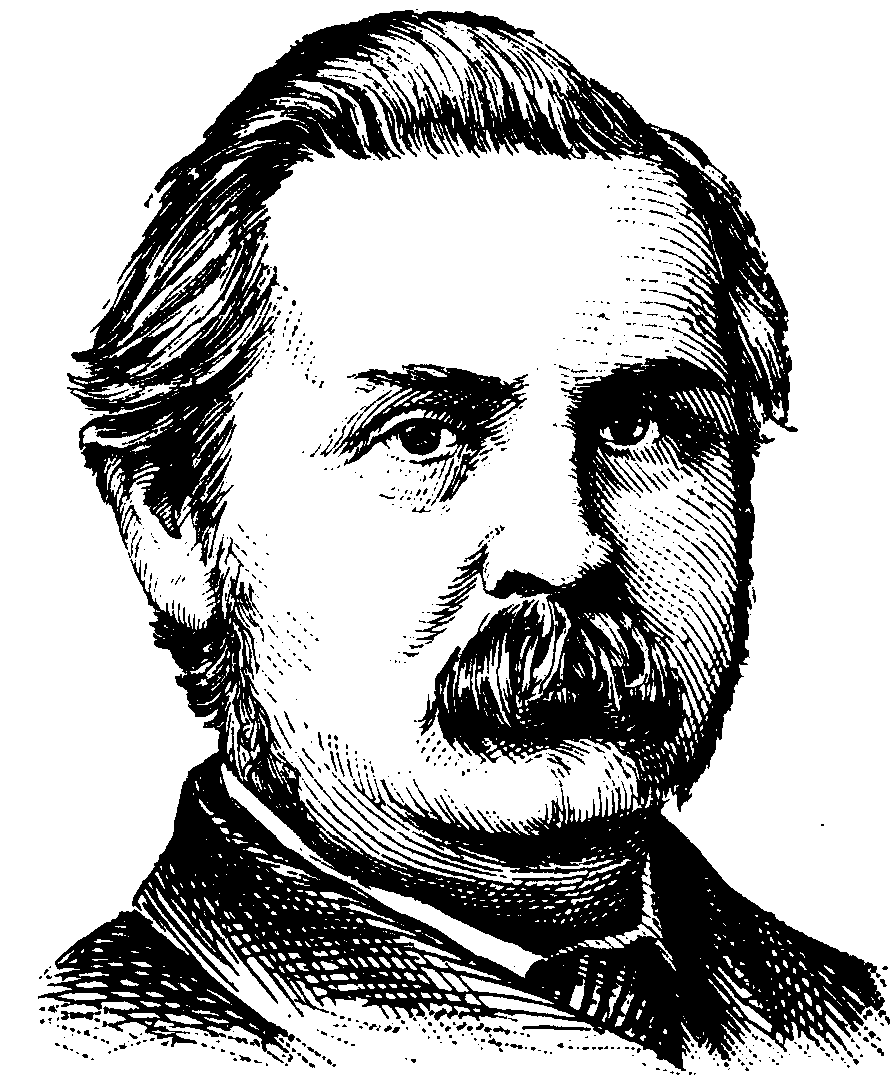
Austin Dobson
One approaches the poems of Austin Dobson as one stands before a rare collection of enamels, fan-mounts, jeweled snuff-boxes, and delicate carvings in ivory and silver; and after delighting in the beauty and finish of these graceful curios, passes into a gallery of paintings and water-colors, suggesting Watteau, Fragonard, Boucher, Meissonier, and Greuze. We also wander among trim box-hedges and quaint gardens of roses and bright hollyhocks; lean by sun-dials to watch the shadow of Time; and enjoy the sight of gay belles, patched and powdered and dressed in brocaded gowns and gypsy hats. Gallant beaux, such as are associated with Reynolds's portraits, appear, and hand them into sedan-chairs or lead them through stately minuets to the notes of Rameau, Couperin, and Arne.
Just as the scent of rose-leaves, lavender, and musk rises from antique Chinese jars, so Dobson's delicate verse reconstructs a life
"Of fashion gone, and half-forgotten ways."
He is equally at home in France. Nothing could be more sympathetic and exquisite than 'A Revolutionary Relic,' 'The Curé's Progress,' 'Une Marquise,' and the 'Proverbs in Porcelain,' one of which is cited below.
In the 'Vers de Société,' as well as his other poetry, Dobson fulfills all the requirements of light verse—charm, mockery, pathos, banter, and, while apparently skimming the surface, often shows us the strange depths of the human heart. He blends so many qualities that he deserves the praise of T.B. Aldrich, who says, "Austin Dobson has the grace of Suckling and the finish of Herrick, and is easily master of both in metrical art."
Henry Austin Dobson, the son of Mr. George Clarisse Dobson, a civil engineer, was born in Plymouth, England, January 18th 1840. His early years were spent in Anglesea, and after receiving his education in Beaumaris, Coventry, and Strasburg, he returned to England to become a civil engineer. In 1856 he entered the civil service of Great Britain, and ever since that date he has held offices in the Board of Trade. His leisure was devoted to literature, and when Anthony Trollope first issued his magazine St. Paul's in 1868, he introduced to the public the verse of Austin Dobson. In 1873 his fugitive poems were published in a small volume entitled 'Vignettes in Rhyme' and 'Vers de Société.' This was followed in 1877 by 'Proverbs in Porcelain,' and both books, with additional poems, were printed again in two volumes: 'Old World Idylls' (1883), and 'At the Sign of the Lyre' (1885). Mr. Dobson's original essays are contained in three volumes: 'Four Frenchwomen,' studies of Charlotte Corday, Madame Roland, the Princess de Lamballe, and Madame de Genlis (1890), and 'Eighteenth-Century Vignettes' (first series 1892, second series 1894), which touch upon a host of picturesque and fascinating themes. He has written also several biographies: of Hogarth, of Fielding, of Steele (1886), of Goldsmith (1888), and a 'Memoir of Horace Walpole' (1890). He has also written felicitous critical introductions to many new editions of the eighteenth-century classics.
Austin Dobson has been most happy in breathing English life into the old poems of French verse, such as ballades, villanelles, roundels, and rondeaux; and he has also written clever and satirical fables, cast in the form and temper of Gay and Prior, with quaint obsolete affectations, redolent of the classic age of Anne.
So serious is his attitude towards art, and so large his audience, that the hope expressed in the following rondeau will certainly be realized:—
In after days, when grasses high O'er-top the stone where I shall lie, Though ill or well the world adjust My slender claim to honored dust, I shall not question nor reply. I shall not see the morning sky, I shall not hear the night-wind sigh; I shall be mute, as all men must, In after days. But yet, now living, fain were I That some one then should testify, Saying—He held his pen in trust To Art, not serving shame or lust. Will none?—Then let my memory die In after days!
ON A NANKIN PLATE
Villanelle
"Ah me, but it might have been! Was there ever so dismal a fate?" Quoth the little blue mandarin. "Such a maid as was never seen: She passed, tho' I cried to her, 'Wait,'— Ah me, but it might have been! "I cried, 'O my Flower, my Queen, Be mine!'—'Twas precipitate," Quoth the little blue mandarin. "But then ... she was just sixteen,— Long-eyed, as a lily straight,— Ah me, but it might have been! "As it was, from her palankeen She laughed—'You're a week too late!'" (Quoth the little blue mandarin.) "That is why, in a mist of spleen I mourn on this Nankin Plate. Ah me, but it might have been!" Quoth the little blue mandarin.
THE OLD SEDAN-CHAIR
"What's not destroyed by Time's devouring Hand? Where's Troy,—and where's the May-Pole in the Strand?" —Bramston's 'Art of Politicks.'
It stands in the stable-yard, under the eaves, Propped up by a broomstick and covered with leaves; It once was the pride of the gay and the fair, But now 'tis a ruin,—that old Sedan-chair! It is battered and tattered,—it little avails That once it was lacquered, and glistened with nails; For its leather is cracked into lozenge and square Like a canvas by Wilkie,—that old Sedan-chair. See, here come the bearing-straps; here were the holes For the poles of the bearers—when once there were poles; It was cushioned with silk, it was wadded with hair, As the birds have discovered,—that old Sedan-chair. "Where's Troy?" says the poet! Look; under the seat Is a nest with four eggs; 'tis a favored retreat Of the Muscovy hen, who has hatched, I dare swear, Quite an army of chicks in that old Sedan-chair. And yet—Can't you fancy a face in the frame Of the window,—some high-headed damsel or dame, Be-patched and be-powdered, just set by the stair, While they raise up the lid of that old Sedan-chair? Can't you fancy Sir Plume, as beside her he stands, With his ruffles a-droop on his delicate hands, With his cinnamon coat, with his laced solitaire, As he lifts her out light from that old Sedan-chair? Then it swings away slowly. Ah, many a league It has trotted 'twixt sturdy-legged Terence and Teague; Stout fellows!—but prone, on a question of fare, To brandish the poles of that old Sedan-chair! It has waited by portals where Garrick has played; It has waited by Heidegger's "Grand Masquerade"; For my Lady Codille, for my Lady Bellair, It has waited—and waited, that old Sedan-chair! Oh, the scandals it knows! Oh, the tales it could tell Of Drum and Ridotto, of Rake and of Belle,— Of Cock-fight and Levee, and (scarcely more rare!) Of Fête-days at Tyburn, that old Sedan-chair! "Heu! quantum mutata," I say as I go. It deserves better fate than a stable-yard, though! We must furbish it up, and dispatch it,—"With Care,"— To a Fine-Art Museum—that old Sedan-chair.
THE BALLAD OF PROSE AND RHYME
When the ways are heavy with mire and rut, In November fogs, in December snows, When the North Wind howls, and the doors are shut,— There is place and enough for the pains of prose; But whenever a scent from the whitethorn blows, And the jasmine-stars at the casement climb, And a Rosalind-face at the lattice shows, Then hey! for the ripple of laughing rhyme! When the brain gets dry as an empty nut, When the reason stands on its squarest toes, When the mind (like a beard) has a "formal cut,"— There is place and enough for the pains of prose; But whenever the May-blood stirs and glows, And the young year draws to the "golden prime," And Sir Romeo sticks in his ear a rose,— Then hey! for the ripple of laughing rhyme! In a theme where the thoughts have a pedant-strut, In a changing quarrel of "Ayes" and "Noes," In a starched procession of "If" and "But,"— There is place and enough for the pains of prose; But whenever a soft glance softer grows And the light hours dance to the trysting-time, And the secret is told "that no one knows,"— Then hey! for the ripple of laughing rhyme!
Envoy
In the work-a-day world,—for its needs and woes, There is place and enough for the pains of prose; But whenever the May-bells clash and chime, Then hey! for the ripple of laughing rhyme!
THE CURÉ'S PROGRESS
Monsieur The Curé down the street Comes with his kind old face,— With his coat worn bare, and his straggling hair, And his green umbrella-case. You may see him pass by the little "Grande Place," And the tiny "Hôtel-de-Ville"; He smiles as he goes, to the fleuriste Rose, And the pompier Théophile. He turns as a rule through the "Marché" cool, Where the noisy fishwives call; And his compliment pays to the "belle Thérèse," As she knits in her dusky stall. There's a letter to drop at the locksmith's shop, And Toto, the locksmith's niece, Has jubilant hopes, for the Curé gropes In his tails for a pain d'épice. There's a little dispute with a merchant of fruit Who is said to be heterodox, That will ended be with a "Ma foi, oui!" And a pinch from the Curé's box. There is also a word that no one heard To the furrier's daughter Lou; And a pale cheek fed with a flickering red, And a "Bon Dieu garde M'sieu!" But a grander way for the Sous-Préfet, And a bow for Ma'am'selle Anne; And a mock "off-hat" to the Notary's cat, And a nod to the Sacristan:— For ever through life the Curé goes With a smile on his kind old face— With his coat worn bare, and his straggling hair. And his green umbrella-case.
"GOOD-NIGHT, BABETTE"
"Si vieillesse pouvait!"
Scene.—A small neat room. In a high Voltaire chair sits a white-haired old gentleman.
M. VIEUXBOIS [turning querulously]
Day of my life! Where can she get? Babette! I Say! Babette!—Babette!
BABETTE [entering hurriedly]
Coming, M'sieu'! If M'sieu' speaks So loud, he won't be well for weeks!
M. VIEUXBOIS
Where have you been?
BABETTE
Why, M'sieu' knows:—
April!... Ville-d' Avray!... Ma'm'selle Rose!
M. VIEUXBOIS
Ah! I am old,—and I forget. Was the place growing green, Babette?
BABETTE
But of a greenness!—Yes, M'sieu'! And then the sky so blue!—so blue! And when I dropped my immortelle, How the birds sang! [Lifting her apron to her eyes.] This poor Ma'm'selle!
M. VIEUXBOIS
You're a good girl, Babette, but she,— She was an angel, verily. Sometimes I think I see her yet Stand smiling by the cabinet; And once, I know, she peeped and laughed Betwixt the curtains.... Where's the draught? [She gives him a cup.] Now I shall sleep, I think, Babette;— Sing me your Norman chansonnette.
BABETTE [sings]
"Once at the Angelus (Ere I was dead), Angels all glorious Came to my bed;— Angels in blue and white, Crowned on the head."
M. VIEUXBOIS [drowsily]
"She was an Angel" ... "Once she laughed" ...
What! was I dreaming? Where's the draught?
BABETTE [showing the empty cup]
The draught, M'sieu'?
M. VIEUXBOIS
How I forget! I am so old! But sing, Babette!
BABETTE [sings]
"One was the Friend I left Stark in the Snow; One was the Wife that died Long,—long ago; One was the Love I lost— How could she know?"
M. VIEUXBOIS [murmuring]
Ah Paul! ... old Paul! ... Eulalie, too! And Rose ... And O! "the sky so blue!"
BABETTE [sings]
"One had my Mother's eyes, Wistful and mild; One had my Father's face; One was a Child: All of them bent to me,— Bent down and smiled!" [He is asleep!]
M. VIEUXBOIS [almost inaudibly]
How I forget! I am so old!... Good-night, Babette!
THE LADIES OF ST. JAMES'S
A Proper New Ballad of the Country and the Town
"Phyllida amo ante alias."—Virgil.
The ladies of St. James's Go swinging to the play; Their footmen run before them With a "Stand by! Clear the way!" But Phyllida, my Phyllida! She takes her buckled shoon, When we go out a-courting Beneath the harvest moon. The ladies of St. James's Wear satin on their backs; They sit all night at Ombre, With candles all of wax: But Phyllida, my Phyllida! She dons her russet gown, And runs to gather May-dew Before the world is down. The ladies of St. James's! They are so fine and fair, You'd think a box of essences Was broken in the air: But Phyllida, my Phyllida! The breath of heath and furze, When breezes blow at morning, Is not so fresh as hers. The ladies of St. James's! They're painted to the eyes; Their white it stays forever, Their red it never dies: But Phyllida, my Phyllida! Her color comes and goes; It trembles to a lily,— It wavers like a rose, The ladies of St. James's! You scarce can understand The half of all their speeches, Their phrases are so grand: But Phyllida, my Phyllida! Her shy and simple words Are clear as after rain-drops The music of the birds. The ladies of St. James's! They have their fits and freaks; They smile on you—for seconds; They frown on you—for weeks: But Phyllida, my Phyllida! Come either storm or shine, From Shrove-tide unto Shrove-tide, Is always true—and mine. My Phyllida! my Phyllida! I care not though they heap The hearts of all St. James's, And give me all to keep; I care not whose the beauties Of all the world may be,— For Phyllida, my Phyllida, Is all the world to me.
DORA VERSUS ROSE
"The Case is Proceeding"
From the tragic-est novels at Mudie's— At least on a practical plan— To the tales of mere Hodges and Judys, One love is enough for a man. But no case that I ever yet met is Like mine: I am equally fond Of Rose, who a charming brunette is, And Dora, a blonde. Each rivals the other in powers— Each waltzes, each warbles, each paints— Miss Rose, chiefly tumble-down towers; Miss Do., perpendicular saints. In short, to distinguish is folly; 'Twixt the pair I am come to the pass Of Macheath, between Lucy and Polly,— Or Buridan's ass. If it happens that Rosa I've singled For a soft celebration in rhyme, Then the ringlets of Dora get mingled Somehow with the tune and the time; Or I painfully pen me a sonnet To an eyebrow intended for Do.'s, And behold I am writing upon it The legend, "To Rose." Or I try to draw Dora (my blotter Is all over scrawled with her head), If I fancy at last that I've got her, It turns to her rival instead; Or I find myself placidly adding To the rapturous tresses of Rose Miss Dora's bud-mouth, and her madding, Ineffable nose. Was there ever so sad a dilemma? For Rose I would perish (pro tem.); For Dora I'd willingly stem a— (Whatever might offer to stem); But to make the invidious election,— To declare that on either one's side I've a scruple,—a grain,—more affection, I cannot decide. And as either so hopelessly nice is, My sole and my final resource Is to wait some indefinite crisis,— Some feat of molecular force, To solve me this riddle conducive By no means to peace or repose, Since the issue can scarce be inclusive Of Dora and Rose.
(After-thought)
But perhaps if a third (say, a Norah), Not quite so delightful as Rose, Nor wholly so charming as Dora, Should appear, is it wrong to suppose,— As the claims of the others are equal,— And flight—in the main—is the best,— That I might ... But no matter,—the sequel Is easily guessed.
UNE MARQUISE
A Rhymed Monologue in the Louvre
"Belle Marquise, vos beaux yeux me font mourir d'amour."
—Molière.
I
As you sit there at your ease, O Marquise! And the men flock round your knees Thick as bees, Mute at every word you utter, Servants to your least frill-flutter, "Belle Marquise!" As you sit there, growing prouder, And your ringed hands glance and go, And your fan's frou-frou sounds louder, And your "beaux yeux" flash and glow;— Ah, you used them on the Painter, As you know, For the Sieur Larose spoke fainter, Bowing low, Thanked Madame and Heaven for Mercy That each sitter was not Circe,— Or at least he told you so; Growing proud, I say, and prouder To the crowd that come and go, Dainty Deity of Powder, Fickle Queen of Fop and Beau, As you sit where lustres strike you, Sure to please, Do we love you most, or like you, "Belle Marquise!"
II
You are fair; oh yes, we know it Well, Marquise; For he swore it, your last poet, On his knees; And he called all heaven to witness Of his ballad and its fitness, "Belle Marquise!" You were everything in ère (With exception of sévère),— You were cruelle and rebelle, With the rest of rhymes as well; You were "Reine" and "Mère d' Amour"; You were "Vénus à Cythère"; "Sappho mise en Pompadour," And "Minerve en Paravère"; You had every grace of heaven In your most angelic face, With the nameless finer leaven Lent of blood and courtly race; And he added, too, in duty, Ninon's wit and Boufflers's beauty; And La Valliere's yeux veloutés Followed these; And you liked it, when he said it (On his knees), And you kept it, and you read it, "Belle Marquise!"
III
Yet with us your toilet graces Fail to please, And the last of your last faces, And your mise; For we hold you just as real, "Belle Marquise!" As your Bergers and Bergères, Tes d' Amour and Batelières; As your pares, and your Versailles, Gardens, grottoes, and socailles; As your Naiads and your trees;— Just as near the old ideal Calm and ease, As the Venus there by Coustou, That a fan would make quite flighty, Is to her the gods were used to,— Is to grand Greek Aphroditè, Sprung from seas. You are just a porcelain trifle, "Belle Marquise!" Just a thing of puffs and patches Made for madrigals and catches, Not for heart wounds, but for scratches, O Marquise! Just a pinky porcelain trifle, "Belle Marquise!" Wrought in rarest rose-Dubarry, Quick at verbal point and parry, Clever, doubtless;—but to marry, No, Marquise!
IV
For your Cupid, you have clipped him, Rouged and patched him, nipped and snipped him, And with chapeau-bras equipped him, "Belle Marquise!" Just to arm you through your wife-time, And the languors of your lifetime, "Belle Marquise!" Say, to trim your toilet tapers Or—to twist your hair in papers, Or—to wean you from the vapors;— As for these, You are worth the love they give you, Till a fairer face outlive you, Or a younger grace shall please; Till the coming of the crows'-feet, And the backward turn of beaux' feet, "Belle Marquise!" Till your frothed-out life's commotion Settles down to Ennui's ocean, Or a dainty sham devotion, "Belle Marquise!"
V
No: we neither like nor love you, "Belle Marquise!" Lesser lights we place above you,— Milder merits better please. We have passed from Philosophe-dom Into plainer modern days,— Grown contented in our oafdom, Giving grace not all the praise; And, en partant, Arsinoé,— Without malice whatsoever,— We shall counsel to our Chloë To be rather good than clever; For we find it hard to smother Just one little thought, Marquise! Wittier perhaps than any other,— You were neither Wife nor Mother. "Belle Marquise!"
A BALLAD TO QUEEN ELIZABETH
Of the Spanish Armada
King Philip had vaunted his claims; He had sworn for a year he would sack us; With an army of heathenish names He was coming to fagot and stack us; Like the thieves of the sea he would track us, And shatter our ships on the main; But we had bold Neptune to back us,— And where are the galleons of Spain? His carackes were christened of dames To the kirtles whereof he would tack us; With his saints and his gilded stern-frames, He had thought like an egg-shell to crack us; Now Howard may get to his Flaccus, And Drake to his Devon again, And Hawkins bowl rubbers to Bacchus,— For where are the galleons of Spain? Let his Majesty hang to St. James The axe that he whetted to hack us: He must play at some lustier games. Or at sea he can hope to out-thwack us; To his mines of Peru he would pack us To tug at his bullet and chain; Alas! that his Greatness should lack us!— But where are the galleons of Spain?
Envoy
Gloriana!—the Don may attack us Whenever his stomach be fain; He must reach us before he can rack us,... And where are the galleons of Spain?
THE PRINCESS DE LAMBALLE
From 'Four Frenchwomen'
A tender wife, a loving daughter, and a loyal friend,—shall we not here lay down upon the grave of Marie de Lamballe our reverential tribute, our little chaplet of immortelles, in the name of all good women, wives, and daughters?
"Elle était mieux femme que les autres."[A] To us that apparently indefinite, exquisitely definite sentence most fitly marks the distinction between the subjects of the two preceding papers and the subject of the present. It is a transition from the stately figure of a marble Agrippina to the breathing, feeling woman at your side; it is the transition from the statuesque Rachelesque heroines of a David to the "small sweet idyl" of a Greuze. And, we confess it, we were not wholly at ease with those tragic, majestic figures. We shuddered at the dagger and the bowl which suited them so well. We marveled at their bloodless serenity, their superhuman self-sufficiency; inly we questioned if they breathed and felt. Or was their circulation a matter of machinery—a mere dead-beat escapement? We longed for the sexe prononcé of Rivarol—we longed for the showman's "female woman!" We respected and we studied, but we did not love them. With Madame de Lamballe the case is otherwise. Not grand like this one, not heroic like that one, "elle est mieux femme que les autres."
She at least is woman—after a fairer fashion—after a truer type. Not intellectually strong like Manon Philipon, not Spartan-souled like Marie de Corday, she has still a rare intelligence, a courage of affection. She has that clairvoyance of the heart which supersedes all the stimulants of mottoes from Reynel or maxims from Rousseau; she has that "angel instinct" which is a juster lawgiver than Justinian. It was thought praise to say of the Girondist lady that she was a greater man than her husband; it is praise to say of this queen's friend that she was more woman than Madame Roland. Not so grand, not so great, we like the princess best. Elle est mieux femme que les autres.