Volume 12 — ALEXANDRE DUMAS, JUNIOR
Reading edition
(1824-1895)
BY FRANCISQUE SARCEY

e shall not say much about the life of Alexandre Dumas the younger. The history of a great writer is the history of his works. He was born in Paris, on July 27th, 1824. His name on the register of births appears as "Alexandre, son of Marie Catherine Lebay, seamstress." He was not acknowledged by his father until he had reached his sixth year, March 7th, 1830. I emphasize this particular because it had great influence on the bent of his genius. During all his life Dumas was haunted by a desire of rehabilitating illegitimate children, of creating a reaction against their treatment by the Civil Code and the prejudice which makes of them something little better than outcasts in society.
"When seven years old," he himself says, "I entered as a boarder the school of Monsieur Vauthier, on Rue Montagne Saint-Geneviève. Thence I passed, about two years later, to the Saint-Victor School; the principal was Monsieur Goubaux, a friend of my father, with whom he collaborated under the nom de plume of Dinaux. This school, which numbered two hundred and fifty boarding pupils, and with the rather strange habits which I tried to depict in 'The Clémenceau Case,' occupied all the ground covered to-day by the Casino de Paris and the 'Pôle-Nord' establishment. When about fifteen I left the Saint-Victor School for Monsieur Hénon's school, which was situated in the Rue de Courcelles and has now disappeared. It is in the Collêge Bourbon (now the Lycée Condorcet) that I received all my instruction, as the pupils of the two schools where I lived attended the college classes. I never belonged to any of the higher State schools,—I have not even the degree of bachelor."
At the end of his years of study he returned to his father. He did not stay there more than six months. The rather tumultuous life which he saw in the house disturbed his proud mind, already filled with serious yearnings.
"You have debts," his father said to him. "Do as I do: work, and you will pay them."
Such was indeed the young man's intention. His first work was a one-act play in verse, 'The Queen's Jewel,' which no one, assuredly, would mention to-day but for his signature. The date was 1845, and the author was then twenty-one. Other works by him were published at various times in the Journal des Demoiselles.
"I was," he has said, "the careless, lazy, and spoilt child of all my father's friends. I believed in the eternity of youth, of strength, of joy. I spent the whole day laughing, the whole night sleeping, unless I had some reason for writing verses."
About 1846 he set resolutely to work. He turned to novel-writing, which seemed to him to offer greater facilities for reaching the public and greater chances of immediate income than dramatic composition. Only two of his novels have survived: 'La Dame aux Camélias' ('Camille': 1848), because from this book came the immortal drama by the same title; and 'The Clémenceau Case,' because the author wrote it when he was in complete possession of his talent, and because moreover it is a first-rate work.
It was in 1852 that the Vaudeville Theatre gave the first performance of 'Camille,' the fortune of which was to be so extraordinary. For two or three years the play had been tossed from theatre to theatre. Nobody wanted it. To the ideas of the time it seemed simply shocking, and the play was still forbidden in London after its performances in France were numbered by the hundreds.
There is this special trait in 'Camille'—it was a work all instinct with the spirit of youth. Dumas twenty years later sadly said: "I might perhaps make another 'Demi-Monde'; I could not make another 'Camille.'" There existed, indeed, other works which have all the fire and charm of the twentieth year. 'Polyeucte' is Corneille's masterpiece; his 'Cid' breathes the spirit of youth: Corneille at forty could not have written the 'Cid.' Racine's first play is 'Andromaque': Beaumarchais's is the 'Barber of Seville'; Rossini, when young, enlivened it with his light and sparkling airs. Fifteen years later he himself wrote his 'William Tell,' a higher work, but a work which was not young.
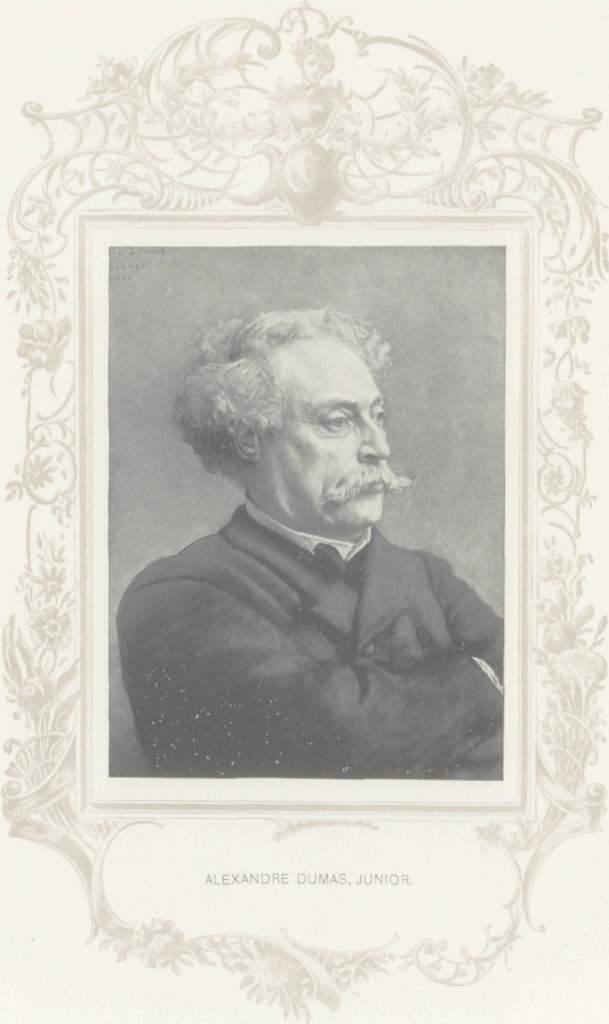
ALEXANDRE DUMAS, JUNIOR.
If the theatrical managers had recoiled from 'Camille' in spite of the great names that recommended it, it is because it was cut after a pattern to which neither they nor the public were accustomed; it is because it contained the germ of a whole dramatic revolution. Now, the author was not a theatrical revolutionist. He had not said to himself, "I am going to throw down the old fabric of the drama, and erect a new one on its ruins." To tell the truth, he had no idea of what he was doing. He had witnessed a love drama. He had thrown it still throbbing upon the stage, without any regard for the dramatic conventions which were then imposed upon playwrights, and which were almost accepted as laws. He had simply depicted what he had seen. All the managers, attached as they were to the old customs, and respectful of the traditions, had trembled with horror when they saw moving around Camille the ignoble Prudence, the idiotic Due de Varville, the silly Saint-Gaudens. But the public—though the fact was suspected neither by them nor by the public itself—yearned for more truth upon the boards. When 'Camille' was presented to them, the play-goers uttered a cry of astonishment and joy: that was the thing! that was just what they wanted! From that day, which will remain as a date in the history of the French stage, the part of Camille has been performed by all the celebrated actresses. The part has two sides: one may see in it a degraded woman who has fallen profoundly in love, rather late in life; one may also see in it a woman, already poetical in her own nature, suddenly carried away by a great passion into the sacred regions of the Ideal.
Almost any young man in Dumas's place would have lost his head after so astounding a success, and might not have resisted the temptation of at once working out the vein. For on coming out of the theatre after the first performance, the author had all the managers at his feet, and the smallest trifle was sure to be accepted if it only had his signature. But he had learned, by the side of "a prodigal father," the art of husbanding his talent. He declined to front the footlights again, save with a work upon which he had been able to bestow all the care and labor it deserved: he waited a year before he gave, at the Gymnase theatre, 'Diane de Lys.'
'Diane de Lys' undoubtedly pleased the public, but its success was not exactly brilliant. It is full of great qualities, it is strongly conceived, constructed with rare power and logic, but it added nothing to his reputation. The play as a whole seemed long and melancholy. It is a curious subject for critical study, as one of the stages in which the genius of the author stopped awhile, on its way to higher works. It will leave no great trace in his career.
Two years later he gave at the Gymnase theatre—I do not dare to say his masterpiece, but certainly the best constructed and most enjoyable play he ever wrote, 'Le Demi-Monde' (The Other Half-World). In this play he discovered and defined the very peculiar world of those women who live on the margin of regular "society," and try to preserve its tone and demeanor. What scientific and strong construction are here! What an admirable disposition of the scenes, both flexible and logical! And through the action, which moves on with wonderful straightforwardness and breadth, how many portraits, drawn with a steady hand, each one bearing such distinctive features that you would know them if you met them on the street! Olivier de Jalin, the refined Parisian, the dialectician of the play, who is no other than Dumas himself; Raymond de Nanjac, handsome and honest, but not keen or Parisian; and that giddy Valentine de Sanctis, whose head turns with the wind, whose tongue cannot rest one moment; and especially Suzanne d'Ange, so witty, so complex, so devious in her motions, so roublarde, as a Parisian of to-day would say.
Between 'The Demi-Monde,' and 'La Question d'Argent' (The Money Question), which followed, Dumas spent two years at work. 'La Question d'Argent' is a favorite play with the connoisseurs; but its reception by the public was of the coldest. It is a noteworthy fact that plays turning upon money have never been successful. Le Sage's 'Turcaret' is a dramatic masterpiece: it never had the luck to please the crowd. Dumas's Jean Giraud is, however, a very curiously studied character. The author has represented in him the commonest type of the shady money-man, the unconscious rascal. And very skillfully he made an individual out of that general type, by giving to Jean Giraud a certain rough good-nature; the appearance of a good fellow, with a certain degree of fineness; a mixture of humility and self-conceit, of awkwardness and impudence, and even some ideas as to the power of money that do not lack dignity, and some real liberality of sentiment and act,—for wealth alone, though acquired by ignominious means, suggests and dictates to the great robbers some advantageous movements which the small rascal cannot indulge in: and around this Turcaret of the Second Empire how many pictures of honest people, every one of whom, in his or her way, is good and fine!
One year later Dumas carried to the Gymnase, his favorite theatre, 'Le Fils Naturel' (The Natural Son); and the next year 'Un Père Prodigue' (A Prodigal Father; known also in English through a free adaptation as 'My Awful Dad').
In 'Le Fils Naturel' Dumas for the first time wrote a theme-play, a kind of work in which he was to become a master. Hitherto we have seen him drawing pictures of manners. To be sure, philosophical considerations on the period depicted are not wanting, but the play has not the form and does not assume the movement of a thesis. It does not take up one special trait of our social order, one of our worldly prejudices, in order to show its strong and weak sides. 'Le Fils Naturel' is the work of a moralist as well as of a playwright; or rather, it is the work of a playwright who was a born moralist.
'Un Père Prodigue' originally excited great curiosity. It escaped no one that in his Count Fernand de la Rivonnière, Dumas had shown us some traits of his illustrious father, who had been a prodigal father; and that he had depicted himself in Viscount André. Every one made comparisons; some, of course, accused the author of filial disrespect. The accusation was ridiculous, and he did not even answer it. He had so well disguised the persons, he had transported them into such different surroundings, that no one could recognize in them their true prototypes. Then—and this is no small praise—if Count de la Rivonnière is guilty of one fault, that of throwing to the wind his fortune, he is a most amiable nobleman, full of broad ideas and generous sentiments,—has a warm heart. The fourth act, in which the father sacrifices himself in order to save his son's life, is pathetic in the extreme. But nothing equals the first act, which is a model of animated and picturesque composition. No one ever painted in more vivid colors the pillage of a household, and a family without so much as a shadow of discipline. It is an accumulation of small details, not one of which is of an indifferent nature, and which, taken together, drive into our minds the idea that this nobleman, so well-mannered, so charming in conversation, so sober for himself, is running to ruin as gayly as he can.
For four years after the production of 'Un Père Prodigue' Dumas wrote nothing. But in 1864 he reappeared at the Gymnase with a strange play, 'L'Ami des Femmes' (A Friend of the Sex), which completely failed. After 'L'Ami des Femmes' there was another interruption, not of Dumas's labors but of his dramatic production. Perhaps he was sick of an art which had caused him a cruel disappointment. He turned again to novel-writing, and published (1866) 'L'Affaire Clémenceau' (The Clémenceau Case), the success of which was not as great as he had hoped. In France, when a man is superior in one specialty people will not let him leave it. He is not allowed to be at once an unequaled novelist and a first-rate dramatist.
At that time Dumas hesitated which road to follow. An incident which created a great deal of comment threw him back towards the stage, and towards a new form of comedy.
M. Émile de Girardin, one of the best known publicists of the Second Empire, had bethought himself, when over fifty years of age, and knowing nothing of this kind of work, to write a play. He had been a great friend of Dumas père, and had kept up the most affectionate intercourse with his son. He had asked him to fit his play for the stage. It possessed one really dramatic idea. Dumas, in order to oblige his father's friend, made out of it 'Le Supplice d'une Femme' (A Woman's Torture). Émile de Girardin, who was self-conceited and somewhat despotic, refused to recognize his offspring in the bear that Dumas had licked. He declined to sign the play: "Neither shall I," Dumas retorted.
'A Woman's Torture' was acted at the Comédie Française with extraordinary success. This success was for Dumas a warning and a lesson. 'A Woman's Torture' was a three-act play, short, concise, panting, which hurried to the coup de théâtre of the second act, upon which the drama revolved, and rushed to its conclusion. The time of five-act comedies, with ample expositions, copious developments, philosophical disquisitions, curious and fanciful episodes, was gone. Henceforth the dramatist had to deal with a hurried and blasé public, which, taking dinner at eight, could give to the theatre but a short time, and an attention disturbed by the labor of digestion. 'A Woman's Torture,' which lasted only an hour and a half, and proceeded only by rapid strokes, was exactly what that public wanted. After that time Dumas wrote only three-act and one-act plays; using four acts only for 'Les Idées de Madame Aubray' (Madame Aubray's Ideas); and these four acts are very short. In 1867 this play announced Dumas's return to the stage; and Dumas is here more paradoxical than he had ever been. His theme looked like a wager not simply against bourgeois prejudices, but even against good sense, and, I dare to say, against justice. This wager was won by Dumas, thanks to an incredible display of skill. He took up the thesis a second time in 'Denise,' and won his wager again, but with less difficulty. In 'Denise' the lover struggles only against social prejudices, and allows himself to be carried away by one of those emotional fits which disturb and confound human reason. In 'Madame Aubray's Ideas' the triumph is one of pure logic.
'Une Visite de Noces' (A Wedding Call) and 'La Princesse Georges' followed rather closely on 'Madame Aubray's Ideas.' 'A Wedding Call'!—what a thunderbolt then! It was of but one act, but one act the effect of which was prodigious, the echo of which is still heard. Time and familiarity have now softened for us the too sharp outlines of this bitter play. It has been acknowledged a masterpiece. It is certainly one of the boldest works of this extraordinary magician, who, thanks to his unerring skill and to the dazzling wit of his dialogue, brought the public to listen to whatever he chose to put upon the stage. It seemed that, like a lion tamer in the arena, Dumas took pleasure in belaboring and exasperating this many-headed monster, in order to prove to his own satisfaction that he could subdue its revolts.
'La Princesse Georges' is a work of violent and furious passion. We find in it Madame de Terremonde, the good woman who adores her husband, but who adores him with fury, who wants him all to herself, and who, when sure that she is betrayed, passes from the most exasperated rage to tears and despair. There is in the first act a scene of exposition which has become celebrated. No one ever so rapidly mastered the public; no one ever from the first stroke so painfully twisted the heart of the spectators.
Let us pass rapidly over 'La Femme de Claude' (Claude's Wife: 1873). Of all his plays it is the one Dumas said he liked best, the one he most passionately defended with all sorts of commentaries, letters, prefaces, etc.; the one which he insisted on having revived, a long time after it had failed. To my mind that play was a mistake; and the public, in spite of Dumas's arguments, in spite of the protests of the critics, who are often very glad to distinguish themselves by not yielding to the common voice,—the public insisted on agreeing with me.
Only a few months later, Dumas brilliantly retrieved himself with 'Monsieur Alphonse.' His Madame Guichard is the most cheerfully vulgar type of the parvenue which any one ever dared to put upon the stage. She can hardly read and write; she is no longer young, and she is "to boot" very proud of her money; she has no tact and no taste; but at heart she is a good sort of woman. Her morality is as primitive as her education. But deceit disgusts her; she hates but one thing, she says,—lying. She is not troubled by conventionalities; and her speech has all the color and energy of popular speech. But see! Dumas in depicting this woman preserved exquisite measure. Madame Guichard says many pert and droll things; she never utters a coarse word. Her language is picturesque; it is free from slang. Hers is a vulgar nature, but she does not offend delicate ears by the grossness of her utterance. Dumas never drew a more living picture; she is the joy of this rather sad play.
All that remain to be reviewed are 'L'Étrangère,' 'La Princesse de Bagdad,' and 'Françillon'; all of which were given at the Comédie Française. 'L'Étrangère' is indeed a melodrama, with an admixture of comedy. Had he gone further in that direction, Dumas might have made a new sort of play, which would perhaps have reigned a long time on the stage. But after this trial, successful though it was, he stopped. 'La Princesse de Bagdad' entirely failed. 'Françillon' was Dumas's last success at the Comédie Française.
After 1887 Dumas gave nothing to the stage. He had completed a great five-act play, 'The Road to Thebes,' which the manager of the Comédie Française hoped every year to put on the boards. Dumas kept promising it; but either from distrust of himself or of the public, or from fatigue, or fear of meeting with failure, he asked for new delays, until the day when he declared that not only the play would not be acted during his life, but that he would not even allow it to be acted after his death.
This death he saw coming, with sad but calm eyes. It was a sorrow for us to see this man, whom we had known so quick and alert, grow weaker every day, showing the progress of disease in his shriveled features and body. The complexion had lost all color, the cheeks had become flaccid, the eye had no life left.
On October 1st, 1895, he wrote to his friend Jules Claretie:—"Do not depend upon me any more; I am vanquished. There are moments when I mourn my loss, as Madame D'Houdetot said when dying." He was at Puys, by the seaside, when he wrote that despairing letter. He returned to Marly, there to die, surrounded by his family, on November 28th, 1895, in a house which he loved and which had been bequeathed to him years before by an intimate friend.
His loss threw into mourning the world of letters, and the whole of Paris. People discovered then—for death loosens every tongue and every pen—how kind and generous in reality was Dumas, who had often been accused of avarice by those who contrasted him with his father; how many services he had discreetly rendered, how open his hand always was. His constant cheerfulness and good-nature had finally caused him to be forgiven for his wit, which was sarcastic and cutting, and for his success, which had thrown so many rivals into the shade. This witty man, who was always obliging and even tender-hearted, had no envy, and gave his applause without a shadow of reserve to the successes of others. Every young author found in him advice and support; he did not expect gratitude, and therefore was soured by no disappointment. He was a good man, partly from nature, partly from determination; for he deemed that, after all, the best way to live happy in this world is to make happy as many people as possible.
If in this long essay I have not spoken of Dumas as a moralist, it is because, in my opinion, in spite of all that has been said, Dumas was a dramatist a great deal more than a philosopher. In his comedies he discussed a great many moral and social questions, without giving a solution for any; or rather, the solutions that he gave were due not to any set of fixed principles, but to the conclusion which he was preparing for this play or that. He said, indifferently, "Kill her" or "Forgive her," according to the requirements of the subject which he had selected; and he would afterwards write a sensational preface with a view to demonstrate that the solution this time given by him was the only legitimate one. These prefaces are very amusing reading; for he wrote them with all the fire of his nature, and he had the gift of movement. But they were a strange medley of incongruous and contradictory statements. Every idea that he expresses can be grasped and understood; but it is impossible to see how it agrees with those that precede and follow. It is a chaos of clear ideas.
Dumas was not a philosopher, but an agitator. He stirred up a great many questions; he drew upon them our distracted attention; he compelled us to think of them. Therein he did his duty as a dramatist.
He gave much thought to the fate of woman in our civilization. We may say, however, that though loving her much, he still more feared her, and I shall even add, despised her. All his characters who have the mission of defending morality and good sense are very attentive to her, but keep her at arm's-length. They are affectionate counselors, not lovers. They hold her to be a frail being, who must be controlled and guided. Some one has said that there was in Dumas something of the Catholic priest. It is true. He was to women a lay director of conscience.
He was a great connoisseur of pictures and a great art lover. Music, I think, is the only art that did not affect him much. He was a dazzling talker; his plays teem with bright sayings; his conversation sparkled with them. I did not know him in his prime, when he delighted his friends and companions by his unceasing flow of spirits. I became intimate with him only later. If you knew how to start him, he simply coruscated. I never knew any one, save Edmond About, who was as witty, and who, like About, always paid you back in good sounding coin.
Dumas was a member of the French Academy. He had not wished for that honor, because it had been denied to his father. He desired, in his reception speech, to call up the great spirit of this illustrious father and make it share his academician's chair. He had this joy; the two Dumas were received on the same day. Their two names will never perish.
[The editors have been compelled, for lack of space, to leave out that part of M. Sarcey's valuable essay which is a professional analysis of several of Dumas's plays, and which would be of interest, chiefly, to special students of the French drama and stage.]
THE PLAYWRIGHT IS BORN—AND MADE
From the Preface to 'A Prodigal Father'
Of all the various forms of thought, the stage is that which nearest approaches the plastic arts—inasmuch as we cannot work in it unless we know its material processes; but with this difference: that in the other arts one learns these processes, while in play-writing one guesses them; or to speak more accurately, they are in us to begin with.
One can become a painter, a sculptor, a musician, by sheer study: one does not become a dramatic author in this fashion. A caprice of nature makes your eye in such a way that you can see a thing after a particular manner, not absolutely correct, but which must nevertheless appear, to any other persons that you wish to have so think, the only correct point of view. The man really called to write for the stage reveals what is an extremely rare faculty, in his very first attempts,—say in a farce in school, or a drawing-room charade. There is a sort of science of optics and of perspective that enables one to draw a personage, a character, a passion, an impulse of the soul, with a single stroke of the pen. Dramatic cheating of the eye is so complete that often the spectator, when he is a mere reader of the play, desiring to give himself once more the same emotion that he has felt as one of the audience, not only cannot recapture that emotion in the written words before him, but often cannot even distinguish the passage where the emotion lies hid. It was a word, a look, a silence, a gesture, a purely atmospheric combination, that held him spellbound. So comes in the genius of the playwright's trade, if those two words can be associated. One may compare writing for the stage in relation to other phases of literature, as we compare ceiling painters with [painters of] pictures for the wall or the easel. Woe to the painter if he forget that his composition is to be looked at from a distance, with a light below it!
A man without merit as a thinker, a moralist, a philosopher, an author, may turn out to be a dramatic author of the first class; that is to say, in the work of setting in motion before you the purely external movements of mankind; and on the other hand, to become in the theatre the thinker, the moralist, the philosopher, or the author to whom one listens, one must indispensably be furnished with the particular and natural qualities of a man of much lower grade. In short, to be a master in the art of writing for the stage, you must be a poor hand in the superior art....
That dramatic author who shall know mankind like Balzac, and who shall know the theatre like Scribe, will be the greatest dramatic author that has ever existed.
Translated for 'A Library of the World's Best Literature,' by E. Irenæus Stevenson
AN ARMED TRUCE
From 'A Friend of the Sex'
[The following conversation in the first act of the play takes place in the pleasant morning-room of a country-house near Paris, the home of M. and Madame Leverdet. M. Leverdet is asleep in his chair. The speakers are Madame Leverdet, a coquettish, sprightly lady approaching middle age, and young M. De Ryons, a friend and neighbor. Madame Leverdet is determined to marry off De Ryons advantageously, and as soon as possible. Unfortunately he is a confirmed bachelor, not to say woman-hater, whose cynicism is the result of severely disappointing experiences. Under that cynicism there is however genuine respect and even chivalry as to the right sort of woman,—the superior and sincere type, which he does not happen often to encounter.]
Madame Leverdet—Let us come to serious topics while we are alone, my friend.
De Ryons—And apropos of them?
Madame Leverdet—Are you willing to be married off yet?
De Ryons [with a start of terror]—Pardon me, my dear lady! At what hour can I take the first train for Paris?
Madame Leverdet—Now listen to me, at least.
De Ryons—What! Here it is two years since I have called on you; I come to make you a little visit of a morning, in all good friendship, with the thermometer forty, centigrade; I am totally unsuspecting; all I ask is to have a little lively chat with a clever woman—and see how you receive me.
Madame Leverdet [continuing]—A simple, charming young girl—
De Ryons [interrupting her, and in the same tone]— —musical, speaks English, draws nicely, sings agreeably, a society woman, a domestic woman,—all at the choice of the applicant.
Madame Leverdet [laughing]—Yes, and pretty and graceful and rich; and, by-the-by, one who finds you a charming fellow.
De Ryons—She is quite right there. I shall make a charming husband—I shall; I know it. Only thirty-two years old; all my teeth, all my hair (no such very common detail, the way young men are nowadays); lively, sixty thousand livres income as a landed proprietor—oh, I am an excellent match: only unfortunately I am not a marrying man.
Madame Leverdet—And why not, if you please?
De Ryons [smiling]—It would interfere severely with my studies.
Madame Leverdet—What sort of studies?
De Ryons—My studies of—woman.
Madame Leverdet—Really! I don't understand you.
De Ryons—What! Do you not know that I am making women my particular, my incessant study, and that I am reckoning on leaving some new and very interesting documents dealing with that branch of natural history?—a branch very little understood just at present, in spite of all that has been written on the topic. My friend, I cannot sacrifice the species to the individual; I belong to science. It is quite impossible for me to give myself wholly and completely—as one certainly should do when he marries—to one of those charming and terrible little carnivora for whose sake men dishonor themselves, ruin themselves, kill themselves; whose sole preoccupation, in the midst of the universal carnage that they make, is to dress themselves now like umbrellas and now like table bells.
Madame Leverdet [scornfully]—So you really think you understand women, do you?
De Ryons—I rather think I do. Why, just as you see me this instant, at the end of five minutes' study or conversation I can tell you to what class a woman belongs,—whether to the middle class, to women of rank, artists, or whatever you please; what are her tastes, her characteristics, her antecedents, the state of her heart,—in a word, everything that concerns my special science.
Madame Leverdet—Really! Will you have a glass of water?
De Ryons—Not yet, thank you.
Madame Leverdet—I suppose, then, you are under the impression that you know me too.
De Ryons—As if I did not!
Madame Leverdet—Well, and I am—what?
De Ryons—Oh, you are a clever woman. It is for that reason that I call on you [aside: every two years].
Madame Leverdet—Will you kindly give me the sum of your observations in general? You can tell me so much, since I am a clever woman.
De Ryons—The true, the true, the true sum?
Madame Leverdet—Yes.
De Ryons—Simply that woman of our day is an illogical, subordinate, and mischief-making creature. [In saying this De Ryons draws back and crouches down as if expecting to be struck.]
Madame Leverdet—So then, you detest women?
De Ryons—I? I detest women? On the contrary, I adore them; but I hold myself in such a position toward them that they cannot bite me. I keep on the outside of the cage.
Madame Leverdet—Meaning by that—what?
De Ryons—Meaning by that, that I am a friend of the sex; for I have long perceived that just as truly as women are dangerous in love, just so much are they adorable in friendship, with men;—that is to say, with no obligations, and therefore no treasons; no rights, and in consequence no tyrannies. One assists, too, as a spectator, often as a collaborator, in the comedy of love. A man under such conditions sees before his nose the stage tricks, the machinery, the changes of scenes, all that stage mounting so dazzling at a distance and so simple when one is near by. As a friend of the sex and on a basis of friendship, one estimates the causes, the contradictions, the incoherences, of that phantasmagoric changeableness that belongs to the heart of a woman. So you have something that is interesting and instructive. Under such circumstances a man is the consoler, and gives his advice; he wipes away tears; he brings quarrelsome lovers together; he asks for the letters that must be returned; he hands back the photographs (for you know that in love affairs photographs are taken only in order to be returned, and it is nearly always the same photograph that serves as many times as may be necessary. I know one photograph that I have had handed back by three different men, and it ended its usefulness by being given for good and all to a fourth one, who was—not single).... In short, you see, my dear madam, I am above all the friend of those women—who have known what it is to be in love. And moreover inasmuch, just as Rochefoucauld says, as women do not think a great deal of their first experience,—why, one fine day or another—
Madame Leverdet—You prove to be the second one.
De Ryons—No, no; I have no number, I! A well-brought-up woman never goes from one experience of the heart to another one, without a decent interval of time, more or less long. Two railroad accidents never come together on the same railway. During the intervals a woman really needs a friend, a good confidant; and it is then that I turn up. I let her tell me all the melancholy affairs in question; I see the unhappy victim in tears after the traitor has called; I lament with her, I weep with her, I make her laugh with me: and little by little I replace the delinquent without her seeing that I am doing so. But then I know very well that I am without importance, that I am a mere politician of the moment, a cabinet minister without a portfolio, a sentimental distraction without any consequences; and some fine day, after having been the confidential friend as to past events, I become the confidential friend as to future ones,—for the lady falls in love for the second time with somebody who knows nothing of the first experience, who will never know anything about it, and who of course must be made to suppose he represents the first one. Then I go away for a little time and leave them to themselves, and then I come back like a new friend to the family. By-and-by, when the dear creature is reckoning up the balance-sheet of her past, when her conscience pours into her ear the names that she would rather not remember, and my name comes with the others, she reflects an instant,—and then she says resolutely and sincerely to herself, "Oh, he does not count!" My friend, I am always the one that does not count, and I like it extremely.
Madame Leverdet [indignantly]—You are simply a monster!
De Ryons—Oh no, oh no, oh no, I am not!
Madame Leverdet—According to your own account, you have no faith in women.... Wretch! Ungrateful creature! And yet it is woman who inspires all the great things in this life.
De Ryons—But somehow forbids us to accomplish them.
Madame Leverdet—Go out from here, my dear De Ryons, and never let me see you again.
De Ryons [rising promptly and making a mocking bow]—My dear lady—
Madame Leverdet—No, I will not shake hands with you.
De Ryons—Then I shall die of chagrin—that's all about it.
Madame Leverdet—Do you know how you will end, you incorrigible creature? When you are fifty years old you will have rheumatism.
De Ryons—Yes, or sciatica. But I shall find some one who will embroider me warm slippers.
Madame Leverdet—Indeed you will not! You will marry your cook.
De Ryons—That depends on how well she cooks. Again farewell, dear madam.
Madame Leverdet—No, stay one moment.
De Ryons—It is you who are keeping me; so look out.
Madame Leverdet—Let me have really your last word on the whole matter.
De Ryons—It is very easily given. There are just two kinds of women: those who are good women, and those who are not.
Madame Leverdet—Without fine distinctions?
De Ryons—Without fine distinctions.
Madame Leverdet—What is one to do in the case of those who are not—good women?
De Ryons—They must be consoled.
Madame Leverdet—And those who are?
De Ryons—They must be guaranteed against being anything else; and as to that process of guarantee I have taken a patent.
Madame Leverdet—Come now, if you are playing in parlor theatricals, say so. What are you trying to be,—Lovelace or Don Quixote?
De Ryons—I am neither the one nor the other. I am a man who, having nothing else to do, took to studying women just as another man studies beetles and minerals, only I am under the impression that my scientific study is more interesting and more useful than that of the other savant—because we meet your sex everywhere. We meet the mother, the sister, the daughter, the wife, the woman who is in love; and it is important to be well informed upon such an eternal associate in our lives. Now I am a man of my time, exercised over one theory or another, hardly knowing what he must believe, good or bad, but inclined to believe in good when occasion presents itself. I respect women who respect themselves.... It is not I who created the world; I take it as I find it.... And as to marriage, the day when I shall find a young girl with the four qualities of goodness of heart, sound health, thorough self-respect, and cheerfulness,—the squaring of the conjugal hypothenuse,—then I count for nothing all my long term of waiting; like the great Doctor Faust, I become young again, and such as I am, I give myself to her. My friend, if this same young girl of whom you have been speaking (and by the way, I know her just as well as you do) really unites these conditions,—I do not believe she does so, though I shall see very soon,—why then, I will marry her to-morrow—I will marry her to-night. But in the mean time, as I have positively nothing to do,—if you happen to know a self-respecting woman who needs to be kept from a bit of folly ... why, I am wholly at your service.
Translated for 'A Library of the World's Best Literature,' by E. Irenæus Stevenson
TWO VIEWS OF MONEY
From 'The Money Question'
[The following passage occurs in the first act of Dumas's play. The characters include the young parvenu Jean Giraud, the aristocratic M. De Cayolle, and several others, all guests in the drawing-room of the country-house of Madame Durieu. In course of the conversation Giraud refers to his father, at one time a gardener on the estate of M. De Charzay.]
Jean Giraud—Oh, yes, yes, I have got along in the world, as people say. There are people who blush for their fathers; I make a brag of mine—that's the difference.
René de Charsay—And what is Father Giraud nowadays? Oh, I beg your pardon—
Jean—Don't be embarrassed—we keep on calling him Father Giraud all the same. He is a gardener still, only he gardens on his own account. He owns the house that your father was obliged to sell a while ago. My father has never had but one idea,—our Father Giraud,—and that is to be a land-owner; I bought that piece of property for him, and so he is as happy as a fish in the water. If you like, we will go and take breakfast with him to-morrow morning. He will be delighted to see you. How things change, eh? There, where a while ago we were the servants, now we are the masters; though we are not so very proud, for all that.
Countess Savelli [aside]—He has passed the Rubicon of parvenus! He has confessed his father! Now nothing can stop his way!
Jean [to De Charsay]—I have wanted to see you for a long time, but I have not been sure how you would meet me.
René—I would have met you with pleasure, as my uncle would have met you. One cannot utter reproaches to a man who has made his own fortune, except when he has made it by dishonest means; a man who owes it to his intelligence and his probity, who uses it worthily, everybody is ready to meet kindly, as you are met here.
Jean—Sir, it is not necessary that a man should use his fortune nobly, provided it is made—that is the main thing!
Madame Durieu—Oh, oh, M. Giraud! there you spoil everything that you have said.
Jean—I don't say that of my own case, madam, but I say just what I say,—money is money, whatever may be the kind of hands where it sticks. It is the sole power that one never disputes. You may dispute virtue, beauty, courage, genius; but you can't dispute money. There is not one civilized being, rising in the morning, who does not recognize the sovereignty of money, without which he would have neither the roof which shelters, him, nor the bed in which he sleeps, nor the bread that he eats. Whither are bound these masses of people crowding in the streets?—from the employé sweating under his too heavy burden, to the millionaire hurrying down to the Bourse behind his two trotters? The one is running after fifteen sous, the other after one hundred thousand francs. Why do we all have these shops, these railroads, these factories, these theatres, these museums, these lawsuits between brothers and sisters, between fathers and sons, these revelations, these divisions in families, these murders? All for pieces, more or less numerous, of that white or yellow metal which people call silver or gold. And pray who will be the most thought of at the end of this grand race after money? The man who brings back the most of it. Ah, nowadays a man has no business to have more than one object in life—and that is to become as rich as possible! For my part, that has always been my idea; I have carried it out: I congratulate myself on it. Once upon a time everybody found me homely, stupid, a bore; to-day everybody finds me handsome, witty, amiable,—and the Lord knows if I am witty, amiable, handsome! On the day when I might be stupid enough to let myself be ruined, to become plain "Jean" as before, there would not be enough stones in the Montmartre quarries to throw at my head. But there, that day is a good way off, and meantime many of my business acquaintances have been ruined for the sake of keeping me from ruin. The last word, too, the greatest praise that I could give to wealth, certainly is, that such a circle as I find myself in at present has had the patience to listen so long to the son of a gardener, who has no other right to their attention than the poor little millions that he has made.
Durieu [aside]—It is all absolutely true, every word that he has been saying—gardener's son that he is! He sees our epoch just as it really is.
Madame Durieu—Come now, my dear M. De Cayolle, what do you think of what M. Giraud has been telling us?
Cayolle—I think, madam, that the theories of M. Giraud are sound, but sound only as to that society in which M. Giraud has lived until now: a world of speculation, whose one object naturally ought to be to make money. As to wealth itself, it brings about infamous things, but it also brings about great and noble things. In that respect it is like human speech: a bad thing for some people, a good thing for others, according to the use they make of it. This obligation of our state of society that makes a man wake up each morning with taking thought of the necessary sum for his personal wants, lest he take what does not belong to him, has created the finest intelligence of all the ages! It is simply to this need of money every day that we owe Franklin, who began the world by being a printer's apprentice; Shakespeare, who used to hold horses at the door of the theatre which later he was going to immortalize; Machiavelli, who was secretary to the Florentine republic at fifteen crowns a month; Raphael, the son of a mere dauber; Jean Jacques Rousseau, a notary's clerk and an engraver,—one who did not have a dinner every day; Fulton, once upon a time a mechanic, who gave us steam: and so many others. Had these same people been born with an income of half a million livres apiece, there would have been a good many chances that not one of them would ever have become what he did become. [To M. Giraud.] This race after wealth, of which you speak, M. Giraud, has good in it: even if it enriches some silly people or some rascals, if it procures for them the consideration of those in a humble station of life,—of the lower classes, of those who have cash relations with society, on the other hand there is a great deal of good in the spur given to faculties which would otherwise remain stationary; enough good to pardon some errors in the distribution of wealth. Just in proportion as you enter into the true world of society—a world which is almost unknown to you, M. Giraud—you will find that a man who is received there is received only in proportion to his personal value. Look around here where we are, without taking the trouble to go any further, and you will see that money has not the influence you ascribe to it. For proof, here is Countess Savelli, with half a million francs income, who in place of dining out with millionaires besieging her house every day, comes quietly here to dine with our friends the Durieus, people without title, poor people measured by her fortune; and she comes here for the pleasure of meeting M. De Charzay, who has not more than a thousand crowns income, but who, for all the millionaires in the world, would never do a thing a man ought not to do; and she meets here M. De Roncourt, who has a business of fifteen hundred francs because he gave up his fortune to creditors who were not his own creditors. There is Mademoiselle De Roncourt, who sacrificed her dowry to the same sentiment of honor; yonder is Mademoiselle Durieu, who would never be willing to become the wife of any other than an honest man, even if he had for his rivals all the Croesuses present and to come; and last of all, one meets me here,—a man who has for money (in the acceptation that you give the word) the most profound contempt. Now, M. Giraud, if we listened to you for so long a time, it is because we are well-bred people, and besides, you talk very well; but there has been no flattery for your millions in our attention, and the proof is that everybody has been listening to me a longer time than to you,—listening to me, who have not like you a thousand-franc note to put along with every one of my phrases!
Jean—Who is that gentleman who has just been speaking?
Durieu—That is M. De Cayolle.
Jean—The railway director?
Durieu—Yes.
Jean [going to M. De Cayolle]—M. De Cayolle, I hope you will believe that I am very glad to meet you.
Cayolle—I dare say you are, monsieur. [M. De Cayolle as he utters the words turns his back upon Giraud and steps aside.]
Translated for 'A Library of the World's Best Literature,' by E. Irenæus Stevenson
M. DE RÉMONIN'S PHILOSOPHY OF MARRIAGE
From 'L'Étrangère'
Madame de Rumières—See here, now, Rémonin, you who claim to explain everything as a learned man—can you solve this proposition? Why is it that with all the quantity of love in this world, there are so many unhappy marriages?
M. Rémonin—I could give you a perfect explanation, my dear lady, if you were not a woman.
Madame de Rumières—You mean that the explanation is not decent?
M. Rémonin—No, I mean that it is a matter based on the abstract.... It is this. The reason why marriages are rarely happy, in spite of the "quantity of love" in question, is because love and marriage, scientifically considered, have no relationship. They belong to two sorts of things, completely differing. Love is of the physical. Marriage is a matter of chemistry.
Madame de Rumières—Explain yourself.
Rémonin—Certainly. Love is an element of the natural evolution of our being; it comes to us of itself in course of our life, at one time or another, independent of all our will, and even without a definite object. The human creature can wish to be in love before really loving any one!... But marriage is a social combination, an adjustment, that refers itself to chemistry, as I have said; since chemistry concerns itself with the action of one element on another and the phenomena resulting: ... to the end of bringing about family life, morality, and labor, and in consequence the welfare of man, as involved in all three. Now, so often as you really can conform to the theory of such a blending of things, so long as you happen to have effected in marriage such a combination of the physical and chemical, all goes well; the experiment is happy, it results well. But if you are ignorant or maladroit enough to seek and to make a combination of two refractory chemical forces in the matrimonial experiment, then in the place of a fusion you will find you have only inert forces; and the two elements remain there, together but unfused, eternally opposed to each other, never able to be united!... Or else there is not merely inertia—there are shocks, explosions, catastrophes, accidents, dramas....
Madame de Rumières—Have you ever been in love?
M. Rémonin—I? My dear marquise, I am a scientist—I have never had time! And you?
Madame de Rumières—I have loved my children. M. de Rumières was a charming man all his life; but he didn't expect me really to love him. My son tells me his affairs of the heart; ... my daughter has already made me a grandmother ... I have little to reproach myself as to my past life, and now I look on at the lives of others, sometimes much interested. I am like the subscribers to the Opéra, who know the whole repertory by heart, but who can always hear some passages with pleasure and who encourage the débutants.
Condensed and translated for 'A Library of the World's Best Literature,' by E. Irenæus Stevenson.
REFORMING A FATHER
From 'A Prodigal Father'
[The ensuing dialogue occurs in the first act of the play. The Count de Ravonnieres and his son Andre reside together in their comfortable bachelor's establishment in Paris, and are devotedly attached to one another. The count, unfortunately, has only grown more careless of money, more a gay man of the world, as he has grown older; and blessed with a youthfulness of physique and temperament that nothing impairs, he is as thriftless as he is fascinating. His son, accordingly, has had to be the economist of their resources, which are at a dangerous ebb. As the scene opens, the count is preparing to take luncheon, with Joseph, the confidential servant of the house, in attendance.]
Joseph—Monsieur is served.
Count de Ravonnieres—Very well. You will please go to my florist Lemoine, the Opera florist,—you know who I mean,—and tell him to send, to-day, with my card,—he has a lot of cards of mine in advance,—to Mademoiselle Albertine de la Borde, 26 or 28 Rue de la Paix—I don't exactly remember the number that the lady gave me—
Joseph—No. 26.
Count—Ah! You know her address, do you?
Joseph—Yes, sir.
Count—To send her a bouquet of white lilacs and roses. And I don't need you any more: go at once. [Joseph bows, and hands the Count a large envelope.] What's all this?
Joseph—Some law papers that have come in your absence, sir, which I did not think ought to be forwarded to Dieppe.
Count [without taking the papers]—Quite right. Has my son seen them?
Joseph—No, sir.
Count—Very well; don't let him see them. Put them away with the others.
Joseph—May I beg monsieur to say a good word for me to his son?
Count—As to what, Joseph?
Joseph—Your son, sir, has just told me to look out for another situation; and I am so attached to the family—
Count—Oh, I will straighten all that out; if my son sends you away I will take you into our service again. Come now, get off to my florist; be quick about it.
As Joseph goes out, André enters. He does not at first perceive his father, but on turning toward the table discovers him.
André—Ah! you are here, are you?
Count—Yes, I have been here during an hour; and moreover, a very agreeable person has been doing the honors of your establishment on my behalf.
André—It is a fine time to talk about agreeable persons! You are a very agreeable person—
Count—What in the world is the matter with you?
André—I am perfectly furious.
Count—Against whom?
André—Against you.
Count—Why? What have I been doing?
André—You have drawn on me at sight this draft here.
Count—Oh yes, I know very well what that means. It comes from London; it is to pay for the boat, you know.
André—Oh yes, it comes from London, and it is to pay for the boat! That is no excuse for it. And what about the boat, if you please?
Count—But my dear fellow, they had no business to present it until the 15th.
André—Well?
Count—Why, to-day is the 15th!
André—You ought to know it.
Count—I thought that to-day was only the 14th! Have you paid it?
André—Of course.
Count—Ah! then I owe you six thousand francs. That's all there is to the matter.
André—Yes, that's all! But you never said a word to me about it; I had no money in the house: I had to send to our man of business. May I beg of you in the future to be so good as to—
Count—Poor boy! poor boy! Really, between ourselves, you would have done a great deal better (as it is a month since you have seen me, and since you are really very fond of me) to embrace me in meeting me again, rather than to say all these things to me that you have been saying!
André [embracing his father heartily]—Oh, of course they make no difference, when it comes to that!
Count—Your second impulse is a very good one; but you ought to have begun with it. All the same, I do not in the less ask pardon for the inconvenience that I have caused you, my boy. [Takes some bank-notes from his pocket.] Here are your six thousand francs, and [holding out the remainder of the notes to André] since you need money, help yourself.
André—Where in the world does that money come from?
Count—Oh, it is some money that I have received.
André—There was none coming to you from anywhere!
Count—There is always something to come to one, if he looks around carefully. And now let us speak of serious things.
André—Yes, by all means. Father, are you not disposed to settle down?
Count—What do you mean by "settle down"?
André—To save money, for one thing.
Count—Save money! I should be charmed to do so; but I really do not see how we can do it. We certainly live as modestly as possible. This house belongs to us; we have only four saddle horses, four carriage horses, a couple of extra horses for evening service (we could not get along with less), two coachmen, two valets, two grooms, one cook. Why, we haven't even a housekeeper.
André—No, we only want that!
Count—We never receive any except masculine society; we certainly are not extravagant as to the table. Look at me here: I am breakfasting this minute on two eggs and a glass of water. It seems to me that with our fortune—
André—Our fortune? Would you like to know in what condition our fortune is?
Count—You ought to know better than I, since it is you who have had the running of affairs since your majority.
André—Well then, I do know the expenses; and let me tell you that you have counted up only those that are part of our life in Paris, and you have not said a syllable of those that belong to our country one.
Count—Those that belong to our country one! Those are all just so much economy.
André—So then the place at Vilsac is just so much economy?
Count—Of course. We get everything from it, from eggs up to oxen.
André—Yes, and even to wild boars, when it suits you to shoot one. Now be so good as to consider the place at Vilsac, which you call a matter of economy. First of all, it brings us in absolutely nothing.
Count—It never has brought us in anything.
André—It is mortgaged for two hundred thousand francs.
Count—That happened when I was young.
André—Are you under the impression that there comes a time when mortgages wear themselves out? I wish they did. But I am afraid that you deceive yourself; and in the mean time, you are paying every year a mortgagor's interest. Furthermore, at Vilsac—
Count—Where, remember, we spend September, October, November, all of which is positively an economy—
André—Furthermore, as to Vilsac, this summer place where we pass September, October, and November,—all of which is positively an economy,—the proof of its being an economy is that here we are in the middle of September, and we are just setting out for Dieppe.
Count—For one time only, by chance! And moreover, we will have to go down to Vilsac by the end of the month, for I have asked those fellows to come down there for the shooting.
André—Yes, in this economical country place, where you have asked all those gentlemen to come down for the shooting, at the end of the month—
Count—Really, one would be bored to death without that!
André—In this same economical establishment, I say, you have twelve keepers.
Count—Quite true; but it is one of the best preserves in France, and really, there are so many poachers—
André—You have two masters of hounds, you have ten horses,—in short, a whole hunting equipage; and I don't speak of the indemnities that you pay year by year, if only for the rabbits that you kill.
Count—The fact is, there are thousands of rabbits; but shooting rabbits is such fun!
André—Add to that the entertainments that it occurs to you to give every now and then, with fireworks and so on, during the evening.
Count—Oh, yes, but that pleases all the peasants of the neighborhood, who adore me; between ourselves it is rather—Oh, my dear boy! if I had only been rich, what fine things I would have done! In France, people do not know how to spend money. In Russia it is quite another matter! Now, there you have people who understand how to give an entertainment. But then what can anybody do with two hundred thousand livres for an income?
André—Father, one can do exactly what you have done,—one can ruin himself.
Count—What! ruin himself?
André—Yes. When my mother died your personal fortune brought you, as you say, an income of two hundred thousand livres; and the money which my mother left to me, of which you have had the use until I came of age, amounted to a hundred and twenty thousand livres.
Count—I certainly have made an accounting to you in the matter.
André—A perfectly exact one, only—
Count—Only—?
André—Only in doing so you have seriously impaired your own capital.
Count—Why did you not say that to me at the time?
André—Because I too—I was thinking of nothing but spending money.
Count—You ought to have warned me about this before now.
André—But I—I was doing then just what I see you doing; I was taking life exactly as you had taught me to take it.
Count—André, I hope that is not a reproach.
André—God bless me, no. I am only saying to you why I have not looked after your interests better than you have ever done so yourself.
Count—Very good, Then I am going to explain to you why I brought you up—
André—Not worth while, my dear father. There is no good in going back to that, and I know quite well—
Count—On the contrary, you know nothing at all about the matter, and you will please allow me to speak. It will be a consolation. You are perfectly right as to things that have no common-sense in them; and if I have brought you up after a certain manner, it is just because I myself suffer from a different kind of education. I was brought up very severely; at twenty-two years I knew nothing of life. I was born, I was kept hanging on at Vilsac, with my father and my mother, who were saints on earth, with my great-uncle, who had the gout, and with my tutor, who was an abbé. I was born with a constitution like iron. I went hunting day by day for whole months, on foot or on horseback. I ate my meals like an ogre. I rode every sort of a horse, and I was a swordsman like St. George himself. As for other things, my dear fellow, there was no use dreaming about them: I had not a crown in my pocket. The other sex—well, I had heard it said that there was a world of women somewhere, but I certainly did not know where it was. One day my father asked me if I was willing to marry, and I cried out, "Oh yes, yes!" with such an explosion that my father himself could not help laughing—he who never laughed. I was presented to a young girl, virtuous and beautiful; and I fell in love with her with a passion which at first fairly frightened the delicate and timid creature. Such was your mother, my dear André, and to her I owe the two happiest years of my life; it is true that I owe to her also my greatest grief, for at the end of those two years she died. But it must be said, either to the blame or to the praise of nature, that organizations such as mine are proof against the severest shocks. At twenty-four years I found myself rich, a widower, free to do what I pleased, and thrown—with a child a year old—into the midst of this world called Paris, of which I knew nothing whatever. Ought I to have condemned you to this sort of life that I had led at Vilsac, and which had been for me so often an intolerable bore? No, I obeyed my real nature. I gave you my qualities and my shortcomings, without reckoning closely in the matter; I have sought in your case your affection rather than your obedience or your respect. I have never taught you economy, it is true, but then I did not know anything about that myself; and besides, I had not a business and a business name to leave you. To have everything in common between us, one heart and one purse, to be able to give each other everything and say everything to each other,—that has been our motto. The puritans will think that they have a right to blame this intimacy as too close: let them say so if they choose. We have lost, it seems, some hundreds of thousands of francs; but we have gained this,—that we can always count upon each other, you upon me and I upon you. Either of us will be ready at any moment to kill himself for the other, and that is the most important matter between a father and a son; all the rest is not worth the trouble that one takes to reason about it. Don't you think I am right?
André—All that is true, my dear father! and I am just as much attached to you as you are to me. Far be it from me to reproach you; but now in my turn I want to make a confession to you. You are an exception in our society; your fettered youth, your precocious widowerhood, are your excuses, if you need any. You were born at a time when all France was in a fever, and when the individual, as well as the great mass of people, seemed to be striving to spend by every possible means a superabundance of vitality. Urged toward active life by nature, by curiosity, by temperament, you have cared for things that were worth caring for,—for them only; for entertaining yourself, for hunting, for fine horses, for the artist world, for people of rank and distinction. In such an environment as this you have paid your tribute to your country, you have paid the debt of your rank in life and of your name. But I, on the other hand, like almost all my generation, brought in contact with a fashionable world from the time that I began life,—I, born in an epoch of lassitude and transition,—I led for a while this life by mere imitation in laziness.... It is a kind of existence that no longer amuses me; and moreover, I can tell you that it never did amuse me. To sit up all night turning over cards; to get up at two o'clock in the afternoon, to have horses put to the carriage and go for the drive around the Lake, or to ride horseback; to live by day with idlers and to pass my evenings with such parasites as your friend M. De Tournas—all that seems to me the height of foolishness. And at the bottom of your own thoughts you think just as I do. So now, now that you really have got to a serious explanation of affairs, let us reach a real irrevocable determination of them. Are you willing to let me arrange your life for you in the future exactly as I would wish to arrange my own life? Are you willing to have confidence in me, and after having brought me up in your way, are you willing that in turn, while there is still time for it, I should—bring you up in mine?
Count—Yes, go on.
André—Very well,—to severe diseases strong remedies. You think a great deal of our Vilsac estate?
Count—I was born there. I should not be sorry to end my days there.
André—Very well. We will keep Vilsac for you, and find money in some other way to pay off the mortgage.
Count—How?
André—That's my business; only you must send away the two piqueurs, and six of the keepers.
Count—Poor fellows!
André—And only four horses are to be kept. No more entertainments are to be given, no more fireworks. You will entertain only two or three intimate friends now and then,—if we find as many friends as that among all those that are about us nowadays here.—and you will stay at Vilsac seven or eight months of the year.
Count—Alone!
André—Wait a little. I have not finished yet. This house where we are must be sold. We must put out of doors these servants, who are just so many thieves; and we will keep at Paris only a very modest stopping-place.
Count—Will you kindly allow me to get my breath?
André—Don't stir, or my surgical operation will not be successful. Now that your debts are paid there will be left to you—
Count—There will be left to me—
André—Forty thousand livres income, and as much for me,—no more; and with all that, during three or four years you will not have the capital at your disposition.
Count—Heavens, what a smash!
André—Are you willing to accept my scheme?
Count—I must.
André—Very well, then: sign these papers!
Count—What are they?
André—They are papers which I have just got from the notary, and which I have been expecting to make you sign while at Dieppe and send to me; but since you are here—
Count [signs]—Since I am here, I may as well sign at once: you are quite right,—there you are.
André—Very well; now as, according to my notions, just as much as you are left to yourself you will slip back into the same errors as in the past—
Count—What are you going to do further?
André—Guess.
Count—You are going to forbid—
André—Are you out of your senses? I am going to marry you off.
Count—Marry me off!
André—Without permission.
Count—And how about yourself?
André—I am going to marry myself off—afterwards. You must begin as an example.
Count—André, do you know something?
André—What?
Count—Some one has told you the very thing I have had in mind.
André—Nobody has told me anything.
Count—Your word on it?
André—My word on it.
Count—Explain yourself. You, all by yourself, have had this idea of marriage?
André—I myself.
Count—Deny now the sympathy between us!
André—Well?
Count—It exists [putting his arms around his son]. There, embrace me!
André—And you accept?
Count—As if I would do anything else!
Translated for 'A Library of the World's Best Literature,' by E. Irenæus Stevenson
MR. AND MRS. CLARKSON
From 'L'Étrangère'
[These scenes, the final ones of the drama, occur in the private drawing-room of Catherine, the young Duchess of Septmonts. Mr. Clarkson, a wealthy American man of business, a Californian, has just received a note from the Duke of Septmonts, a blasé young roué of high family, requesting him to call at once. He has come, in some bewilderment, to find the duke. Mr. Clarkson has only a formal acquaintance with the duke, but Mrs. Clarkson, who resides much of the time in Paris, acting as Mr. Clarkson's business representative, knows the duke confidentially. The Duchess of Septmonts receives Clarkson.]
Mr. Clarkson—I beg your pardon, madam, for having insisted on making my way in here; but a few moments ago I found on returning to my house, a letter from your husband. It asked me for a rendezvous as soon as possible, without giving me a reason for it. I find M. de Septmonts not at home. May I ask you if you know how I can be of service to him?
Catherine—I was under the impression that in his letter, M. de Septmonts explained to you the matter in which he wishes your assistance.
Clarkson—No.
Catherine—Did not his letter contain another letter, sealed, which he purposed leaving in your hands?
Clarkson—No.
Catherine—Are you really telling me the truth?
Clarkson—I never lie, madam: I have too much business on my hands; it would mix me up quite too much in my affairs.
Catherine—Then perhaps it is to Mrs. Clarkson that my husband has intrusted that letter.
Clarkson—No. She would have mentioned it; for I told her that I had received a line from the Duke, and was on my way to this house.
Catherine—Perhaps your wife did not tell you—all.
Clarkson—She has no earthly reason to conceal anything from me!
Catherine—True! I know very well that she is your wife only in name; she told me as much when I was at her house yesterday.
Clarkson—Really! She must be very much pleased with you, for she does not talk readily about her personal affairs.
Catherine—Unfortunately, it is quite otherwise as far as I am concerned; she has not hidden from me the fact that she detests me, and that she will do me all the injury she possibly can.
Clarkson—You? Injury? For what reason? Pray, what have you done to her?
Catherine—Nothing! I have known her only two days. Nevertheless—
Clarkson—Nevertheless—
Catherine—What I was going to say is not my secret, sir, it is hers, and she alone has the right to tell it to you. But as to this letter that my husband has told my father he has sent to you—it is I who wrote that letter. You may as well know, too, that it was abstracted from my possession; and moreover, that with that letter any one can indeed do me all the mischief with which your wife, Mrs. Clarkson, has threatened me.
Clarkson [very gravely]—Then we must know at once if my wife has that letter. I will write her to come here immediately and join us—that I have something very important to communicate to her—here. Are you willing to have her come? [He writes while he speaks.]
Catherine—Certainly.
Clarkson—Then we can have a general explanation. You may be sure, madam, that I shall never lend my hand to anything that means harm to you, or to any woman: I come from the country where we respect women.
Catherine [rings the bell, and says to a servant who answers it]—See that this letter is sent immediately. Be careful that it does not go astray. It is not my letter. This gentleman has written it. [Exit servant.]
Clarkson—And now, madam, do you know why M. de Septmonts wishes to have an interview with me?
Catherine—Yes, I can guess. It concerns me, perhaps; but I have no right to discuss the matter. It is something which belongs to the Duke, and he alone has the right to impart it to you. All I can do is to beg of you to have all details thoroughly explained to you, and to look into them very carefully.
A Servant enters
Servant—M. le Duc has come in; he will be glad to have Mr. Clarkson come to him.
Clarkson—Very good. [Going.] I bid you good evening, madam.
Catherine [to the servant]—Wait a moment. [Going to Clarkson and speaking in a low voice.] Suppose I were to ask you a very great service.
Clarkson—Ask it, madam.
Catherine—Suppose I were to ask you to say to my husband that you are waiting for him here in this drawing-room—that you will be glad to speak with him here.
Clarkson—Nothing but that? With great pleasure. [To the servant.] Say to M. de Septmonts that I shall be obliged if he will join me—here. [Servant goes out.]
Catherine—I shall leave you; for if I know what is going to be discussed in this interview, I neither could nor should take part in it; but whatever may come of it, I shall never forget that you have done everything that you could do as a courtesy to me,—and that you are a gentleman. [Exit Catherine.]
Clarkson [alone]—Charming! She is charming, that little woman; but may I be hanged if I understand one word of what is going on here.
The Duke of Septmonts comes in hastily, and advances to Clarkson.
Septmonts—I have just come from your house, Mr. Clarkson. Mrs. Clarkson told me you were here. I returned at once. Pardon me for troubling you. If when I came in I asked you to come to my own drawing-room, and have thus troubled you once more, it is because I was told you were expecting me here, with the duchess. This is her private parlor; and as what we have to say is a matter for men—
Clarkson—Therefore the duchess went to her own room when your return here was announced.
Septmonts—Mr. Clarkson, did she tell the servant that you would prefer to hold our conversation here?
Clarkson—No, I told him.
[Septmonts goes to the door of the room by which Catherine went out, and closes the portière.]
Clarkson [in a scornful aside]—What an amount of mystery and precaution!
Septmonts—The matter is this, Mr. Clarkson. I must fight a duel to-morrow morning. This duel can terminate only in the death of one or other of the contestants. I am the insulted one, therefore I have the choice of weapons. I choose the sword.
Clarkson—Do you fence well?
Septmonts—I believe I am one of the best fencers in Paris. But another friend on whom I could count is one of those men of the world who discuss all the details of an affair, and with whom the preliminaries of such a meeting might last several days. I want to get through with the matter at once.
Clarkson—Ah! The fact is, you do give an importance and a solemnity to such things in France that we don't understand, we Americans, who settle the question in five minutes on the first corner of the street, in the sight of everybody.
Septmonts—That is just the reason that I allowed myself to apply to you, Mr. Clarkson. Now, are you disposed to be present as my second?
Clarkson—Bless me, with all my heart! Besides, when I mentioned your letter to Mrs. Clarkson she told me to do all I could to serve you. Have you and my wife known each other long?
Septmonts—About four years; and I owe your wife a great deal, morally speaking. I have no desire to conceal the fact. I was not yet married when I met Mrs. Clarkson. One day I had lost a large sum at play,—a hundred and fifty thousand francs,—which I did not have, and tried in vain to procure; for at that time I was completely ruined. Mrs. Clarkson very generously lent me the sum, and I repaid it, with interest equivalent to the capital.
Clarkson—But as you were ruined, duke, how could you pay this large capital and this large interest? Did your father or mother die? In France the death of parents is a great resource, I know.
Septmonts—No. I was an orphan, and I had no expectations. I married.
Clarkson—Ah, true! You French people make much of marriages for money! It's a great advantage over us Americans, who only marry for love. Now with us, in such a case as yours, a man goes into some business or other; he goes to mining; he works. But every country has its own customs. I beg your pardon for interrupting you. After all, it doesn't concern me. Come back to our duel.
Septmonts—I have a letter here in my hands—
Clarkson—Ah! You have a letter in your hands—
Septmonts—A letter which compromises my wife—
Clarkson—Ah! I am completely at your service. I belong to the sort of men who do not admit any compromises in matters of that kind.
Septmonts—I may be killed—one has to look ahead. If I lose my life, I lose it by having been so injured by my wife that I intend to be revenged on her.
Clarkson—And how?
Septmonts—I wish that the contents of this letter, which I have in my possession, shall become public property if I am killed.
Clarkson [coldly]—Ah! And how can I serve you as to that?
Septmonts—I will intrust this sealed letter to you. [He takes the letter from his pocket.] Here it is.
Clarkson [still more coldly]—Very well.
Septmonts—Now, if I survive, you will restore it to me as it is. If not, then in the trial which will follow, you will read it in a court. I wish the letters to become public. Then it will be known that I avenged my honor under a feigned pretext; and M. Gérard and the duchess will be so situated that they will never be able to see each other again.
Clarkson—Nonsense! Once dead, what does it matter to you?
Septmonts—I am firm there. Will you kindly accept the commission?
Clarkson [in a formal tone]—Surely.
Septmonts—Here is the letter.
Clarkson [takes it and holds it as he speaks]—But, duke, now that I think about it, when this trial occurs it is probable, even certain, that I shall not be in France. I was expecting to leave Paris on business to-morrow morning at the latest. I can wait until to-morrow evening to please you, and to help you with this duel of yours; but that is really all the time I can spare.
Septmonts—Very well; then you will have the goodness to give this letter to Mrs. Clarkson with the instructions I have just given you, and it will be in equally good hands.
Clarkson [looking at the letter]—All right. A blank envelope. What is there to indicate that this letter was addressed to M. Gérard?
Septmonts—The envelope with his name on it is inside.
Clarkson—You found this letter?
Septmonts—I found it—before it was mailed.
Clarkson—And as you had your suspicions you—opened it?
Septmonts—Yes.
Clarkson—I beg your pardon for questioning you so, but you yourself did me the honor to say that you wished me to be fully informed. Do you know whether the sentiments between M. Gérard and the duchess were of long standing?
Septmonts—They date from before my marriage.
Clarkson [looking toward the apartment of the duchess]—Oh, I see. That is serious!
Septmonts—They loved each other, they wanted to marry each other, but my wife's father would not consent.
Clarkson [reflectively]—M. Gérard wanted to marry her, did he?
Septmonts—Yes; but when he learned that Mademoiselle Mauriceau was a millionaire, as he had nothing and had no title other than his plain name Gérard, he withdrew his pretensions.
Clarkson—That was a very proper thing for the young man to do. It doesn't surprise me!
Septmonts—Yes; but now, Mr. Clarkson, this young gentleman has come back—
Clarkson—And is too intimate a friend to your wife?
Septmonts—Ah, I do not say that!
Clarkson—What do you say, then?
Septmonts—That as the letter in question gives that impression, the situation amounts to the same thing as far as a legal process is concerned.
Clarkson [thoughtfully and coldly]—Oh-h-h!
Septmonts—Don't you agree with me, Mr. Clarkson?
Clarkson—No, not at all. I can understand revenge on those who have injured us, but not on those who haven't done so. And I don't like vengeance on a woman anyway, even when she is guilty; and certainly not when she is innocent; and you owe your wife a great deal—between ourselves, you owe your wife a great deal, duke. I understand now why, for once, your father-in-law M. Mauriceau sides with his daughter and M. Gérard against you. He is sure they both are innocent. By-the-by, does M. Mauriceau also know of this letter?
Septmonts—Yes. He even tried to take it from me by force.
Clarkson—Why did he not take it?
Septmonts—Ah, because you see, I had the presence of mind to tell him that I did not have it any longer—that I had sent it to you!
Clarkson [ironically]—That was very clever!
Septmonts—And then when M. Gérard had challenged me, M. Mauriceau thought he would make an impression by saying to him before me, "I will be your second."
Clarkson—Well, is that the whole story?
Septmonts—Yes.
Clarkson—Very well, my dear sir: to speak frankly, all those people whom you characterize so slightingly seem to me the right kind of people—excellent people. Your little wife seems to be the victim of prejudices, of morals, and of combinations about which we mere American savages don't know anything at all. In our American society, which of course I can't compare with yours, as we only date from yesterday,—if Mademoiselle Mauriceau had loved a fine young fellow like M. Gérard, her father would have given her to the man she loved; or if he had refused that, why she would have gone quite simply and been married before the justice of the peace! Perhaps her father wouldn't have portioned her; but then the husband would have worked, gone into business, and the two young people would have been happy all the same. As to your M. Gérard here, he is an honest man and a clever one. We like people who work, we Americans, and to whatever country they belong, we hold them as compatriots—because we are such savages, I suppose. So you understand that I don't at all share your opinion of this question.
Septmonts—And so speaking, you mean—?
Clarkson—That if I give you this explanation, it is because I think I understand that in paying me the honor of choosing me as a second, you thought that the men of my country were less clear-sighted, less scrupulous than the men of yours. In short, duke, you thought I would lend my hand to all these social pettinesses, these little vilenesses which you have just recounted with a candor that honors you.
Septmonts—Do you happen to remember, Mr. Clarkson, that you are talking to me—in this way?
Clarkson—To you. Because there are only two of us here! But if you like, we will call in other people to listen.
Septmonts—Then, sir, you tell me to my face—
Clarkson—I tell you to your face that to squander your inheritance—to have gambled away money you did not have—to borrow it from a woman without knowing when or how you could return it—to marry in order to pay your debts and continue your dissipations—to revenge yourself now on an innocent woman—to steal letters—to misapply your skill in arms by killing a brave man—why, I tell you to your face that all that is the work of a rascal, and that therefore a rascal you are. Oh, what astonishes me is that fifty people haven't told you so already, and that I have had to travel three thousand leagues to inform you on the subject! For you don't seem to have ever suspected it, and you don't look thoroughly convinced even now.
Septmonts [controlling himself with the greatest difficulty]—Mr. Clarkson, you know that I cannot call you to account until I have settled with your friend M. Gérard. You take a strange advantage of the fact, sir. But we shall meet again. Please return me the paper you have had from me.
Clarkson—Your wife's letter? Never in the world! As it was addressed to M. Gérard, it belongs to M. Gérard. I intend to give it to M. Gérard. If he wants to return it to you, I won't stand in the way; but I doubt whether he will return it.
Septmonts—You will fight me, then, you mean?
Clarkson—Oh! as for that; yes, fight as much as you like.
Septmonts—Very well; when I have finished with the other, you and I will have our business together.
Clarkson—Say the day after to-morrow, then?
Septmonts—The day after to-morrow.
Clarkson—Stop; I must start off by to-morrow night, at the latest.
Septmonts—You can wait. And while waiting, leave me!
Clarkson—Duke, do I look like a man to whom to say "leave" in that tone, and who goes? Now look at me; it isn't hard to see what I have decided. I don't mean you to fight with Gérard before you have fought with me. If Gérard kills you, I shan't have the pleasure of crossing swords with "one of the first fencers in Paris," which it will amuse me to do. If you kill him, you cause irreparable misfortunes. If you think I'm going to let you kill a man who has saved me twenty-five per cent. in the cost of washing gold, you are mistaken! Come, prove you are brave, even when you aren't sure of being the stronger! Go and get a good pair of swords from your room (since the sword is your favorite weapon—mine, too, for the matter of that), and follow me to those great bare grounds back of your house. On my way here I was wondering why in goodness's name they were not utilized. In the heart of the city they must be worth a good deal! We will prove it. As for seconds, umpires of the point of honor, we'll have the people who pass by in the street—if any do pass.
[Septmonts rushes in a fury toward the door, but when there stretches his hand toward the bell. Clarkson throws himself between him and the bell.]
Clarkson—Ah! no ringing, please! Don't play the Louis XV. gentleman, and order your servants to cudgel a poor beggar! or as sure as my name is Clarkson, I'll slap your face, sir, before all your lackeys!
Septmonts—Very well, so be it! I will begin with you. [Angrily hastens from the room for the weapons.]
Clarkson—Quite right! [Looking coolly at his watch.] Let me see; why, perhaps I can get away from Paris this evening after all. [He goes calmly out at the back toward the darkened garden.]
[The Duchess of Septmonts has pulled aside the portière and looks toward the door by which her husband and Mr. Clarkson have gone out. She is very much agitated, and can hardly walk. She rings the bell, and then makes an effort to appear calm. The servant comes in.]
Catherine [tremulously, to the servant]—Ask my father to come here, immediately. [The servant goes out. Catherine looks toward the window and makes a movement to go to it.] No, I will not look out! I will not know anything! I do not know anything; I have heard nothing; the minutes that that hand marks upon the clock, no one knows what they say to me. One of them will decide my life! Even if I had heard nothing, things would take the turn that they have, and I should merely be amazed in knowing of them. Instead of knowing nothing, I have merely to remember nothing. But no, no,—I am trying in vain to smother the voice of my own conscience! What I am doing is wicked. From the moment that I have known anything about this, I am an accomplice; and if one of these two men is killed he has been killed with my consent. No, I cannot and I will not. [She runs toward the door. As she does so Mrs. Clarkson enters hastily.] You, you, madam!
Mrs. Clarkson—Were you not really expecting me to-day, madam? My husband sends me a note to say that you—and he—wish to speak to me immediately.
Catherine—Madam, since Mr. Clarkson has written you, there has occurred a thing which neither your husband, nor I, nor you yourself could foresee.
Mrs. Clarkson—What do you mean?
Catherine—While my husband the duke has been explaining to Mr. Clarkson the reasons of the duel,—which you, you, madam, have provoked,—your husband, who did not find these reasons either sufficient or honorable, has undertaken to defend us—Gérard, yes, Gérard, and me,—and so very forcibly, that at this instant—
Mrs. Clarkson—They are fighting?
Catherine—Yes, yes, only a few steps away from here!
Mrs. Clarkson—Ah! That sounds like Clarkson! [She takes a step toward the door.]
Catherine—Madam, that duel must not go on.
Mrs. Clarkson—Why not?
Catherine—I will not permit these two men to lose their lives on my account.
Mrs. Clarkson—You? What difference does it make to you? They are not doing anything but what they chose to do. "Hands off," as the officials at the gaming-tables say when the ball has stopped rolling. You have wished to be free, haven't you? and you are perfectly right; you never said so to anybody, but you begged it all the same of One who can do anything. He has heard your prayer, and he has made use of me to save you; of me, who have been anxious to destroy you! That is justice; and do you think that I object—I who am to be the loser? In the game that I play with Destiny, every time I make up my mind that God is against me, I bow my head and throw up the game. I don't fear any one except God. He is on your side. Let us talk no more about it.
[Just as she is speaking the last words, Clarkson comes in. He is very grave.]
Mrs. Clarkson—See there. You are a widow.
Clarkson [to Mrs. Clarkson]—My dear Noémi, will you be so kind as to hand that paper to our friend the duchess. She will perhaps feel some embarrassment in taking it directly from my hand—and it is a thing that must be returned to her. Such was the last wish of her husband; he really did not have time to tell me as much, but I fancy that I guess it right.
[Mrs. Clarkson calmly takes the letter and goes to Catherine.]
Mrs. Clarkson—I once said to your friend M. Rémonin that if I lost my game I would lose like one who plays fair. Madam, it was through me that your marriage came to pass; and now it is through me that your marriage—is dissolved. [Turning to Clarkson.] And now, Clarkson, my dear, let us get out of this. You are a good and a brave fellow. I will go anywhere with you. I have had enough of Europe—things here are too small. Do you know, I really believe I am going to find myself in love with you! Come, let us go! I am positively smothering.
Clarkson—Yes, let us go.
[At the moment that Mr. and Mrs. Clarkson are going out, servants and police officials, accompanied by a commissioner of the police service, appear in the door. Clarkson is pointed out.]
Commissioner—I beg your pardon, monsieur,—there seems to have been—a murder here.
Clarkson—Oh no, monsieur, not at all a murder—only a duel.
Commissioner—And am I to understand, monsieur, that it is you who—
Clarkson—Oh yes, monsieur, it is I. You have come to take me into custody?
Commissioner—Yes, monsieur.
Clarkson—What a ridiculous country! I am ready to follow you, monsieur. But I am an American citizen. I shall give you bail—but of course, the law before anything....
Mrs. Clarkson—Reckon on me, Clarkson. I shall take charge of this matter.
Clarkson—How are you going to do that?
Mrs. Clarkson—Oh, that's my affair.
[Mrs. Clarkson crosses the stage and whispers a word to the commissioner. The commissioner bows very respectfully. Mrs. Clarkson goes out.]
Commissioner [to Dr. Rémonin]—You are a doctor, monsieur?
Rémonin—Yes, monsieur.
Commissioner—Will you have the goodness to give a certificate of death?
Rémonin [significantly]—With great pleasure!
Translated for 'A Library of the World's Best Literature,' by E. Irenæus Stevenson