Volume 12 — ALEXANDRE DUMAS, SENIOR
Reading edition
(1803?-1870)
BY ANDREW LANG

o author is less capable of being illustrated by extracts than Alexandre Dumas. Writers like Prosper Mérimée or Mr. Robert Louis Stevenson can be not inadequately represented by a short story or a brief scene. Even from Scott's work we can detach 'Wandering Willie's Tale,' or 'The Tapestried Chamber,' or the study of Effie Deans in prison, or of Jeanie Deans before the Queen. But Dumas is invariably diffuse; though, unlike other diffuse talkers and writers, he is seldom tedious. He is long without longueurs. A single example will explain this better than a page of disquisition. The present selector had meant to extract Dumas's first meeting with Charles Nodier at the theatre. In memory, that amusing scene appeared to occupy some six pages. In fact, it covers nearly a hundred and thirty pages of the Brussels edition of the 'Memoirs' of Dumas. One reads it with such pleasure that looked back upon, it seems short, while it is infinitely too long to be extracted. In dialogue Dumas is both excellent and copious, so that he cannot well be abbreviated. He is the Porthos of novelists, gigantic, yet (at his best) muscular and not overgrown. For these reasons, extracts out of his romances do no justice to Dumas. To read one of his novels, say 'The Three Musketeers,' even in a slovenly translation, is to know more of him than a world of critics and essayists can teach. It is also to forget the world, and to dwell in a careless Paradise. Our object therefore is not to give an "essence of Dumas," but to make readers peruse him in his own books, and to save them trouble by indicating, among these books, the best.
It is notorious that Dumas was at the head of a "Company" like that which Scott laughingly proposed to form "for writing and publishing the class of books called Waverley Novels." In legal phrase, Dumas "deviled" his work; he had assistants, "researchers," collaborators. He would briefly sketch a plot, indicate the authorities to be consulted, hand his notes to Maquet or Fiorentino, receive their draught, and expand that into a romance. Work thus executed cannot be equal to itself. Many books signed by Dumas may be neglected without loss. Even to his best works, one or other of his assistants was apt to assert a claim. The answer is convincing. Not one of these ingenious men ever produced, by himself, anything that could be mistaken for the work of the master. All his good things have the same stamp and the same spirit, which we find nowhere else. Again, nobody contests his authorship of his own 'Memoirs,' or of his book about his dogs, birds, and other beasts—'The Story of My Pets.' Now, the merit of these productions is, in kind, identical with many of the merits of his best novels. There is the same good-humor, gayety, and fullness of life. We may therefore read Dumas's central romances without much fear of being grateful to the wrong person. Against the modern theory that the Iliad and Odyssey are the work of many hands in many ages, we can urge that these supposed "hands" never did anything nearly so good for themselves; and the same argument applies in the case of Alexandre Dumas.
A brief sketch of his life must now be given. "No man has had so many of his possessions disputed as myself," says Dumas. Not only his right to his novels, but his right to his name and to legitimate birth, was contested. Here we shall follow his own account of himself in his 'Memoirs,' which do not cover nearly the whole of his life. Alexandre Dumas was born at Villers-Cotterets-sur-Aisne, on July 24th, 1803(?). He lived to almost exactly the threescore and ten years of the Psalmist. He saw the fall of Napoleon, the restoration of the rightful king, the expulsion of the Legitimate monarch in 1830, the Orleans rule, its overthrow in 1848, the Republic, the Empire, and the Terrible Year, 1870-1871. Then he died, in the hour of the sorrow of his
"Immortal and indomitable France."
ALEXANDRE DUMAS.
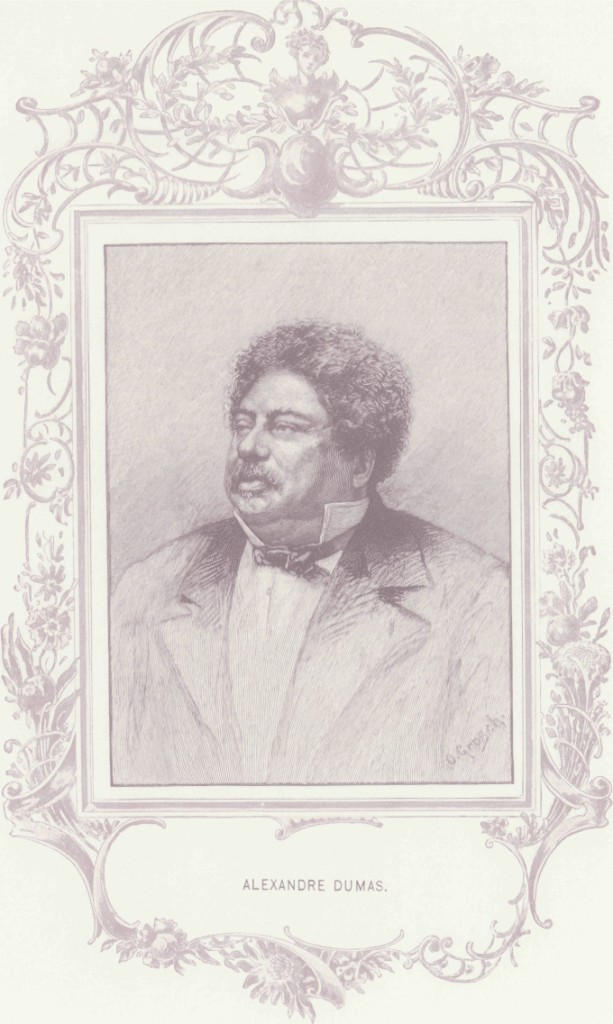
Dumas's full name was noble: he was Alexandre Dumas-Davy de la Pailleterie. His family estate, La Pailleterie, was made a marquisate by Louis XIV. in 1707. About 1760 the grandfather of Dumas sold his lands in France, and went to Hayti. There in 1762 was born his father, son of Louise Cossette Dumas and of the Marquis de la Pailleterie. The mother must have been a woman of color; Dumas talks of his father's "mulatto hue," and he himself had undoubted traces of African blood. Yet it appears that the grandparents were duly married. In 1772, his wife having died, the old marquis returned to France. The Revolution broke out, and the father of Alexandre Dumas fought in the armies of the Republic. The cruel mob called him by way of mockery, "Monsieur Humanity," because he endeavored to rescue the victims of their ferocity. He was a man of great courage and enormous physical strength. Napoleon, in honor of one of his feats of arms, called him in a dispatch "The Horatius Cocles of the Republic." He was with Napoleon in Egypt, where a quarrel arose, as he suspected and opposed the ambition of the future emperor. Though Dumas found a treasure in a bey's house, he honorably presented it to his government. He died in France, a poor man, in 1806.
Dumas was not at home when his father died. He was staying, a child of four, with his cousin Marianne.
"At midnight I was awakened, or rather my cousin and I were awakened, by a great blow struck on the door of our room. By the light of a night lamp I saw my cousin start up, much alarmed. No mortal could have knocked at our chamber door, for the outer doors were locked. [He gives a plan of the house.] I got out of bed to open the door. 'Where are you going, Alexandre?' cried my cousin.
"'To let in papa, who is coming to say adieu.'
"The girl dragged me back to bed; I cried, 'Adieu, papa, adieu!' Something like a sighing breath passed over my face.... My father had died at the hour when we heard the knock!"
This anecdote may remind the reader of what occurred at Abbotsford on the night when Mr. Bullock died in London. Dumas tells another tale of the same kind ('Memoirs,' Vol. xi., page 255: Brussels, 1852). On the night of his mother's death he in vain sought a similar experience. These things "come not by observation"; but Dumas, like Scott, had a mind not untuned to such themes, though not superstitious.
Young Dumas, like most men of literary genius, taught himself to read. A Buffon with plates was the treasure of the child, already a lover of animals. To know more about the beasts he learned to read for his own pleasure. Of mythology he was as fond as Keats. His intellectual life began (like the imaginative life of our race) in legends of beasts and gods. For Dumas was born un primitif, as the French say; his taste was the old immortal human taste for romance, for tales of adventure, love, and war. This predilection is now of course often scouted by critics who are over-civilized and under-educated. Superior persons will never share the love of Dumas which was common to Thackeray and Mr. Robert Louis Stevenson. From Buffon he went on to the 'Letters to Émil' (letters on mythology), and to the 'Arabian Nights.' An imaginative child, he knew the "pains of sleep" as Coleridge did, and the terrors of vain imagination. Many children whose manhood is not marked by genius are visionaries. A visionary too was little Dumas, like Scott, Coleridge, and George Sand in childhood. To the material world he ever showed a bold face. "I have never known doubt or despair," he says; his faith in God was always unshaken; the doctrine of immortality he regarded rather with hope than absolute belief. Yet surely it is a corollary to the main article of his creed.
At ten, Dumas went to a private school kept by an Abbé Grégoire. At the Restoration, a boy of twelve, he made and he adhered to an important resolution. He chose to keep his grandmaternal name of Dumas, like his father, and to drop the name and arms of De la Pailleterie, with all the hopes of boons from the restored Royalists. Dumas remained a man of the popular party, though he had certain relations of friendship with the house of Orléans. But he entertained no posthumous hatred of the old monarchy and the old times. His kings are nearly as good, in his romances, as Sir Walter's own, and his Henri III. and Henri IV. may be named with Scott's Gentle King Jamie and Louis XI.
Madame Dumas, marquise as she was by marriage, kept a tobacconist's shop; and in education, Dumas was mainly noted for his calligraphy. Poaching was now the boy's favorite amusement; all through his life he was very fond of sport. Napoleon returned from Elba; Dumas saw him drive through Villers-Cotterets on his way to Waterloo. Soon afterwards came in stragglers; the English, they said, had been defeated at five o'clock on June 18th, but the Prussians arrived at six o'clock and won the battle. What the English were doing between five and six does not appear; it hardly seems that they quitted the field. The theory of that British defeat at Waterloo was never abandoned by Dumas. He saw Napoleon return through Villers-Cotterets. "Wellington, Bülow, Blücher, were but masks of men; really they were spirits sent by the Most High to defeat Napoleon." It is a pious opinion!
At the age of fifteen Dumas, like Scott, became a notary's clerk. About this time he saw 'Hamlet' played, in the version of Ducis. Corneille and Racine had always been disliked by this born romanticist. 'Hamlet' carried him off his feet. Soon afterwards he read Bürger's 'Lenore,' the ballad which Scott translated at the very beginning of his career as an author.
"Tramp! tramp! along the land they rode, Splash! splash! along the sea; The scourge is red, the spur drops blood, The flashing pebbles flee."
This German ballad, says Scott, "struck him as the kind of thing he could do himself." And Dumas found that the refrain
"Hurrah, fantôme, les morts vont vite,"
was more to his taste than the French poetry of the eighteenth century. He tried to translate 'Lenore.' Scott finished it in a night; Dumas gave up in despair. But this, he says, was the beginning of his authorship. He had not yet opened a volume of Scott or Cooper, "ces deux grands romanciers." With a friend named Leuven he began to try to write plays (1820-1821). He now poached his way to Paris, defraying his expenses with the game he shot on the road. Shakespeare too was a poacher; let us excuse the eccentricities of genius. He made Talma's acquaintance; he went to the play; he resigned his clerkship: "Paris was my future." Thither he went; his father's name served him with General Foy, and he obtained a little post in the household of the Duc D'Orléans—a supernumerary secretaryship at £60 a year. At the play he met Charles Nodier, reading the rarest of Elzevirs, and at intervals (like Charles Lamb) hissing his own piece! This delightful scene, with its consequences, occupies one hundred and thirty pages!
Dumas now made the acquaintance of Frederic Soulié, and became a pillar of theatres. He began to read with a purpose: first he read Scott; "The clouds lifted, and I beheld new horizons." Then he turned to Cooper; then to Byron. One day he entered his office, crying aloud, "Byron is dead!" "Who is Byron?" said one of his chiefs. Here Dumas breaks off in his 'Memoirs' to give a life of Byron! He fought his first duel in the snow, and won an easy, almost a bloodless victory. For years he and Leuven wrote plays together,—plays which were never accepted.
At last he, Rousseau (not Jean Jacques!), and Leuven composed a piece together. Refused at one house, it was accepted at another: 'La Chasse et l'Amour' (The Chase and Love) was presented on September 22d, 1823. It succeeded. A volume of three short stories sold to the extent of four copies. Dumas saw that he must "make a name" before he could make a livelihood. "I do not believe in neglected talent and unappreciated genius," says he. Like Mr. Arthur Pendennis, he wrote verses "up to" pictures. Thackeray did the same. "Lady Blessington once sent him an album print of a boy and girl fishing, with a request that he would make some verses for it. 'And,' he said, 'I liked the idea, and set about it at once. I was two entire days at it,—was so occupied with it, so engrossed by it, that I did not shave during the whole time.'" So says Mr. Locker-Lampson.
We cannot all be Dumas or Thackeray. But if any literary beginner reads these lines, let him take Dumas's advice; let him disbelieve in neglected genius, and do the work that comes in his way, as best he can. Dumas had a little anonymous success in 1826, a vaudeville at the Porte-Saint-Martin. At last he achieved a serious tragedy, or melodrama, in verse, 'Christine.' He wrote to Nodier, reminding him of their meeting at the play. The author of 'Trilby' introduced him to Taylor; Taylor took him to the Théâtre Français; 'Christine' was read and accepted unanimously.
Dumas now struck the vein of his fortune. By chance he opened a volume of Anquetil, and read an anecdote of the court of Henri III. This led him to study the history of Saint Megrin, in the Memoirs of L'Estoile, where he met Quelus, and Maugiron, and Bussy d'Amboise, with the stirring tale of his last fight against twelve men. Out of these facts he made his play 'Henri III.,' and the same studies inspired that trilogy of romances 'La Reine Margot' (Queen Margot), 'La Dame de Monsoreau' (The Lady of Monsoreau), and 'Les Quarante-Cinq' (The Forty-Five). These are, with the trilogy of the 'Mousquetaires,' his central works as a romancer, and he was twenty-five when he began to deal with the romance of history. His habit was to narrate his play or novel, to his friends, to invent as he talked, and so to arrive at his general plan. The mere writing gave him no trouble. We shall later show his method in the composition of 'The Three Musketeers.'
'Christine' had been wrecked among the cross-currents of theatrical life. 'Henri III.' was more fortunate. Dumas was indeed obliged to choose between his little office and the stage; he abandoned his secretaryship. In 1829 occurred this "duel between his past and his future." Just before the first night of the drama, Dumas's mother, whom he tenderly loved, was stricken down by paralysis. He tended her, he watched over his piece, he almost dragged the Duc d'Orléans to the theatre. On that night he made the acquaintance of Hugo and Alfred de Vigny. Dumas passed the evening between the theatre and his mother's bedside. When the curtain fell, he was "called on"; the audience stood up uncovered, the Duc d'Orléans and all!
Next morning Dumas, like Byron, "woke to find himself famous." He had "made his name" in the only legitimate way,—by his work. Troubles followed, difficulties with the Censorship, duels and rumors of duels, and the whole romantic upheaval which accompanied the Revolution of 1830. Dumas was attached again to the Orléans household. He dabbled in animal magnetism, which had been called mesmerism, and now is known as hypnotism. The phenomena are the same; only the explanations vary. About 1830 there was a mania for animal magnetism in Paris; Lady Louisa Stuart recounted some of the marvels to Sir Walter Scott, who treated the reports with disdain. When writing his romance 'Joseph Balsamo' (a tale of the French Revolution), Dumas made studies of animal magnetism, and was, or believed himself to be, an adept. The orthodox party of modern hypnotists merely hold that by certain physical means, a state of somnambulism can be produced in certain people. Once in that state, the patients are subject, to "suggestion," and are obedient to the will of the hypnotizer. He for his part exerts no "magnetic current," no novel unexplained force or fluid. Some recent French and English experiments are not easily to be reconciled with this hypothesis. Dumas himself believed that he exerted a magnetic force, and without any "passes" or other mechanical means, could hypnotize persons who did not know what he was about, and so were not influenced by "suggestion." In a few cases he held that his patients became clairvoyant; one of them made many political prophecies,—all unfulfilled. Another, in trance, improved vastly as a singer; "her normal voice stopped at contre-si. I bade her rise to contre-re, which she did; though incapable of it when awake." So far, this justifies the plot of Mr. Du Maurier's novel 'Trilby.' Dumas offers no theory; he states facts, as he says, including "post-hypnotic suggestion."
These experiments were made by Dumas merely as part of his studies for 'Joseph Balsamo' (Cagliostro); his conclusion was that hypnotism is not yet reduced to a scientific formula. In fiction it is already overworked. Dumas got his 'Christine' acted at last. Then broke out the Revolution of 1830. Dumas's description of his activity is "as good as a novel," but too long and varied for condensation. It seems better to give this extract about his life of poverty before his mother died, before fame visited him. (I quote Miss Cheape's translation of the passage included in her 'Stories of Beasts,' published by Longmans, Green and Company.)
He had, in later years, named a cat Mysouff II.
"If you won't think me impertinent, sir," said Madame Lamarque, "I should so like to know what Mysouff means."
"Mysouff just means Mysouff, Madame Lamarque."
"It is a cat's name, then?"
"Certainly, since Mysouff the First was so-called. It is true, Madame Lamarque, you never knew Mysouff." And I became so thoughtful that Madame Lamarque was kind enough to withdraw quietly, without asking any questions about Mysouff the First.
That name had taken me back to fifteen years ago, when my mother was still living. I had then the great happiness of having a mother to scold me sometimes. At the time I speak of, I held a situation in the service of the Duc d'Orléans, with a salary of 1500 francs. My work occupied me from ten in the morning until five in the afternoon. We had a cat in those days, whose name was Mysouff. This cat had missed his vocation; he ought to have been a dog. Every morning I started for my office at half-past nine, and came back every evening at half-past five. Every morning Mysouff followed me to the corner of a particular street, and every evening I found him in the same street, at the same corner, waiting for me. Now the curious thing was that on the days when I had found some amusement elsewhere, and was not coming home to dinner, it was of no use to open the door for Mysouff to go and meet me. Mysouff, in the attitude of the serpent with its tail in its mouth, refused to stir from his cushion. On the other hand, on the days I did come, Mysouff would scratch at the door until some one opened it for him. My mother was very fond of Mysouff; she used to call him her barometer.
"Mysouff marks my good and my bad weather," my dear mother would say: "the days you come in are my days of sunshine; my rainy days are when you stay away."
When I came home I used to see Mysouff at the street corner, sitting quite still and gazing into the distance. As soon as he caught sight of me, he began to move his tail; then as I drew nearer, he rose and walked backward and forward across the pavement with his back arched and his tail in the air. When I reached him, he jumped up upon me as a dog would have done, and bounded and played round me as I walked towards the house; but when I was close to it he dashed in at full speed. Two seconds after, I used to see my mother at the door.
Never again in this world, but perhaps in the next, I shall see her standing waiting for me at the door.
That is what I was thinking of, dear readers, when the name of Mysouff brought back all these recollections; so you understand why I did not answer Madame Lamarque's question.
The life of Dumas after 1830 need not be followed step by step; indeed, for lack of memoirs, to follow it is by no means easy.
Dumas, by dint of successful plays, and later of successful novels, earned large sums of money—£40,000 in one year, it is said. He traveled far and wide, and compiled books of travel. In the forties, before the Revolution of 1848, he built a kind of Abbotsford of his own, named "Monte Cristo," near St. Germains, and joyously ruined himself. "Monte Cristo," like Abbotsford, has been described as a palace. Now, Abbotsford is so far from being a palace that Mr. Hope Scott, when his wife, Scott's granddaughter, inherited the place, was obliged to build an additional wing.
At Monte Cristo Dumas kept but one man-servant, Michel (his "Tom Purdie"), who was groom, keeper, porter, gardener, and everything. Nor did Dumas ruin himself by paying exorbitant prices for poor lands, as Scott did. His collection of books and curios was no rival for that of Abbotsford. But like Scott, he gave away money to right and left, and he kept open house. He was eaten up by parasites,—beggars, poor greedy hangers-on of letters, secretaries, above all by tribes of musical people. On every side money flowed from him; hard as he worked, largely as he earned, he spent more. His very dog brought in thirteen other dogs to bed and board. He kept monkeys, cats, eagles, a vulture, a perfect menagerie. His own account of these guests may be read in "My Pets"; perhaps the most humorous, good-humored, and amusing of all his works.
The Revolution of 1848 impoverished him and drove him from Monte Cristo; not out of debt to his neighbors. Dumas was a cheerful giver, but did not love to "fritter away his money in paying bills." He started newspapers, such as The Musketeer, and rather lost than gained by a careless editorship. A successful play would enrich him, and he would throw away his gains. He went with Garibaldi on his expedition against the King of Naples, and was received with ingratitude by the Neapolitans.
A friend of Daniel Dunglas Home, the "medium," he accompanied him to Russia, where Home married a lady of a noble and wealthy family. Returned to France, Dumas found his popularity waning. His plays often failed; he had outlived his success and his generation; he had saved nothing; he had to turn in need to his son Alexandre, the famous dramatist. Finally he died, doubting the security of his own fame, in the year of the sorrows of France.
Dumas is described by Michelet as "a force of nature." Never was there in modern literature a force more puissant, more capricious, or more genial. His quantity of mind was out of all proportion to its quality. He could learn everything with ease; he was a skilled cook, a fencer; he knew almost as if by intuition the technique and terminology of all arts and crafts. Ignorant of Greek, he criticized and appreciated Homer with an unmatched zest and appreciation. Into the dry bones of history he breathed life, mere names becoming full-blooded fellow-creatures under his spell. His inspiration was derived from Scott, a man far more learned than he, but scarcely better gifted with creative energy. Like Scott he is long, perhaps prolix; like him he is indifferent to niceties of style, does not linger over the choice of words, but serves himself with the first that comes to hand. Scott's wide science of human nature is not his; but his heroes, often rather ruffianly, are seldom mere exemplary young men of no particular mark. More brilliantly and rapidly than Scott, he indicates action in dialogue. He does not aim at the construction of rounded plots; his novels are chronicles which need never stop while his heroes are alive. His plan is to take a canvas of fact, in memoir or history, and to embroider his fantasies on that. Occasionally the canvas (as Mr. Saintsbury says) shows through, and we have blocks of actual history. His 'Joan of Arc' begins as a romance, and ends with a comparatively plain statement of facts too great for any art but Shakespeare's. But as a rule it is not historical facts, it is the fictitious adventures of characters living in an historical atmosphere, that entertain us in Dumas.
The minute inquirer may now compare the sixteenth-century 'Memoirs of Monsieur D'Artagnan' (fictitious memoirs, no doubt) with the use made of them by Dumas in 'The Three Musketeers' and 'Twenty Years After.' The 'Memoirs' (reprinted by the Librairie Illustrée, Paris) gave Dumas his opening scenes; gave him young D'Artagnan, Porthos, Athos, Aramis, Rosnay, De Treville, Milady, the whole complicated intrigue of Milady, D'Artagnan, and De Vardes. They gave him several incidents, duels, and "local color." By making Milady the wife of Athos, Dumas knotted his plot; he added the journey to England, after the Queen's diamonds; from a subordinate character he borrowed the clerical character of Aramis; a mere hint in the 'Memoirs' suggested the Bastion Saint-Gervais. The discrimination of character, the dialogue, and many adventures, are Dumas's own; he was aided by Maquet in the actual writing. In a similar way, Brantôme and L'Estoile, in their 'Memoirs,' supply the canvas of the tales of the Valois cycle.
The beginner in Dumas will assuredly find the following his best works. For the Valois period, 'The Horoscope' (a good deal neglected), 'Queen Margot,' 'The Lady of Monsoreau,' 'The Forty-Five.' 'Isabeau of Bavière,' an early novel, deals with the anarchy and misery before the coming of Jeanne d'Arc. For Henri II., 'The Two Dianas' is indicated. For the times of Richelieu, Mazarin, Louis XIV., we have 'The Three Musketeers,' 'Twenty Years After,' and 'The Viscount of Bragelonne.' These deal with the youth, middle age, old age, and death of D'Artagnan, Porthos, Athos, and Aramis. The Revolutionary novels, 'Joseph Balsamo,' 'The Queen's Necklace,' and others, are much less excellent. The Regency is not ill done in 'The Regent's Daughter'; and 'The Chevalier of Harmenthal,' with 'Olympe of Cleves,' has many admirers. Quite apart from these is the immense modern fantasy of 'The Count of Monte Cristo'; the opening part alone is worthy of the master. 'The Black Tulip,' so warmly praised by Thackeray, is an innocent little romance of the days of Dutch William. Les jeunes filles may read 'The Black Tulip': indeed, Dumas does not sacrifice at all to "the Goddess of Lubricity," even when he describes very lax moralities.
With a knowledge of these books, and of 'My Pets' and the 'Memoirs,' any student will find himself at home in Dumas, and can make wider ranges in that great wilderness of fancy. Some autobiographical details will be found in the novel called 'Ange Pithou.' 'Isaac Laquedem' was meant to be a romance of the Wandering Jew; only two volumes are published. Philosophy a reader will not find, nor delicate analysis, nor "chiseled style"; but he will be in touch with a great sunny life, rejoicing in all the accidents of existence.
THE CURE FOR DORMICE THAT EAT PEACHES
From 'The Count of Monte Cristo'
Not on the same night he had intended, but the next morning, the Count of Monte Cristo went out on the road to Orléans. Leaving the village of Linas, without stopping at the telegraph, which at the moment the count passed threw out its long bony arms, he reached the tower of Montlhéry, situated, as every one knows, upon the highest point of the plain of that name. At the foot of the hill the count dismounted, and began to ascend the mountain by a little winding path about eighteen inches wide; when he reached the summit he found himself stopped by a hedge, upon which green fruit had succeeded to red and white flowers.
Monte Cristo looked for the door of the inclosure, and was not long in finding it. It was a little wooden gate, working on willow hinges, and fastened with a nail and string. The count soon understood its mechanism, and the door opened. He then found himself in a little marvelously well-kept garden, about twenty feet long by twelve wide, bounded on one side by part of the hedge, in which was formed the ingenious machine we have named a door; and on the other by the old tower, covered with ivy and studded with wild flowers. Monte Cristo stopped, after having closed the door and fastened the string to the nail, and cast a look around.
"The man at the telegraph," said he, "must either keep a gardener or devote himself passionately to horticulture." Suddenly he struck himself against something crouching behind a wheelbarrow filled with leaves; the something rose, uttered an exclamation of astonishment, and Monte Cristo found himself facing a man about fifty years old, who was plucking strawberries, which he was placing upon vine-leaves. He had twelve leaves and about as many strawberries, which, on rising suddenly, he let fall from his hand. "You are gathering your crop, sir?" said Monte Cristo, smiling.
"Excuse me, sir," replied the man, raising his hand to his cap; "I am not up there, I know, but I have only just come down."
"Do not let me interfere with you in anything, my friend," said the count; "gather your strawberries, if indeed there are any left."
"I have ten left," said the man, "for here are eleven, and I had twenty-one, five more than last year. But I am not surprised; the spring has been warm this year, and strawberries require heat, sir. This is the reason that, instead of the sixteen I had last year, I have this year, you see, eleven already plucked—twelve, thirteen, fourteen, fifteen, sixteen, seventeen, eighteen. Ah, I miss three! they were here last night, sir—I am sure they were here—I counted them. It must be the son of Mother Simon who has stolen them; I saw him strolling about here this morning. Ah! the young rascal! stealing in a garden; he does not know where that may lead him to."
"Certainly, it is wrong," said Monte Cristo, "but you should take into consideration the youth and greediness of the delinquent."
"Of course," said the gardener, "but that does not make it the less unpleasant. But, sir, once more I beg pardon; perhaps you are an official that I am detaining here?" And he glanced timidly at the count's blue coat.
"Calm yourself, my friend," said the count, with that smile which at his will became so terrible or benevolent, and which this time beamed only with the latter expression; "I am not an inspector, but a traveler, conducted here by curiosity he half repents of, since he causes you to lose your time."
"Ah! my time is not valuable," replied the man, with a melancholy smile. "Still, it belongs to the government, and I ought not to waste it; but having received the signal that I might rest for an hour" (here he glanced at a sun-dial, for there was everything in the inclosure of Montlhéry, even a sun-dial), "and having ten minutes before me, and my strawberries being ripe, when a day longer—by-the-by, sir, do you think dormice eat them?"
"Indeed, I should think not," replied Monte Cristo: "dormice are bad neighbors for us who do not eat them preserved, as the Romans did."
"What! did the Romans eat them?" said the gardener; "eat dormice?"
"I have read so," said the count.
"Really! They can't be nice, though they do say 'as fat as a dormouse.' It is not a wonder they are fat, sleeping all day, and only waking to eat all night. Listen: last year I had four apricots—they stole one; I had one nectarine, only one—well, sir, they ate half of it on the wall; a splendid nectarine—I never ate a better."
"You ate it?"
"That is to say, the half that was left—you understand; it was exquisite, sir. Ah, those gentlemen never choose the worst morsels; like Mother Simon's son, who has not chosen the worst strawberries. But this year," continued the horticulturist, "I'll take care it shall not happen, even if I should be forced to sit up the whole night to watch when the strawberries are ripe." Monte Cristo had seen enough. Every man has a devouring passion in his heart, as every fruit has its worm; that of the man at the telegraph was horticulture. He began gathering the vine-leaves which screened the sun from the grapes, and won the heart of the gardener. "Did you come here, sir, to see the telegraph?" he said.
"Yes, if not contrary to the rules."
"Oh no," said the gardener; "there are no orders against doing so, providing there is nothing dangerous, and that no one knows what we are saying."
"I have been told," said the count, "that you do not always yourselves understand the signals you repeat."
"Certainly, sir; and that is what I like best," said the man, smiling.
"Why do you like that best?"
"Because then I have no responsibility. I am a machine then, and nothing else; and so long as I work, nothing more is required of me."
"Is it possible," said Monte Cristo to himself, "that I can have met with a man that has no ambition? That would spoil my plans."
"Sir," said the gardener, glancing at the sun-dial, "the ten minutes are nearly expired; I must return to my post. Will you go up with me?"
"I follow you." Monte Cristo entered the tower, which was divided into three stages. The lowest contained gardening implements, such as spades, rakes, watering-pots, hung against the wall; this was all the furniture. The second was the usual dwelling or rather sleeping-place of the man; it contained a few poor articles of household furniture, a bed, a table, two chairs, a stone pitcher, and some dry herbs hung up to the ceiling, which the count recognized as sweet-peas, and of which the good man was preserving the seeds, having labeled them with as much care as if he had been a botanist.
"Does it require much study to learn the art of telegraphing, sir?" asked Monte Cristo.
"The study does not take long; it was acting as a supernumerary that was so tedious."
"And what is the pay?"
"A thousand francs, sir."
"It is nothing."
"No; but then we are lodged, as you perceive."
Monte Cristo looked at the room. They passed on to the third stage; it was the room of the telegraph. Monte Cristo looked in turns at the two iron handles by which the machine was worked. "It is very interesting," he said; "but it must be very tedious for a lifetime."
"Yes. At first my neck was cramped with looking at it, but at the end of a year I became used to it; and then we have our hours of recreation, and our holidays when we have a fog."
"Ah, to be sure."
"Those are indeed holidays to me; I go into the garden, I plant, prune, trim, and kill the insects all day long."
"How long have you been here?"
"Ten years, and five as a supernumerary make fifteen."
"You are—"
"Fifty-five years old."
"How long must you serve to claim the pension?"
"Oh, sir, twenty-five years."
"And how much is the pension?"
"A hundred crowns."
"Poor humanity!" murmured Monte Cristo.
"What did you say, sir?" asked the man.
"I was saying it was very interesting."
"What was?"
"All you were showing me. And you really understand none of these signals?"
"None at all."
"And have you never tried to understand them?"
"Never. Why should I?"
"But still there are some signals only addressed to you."
"Certainly."
"And do you understand them?"
"They are always the same."
"And they mean—"
"Nothing new; You have an hour; or To-morrow."
"This is simple enough," said the count; "but look! is not your correspondent putting himself in motion?"
"Ah yes; thank you, sir."
"And what is it saying—anything you understand?"
"Yes; it asks if I am ready."
"And you reply?"
"By the same sign, which at the same time tells my right-hand correspondent that I am ready, while it gives notice to my left-hand correspondent to prepare in his turn."
"It is very ingenious," said the count.
"You will see," said the man, proudly; "in five minutes he will speak."
"I have then five minutes," said Monte Cristo to himself; "it is more time than I require. My dear sir, will you allow me to ask you a question?"
"What is it, sir?"
"You are fond of gardening?"
"Passionately."
"And you would be pleased to have, instead of this terrace of twenty feet, an inclosure of two acres?"
"Sir, I should make a terrestrial paradise of it."
"You live badly on your thousand francs?"
"Badly enough; but yet I do live."
"Yes; but you have only a small garden."
"True, the garden is not large."
"And then, such as it is, it is filled with dormice, who eat everything."
"Ah! they are my scourges."
"Tell me, should you have the misfortune to turn your head while your right-hand correspondent was telegraphing—"
"I should not see him."
"Then what would happen?"
"I could not repeat the signals."
"And then?"
"Not having repeated them, through negligence, I should be fined."
"How much?"
"A hundred francs."
"The tenth of your income—that would be fine work."
"Ah!" said the man.
"Has it ever happened to you?" said Monte Cristo.
"Once, sir, when I was grafting a rose-tree."
"Well, suppose you were to alter a signal, and substitute another?"
"Ah, that is another case; I should be turned off, and lose my pension."
"Three hundred francs."
"A hundred crowns; yes, sir; so you see that I am not likely to do any of these things."
"Not even for fifteen years' wages? Come, it is worth thinking about?"
"For fifteen thousand francs!"
"Yes."
"Sir, you alarm me."
"Nonsense!"
"Sir, you are tempting me?"
"Just so; fifteen thousand francs, do you understand?"
"Sir, let me see my right-hand correspondent!"
"On the contrary, do not look at him, but on this."
"What is it?"
"What! do you not know these little papers?"
"Bank-notes!"
"Exactly; there are fifteen of them."
"And whose are they?"
"Yours, if you like."
"Mine!" exclaimed the man, half suffocated.
"Yes; yours—your own property."
"Sir, my right-hand correspondent is signaling."
"Let him."
"Sir, you have distracted me; I shall be fined."
"That will cost you a hundred francs; you see it is your interest to take my bank-notes."
"Sir, my right-hand correspondent redoubles his signals; he is impatient."
"Never mind—take these;" and the count placed the packet in the hands of the man. "Now, this is not all," he said; "you cannot live upon your fifteen thousand francs."
"I shall still have my place."
"No! you will lose it, for you are going to alter the sign of your correspondent."
"Oh, sir, what are you proposing?"
"A jest!"
"Sir, unless you force me—"
"I think I can effectually force you;" and Monte Cristo drew another packet from his pocket. "Here are ten thousand more francs," he said; "with the fifteen thousand already in your pocket, they will make twenty-five thousand. With five thousand you can buy a pretty little house with two acres of land; the remaining twenty thousand will bring you in a thousand francs a year."
"A garden with two acres of land!"
"And a thousand francs a year."
"Oh heavens!"
"Come, take them!" and Monte Cristo forced the bank-notes into his hand.
"What am I to do?"
"Nothing very difficult."
"But what is it?"
"To repeat these signs;" Monte Cristo took a paper from his pocket, upon which were drawn three signs, with numbers to indicate the order in which they were to be worked.
"There, you see it will not take long."
"Yes; but—"
"Do this, and you will have nectarines and all the rest." The mark was hit: red with fever, while the large drops fell from his brow, the man executed, one after the other, the three signs given by the count; notwithstanding the frightful contortions of the right-hand correspondent, who, not understanding the change, began to think the gardener had become mad. As to the left-hand one, he conscientiously repeated the same signals, which were definitively carried to the Minister of the Interior. "Now you are rich," said Monte Cristo.
"Yes," replied the man, "but at what a price!"
"Listen, friend," said Monte Cristo. "I do not wish to cause you any remorse; believe me, then, when I swear to you that you have wronged no man, but on the contrary have benefited mankind." The man looked at the bank-notes, felt them, counted them; he turned pale, then red; then rushed into his room to drink a glass of water, but he had no time to reach the water-jug, and fainted in the midst of his dried herbs. Five minutes after the new telegram reached the minister, Debray had the horses put to his carriage, and drove to Danglars's.
"Has your husband any Spanish bonds?" he asked of the baroness.
"I think so, indeed! He has six millions' worth."
"He must sell them at whatever price."
"Why?"
"Because Don Carlos has fled from Bourges, and has returned to Spain."
"How do you know?"—Debray shrugged his shoulders. "The idea of asking how I hear the news!" he said. The baroness did not wait for a repetition; she ran to her husband, who immediately hastened to his agent and ordered him to sell at any price. When it was seen that Danglars sold, the Spanish funds fell directly. Danglars lost five hundred thousand francs; but he rid himself of all his Spanish shares. The same evening the following was read in Le Messager:—
"Telegraphic dispatch. The King, Don Carlos, has escaped the vigilance exercised over him at Bourges, and has returned to Spain by the Catalonian frontier. Barcelona has risen in his favor."
All that evening nothing was spoken of but the foresight of Danglars, who had sold his shares, and of the luck of the stock-jobber, who only lost five hundred thousand francs by such a blow. Those who had kept their shares, or bought those of Danglars, looked upon themselves as ruined, and passed a very bad night. Next morning Le Moniteur contained the following:
"It was without any foundation that Le Messager yesterday announced the flight of Don Carlos and the revolt of Barcelona. The King (Don Carlos) has not left Bourges, and the peninsula is in the enjoyment of profound peace. A telegraphic signal, improperly interpreted owing to the fog, was the cause of this error."
The funds rose one per cent, higher than before they had fallen. This, reckoning his loss, and what he had missed gaining, made the difference of a million to Danglars. "Good!" said Monte Cristo to Morrel, who was at his house when the news arrived of the strange reverse of fortune of which Danglars had been the victim. "I have just made a discovery for twenty-five thousand francs, for which I would have paid a hundred thousand."
"What have you discovered?" asked Morrel.
"I have just discovered the method of ridding a gardener of the dormice that eat his peaches."
THE SHOULDER OF ATHOS, THE BELT OF PORTHOS, AND THE HANDKERCHIEF OF ARAMIS
From 'The Three Musketeers'
Furious with rage, D'Artagnan crossed the ante-room in three strides, and began to descend the stairs four steps at a time, without looking where he was going; when suddenly he was brought up short by knocking violently against the shoulder of a musketeer who was leaving the apartments of M. De Treville. The young man staggered backwards from the shock, uttering a cry, or rather a yell.
"Excuse me," said D'Artagnan, trying to pass him, "but I am in a great hurry."
He had hardly placed his foot on the next step, when he was stopped by the grasp of an iron wrist on his sash.
"You are in a great hurry!" cried the musketeer, whose face was the color of a shroud; "and you think that is enough apology for nearly knocking me down? Not so fast, my young man. I suppose you imagine that because you heard M. De Treville speaking to us rather brusquely to-day, that everybody may treat us in the same way? But you are mistaken, and it is as well you should learn that you are not M. De Treville."
"Upon my honor," replied D'Artagnan, recognizing Athos, who was returning to his room after having his wound dressed, "upon my honor, it was an accident, and therefore I begged your pardon. I should have thought that was all that was necessary. I repeat that I am in a very great hurry, and I should be much obliged if you would let me go my way."
"Monsieur," said Athos, loosening his hold, "you are sadly lacking in courtesy, and one sees that you must have had a rustic upbringing."
D'Artagnan was by this time half-way down another flight; but on hearing Athos's remark he stopped short.
"My faith, monsieur!" exclaimed he, "however rustic I may be, I shall not come to you to teach me manners."
"I am not so sure of that," replied Athos.
"Oh, if I was only not in such haste," cried D'Artagnan; "if only I was not pursuing somebody—"
"Monsieur, you will find me without running after me. Do you understand?"
"And where, if you please?"
"Near Carmes-Deschaux."
"At what hour?"
"Twelve o'clock."
"Very good. At twelve I will be there."
"And don't be late, for at a quarter past twelve I will cut off your ears for you."
"All right," called out D'Artagnan, dashing on down-stairs after his man; "you may expect me at ten minutes before the hour."
But he was not to escape so easily. At the street door stood Porthos, talking to a sentry, and between the two men there was barely space for a man to pass. D'Artagnan took it for granted that he could get through, and darted on, swift as an arrow, but he had not reckoned on the gale that was blowing. As he passed, a sudden gust wrapped Porthos's mantle tight round him; and though the owner of the garment could easily have freed him had he so chosen, for reasons of his own he preferred to draw the folds still closer.
D'Artagnan, hearing the volley of oaths let fall by the musketeers, feared he might have damaged the splendor of the belt, and struggled to unwind himself; but when he at length freed his head, he found that like most things in this world the belt had two sides, and while the front bristled with gold, the back was mere leather; which explains why Porthos always had a cold and could not part from his mantle.
"Confound you!" cried Porthos, struggling in his turn, "have you gone mad, that you tumble over people like this?"
"Excuse me," answered D'Artagnan, "but I am in a great hurry. I am pursuing some one, and—"
"And I suppose that on such occasions you leave your eyes behind you?" asked Porthos.
"No," replied D'Artagnan, rather nettled; "and thanks to my eyes, I often see things that other people don't."
Possibly Porthos might have understood this allusion, but in any case he did not attempt to control his anger, and said sharply:—
"Monsieur, we shall have to give you a lesson if you take to tumbling against the musketeers like this!"
"A lesson, monsieur!" replied D'Artagnan; "that is rather a severe expression."
"It is the expression of a man who is always accustomed to look his enemies in the face."
"Oh, if that is all, there is no fear of your turning your back on anybody," and enchanted at his own wit, the young man walked away in fits of laughter.
Porthos foamed with rage, and rushed after D'Artagnan.
"By-and-by, by-and-by," cried the latter; "when you have not got your mantle on."
"At one o'clock then, behind the Luxembourg."
"All right; at one o'clock," replied D'Artagnan as he vanished around the corner.
But he could see no one either in the street he had passed through, or in the one his eager gaze was searching; however slowly the stranger might have walked, he had gone his way, or perhaps into some house. D'Artagnan inquired of everybody he met, but could find nothing at all about him. This chase however did him good in one way; for in proportion as the sweat started out on his forehead, his heart began to cool.
He began to think over the many unlucky things which had happened. It was scarcely eleven in the morning, and yet this morning had already brought him into disgrace with M. Treville, who must think the way D'Artagnan had left him was rather boorish.
Moreover, he had gotten himself into two fierce duels with two men, each able to kill three D'Artagnans; in a word, with two musketeers,—beings he set so high that he placed them above all other men.
It was a sad lookout. To be sure, as the youth was certain to be killed by Athos, he was not much disturbed about Porthos. As hope is the last thing to die in a man's heart, however, he ended by hoping that he might come out alive from both duels, even if dreadfully injured; and on that supposition he scored himself in this way for his conduct:—
"What a rattle-headed dunce I am! That brave and unfortunate Athos was wounded right on that shoulder I ran against head-foremost, like a ram. The only thing that surprises me is that he didn't strike me dead on the spot; he had provocation enough, for I must have hurt him savagely. As to Porthos—oh! as to Porthos—that's a funny affair!"
And the youth began to laugh aloud in spite of himself; looking round carefully, however, to see if his laughing alone in public without apparent cause aroused any suspicion.
"As to Porthos, it is funny enough, to be sure, but I am a crazy blockhead all the same. Are people to be run into without warning? No! And have I any right to peep under their cloaks to see what they haven't got? He would have forgiven me, I am sure, if I had said nothing to him about that cursed cloak,—with a double meaning, it is true, but too broad a joke in one of them! Ah! cursed Gascon that I am, I believe I should crack a joke if I was being roasted over a slow fire. Friend D'Artagnan," he went on, speaking to himself with the gentleness he thought fair, "if you get away, which there is not much chance of, I would advise you to practice entire politeness for the future. You must henceforth be admired and quoted as a model of it. To be obliging and civil does not necessarily make a man a coward. Look at Aramis, now: mildness and grace embodied; and did anybody ever dream of calling Aramis a coward? No indeed, and from this instant I will try to model myself after him. And luckily, here he is."
D'Artagnan, walking and soliloquizing, had come within a few steps of the Aiguillon House, and in front of it saw Aramis chatting gayly with three of the King's Guards. Aramis also saw D'Artagnan; but not having forgotten that it was in his presence M. de Treville had got so angry in the morning, and as a witness of the rebuke was not at all pleasant, he pretended not to see him. D'Artagnan, on the other hand, full of his plans of conciliation and politeness, approached the young man with a profound bow accompanied by a most gracious smile. Aramis bowed slightly but did not smile. Moreover, all four immediately broke off their conversation.
D'Artagnan was not so dull as not to see he was not wanted; but he was not yet used enough to social customs to know how to extricate himself dexterously from his false position, which his generally is who accosts people he is little acquainted with, and mingles in a conversation which does not concern him. He was mentally casting about for the least awkward manner of retreat, when he noticed that Aramis had let his handkerchief fall, and (doubtless by mistake) put his foot on it. This seemed a favorable chance to repair his mistake of intrusion: he stooped down, and with the most gracious air he could assume, drew the handkerchief from under the foot in spite of the efforts made to detain it, and holding it out to Aramis, said:—
"I believe, sir, this is a handkerchief you would be sorry to lose?"
The handkerchief was in truth richly embroidered, and had a cornet and a coat of arms at one corner. Aramis blushed excessively, and snatched rather than took the handkerchief.
"Ha! ha!" exclaimed one of the guards, "will you go on saying now, most discreet Aramis, that you are not on good terms with Madame de Bois-Tracy, when that gracious lady does you the favor of lending you her handkerchief!"
Aramis darted at D'Artagnan one of those looks which tell a man that he has made a mortal enemy; then assuming his mild air he said:—
"You are mistaken, gentlemen: this handkerchief is not mine, and I cannot understand why this gentleman has taken it into his head to offer it to me rather than to one of you. And as a proof of what I say, here is mine in my pocket."
So saying, he pulled out his handkerchief, which was also not only a very dainty one, and of fine linen (though linen was then costly), but was embroidered and without arms, bearing only a single cipher, the owner's.
This time D'Artagnan saw his mistake; but Aramis's friends were by no means convinced, and one of them, addressing the young musketeer with pretended gravity, said:—
"If things were as you make out, I should feel obliged, my dear Aramis, to reclaim it myself; for as you very well know, Bois-Tracy is an intimate friend of mine, and I cannot allow one of his wife's belongings to be exhibited as a trophy."
"You make the demand clumsily," replied Aramis; "and while I acknowledge the justice of your reclamation, I refuse it on account of the form."
"The fact is," D'Artagnan put in hesitatingly, "I did not actually see the handkerchief fall from M. Aramis's pocket. He had his foot on it, that's all, and I thought it was his."
"And you were deceived, my dear sir," replied Aramis coldly, very little obliged for the explanation; then turning to the guard who had professed himself Bois-Tracy's friend—"Besides," he went on, "I have reflected, my dear intimate friend of Bois-Tracy, that I am not less devotedly his friend than you can possibly be, so that this handkerchief is quite as likely to have fallen from your pocket as from mine!"
"On my honor, no!"
"You are about to swear on your honor, and I on my word; and then it will be pretty evident that one of us will have lied. Now here, Montaran, we will do better than that: let each take a half."
"Perfectly fair," cried the other two guardsmen; "the judgment of Solomon! Aramis, you are certainly full of wisdom!"
They burst into a loud laugh, and as may be supposed, the incident bore no other fruit. In a minute or two the conversation stopped, and the three guards and the musketeer, after heartily shaking hands, separated, the guards going one way and Aramis another.
"Now is the time to make my peace with this gentleman," said D'Artagnan to himself, having stood on one side during all the latter part of the conversation; and in this good spirit drawing near to Aramis, who was going off without paying any attention to him, he said:—
"You will excuse me, I hope."
"Ah!" interrupted Aramis, "permit me to observe to you, sir, that you have not acted in this affair as a man of good breeding ought."
"What!" cried D'Artagnan, "do you suppose—"
"I suppose that you are not a fool, and that you knew very well, even though you come from Gascony, that people do not stand on handkerchiefs for nothing. What the devil! Paris is not paved with linen!"
"Sir, you do wrong in trying to humiliate me," said D'Artagnan, in whom his native pugnacity began to speak louder than his peaceful resolutions. "I come from Gascony, it is true; and since you know it, there is no need to tell you that Gascons are not very patient, so that when they have asked pardon once, even for a folly, they think they have done at least as much again as they ought to have done."
"Sir, what I say to you about this matter," said Aramis, "is not for the sake of hunting a quarrel. Thank Heaven, I am not a swashbuckler, and being a musketeer only for a while, I only fight when I am forced to do so, and always with great reluctance; but this time the affair is serious, for here is a lady compromised by you."
"By us, you mean," cried D'Artagnan.
"Why did you give me back the handkerchief so awkwardly?"
"Why did you let it fall so awkwardly?"
"I have said that the handkerchief did not fall from my pocket."
"Well, by saying that you have told two lies, sir; for I saw it fall."
"Oh ho! you take it up that way, do you, Master Gascon? Well, I will teach you how to behave yourself."
"And I will send you back to your pulpit, Master Priest. Draw, if you please, and instantly—"
"Not so, if you please, my good friend; not here, at least. Do you not see that we are opposite Aiguillon House, full of the Cardinal's creatures? How do I know that it is not his Eminence who has honored you with the commission to bring him in my head? Now, I entertain an absurd partiality for my head, it seems to suit my shoulders so finely. I have no objection to killing you, you may be sure, but quietly, in a snug, distant spot, where you will not be able to boast of your death to anybody."
"I agree, but don't be too confident; and take away your handkerchief—whether it belongs to you or somebody else, perhaps you may stand in need of it to bandage up a wound. As a Gascon, I don't put off engagements for prudence's sake."
"Prudence is a virtue useless enough to musketeers, I know, but indispensable to churchmen; and as I am only a temporary musketeer, I hold it best to be prudent. At two o'clock I shall have the honor of expecting you at Treville's. There I will point out the best place and time to you."
The two bowed and separated. Aramis went up the street which led to the Luxembourg; while D'Artagnan, seeing that the appointed hour was coming near, took the road to the Carmes-Deschaux, saying to himself, "I certainly cannot hope to come out of these scrapes alive; but if I am doomed to be killed, it will be by a royal musketeer."
THE DEFENSE OF THE BASTION SAINT-GERVAIS
From 'The Three Musketeers'
When D'Artagnan arrived, he found his three friends all together. Athos was thinking deeply, Porthos was twirling his mustache, and Aramis was reading his prayers out of a beautiful little book bound in blue velvet.
"My faith, gentlemen!" exclaimed he, "I hope that what you have to tell me is very important, or I shall owe you a grudge for dragging me here, out of my bed, after a whole night passed in taking and dismantling a bastion! Ah, it is a thousand pities you were not there! It was warm work!"
"We were somewhere else, where it was not very cold either," replied Porthos, giving his mustache another twist....
"Aramis," said Athos, "didn't you breakfast the other day at Parpaillot's?"
"Yes."
"Were you comfortable there?"
"No, I did not like it at all. It was a fast day, and they had nothing but meat."
"What, no fish to be had in a seaport town?"
"They say," replied Aramis, taking up his book, "that they have all taken to the deep sea, since the Cardinal built that dike."
"That is not what I was asking," replied Athos. "Were you quite free and at your ease, or did any one pay attention to you?"
"Oh, nobody paid any attention to me. And if that is your object, Athos, Parpaillot's will suit us very well."
"Let us go at once then," said Athos, "for these walls are like paper."
On the way they met Grimaud [the valet of Athos], whom Athos beckoned silently to follow them. Grimaud, according to his custom, obeyed without a word. The poor fellow had almost forgotten how to speak!
It did not take them long to reach Parpaillot's, but unluckily the hour was ill chosen for a private conference. The réveille had just been sounded, and the sleepy soldiers were all pouring into the inn. This state of matters delighted the landlord, but was hardly so agreeable to the four friends, who merely nodded sulkily at the salutations of the crowd.
"If we are not careful," said Athos, rousing himself, "we shall find ourselves landed in some quarrel, which would be highly inconvenient at this moment. D'Artagnan, tell us about your night's work, and then we will tell you about ours."
"Ah yes," said a light-horse soldier, who was slowly sipping a glass of brandy, "you were down at the trenches last night, I think, and I believe you had a brush with the Rochellois."
D'Artagnan looked at Athos, to see if he ought to answer or not.
"My dear fellow," replied Athos, "I don't think you are aware that M. De Busigny did you the honor to address you! Since these gentlemen are interested in last night's affair, tell them about it."
"Is it true that you captured a bastion?" asked a Swiss, who had filled his beer up with rum.
"Yes, monsieur," replied D'Artagnan, "we had that honor. We also introduced a barrel of powder into a corner, which in exploding opened a really beautiful breach; and as the bastion was not built yesterday, the whole building was severely shaken."
"What bastion was it?" said a dragoon, who was holding a goose on the point of his sword, and cooking it at the fire.
"The Bastion Saint-Gervais," replied D'Artagnan; "the Rochellois behind it were always annoying our men."
"And there was a good deal of sharp-shooting?"
"A good deal. We lost five men, and the Rochellois eight or ten."
"But this morning," went on the light-horseman, "they will probably send down some pioneers to rebuild the bastion."
"Yes, probably," answered D'Artagnan.
"Gentlemen," broke in Athos, "I want to propose a bet."
"What bet?" asked the light-horseman.
"I bet you, M. De Busigny, that I and my three friends Porthos, Aramis, and D'Artagnan, will breakfast in the Bastion Saint-Gervais, and will hold it an hour by the clock, against all comers."
Porthos and Aramis looked at each other. They were beginning to understand what Athos had in his head.
"But," objected D'Artagnan, leaning over to whisper to Athos, "we shall be killed without a chance of escape."
"We shall be killed a great deal more certainly if we don't go," replied Athos.
"Ah!" ejaculated Porthos, twirling his mustache, "that is a grand bet."
"I take it," said M. De Busigny; "let us fix the stakes."
"That is easily done," replied Athos. "We are four and you are four. The loser shall give the whole eight a dinner."
"Very well, let us agree to that," said M. De Busigny and the dragoon.
"Your breakfast is ready, gentlemen," broke in the landlord at this instant.
"Then bring it here," answered Athos.
The landlord obeyed, and Athos, making a sign to Grimaud, pointed out a large basket standing in a corner, which he was to fill with wine and food.
"But where are you going to eat it?" asked the landlord.
"What does that matter to you as long as you are paid?" replied Athos, throwing two pistoles on the table. Then, turning to M. De Busigny, he observed:—
"Will you have the kindness, monsieur, to set your watch by mine, or let me set mine by yours?"
"Certainly, monsieur," said the light-horseman, drawing out a beautiful watch incrusted with diamonds; "half-past seven."
"Five-and-twenty minutes to eight. So I am five minutes faster than you;" and bowing to the rest of the company, the four young men took the road to the Bastion Saint-Gervais, followed by Grimaud carrying the basket. He had not the faintest idea where they were going, or what they were to do, but Athos had given his orders, and he always obeyed without questioning.
As long as they were within the camp, the four friends remained silent; but once they had passed the wall of circumvallation, D'Artagnan, who was completely in the dark, thought it was time to ask for an explanation.
"And now, my dear Athos," said he, "will you be good enough to tell me where we are bound for?"
"Why, for the bastion, of course."
"And what are we to do when we get there?"
"I told you before. We are going to breakfast."
"But why didn't we do that at Parpaillot's?"
"Because we had some important matters to discuss, and it was impossible to talk for five minutes at that inn, with all those people coming and going, and perpetually bowing and speaking to you. Here at least," continued Athos, pointing to the bastion, "we shall not be interrupted."
"It seems to me," said D'Artagnan, with the caution which was as much his characteristic as his foolhardy courage, "it seems to me that we might have found some secluded place among the sand-hills on the sea-shore."
"Oh, somebody would have seen, and in a quarter of an hour spies would have informed the Cardinal that we were holding council."
"Yes," said Aramis. "Athos is right. Animadvertuntur in desertis."
"A desert would have done very well," replied Porthos; "but first we should have to find it."
"There is no desert where a bird cannot fly overhead, or a fish jump out of the water, or a rabbit run out of his hole; and bird, fish, and rabbit have all become spies of the Cardinal. Much better to go on with our adventure, which we cannot now give up without dishonor. We have made a bet, and a bet on the spur of the moment; a bet of which I defy any one to guess the true meaning. To win it, we must hold the bastion for an hour. Either they will attack us, or they won't. If we are left unmolested, we shall have plenty of time to talk without any one overhearing us, for I will answer for the walls of this bastion having no ears. If they try to dislodge us, we can talk all the same, and in defending our position shall cover ourselves with glory. You see that from every point of view we have the whip hand."
"Yes," said D'Artagnan, "but most certainly we shall attract some stray bullet."
"My good fellow," remarked Athos, "do you really think that the enemy's bullets are those we have most cause to fear?"
"But surely, if we were embarking on such an expedition, we ought to have brought our muskets?"
"Porthos, you are a goose! What would be the good of burdening ourselves with anything so useless?"
"I should hardly think that a heavy musket, a dozen cartridges, and a powder flask would be useless when one is in the presence of an enemy."
"Dear me!" said Athos, "didn't you hear what D'Artagnan was saying?"
"What did D'Artagnan say?" asked Porthos.
"He said that during last night's attack eight or ten Frenchmen were killed, and as many Rochellois."
"Well?"
"Well, hasn't everybody been too busy ever since to think of stripping the dead bodies?"
"What then?"
"What then? Why, we shall find their muskets, their flasks, and their cartridges, all waiting for us; and instead of four muskets and twelve charges, there will be fifteen pieces and a hundred bullets."
"O Athos," exclaimed Aramis, "you are a great man!"
Porthos nodded approval; only D'Artagnan did not seem to be convinced; and Grimaud appeared to have his doubts, for seeing they were still making for the bastion (which up to that moment he had declined to believe), he plucked his master by the coat.
"Where are we going?" he asked by a sign.
Athos pointed out the bastion.
"But," objected Grimaud, speaking always in pantomime, "we shall leave our bodies there."
Athos raised his hands and eyes to heaven. Grimaud placed his basket on the ground and sat down, shaking his head.
Athos took a pistol from his belt, looked to see if it was well primed, cocked it, and approached the barrel to Grimaud's ear. Grimaud was on his legs again, as if by magic. Athos then signed to him to take up the basket and go on.
Grimaud obeyed.
When they reached the bastion, the four friends turned round and beheld over three hundred soldiers assembled at the gate of the camp; M. De Busigny, the dragoon, the Swiss, and their silent companion forming a group apart.
Athos removed his hat, put it on the edge of his sword, and waved it in the air.
The spectators returned his salute and gave a great hurrah, which penetrated to their ears even at that distance. Then all four disappeared inside the bastion, where Grimaud had preceded them.
THE CONSULTATION OF THE MUSKETEERS
From 'The Three Musketeers'
As Athos had assumed, the bastion was only occupied by a dozen dead men, French and Rochellois.
"Gentlemen," said Athos, to whom the command of the expedition naturally fell, "while Grimaud lays out breakfast, we will begin by picking up the muskets and cartridges, and of course there is nothing in this employment to prevent our talking. Our friends here," he added, pointing to the dead, "will pay no attention to us."
"But after we have made sure they have nothing in their pockets, we had better throw them into the trench," said Porthos.
"Yes," replied Athos, "that is Grimaud's business."
"Well then," said D'Artagnan, "let Grimaud search them, and after he has done so, throw them over the wall."
"He shall do nothing of the sort," replied Athos; "we may find them useful yet."
"You are going mad, my good fellow! Of what use can these dead men be?"
"Don't judge hastily, say the gospel and the Cardinal," replied Athos. "How many guns have we got?"
"Twelve," said Aramis.
"How many charges?"
"A hundred."
"That will do. Now let us load."
They set to work; and as they finished loading the last gun, Grimaud made a sign that breakfast was ready.
By a gesture Athos replied that they were ready also, and then pointed out a pepper-box turret, where Grimaud was to keep watch. To help him pass the time Athos allowed him to take some bread, two cutlets, and a bottle of wine....
"Now," said D'Artagnan, "that there is no chance of our being overheard, I hope you will tell us your secret."
"I trust, gentlemen, to give you both pleasure and glory at once," replied Athos. "I have made you take a charming walk, and now here is an excellent breakfast; while below, as you may see through the loop-holes, are five hundred persons, who consider us to be either lunatics or heroes,—two classes of idiots who have much in common...."
"What is the matter, Grimaud? As the circumstances are grave, I will allow you to speak, but be short, I beg. What is it?"
"A troop."
"How many?"
"Twenty?"
"What are they?"
"Sixteen pioneers, four soldiers."
"How far off?"
"Five hundred paces."
"Then we have just time to finish this fowl and drink your health, D'Artagnan."
A few minutes later the troop hove in sight, marching along a narrow trench that connected the bastion and the town.
"Bah!" said Athos. "It was scarcely worth while disturbing ourselves for a mere handful of rascals armed with pickaxes, hoes, and shovels. Grimaud had only got to make them a sign to return whence they came, and I am sure they would have left us in peace."
"I doubt it," said D'Artagnan, "for they are advancing steadily. And besides the sappers, there are four soldiers and a brigadier, all armed with muskets."
"It is only because they have not seen us," replied Athos.
"Upon my honor," cried Aramis, "I feel quite ashamed to fire on poor devils like that."
"False priest!" exclaimed Porthos, "to have pity on heretics."
"Aramis is right," said Athos. "I will warn them."
"What on earth are you doing?" said D'Artagnan. "You will get yourself shot, my good fellow."
But Athos paid no attention to this remark, and mounting the breach, his hat in one hand and his musket in the other, he addressed the troop, who were so astonished at this unexpected apparition that they halted about fifty paces distant. "Gentlemen," he said, bowing courteously as he spoke, "I am at this moment breakfasting with some friends in the shelter of this bastion. As you know, there is nothing so unpleasant as to be disturbed during your meals; therefore we should be greatly obliged if you would postpone any business you may have here, till we have finished, or else call again. Unless, indeed, you have the happy inspiration to quit the side of rebellion, and to drink, with us, to the health of the King of France."
"Do take care, Athos!" exclaimed D'Artagnan; "don't you see they are aiming at you?"
"Oh, yes, of course," said Athos; "but they are only civilians, who don't know how to shoot; and they will never touch me."
He had scarcely uttered the words when four muskets fired simultaneously. The balls fell round Athos, but not one grazed him.
Four muskets immediately answered, but these were better directed than the others. Three of the soldiers fell dead, and one of the sappers was wounded.
"Grimaud, another musket," said Athos, who was still on the breach. Grimaud obeyed; a second volley was fired; the brigadier and two pioneers fell dead, and the rest of the troop took flight.
"Now we must make a sortie," cried Athos; and the four comrades dashed out of the fort, picked up the muskets belonging to the dead soldiers, and retreated to the bastion, carrying the trophies of their victory....
"To arms!" called Grimaud.
The young men jumped up and ran for their muskets.
This time the advancing troop was composed of twenty or twenty-five men, but they were no longer sappers, but soldiers of the garrison.
"Hadn't we better return to the camp?" said Porthos. "The fight is not equal at all."
"Impossible, for three reasons," said Athos. "First, because we haven't finished breakfast; second, because we have several important things to discuss; and third, because there are still ten minutes before the hour is up."
"Well, anyway," remarked Aramis, "we had better have some plan of campaign."
"It is very simple," replied Athos. "The moment the enemy is within reach, we fire. If they still come on, we fire again, and go on firing as long as our guns are loaded. If any of them are left, and they try to carry the place by assault, we will let them get well into the ditch, and then drop on their heads a piece of the wall, that only keeps poised by a kind of miracle."
"Bravo," cried Porthos. "Athos, you were born to be a general; and the Cardinal, who thinks himself a great commander, is not to be compared to you."
"Gentlemen," replied Athos, "remember, one thing at a time. Cover your man well."
"I have mine," said D'Artagnan.
"And I," said Porthos and Aramis.
"Then fire;" and as Athos gave the word, the muskets rang out and four men fell. Then the drum beat, and the little army advanced to the charge, while all the while the fire was kept up, irregularly, but with a sure aim. The Rochellois however did not flinch, but came on steadily.
When they reached the foot of the bastion, the enemy still numbered twelve or fifteen. A sharp fire received them, but they never faltered, and leaping the trench, prepared to scale the breach.
"Now, comrades!" cried Athos. "Let us make an end of them. To the wall!"
And all four, aided by Grimaud, began to push with their guns a huge block of wall, which swayed as if with the wind, and then rolled slowly down into the trench. A horrible cry was heard, a cloud of dust mounted upwards; and all was silent.
"Have we crushed them all, do you think?" asked Athos.
"It looks like it," answered D'Artagnan.
"No," said Porthos, "for two or three are limping off."
Athos looked at his watch.
"Gentlemen," he said, "an hour has elapsed since we came here, and we have won our bet." ...
"What is going on in the town?" asked Athos.
"It is a call to arms."
They listened, and the sound of a drum reached their ears.
"They must be sending us an entire regiment," said Athos.
"You don't mean to fight a whole regiment?" said Porthos.
"Why not?" asked the musketeer. "If we had only had the sense to bring another dozen bottles, I could make head against an army!"
"As I live, the drum is coming nearer," said D'Artagnan.
"Let it," replied Athos. "It takes a quarter of an hour to get from here to the town, so it takes a quarter of an hour to get from the town here. That is more than enough time for us to arrange our plans. If we leave this, we shall never find such a good position.... But I must first give Grimaud his orders;" and Athos made a sign to his servant.
"Grimaud," said he, pointing to the dead who were lying on the bastion, "you will take these gentlemen and prop them up against the wall, and put their hats on their heads and their guns in their hands."
"Great man!" ejaculated D'Artagnan; "I begin to see."
"You do?" asked Porthos.
"Do you understand, Grimaud?" said Aramis.
Grimaud nodded.
"Then we are all right," said Athos....
"On guard!" cried D'Artagnan. "Look at those red and black points moving down there! A regiment, did you call it, Athos?—it is a perfect army!"
"My word, yes!" said Athos, "there they come! How cunning to beat neither drums nor trumpets. Are you ready, Grimaud?"
Grimaud silently nodded, and showed them a dozen dead men, arranged skillfully in various attitudes, some porting arms, some taking aim, others drawing their swords.
"Well done!" exclaimed Athos, "it does honor to your imagination."
"If it is all the same to you," said Porthos, "I should like to understand what is going on."
"Let us get away first," replied D'Artagnan, "and you will understand after."
"One moment, please! Give Grimaud time to clear away the breakfast."
"Ah!" said Aramis; "the red and black specks are becoming more distinct, and I agree with D'Artagnan that we have no time to lose before we regain the camp."
"Very well," rejoined Athos, "I have nothing to say against retreating. The wager was for an hour, and we have been here an hour and a half. Let us be off at once."
The four comrades went out at the back, following Grimaud, who had already departed with the basket.
"Oh!" cried Athos, stopping suddenly, "what the devil is to be done?"
"Has anything been forgotten?" asked Aramis.
"Our flag, man, our flag! We can't leave our flag in the enemy's hands, if it is nothing but a napkin." And Athos dashed again into the bastion, and bore away the flag unhurt, amid a volley of balls from the Rochellois.
He waved his flag, while turning his back on the troops of the town, and saluting those of the camp. From both sides arose great cries, of anger on the one hand and enthusiasm on the other, and the napkin, pierced with three bullet-holes, was in truth transformed into a flag. "Come down, come down!" they shouted from the camp.
Athos came down, and his friends, who had awaited him anxiously, received him with joy.
"Be quick, Athos," said D'Artagnan; "now that we have got everything but money, it would be stupid to get killed."
But Athos would not hurry himself, and they had to keep pace with him.
By this time Grimaud and his basket were well beyond bullet range, while in the distance the sounds of rapid firing might be heard.
"What are they doing?" asked Porthos; "what are they firing at?"
"At our dead men," replied Athos.
"But they don't fire back."
"Exactly so; therefore the enemy will come to the conclusion that there is an ambuscade. They will hold a council, and send an envoy with a flag of truce, and when they at last find out the joke, we shall be out of reach. So it is no use getting apoplexy by racing."
"Oh, I understand," said Porthos, full of astonishment.
"That is a mercy!" replied Athos, shrugging his shoulders, as they approached the camp, which was watching their progress in a ferment of admiration.
This time a new fusillade was begun, and the balls whistled close to the heads of the four victors and fell about their ears. The Rochellois had entered the bastion.
"What bad shooting!" said D'Artagnan. "How many was it we killed? Twelve?"
"Twelve or fifteen."
"And how many did we crush?"
"Eight or ten."
"And not a scratch to show for it."
"Ah, what is that on your hand, D'Artagnan? It looks to me like blood."
"It's nothing," replied D'Artagnan.
"A spent ball?"
"Not even that."
"But what is it, then?" As we have said, the silent and resolute Athos loved D'Artagnan like his own son, and showed every now and then all the anxiety of a father.
"The skin is rubbed off, that is all," said D'Artagnan. "My fingers were caught between two stones—the stone of the wall and the stone of my ring."
"That is what comes of having diamonds," remarked Athos disdainfully....
"Here we are at the camp, and they are coming to meet us and bring us in triumphantly."
And he only spoke the truth, for the whole camp was in a turmoil. More than two thousand people had gazed, as at a play, at the lucky bit of braggadocio of the four friends,—braggadocio of which they were far from suspecting the real motive. The cry of "Long live the musketeers," resounded on all sides, and M. De Busigny was the first to hold out his hand to Athos and to declare that he had lost his wager. The dragoon and the Swiss had followed him, and all the others had followed the dragoon and the Swiss. There was nothing but congratulations, hand-shakings, embraces; and the tumult became so great that the Cardinal thought there must be a revolt, and sent La Houdinière, his captain of guards, to find out what was the matter.
"Well?" asked the Cardinal, as his messenger returned.
"Well, monseigneur," replied La Houdinière, "it is about three musketeers and a guardsman who made a bet with M. De Busigny to go and breakfast at the Bastion Saint-Gervais, and while breakfasting, held it for two hours against the enemy, and killed I don't know how many Rochellois."
"You asked the names of these gentlemen?"
"Yes, monseigneur."
"What are they?"
"Athos, Porthos, and Aramis."
"Always my three heroes," murmured the Cardinal. "And the guardsman?"
"M. D'Artagnan."
"Always my young rogue! I must gain over these men."
And the same evening, the Cardinal had a conversation with M. De Treville about the morning's exploit, with which the whole camp was still ringing. M. De Treville, who had heard it all at first hand, gave his Eminence all the details, not forgetting the episode of the napkin.
"Very good, M. De Treville," said the Cardinal; "but you must get me that napkin, and I will have three golden lilies embroidered on it, and give as a banner to your company."
"Monseigneur," replied M. De Treville, "that would be an injustice to the guards. M. D'Artagnan does not belong to me, but to M. Des Essarts."
"Then you must take him," said the Cardinal. "As these four brave soldiers love each other so much, they ought certainly to be in the same regiment."
That evening M. De Treville announced the good news to the three musketeers and to D'Artagnan, and invited them all to breakfast the following day.
D'Artagnan was nearly beside himself with joy. As we know, it had been the dream of his life to be a musketeer.
THE MAN IN THE IRON MASK
From 'The Viscount of Bragelonne'
[Dumas adopts the theory that the Man in the Iron Mask was the suppressed twin brother of Louis XIV.]
"What is all this noise?" asked Philippe, turning towards the door of the concealed staircase. And as he spoke a voice was heard saying, "This way, this way. Still a few steps, sire."
"It is M. Fouquet's voice," said D'Artagnan, who was standing near the Queen Mother.
"Then M. D'Herblay will not be far off," added Philippe; but little did he expect to see the person who actually entered.
All eyes were riveted on the door, from which the voice of M. Fouquet proceeded; but it was not he who came through.
A cry of anguish rang through the room, breaking forth simultaneously from the King and the spectators, and surely never had been seen a stranger sight.
The shutters were half closed, and only a feeble light struggled through the velvet curtains, with their thick silk linings, and the eyes of the courtiers had to get accustomed to the darkness before they could distinguish between the surrounding objects. But once discerned, they stood out as clear as day.
So, looking up, they saw Louis XIV. in the doorway of the private stair, his face pale and his brows bent; and behind him stood Fouquet.
The Queen Mother, whose hand held that of Philippe, uttered a shriek at the sight, thinking that she beheld a ghost.
Monsieur staggered for a moment and turned away his head, looking from the King who was facing him to the King who was by his side.
Madame on the contrary stepped forward, thinking it must be her brother-in-law reflected in a mirror. And indeed, this seemed the only rational explanation of the double image.
Both young men, agitated and trembling, clenching their hands, darting flames of fury from their eyes, dumb, breathless, ready to spring at each other's throats, resembled each other so exactly in feature, figure, and even, by pure accident, in dress, that Anne of Austria herself stood confounded. For as yet the truth had not dawned on her. There are some torments that we all instinctively reject. It is easier far to accept the supernatural, the impossible.
That he should encounter such obstacles had never for one moment occurred to Louis. He imagined he had only to show himself, for the world to fall at his feet. The Sun-king could have no rival; and where his rays did not fall, there must be darkness—
As to Fouquet, who could describe his bewilderment at the sight of the living portrait of his master? Then he thought that Aramis was right, and that the new-comer was every whit as much a king as his double, and that after all, perhaps he had made a mistake when he had declined to share in the coup d'état so cleverly plotted by the General of the Jesuits.
And then, it was equally the blood royal of Louis XIII. that Fouquet had determined to sacrifice to blood in all respects identical; a noble ambition, to one that was selfish. And it was the mere aspect of the pretender which showed him all these things.
D'Artagnan, leaning against the wall and facing Fouquet, was debating in his own mind the key to this wonderful riddle. He felt instinctively, though he could not have told why, that in the meeting of the two Louis XIV's lay the explanation of all that had seemed suspicious in the conduct of Aramis during the last few days.
Suddenly Louis XIV., by nature the most impatient of the two young men, and with the habit of command that was the result of training, strode across the room and flung open one of the shutters. The flood of light that streamed through the window caused Philippe involuntarily to recoil, and to step back into the shelter of an alcove.
The movement struck Louis, and turning to the Queen he said:
"Mother, do you not know your own son, although every one else has denied his King?"
Anne trembled at his voice and raised her arms to heaven, but could not utter a single word.
"Mother," retorted Philippe in his quietest tones, "do you not know your own son?"
And this time it was Louis who stepped back.
As for Anne, pierced to the heart with grief and remorse, she could bear it no longer. She staggered where she stood, and unaided by her attendants, who seemed turned into stone, she sank down on a sofa with a sigh.
This spectacle was too much for Louis. He rushed to D'Artagnan, whose brain was going round with bewilderment, and who clung to the door as his last hope.
"To me, musketeer! Look us both in the face, and see which is the paler, he or I."
The cry awoke D'Artagnan from his stupor, and struck the chord of obedience strong in the bosom of every soldier. He lifted his head, and striding straight up to Philippe laid his hand on his shoulder, saying quietly:—
"Monsieur, you are my prisoner."
Philippe remained absolutely still, as if nailed to the floor, his eyes fixed despairingly on the King who was his brother. His silence reproached him as no words could have done, with the bitterness of the past and the tortures of the future.
And the King understood, and his soul sank within him. His eyes fell, and drawing his brother and sister-in-law with him, he hastily quitted the room; forgetting in his agitation even his mother, lying motionless on the couch beside him, not three paces from the son whom for the second time she was allowing to be condemned to a death in life.
Philippe drew near to her, and said softly:—
"If you had not been my mother, madame, I must have cursed you for the misery you have caused me."
D'Artagnan overheard, and a shiver of pity passed through him. He bowed respectfully to the young prince, and said:—
"Forgive me, monseigneur; I am only a soldier, and my faith is due to him who has left us."
"Thank you, M. D'Artagnan. But what has become of M. D'Herblay?"
"M. D'Herblay is safe, monseigneur," answered a voice behind them; "and while I am alive and free, not a hair of his head shall be hurt."
"M. Fouquet!" said the prince, smiling sadly.
"Forgive me, monseigneur," cried Fouquet, falling on his knees; "but he who has left the room was my guest."
"Ah!" murmured Philippe to himself with a sigh, "you are loyal friends and true hearts. You make me regret the world I am leaving. M. D'Artagnan, I will follow you."
As he spoke, Colbert entered and handed to the captain of the musketeers an order from the King; then bowed, and went out.
D'Artagnan glanced at the paper, and in a sudden burst of wrath crumpled it in his hand.
"What is the matter?" asked the prince.
"Read it, monseigneur," answered the musketeer.
And Philippe read these words, written hastily by the King himself:—
"M. D'Artagnan will conduct the prisoner to the Îles Sainte-Marguerite. He will see that his face is covered with an iron mask, which must never be lifted on pain of death."
"It is just," said Philippe; "I am ready."
"Aramis was right," whispered Fouquet to D'Artagnan, "this is as good a king as the other."
"Better," replied D'Artagnan; "he only needed you and me."
A TRICK IS PLAYED ON HENRY III. BY AID OF CHICOT
From 'The Lady of Monsoreau'
The King and Chicot remained quiet and silent for the next ten minutes. Then suddenly the King sat up, and the noise he made roused Chicot, who was just dropping off to sleep.
The two looked at each other with sparkling eyes.
"What is it?" asked Chicot in a low voice.
"Do you hear that sighing sound?" replied the King in a lower voice still. "Listen!"
As he spoke, one of the wax candles in the hand of the golden satyr went out; then a second, then a third. After a moment, the fourth went out also.
"Oh, oh!" cried Chicot, "that is more than a sighing sound." But he had hardly uttered the last word when in its turn the lamp was extinguished, and the room was in darkness, save for the flickering glow of the dying embers.
"Look out!" exclaimed Chicot, jumping up.
"He is going to speak," said the King, shrinking back into his bed.
"Then listen and let us hear what he says," replied Chicot, and at the same instant a voice which sounded at once both piercing and hollow, proceeded from the space between the bed and the wall.
"Hardened sinner, are you there?"
"Yes, yes, Lord." gasped Henri with chattering teeth.
"Dear me!" remarked Chicot, "that is a very hoarse voice to have come from heaven! I feel dreadfully frightened; but never mind!"
"Do you hear me?" asked the voice.
"Yes, Lord," stammered Henri; "and I bow before your anger."
"Do you think you are carrying out my will by performing all the mummeries you have taken part in to-day, while your heart is full of the things of this world?"
"Well said!" cried Chicot; "you touched him there!"
The King's hands shook as he clasped them, and Chicot went up to him.
"Well," murmured Henri, "are you convinced now?"
"Wait a bit," answered Chicot.
"What do you want more?"
"Hush! listen to me. Creep softly out of bed, and let me take your place."
"Why?"
"Because then the anger of the Lord will fall first upon me."
"And do you think I shall escape?"
"We will try, anyway;" and with affectionate persistence he pushed the King out of bed, and took his place.