Volume 1 — VITTORIO ALFIERI
Reading edition
(1749-1803)
BY L. OSCAR KUHNS

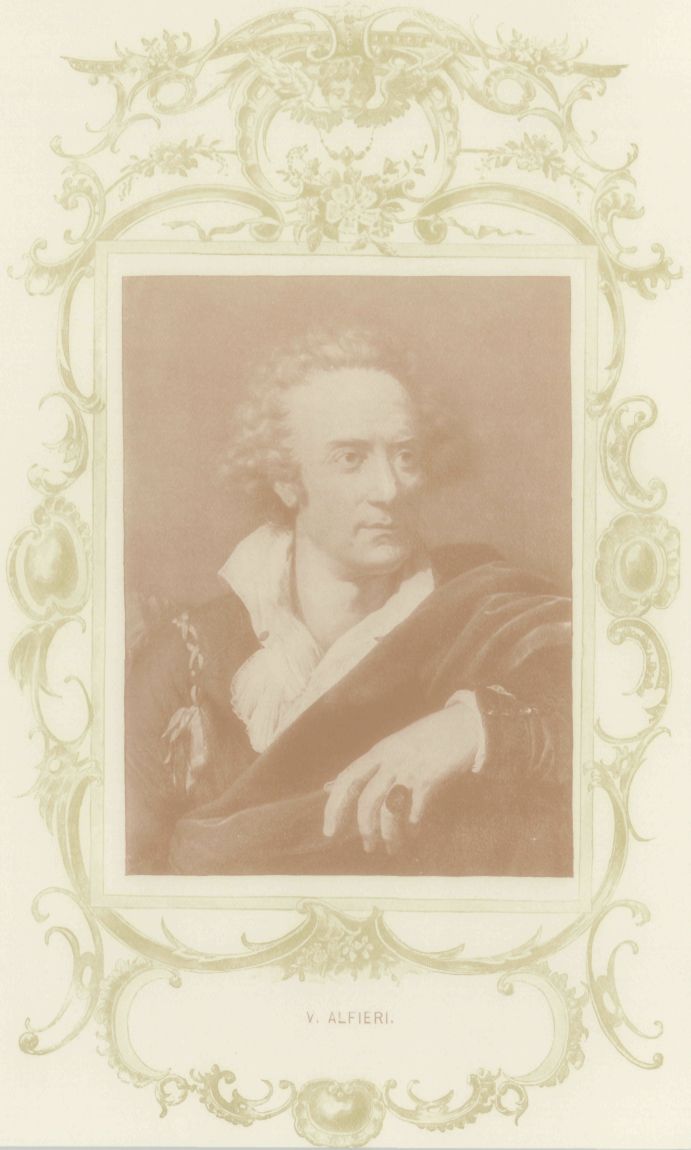
talian literature during the eighteenth century, although it could boast of no names in any way comparable with those of Dante, Petrarch, Ariosto, and Tasso, showed still a vast improvement on the degradation of the preceding century. Among the most famous writers of the times--Goldoni, Parini, Metastasio--none is so great or so famous as Vittorio Alfieri, the founder of Italian tragedy. The story of his life and of his literary activity, as told by himself in his memoirs, is one of extreme interest. Born at Asti, on January 17th, 1749, of a wealthy and noble family, he grew up to manhood singularly deficient in knowledge and culture, and without the slightest interest in literature. He was "uneducated," to use his own phrase, in the Academy of Turin. It was only after a long tour in Italy, France, Holland, and England, that, recognizing his own ignorance, he went to Florence to begin serious work.
At the age of twenty-seven a sudden revelation of his dramatic power came to him, and with passionate energy he spent the rest of his life in laborious study and in efforts to make himself worthy of a place among the poets of his native land. Practically he had to learn everything; for he himself tells us that he had "an almost total ignorance of the rules of dramatic composition, and an unskillfulness almost total in the divine and most necessary art of writing well and handling his own language."
His private life was eventful, chiefly through his many sentimental attachments, its deepest experience being his profound love and friendship for the Countess of Albany,--Louise Stolberg, mistress and afterward wife of the "Young Pretender," who passed under the title of Count of Albany, and from whom she was finally divorced. The production of Alfieri's tragedies began with the sketch called 'Cleopatra,' in 1775, and lasted till 1789, when a complete edition, by Didot, appeared in Paris. His only important prose work is his 'Auto-biography' begun in 1790 and ended in the year of his death, 1803. Although he wrote several comedies and a number of sonnets and satires,--which do not often rise above mediocrity,--it is as a tragic poet that he is known to fame. Before him--though Goldoni had successfully imitated Molière in comedy, and Metastasio had become enormously popular as the poet of love and the opera--no tragedies had been written in Italy which deserved to be compared with the great dramas of France, Spain, and England. Indeed, it had been said that tragedy was not adapted to the Italian tongue or character. It remained for Alfieri to prove the falsity of this theory.
Always sensitive to the charge of plagiarism, Alfieri declared that whether his tragedies were good or bad, they were at least his own. This is true to a certain extent. And yet he was influenced more than he was willing to acknowledge by the French dramatists of the seventeenth century. In common with Corneille and Racine, he observed strictly the three unities of time, place, and action. But the courtliness of language, the grace and poetry of the French dramas, and especially the tender love of Racine, are altogether lacking with him.
Alfieri had a certain definite theory of tragedy which he followed with unswerving fidelity. He aimed at the simplicity and directness of the Greek drama. He sought to give one clear, definite action, which should advance in a straight line from beginning to end, without deviation, and carry along the characters--who are, for the most part, helplessly entangled in the toils of a relentless fate--to an inevitable destruction. For this reason the well-known confidantes of the French stage were discarded, no secondary action or episodes were admitted, and the whole play was shortened to a little more than two-thirds of the average French classic drama. Whatever originality Alfieri possessed did not show itself in the choice of subjects, which are nearly all well known and had often been used before. From Racine he took 'Polynice,' 'Merope' had been treated by Maffei and Voltaire, and Shakespeare had immortalized the story of Brutus. The situations and events are often conventional; the passions are those familiar to the stage,--jealousy, revenge, hatred, and unhappy love. And yet Alfieri has treated these subjects in a way which differs from all others, and which stamps them, in a certain sense, as his own. With him all is sombre and melancholy; the scene is utterly unrelieved by humor, by the flowers of poetry, or by that deep-hearted sympathy--the pity of it all--which softens the tragic effect of Shakespeare's plays.
Alfieri seemed to be attracted toward the most horrible phases of human life, and the most terrible events of history and tradition. The passions he describes are those of unnatural love, of jealousy between father and son, of fratricidal hatred, or those in which a sense of duty and love for liberty triumphs over the ties of filial and parental love. In treating the story of the second Brutus, it was not enough for his purpose to have Caesar murdered by his friend; but, availing himself of an unproven tradition, he makes Brutus the son of Caesar, and thus a parricide.
It is interesting to notice his vocabulary; to see how constantly he uses such words as "atrocious," "horror," "terrible," "incest," "rivers," "streams," "lakes," and "seas" of blood. The exclamation, "Oh, rage" occurs on almost every page. Death, murder, suicide, is the outcome of every tragedy.
The actors are few,--in many plays only four,--and each represents a certain passion. They never change, but remain true to their characters from beginning to end. The villains are monsters of cruelty and vice, and the innocent and virtuous are invariably their victims, and succumb at last.
Alfieri's purpose in producing these plays was not to amuse an idle public, but to promulgate throughout his native land--then under Spanish domination--the great and lofty principle of liberty which inspired his whole life. A deep, uncompromising hatred of kings is seen in every drama, where invariably a tyrant figures as the villain. There is a constant declamation against tyranny and slavery. Liberty is portrayed as something dearer than life itself. The struggle for freedom forms the subjects of five of his plays,--'Virginia,' 'The Conspiracy of the Pazzi,' 'Timoleon,' the 'First Brutus,' and the 'Second Brutus.' One of these is dedicated to George Washington--'Liberator dell' America.' The warmth of feeling with which, in the 'Conspiracy of the Pazzi,' the degradation and slavery of Florence under the Medici is depicted, betrays clearly Alfieri's sense of the political state of Italy in his own day. And the poet undoubtedly has gained the gratitude of his countrymen for his voicing of that love for liberty which has always existed in their hearts.
Just as Alfieri sought to condense the action of his plays, so he strove for brevity and condensation in language. His method of composing was peculiar. He first sketched his play in prose, then worked it over in poetry, often spending years in the process of rewriting and polishing. In his indomitable energy, his persistence in labor, and his determination to acquire a fitting style, he reminds us of Balzac. His brevity of language--which shows itself most strikingly in the omission of articles, and in the number of broken exclamations--gives his pages a certain sententiousness, almost like proverbs. He purposely renounced all attempts at the graces and flowers of poetry.
It is hard for the lover of Shakespearean tragedy to be just to the merits of Alfieri. There is a uniformity, or even a monotony, in these nineteen plays, whose characters are more or less alike, whose method of procedure is the same, whose sentiments are analogous, and in which an activity devoid of incident hurries the reader to an inevitable conclusion, foreseen from the first act.
And yet the student cannot fail to detect great tragic power, sombre and often unnatural, but never producing that sense of the ridiculous which sometimes mars the effect of Victor Hugo's dramas. The plots are never obscure, the language is never trivial, and the play ends with a climax which leaves a profound impression.
The very nature of Alfieri's tragedies makes it difficult to represent him without giving a complete play. The following extracts, however, illustrate admirably the horror and power of his climaxes.
AGAMEMNON
[During the absence of Agamemnon at the siege of Troy, Aegisthus, son of Thyestes and the relentless enemy of the House of Atreus, wins the love of Clytemnestra, and with devilish ingenuity persuades her that the only way to save her life and his is to slay her husband.]
ACT IV--SCENE I AEGISTHUS--CLYTEMNESTRA Aegisthus--To be a banished man, ... to fly, ... to die: ... These are the only means that I have left. Thou, far from me, deprived of every hope Of seeing me again, wilt from thy heart Have quickly chased my image: great Atrides Will wake a far superior passion there; Thou, in his presence, many happy days Wilt thou enjoy--These auspices may Heaven Confirm--I cannot now evince to thee A surer proof of love than by my flight; ... A dreadful, hard, irrevocable proof. Clytemnestra--If there be need of death, we both will die!-- But is there nothing left to try ere this? Aegis.--Another plan, perchance, e'en now remains; ... But little worthy ... Cly.--And it is-- Aegis.--Too cruel. Cly.--But certain? Aegis. Certain, ah, too much so! Cly.--How Canst thou hide it from me? Aegis.--How canst thou Of me demand it? Cly.--What then may it be? ... I know not ... Speak: I am too far advanced; I cannot now retract: perchance already I am suspected by Atrides; maybe He has the right already to despise me: Hence do I feel constrained, e'en now, to hate him; I cannot longer in his presence live; I neither will, nor dare.--Do thou, Aegisthus, Teach me a means, whatever it may be, A means by which I may withdraw myself From him forever. Aegis.--Thou withdraw thyself From him? I have already said to thee That now 'tis utterly impossible. Cly.--What other step remains for me to take? ... Aegis.--None. Cly.--Now I understand thee.--What a flash. Oh, what a deadly, instantaneous flash Of criminal conviction rushes through My obtuse mind! What throbbing turbulence In ev'ry vein I feel!--I understand thee: The cruel remedy ... the only one ... Is Agamemnon's life-blood. Aegis.--I am silent ... Cly.--Yet, by thy silence, thou dost ask that blood. Aegis.--Nay, rather I forbid it.--To our love And to thy life (of mine I do not speak) His living is the only obstacle; But yet, thou knowest that his life is sacred: To love, respect, defend it, thou art bound; And I to tremble at it.--Let us cease: The hour advances now; my long discourse Might give occasion to suspicious thoughts.-- At length receive ... Aegisthus's last farewell. Cly.--Ah! hear me ... Agamemnon to our love ... And to thy life? ... Ah, yes; there are, besides him, No other obstacles: too certainly His life is death to us! Aegis.--Ah! do not heed My words: they spring from too much love. Cly.--And love Revealed to me their meaning. Aegis.--Hast thou not Thy mind o'erwhelmed with horror? Cly.--Horror? ... yes; ... But then to part from thee! ... Aegis.--Wouldst have the courage? ... Cly.--So vast my love, it puts an end to fear. Aegis.--But the king lives surrounded by his friends: What sword would find a passage to his heart? Cly.--What sword? Aegis.--Here open violence were vain. Cly.--Yet, ... treachery! ... Aegis.--'Tis true, he merits not To be betrayed, Atrides: he who loves His wife so well; he who, enchained from Troy, In semblance of a slave in fetters, brought Cassandra, whom he loves, to whom he is Himself a slave ... Cly.--What do I hear! Aegis.--Meanwhile Expect that when of thee his love is wearied, He will divide with her his throne and bed; Expect that, to thy many other wrongs, Shame will be added: and do thou alone Not be exasperated at a deed That rouses every Argive. Cly.--What said'st thou? ... Cassandra chosen as my rival? ... Aegis.--So Atrides wills. Cly.--Then let Atrides perish. Aegis.--How? By what hand? Cly.--By mine, this very night, Within that bed which he expects to share With this abhorred slave. Aegis.--O Heavens! but think ... Cly.--I am resolved ... Aegis.--Shouldst thou repent? ... Cly.--I do That I so long delayed. Aegis.--And yet ... Cly.--I'll do it; I, e'en if thou wilt not. Shall I let thee, Who only dost deserve my love, be dragged To cruel death? And shall I let him live Who cares not for my love? I swear to thee, To-morrow thou shalt be the king in Argos. Nor shall my hand, nor shall my bosom tremble ... But who approaches? Aegis.--'Tis Electra ... Cly.--Heavens! Let us avoid her. Do thou trust in me. SCENE II ELECTRA Electra--Aegisthus flies from me, and he does well; But I behold that likewise from my sight My mother seeks to fly. Infatuated And wretched mother! She could not resist The guilty eagerness for the last time To see Aegisthus.--They have here, at length, Conferred together ... But Aegisthus seems Too much elated, and too confident, For one condemned to exile ... She appeared Like one disturbed in thought, but more possessed With anger and resentment than with grief ... O Heavens! who knows to what that miscreant base, With his infernal arts, may have impelled her! To what extremities have wrought her up!... Now, now, indeed, I tremble: what misdeeds, How black in kind, how manifold in number, Do I behold! ... Yet, if I speak, I kill My mother: ... If I'm silent--? ... ACT V--SCENE II AEGISTHUS--CLYTEMNESTRA Aegis.--Hast thou performed the deed? Cly.--Aegisthus ... Aegis.--What do I behold? O woman, What dost thou here, dissolved in useless tears? Tears are unprofitable, late, and vain; And they may cost us dear. Cly.--Thou here? ... but how? ... Wretch that I am! what have I promised thee? What impious counsel? ... Aegis.--Was not thine the counsel? Love gave it thee, and fear recants it.--Now, Since thou'rt repentant, I am satisfied; Soothed by reflecting that thou art not guilty, I shall at least expire. To thee I said How difficult the enterprise would be; But thou, depending more than it became thee On that which is not in thee, virile courage, Daredst thyself thy own unwarlike hand For such a blow select. May Heaven permit That the mere project of a deed like this May not be fatal to thee! I by stealth, Protected by the darkness, hither came, And unobserved, I hope. I was constrained To bring the news myself, that now my life Is irrecoverably forfeited To the king's vengeance... Cly.--What is this I hear? Whence didst thou learn it? Aegis.--More than he would wish Atrides hath discovered of our love; And I already from him have received A strict command not to depart from Argos. And further, I am summoned to his presence Soon as to-morrow dawns: thou seest well That such a conference to me is death. But fear not; for I will all means employ To bear myself the undivided blame. Cly.--What do I hear? Atrides knows it all? Aegis.--He knows too much: I have but one choice left: It will be best for me to 'scape by death, By self-inflicted death, this dangerous inquest. I save my honor thus; and free myself From an opprobrious end. I hither came To give thee my last warning: and to take My last farewell... Oh, live; and may thy fame Live with thee, unimpeached! All thoughts of pity For me now lay aside; if I'm allowed By my own hand, for thy sake, to expire, I am supremely blest. Cly.--Alas!... Aegisthus... What a tumultuous passion rages now Within my bosom, when I hear thee speak!... And is it true?... Thy death... Aegis.--Is more than certain.... Cly.--And I'm thy murderer!... Aegis.--I seek thy safety. Cly.--What wicked fury from Avernus' shore, Aegisthus, guides thy steps? Oh, I had died Of grief, if I had never seen thee more; But guiltless I had died: spite of myself, Now, by thy presence, I already am Again impelled to this tremendous crime... An anguish, an unutterable anguish, Invades my bones, invades my every fibre... And can it be that this alone can save thee?... But who revealed our love? Aegis.--To speak of thee, Who but Electra to her father dare? Who to the monarch breathe thy name but she? Thy impious daughter in thy bosom thrusts The fatal sword; and ere she takes thy life, Would rob thee of thy honor. Cly.--And ought I This to believe?... Alas!... Aegis.--Believe it, then, On the authority of this my sword, If thou believ'st it not on mine. At least I'll die in time... Cly.--O Heavens! what wouldst thou do? Sheathe, I command thee, sheathe that fatal sword.--Oh, night of horrors!... hear me... Perhaps Atrides Has not resolved... Aegis.--What boots this hesitation?... Atrides injured, and Atrides king, Meditates nothing in his haughty mind But blood and vengeance. Certain is my death, Thine is uncertain: but reflect, O queen, To what thou'rt destined, if he spare thy life. And were I seen to enter here alone, And at so late an hour... Alas, what fears Harrow my bosom when I think of thee! Soon will the dawn of day deliver thee From racking doubt; that dawn I ne'er shall see: I am resolved to die:...--Farewell... forever! Cly.--Stay, stay... Thou shalt not die. Aegis.--By no man's hand Assuredly, except my own:--or thine, If so thou wilt. Ah, perpetrate the deed; Kill me; and drag me, palpitating yet, Before thy judge austere: my blood will be A proud acquittance for thee. Cly.--Madd'ning thought!... Wretch that I am!... Shall I be thy assassin?... Aegis.--Shame on thy hand, that cannot either kill Who most adores thee, or who most detests thee! Mine then must serve.... Cly.--Ah!... no.... Aegis.--Dost thou desire Me, or Atrides, dead? Cly.--Ah! what a choice!... Aegis.--Thou art compelled to choose. Cly.--I death inflict ... Aegis.--Or death receive; when thou hast witnessed mine. Cly.--Ah, then the crime is too inevitable! Aegis.--The time now presses. Cly.--But ... the courage ... strength? ... Aegis.--Strength, courage, all, will love impart to thee. Cly.--Must I then with this trembling hand of mine Plunge ... in my husband's heart ... the sword? ... Aegis.--The blows Thou wilt redouble with a steady hand In the hard heart of him who slew thy daughter. Cly.--Far from my hand I hurled the sword in anguish. Aegis.--Behold a steel, and of another temper: The clotted blood-drops of Thyestes's sons Still stiffen on its frame: do not delay To furbish it once more in the vile blood Of Atreus; go, be quick: there now remain But a few moments; go. If awkwardly The blow thou aimest, or if thou shouldst be Again repentant, lady, ere 'tis struck, Do not thou any more tow'rd these apartments Thy footsteps turn: by my own hands destroyed, Here wouldst thou find me in a sea of blood Immersed. Now go, and tremble not; be bold. Enter and save us by his death.-- SCENE III AEGISTHUS Aegis. Come forth, Thyestes, from profound Avernus; come, Now is the time; within this palace now Display thy dreadful shade. A copious banquet Of blood is now prepared for thee, enjoy it; Already o'er the heart of thy foe's son Hangs the suspended sword; now, now, he feels it: An impious consort grasps it; it was fitting That she, not I, did this: so much more sweet To thee will be the vengeance, as the crime Is more atrocious.... An attentive ear Lend to the dire catastrophe with me; Doubt not she will accomplish it: disdain, Love, terror, to the necessary crime Compel the impious woman.-- AGAMEMNON (within) Aga.--Treason! Ah! ... My wife?.. O Heavens!.. I die... O traitorous deed! Aegis.--Die, thou--yes, die! And thou redouble, woman. The blows redouble; all the weapon hide Within his heart; shed, to the latest drop, The blood of that fell miscreant: in our blood He would have bathed his hands. SCENE IV CLYTEMNESTRA--AESGISTHUS Cly.--What have I done? Where am I?... Aegis.--Thou hast slain the tyrant: now At length thou'rt worthy of me. Cly.--See, with blood The dagger drips;... my hands, my face, my garments, All, all are blood... Oh, for a deed like this, What vengeance will be wreaked!... I see already Already to my breast that very steel I see hurled back, and by what hand! I freeze, I faint, I shudder, I dissolve with horror. My strength, my utterance, fail me. Where am I? What have I done?... Alas!... Aegis.--Tremendous cries Resound on every side throughout the palace: 'Tis time to show the Argives what I am, And reap the harvest of my long endurance. SCENE V ELECTRA--AEGISTHUS Elec.--It still remains for thee to murder me, Thou impious, vile assassin of my father ... But what do I behold? O Heavens! ... my mother? ... Flagitious woman, dost thou grasp the sword? Didst thou commit the murder? Aegis.--Hold thy peace. Stop not my path thus; quickly I return; Tremble: for now that I am king of Argos, Far more important is it that I kill Orestes than Electra. SCENE VI CLYTEMNESTRA--ELECTRA Cly.--Heavens! ... Orestes? ... Aegisthus, now I know thee.... Elec.--Give it me: Give me that steel. Cly.--Aegisthus! ... Stop! ... Wilt thou Murder my son? Thou first shalt murder me. SCENE VII ELECTRA Elec.--O night! ... O father! ... Ah, it was your deed, Ye gods, this thought of mine to place Orestes In safety first.--Thou wilt not find him, traitor.-- Ah live, Orestes, live: and I will keep This impious steel for thy adult right hand. The day, I hope, will come, when I in Argos Shall see thee the avenger of thy father. Translation of Edgar Alfred Bowring, Bohn's Library.