Volume 1 — ACCADIAN-BABYLONIAN AND ASSYRIAN LITERATURE
Reading edition
BY CRAWFORD H. TOY

ecent discoveries have carried the beginnings of civilization farther and farther back into the remote past. Scholars are not agreed as to what region can lay claim to the greatest literary antiquity. The oldest historical records are found in Egypt and Babylonia, and each of these lands has its advocates, who claim for it priority in culture. The data now at our command are not sufficient for the decision of this question. It may be doubted whether any one spot on the globe will ever be shown to have precedence in time over all others,--whether, that is, it will appear that the civilization of the world has proceeded from a single centre. But though we are yet far from having reached the very beginnings of culture, we know that they lie farther back than the wildest dreams of half a century ago would have imagined. Established kingdoms existed in Babylonia in the fourth millennium before the beginning of our era; royal inscriptions have been found which are with great probability assigned to about the year 3800 B.C. These are, it is true, of the simplest description, consisting of a few sentences of praise to a deity or brief notices of a campaign or of the building of a temple; but they show that the art of writing was known, and that the custom existed of recording events of the national history. We may thence infer the existence of a settled civilization and of some sort of literary productiveness.
The Babylonian-Assyrian writings with which we are acquainted may be divided into the two classes of prose and poetry. The former class consists of royal inscriptions (relating to military campaigns and the construction of temples), chronological tables (eponym canons), legal documents (sales, suits, etc.), grammatical tables (paradigms and vocabularies), lists of omens and lucky and unlucky days, and letters and reports passing between kings and governors; the latter class includes cosmogonic poems, an epic poem in twelve books, detached mythical narratives, magic formulas and incantations, and prayers to deities (belonging to the ritual service of the temples). The prose pieces, with scarcely an exception, belong to the historical period, and may be dated with something like accuracy. The same thing is true of a part of the poetical material, particularly the prayers; but the cosmogonic and other mythical poems appear to go back, at least so far as their material is concerned, to a very remote antiquity, and it is difficult to assign them a definite date.
Whether this oldest poetical material belongs to the Semitic Babylonians or to a non-Semitic (Sumerian-Accadian) people is a question not yet definitely decided. The material which comes into consideration for the solution of this problem is mainly linguistic. Along with the inscriptions, which are obviously in the Semitic-Babylonian language, are found others composed of words apparently strange. These are held by some scholars to represent a priestly, cryptographic writing, by others to be true Semitic words in slightly altered form, and by others still to belong to a non-Semitic tongue. This last view supposes that the ancient poetry comes, in substance at any rate, from a non-Semitic people who spoke this tongue; while on the other hand, it is maintained that this poetry is so interwoven into Semitic life that it is impossible to regard it as of foreign origin. The majority of Semitic scholars are now of the opinion that the origin of this early literature is foreign. However this may be, it comes to us in Babylonian dress, it has been elaborated by Babylonian hands, has thence found its way into the literature of other Semitic peoples, and for our purposes may be accepted as Babylonian. In any case it carries us back to very early religious conceptions.
The cosmogonic poetry is in its outlines not unlike that of Hesiod, but develops the ruder ideas at greater length. In the shortest (but probably not the earliest) form of the cosmogony, the beginning of all things is found in the watery abyss. Two abysmal powers (Tiamat and Apsu), represented as female and male, mingle their waters, and from them proceed the gods. The list of deities (as in the Greek cosmogony) seems to represent several dynasties, a conception which may embody the belief in the gradual organization of the world. After two less-known gods, called Lahmu and Lahamu, come the more familiar figures of later Babylonian writing, Anu and Ea. At this point the list unfortunately breaks off, and the creative function which may have been assigned to the gods is lost, or has not yet been discovered. The general similarity between this account and that of Gen. i. is obvious: both begin with the abysmal chaos. Other agreements between the two cosmogonies will be pointed out below. The most interesting figure in this fragment is that of Tiamat. We shall presently see her in the character of the enemy of the gods. The two conceptions of her do not agree together perfectly, and the priority in time must be assigned to the latter. The idea that the world of gods and men and material things issued out of the womb of the abyss is a philosophic generalization that is more naturally assigned to a period of reflection.
In the second cosmogonic poem the account is more similar to that of the second chapter of Genesis, and its present form originated in or near Babylon. Here we have nothing of the primeval deep, but are told how the gods made a beautiful land, with rivers and trees; how Babylon was built and Marduk created man, and the Tigris and the Euphrates, and the beasts and cities and temples. This also must be looked on as a comparatively late form of the myth, since its hero is Marduk, god of Babylon. As in the Bible account, men are created before beasts, and the region of their first abode seems to be the same as the Eden of Genesis.
Let us now turn to the poem in which the combat between Tiamat and Marduk forms the principal feature. For some unexplained reason Tiamat rebels against the gods. Collecting her hosts, among them frightful demon shapes of all imaginable forms, she advances for the purpose of expelling the gods from their seats. The affrighted deities turn for protection to the high gods, Anu and Ea, who, however, recoil in terror from the hosts of the dragon Tiamat. Anshar then applies to Marduk. The gods are invited to a feast, the situation is described, and Marduk is invited to lead the heavenly hosts against the foe. He agrees on condition that he shall be clothed with absolute power, so that he shall only have to say "Let it be," and it shall be. To this the gods assent: a garment is placed before him, to which he says "Vanish," and it vanishes, and when he commands it to appear, it is present. The hero then dons his armor and advances against the enemy. He takes Tiamat and slays her, routs her host, kills her consort Kingu, and utterly destroys the rebellion. Tiamat he cuts in twain. Out of one half of her he forms the heavens, out of the other half the earth, and for the gods Anu and Bel and Ea he makes a heavenly palace, like the abyss itself in extent. To the great gods also he assigns positions, forms the stars, establishes the year and month and the day. At this point the history is interrupted, the tablet being broken. The creation of the heavenly bodies is to be compared with the similar account in Gen. i.; whether this poem narrates the creation of the rest of the world it is impossible to say.
In this history of the rebellion of Tiamat against the gods we have a mythical picture of some natural phenomenon, perhaps of the conflict between the winter and the enlivening sun of summer. The poem appears to contain elements of different dates. The rude character of some of the procedures suggests an early time: Marduk slays Tiamat by driving the wind into her body; the warriors who accompany her have those composite forms familiar to us from Babylonian and Egyptian statues, paintings, and seals, which are the product of that early thought for which there was no essential difference between man and beast. The festival in which the gods carouse is of a piece with the divine Ethiopian feasts of Homer. On the other hand, the idea of the omnipotence of the divine word, when Marduk makes the garment disappear and reappear, is scarcely a primitive one. It is substantially identical with the Biblical "Let it be, and it was." It is probable that the poem had a long career, and in successive recensions received the coloring of different generations. Tiamat herself has a long history. Here she is a dragon who assaults the gods; elsewhere, as we have seen, she is the mother of the gods; here also her body forms the heaven and the earth. She appears in Gen. i. 2 as the Tehom, the primeval abyss. In the form of the hostile dragon she is found in numerous passages of the Old Testament, though under different names. She is an enemy of Yahwe, god of Israel, and in the New Testament (Rev. xii.) the combat between Marduk and Tiamat is represented under the form of a fight between Michael and the Dragon. In Christian literature Michael has been replaced by St. George. The old Babylonian conception has been fruitful of poetry, representing, as it does, in grand form the struggle between the chaotic and the formative forces of the universe.
The most considerable of the old Babylonian poems, so far as length and literary form are concerned, is that which has been commonly known as the Izdubar epic. The form of the name is not certain: Mr. Pinches has recently proposed, on the authority of a Babylonian text, to write it Gilgamesh, and this form has been adopted by a number of scholars. The poem (discovered by George Smith in 1872) is inscribed on twelve tablets, each tablet apparently containing a separate episode.
The first tablet introduces the hero as the deliverer of his country from the Elamites, an event which seems to have taken place before 2000 B.C. Of the second, third, fourth, and fifth tablets, only fragments exist, but it appears that Gilgamesh slays the Elamite tyrant.
The sixth tablet recounts the love of Ishtar for the hero, to whom she proposes marriage, offering him the tribute of the land. The reason he assigns for his rejection of the goddess is the number and fatal character of her loves. Among the objects of her affection were a wild eagle, a lion, a war-horse, a ruler, and a husbandman; and all these came to grief. Ishtar, angry at her rejection, complains to her father, Anu, and her mother, Anatu, and begs them to avenge her wrong. Anu creates a divine bull and sends it against Gilgamesh, who, however, with the aid of his friend Eabani, slays the bull. Ishtar curses Gilgamesh, but Eabani turns the curse against her.
The seventh tablet recounts how Ishtar descends to the underworld seeking some better way of attacking the hero. The description of the Babylonian Sheol is one of the most effective portions of the poem, and with it George Smith connects a well-known poem which relates the descent of Ishtar to the underworld. The goddess goes down to the house of darkness from which there is no exit, and demands admittance of the keeper; who, however, by command of the queen of the lower world, requires her to submit to the conditions imposed on all who enter. There are seven gates, at each of which he removes some portion of her ornaments and dress. Ishtar, thus unclothed, enters and becomes a prisoner. Meantime the upper earth has felt her absence. All love and life has ceased. Yielding to the persuasions of the gods, Ea sends a messenger to demand the release of the goddess. The latter passes out, receiving at each gate a portion of her clothing. This story of Ishtar's love belongs to one of the earliest stages of religious belief. Not only do the gods appear as under the control of ordinary human passions, but there is no consciousness of material difference between man and beast. The Greek parallels are familiar to all. Of these ideas we find no trace in the later Babylonian and Assyrian literature, and the poem was doubtless interpreted by the Babylonian sages in allegorical fashion.
In the eighth and ninth tablets the death of Eabani is recorded, and the grief of Gilgamesh. The latter then wanders forth in search of Hasisadra, the hero of the Flood-story. After various adventures he reaches the abode of the divinized man, and from him learns the story of the Flood, which is given in the eleventh tablet.
This story is almost identical with that of the Book of Genesis. The God Bel is determined to destroy mankind, and Hasisadra receives directions from Ea to build a ship, and take into it provisions and goods and slaves and beasts of the field. The ship is covered with bitumen. The flood is sent by Shamash (the sun-god). Hasisadra enters the ship and shuts the door. So dreadful is the tempest that the gods in affright ascend for protection to the heaven of Anu. Six days the storm lasts. On the seventh conies calm. Hasisadra opens a window and sees the mountain of Nizir, sends forth a dove, which returns; then a swallow, which returns; then a raven, which does not return; then, knowing that the flood has passed, sends out the animals, builds an altar, and offers sacrifice, over which the gods gather like flies. Ea remonstrates with Bel, and urges that hereafter, when he is angry with men, instead of sending a deluge, he shall send wild beasts, who shall destroy them. Thereupon Bel makes a compact with Hasisadra, and the gods take him and his wife and people and place them in a remote spot at the mouth of the rivers. It is now generally agreed that the Hebrew story of the Flood is taken from the Babylonian, either mediately through the Canaanites (for the Babylonians had occupied Canaan before the sixteenth century B.C.), or immediately during the exile in the sixth century. The Babylonian account is more picturesque, the Hebrew more restrained and solemn. The early polytheistic features have been excluded by the Jewish editors.
In addition to these longer stories there are a number of legends of no little poetical and mythical interest. In the cycle devoted to the eagle there is a story of the struggle between the eagle and the serpent. The latter complains to the sun-god that the eagle has eaten his young. The god suggests a plan whereby the hostile bird may be caught: the body of a wild ox is to be set as a snare. Out of this plot, however, the eagle extricates himself by his sagacity. In the second story the eagle comes to the help of a woman who is struggling to bring a man-child (apparently Etana) into the world. In the third is portrayed the ambition of the hero Etana to ascend to heaven. The eagle promises to aid him in accomplishing his design. Clinging to the bird, he rises with him higher and higher toward the heavenly space, reaching the abode of Anu, and then the abode of Ishtar. As they rise to height after height the eagle describes the appearance of the world lying stretched out beneath: at first it rises like a huge mountain out of the sea; then the ocean appears as a girdle encircling the land, and finally but as a ditch a gardener digs to irrigate his land. When they have risen so high that the earth is scarcely visible, Etana cries to the eagle to stop; so he does, but his strength is exhausted, and bird and man fall to the earth.
Another cycle of stories deals with the winds. The god Zu longs to have absolute power over the world. To that end he lurks about the door of the sun-god, the possessor of the tablets of fate whereby he controls all things. Each morning before beginning his journey, the sun-god steps out to send light showers over the world. Watching his opportunity, Zu glides in, seizes the tablets of fate, and flies away and hides himself in the mountains. So great horror comes over the world: it is likely to be scorched by the sun-god's burning beams. Anu calls on the storm-god Ramman to conquer Zu, but he is frightened and declines the task, as do other gods. Here, unfortunately, the tablet is broken, so that we do not know by whom the normal order was finally restored.
In the collection of cuneiform tablets disinterred at Amarna in 1887 was found the curious story of Adapa. The demigod Adapa, the son of Ea, fishing in the sea for the family of his lord, is overwhelmed by the stormy south wind and cast under the waves. In anger he breaks the wings of the wind, that it may no longer rage in the storm. Anu, informed that the south wind no longer blows, summons Adapa to his presence. Ea instructs his son to put on apparel of mourning, present himself at Anu's gate, and there make friends with the porters, Tammuz and Iszida, so that they may speak a word for him to Anu; going into the presence of the royal deity, he will be offered food and drink which he must reject, and raiment and oil which he must accept. Adapa carries out the instructions of his father to the letter. Anu is appeased, but laments that Adapa, by rejecting heavenly food and drink, has lost the opportunity to become immortal. This story, the record of which is earlier than the sixteenth century B.C., appears to contain two conceptions: it is a mythical description of the history of the south wind, but its conclusion presents a certain parallelism with the end of the story of Eden in Genesis; as there Adam, so here Adapa, fails of immortality because he infringes the divine command concerning the divine food. We have here a suggestion that the story in Genesis is one of the cycle which dealt with the common earthly fact of man's mortality.
The legend of Dibbarra seems to have a historical basis. The god Dibbarra has devastated the cities of Babylonia with bloody wars. Against Babylon he has brought a hostile host and slain its people, so that Marduk, the god of Babylon, curses him. And in like manner he has raged against Erech, and is cursed by its goddess Ishtar. He is charged with confounding the righteous and unrighteous in indiscriminate destruction. But Dibbarra determines to advance against the dwelling of the king of the gods, and Babylonia is to be further desolated by civil war. It is a poetical account of devastating wars as the production of a hostile diety. It is obvious that these legends have many features in common with those of other lands, myths of conflict between wind and sun, and the ambition of heroes to scale the heights of heaven. How far these similarities are the independent products of similar situations, and how far the results of loans, cannot at present be determined.
The moral-religious literature of the Babylonians is not inferior in interest to the stories just mentioned. The hymns to the gods are characterized by a sublimity and depth of feeling which remind us of the odes of the Hebrew Psalter. The penitential hymns appear to contain expressions of sorrow for sin, which would indicate a high development of the religious consciousness. These hymns, apparently a part of the temple ritual, probably belong to a relatively late stage of history; but they are none the less proof that devotional feeling in ancient times was not limited to any one country.
Other productions, such as the hymn to the seven evil spirits (celebrating their mysterious power), indicate a lower stage of religious feeling; this is specially visible in the magic formulas, which portray a very early stratum of religious history. They recall the Shamanism of Central Asia and the rites of savage tribes; but there is no reason to doubt that the Semitic religion in its early stages contained this magic element, which is found all the world over.
Riddles and Proverbs are found among the Babylonians, as among all peoples. Comparatively few have been discovered, and these present nothing of peculiar interest. The following may serve as specimens:--"What is that which becomes pregnant without conceiving, fat without eating?" The answer seems to be "A cloud." "My coal-brazier clothes me with a divine garment, my rock is founded in the sea" (a volcano). "I dwell in a house of pitch and brick, but over me glide the boats" (a canal). "He that says, 'Oh, that I might exceedingly avenge myself!' draws from a waterless well, and rubs the skin without oiling it." "When sickness is incurable and hunger unappeasable, silver and gold cannot restore health nor appease hunger." "As the oven waxes old, so the foe tires of enmity." "The life of yesterday goes on every day." "When the seed is not good, no sprout comes forth."
The poetical form of all these pieces is characterized by that parallelism of members with which we are familiar in the poetry of the Old Testament. It is rhythmical, but apparently not metrical: the harmonious flow of syllables in any one line, with more or less beats or cadences, is obvious; but it does not appear that syllables were combined into feet, or that there was any fixed rule for the number of syllables or beats in a line. So also strophic divisions may be observed, such divisions naturally resulting from the nature of all narratives. Sometimes the strophe seems to contain four lines, sometimes more. No strophic rule has yet been established; but it seems not unlikely that when the longer poetical pieces shall have been more definitely fixed in form, certain principles of poetical composition will present themselves. The thought of the mythical pieces and the prayers and hymns is elevated and imaginative. Some of this poetry appears to have belonged to a period earlier than 2000 B.C. Yet the Babylonians constructed no epic poem like the (Iliad,) or at any rate none such has yet been found. Their genius rather expressed itself in brief or fragmentary pieces, like the Hebrews and the Arabs.
The Babylonian prose literature consists almost entirely of short chronicles and annals. Royal inscriptions have been found covering the period from 3000 B.C. to 539 B.C. There are eponym canons, statistical lists, diplomatic letters, military reports; but none of these rise to the dignity of history. Several connected books of chronicles have indeed been found; there is a synchronistic book of annals of Babylonia and Assyria, there is a long Assyrian chronicle, and there are annalistic fragments. But there is no digested historical narrative, which gives a clear picture of the general civil and political situation, or any analysis of the characters of kings, generals, and governors, or any inquiry into causes of events. It is possible that narratives having a better claim to the name of history may yet be discovered, resembling those of the Biblical Book of Kings; yet the Book of Kings is scarcely history--neither the Jews nor the Babylonians and Assyrians seem to have had great power in this direction.
One of the most interesting collections of historical pieces is that recently discovered at Amarna. Here, out of a mound which represents a palace of the Egyptian King Amenhotep IV., were dug up numerous letters which were exchanged between the kings of Babylonia and Egypt in the fifteenth and sixteenth centuries, and numerous reports sent to the Egyptian government by Egyptian governors of Canaanite cities. These tablets show that at this early time there was lively communication between the Euphrates and the Nile, and they give a vivid picture of the chaotic state of affairs in Canaan, which was exposed to the assaults of enemies on all sides. This country was then in possession of Egypt, but at a still earlier period it must have been occupied by the Babylonians. Only in this way can we account for the surprising fact that the Babylonian cuneiform script and the Babylonian language form the means of communication between the east and west and between Egypt and Canaan. The literary value of these letters is not great; their interest is chiefly historic and linguistic. The same thing is true of the contract tablets, which are legal documents: these cover the whole area of Babylonian history, and show that civil law attained a high state of perfection; they are couched in the usual legal phrases.
The literary monuments mentioned above are all contained in tablets, which have the merit of giving in general contemporaneous records of the things described. But an account of Babylonian literature would be incomplete without mention of the priest Berosus. Having, as priest of Bel, access to the records of the temples, he wrote a history of his native land, in which he preserved the substance of a number of poetical narratives, as well as the ancient accounts of the political history. The fragments of his work which have been preserved (see Cory's 'Ancient Fragments') exhibit a number of parallels with the contents of the cuneiform tablets. Though he wrote in Greek (he lived in the time of Alexander the Great), and was probably trained in the Greek learning of his time, his work doubtless represents the spirit of Babylonian historical writing. So far as can be judged from the remains which have come down to us, its style is of the annalistic sort which appears in the old inscriptions and in the historical books of the Bible.
The Babylonian literature above described must be understood to include the Assyrian. Civilization was first established in Babylonia, and there apparently were produced the great epic poems and the legends. But Assyria, when she succeeded to the headship of the Mesopotamian valley, in the twelfth century B.C., adopted the literature of her southern sister. A great part of the old poetry has been found in the library of Assurbanipal, at Nineveh (seventh century B.C.), where a host of scribes occupied themselves with the study of the ancient literature. They seem to have had almost all the apparatus of modern critical work. Tablets were edited, sometimes with revisions. There are bilingual tablets, presenting in parallel columns the older texts (called Sumerian-Accadian) and the modern version. There are numerous grammatical and lexicographical lists. The records were accessible, and often consulted. Assurbanipal, in bringing back a statue of the goddess Nana from the Elamite region, says that it was carried off by the Elamites 1635 years before; and Nabonidus, the last king of Babylon (circa B.C. 550), a man devoted to temple restoration, refers to an inscription of King Naram-Sin, of Agane, who, he says, reigned 3200 years before. In recent discoveries made at Nippur, by the American Babylonian Expedition, some Assyriologists find evidence of the existence of a Babylonian civilization many centuries before B.C. 4000 (the dates B.C. 5000 and B.C. 6000 have been mentioned); the material is now undergoing examination, and it is too early to make definite statements of date. See Peters in American Journal of Archaeology for January-March, 1895, and July-September, 1895; and Hilprecht, 'The Babylonian Expedition of the University of Pennsylvania,' Vol. i., Part 2, 1896.
The Assyrian and Babylonian historical inscriptions, covering as they do the whole period of Jewish history down to the capture of Babylon by Cyrus, are of very great value for the illustration of the Old Testament. They have a literary interest also. Many of them are written in semi-rhythmical style, a form which was favored by the inscriptional mode of writing. The sentences are composed of short parallel clauses, and the nature of the material induced a division into paragraphs which resemble strophes. They are characterized also by precision and pithiness of statement, and are probably as trust-worthy as official records ever are.
I. THEOGONY In the time when above the heaven was not named, The earth beneath bore no name, When the ocean, the primeval parent of both, The abyss Tiamat the mother of both.... The waters of both mingled in one. No fields as yet were tilled, no moors to be seen, When as yet of the gods not one had been produced, No names they bore, no titles they had, Then were born of the gods.... Lachmu Lachamu came into existence. Many ages past.... Anshar, Kishar were born. Many days went by. Anu....
[Here there is a long lacuna. The lost lines completed the history of the creation of the gods, and gave the reason for the uprising of Tiamat with her hosts. What it was that divided the divine society into two hostile camps can only be conjectured; probably Tiamat, who represents the unfriendly or chaotic forces of nature, saw that her domain was being encroached on by the light-gods, who stand for cosmic order.]
II. REVOLT OF TIAMAT To her came flocking all the gods, They gathered together, they came to Tiamat; Angry they plan, restless by night and by day, Prepare for war with gestures of rage and hate, With combined might to begin the battle. The mother of the abyss, she who created them all, Unconquerable warriors, gave them giant snakes, Sharp of tooth, pitiless in might, With poison like blood she filled their bodies, Huge poisonous adders raging, she clothed them with dread, Filled them with splendor.... He who sees them shuddering shall seize him, They rear their bodies, none can resist their breast. Vipers she made, terrible snakes.... ... raging dogs, scorpion-men ... fish men.... Bearing invincible arms, fearless in the fight. Stern are her commands, not to be resisted. Of all the first-born gods, because he gave her help, She raised up Kingu in the midst, she made him the greatest, To march in front of the host, to lead the whole, To begin the war of arms, to advance the attack, Forward in the fight to be the triumpher. This she gave into his hand, made him sit on the throne:-- By my command I make thee great in the circle of the gods; Rule over all the gods I have given to thee, The greatest shalt thou be, thou my chosen consort; Be thy name made great over all the earth. She gave him the tablets of fate, laid them on his breast. Thy command be not gainsaid, thy word stand fast. Thus lifted up on high, endued with Anu's rank, Among the gods her children Kingu did bear rule.
[The gods, dismayed, first appeal to Anu for aid against Tiamat, but he refuses to lead the attack. Anshar then sends to invite the gods to a feast.]
Anshar opened his mouth, To Gaga, his servant, spake he:-- Go, O Gaga, my servant thou who delightest my soul, To Lachmu Lachamu I will send thee... That the gods may sit at the feast, Bread to eat, wine to drink, To give the rule to Marduk. Up Gaga, to them go, And tell what I say to thee:-- Anshar, your son, has sent me, Told me the desire of his heart.
[He repeats the preceding description of Tiamat's preparations, and announces that Marduk has agreed to face the foe.]
I sent Anu, naught can he against her. Nudimmud was afraid and turned cowering back, Marduk accepted the task, the ruler of gods, your son, Against Tiamat to march his heart impels him. So speaks he to me: If I succeed, I, your avenger, Conquer Tiamat and save your lives. Come, ye all, and declare me supreme, In Upsukkenaku enter ye joyfully all. With my mouth will I bear rule, Unchangeable be whate'er I do, The word of my lips be never reversed or gainsaid. Come and to him give over the rule, That he may go and meet the evil foe. Gaga went, strode on his way, Humbly before Lachmu and Lachamu, the gods, his fathers, He paid his homage and kissed the ground, Bent lowly down and to them spake:-- Anshar, your son, has sent me, Told me the desire of his heart.
[Gaga then repeats Anshar's message at length, and the narrative proceeds.]
Lachmu and Lachamu heard and were afraid, The Igigi all lamented sore: What change has come about that she thus hates us? We cannot understand this deed of Tiamat. With hurry and haste they went, The great gods, all the dealers of fate, ... with eager tongue, sat themselves down to the feast. Bread they ate, wine they drank, The sweet wine entered their souls, They drank their fill, full were their bodies.
[In this happy state they were ready to accept Marduk's conditions.]
To Marduk, their avenger, they gave over the rule. They lifted him up on a lofty throne, Above his fathers he took his place as judge:-- Most honored be thou among the great gods, Unequaled thy rule, thy word is Anu. From this time forth thy command be not gainsaid; To lift up and cast down be the work of thy hand; The speech of thy mouth stand fast, thy word be irresistible, None of the gods shall intrude on thy domain, Fullness of wealth, the desire of the temples of the gods, Be the portion of thy shrine, though they be in need. Marduk, thou, our avenger, Thine be the kingdom over all forever. Sit thee down in might, noble be thy word, Thy arms shall never yield, the foes they shall crush. O lord, he who trusts in thee, him grant thou life, But the deity who set evil on foot, her life pour out. Then in the midst they placed a garment. To Marduk their first-born thus spake they:-- Thy rule, O lord, be chief among the gods, To destroy and to create--speak and let it be. Open thy mouth, let the garment vanish. Utter again thy command, let the garment appear. He spake with his mouth, vanished the garment; Again he commanded, and the garment appeared. When the gods, his fathers, saw thus his word fulfilled, Joyful were they and did homage: Marduk is king. On him conferred sceptre and throne.... Gave him invincible arms to crush them that hate him. Now go and cut short the life of Tiamat, May the winds into a secret place carry her blood. The ruler of the gods they made him, the gods, his fathers, Wished him success and glory in the way on which he went. He made ready a bow, prepared it for use, Made ready a spear to be his weapon. He took the ... seized it in his right hand, Bow and quiver hung at his side, Lightning he fashioned flashing before him, With glowing flame he filled its body, A net he prepared to seize Tiamat, Guarded the four corners of the world that nothing of her should escape, On South and North, on East and West He laid the net, his father Anu's gift. He fashioned the evil wind, the south blast, the tornado, The four-and-seven wind, the wind of destruction and woe, Sent forth the seven winds which he had made Tiamat's body to destroy, after him they followed. Then seized the lord the thunderbolt, his mighty weapon, The irresistible chariot, the terrible, he mounted, To it four horses he harnessed, pitiless, fiery, swift, Their teeth were full of venom covered with foam. On it mounted Marduk the mighty in battle. To right and left he looked, lifting his eye. His terrible brightness surrounded his head. Against her he advanced, went on his way, To Tiamat lifted his face. They looked at him, at him looked the gods, The gods, his fathers, looked at him; at him looked the gods. And nearer pressed the lord, with his eye piercing Tiamat. On Kingu her consort rested his look. As he so looked, every way is stopped. His senses Kingu loses, vanishes his thought, And the gods, his helpers, who stood by his side Saw their leader powerless.... But Tiamat stood, not turning her back. With fierce lips to him she spake:-- Then grasped the lord his thunderbolt, his mighty weapon, Angry at Tiamat he hurled his words:-- When Tiamat heard these words, She fell into fury, beside herself was she. Tiamat cried wild and loud Till through and through her body shook. She utters her magic formula, speaks her word, And the gods of battle rush to arms. Then advance Tiamat, and Marduk the ruler of the gods To battle they rush, come on to the fight. His wide-stretched net over her the lord did cast, The evil wind from behind him he let loose in her face. Tiamat opened her throat as wide as she might, Into it he sent the evil wind before she could close her lips. The terrible winds filled her body, Her senses she lost, wide open stood her throat. He seized his spear, through her body he ran it, Her inward parts he hewed, cut to pieces her heart. Her he overcame, put an end to her life, Cast away her corpse and on it stood. So he, the leader, slew Tiamat, Her power he crushed, her might he destroyed. Then the gods, her helpers, who stood at her side, Fear and trembling seized them, their backs they turned, Away they fled to save their lives. Fast were they girt, escape they could not, Captive he took them, broke in pieces their arms. They were caught in the net, sat in the toils, All the earth they filled with their cry. Their doom they bore, held fast in prison, And the eleven creatures, clothed with dread, A herd of demons who with her went, These he subdued, destroyed their power, Crushed their valor, trod them under foot; And Kingu, who had grown great over them all, Him he overcame with the god Kugga, Took from him the tablets of fate which were not rightfully his, Stamped thereon his seal, and hung them on his breast. When thus the doughty Marduk had conquered his foes, His proud adversary to shame had brought, Had completed Anshar's triumph over the enemy, Had fulfilled Nudimmud's will, Then the conquered gods he put in prison, And to Tiamat, whom he had conquered, returned. Under his foot the lord Tiamat's body trod, With his irresistible club he shattered her skull, Through the veins of her blood he cut; Commanded the north wind to bear it to a secret place. His fathers saw it, rejoiced and shouted. Gifts and offerings to him they brought. The lord was appeased seeing her corpse. Dividing her body, wise plans he laid. Into two halves like a fish he divided her, Out of one half he made the vault of heaven, A bar he set and guards he posted, Gave them command that the waters pass not through. Through the heaven he strode, viewed its spaces, Near the deep placed Nudimmud's dwelling. And the lord measured the domain of the deep, A palace like it, Eshara, he built, The palace Eshara which he fashioned as heaven. Therein made he Anu, Bel, and Ea to dwell. He established the station of the great gods, Stars which were like them, constellations he set, The year he established, marked off its parts, Divided twelve months by three stars, From the day that begins the year to the day that ends it He established the station Nibir to mark its limits. That no harm come, no one go astray, The stations of Bel and Ea be set by its side. Great doors he made on this side and that, Closed them fast on left and right. The moon-god he summoned, to him committed the night.
[Here the account breaks off; there probably followed the history of the creation of the earth and of man.]
III. FRAGMENTS OF A DESCENT TO THE UNDERWORLD
To the underworld I turn, I spread my wings like a bird, I descend to the house of darkness, to the dwelling of Irkalla, To the house from which there is no exit, The road on which there is no return, To the house whose dwellers long for light, Dust is their nourishment and mud their food, Whose chiefs are like feathered birds, Where light is never seen, in darkness they dwell. In the house which I will enter There is treasured up for me a crown, With the crowned ones who of old ruled the earth, To whom Anu and Bel have given terrible names, Carrion is their food, their drink stagnant water. There dwell the chiefs and unconquered ones, There dwell the bards and the mighty men, Monsters of the deep of the great gods. It is the dwelling of Etana, the dwelling of Ner, Of Ninkigal, the queen of the underworld.... Her I will approach and she will see me. ISHTAR'S DESCENT TO THE UNDERWORLD
[After a description substantially identical with the first half of the preceding poem, the story goes on:--]
To the gate of the underworld Ishtar came,
To the keeper of the gate her command she addressed:--
Keeper of the waters, open thy gate,
Open thy gate that I may enter.
If thou open not the gate and let me in,
I will strike the door, the posts I will shatter,
I will strike the hinges, burst open the doors,
I will raise up the dead devourers of the living,
Over the living the dead shall triumph.
The keeper opened his mouth and spake,
To the Princess Ishtar he cried:--
Stay, lady, do not thus,
Let me go and repeat thy words to Queen Ninkigal.
[He goes and gets the terrible queen's permission for Ishtar to enter on certain conditions.]
Through the first gate he caused her to pass
The crown of her head he took away.
Why, O keeper, takest thou away the great crown of my head?
Thus, O lady, the goddess of the underworld doeth to all her visitors at the entrance.
Through the second gate he caused her to pass,
The earrings of her ears he took away.
Why, O keeper, takest thou away the earrings of my ears?
So, O lady, the goddess of the underworld doeth to all that enter her realm.
[And so at each gate till she is stripped of clothing. A long time Ninkigal holds her prisoner, and in the upper world love vanishes and men and gods mourn. Ea sees that Ishtar must return, and sends his messenger to bring her.]
Go forth, O messenger,
Toward the gates of the underworld set thy face,
Let the seven gates of Hades be opened at thy presence,
Let Ninkigal see thee and rejoice at thy arrival,
That her heart be satisfied and her anger be removed.
Appease her by the names of the great gods . . .
Ninkigal, when this she heard,
Beat her breast and wrung her hands,
Turned away, no comfort would she take.
Go, thou messenger,
Let the great jailer keep thee,
The refuse of the city be thy food,
The drains of the city thy drink,
The shadow of the dungeon be thy resting-place,
The slab of stone be thy seat.
Ninkigal opened her mouth and spake,
To Simtar, her attendant, her command she gave.
Go, Simtar, strike the palace of judgment,
Pour over Ishtar the water of life, and bring her before me.
Simtar went and struck the palace of judgment,
On Ishtar he poured the water of life and brought her.
Through the first gate he caused her to pass,
And restored to her her covering cloak.
[And so through the seven gates till all her ornaments are restored. The result of the visit to the underworld is not described.]
IV. THE FLOOD
[The hero Gilgamesh (Izdubar), wandering in search of healing for his sickness, finds Hasisadra (Xisuthros), the Babylonian Noah, who tells him the story of the Flood.]
Hasisadra spake to him, to Gilgamesh:---
To thee I will reveal, Gilgamesh, the story of my deliverance,
And the oracle of the gods I will make known to thee.
The city Surippak, which, as thou knowest,
Lies on the Euphrates' bank,
Already old was this city
When the gods that therein dwell
To send a flood their heart impelled them,
All the great gods: their father Anu,
Their counsellor the warlike Bel,
Adar their throne-bearer and the Prince Ennugi.
The lord of boundless wisdom,
Ea, sat with them in council.
Their resolve he announced and so he spake:--
O thou of Surippak, son of Ubaratutu,
Leave thy house and build a ship.
They will destroy the seed of life.
Do thou preserve in life, and hither bring the seed of life
Of every sort into the ship.
[Here follows a statement of the dimensions of the ship, but the numbers are lost.]
When this I heard to Ea my lord I spake:--
The building of the ship, O lord, which thou commandest
If I perform it, people and elders will mock me.
Ea opened his mouth and spake,
Spake to me, his servant:--
[The text is here mutilated: Hasisadra is ordered to threaten the mockers with Ea's vengeance.]
Thou, however, shut not thy door till I shall send thee word.
Then pass through the door and bring
All grain and goods and wealth,
Family, servants and maids and all thy kin,
The cattle of the field, the beasts of the field.
Hasisadra opened his mouth, to Ea his lord he said:--
O my lord, a ship in this wise hath no one ever built....
[Hasisadra tells how he built the ship according to Ea's directions.]
All that I had I brought together,
All of silver and all of gold,
And all of the seed of life into the ship I brought.
And my household, men and women,
The cattle of the field, the beasts of the field,
And all my kin I caused to enter.
Then when the sun the destined time brought on,
To me he said at even-fall:--
Destruction shall the heaven rain.
Enter the ship and close the door.
With sorrow on that day I saw the sun go down.
The day on which I was to enter the ship I was afraid.
Yet into the ship I went, behind me the door I closed.
Into the hands of the steersman I gave the ship with its cargo.
Then from the heaven's horizon rose the dark cloud
Raman uttered his thunder,
Nabu and Sarru rushed on,
Over hill and dale strode the throne-bearers,
Adar sent ceaseless streams, floods the Anunnaki brought.
Their power shakes the earth,
Raman's billows up to heaven mount,
All light to darkness is turned.
Brother looks not after brother, no man for another cares.
The gods in heaven are frightened, refuge they seek,
Upward they mount to the heaven of Anu.
Like a dog in his lair,
So cower the gods together at the bars of heaven.
Ishtar cries out in pain, loud cries the exalted goddess:--
All is turned to mire.
This evil to the gods I announced, to the gods foretold the evil.
This exterminating war foretold
Against my race of mankind.
Not for this bare I men that like the brood of the fishes
They should fill the sea.
Then wept the gods with her over the Anunnaki,
In lamentation sat the gods, their lips hard pressed together.
Six days and seven nights ruled wind and flood and storm.
But when the seventh day broke, subsided the storm, and the flood
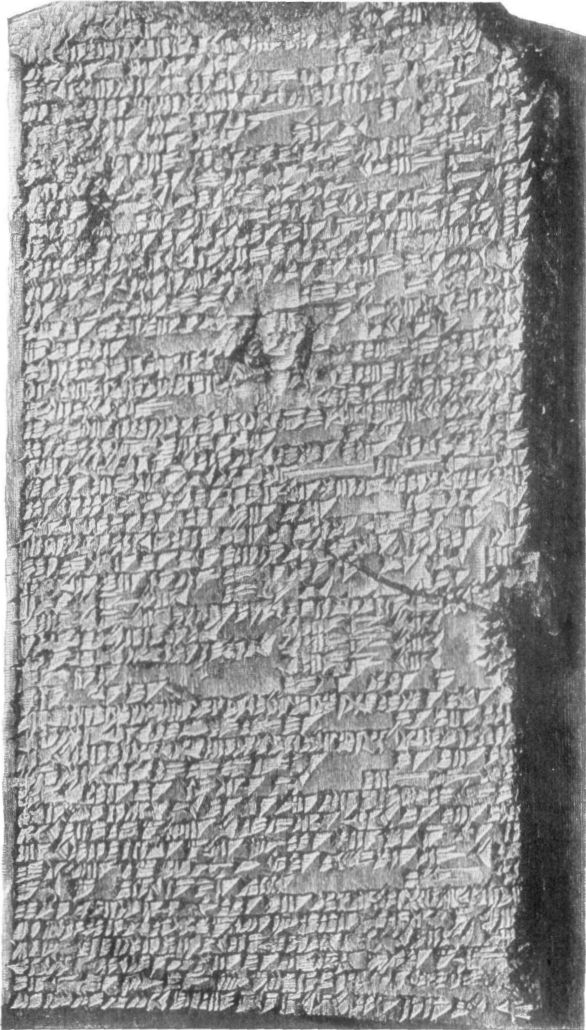
ASSYRIAN CLAY TABLET, Containing a part of the story of the flood, from the library of Assurbanipal. Found in recent explorations in Ancient Babylon, London: British Museum,
Assyrian Clay Tablet (Fac-simile).
Which raged like a mighty host, settled itself to quiet. Down went the sea, ceased storm and flood. Through the sea I rode lamenting. The upper dwellings of men were ruined, Corpses floated like trees. A window I opened, on my face the daylight fell. I shuddered and sat me down weeping, Over my face flowed my tears. I rode over regions of land, on a terrible sea. Then rose one piece of land twelve measures high. To the land Nizir the ship was steered, The mountain Nizir held the ship fast, and let it no more go.
At the dawn of the seventh day I took a dove and sent it forth. Hither and thither flew the dove, No resting-place it found, back to me it came. A swallow I took and sent it forth, No resting-place it found, and back to me it came. A raven I took and sent it forth, Forth flew the raven and saw that the water had fallen, Carefully waded on but came not back. All the animals then to the four winds I sent. A sacrifice I offered, An altar I built on the mountain-top, By sevens I placed the vessels, Under them spread sweet cane and cedar. The gods inhaled the smoke, inhaled the sweet-smelling smoke, Like flies the gods collected over the offering. Thither then came Ishtar, Lifted on high her bow, which Anu had made:-- These days I will not forget, will keep them in remembrance, Them I will never forget. Let the gods come to the altar, But let not Bel to the altar come, Because he heedlessly wrought, the flood he brought on, To destruction my people gave over. Thither came Bel and saw the ship, Full of anger was he Against the gods and the spirits of heaven:-- What soul has escaped! In the destruction no man shall live. Then Adar opened his mouth and spake, Spake to the warlike Bel:-- Who but Ea knew it? He knew and all he hath told. Then Ea opened his mouth, Spake to the warlike Bel:-- Thou art the valiant leader of the gods, Why hast thou heedlessly wrought, and brought on the flood? Let the sinner bear his sin, the wrongdoer his wrong; Yield to our request, that he be not wholly destroyed. Instead of sending a flood, send lions that men be reduced; Instead of sending a flood, send hyenas that men be reduced; Instead of sending a flood, send flames to waste the land; Instead of sending a flood, send pestilence that men be reduced. The counsel of the great gods to him I did not impart; A dream to Hasisadra I sent, and the will of the gods he learned. Then came right reason to Bel, Into the ship he entered, Took my hand and lifted me up, Raised my wife and laid her hand in mine, To us he turned, between us he stepped, His blessing he gave. Human Hasisadra has been, But he and his wife united Now to the gods shall be raised, And Hasisadra shall dwell far off at the mouth of the streams. Then they took me and placed me Far off at the mouth of the streams.
V. THE EAGLE AND THE SNAKE
To Samas came the snake and said:--
The eagle has come to my nest, my young are scattered.
See, O Samas, what evil he has done me.
Help me, thy nest is as broad as the earth,
Thy snare is like the heavens,
Who can escape out of thy net?
Hearing the snake's complaint,
Samas opened his mouth and spake:--
Get thee on thy way, go to the mountain.
A wild ox shall be thy hiding-place.
Open his body, tear out his inward parts,
Make thy dwelling within him.
All the birds of heaven will descend, with them will come the eagle,
Heedless and hurrying on the flesh he will swoop,
Thinking of that which is hidden inside.
So soon as he enters the ox, seize his wing,
Tear off his wing-feathers and claws,
Pull him to pieces and cast him away,
Let him die of hunger and thirst.
So as the mighty Samas commanded,
Rose the snake, went to the mountain,
There he found a wild ox,
Opened his body, tore out his inward parts,
Entered and dwelt within him.
And the birds of heaven descended, with them came the eagle.
Yet the eagle, fearing a snare, ate not of the flesh with the birds.
The eagle spake to his young:--
We will not fly down, nor eat of the flesh of the wild ox.
An eaglet, keen of eye, thus to his father spake:--
In the flesh of the ox lurks the snake
[The rest is lost.]
VI. THE FLIGHT OF ETANA
The priests have offered my sacrifice
With joyful hearts to the gods.
O Lord, issue thy command,
Give me the plant of birth, show me the plant of birth,
Bring the child into the world, grant me a son.
Samas opened his mouth and spake to Etana:--
Away with thee, go to the mountain....
The eagle opened his mouth and spake to Etana:--
Wherefore art thou come?
Etana opened his mouth and said to the eagle:--
My friend, give me the plant of birth, show me the plant of birth,
Bring the child into the world, grant me a son....
To Etana then spake the eagle:--
My friend, be of good cheer.
Come, let me bear thee to Anu's heaven,
On my breast lay thy breast,
Grasp with thy hands the feathers of my wings.
On my side lay thy side.
On his breast he laid his breast,
On his feathers he placed his hands,
On his side laid his side,
Firmly he clung, great was his weight.
Two hours he bore him on high.
The eagle spake to him, to Etana:--
See my friend, the land, how it lies,
Look at the sea, the ocean-girded,
Like a mountain looks the land, the sea like petty waters.
Two hours more he bore him up.
The eagle spake to him, to Etana:--
See my friend the land, how it lies,
The sea is like the girdle of the land.
Two hours more he bore him up.
The eagle spake to him, to Etana:--
See my friend the land, how it lies,
The sea is like the gardener's ditches.
Up they rose to Anu's heaven,
Came to the gate of Anu, Bel and Ea....
Come, my friend, let me bear thee to Ishtar,
To Ishtar, the queen, shalt thou go, and dwell at her feet.
On my side lay thy side,
Grasp my wing-feathers with thy hands.
On his side he laid his side,
His feathers he grasped with his hands.
Two hours he bore him on high.
My friend see the land, how it lies,
How it spreads itself out.
The broad sea is as great as a court.
Two hours he bore him on high.
My friend see the land, how it lies,
The land is like the bed of a garden,
The broad sea is as great as a [.]
Two hours he bore him on high.
My friend see the land, how it lies.
[Etana, frightened, begs the eagle to ascend no further; then, as it seems, the bird's strength is exhausted.]
To the earth the eagle fell down
Shattered upon the ground.
VII. THE GOD ZU
He sees the badges of rule,
His royal crown, his raiment divine.
On the tablets of fate of the god Zu fixes his look.
On the father of the gods, the god of Duranki, Zu fixes his gaze.
Lust after rule enters into his soul.
I will take the tablets of fate of the gods,
Will determine the oracle of all the gods,
Will set up my throne, all orders control,
Will rule all the heavenly spirits.
His heart was set on combat.
At the entrance of the hall he stands, waiting the break of day,
When Bel dispensed the tender rains,
Sat on his throne, put off his crown,
He snatched the tablets of fate from his hands,
Seized the power, the control of commands.
Down flew Zu, in a mountain he hid.
There was anguish and crying.
On the earth Bel poured out his wrath.
Anu opened his mouth and spake,
Said to the gods his children:--
Who will conquer Zu?
Great shall be his name among the dwellers of all lands.
They called for Ramman, the mighty, Anu's son.
To him gives Anu command:--
Up, Ramman, my son, thou hero,
From thine attack desist not, conquer Zu with thy weapons,
That thy name may be great in the assembly of the great gods.
Among the gods thy brethren, none shall be thy equal,
Thy shrines on high shall be built;
Found thee cities in all the world;
Thy cities shall reach to the mountain of the world;
Show thyself strong for the gods, strong be thy name!
To Anu his father's command Ramman answered and spake:--
My father, who shall come to the inaccessible mound?
Who is like unto Zu among the gods thy sons?
The tablets of fate he has snatched from his hands,
Seized on the power, the control of commands.
Zu has fled and hides in his mountain.
[The rest is lost.]
VIII. ADAPA AND THE SOUTHWIND
Under the water the Southwind blew him
Sunk him to the home of the fishes.
O Southwind, ill hast thou used me, thy wings I will break.
As thus with his mouth he spake the wings of the Southwind were broken.
Seven days long the Southwind over the earth blew no more.
To his messenger Ila-Abrat
Anu then spake thus:--
Why for seven days long
Blows the Southwind no more on the earth?
His messenger Ila-Abrat answered and said: My lord,
Adapa, Ea's son, hath broken the wings of the Southwind.
When Anu heard these words,
"Aha!" he cried, and went forth.
[Ea, the ocean-god, then directs his son how to proceed in order to avert Anu's wrath. Some lines are mutilated.]
At the gate of Anu stand.
The gods Tammuz and Iszida will see thee and ask:--
Why lookest thou thus, Adapa,
For whom wearest thou garments of mourning?
From the earth two gods have vanished, therefore do I thus.
Who are these two gods who from the earth have vanished?
At each other they will look, Tammuz and Iszida, and lament.
A friendly word they will speak to Anu
Anu's sacred face they will show thee.
When thou to Anu comest,
Food of death will be offered thee, eat not thereof.
Water of death will be offered thee, drink not thereof.
A garment will be offered thee, put it on.
Oil will be offered thee, anoint thyself therewith.
What I tell thee neglect not, keep my word in mind.
Then came Anu's messenger:--
The wing of the Southwind Adapa has broken,
Deliver him up to me.
Up to heaven he came, approached the gate of Anu.
At Anu's gate Tammuz and Iszida stand,
Adapa they see, and "Aha!" they cry.
O Adapa, wherefore lookest thou thus,
For whom wearest thou apparel of mourning?
From the earth two gods have vanished
Therefore I wear apparel of mourning.
Who are these two gods who from the earth have vanished?
At one another look Tammuz and Iszida and lament.
Adapa go hence to Anu.
When he came, Anu at him looked, saying, O Adapa,
Why hast thou broken the Southwind's wing?
Adapa answered: My lord,
'Fore my lord's house I was fishing,
In the midst of the sea, it was smooth,
Then the Southwind began to blow
Under it forced me, to the home of the fishes I sank.
[By this speech Ann's anger is turned away.]
A beaker he set before him.
What shall we offer him? Food of life
Prepare for him that he may eat.
Food of life was brought for him, but he ate not.
Water of life was brought for him, but he drank not.
A garment was brought him, he put it on,
Oil they gave him, he anointed himself therewith.
Anu looked at him and mourned:--
And now, Adapa, wherefore
Has thou not eaten or drunken?
Now canst thou not live forever ...
Ea, my lord, commanded me:--
Thou shalt not eat nor drink.
IX. PENITENTIAL PSALMS
I
The Suppliant:
I, thy servant, full of sin cry to thee.
The sinner's earnest prayer thou dost accept,
The man on whom thou lookest lives,
Mistress of all, queen of mankind,
Merciful one, to whom it is good to turn,
Who acceptest the sigh of the heart.
The Priest:
Because his god and his goddess are angry, he cries to thee.
To him turn thy face, take his hand.
The Suppliant: Beside thee there is no god to guide me. Look in mercy on me, accept my sigh, Say why do I wait so long. Let thy face be softened! How long, O my lady! May thy kindness be turned to me! Like a dove I mourn, full of sighing.
The Priest: With sorrow and woe His soul is full of sighing, Tears he sheds, he pours out laments.
II
O mother of the gods, who performest the commands of Bel,
Who makest the young grass sprout, queen of mankind,
Creator of all, guide of every birth,
Mother Ishtar, whose might no god approaches,
Exalted mistress, mighty in command!
A prayer I will utter, let her do what seems her good.
O my lady, make me to know my doing,
Food I have not eaten, weeping was my nourishment,
Water I have not drunk, tears were my drink,
My heart has not been joyful nor my spirits glad.
Many are my sins, sorrowful my soul.
O my lady, make me to know my doing,
Make me a place of rest,
Cleanse my sin, lift up my face.
May my god, the lord of prayer, before thee set my prayer!
May my goddess, the lady of supplication, before thee set my supplication!
May the storm-god set my prayer before thee!
[The intercession of a number of gods is here invoked.]
Let thy eye rest graciously on me....
Turn thy face graciously to me....
Let thy heart be gentle, thy spirit mild....
III
O lady, in sorrow of heart sore oppressed I cry to thee.
O lady, to thy servant favor show.
Let thy heart be favorable,
To thy servant full of sorrow show thy pity,
Turn to him thy face, accept his prayer.
IV
To thy servant with whom thou art angry graciously turn.
May the anger of my lord be appeased,
Appeased the god I know not!
The goddess I know, the goddess I know not,
The god who was angry with me,
The goddess who was angry with me be appeased!
The sin which I have committed I know not.
May my god name a gracious name,
My goddess name a gracious name,
The god I know, the god I know not
Name a gracious name,
The goddess I know, the goddess I know not
Name a gracious name!
Pure food I have not eaten,
Pure water I have not drunk,
The wrath of my god, though I knew it not, was my food,
The anger of my goddess, though I knew it not, cast me down.
O lord, many are my sins, great my misdeeds.
[These phrases are repeated many times.]
The lord has looked on me in anger,
The god has punished me in wrath,
The goddess was angry with me and hath brought me to sorrow.
I sought for help, but no one took my hand,
I wept, but no one to me came,
I cry aloud, there is none that hears me,
Sorrowful I lie on the ground, look not up.
To my merciful god I turn, I sigh aloud,
The feet of my goddess I kiss [.]
To the known and unknown god I loud do sigh,
To the known and unknown goddess I loud do sigh,
O lord, look on me, hear my prayer,
O goddess, look on me, hear my prayer.
Men are perverse, nothing they know.
Men of every name, what do they know?
Do they good or ill, nothing they know.
O lord, cast not down thy servant!
Him, plunged into the flood, seize by the hand!
The sin I have committed turn thou to favor!
The evil I have done may the wind carry it away!
Tear in pieces my wrong-doings like a garment!
My god, my sins are seven times seven--forgive my sins!
My goddess, my sins are seven times seven--forgive my sins!
Known and unknown god, my sins are seven times seven--forgive my sins!
Known and unknown goddess, my sins are seven times seven--forgive my sins!
Forgive my sins, and I will humbly bow before thee.
V
May the lord, the mighty ruler Adar, announce my prayer to thee!
May the suppliant lady Nippur announce my prayer to thee!
May the lord of heaven and earth, the lord of Eridu, announce my prayer to thee!
The mother of the great house, the goddess Damkina, announce my prayer to thee!
May Marduk, the lord of Babylon, announce my prayer to thee!
May his consort, the exalted child of heaven and earth, announce my prayer to thee!
May the exalted minister, the god who names the good name, announce my prayer to thee!
May the bride, the first-born of the god, announce my prayer to thee!
May the god of storm-flood, the lord Harsaga, announce my prayer to thee!
May the gracious lady of the land announce my prayer to thee!
X. INSCRIPTION OF SENNACHERIB
(Taylor-cylinder, B.C. 701. Cf. 2 Kings xviii., xix.)
Sennacherib, the great king, the powerful king,
The king of the world, the king of Assyria,
The king of the four zones,
The wise shepherd, the favorite of the great gods,
The protector of justice, the lover of righteousness,
The giver of help, the aider of the weak,
The perfect hero, the stalwart warrior, the first of princes,
The destroyer of the rebellious, the destroyer of enemies,
Assur, the mighty rock, a kingdom without rival has granted me.
Over all who sit on sacred seats he has exalted my arms,
From the upper sea of the setting sun
To the lower sea of the rising sun,
All the blackheaded people he has cast beneath my feet,
The rebellious princes shun battle with me.
They forsook their dwellings; like a falcon
Which dwells in the clefts, they fled alone to an inaccessible place.
To the city of Ekron I went,
The governors and princes who had done evil I slew,
I bound their corpses to poles around the city.
The inhabitants of the city who had done evil I reckoned as spoil;
To the rest who had done no wrong I spoke peace.
Padi, their king, I brought from Jerusalem,
King over them I made him.
The tribute of my lordship I laid upon him.
Hezekiah of Judah, who had not submitted to me,
Forty-six of his strong cities, small cities without number, I besieged.
Casting down the walls, advancing engines, by assault I took them.
Two hundred thousand, one hundred and fifty men and women, young and old,
Horses, mules, asses, camels, oxen, sheep,
I brought out and reckoned as spoil.
Hezekiah himself I shut up like a caged bird
In Jerusalem, his royal city,
The walls I fortified against him,
Whoever came out of the gates I turned him back.
His cities which I had plundered I divided from his land
And gave them to Mitinti, king of Ashdod,
To Padi, king of Ekron, and to Silbal, king of Gaza.
To the former tribute paid yearly
I added the tribute of alliance of my lordship and
Laid that upon him. Hezekiah himself
Was overwhelmed by the fear of the brightness of my lordship.
The Arabians and his other faithful warriors
Whom, for the defence of Jerusalem, his royal city,
He had brought in, fell into fear,
With thirty talents of gold and eight hundred talents of silver, precious stones,
Couches of ivory, thrones of ivory,
And his daughters, his women of the palace,
The young men and the young women, to Nineveh, the city of my lordship,
I caused to be brought after me, and he sent his ambassadors
To give tribute and to pay homage.
XI. INVOCATION TO THE GODDESS BELTIS
To Beltis, the great Lady, chief of heaven and earth,
Queen of all the gods, mighty in all the lands.
Honored is her festival among the Ishtars.
She surpasses her offspring in power.
She, the shining one, like her brother, the sun,
Enlightens Heaven and earth,
Mistress of the spirits of the underworld,
First-born of Anu, great among the gods,
Ruler over her enemies,
The seas she stirs up,
The wooded mountains tramples under foot.
Mistress of the spirits of upper air,
Goddess of battle and fight,
Without whom the heavenly temple
None would render obedience,
She, the bestower of strength, grants the desire of the faithful,
Prayers she hears, supplication receives, entreaty accepts.
Ishtar, the perfect light, all-powerful,
Who enlightens Heaven and earth,
Her name is proclaimed throughout all the lands,
Esarhaddon, king of lands, fear not.
To her it is good to pray.
XII. ORACLES OF ISHTAR OF ARBELA
(B.C. 680-668)
Esarhaddon, king of lands, fear not.
The lord, the spirit who speaks to thee
I speak to him, I have not kept it back.
Thine enemies, like the floods of Sivan
Before thee flee perpetually.
I the great goddess, Ishtar of Arbela
Have put thine enemies to flight.
Where are the words I spake to thee?
Thou hast not trusted them.
I, Ishtar of Arbela, thy foes
Into thy hands I give
In the van and by thy side I go, fear not
In the midst of thy princes thou art.
In the midst of my host I advance and rest.
O Esarhaddon, fear not.
Sixty great gods are with me to guard thee,
The Moon-god on thy right, the Sun-god on thy left,
Around thee stand the sixty great gods,
And make the centre firm.
Trust not to man, look thou to me
Honor me and fear not.
To Esarhaddon, my king,
Long days and length of years I give.
Thy throne beneath the heavens I have established;
In a golden dwelling thee I will guard in heaven
Guard like the diadem of my head.
The former word which I spake thou didst not trust,
But trust thou now this later word and glorify me,
When the day dawns bright complete thy sacrifice.
Pure food thou shalt eat, pure waters drink,
In thy palace thou shalt be pure.
Thy son, thy son's son the kingdom
By the blessing of Nergal shall rule.
XIII. AN ERECHITE'S LAMENT
How long, O my Lady, shall the strong enemy hold thy sanctuary?
There is want in Erech, thy principal city;
Blood is flowing like water in Eulbar, the house of thy oracle;
He has kindled and poured out fire like hailstones on all thy lands.
My Lady, sorely am I fettered by misfortune;
My Lady, thou hast surrounded me, and brought me to grief.
The mighty enemy has smitten me down like a single reed.
Not wise myself, I cannot take counsel;
I mourn day and night like the fields.
I, thy servant, pray to thee.
Let thy heart take rest, let thy disposition be softened.