Volume 1 — THOMAS BAILEY ALDRICH
Reading edition
(1836-)

poet in verse often becomes a poet in prose also, in composing novels; although the novelist may not, and in general does not, possess the faculty of writing poems. The poet-novelist is apt to put into his prose a good deal of the same charm and the same picturesque choice of phrase and image that characterize his verse; while it does not follow that the novelist who at times writes verse--like George Eliot, for example--succeeds in giving a distinctly poetic quality to prose, or even wishes to do so. Among authors who have displayed peculiar power and won fame in the dual capacity of poet and of prose romancer or novelist, Sir Walter Scott and Victor Hugo no doubt stand pre-eminent; and in American literature, Edgar Allan Poe and Oliver Wendell Holmes very strikingly combine these two functions. Another American author who has gained a distinguished position both as a poet and as a writer of prose fiction and essays is Thomas Bailey Aldrich.
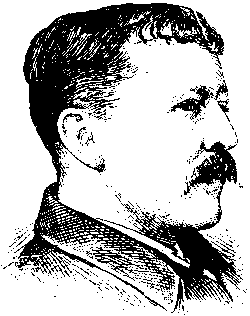
It is upon his work in the form of verse, perhaps, that Aldrich's chief renown is based; but some of his short stories in especial have contributed much to his popularity, no less than to his repute as a delicate and polished artificer in words. A New Englander, he has infused into some of his poems the true atmosphere of New England, and has given the same light and color of home to his prose, while imparting to his productions in both kinds a delightful tinge of the foreign and remote. In addition to his capacities as a poet and a romancer, he is a wit and humorist of sparkling quality. In reading his books one seems also to inhale the perfumes of Arabia and the farther East, blended with the salt sea-breeze and the pine-scented air of his native State, New Hampshire.
He was born in the old seaside town of Portsmouth, New Hampshire, November 11th, 1836; but moved to New York City in 1854, at the age of seventeen. There he remained until 1866; beginning his work quite early; forming his literary character by reading and observation, by the writing of poems, and by practice and experience of writing prose sketches and articles for journals and periodicals. During this period he entered into associations with the poets Stedman, Stoddard, and Bayard Taylor, and was more or less in touch with the group that included Walt Whitman, Fitz-James O'Brien, and William Winter. Removing to Boston in January, 1866, he became the editor of Every Saturday, and remained in that post until 1874, when he resigned. In 1875 he made a long tour in Europe, plucking the first fruits of foreign travel, which were succeeded by many rich and dainty gatherings from the same source in later years. In the intervals of these wanderings he lived in Boston and Cambridge; occupying for a time James Russell Lowell's historic house of Elmwood, in the semi-rural university city; and then established a pretty country house at Ponkapog, a few miles west of Boston. This last suggested the title for a charming book of travel papers, 'From Ponkapog to Pesth.' In 1881 he was appointed editor of the Atlantic Monthly, and continued to direct that famous magazine for nine years, frequently making short trips to Europe, extending his tours as far as the heart of Russia, and gathering fresh materials, for essay or song. Much of his time since giving up the Atlantic editorship has been passed in voyaging, and in 1894-5 he made a journey around the world.
From the beginning he struck with quiet certainty the vein that was his by nature in poetry; and this has broadened almost continually, yielding richer results, which have been worked out with an increasing refinement of skill. His predilection is for the picturesque; for romance combined with simplicity, purity, and tenderness of feeling, touched by fancy and by occasional lights of humor so reserved and dainty that they never disturb the pictorial harmony. The capacity for unaffected utterance of feeling on matters common to humanity reached a climax in the poem of 'Baby Bell,' which by its sympathetic and delicate description of a child's advent and death gave the author a claim to the affection^ of a wide circle; and this remained for a long time probably the best known among his poems. 'Friar Jerome's Beautiful Book' is another of the earlier favorites. 'Spring in New England' has since come to hold high rank both for its vivid and graceful description of the season, for its tender fervor of patriotism, and for its sentiment of reconciliation between North and South. The lines on 'Piscataqua River' remain one of the best illustrations of boyhood memories, and have something of Whittier's homely truth. In his longer narrative pieces, 'Judith' and 'Wyndham Towers,' cast in the mold of blank-verse idyls, Mr. Aldrich does not seem so much himself as in many of his briefer flights. An instinctive dramatic tendency finds outlet in 'Pauline Paulovna' and 'Mercedes'--the latter of which, a two-act piece in prose, has found representation in the theatre; yet in these, also, he is less eminently successful than in his lyrics and society verse.
No American poet has wrought his stanzas with greater faithfulness to an exacting standard of craftsmanship than Mr. Aldrich, or has known better when to leave a line loosely cast, and when to reinforce it with correction or with a syllable that might seem, to an ear less true, redundant. This gives to his most carefully chiseled productions an air of spontaneous ease, and has made him eminent as a sonneteer. His sonnet on 'Sleep' is one of the finest in the language. The conciseness and concentrated aptness of his expression also--together with a faculty of bringing into conjunction subtly contrasted thoughts, images, or feelings--has issued happily in short, concentrated pieces like 'An Untimely Thought,' 'Destiny,' and 'Identity,' and in a number of pointed and effective quatrains. Without overmastering purpose outside of art itself, his is the poetry of luxury rather than of deep passion or conviction; yet, with the freshness of bud and tint in springtime, it still always relates itself effectively to human experience. The author's specially American quality, also, though not dominant, comes out clearly in 'Unguarded Gates,' and with a differing tone in the plaintive Indian legend of 'Miantowona.'
If we perceive in his verse a kinship with the dainty ideals of Théophile Gautier and Alfred de Musset, this does not obscure his originality or his individual charm; and the same thing may be said with regard to his prose. The first of his short fictions that made a decided mark was 'Marjorie Daw.' The fame which it gained, in its separate field, was as swift and widespread as that of Hawthorne's 'The Gentle Boy' or Bret Harte's 'Luck of Roaring Camp.' It is a bright and half-pathetic little parody on human life and affection; or perhaps we should call it a parable symbolizing the power which imagination wields over real life, even in supposedly unimaginative people. The covert smile which it involves, at the importance of human emotions, may be traced to a certain extent in some of Mr. Aldrich's longer and more serious works of fiction: his three novels, 'Prudence Palfrey,' 'The Queen of Sheba,' and 'The Stillwater Tragedy.' 'The Story of a Bad Boy,' frankly but quietly humorous in its record of the pranks and vicissitudes of a healthy average lad (with the scene of the story localized at old Portsmouth, under the name of Rivermouth), a less ambitious work, still holds a secure place in the affections of many mature as well as younger readers. Besides these books, Mr. Aldrich has published a collection of short descriptive, reminiscent, and half-historic papers on Portsmouth,--'An Old Town by the Sea'; with a second volume of short stories entitled 'Two Bites at a Cherry.' The character-drawing in his fiction is clear-cut and effective, often sympathetic, and nearly always suffused with an agreeable coloring of humor. There are notes of pathos, too, in some of his tales; and it is the blending of these qualities, through the medium of a lucid and delightful style, that defines his pleasing quality in prose.
[The following selections are copyrighted, and are reprinted by permission of the author, and Houghton, Mifflin & Co., publishers.]
DESTINY Three roses, wan as moonlight, and weighed down Each with its loveliness as with a crown, Drooped in a florist's window in a town. The first a lover bought. It lay at rest, Like flower on flower, that night, on Beauty's breast. The second rose, as virginal and fair, Shrunk in the tangles of a harlot's hair. The third, a widow, with new grief made wild, Shut in the icy palm of her dead child.
IDENTITY Somewhere--in desolate wind-swept space-- In Twilight-land--in No-man's land-- Two hurrying Shapes met face to face, And bade each other stand. "And who are you?" cried one, agape, Shuddering in the gloaming light. "I know not," said the second Shape, "I only died last night!"
PRESCIENCE The new moon hung in the sky, the sun was low in the west, And my betrothed and I in the churchyard paused to rest-- Happy maiden and lover, dreaming the old dream over: The light winds wandered by, and robins chirped from the nest. And lo! in the meadow sweet was the grave of a little child, With a crumbling stone at the feet and the ivy running wild-- Tangled ivy and clover folding it over and over: Close to my sweetheart's feet was the little mound up-piled. Stricken with nameless fears, she shrank and clung to me, And her eyes were filled with tears for a sorrow I did not see: Lightly the winds were blowing, softly her tears were flowing-- Tears for the unknown years and a sorrow that was to be!
ALEC YEATON'S SON GLOUCESTER, AUGUST, 1720 The wind it wailed, the wind it moaned, And the white caps flecked the sea; "An' I would to God," the skipper groaned, "I had not my boy with me!" Snug in the stern-sheets, little John Laughed as the scud swept by; But the skipper's sunburnt cheek grew wan As he watched the wicked sky. "Would he were at his mother's side!" And the skipper's eyes were dim. "Good Lord in heaven, if ill betide, What would become of him! "For me--my muscles are as steel, For me let hap what may; I might make shift upon the keel Until the break o' day. "But he, he is so weak and small, So young, scarce learned to stand-- O pitying Father of us all, I trust him in thy hand! "For thou who markest from on high A sparrow's fall--each one!-- Surely, O Lord, thou'lt have an eye On Alec Yeaton's son!" Then, helm hard-port; right straight he sailed Towards the headland light: The wind it moaned, the wind it wailed, And black, black fell the night. Then burst a storm to make one quail, Though housed from winds and waves-- They who could tell about that gale Must rise from watery graves! Sudden it came, as sudden went; Ere half the night was sped, The winds were hushed, the waves were spent, And the stars shone overhead. Now, as the morning mist grew thin, The folk on Gloucester shore Saw a little figure floating in Secure, on a broken oar! Up rose the cry, "A wreck! a wreck! Pull mates, and waste no breath!"-- They knew it, though 'twas but a speck Upon the edge of death! Long did they marvel in the town At God his strange decree, That let the stalwart skipper drown And the little child go free!
MEMORY My mind lets go a thousand things, Like dates of wars and deaths of kings, And yet recalls the very hour-- 'Twas noon by yonder village tower. And on the last blue noon in May-- The wind came briskly up this way, Crisping the brook beside the road; Then, pausing here, set down its load Of pine-scents, and shook listlessly Two petals from that wild-rose tree.
TENNYSON (1890) I Shakespeare and Milton--what third blazoned name Shall lips of after ages link to these? His who, beside the wild encircling seas, Was England's voice, her voice with one acclaim, For threescore years; whose word of praise was fame, Whose scorn gave pause to man's iniquities. II What strain was his in that Crimean war? A bugle-call in battle; a low breath, Plaintive and sweet, above the fields of death! So year by year the music rolled afar, From Euxine wastes to flowery Kandahar, Bearing the laurel or the cypress wreath. III Others shall have their little space of time, Their proper niche and bust, then fade away Into the darkness, poets of a day; But thou, O builder of enduring rhyme, Thou shalt not pass! Thy fame in every clime On earth shall live where Saxon speech has sway. IV Waft me this verse across the winter sea, Through light and dark, through mist and blinding sleet, O winter winds, and lay it at his feet; Though the poor gift betray my poverty, At his feet lay it; it may chance that he Will find no gift, where reverence is, unmeet.
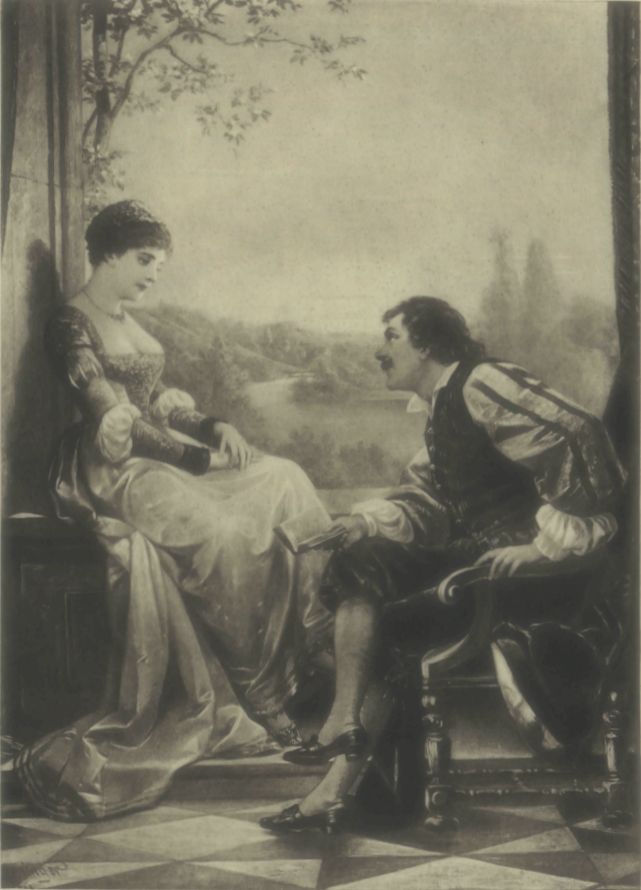
POETRY. Photogravure from a painting by C. Schweninger.
SWEETHEART, SIGH NO MORE It was with doubt and trembling I whispered in her ear. Go, take her answer, bird-on-bough, That all the world may hear-- Sweetheart, sigh no more! Sing it, sing it, tawny throat, Upon the wayside tree, How fair she is, how true she is, How dear she is to me-- Sweetheart, sigh no more! Sing it, sing it, and through the summer long The winds among the clover-tops, And brooks, for all their silvery stops, Shall envy you the song-- Sweetheart, sigh no more!
BROKEN MUSIC "A note All out of tune in this world's instrument." AMY LEVY. I know not in what fashion she was made, Nor what her voice was, when she used to speak, Nor if the silken lashes threw a shade On wan or rosy cheek. I picture her with sorrowful vague eyes, Illumed with such strange gleams of inner light As linger in the drift of London skies Ere twilight turns to night. I know not; I conjecture. 'Twas a girl That with her own most gentle desperate hand From out God's mystic setting plucked life's pearl-- 'Tis hard to understand. So precious life is! Even to the old The hours are as a miser's coins, and she-- Within her hands lay youth's unminted gold And all felicity. The winged impetuous spirit, the white flame That was her soul once, whither has it flown? Above her brow gray lichens blot her name Upon the carven stone. This is her Book of Verses--wren-like notes, Shy franknesses, blind gropings, haunting fears; At times across the chords abruptly floats A mist of passionate tears. A fragile lyre too tensely keyed and strung, A broken music, weirdly incomplete: Here a proud mind, self-baffled and self-stung, Lies coiled in dark defeat.
ELMWOOD In Memory of James Russell Lowell Here, in the twilight, at the well-known gate I linger, with no heart to enter more. Among the elm-tops the autumnal air Murmurs, and spectral in the fading light A solitary heron wings its way Southward--save this no sound or touch of life. Dark is the window where the scholar's lamp Was used to catch a pallor from the dawn. Yet I must needs a little linger here. Each shrub and tree is eloquent of him, For tongueless things and silence have their speech. This is the path familiar to his foot From infancy to manhood and old age; For in a chamber of that ancient house His eyes first opened on the mystery Of life, and all the splendor of the world. Here, as a child, in loving, curious way, He watched the bluebird's coming; learned the date Of hyacinth and goldenrod, and made Friends of those little redmen of the elms, And slyly added to their winter store Of hazel-nuts: no harmless thing that breathed, Footed or winged, but knew him for a friend. The gilded butterfly was not afraid To trust its gold to that so gentle hand, The bluebird fled not from the pendent spray. Ah, happy childhood, ringed with fortunate stars! What dreams were his in this enchanted sphere, What intuitions of high destiny! The honey-bees of Hybla touched his lips In that old New-World garden, unawares. So in her arms did Mother Nature fold Her poet, whispering what of wild and sweet Into his ear--the state-affairs of birds, The lore of dawn and sunset, what the wind Said in the tree-tops--fine, unfathomed things Henceforth to turn to music in his brain: A various music, now like notes of flutes, And now like blasts of trumpets blown in wars. Later he paced this leafy academe A student, drinking from Greek chalices The ripened vintage of the antique world. And here to him came love, and love's dear loss; Here honors came, the deep applause of men Touched to the heart by some swift-wingèd word That from his own full heart took eager flight-- Some strain of piercing sweetness or rebuke, For underneath his gentle nature flamed A noble scorn for all ignoble deed, Himself a bondman till all men were free. Thus passed his manhood; then to other lands He strayed, a stainless figure among courts Beside the Manzanares and the Thames. Whence, after too long exile, he returned With fresher laurel, but sedater step And eye more serious, fain to breathe the air Where through the Cambridge marshes the blue Charles Uncoils its length and stretches to the sea: Stream dear to him, at every curve a shrine For pilgrim Memory. Again he watched His loved syringa whitening by the door, And knew the catbird's welcome; in his walks Smiled on his tawny kinsmen of the elms Stealing his nuts; and in the ruined year Sat at his widowed hearthside with bent brows Leonine, frosty with the breath of time, And listened to the crooning of the wind In the wide Elmwood chimneys, as of old. And then--and then.... The after-glow has faded from the elms, And in the denser darkness of the boughs From time to time the firefly's tiny lamp Sparkles. How often in still summer dusks He paused to note that transient phantom spark Flash on the air--a light that outlasts him! The night grows chill, as if it felt a breath Blown from that frozen city where he lies. All things turn strange. The leaf that rustles here Has more than autumn's mournfulness. The place Is heavy with his absence. Like fixed eyes Whence the dear light of sense and thought has fled, The vacant windows stare across the lawn. The wise sweet spirit that informed it all Is otherwhere. The house itself is dead. O autumn wind among the sombre pines, Breathe you his dirge, but be it sweet and low. With deep refrains and murmurs of the sea, Like to his verse--the art is yours alone. His once--you taught him. Now no voice but yours! Tender and low, O wind among the pines. I would, were mine a lyre of richer strings, In soft Sicilian accents wrap his name.
SEA LONGINGS The first world-sound that fell upon my ear Was that of the great winds along the coast Crushing the deep-sea beryl on the rocks-- The distant breakers' sullen cannonade. Against the spires and gables of the town The white fog drifted, catching here and there At overleaning cornice or peaked roof, And hung--weird gonfalons. The garden walks Were choked with leaves, and on their ragged biers Lay dead the sweets of summer--damask rose, Clove-pink, old-fashioned, loved New England flowers Only keen salt-sea odors filled the air. Sea-sounds, sea-odors--these were all my world. Hence is it that life languishes with me Inland; the valleys stifle me with gloom And pent-up prospect; in their narrow bound Imagination flutters futile wings. Vainly I seek the sloping pearl-white sand And the mirage's phantom citadels Miraculous, a moment seen, then gone. Among the mountains I am ill at ease, Missing the stretched horizon's level line And the illimitable restless blue. The crag-torn sky is not the sky I love, But one unbroken sapphire spanning all; And nobler than the branches of a pine Aslant upon a precipice's edge Are the strained spars of some great battle-ship Plowing across the sunset. No bird's lilt So takes me as the whistling of the gale Among the shrouds. My cradle-song was this, Strange inarticulate sorrows of the sea, Blithe rhythms upgathered from the Sirens' caves. Perchance of earthly voices the last voice That shall an instant my freed spirit stay On this world's verge, will be some message blown Over the dim salt lands that fringe the coast At dusk, or when the trancèd midnight droops With weight of stars, or haply just as dawn, Illumining the sullen purple wave, Turns the gray pools and willow-stems to gold.
A SHADOW OF THE NIGHT Close on the edge of a midsummer dawn In troubled dreams I went from land to land, Each seven-colored like the rainbow's arc, Regions where never fancy's foot had trod Till then; yet all the strangeness seemed not strange, At which I wondered, reasoning in my dream With twofold sense, well knowing that I slept. At last I came to this our cloud-hung earth, And somewhere by the seashore was a grave, A woman's grave, new-made, and heaped with flowers; And near it stood an ancient holy man That fain would comfort me, who sorrowed not For this unknown dead woman at my feet. But I, because his sacred office held My reverence, listened; and 'twas thus he spake:-- "When next thou comest thou shalt find her still In all the rare perfection that she was. Thou shalt have gentle greeting of thy love! Her eyelids will have turned to violets, Her bosom to white lilies, and her breath To roses. What is lovely never dies, But passes into other loveliness, Star-dust, or sea-foam, flower, or wingèd air. If this befalls our poor unworthy flesh, Think thee what destiny awaits the soul! What glorious vesture it shall wear at last!" While yet he spoke, seashore and grave and priest Vanished, and faintly from a neighboring spire Fell five slow solemn strokes upon my ear. Then I awoke with a keen pain at heart, A sense of swift unutterable loss, And through the darkness reached my hand to touch Her cheek, soft-pillowed on one restful palm-- To be quite sure!
OUTWARD BOUND I leave behind me the elm-shadowed square And carven portals of the silent street, And wander on with listless, vagrant feet Through seaward-leading alleys, till the air Smells of the sea, and straightway then the care Slips from my heart, and life once more is sweet. At the lane's ending lie the white-winged fleet. O restless Fancy, whither wouldst thou fare? Here are brave pinions that shall take thee far-- Gaunt hulks of Norway; ships of red Ceylon; Slim-masted lovers of the blue Azores! 'Tis but an instant hence to Zanzibar, Or to the regions of the Midnight Sun: Ionian isles are thine, and all the fairy shores!
REMINISCENCE Though I am native to this frozen zone That half the twelvemonth torpid lies, or dead; Though the cold azure arching overhead And the Atlantic's never-ending moan Are mine by heritage, I must have known Life otherwhere in epochs long since fled; For in my veins some Orient blood is red, And through my thought are lotus blossoms blown. I do remember ... it was just at dusk, Near a walled garden at the river's turn, (A thousand summers seem but yesterday!) A Nubian girl, more sweet than Khoorja musk, Came to the water-tank to fill her urn, And with the urn she bore my heart away!
PÈRE ANTOINE'S DATE-PALM
Near the Levée, and not far from the old French Cathedral in the Place d'Armes, at New Orleans, stands a fine date-palm, thirty feet in height, spreading its broad leaves in the alien air as hardily as if its sinuous roots were sucking strength from their native earth.
Sir Charles Lyell, in his 'Second Visit to the United States,' mentions this exotic:--"The tree is seventy or eighty years old; for Père Antoine, a Roman Catholic priest, who died about twenty years ago, told Mr. Bringier that he planted it himself, when he was young. In his will he provided that they who succeeded to this lot of ground should forfeit it if they cut down the palm."
Wishing to learn something of Père Antoine's history, Sir Charles Lyell made inquiries among the ancient Creole inhabitants of the faubourg. That the old priest, in his last days, became very much emaciated, that he walked about the streets like a mummy, that he gradually dried up, and finally blew away, was the meagre and unsatisfactory result of the tourist's investigations. This is all that is generally told of Père Antoine.
In the summer of 1861, while New Orleans was yet occupied by the Confederate forces, I met at Alexandria, in Virginia, a lady from Louisiana--Miss Blondeau by name--who gave me the substance of the following legend touching Père Antoine and his wonderful date-palm. If it should appear tame to the reader, it will be because I am not habited in a black ribbed-silk dress, with a strip of point-lace around my throat, like Miss Blondeau; it will be because I lack her eyes and lips and Southern music to tell it with.
When Père Antoine was a very young man, he had a friend whom he loved as he loved his life. Émile Jardin returned his passion, and the two, on account of their friendship, became the marvel of the city where they dwelt. One was never seen without the other; for they studied, walked, ate, and slept together.
Thus began Miss Blondeau, with the air of Fiammetta telling her prettiest story to the Florentines in the garden of Boccaccio.
Antoine and Émile were preparing to enter the Church; indeed, they had taken the preliminary steps, when a circumstance occurred which changed the color of their lives. A foreign lady, from some nameless island in the Pacific, had a few months before moved into their neighborhood. The lady died suddenly, leaving a girl of sixteen or seventeen, entirely friendless and unprovided for. The young men had been kind to the woman during her illness, and at her death--melting with pity at the forlorn situation of Anglice, the daughter--swore between themselves to love and watch over her as if she were their sister.
Now Anglice had a wild, strange beauty that made other women seem tame beside her; and in the course of time the young men found themselves regarding their ward not so much like brothers as at first. In brief, they found themselves in love with her.
They struggled with their hopeless passion month after month, neither betraying his secret to the other; for the austere orders which they were about to assume precluded the idea of love and marriage. Until then they had dwelt in the calm air of religious meditations, unmoved except by that pious fervor which in other ages taught men to brave the tortures of the rack and to smile amid the flames. But a blonde girl, with great eyes and a voice like the soft notes of a vesper hymn, had come in between them and their ascetic dreams of heaven. The ties that had bound the young men together snapped silently one by one. At last each read in the pale face of the other the story of his own despair.
And she? If Anglice shared their trouble, her face told no story. It was like the face of a saint on a cathedral window. Once, however, as she came suddenly upon the two men and overheard words that seemed to burn like fire on the lip of the speaker, her eyes grew luminous for an instant. Then she passed on, her face as immobile as before in its setting of wavy gold hair.
"Entre or et roux Dieu fit ses longs cheveux."
One night Émile and Anglice were missing. They had flown--but whither, nobody knew, and nobody save Antoine cared. It was a heavy blow to Antoine--for he had himself half resolved to confess his love to Anglice and urge her to fly with him.
A strip of paper slipped from a volume on Antoine's priedieu, and fluttered to his feet.
"Do not be angry," said the bit of paper, piteously; "forgive us, for we love." ("Pardonnez-nous, car nous aimons.")
Three years went by wearily enough. Antoine had entered the Church, and was already looked upon as a rising man; but his face was pale and his heart leaden, for there was no sweetness in life for him.
Four years had elapsed, when a letter, covered with outlandish postmarks, was brought to the young priest--a letter from Anglice. She was dying;--would he forgive her? Émile, the year previous, had fallen a victim to the fever that raged on the island; and their child, Anglice, was likely to follow him. In pitiful terms she begged Antoine to take charge of the child until she was old enough to enter the convent of the Sacré-Coeur. The epistle was finished hastily by another hand, informing Antoine of Madame Jardin's death; it also told him that Anglice had been placed on board a vessel shortly to leave the island for some Western port.
The letter, delayed by storm and shipwreck, was hardly read and wept over when little Anglice arrived.
On beholding her, Antoine uttered a cry of joy and surprise--she was so like the woman he had worshiped.
The passion that had been crowded down in his heart broke out and lavished its richness on this child, who was to him not only the Anglice of years ago, but his friend Émile Jardin also.
Anglice possessed the wild, strange beauty of her mother--the bending, willowy form, the rich tint of skin, the large tropical eyes, that had almost made Antoine's sacred robes a mockery to him.
For a month or two Anglice was wildly unhappy in her new home. She talked continually of the bright country where she was born, the fruits and flowers and blue skies, the tall, fan-like trees, and the streams that went murmuring through them to the sea. Antoine could not pacify her.
By and by she ceased to weep, and went about the cottage in a weary, disconsolate way that cut Antoine to the heart. A long-tailed paroquet, which she had brought with her in the ship, walked solemnly behind her from room to room, mutely pining, it seemed, for those heavy orient airs that used to ruffle its brilliant plumage.
Before the year ended, he noticed that the ruddy tinge had faded from her cheek, that her eyes had grown languid, and her slight figure more willowy than ever.
A physician was consulted. He could discover nothing wrong with the child, except this fading and drooping. He failed to account for that. It was some vague disease of the mind, he said, beyond his skill.
So Anglice faded day after day. She seldom left the room now. At last Antoine could not shut out the fact that the child was passing away. He had learned to love her so!
"Dear heart," he said once, "What is't ails thee?"
"Nothing, mon père," for so she called him.
The winter passed, the balmy spring had come with its magnolia blooms and orange blossoms, and Anglice seemed to revive. In her small bamboo chair, on the porch, she swayed to and fro in the fragrant breeze, with a peculiar undulating motion, like a graceful tree.
At times something seemed to weigh upon her mind. Antoine observed it, and waited. Finally she spoke.
"Near our house," said little Anglice--"near our house, on the island, the palm-trees are waving under the blue sky. Oh, how beautiful! I seem to lie beneath them all day long. I am very, very happy. I yearned for them so much that I grew ill--don't you think it was so, mon père?
"Hélas, yes!" exclaimed Antoine, suddenly. "Let us hasten to those pleasant islands where the palms are waving."
Anglice smiled. "I am going there, mon père."
A week from that evening the wax candles burned at her feet and forehead, lighting her on the journey.
All was over. Now was Antoine's heart empty. Death, like another Émile, had stolen his new Anglice. He had nothing to do but to lay the blighted flower away.
Père Antoine made a shallow grave in his garden, and heaped the fresh brown mold over his idol.
In the tranquil spring evenings, the priest was seen sitting by the mound, his finger closed in the unread breviary.
The summer broke on that sunny land; and in the cool morning twilight, and after nightfall, Antoine lingered by the grave. He could never be with it enough.
One morning he observed a delicate stem, with two curiously shaped emerald leaves, springing up from the centre of the mound. At first he merely noticed it casually; but presently the plant grew so tall, and was so strangely unlike anything he had ever seen before, that he examined it with care.
How straight and graceful and exquisite it was! When it swung to and fro with the summer wind, in the twilight, it seemed to Antoine as if little Anglice were standing there in the garden.
The days stole by, and Antoine tended the fragile shoot, wondering what manner of blossom it would unfold, white, or scarlet, or golden. One Sunday, a stranger, with a bronzed, weather-beaten face like a sailor's, leaned over the garden rail, and said to him, "What a fine young date-palm you have there, sir!"
"Mon Dieu!" cried Père Antoine starting, "and is it a palm?"
"Yes, indeed," returned the man. "I didn't reckon the tree would flourish in this latitude."
"Ah, mon Dieu!" was all the priest could say aloud; but he murmured to himself, "Bon Dieu, vous m'avez donné cela!"
If Père Antoine loved the tree before, he worshiped it now. He watered it, and nurtured it, and could have clasped it in his arms. Here were Émile and Anglice and the child, all in one!
The years glided away, and the date-palm and the priest grew together--only one became vigorous and the other feeble. Père Antoine had long passed the meridian of life. The tree was in its youth. It no longer stood in an isolated garden; for pretentious brick and stucco houses had clustered about Antoine's cottage. They looked down scowling on the humble thatched roof. The city was edging up, trying to crowd him off his land. But he clung to it like lichen and refused to sell.
Speculators piled gold on his doorsteps, and he laughed at them. Sometimes he was hungry, and cold, and thinly clad; but he laughed none the less.
"Get thee behind me, Satan!" said the old priest's smile.
Père Antoine was very old now, scarcely able to walk; but he could sit under the pliant, caressing leaves of his palm, loving it like an Arab; and there he sat till the grimmest of speculators came to him. But even in death Père Antoine was faithful to his trust: the owner of that land loses it if he harm the date-tree.
And there it stands in the narrow, dingy street, a beautiful, dreamy stranger, an exquisite foreign lady whose grace is a joy to the eye, the incense of whose breath makes the air enamored. May the hand wither that touches her ungently!
"Because it grew from the heart of little Anglice," said Miss Blondeau tenderly.
MISS MEHETABEL'S SON
I
THE OLD TAVERN AT BAYLEY'S FOUR-CORNERS
You will not find Greenton, or Bayley's Four-Corners as it is more usually designated, on any map of New England that I know of. It is not a town; it is not even a village: it is merely an absurd hotel. The almost indescribable place called Greenton is at the intersection of four roads, in the heart of New Hampshire, twenty miles from the nearest settlement of note, and ten miles from any railway station. A good location for a hotel, you will say. Precisely; but there has always been a hotel there, and for the last dozen years it has been pretty well patronized--by one boarder. Not to trifle with an intelligent public, I will state at once that, in the early part of this century, Greenton was a point at which the mail-coach on the Great Northern Route stopped to change horses and allow the passengers to dine. People in the county, wishing to take the early mail Portsmouth-ward, put up over night at the old tavern, famous for its irreproachable larder and soft feather-beds. The tavern at that time was kept by Jonathan Bayley, who rivaled his wallet in growing corpulent, and in due time passed away. At his death the establishment, which included a farm, fell into the hands of a son-in-law. Now, though Bayley left his son-in-law a hotel--which sounds handsome--he left him no guests; for at about the period of the old man's death the old stage-coach died also. Apoplexy carried off one, and steam the other. Thus, by a sudden swerve in the tide of progress, the tavern at the Corners found itself high and dry, like a wreck on a sand-bank. Shortly after this event, or maybe contemporaneously, there was some attempt to build a town at Greenton; but it apparently failed, if eleven cellars choked up with débris and overgrown with burdocks are any indication of failure. The farm, however, was a good farm, as things go in New Hampshire, and Tobias Sewell, the son-in-law, could afford to snap his fingers at the traveling public if they came near enough--which they never did.
The hotel remains to-day pretty much the same as when Jonathan Bayley handed in his accounts in 1840, except that Sewell has from time to time sold the furniture of some of the upper chambers to bridal couples in the neighborhood. The bar is still open, and the parlor door says PARLOUR in tall black letters. Now and then a passing drover looks in at that lonely bar-room, where a high-shouldered bottle of Santa Cruz rum ogles with a peculiarly knowing air a shriveled lemon on a shelf; now and then a farmer rides across country to talk crops and stock and take a friendly glass with Tobias; and now and then a circus caravan with speckled ponies, or a menagerie with a soggy elephant, halts under the swinging sign, on which there is a dim mail-coach with four phantomish horses driven by a portly gentleman whose head has been washed off by the rain. Other customers there are none, except that one regular boarder whom I have mentioned.
If misery makes a man acquainted with strange bed-fellows, it is equally certain that the profession of surveyor and civil engineer often takes one into undreamed-of localities. I had never heard of Greenton until my duties sent me there, and kept me there two weeks in the dreariest season of the year. I do not think I would, of my own volition, have selected Greenton for a fortnight's sojourn at any time; but now the business is over, I shall never regret the circumstances that made me the guest of Tobias Sewell, and brought me into intimate relations with Miss Mehetabel's Son.
It was a black October night in the year of grace 1872, that discovered me standing in front of the old tavern at the Corners. Though the ten miles' ride from K---- had been depressing, especially the last five miles, on account of the cold autumnal rain that had set in, I felt a pang of regret on hearing the rickety open wagon turn round in the road and roll off in the darkness. There were no lights visible anywhere, and only for the big, shapeless mass of something in front of me, which the driver had said was the hotel, I should have fancied that I had been set down by the roadside. I was wet to the skin and in no amiable humor; and not being able to find bell-pull or knocker, or even a door, I belabored the side of the house with my heavy walking-stick. In a minute or two I saw a light flickering somewhere aloft, then I heard the sound of a window opening, followed by an exclamation of disgust as a blast of wind extinguished the candle which had given me an instantaneous picture en silhouette of a man leaning out of a casement.
"I say, what do you want, down there?" inquired an unprepossessing voice.
"I want to come in; I want a supper, and a bed, and numberless things."
"This isn't no time of night to go rousing honest folks out of their sleep. Who are you, anyway?"
The question, superficially considered, was a very simple one, and I, of all people in the world, ought to have been able to answer it off-hand; but it staggered me. Strangely enough, there came drifting across my memory the lettering on the back of a metaphysical work which I had seen years before on a shelf in the Astor Library. Owing to an unpremeditatedly funny collocation of title and author, the lettering read as follows:--"Who am I? Jones." Evidently it had puzzled Jones to know who he was, or he wouldn't have written a book about it, and come to so lame and impotent a conclusion. It certainly puzzled me at that instant to define my identity. "Thirty years ago," I reflected, "I was nothing; fifty years hence I shall be nothing again, humanly speaking. In the mean time, who am I, sure enough?" It had never before occurred to me what an indefinite article I was. I wish it had not occurred to me then. Standing there in the rain and darkness, I wrestled vainly with the problem, and was constrained to fall back upon a Yankee expedient.
"Isn't this a hotel?" I asked finally.
"Well, it is a sort of hotel," said the voice, doubtfully. My hesitation and prevarication had apparently not inspired my interlocutor with confidence in me.
"Then let me in. I have just driven over from K---- in this infernal rain. I am wet through and through."
"But what do you want here, at the Corners? What's your business? People don't come here, leastways in the middle of the night."
"It isn't in the middle of the night," I returned, incensed. "I come on business connected with the new road. I'm the superintendent of the works."
"Oh!"
"And if you don't open the door at once, I'll raise the whole neighborhood--and then go to the other hotel."
When I said that, I supposed Greenton was a village with a population of at least three or four thousand, and was wondering vaguely at the absence of lights and other signs of human habitation. Surely, I thought, all the people cannot be abed and asleep at half past ten o'clock: perhaps I am in the business section of the town, among the shops.
"You jest wait," said the voice above.
This request was not devoid of a certain accent of menace, and I braced myself for a sortie on the part of the besieged, if he had any such hostile intent. Presently a door opened at the very place where I least expected a door, at the farther end of the building, in fact, and a man in his shirt-sleeves, shielding a candle with his left hand, appeared on the threshold. I passed quickly into the house, with Mr. Tobias Sewell (for this was Mr. Sewell) at my heels, and found myself in a long, low-studded bar-room.
There were two chairs drawn up before the hearth, on which a huge hemlock back-log was still smoldering, and on the unpainted deal counter contiguous stood two cloudy glasses with bits of lemon-peel in the bottom, hinting at recent libations. Against the discolored wall over the bar hung a yellowed hand-bill, in a warped frame, announcing that "the Next Annual N.H. Agricultural Fair" would take place on the 10th of September, 1841. There was no other furniture or decoration in this dismal apartment, except the cobwebs which festooned the ceiling, hanging down here and there like stalactites.
Mr. Sewell set the candlestick on the mantel-shelf, and threw some pine-knots on the fire, which immediately broke into a blaze, and showed him to be a lank, narrow-chested man, past sixty, with sparse, steel-gray hair, and small, deep-set eyes, perfectly round, like a fish's, and of no particular color. His chief personal characteristics seemed to be too much feet and not enough teeth. His sharply cut, but rather simple face, as he turned it towards me, wore a look of interrogation. I replied to his mute inquiry by taking out my pocket-book and handing him my business-card, which he held up to the candle and perused with great deliberation.
"You're a civil engineer, are you?" he said, displaying his gums, which gave his countenance an expression of almost infantile innocence. He made no further audible remark, but mumbled between his thin lips something which an imaginative person might have construed into, "If you're a civil engineer, I'll be blessed if I wouldn't like to see an uncivil one!"
Mr. Sewell's growl, however, was worse than his bite,--owing to his lack of teeth, probably--for he very good-naturedly set himself to work preparing supper for me. After a slice of cold ham, and a warm punch, to which my chilled condition gave a grateful flavor, I went to bed in a distant chamber in a most amiable mood, feeling satisfied that Jones was a donkey to bother himself about his identity.
When I awoke, the sun was several hours high. My bed faced a window, and by raising myself on one elbow I could look out on what I expected would be the main street. To my astonishment I beheld a lonely country road winding up a sterile hill and disappearing over the ridge. In a cornfield at the right of the road was a small private graveyard, inclosed by a crumbling stone wall with a red gate. The only thing suggestive of life was this little corner lot occupied by death. I got out of bed and went to the other window. There I had an uninterrupted view of twelve miles of open landscape, with Mount Agamenticus in the purple distance. Not a house or a spire in sight. "Well," I exclaimed, "Greenton doesn't appear to be a very closely packed metropolis!" That rival hotel with which I had threatened Mr. Sewell overnight was not a deadly weapon, looking at it by daylight. "By Jove!" I reflected, "maybe I'm in the wrong place." But there, tacked against a panel of the bedroom door, was a faded time-table dated Greenton, August 1st, 1839.
I smiled all the time I was dressing, and went smiling downstairs, where I found Mr. Sewell, assisted by one of the fair sex in the first bloom of her eightieth year, serving breakfast for me on a small table--in the bar-room!
"I overslept myself this morning," I remarked apologetically, "and I see that I am putting you to some trouble. In future, if you will have me called, I will take my meals at the usual table d'hôte."
"At the what?" said Mr. Sewell.
"I mean with the other boarders."
Mr. Sewell paused in the act of lifting a chop from the fire, and, resting the point of his fork against the woodwork of the mantel-piece, grinned from ear to ear.
"Bless you! there isn't any other boarders. There hasn't been anybody put up here sence--let me see--sence father-in-law died, and that was in the fall of '40. To be sure, there's Silas; he's a regular boarder; but I don't count him."
Mr. Sewell then explained how the tavern had lost its custom when the old stage line was broken up by the railroad. The introduction of steam was, in Mr. Sewell's estimation, a fatal error. "Jest killed local business. Carried it off, I'm darned if I know where. The whole country has been sort o' retrograding ever sence steam was invented."
"You spoke of having one boarder," I said.
"Silas? Yes; he come here the summer 'Tilda died--she that was 'Tilda Bayley--and he's here yet, going on thirteen year. He couldn't live any longer with the old man. Between you and I, old Clem Jaffrey, Silas's father, was a hard nut. Yes," said Mr. Sewell, crooking his elbow in inimitable pantomime, "altogether too often. Found dead in the road hugging a three-gallon demijohn. Habeas corpus in the barn," added Mr. Sewell, intending, I presume, to intimate that a post-mortem examination had been deemed necessary. "Silas," he resumed, in that respectful tone which one should always adopt when speaking of capital, "is a man of considerable property; lives on his interest, and keeps a hoss and shay. He's a great scholar, too, Silas: takes all the pe-ri-odicals and the Police Gazette regular."
Mr. Sewell was turning over a third chop, when the door opened and a stoutish, middle-aged little gentleman, clad in deep black, stepped into the room.
"Silas Jaffrey," said Mr. Sewell, with a comprehensive sweep of his arm, picking up me and the new-comer on one fork, so to speak. "Be acquainted!"
Mr. Jaffrey advanced briskly, and gave me his hand with unlooked-for cordiality. He was a dapper little man, with a head as round and nearly as bald as an orange, and not unlike an orange in complexion, either; he had twinkling gray eyes and a pronounced Roman nose, the numerous freckles upon which were deepened by his funereal dress-coat and trousers. He reminded me of Alfred de Musset's blackbird, which, with its yellow beak and sombre plumage, looked like an undertaker eating an omelet.
"Silas will take care of you," said Mr. Sewell, taking down his hat from a peg behind the door. "I've got the cattle to look after. Tell him if you want anything."
While I ate my breakfast, Mr. Jaffrey hopped up and down the narrow bar-room and chirped away as blithely as a bird on a cherry-bough, occasionally ruffling with his fingers a slight fringe of auburn hair which stood up pertly round his head and seemed to possess a luminous quality of its own.
"Don't I find it a little slow up here at the Corners? Not at all, my dear sir. I am in the thick of life up here. So many interesting things going on all over the world--inventions, discoveries, spirits, railroad disasters, mysterious homicides. Poets, murderers, musicians, statesmen, distinguished travelers, prodigies of all kinds turning up everywhere. Very few events or persons escape me. I take six daily city papers, thirteen weekly journals, all the monthly magazines, and two quarterlies. I could not get along with less. I couldn't if you asked me. I never feel lonely. How can I, being on intimate terms, as it were, with thousands and thousands of people? There's that young woman out West. What an entertaining creature she is!--now in Missouri, now in Indiana, and now in Minnesota, always on the go, and all the time shedding needles from various parts of her body as if she really enjoyed it! Then there's that versatile patriarch who walks hundreds of miles and saws thousands of feet of wood, before breakfast, and shows no signs of giving out. Then there's that remarkable, one may say that historical colored woman who knew Benjamin Franklin, and fought at the battle of Bunk--no, it is the old negro man who fought at Bunker Hill, a mere infant, of course, at that period. Really, now, it is quite curious to observe how that venerable female slave--formerly an African princess--is repeatedly dying in her hundred and eleventh year, and coming to life again punctually every six months in the small-type paragraphs. Are you aware, sir, that within the last twelve years no fewer than two hundred and eighty-seven of General Washington's colored coachmen have died?"
For the soul of me I could not tell whether this quaint little gentleman was chaffing me or not. I laid down my knife and fork, and stared at him.
"Then there are the mathematicians!" he cried vivaciously, without waiting for a reply. "I take great interest in them. Hear this!" and Mr. Jaffrey drew a newspaper from a pocket in the tail of his coat, and read as follows:--"It has been estimated that if all the candles manufactured by this eminent firm (Stearine & Co.) were placed end to end, they would reach 2 and 7-8 times around the globe. Of course," continued Mr. Jaffrey, folding up the journal reflectively, "abstruse calculations of this kind are not, perhaps, of vital importance, but they indicate the intellectual activity of the age. Seriously, now," he said, halting in front of the table, "what with books and papers and drives about the country, I do not find the days too long, though I seldom see any one, except when I go over to K---- for my mail. Existence may be very full to a man who stands a little aside from the tumult and watches it with philosophic eye. Possibly he may see more of the battle than those who are in the midst of the action. Once I was struggling with the crowd, as eager and undaunted as the best; perhaps I should have been struggling still. Indeed, I know my life would have been very different now if I had married Mehetabel--if I had married Mehetabel."
His vivacity was gone, a sudden cloud had come over his bright face, his figure seemed to have collapsed, the light seemed to have faded out of his hair. With a shuffling step, the very antithesis of his brisk, elastic tread, he turned to the door and passed into the road.
"Well," I said to myself, "if Greenton had forty thousand inhabitants, it couldn't turn out a more astonishing old party than that!"
II
THE CASE OF SILAS JAFFREY
A man with a passion for bric-a-brac is always stumbling over antique bronzes, intaglios, mosaics, and daggers of the time of Benvenuto Cellini; the bibliophile finds creamy vellum folios and rare Alduses and Elzevirs waiting for him at unsuspected bookstalls; the numismatist has but to stretch forth his palm to have priceless coins drop into it. My own weakness is odd people, and I am constantly encountering them. It was plain that I had unearthed a couple of very queer specimens at Bayley's Four-Corners. I saw that a fortnight afforded me too brief an opportunity to develop the richness of both, and I resolved to devote my spare time to Mr. Jaffrey alone, instinctively recognizing in him an unfamiliar species. My professional work in the vicinity of Greenton left my evenings and occasionally an afternoon unoccupied; these intervals I purposed to employ in studying and classifying my fellow-boarder. It was necessary, as a preliminary step, to learn something of his previous history, and to this end I addressed myself to Mr. Sewell that same night,
"I do not want to seem inquisitive," I said to the landlord, as he was fastening up the bar, which, by the way, was the salle à manger and general sitting-room--"I do not want to seem inquisitive, but your friend Mr. Jaffrey dropped a remark this morning at breakfast which--which was not altogether clear to me."
"About Mehetabel?" asked Mr. Sewell, uneasily.
"Yes."
"Well, I wish he wouldn't!"
"He was friendly enough in the course of conversation to hint to me that he had not married the young woman, and seemed to regret it."
"No, he didn't marry Mehetabel."
"May I inquire why he didn't marry Mehetabel?"
"Never asked her. Might have married the girl forty times. Old Elkins's daughter, over at K----. She'd have had him quick enough. Seven years, off and on, he kept company with Mehetabel, and then she died."
"And he never asked her?"
"He shilly-shallied. Perhaps he didn't think of it. When she was dead and gone, then Silas was struck all of a heap--and that's all about it."
Obviously Mr. Sewell did not intend to tell me anything more, and obviously there was more to tell. The topic was plainly disagreeable to him for some reason or other, and that unknown reason of course piqued my curiosity.
As I was absent from dinner and supper that day, I did not meet Mr. Jaffrey again until the following morning at breakfast. He had recovered his bird-like manner, and was full of a mysterious assassination that had just taken place in New York, all the thrilling details of which were at his fingers' ends. It was at once comical and sad to see this harmless old gentleman, with his naïve, benevolent countenance, and his thin hair flaming up in a semicircle, like the footlights at a theatre, reveling in the intricacies of the unmentionable deed.
"You come up to my room to-night," he cried, with horrid glee, "and I'll give you my theory of the murder. I'll make it as clear as day to you that it was the detective himself who fired the three pistol-shots."
It was not so much the desire to have this point elucidated as to make a closer study of Mr. Jaffrey that led me to accept his invitation. Mr. Jaffrey's bedroom was in an L of the building, and was in no way noticeable except for the numerous files of newspapers neatly arranged against the blank spaces of the walls, and a huge pile of old magazines which stood in one corner, reaching nearly up to the ceiling, and threatening to topple over each instant, like the Leaning Tower at Pisa. There were green paper shades at the windows, some faded chintz valances about the bed, and two or three easy-chairs covered with chintz. On a black-walnut shelf between the windows lay a choice collection of meerschaum and brier-wood pipes.
Filling one of the chocolate-colored bowls for me and another for himself, Mr. Jaffrey began prattling; but not about the murder, which appeared to have flown out of his mind. In fact, I do not remember that the topic was even touched upon, either then or afterwards.
"Cozy nest this," said Mr. Jaffrey, glancing complacently over the apartment. "What is more cheerful, now, in the fall of the year, than an open wood-fire? Do you hear those little chirps and twitters coming out of that piece of apple-wood? Those are the ghosts of the robins and bluebirds that sang upon the bough when it was in blossom last spring. In summer whole flocks of them come fluttering about the fruit-trees under the window: so I have singing birds all the year round. I take it very easy here, I can tell you, summer and winter. Not much society. Tobias is not, perhaps, what one would term a great intellectual force, but he means well. He's a realist--believes in coming down to what he calls (the hardpan); but his heart is in the right place, and he's very kind to me. The wisest thing I ever did in my life was to sell out my grain business over at K----, thirteen years ago, and settle down at the Corners. When a man has made a competency, what does he want more? Besides, at that time an event occurred which destroyed any ambition I may have had. Mehetabel died."
"The lady you were engaged to?"
"No, not precisely engaged. I think it was quite understood between us, though nothing had been said on the subject. Typhoid," added Mr. Jaffrey, in a low voice.
For several minutes he smoked in silence, a vague, troubled look playing over his countenance. Presently this passed away, and he fixed his gray eyes speculatively upon my face.
"If I had married Mehetabel," said Mr. Jaffrey, slowly, and then he hesitated. I blew a ring of smoke into the air, and, resting my pipe on my knee, dropped into an attitude of attention. "If I had married Mehetabel, you know, we should have had--ahem!--a family."
"Very likely," I assented, vastly amused at this unexpected turn.
"A Boy!" exclaimed Mr. Jaffrey, explosively.
"By all means, certainly, a son."
"Great trouble about naming the boy. Mehetabel's family want him named Elkanah Elkins, after her grandfather; I want him named Andrew Jackson. We compromise by christening him Elkanah Elkins Andrew Jackson Jaffrey. Rather a long name for such a short little fellow," said Mr. Jaffrey, musingly.
"Andy isn't a bad nickname," I suggested.
"Not at all. We call him Andy, in the family. Somewhat fractious at first--colic and things. I suppose it is right, or it wouldn't be so; but the usefulness of measles, mumps, croup, whooping-cough, scarlatina, and fits is not clear to the parental eye. I wish Andy would be a model infant, and dodge the whole lot."
This suppositions child, born within the last few minutes, was plainly assuming the proportions of a reality to Mr. Jaffrey. I began to feel a little uncomfortable. I am, as I have said, a civil engineer, and it is not strictly in my line to assist at the births of infants, imaginary or otherwise. I pulled away vigorously at the pipe, and said nothing.
"What large blue eyes he has," resumed Mr. Jaffrey, after a pause; "just like Hetty's; and the fair hair, too, like hers. How oddly certain distinctive features are handed down in families! Sometimes a mouth, sometimes a turn of the eye-brow. Wicked little boys over at K---- have now and then derisively advised me to follow my nose. It would be an interesting thing to do. I should find my nose flying about the world, turning up unexpectedly here and there, dodging this branch of the family and reappearing in that, now jumping over one great-grandchild to fasten itself upon another, and never losing its individuality. Look at Andy. There's Elkanah Elkins's chin to the life. Andy's chin is probably older than the Pyramids. Poor little thing," he cried, with sudden indescribable tenderness, "to lose his mother so early!" And Mr. Jaffrey's head sunk upon his breast, and his shoulders slanted forward, as if he were actually bending over the cradle of the child. The whole gesture and attitude was so natural that it startled me. The pipe slipped from my fingers and fell to the floor.
"Hush!" whispered Mr. Jaffrey, with a deprecating motion of his hand. "Andy's asleep!"
He rose softly from the chair, and walking across the room on tiptoe, drew down the shade at the window through which the moonlight was streaming. Then he returned to his seat, and remained gazing with half-closed eyes into the dropping embers.
I refilled my pipe and smoked in profound silence, wondering what would come next. But nothing came next. Mr. Jaffrey had fallen into so brown a study that, a quarter of an hour afterwards, when I wished him good-night and withdrew, I do not think he noticed my departure.
I am not what is called a man of imagination; it is my habit to exclude most things not capable of mathematical demonstration: but I am not without a certain psychological insight, and I think I understood Mr. Jaffrey's case. I could easily understand how a man with an unhealthy, sensitive nature, overwhelmed by sudden calamity, might take refuge in some forlorn place like this old tavern, and dream his life away. To such a man--brooding forever on what might have been, and dwelling wholly in the realm of his fancies--the actual world might indeed become as a dream, and nothing seem real but his illusions. I dare say that thirteen years of Bayley's Four-Corners would have its effect upon me; though instead of conjuring up golden-haired children of the Madonna, I should probably see gnomes and kobolds, and goblins engaged in hoisting false signals and misplacing switches for midnight express trains.
"No doubt," I said to myself that night, as I lay in bed, thinking over the matter, "this once possible but now impossible child is a great comfort to the old gentleman,--a greater comfort, perhaps, than a real son would be. Maybe Andy will vanish with the shades and mists of night, he's such an unsubstantial infant; but if he doesn't, and Mr. Jaffrey finds pleasure in talking to me about his son, I shall humor the old fellow. It wouldn't be a Christian act to knock over his harmless fancy."
I was very impatient to see if Mr. Jaffrey's illusion would stand the test of daylight. It did. Elkanah Elkins Andrew Jackson Jaffrey was, so to speak, alive and kicking the next morning. On taking his seat at the breakfast-table, Mr. Jaffrey whispered to me that Andy had had a comfortable night.
"Silas!" said Mr. Sewell, sharply, "what are you whispering about?"
Mr. Sewell was in an ill humor; perhaps he was jealous because I had passed the evening in Mr. Jaffrey's room; but surely Mr. Sewell could not expect his boarders to go to bed at eight o'clock every night, as he did. From time to time during the meal Mr. Sewell regarded me unkindly out of the corner of his eye, and in helping me to the parsnips he poniarded them with quite a suggestive air. All this, however, did not prevent me from repairing to the door of Mr. Jaffrey's snuggery when night came.
"Well, Mr. Jaffrey, how's Andy this evening?"
"Got a tooth!" cried Mr. Jaffrey, vivaciously.
"No!"
"Yes, he has! Just through. Give the nurse a silver dollar. Standing reward for first tooth."
It was on the tip of my tongue to express surprise that an infant a day old should cut a tooth, when I suddenly recollected that Richard III. was born with teeth. Feeling myself to be on unfamiliar ground, I suppressed my criticism. It was well I did so, for in the next breath I was advised that half a year had elapsed since the previous evening.
"Andy's had a hard six months of it," said Mr. Jaffrey, with the well-known narrative air of fathers. "We've brought him up by hand. His grandfather, by the way, was brought up by the bottle--" and brought down by it, too, I added mentally, recalling Mr. Sewell's account of the old gentleman's tragic end.
Mr. Jaffrey then went on to give me a history of Andy's first six months, omitting no detail however insignificant or irrelevant. This history I would in turn inflict upon the reader, if I were only certain that he is one of those dreadful parents who, under the aegis of friendship, bore you at a street-corner with that remarkable thing which Freddy said the other day, and insist on singing to you, at an evening party, the Iliad of Tommy's woes.
But to inflict this enfantillage upon the unmarried reader would be an act of wanton cruelty. So I pass over that part of Andy's biography, and for the same reason make no record of the next four or five interviews I had with Mr. Jaffrey. It will be sufficient to state that Andy glided from extreme infancy to early youth with astonishing celerity--at the rate of one year per night, if I remember correctly; and--must I confess it?--before the week came to an end, this invisible hobgoblin of a boy was only little less of a reality to me than to Mr. Jaffrey.
At first I had lent myself to the old dreamer's whim with a keen perception of the humor of the thing; but by and by I found that I was talking and thinking of Miss Mehetabel's son as though he were a veritable personage. Mr. Jaffrey spoke of the child with such an air of conviction!--as if Andy were playing among his toys in the next room, or making mud-pies down in the yard. In these conversations, it should be observed, the child was never supposed to be present, except on that single occasion when Mr. Jaffrey leaned over the cradle. After one of our séances I would lie awake until the small hours, thinking of the boy, and then fall asleep only to have indigestible dreams about him. Through the day, and sometimes in the midst of complicated calculations, I would catch myself wondering what Andy was up to now! There was no shaking him off; he became an inseparable nightmare to me; and I felt that if I remained much longer at Bayley's Four-Corners I should turn into just such another bald-headed, mild-eyed visionary as Silas Jaffrey.
Then the tavern was a grewsome old shell any way, full of unaccountable noises after dark--rustlings of garments along unfrequented passages, and stealthy footfalls in unoccupied chambers overhead. I never knew of an old house without these mysterious noises. Next to my bedroom was a musty, dismantled apartment, in one corner of which, leaning against the wainscot, was a crippled mangle, with its iron crank tilted in the air like the elbow of the late Mr. Clem Jaffrey. Sometimes,
"In the dead vast and middle of the night,"
I used to hear sounds as if some one were turning that rusty crank on the sly. This occurred only on particularly cold nights, and I conceived the uncomfortable idea that it was the thin family ghosts, from the neglected graveyard in the cornfield, keeping themselves warm by running each other through the mangle. There was a haunted air about the whole place that made it easy for me to believe in the existence of a phantasm like Miss Mehetabel's son, who, after all, was less unearthly than Mr. Jaffrey himself, and seemed more properly an inhabitant of this globe than the toothless ogre who kept the inn, not to mention the silent Witch of Endor that cooked our meals for us over the bar-room fire.
In spite of the scowls and winks bestowed upon me by Mr. Sewell, who let slip no opportunity to testify his disapprobation of the intimacy, Mr. Jaffrey and I spent all our evenings together--those long autumnal evenings, through the length of which he talked about the boy, laying out his path in life and hedging the path with roses. He should be sent to the High School at Portsmouth, and then to college; he should be educated like a gentleman, Andy.
"When the old man dies," remarked Mr. Jaffrey one night, rubbing his hands gleefully, as if it were a great joke, "Andy will find that the old man has left him a pretty plum."
"What do you think of having Andy enter West Point, when he's old enough?" said Mr. Jaffrey on another occasion. "He needn't necessarily go into the army when he graduates; he can become a civil engineer."
This was a stroke of flattery so delicate and indirect that I could accept it without immodesty.
There had lately sprung up on the corner of Mr. Jaffrey's bureau a small tin house, Gothic in architecture and pink in color, with a slit in the roof, and the word BANK painted on one façade. Several times in the course of an evening Mr. Jaffrey would rise from his chair without interrupting the conversation, and gravely drop a nickel into the scuttle of the bank. It was pleasant to observe the solemnity of his countenance as he approached the edifice, and the air of triumph with which he resumed his seat by the fireplace. One night I missed the tin bank. It had disappeared, deposits and all, like a real bank. Evidently there had been a defalcation on rather a large scale. I strongly suspected that Mr. Sewell was at the bottom of it, but my suspicion was not shared by Mr. Jaffrey, who, remarking my glance at the bureau, became suddenly depressed.
"I'm afraid," he said, "that I have failed to instill into Andrew those principles of integrity which--which--" and the old gentleman quite broke down.
Andy was now eight or nine years old, and for some time past, if the truth must be told, had given Mr. Jaffrey no inconsiderable trouble; what with his impishness and his illnesses, the boy led the pair of us a lively dance. I shall not soon forget the anxiety of Mr. Jaffrey the night Andy had the scarlet-fever--an anxiety which so infected me that I actually returned to the tavern the following afternoon earlier than usual, dreading to hear that the little spectre was dead, and greatly relieved on meeting Mr. Jaffrey at the door-step with his face wreathed in smiles. When I spoke to him of Andy, I was made aware that I was inquiring into a case of scarlet-fever that had occurred the year before!
It was at this time, towards the end of my second week at Greenton, that I noticed what was probably not a new trait--Mr. Jaffrey's curious sensitiveness to atmospherical changes. He was as sensitive as a barometer. The approach of a storm sent his mercury down instantly. When the weather was fair he was hopeful and sunny, and Andy's prospects were brilliant. When the weather was overcast and threatening he grew restless and despondent, and was afraid that the boy was not going to turn out well.
On the Saturday previous to my departure, which had been fixed for Monday, it rained heavily all the afternoon, and that night Mr. Jaffrey was in an unusually excitable and unhappy frame of mind. His mercury was very low indeed.
"That boy is going to the dogs just as fast as he can go," said Mr. Jaffrey, with a woeful face. "I can't do anything with him."
"He'll come out all right, Mr. Jaffrey. Boys will be boys. I would not give a snap for a lad without animal spirits."
"But animal spirits," said Mr. Jaffrey sententiously, "shouldn't saw off the legs of the piano in Tobias's best parlor. I don't know what Tobias will say when he finds it out."
"What! has Andy sawed off the legs of the old spinet?" I returned, laughing.
"Worse than that."
"Played upon it, then!"
"No, sir. He has lied to me!"
"I can't believe that of Andy."
"Lied to me, sir," repeated Mr. Jaffrey, severely. "He pledged me his word of honor that he would give over his climbing. The way that boy climbs sends a chill down my spine. This morning, notwithstanding his solemn promise, he shinned up the lightning-rod attached to the extension, and sat astride the ridge-pole. I saw him, and he denied it! When a boy you have caressed and indulged and lavished pocket-money on lies to you and will climb, then there's nothing more to be said. He's a lost child."
"You take too dark a view of it, Mr. Jaffrey. Training and education are bound to tell in the end, and he has been well brought up."
"But I didn't bring him up on a lightning-rod, did I? If he is ever going to know how to behave, he ought to know now. To-morrow he will be eleven years old."
The reflection came to me that if Andy had not been brought up by the rod, he had certainly been brought up by the lightning. He was eleven years old in two weeks!
I essayed, with that perspicacious wisdom which seems to be the peculiar property of bachelors and elderly maiden ladies, to tranquillize Mr. Jaffrey's mind, and to give him some practical hints on the management of youth.
"Spank him," I suggested at last.
"I will!" said the old gentleman.
"And you'd better do it at once!" I added, as it flashed upon me that in six months Andy would be a hundred and forty-three years old!--an age at which parental discipline would have to be relaxed.
The next morning, Sunday, the rain came down as if determined to drive the quicksilver entirely out of my poor friend. Mr. Jaffrey sat bolt upright at the breakfast-table, looking as woe-begone as a bust of Dante, and retired to his chamber the moment the meal was finished. As the day advanced, the wind veered round to the northeast, and settled itself down to work. It was not pleasant to think, and I tried not to think, what Mr. Jaffrey's condition would be if the weather did not mend its manners by noon; but so far from clearing off at noon, the storm increased in violence, and as night set in, the wind whistled in a spiteful falsetto key, and the rain lashed the old tavern as if it were a balky horse that refused to move on. The windows rattled in the worm-eaten frames, and the doors of remote rooms, where nobody ever went, slammed to in the maddest way. Now and then the tornado, sweeping down the side of Mount Agamenticus, bowled across the open country, and struck the ancient hostelry point-blank.
Mr. Jaffrey did not appear at supper. I knew that he was expecting me to come to his room as usual, and I turned over in my mind a dozen plans to evade seeing him that night. The landlord sat at the opposite side of the chimney-place, with his eye upon me. I fancy he was aware of the effect of this storm on his other boarder; for at intervals, as the wind hurled itself against the exposed gable, threatening to burst in the windows, Mr. Sewell tipped me an atrocious wink, and displayed his gums in a way he had not done since the morning after my arrival at Greenton. I wondered if he suspected anything about Andy. There had been odd times during the past week when I felt convinced that the existence of Miss Mehetabel's son was no secret to Mr. Sewell.
In deference to the gale, the landlord sat up half an hour later than was his custom. At half-past eight he went to bed, remarking that he thought the old pile would stand till morning.
He had been absent only a few minutes when I heard a rustling at the door. I looked up, and beheld Mr. Jaffrey standing on the threshold, with his dress in disorder, his scant hair flying, and the wildest expression on his face.
"He's gone!" cried Mr. Jaffrey.
"Who? Sewell? Yes, he just went to bed."
"No, not Tobias--the boy!"
"What, run away?"
"No--he is dead! He has fallen from a step-ladder in the red chamber and broken his neck!"
Mr. Jaffrey threw up his hands with a gesture of despair, and disappeared. I followed him through the hall, saw him go into his own apartment, and heard the bolt of the door drawn to. Then I returned to the bar-room, and sat for an hour or two in the ruddy glow of the fire, brooding over the strange experience of the last fortnight.
On my way to bed I paused at Mr. Jaffrey's door, and in a lull of the storm, the measured respiration within told me that the old gentleman was sleeping peacefully.
Slumber was coy with me that night. I lay listening to the soughing of the wind, and thinking of Mr. Jaffrey's illusion. It had amused me at first with its grotesqueness; but now the poor little phantom was dead, I was conscious that there had been something pathetic in it all along. Shortly after midnight the wind sunk down, coming and going fainter and fainter, floating around the eaves of the tavern with an undulating, murmurous sound, as if it were turning itself into soft wings to bear away the spirit of a little child.
Perhaps nothing that happened during my stay at Bayley's Four-Corners took me so completely by surprise as Mr. Jaffrey's radiant countenance the next morning. The morning itself was not fresher or sunnier. His round face literally shone with geniality and happiness. His eyes twinkled like diamonds, and the magnetic light of his hair was turned on full. He came into my room while I was packing my valise. He chirped, and prattled, and caroled, and was sorry I was going away--but never a word about Andy. However, the boy had probably been dead several years then!
The open wagon that was to carry me to the station stood at the door; Mr. Sewell was placing my case of instruments under the seat, and Mr. Jaffrey had gone up to his room to get me a certain newspaper containing an account of a remarkable shipwreck on the Auckland Islands. I took the opportunity to thank Mr. Sewell for his courtesies to me, and to express my regret at leaving him and Mr. Jaffrey.
"I have become very much attached to Mr. Jaffrey," I said; "he is a most interesting person; but that hypothetical boy of his, that son of Miss Mehetabel's--"
"Yes, I know!" interrupted Mr. Sewell, testily. "Fell off a step-ladder and broke his dratted neck. Eleven year old, wasn't he? Always does, jest at that point. Next week Silas will begin the whole thing over again, if he can get anybody to listen to him."
"I see. Our amiable friend is a little queer on that subject."
Mr. Sewell glanced cautiously over his shoulder, and tapping himself significantly on the forehead, said in a low voice,--
"Room To Let--Unfurnished!"
The foregoing selections are copyrighted, and are reprinted by permission of the author, and Houghton, Mifflin & Co., publishers.