Volume 1 — LOUISA MAY ALCOTT
Reading edition
(1832-1888)

ouisa May Alcott, daughter of Amos Bronson and Abigail (May) Alcott, and the second of the four sisters whom she was afterward to make famous in 'Little Women,' was born in Germantown, Pennsylvania, November 29th, 1832, her father's thirty-third birthday. On his side, she was descended from good Connecticut stock; and on her mother's, from the Mays and Quincys of Massachusetts, and from Judge Samuel Sewall, who has left in his diary as graphic a picture of the New England home-life of two hundred years ago, as his granddaughter of the fifth generation did of that of her own time.
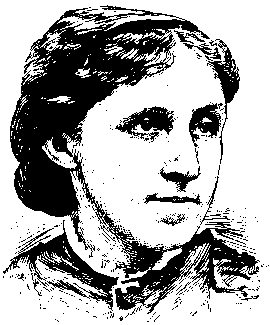
At the time of Louisa Alcott's birth her father had charge of a school in Germantown; but within two years he moved to Boston with his family, and put into practice methods of teaching so far in advance of his time that they were unsuccessful. From 1840, the home of the Alcott family was in Concord, Massachusetts, with the exception of a short time spent in a community on a farm in a neighboring town, and the years from 1848 to 1857 in Boston. At seventeen, Louisa's struggle with life began. She wrote a play, contributed sensational stories to weekly papers, tried teaching, sewing,--even going out to service,--and would have become an actress but for an accident. What she wrote of her mother is as true of herself, "She always did what came to her in the way of duty or charity, and let pride, taste, and comfort suffer for love's sake." Her first book, 'Flower Fables,' a collection of fairy tales which she had written at sixteen for the children of Ralph Waldo Emerson, some other little friends, and her younger sisters, was printed in 1855 and was well received. From this time until 1863 she wrote many stories, but few that she afterward thought worthy of being reprinted. Her best work from 1860 to 1863 is in the Atlantic Monthly, indexed under her name; and the most carefully finished of her few poems, 'Thoreau's Flute,' appeared in that magazine in September, 1863. After six weeks' experience in the winter of 1862-63 as a hospital nurse in Washington, she wrote for the Commonwealth, a Boston weekly paper, a series of letters which soon appeared in book form as 'Hospital Sketches,' Miss Alcott says of them, "The 'Sketches' never made much money, but showed me 'my style.'" In 1864 she published a novel, 'Moods'; and in 1866, after a year abroad as companion to an invalid, she became editor of Merry's Museum, a magazine for children.
Her 'Little Women,' founded on her own family life, was written in 1867-68, in answer to a request from the publishing house of Roberts Brothers for a story for girls, and its success was so great that she soon finished a second part. The two volumes were translated into French, German, and Dutch, and became favorite books in England. While editing Merry's Museum, she had written the first part of 'The Old-Fashioned Girl' as a serial for the magazine. After the success of 'Little Women,' she carried the 'Old-Fashioned Girl' and her friends forward several years, and ended the story with two happy marriages. In 1870 she went abroad a second time, and from her return the next year until her death in Boston from overwork on March 6th, 1888, the day of her father's funeral, she published twenty volumes, including two novels: one anonymous, 'A Modern Mephistopheles,' in the 'No Name' series; the other, 'Work,' largely a record of her own experience. She rewrote 'Moods,' and changed the sad ending of the first version to a more cheerful one; followed the fortunes of her 'Little Women' and their children in 'Little Men' and 'Jo's Boys,' and published ten volumes of short stories, many of them reprinted pieces. She wrote also 'Eight Cousins,' its sequel 'Rose in Bloom,' 'Under the Lilacs,' and 'Jack and Jill,'
The charm of her books lies in their freshness, naturalness, and sympathy with the feelings and pursuits of boys and girls. She says of herself, "I was born with a boy's spirit under my bib and tucker," and she never lost it. Her style is often careless, never elegant, for she wrote hurriedly, and never revised or even read over her manuscript; yet her books are full of humor and pathos, and preach the gospel of work and simple, wholesome living. She has been a help and inspiration to many young girls, who have learned from her Jo in 'Little Women,' or Polly in the 'Old-Fashioned Girl,' or Christie in 'Work,' that a woman can support herself and her family without losing caste or self-respect. Her stories of the comradeship of New England boys and girls in school or play have made her a popular author in countries where even brothers and sisters see little of each other. The haste and lack of care in her books are the result of writing under pressure for money to support the family, to whom she gave the best years of her life. As a little girl once said of her in a school essay, "I like all Miss Alcott's books; but what I like best in them is the author herself."
The reader is referred to 'Louisa May Alcott: Her Life, Letters, and Journals,' edited by Ednah D. Cheney, published in 1889.
THE NIGHT WARD
From 'Hospital Sketches'
Being fond of the night side of nature, I was soon promoted to the post of night nurse, with every facility for indulging in my favorite pastime of "owling." My colleague, a black-eyed widow, relieved me at dawn, we two taking care of the ward between us, like regular nurses, turn and turn about. I usually found my boys in the jolliest state of mind their condition allowed; for it was a known fact that Nurse Periwinkle objected to blue devils, and entertained a belief that he who laughed most was surest of recovery. At the beginning of my reign, dumps and dismals prevailed; the nurses looked anxious and tired, the men gloomy or sad; and a general "Hark-from-the-tombs-a-doleful-sound" style of conversation seemed to be the fashion: a state of things which caused one coming from a merry, social New England town, to feel as if she had got into an exhausted receiver; and the instinct of self-preservation, to say nothing of a philanthropic desire to serve the race, caused a speedy change in Ward No. 1.
More flattering than the most gracefully turned compliment, more grateful than the most admiring glance, was the sight of those rows of faces, all strange to me a little while ago, now lighting up with smiles of welcome as I came among them, enjoying that moment heartily, with a womanly pride in their regard, a motherly affection for them all. The evenings were spent in reading aloud, writing letters, waiting on and amusing the men, going the rounds with Dr. P---- as he made his second daily survey, dressing my dozen wounds afresh, giving last doses, and making them cozy for the long hours to come, till the nine o'clock bell rang, the gas was turned down, the day nurses went off duty, the night watch came on, and my nocturnal adventures began.
My ward was now divided into three rooms; and under favor of the matron, I had managed to sort out the patients in such a way that I had what I called my "duty room," my "pleasure room," and my "pathetic room," and worked for each in a different way. One I visited armed with a dressing-tray full of rollers, plasters, and pins; another, with books, flowers, games, and gossip; a third, with teapots, lullabies, consolation, and sometimes a shroud.
Wherever the sickest or most helpless man chanced to be, there I held my watch, often visiting the other rooms to see that the general watchman of the ward did his duty by the fires and the wounds, the latter needing constant wetting. Not only on this account did I meander, but also to get fresher air than the close rooms afforded; for owing to the stupidity of that mysterious "somebody" who does all the damage in the world, the windows had been carefully nailed down above, and the lower sashes could only be raised in the mildest weather, for the men lay just below. I had suggested a summary smashing of a few panes here and there, when frequent appeals to headquarters had proved unavailing and daily orders to lazy attendants had come to nothing. No one seconded the motion, however, and the nails were far beyond my reach; for though belonging to the sisterhood of "ministering angels," I had no wings, and might as well have asked for a suspension bridge as a pair of steps in that charitable chaos.
One of the harmless ghosts who bore me company during the haunted hours was Dan, the watchman, whom I regarded with a certain awe; for though so much together, I never fairly saw his face, and but for his legs should never have recognized him, as we seldom met by day. These legs were remarkable, as was his whole figure: for his body was short, rotund, and done up in a big jacket and muffler; his beard hid the lower part of his face, his hat-brim the upper, and all I ever discovered was a pair of sleepy eyes and a very mild voice. But the legs!--very long, very thin, very crooked and feeble, looking like gray sausages in their tight coverings, and finished off with a pair of expansive green cloth shoes, very like Chinese junks with the sails down. This figure, gliding noiselessly about the dimly lighted rooms, was strongly suggestive of the spirit of a beer-barrel mounted on corkscrews, haunting the old hotel in search of its lost mates, emptied and staved in long ago.
Another goblin who frequently appeared to me was the attendant of "the pathetic room," who, being a faithful soul, was often up to tend two or three men, weak and wandering as babies, after the fever had gone. The amiable creature beguiled the watches of the night by brewing jorums of a fearful beverage which he called coffee, and insisted on sharing with me; coming in with a great bowl of something like mud soup, scalding hot, guiltless of cream, rich in an all-pervading flavor of molasses, scorch, and tin pot.
Even my constitutionals in the chilly halls possessed a certain charm, for the house was never still. Sentinels tramped round it all night long, their muskets glittering in the wintry moonlight as they walked, or stood before the doors straight and silent as figures of stone, causing one to conjure up romantic visions of guarded forts, sudden surprises, and daring deeds; for in these war times the humdrum life of Yankeedom has vanished, and the most prosaic feel some thrill of that excitement which stirs the Nation's heart, and makes its capital a camp of hospitals. Wandering up and down these lower halls I often heard cries from above, steps hurrying to and fro, saw surgeons passing up, or men coming down carrying a stretcher, where lay a long white figure whose face was shrouded, and whose fight was done. Sometimes I stopped to watch the passers in the street, the moonlight shining on the spire opposite, or the gleam of some vessel floating, like a white-winged sea-gull, down the broad Potomac, whose fullest flow can never wash away the red stain of the land.
AMY'S VALLEY OF HUMILIATION
From 'Little Women'
"That boy is a perfect Cyclops, isn't he?" said Amy one day, as Laurie clattered by on horseback, with a flourish of his whip as he passed.
"How dare you say so, when he's got both his eyes? and very handsome ones they are, too," cried Jo, who resented any slighting remarks about her friend.
"I didn't say anything about his eyes; and I don't see why you need fire up when I admire his riding."
"Oh, my goodness! that little goose means a centaur, and she called him a Cyclops," exclaimed Jo, with a burst of laughter.
"You needn't be so rude; it's only a 'lapse of lingy,' as Mr. Davis says," retorted Amy, finishing Jo with her Latin. "I just wish I had a little of the money Laurie spends on that horse," she added, as if to herself, yet hoping her sisters would hear.
"Why?" asked Meg, kindly, for Jo had gone off in another laugh at Amy's second blunder.
"I need it so much: I'm dreadfully in debt, and it won't be my turn to have the rag-money for a month."
"In debt, Amy: what do you mean?" and Meg looked sober.
"Why, I owe at least a dozen pickled limes; and I can't pay them, you know, till I have money, for Marmee forbids my having anything charged at the shop."
"Tell me all about it. Are limes the fashion now? It used to be pricking bits of rubber to make balls;" and Meg tried to keep her countenance, Amy looked so grave and important.
"Why, you see, the girls are always buying them, and unless you want to be thought mean, you must do it too. It's nothing but limes now, for every one is sucking them in their desks in school-time, and trading them off for pencils, bead-rings, paper dolls, or something else, at recess. If one girl likes another, she gives her a lime; if she's mad with her, she eats one before her face, and don't offer even a suck. They treat by turns; and I've had ever so many, but haven't returned them, and I ought, for they are debts of honor, you know."
"How much will pay them off, and restore your credit?" asked Meg, taking out her purse.
"A quarter would more than do it, and leave a few cents over for a treat for you. Don't you like limes?"
"Not much; you may have my share. Here's the money: make it last as long as you can, for it isn't very plenty, you know."
"Oh, thank you! it must be so nice to have pocket-money. I'll have a grand feast, for I haven't tasted a lime this week. I felt delicate about taking any, as I couldn't return them, and I'm actually suffering for one."
Next day Amy was rather late at school; but could not resist the temptation of displaying, with pardonable pride, a moist brown-paper parcel before she consigned it to the inmost recesses of her desk. During the next few minutes the rumor that Amy March had got twenty-four delicious limes (she ate one on the way), and was going to treat, circulated through her "set" and the attentions of her friends became quite overwhelming. Katy Brown invited her to her next party on the spot; Mary Kingsley insisted on lending her her watch till recess; and Jenny Snow, a satirical young lady who had basely twitted Amy upon her limeless state, promptly buried the hatchet, and offered to furnish answers to certain appalling sums. But Amy had not forgotten Miss Snow's cutting remarks about "some persons whose noses were not too flat to smell other people's limes, and stuck-up people who were not too proud to ask for them"; and she instantly crushed "that Snow girl's" hopes by the withering telegram, "You needn't be so polite all of a sudden, for you won't get any."
A distinguished personage happened to visit the school that morning, and Amy's beautifully drawn maps received praise; which honor to her foe rankled in the soul of Miss Snow, and caused Miss March to assume the airs of a studious young peacock. But, alas, alas! pride goes before a fall, and the revengeful Snow turned the tables with disastrous success. No sooner had the guest paid the usual stale compliments, and bowed himself out, than Jenny, under pretence of asking an important question, informed Mr. Davis, the teacher, that Amy March had pickled limes in her desk.
Now, Mr. Davis had declared limes a contraband article, and solemnly vowed to publicly ferule the first person who was found breaking the law. This much-enduring man had succeeded in banishing gum after a long and stormy war, had made a bonfire of the confiscated novels and newspapers, had suppressed a private post-office, had forbidden distortions of the face, nicknames, and caricatures, and done all that one man could do to keep half a hundred rebellious girls in order. Boys are trying enough to human patience, goodness knows! but girls are infinitely more so, especially to nervous gentlemen with tyrannical tempers, and no more talent for teaching than "Dr. Blimber." Mr. Davis knew any quantity of Greek, Latin, algebra, and ologies of all sorts, so he was called a fine teacher; and manners, morals, feelings, and examples were not considered of any particular importance. It was a most unfortunate moment for denouncing Amy, and Jenny knew it. Mr. Davis had evidently taken his coffee too strong that morning; there was an east wind, which always affected his neuralgia, and his pupils had not done him the credit which he felt he deserved; therefore, to use the expressive if not elegant language of a school-girl, "he was as nervous as a witch, and as cross as a bear." The word "limes" was like fire to powder: his yellow face flushed, and he rapped on his desk with an energy which made Jenny skip to her seat with unusual rapidity.
"Young ladies, attention, if you please!"
At the stern order the buzz ceased, and fifty pairs of blue, black, gray, and brown eyes were obediently fixed upon his awful countenance.
"Miss March, come to the desk."
Amy rose to comply with outward composure; but a secret fear oppressed her, for the limes weighed upon her conscience.
"Bring with you the limes you have in your desk," was the unexpected command which arrested her before she got out of her seat.
"Don't take all," whispered her neighbor, a young lady of great presence of mind.
Amy hastily shook out half a dozen, and laid the rest down before Mr. Davis, feeling that any man possessing a human heart would relent when that delicious perfume met his nose. Unfortunately, Mr. Davis particularly detested the odor of the fashionable pickle, and disgust added to his wrath.
"Is that all?"
"Not quite," stammered Amy.
"Bring the rest, immediately."
With a despairing glance at her set she obeyed.
"You are sure there are no more?"
"I never lie, sir."
"So I see. Now take these disgusting things, two by two, and throw them out of the window."
There was a simultaneous sigh, which created quite a little gust as the last hope fled, and the treat was ravished from their longing lips. Scarlet with shame and anger, Amy went to and fro twelve mortal times; and as each doomed couple, looking, oh, so plump and juicy! fell from her reluctant hands, a shout from the street completed the anguish of the girls, for it told them that their feast was being exulted over by the little Irish children, who were their sworn foes. This--this was too much; all flashed indignant or appealing glances at the inexorable Davis, and one passionate lime-lover burst into tears.
As Amy returned from her last trip, Mr. Davis gave a portentous "hem," and said, in his most impressive manner:--
"Young ladies, you remember what I said to you a week ago. I am sorry this has happened; but I never allow my rules to be infringed, and I never break my word. Miss March, hold out your hand."
Amy started, and put both hands behind her, turning on him an imploring look, which pleaded for her better than the words she could not utter. She was rather a favorite with "old Davis," as of course he was called, and it's my private belief that he would have broken his word if the indignation of one irrepressible young lady had not found vent in a hiss. That hiss, faint as it was, irritated the irascible gentleman, and sealed the culprit's fate.
"Your hand, Miss March!" was the only answer her mute appeal received; and, too proud to cry or beseech, Amy set her teeth, threw back her head defiantly, and bore without flinching several tingling blows on her little palm. They were neither many nor heavy, but that made no difference to her. For the first time in her life she had been struck; and the disgrace, in her eyes, was as deep as if he had knocked her down.
"You will now stand on the platform till recess," said Mr. Davis, resolved to do the thing thoroughly, since he had begun.
That was dreadful. It would have been bad enough to go to her seat and see the pitying faces of her friends, or the satisfied ones of her few enemies; but to face the whole school with that shame fresh upon her seemed impossible, and for a second she felt as if she could only drop down where she stood, and break her heart with crying. A bitter sense of wrong, and the thought of Jenny Snow, helped her to bear it; and taking the ignominious place, she fixed her eyes on the stove-funnel above what now seemed a sea of faces, and stood there so motionless and white, that the girls found it very hard to study, with that pathetic little figure before them.
During the fifteen minutes that followed, the proud and sensitive little girl suffered a shame and pain which she never forgot. To others it might seem a ludicrous or trivial affair, but to her it was a hard experience; for during the twelve years of her life she had been governed by love alone, and a blow of that sort had never touched her before. The smart of her hand, and the ache of her heart, were forgotten in the sting of the thought,--"I shall have to tell at home, and they will be so disappointed in me!"
The fifteen minutes seemed an hour; but they came to an end at last, and the word "Recess!" had never seemed so welcome to her before.
"You can go, Miss March," said Mr. Davis, looking, as he felt, uncomfortable.
He did not soon forget the reproachful look Amy gave him, as she went, without a word to any one, straight into the ante-room, snatched her things, and left the place "forever," as she passionately declared to herself. She was in a sad state when she got home; and when the older girls arrived, some time later, an indignation meeting was held at once. Mrs. March did not say much, but looked disturbed, and comforted her afflicted little daughter in her tenderest manner. Meg bathed the insulted hand with glycerine, and tears; Beth felt that even her beloved kittens would fail as a balm for griefs like this, and Jo wrathfully proposed that Mr. Davis be arrested without delay; while Hannah shook her fist at the "villain," and pounded potatoes for dinner as if she had him under her pestle.
No notice was taken of Amy's flight, except by her mates; but the sharp-eyed demoiselles discovered that Mr. Davis was quite benignant in the afternoon, and also unusually nervous. Just before school closed Jo appeared, wearing a grim expression as she stalked up to the desk and delivered a letter from her mother; then collected Amy's property and departed, carefully scraping the mud from her boots on the door-mat, as if she shook the dust of the place off her feet.
"Yes, you can have a vacation from school, but I want you to study a little every day with Beth," said Mrs. March that evening. "I don't approve of corporal punishment, especially for girls. I dislike Mr. Davis's manner of teaching, and don't think the girls you associate with are doing you any good, so I shall ask your father's advice before I send you anywhere else."
"That's good! I wish all the girls would leave, and spoil his old school. It's perfectly maddening to think of those lovely limes," sighed Amy with the air of a martyr.
"I am not sorry you lost them, for you broke the rules, and deserved some punishment for disobedience," was the severe reply, which rather disappointed the young lady, who expected nothing but sympathy.
"Do you mean you are glad I was disgraced before the whole school?" cried Amy.
"I should not have chosen that way of mending a fault," replied her mother; "but I'm not sure that it won't do you more good than a milder method. You are getting to be altogether too conceited and important, my dear, and it is about time you set about correcting it. You have a good many little gifts and virtues, but there is no need of parading them, for conceit spoils the finest genius. There is not much danger that real talent or goodness will be overlooked long; even if it is, the consciousness of possessing and using it well should satisfy one, and the great charm of all power is modesty."
"So it is," cried Laurie, who was playing chess in a corner with Jo. "I knew a girl once who had a really remarkable talent for music, and she didn't know it; never guessed what sweet little things she composed when she was alone, and wouldn't have believed it if any one had told her."
"I wish I'd known that nice girl; maybe she would have helped me, I'm so stupid," said Beth, who stood beside him listening eagerly.
"You do know her, and she helps you better than any one else could," answered Laurie, looking at her with such mischievous meaning in his merry eyes, that Beth suddenly turned very red, and hid her face in the sofa-cushion, quite overcome by such an unexpected discovery.
Jo let Laurie win the game, to pay for that praise of her Beth, who could not be prevailed upon to play for them after her compliment. So Laurie did his best and sung delightfully, being in a particularly lively humor, for to the Marches he seldom showed the moody side of his character. When he was gone, Amy, who had been pensive all the evening, said suddenly, as if busy over some new idea:--
"Is Laurie an accomplished boy?"
"Yes; he has had an excellent education, and has much talent; he will make a fine man, if not spoilt by petting," replied her mother.
"And he isn't conceited, is he?" asked Amy.
"Not in the least; that is why he is so charming, and we all like him so much."
"I see: it's nice to have accomplishments, and be elegant, but not to show off, or get perked up," said Amy thoughtfully.
"These things are always seen and felt in a person's manner and conversation, if modestly used; but it is not necessary to display them," said Mrs. March.
"Any more than it's proper to wear all your bonnets, and gowns and ribbons, at once, that folks may know you've got 'em," added Jo; and the lecture ended in a laugh.
THOREAU'S FLUTE From the Atlantic Monthly, September, 1863 We, sighing, said, "Our Pan is dead; His pipe hangs mute beside the river; Around it wistful sunbeams quiver, But Music's airy voice is fled. Spring mourns as for untimely frost; The bluebird chants a requiem; The willow-blossom waits for him;-- The Genius of the wood is lost." Then from the flute, untouched by hands, There came a low, harmonious breath: "For such as he there is no death; His life the eternal life commands; Above man's aims his nature rose: The wisdom of a just content Made one small spot a continent, And turned to poetry Life's prose. "Haunting the hills, the stream, the wild, Swallow and aster, lake and pine, To him grew human or divine,-- Fit mates for this large-hearted child. Such homage Nature ne'er forgets, And yearly on the coverlid 'Neath which her darling lieth hid Will write his name in violets. "To him no vain regrets belong, Whose soul, that finer instrument, Gave to the world no poor lament, But wood-notes ever sweet and strong. O lonely friend! he still will be A potent presence, though unseen,-- Steadfast, sagacious, and serene: Seek not for him,--he is with thee."
A SONG FROM THE SUDS From 'Little Women' Queen of my tub, I merrily sing, While the white foam rises high; And sturdily wash, and rinse, and wring, And fasten the clothes to dry; Then out in the free fresh air they swing, Under the sunny sky. I wish we could wash from our hearts and souls The stains of the week away, And let water and air by their magic make Ourselves as pure as they; Then on the earth there would be indeed A glorious washing-day! Along the path of a useful life, Will heart's-ease ever bloom; The busy mind has no time to think Of sorrow, or care, or gloom; And anxious thoughts may be swept away, As we busily wield a broom. I am glad a task to me is given, To labor at day by day; For it brings me health, and strength, and hope, And I cheerfully learn to say,-- "Head you may think, Heart you may feel, But Hand you shall work alway!"
Selections used by permission of Roberts Brothers, Publishers, and John S.P. Alcott.