Volume 1 — AESCHINES
Reading edition
(389-314 B.C.)

he life and oratory of Aeschines fall fittingly into that period of Greek history when the free spirit of the people which had created the arts of Pindar and Sophocles, Pericles, Phidias, and Plato, was becoming the spirit of slaves and of savants, who sought to forget the freedom of their fathers in learning, luxury, and the formalism of deducers of rules. To this slavery Aeschines himself contributed, both in action with Philip of Macedon and in speech. Philip had entered upon a career of conquest; a policy legitimate in itself and beneficial as judged by its larger fruits, but ruinous to the advanced civilization existing in the Greek City-States below, whose high culture was practically confiscated to spread out over a waste of semi-barbarism and mix with alien cultures. Among his Greek sympathizers, Aeschines was perhaps his chief support in the conquest of the Greek world that lay to the south within his reach.
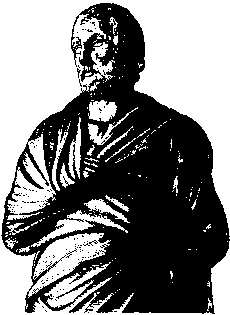
Aeschines was born in 389 B.C., six years before his lifelong rival Demosthenes. If we may trust that rival's elaborate details of his early life, his father taught a primary school and his mother was overseer of certain initiatory rites, to both of which occupations Aeschines gave his youthful hand and assistance. He became in time a third-rate actor, and the duties of clerk or scribe presently made him familiar with the executive and legislative affairs of Athens. Both vocations served as an apprenticeship to the public speaking toward which his ambition was turning. We hear of his serving as a heavy-armed soldier in various Athenian expeditions, and of his being privileged to carry to Athens, in 349 B.C., the first news of the victory of Tamynae, in Euboea, in reward for the bravery he had shown in the battle.
Two years afterward he was sent as an envoy into the Peloponnesus, with the object of forming a union of the Greeks against Philip for the defense of their liberties. But his mission was unsuccessful. Toward the end of the same year he served as one of the ten ambassadors sent to Philip to discuss terms of peace. The harangues of the Athenians at this meeting were followed in turn by a speech of Philip, whose openness of manner, pertinent arguments, and pretended desire for a settlement led to a second embassy, empowered to receive from him the oath of allegiance and peace. It was during this second embassy that Demothenes says he discovered the philippizing spirit and foul play of Aeschines. Upon their return to Athens, Aeschines rose before the assembly to assure the people that Philip had come to Thermopylae as the friend and ally of Athens. "We, your envoys, have satisfied him," said Aeschines. "You will hear of benefits still more direct which we have determined Philip to confer upon you, but which it would not be prudent as yet to specify."
But the alarm of the Athenians at the presence of Philip within the gates was not allayed. The king, however, anxious to temporize with them until he could receive his army supplies by sea, suborned Aeschines, who assured his countrymen of Philip's peaceful intentions. On another occasion, by an inflammatory speech at Delphi, he so played upon the susceptibilities of the rude Amphictyones that they rushed forth, uprooted their neighbors' harvest fields, and began a devastating war of Greek against Greek. Internal dissensions promised the shrewd Macedonian the conquest he sought. At length, in August, 338, came Philip's victory at Chaeronea, and the complete prostration of Greek power. Aeschines, who had hitherto disclaimed all connection with Philip, now boasted of his intimacy with the king. As Philip's friend, while yet an Athenian, he offered himself as ambassador to entreat leniency from the victor toward the unhappy citizens.
The memorable defense of Demosthenes against the attack of Aeschines was delivered in 330 B.C. Seven years before this, Ctesiphon had proposed to the Senate that the patriotic devotion and labors of Demosthenes should be acknowledged by the gift of a golden crown--a recognition willingly accorded. But as this decision, to be legal, must be confirmed by the Assembly, Aeschines gave notice that he would proceed against Ctesiphon for proposing an unconstitutional measure. He managed to postpone action on the notice for six years. At last he seized a moment when the victories of Philip's son and successor, Alexander, were swaying popular feeling, to deliver a bitter harangue against the whole life and policy of his political opponent. Demosthenes answered in that magnificent oration called by the Latin writers 'De Corona' Aeschines was not upheld by the people's vote. He retired to Asia, and, it is said, opened a school of rhetoric at Rhodes. There is a legend that after he had one day delivered in his school the masterpiece of his enemy, his students broke into applause: "What," he exclaimed, "if you had heard the wild beast thunder it out himself!"
Aeschines was what we call nowadays a self-made man. The great faults of his life, his philippizing policy and his confessed corruption, arose, doubtless, from the results of youthful poverty: a covetousness growing out of want, and a lack of principles of conduct which a broader education would have instilled. As an orator he was second only to Demosthenes; and while he may at times be compared to his rival in intellectual force and persuasiveness, his moral defects--which it must be remembered that he himself acknowledged--make a comparison of character impossible.
His chief works remaining to us are the speeches 'Against Timarchus,' 'On the Embassy,' 'Against Ctesiphon,' and letters, which are included in the edition of G.E. Benseler (1855-60). In his 'History of Greece,' Grote discusses at length--of course adversely--the influence of Aeschines; especially controverting Mitford's favorable view and his denunciation of Demosthenes and the patriotic party. The trend of recent writing is toward Mitford's estimate of Philip's policy, and therefore less blame for the Greek statesmen who supported it, though without Mitford's virulence toward its opponents. Mahaffy ('Greek Life and Thought') holds the whole contest over the crown to be mere academic threshing of old straw, the fundamental issues being obsolete by the rise of a new world under Alexander.
A DEFENSE AND AN ATTACK
From the 'Oration against Ctesiphon'
In regard to the calumnies with which I am attacked, I wish to say a word or two before Demosthenes speaks. He will allege, I am told, that the State has received distinguished services from him, while from me it has suffered injury on many occasions; and that the deeds of Philip and Alexander, and the crimes to which they gave rise, are to be imputed to me. Demosthenes is so clever in the art of speaking that he does not bring accusation against me, against any point in my conduct of affairs or any counsels I may have brought to our public meetings; but he rather casts reflections upon my private life, and charges me with a criminal silence.
Moreover, in order that no circumstance may escape his calumny, he attacks my habits of life when I was in school with my young companions; and even in the introduction of his speech he will say that I have begun this prosecution, not for the benefit of the State, but because I want to make a show of myself to Alexander and gratify Alexander's resentment against him. He purposes, as I learn, to ask why I blame his administration as a whole, and yet never hindered or indicted any one separate act; why, after a considerable interval of attention to public affairs, I now return to prosecute this action....
But what I am now about to notice--a matter which I hear Demosthenes will speak of--about this, by the Olympian deities, I cannot but feel a righteous indignation. He will liken my speech to the Sirens', it seems, and the legend anent their art is that those who listen to them are not charmed, but destroyed; wherefore the music of the Sirens is not in good repute. Even so he will aver that knowledge of my words and myself is a source of injury to those who listen to me. I, for my part, think it becomes no one to urge such allegations against me; for it is a shame if one who makes charges cannot point to facts as full evidence. And if such charges must be made, the making surely does not become Demosthenes, but rather some military man--some man of action--who has done good work for the State, and who, in his untried speech, vies with the skill of antagonists because he is conscious that he can tell no one of his deeds, and because he sees his accusers able to show his audience that he had done what in fact he never had done. But when a man made up entirely of words,--of sharp words and overwrought sentences,--when he takes refuge in simplicity and plain facts, who then can endure it?--whose tongue is like a flute, inasmuch as if you take it away the rest is nothing....
This man thinks himself worthy of a crown--that his honor should be proclaimed. But should you not rather send into exile this common pest of the Greeks? Or will you not seize upon him as a thief, and avenge yourself upon him whose mouthings have enabled him to bear full sail through our commonwealth? Remember the season in which you cast your vote. In a few days the Pythian Games will come round, and the convention of the Hellenic States will hold its sessions. Our State has been concerned on account of the measures of Demosthenes regarding present crises. You will appear, if you crown him, accessory to those who broke the general peace. But if, on the other hand, you refuse the crown, you will free the State from blame. Do not take counsel as if it were for an alien, but as if it concerned, as it does, the private interest of your city; and do not dispense your honors carelessly, but with judgment; and let your public gifts be the distinctive possession of men most worthy. Not only hear, but also look around you and consider who are the men who support Demosthenes. Are they his fellow-hunters, or his associates in old athletic sports? No, by Olympian Zeus, he was never engaged in hunting the wild boar, nor in care for the well-being of his body; but he was toiling at the art of those who keep up possessions.
Take into consideration also his art of juggling, when he says that by his embassy he wrested Byzantium from the hands of Philip, and that his eloquence led the Acarnanians to revolt, and struck dumb the Thebans. He thinks, forsooth, that you have fallen to such a degree of weakness that he can persuade you that you have been entertaining Persuasion herself in your city, and not a vile slanderer. And when at the conclusion of his argument he calls upon his partners in bribe-taking, then fancy that you see upon these steps, from which I now address you, the benefactors of your State arrayed against the insolence of those men. Solon, who adorned our commonwealth with most noble laws, a man who loved wisdom, a worthy legislator, asking you in dignified and sober manner, as became his character, not to follow the pleading of Demosthenes rather than your oaths and laws. Aristides, who assigned to the Greeks their tributes, to whose daughters after he had died the people gave portions--imagine Aristides complaining bitterly at the insult to public justice, and asking if you are not ashamed that when your fathers banished Arthurias the Zelian, who brought gold from the Medes (although while he was sojourning in the city and a guest of the people of Athens they were scarce restrained from killing him, and by proclamation forbade him the city and any dominion the Athenians had power over), nevertheless that you are going to crown Demosthenes, who did not indeed bring gold from the Medes, but who received bribes and has them still in his possession. And Themistocles and those who died at Marathon and at Plataea, and the very graves of your ancestors--will they not cry out if you venture to grant a crown to one who confesses that he united with the barbarians against the Greeks?
And now, O earth and sun! virtue and intelligence! and thou, O genius of the humanities, who teachest us to judge between the noble and the ignoble, I have come to your succor and I have done. If I have made my pleading with dignity and worthily, as I looked to the flagrant wrong which called it forth, I have spoken as I wished. If I have done ill, it was as I was able. Do you weigh well my words and all that is left unsaid, and vote in accordance with justice and the interests of the city!