THE HEBREW TRADITION. (continued 2)
Joanna B. Horner translation
But the question is, how we can reconcile the remarkable displacement of events with the true numbers? Ideler has shown that we must refer the first establishment of the era of the world, and consequently the foundation of the whole chronological system that we are considering, to the author of the Moleds, or new moons, and particularly of the late Jewish calendars, therefore to the Rabbi Hillel, in the first half of the fourth century. In the time of Eusebius, and Theon of Alexandria, people could not possibly be so completely ignorant of the history of the last centuries before Christ, as the rabbinical chronology supposed. It was least to be believed of such a learned mathematician, astronomer, and chronologist, as we imagine the reformer of the Jewish calendar to have been, who founded it upon the nineteenth-yeared cycle of Meton and Calippus[317].
It appears to me, therefore, that the following acceptation is alone possible, which I would at least recommend to the closer examination of well-versed labourers in Jewish antiquities. The Talmud contains very few chronological dates, and nothing justifies us in the belief that the learned Hillel had already given a chronological view of the events, as we afterwards find them. But he must have necessarily had some resting points for his technical chronological works, if he desired to connect his present with the past, and even with the Creation. It could not have been difficult to find these resting points at that time, so soon after Africanus; the best authorities were still open to him. But the Exodus from Egypt must have been his most important point, for previous to that event the numbers in the Pentateuch were clear, and without mistakes. It was only necessary for him to decide between the two different views concerning the period between Jacob and Moses. The numbers after the Exodus were much more uncertain, as the calculations of Josephus have already proved. On the other hand, the well-known era of the Seleucidæ, which was at that time still in use, naturally formed another fixed point which he could not avoid. Under these circumstances, every clever and mathematically educated chronologist, would be compelled to connect the date of the Exodus with the only certain and astronomically verified Egyptian chronology. If the era of King Menephthes, and the exact year of its commencement was familiar to the mathematician, Theon of Alexandria, who lived at a later period, must it not have been equally well known to the astronomer Hillel? But nothing more was necessary to determine the date of the Exodus, which took place under the same King Menephthes[318].
We should not therefore be surprised to see, even at that time, the perfectly correct acceptation of the year 2448 for the Exodus. It was, at all events, impossible to determine the year of the Creation without having obtained the two periods of the Seleucidic Era, and of the Exodus.
On the other hand, it is very improbable that Hillel set to work as Ideler[319] imagines he did. He says “that Hillel evidently started from the beginning of the Seleucidic Era, which was at that time still universally employed by the Jews, the autumn of the year B.C. 312. Reckoning from this point backwards, he made the next epoch the destruction of the first Temple, and placed it only 112 years earlier than the Seleucidic Era, counting about 150 years too little, so that he advanced Nebuchadnezzar to the times of Artaxerxes I. Whilst he thus went back still farther to the building of the first Temple, to the Exodus of the Israelites out of Egypt, to the Flood, and to the Creation, following partly the express statements of time in the Bible, partly his own explanation of it, he found the beginning of the year, 3450 of the world, to be the epoch of the Minjan schtaroth.” As we said before, it was perfectly impossible for a scholar of the fourth century to make such a gross mistake of nearly 160 years at that late period. But it is easily explained, if we believe that after the great gap in Jewish literature, which commenced at the conclusion of the Talmud, about the year 500, and which lasted to the eighth century, the Rabbis had adopted those few correct chronological periods fixed by Hillel, and now first undertook to fill up their history of the world, which comprised 5000 years, according to the statements of the Old Testament. In fact, we find neither in the Talmud, nor even in the first writings of the rabbis, which succeed the Talmud, e. g. in the Seder Olam Rabah, one of the oldest of those writings, the full chronological details, some extracts of which we have seen above. It appears to have been first completed in the twelfth century, therefore in the period of a scientific barbarism, which had been long introduced. It was only necessary to follow the numbers of the Pentateuch from the Creation to the Flood, and to the Exodus, in order to obtain the given year 2448 = 1314. The convenient number 480 years, down to the building of the Temple, in the first Book of Kings, was afterwards immediately adopted, and the chronology of the times of the Judges adapted to it. But hereby the historical event next following was at the same time displaced to about the 160-170 years we have mentioned, and drew with it the displacement of all the succeeding events. It first became apparent at the next fixed point, about the year 3450 = 312, that the chain of events was far too long for the stated interval, from the building of the first to the second Temple. Therefore, the period from the erection of the second Temple, built under Darius Hystaspes, to the time of Alexander, to which was given the name of the Grecian Era[320], was cut down without ceremony from 184 years into 34 years. This raised no obstacle at first, but afterwards occasioned many difficulties, until these also were got rid of by the simple expedient of taking Darius II. and III for one and the same person. Only thus can we explain the peculiar phenomena of an entirely displaced and afterwards mutilated chronology, in which, however, there appears two fixed points alone correct, and which afford us at the same time the important, and probably the most exact, determination of the Exodus by a truly learned chronologist of the fourth century[321].
Viewing it, therefore, from this side, we return to the opinion, that the great stumbling-block to the whole of the chronology hitherto adopted for the Old Testament was the number 480 years, which was calculated as the period between the Exodus and the building of the Temple mentioned in the first Book of Kings[322]. As soon as we set this aside, regarding it only as a supplementary multiple of twelve generations, or segments of 40 years each, the Hebrew and Egyptian chronologies are no longer opposed to each other with reference to the time of the Exodus. All the other intimations we meet with in the Hebrew accounts, and their whole connection, demand, on the contrary, precisely the same time, which we find unequivocally stated in the Egyptian annals of Manetho.
The question now is, whether along with this number 480, to which we can attribute no greater importance than to the simple number forty, so often repeated in the history of Israel at that period, we must also give up as valueless every other chronological measure of the events immediately succeeding the Exodus. But this is so little the case, that, on the contrary, in the true chronological scale which the Mosaic writings furnish, we find a fresh refutation of the opinions hitherto adopted, and a confirmation of the Egyptian statements. We look upon the Register of Generations as this scale.
I am not aware whether these numerous family records have ever been fully placed under one point of view, and estimated as a whole in their great chronological significance, in the same way as they have certainly frequently been used for separate purposes and divisions of time. Such a survey would very much increase the importance of the separate lists, and facilitate their application to chronological determinations.
It is well known how in the East at all times, and even to this day, the register of generations and genealogies is orally transmitted, with a wonderful fidelity and completeness, through the memories of perfectly illiterate and frequently even now nomadic races. The Arabian races are especially noted for this, and their historical recollections are often almost entirely limited to this dry register. I have met with many such pedigrees in the upper districts of the Nile, south of the province of Dongola, among the Arabs who immigrated there from the west, these being the only written remains of their past, which inform us of their immigration and distribution in those districts. But these lists of names are still more to be depended upon among those nations of antiquity, who, like the Egyptians and the Hebrews, were a literary people, and were accustomed to preserve in writing these sacred bequests of individual families. On the rock of the Kosser-road, in the eastern desert of Egypt, I found a hieroglyphical inscription belonging to the time shortly before the first Persian dominion, in which a chief architect of the country, named Ranumhet, carries back his direct ancestors as far as the twenty-fourth generation, to an ancestral mother Nofratmu, who, according to a rough calculation, must have lived about the end of the 19th Dynasty, therefore about the time of Moses.
But the Israelites particularly, above all the nations of antiquity, appear to have laid the greatest stress upon the register of generations, lists of names, and general enumerations of tribes and generations. The writings of the Old Testament are full of them, especially all the historical books; and the care and exactitude which was expended upon the general preparation of these lists, is evident to the reader. The peculiar destiny of the Israelitish people, firmly bound together, always separating themselves most rigorously from strangers, yet frequently transplanted in masses from one country to another, and settled amidst other nations, enables us perfectly to comprehend this universal attention to an authentic register of generations. We find it stated that they were already twice numbered[323] in the desert; for which purpose the whole people were collected together, and were entered in the registers of the births “by their generations, after their families, according to the number of the names, from twenty years and upwards, and by their polls.” On their return from exile it is particularly observed that some of the wanderers could not trace their genealogy[324]. Among these were several priests’ families, of whom it is said, “These sought the register of their generations, but it was not found, and, therefore, they were rejected from the priesthood[325].” It follows from this that the priests of the tribe of Levi were obliged by law to preserve and continue the register of their generations. This law must naturally only have existed since the Exodus, and, therefore, when Josephus[326] asserts that the High priests possessed written registers of their generations, as far back as 2000 years, this is, indeed, connected with his opinion about the early epoch of the Exodus; it shows, however, that they were brought down to his time, which is, indeed, also confirmed by the register of the generations of Jesus Christ[327].
We need no further justification, therefore, for placing great value upon the successive generations, and for discovering in them the true chronological thread for those times during which more exact reliable statements are wanting. We fortunately possess a whole array of genealogies for the period between the Exodus and the building of the Temple; and, indeed, principally generations of priests, which go back as far as Levi, and are, therefore, from the reasons we have stated above, the most to be depended upon. Altogether, five different generations of the Levites may be distinguished; some obscurities have crept into our text, which probably happened at the time it assumed its present form, since they are found also in the Septuagint; it seems, however, that they may easily be removed[328].
The following is a survey of the principal genealogies, in which the Levitical generations preserve the order in which they are cited, 1 Chron. vii.[329] This is preceded by the genealogical succession, according to Josephus, from Levi to Zadok, and by his series of High priests from Aaron to Zadok. Lastly, there follows a table of the generations of Judah. On the other hand, we have excluded other genealogies; e. g. the three of Ephraim; Num. xxvi. 35; 1 Chron. vii. 20, 21, 24-27[330]; because they are evidently confused, and lead to no result[331].
THE GENERATIONS OF THE JEWS FROM ABRAHAM TO DAVID.
The Heads of the People from Abraham to David. The Succession of the High Priests to Zadok, according to Josephus, A. J. 5, 11, 5. The Ancestors of Zadok, according to Josephus, A. J. 8, 1, 3.
1. Abraham 100 or 30
2. Isaac 100 30
200
3. Jacob 100 30
90
1. Levi 100 30 1. Λευί.
2. Kohath 100 30 2. Κάαθος.
3. Amram 100 30 3. Ἀμαράμης.
400 90
1. Moses 40 1. Ἀαρών 30 1. Ἀαρών 30
2. Joshua 40 2. Ἐλεαζάρης 30 2. Ἐλεαζάρης 30
3. Othniel 40 3. Φινεέσης 30 3. Φινεέσης 30
4. Ehud 40 4. Ἀβιεζέρης 30 4. Ἰώσηπος 30
5. Shamgar 40 5. Βουκί 30 5. Βοκκίας 30
6. Barak 40 6. Ὅζις 30 6. Ἰώθαμος 30
7. Gideon 40 7. Ἠλεί 30 7. Μαραίωθος 30
8. Jephthah 40 8. (Φινεέσης) 30 8. Ἀροφαῖος 30
9. Samson 40 9. Ἰοχάβης 30 9. Ἀχίτωβος 30
10. Eli 40 10. Ἀχιμέλεχος = Ἀχίας 30 10. Σάδωκος 30
11. Samuel Saul 40 11. Ἁβιάθαρος with Σάδωκος 30
12. David 40
480 330 300
I. II. III. IV. V. VI. VII. VIII. IX.
The Generation of Aaron. 1 Chron. vii. 1-9, 50-53. Ezra vii. 2-5. The Generation of Gershom-Libni. 1 Chron. vii. 20, 21. ( = VIII.) The Generation of Kohath-Amminadab. 1 Chron. vii. 22-24. ( = VI.) The Generation of Elkanah-Amasai. 1 Chron. vii. 25-28.( = VII.) The Generation of Merari-Mahli. 1 Chron. vii. 29-30. The Ancestors of Heman The Ancestors of Asaph from Jahath, 1 Chron. vii. 39-43. (= II.) The Ancestors of Ethan from Mushi. 1 Chron. vii. 44-17. The Ancestors of David from Judah. Ruth iv. 18. 1 Chron. ii. 4-13. Gos. Matth. i. 3-6. Luke iii. 32, 33.
from Izhar. 1 Chron. vii. 36-38. (= III.) from Amasai. 1 Chron. vii. 33-36. (= IV.)
1. Levi 1. Levi 1. [Levi] 1. [Levi] 1. Levi 1. Levi 1. [Levi] 1. Levi 1. Levi 1. Judah
2. Kohath 2. Gershom 2. Kohath 2. Elkanah 2. Merari 2. Kohath 2. Elkanah 2. Gershom 2. Merari
3. Amram 3. Libni 3. Amminadab 3. Amasai (and) 3. Mahli 3. Izhar 3. Amasai 3. (Jahath) 3. Mushi 2. Pharez
1. Aaron 30 1. (Jahath) 1. Korah 30 1. Ahimoth 30 1. Libni 1. Korah 30 1. Mahath 30 1. Shimei 30 1. Mahli 30 1. Hezron 30
2. Eleazar 30 2. Zimmah 2. Assir 30 2. Elkanah 30 2. Shimei 2. [Assir] 30 2. Elkanah 30 2. Zimmah 30 2. Shamer 30 2. Ram 30
3. Phinehas 30 3. Joah 3. Elkanah 30 3. Elkanah Zophai 30 3. Uzza 3. [Elkanah] 30 3. Zuph 30 3. Ethan 30 3. Bani 30 3. Amminadab 30
4. Abishua 30 4. Iddo 4. Ebiasaph 30 4. Nahath 30 4. Shimea 4. Ebiasaph 30 4. Toah (Thohu) 30 4. Adaiah 30 4. Amzi 30 4. Nahshon 30
5. Bukki 30 5. Zerah 5. Assir 30 5. Eliab 30 5. Haggiah 5. Assir 30 5. Eliel (Elihu) 30 5. Zerah 30 5. Hilkiah 30 5. Salmon 30
6. Uzzi 30 6. Jeaterai 6. Tahath 30 6. Jeroham 30 6. Asaiah 6. Tahath 30 6. Jeroham 30 6. Ethni 30 6. Amaziah 30 6. Boaz 30
7. Zerahiah 30 7. Uriel 30 7. Elkanah 30 7. Zephaniah 30 7. Elkanah 30 7. Malchiah 30 7. Hashabiah 30 7. Obed 30
8. Meraioth 30 8. Uzziah 30 8. Samuel 30 8. Azariah 30 8. Shemuel 30 8. Baaseiah 30 8. Malluch 30 8. Jesse 30
9. Amariah 30 9. Saul 30 9. Vashni 30 9. Joel 30 9. Joel 30 9. Michael 30 9. Abdi 30 9. David 30
10. Ahitub 30 10. (Jonathan) 30 10. 30 10. [Heman] 30 10. Heman 30 10. Shimea 30 10. Kishi 30
11. Zadok 30 11. Berachiah 30 11. Ethan 30
12. Asaph 30
330 300 300 300 300 360 330 270
The first column contains after the patriarchs from Abraham to Amram, the 12 heads of the people, commencing with Moses, who appear to have been regarded as the representations of 12 generations of 40 years each, and thence to have occasioned the calculation of 480 years. Ewald[332], as well as Bertheau[333], gives another list, because, on the whole, the subject admits of no exactitude; the common acknowledgment of the division of the period into twelve parts is alone of importance to us. But one (VIII.) of the genealogies we have quoted (1 Chron. vii. 39-43[334]) contains twelve generations of one and the same family[335]. It is possible, therefore, that this succession, rather than that uncertain division, gave occasion to the 480 years. It was, besides, distinguished from the others by being continued through Gershom, the First-born of Levi. But the principal lineage of the Levites was that of the high priests, who were descended from Aaron and Kohath (I.); this contains, as well as that of Mushi (IX.), only 11 generations. This might therefore be the reason why the Seventy only reckoned 440 years[336].
In the Chronicles the second succession of Levites is closely connected with the third[337]. But in the Hebrew as well as in the Greek text a distinct pause is made at verse 22, after Jeaterai. The author begins again: “The son of Kohath; Amminadab, his son; Korah, his son[338];” and so on. The Seventy even write the plural υἱοὶ Καάθ. A new succession therefore undoubtedly begins here, and we must consider the portion from Gershom to Jeaterai as an incomplete genealogy inserted here, which evidently runs parallel to the first part of our eighth Levitical series[339]. Kohath, who succeeds Jeaterai, was also a son of Levi, and the names which follow, clearly show that it ought to be the same series as our sixth. That the third and sixth series are really identical follows from the name of the grandson of Kohath being Korah, which recurs in both, and also from the three successive names, Ebiasaph, Assir, Tahath, also recurring. The eighth name, Uzziah, is also undoubtedly the same name as Azariah in the other text; for the very same change of both names is again found afterwards in the King of Judah, the son of Amaziah, who is called Azariah eight times in the same chapter (2 Kings xv.) and is afterwards three times called by his usual name, Uzziah[340]. I have not, therefore, hesitated to fill up the two names of Assir and Elkanah which were wanting after Korah[341] in the sixth series, as the third series is, on the whole, most to be depended on. It has undoubtedly been retained on account of the last name of Saul, whom we must consider to be no other than King Saul, whose generation indeed is usually (1 Sam. ix. 1) carried back through Kish and Aphiah, with an interruption, to Benjamin, but here again also presents difficulties and appears in general to have been disputed.
But the sixth series does not conclude in the Chronicles with Joel, but is continued into our seventh, and no text appears to indicate that there is a pause. Yet the correctness of our division here also, will hardly be found doubtful. It would be quite impossible to believe that among six genealogies one alone could have been as long again as all the others; for if we omitted the two restored members of the sixth series, we should still retain nineteen members in place of ten or eleven, as in the other genealogies. We should therefore still feel obliged to believe there was a mistake, even though unable to point it out. But, upon a further investigation, it explains itself.
It is very apparent that we have the same genealogies in the fourth series as in the seventh, although there appears to be several deviations in the manner the names are written, and in some passages completely different names. Let us now see how the fourth series is introduced in the Chronicles. The first part of the seventh chapter (in the Hebrew text made the sixth) brings prominently forward, apart from the other genealogies, that of the generations of the high priests, which goes back through Aaron, Amram, and Kohath, to Levi. The generations of the other Levites are afterwards designated, and indeed in two divisions. The first proceeds from the first-born of the sons of Levi, in which, nevertheless, in the race of Kohath, Amram has already been removed from the series, and Amminadab, i. e. Izhar, takes his place; the second goes upwards from the three songsters of David, Heman, Assaph, and Ethan, as far back as the grandchildren of Levi. The ancestors of Heman come first, because a first-born grandson of Levi stands at the head, Izhar, i. e. Amminadab, whose generation was therefore already mentioned among those of the first-born grandsons (III.). The ancestors of Assaph and of Ethan succeed, because later-born grandsons of Levi stand at the head, who are again arranged in the succession of the sons of Levi.
There is here a strict and duly considered rule, which is made evident by the following survey:
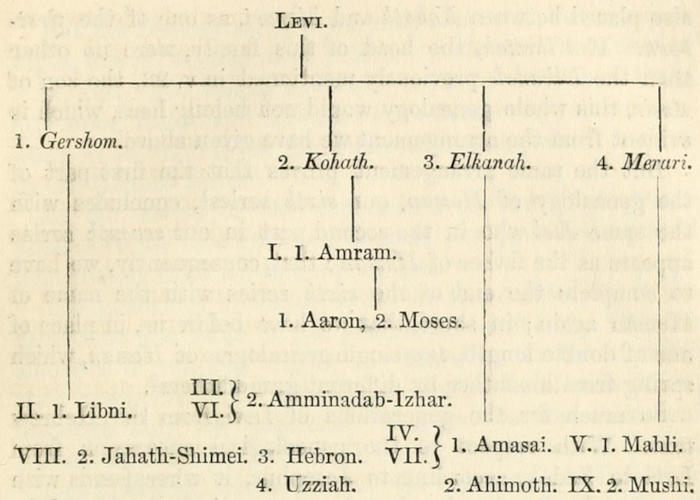
This certainty presupposes what has been already assumed here, that Elkanah was a son of Levi, and, indeed, the third son, although in former passages he is not cited as among the sons of Levi. Little is proved by this omission, for there are many such cases, and in this very chapter, v. 43, Jahath is called a son of Gershom, although in v. 17 he is not cited among the sons of Gershom[342]. In such cases, certainly, the conjecture still remains which we admitted above, p. 464, in the case of Jahath, that one name has been substituted for another, as, without doubt, occurs in many cases; and therefore some might prefer here to suppose Elkanah the same person as Kohath, Zuph (VII.) as a later Elkanah (IV.), Toah (VII.) as Nahath (IV.), Azariah (VI.) as Uzziah (III.), Joel (VII.) as Vashni (IV.), Laadan as Libni, &c. However, this seems very improbable here. In the chapter we allude to the children of Gershom-Libni are first stated in the series of the first-born, then the children of Kohath-Amminadab, then the children of Elkanah-Amasai, lastly the children of Merari-Mahli. Elkanah is, therefore, evidently also placed between Kohath and Merari, as one of the first-born. If Elkanah, the head of this family, were no other than the Elkanah previously mentioned in v. 23, the son of Assir, this whole genealogy would not belong here, which is evident from the arrangement we have given above.
But the same arrangement proves that the first part of the genealogy of Heman, our sixth series[343], concludes with the same Joel who in the second part in our seventh series appears as the father of Heman; that, consequently, we have to complete the end of the sixth series with the name of Heman again; in short, that we have before us, in place of one of double length, two single genealogies of Heman, which spring from his father by different grandfathers[344].
So much for the generations of Levi from the Hebrew text. With respect to the genealogical succession from Levi to Zadok, according to Josephus, it corresponds with our first Levitical series, but does not entirely agree with it. According to Josephus, the generations belonging here would be as follows:
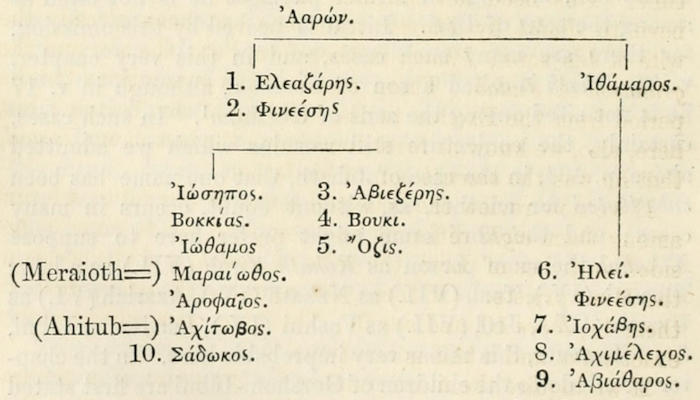
But the Hebrew series is not only supported by three passages, but it has also more internal probability than that of Josephus. For Βοκκίας and Βουκί seem to differ but little, and since Zadok and Abiathar are cotemporary, a name appears to be wanting in the series of Σάδωκος, which is given in the Hebrew series[345].
In our series of the successions of the High priests φινεέσης is an interposition, because the pontificate passed immediately from Eli to his grandson.
The genealogy of Judah, which we have added, is at the same time the table of the generation of David. It is the shortest of all, but ought not therefore to be regarded with suspicion. We must place Hezron equal with Moses, although only one generation is given between him and Judah, for it is said of him (1 Chron. ii. 24) that he died at Caleb-Ephratah, therefore after the entrance into Palestine, and that his wife, Abiah, had a son after his death. Therefore there only remains Judah and Pharez for the Egyptian time. This need not surprise us, since Pharez was only born to Judah by Thamar after she had been already the wife of his sons; Pharez is, therefore, both the son and the grandson of Judah. There remain nine generations for the period from the Exodus to the building of the Temple; but here, also, we know at least concerning the last name, David, that he was the seventh son of his father.
If we now review the collected series of our table, we find among them eight different and complete series, namely, besides six tribes of Levi, the tribe of Judah, and the series of the High priests. Of these, one contains 12 names, three of them 11, three 10, and one 9. This gives as a mean number exactly ten and a half generations.
If we inquire the mean number for the years of a generation, we must not think of the Hebrew number 40. It is evidently too high a number, and was only sometimes conferred by the Hebrews on the generations, because it had been long used by them for undetermined quantities as a round and sacred number.
The 33⅓rd years also of the Egyptian generations, according to Herodotus (ii. 142), was rather a subdivision of the century than a calculation of the real succession of generations. The longest series, from which we could obtain a mean number, are the series of kings. But we can obtain no scale even from them. The kings of Judah only reigned on an average nineteen years, those of Israel only twelve years. Successions of reigns are, however, always shorter than generations, and in Judah seven out of twenty kings were killed, or expelled; in Israel, fully half out of twenty. We shall therefore approach much nearer the truth if we adopt the Greek acceptation[346] of thirty years for a generation, in which we only follow most of the modern scholars.
Admitting this, ten or eleven generations would amount to 300 or 330 years, and if we place Solomon about the year 1000, the genealogies would lead us to 1300 or 1330 years before Christ, which most perfectly agrees with our earlier results, since, according to Manetho, we believe we ought to place Menephthes 1328-1309. The Rabbinical date of the Exodus is B.C. 1314, exactly between 1300 and 1330, upon which of course no more importance is to be laid than is allowable by the indeterminate factors of the calculation. At any rate the whole discussion leads to this, that the genealogies, the only trustworthy although less exact chronological thread of those Hebrew times, speak as decidedly against the calculation hitherto adopted of 480 years, as in favour of our calculation of, about, 300 years. This agreement appears to me of the greatest importance in judging both the Egyptian as well as the Jewish history.
But if, finally, we look at the numbers in the Book of Judges, we have already seen that, according to the usual mode of reckoning, they are by no means found to agree immediately with any other chronological acceptation; still the chronological character of many separate numbers cannot be mistaken, and we may at least expect that, from our point of view also, a simple solution must present itself, which would release the statements of numbers in the Book of Judges from the contradictions in which, as hitherto interpreted, they have stood with the Manethonic chronology.
Bunsen[347] gives us a survey of this period. He compares the “Time of Foreign Rule and Anarchy” with the “Time of the Judges and of Peace.” For the former he puts 3 x + 111 years, for the latter, including the monarchical time to the building of the Temple, 4 x + 442 years. He considers the first, less historical than the last (p. 212), and supposes that the number 480 is perhaps formed out of the latter 442. At all events, he believes we must start from this number. But I should prefer an entirely different combination, which promises to lead sooner to a result. If we place the uncertain and round numbers upon one side, and the remaining on the other side, we shall obtain the following survey[348]:
INDETERMINATE NUMBERS. HISTORICAL NUMBERS.
40. Years in the Desert.
x Joshua (25, according to Josephus, A. J. V. 1, 29).
x Successors to Joshua (Joshua xxiv. 31).
40. Othniel (Judg. iii. 11). 8. under Mesopotamia (Judg. iii. 8.)
18. under the Moabites (Judg. iii. 14).
80. Ehud (Judg. iii. 30; according to the Seventy 40).
x Shamgar.
20. under the Canaanites (Judg. iv. 3. This Period happens, according to Judg. iv. 4, perhaps under Deborah).
40. Deborah (Judg. iv. 4) and Barak (Judg. v. 1, 31).
40. Gideon (Judg. viii. 28). 7. under the Midianites (Judg. vi. 1).
3. Abimelech (Judg. ix. 22).
23. Tola (Judg. x. 2).
22. Jair (Judg. x. 3).
18. Philistines (Judg. x. 8).
6. Jephthah (Judg. xii. 7).
7. Ibzan (Judg. xii. 9).
10. Elon (Judg. xii. 11).
8. Abdon (Judg. xii. 14).
40. Philistines (Judg. xiii. 1). 150
20. Samson (in the time of the Philistines, Judg. xv. 20, xvi. 31).
x Anarchy (Judg. xvii. 6, xviii. 1, xix. 1, xxi. 25).
40. Eli (1 Sam. iv. 18).
20. Saul (1 Sam. vii. 1, 2; compare iv. 18, vi. 1; 2 Sam vi. 3; 1 Chron. xiv. 3. According to Acts xiii. 21, Jos. A. J. VI. 14, 9, Saul reigned 40 years).
40. David (2 Sam. v. 4, 5; 1 Kings, ii. 11).
14 times x × 12 years = 168. 150 + 168 = 318 years.
From this juxtaposition alone we obtain a threefold division of the whole period. In the first division we see from the time of Joshua the determinate and indeterminate numbers alternating almost regularly (for Shamgar appears to be included in Ehud’s higher number, and therefore to have no number himself), and the historical numbers are certainly not ascribed here to the separate personages, but to the period of the oppression, therefore the whole time appears to have been one of contest and startling revolts, which, by means of a succession of powerful men, ends at length in a victorious assertion of their own dominion.
This second period commences with Abimelech, and is only once interrupted by the government of the Philistines. Here there is a real succession of events and separate governments, and therefore no round numbers.
The third division begins with a new, and, as it appears, a far longer oppression by the Philistines, in which the narrative of Sampson only forms a passing episode. It seems to me that the anarchical times, which are entirely omitted by others, are connected with this oppression, and, although there is no date, that they were of considerable duration. They form, in a certain degree, the real conclusion of the time of the Judges. The new, the regal time, begins with Eli, which is always alluded to in the time of the anarchy. Before the time of Eli the historical thread was broken; from his time it continues uninterrupted. Eli prepares the way for the kings. Samuel grows up under him, and his first action after the death of Eli seems to have been to anoint Saul as king. He appears to have continued his office of judge under Saul, whom he has rather chosen as a general, as he also afterwards anoints David as king. This may be the reason why no time is ascribed to him; the Ark of the Covenant, which was taken as booty in the conquest of Mizpah by the Philistines, and was retained for seven months (1 Sam. vi. 1), was thus brought to Kirjath-Jearim, shortly before Saul’s elevation; remained there twenty years (1 Sam. vii. 2), and was first brought away from that place at the elevation of David (2 Sam. vi. 3), “for we inquired not at it in the days of Saul” (1 Chron. xiii. 3).
If we now add up the historical numbers, we shall obtain 150 years, so that there is on an average 12 years for each of the twelve governments. Now if we apply this mean number (which is best adapted to the purpose, and which was also that of the kings of Israel) to the fourteen governments, whose numbers are uncertain, we shall obtain 168 years, which, together with the 150, gives 318 years. Now if we count these backward, beginning at Solomon, about 1000 years before Christ, we come to the year 1318 before Christ, therefore again under the government of Pharaoh Menephthes.
We thus obtain, also, from this side a simple confirmation of our former results. It is at least evident, that the numbers in the Book of Judges can no longer be employed as a refutation of the Manethonic calculation. But this agreement between the chronology of the time of the Judges, and the genealogies of the Chronicles, is of manifest importance to Jewish history.
As soon as we may consider the chronological importance of the genealogies established, we are enabled to rise still higher on the same path in the history of Israel, and to obtain a chronological view concerning the period of the sojourn of the Israelites in Egypt.
If in the 40 years of the later generations we can only perceive a chronological garb, without on that account supposing that the substance of the narratives are unhistorical, still less should we see in the hundred and more years of the generations from Abraham to Moses, the true chronological relation upon which these perfectly credible narratives are founded. The whole array of numbers is rather, as we have indicated above, to be judged from a perfectly different point of view, the closer investigation of which does not belong here.
When, for the sake of judging the chronology of the times from Moses to Jacob, and from Jacob to Abraham, we start from the historical importance of the genealogies, this period becomes extremely contracted, and we are led to new historical comparisons, which appear to throw a clear light upon those times.
In all registers of generations we only find three generations from Joseph or Levi to Moses. In the pedigree of Judah, indeed, we only saw two, which was however explained by the unnatural alliance of Thamar. But Aaron himself, and Moses, on the father’s side, stood in the third degree from Levi, but from the maternal side in the second; for their father, Amram, the grandson of Levi, took to wife in Egypt his aunt Jochabed, the daughter of Levi (Exod. vi. 20; Num. xxvi. 59), who bore him Moses and Aaron. Thus one event explains and confirms another, and allows us still less to doubt the historical reality and the natural relations which the successive generations bear to each other.
Therefore, unless we wish to regard all the narratives of those times, and all the accounts, which afterwards refer to them, as mythical and unhistorical, for which there is not the slightest ground, we must also here separate the chronological garb from the subject itself, and recognise, as a necessary conclusion, that only about ninety years intervened from the entrance of Jacob to the Exodus of Moses, and about as much from the entrance of Abraham into Canaan, to Jacob’s Exodus[349], so that from Abraham to Moses only about 180, or if we wish to make the most of it, 215 years passed, which alone, according to the present calculation, are reckoned from Abraham to Jacob.
But even this result is by no means only founded upon the internal impossibility of the numbers hitherto adopted, nor upon the genealogies alone, but upon a much more general historical connection of the events, as we find them both in the Egyptian and Israelitish history of those times.
All the views hitherto adopted from Josephus, and from those who before his day held the same opinions, down to the most modern scholars, must, on the supposition that the Jews were the Hyksos—which we have rejected above (p. 422), as not worth refutation—or at least that they departed with them, and further that they lived in Egypt from the time of Jacob, 215 or 430 years, necessarily have led them to the conclusion that Joseph and Jacob came to Egypt during the dominion of the Hyksos. But an attentive and impartial consideration of the passages bearing upon this point, show beyond doubt that this could not be the case according to the Biblical accounts, and therefore that either this representation, or the accepted chronology, must contain errors.
“And Joseph,” it says, Gen. xxxix. 1, “was brought down to Egypt, and Potiphar, an officer of Pharaoh, captain of the guard, an Egyptian, bought him of the hands of the Ishmaelites, which had brought him down thither.”
Here, as in all the other passages where the Egyptian king is mentioned, he is called Pharaoh. This is an Egyptian designation and not a Semitic one, as we should have expected if the Semitic Hyksos[350] had still ruled in Egypt. In that case we should have been everywhere compelled to admit in this designation, throughout the history of Abraham, Jacob, Joseph, and Moses, an anachronism which cannot easily find a parallel. The captain of the king’s body-guard was also an Egyptian, as is proved by his name Potiphar, פוטיפר[351], which is written by the Seventy Πετεφρής, i. e. Petphra. Still an Egyptian in so important a situation at a Semitic court might as well form an exceptional case, as the Hebrew Joseph, according to our opinion, at an Egyptian court. “And Pharaoh took off his ring from his hand, and put it upon Joseph’s hand, and arrayed him in vestures of fine linen[352], and put a gold chain[353] about his neck. And he made him to ride in the second chariot[354] which he had, and they cried before him, Bow the knee; and he made him ruler over all the land of Egypt. And Pharaoh said unto Joseph, I am Pharaoh, and without thee shall no man lift up his hand or foot in all the land of Egypt. And Pharaoh called Joseph’s name צפנת פענח (Ψονθομφανήχ), and he gave him to wife Asenath, the daughter of Potipherah, priest of On.” (Gen. xli. 42, &c.) The fact that the distinctions here conferred upon Joseph are in perfect accordance with Egyptian manners[355], would still not be sufficient to prove that he lived at an Egyptian court, for the Semitic rulers might possibly have brought with them the same customs, or might have adopted them. But if such were our belief, it would be impossible to combine with it the circumstance that Joseph received from Pharaoh expressly an Egyptian name. For even if the older Hebrew commentators have attempted to derive the name from the Hebrew, these attempts have long been rejected by modern scholars[356]. We should be able to decide with more complete certainty about the Egyptian signification of the name if we found it written in hieroglyphics. It sounds in Hebrew Zepnet-ponch (Zaphnath-phaneach). It appears to me that the last portion can hardly be referred to any other word than the hieroglyphical 𓋹𓈖𓐍 anch, Coptic ⲱⲛϩ, ⲁⲛϩ, with the article ⲡ ⲱⲛϩ, the life; the first part is obscure. Since the Seventy write Ψονθομφανήχ, it is generally supposed that the two first letters in the Hebrew text have been misplaced, and that the uniting genitive —n (before the labial —m) has been omitted. Both are possible, but not probable. It seems to me that the Seventy cannot claim any more authority on this point than any other interpreter. It is not surprising that, without understanding the hieroglyphical writing, they were as little capable as we are of explaining the old name from the popular language. But that they wrote Ψονθ in place of Zepnet, or Zpent, seems to prove that they explained the name something like ⲡ ⲥⲱⲛⲧ ⲙ ⲫⲁⲛϩ creatio (creator) vitæ.
But how is it possible that a Semitic king, who, like the six in the lists of the so-called shepherd kings, must undoubtedly have himself borne a Semitic name, would have given Joseph an Egyptian name, in order to do him honour.
Asenath is of course an Egyptian name like that of her father, Potiphra, i. e. Petphra, and his being called a High priest of On (Heliopolis) is an additional and more certain proof that the Semitic nation of the Hyksos were not reigning here, for they would have destroyed all the Egyptian temples; and they would hardly have permitted the worship of Ra (Helios) to continue in the neighbourhood of Memphis, whose High priest must give his daughter to Joseph for a wife, in order to show him particular honour, and to naturalise him completely.
It is equally evident, from the meeting of Joseph with his brethren, that he lived at a really Egyptian court. Distrust towards their Phœnician neighbours was continually kept alive among the Egyptians, therefore it was easy to form a pretext to attack the Hebrews. “Ye are spies, to see the nakedness of the land ye are come.” (Gen. xlii. 9, 12, 14.) When the brethren talk among themselves of the act which they perpetrated against Joseph, they speak out loud in the presence of Joseph: “They knew not that Joseph understood them, for he spake unto them by an interpreter.” (Gen. xlii. 23.) Joseph had become so completely an Egyptian, and the Egyptian language was so exclusively spoken at the court of Pharaoh, that the brethren could not conjecture any one was near them who understood their language.
When, therefore, on their second visit to Joseph’s house, they were about to take their meal, it is said, “And they set for him by himself, and for them by themselves, and for the Egyptians, which did eat with him, by themselves: because the Egyptians might not eat bread with the Hebrews, for that is an abomination unto the Egyptians.” (Gen. xliii. 32.) The native Egyptians could never have expressed this horror, and regulated their manners accordingly, under the dominion of a Semitic reigning family. Lastly, it is equally improbable that Joseph would have advised the immigrating family to call themselves shepherds in order to obtain from Pharaoh a country set apart for themselves. “And it shall come to pass when Pharaoh shall call you, and shall say, What is your occupation? That ye shall say, Thy servant’s trade hath been about cattle from our youth, even until now, both we, and also our fathers; that ye may dwell in the land of Goshen; for every shepherd is an abomination unto the Egyptians.” (Gen. xlvi. 33.) If the shepherd people of the Hyksos reigned in Egypt, how could the shepherds be an abomination to them?
If it is therefore evident that Joseph lived at an Egyptian, and not at a Semitic court, the old tradition of the Jewish interpreters that Joseph came to Egypt in the reign of a shepherd king, Apophis, is entirely destroyed, as well as the view taken by more modern scholars concerning the Hebrew chronology of that time.
But according to Manetho, the Exodus happened in the reign of Menephthes, and according to all the Hebrew genealogies, Jacob’s entrance could only have happened 90 or 100 years earlier. Therefore Sethôs, the father of the great Ramses, must certainly be the Pharaoh under whom Joseph came into Egypt. This is most indubitably confirmed by the unmistakeable agreement which exists between the Hebrew account of the Pharaoh of Joseph, and what is related by others of King Sethôs. It is said by the former, “And Joseph bought all the land of Egypt for Pharaoh; for the Egyptians sold every man his field, because the famine prevailed over them: so the land became Pharaoh’s. And as for the people, he removed them to cities from one end of the borders of Egypt even to the other end thereof. Only the land of the priests bought he not; for the priests had a portion assigned them of Pharaoh, and did eat their portion which Pharaoh gave them: wherefore they sold not their lands. Then Joseph said unto the people, Behold, I have bought you this day and your land for Pharaoh: lo, here is seed for you, and ye shall sow the land. And it shall come to pass in the increase, that ye shall give the fifth part unto Pharaoh, and four parts shall be your own.... And Joseph made it a law over the land of Egypt unto this day, that Pharaoh should have the fifth part; except the land of the priests only, which became not Pharaoh’s.” (Gen. lxvii. 20, &c.)
We find the same great alteration in the agrarian conditions of the country, and connected with it the introduction of a general ground-tax, from which the priests alone were excepted, ascribed by Herodotus and Diodorus to the King Sesostris-Sesoosis.
We read in Herodotus, ii. 1081, that the king intersected the country with canals, because the places which were remote from the Nile suffered, when it retreated, from a scarcity of water. It appears from what has been observed above, that it was chiefly Ramses who completed the Egyptian system of canals, although it is very probable that the great transformation in the condition of the ground which it occasioned had been already commenced by his father, Sethôsis. It is well known that the fertility of Egypt alone depends upon the proper and well-maintained regulation of the overflowings. Since the time of Möris-Amenemha, who was the first to bestow any considerable attention upon it, the country had degenerated, owing to its long foreign rule, and had but just risen again to complete independence under the mighty Pharaohs of the 18th Dynasty. It is quite conceivable that such comprehensive and tedious undertakings for increasing the general prosperity, as a universal construction of canals, especially in the Delta, could only have been first undertaken by the earlier kings of the 19th Dynasty, Sethôsis and Ramses, who were both of them favoured by long reigns. Therefore until that time, a general failure of the crops and a famine might have very frequently occurred, at a low or even a moderate rise of the water, and perhaps happened for several successive years. Strabo[357] relates that, before the time of the Prefect Petronius, owing to the water-works being neglected, famine broke out in Egypt if the Nile only rose 8 ells, and 14 ells were necessary for a particularly good year; whereas, by his improvements, it was only necessary for the Nile to rise 10 ells to produce the best harvest, and if it rose but 8 ells no scarcity ensued. Famine broke out in Egypt in the Arabian times also from the same reason[358]. Thus the famine-years in the time of Joseph may be explained to have occurred in the reign of Sethôs; this event may even have called attention to the necessity of a better water regulation in the country.
In the following chapter Herodotus says, that the King Sesostris “divided the land between all the Egyptians by giving an equal-sized square portion to each, from which he afterwards derived his income by laying an annual tax upon it. But when the river carried away a part of any person’s portion, he showed it to the king, who sent people to inquire and measure how much smaller the piece of land had become, in order that he might pay the tax for the remainder according to the commands.” This is essentially the same arrangement which is ascribed to Joseph, the minister of Pharaoh. Herodotus had already[359] mentioned in an earlier passage that the priests paid no taxes, but even received their daily sustenance besides, exactly as it is related in the Mosaic accounts.
Diodorus[360] says of Sesoosis, that he “divided the whole country into thirty-six parts,” which the Egyptians called Nomes; over these he placed Nomarchs, who had the charge of the Royal Revenues, and “ruled everything besides in their provinces.” Therefore here again there was an entirely new division and government of the country, in which the taxes to the king are not forgotten. Afterwards (c. 57) he adds also, that he raised many great mounds, and upon them transplanted the towns which were situated too low (μετῴκισεν). The fresh regulations in the country, and especially the new canals, necessarily created a great number of towns and villages for the management of the grounds which were portioned out, and were now partly cultivated for the first time. To this we may most naturally refer the remark in the Hebrew account that Pharaoh “removed them to cities from one end of the borders of Egypt even to the other end thereof.” (Gen. xlvii. 21.) Diodorus (c. 56) also mentions the hard taskwork which thence became necessary, and that in consequence of it the “Babylonian prisoners, who could no longer bear the toilsome labour, rebelled against the king.”
In the very valuable description of the manner in which the Egyptian administration had subsisted under the old[361] kings of the country, which is drawn from the most ancient sources, Diodorus again mentions (c. 73, 74) the arrangement of the Nomes, and a division of the property, by which one-third belonged to the priests, one to the king, the other to the warriors; and how all the cultivators of the soil, for a small reward, only performed task-service for the three orders who possessed land. It is here also expressly mentioned, that the priests were exempt (ἀτελεῖς) from taxation[362]. But it seems that it is only from the Mosaic narrative we learn that the universal statute of the taxes imposed on the remaining possessors of the land was fixed upon exactly the fifth part of the produce; this narrative here, as well as in other points, confidently completes our knowledge of those circumstances.
Now if the arrangements we have cited, which in fact so essentially changed Egypt, that their introduction could not fail to occupy an important place in the monuments of that time, and to be thus handed down to posterity, were ascribed in the Greek account to Sesostris-Sesoosis, we should, in the next place, be uncertain whether Sethôs or his son Ramses was meant. It is not in itself improbable, that works demanding so much time, and the extensive alterations in the political circumstances, might fully occupy two such long reigns as those of both the kings mentioned; and of the canal works especially, we know that at least two particular canals of considerable importance were completed by Ramses, east and west of the Delta, and towns were built beside them. But since it can now hardly be disputed that those events could not have taken place either earlier or later than under these two reigns, which embraced more than a century, it appears to be perfectly justifiable to suppose that the first and most essential steps to this reform were taken in the reign of Sethôs, because, according to the genealogical calculation of time in the Bible, Joseph must have lived and acted in the first half of the reign of Sethôsis. The succession of kings in the Mosaic accounts also perfectly agrees with this. We here read of only three Pharaohs during that time. Joseph came to Potiphar in Egypt in the reign of the first, and rose by his wisdom to be first minister of the king. This Pharaoh was Sethôsis I., with whom the Manethonic lists begin a new Dynasty. By means of the new improvements introduced and regulated by him, the country was saved from the years of famine which had hitherto been constantly dreaded, and the power of the king was increased and strengthened.
“And Joseph died, and all his brethren, and his whole race.” “Now there arose up a new king over Egypt, which knew not Joseph[363].” Sethôsis had reigned more than fifty years, and Joseph must have lived in the first part of his reign. It is therefore conceivable that the new King Ramses II. knew nothing more of him, or wished to know nothing more, and therefore might not on his (Joseph’s) account have favoured the rapidly increasing population of the Israelites in Egypt. We therefore see that it was incorrect to explain the words of the account, which are only correct when taken in their simplest signification, that a new king arose—by understanding that by this the commencement of a new royal house is intended after a long and indefinite period. The birth of Moses, and his education at the court of Pharaoh, happened under this King Ramses II., and indeed in the latter part of his reign of sixty-six years, in which the times of Joseph were still more forgotten, and the hard oppressions and persecutions of the Jews prevailed. This king, although of a Theban family, resided equally, and perhaps in those times, even more at Memphis than at Thebes, as the later Saitic, Bubastic, and other dynasties also by no means forsook the old palace in Memphis. There exists, therefore, no grounds for imagining the youth of Moses to have been spent at Thebes rather than at Memphis.
But when Moses had slain the Egyptian, he fled to Midian. “And it came to pass in process of time, that the King of Egypt died; and the children of Israel sighed by reason of the bondage[364].” The third king, therefore, succeeded the Pharaoh of the Exodus, Menephthes, the son of the great Ramses, the same under whom, as we believe we have pointed out, the Exodus really happened, and from whom the new Sothis period, which began in his reign, likewise received its name.
If, in the same manner, we go still farther back in the Hebrew accounts from Joseph to Abraham, we find this period also only occupied by three generations, which would fix it, according to the views we have exhibited, to about 90 or 100 years.
According to the chronology hitherto adopted, Abraham’s visit to Egypt would also have happened in the time of the Hyksos. But this is partly opposed by the same objections which we mentioned when speaking of the immigration of Jacob. Abraham also comes to the court of a Pharaoh, therefore of a native Egyptian ruler, and, in accordance with the Manethonic chronology, the visit of Abraham would have happened under Tuthmosis IV. or Amenophis III., therefore in the middle of the 18th Dynasty, after the Hyksos had been already expelled by the 17th Dynasty, first into the lowest country of the Delta, and then from their last fortress, Abaris.
Therefore only about 200 years had passed between Abraham’s journey into Egypt and the time of the Exodus. But what gave occasion to the number four hundred and thirty years, so expressly stated in Exodus xii. 40, and which appears, in comparison with the round statement of 400 years in Gen. xv. 13, as more exact, and, at all events, not an unmeaning number? We have already expressed our opinion that the round and indeterminate numbers, as well as the larger calculations, were only adopted at a later period in the writings of the Old Testament. The number 480 or 440 years between the Exodus and the building of the Temple appeared to us to depend upon a calculation of 12 or 11 generations of 40 years each. But in the 430 years may, perhaps, lie the first indication of the early-conceived idea mentioned above, that the Israelites were the Hyksos. For the number would, in fact, be most perfectly explained if it was referred to the residence of these Semitic races in Egypt.
We shall, namely, point out, in the second part of the chronology, that the long contest between the Egyptians and the Hyksos, mentioned by Manetho, occurred during the 17th Dynasty from Amosis to Tuthmosis III. The former completely broke the foreign dominion, and drove back the Hyksos to the northern part of the Delta; but it was Tuthmosis who first succeeded in sending them out of their last stronghold of refuge, Abaris. Thence arose the confusion that has so generally prevailed concerning these two kings. The one as much as the other might be regarded as the conqueror of the Hyksos. Manetho specified the whole time of the residence of the Hyksos in Egypt, up to their departure from Abaris, to be 511 years. But it must also have appeared from his narrative, and have been a fact specially known to the priests from their history, that the real dominion of the Hyksos in Egypt was terminated by Amosis. If we now subtract the time from Amosis to Tuthmosis, which was 80 years, from 511[365], exactly four hundred and thirty years remain for the dominion of the Hyksos in Egypt[366]. If, therefore, in the present day, the opinion can in any way be maintained and defended that Abraham (or Jacob) was King Salatis, and entered Egypt not as a petitioner, but as a powerful and conquering enemy, and that his seed was first conquered and driven away in the time of Moses by the native kings, the relation of the above-mentioned numbers would certainly appear as one of the most important proofs of it. It cannot, however, be argued that an admission which appears, according to our present criticism, perfectly impossible, must have appeared equally so in ancient times. An impartial apprehension of the present, and a faithful rendering of the past, was the vocation of an ancient annalist or historian; it is only thus that they are of importance and worthy of consideration in our inquiry. Criticism was completely out of their sphere, historical as well as philological; and when, nevertheless, we do meet with it, it is generally very unsatisfactory, and even from the most distinguished writers, astonishingly feeble. The school of professional Alexandrian critics is by no means excepted. We find the most striking examples of this, particularly in the Christian chronologists, who were not wanting either in abundance of authorities, nor in extensive learning and honest intentions. But we have actually seen, from the example of Josephus, as well as from earlier and later authors, how the opinion above mentioned, of the identity of the Hyksos with the Jews, really gained admittance from various very superficial foundations, and yet Josephus belonged undoubtedly to the most learned antiquarians who we can place under our observation here. We ought not, therefore, to be surprised even if we find this view again stated at an earlier period in the arrangement and combinations of the Hebrew historical books; and this appears, in fact, to be very probable, by the number 430 years, which can neither be applied to the three generations of Jacob, nor to the six from Abraham to Moses.
The calculation also verifies itself still further. It was an early opinion that Joseph came to Egypt in the reign of the shepherd King Aphophis. This is expressly said by Eusebius and Syncellus; and the various changes in the position of Aphophis, who is differently placed both by Josephus and Africanus, appear, upon a closer investigation, always to originate from the same reason, namely, in order to place Joseph under Aphophis. The correct position of Aphophis, according to Manetho, was undoubtedly at the end of the 16th Dynasty, as we find it stated by Africanus[367]. Joseph stood, according to the generations, exactly between Abraham and Moses. According to the Egyptian chronology, the first Dynasty of the Hyksos reigned 259 years, the second 251 years, therefore Aphophis, the last king of the 1st Dynasty, reigned in the middle of the time of the Hyksos. This was probably the first idea which supported the opinion of the exact division of the 430 years into two equal halves, and the belief that Jacob came to Egypt in the time of Aphophis. Jacob’s entrance, or the end of the first 215 years, accordingly happened in the seventeenth year of the Aphophis; Joseph was exalted by Pharaoh 9 years earlier, therefore in the eighth year of Aphophis.
But the correct Egyptian statement, that the Hyksos first departed in the reign of Tuthmosis, had been already misunderstood in the time of Josephus. He placed the Exodus of the Hyksos and of the Jews under Amosis, and made the whole 17th Dynasty of 251 years precede Amosis. It was impossible, therefore, that he could place Joseph under Aphophis. He could as little make the entrance of Abraham happen at the same time as that of the Hyksos, for he gave 511 years for the residence of the Hyksos, 430 for that of the Jews. But he nowhere says either that the Jews entered with the Hyksos, as they departed with them, or that Jacob or Josephus came to Egypt in the reign of Aphophis. He appears rather to have believed that the first and not the second entrance of the Jews into Egypt, therefore the entrance of Abraham happened in the time of Aphophis; and thus that the tradition, which was no doubt known to him, was so to be understood. He must, at least, have thought that the entrance of Abraham really took place in the first Hyksos Dynasty, although, indeed, not under the last, but under the fourth king. According to my opinion, this was the reason why Josephus made Aphophis the fourth king of the Dynasty.
Africanus, the most faithful among the reporters, did not admit all these calculations, or seek to explain the Manethonic calculation, and to make it agree with his own, but let the contradictions stand, and therefore simply gave the Manethonic tradition, even when he did not understand it, and could not correct the mistakes which were handed down to him. We therefore find the correct position of Aphophis retained by him.
Eusebius on the other hand, and his uncertain authorities, again wished to mediate and to explain. In his account we find the first year of the 16th Dynasty placed contemporaneous with the first year of the life of Abraham, which is evidently an arbitrary proceeding, and one that necessarily drew other changes along with it, which are met with plentifully in the numbers substituted for those of Manetho. His 17th Dynasty names the four first kings of the Manethonic 16th Dynasty, and Amosis follows immediately after. In order to fit in again with the later history, it was necessary to abridge considerably the 16th and 17th Dynasties. The numbers of Eusebius, as they appear in the Canon, clearly state that he only counted seventy-five years from the first year of Abraham to his entrance into Canaan and Egypt, and again 430 years from that time to the Exodus of Moses. This happened, therefore, in the last year of Χενχέρης. The same is given in the codex A of Syncellus, p. 72, D. If we here again calculate 215 years to the entrance of Jacob, or 224 to the exaltation of Joseph, we arrive at his reign of Aphophis, as was intended. But in codex B, and in the Armenian translation, the two kings, Athoris and Chencheres, who are correctly placed in the Eusebian Canon, are omitted, and undoubtedly by the oversight of Eusebius himself, not of Syncellus. Thence the Exodus was placed in the reign of Achencheres, in place of Chencheres. The similarity in the names themselves appears to have led to the oversight; thus Syncellus found the text. Now, if we count back from Achencheres 215 or 224 years, we come to Archles, the predecessor of Aphophis. Syncellus knew of no better way than to transpose Archles and Aphophis, as we find to be really the case in his text of Eusebius, p. 62, A; this of course can no longer be reconciled with the emendations of the codex A, which were added in a later passage out of Eusebius. No doubt seems to be left by this explanation of the numbers.
Lastly, Syncellus, who follows the false Sothis, places the Exodus in the last year of Misphragmuthosis, calculates from here backwards 215 years, and passing over the 2nd Hyksos Dynasty, which Sothis and Eusebius had already placed before the 1st Hyksos Dynasty, arrives at the fourth king of the latter. Therefore, as in Josephus, Aphophis is placed there.
All these circumstances are easily explained when the aim and the issue of the matter is known. But the original grounds why Aphophis, the last king of the 1st Manethonic Hyksos Dynasty, was regarded as the Pharaoh of Joseph and Jacob, is alone apparent by the simple relation which we have found subsisting between the Hebrew and the Manethonic numbers.
I do not believe that a sound critical examination can consider so many and such universal agreements and confirmations to be accidental, or the result of an artificial correction, which, at all events, would of necessity be easily pointed out, the more so as, with the exception of a few individual points, my restoration of the Manethonic chronology was principally determined before my journey to Egypt.
We therefore believe, that by means of a new path, namely, the Manethonic chronology, we have found the key to the relative portions of time in the Old Testament, so far as these are connected with Egypt; and in an inverse manner we may now consider the agreement that subsists between the chronology of the Hebrew history (both the true chronology represented in the genealogies, and the false one, which was afterwards erroneously adopted) and the Egyptian numbers upon which the chronology was originally founded, to be indeed strongly confirmatory of the authenticity of these last, as they appear according to our restoration of them.
It is very evident that our carrying back the Old Testament chronology to its natural relations, as far back as Abraham, must be not merely of chronological, but of truly historical importance in the highest meaning of the term. The prolongation to above a hundred years, contrary to all historical experience, of the thirty-yeared generations of the immediate ancestors of Moses, who lived in the midst of the Egyptians, the length of whose lives was exactly like our own, must either appear an intentional miracle, or make us doubt the simple historical reality of the persons themselves, and of the events concerning them. The superhuman duration of life, considered as a miracle, would appear to be entirely without a purpose; besides, in the Old Testament itself it is never viewed as such. The Psalmist[368], on the contrary, considered as we do, a life of eighty years as a great age. Therefore the most distinguished, and most earnest inquirers of the present day were led to the opinion, evidently from the numbers, that the history of the three patriarchs, Abraham, Isaac, and Jacob, was less strictly historical, but only brought before the reader, as it were, three representations of long epochs of about a century each[369]. It was likewise necessary to regard the register of generations in the time of the Judges as defective, and extremely shortened, because in no other manner could they fill up the long period of 480 years. In order to make this abbreviation more probable, the genealogy of Haman was referred to as the only one which was preserved perfect[370], while we, on the contrary, consider it a double one.
Now according to our view of the subject, this apparently so well-founded doubt of the real continuity of the events, and of the historical character of the contents, in as far as they depend upon the chronology, entirely disappears, and I see no longer any reason to consider the accounts of the great personality of Abraham, of the non-prominent activity of Isaac, the opulent life of Jacob, and the remarkable fate of Joseph, chiefly as typical, and as it were only slightly connected with the historical reality[371]. For although we must still make a considerable difference between the character of the history of Israel before and after the building of the temple, yet it cannot be denied that the agreement we have pointed out between the true chronological thread, as it is represented to us by the genealogies, and the Egyptian history, as well as the confirmation of so many notices respecting Egypt, from the time of Moses and Joseph, establish a far greater historical character for the Hebrew accounts, as far back as Abraham, than would have ever been allowed them by a strict criticism, had we been obliged to ascribe to the old authorities themselves the numbers which were inserted at a later period.
[After some notice concerning the times before Abraham, the author concludes this section as follows:]
If, however, our entire view of the Old Testament chronology, regarding it as founded upon accurately preserved dates, only so far back as the separation of the kingdom, but nevertheless attached from that epoch up to the time of Abraham to an evidently authentic thread of historically reliable genealogies, offering, however, before the Egyptian period, only cyclical instead of historical numbers and genealogies, and mainly confined to Babylonian sources and traditions—if, I say, this general view of the character of the chronological data which leaves untouched the significance of their contents, should, on theological grounds, arouse scruples in the mind of any one, I would refer him to the introduction which Bunsen has prefixed to the third section of his first book on Egypt, as full of talent as of meaning, and from which I would more especially extract the following passages[372].
“Whoever adopts as a principle that chronology is a matter of revelation, is precluded from giving effect to any doubt that may cross his path, as involving a virtual abandonment of his faith in revelation. He must be prepared, not only to deny the existence of contradictory statements, but to fill up chasms; however irreconcileable the former may appear by any aid of philology and history, however unfathomable the latter. He who, on the other hand, neither believes in an historical tradition as to the eternal existence of man, nor admits an historical and chronological element in revelation, will either contemptuously dismiss the inquiry, or, by prematurely rejecting its more difficult elements, fail to discover those threads of the research which lie beneath the unsightly and time-worn surface, and which yet may prove the thread of Ariadne.
“The assumption that it entered into the scheme of Divine Providence either to preserve for us a chronology of the Jews and their forefathers by real tradition, or to provide the later commentators with magic powers, in respect to the most exoteric element of history, may seem indispensable to some, and absurd to others. Historical inquiry has nothing whatever to do with such idle, preposterous, and often fallacious assumptions. Its business is to see whether anything—and if so, what—has been transmitted to us. If it fulfil this duty in a spirit of reverence as well as of liberty, sooner or later it will obtain the prize, which, if the history of the last 2000 years prove anything at all, Providence has refused to both the other systems.”
[After the two first sections of The Criticism upon the Authorities, of which the first, upon Herodotus and Diodorus, has been omitted in this translation, while the second, upon the Hebrew tradition, has been strongly dwelt upon, the author proceeds to the third and last section, which treats of the historical works of Manetho and the authorities which refer to him. Now, although this section contains the really critical restoration of the Manethonic chronology, considered by the author as the only one to be relied on in its general features, it has not been considered compatible with the object of the present work to communicate at full length this difficult research, which was only written for the profound investigator. We think it sufficient to give the two passages in which the whole extent of the Manethonic history, down to the second Persian conquest, according to a statement obtained from Manetho himself, is said to amount to 3555 years, and the connection is pointed out between this time, considered as strictly historical, and the cyclically discovered History of the Gods.]
The number 3555 is, however, alone essential and important, and, in spite of all the uncertainties and revisings of the text, there cannot be the slightest doubt about it. It led undoubtedly to the termination of the reign of Nectanebus II. If we can, therefore, determine this end in other more certain ways, we need no longer trouble ourselves about the calculation of Syncellus; since this, as every one allows, is, at all events, incorrect. But it cannot be doubted that Manetho knew, and correctly stated, the true year of the conquest of Egypt by Ochus, which very likely happened during his lifetime.
The calculation of this concluding year has, however, been so fully and convincingly proved by Böckh (p. 125-133), that I consider it would be superfluous to return to it again. I assume with him that the year 340 B.C. is perfectly ascertained to be the concluding year of the Egyptian dominion. Calculating back from this stated terminating point 3555 Egyptian or 3553 Julian years, we come to the year 3893 before Christ, as the first of Menes. We consider this to be established as perfectly historical, in as far as the Manethonic relation founded upon the annals of the kingdom may generally be regarded as historically correct.
But long before the cyclical system of the government of the gods could be founded upon the Sothis periods, which were established in the course of history, Menes had already been admitted into the Egyptian annals, and was maintained to be the fixed chronological commencement of Egyptian history, especially of the history of Lower Egypt. His epoch could be no more altered. What happened before his time was ante-historical, and might be adjusted to the cyclical necessities of mythology. The only historical fact was, that other kings had reigned before Menes, and indeed in This. In order to distinguish them from the later kings as being ante-historical, a designation was selected, which we are not yet acquainted with in hieroglyphics, but which was translated in Greek by Νέκυες, the deceased; here also undoubtedly establishing the idea that they were deceased Men.
We may, however, certainly regard it as the most welcome confirmation of the whole of our restoration of the Manethonic chronology, that this ante-historical Dynasty of man of the ten Thinitic kings, the invention of whom could have no other aim than the extension of the history of man to the commencement of the current Sothis period, most accurately indeed fulfils the purpose that was designed. For while we add to the first of the 3555 Manethonic years, namely, to the year 3893 (3892) B.C. (Julian), the first of the reign of Menes, the 350 civil years of the Thinitic Νέκυες, the year 4242 is the result, which was, in reality, the necessarily expected commencement year of the current Sothis period. This immediately explains why the number 350, although it was ante-historical, and was therefore invented, is still in itself no cyclical number, and is in no way related to the Sothis period. It could just as little be a Sothic number as the number 3555, which it completed. But, on the contrary, it thence proves both the truthfulness as well as the historical character of the important and genuine Manethonic number 3555, and further proves that the establishment of the first historical year, or the Menes epoch, which is directly given by the number 3555 years, cannot first proceed from Manetho, but must be at least as old as the invention of the cyclical system of Egyptian mythology inseparably united with it, which no one will or can ascribe first to Manetho, because we have pointed out the same numbers belonging to the gods before his time. But the establishment of the discovered Menes year must indeed be still older than the formation of the whole cyclical system, since this is first appended to that number, and presupposes it; that is to say, the Menes epoch designated by Manetho was one which had been given from the beginning, and was handed down historically, and was combined in the following manner, with the cyclical system of the history of the gods.
PERIOD OF THE GODS.
Gods 13,870 years.
Demi-gods 3,650 ”
17,520 ” = 12 Sothis periods.
PERIOD OF MAN.
Ante-Historical Dynasty 350 years.
30 Historical Dynasties 3555 ”
Foreign dominion to the time of Antoninus 478 ”
4383 ” = 3 Sothis periods.
Thus the history of the thirty Manethonic Dynasties, which began with Menes and comprised 3555 Egyptian years, was between two Sothis periods, without coming in contact with them, an evident proof that they were not formed with reference to the Sothis periods.
In order to take a general survey, we shall now repeat, in a few words, the result of our investigations.
Manetho apparently added himself to his detailed history, which was comprised in three Books, a Review of the Dynasties, in a continued series, in the style of the old Egyptian annals. These were more often transcribed than the work itself, which seems, indeed, to have been less widely distributed, owing to this convenient compendium. Separate narratives, however, from the work itself have been adopted by later authors, and were thereby preserved to us, although not without some alterations, after the complete work itself was lost, which must have happened at an early period, perhaps when the Alexandrian library was destroyed.
It was at least unknown to Josephus in the first century of our era; but the more copious, and certainly chiefly literal extracts communicated by him, he has borrowed from other works. Along with these, he either himself combined, or found combined, another partial list of kings, which only included the names from Amosis down to Menephthes (Amenophis), and which was drawn up specially and solely for the learned purposes of the Jews, at all events before the time of Josephus.
Theophilus, Bishop of Antioch, in the second century, communicated the same list with slight deviations, and probably not from the writings of Josephus.
The complete Dynastic lists of the Manethonic work, which by a different method have also themselves been preserved, seem to have been unknown to both. These were first preserved to us by Africanus in the third century. They had undoubtedly before this time passed through several hands, and assumed forms partly deviating from one another. The partial Jewish list which we find in Josephus and Theophilus, was already adopted, in the time of Africanus (though hardly by himself), in the same series with the others, as one peculiarly authenticated, and apparently complete; because it contained no subdivision in itself, it was regarded as one single Dynasty, the 18th, although it really corresponded with the 17th and 18th and half of the 19th Dynasty taken together. Thence arose the confusion which now exists here.
The necessity for an agreement between the Christian-Jewish and the Egyptian computation of time produced, towards the end of the third, or the beginning of the fourth century, two spurious writings; first, the Old Chronicle, which retained the Egyptian cyclical point of view, that, namely, of the history of the gods, and even extended it, yet in such a manner that the means of reduction was suggested, by which these large numbers might be compressed into the period assumed as that given by Moses for the time since Adam. With the same end in view the first 15 Dynasties of man were transformed into 15 Generations.
The second spurious work, the Sothis, professed to be Manethonic; and could do this more easily, because a long time had elapsed since the genuine history had been lost. This writing proceeded still further upon the same road as the Old Chronicle. By means of alterations and abbreviations it reduced the Egyptian numbers to certain epochs, which were considered as Biblical, and on the other hand partly abandoned the Cyclical basis.
Eusebius, who wrote in the fourth century, was deceived by both these writings, and endeavoured to make their statements agree with the genuine Manethonic Dynastic lists. He had these lists before him in a form which was rather different from, and at all events more negligently drawn up, than that of Africanus. He followed it for the Old Monarchy, which was almost entirely omitted in the two spurious writings. In the New Monarchy he adopted principally the Dynastic numbers of the Old Chronicle. In other points he followed the Sothis. His numbers of the gods, like those of the spurious writings, are upon the whole founded on the genuine Manethonic numbers, which he nevertheless combined in a mistaken manner.
In the commencement of the fifth century the speculative chronologists, Anianos and Panodorus, laboured with subtle ingenuity at Egyptian chronology, but necessarily entirely failed in discovering the truth, because they considered the two spurious writings as the true basis. They endeavoured by ingenious arithmetical calculations to bring the numbers of the Old Chronicle and of the Sothis to agree more exactly with their acceptations of the Biblical chronology, than it had been the intention of these writings themselves.
Lastly, in the eighth century, Georgius Syncellus delivered his compiled, but on that very account for us most important work, by which we first became acquainted with almost all the earlier authorities. Through him alone we possess especially the most valuable basis for our Manethonic chronology, the Dynastic lists of Africanus. He himself decided nevertheless likewise in favour of the two spurious writings, and indeed as they were worked out by Panodorus; upon this last he founded his own system, which therefore is only so far of value to us as we thereby become acquainted with his authorities.