Front matter
Reading edition
Cover art
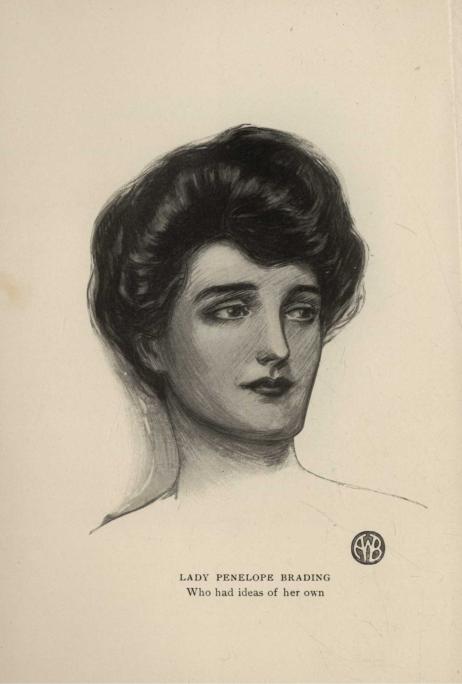
LADY PENELOPE BRADING Who had ideas of her own
Lady Penelope
By
Morley Roberts
Author of "Rachel Marr," "The Promotion of the Admiral," etc.
Illustrated by Arthur William Brown
L. C. Page & Company Boston Mdccccv
Copyright, 1904, 1903 BY L. C. PAGE & COMPANY (INCORPORATED)
All rights reserved
Published February, 1905
COLONIAL PRESS Electrotyped and Printed by C. H. Simonds & Co. Boston, Mass., U.S.A.
LIST OF ILLUSTRATIONS
LADY PENELOPE BRADING . . . . . . . . . Frontispiece
Who had ideas of her own.
CAPTAIN PLANTAGENET GOBY, V.C., LATE OF THE GUARDS
Who was ordered to read poetry.
LEOPOLD NORFOLK GORDON
Some said his real name was Isaac Levi.
AUSTIN DE VERE
He wrote poetry, and abhorred bulldogs and motor-cars.
THE MARQUIS DE RIVAULX
Anti-Semite to his manicured finger-tips.
RUFUS Q. PLANT
Born in Virginia.
CARTERET WILLIAMS, WAR CORRESPONDENT
He wrote with a red picturesqueness which was horribly attractive.
JIMMY CAREW, A.R.A.
He was the best looking of the whole "horde"
THE EARL OF PULBOROUGH
Clever; but indolent.
LADY PENELOPE
CHAPTER I.
All the absurd birthday celebrations were over, and Penelope was twenty-one.
She declared that her whole life was to be devoted to reform. She meant to reform society, to make it good and useful and straightforward, and simple and utterly delightful.
She let it be understood that men were in great need of her particular attention. They were too selfish and self-centred, too extravagant, too critical of each other, too vain. They acknowledged it humbly when she mentioned it, for Lady Penelope Brading's beauty was something to see and to talk of; major and minor poets agreed about it; artists desired to paint her and failed, as they always do when true loveliness shines on them. She had the colour of a Titian; the contours of a Correggio; the witchery of a Reynolds, and under wonderful raiment the muscles of a young Greek athlete. She wiped out any society in which she moved. When sweet Eclipse showed herself, the rest were nowhere. The other girls did not exist; she even made married beauties quake; as for the men, they endured everything she said, and worshipped her all the more. She was strange and new and a tonic. She had no sense of humour whatsoever; she could not understand a joke even if it was explained by an expert on the staff of Punch. This made her utterly delightful. Her beautiful seriousness was as refreshing as logic in a sermon. She believed in clergymen, in politicians, in the Deceased Wife's Sister, in all eminent physicians, in the London County Council, in the City of Westminster, in the British Constitution, in herself, and hygiene. She read the Times, the Athenæum, the Encyclopædia Britannica, Herbert Spencer, Mr. Kidd, and the late Mr. Drummond. She used Sandow's exercises and cold water. She was opposed to war; she admired the leader of the opposition and the lord mayor; she subscribed to a society for establishing a national theatre to play Mr. Bernard Shaw's tragedies, and to the nearest hospital. She was the most delightful person in England, and was against vaccination. She had money and lands and houses and ideas.
"We ought all to do something; to be something," said Lady Penelope Brading.
It was an amazing statement, a shocking statement, and clean against all class tradition when she interpreted it to the alarmed. Was it not to be something if one was rich, let us say? Was it not to do something if one spent one's money on horses and sport and dress and bridge? Heaven defend us all if anything more is asked of man or woman than killing time and killing beasts! Hands went up to heaven when Penelope preached.
Not that she preached at length. Her sermons lasted five seconds by any clock, save at the times when she warmed her ankles by the fire with some pet friend of hers, and took into consideration how she was to use her power for the regeneration of the world which was hers. Now she was with Ethel Mytton, a remote relative of the celebrated Mytton who drank eight bottles of port a day, and was a sportsman of the character which makes all Englishmen prouder of sport than of their history. Ten thousand on a football field would put him higher than Sir Richard Grenville. Sidney was a fool to him. Her father was a cabinet minister.
But Ethel was meek and mild, and followed Penelope at a humble distance, modelling herself on that sweet mould of revolution. So might a penny candle imitate an arc-light; so a glowworm worship the big moon.
"But you'll get married, dear," said Ethel, "of course you'll get married."
Penelope was pensive.
"There are other things than marriage," said Penelope.
"Oh, are there?" sighed Ethel. She did not think so, for she was in love. Penelope loved theories best.
"Which of them will you marry?" asked Ethel.
"Which what?"
"Silly, them," said Ethel. "What the duchess calls your 'horde.'"
"I don't know," replied Penelope. "I'm like Diogenes, and I'm looking for an honest man."
"Oh, honesty,—yes, of course, I know what you mean. But there are plenty of them, Pen dear.
"Boo!" said Pen; "so the other Greeks said to the man in the tub."
Ethel sighed.
"What Greeks and what man in what tub?" she inquired, plaintively.
And Penelope did not enlighten her darkness, for in came the Duchess of Goring, her aunt, whose Christian name was Titania. She weighed sixteen stone in glittering bead armour, and had a voice exactly like Rose Le Clerc's in "The Duchess of Bayswater." She rarely stopped talking, and was ridiculously moral and conventional, and, except for her voice, she might have been a shopkeeper's wife in any suburb.
"My dear Penelope," said Titania, "I'm glad to see you again. You look positively sweet, my darling, after all these parties and carryings-on, and what not, and now at last you are quite grown up and yourself and your own and twenty-one. I wish I was. I was nine stone then exactly,—not a pound more. Oh, and it's you, Ethel. I hope your dear papa is not overworking himself, now he's a cabinet minister. Cabinet ministers will overwork themselves. I've known them die of it. Tell him what I say, will you? But of course he will pay no attention, and in time will die like the rest. It's no use advising men to be sensible. I've given it up. Ah, here at last is Lord Bradstock."
Titania flowed on wonderfully; she flowed exactly like the twisting piece of glass in a mechanical clock which mimics a jet of water. She turned round and never advanced. But Augustin, Lord Bradstock, was as calm as a mill-pond, as a mere in the mountains. He was tall and thin and ruddy and white-haired at fifty. He had been twice a widower.
"Why at last, Titania?" he yawned, as he stood with Penelope's hand in his. He was still her guardian in his heart, though she was out of tutelage.
"I say at last, Augustin, because you were not here before me," cried Titania. "And I expected you to be here before me from what you said this morning. I told you I meant to come in and speak quietly and seriously to Penelope, and you said you would come, too."
Penelope's eyes thanked her guardian, and they smiled at him half-secretly, saying as plain as any words: "What a dear you are to come in and dilute aunty for me!"
"Yes," said Bradstock, "I think I said I would prepare her."
"I've not had a single chance lately to say a word for her good," cried Titania, "what with this person and that person and the horde. I think it is time now, Penelope, that you reorganized your amazing circle of acquaintances, mostly men, by the way. While Augustin was responsible for you, of course you were obstinate, but now you are in a position of greater freedom you will see the advisability of being guided by your aunt. I'm sure, I'm positive of it."
Now the real sore point with the duchess was this matter of the "horde." It was the only picturesque phrase she ever invented in her life, and without any doubt it did characterize in some measure the remarkable collection of men who were pretenders to Penelope's hand and fortune.
"Out of the entire, the entire—"
"Caboodle," said Bradstock, suggestively.
The duchess shook her head like a horse in fly-time.
"No, Augustin, not caboodle; pray, what is caboodle? Out of the entire—lot, Penelope, there are hardly three who belong to your class. I entreat you to go through them and dismiss those of whom we can't approve, I and Lord Bradstock."
"Don't drag me in," said Bradstock. "They are all very good fellows; I approve of them all."
"Tut, tut," said Titania, "is this the way you help, Augustin? You are a hindrance. I believe it is entirely owing to you that Penelope has these strange and alarming ideas. Yes, my dear, I'm afraid it is. He is not the kind of man who should have been your guardian. I ought to have been consulted. I knew a bishop who would have been admirable, most admirable. He's dead, dear man, and the present one is a scandal to the Protestant Church, what with incense and processions and candles and confession-boxes. But, as I was saying, I do hope you will dismiss some of these men. And I hope you will be sensible and not say shocking things. No one should say shocking things till they are married, and even then with discretion. Socialism and reform and marriage! Dear me, you really must not talk about marriage, but you must get married to a suitable person. I'm sure, Augustin, we should have no insuperable objection to, let us say, young Bramber. He'll be an earl by and by. And you mustn't talk about reforming society, my dear love. It is quite impossible to reform society without abolishing it, my pet. Ethel darling, many cabinet ministers have owned as much to me with much alarm, almost with tears. It's no use trying. Tell your dear father so, Ethel. I forgot to mention it the other day when we discussed the London County Council and its terrible extravagance compared with the economy of the government. We talked, too, about the War Office, and I told him that it couldn't be reformed without abolishing it, which was not to be thought of for an instant. What should we do without a War Office, as we are always fighting? He sighed deeply, poor man. Dr. Lumsden Griff says sighing is cardiac in its origin, and I wish your father would see him, Ethel. He's the first doctor in London for the ventricles of the heart. So every one says. But about your ideas, Penelope—"
"Good heavens, aunty, I haven't any left," said Penelope. This was not in the least surprising, for Titania reduced any ordinary gathering to idiocy at the shortest notice.
"Oh, but you have," said Titania, "and society cannot endure ideas, my love. Anything but ideas, darling."
"Well, well," sighed Bradstock, "what is the use of talking to her, Titania? Pen is Pen, and there's an end of it."
"I wish there was," cried the duchess. "But she rails against marriage. And she's only twenty-one. Dear, dear me!"
"She pays too much attention to you married women," said Bradstock. "How's the duke, by the way?"
As the duke was engaged in running two theatres at the same time, not wholly in the interests of art or finance, Bradstock might have asked after his health at some other juncture. Titania ignored him.
"She rails against marriage," lamented Titania.
"I don't," said Penelope.
"You do," said her aunt.
"It's only the horrible publicity," said Penelope, "and the way things are done, and the ghastly presents and the bishops and the newspaper men and the horrible crowd outside and the worse crowd inside, and all the horrid fluff and flummery of it. If I'm ever married, I'll get it done in a registrar's office."
"Oh, Penelope," wailed Ethel.
But Titania became terrible.
"You shall not be, Penelope," she cried. "I could not stand it. As your aunt, my dear— Oh, my love, I knew some one who was married in that way, and it was a most shocking affair, and of course it turned out that he had been married before and was a bigamist. The scandal was hushed up, and the first wife, who was the sweetest girl, and died of consumption shortly afterward at her father's vicarage in Kent or Yorkshire, near Pevensey or Pontefract; at any rate it began with a P, and the man, though a villain, was a gentleman, for he married the second one all over again in a foreign place, with a chaplain officiating; much better than a registrar, who can marry you, I'm told, in pajamas if he likes, though not like a bishop, which one might have expected in his case. You all knew him slightly, at any rate. Never, my dear, get married at a registrar's."
"It's better than the open shame of a cathedral and a bishop," said Penelope. "Being married is one's private business, and it's nothing but horrid savagery to have crowds there!"
"Bravo!" said Bradstock, and Titania turned on him.
"Did I not say all this was your fault, Augustin? You were no more fit to be her guardian than you are to be Archbishop of Canterbury. Am I a savage, Penelope? and did I not get married in a cathedral, a most beautiful cathedral, all Gothic and newly restored at a vast expense? My dear, I am amazed and horrified and shocked to think that you should not perceive the quite exquisite fitness of being married in a piece of lovely Gothic architecture, to the very loveliest music, breathing over Eden, and so on, while all your dearest friends shed tears of purest joy—"
"To see her got rid of," said Bradstock.
And even Ethel Mytton laughed.
"Augustin! Ethel Mytton! How can you say such things and laugh? It's wicked; it's indecent!"
"Yes," said Penelope, "that's what I say. There's nothing to choose between your way and the American way the millionaire women have over there, when they hold a flower-show in a gilded room, and get married under a bell of roses at the cost of a hundred thousand dollars. I'd rather be knocked down by a nice savage, or run away with by a viking, or caught by a pirate. I won't be breathed over in Eden by a stuffy crowd. If—if—"
"Oh, if what?" gasped Titania.
"If I ever do get married," said Penelope, "I'll never tell any of you beforehand!"
"Good heavens!" said the duchess, "you won't tell us?"
"I won't."
"You'll let us find out! Shall I know nothing of the marriage of my brother's child till I read it in the Times? It shall not be! Augustin, does she mean it?"
Augustin lighted a cigarette and walked to the window, which looked down on the traffic of Piccadilly.
"I give it up," said Augustin. "When could I answer riddles? Do you mean it, Pen?"
And Penelope, rising up, stood on the hearthrug and, looking like the descendant of a viking and some fair Venetian, declared that she did mean it. And she further went on to say, in great haste and with a most remarkable flow of words, that it shouldn't be in the Times or any other paper. And she said that if Titania, Duchess of Goring, was her aunt, it couldn't be helped, and that her principles were more to her than any one's approval. Though she loved her aunt and her dear sweet guardian, these same principles were even dearer than they were. And she said that they had no principles ("not even Guardy dear"), and that they only thought of a demon thing called Society, which was at once a fetich and a phantom. And she became so excited that she talked like a real woman orator upon a platform, and expressed her intention of using her influence to bring about reform, especially in such matters and with regard to young men who did nothing, and seemed to think they had been created for that very purpose. And, as she talked, there wasn't a man in the world who would not have yearned to take his coat off and ask for a pick and shovel at the least, for she was as beautiful as any young goddess fresh from Grecian foam or from high Olympus. Even Bradstock sighed to think that he had never done anything for the human race, which required so much help, but sit in the Upper House, a speechless phantom. And Ethel Mytton cried with an imparted enthusiasm, while the duchess wept with horror.
"And more than that," said Penelope, who broke down in her eloquence and resorted to the tone of conversation, "more than that, I'll never, never let you know whom I marry! I mean it! That—that's flat!"
And after this damp but awful peroration, she sat down with heaving bosom, and poor, bewildered Titania shook her head till it looked as if it would come off. She found no flow of words to oppose Penelope with. The biggest river is nothing when it flows into the sea, and, if Titania was the Amazon, Pen was the South Atlantic.
"Not who he is?" said the duchess, as feebly as if she were no more than a brook in a meadow.
"I will not," said Penelope, like a sea in a cyclone.
"Not— Oh, I must go home," piped Titania. "Augustin, she's capable of marrying a chauffeur, because he can drive at sixty miles an hour,—or—or a groom!"
"I'd rather marry either or both," said Pen, furiously, "than be mobbed and musicked into matrimony with a grinning crowd of idiots looking on."
"This is immoral," said Titania, "it's very immoral; you couldn't marry both. I'll go home, Bradstock."
And Bradstock took her there.
"You've done it, Titania," he said, as they drove. "She's as obstinate and as violent as a passive resister. You've put her bristles up, and Pen never goes back from what she says."
"You are very like a man, Augustin," sobbed the duchess.
"She's more like a woman than I'm like a man," growled Bradstock.
He had never risen to eminence, and only once to his feet in the Upper House, and sometimes this rankled.
"Yes, I mean it, I mean it," said Penelope.
"And I wanted to be your bridesmaid," sobbed Ethel.
"You never will be, and you can tell every one what I say."
"I won't," said Ethel, "I won't."
And she went away and told them.
CHAPTER II.
In spite of what good conventional people said, there was nothing abnormal in Penelope's character. The walking world appears abnormal to an institute for cripples; good going is an absurdity, and as for running— The truth is that Penelope, by some unimaginable freak of fortune, had been born quite sound and sane, barring her one lack, that of humour. The providential death of her parents at an early age saved her from a deal of teaching. Bradstock saved her from a great deal more, and she saw to the rest. It pleased Augustin, Lord Bradstock, to play with gunpowder, in spite of what he said about dynamite. He encouraged her to trust to herself in a way that every well-regulated woman considered highly dangerous, and he used to enrage her in order to hear what she had to say to him. There was a period in which she swore vigorously. She learnt her language from an old stableman, who adored her even more than he did any horse. This was at the age of three. Her first interview with her aunt, the Duchess of Goring, was positively so shocking to Titania, who was mid-Victorian, and never got over it, that the poor thing almost fainted when Penelope, a shining brat of three, damned her eyes with terrific vigour. Goring, who was that very curious and absurd survival of a thousand ages, known as a sportsman, roared with laughter. There was humanity in him. There was none in Titania, though there might have been if she had married any one but a duke. And Penelope damned her eyes for saying she mustn't go to the stables without a retinue, an escort, a bodyguard of footmen and nurses and governesses.
"I haven't a governeth now," lisped Penelope. "I thacked the latht one, didn't I, Bradstock?"
Lady Bradstock, number two, was then reigning without governing as far as Bradstock was concerned, and governing without reigning as far as another was concerned, and she paid no attention to Penelope, except to encourage her to amuse her guardian. Thus Penelope grew like a tree in the open, and there were no Dutch gardeners to clip her. At fifteen she greeted her last governess, a lady of great learning and no ability, with the news that she had had her luggage got ready, and that there was the carriage at the door for her. There is no defending such conduct. Pen never defended it herself in later years. She acknowledged she had been a brute to Miss Mackarness, and gave her a position as housekeeper in one of her own houses, that she never visited, with permission to receive the shillings some visitors paid to see a mansion like a sarcophagus, with one treasure of a Turner in it.
The trouble was that Penelope was natural. She had not been trained to become so; she grew so. There is no more painful and laborious a process than to learn to be natural in later life. But to grow like it! Ah, that was splendid, and many unthinking people laughed to hear Pen when she swore, or cried, or begged for pardon, or dominated the whole little world around her. The world indeed smiled on Pen, and now she was twenty-one and splendid, mobile, gracious, Venetian, strong, and as rich as an American heiress, and she already had as many wooers as Penelope of old. But the little bow of Cupid was too much for them. Other defence was too good. And now these strange notions grew up in her. There was some natural shame in her heart that the crowd of duchesses and what not could not understand. When He came at last, riding gallantly, a brave male, virile, strong, and bold, armed in shining armour, should she lead him out into Piccadilly, investing him in a frock coat for his armour and a cylinder for his helmet, and marry him in a crowd, while a paid organist played something about Eden? Oh, where was Eden?
Here's romance then, and in a new guise in a young woman. For the true romantic age is the age of feminine desperation. When one has been "taught" all one's best years, it's hard to be romantic till one wears through one's fetters at the very foot of the scaffold, when it's too late. How many sweet women sour in cream-jugs, and escape the cat, or some roaring lion, for nothing but sourest contemplation. They crowd feminine churches.
Pen's brother, or, rather, half-brother, was ten years her senior, and played a suitable part in the orchestra of the House of Lords as Lord Brading. He voted for the government when it was conservative, and against it when it was liberal with perfect certainty and good-will. There was nothing remarkable about Brading but the strange, almost awestruck admiration with which he worshipped Penelope. A man even of the most absurd conservative solidity must be a radical and an anarchist somewhere, and indeed he pretended to be something of a socialist. Nevertheless, he had humour. Brading thought his half-sister a wonder, and had no criticism for her. Indeed it is believed that he helped the groom mentioned above to teach her unrefinements of the English language peculiarly shocking to early and mid Victorians. But in his heart "Bill" Brading considered Pen's mother accounted for, excused everything. The last Lady Brading was an American who wallowed in money, which she invested in repairing her husband's character and his castles. When he died, and nothing could be done for his character but suppress biographers, she invested in ancient demesnes on Pen's behalf, and bought her rat-riddled and ghost-haunted mansions of historic character till there were few (and among them Penelope could not be counted) who could tell how many of them she owned. Then Lady Brading went to a newer world than the United States, and left Pen to the care of Augustin, Lord Bradstock, a man of brains and no voice when on his legs. It is reported that he learnt a speech of his own composing by heart, and when he rose to deliver it all he said was, "Good God," in an astonished whisper, and collapsed, struck by a form of paralysis which rarely attacks fools and which bores cannot suffer from.
Penelope was richer than her half-brother, for her mother, having paid her husband's debts, rebuilt Brading House, and saved his life from being written after a very quiet and gentlemanly departure, considered she had done her duty to the family. She left her stepson five thousand pounds, it is true, and, with a want of ostentation not peculiarly American, she left another five to Penelope, and modestly made her residuary legatee. The residue was considerably over a million dollars. And then there were the houses, most of them ineligible properties in ring-fences, fit for immediate occupation after they had been restored. For poor Lady Brading had a passion for ruins, and collected castles as some do bric-à-brac. The two great griefs of her life were that she could not buy Haddon Hall and Arundel Castle.
Well, there is the situation plainly outlined. Pen was as savage as Pocahontas, so some said, and she could, an she liked, wallow in money. She owned property all over England, to say nothing of a chateau near Tours, a palazzo in Venice, and a building in New York which brought in more than the rest cost to keep up. She had a brother, a peer with a voice, a guardian a peer without one, an aunt who was a duchess, and strange ideas of her own which got up and talked on the most unsuitable occasions.
But then there was her beauty as clamant as a rose of fire, as sweet as violet or verbena! The rose can be gilded it seems, like a lily, and the gold was a power to her, giving authority over men. She who had enough to command the work of many thousands at current wages (for this is money truly) commanded that strange respect for power as well as love for herself. Her lovers were numberless, so people said, and there was this truth in their being beyond arithmetic that no one troubled to count them. Marriageable beauties of a lesser order of loveliness prayed for her extinction in matrimony. Mothers of the marriageable prayed for it with a fervour only equalled by the fervour of her hopeless lovers, if there can be fervour without hope. It is the command of true beauty that it can. Had not all the painters, all the sculptors, from Pheidias down to the unselected classics of our own time, met together when she rose, a newer Aphrodite from the sea of the unknown! Her loveliness was sweet and intolerable; one ached at it. Cowards shrank from it. Brave men cried for her. There are strange tales!
What a strange motley gathering she selected. They had one thing in common, to be discovered shortly, one would think. She discovered their qualities by inspection. Many would-bes she drove away overcliff. She knew men of many classes adored her, wondering and humble. One great lover of hers, who was very good to horses, and only reasonably bitter against motor-cars, was her groom, Timothy Bunting. He didn't know he loved her. Indeed, he imagined he loved her maid. But there is this quality in a great love, that it asks all or nothing. Tim was perhaps as great as the greatest, but he rode behind her even when the Marquis de Rivaulx or Rufus Q. Plant rode alongside her with a quiet and unjealous mind. There was much in Timothy, as much or more than there was in the French marquis, who rode "well enough," as Tim said, or as in Plant, who rode "all over 'is 'orse," as became one bred in Arizona. These must show themselves by and by. They had the quality, at any rate. Even Tim knew it.
But what was it that gave permission to Mr. Austin de Vere to join the throng? He wrote poetry. He followed her as close as a rhyme in a couplet. He never wrote her any, for which she was pleased to be flatteringly thankful. There are some things that cannot be set down in verse even by the greatest, and the poet De Vere acknowledged this humbly. He had the character of being the most conceited and immitigable ass in England, and when he was with Penelope he was as humble as a puppy in leash. There was something great in his mighty subjection. Not even Goby, late of the Guards, was so mitigable and so mitigated when Pen was by. And Goby's V.C. was almost as much valued by him as his clothes and boots. He gained it by a fit of angry rage, such as had led him to pay several sovereigns at a desk in a back office at a police-station, and came out of his temper to discover he was a hero. So much for luck when a big man, with the quality and temper of a bull, gets into a row in a sangar without any police to stay his hand.
"As for that De Vere," said Goby, "why, I could crush him with one hand."
"And he could make you sore with a few words," said Penelope.
"He couldn't," bragged Goby.
Penelope smiled.
"No, perhaps he couldn't," she said, pensively, and Goby was pleased with her opinion of his bull's hide. Europa had at any rate scratched him. He indicated the sea of matrimony with inarticulate bellows. But of course he was really quite possible. As Chloe Cadwallader said, his boots were inspiration, polished, and his Christian name was Plantagenet. He had some obscure right to it.
Then there was Lord Bramber. Some folks said if she married any one, she would marry Bramber, because his father was the Earl of Pulborough. They forgot all the rest of the aristocratic mob. If any title pleased her democratic soul, she could pick strawberries. One senile and one merely silly duke pursued her panting. But she certainly liked Bramber, and showed her partiality for him or her unpartiality with frankness. She had hopes of him, though he appeared hopeless now at the age of twenty-seven. She maintained that men were half their age and women twice it, at the least.
"Dear Titania is ninety," said Penelope, "and Guardy is twenty-five. Lord Bramber will perhaps think of doing some work when he is fifteen."
There came with these, with and not after, Jimmy Carew, who was an A.R.A. He painted portraits, and talked about art with eloquence till no one, even an artist, could guess what he meant. But he believed things with such faith that many of his fair sitters agreed with him. He was the best looking of the whole "horde," as Titania called Pen's adorers.
The "horde" included Leopold Norfolk Gordon, who had a house in Park Lane and ever so many people's money to keep it up with. As may be guessed from his name, he was a Jew. Several people, with whom he could not share the money he had acquired by unsullied dishonesty, said his real name was Isaac Levi. Goby, who hated him bitterly, consoled him when a less successful Israelite called him "Ikey," at Ascot, by saying:
"It's damned hard lines, Gordon. A man may be born in Whitechapel without being a Jew."
So near may insolence come to wit. When this was pointed out to Goby, he told the story everywhere with many chuckles. But it was impossible to deny certain attributes to poor Gordon, whether his name was Levi or Moses, or Ehrenbreitstein, for that matter. Penelope had no racial prejudices, and anti-Semitism was unnatural and abhorrent to her. She said things about negroes to Rufus Q. Plant (born in Virginia) which made his flesh creep almost as badly as if he had been born in Delaware. So in spite of Gordon's looking somewhat Semitic, she asserted there were the qualities she required in the poor man, who indeed was not bumptious or loud or peculiarly offensive in her presence. He that stole millions feared a girl. He polished his last week's hat with trembling hands, that had signed death-warrants in the city, when he spoke with her.
And to round off the "horde" with another sample, there came in Carteret Williams. He was the biggest of the lot, and had a voice like a toastmaster's, or that of the man who announces the train at Zurich. It is worth going there to hear him, by the way. Many good Americans travel for less. Williams was a writer, a journalist, a war-correspondent, or, as he said, a "battle vulture." When he could dip his pen in blood, he wrote with a red picturesqueness which was horribly attractive. He belonged to a very decent family, and took to his present trade by nature. That gives some hint of why Penelope liked him.
What was the secret, then, the secret that brought young Bramber, and Rufus Quintus Plant, and "Ikey Levi," alias Leopold Norfolk Gordon, and Captain Plantagenet Goby, and the verse-making De Vere, together with the Marquis de Rivaulx and Jimmy Carew, under one table-cloth, so to speak, at the Tattenham Corner of wooing? Some said Penelope wouldn't have anything to do with any one who was not a Man. It is true she abhorred those who were not men; but so much depends upon a definition. In the West (and the East, for that matter) a Man goes for what he is worth, and is common currency, as he should be, and a "White Man" is the gold. To be called a White Man is the true compliment, and implies,—well, it implies what the "horde" implied. They were men and Man, and "White," so Penelope said when she had picked up the picturesque figure from Rufus Q. Plant. They might be asses (and some were, or at least mules), but they meant to run straight. They were lazy, or some were, but the laziest lay under the delusion that laziness was their godlike duty. They needed the spur. They might be brutes in the way of business (you should read what has been written in a New York paper about Plant, or hear what a certain disembowelled set in the city say of Gordon, who turned them inside out), but they played the game. They knew what cricket was, even when it was played with red-hot shot, and not to carry one's bat meant blue ruin. After saying that they were all this, which implies they were men of honour, each according to the code of their fellows (for this is honour), I shall show you how they came, or how many of them came, to utter grief in curious ways under very odd stresses. What can a man of honour do in an entirely new position, one not provided for in any code? It would puzzle a jury of archangels to say.
"Have you heard?" asked Goby, with wondering eyes.
"What she says?" replied Gordon.
"Shade of Titian!" cried Jimmy Carew.
"Well, I'm damned!" said Carteret Williams.
"This is romance," sighed the De Vere.
"I'm—I'm—that's what I am," whistled Rufus Q. Plant.
"Imphm!" murmured Lord Bramber.
"Sapristi!" shrieked the French marquis.
Wasn't it enough to make them exclaim when it was reported all over London, and in the country, and in papers and cables to New York that Penelope Brading had sworn, with a great oath, that she meant to upset the holy apple-cart of all tradition (at least since Adam) by never letting any one know who her husband was! They knew her, and knew her word was sacred. Now let all unwhite men, all unrealities, all ghosts, all vain folks vanish one by one.
With one voice the "horde" exclaimed, as they set their teeth:
"Well, we don't care!"
What does this say for Penelope's faculties of distinguishing men from monkeys, and white from gray?
CHAPTER III.
All that happened now only shows one how the greatest sense of modesty may end in the biggest advertisement. Penelope, though determined to do her duty, which was mainly to educate mankind, meant doing it unobtrusively, and there was not a man or woman in the British Isles or in the United States who did not hear of her quiet intention. The cables hummed with Penelope's name; it was whispered in the great deeps of the sea; wireless telegraphists caught Lady Penelope Brading out of Hertzian waves; ships ploughed the ocean laden with Penelope and copy about her.
In two twos the notoriety hunters in London sank into insignificance; professional beauties were neglected, and the sale of their photographs fell off. There was an immense demand for Penelope's, which, luckily, no one could satisfy until an enterprising New Yorker flooded the United States with portraits. Before it was found out that this particular photograph was one of a young actress whom he proposed introducing to the public shortly, he sold amazing quantities of them. When there was one in every inquiring household from Hudson Bay to the Gulf of Mexico, the real sitter for it wrote to the papers and complained bitterly. She is now playing to crowded houses. There are many paths to fame.
Poor Pen was at first horribly shocked. She was young. And yet she was human. She said: "Oh, dear, oh, dear!" and, swearing that she would never read a word about herself, she subscribed to a newspaper cutting agency.
From the New York papers alone one could cull a highly coloured account of her whole history. And they gave Bradstock's history, too, not omitting his two-word exclamatory speech in the House of Lords. Bradstock stood it like a Trojan, like a Spartan. He never turned a hair even when they said that he was going to marry Penelope himself. They gave a full biography of Titania, with a real photograph. When the duchess saw it, she was silent for full five minutes, such was the shock it gave her. Then she talked for five hours, and called on the American ambassador.
"Cannot you do anything for me?" asked Titania, perorating.
"I'm afraid not, your Grace," said the ambassador, wearily. He said it was an awful thing to be an ambassador sometimes, though it had its points.
Being discomfited for once by an ambassador, she turned on Bradstock, and rent him limb from limb. And then she went to Penelope.
"I'm only doing my duty," said Penelope, with her beautiful lips as firm as Grecian marble.
"Your duty!" shrieked the duchess; "and look at the papers!"
"I can't help what they say, aunt. One's duty—"
"They tell my weight," said Titania. "How did they know?"
"They must have guessed it," said Penelope.
"I don't look it," pleaded the duchess, now suddenly plaintive.
"No, no, dear auntie, you don't," said poor Penelope. "Oh, it's cruel of them."
"Help me, then," said Titania. "Get married at once in a cathedral, and all this will stop. I'll ask the dear archbishop to officiate, Penelope. Oh, my darling!"
But Penelope became Pentelican marble again; she froze into a severe goddess, and she saw Titania weep.
"It's scandalous! Oh, and they have a list of them all," said Titania.
Indeed, the New York Dustman had the "horde" set out in a row like the entries for the Derby. They said the betting was on Rufus Q. Plant, of course. They gave a short and succulent biography of them all. They headed the list "The Lady Penelope Handicap." They used some slang about "weight for age."
"Great heavens!" said Titania, "all town is ringing with it. If this is the result of looking on marriage as one's private business, give me publicity!"
There would have been less of it if a prince had married a publican's daughter in St. Paul's, and had presented the dean with a set of pewter pots.
"And if she does what she says!"
The only men who did not talk much about Penelope were naturally those who aspired to win her. Every one neglected politics and sport to discuss her. She became politics and sport. Huge sums of money were at stake as to whether she would keep her word; as to the length of time she would keep the secret, and as to who the man was to be. There were public and private books made on the series of events. And there was a Penelope party and an opposition. Many young people who were revolutionary in their sentiments said she was right. There was a Penelope Cave in the House of Commons. Some of those who fought year in and year out for the Deceased Wife's Sister backed her up. It was whispered that the prince was a Penelopian; two princesses threatened with objectionable persons of the royal blood were heard to observe that there was something in what she said. Penelope was within measurable distance of becoming a national, or even an international, question. Mrs. X. wrote an article in the Fortnightly on "Secret Marriage in History." Mr. Z. sat down and wrote a novel, bristling with "wit and epigram," in ten days, which ran into the third edition of two hundred and fifty copies in thirty. It was said that questions were to be asked in the House. A play on the subject was forbidden by the lord chamberlain. The wittiest article on the subject was written by a Mr. Shaw. He argued that no really beautiful woman had any right to be married at all. He said plaintively that it wasn't fair, and convinced the ugly in two syllogisms.
And, as the result of this, Penelope went away into the country, though it was May, with Ethel Mytton and Mrs. Cadwallader, who was called Chloe, and stood by Pen remorselessly in every difficulty. For Pen had helped her out of an awful mess, the history of which would make a whole story of itself. As a result of it, Cadwallader was in the Rocky Mountains shooting, and a certain young soldier was taking too much liquor and too little quinine in Nigeria, and Chloe got her diamonds back from Messrs. Attenborough, and was eternally grateful to Penelope in consequence.
"And I shall send for them one by one," said Penelope. "They can come down by the ten o'clock train from Paddington, and go back by the five o'clock one from here. And after lunch I shall explain my ideas to them."
"And I'll be with you," said Chloe, who was as dark-locked as a raven's wing.
"Oh, I don't mind," said Penelope; "of course you will. I'm too young, am I not, to be left alone, Chloe? Is it true, Chloe, that the older a woman gets the bigger fool she is?"
Chloe said it was true.
"I'll ask Titania to let Bob come over," said Penelope. "He's the wisest person I know."
Bob was Titania's grandson, and was certainly young enough to be wise, as he was only fourteen. He had been sent to three of the great public schools, and had been taken away because of his fighting capabilities. He never knew when he had enough, and it is quite impossible to keep a boy at any school if he breaks out of bounds to fight some young butcher or baker in a back alley at least once a week. Now he had a tutor who had been an amateur boxer of great merit. It began to take the tutor all his time to handle his pupil. But if Bob was knocked endways about three times a week, it sobered him and made him do his work. He did not yet know whether he wanted to be a prize-fighter or the commander-in-chief. But he loved Penelope.
"I'll send for Bob," said Penelope.
And Bob came with Mr. Guthrie, his tutor, and Titania was glad to get rid of him for a time.
"Oh, Pen," said Bob, "how jolly kind of you to ask me. I'm sick of grandmother; she worries me to death. Always says, 'Robert, you mustn't.' I say, have you read Kip's 'Cat that Walked by Himself'? Mr. Guthrie says it's splendid, and I say it's rot. But old Guth likes Virgil and Horace. Isn't that strange, for he can box like anything. Baker, the groom, says he can. And Baker's awful good with the mitts. But I say, Pen, what's all this about you in the papers? Grandmother wails when she sees one now. I ain't sure I like having you so much in the papers, Pen."
"I don't like it, either," said Penelope, "but I can't help it."
"Is it true that you're going to be married and never tell any one?" demanded Bob from the bottom of a huge rocking-chair, as they sat on the lawn. They were in one of Pen's habitable houses, and the lawn ran down to the Thames.
"I won't if I don't want to," said Penelope. "But you're a boy, Bob, and don't understand these things."
Bob snorted and smiled, not unsubtly.
"Oh, Pen, don't be like grandmother. I understand pretty nearly everything now. Granny's always saying that, and it's jolly rot. You can't be like me, turned out of three schools, and not know something. Are you going to get married soon?"
Pen shook her head.
"She's very savage at your knowing that Jew cad, Gordon, but grandfather isn't. He says that Gordon may be a Jew, of course, but he's all right. I asked him if I could get put on a board as a director, and he was so mad with me. I think Gordon's asked him to be a director, and he'd like to only he daren't. He's got none too much money, you know, Pen. But about all these chaps, Pen?"
He went through the horde seriatim, and pronounced upon them all with ineffable wisdom.
"Goby's an ass, but a good ass, Pen," he said, as he kicked with his legs. "He gave me a thick-un a year ago when I was in difficulties. But he hasn't the brains to make a good corporal. Baker says that. Baker was a sergeant in the Dublin Fusiliers. I like Plant, though, Pen. Baker says he rides in a rummy fashion, more like a circus man than anything else, but he can stick to a horse. And there's your Frenchman. I say, how does he come to be called Rivaulx? Was he called after Rivaulx in Yorkshire, or was it called after him? Ask him if he shoots larks in his native country. All Frenchmen do, old Guth says. He says he read a book the other day in which a French priest says he never sees a lark without wanting to shoot it. What a miserable rotter, wasn't he? But Rivaulx isn't so bad, though. He's a gentleman, at any rate, though he is French. I say, why do foreigners never look like gentlemen? Dashed if I know. I've often wondered, because grandfather likes them, through his having been an ambassador. Sometimes a German does, though. And Bramber's all right, Pen. I don't think I'd mind your marrying him."
"I won't marry any one who isn't a useful citizen," said Pen.
"He's all right," urged Bob. "He's as strong as a bull. Baker says he'd peel better than most prize-fighters. What is a useful citizen? I say, if you get married, you'll tell me who it is?"
"No," said Penelope.
"I call that mean," said Bob. "I'd not tell any one, and I'd help like fun."
"I'm sure you would, Bob. But I may never get married."
"Rot," said Bob, "a girl like you not get married! Oh, I say!"
And he continued to say for some hours, and proved himself most entertaining company, quoting Baker, who had been a sergeant in the Dublin Fusiliers, and had been very severely knocked about by Jem Mace, and appealing to Mr. Guthrie, who came over with him to get him to look at a book in the mornings, to back him up. He was really very modest and gentlemanly, at the same time that he was exceedingly bumptious and arrogant, after the best manner of the extremely healthy English boy.
And at twelve o'clock he came running to Penelope and Chloe by the river-bank in wild excitement.
"I say, Pen, I say, Pen, there's old Goby coming, and with that miserable rotter who makes poetry. What's brought 'em here?"
"I asked them to lunch," said Pen.
"Eh, what?" cried Bob. "Goby and that rotter, Austin de Vere! I say, Mr. Guthrie—"
He ran off to Guthrie, bawling:
"I say, Mr. Guthrie, here's that poet chap, Austin de Vere, come. Didn't you say he mostly wrote rot?"
And Goby and De Vere came across the lawn together, like a mastiff and a Maltese in company. They made each other as nervous as cats, and couldn't for their lives understand why they were asked together.
"The clumsy brute," said De Vere.
"The verse-making monkey," said Goby.
But tailors could have admired them both. They were perfect. And lunch was a most painful function, only endurable to Penelope because she was on the track of her duty, and to Chloe because she laughed internally, and to Mr. Guthrie (who was really a clever man) because he liked to study men and manners, and to Bob because he talked all the time, owing to the silence of the others.
"I say, Captain Goby, I've got a splendid bull-pup. Baker got him for me, cheap, for a quid,—a sovereign, I mean. You remember Baker. He was a sergeant,—oh, I told you that just now. Do you like bulldogs, Mr. de Vere?"
De Vere was politely sulky.
"Bulldogs, oh, ah, well, I do not know that I do."
He looked at Goby, who was also sulky and feeling very much out of it. But the subject of bulldogs appealed to him, because he saw it didn't amuse his rival.
"I'll give you a real good pup, Bob," he said, good-naturedly; "one that no one could get for a sovereign.
"A real pedigree pup?"
"With a pedigree as long as your own," said Goby.
Bob sighed, and laid his hand on Goby's.
"I say, Pen, isn't Captain Goby a real good 'un?" he asked. "Baker says—"
But what Baker said does not come into this history, as the lunch finished, and they all went into the garden. Goby spoke to Bob as they went out.
"I say, Bob, get hold of that ass De Vere, and talk to him as hard as the very deuce, will you?"
"You meant that about the pup?" said Bob.
"Of course, Bob."
"I'll talk his beastly head off," said Bob.
And this was why Penelope spoke confidentially to Captain Goby before she did so to the poet. She was exceedingly pale and very dignified, but she lost no time in getting to the point.
"Captain Goby," she said, "you have asked me to marry you at least three times."
Goby sighed.
"Is it only three?" he demanded, and he added, firmly, "it will be more yet."
"And I said 'no' because I had no idea of marrying any one."
"That was rot," said Goby. "For, if you married no one else, you would marry me."
"Certainly not as you are," retorted Penelope. "I want you and all men (that I know) to reform."
Goby was not astonished at anything Penelope said.
"I reformed long ago," he said. "As soon as I saw you, I said I'd reform and I did. It was a great deal of trouble, but I did it. Oh, you've no idea how I suffered. But I said, 'Plantagenet, my boy, if you are to be worthy, you must buck up!'"
This was encouraging.
"I'm glad I've had so much influence," said Pen, who didn't quite know what his reforms had been. "But there are other things. This is merely negative. What are you doing to be useful to the state? Are you loafing about on your money? Do you do any work? Are you educating yourself?"
Goby gasped.
"I say, come, Lady Penelope, I've done all that! Education! why, I had a horrid time at school and at a crammer's—"
"Do you read?" asked Pen, severely.
"Why, of course," said Goby.
"What?"
Goby rubbed his cropped hair with two fingers.
"Papers?"
"Anything?" said Pen.
"Well, I read the Sportsman and the Pink Un (at least, I did before I reformed) and the Referee," said Goby.
"Books?"
"Not many," said Goby. "But I will. What do you recommend?"
"I think Tennyson and Shelley would do you good," said Pen, "but you had better ask Mr. de Vere. And do you do anything useful?"
"De Vere! Oh, Lord!" cried Goby. "Anything useful? Why, I was in the army—"
"And now you do nothing. Well," said Penelope, "I think you had better begin at once. Any man I know has to do something useful. You must go to the War Office and ask to be made something again. I think a colonelcy of a militia regiment would suit you. And I am going to ask Mr. de Vere to take an interest in your reading."
"The devil!" said Goby. "I say, my dear Lady Penelope, I can't stand him. Why, you may have seen we are barely civil to each other."
"I shall speak to him firmly," said Penelope, "and it's for his good, too. He leads an unhealthy indoor life. I want you to change all that. You row a great deal still, don't you?"
"Since I reformed I began again," said Goby. He felt the muscles of his right arm with complacency.
"Take him out and make him row, then," said Pen, "and while he rows you can read poetry to him, and so on. It will be good for both of you."
"But—" said Goby.
"Yes?"
"If I do this, will you marry me?"
Penelope shook her head.
"If you do it, I'll think whether I'll marry you."
"Oh," said the soldier, "and if I just can't hit it off with that poet?"
"Then I won't think about it," replied Pen. "I'll never, never consider the possibility of marrying any one who isn't leading a useful life, and educating himself, and living on less than a thousand a year. Can you do that, too?"
"Dashed if I see how it can be done," said Plantagenet Goby. "But I'll try, oh, yes, I'll try."
"Now you talk to Chloe," said Penelope, and she went away to the rescue of the poet. For Bob had got him in a corner.
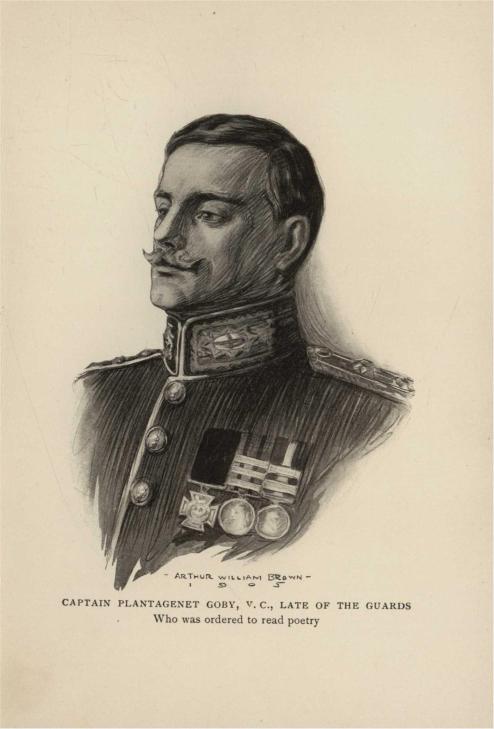
CAPTAIN PLANTAGENET GOBY, V.C., LATE OF THE GUARDS. Who was ordered to read poetry
"I say, Mr. de Vere, wasn't that ripping of old Goby to say he'd give me a real pedigree bull-pup? He knows a bull-pup from a window-shutter, as Baker says. You don't like them? No, but you would if you had one. I feed mine myself, and I wear thick gloves, so's not to get hydrophobia when he bites. He's a most interesting dog, and not so good-tempered as most bulldogs. When he sees a cat, oh, my, it's fun! Look here, when Goby gives me the new pup with the pedigree, you can have mine, if you like, cheap. I know you have a place in the country, and you must want a bulldog. Will you buy him?"
"Good heavens, no!" said the poet.
"Humph!" cried Bob, who of course had quite forgotten that he was doing all this for Goby, and was just enjoying himself. "Why, what do you do in the country without a dog? Do you ride?"
"No," said De Vere.
"Well, of all—I say, Mr. de Vere, what do you do? Do you walk about and make poetry, and do you like making it? Old Guth, I mean Mr. Guthrie, he's my tutor, and he's over there talking to Mrs. Cadwallader, he reads a lot, and some of yours, too."
"Oh, does he!" said De Vere, who began to take some interest. "Does he?"
"Oh, a lot of yours, he says; most of it, I think."
"And does he like it?"
Bob put his head on one side.
"Well, he says it's not bad, some of it."
De Vere flinched at this faint praise.
"Indeed! And what does he like best?" he asked.
"Oh, the beastliest rot," returned Bob, "Browning and Shelley, and I say, do you see that bulge in his pocket? That's Catullus. He reads him all day. But here comes Pen. I say, won't you have my bull-pup? I'll let you have him for half a sovereign; I got him for a sovereign, at least, Baker did. I think your poetry's very fine, sir; Mr. Guthrie lent me some."
But Penelope came across the lawn, and De Vere forgot Bob and the bull-pup, and fell down and worshipped. And the goddess took hold of him, and stripped a lot of his poetry away, and set a few facts before him and made him gasp.
"I heard a very strange rumour, Lady Penelope," he said, when he was once more standing upright before Aphrodite. "I heard—oh, but it was absurd! I can't believe it."
"Then it is probably true," said the goddess, breathlessly, "for I mean to have my own way and to initiate a reform in marriages, Mr. de Vere. I have been reading the accounts of some fashionable weddings lately, and they made me ill. What you have heard is quite true."
The poet shook his head.
"I have had the honour to beg you to believe a thousand times that I am devoted to you—"
"Three times, I think," said Pen, who was good at arithmetic.
"Is it only thrice? But do I understand that, if I were to have the inexpressible delight of winning your love, Lady Penelope, that the marriage would be a secret one, that no one would know of it?"
"I mean that," said Penelope, enthusiastically. "It is a new departure, an assertion of a just individualism, although I am a socialist. I abhor ceremonies, and will not be interfered with. I have stated with the utmost clarity to all my relations that I shall not consult them or let them know until I choose, and I shall only get married (if I ever do) on these terms."
"I agree to them," said the poet. "Lady Penelope, will you do me the inexpressible honour to be my wife?"
"Oh, dear, no," said Pen. "Why, certainly not, Mr. de Vere. I don't love any one yet, and perhaps I never shall. But what I say is this: I'll think as to whether I shall marry you if you do as I wish about this matter and about others."
"My blessed lady," said the poet, "is there anything I would not dare or do?"
"I've told Captain Goby exactly the same thing," said Penelope, thereby putting her pretty foot upon the sudden flowers of De Vere's imagination, "and what I want of you is to be more an out-of-door man. You live too much in rooms, hothouses, Mr. de Vere, and in your own garden."
"I was in a garden, I a poet, with one who was (oh, and is) an angel," said De Vere, "but now I dwell in arid deserts, shall I say the Desert of Gobi? What have I to do with him? Shall he dare to pretend to you, dear lady?"
"He's a very good chap," said Pen, quite shortly, "and I think it would do you good to associate with him more. I've told him so, and he agrees. I want you to make him read a little, and exercise his imagination. And he can take you out rowing and shooting perhaps, and I think a little hunting wouldn't do you harm. You might ask him to stay with you, and he'll ask you. And I want you to go out in motor-cars."
"Good heavens!" said De Vere.
"I know it will be hard," said Pen, consolingly. "But you know what I want. It's not enough to be rich and write poetry, Mr. de Vere. I think you might read statistics; statistics are a tonic, and I want you to be a useful citizen, too. There are things to be done. Just look at my cousin Bob. Now he'll be a splendid man."
"He wanted to sell me a bull-pup," murmured the poet.
"He's a good boy," said Pen, affectionately, "and his instincts are to be trusted. I think a bulldog would do you good perhaps. And I shall expect to hear you have asked Captain Goby to stay with you. And don't forget the statistics."
"I'll do it," said the unhappy poet, "for while the One Hope I have exists, and until 'vain desire at last and vain regret go hand in hand to death,' I am your slave."
And, as he went away, he called Bob to him.
"I'll give you half a sovereign for that bulldog," he said, bitterly.
"Oh, I say. But Baker says he's worth two sovereigns," cried Bob.
"I'll give you two," said the poet.
And Bob danced on the lawn.
CHAPTER IV.
If Penelope had had any sense of humour, she would have deprived the round world of much to laugh at in sad times, when laughter was wanted. But thanks be to whatever gods there are, some folks have no humour, and some have a little, and a few much, and thus the world gets on in spite of the spirit of gravity, which, as may be remembered by students of philosophy, Nietzsche branded as the enemy. Pen went ahead, bent on cutting her own swath in the hay-field, and she cut a big one. Goby and the poet must stand as exemplars of her clear and childlike method. It was Pen's Short Way with Her Lovers. She got Rivaulx, who was Nationalist and Anti-Semite to his manicured finger-tips, and had been mixed up in the Dreyfus case, and set him cheek by jowl with Gordon, alias Isaac Levi.
She made them dine together in public, and the poor marquis, being head over heels in love with the earnest creature who was so beautiful, submitted like a lamb.
"Very well, I will," said Rivaulx. There were almighty shrieks in the Paris press. The Journal had an article that was wonderful. The affair woke up anti-Semitism again. Rivaulx had been bought by Jewry; France was once more betrayed; the bottom of the world was falling out.
Pen, with no sense of humour, had a native capacity for discovering every one's real weakness. As the Frenchman would rather have died than dine as he did, so Gordon would almost prefer to die suddenly than to run the risk of it. He had wonderful brains, and was a power in finance: he could risk a million when he hadn't it or when he had it as coolly as most men can risk a penny on the chance of a slot-machine working. But physically he was timid. Rivaulx went ballooning. He intended to rival Santos-Dumont.
"You must go with him, Mr. Gordon," said Penelope. Gordon nearly fainted, but Pen was firm, as firm as a rock. Gordon offered to subscribe to all the hospitals in London if she would let him off. He offered to build a small one and endow it; he even suggested that he would build a church. But the poor man had to go. It was now thoroughly understood that any man who refused to do exactly what she told him was struck off the list. The comic papers were almost comic about it. On the day that Gordon went up with Rivaulx in an entirely non-dirigible balloon, the Crystal Palace grounds were crowded with all the Frenchmen and all the Jews in London. The balloon came down in a turnip-field fifteen miles from anywhere, and Gordon got back to London and went to bed. He was consoled by a telegram from Penelope, who congratulated him on overcoming his natural cowardice, and suggested he should do it again.
"I'll give her up first," said Gordon, knowing all the time that he could no more do it than give up finance. He went out and robbed a lot of his friends as a compensation for disturbance, and found himself a hero. In about forty-eight hours the sensation of being looked on as a man of exceptional grit so pleased him that he adored Penelope more than ever. He was as proud of having been in a balloon as Rivaulx was of having dined tête-à-tête with him in the open.
She sent for Rufus Q. Plant, and she introduced him to Lord Bramber. Plant was a big American with the common delusion among Americans that he had an entirely English accent. But he hated aristocrats. Bramber had an Oxford accent (Balliol variety), and disliked Americans more than getting up in the morning. He was a fine-looking young fellow with a good skull, who did nothing with it. He had the tendencies of a citizen of Sybaris, and got up at noon. Plant rose at dawn. Bramber loved horses and hated motor-cars. Plant had a manufactory of motors. Pen sent them away together on a little tour, and hinted delicately to Plant that his English accent would be improved by a little Oxford polish.
"And as for you, Lord Bramber, when you come back, I hope you will be more ready to acknowledge that you don't know everything. Mr. Plant will do you good, and will teach you to drive a motor!"
She had never been so beautiful. She showed at her best when her interest in humanity made her courageous and brutal. The colour in her cheeks was splendid; her eyes were as earnest as the sea. If Bramber choked, he submitted, though he blasphemed awfully when he got alone.
"Go at once," said Penelope.
She paired off Carteret Williams with Jimmy Carew, A.R.A. Williams knew as much about art as a hog does of harmony. Jimmy thought the war correspondent a howling Philistine, as indeed he was, and believed anything that could not be painted was a mere by-product of the universe.
"You'll do each other good," said Pen, clasping her beautiful hands together with enthusiasm. Jimmy wanted to draw her at once. Williams wished for an immediate invasion, so that he could save her life and write a flamboyant article about it.
"Show him pictures, Mr. Carew, beginning with Turner and Whistler."
"Make him understand that art isn't everything, Mr. Williams."
She sent them away together, and was wonderfully pleased with herself.
"They are all fine men," she said, thoughtfully, "but it is curious that every man I know thinks every other man more or less of a fool or an idiot, or a cad. They are dreadfully one-sided. When they come back they will be much improved. This is my work in the world, and I don't care a bit what people say."
People said lots, though after a bit the fun died down, except among her own people. And even they laughed at last. At least, every one did but Titania, and she had no more sense of humour than Penelope herself. Indeed, she had less, for Penelope could understand a joke when it was explained to her carefully, and Titania couldn't. And in after years Pen came to see the humourous side of things. She even appreciated a joke against herself, which is the crucial test of humour. But Titania died maintaining that life was a serious business, and should be taken like medicine.
"I never heard of more insane proceedings," said Titania, "never! The notion of sending that poor Jew up in a balloon with that mad Frenchman! Balloons at the best are blasphemous. And to make Captain Goby read with poor little De Vere! I'm sure there will be murder done before she's married. And now it's an understood thing that she will marry one of them. And Brading laughs! If he is only her half-brother, I consider him responsible. And Augustin smiles and smokes and smokes and smiles. And Chloe Cadwallader, whom I never approved of and never shall, backs her up, of course. One of these days I shall tell Chloe Cadwallader what I think of her!"
"I say, granny, what do you think of her?" asked Bob.
"Never mind," said Titania; "there are things that you know nothing of, Robert."
"Oh, are there?" said Bob. "I say, granny, I ain't sure of that. I've been expelled from three schools, and Baker says—"
"Oh, bother Baker," cried his exasperated grandmother. "I think Mr. Guthrie might keep you away from Baker."
"He can't," said Bob, cheerfully. "Old Guth and I have made a treaty. I do what he tells me between ten and twelve, and what I like afterward. If we are reading Latin, and the clock strikes twelve, I say, 'Mr. Guthrie, don't you think Latin's rot?' and he says, 'Oh, is it twelve? I thought it was only eleven!' I get on with Guth, I tell you."
And he was very thick with Goby, who had given him the pedigree bull-pup. Mr. de Vere now owned the interesting one which had to be fed with gloves on, and loathed it with an exceeding hatred only exceeded by his hatred for Goby.
"I say, Pen, you go it," said Bob. "There's heaps of fun in this. They all tip me now like winking."
But Pen did not see the fun. It was a serious business. She looked after her lovers with the greatest care. They brought her reports; they complained of each other. She smoothed over difficulties, and explained what they were to do.
"How the devil am I to live on a thousand a year!" said Goby. But he tried it and found it quite exciting. It exercised his self-control wonderfully. He went into the War Office once a week and demanded some kind of job, and was put off with all kinds of regulations. He sent a telegram to Penelope the first week, saying that according to his accounts he had spent no more than £20. She wired congratulations, and received another wire:
"Have made a mistake. Forgot to include a few bills. Will be more careful in future.
"GOBY."
Plant said:
"What, a thousand a year! That's easy. I can live on thirty shillings a week. My dear Lady Penelope, I've done it on half a dollar a day. I'll show you."
He took one room in Bloomsbury, and sent in his bills and accounts to her weekly. She suggested he should find out if his great success in the United States had ruined any one in particular, and if so that he should compensate them. This cost him a hundred thousand dollars. Almost every other day she got a telegram something like this:
"Have found another person I ruined. Am cabling five thousand dollars to widow and orphans. Man is dead."
Or,—
"Another find. Man said to be a lunatic, but perfectly sane except on point of Trusts. Have cabled for his transfer to more comfortable asylum."
Or,—
"Widow refuses money with insults. Have settled it on daughter, and have given son job."
Or,—
"Man in question has given amount cabled to Republicans of New York. Has recovered and has started a Trust himself."
This was very satisfactory. Penelope saw she was doing good. In the middle of her joy, she received a wire from Goby.
"May I stop poetry with De Vere? Doctor says I am overdoing it. GOBY."
She also received one at the same time from De Vere:
"If I could have a week to myself to write satire, should be eternally grateful. Doctor says rowing may be carried to excess. The bulldog is well.
"DE VERE."
The Marquis de Rivaulx, after a fortnight with Gordon, asked to be allowed to go over to Paris to see his mother. But he acknowledged that Gordon was not a bad chap, though he was as white as a sheet in the balloon.
"And he told me, my dear lady, what to buy. He knows very well what to buy and what to sell. He is immensely clevair, oh, yes. And may I go and see maman?"
She let him go, but not before he promised to take no part in any further anti-Semitic proceedings. She told Gordon not to brag so much of having been in a balloon.
"You know you were afraid," she said. "The marquis said you were."
"Of course I was," said Gordon, "but I went, didn't I?"
That was unanswerable.
She had an "at home" once a week. It was understood that no one but her own relatives and members of the horde were to call on that day. She then issued any directions that she thought of during the week. Bradstock was now openly and recklessly on her side.
"I believe you're doing good, real good," said Augustin. "I'm proud of you. Don't mind my laughing, Pen. Oh, but you are wonderful."
He gave her advice.
"Kick young Bramber into public life," he said. "He's got brains."
"Lord Bramber," said Pen, "you are to go into Parliament at once. Speak to Lord Bradstock about it, and I'll talk to Mrs. Mytton on your behalf. I expect you to be an Under-Secretary of State at once."
"Damn! this is worse than Plant," said the obedient Bramber. Nevertheless, he owned that Plant was a man, and a real good sort.
"I go to see him, Lady Penelope, in his room in Bloomsbury. He's living on about half a crown a day. I—oh—yes, I'm coming down to the thousand by degrees. And of course if you want me to go into the House, I'll go."
Carteret Williams was there, and was put through his paces by Pen about art. He had learnt something about it by rote.
"The Academy is composed of painters," he said, mechanically, "but there are few artists in it. I quite agree with Carew, who had his pictures chucked before they made him an associate through fear. Turner is a very great artist. He shows how near the sublime can get to the ridiculous. Whistler is also great. He shows how near the ridiculous can go to the sublime. Art is a combination of the material and the spiritual. So Carew says. He showed me a lot of Blake, and he says that the beauty of Blake is that you can't understand him by any ordinary means, such as the intellect. I'm not up to Blake yet. The old masters are very fine. I admit it. Velasquez is dry, but wonderful. Rembrandt appeals to me because he is very dark; I think he would be better if he were darker. We go to the National Gallery every day, and then I take him to the Press Club, where he hears about real life."
When Carew came, he owned that Williams wasn't a bad sort.
"And he's doing his level best to understand," said Carew, with enthusiasm. "He stands before a picture of mine every day for an hour while I explain it. He sees something in it at last. And he's reading about art, and is beginning to see why a photograph isn't the last word of things. He's led a wonderful life, Lady Penelope, and when he gets on what he's seen and done, I feel almost ashamed to live as I do."
"That's right," said Pen; "every artist should. And every man who is not an artist should be sorry that he is not. We are far from perfect yet."
How beautiful she looked, thought Carew.
"She lives in the world of the ideal, and so do I."
"I am very much pleased with everything," said Pen at large to the assembly, and De Vere, who was having a holiday for his satire, was pleased too. And Goby was delighted at being let off poetry for awhile.
"Not but what there's something in it, I admit," said Goby, critically. "Robert Lindsay Gordon is a fair snorter at it. I can't say I'm up to Shelley yet. De Vere read me the Epi-something-or-other."
"'Epipsychidion,'" said Pen.
"That's it, a regular water-jump of a word," said Goby, "and he took it in his stride, while I boggled on the bank. However, I'm coming up hand over hand with him. I'm reading Keats with him. He's all right when you get to know him, Lady Penelope, and rowing's doing him no end of good. He's a well-made little chap, and getting some good muscle. If I'm not dead by the time I can take the Epi-what's-his-name, I'll make a man of him."
Rivaulx, who had come in with Gordon on his return from seeing his mother in Paris, was very proud of himself.
"A year ago I should not have had the courage to show myself with a Jew," said Rivaulx, triumphantly. "Lady, dear lady, I thought I should have died when I asked him to dinner. But now I like him. He is wonderful. When he says 'buy,' I buy, and heigh, presto! the shares go up like my balloon. And when he says 'sell,' I sell, and they go down like a barometer when you go up. Oh, yes, and all your aristocracy admire him. I saw seven great lords with him the other day, and they said: 'What company am I to be a director of, Gordon?' and he said he'd ask his clerk. But I have refused to be a director. I should not like maman to know I know him. She is very dreadful against Jews, owing to the affaire in France."
And that was the celebrated afternoon that Penelope, who found that she was doing good in every way to all mankind by obliterating all class and professional jealousies, raised passion and curiosity to its highest point by saying, with the sweetest blush:
"Very well, then, I promise to marry one of you!"
CHAPTER V.
Penelope was the swan, and all her relations were the ducks. The noise they made was simply unendurable. For, besides Titania, she had cousins and other aunts, or people who were in the position of aunts, and she had friends who had been friends of her mother, and they came down on her like the Assyrian. They objected to publicity, especially for other people, and for a young woman to become a public character was something worse than immorality. Nothing but Penelope's entire singleness of character and her humourous want of humour enabled her to meet and overcome them. And even she felt at times that flight was the only thing left. She sent to her solicitor for a list of all the houses and mansions and castles that she owned, and she took her motor-car and her pet chauffeur, and, having borrowed Bob from his grandmother, she set off on a tour. She disappeared for a week at a time. Then she disappeared for two weeks. She was even lost for a month.
"She ought to be in an asylum," said Titania, "and I have to let Bob go with her. He is some kind of a safeguard. How do I know she isn't married already? Bob, dear Bob, has ceased to confide in me. When I interrogate him, he puts me off. I get nothing out of him. The only thing that I can congratulate myself on is that now, instead of 'Baker says,' it is 'Pen says.' And I doubt, I own I doubt, and I cannot help it, whether Bob is not being done serious harm to, considering that he will one day be a duke. A duke should be brought up properly. Goring was brought up badly, I deeply regret to say. He laughs at Penelope's behaviour, and says girls will be girls. I say they will be women, and he says, 'Thank the Lord,' and I don't know what he means. But, as I say, this wretched girl may be married by now. It is already months since she said, in my hearing, to a whole crowd of men, 'I promise to marry one of you!' Was there ever an aunt in a more unfortunate position? I feel as if I should become a lunatic. Augustin, do you hear me, I am rapidly becoming insane."
"Oh, ah," said Augustin, who always knew more about Pen's actions than any one else. She wrote to him from a hundred places.
"Keep your eye upon Mr. Gordon," she said. "And what are people saying about Lord Bramber's speech? I shall be up in town in time to see Mr. Carew's new picture. I got a letter from Mr. de Vere, saying that Captain Goby was learning Wordsworth's ode on the 'Intimations of Immortality in Childhood' by heart. Mr. de Vere says he is doing what I told him, and is keeping his eye on Mr. Roosevelt. I told him to model himself on the President of the United States. He says he rows and has bought a Sandow exerciser, and he says it does not make him so tired now. Mr. Williams told me when I was last in town that he was thinking of writing a guide to Dulwich Gallery if war didn't break out. I am afraid he hopes it will. Mr. Plant's last weekly accounts were only 10*s*. 6*d*. I advised him to see a doctor if he thought it was doing him harm. The marquis has written a very good article in the Revue des Deux Mondes against anti-Semitism. I am greatly pleased with this. I hope Mr. Carew's picture is intelligible. I told him it was no absolute sign of genius to be entirely incomprehensible. He took it very well. I think Mr. Williams will have a good effect on him. I have visited ten mansions, seven castles (two with moats; mother used to love moats, because there are none in America), and several other houses of mine. Most need repairs. I shall be home next week. Tell aunt that Bob is very well and brown, and is learning to drive my car at full speed down a narrow road with sharp turns in it. Smith says he will be the best driver in England when he is grown up, if he goes on and doesn't have his nerve broken up early by an accident. But I think his nerve is good, though I can't always tell, as I shut my eyes when we go very fast. Good-bye now, dear Guardy.
"Your loving
"PENELOPE.
"P. S. I am sure I am doing good!"
Bob was very sure of it, too.
"I say, Pen, old Guth will be lonely, won't he? But he's all right if he has a bally Catullus in his pocket, and he draws his screw just the same. Granny is very decent to him, take it all around. And I like him because he likes dogs. I must wire to Baker to hear how 'Captain' is getting on. I called him Captain because old Goby gave him to me. I say, Pen, don't you think Smith is a ripping good driver? He says that he'll be my chauffeur when I'm a duke, if you don't want him. He says him and me'll win every bally race. I'd like to do that. I begin to think horse-racing is rot. You see three or four people can't ride a race-horse, and the responsibility of driving you fast when the road's crooked is the fun. Every time I miss a cart, Pen, I feel as happy as if I'd hit Rhodes for four every time he sent a ball down to me. That would be fun. Baker says—no, I mean Smith says that all other sports are rot of the worst kind. He says if he's ever rich, he'll go through the city every day as fast as he can. He hates the police, and some of them hate him. He rode over a sergeant in the Kingston Road once, but he didn't hurt him much. When shall we leave this castle and go to another one? I hope the next is a long way off. Smith says he wants a good road to show what she'll do when she's out to the last notch. And it must be down-hill."
And in town, while Pen was going about the country, people's tongues ran as fast as any motorcar.
"It is nonsense," said one; "she's married already."
"I know she's not. I paid a shilling and looked it up at Somerset House."
"That's nothing," said a barrister. "They could have been married under wrong names."
"That wouldn't be legal."
"Yes, it would. It's only illegal if a false name is used and one of the parties doesn't know. Then the one who is deceived can get a declaration of nullity," said the barrister.
"Oh, well, but who is it?"
"It's no one. I don't believe she'll marry at all."
"She's a crank."
"It's madness. I hear the Duchess of Goring has taken to her bed."
"Well, Goring hasn't. I saw him at the Frivolity."
"Who is it now?"
"I don't know her name. But where's Lady Penelope?"
No one knew but Bradstock, and even Augustin was behind by a post or two. None of the "horde" knew, and they began to get suspicious of each other. Goby watched De Vere, and De Vere kept his eye on Goby. It was obvious from the newspapers that Bramber was in the House. Gordon was seen at his Club. And then Carteret Williams was missing. Carew hunted for him in vain at the Press Club and at the office of the Morning Hour. There was no war yet, though there were rumours of it in the Balkans as usual.
It got about that she had married Williams, though he had only run away from Carew for a week.
"The very worst of the lot," wailed Titania. "I knew it would be Williams. He's hardly a gentleman, though he comes of a good family. Being a war correspondent makes a man brutal. I knew, I knew, I knew it was Williams, and now I shall never speak to her; and he will beat her in time, I know it, and there will be a horrible scandal; and what, oh, what can she have done with Bob? Augustin, go at once and find where Bob is. I knew it would be Williams! Didn't I always say it would be Williams? I could have forgiven her any one else."
Gordon came to ask Bradstock if it was true. And Bradstock had a sense of humour, if Pen had none.
"My dear sir," he said, "how can I tell? She liked him very much, took a great interest in him. She told me he was writing a guide to the art of Dulwich Gallery. Do you think that a bad sign?"
Gordon groaned.
"It looks bad, Lord Bradstock. But I don't believe she takes much interest in him. She takes an interest in me, my lord! Why, I went up in a balloon all on her account. I went with that madman, the French marquis, and as sure as my name's Le— I mean Gordon, there's not another woman in the world I'd have done it for. Don't you think that going up in a balloon, when you'd rather die than do it, ought to touch a woman's heart? I give you my word that she as good as said, 'Go up in a balloon and I'll—' well, or words to that effect. I tell you what, Lord Bradstock, I know you ain't a rich man, not a very rich one, that is, but, if you'll be on my side, I'll put you on to a good thing, the best thing in the market. It's going up like—oh, like a beastly balloon, sir,—my lord, I mean. I'm making it go up, and I'll tell you when to sell. Oh, Lord, I'm very unhappy, my lord. I love the ground she walks on. I'd like to buy it at the price of a city frontage. Come in with me, my lord, and you shall have a tip that half a dozen dukes are dying for. There's a room full of bally dukes waiting to see me now, and I gave them the slip. Will you come in with me? Do, do!"
He was a lamentable object, and there was a spot upon his hat which did not shine. He worked at it eagerly with his sleeve, and stood waiting for a reply.
"I don't mind telling you," said Bradstock, "that my income is only five thousand a year."
"Poor beggar!" murmured Gordon.
"But I only spend four. And if I had more what could I do with it?"
"Give it me," said Gordon, eagerly, "and I'll make more of it for you. Man alive,—my lord, I mean—I can make it millions."
There was a faint suspicion of the "millionth" in the word.
"I can make it millionth," said Gordon. "I've put a pound or two into that Frenchman's pocket, I can tell you, though he did take me up in a balloon, and I'll put fifty for one into yourth, so help me."
"I don't want it."
"Well, you can give it away," shrieked Gordon. "They'll make you a duke if you only give away enough. If there wathn't a faint thuspithion of Jewish blood in me, I'd be a baron now at leathth. Give it away to hospithalths, build a lunatic asylum, finanth your party. And if that don't thucktheed, go into beer or biscuits, and you'll be made anything you like."
"If they would make me thirty, I'd do it," said Bradstock.
"Thirty dukes?" asked Gordon, in bewilderment.
"Thirty years old," said Bradstock.
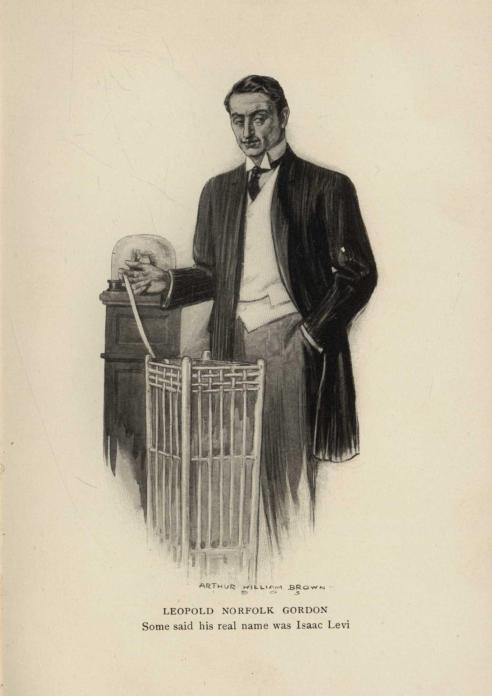
LEOPOLD NORFOLK GORDON. Some said his real name was Isaac Levi
Gordon advanced on him and took him by a button.
"My lord," he said, solemnly, "money ith youth and strength and everything except Lady Penelope. If you had a million, you'd feel twenty-five. When I had a measly hundred thousand, I was thin and always going to doctors. When I got two, I got fatter and gave 'em up. Now I'm worth two millionth."
But Bradstock said, brutally: "No, Mr. Gordon, I don't want money, and I don't want you to marry Lady Penelope. If I had a million, I'd rather lose it than see her do so."
"Did you tell her that?" asked Gordon.
"I did."
"I'm damned glad," said Gordon. "If you want a cat to go one way, pull its tail the other."
"Tut, tut," said Bradstock, and Gordon went away sorrowfully, for he had great riches, and saw no good in them without Pen.
Bradstock had to interview all the lovers one after one. They came to implore his vote and interest. He saw Rivaulx, whose great desire was to look like an Englishman and act like one. Rivaulx adopted a stony calm, which sat upon him like a title on a Jew, but did not stick so tight. He ended a talk which began most conventionally in a wild and impassioned waltz around Bradstock's room, with despair for a partner. He tore at his hair, but, having had it clipped till it was like a shaved blacking-brush, he could not get hold of it.
"I must wed her," he howled. "I told maman so, or I shall perish. I will become an Englishman. Mon Dieu, I am sad. I am fearfully mournful. I weep exceedingly. Have I not done all? I have eaten largely in public with Mr. Gordon. I have bought his shares and have sold them, but in my heart I cannot. When I return to Paris, I shall fight duels because I have written for Dreyfus with tears in my eye and my tongue in my cheek for sorrow. Where is she, Lord Bradstock? Tell me where she is? I will go to her and say I have done all and can no more!"
De Vere tackled him, too.
"My dear chap," said Bradstock, "I don't know her mind."
"She knows her own," said De Vere, with much bitterness, "and so does that boy Bob. I bought a bulldog of him, because she said she thought one would do me good. I don't know why, and now Bob sells me dogs by telegram, and I daren't refuse 'em."
"Great Scott!" said his host; "but why?"
"That young ruffian has an influence over her," mourned the poet. "He is always with her. He is capable of saying I am a 'rotter'; yes, a rotter, a dozen times a day if I refuse, and to have him doing that would be more than I can endure. I want her to love me, and so I buy his dogs. I have a bulldog which hasn't done me any good. All he has done is to tear my trousers and trample over my flower-beds. I have an Irish terrier who is now being cured of bulldog bites by a veterinary surgeon. I've a retriever who howls at night and makes the bulldog unhappy. I have a Borzois with bronchitis and no hair on his tail. Bob wrote to say the hair would grow if I put hair-wash on it myself. He said men couldn't be trusted to do it. And then I've Goby on my hands. I speak in confidence, Lord Bradstock."
"Of course," said Bradstock.
"Then I own I loathe Goby," said De Vere, viciously. "He has less brains than my bulldog, and I think the bulldog has less brains than the retriever. He reads poetry because she said he was to, and he makes me explain mine to him. Explain it! And he makes me row every day he's with me, and he says I'm not imitating Roosevelt if I don't. She said I was to imitate Roosevelt. Why should I? I loathe Republicans. She also told me I was to imitate Sven Hedin. On inquiry I found Sven Hedin was an ass who explored deserts, and went without water for many days. Goby can do that, as my wine-cellar can testify. He says he only tastes water when he cleans his teeth, and then it makes him sick. And, though I keep wine for my friends, I am a water-drinker. How can I do without it? I am very unhappy."
"I should chuck Goby and give it up," said Bradstock.