Front matter (continued 2)
Reading edition
"I wish I could," said the poet, "but my nature is an enduring one. We learn in suffering Gobies and bulldogs what we teach in song. A dog may be the friend of man, but a bulldog is a tailor's enemy. And I believe they gave Goby the V.C. to get rid of him. Do they ever give decorations to get rid of people?"
Bradstock said he thought so, and wondered what he could give De Vere.
And then the poet sighed and rose.
"I have to meet Goby and lunch with him. And afterward we read Shelley together, and then he will teach me billiards at his club. I loathe billiards. It is the most foolish game on earth except keeping bulldogs. And Goby's friends are not sympathetic. They are sportsmen, and ought to be hunted with bulldogs."
He went away sadly, and Bradstock lay on a sofa and laughed till he cried.
"Pen will be my death and the death of a dozen," he said. "And as for Bob—"
No sooner had De Vere departed than young Bramber was announced.
"Conceited young ass," said Bradstock. But Bramber was in the House, and was supposed to be doing very well. He had brains, no doubt, and the manner of Oxford (Balliol variety, as aforesaid) sat on him well. He made speeches, and Mr. Mytton congratulated him on one of them. Nothing but his passion for Penelope prevented him being as conceited as Bradstock supposed him to be. But it must be remembered that Bradstock couldn't make speeches.
"I thought I'd come and look you up," said Bramber. "I thought you could tell me something about Lady Penelope."
"I can't," replied Bradstock. "I spend all my afternoons in saying so. I've had Rivaulx and Austin de Vere and Gordon here already, and after you go I don't doubt that Goby or Plant will turn up. How do you get on with Plant? Do you know, Bramber, I believe Plant is the best man of the lot of you."
Bramber frowned.
"He has an accent that can be cut into slabs, to use his own dialect," said Bramber.
"Your own accent is equally disagreeable to an American," said Bradstock, who had been in the United States several times.
"I have no accent," said Bramber, haughtily.
"Oh," returned Bradstock. "And how do you get along with Plant?"
Bramber was obviously more jealous of Plant than any one. But he made a tremendous effort to be fair.
"He's a very able man," he said at last, "but there's no man I should find it so hard to get on with. He says just what he thinks in the most awful way. And because Lady Penelope said he was not to spend more than twenty-five pounds a week, he is living on ten shillings out of bravado. I hate bravado. He made me dine with him in Soho, and our dinners came to elevenpence each. Where is Lady Penelope?"
"I don't know," said Bradstock.
"I didn't see Plant yesterday," said Bramber, uneasily.
"The devil!"
"You don't think?"
"I don't know what to think," said Bradstock, wickedly. "I hear that Jimmy Carew hasn't been seen for days, either."
Bramber fidgeted on his chair.
"She can't marry Carew. He's a thorough outsider."
"Women don't understand the word, my dear chap. How are you getting on in the House? And have you been motoring with Plant?"
"Yes," said Bramber; "we killed three fowls and a dog yesterday. And Plant was fined ten pounds a week ago. He said he would wire to Lady Penelope to know if that was business expenses. I believe he wants to break my neck."
"I shouldn't be surprised," said Bradstock. "Has he gone out alone to-day, do you think? I suppose you know Penelope is doing a lot of it now?"
"The devil she is!" said Bramber. "I think I'll go and look up Plant."
Bradstock got some amusement out of the situation, if Titania didn't.
CHAPTER VI.
Penelope came back to town about a week later and saw every one.
"I wonder whom I love," said Pen, "for I'm sure I love some one. And they are all so kind and sweet and good. I'm sorry I shall have to hurt so many of them, for the poor dears all adore me."
It was marvellous how they had developed in a short time under Pen's system, which was evidently sound, as Bradstock declared. Plant, under his ten-and-sixpence-a-week scheme, had lost a stone weight, and was as hard and fine as a coil of wire. His search after the people he had ruined gave him a peace of mind to which he had long been a stranger, for American millionaires in business have no peace of mind.
"I feel good," said Plant, meaning it both ways, "and my endurance of young Bramber has stiffened my moral fibre."
"Whether I marry you or not, Mr. Plant," said Penelope, "I am awfully pleased with you. And how has Lord Bramber behaved?"
"He's been death on what he called my accent," said Plant, a little bitterly, "and it is notorious I've none to speak of; and, for that matter, his own you could cut with a knife. However, I think he's a good boy, and will discover he has brains. I've talked to him straight, Lady Penelope. I told him you meant me to. I said he might be a lord and the son of an earl, but that he was a lazy, loafing scallawag, and that, if he'd been my son, I'd have cowhided him. That did him good; it made him sit up, I tell you. Oh, he fairly fizzled and felt like going for me, but he knew better. He has brains, and I've talked with members of your legislature who say he'll do well. Put this down to me, Lady Penelope. Credit me with this. I've looked after him like a baby, and I've hustled him around in my motor till he can't help going when he's out of it. You and me together, my dear young lady, could educate the entire universe. If you'll only marry me, I'll start a university on these lines of yours."
The idea was a pleasing one, but of course Pen pointed out to him that it was his duty to do it whether she married him or not.
"Duty is duty," said Pen. "I'm doing all this out of a sense of duty."
"Don't marry out of a sense of it," retorted Plant. "I just want to be loved. I'm going around feeling I want to be loved. I've never been loved properly all my life, and I begin to hanker after it wildly. And, if you do marry me, Lady Penelope, I want you to understand right here and now that I don't want you to do your duty by me. If you begin to do that, I'll take a Colt's forty-five and scatter my brains out. I want love, that's what I want. I want it straight, without water in it."
"I see what you mean," said Penelope. "I think you are a very noble-hearted man, Mr. Plant."
And away went poor Plant to draw up a scheme for a university.
"I think I could almost love him," said the pensive Penelope. "I could—almost—"
Her contemplations were interrupted by Captain Goby. He was a little paler than usual, and perhaps a trifle more intelligent. And he was more in love than ever.
"I've done everything you told me," he said, as he sat down and eyed her wistfully. "I've gone into poetry like a bull at a hedge, Lady Penelope. I begin to see what it means. Old Austin (poor old josser) has taken the deuce's own pains over me. He's read 'The Lady of the Garden' to me seventeen times. He wrote it ten years ago. He says he wonders how he did it, and so do I. I've been trying to write poetry to you, do you know. That showed me there must be some special gift in it, for I never did anything worth the horrid trouble. And I've been worrying the War Office like a bulldog. They say they'll think of me, and haven't gone any further, and talking of bulldogs, Bob's bulldog bit Austin de Vere, and he swore like a man. I was surprised. But if I were you, I'd tell Bob to stop sending him more dogs. He's very kind to them, but they worry him. Bob's prices are very high, too. How is Bob? Oh, by the way, I'm living on ten pounds a week. Need I reckon tailor's bills in, do you think? Oh, yes, this bulge is the Golden Treasury. I take it out and read a lyric between meals. The chaps at the Rag chaff me like blazes, but I don't mind so long as I improve. I want to improve so as to be worthy of your intellect, Lady Penelope."
"The poor dear," said Pen, when he was gone, "I think I could almost love him!"
As luck would have it, Bob and Austin de Vere came in almost at the same minute. For now Titania couldn't keep Bob away. For the matter of that, she did not want to. Bob was to be Penelope's safeguard. He was much better than Chloe Cadwallader, said Titania.
However, De Vere came in first. He held Penelope's hand no longer than a poet should, as poets naturally hold girls' hands rather longer than other people.
"You are looking really well, Mr. de Vere," said Penelope, when she was free.
"I am well," said the poet, "exceedingly well in a way. My dear lady of the beautiful garden, I owe all that to you. At first I was afraid of Captain Goby. I told Lord Bradstock so the other day. I'm afraid I left him under a false impression as to my feelings to Goby, by the way. I'm quite proud of Goby. He says I am really a powerful man, and he made me row till I was worn out. And then he insisted that I should use Sandow's exerciser. I own I did it with reluctance. I pointed out to Goby that I did not wish to look like Mr. Sandow. Goby always stopped by the posters in which Mr. Sandow is lifting ten tons or so, and pointed out certain muscles to me as ideals. I was recalcitrant, for, although I admire Mr. Sandow immensely, I think muscle can be overdone. However, I used the machine, which is ingenious and elastic, and only dangerous if the hook comes out of the wall, and I've found I rather like it. I should miss it now. I think it imparts a certain vigour to verse, if not overdone. Oh—"
For in came Bob. He rushed at Pen and kissed her hair, and then bounced at the poet.
"I say is it true the bulldog bit you? I saw Goby yesterday in the park, and he said so," asked Bob, in great excitement.
"It is true," said the poet.
Penelope shook her head at the late owner of the dog.
"Oh, Bob! Mr. de Vere, I'm very sorry."
"So was I," said De Vere.
"Where did he bite you?" asked Bob, anxiously. "Was it the arm or the leg? And did he hang on like a proper bulldog? Baker says that if a bulldog once gets hold, you have to use a red-hot poker to make him let go. Did you use a red-hot poker?"
"He only snapped and fetched blood," said De Vere.
"Ah!" cried Bob, "I always thought he wasn't a real good bulldog."
"At any rate, he bit the Irish terrier," said the poet. "I mean the one you sold to me for three pounds."
"I'm glad he did, sir. That Irish terrier, though he's splendidly bred, Baker says, has an awful temper and is very troublesome. Does Rollo, the retriever, howl much at night, sir?"
"Oh, not so very much," said De Vere. "It's only when the moon is near the full that he does his best."
"I never thought of that," said Bob, "but now I remember that it was very moony when I sent him over to you. Baker said you'd like him. His kennel is next to Baker's house."
"I'm much obliged to Baker," said De Vere. "But the tail of the Borzois is still bald, Bob."
Bob opened his eyes wide.
"Oh, dear, I thought you would have cured him by now; and how about his bronchitis?"
"That's better, I hope and trust," said the poet. And Penelope, who was very greatly touched by his kindness to all these dogs, sent Bob into the library.
"It's so good of you to be kind to Bob," she said. "Bob's a dear, and he adores me. He says that he's going to live with me always, even when I'm married."
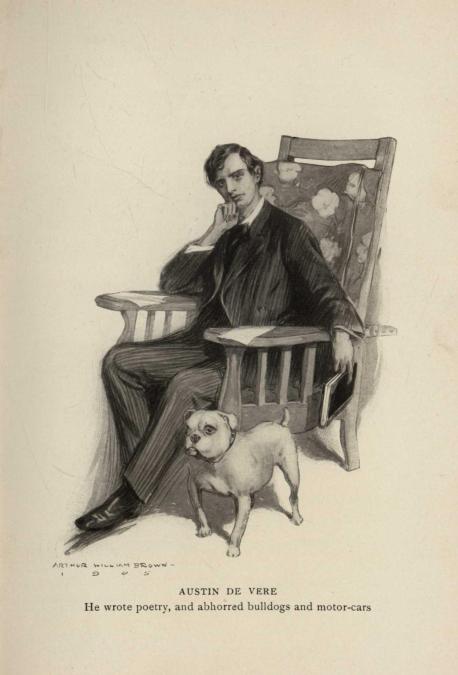
AUSTIN DE VERE. He wrote poetry, and abhorred bulldogs and motor-cars
"Oh!" gasped De Vere. "We were talking about Goby, I think, when dear Bob came in. You'll find him much improved, I'm sure, my dear Lady Penelope. He has read a great deal of Shelley and Keats and Browning with me. He was especially struck with 'Sordello.' I read it to him and he sat with his hand to his forehead taking it all in. And every now and again he said, 'Great Scott!' which is his way of expressing wonderment and admiration. I do not know its origin. I've written to Doctor Murray to ask him if he knows. And Goby, oh, yes, you'll find him improved. I've done my best with him, and I've really struggled hard. Any improvement you notice is, I really believe, under you and Providence, due to me."
And when he went, Penelope sat thinking.
"The poor dear, how nicely he took the bulldog bites and the howling of the retriever. I think—I think I could almost love him!"
And that afternoon and evening she saw Bramber and Carteret Williams and Jimmy Carew and Gordon, and they were all most marvellously improved. Bramber was alert and bright, and began to show that he had some ambition in him, and, if he did not tell Penelope his exact mind about Plant, he did show some little appreciation of the American's qualities.
"Associating with him has done you good," said Pen. "I see it has. You lived far too much for yourself, Lord Bramber. I cannot endure selfishness."
"I'm not selfish any more, I think," said Bramber. "I rather like Plant. He seems a man, take him all around. He is abrupt, perhaps, and brutal. I own I've found him trying, and he says things one finds it hard to forgive."
"Yes, he told me," said Pen, delightedly. "Oh, he told me he said you ought to be beaten severely, and he said you took it very nicely. Did you?"
Bramber bit his lip.
"I did."
"That's right," said Pen. "Oh, I'm improving you all so much. You've no idea how much improved you are. Mr. Mytton said he'd make something out of you, Lord Bramber."
"Did he really?"
"Oh, yes. He said he made fair successes out of very much worse material.
"He's quite a dear," she sighed, when he was gone, but, before she could add that she might almost love him, Carew and Williams came in together. And before she could greet them, Gordon came, too. Williams eyed him with strange ferocity, for he was by nature a hater of Hebrews, and wanted to dust the floor with him. Pen, who was as quick as lightning, caught his glances and said to him, sweetly:
"I think you would get on nicely with Mr. Gordon."
And Williams blenched visibly.
"Oh, I couldn't leave Carew," he said. "I'm deep in art, very deep; I adore it. Carew has introduced me to several Academicians, and I have bought a box of paints. One Academician took me home with him and showed me his pictures. He doesn't agree with Jimmy altogether, and he says Jimmy will alter his opinions presently. His idea is that when a man is an A.R.A., he is only beginning, you see. He also explained to me the attitude of the R.A. with regard to the Chantrey Bequest. He says that if they found a good picture not by an Academician, they would buy it, which is interesting, isn't it? He was painting a picture called 'War,' and wanted my opinion. I said I'd ask Jimmy, because I didn't know anything about war except what I'd seen. I don't know why he was chuffy about it. I find artists get chuffy and huffy very quick, and I don't know what for. Do you think there will be war soon?"
Penelope didn't know, and said she wanted eternal peace and happiness for every one, and meant having it if it could be got by any legitimate influence.
"War is horrible!"
"It is," said Carew, who joined in just here, after getting away from Gordon, who told him to buy Hittites at 3-1/8. "War is horrid. Williams is always talking of it."
"I'm not," said Williams, angrily. "I want peace, eternal peace and happiness for every one."
"Ah, so do I," put in Gordon. "My idea is to have a peaceful life, far from the roar of London, in a deep green vale, where I shall hear no one talking of shares, and where mines are unknown, and there are no Chinese or crushing reports. Why is it that most reports from mines are crushing? I wish I knew."
"Ah, how sweet it would all be," said beautiful Penelope. "You could keep cows, Mr. Gordon."
"I adore them," said Gordon. "There is a breed without horns, isn't there?"
"They look incomplete," said Jimmy.
"What are you painting now?" asked Pen.
"I'm not really painting, I'm modelling in clay, as you told me," said the obsequious lover. "Don't you remember saying I was to model in clay? I'm doing Williams in clay. He looks very well in it. I'm also doing a bull going at a gate. When I get tired of Williams, I do the bull, and when I'm fatigued by the bull I go back to Williams."
"And are they like?" asked Penelope.
"Oh, exactly," replied Carew.
And the interesting conversation was interrupted by Chloe and Ethel. But Penelope said to herself that they were all dears.
"Mr. Williams is greatly improved," she murmured happily. "And Mr. Carew looks more healthy and less engrossed in himself. I was awfully glad to hear Mr. Gordon speak like that about a peaceful life."
And Williams slipped Carew on the door-step and went to his club. He roared of war till two o'clock in the morning, and then got three out-of-work war correspondents in the corner and told them the great story of his love. But Jimmy went down to Chelsea, and damned modelling in clay to other impressionist painters, and had a real good time. As for Gordon of the "deep green vale," he went home and found a clerk waiting with a bundle of cables from all quarters of the mining globe. He sent a wire to Bramber to be let off an engagement to hear a debate on drains.
On the whole, every one was tolerably happy, if we do not include Titania and the retriever who howled at nights.
CHAPTER VII.
It is possible that Penelope never enjoyed herself so much as she did at this period. She was so busy that she had no time to worry; her team took all her time. She was young, she was beautiful, she was adored, she was popular, she was even notorious. A dozen reporters dogged her footsteps, and when they lost her they followed her lovers. They haunted her door-step armed with kodaks; they invented paragraphs; they hunted her men and her maids. They made love to the girls, and seduced the men into neighbouring bars. One newspaper man, who belonged to the Mayfair Daily, got into her establishment as a footman, and was discovered by the butler drawing Penelope at dinner when he should have been drawing corks. A search in his clothes revealed some pencils and a note-book and another book of drawings. They were of such a character that the reporter was put outside into the street. The butler could have forgiven the sketch of his mistress: there was one of himself that no man could forgive.
The great desire of all these men was to spot the winner. Penelope's maid, Harriet Weekes, who was more or less engaged to Timothy Bunting, the groom (a sad mésalliance, by the way), found it impossible to go out without being accosted respectfully by a new admirer, who tried to lead the conversation around to her mistress.
"If you please, my lady, another of them spoke to me to-day. I hope, my lady, you don't think it my fault," said Weekes.
"What do they say?" asked Penelope, curiously. She took great interest in the manners and customs of other classes, perhaps with a view of altering them when she got time.
"Oh, my lady, they always say the same thing. I think men are very much the same all over the world. They say 'It's a fine day,' even if it's raining, and of course it is, and they say they want to walk a little way with me (begging your pardon), and that I am very beautiful, and that they have long loved me, if you please, my lady, and have been trying to speak about it for years. And I tell 'em I don't want 'em, and I don't, to be sure, though one (he's on the Piccadilly Circus Gazette) is a very handsome man with a heagle's glance, dressed in gray tweeds. And they won't be put off, I assure you, my lady. Men on newspapers are hextremely persevering with a fine flow of language. And if, being persuaded to take a little walk, for they are difficult to put off by trade, I do take one, they begin to ask, begging your pardon, I'm sure, my lady, if I am your sister, and I'm sure I'm as like you as a butterfly is to a beetle, as Mr. Bunting says, though he adores the ground I walk on, if he's to be believed, which I'm not sure of yet, and the butler is very angry with me about the whole affair. And one, who said he was the editor of the Times, which I don't believe in the least, because it doesn't seem likely, does it, my lady, that the editor of the Times would do such things himself? said he wanted to marry me and put me on the staff as his lovely bride. I must say he spoke most beautifully, and he said he knew Captain Goby, and also Mr. Gordon, and he said they were getting thin he thought. And another, quite the gentleman, though by his trousers poor and careful, said he owned most of the Daily Telegraph. And I couldn't help looking at his clothes. He was very quick, and said that was owing to the competition of the half-penny papers. Would I save the Daily Telegraph from himpending ruin by telling him which it would be, he said. And I said flatly that I wouldn't. I never saw such wicked impudence. Oh, yes, my lady, your hair's done now, and it's as lovely as a dream."
And, as Miss Weekes finished, she wondered, quite as much as any of the newspaper men, who it was to be.
"It's my belief," she said to Timothy, a little later, "that my lady is beginning to incline to one of 'em. I've noticed she's quieter like and more gentle. And there's a soft sadness in her eye and a colour that comes and goes."
"There ain't one of the biling worthy of her," said Timothy, bitterly. "But there, Miss Weekes, there ain't no man worthy of a real beautiful, good lidy. A fair wonder how I dares to hope that some day far off, when motor-cars has killed every 'orse, you'll be Mrs. Bunting."
"It's a great come down, Tim," said Harriet. "Mr. Gubbles says he wonders, too."
"If he wasn't the butler, and old, I'd plug 'im," said Timothy, crossly. "It's all right for me to wonder, but he ain't in it."
"Ah, but class distinctions is hard to get over, Mr. Bunting," said Harriet. "You must pardon a butler's feelings. Even Mr. Gubbles has his feelings. And he agrees with you that there's no one but a duke ought to marry our dear lady. And she demeaning herself (if I dare say so) with Academicians and war correspondencies and Jew men; not but what Mr. Gordon is very gentlemanly and generous. Only yesterday, Mr. Bunting, he says to me when he met me outside, 'Do you read?' And I says, 'Yes, sir,' being some flustered, and he says, 'You read that.' And it was a five-pound note. And he adds something about 'your vote and hinfluence.' But I can't do it, Mr. Bunting, I can't. If it was Captain Goby, I might, and if it was young Lord Bramber I might more so, and even if it was Mr. de Vere, with a duke remote in his family, but for a Jewish man I can't. So I said, 'Thank you, sir,' and he went off. But some one is beginnin' to rise up in my lady's mind, I saw it plainly when I was dressing her. It would be worth more than five pounds to know who is risin'."
"Yes," said Timothy. "'Ow much would it run to, do you think?"
"I believe it would be worth a public 'ouse."
"Beer and spirits?" asked Timothy, eagerly.
"And a corner 'ouse at that," replied Harriet, nodding her head.
"Oh, 'Arriet," said Timothy, with a gasp, "you fairly dazzle me."
The newspaper men had dazzled Harriet.
But indeed what she said seemed true to her. And it seemed true to Lord Bradstock, who had, like the man of the Circus Gazette, an eagle's glance.
"She has been playing fair," said Bradstock, "but one of them is drawing ahead, Titania."
"Good heavens, who is he, and how do you know?" asked Titania.
"It's intuition," said Bradstock, "intuition combined with, or founded on, a little observation. She's different, Titania. She takes no interest in the London County Council."
"You don't say so!" cried the duchess, in alarm.
Bradstock nodded.
"It's a fact. I asked her if she had read the last debate, and she hadn't, and when I mentioned the Deceased Wife's Sister she yawned."
"That looks bad," said Titania, "for only a week ago she raved about her, and Goring said he'd vote for her if she insisted on it. And she did insist, and tears came in her eyes about the poor thing."
"Well, I told you so," said Bradstock, "and I do hope it isn't Williams. I'm afraid of Williams. He's capable of knocking her down and carrying her off on his shoulder. Do you remember with what joy she read us the account of the savage tribe somewhere (was it the east of London?) where they do that?"
"It made me shiver with apprehension," said Titania. "Oh, if she was only married safely to a good duke, one not like Goring! Is there a good duke, Augustin?"
"Several, so I'm informed," replied Bradstock, "and there are quite a number of good earls, some quite admirable. But I wish you'd get hold of Chloe Cadwallader, and find out something."
Titania bristled like a porcupine.
"There is no need to find out anything about Mrs. Cadwallader," she said. "If Penelope wasn't too dangerously innocent to be single, she would not have anything to do with her."
"I'm sure the poor woman was only silly," said Bradstock. "Haven't we all been silly in our time, Titania? Didn't I marry twice? And you married once."
"I'll speak to her," said the duchess, hastily. "If we can only find out who it is, we can, I'm sure, prevent her doing as she says and making a secret marriage of it. The scandal would be horrid. Oh, Augustin, suppose she did it, and had a large family suddenly. I should die of it."
"Good heavens," said Bradstock, "you alarm me, Titania, you are so gloomy. She would surely acknowledge her marriage then?"
Titania threw up her hands.
"Augustin, I'm sure of nothing with Penelope. I cannot answer for her. She will bring my gray hairs with sorrow—"
"To cremation," said Bradstock. "She has invested money in a crematorium."
"I thought it was dairy-farming," cried Titania. "Oh, but think, Augustin, of the horror of the situation as it might be! What would her Royal Highness say to me? Imagine her marrying and keeping it dark, and having, as I say, a large family suddenly without a husband producible on the moment to answer natural inquiries! Imagine her saying then that her marriage was her own business, and her certificate of marriage firmly withheld by a young and obstinate mother in a safe! She has a safe. She has a safe, Augustin, with many keys. I wish I could get at it, and find things out that are in it. I wish I knew a burglar, a good honest and reliable burglar, married and trustworthy, that I could send in to break it open. Most girls have a desk with an ordinary key, easy to open, but Penelope has a Lord Milner's safe with patent things to keep it shut. It's not natural, it's wicked. Oh, I did hope, when I found out what the duke was like and what his ways were, that I knew the extent of my troubles, but there is no end to them, and Penelope begins where Goring leaves off."
"Is it as bad as that?" asked Bradstock.
"And then there's Bob—"
"By Jove," said Augustin, "I believe Bob's the key to the safe! Titania, he's more likely to find something out than any one."
Titania nodded solemnly.
"Augustin, you are right. I'll speak to Bob."
"Let me do it."
"No, no, Augustin. He is very quick and suspicious, and he loves her, he adores her. This requires a feminine intelligence. I will work upon him quietly."
And she went away to work upon Bob quietly.
CHAPTER VIII.
Now Titania believed that she was very smart and very clever, and that she would do things subtly and do them better than Bradstock or a barrister, even if he was a K.C. And as it is the most invariably weak point in people that they think young people fools, or at any rate easily hoodwinked, she really believed that Bob, her dearly beloved young scoundrel of a grandson, would be as easy to work on as butter. And yet she had the sense to see that Bob adored Penelope.
"I am very greatly troubled about Penelope, Bob," she said to him, as soon as she got him alone.
"Don't you worry about Pen, granny," replied Bob, cheerfully, "she can take care of herself. Why, she can drive a motor-car now up to about thirty miles an hour, and Geordie Smith says she's all there. And so does old Guth. He had long talks with her, and he says she has brains. I tell you old Guth knows 'em when he sees 'em."
Titania nodded.
"Oh, I know she is clever, dear, but her ideas are so extraordinary."
"Ain't they?" said Bob. "I do wonder which of 'em she'll marry, don't you?"
"Indeed I do," replied his grandmother. "Have you any idea, Bob, which she likes best?"
Bob shook his head.
"Not me. I wish it was Goby; old Goby is a ripping good sort. He knows what's what, does old Goby."
Goby tipped him freely and frequently, and Bob sold him a spavined pony, aged fifteen years.
"He's a bit of a fool, of course," said Bob, thoughtfully. "Do you know, granny, he isn't the judge of horses you'd think he is?"
"Does Penelope ever confide in you, Bob?" asked Titania.
There was a touch of anxiety in her voice that the boy felt at once. He put his head on one side and looked at her out of the corner of his eye. He didn't answer the question.
"I say, granny, don't you think I can have a bigger allowance now? I find mine much too little. If I had ten shillings a week more, I could get on for a bit."
"You shall have it," said Titania. "Does she ever confide in you, Bob?"
"Some," said Bob, carelessly.
"Which do you think she likes best?" asked Titania.
"I don't know," said Bob, "but I dare say I could find out. I say, should you be very angry if it was Gordon?"
Titania uttered a little scream.
"Great heavens, Bob, I should die of it!"
Bob sat down and looked at her.
"He's not bad, granny, not half mean, oh, no, not at all!"
He had given Bob as much as he gave Miss Harriet Weekes about three days before.
"I rather like him," said Bob. "Pen thinks he's much improved since she put him in harness with the Frenchy. It touched her his going up in a balloon. I say, may I go up in a balloon? Rivaulx said I might."
"No!" screamed his grandmother. "Oh, Bob, you wouldn't?"
"I won't if you don't want me to," sighed Bob, "but it's a horrid disappointment. He says going up in one is jolly, and London underneath is ripping. If I don't, will you ask grandfather to give me another hunter?"
"Yes, of course," said poor Titania; "but what do you think about Penelope? Could you find out anything, Bob, if I let you go and stay with her?"
Bob's eyes gleamed.
"Rather," he said, "of course. But I needn't worry about old Guth if I do? I've been working very hard, and I think a holiday would do him good, too. I'm very much overworked. Do I look tired, granny? I always feel tired now in my head. Guth says a breakdown from overwork is much worse than most fatal diseases."
"You shall go to Penelope if she'll have you," said his anxious grandmother. "Do you have headaches, Bob?"
"Not headaches," said Bob, "I shouldn't call 'em headaches exactly. They're pains, and old Guth says he had 'em when he was at Oxford. They get worse, he says, and then the breakdown comes, and you have to take a very long rest. I'll go on working if you like, though."
He sighed.
"You shall go to your cousin's," said Titania, "and my dear, dear Bob, keep your eye on Penelope and tell me all you discover. Her ideas are very strange, you know, and we are all so anxious about her future."
"So am I," said Bob. "If she married the wrong one I shall be out of it. I couldn't get on well with old De Vere, and if she married him I'm quite convinced he wouldn't buy any more dogs. I want her to marry Goby or Bramber. But I think Bramber is rather mean in some ways, and very thoughtless of others. I told him I wanted some salmon fishing at his father's place in Scotland, and he's said nothing about it since."
"I shouldn't mind Lord Bramber so much," said Titania. "But I'm afraid it won't be Bramber."
"Cheer up," said her grandson. "I'll look after her. But don't forget about the extra ten shillings and the horse. Could you give me the ten shillings for six weeks now, granny?"
And he went off to Penelope's house and marched in on her.
"Pen, I'm coming to stay with you if you'll have me," he said.
"Of course I will," said Penelope. "But how did you manage it?"
"I'm overworked," said Bob, solemnly, "and sitting on chairs and learning Latin don't agree with me. I want more open air, I think, or I shall get consumption."
He was fat and ruddy and as strong as a bull-calf. He put his arm around Pen's neck.
"I say, Pen, I do love you," he said. "I think it's rot I'm so young, or I'd have married you myself. Granny's in an awful state about you, Pen. She asked me if I knew who it was you liked best, and she threw out hints a foot wide that I was to find out if I could."
"Indeed," said Pen; "and what did you say?"
Bob chuckled.
"I said the best thing would be for me to come and stay with you. And that's why I'm here. But I say, Pen, I'll never sneak, not even if you marry Mr. de Vere. Granny's raised my allowance ten bob a week, and I'm to have another hunter. I got too big for the pony, so I sold him to Goby; Goby looked very melancholy, but he said he wanted him badly for some reason. And he said he hoped I'd be his friend always. I like poor old Goby. I think I'll go into the park, Pen. My things will be here by and by. Couldn't we go to the theatre to-night? There's a ripping farce with a fight in it at the Globe. And will you have plum pudding for dinner, and ice meringues?"
He went into the park and met Williams there.
"I say, Mr. Williams, where's Mr. Carew?" he asked.
"Damn Carew," said Williams. "I don't know where he is, and I don't want to."
"I'm staying at my cousin's," said Bob.
"At Lady Penelope's?" asked the war correspondent.
"That's it," said Bob. "Would you like to know what theatre we are going to to-night?"
"Yes," said Williams, eagerly.
Bob shook his head.
"I don't suppose I ought to tell you. Tell me something very exciting about some bloody war, Mr. Williams."
Williams grunted.
"Or an execution. Have you ever seen heads chopped off with a sword?"
"Often in China, Bob."
"I say, what fun!" said Bob. "Tell me all about it. Is it true they smoke cigarettes while they are being chopped? And do they mind? Could I see one if I went out? I say, if you'll describe it, I'll see if I can tell you about the theatre."
Carteret Williams described it.
"Seventeen!" said Bob. "By Jove, I'll tell this to Penelope. She'll be greatly interested. Do you think I could be a war correspondent, Mr. Williams? I'd like to be, because Latin wouldn't be needed. I'm awfully sorry for war correspondents in those days when no one but the Roman chaps did any fighting. I've enjoyed that story of yours more than anything I've heard for years, Mr. Williams. When they write about these things in books, why don't they describe the blood the way you do? It's the Globe we're going to; there's a ripping farce there. I wish they would do an execution of pirates. I say, don't tell Pen I told you; she might be waxy with me. Think of something else to tell me. Good-bye."
And he went to look at the ducks.
"Williams is all right," said Bob; "I wonder if it is Williams."
And at home Pen began to know who it was. And Ethel Mytton began to know it was some one. And so did Chloe Cadwallader.
Miss Weekes was right, there is no mistake about that.
CHAPTER IX.
Penelope was certainly on the verge of being in love, to go no farther than that. She discovered that certain of the horde had a curious tendency to disappear from her mind, though none of them lost any opportunity of appearing in her drawing-room. She was so sorry for those she didn't love that her kindness to them increased. Her dread of the one she began to adore forbade her to show how soft she had grown to him. Not even Ethel and Chloe together could make anything out of it, which shows every one, of course, that they were two simple idiots, or that Penelope had a very remarkable character. It seems to me that the latter must have been the case, for Chloe was no fool in spite of the folly she had shown on one particular occasion.
"Am I a fool?" she asked Ethel Mytton, "or is Penelope the deepest, darkest mystery of modern times? I am convinced she has made her choice."
"Oh, which do you think?" asked Ethel, with much anxiety. "Do you—do you think it is Captain Goby?"
"I don't know," replied Chloe; "it may be. I give it up. I shall ask Bob."
"I've asked him," said Ethel, "and he won't say anything. I think he knows more than we do. He's a sweet boy, but just as cunning as a ferret."
But of course Bob knew no more than they did, though he would never own to it. He threw out casual hints that he was wiser than his elders, and the only one he was in the least frank with was Lord Bradstock, who asked him to lunch and was infinitely amused with him.
"I say, Lord Bradstock, if you'll keep it dark, I'll tell you something!"
Bradstock promised to keep it as dark as a dry plate.
"All these women think I know who Penelope's sweet on, and I don't. And, what's more, I wouldn't tell if I did. Would you?"
"Certainly not," said Bradstock.
"You can't think how I'm chased," said Bob. "Ethel Mytton is the worst. She's dead nuts on poor Goby, and Goby doesn't see her when Pen's in the room. And Mrs. Cadwallader, she's always mugging up to me with chocolates or something to get things out of me. And the newspaper Johnnies are on me, too. And Williams takes me out, and Carew (I don't care for Carew), and I like Goby best. Mr. de Vere is a rotter, don't you think? The marquis was at Pen's, and he said that if Pen didn't marry him he'd go up in a balloon and never come back. I want him to take me in a balloon. Don't you think I might go? Granny's cross when I speak of it. I've always wanted to go in a balloon, and I think it hard lines I can't go because she doesn't like 'em. Pen won't go, either. She thinks that if she did, Rivaulx would never let her come down again, or something. I daresay he wouldn't; he's quite mad, I think, sometimes. Baker says all Frenchmen are mad. Do you think so?"
Bradstock didn't know; he wasn't sure of it, though he owned to thinking it was possible.
"After all, Bob," he said, when Bob went at last, "and after all I dare say Penelope won't marry any of them."
And of course that is what a good many people said. They said it was Lady Penelope's fun. The Marchioness of Rigsby, who settled every one's affairs, said so to Titania.
"Why wasn't she beaten, my dear, when she was young?" asked the marchioness. "I was severely beaten; it did me good; it gave me sense. I always used to beat my girls with the flat of my hand, and now they are most sensible and married excellently, although I own they are not beauties. I can afford to own it now. I shall speak to Penelope myself."
She did it and was routed. Pen was direct; she beat no one, and certainly did not beat about the bush. She had no fear of the world, and dreaded no marchioness.
"I'll attend to my own affairs, thank you," said Pen.
"My dear love," said the marchioness, "you ought to have been beaten while you were still young. This conduct of yours is a scandal. It is merely a means of attracting public notice. And I am old enough to speak about it. I will speak about it."
Pen left her speaking and went out.
"She is distinctly rude," said the marchioness, viciously. "I wish she was about ten and I was her mother!"
But Pen could not endure being spoken to.
"I love him," said Pen, "and what business is it of theirs? If they disapprove I shall hate them! If they approve I shall hate them worse. Oh, I almost wish I was going to marry some one who would make them die!"
"Mark me," said the marchioness to Titania, "this will end in her marrying a groom. Has she a good-looking one?"
Titania started.
"Oh, a very good-looking one," she cried.
"What did I say? Remember what I said," said the marchioness, darkly. "No really good girl could act as she does. She will marry a groom!"
She went around saying so in revenge for Penelope's want of politeness. The journalists took Timothy Bunting's photograph, and Miss Weekes was proud till she heard the dreadful rumour. Timothy beat a man on a paper, and Bob was delighted. Titania took to her bed, and said the end of the world was at hand. Bradstock laughed till he cried, and cut the marchioness in the park. Her husband was very much pleased at this, and said it served her right. Chloe Cadwallader wrote her first letter since the scandal to Cadwallader in the Rockies, for she felt he would be the only man in the world who hadn't heard of it. Ethel lay wait for Captain Goby, and asked him to kill some one. There was not a soul in London who did not hear of it. And then Timothy quarrelled with Harriet Weekes. He went to Penelope, and with a crimson face and bated breath and much humbleness asked to be sent down to the country.
"You shall go," said Penelope, with great decision. "I can trust you, I know."
"My lady, you can trust me with untold gold and diamonds," replied Timothy Bunting, almost with tears.
"I shall send you to a house of mine you have never heard of," said Penelope. "And I expect you, Bunting, not to write to any one from there. I do not wish any one to know I live there."
"I'll not tell the Harchbishop of Canterbury 'imself, my lady, not if he begged me on his knees, with lighted candles in his 'and," said Bunting. "And, above all, my lady, I'll not tell it to Miss Weekes. Her and me 'ave quarrelled, and 'ave parted for hever. And I wouldn't trust her, my lady, not farther than you can sling a bull by the tail, my lady. I've trusted her to my rueing, so I have, and if she finds out hanything she'll sell it to the Times, which 'ave promised her a public 'ouse at a corner."
This revelation of the methods of Printing House Square shocked Penelope dreadfully.
"Oh, I always thought the Times was a respectable journal," she said.
But Timothy Bunting shook his head.
"Their sportin' tips ain't a patch on many of the penny papers, my lady. But don't you forget what I says of Miss Weekes. She's a serpent in your boodore a-coiling everywhere, and speaking to newspaper men outside the harea like an 'ousemaid. Not but that I knows an 'ousemaid far above such dirty work, my lady."
A little encouragement might have led him to say more about the housemaid who would not condescend to talk with journalists. But Penelope gave him an address, verbally.
"You will go to this place to-morrow," she said. "There are no horses now, but there will be next week. I trust you to do what I tell you."
"Miss—my lady, I mean," said Timothy, proudly, "I wouldn't reveal where I was if the Hemperor of Germany crawled to me for that purpose all along of the ground, making speeches as he went."
Penelope smiled at her faithful henchman kindly, and she wondered how it happened that he thought of placing the emperor in such an absurd position; a position, too, which was very unlikely.
"Now are you sure you remember, Bunting?" she asked.
"Miss Mackarness, Moat 'Ouse, near Spilsby, Lincolnshire," repeated Timothy.
"And you will speak personally to Miss Mackarness, who will give you every instruction," said his young mistress. "I hope you don't drink, Bunting?"
"Never," said Bunting, promptly, "at least I won't from now on till you give the word, my lady. But, my lady, as I'm goin' from here I don't mind revealin' to you that Mr. Gubbles does. Mr. Gubbles 'as been very unkind to me, and—"
"That will do," said Penelope. "Good-bye, Bunting. I expect to see you in about a month. It may be less."
"I 'opes, my lady, it will be much less," said the groom, and as he went away he nodded his close-cropped head.
"This is a damned rum start," he murmured. "Wot's up, I wonder? This 'ere Miss Mackarness was 'ousekeeper at Upwell Castle, and I'm a Dutchman if any one of us 'as ever 'eard of Moat 'Ouse. She's goin' to do it, as she said, goin' to be married and keep it dark. Women is wonderful strange and, so to speak, dreadful. I thot I knew 'Arriet Weekes through and through, and she turned out to be a serpent with false teeth, ready to sell Lady Penelope to the Times. And my lady 'as turned me round 'er finger. I'm knee-deep in secret hoaths, and, without knowin' what I was doin', I've swore off drink. Well, I always did like ginger-beer!"
But he sighed all the same. And that afternoon he packed up and disappeared, and no one knew what had become of him. Neither he nor any one of those who hunted for news had any notion of the fame which would presently be his. Nor did Penelope see quite what she had done when this nice-looking young man suddenly vanished by her orders.
But Penelope was in love.
CHAPTER X.
Love is a pathological state which can only be cured by one means. It is a disease, and robs the most humourous of their humour. When Rabelais was in love he no doubt wrote poems which he afterward destroyed. When Dante was in love he did the Paradiso. When he cheered up he wrote the Inferno. Neither of these is any joke. But then, Dante had no more humour than Penelope. It can be imagined (or it cannot be imagined) how unhumourous Pen became when she found she had made her choice between Plant and De Vere and Goby and Carew and Williams and Bramber and Gordon and Rivaulx. She wept at night over those she could not marry. And it added grief to grief to think that the unmarried would probably relapse into their evil ways.
"What can one poor girl do with so many?" she asked. "I'm sure they will turn around on me, and once more follow their dreadful instincts! And they have improved so much!"
The result of her sorrow was such pity that every poor wretch of them all was convinced she loved him better and better. They were quite cheerful. They looked at each other almost sympathetically. They grieved for each other, and struggled on the hard cinder-path of duty, with Penelope at least a long lap ahead. The amount of good they did was wonderful. Plant got his university started, Rivaulx went over to Paris and asked Dreyfus to dinner, Goby was deep in Imperial Yeomanry and rifle ranges, Bramber spoke on every opportunity in the House and voted with the insistence of a whip. De Vere wrote a monograph on outdoor sports, with an appendix on bulldogs. He also owned that poetry was not everything, and went so far as to say that the poet laureate was a very good fellow. Gordon floated a company without any water in the capital, and ran the whole affair with absolute honesty and no waiver clause. Carew learned to draw, and spoke sober truth about the Chantry Bequest.
Williams never swore in public, and painted in water-colours. And none of them played bridge or went into good society.
"And when they know?" said poor Penelope.
"I wonder if I ought not to sacrifice him and myself on the altar of duty?" said Pen. But she was in love, and the motor-car in which she was to disappear stood ready. She made weekly trips in it with Bob. Sometimes they stayed away for three days, sometimes even for a week.
"Oh, Bob, I'm so unhappy: so happy," said Pen.
And Bob looked at her critically.
"Well, you look stunning, anyhow," he replied, "you get better looking every day, Pen. Old De Vere said so. He let on that you were a cross between a lily and a rose, or some such rot. You mark me, Pen, he'll go back to poetry if you marry him, and give up dogs. I don't want him to do that. Baker has some pups coming on, a new kind of very savage dog, and I'm halves in 'em. Can't you give me a tip as to whether it's De Vere? If it is, I'll sell him one now, cheap."
But Pen looked beautiful and kept her mouth shut. Neither Bob nor Titania nor Bradstock could extract a word from her. And, nevertheless, the whole world grew suspicious. The society papers said she had made her choice. The sporting papers gave tips. They said, "For the Lady Penelope Stakes we give Plant or Bramber," or at least one of them did. Others selected De Vere, and one rude man said a rank outsider would get it. Of course he didn't believe in Pen's word. But then, no one did.
And still Pen kept her teeth shut and was as obstinate as a government mule to all persuasion. Ethel cried and said:
"Oh, is it Captain Goby?"
Chloe laughed and laid traps for Penelope saying:
"Oh, by the way, I saw Lord Bramber just now."
Or it might be De Vere or Carew or Williams. But no one got a rise out of Penelope.
"I am entirely determined to give a lead to those who wish to be married without publicity. I shall found a society presently," said Penelope.
When Titania, whom nothing could discourage, went at her furiously, Bradstock smiled.
"If she has a daughter, some day we shall see the girl married in Westminster Abbey," said Bradstock. But even he was very curious.
"Have you found out anything yet, Bob?" he asked that young financier.
"I'm on the way," said Bob, "give me time, Lord Bradstock. I feel sure it's not De Vere. He's buying all the dogs I offer him. If he was sure, he wouldn't."
But Bradstock wasn't certain. Penelope might have no humour, but she was quite equal to ordering De Vere to buy in order to blind Bob.
"I never thought of that," said Bob. "I frankly own Pen's a deal worse than Euclid. And I never thought to say that of anything."
And upon a certain day in June, when June was doing its best to live up to the poet's ideal, Pen disappeared, by herself, leaving Bob at home with Guthrie, who now came over each day to keep the young vagabond doing something. She came back after lunch, and Bob found her abnormally silent. She had nothing to say, and there was a curious far-off look in her eyes. Her interest in dogs was nil; she showed no appreciation of ferrets; when he spoke she said "Oh" and "Ah" and "what's that you say?" And Bob had no suspicion whatsoever, just as clever people never have when they might be expected to show their wisdom.
When she did speak, though, it was to the point.
"I think, Bob, it is time you went back to your grandmother's," she declared, suddenly, and back he went in spite of all his cajoleries. Pen was very strange, he thought, and rather beastly. There certainly was a change in her, for she dismissed Harriet Weekes with a douceur which did not really sweeten that lady's departure.
And in the afternoon Pen casually remarked to Chloe that she was going out of town for three days. When she said so the motor-car was at the door, and Geordie Smith was there too.
If Timothy Bunting had known that Smith was as deep in his lady's confidence as he was himself, he would have been jealous. But he must have been, for Pen said to him, when they were out of Piccadilly:
"How long will it take to get to Spilsby, Smith?"
"My lady, with this new racing-car I'll get there when you like," replied Smith, firmly.
Pen remembered that Bob said Smith's ambition was to ride through the city regardless of fines.
"I wouldn't try to do it under three hours," she said.
"Unless we are followed," said Smith. "If we are followed, my lady, may I let her go?"
"Yes," said Penelope.
Geordie Smith nodded to himself.
"Fines be damned, and legal limits ditto," said Smith to himself; "wait, my darling, till we get through the traffic."
He meant "darling" for his new car. He adored it as much as he did his mistress. He used to dream of it at night and had nightmares about it. Dream ruffians cut up his tires; he was in the middle of Salisbury Plain without petrol; "she" refused to spark; he was held up by gigantic policemen with stop watches the size of a church clock. But now she moved under him smooth and cosy, with a vast reserve of power; she was quick, swift, docile, intelligent, fearless of policemen, careless of the limping law.
"If my lady wants to go quick, I'm the man," said Geordie. "But I wonder what's up?"
Geordie played the car as Joachim plays the violin, or Paderewski the piano. She skated, she swam, she shot like a water-beetle, she was responsive to his lightest touch. He heard her music as every engineer does, and found it as lovely as a dream song.
"Oh, for a clear road," said the player. He found some of it clear before they reached Barnet, and then he fingered the keyboard, as it were, like a master.
"Horses, horses," said Smith, "the poor miserable things! Ain't I sorry for Tim Bunting! Here we go, my lady."
He broke the law magnificently, and with such skill that Penelope wondered. But only once he ran against the law in the shape of a policeman, north of Hatfield, who saw him coming and signalled to him to stop.
"Shall I?" said Smith.
"No!" shrieked Pen, against the tide of wind.
They passed him flying and saw him run as they passed.
"He'll wire to Hitchin and have us there," said Smith. But he knew his roads. "Oh, will he?"
He took the right fork of the roads at Welwyn and roared through Stevenage to Baldock and found the main road again at Sandy. They reached Huntington, sixty miles from town, in an hour and three quarters.
"And I've never let her out but once," said Smith; "she's a daisy!"
The eighteen miles to Spilsborough they did at a speed that made Penelope bend her head. She felt wonderful: she was on a shooting-star. They slackened on the outskirts of the cathedral city and rolled through it delicately. She looked about her and remembered the dear bishop who had christened her when he was no more than a vicar.
"We'll go by Crowland and Spalding, Smith." A car followed them out of Spilsborough, and Smith, going easy, looked back and saw it.
"Catch us, my son," he said, contemptuously. But when they were well clear of town and he turned her loose, so to speak, Pen's nerve went, or it appeared to go.
"Don't go so fast, Smith," she commanded.
And Smith obeyed sorrowfully.
"They can't stand it," he said; "none of 'em can stand it really. They let on they can, but it's no go. A few hot miles gives them the mulligrubs."
But nevertheless they were running over thirty miles an hour. The car behind crawled up to them.
"All I've got to do, my lady, is to ask her to shake 'em off, and away we go and leave 'em," he suggested.
"Oh, no, no," said Pen.
At Spalding the pursuer, if he were one, was not a hundred yards behind. But in the town Smith got ahead. He did not see Penelope trembling. Smith had taken a look at the one behind.
"There's power there," he said, savagely. "If he lets her out and my lady squeals, I'm passed!"
She did "squeal" the other side of Spalding, but not for herself. The other car had to stop.
"That's done 'em," said Smith; "they're in the ditch." He gained ten miles on them, and Penelope wept.
And just as they were coming into Boston at an easy gait, Smith turned and saw the other car coming up behind like a meteor, with the dust astern of her in a fume.
"That chap can drive after all," said Smith. "Won't you try to let me get away from him before we get to Spilsby, my lady?"
"I—I don't want to," said Pen.
And five miles outside of Spilsby the pursuing car drew up with them. Two indistinguishable monsters drove it, and through his glaring goggles Smith glared at them as they came alongside.
"Stop," said Penelope, suddenly. "Stop, Smith."
And the other car stopped too.
"I'll go on with the other car," said Penelope. She took her place by the most unrecognizable portent of the two, and disappeared in a sudden and terrific cloud of dust.
"Damned if I know who it is, even now," said Smith.
CHAPTER XI.
It was Friday when Penelope disappeared from London in a motor-car, and was carried off by a motor pirate, unknown to any one, because he wore a peak cap, a fur coat with the fur outside, and gigantic goggles, making him resemble a diver or a cuttlefish.
It was Monday when she returned to town in a motor-car with Geordie Smith. And all the way into town Geordie said:
"Blessed if I'd ha' thought it. I always reckoned it would have been one of the others. I lose money on this, but if I do, it warms the cockles of my heart to see my lady happy. Bless her sweet face, I wish she'd leave the blooming world alone and have a good time. I never set eyes on such an aggravatin' beautiful sweet lady for interferin' with men. Just as if the queen herself could alter our ways! Women always gas that they can or mean to, and they're just like hens with men for ducks."
If he had been a classical scholar he might have remembered Ariadne up to her knees in the sea, with her lover on the deep in a boat.
"When I saw who it was at Moat House," said Geordie, "you could have knocked me endwise with something less than a steel spanner. And that horse-whipping ass of a Bunting was equal took aback. For somehow we never spotted him as likely to make the non-stop run. Humph, humph!"
And he left Penelope at her house just in time for afternoon tea. As she lay on the sofa she handed a paper to Chloe Cadwallader, saying:
"I wish you would send out cards to all these people for Thursday night."
"That's very short notice, darling," said Chloe.
"They'll come," said Pen.
And when Chloe looked at the list she found it included only Pen's particular friends, her most bitter relations, and the whole of the "horde."
"I wonder—" said Chloe, and she wondered somewhat later with Ethel.
"Is it?" said Ethel.
"Can it be?" cried Chloe.
"It can't be," said Ethel.
"Who knows?" asked Chloe. "She is so plain and so simple and straightforward that there is no certainty about anything she does. I understand the wicked and the weak, but Penelope—"
She threw up her hands, and presently wrote out the cards. And Penelope was trying "to a degree," as Chloe said all Monday and Tuesday and Wednesday. And on Thursday she sent for Bob, who came helter-skelter in a hansom.
"You'll stand by me, Bob," said Pen, clutching him.
Bob put his hands in his pockets and stood straddle-legs. He stared at her. What was hidden from the wisdom of Chloe was revealed to the simplicity of this boy.
"Pen," said Bob, solemnly, "I'll stick by you till death. But ain't you going to tell me who it is?"
"Who what is?" asked Pen, feebly.
"Him," said Bob. "Pen, you've been and gone and done it."
Pen, the strong and mighty Pen, wept a little.
"Don't snivel," said Bob. "It can't be helped now, I suppose, unless you get a divorce. Do you want one?"
"Oh, no!" said Pen. "Not at all!"
Bob considered the matter for a few minutes.
"I say, what makes you cry?" he asked.
"I—I don't know," said Penelope.
"Girls are very rum. Baker says they are. He's not married, you know. He says mules are easy to them. He drove mules once in India, he says. You know you are doing all this off your own bat, Pen, ain't you? Why don't you chuck it?"
"Chuck what, dear?"
"Oh, this notion of not letting on. Baker says it's the rummest start he ever knew, and he says he's seen some rum things in his life, especially when he was a sergeant in the Dublin Fusiliers. Can't you chuck it?"
"Oh, no, certainly not," said Pen, firmly. "It's only, Bob, that I'm not used to it yet, you see."
"Of course not," said Bob. "Being married is strange at first, I suppose. Baker says he knew a woman who was married four times, and by the fourth time she wasn't nervous to speak of. But is it true, Pen, that you won't tell any one who it is?"
"I won't," said Pen.
"Bravo," cried Bob. "Stick to it. Oh, it will make granny so savage! Has Bill spoken about it to you?"
"He laughs," said Pen. "He always does laugh."
"He tells rattling good stories," said Bob. "He told me a splendid one about a man who stole a parrot the other day. I'll tell it you sometime when I remember it. Is anything going to happen to-night, Pen?"
Pen shivered.
"Oh, dear, I don't know. Mind you come, too, Bob."
Bob vowed he wouldn't miss coming for worlds.
"I believe you're thinking of telling 'em you've done it," he said, and Pen said she was thinking of telling them.
"You won't tell me who it is? I'm as close as wax," urged Bob.
"I can't, dear," said Pen.
"Oh, by Jove, I remember Bill's parrot story, Pen. A man stole a parrot, and when he was caught he said he took it for a lark. And the man who owned it said he'd make a bally fine judge at a bird-show."
"Oh," said Pen, rather blankly; "but if he only took it for a lark, I suppose they let him off. Did they?"
"Let him off what?"
"Why—going to prison, of course," said Pen.
"I don't know," replied Bob, staring. "Don't you see it's a joke?"
"Yes, I see, of course," said Pen. "Why, the man said it was a lark, and it was a parrot. I think it's a very good story, Bob."
And Bob went away wondering whether it was or not.
"I'll tell it to Baker," he said, thoughtfully.
He turned up at nine o'clock that night with Titania, who was in a state of mind requiring instant attention from a physician.
"Good heavens, what is it, I wonder," said Titania. "Robert, I wonder what it is? But what do you know? I am in a tremble; I am sure she will do or say something even more scandalous than she has done yet. I put it all on Bradstock; to make him her guardian was a fatal error. My nerves—but I have none. I quiver like a jelly; I shake; I must be pale as a ghost. Why should we take so much trouble over anything? I must think of myself. I will go to bed and stay there for a week, and send for Dr. Lumsden Griff."
But Bradstock was as calm as a philosopher without anything in the objective world to worry him.
"What does it matter?" he inquired. "Does anything matter?"
Brading, whom no one had seen for many months, as he had spent the whole winter in a yacht down the Mediterranean, was perfectly good-humoured.
"You see, she's a dear, but only my half-sister after all," he said to Bradstock, "and women are so wonderful! I can tell you a story by and by of a Greek lady, and one about a Spaniard. And, to tell the truth, I almost agree with Pen. I'm a bit of a socialist, or an anarchist, if you like. Have you read Nietzsche?"
"Who wrote it?" asked Bradstock.
But the horde came in one by one, and Penelope, who was dressed in the most unremarkable costume at her disposal, and looked like a lily, received them at the door.
"A most awful and improper situation," said Titania.
"I say, I'll tell you about that Greek girl," said Brading. "Do you think Pen could stick a knife in a fellow?"
Bradstock didn't think so, and listened to the story of the lady who suggested the notion.
"Right through my coat and waistcoat," said Brading. "Only a very stiff piece of starch saved my life!"
"Good heavens!" cried Bradstock.
The room was full, and Bob buzzed around it like a bluebottle in an orchard.
"Oh, I say," he cried to every one. He told the story of the parrot after he had asked Brading whether he had it right. He tried it on De Vere and failed. Goby roared handsomely. Bramber was absent-minded with his eye on Penelope. Gordon said, "Yes, yes, a ripping good story." The Marquis de Rivaulx balked at it, but was led to understand it.
"And when can I go up in a balloon?" asked Bob. He waited for no answer, but told it to Williams, suggesting that the war correspondent might pay for it by a story with blood and torture in it, please. And all of a sudden it was noticed that the hostess had slipped out of the room.
"Where—where is Penelope?" asked trembling Titania. "Mrs. Cadwallader, where is Lady Penelope?"
Bob ran her to earth in her bedroom, and after many appeals he was let in.
"Oh, dear, oh, dear," said Penelope. "Bob, let me take hold of you. Do I tremble?"
"Rather," said Bob. "I'll bet you couldn't drink a glass of wine without spilling it. What's wrong? Buck up. Ain't you comin' in to tell 'em? I've broken it a bit for you."
Pen screamed.
"You wretched boy, what have you done?"
"Bless you, nothing to speak of," said Bob. "I only said you would make 'em sit up presently. They think I know something, and want to bribe me. I say, Pen, if you say nothing for a few days, I believe old Gordon will make me a director. Can you? I want to make money and restore the family property. I say, do."
But Pen paid no attention to him. She groaned instead.
"Where's the pain?" asked Bob, anxiously. "Shall I get you some brandy?"
"No, no, Bob! I must go in and tell them."
"Come on, then," said Bob, eagerly. "I don't care about the directorship. They're all white and shaking. I guess they are in a stew."
But still Pen did not move, and when Chloe came she sent her away, saying, "In a moment, in a moment!"
Then Bob had a brilliant idea.
"I say, Pen, I'll do it!"
"Do what?"
"I'll go in and tell 'em you've done it. It would be a lark!"
But Pen shook her head.
"No, I must, I will be brave. If a woman has ideas she must live up to them. I have done good so far. Are they not very much improved, Bob?"
"Some, I think," said Bob, carelessly. "But I dare say they'll go regular muckers now. Come on, Pen, I do want to see their jaws drop."
And Pen went with him. She stayed outside the door, and Bob went in first.
"She's coming," said Bob. And Pen entered with her eyes on the floor. Bob took her hand.
"Buck up and spit it out," he said, in an encouraging whisper, which was audible in the farthest corner of the room. Some of the horde turned pale; Titania fell back in her chair; Bradstock leant against the wall. Brading put up his eyeglass, and then told Bradstock Pen reminded him of a girl who had once tried to smother him with a pillow.
"She had Penelope's straightforwardness, and never gave in, just like Pen," said Brading, thoughtfully.
And now Penelope took hold of her courage, so to speak, and opened her mouth.
"S-sh," said Bob, who looked on himself as the master of the ceremonies, "s-sh, I say."
And he took hold of Pen's hand.
"I'm so glad to see you here to-night," said the reformer, "for I am so much interested in you all, you see. And you've all been so brave."
"Hear, hear," said Bob.
"So brave in different ways, about balloons and motor-cars and curing yourselves of your weak points," went on Penelope. "That's what I hoped my influence would do. I said I was only a girl, but even a girl ought to do something, and I knew you all liked me very much, for you all said so, and I said, what can I do for you? And I did my best, and you did yours, I'm sure, for I've heard from every one of you all about the others."
This made many of them look rather queer, as no doubt it might.
"And months ago I said—I said—"
"Go ahead, Pen," whispered Bob. "You mean you said you'd marry one of 'em."
"I said I'd—marry one of you."
Titania groaned in the corner of a vast settee. Bradstock and Brading whistled, or it seemed so. But the other poor wretches stared at Penelope, and saw no one, heard no one, but her.
"And I wanted you to come to-night so that I could ask you all to go on in the path of rectitude and simplicity and courage, balloons and hard work and healthiness and thought for others, even if I was married," said Pen, with a gasp. "Will you, oh, will you?"
"We will," said the crowd, Goby leading with a deep bass voice and tears in his eyes.
"Oh, I'm so glad," said Penelope, "for I shall not have lived in vain even if I died to-night. And now—and now—I have to tell you something."
"Great heavens," said Titania, in an awestricken and penetrating whisper, "what is she going to say now?"
"I have kept my word," said Penelope, with her eyes on the floor. "I have kept my word!"
"What—what word?" asked the collapsed duchess, and Pen tried to say what word she had kept.
"Speak up," said Bob, "speak up, Pen!"
And she did speak up.
"For—for," gasped Penelope, "for, you see, I have married one of you!"
Titania uttered a scream and promptly fainted. The men looked at each other furiously and suspiciously, while Pen was on her knees beside the poor duchess. At that moment a message was brought in for Gordon, and an urgent note from the whip for Bramber. Brading stood in a corner and whistled. Bradstock shrugged his shoulders, and Bob buzzed all over the room like a wasp in a bottle. By dint of water and smelling-salts and the slapping of hands Titania was brought to, and when she had recovered consciousness to the extent of knowing what it was that had bowled her over, she uttered words on the spur of the moment which were almost as much of a bombshell as those Penelope had spoken.
"I don't believe she's married at all," said Titania.
CHAPTER XII.
To talk about the grounds of certainty is to talk metaphysically, and metaphysics being the highest form of nonsense, becomes sense in that altitude, as it must be if Hegel is to be believed. But in the conduct of life the grounds of certainty are an estate beyond the rainbow. If Penelope believed any one thing with more fervour than another, it was that her truthfulness must be self-evident. The course of events after the evening on which Titania fainted and recovered so sharply showed her that nothing was certain, not even self-evident truths. For though she said she was married, few, if any, believed her. Titania, who believed in her intuitions, as all right-minded women must, because reason is only an attribute of man, declared that Penelope had lied, to put it plainly. She invented an hypothesis to account for it.
"She found out she didn't want to marry any of them, and her courage to say so failed her. This notion of hers gives her time, and of course, my dear, as you see from what I say, she's not married in the least."
Bradstock, who was a philosopher, disagreed with her, and agreed with Bob.
"Not married in the least, eh?" said Bradstock. "What is the least degree of marriage which would meet with your moral approval, Titania?"
"Don't talk nonsense, Augustin," replied Titania, tartly.
"I cannot help it," said Augustin, "the situation is so absurd."
And so it was for every one but the Duchess and Penelope, who did not understand a joke even with illustrations. And they undoubtedly had the illustrations. There were leading articles in several papers on the subject of marriage, with discreet allusions to Penelope's case. There was a long and rabid correspondence in the Daily Turncoat, a new halfpenny paper, to which every lady with a past or a future contributed. The editor of the Dictator wrote a moral essay with his own hand, obvious to every student of his immemorial style, which proved that another such case would knock the bottom out of the British Empire and bring on protection. He showed that marriage, open and unadulterated, in a chapel, at the least, was the minimum on which morality could exist, and he pointed out with sad firmness that the ethical standards of the true Briton were the only decent ones at present unfurled in the universe, and that they were in great danger of being rolled up and put away. As every one knows, all he said was undoubtedly fact. The true Briton is the only moral person in the world. As a result Penelope felt that she wasn't a true Briton, and it made her very mournful, as it should have done. Nothing but her native obstinacy, which was imperial if not British, made her stick to her ideas, when her half-brother came to her and asked her crudely to "chuck" it. For, though he was humourous, it was past a joke now, and his admiration of Pen was tinged with alarm.
"I say, old girl, chuck it," said Bill.
"I can't! I won't!" said Penelope.
"Nobody believes you."
Penelope couldn't help that.
"I've spoken the truth."
"Why, even the other men don't believe it," said her brother. "Why, I met three of 'em to-day, and they all said, 'Oh, yes, we understand.' I say, Pen, this is too much. Chuck it!"
"Once for all, dear, I won't," said Penelope. "Much as I dislike this publicity, I see it is doing good. I get letters every day from scores of people saying that I am doing good. Three to-day declared that they were following my example in a registrar's office, and three more are thinking of it. One lady writes, saying she hopes I would go in for abolishing marriage altogether when public opinion was prepared for the extinction of the race. I don't agree with her, but she was enthusiastic, and enthusiasm is a great thing."
"I shall go yachting for a year," said Bill.
"I wish you would, dear Bill," replied Penelope. "It will do you good. You look quite pale, and I don't like you to do that. Have you any cough?"
"Damn it, no," said Brading, crossly.
And he went yachting again without publicity but with a lady. He was no true Briton, and never read the Dictator.
His departure took one thing off Pen's hands, but none of her lovers departed. Titania's words had sunk deep in their minds.
"She's not married," they said. "And if she says she is, it is only to try us."
They all interviewed Bob, and made things very pleasant for that rising statesman. If he believed Pen was married there was no reason to say so openly.
"Am I old enough to be a director, do you think?" he asked Gordon. "What I want is to make pots of money and rebuild Goring, which is a bally ruin."
"You don't answer my questions," said Gordon.
"Oh, about Pen," said Bob. "She's queer. I don't know, Mr. Gordon, I can't tell. She may be, for all I know. She's so clever, I don't know that she hasn't married you, and put you up to coming and asking me questions."
Gordon couldn't help grinning.
"I think you'll be a director of something some day," said he. "I can't make you one now, but if you have a hundred pounds I'll invest it in something for you, my son, that will make your hair curl."
"Like yours?" asked Bob, curiously, and Gordon flinched.
"Well," went on Bob, without waiting for an answer, "I haven't a hundred pounds, but I've an idea how to get it."
"Yes?" said the financier. "What's your idea, Bob?"
"It's a safe and a certain investment, is it?"
"Why, of course," replied Gordon.
"Then I'll tell you what, you lend it me," said Bob, brightly, "and invest it for me."
"Damned if I don't," cried Gordon. "Bob, when you are twenty-one I'll make you a director and ask your advice! And you'll come and tell me if you find out anything about Lady Penelope?"
Bob looked at him and shook his head.
"I say, you're so clever, I don't know how to take you. I dare say it's you!"
The flattered financier smiled.
"Oh, by the way," said Bob, rather in a hurry, "I suppose I should get nearly as much if I invested ninety pounds as if I put in a hundred?"
"Nearly," said Gordon, who hoped to be let off a little, "only ten per cent. less."
"That'll do me," said Bob. "Then you can give me the tenner now, Mr. Gordon, and put in the rest for me."
"I wish I had a boy like that," said Gordon. He went away ten pounds poorer, but with a great admiration for Bob, who was determined to restore the faded splendour of Goring.
"Hanged if I know who it is," said Bob. "It may be Gordon after all. And every one but De Vere and Bramber have been at me. Is it one of these?"
He had a remarkable list of all those who had pretended to Penelope's hand, for he was very curious, like all the rest of the world. He was also a little sore with Pen for not confiding in him.
"I told her I'd find out," he said, "and I will."
This was his list, and a curious document it was, written in a big, round hand that "old Guth" could never get him to modify. His spelling was almost ducal in its splendour.
"Plant. It isn't Mr. Plant, because he said would I like to go out in a motor, a new one, ninety-horse power, and I said rather, if he'd let her rip. And he looked anshious I thought. He tiped me.
"Goby. It isn't Goby, Goby says he'll always be my friend. He said had I another pony not sound, to experiment with. He stamped up and down, some. He tiped me.
"Williams. It isn't Williams, he took me to lunch and told me lots of things about the Chinese that his paper wouldn't print. They were orful. He said if I'd keep in with him he knew worse. He didn't tip me this time because the lunch was so much. I had turtell three times.
"Rivaulx. It isn't the Frenchy because he tore his hair, and said I could go up in a baloon any day. At least, he didn't tear his hair; it's too short. He keeps it up with Gordon too but looks horrid. He tiped me.
"Carew. It isn't him. He's very anxshus and says he can't paint: says the crittics are right. He was a sad sight to see, walking around in his studio. He said would I sit to him for an angel. He stops walking and tries to do Pen quick. I think it's muck. I wouldn't like a tip from him, for if an artist can't paint through grief what becomes of him? Do the others buy him for the Chantrey Bequest?"
"That's the lot so far," said Bob. And he added to his notes:
"Gordon. It isn't Gordon. He lent me a hundred pounds to invest in something to make hair curl. I said make it ninety and give me ten now, and he did. He didn't tip me, but I don't think him mean on that account."
"That leaves only De Vere and Bramber," said Bob, "and she never seemed much stuck on either to my mind. But if they don't say anything to me I shall begin to suspect."
He said so to Bradstock, who called him a young devil.
But about three days later Bob added to his notes:
"Bramber. It isn't Bramber. I met him in the park. He took me to the House and gave me a beastly lunch. But he didn't notice it as he couldn't eat and looked very pale and savidge. He tiped me.
"De Vere. It's not the poetry rotter. He wants me to stay with him and look after the dogs. He said if I had a sick one he'd rather have it than not. He said he was desprit. I don't know why, but suppose it's Pen. He tiped me."
"Now where am I at?" he said, blankly. "I've written down it isn't any of 'em. And that's what granny says. But I don't believe her."
He chewed his pencil till it was in rags, and then a sudden idea struck him.
"I'll buy all Sherlock Holmes and read him right through," said Bob. "That's the way to find out anything. I wish I knew the man that wrote him. I wonder if De Vere knows him? I'll ask Baker to get a sick dog from the vet's, and I'll go down and stay with De Vere if I can make granny say 'yes.' I wonder why old De Vere wants a sick dog, though. I can't understand poets."
It was no wonder Gordon wished he had a boy like Bob.
CHAPTER XIII.
It was all very well for Bob to declare that his grandmother was altogether "off it" when she said that Penelope wasn't married at all. For, little by little, after furious discussions in ten thousand houses, in the court, the camp, and the grove, that came to be the general opinion.
Titania expressed the general opinion:
"She is mad, of course. What can one expect when her mother was an American? All Americans are mad. Bradstock assures me there is a something in the air of the United States (oh, even in Canada) which makes one take entirely new views of everything. And that, of course, is madness, my dear, madness undoubted and dangerous. He assured me, poor fellow, that six months in that absurd country made him tremble for his belief in a constitutional monarchy! He adds that he has only partially recovered, by firmly fixing his eyes on what a limited monarch might be, if he tried. Yes, she was an American, and adored our aristocracy, not knowing what we are, poor thing. And yet where Penelope's ideas come from I do not know. I firmly believe Bradstock is the cause of them. When she was a little girl he would take her on his knee and pour anarchism into her innocent ears. You know his way; he runs counter to everything, though now comparatively silent. And Penelope was always ready to go against me, though she loves me. This was an early idea of hers; Augustin owns that he suggested it humourously to her years ago. There is nothing so dangerous as humour; it is always liable to be taken seriously. Mr. Browning, the poet, said so to me at a garden-party; he said he was a humourist, and he said Mr. Tennyson (oh, yes, Lord Tennyson) lacked humour, while he himself had too much of it. He explained Sordello to me, and made me laugh heartily. But as I was saying, Penelope took up the idea and gave it out, and now is sorry, and, not having the courage to say so, she has taken refuge in what I am reluctantly compelled to characterize as a lie, and it is a great relief to me. The scandal will blow over; already the halfpenny papers are tired of her. I expect she will marry by and by. Oh, no, of course she isn't married!"
And as Penelope's ideas were in every way absolutely contrary to what one has a right to expect, it is only natural that, proof of the contrary being lacking, the whole world began gradually to come around to Titania's opinion. A duchess has a great deal of influence if she only likes to use it, and the public is no more proof against her than the public offices are.
And Pen set her teeth together and ignored every one, and had very little to say to society. Her apparent passion was for motor-cars, and she went out in the sixty-horse Panhard almost every day. And every end of the week she disappeared, coming back on Monday or Tuesday.
"I could tell 'em something," said Geordie Smith, "couldn't I, old girl?"
The "old girl" he referred to was the machine he loved next best, at least, to Lady Penelope.
"Me and Bunting could wake 'em up some," he said. "I'd like Bunting if he'd only get rid of the notion that horses are everything. I hope to see the time when there won't be any except in parks, running wild like deer."
It was an awful notion, and it was a wonder that he and Bunting got on without fighting.
"My lady uses your bloomin' tracking engine," said Tim, contemptuously, "but she loves 'orses. You can't give carrots to your old thing, and it ain't got no smooth and silky muzzle to pat. Faugh! the smell of it makes me sick; give me the 'ealthy hodour of the stable, Smith!"
"Find me a horse that'd carry her and me a hundred and twenty miles in three hours and damn the expense in fines," replied Smith, "and I'm with you. My lady loves this car a'most as much as I do. Who can catch her and me, flying along? Let 'em come, let 'em try, and I'll put her out to the top notch and let her sizzle. You come out and try, Tim; one drive and you'll be another man, looking on horses as what they are, mere animals and not up to date. My lady's up to date and beyond it."
"When I go in your bally machine hit'll be by my lady's horders," said Timothy, "and it'll be tryin' my hallegiance very 'ard. Come and 'ave a drink, if you hain't too advanced for that! 'Ave you been chased lately as you brought my lady 'ome?"
"I thought I was," replied Smith, "but I shook 'em off. I'm egging her on to get a ninety-horse in case. That young cousin of hers let on to me that she'll be followed up some day, and I told her. She'll do it!"
"I wonder what's her game?" said Tim. "Blowed if I hunderstand."
"So far's I see," replied Smith, "it's a general notion that a party's private biz is their private biz. And the others says it isn't, and there's where the trouble begins. I agree with her in a measure, don't you?"
"I agrees with my lady hevery time," said Tim. "She's a sweet lady, and, my word, if I didn't I'd get the sack, which I don't want. What she says she sticks to, bein' in that different to hany woman I never met. That's what the trouble is, that and reformin' lovers and husbands and law and so hon!"
But the real trouble was that what she said she stuck to. She began to care much less for reform, and now never read Herbert Spencer and the greater philosopher, who has discovered that man doesn't think so much of yesterday as he does of to-morrow. She forgot the Deceased Wife's Sister, and ignored the London County Council, and didn't read the Times except on great occasions. She spent the days in dreaming, and, except when she was devouring the space between London and Lincolnshire, she lay about on sofas and read poetry or listened to Bob, and looked ten thousand times more beautiful than ever, like the Eastern beauties, of whom one reads in the Arabian Nights, returning from the bath. She was wonderfully affectionate to Bob, who was a most considerate boy, and didn't worry her when he had once discovered that asking questions was no use. He told her of his vain efforts to find out whom she had married, and was very amusing. He began to have great ambitions.
"Mr. Gordon says I've a great future before me, Pen. He thinks no end of me. He says being a duke by and by is all very well, but I agree with him there are greater things than merely being one. He says the men with power are the rulers of the world. He told me how he and Rothschild stopped a war in a hurry. He didn't say which war. I asked him why he didn't stop the South African War, and he said that was different. I asked him did he bring it on then, and he said 'No.' But I think he did, somehow. Will you ask old Sir Henry if he did? I don't like Sir Henry, though, do you?"
He went on to tell her about Sherlock Holmes.
"I'm reading him through again, Pen. And when I go down to De Vere's I shall ask De Vere to invite the man that wrote him. I'm going to De Vere's to take him a sick dog. He said he wanted one, and I've got one from Baker. Baker says he must want to vivisect him, and he doesn't like the idea. Baker's a very kind man to animals, but I've given my word that the dog sha'n't be vivisected. You don't think a poet would, do you? Did you tell him to learn to be a vet or anything? If you did, that would explain it. I've been through the whole list, Pen, and, though I won't worry you, I've come to the conclusion so far that I don't know which you've married. If I find out I won't tell."