Front matter (continued 4)
Reading edition
And Bob explained the whole story.
"You might have seen it in the papers," said Bob.
"I don't read 'em," said Bunting, "except to turn a Times leader into Greek. But it seems a complicated situation, doesn't it?"
"It is very complicated," sighed Bob, "and my grandmother is very ill about it. And now she will wonder if it's you, after all!"
"Dear me, so she will," said Bunting. "Have some tea."
They had tea, and Bob rose to go.
"Will you write to the Times, and say you haven't married her?" he asked.
"Certainly not," said Mr. Bunting. "Didn't I say to the others that I threw down-stairs that I had married her?"
"So you did," said Bob. "But of course you haven't?"
Bunting smiled.
"Good-bye. When you come to Oxford again, come and see me. I must crawl under the sofa now."
"What for?" asked Bob.
"For Thucydides, of course," replied Mr. Bunting.
And when Bob was in the train for London, he turned very pale.
"Good heavens!" he said, "how do I know it isn't this Bunting, after all?"
CHAPTER XIX.
After this, things by no means cleared up, as they should have done considering the amount of trouble that all the world took to find out the truth. Every one said something different from some one else. Bob gave horribly imaginative accounts of his adventures at Oxford, and threw out suggestions that Pen was really married to a Bunting, if not to Timothy Bunting. But when he appealed for corroboration to Gordon, that gentleman shuffled and prevaricated dreadfully, as he did not like to acknowledge he had been thrown down-stairs. There was a very curious scene, in which Gordon and Bob had the best part of a row before Titania, who came up to town to be near Dr. Lumsden Griff, who knew all about the left or right ventricle of her heart. As his jealous confrères said he knew nothing else, perhaps he did. However, that is by the way.
"Tell it me again, Robert," said Titania.
Bob told her again.
"He said he was married to her?"
"He said he said so to Mr. Plant and Mr. Gordon, and Williams and De Vere," said Bob, gloating over the details of the row. "And he slung 'em all down-stairs. He's about six feet six high, and as broad as a billiard-table, and as strong as three Sandows, I should say."
"I am much confused again," said Titania, plaintively. "I had come to the point where certain news of her marriage to a groom would have been a relief to me. Where are we now?"
As she asked, Gordon was announced. Bob rushed at him.
"I say, Mr. Gordon, tell us how he threw you down-stairs, and what he said?"
"He didn't throw me down-stairs," said Gordon, quite crossly. "I threw myself down—I mean I slipped."
"Tell us how you slipped, then, and why," said Bob.
But Gordon wouldn't.
"Oh, I say!" said Bob.
Titania begged Gordon to tell her.
"But then he told me he had married Pen," she said to herself. "What is the use of asking any one anything?"
"How did you find him?" asked Bob.
"I looked him up," said Gordon.
"Why did you look him up?"
"Because I wanted to find him out," returned Gordon, sulkily. "But I didn't come to be cross-examined by you, Bob."
In spite of the large sums of money which Gordon owed Bob, Bob was on the point of an explosion. But trouble was averted by Plant's entrance. Before he could say a word, a telegram was brought to Titania, and she read it at once and uttered dismal groans.
"What is it?" chorused the two men and Bob.
"It's from Penelope."
"Please read it out."
Bob read it for his grandmother.
"Am exceedingly displeased with latest reports and news. Contradict at once. Am not married to Bunting, who is much upset by report, and can hardly look me in the face. PENELOPE."
"Bunting is with her!" said Titania.
"Which Bunting?" asked Bob. "He—I mean the one at Oxford—told Mr. Gordon and Mr. de Vere that he was married to her."
Gordon groaned, and, seizing his hat, fled from the room. He came back again.
"Where does the wire come from?"
"From Spilsborough," said Bob. "Granny, I wonder if the bishop is in it."
Gordon groaned and went. And went a little too early, for another wire came. It was a very long one.
Titania looked at the signature first, and she sat up.
"It's from Penelope's husband," she cried.
"Who is he really?" shrieked Bob.
"It's signed Penelope's husband, I mean," said Titania, "and he seems very unhappy."
The telegram read:
"Am in great distress. Penelope is furious because told you confidence that was married to her. She has heard this, and has learnt that others, lying scoundrels, said they were, too. She says their noble conduct saved her, and will not speak at present, though holding out hopes of reconciliation later to her and infant, which is doing well, if I say nothing and do not fight with others, but do my duty, which I find hard under peculiar circumstances. Hence am precluded from confirming what I told you, and can only communicate anonymously, as Penelope threatens to have divorce or equivalent, being headstrong, as you are aware, and I am in distress about it. Wire reply.
"PENELOPE'S HUSBAND."
"He's mad," said Titania. "How can I wire reply to a man I know nothing of?"
She turned to Plant.
"You told me in confidence, Mr. Plant. Did you send this?"
Plant turned all the colours of the rainbow.
"Yes," he said, desperately, and he bolted from the room and the house and disappeared, while Bob gasped, and Titania nodded her head in a most awe-inspiring manner.
"Get some telegraph forms," she said. And when Bob brought them, she dictated telegrams to all the horde in the diplomatic form of identic notes.
"Have received sad telegram signed Penelope's husband. Recognize under painful circumstances he cannot reveal himself. Am much composed and have given up hope. It appears it cannot be Bunting, though Bunting is with her. Contradict this; also the rumour that it is the Rajah of Jugpore.
"TITANIA GORING."
"Send them," she said, "and let me rest. I presume that the right one will get it. The only trouble is that six of the wrong ones will, too."
"Goby will go insane," said Bob. "I know he will. I can't see how this will end without murder."
And Titania laughed dreadfully. She laughed so queerly that Doctor Griff was sent for, and refused to allow her to see De Vere and Goby and Bramber and Gordon and Plant and Williams and Carew. The last turned up first in a hansom cab, with a large palette knife in his hand. He had forgotten to put it down. As hansom after hansom came up and discharged one furious lover after another at the steps of Titania's town house, it looked as if Bob's foreseen murder would occur there and then. It is possible that nothing but the timely arrival of Bradstock saved London from the desirable news of a murder in high life and Belgrave Square. He got hold of the men one by one, and sent them away. As they went, a telegraph boy came to the house with another telegram addressed to Titania.
"I shall open this, Bob," said Bradstock. It was another from Pen.
"Have just learnt that you and others have been trying to discover my whereabouts. If I am pursued, I shall leave and go elsewhere. This is final.
PENELOPE."
"From Spilsborough, Bob," said Bradstock.
"She's heard that I and Goby and Rivaulx and the others were there," said Bob. "Do you think the bishop knows where she is?"
"I wouldn't trust a bishop," said Bradstock. "I daresay he does. It is said that bishops steal Elzevirs and umbrellas, Bob. I think I shall go to Spilsborough myself. Have you seen the evening papers, Bob?"
Bob had seen none of them.
"Some say now that she is married to Jugpore, and others say it is a morganatic marriage to the mediatized Prince of Bodenstrau."
"Oh, I say, Pen will be mad," cried Bob. "Isn't he a real bad un?"
"The very worst," said Bradstock.
"And are you really going to Spilsborough, Lord Bradstock?"
"I really think so," said Bradstock. "I begin to think I must do something."
He stood pondering.
"May I come with you?"
Bradstock declined the honour.
"If I don't succeed, you may go again if you like," he said. And that very afternoon he went to Liverpool Street and took the train for Spilsborough to call on the bishop.
"My dear Bradstock, I am delighted to see you," said his lordship. "I presume you, too, have come here about Penelope?"
"I have," said Bradstock, "every one does."
"Did young Bob tell you all about the peculiar occurrences which took place here only lately? They were quite remarkable."
Bradstock agreed that they were remarkable.
"A duel on the dean's grass, now! Who would have thought of that but a Frenchman? Have you seen the marquis lately, and that very agreeable financier, the American? I was much grieved not to be able to ask him to dinner, owing to his sudden departure. He showed considerable skill in grasping the essentials of the situation, for, when the marquis, who was literally foaming at the mouth, offered him the choice of swords in a violent but perfectly gentlemanly way, he chose both of them, and put them under his arm. It is not every one who could have displayed such readiness in preventing violence. One would not have expected it in an American, for I understand disorder and disturbances leading to bloodshed are quite common even in Washington."
"I have frequently seen most bloodthirsty duels behind the Capitol during the sessions of Congress," said Bradstock, gravely.
"Ah, so I understand," replied the bishop. "But is there no news of dear Penelope?"
"Come, bishop, let us be frank," said Bradstock. "Have you no idea whom she has married?"
The gentle bishop looked much surprised.
"I? My dear Bradstock, I haven't the least idea. But I gather that both the gentlemen I interrupted the other day claim to be her husband, to say nothing of many others whom I have not yet set eyes on."
"And you have no notion where she is?"
The bishop lifted his hands.
"I think she must be near this place," he said. "I consider there can be no doubt of that, owing to matters with which Bob made me acquainted. By the way, I think this young Bob a very remarkable boy, Bradstock."
"So do I, bishop," said Bradstock.
"A very remarkable boy. The dean, who saw very little of him, came to that conclusion. He said he would be an ornament to the House of Lords, or the biggest young rip that ever disgraced it."
"Your dean must be a clever man," said Bradstock.
"Do not call him my dean," replied the bishop. "He is the cathedral's dean, and very difficult to handle. However, he is said to be clever, and I dare say is clever, especially about grass and a choir and things material. But, as I was going on to say, I consider it quite easy to find out where Penelope is, provided we go about it skilfully. I cannot but remember that I christened her, and I still take an interest in her."
"How do you propose to discover her whereabouts?" asked Bradstock.
"She sends telegrams from our Spilsborough post-office, does she not?"
"Yes," said Bradstock.
"Then some one should watch the post-office for her messenger. It seems probable that you would know him, as she is not likely to confide in strangers. Who can say that the very man she has married does not send them?"
That was easily disposed of, for, to Bradstock's certain knowledge, all the lovers were in town when the last wires came.
"Well, I suggest you watch the post-office," said the bishop. "It is, I opine, a perfectly legitimate thing to do."
Bradstock objected that she mightn't send any more for weeks.
A brilliant idea struck the bishop.
"Send her one which requires an answer, Bradstock."
"Where to?" asked Bradstock.
"Tut, tut!" said the bishop, "how foolish of me. Stay, I have it. Put something in the Times which requires an answer."
"I will," said Bradstock.
"And send for young Bob to watch," said the bishop. "It is time that this scandal was stopped. I am exceedingly grieved with Penelope for getting married in a registrar's office. I will offer to marry her all over again in this very cathedral. And now you shall come and have lunch, and I will show you the swords given me by the marquis."
After lunch and an inspection of the trophies in the dining-room, Bradstock and the bishop drafted an advertisement for the Times, imploring Pen to telegraph to Bradstock, saying how she was, as there was a rumour afloat that she didn't feel well. This was sent by wire to town, and was accompanied in its flight by one to Bob, asking him to come up in a motor-car at once.
"I think," said the bishop, "that I should like to go in a motor-car. There must be something delightful in speeding through the country feeling that steel and petrol do not suffer any of the strain that comes on horses. I shall ask young Bob to take me out."
"He will be delighted," said Bradstock. "I'm sure he will be delighted. They say he is an enterprising driver for his youth."
"I love enterprise," murmured the bishop. "I am surprised now to think of my own. I entered the Church meaning to be a bishop, and I am a bishop. I love enterprise. All curates seem full of it. Deans, I regret to say, are seldom vigorously enterprising. Archdeacons, too, have a tendency to take things easily, too easily."
"What do you think of the Higher Criticism?" asked Bradstock.
"Ha!" said the bishop, "ha! I think—oh, I think a great deal of it. That is, I think of it a great deal. I do not think all enterprise is praiseworthy. Would you like to know the dean?"
They spent the afternoon in the dean's cathedral, and walked on the dean's grass, and about six o'clock Bob rolled into the cathedral close in a fifteen-horse-power Daimler, and drew up in front of the bishop's palace.
"Have you found her out?" he demanded, eagerly, of Bradstock.
"No, but you shall," said Bradstock.
CHAPTER XX.
The bishop was very kind and amiable to Bob. Some people say that bishops are always kind and good to people who will be dukes by and by. One never knows what a duke can do for one later, and, of course, a bishop wants to be an archbishop. That is only natural: even a cardinal wants to be Pope, although he almost always says he is sorry he became one when he finds himself at the end of his tether. The bishop was a human being, but a nice one, and he really liked Bob, who suggested youth and strength and the future, all of them agreeable things to those who are not young and see their future behind them. So he talked to Bob almost as if he was one of the Bench of Bishops. He was familiar and jovial, and told some good stories of other bishops and even one of an archbishop. And he suggested to Bob that he rather wanted to see what a motor-car was like.
"There is a prejudice against them here," said the bishop. "Perhaps a natural prejudice among those who own chickens and dogs and children. But Providence works in a mysterious way, and I should be the last to hasten to blame even the gentleman known as a road hog. I begin to perceive an unwonted sprightliness in the villagers as the elimination of the unfit, the rheumatic, the undecided, and the foolish proceeds apace. A young man, who told me that he had in the course of his career as an owner of cars killed nearly a thousand dogs, two thousand five hundred fowls, several aged persons, some idiots, and a policeman, said that he noticed nowadays an air of bright alertness in his immediate neighbourhood which was at once a pleasure and an encouragement. He asserted that the dogs who remained were of a higher type of intellect than the others; and he said that even the fowls now stood sideways in the road and used their natural advantage of looking both ways at once. There was, too, a great improvement in village children and even in policemen. Oh, yes, I think much may be said for the motor-car."
"I should very much like to take you out in one, my lord," said Bob.
The bishop smiled graciously.
"You shall, my boy, as soon as this matter of Penelope is settled. I shall greatly enjoy passing rapidly through the country. I think of buying one for purposes of my pastoral visitations. Perhaps I may wake up some of my more somnolent clergy. I may even raise their general intellectual average, which is low, really low."
Bob's chauffeur put up at the Angel, but Bob himself had a bed in the palace, and dined in state with the bishop and Bradstock. They discussed Penelope all dinner-time, even before Ridley, for, as the bishop explained, Ridley took no interest in anything whatever but wine.
"I believe," said the bishop, with a chuckle, "that I might venture in his presence to advocate the disestablishment of the Church, or to give vent to heretical or even atheistical sentiments without his being aware that I was doing anything surprising, improper, or unusual. By all means, let us talk before Ridley. How do you think Bob should proceed, Bradstock?"
"He must stay in his car near, but not too near, the post-office," said Bradstock. "If Bob is properly goggled, this George Smith, whom we suppose to bring Pen's letters and telegrams, will not notice him. Shall you know him, Bob?"
"Rather," said Bob. "He walks very queerly. I could tell him a mile off."
"Very well, then," Bradstock continued, "when he goes, you will follow him at a distance. He must not be lost sight of."
"I much underrate our young friend's enterprise if he loses him," said the bishop. "There are occasions when exceeding the legal limit becomes a duty, Bob."
"Rather," said Bob. "Oh, I'll do it."
They calculated that the Times would reach Pen about noon, as they believed she must be within twenty miles of Spilsborough. Bob accordingly arranged to take up his watch at the post-office before one o'clock.
"And perhaps to-morrow night the mystery will be solved," said the bishop. "It is really remarkable. I am not at all able to follow Penelope's mind."
Bob explained it to him.
"They ragged her," he said,—by "they" meaning Titania and others,—"and she loves peace and hates showing off, and she's as obstinate as a pig. And grandmother said she was to be married in Westminster Abbey by a bishop, and that put her back up. Oh, Pen's easy to understand, I think."
"You have no idea whom she has really married?" asked the bishop.
"Not much," said Bob. "I give it up. I've thought it was all of 'em, and every one has done or said something that could be taken both ways. I was sure it was Goby, and then I was certain it was Bramber, and then I fairly knew it was Rivaulx, and I could have sworn it was Plant. And I'm very much worried by what occurred at Oxford. This new Bunting was very surprising."
The bishop had not heard of the new Bunting, and listened to Bob's story with great interest.
"The world is a very surprising place," said the bishop, with emphasis; "a very surprising place indeed. We do not need to go to Africa for new things. We are surrounded by the unexpected, by the marvellous. Bob's delightful story makes me feel that no one can reckon with certainty upon anything. I am half-inclined to think that this new Bunting must be a relation of the other Bunting, and that Penelope has met him, been struck with him, and has married him and lives in temporary retirement, while her husband struggles with Thucydides under a sofa. But after to-morrow we shall know more."
"I hope so," said Bradstock.
"I feel sure of it," said the bishop.
And Bob went to bed.
"Do you know, Bradstock," said the bishop, as he stroked his leg, which was a very reasonable leg for a bishop, "I wonder you didn't think I had married Penelope."
"Good heavens!" said Bradstock, "have you?"
"Certainly not," replied the bishop, "but it is odd she should be near Spilsborough, isn't it?"
"She must be somewhere," said Bradstock, rather irritably. "Hang it! the girl must be somewhere."
"When you think of it, she must," said the bishop. "Yes, yes, you are right. Still, Spilsborough—yes, it's odd, but not remarkable. As you say, she must be somewhere. I hope it's not the Jew, Bradstock."
So did Bradstock.
"It looks very much as if she was ashamed of him. But I'm incapable of judging, not having been married," said the bishop.
"I've been married twice," said Bradstock, "and Pen is a woman, which means she resembles no other woman in any respect whatever as regards her ways, manners, customs, and thoughts."
"You say that coolly?" asked the bishop.
"Icily," replied Bradstock.
The bishop shook his head.
"You surprise me," said the bishop, "and I think I will go to bed."
Bradstock went to bed, too.
"I shouldn't be surprised if she had married the bishop and was under this roof now," said Bradstock. "Nothing would surprise me unless I discover she's married to Rivaulx or Bramber. I don't think I should mind either of 'em."
And next day at half-past twelve Bob and his chauffeur took up a position near the post-office. As Geordie Smith knew Bradstock, he kept quietly at the palace. But the interested bishop who had not married Penelope kept bustling about the neighbourhood in quite an excitement.
"I wish I was coming with you, Bob."
"Oh, do!" said Bob.
"I almost think it would be advisable," said the bishop. "What I said would have weight with Penelope, I believe."
"I rather wish you'd come," cried Bob. "It would be fun, and you said you'd like to go in a motor-car."
"So I did," said the bishop, "but I've never been in one. No one has seen me in one. I fear a crowd would assemble."
"At any rate, my lord, you might get in and sit down a minute."
The bishop looked around.
"I really think I will," he said. And he entered the car.
"This is really comfortable, Bob, very comfortable, quite like an armchair. Is your driver a good one?"
"A ripper," said Bob. "The best they have where I got the car. It's not mine, but when I get all the money that Gordon owes me, I'll buy one."
The chauffeur got down and did something inexplicable to the machinery with a spanner. And the spanner broke.
"I'll just run across and get a new one, sir," said the chauffeur.
"It's getting late," said Bob. "Don't be long, and before you go start her up."
The driver set her going, and the bishop caught hold of Bob.
"You're not off? This is very surprising. It makes a very curious noise."
"There won't be any to speak of when we get her moving," said Bob. "You see the engine is going, and when we like we can start at once."
He was happy, bright, and eager.
"There's a motor-car coming," whispered the bishop.
Bob jumped.
"I say, it's yellow like Pen's big new one," he said. And the car stopped in front of the post-office ten yards away. Bob grabbed the bishop's arm.
"That's Geordie Smith," he said. "That's Geordie getting out. I could tell his legs a mile off. Where's my man?"
But the man didn't come, and Geordie was back in his car. He went off sweetly.
"The north road," said Bob. "I'm sure he'll take it. He's going quick. We can't wait for my man."
He grabbed the steering-wheel, shifted the lever, and the car moved off on the first speed.
"I'll—I'll go a little way with you," said the bishop.
"You'll have to unless you jump," replied Bob. "I'll keep in sight if I die for it."
This encouraged the bishop very much, of course, and it is possible that he might have jumped if he had not caught sight of the dean and a minor canon, who were staring hard at him with their mouths as wide open as the grotesque muzzle of a Gothic gargoyle.
"I'll not jump," said the bishop, and he waved his hand to Mr. Dean. "No, I'll not jump before the dean if I die for it."
Before he knew it, they were out on the road, and the dust of the yellow car in front was like the pillar of smoke to the Hebrews in the desert. Bob let her out to the second speed, and the bishop gasped.
"We go very quick," he said.
"Oh, not at all," replied Bob. "I don't want to go fast. If Geordie thinks he's being followed, he'll go sixty miles an hour, and I don't think I can do more than forty-five in this."
"Can't you?" asked the bishop. "I'm almost glad you can't."
"Is this the great north road?" asked Bob.
"No," said the bishop, "it's the road to Crowland and Spalding. I've often driven on it, but never so fast as this."
Geordie's car drew ahead, and Bob put his car on the third speed.
"Bob!" cried the bishop, as he clutched the sides of his seat. "Bob!"
"Yes?"
"Isn't this an illegal speed?"
"Rather," said Bob.
"I cannot aid and abet you in going at it, then," said the bishop, as firmly as he could. "I must request you to be legal."
Bob kept his eyes ahead.
"Please don't talk," he roared, "or I shall have an accident. You must remember I'm not at all experienced."
What could the poor bishop do? He groaned and sat very tight indeed, and, seeing the landscape eaten up by this monster at the rate of thirty miles an hour, came to the conclusion that there was nothing stable in the universe, not even theology. And about a mile ahead of them rose a pillar of dust.
"This is a remarkable situation," thought the bishop; "a situation which requires some firmness of mind. I am a bishop, and I am no better than half my clergy who break the law regularly. This must be nearly a hundred miles an hour! I wish, I almost wish Penelope had died soon after I christened her. This Bob is an infernal young ruffian; his manner is not respectful. I should like to cane him. But how can I stop him? I do not understand these strange brass things. I could as soon play the big organ in the cathedral that I wish I was in. If I pull Bob he will have an accident. If I speak to him, I may divert his attention—oh!"
They executed a fowl which had not learnt to stand sideways, and slammed through a village, scattering several ancient inhabitants who were enjoying a gossip in the middle of the road. As a matter of fact, they were damning Geordie Smith in heaps when the pursuing Bob fell upon them. They passed a church, and the bishop saw a clergyman staring over the wall. The village fell into the category of things which had been and slid away behind them.
"We are stopping still and the world slides," said the bishop, "but that was Griggs, I know, and he knew me. He has eyes like a hawk's. I am much surprised at myself. I have seventeen engagements this afternoon. Ridley will be alarmed. The dean—oh!"
They slammed a barking dog into the middle of the week after next.
"That was a near shave," roared Bob, exulting. "I've seen a smaller dog than that capsize a bigger car than this!"
"May I speak now?" implored the bishop.
"Righto," said Bob. "Here's a good straight bit. What is it?"
He was the superior: he was a big bird and the bishop was a beetle. He was the head master; his lordship of the see of Spilsborough was a new boy. The bishop felt small, terrified, amazed, humiliated.
"Are we going a hundred miles an hour?" asked the bishop.
"Rot!" said Bob, "we're only doing about thirty."
They scorched through quiet Crowland.
"Please put me down," implored the humble bishop.
"I can't stop," said Bob. "I'm afraid he's getting ahead. Sit tight, bishop, I'm going faster now."
"You mustn't, you can't," said the bishop.
Bob stooped for an answer and turned on the fourth speed. The bishop felt the machine sailing underneath him. He fell back and lost all ordinary consciousness.
"It is true," said his mind deep inside him; "it is true that all things are illusion! I have sometimes suspected it. We are a mode of motion; we are affections of the ether. I believe Professor Osborne Reynolds is right. I am a kind of vortex spinning in piled grains of ether. Bob is a vortex. We are in a vortex. We are straws in ether; we are shadows. I have a real non-existent pain in my real imaginary non-existent stomach. I am not alive and I am not dead. I am brave; I am a coward; I am a bishop. This is very wonderful. I shall preach about it when I return to earth. Is that a hedge? Did I see a cow?—a strange, elongated, horned, lowing, permanent, impermanent possibility of sensation and milk in a field made of matter, which is energy, which is an illusion. I become calm; motion is relative. I almost enjoy it. I become a Hegelian. I see that being equals non-being; that pain becomes pleasure if you only have enough of it. I no longer pity those who suffer sufficiently. There is apparently too little pain in the universe. Torquemada did his best to remedy it. Oh, was that a dog? I quite enjoy myself. I wonder if he can go faster. If he can, I wish he would. We are going slow, too slow!"
And, as Geordie's dust showed up much nearer, Bob put his car again at the third speed, and the bishop gasped.
"How do you like it?" asked Bob, as they spun through Spalding.
The bishop's face was a fine glowing crimson; his bloodshot eyes glittered like opals; he was intoxicated with movement and with new lights on philosophy.
"I—I should like to go a thousand miles an hour at night," said the bishop. "I think it is wonderful, Bob. Are you Bob, and I a bishop? Where is Spilsborough? Is there a Spilsborough?"
"Steady on!" said Bob. "I say, you're excited!"
"I am," replied the bishop. "I am excited; I feel peculiar. I think I can originate a new philosophy. Why are we doing this?"
"We are trying to find out where Penelope is," said Bob.
"Penelope, Penelope," said the bishop. "Penelope is a vortex. Yes, she is a vortex. Men and women are vortices. I shall study mathematics and apply it to theology."
"Hello!" said Bob, and he stopped almost dead. For Geordie's dust had suddenly died down.
"I'll bet he has a puncture," said Bob. And the bishop sighed and stared about him, as if he were just awakened.
"Where are we?" he asked.
"Blessed if I know," said Bob. "But you ought to know."
"I don't," said the bishop. And he got out and stood on the dusty road. He reeled, and the dean would have said he was intoxicated. And so he was.
"Geordie's off again," said Bob. "Come, jump in."
"I won't," said the bishop. "Certainly I won't. That machine is a kind of devil. It undermines the strongest convictions. I am afraid of it. I shall have to resign my bishopric if I ride another mile."
"Oh, rot!" said Bob. "Aren't you coming? I can't wait."
"Take the devilish thing away," cried the bishop. "Anathema maranatha and all the rest of it!"
Without another word, Bob pulled the lever and sailed off up the road, leaving a trail of petrol vapour behind him.
"Mentally and physically, I don't know where I am," said the bishop. "I don't know who I am, either. From my clothes I conclude I am a bishop, but to come to that conclusion I have to assume that I have the right to wear them. I have had a remarkable experience. Yes, I am a bishop. This is the earth and very dusty. It is hot, and I am miles from anywhere."
He looked up the road and saw a far cloud of dust.
"Under that dust is Bob," said the bishop. "As I said, Penelope is a vortex. Everything is much more remarkable than I thought, much more remarkable. I shall write to the professor to discover what he means. It is dreadful that what may be called a mere physical experience should incline me to look on some of my fellow bishops and the higher criticism with a more lenient eye. I don't see how any dogma can survive a hundred miles an hour. But Bob has not treated me altogether well. He plumps me down somewhere between Spalding and Spilsby or Boston or some other dreadful locality under the ghostly influence of my brother of Lincoln, and disappears in dust and smell. He was distinctly disrespectful. He said, 'Sit down, bishop,' in a very authoritative manner. He told me I was excited. I own I was, but I resented being told so by a boy, because he was a boy, or was it because I am a bishop? An unaccustomed bishop in a motor-car is plainly nobody compared with an experienced boy in one. I wish Penelope was a sensible person, or that I had never known her, or that she hadn't been born! I wonder what I am to do. I must walk; I may be overtaken by a cart and get a ride in one. I anticipate much talk in Spilsborough about this. I wonder what Ridley will say. Ridley is a stoic; perhaps he will say nothing. I wish I was near Ridley; I am thirsty. This road is dusty. It also appears long and interminable. I am as dry as convocation. I much resent Bob's treatment of me. I wish Bradstock was here, and I was where Bradstock is. Bradstock is in my library, in my chair, with a book in his hand and a whiskey and soda by his side. He takes things with great calmness. I wish he was here to take this with calmness."
And he walked south for three hours and got back to Spalding, and there took a train for Spilsborough.
CHAPTER XXI.
"I don't think I quite understand the bishop," said Bob, as he left the dignitary of the Church stranded long miles from anywhere. "He looked very queer. But I suppose they're made bishops because they are queer, unless it's on account of their legs. I can understand the gaiters, but the apron licks me. I'll ask him about it some day. But I wonder where we are, and how much longer Geordie will go on. It's luck I've had no puncture and no breakdown. I thought it was all up when I sent that dog over the hedge. He did fly. I wonder whether any bobbies have spotted my number. I don't care. Gordon owes me a lot of money by now. What's thirty-two times two thousand odd? Oh, I can't remember. I'm getting rather tired."
But he stuck to Geordie like a burr to a sheep, and between the two of them they stirred up more ancient peace and the haunts of it than any other two cars in the United Kingdom. They fairly bounded through sleepy old Boston, and a policeman, waked up from sleep by Geordie, was wide-awake enough by the time Bob came through to call on him to stop.
"I wouldn't stop for an army of policemen," said Bob, recklessly. "I don't care. I'll catch Geordie if I die for it. Gordon will pay my fines. I wonder how the bishop is. This is the Spilsby road, is it? I wonder whether Pen's at Spilsby? Will she be very cross with me? Oh, that was a hen! I do think hens shouldn't be allowed in a road."
A dog stood in the middle of the way and barked. In the middle of his second bark, the front wheel caught him. He ended his bark in the ditch, and was very dreamy about the whole affair for some time afterward.
"That was a dog," said Bob. "I do think dogs shouldn't be allowed in a road."
He missed a horse by a hairbreadth a mile farther on, and felt very cross. He said horses shouldn't be allowed in a road. He said the same of carts and of a carriage, of children and agricultural labourers. They were so slow. For now Geordie was going pretty fast, and Bob had to go on the fourth speed, which is highly illegal and wicked and very dangerous. He had never enjoyed himself so much before, and he was undoubtedly the happiest boy in the three kingdoms.
"Geordie doesn't know I'm after him," he said. "I'll bet he's riding along easy. That car of Pen's can go like lightning if he lets her out. He will be mad when I come up."
And suddenly he perceived down a long, white road that Geordie was going more slowly.
"This must be Spilsby," said Bob. He saw Geordie's dust go off at a right angle toward the right.
"I've done it," said the exultant boy. "We must be near Pen's now."
For to turn to the right in the neighbourhood of Spilsby means to go toward the North Sea.
Bob ran into Spilsby quite meekly on the second speed, and turned after Geordie. A mile farther on, Bob saw a house in some trees, and all of a sudden there was no more dust from Geordie's car. Bob pulled up in the middle of the road.
"By Jove, I've done it, I know," said Bob, "and now I feel a bit nervous. I wonder what Pen will say, and whether her husband is there, and what the kid's like. Well, here's for it! She can't do more than eat me."
And he drove on till he came to the house, which was an ivy-covered building like a square barrack, and would have been hideous without its creepers. There was a moat around it and big elms hid it from a distance. The gate was open, and by the front door stood Geordie and his car. Bob gave a view-halloo, and, twisting through the gate, came to a standstill alongside Pen's big yellow racer.
And Penelope herself came to the door, and saw not only Geordie, whom she recognized simply by the fact that he was in a car she knew, but an undistinguishable stranger also.
"Oh!" said Bob.
"Eh?" said Geordie.
"Who—" said Penelope.
And Bob staggered out of his machine, and fairly reeled when he stood upright. He had no notion that no one, not even Titania, could have recognized him. He forgot his goggles, and he forgot he was so dusty that one might have planted cabbages on his cheeks. He did not know that he weighed several pounds more than usual, owing to the amount of Lincolnshire that he carried on him. He had no idea that he was awful, hideous, a goggled, dirty portent. He smiled, and the dirt cracked upon him, and Penelope shrank back.
"Oh, I say, Pen, are you mad with me?" he asked.
And Penelope shrieked and ran to him, and, falling upon him, embraced him with horrible results to her clothes.
"Oh, Bob, Bob, is it you?" she cried.
"It's me, right enough," said Bob. "I say, can I have a drink? I'm dying! Am I dusty? Yes, so I am. Oh, Pen, it's come off on you! I say, I do want a drink. It's such a warm day, and Geordie would go so fast. I followed Geordie."
Geordie looked horribly disgusted, but neither Pen nor Bob paid the least attention to him.
"Followed up by a boy," groaned Geordie, "and in that thing!"
He regarded the mean fifteen-horse-power concern with great contempt. "Well, I'm blessed!"
"Oh, come in, Bob, dear Bob," said Pen.
"Are you glad to see me?"
"Oh, I've been dying to see you."
"Upon your honour?" asked Bob.
"Yes, yes," said Penelope. "I want to ask you so much, and I've got so much to say. But tell me, tell me quick. Does any one else know where I am?"
Bob shook dust out of his head.
"Not a soul, unless it's the bishop," he replied.
"What bishop?"
"The Bishop of Spilsborough," replied Bob. "I left him on the road."
"Oh!" gasped Pen, "is he following you?"
"Not much," said Bob. "He got scared and got out and wouldn't get in again, and he talked such rot I thought he was mad, for a bishop, so I left him, and suppose he's walking home again."
Pen almost shook him.
"But what was he doing with you?"
"He wanted to come part of the way in my car, so I let him, and he was awfully funky. I don't think much of bishops if they're all like him, though he did stop Plant and Rivaulx fighting with swords in the cathedral."
"Fighting? with swords? Oh, what—" said Penelope.
"To be sure, I forgot you very likely didn't know. I'll tell you by and by. Bradstock's at Spilsborough. Where's my drink, Pen? I say, did you hear of Mr. Bunting at Oxford? That was fun. He threw De Vere out of the window, and knocked Carteret Williams down with Liddell and Scott."
"What Mr. Bunting?"
"They thought he was Timothy Bunting, but he wasn't. I had tea with him afterward. I'll tell you by and by. Do you know grandmother had fits about it all?"
Penelope knew nothing, or very little, and as the results of her fatal conduct were thus revealed to her in dreadful incomplete chunks, her heart almost failed her and she half-forgot her own terrible troubles.
"Am I mad, or is Bob?" she asked. "Oh, the bishop and Guardy and duels and fits and Mr. Bunting and windows and Liddell and Bob having tea!"
She ran for a drink herself, and poured it over Bob in her eagerness for more news.
"I say, Pen, be careful! That went down my neck," said Bob, "and outside it, too. I say, who've you married? Tell me. Where's the kid? May I see it? I say, Pen, you look splendid, but sad somehow and rather worried. I feel better now. I don't mind what went down outside. I'll have a bath soon. Where's the kid? They do talk a lot about it in town. They say, some of 'em, that you've married the Rajah of Jugpore, the little beast, and that the baby is black, or partly black. Is it? I know it isn't."
"Oh, oh!" said Pen, "how horrible of them!"
She rushed at the bell, and when the servant came she commanded the instant appearance of the baby and the nurse.
"You know they said you married Timothy Bunting," said Bob.
Penelope flushed crimson.
"It was wicked of them."
"That beast Weekes told granny you had. She said she knew it. That's how I had tea with Mr. Bunting at Oxford, after he'd chucked Plant and Gordon down-stairs. They were sick. Oh, oh! is this the kid?"
Pen took the precious infant in her arms, and told the nurse she might go and have tea. When she had disappeared, Pen burst into tears.
"He's—he's all I've got," she said, sobbing.
Bob started.
"I say, what do you mean? You don't mean you aren't married at all?"
"No, no," said Penelope. "I mean—oh, it's terrible! Oh, baby, I love you!"
She kissed the baby, who was certainly a very fine baby, and wept again. Bob inspected the boy with great interest.
"I say, I rather think it's like Plant," he said.
Pen gasped.
"But in this light, it's rather like Gordon."
"Oh!" said Penelope.
"And its forehead is like De Vere's a little. I say, won't you tell me who you've married?"
Penelope hugged the baby and howled.
"I can't, I can't. We've q-quarrelled," she said, "and he's furious, and I'm f-furious with him."
"Why?" asked Bob, still inspecting the baby for signs of his male parentage, "why? Oh, I say, sideways he reminds me of Williams and Rivaulx, and upside down he's a little like Carew and Goby. But why have you quarrelled, Pen?"
Pen explained with tears how it had happened.
"You see, I said he wasn't to tell," she said. "And he went to your grandmother and told!"
"So did all the rest," said Bob, "and that was where granny got very confused. I listened. I know it was a sneak thing to do, but I was thinking of your interests, and she said to the last of 'em: 'I know you've come to say you've married dear Penelope.' It was very pathetic, Pen. I never thought granny could be pathetic before. She usually makes me pathetic instead, or she used to. But was he one of 'em?"
"He was," sniffed Pen, "and he broke his solemn oath. The others were noble. I sent them telegrams to say they were noble."
"That's why they all went to Spilsborough, where you sent the telegrams from," said Bob, "and that's why Plant and Rivaulx fought with swords under the cathedral, till the bishop and the dean stopped them. I tell you the dean was mad."
"Oh, dear, dear!" said Penelope. "I wish they wouldn't. Did they hurt each other?"
"Not much, I think," replied Bob. "I didn't see any blood. But when I told 'em you'd married Timothy Bunting, Rivaulx lay on the grass and tried to bite it and howled dreadfully."
"Poor marquis!" said Pen. "But why did you tell them so dreadful a story?"
Bob shook his head.
"I'm sorry, Pen, but I believed it. Weekes said she knew, and granny had fits. There's something about fits that makes you believe almost anything. But you haven't told me who it is. I say, with the light sideways on that baby, he reminds me of Bramber. But who is it?"
"We've p-parted," said Penelope. "He came and said he'd told, and I was very f-furious, and we had a r-row. And he was so cross and mad, because without me he couldn't prove it. For we were married in other names, and I wrote my name in another handwriting, and I said I would deny it. And he flew into a passion and into a motor-car and went away. And I've only my p-pride and b-baby left. And I'm so sorry for every one. And how did you find me?"
Bob told her how he had done it, and told her of Bradstock's advertisement, and told her about the bishop, and more about Mr. Bunting of All Saints, Oxford, who was the strongest man he had ever seen. Carteret Williams was nothing in his hands.
"And now I've told you everything, won't you tell me who it is?"
"No," said poor Penelope; "it would humiliate me to tell now, and I won't."
"But they must know here," said Bob.
"Only three," replied Penelope. "Miss Mackarness and Geordie Smith and Timothy. And Timothy was so unhappy when he heard he had married me that I sent him away to Upwell, where there are more horses. But he's back now. And Miss Mackarness and Geordie Smith have sworn not to tell. And I expect you not to ask them."
Bob snorted a little at this.
"Oh, all right, but I shall have to say where you are when I go back to Spilsborough."
"Oh, you won't," said Pen.
"I must," said Bob. "Bradstock is terribly worried about it now, and thinks you've treated him badly, and the bishop is very curious, and he asks questions in a way that it's difficult not to answer somehow. And besides there's granny and all the rest. I say, do you know Gordon has been speculating for me, and has made seventy thousand pounds for me?"
"You don't say so?" cried Pen.
"I think it must be Gordon," said Bob. "When the shadow's on that kid, he looks rather like Gordon, if you can think of Gordon as a baby, which is hard. But when I'm a duke, I shall rebuild Goring and pay off some of the mortgages. Whoever you've married, I'm very grateful to you, Pen, about Gordon and De Vere. De Vere bought the spotted dog I told you of. I found Goby weeping with Ethel. That made me think it wasn't him. But now you say you've quarrelled with him, I'm not sure again. I say, I'm very sleepy. May I stay to-night?"
"Of course," said Penelope. And then a brilliant idea struck her.
"Bob, you do love me, don't you?"
"What rot! of course," said Bob.
"Then stay here altogether for a time," said Pen.
"By Jove, what fun!" cried Bob. "I'll send 'em a wire, and I will. Can Geordie go somewhere else but Spilsborough and send one?"
"Certainly," said Penelope. And it was arranged that Geordie should go to Lincoln to send it from there. This is the telegram Bob sent to Lord Bradstock:
"I have found Penelope. She won't say who it is because she has quarrelled with him, and she won't let me come back yet. I will take care of her. Tell grandmother and Guthrie. She quarrelled with him because he said he was married to her. But the baby is not black."
And Bradstock swore. The bishop was too tired to swear, perhaps, but he was very cross. So were all the others, including her husband.
CHAPTER XXII.
They had relied greatly upon Bob. The bishop, though rather bitter on the subject of Bob, tried to be fair to him, and said he was a very promising boy.
"I think it most remarkable," said his lordship, when his fine but tired legs were beneath the mahogany once more, "that he should be able to drive these dreadful machines with such skill. He missed a great many things that he might have hit, but, as he said, he 'boosted' one dog over a hedge in a most skilful way. He said 'boosted,' a very peculiar word. I must write to Doctor Murray about it. But I do not think he has been brought up with care. He was not altogether respectful to me, Bradstock."
"I much regret it," said Bradstock, "but what can you expect at Goring? On the whole, his manners are not so bad. Perhaps you annoyed him. He does not like being annoyed."
"Indeed," said the bishop, "indeed! Well, I may have worried him in a way that I do not quite understand. But I have to own that for a boy to put his hand on my shoulder and say, 'Sit down, bishop,' in a most authoritative way, made me a little cross. And when I refused to enter the motorcar again, I think he might have given me more time to reflect on the fact that I was a very long way from anywhere. He was very short and peremptory with me. It was most curious, and I regret I did not go on with him, for I am extremely anxious to put an end to this scandal. One never knows what will happen. The duel in the moonlight under the cathedral was most remarkable. I wonder when Bob will return."
"So do I," said Bradstock, drily.
"Why do you say so in that tone?" asked the bishop.
"Because I doubt whether he will return at all if he finds Penelope," replied Bradstock.
"Good heavens!" cried the bishop, "but he went for the very purpose of discovering her."
"You don't know Pen," said Bradstock, "and he worships her. If she doesn't want to be discovered, she will keep him. I am certain of it."
This showed that Bradstock, though a silent peer, was a very sensible one. The bishop frowned and smote the table.
"I shall be extremely angry with Bob if you turn out to be right," he said, firmly. "I shall be extremely angry with him."
"Much he will care about that," said Bradstock. "You ought to have gone on with him."
"I believe I ought to have done so. Yes, you are right, Bradstock; it was an error of judgment. I was a coward. I was afraid to die. I did not like the idea of being 'boosted' over a hedge. I am ashamed of myself."
"Never mind," said Bradstock, consolingly, "I have seen heroes quail in a motor-car. I myself have quailed in one."
The bishop shook his head.
"Nevertheless, I blame myself. I ought not to have been afraid, even though I felt peculiar and unwonted sensations in my gaiters," he murmured.
He smote the table again.
"I will make amends, Bradstock. I will devote myself to the task of finding Penelope at any speed that is necessary. I cannot quite reconcile myself to the notion that I am a coward. I will find her if Bob deceives us."
"You can't," said Bradstock, rather gloomily.
"I can, I will," said the bishop. "I will use my brains."
It was a happy thought. The bishop mused. There was a knock at the outer door. It was a double, a telegraphic knock.
"From the duchess?" asked the bishop.
"From Bob, or I am a bishop," said the peer.
And Ridley gave him a telegram. Bradstock read it slowly, lifted his eyebrows, rubbed his handsome white head, and handed it to the bishop.
"From Bob, bishop, a very remarkable Bobbish document."
The bishop read it.
"It certainly is a remarkable document, a very remarkable document, indeed," said his lordship. "I see it was handed in at Lincoln. She won't say who it is because she has quarrelled with him. With her husband, that is to say. She will not let Bob come back. She quarrelled with him because he said he was married to her. Very remarkable! Somewhat confusing. But it is a relief to hear that the baby is not black, Bradstock."
Bradstock was pessimistic.
"It may be half-black," he said, mournfully.
"Which half?" asked the bishop, with alarm. "If it is, I hope it will not be the top half."
"Absurd!" said Bradstock. "I mean it may be dun or yellowish."
"Let us trust not," replied the bishop. "I am inclined to think Bob would have said it was not very black if it had been at all coloured. I think we may dismiss the Jugpore legend."
"I trust we may," said Bradstock.
"I have an idea," said the bishop, "I have a luminous idea. Let us go to the library."
They adjourned to the library, and Bradstock lighted a cigar.
"What is your idea?" he asked.
"I will tell you in a few minutes," said the bishop, as he laid a big atlas upon his table. Bradstock watched him curiously. The bishop opened the atlas and laid a flat ruler on it. He shifted it once or twice, nodded his head, said "Ah!" and nodded it again.
"I believe I have it," said the bishop. "It will be worth trying, at any rate."
"What is it?" asked Bradstock.
"Come and look at the atlas," said the bishop, and Bradstock did as he was asked.
The bishop put his finger-tips together and began:
"Bob was following this person named Smith, and went north, did he not? Let us say north. I believe it is technically north by east. He put me out, or, to be fair even to Bob, I got out and was asked to return very casually, north of Spalding in the Boston road, miles from anywhere. This Smith was going back to Penelope. For while Bob and I were away, you got her telegram dated Spilsborough, sent to London and re-telegraphed to you here, saying that she was well, in reply to your Times advertisement. Obviously, Penelope lives somewhere north of the spot where Bob left me without time for argument. Do you follow me?"
"Certainly," said Bradstock. "It is all as clear as quaternions."
"Now we get this very remarkable document from Lincoln."
"We do, bishop."
"It is obvious she doesn't live at Lincoln. She has sent this very fast Smith there to send off Bob's telegram. Is that not so?"
"Of course," said Bradstock.
"Let us imagine that Lincoln is nearly as far from where she is as Spilsborough is."
"Let us imagine it," said Bradstock. "I am willing to imagine it."
"What conclusion do you draw?" asked the bishop.
Bradstock shook his head.
"Really, Bradstock," said the bishop, "I am surprised at you. If she is between Spalding and Lough, as I'm sure she is, an equal distance from her to Lincoln and from her to Spilsborough would place her about Boston, or perhaps farther north. Now, if on inquiry we find she is not near Boston, she must be near a decent road fit for motor-cars to Lincoln. Do you follow me?"
"I do," said Bradstock.
"Then if she is not near Boston, where is she?" Bradstock studied the map.
"I should say Burgh, or Warnfleet, or Spilsby."
"Right," said the bishop. "I am almost sure of it. For if she had been farther north, she would not have chosen Spilsborough to telegraph from in the first instance. What do you say to that?"
"I say that I am not surprised that you are a bishop, though I may wonder why you are in the Church," said Bradstock.
"What do you mean by that, Bradstock?" asked his lordship.
"Nothing, nothing at all," replied Bradstock, hastily. "I agree with you. What shall we do?"
The bishop eyed him a little doubtfully, but returned to his muttons.
"I want to bowl out Bob," he said.
"A bishop is a human being, after all," thought Bradstock.
"He might have reasoned with me," said the bishop. "I am quite free the day after to-morrow, and we will go to Boston and make inquiries. If they fail, we will try Warnfleet and Spilsby and Burgh."
"We will," said Bradstock. "I think this idea of yours exceedingly clever, bishop."
"You do?"
"Certain, I do."
"I forgive your recent gibe," said the bishop. "It was clearer than quaternions to me, and much clearer than Bob's rudeness, which I continue to find inexplicable. And now I think the duchess should be informed of his telegram. It will console her, I am sure, to learn that this fatherless infant is not black."
"Not very black," insisted Bradstock.
And the bishop sent a wire to Titania, saying that Bob had disappeared into space, but had telegraphed saying that he had found Penelope with a normal infant.
"After all, he only said it wasn't black," sighed Bradstock.
But the bishop would not listen to him. So he went out and sent a wire to Titania himself.
"I should like to make Bob black and blue," the bishop said. For his legs still ached.
CHAPTER XXIII.
Next morning the bishop had an hysteric telegram from Titania. It was obscure and of great length:
"Do not understand anything, but have hopes. Your telegram arrived before Augustin's. You say normal; he says Robert's words do not convey anything but negation of extreme blackness. Jugpore going back to India, owing to scandalous conduct at music-hall. India Office furious. Secretary of State in bed. Rumour now affirms infant not Penelope's. Says adopted. Have just seen Plant and Gordon and Carteret Williams, and expect the others. They say they knew it all the time. Say they gave her the infant. Am confused, but hope you and Augustin will clear up details and find Penelope. Am exceedingly vexed with Robert. De Vere has just come, weeps, but seems pleased. Bramber wires wishes to see me, but father is ill at Pulborough, doctors (three) giving up hope. Goby just left. Will come to Spilsborough myself to-day if doctor permits, owing to palpitations. Keep me informed."
"Dear me!" said the bishop, "this seems quite a new development, a very surprising one. But I am sorry to see, Bradstock, that you sent another telegram without consulting me."
"I didn't want you to give her too much hope," replied Bradstock. "You were so certain. Your telegram was not logical. What is not black is not necessarily white, for not-black may be green, or blue, or magenta."
"You are a pessimist," said the bishop. "However, I forgive you. What surprises me is this adoption story. I don't believe it."
Bradstock was fractious.
"Well, I don't know, bishop. She always said if she had none of her own she would adopt one."
"Nonsense!" said the bishop.
"It is not nonsense," said Bradstock.
"Why don't you say they are twins?" demanded the bishop.
"What are twins?"
"It," said the bishop. "Really, Bradstock, don't you see you are unreasonable? You will believe anything."
"And this from a bishop," murmured Bradstock. "Why should I say it was twins?"
"If she adopted one, she might adopt two," said the bishop.
"That is ridiculous. I never heard of twins being adopted," cried Bradstock. "Besides, Bob says 'the baby.'"
"Well, well," said the bishop, "do not let us argue passionately about a detail."
"I do not see that twins can be called a detail," said Bradstock, crossly.
"Very well, call them what you like," said the bishop, hastily. "But I expect the duchess will be here any moment."
Bradstock said he shouldn't wonder if she was.
"She will insist on coming with us to-morrow," he said.
The bishop started.
"Bradstock, we will go to-day. I will put off my business and go at once. The duchess is a remarkable woman, but she talks too much."
And such was his lordship's energy that they started by train for Boston in less than half an hour.
"I rather enjoy this," said the bishop. "This is an unusual event in a life like mine, Bradstock. I wonder whether we shall succeed, and I wonder what the young rascal will say when he sees me. He will be rather abashed, I fancy."
"Do you fancy that?" asked Bradstock. "Is imagination necessary, by the way, for the clerical or episcopal life?"
"It is highly necessary, but rare," said the bishop.
"So I should imagine," said Bradstock.
"What do you mean by that?" asked the bishop, a little warmly.
Bradstock said he meant nothing by it, except that he was glad it was necessary. Nevertheless, the bishop looked at him sternly for some minutes, and he felt rather uncomfortable.
"I should not be surprised if Titania was now at the palace," he said, to change the conversation.
"Ridley and my housekeeper must deal with her," said the bishop. "Ridley deals with every one calmly. Kings and curates come equally and easily within his powers. Ridley may most distinctly be called an adequate butler. He will offer her my best spare bedroom, or arrange for her sojourn at the Grand. I do not believe an archbishop in a fit would throw Ridley off his balance. I rather wondered whether it would disturb him to see me come in with two duelling-swords under my arm upon that memorable occasion of the duel, but Ridley was as calm as—as an adequate butler. I rejoice in Ridley. If we fail to-day, I think I will ask his advice. He is a sound and solid thinker. I hardly think I should have been a bishop to-day, but for Ridley. When I was a vicar of St. Mary's at Ray Pogis, he came to me, then deeply engaged in smashing Harnack into dust, and said: 'Sir, the Prime Minister is staying at Pogis House.' I knew if he was at Pogis House, he would attend New Pogis church. The incumbent at New Pogis was one of those men whom it would require much courage to make an archdeacon of, and he was under great obligations to me. I spoke to him. He fell ill most opportunely. I preached a sermon which had every appearance of spontaneity, though I had spent months upon it, keeping it by me for some such occasion, as it dealt with the duties of men in high position, and three months later I was offered Spilsborough. But for Ridley, I might still be a vicar. This, I believe, Bradstock, is Boston."
They left the train and began to make inquiries just about the time that Ridley was dealing with the duchess. He knew all about her, all about the duke, all about Penelope, all about Bradstock, and all about the "horde." He had read all the telegrams, those which were sent and those which he had picked out of the bishop's waste-paper basket.
"Yes, your Grace," said Ridley, "his lordship the bishop was called away early with Lord Bradstock on important business. He wrote a letter which his lordship has probably taken away in his pocket, and desired me to ask your Grace whether you would prefer to stay here or at the Grand. The Grand is comfortable, but this is quiet."
"I will stay here," said the duchess. "I should like to lie down at once."
And when she was comfortable, Ridley cross-examined her maid about everything, and was soon on firm ground.
"You may rely on his lordship," said Ridley. "With me at his back, he will be an archbishop yet. No, certainly not. The baby is not black if his lordship says so."
"But they do say she's not married and it isn't hers," said the lady's maid, shaking her head. "They say now that she has adopted it."
"When I hear of young ladies adopting infants in obscure parts of the country, I know what to think," said Ridley.
"Lord, Mr. Ridley, but I can't believe it of her," urged the maid.
"I am alleging nothing against her young ladyship," said Ridley. "She states it is hers. I said that if she stated that she had adopted it, I should know what to think. When she states it, I will tell you what I think. And in the meantime I may say that I expect every one connected with this unseemly business to be here shortly. I am a man of some discernment. This adoption rumour will encourage these poor gentlemen, who are all mad, and they will follow her Grace here, or I am a mere footman in a poor family and my name's not Ridley."
It apparently was Ridley, for there was a very loud knock at the door.
"Mr. Ridley, will you see this gentleman?" said the footman, handing the butler a card, on which was engraved the name of Leopold Norfolk Gordon. "He seems very excited. I think he's a Jew."
"A Jew!" said Ridley.
"By the looks of 'im a Jew," said the footman. And her Grace's maid gave them a few details of Mr. Gordon's career.
"Oh, yes, of course," said Ridley. "I remember. Let him wait, Johnson. He can wait in the little room. As a Christian, I confess to feeling bitter against Jews, especially as I once borrowed money from one."
"This is a very nice one, though," said the lady's maid, "and Mr. Robert is quite fond of him."
"I cannot stomach the idea," said Ridley. "I thought better of the boy. But I suppose I must see what he wants, though I can guess."
He interviewed Gordon in the little room.
"I want to see his lordship the bishop," said Gordon.
"His lordship the bishop is absent on important business, sir," said Ridley. He added to himself, "As the butler of a Christian bishop, I object to calling him 'sir;' but as a butler in the habstract I must."
"Where has he gone?" asked Gordon. "Do you know?"
"He has gone to look for her young ladyship, sir."
"Ah! I guessed it! With Lord Bradstock?"
"Yes, sir, with his lordship."
"Which way has he gone?"
"I don't think, sir, that I should be justified in mentioning which way, sir," said Ridley.
"Oh, yes, you would," said Gordon. He put his hand in his pocket.
"I do not think so, sir. At least, I have doubts," said Ridley, with modified firmness.
Gordon took out a sovereign and scratched his nose with it.
"Which way?"
"Boston way," said Ridley. "Thank you, sir. But I do not think you can find him or catch him. Could I assist you in any manner, sir? Things are mixed, sir. Have you heard the news that Mr. Robert sent?"
"What news?" asked Gordon.
"I 'ardly think I should be justified in repeating it, sir," said Ridley.
"Oh, yes, you would," said Gordon, as he put his hand in his pocket.
And Ridley told him all about everything. Gordon knew very little beyond the fact that Bob had sent a telegram to Bradstock, who had sent it to the duchess, who had published it on the wires that the infant was not black. And of course he knew the fresh London rumour that Penelope had adopted it.
"Her Grace the Duchess of Goring is now in the palace, sir," said Ridley. "And between you and me, sir, I should not be surprised if all the other gentlemen came. I suppose you heard of the duel, sir?"
"What duel?" asked Gordon.
"I do not think I should be justified in saying which duel, sir," said Ridley.
"Oh, yes, you would," said Gordon, thinking that a Christian butler was a very expensive person to deal with. And Ridley told him.
"You'll send me word to the Grand when his lordship comes back?" said Gordon.
"I should hardly be—"
"Of course, you would be," said Gordon.
"Very well, I will, sir," said Ridley.
Gordon went back to the hotel, and Ridley went back to the others.
"He's not at all bad for a Jew," he said, contemplatively, "not at all bad. I only hope that the Christian gentlemen whom I expect every moment will be as reasonable."
Before the evening was over, he interviewed with varying results Mr. Rufus Q. Plant, Mr. de Vere, Captain Goby, and Mr. Carteret Williams. He knew that Lord Bramber couldn't come on account of the illness of the earl, and he heard that Carew was down with influenza and delirious on the subject of Penelope. He told the others what he thought of them all.
"Mr. Plant is a man I should like to meet often," said Ridley. "I have heard people say unpleasant things of Americans. It may be true that they know little of cathedrals. I myself have heard an American speak of our best Norman harches as vurry elegant Gothic. I have known one voluble with hadmiration of a beastly bit of late perpendic'lar. But a man may know little of harchitecture and be a very worthy person for all that. This Mr. Plant has ways that I've heard described as befitting a nobleman. My own opinion is that very few noblemen have ideas befitting an American millionaire. Dukes are often mean; earls also. I am acquainted with one viscount who is viciously careful. Mr. Plant is a gentleman far above the others, even above Captain Goby, who has a generous mind. Mr. Williams is peculiar, but, for a poor man, not mean. His second cousin, Lord Carteret, when I knew him, was as fine an open-handed, swearing nobleman as one would wish to meet. Mr. Austin de Vere is peculiar; mad, I think, about dogs especially. Young Mr. Robert told me he collected bulldogs. He said it with a wink which I did not understand. I wonder where his lordship is now."
His lordship the bishop and Lord Bradstock were both cross. They had drawn Boston blank, and found it too late and too hot to go on to Spilsby and Waynfleet and Burgh.
"Well," said the bishop, "we have proved a certain amount. She isn't at Boston."
"Nor at Windsor or Manchester or Bristol or Plymouth," said Bradstock, whose temper was rapidly going.
"I am surprised at you," said the bishop, who felt it necessary not to be cross when Bradstock was. "We have also proved that a yellow car comes through here very often, mostly without disastrous results. She is farther north. We will go to Spilsby to-morrow, I think."
"I think I will stay at home," replied Bradstock, "or at your place, and I'll read theology."
The bishop raised his eyebrows.
"It will do you good, if you can understand it," he said, a little tartly.
"I do not expect to understand it," said Bradstock.
"Then why read it?"
"Only to see if the theologians understand it," replied Bradstock.
It was quite evident that events were proving too much for Bradstock. It was also evident that Bradstock was proving too much for the bishop.
"As a layman, you had better stick to Paley," said the bishop, tartly. "But let us return to Spilsborough. I own my temper is a little touchy to-day, Bradstock."
Bradstock's heart softened.
"Bishop, I apologize for touching it," he said. "Penelope is rather too much for me."
"She is too much for all of us, I fear," said the bishop.
They took the train for home, and, as they moved out of the station, a man in the waterproof clothing of a chauffeur came on the platform. He was not wearing goggles.
"Bishop," said Bradstock, "that man is Geordie Smith."
"Do you think he saw us?"
"How do I know?"
"I didn't ask how you could know. I only asked what your opinion was," said the bishop.
"My opinion is worthless," said Bradstock.
"Dear me!" said the bishop, blandly.
CHAPTER XXIV.
England was excited, and London was more excited still. But Spilsborough was the most excited of them all. How it came out, no one knew, but the fact that the bishop was hunting for Lady Penelope Brading, who was married, who was unmarried, who had an infant which was black, which was white, which was adopted, was blazed all over that quiet episcopal town. Dean Briggs was very much annoyed, for the cathedral was no longer the centre of interest in the place. The clergy and the choir and the beadles and the tradesmen all discussed Lady Penelope. They stood in knots and fought and wrangled and argued till they were metaphorically black in the face. The lovers were pursued by gangs of boys who knew their names, and expected them to fight when they met, and followed them around in the hope of making a ring for them. All the world was aware that the duchess was at the palace. As a result, every one called there who was on terms with the bishop. It is not at all surprising that rumour ran fast, east and west and south and north. It is not every day that a quiet cathedral town is the centre of a vast social cyclone. Boston and Spalding had their eyes on Spilsborough. Boston knew that the bishop had made an unepiscopal visitation there with a white-haired peer. Spilsby heard of it, and was jealous. Spilsby talked of it and began to wonder who the young married lady at the Moat House was. Spilsby wondered slowly. In Lincolnshire things move slowly. Lincolnshire is not fast. Folks there are rooted to the soil; they consider matters firmly and stolidly. And of course it has to be remembered that they belong to the see of Lincoln and do not think very much of Spilsborough. Spilsborough was all very well, no doubt, but Lincoln was older and finer and much more wonderful. Nevertheless, though the Lincolnshire folks are slow, they get there at last. It was all very well for Penelope to call herself Mrs. Bramwell. The Spilsby people began to see through the matter. In another month they would have solved the problem, and would have given away the solution by calling Mrs. Bramwell "Your ladyship." But this was not to be, for when Geordie came back from Boston, he went to Bob at once.
"Mr. Robert, the gaff is pretty nigh blowed," he said, earnestly.
"Is it?" asked Bob.
"Safe as houses," said Geordie. "I've my suspicions that the whole show is up the spout, or very nigh up!"
"You don't say so?" said Bob.
"Blimy, but I do say it," replied Geordie. "I saw that gaitered josser, the bishop, at Boston this very afternoon. Her ladyship will be spoofed and smelt out. Some one is givin' the game away. I don't trust that bishop."
"No more do I," said Bob. "He's very mean, Geordie. He encouraged me to follow you so that I could tell them where my cousin was."
"Bah!" said Geordie, "and they call him a bishop! Her ladyship wishes not to be found out, and she sha'n't be—by a bishop. I own I don't understand her ladyship's idea."
"I do," said Bob. "Suppose some one said you couldn't do something, Geordie, a hundred miles an hour for instance."
Geordie shook his head.
"I'd show 'em!"
"And that you wouldn't after you said you would."
"I'd show 'em," repeated Geordie.
"And that you shouldn't?"
"Shouldn't be damned, beggin' your pardon, Mr. Robert. I'd show 'em!"
"That's my cousin's idea," said Bob.
"And a dashed good idea, too," said Geordie. "I hate interferin' folks worse than policemen. I'd tell her ladyship about this here bishop. And Lord Bradstock was with him, sir."
"The devil!" said Bob, and he ran to Penelope bawling.
"I say, Pen, you'll have to go," he roared, bursting into the room where Pen was lamenting over her many griefs. "The bishop is after you. Geordie's seen him and Bradstock, too. And I feel quite certain that all of 'em will be at Spilsborough now."
"I won't go," sniffed Pen.
"Oh, but you must," said Bob. "You can't be caught here now by the whole lot."
"I don't seem to care," said Penelope.
"Oh, what rot!" cried Bob. "You won't break down now, Pen, just in the middle of the game. I mean in the middle of your idea. Just think how they'll crow over you and the baby."
That roused Penelope.
"They—they sha'n't!"
"Well, they will, unless you've got the one you are married to here," said Bob. "Or are you going to tell me who it is?"
Pen snuffled sadly.
"How can I when we've q-quarrelled?" she demanded.
"Then we'll start at once," said Bob. "I'll tell Miss Mackarness and Tim and all of 'em, and we'll get your car and mine and we'll go somewhere else."
"But where?" asked Pen.
"What rot!" said Bob. "You've got heaps of houses; any of 'em that are deserted. Upwell Castle will do."
"So it will," said Penelope, helplessly. "But we can't go to-day, Bob. Baby is always asleep at this hour. Can't it be to-morrow?"
Bob shook his head.
"It's very dangerous, with the bishop on our track," he said; "it's very dangerous. He's very determined, except in motor-cars. In motor-cars, going fast, he's not at all determined. But out of 'em he's a terror. I'd go to-day."
"No, no, to-morrow," said Penelope, weeping.
And Bob went away.
"I wish Baker was here," he said. "Baker is quite as determined as the bishop, and his advice would be very valuable. I wish I knew how to treat Gordon. I'm afraid he'll be angry. If he's angry, he may keep my money. Well, I don't care."
He told Miss Mackarness to pack up, and Miss Mackarness said she would. Miss Mackarness remarked that the world was not what she had imagined it when she was young. It had in fact come to an end. She said she was not surprised at anything and never would be again. She said she had never been in a motor-car, but wanted to be in one, because death seemed quick and easy in a motor-car. She also said that if she escaped, and Lady Penelope was killed, she knew of a good opening in a lunatic asylum for a woman without nerves, who could not be surprised, and had been accustomed to the ways of the highest society.
"Oh, yes, yes; we'll be ready," said Miss Mackarness. And Bob went away to instruct Geordie and Timothy Bunting, and he spent the whole afternoon, covered with dirty oil, dancing about the two motor-cars, while Geordie put them into first-class trim.
"We ain't going to be run to ground by a bishop," said Bob.
"Not much we ain't, sir," said Tim. "I'd sooner go in one of these machines, so I would."
It was the first time he had ever said as much, and Geordie paid him a compliment from under the car.
"That's the first sensible remark I've ever heard you make, Tim," said the concealed chauffeur.
"Thank you," said Timothy. "I always said you were a good chap, Geordie, even if you was wrapped up in muck and grease." And an idea came to Bob.
"I know what I'll do about Gordon," he said. "I'll write something about this now so's to show it him afterward."
He wrote:
"Pen is very sad. I fear she has quarrelled with Gordon. I'm sure she has married Gordon. I wish she would let me send to him to come, but she has sworn me not to. I think the baby is very like Gordon. It is clever like him, only, being younger, not so clever. I don't mind if it is Gordon. Gordon has been very kind to me, knowing how poor the family is. I wish I was as clever as he is."
He read it over carefully.
"He's more jealous of Rivaulx than any one. I'll put something in about him."
He added:
"I think Rivaulx an ass because of balloons."
"That will please Gordon," said Bob, as he stowed his note-book away. "But I do wish I knew who it is. Women are very fond of secrets. They seem to like babies and secrets best. Pen likes both together, and it's very confusing to any one."
They started next morning in the two cars for Upwell Castle, taking the whole household. Bob installed an old villager and his wife as caretakers. He had selected them himself on the ground that they seemed the stupidest people in the village. Bob was very clever, if not so clever as Gordon.
"I think we've spoofed 'em, Pen," said Bob.
Penelope hugged her baby and wept.
"Why are you crying?" asked Bob.
"I don't know," said Penelope.
"Then don't," said Bob. "It makes me very uncomfortable."
They devoured space, and Timothy held on to the car and to Miss Mackarness. Miss Mackarness said it altered her ideas. Tim said it didn't, but then he was very conservative.
"Now, let 'em all come," said Bob.
CHAPTER XXV.
Titania fell on Bradstock's neck when he came back with the bishop. She very nearly fell on the bishop's neck, too, which alarmed him very much indeed, though he had all that confidence with women which marks the celibate clergy, especially when they are beautiful.
"My dear-r Augustin," said Titania, "I came at once. I felt I had to. I felt I must. There is no sympathy at home for me in my troubles. The duke laughs, laughs in my face, and says Penelope is damn fine sport!"
"Tut, tut!" said the bishop, who was loath to think that dukes could use bad language. "I very much regret to hear it."
Titania waved her hands at large.
"But I do not care. I am wrapped up in woe, and in Robert. Where is he? Show me the telegram he sent."
They showed her the telegram.
"Not black! Oh, Augustin, that might mean anything."
"So it might. What did I say, bishop?" asked Augustin.
"Nonsense!" said the bishop. "I do not believe it is even dark. This is all waste of time. Time cannot now be wasted. This scandal grows. Ridley tells me all these unfortunate gentlemen, but Lord Bramber and Mr. Carew, are in the town. I have had telegrams from both of those asking for information, most excited telegrams. Mr. Carew says he is delirious with fever, and I believe him. Lord Bramber says his father is delirious, which I much regret. I think the son is also delirious, though he does not say he is. He implores me to remember that he is entitled to know first where Penelope is, as he is her husband. This is the telegram."
Augustin and Titania read it.
"If we could only believe it," said Titania.
"We cannot," said the bishop. "Ridley declares they all say the same. They also say the infant is an adopted one. I do not remember, in the course of all that wide experience which comes to a country clergyman in a place like Ray Pogis, any situation equal to this. As a bishop with a wider experience, I have seen nothing so absurd even in the conduct of my clergy, who are indeed hard to beat in stupidity. I regret we did not go on to Waynfleet and Spilsby, Bradstock."
"So do I," said Bradstock, eyeing Titania.
"We will go to-morrow," said the bishop. "I have an intuition that to-morrow we shall find her. I feel sure of it."
"I will come with you," said Titania. "I must! I must! I cannot help fearing, Augustin, that the very worst may have happened. I have now no confidence whatever in dear, misguided Penelope's morals. I do not feel sure that the child is not black, or that it is adopted!"
"Good heavens!" said Augustin.
"Good heavens!" echoed the bishop.
"I haven't," affirmed Titania, dreadfully. "No such thing has happened in our family since the time of Charles the Second, which was lamentable but natural, and has long since been forgiven. I mistrust the general attitude of all these men, bishop. I mistrust it!"
"Certainly they seem in great distress," said the bishop.
Titania rose and looked awful.
"Only upon one supposition can I account for it, bishop. This is their remorse. They are remorseful. They have treated her badly, and she has fled from them in her shame and will not see them!"
"Ha!" said the bishop, "there is something in that!"
"A great deal in it," boomed Titania, in her deepest tone of tragedy. "It explains everything."
But Bradstock said:
"Infernal nonsense, Titania! Bishop, I am surprised at you. They can't all be remorseful."
"Why not?" demanded Titania; "why not, Augustin?"
"Of course not," interjected the bishop, hastily.
"Why not, I ask?" repeated the duchess.
"Oh, well, you know," said Bradstock, "when you come to think of it, wouldn't one be enough to be remorseful for having behaved like a scoundrel?"
The duchess collapsed.
"Dear me! so it would," she said, weakly. "Now I come to think of it, one would be sufficient. Nothing is explained or can be explained till we find Penelope."
The same feeling of desperation inspired the lovers in the various hotels. Their hopeless passion grew upon them. The sense of mystery deepened. They were sorry for Penelope, for the others, for themselves. What did she mean by it? They were all agreed now about the adoption theory, though they stuck to it manfully that they were married to her. Each one believed the infant was adopted, while he nobly claimed it as his own. They were really noble creatures, and showed themselves worthy of a better fate. A peculiar feeling of sympathy grew up among them, as it does among the unfortunate who are yet strong enough not to be overwhelmed. They spoke to each other again. Goby took De Vere's arm and walked about with him.
"I wish I could tell you all the truth, old chap," sighed Goby.
"Ah, so do I," said the poet. "A great passion is a wonderful thing, Goby."
"So it is, old chap," said Goby. "Do you remember the happy days we spent in your home when we read Browning and Shelley together, and you explained your poems to me?"
Austin de Vere sighed.
"Ah, they were happy days, when my nose peeled on the water and my hands were blistered by rowing."
"Do you remember the bulldog?" asked Goby.
"Ah, and the terrier he bit!"
"And the howling retriever?"
"And the bald, bronchitic Borzois," said De Vere, with enthusiasm. "I bought them all of Bob because she loved him."
"I didn't like you then, Austin, old chap," said Goby.
Austin gripped his arm.
"Plantagenet, we will be friends always. Now I can confess that I loathed you. I told Bradstock so. I said you were an ass."
"So I am," said poor Goby. "I admit now I can't understand Browning."
Austin looked about him:
"My dear chap, no more do I," he said, in an alarmed whisper. "He's a much overrated man."
"I never overrated him myself," said Goby, sagely. "Look here, Austin. You know, of course, that I'm married to Penelope?"
"Of course," said Austin. "And you know that I am?"
"We'll quarrel about nothing now. To-morrow we'll look for her. Ridley, the bishop's butler, told me Bradstock and the bishop were going to Spilsby to-morrow. I gave him a sovereign."
"So did I," said Austin. "Let's go in to dinner. I'm glad we are friends, Plantagenet."
"So am I, old chap," said Goby.
At a near table to them were Rivaulx and Gordon. Farther off Plant was with Carteret Williams. Plant regretted that Bramber wasn't there. Williams sighed for the artistic company of the delirious Carew. Not one look of envy or hatred or malice passed between any of them.
"Marquis," said Gordon, gloomily, "will you come to-morrow with me to find my—I mean, Penelope?"
"I will, my dear Gordon," replied the marquis. "To Spilsby."
"How did you know?"
"Ridley, the bishop's man, said it."
"He told me, too. I gave him five pounds," said Gordon.
"I gave him four."
"I'll bet he's told 'em all," said Gordon. "I say, marquis, those were jolly, happy days before this misery came on, when you and I dined together."
"And went up in balloons," said the marquis.
Gordon shook his head.
"Well, yes, even the balloons. Do you know, marquis, I hated you then. I don't now. I think you a real good chap."
The marquis held out his hand, and Gordon shook it.
"Gordon, I used to despise you. It was a great trial to dine with you. I'm glad I did it now. I'm a wiser, better man for the trials. I see that Jews can be noble by nature just as they can be barons by creation. I finally absolve Dreyfus. I almost love you now!"
"Good old marquis," said Gordon. "When we get up to town, I'll put you on the betht thing in the market. I will, so help me!"
Carteret Williams and Plant got on well together. They talked first of Bramber and Carew.
"Carew's all right," said Williams; "all right for an artist. I was in the Ashanti war with an artist once. I put his head in a bucket of water!"
"Why?" asked Plant.
"Because he was too drunk to draw," said Williams. "He hated me when he got sober, and caricatured me. I never liked artists afterward. But when Penelope put me into harness with Carew, I found there was good stuff in him. He could work. He talked awful rot, but there was something at the back of it. I had to own it. How did you get on with Bramber?"
"I thought him a damn fool," said Plant. "But I found out he wasn't. There's stuff in Bramber. My—I mean, Penelope knew that. I say, as he isn't here, poor chap, will you come to Spilsby with me to-morrow?"
Williams started.
"How did you come to think of Spilsby?" he asked, suspiciously.
"The bishop's butler told me. I gave him five pounds," said Plant.
"I gave him two," said Williams. "Yes, I'll go with you, as Carew isn't here. I like Carew now. Poor Carew!"
"And I like Bramber, poor chap," said Plant. "And now I'll go and shake hands with the marquis, who wanted to kill me last time I was here."
"I wish I'd seen that," said Williams, simply. "I like seeing fights!"
They spent a happy evening together and talked of Bob. Austin was great upon Bob. And so was Gordon. Austin told them all about the dogs. Goby spoke about the spavined pony he had bought. Gordon told them how Bob had borrowed a hundred pounds of him to be put into something.
"I owe him fifty thousand pounds, at least," said Gordon. "The boy is a financier. I wish I had a boy like Bob."
And just then Carew walked into the room. He looked ill, but was as handsome as paint. Williams jumped to his feet.
"Oh, Jimmy, I heard you were delirious," he said, anxiously.
"I was," said Jimmy, "very delirious, extraordinarily so. I'm not sure that I'm not delirious now."
He looked around the room anxiously, and drew Williams into a corner.
"Do you know anything about delirium?" he asked, anxiously.
"A lot about delirium tremens," said Williams. "Most of the artists I've been with in Africa had it. They said it was malaria. But have you been drinking?"
Carew shook his head.
"Not much, but I see the room is full of 'em!"
"Full of what?"
"Things, visions, phantasms!" said Jimmy, creepily. Williams looked around in alarm.
"You don't say so!"
"Yes," said Jimmy. "This influenza is awful! I could swear I see the marquis and Gordon and that ass Goby and De Vere!"
"Pull yourself together," said Williams. "They're here all right!"
"Are they real?" asked Jimmy. "They're not delusions?"
"Devil a bit!" said Williams.
"Oh," said Jimmy, "then I think I'll have some brandy. What are they doing here?"
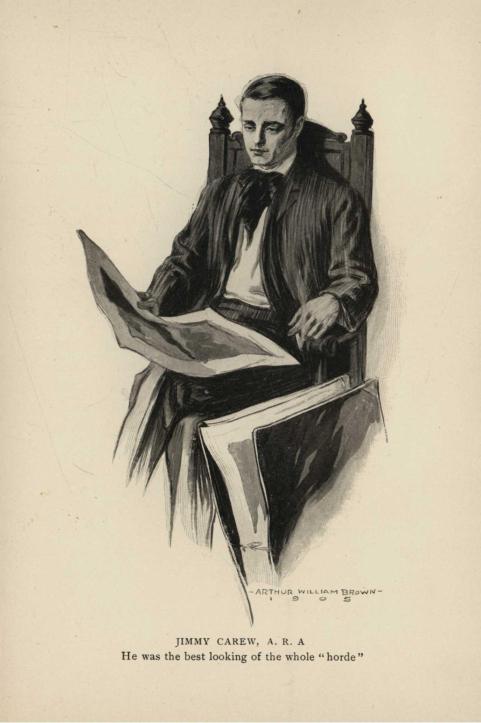
JIMMY CAREW, A.R.A. He was the best looking of the whole "horde"
"What are we doing here?" asked Williams. "We're mad! Oh, but, Jimmy, I'm dashed glad to see you," said Williams, with a lurid string of emphatic war expressions. "Those were happy days when I learnt about art with you, and you learnt about life with me!"
"They were," said Jimmy. "But now I'm almost sick of art."
Williams implored him not to say so.
"Think of Rembrandt and Velasquez and Whistler!"
"I can't think of them. I think of Penelope!"
"Try to think of Monet and Manet," said Williams. "They'll do you good."
"To be sure, to be sure," sighed Jimmy. "I'll try to."
They talked till two in the morning, and the only man missing was Bramber.
"Perhaps he's chucked it," said Williams. "The last time I saw him he looked sick enough to chuck anything. But I suppose the old earl is so rocky he can't get away."