Front matter (continued 3)
Reading edition
"You're a dear," said Pen, languidly.
"I've got a notion how to find out, though," said Bob. "At least, I shall have when I've finished Sherlock Holmes. I'd rather be Sherlock Holmes than a duke. It seems to me that unless you are the Duke of Norfolk or the Duke of Devonshire you are out of it. Being a common duke is dull, but being Holmes must be very exciting."
One thing that he told her made her think furiously.
"Not one of 'em really believes you, Pen, and they're much more jealous of each other than they were. I believe they'll be fighting presently."
"Don't talk nonsense," said Pen, anxiously.
Bob shrugged his shoulders, a trick he had caught from the marquis.
"It's not nonsense. I can see bloodshed in their eyes. The marquis looks awfully ferocious, and Williams, too. Of course, I don't say that Gordon would fight much. And I should snigger to see old De Vere in a duel, shouldn't you? But if Bramber and the marquis and Williams and Goby get together, I shouldn't be surprised if they fought with swords or guns. I think Rivaulx would like that. He would stick them all and make 'em squeal, I can tell you. He's a whale at fencing. He took me to see him once, and when he stamped and said 'Ha-ha,' like a war-horse, I wondered the other man didn't run."
"If they had a duel, any of them, I shouldn't speak to them again," said Penelope. "I abhor duels and warfare and weapons, and think they should be abolished in universal peace. And as I am married now, Bob, I hope you will do what you can to make them believe it."
"You can make 'em believe it at once," said Bob. "I do think this is absurd. And don't you see it's funny, too, Pen?"
"No," said Pen, "it's not. It's right, and what is right can't be funny."
Bob reflected.
"Well, there's something in that. It ain't much fun generally."
And he returned to Sherlock Holmes.
"I wonder what he would do," said Bob to himself, pensively. "There ain't any footsteps or blood in this. I suppose he'd take a look at Pen and then have a smoke and go out in a hansom and come back very tired. I've looked at Pen a lot, but smoking still makes me sick, and I don't know where to go in a hansom. And I think Holmes would think it mean to follow her when she goes off with Smith in her car. Besides, a hansom can't catch a sixty-horse Panhard unless it breaks down. I think he would get at it by looking at the men."
That put him on the track of a dreadful scheme, a most wicked and immoral scheme, that his hero would have disapproved of.
"I believe I have it," said Bob, starting up in wild excitement. "If I go around to them all and say that I'm sure she's not married, but that she loves the one they hate most, they will jump and be in a rage, won't they? I should be, I know. And the one that doesn't jump will be him. I dare say De Vere won't jump, but he's not a jumping sort, but he'll cry, likely. Rivaulx will snort if it isn't him."
He sat and pondered over this lovely scheme.
"But if she loves one of 'em, why don't she own it to him, and why this mystery? They'll ask that, of course. Oh, but that doesn't matter; they'll do the snorting first. And, besides, I could let on that not all of them are in earnest. Ain't it possible that the one she loves won't ask her now, and she's covering up her disappointment? That would make Rivaulx fairly howl, I know. He's a real good chap, and between howling and weeping he says he wants her to be happy. I'll do it."
He went off to do it at once.
"Ha, ha, my beautiful boy," said the Marquis of Rivaulx, whom he found in his rooms in Piccadilly, "have you come with news for me, the devoted and despairing?"
"Well, I don't know, marquis," returned Bob, soberly. "I've been thinking about it, and I'm in a state of puzzle."
"And I am in a state of the devil himself," replied Rivaulx. "I suspect every one. I am enraged. I suspect you, Bob, my boy."
Bob shook his head.
"I suspect you, too. I've never got over thinking that it may be you," he said, "for you are all just like each other, and it's obvious some one is telling me lies."
Rivaulx smiled, a deep and dark French smile, which was agonizing to behold. It puzzled Bob dreadfully.
"There," he said, "you smile, and so does Pen, and you all smile. But I believe I've discovered something."
"About who or which?" asked Rivaulx. "Is it about that Goby?"
He might loathe Gordon, but he was jealous of Goby. He promenaded the room, and was already in a rage.
"Yes," said Bob, boldly. "I believe she's not married, and I believe she likes him best."
"The hound, the vile one, the unmeasured beast," roared Rivaulx, "it cannot be. If she loves him (no, I can't believe it), why does she not wed him? I shall slay him. Is she unhappy? Does she weep? I adore her, but if she loves him he shall marry her or I will stab him to the heart."
"I dare say he's not in earnest," said Bob. And the marquis ground his teeth and foamed at the mouth, and again tried to tear his close-cropped hair without the least success.
"Not—oh, sacred dog of a man,—ha—let me kill him!"
He tore around the room and knocked two ornaments off the mantelpiece and upset a table, which Bob laboriously restored to its place. After he had put it back three times, he gave it up and cowered under the storm.
"I shouldn't be surprised if this was put on," said Bob, rather gloomily. "I know he can act like blazes; Pen says he can. She said he was finer than Irving or Toole in a tragedy. I don't think it has the true ring of sincerity."
And making his escape from the cyclone, he went off to see Goby, who was hideously jealous of Carteret Williams.
"I hope he won't be as mad as the marquis," said Bob. "That table barked my shins horribly the last time it fell. I wish Frenchmen wouldn't shout so when they're angry; I'm nearly deaf."
There was the devil to pay with Goby. He announced his intention of assaulting Williams at once.
"Oh, I say, you mustn't," cried Bob, in great alarm. "She'll never forgive you."
"That Williams!" said Goby. "I always did hate war correspondents. I don't believe it."
But it looked as if he did.
"I dare say you are putting it on," cried Bob. "I don't know where I am."
Goby said he didn't, either, but that if this turned out to be true he would wring Williams's neck in the park the first fine Sunday in June.
"He would have acted just the same if he was married to her, and thought she loved Williams best after all," said Bob to himself. "I'll try Bramber and Williams, and then give it up."
Bramber was in a furious temper, and when Bob assured him that Penelope loved Gordon best of any one, he swore horribly. As he rarely swore, this was very impressive, and Bob almost shivered.
"I say, you mustn't kick Gordon," he urged. "After all, I may be mistaken."
"I wish you were dead," said Bramber, "and you will be if you don't get out."
Bob got out, and when he was in the open air he sighed.
"I don't think I'll try Williams," he said, thoughtfully. "He's much bigger and stronger even than Goby, and they say he's a terror when he's very angry. My scheme doesn't seem to work; there's something wrong with it."
But there was nothing wrong with it, and it worked marvellously. The report that Bob said positively that Pen wasn't married carried much weight. Goby and Rivaulx both gave it away. And all the men now loathed each other openly. Rivaulx cut Goby and Goby cut Williams and Bramber sneered at Gordon, and there was great likelihood of there being the devil to pay. Pen tried to patch up peace among them, and failed, and wept about it, seeing so much of the good she had done melt like sugar in warm rain. At last she announced her intention of leaving them and the world alone.
"I almost think I'll give up reform," she sighed.
And the season went by and the autumn came, and Titania found herself at Goring in October with a large house-party which didn't include Penelope.
"She is, of course, somewhat ashamed of herself," said Titania, happily. "This comes of having ideas and foolishly attempting to carry them into practice. Now that I am certain she is not married and that she only says so, I feel quite different. I no longer abhor the poor, foolish men who are so much in love with her. I see plainly (for I, too, am naturally a democrat of the proper kind) that they have fine qualities. I have marked my sense of this in a way which appears to amuse Lord Bradstock for some reason that I do not follow,—but then, I never could follow Augustin, poor fellow,—by asking them all down here. I dare say they think Penelope will come, for they have all accepted. I am delighted, for I really admire them. Mr. Carew is the handsomest young man in London, and will paint my portrait between meals. I wonder whether I shall try to get thinner by eating less, or will it be better to tell Mr. Carew to make me thinner in his picture. That seems the easiest course; for if Penelope's conduct has not made me thin, what would? Neither hot weather nor despair has the least effect upon me. I shall trust to Mr. Carew's idea of what is right and proper. I wish I could rely with equal confidence upon poor, dear, misguided Penelope."
There was much discontent in the camp when the lovers learnt that their beloved was not one of Titania's house-party. They were not civil to each other, and with difficulty were civil to Titania.
"Confound the old harridan," said Goby. This was wicked, for Titania was very sweet, and retained much more than a trace of her youthful beauty. She belonged to the modern band of those who sternly refuse to grow old.
"Great Scott!" said Carteret Williams. The others made equally appropriate exclamations. They damned Goring in heaps, and looked at each other like a crowd of strange dogs. Owing to Penelope's influence they all came in motor-cars. Even De Vere turned up in one which was guaranteed by age and its maker not to go more than ten miles an hour. There wasn't room to get them into the temporary garage out of the wet. But the marquis did not come in a balloon or a flying-machine. That was something, at any rate, though Bob growled about it bitterly. Pen's request that he should do his best to make the world believe she was married was entirely forgotten. Without quite meaning to say so, he practically asserted in every word that she was not.
"After all," said Bob, "I believe she is capable of deceiving even me, for she is a woman. Horace, in his Odes, seems to think that. It seems to me that classical authors had a very poor opinion of women."
He went to Rivaulx crossly.
"I say, I think you ought to have come in a flying-machine. Why didn't you? Pen will be mad."
He introduced De Vere to Baker (who had been a sergeant in the Dublin Fusiliers), and left him with him, discussing hydrophobia and bulldogs.
"Baker says he has a great admiration for you, sir," said Bob. "He has lots of pups for you to look at. There's a very queer spotted one that Pen said she was sure you would like. It's very cheap for a spotted dog of the kind, Baker says."
But they were an unhappy crowd, and even the shooting, which was fairly good for a poor duke's place, hardly consoled them.
At night the women, who all gambled, naturally were very cross. It appeared that not one of the men would play bridge, because Penelope had made them swear off. There were only three men in the house not in love with Penelope. Titania had a dreadful time, and much regretted her hospitality. Carew was furious, of course, and his notions of colour were very morbid. And he appeared to see the duchess as she was, in spite of the hints the poor woman threw out to the desperate painter, who looked at her sorrowfully and sighed as he shook his head.
"Being painted is an ordeal," she said. Not one of the others consoled her. De Vere wept with her in the drawing-room; Williams wrecked her orchids in the hothouse; Plant and Gordon quarrelled in the smoking-room. And Bramber, who was only there for four days, looked horridly sorry for himself, and sneered at every one. The marquis went around the park in a ninety-horse-power racer seventeen times between breakfast and lunch. The chauffeurs quarrelled furiously; they even fought in the stable yard with Baker as umpire and Bob as timekeeper.
At the dinner-table was the only time of peace, and then it was too peaceful. Nobody but Bob and Ethel Mytton and Titania did any talking. Bob spoke of very little but Penelope, which was natural but awkward. He told them what Baker said, till they all desired to go out and strangle Baker. Bradstock encouraged him, for Bradstock was the only man there who had any apparent desire to be amused. The rest of them played with the soup, toyed with the entrées, fooled with the roasts, choked over the birds, and went out and oversmoked themselves. Then they met in the big hall and the drawing-room, and Titania had to assure them all one after the other, that she was certain Penelope was not married.
"Then why does she say she is?" they asked, bitterly.
"It must be to try you," said Titania. "Augustin, don't you think it is to try them?"
Bradstock made that sound which the English write as "Humph" and the Scotch put down as "Imphm." It means a great deal, but is intelligible to the intelligent.
"Yes, it is to try you," said Titania. "She is a dear, sweet thing, but has ideas which do not commend themselves to me. I understand them, of course, but regret them. It may be, of course, that she does not love any of you, and is trying to get out of it. By and by you will find out if that is so. She is enthusiastic and impulsive. Oh, these impulses of youth! How well I remember the delightful impulses of youth, when one feels as if one could fly with wings! Even now I get impulses. Poor Penelope! Ah, dear, I wish she would come. I have written again and again to ask her, but I'm afraid she will not."
And, indeed, no one at that moment knew where she was, unless, indeed, it was Timothy and Geordie Smith and Miss Mackarness and the pirate in goggles of the motor-car who carried her off.
Titania and Bob between them, at any rate, accomplished one thing. No one pretended to assign a satisfactory reason for Pen's conduct, but every one, except one, perhaps, believed she was still single. They were sure of it, and grew surer every day. As a result, they recovered some little peace of mind; they quarrelled less and ate more and shot straighter. Rivaulx only went fifteen times around the park before lunch; De Vere bought more dogs; Plant agreed to go into some scheme of trust robbery with Gordon, who assured the rest of them that he had Rothschild up his sleeve. Williams stamped less on flower-beds and swore half as much as usual. Goby and Bramber went out walks together with Bob and Ethel Mytton. Titania's barometer went up and her size went down in Carew's picture. He saw her less yellow, and did not insist on her wrinkles. Augustin sat in the library and read books which were of so humourous a character that they compelled him to put them down and laugh continually. It was certainly a most amusing house-party.
"I thought there would have been duels in the park," said Augustin. "I wonder what the deuce Pen would think of them if she saw them now."
And then one day something serious happened. It was on a Sunday, and on Sundays the post came in at half-past ten, just at the time they were all having breakfast before going to church. They were just about as happy as they could ever hope to be till Penelope married one or all of them. Bob, who was especially greedy that morning, was eating against time and winning. Only Ethel was sad, for Goby seemed quite cheerful. When he was mournful she was happier always. Titania flowed wonderfully. Augustin was saying the kind of thing he could say when sitting down. Goring himself was eating as if he was in rivalry with Bob. He never said anything, but looked like a duke, which is a very fine thing when a man is a duke, and can afford it with care. Gordon was eating bacon as if he had no great appetite for it.
"Oh, here's the post," said Titania. Augustin took Saturday's Times and opened it.
"I wonder whether dear Penelope has written to me," said Titania. The "horde" looked up; they hoped even yet that Penelope would give in and come at last.
"Any news?" grunted Goring.
"I don't see any," replied Augustin.
"What are Jack Sheppard's United?" asked Gordon, slipping a piece of bacon into his pocket.
And Augustin made his celebrated speech over again, his single speech in the House of Lords.
"Good God!" said Augustin, and he turned almost as white as the Times paper before it went through the machines. Every one stared at him.
"What is it?" screamed Titania. Bob jumped up and deserted a pig's cheek just as it was showing signs of utter defeat.
"It's—it's—" said Augustin, and he stammered vainly.
"I say, let's look," cried Bob. "Granny, it's something in the Births, Marriages, and Deaths!"
"Good heavens, speak, Augustin!" implored Titania.
The band of lovers went as white as Augustin; they stood up simultaneously.
"I see it, I see it," said Bob, and he actually snatched the paper from Lord Bradstock's hand.
"Is she married? Is she dead?" asked Titania.
"No, no," said Bob, sputtering and aflame with wild excitement; "it's 'Brading—Lady Penelope Brading on the 18th of a son!'"
CHAPTER XIV.
There are blows which stun; this was, of course, one of them. Titania did not shriek or faint at the awful intelligence conveyed by the Thunderer of Printing House Square. She nodded her head as if she was partially paralyzed, and at last murmured in a dry whisper:
"Of a son! Of a son!"
Bradstock's eyebrows were as high as they would go, and he stared at Titania, and then look around on the circle of men and women. Ethel squeaked a little squeak, like a mouse behind the wainscot and was silent.
"Oh—of a son," said Goby, sighing and looking at the floor.
"Of a son!" said Plant, eyeing the ceiling.
"Un fils!" shrieked Rivaulx.
Gordon said "Damnation;" De Vere shook like a stranded jelly-fish; Bramber went as scarlet as a lobster, and then as white as cotton; Carteret Williams looked blue, and Carew looked green, and Bob said: "My eye!"
There is something organic in any given number of people acting under the same shock or the same impulse. What one thinks another thinks; and now all the room fixed their eyes on Titania, whose lips moved in silence.
"This is dreadful!" said Titania to herself. "I don't believe she's married at all. One of these men is a scoundrel, a ruffian, a seducer!"
No one heard what she said, but as she thought it the men looked at each other with awful suspicions. And then Titania, whose mind was whirling, said feebly:
"We—we must hush it up!"
And there lay the Times! Hush it up indeed! And Bradstock recovered some of his equanimity.
"Nonsense! She's married, as she says," he remarked, with comparative coolness.
But no one believed it. The men drew apart from each other. De Vere moved his chair, because Goby was looking at him like a demon. Carew shrank from Carteret Williams. Gordon went livid under Plant's eyes. Bramber looked at them all as if he would die on the spot. Rivaulx rose up and waltzed around the room. It was a happy chance that he did so; it is possible that he saved immediate bloodshed. Bradstock and Bob caught the Frenchman in their arms, and led him outside to the lawn, where there was ample room for a frantic pas seul.
"Steady, old chap!" said Bradstock, "steady! Her husband must acknowledge now who he is!"
"Oh, no," said Bob, in immense delight, "not much! If she's married at all, she's sworn him not to. She told me she'd swear him not to! And she said if he broke his oath she'd never see him again!"
"Great heavens!" said Bradstock, "so she did. I remember now, she did speak of oaths, dreadful oaths!"
Rivaulx danced over a flower-bed, came in contact with a fence, fell over it, and uttered a howl which brought every one into the garden. He tumbled into a ditch, fortunately a comparatively dry one, and lay there, using the very worst French language.
The gloomy crowd lined the ditch and listened, and wished they understood. As a matter of fact, only Bradstock and Bramber knew sufficient decent French to guess what Rivaulx said, and they shivered. In the background Titania and Ethel hung to each other and wept; old Goring remained inside sucking at an unlighted cigar.
"The terrible, terrible disgrace!" said Titania. She believed the very worst at once. "Is it the marquis? Is he smitten with remorse?"
Rivaulx got out of the ditch on the wrong side, and walked out into the park, where he addressed a commination service to a nice little herd of Jersey cows. After five minutes of this exercise, he returned toward the house and climbed the fence. Then he shook his fist at the others.
"One of you is a scélerat," he howled, "a scoundrrrel! I challenge you all to fight! Ha, ha!"
Bradstock took him by the arm and led him away.
"One of us is a hound!" said Goby.
"Yes," said the others, "yes!"
They glared at each other horribly, and clenched their fists. Bob ran around them in the wildest excitement.
"Look here, I say, Captain Goby. Oh, Mr. de Vere! I say, Mr. Plant, if you want to fight, come into the stables. Granny says you mustn't fight here."
He grabbed several of them, and was hurled into space at once. He finally laid hold of De Vere, who wasn't capable of hurling a ladybird off his finger.
"You shall fight Goby if you want to," he roared.
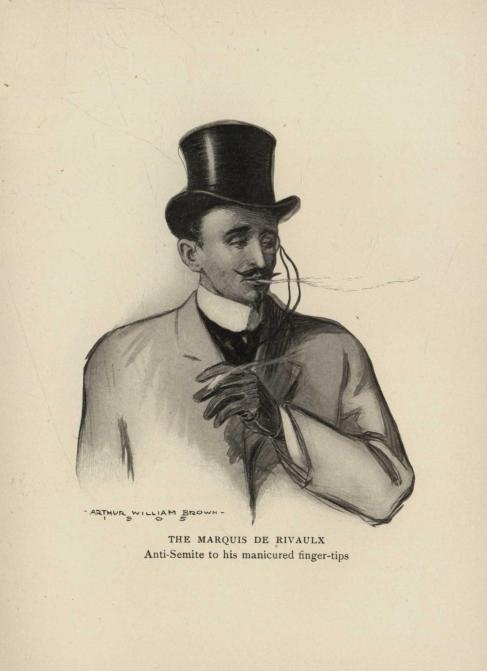
THE MARQUIS DE RIVAULX. Anti-Semite to his manicured finger-tips
"But I don't want to," shrieked the poet. "What shall I do? My heart is broken!"
"Oh, what rot!" said Bob. "I don't understand what the row is about. Pen said she married, and she's got a kid. It will make her happy, for she always loved kids."
But then the notice in her maiden name! Was it not awful, horrible, brazen, peculiar, anti-social, against all law? It was wicked, immoral, indecent. Behind it there must be a dreadful story.
"By God!" said Bradstock, speaking at large to all but Rivaulx, who was breaking up a cane chair at a short distance, "I do think, oaths or none, that the man who is married to her should tell the duchess in confidence."
But Rivaulx heard in the intervals of destruction, and stayed his hand.
"Ha, ha!" he said aloud, "I love her! I am a man! I love her! What shall I do?"
He threw the fragments of the chair into a fountain, kicked over a flower-pot, and ran again into the park, taking the fence in his stride.
"I believe it's remorse," said Titania. "I begin to suspect the marquis!"
But everybody suspected everybody, and yet at the very height of their rage what Bradstock said sank into their hearts. Pen had selected them with care for their inherent nobility. They said to themselves that they would show how noble they were. With one accord they straightened themselves up, and an air of desperate resolve was upon every man's face.
"I will think it out and make up my mind this afternoon," said each of them. They walked away in different directions, and in five minutes not one of them was in sight but the marquis, who was knocking his head against a sapling in a way that caused the herd of Jerseys to revise their estimate of humanity. Even he gave up at last, and went off into the distance with great strides.
"I say," said Bob, "I don't know what to make of this. Where are they going, and what are they going to do? I wish I knew where Pen is; I'd send her a telegram."
The rest of the party said nothing. Titania wept. Old Goring asked Bradstock for a light, and at last got his cigar going. He said nothing whatsoever. Ethel Mytton was in a fearful state of nervousness, and shook with it. Bradstock walked up and down whistling. The men who were not in it gathered in the billiard-room, and said they thought they had better have urgent calls to town. They wanted to discuss the scandal in their clubs. They knew that there wasn't a house in England that would not consider their presence in the light of a tremendous favour, considering all that had occurred at Goring while they were there. They went, and regretted it afterward, for much occurred that very afternoon that no man could have foreseen.
Not a soul came in to lunch but Bob and Bradstock and the old duke.
"Augustin, my boy," said Goring, "these are surprising events, very surprising events. I thought I understood something about women, but I find I'm as ignorant as a two-year-old. What the devil does Penelope mean?"
Bob intervened.
"I believe, grandfather, that she wants to make you all sit up," he said, eagerly.
"Shut up, Bob," said the duke. "Eat pie and hold your tongue. Augustin, is she married, or isn't she?"
"I'm sure of it," said Bradstock, "but—"
"I think it's a damn silly business," said the duke. "I can't remember any parallel except when Miss Wimple, who was a devilish pretty girl fifty years ago, married Prince Scharfskopf morganatically, and kept it dark in spite of twins. There was a devil of a fuss, but it was kept quiet, no announcements in papers, and so on. The emperor boxed Scharfskopf's ears in court when it came out, for it upset his diplomatic apple-cart, as Scharfskopf was to have married Princess Hedwig of Wigstein. She was virtuous and particular, and made trouble, being thirty-five. Do you think Penelope has married any damn prince, for instance?"
Bradstock didn't think so.
"Was any prince sneaking about, eh?"
"Oh, I say," cried Bob, who was listening eagerly, "there was the Rajah of Jugpore!"
"Good heavens!" said Goring, "so there was. I say, Bradstock, what have you to say to that? I'd like to have a look at the infant. Damme, it's a wonderful world!"
And this bore its fruit afterward in scandal and conjecture, for Bob threw out hints about it. But in the meantime they could only talk, and presently they saw the marquis coming across the lawn. He kept on stopping and looking up at the sky, as if for help or a balloon, and he smote his breast repeatedly in a very peculiar fashion.
"Queer cuss, Rivaulx," said Goring. "Takes it hard. Give me a light, Bob. Look at the Johnny smiting himself in the chest. What's he thinking of now? Looks as if he was bound upon a desperate deed. Dear me, I hope there will be no bloodshed, Bradstock! I'm too old for bloodshed now. I won't have duels in the immediate neighbourhood of the house, Bradstock, mind that."
"All right," said Augustin, still looking at Rivaulx gesticulating violently in front of a large laurestinus. "Bob, give me those glasses."
Through the glass Rivaulx's face was plain to see.
"Damn!" said Augustin to himself, "what's up? He's going to do something, something desperate. He is looking like a hero on a scaffold. He has an air of sad nobility. Oh, Pen, Pen!"
Rivaulx advanced on the house with his head up. He came in and sent word to the collapsed duchess that he desired most humbly an audience with her. Bob listened.
"He wanted to see granny," said Bob.
"Let him," said the duke. "I don't; I want peace."
Titania sent down word that she would see him.
"Poor sad Penelope, poor mournful Penelope!" said Rivaulx. "Ha, but I will save her from further woe!"
He found Titania on a sofa, and he kissed her hand. This pleased poor Titania; it reminded her of her youth.
"Oh, marquis, I am in despair!" she cried.
"Despair not," said Rivaulx, as he stood up and smote his forehead, "despair not. All is not lost. But for me, I stand between two dreadful alternatives, and I have resolved to do my duty."
There was an air of tragedy about him that covered him like a robe. Titania shivered.
"What is it? What have you to tell me?"
"Ah, what!" cried Rivaulx. "But I shall do it. I shall do it at once, immediately, if not sooner, as your poet says."
"You won't kill any one, at least not here," shrieked Titania.
"Far from it," replied the marquis. "Oh, but it is terrible, for I have to smash, to break an oath. I swore not to reveal what I am about to reveal."
"Good heavens!" said Titania. "Oh, what? Is it—can it be—no—"
"Yes, yes," cried Rivaulx, "it is true; I own it!"
"Own what, marquis?"
He smote his breast and looked above her.
"I am the man!"
"Oh, what man?" squealed the duchess.
"I am the husband—and—and—the father," said Rivaulx, with a gulp, as if he were swallowing an apple whole.
"Of my Penelope?"
"Yes, yes," said the marquis. "Say nothing. It is a secret, full of oaths. Why, I know not, but she, the dear, insists, and what am I?"
Titania lay and gasped. The relief was tremendous. Three hours ago she would have refused to think of Rivaulx as Pen's husband. Now she welcomed the notion; she sighed and almost fainted. Rivaulx muttered strange things to himself.
"Can I announce it?"
"No," said the marquis, "it is a secret. But it is all right. I go."
"Take my blessing," said Titania. "Go to her quickly, poor dear, and implore her to let me come to her, and bid her tell all the world. What is her address?"
"I cannot give it," said Rivaulx, pallidly. "It is a secret. But I go, I hasten. Adieu, duchess; I am distracted. Oh, my mother and my country!"
He fled from the room, and, leaving his man to bring on his things, went away at an illegal speed toward London.
"Well, well," said Titania, with a gasp, "I cannot understand anything. But, after all, the marquis is a fine man and of a good family. I could almost sleep a little."
But just as she was composing herself to rest, Mr. Plant sent up word that he wished to see her for a few moments on urgent business before he went back to town.
"Let him come up," said the duchess. When Plant entered, he stood bolt upright in front of her, with a strange air of determination.
"I shall surprise you, I reckon," he said, in an American accent as thick as petrol fumes. "I know I shall."
"No, you won't," said Titania. "Nothing can surprise me now, I assure you."
"I shall surprise you, ma'am," said Plant, "and you'll have to own it. Prepare yourself and remember that what I tell you is in the nature of a secret. I can stand it no longer. I have to let it out. To hear Lady Penelope, whom I adore, spoken of as I do, makes my blood boil. She may have made some mistakes, but I've made some, too. I am going to surprise you—"
"No, you are not, Mr. Plant," said Titania.
"I—I am Lady Penelope's husband," said Plant, desperately, fixing his eyes on space.
"You are what?" shrieked Titania.
"Her husband—and—the parent of the announcement in the Times," said Plant, firmly.
"Am I mad?" asked Titania.
"No, but I am," said Plant, who was as pale as a traditional ghost. "I'm mad both ways. I want to kill."
"You mustn't," cried Titania, feebly. "I don't know where I am. What did you say? Oh, say it again!"
He said it again, and before she could say anything further, he rushed from the room and bounded down-stairs. She heard him turn his motor-car loose, and knew that in twenty seconds he was a mile away.
"What's wrong with everything, and me, and them?" asked Titania. "I wish I was a dairy-maid in a quiet farm, and had no relations. Am I mad? Did the marquis say it? Or did I dream it?"
Lord Bramber was announced.
"Oh, oh, oh!" said Titania. "Yes, I'll see him."
Bramber came in fuming, and, like the others, fixed his eyes over her head. He was nervous and abrupt.
"I can't stand any more, duchess," he began.
"I can't stand much," said Titania.
"It's a secret of course," said Bramber, "and I'm breaking my word!"
"Are you the husband of Penelope?" asked Titania.
"I—I am," replied Bramber, "and the cause, so to speak, of the notice in the Times."
"I thought so," said Titania. "Look at me, Ronald. Do I look mad? does my hair stand on end? do I seem wild and wandering?"
"No, of course not," said Bramber. "I'm telling you this because I feel I ought to. Now I'm going to her at once. This last news was rather unexpected, of course. Good-bye—"
"Stay!" shrieked Titania, but she was too late. Bramber was down-stairs and bounded into his motor-car and let her rip.
"What's the matter with everybody?" wailed Titania. "The marquis made me happy, but now I'm confused, very sadly confused, and I can't think she's married them all."
Gordon was announced, and in about three sentences he told her that, though the affair was a secret, he was Penelope's husband.
"I knew you were," said Titania. "When I heard you wanted to see me, I knew you were coming to say so. Oh, good-bye. Ask Lord Bradstock to send for a doctor. Good-bye, Mr. Gordon. Go now."
And Gordon went, just as De Vere came in.
"You have come to say you have married Penelope, I know," said Titania. "I feel sure you have."
"I have a heart for sorrow, for disgrace, for all things lovely. I—I am responsible for everything, even the Times," said De Vere, who was as pale as plaster.
"Leave me," said Titania. "Go and see her at once. Settle who it is. Go!"
And when he had gone, Carteret Williams and Carew came one after the other with the same confession. And she received them sadly, and appeared to wander. When the house was empty, she sent for Bradstock.
"Augustin, dear Augustin," she said, "you won't let them put me in an asylum. Have me taken care of at home, won't you? Don't let Goring give me cruel keepers. I am quite gentle and broken down!"
"I won't let anything beastly be done," said Bradstock. "But, my dear child, what's the matter?"
And Titania told him:
"By the Lord," said Bradstock, "they are damned good chaps! but where the devil are we?"
He went down-stairs when the doctor came and told everything to Goring. And Goring told Bob. For Titania forgot to mention to Augustin that all the husbands had insisted it was a dead secret.
"I say," said Bob, "of all the larks I've ever heard of, this takes the cake! I wonder what I ought to do. I think I'll ask Baker."
And he asked Baker. And in less than twenty-four hours the world knew all about it.
CHAPTER XV.
But when it is said that all the world knew of it, Penelope herself must be excepted. She knew nothing for some time, and, whoever her husband was, he certainly never acquainted her with the horrible details of all the good men who sacrificed their honour in the noble attempt to save her from the results of the terrible misfortune they believed had happened to her. It was, indeed, Miss Mackarness who told her about it, and Miss Mackarness was the old governess whom Penelope had once sacked and sent away. The poor woman was in a terrible state of mind about the affair, and in that was no different from all the rest of the world. To her went Timothy Bunting with the strange story.
"If you please, ma'am, Geordie Smith 'as just brought in a paper wiv a true and pertic'ler account of 'ow all the gents that was courtin' our lady told the Duchess of Goring as 'ow they 'as married 'er!"
"What!" said Miss Mackarness.
"A true and perticuler account as 'ow they 'ad hall married our lady, sayin' as they 'ad concealed it till they could no longer!" repeated Timothy more loudly.
"Good heavens!" said Miss Mackarness, trembling very much, "I fear it will upset Lady Penelope, to say nothing of the infant. Do they all claim the infant, Bunting?"
"I presume so, ma'am," said Bunting. "It looks likely."
"Under these circumstances, Bunting," cried Miss Mackarness, "I feel it is my duty to communicate the facts to our lady. Give me the paper, Bunting!"
Bunting said he would get it, and came back with a hatful of fragments.
"If you please, ma'am, this is hall I can rescue of the details. The cook and the parlour-maid and the two 'ousemaids 'ave fought over it in the servants' 'all, and are now in tears, not 'aving read a word."
And Miss Mackarness took the hatful up to Penelope, who sat with her nurse and the cause of all the trouble in a south room overlooking the moat.
"In the name of all that is wonderful, what's in that hat?" asked Penelope.
"It is Timothy Bunting's hat, my lady," replied the Mackarness.
"So I perceive," said Penelope. "Is a bird in it?"
"Oh, no, my lady. It's the bits of a newspaper," replied the housekeeper, as if she served up the Times in a groom's hat every day. "It's Timothy's hat, but a clean new one."
"But why do you bring it, and why do you put newspaper in it?" asked Penelope.
"If you please, my lady, I cannot help it. The cook and the parlour-maid and the two housemaids fought over it in the servants' hall, and are now in tears, not having read a word of it."
To all appearance the housekeeper had lost her senses. Though this was no wonder, Penelope wondered at it.
"Well," she said at last, "I see what's in the hat, but what's in the newspaper?"
"If you please, my lady, according to Timothy Bunting and Smith, who appear to have read it, it contains the true account of what happened at Goring House the other day, when all the gentlemen staying there, hearing from the Times that your ladyship had a fine boy on the eighteenth, and no husband named by your ladyship's particular directions, all got up one after the other, and, requesting private interviews with her upset Grace, the duchess, declared upon their oaths, though in secret, that they had married you themselves!"
She recited this in a strange, mechanical way, which would have been extremely effective upon the stage, as a picture of hopeless conventionality wounded to death, and at last dying in sheer indifference to all things.
"Dear me!" said Penelope, "dear me!"
"It furthermore appears, my lady, begging your pardon for mentioning it, and I have reproved Bunting bitterly for daring to do so, though I haven't read the fragments in the hat, that no one believes your ladyship's word at all as to your being married."
"Oh, how shameful!" said Penelope. "Why, here's baby!"
The nurse coughed and hid her mouth with her hand.
"Yes, my lady, so he is," said Miss Mackarness. "There doesn't seem any doubt whatsoever about that, but—"
And Penelope sighed. Suddenly her face lighted up.
"Ah!" she said, "I see why they said it to aunty. How very, very noble of them! I knew they were all splendid men; men of the highest character and attainments and possibilities. Will you have telegrams written out to all of them, saying, 'Your conduct is noble, and I am deeply grateful'?"
"Yes, my lady," replied the housekeeper, "and how will you sign it?"
"Sign it Penelope Brading," said Penelope. "And tell Smith to take his car as quickly as he can to Spilsborough, and send them from there."
She lay back in her pillows.
"They are noble fellows," she said. "I have done them an immense amount of good. A year ago not one of them could have risen to such heights of abnegation, such love, such tenderness. I shall see them bringing in a new era yet. Leopold Gordon will inaugurate a new and pure finance. The dear marquis will abolish anti-Semitism and duelling in France. De Vere will write poems of a purity appealing equally to Brixton and Belgravia, and my dear friend Carew will vindicate the Royal Academy's policy of showing that charity begins at home. And the rest—ah, me! Poor dear aunty, how I love her!"
And by the time that she had pondered over a renewed world, Geordie Smith was sending off the wires from Spilsborough with wonderful results.
"I like this," said Smith. "This is what I like! There's nothing dull about it. I wonder what'll happen now? I'll lay five to one I can guess!"
He guessed right as to some, for in about four hours Rufus Plant arrived in Spilsborough on his racing-car, and put up at the Grand Hotel.
"I guess she must be somewhere in this neighbourhood," said Plant. "And here I stay till I find her. And by the tail of the sacred bull, whatever happens, I'll marry her right here in this hyer noble pile of a cathedral. And if she'll do it, I'll restore it for the authorities free of charge, till it's as gawdy as a breastpin and right up to date."
He ran against Gordon, and the two men fell back in horrible surprise.
"You—"
"You!"
"Oh, yes," said Plant, "I'm here on business connected with the cathedral."
"And I'm to see the—bishop, who will join the board on allotment," mumbled Gordon.
And then Goby roared into town on his motorcar. The others saw him, and he saw them, and ignored them palely. He, too, put up at the Grand, but never spoke to them. And De Vere came in while they were at dinner, and sat down opposite to Goby. He said, "Oh!" and, rising, at once bolted from the table.
"I'm damned," said Goby, and he lost his appetite.
"How many more of us?" they asked themselves.
They looked up at every one who entered.
"Bramber will be in any moment," said Plant.
Poor De Vere sat in his bedroom and was ill.
"If I look out into the corridor, I know I shall see that beast Williams," he sobbed.
"Where's that French fool, Rivaulx?" asked Gordon. They all believed the other was the scoundrel of the dreadful drama.
And then the evening papers came in. They declared in big lines that there had been "A Fracas in High Life." They added that it had taken place in the Row at four o'clock that very afternoon. They went on to say that Lord Bramber and the Marquis de Rivaulx, well known as a great sportsman and a balloonist, had fought in a flower-bed, and had been torn from each other's arms and a big rhododendron by two dukes, three earls, and a viscount. They further declared that it was a matter of public notoriety that all the trouble rose out of the mystery connected with the Times and Lady Penelope Brading. They promised more details in later editions.
"They'll fight," said Gordon, savagely. "I hope they'll kill each other. But especially I hope that the marquis will be killed first and most!"
And about eleven o'clock Rivaulx turned up with his chauffeur and a bad black eye.
"He shall fight me here," said Rivaulx. "This is a quiet town. No one will think of Spilsborough! He does not know that she sent me a telegram from here!"
He put up at the Angel, and escaped seeing the others for the time. On his way up he had sent a defiant telegram to Bramber, desiring him to come to Spilsborough, and fight there with swords or pistols or any weapon that commended itself to him. This telegram Bramber never got, for, on reaching home and washing away the traces of the struggle in Hyde Park before all the loveliness of London, he had found his telegram from Spilsborough sent by Geordie Smith. After looking in the ABC guide, and finding no good train, he pelted off in his motor-car, leaving a note for Rivaulx, saying that, though duels were absurd and illegal, he would not refuse to meet the marquis in France or Belgium, if he desired to make a bigger fool of himself than he had already done in the park.
"Curse and confound them all," said Bramber, who was horribly cross and exceedingly sick of the whole world, even including Penelope. "I wonder what she means by this telegram. I wish I was dead! Is she at Spilsborough?"
Just in the middle of Spilsborough he met Rivaulx and pulled up short, not having the least notion, of course, that he would meet him there. But Rivaulx grinned a ghastly smile and raised his hat, as Bramber stopped.
"Ha, I am pleased to see you," said the French marquis. "You have come quickly. It is a fine night, there is a moon, and close by here under the shadow of the cathedral there is a most beautiful piece of grass. There we will fight. I have brought swords with me. Or have you brought guns?"
"I haven't brought guns," said Bramber, who was entirely stunned and at a loss for a word.
The marquis bowed.
"We will fight with swords, my lord. I think this hotel is good; the lady is amiable; there are rooms to spare. When the moon rises, ha! I will call you forth."
And Bramber went to the hotel to think what he should do.
"The ass! the lunatic! How did he get here? I can't get out of fighting him."
He sat outside in his car.
"No, I won't. I'm damned if I do!" he said.
He went in and wrote a note for Rivaulx, who was out in the cathedral close picking what he considered a good place for a duel. The spot he chose was not far from the dean's house.
"I wish it had been Mr. Plant," he said. "Of Bramber, who is a young ass, I am not jealous. But of Plant I am horribly jealous, and he is a bad man. If I met Plant I would say, 'Fight me at once now, and I will put off Lord Bramber till another day.'"
And, going around the corner, he ran right into Plant, who was raging about the town, wondering where Penelope was and how everything was going to end.
"The scoundrel is that marquis," said Plant. And he ran into the scoundrel's arms.
And just while Bramber was shaking the dust of Spilsborough from the tires of his motor-car, Bob himself came into the town in a hired Daimler, full of the most extraordinary news. And Titania was having a series of fits down at Goring, with Dr. Lumsden Griff in attendance.
CHAPTER XVI.
It cannot be imagined that Titania, who had survived so many shocks, was ill for nothing. When Bob discovered what she was ill of, he stood outside on the lawn with his hands deep in his pockets and with his legs wide apart.
"I must tell 'em this at once," said Bob, gloomily. "If I don't tell Gordon, he'll forget he's invested a hundred of mine in something to make hair curl, and I shall lose the money. I mean to make money to keep up Goring by and by. And he said he'd make me a director, too. For the sake of the family, I can't neglect him. Or De Vere, either. Or any of 'em. But—but I never thought it of Pen!"
With his pockets full of money derived from the sale of dogs to De Vere, he rushed off to the station and caught a train for town. When he reached London, he sent a wire to "Old Guth."
"I'm in town on important business. Break it to grandmother between fits. I hope to be back to-morrow."
He rushed off to Park Lane to find Gordon.
"Mr. Gordon has gone to Spilsborough, sir," said Gordon's man.
"D— I mean confound it!" said Bob. He went to Plant's.
"Mr. Plant went to Spilsborough in a great hurry this afternoon, sir," said Plant's landlady. The American millionaire still lived in Bloomsbury, though not on ten shillings a week.
"Oh," said Bob, "I wonder what this means. There's a secret here!"
He drove in a hansom to find Bramber. A very ingenuous piece of humanity in buttons told Bob that Lord Bramber came in about four o'clock torn to ribbons, and found a telegram waiting him.
"And off he went in his motor-car."
"Where?" asked Bob.
"I don't know," said the buttons. But on Bob's going to Bramber's room, he found the ABC open on the table at the page with Spilsborough on it.
"Sherlock Holmes would say he has gone to Spilsborough," cried Bob. "And if Gordon and Plant have gone there, too, I'll bet all the rest have gone. I'll go, too."
But there was no train for three hours!
"I'm done," said Bob, "No, I'm not. I'll hire a motor-car."
He went to the nearest place in Regent Street and hired one.
"Very well, sir," said the man, "but it's rather expensive, you know."
Bob pulled out a handful of sovereigns.
"Take as many as you think fair," he said, grandly. "And don't forget I want a speedy one, and a man that can drive, and I'll pay the fines of course!"
That was how he came to Spilsborough just in time and about the hour when the moon was to rise. He passed a motor-car in the ditch about ten miles out of the cathedral city, and did not stop to find out what was the matter. He thus missed the discovery that Bramber and his chauffeur were both sitting upon the wreck, using very awful language to each other on the subject of losing the way and coming bolt down a side road into the opposing hedge. It is astonishing how an accident at thirty miles an hour brings owners and mechanics down to the same human level.
When Bob reached Spilsborough, he was covered with dust, but was as spry as a grasshopper and awfully full of his news.
"You can drive," said Bob to his man. "I'm very much pleased with you. Stop at this hotel."
He went into the Angel, and staggered blithely to the office.
"Is Mr. Gordon here, or Mr. Plant, or the Marquis of Rivaulx?" he demanded.
He thus discovered the marquis.
He drove off to the Grand, and found Plant and Goby and De Vere and Gordon were there. They were all in bed but Plant, and Plant had gone to see the cathedral by moonlight.
"All right, we'll put up here," said Bob, "and I'll see if I can find Plant. I say, I wonder what Baker will think of this? It beats me!"
He got to the cathedral precincts just about an hour after Rivaulx and Plant had run into each other's arms. Much had occurred since then.
For Rivaulx started back from Plant and almost forgot the existence of Bramber.
"You are a scoundrrrel," said Rivaulx, rolling his r's in the most fearful manner.
"You are a lunatic," replied Plant, coolly; "when did you escape?"
"I have not escaped, I am here," snorted Rivaulx, "but you shall not escape. I meant to kill Lord Bramber upon this spot, but I prefer to keel you. I let him go; he is nothing. You are the scoundrrel!"
"Oh, dry up!" said Plant, crossly. "You tire me, you fatigue me very much. I am exhausted by looking at you. Go home, or I will break you in three pieces and eat them!"
Rivaulx foamed at the mouth.
"Do you refuse to fight me, sare?"
"Certainly not," said Plant. "Take your coat off and hang it on a tombstone, and I'll leave nothing of you but a smear."
"I do not fight with fists," said Rivaulx, contemptuously. "I fight with swords, with steel, with guns or pistols."
Plant shook his head.
"I've none of 'em about me, my son!"
"At the hotel I have swords," cried Rivaulx, eagerly. "I brought them to kill Bramber, who punched my eye in the Rotten Row, and we rolled in bushes. But I will first fight you. Wait and I fetch the swords."
He ran violently into the darkness, and Plant sat on a railing.
"What am I to do? Am I to wait and fight a lunatic? Or shall I go back to the hotel? I think I'll go back. If that raging idiot is found prancing about here with swords, they will run him in."
But he did not know how fast the marquis could run and how near the hotel was. Before he had made up his mind to go, Rivaulx came back again. He flung the swords at Plant's feet.
"Take one and let us begin," he said.
"I think on the whole I'll have both," said Plant, suiting the action to the word. "Now go home, marquis, like a good little boy, and come to the Grand Hotel in the morning and tell me why you want to be hanged in England."
He put both the weapons under his arm.
"You will not fight?" said the marquis, gasping like a dying dolphin.
"What kind of a galoot do you reckon me?" asked Plant, quite unintelligibly.
"Ha!" said the marquis, "I know not what a galoot is, but I will fight you here and leave your body on the grass."
Neither of them had observed the approach of a portly and pleasant gentleman behind them. He was now leaning upon the railing, watching them with a great deal of kindly curiosity.
"I think, gentlemen, that the dean will object," he said at length, and they both turned around suddenly.
"You must not interfere," said Rivaulx; "we do not know you."
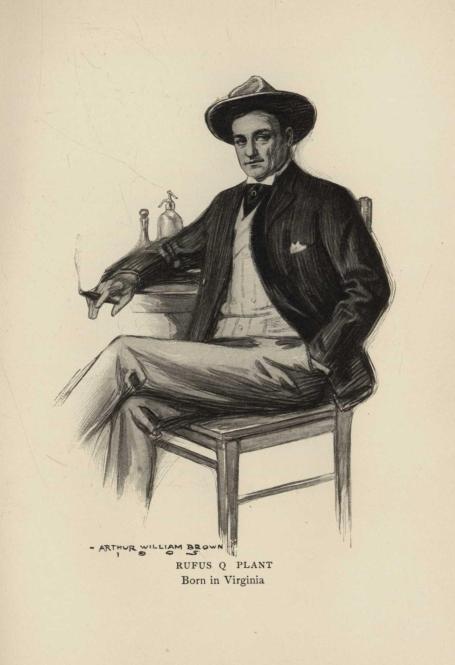
RUFUS Q. PLANT. Born in Virginia
"To be sure, to be sure," replied the gentleman, who was dressed very curiously, as Rivaulx noticed. "I hate interfering, especially with anything belonging to a dean. Deans, gentlemen, are very touchy about matters connected with their cathedrals. Now Dean Briggs, gentlemen, takes the very greatest care of that grass on which you both are now illegally trampling, and I understand that he has made a rule never to have duels upon it. He is very firm on that point. Do I mistake you if I say that it looks to an unprejudiced observer as if you were going to fight a duel?"
Rivaulx bowed.
"I do not know you, sare, and I do not want to. I want to keel this man, who is a scoundrrel."
The stranger addressed Plant.
"And are you equally anxious to break this very rigid rule of the dean's?" he asked, suavely.
"Certainly not," replied Plant; "I want to go to bed."
"I am delighted to hear it. I am intensely gratified to hear it. If one duellist, having possession of both deadly weapons, desires to go to bed, I cannot see anything to hinder him, unless, indeed, he wants to lie down on Mr. Dean's grass. You see, gentlemen, I am a bishop, and a bishop's first desire is to be on good terms with the dean. If Mr. Dean heard that I encouraged any one to break his rules about duelling or going to bed in the precincts of this cathedral, I should not be on good terms with him, I assure you."
"I do not understand," said Rivaulx. "I want to fight, that is all I want to do!"
"Stay!" said the bishop, mildly. "If the somewhat excited gentleman, who is, I gather, not an Englishman, will accompany me a few yards, we will go to the dean's, with whom I have been dining, and will refer the matter to him."
"Of course," said Plant, "that is the right thing to do. Marquis, his lordship the bishop suggests the only course open to gentlemen. I trust you will accept his offer, and, if you do, I undertake to fight you if the dean gives his permission."
"Stay, sare, my lord the bishop," said Rivaulx, "one moment, sare, the bishop. Is this dean of whom you speak a gentleman?"
"Certainly, certainly," replied the bishop, hastily. "He is of the highest breeding, and in his youth he fenced like a fencing-master."
"Then he understands the code of honour, sare the bishop?"
"Absolutely, for a dean," replied his lordship.
"Then I agree, sir lord," cried Rivaulx.
"Ha, we will go to his house, then," said the bishop, "if you will step over this railing. But stop here one moment and observe the moon rising over Mr. Dean's cathedral. Is it not a peaceful, pleasant spot, gentlemen?"
"It beats thunder," said Plant.
"It does, it does," nodded his lordship. "Many Americans, who admire this cathedral immensely, have made the same acute observation. May I ask your names, gentlemen? I am the bishop of this diocese."
"My name is Plant, Rufus Q. Plant, and my friend is the Marquis of Rivaulx."
"Indeed," returned the bishop, "is the gentleman the French nobleman who is interested in balloons?"
"Yes," said Plant.
"Dear me! I am delighted," said his lordship. "I, too, am interested in balloons. I saw one go up once."
"You like them?" asked Rivaulx, warmly. "That is good! I will take you up in one."
"We will talk of it later," said the bishop, rather hastily for a man of his gentle flowing speech. "But this is the dean's house. If I knock at this window, he will put his head out."
He knocked at the window, and Mr. Dean did put his head out.
"I am so loath to disturb you, Mr. Dean," said his lordship, "but, as I was leaving you and taking a little stroll before retiring, I met two gentlemen, one from the United States and one a French marquis, who were engaged in a warm discussion on a point of honour. I am ignorant of the exact point, and I dare say there is no necessity for our knowing. As a result of this discussion, the French marquis desired to fight a duel with swords (you will observe them under the arm of the gentleman from the United States), and I ventured to intervene, as the duel was to take place upon your grass."
"Humph, indeed!" said the dean, in great astonishment. "And what did you say?"
"I said that it was against your rules to allow any one to fight duels there. Was I not right?"
"Rather!" said the dean. "I should say so."
"And on the other hand," continued the bishop, "the gentleman from across the Atlantic wished to go to bed."
"Then why the—why doesn't he?" asked the dean.
"It seemed to me that the gentleman from across the water wanted to go to bed upon your grass," said the bishop. "I pointed out to him that there was a very old and strict rule dating from the time beyond record which forbade this. Was I not right?"
"You were," said the dean. "I never go to bed on the grass myself, and do not permit others to do so. I never fight duels there, either, and do not allow it."
"You see, gentlemen," said the bishop, but before he could add another word Bob rushed right upon the group outside the dean's windows, and saw that Plant made one of them. He saw the swords also, and then recognized Rivaulx.
"Oh, I say," said Bob, "you were going to fight a duel about Pen! I've come in time! It's no good. She has married Timothy Bunting, her groom!"
CHAPTER XVII.
It was such an awful shock to Plant and Rivaulx, and, for the matter of that, to his lordship the Bishop of Spilsborough, that they all gasped dreadfully. Plant took the bishop by the sleeve. Rivaulx lay down upon the grass under the dean's window, and howled as he tore at the turf. The dean said:
"I'll come out! This is becoming serious!"
He came out, and, as he opened the door, the light of the hall lamp fell upon Bob's face.
"Good heavens!" said the bishop, "I thought I knew the voice. Is that you, Robert Goring?"
Bob said it was, but added that he didn't know the bishop.
"Boy, I christened you," said the bishop. "Is all this trouble about Penelope Brading, whom I also christened?"
"Yes," replied Bob; "shall I tell you about it?"
"Let us retire a few paces, and you can tell me," said the bishop. "In the meantime, Mr. Dean, I beg you to exercise patience with the French nobleman on the grass. Come, Bob."
"Well, it's awful rot, you know," said Bob, speaking very rapidly. "We don't know where we are in the family, and grandmother is lying on a sofa screaming."
"Why, Bob?"
"You must have heard of it."
The bishop had heard a great deal, but not all.
"Pen says she's married and has a kid," said Bob, "and she won't say who it is. And all these jossers, including Plant, he's the American over there, and the marquis chewing the grass, said they had married her themselves. Do you see, sir,—my lord, I mean?"
"I see," said the bishop, putting his finger-tips together. "It was, I think, very noble of them."
"But granny said it was very trying, and it made her ill, for she wasn't any further than before, unless Pen had married them all. And grandfather, who kept cool, said that was unlikely."
"It certainly seems unlikely," said the bishop. "But when you came to us, you made some very astonishing remarks about a groom, one Bunting, I think. Now what is there to know about him?"
"Weekes said that, the beast!" cried Bob.
"Who is the beast Weekes?" asked the bishop.
Bob told him who Miss Harriet Weekes was.
"And not an hour after these had said they were married to Pen, this Weekes woman came in black and in a cab and said she must see granny. And granny saw her, and is now in fits, with the doctor feeling her pulse and giving her brandy. For Weekes was very solemn (I listened), and she said: 'Your Grace, I shall reveal the truth, which lies upon my bosom like a tombstone. Her ladyship treated me cruel, and gave me the sack moreover, and I've no call to be silent no more 'avin' diskivered the truth.' She talks like that. Weekes is an uneducated beast, and why Pen ever had her as a maid I can't tell. And granny was confused with the others, having said they were all married to Pen, and she waggled her head awfully. 'I shall surprise your Grace,' said Weekes, and granny said she wouldn't. And she said, 'I shall surprise your Grace, for I've to reveal that I know the man, the serpent, that her ladyship 'as married.' And granny smiled very curiously, and said, 'Weekes, who do you say it is?' And then Weekes cried, the crocodile, and she said that Penelope had married Timothy Bunting, the groom, and that Timothy had been engaged to her, and had as good as told her that he was looking high and despised a public-house at a corner. I don't know what she meant. And she was so solemn and furious that granny believed her, and went off into fit after fit most awful, my lord, and they sent for the doctor, and I came away, for I knew the others would fight when they learnt that all of them had said the same thing. And I believe it is Timothy myself."
"Dear, dear me!" said the bishop, "this is even more remarkable than I anticipated from the very strange reports in the papers. But I think you have done well, Robert, and I do not regret having christened you by any means, which is more than I can say for some of the aristocracy. Let us return to the dean, who is, I am afraid, having some trouble with the French marquis. He is not accustomed to foreign noblemen and to Americans, except when they come here to see his cathedral."
They turned toward the deanery, where Rivaulx was still rolling on the grass.
"Do you think it is Timothy?" asked Bob.
The bishop shook his head gently.
"I do not see what grounds we have to go on, Robert. Here we have an American who states, if I understand you rightly, that he has married my poor Penelope, and a French marquis of high repute who also states the same. And there are others—"
"Five or six!" said Bob.
"And there are five or six others who commit themselves to the same statement. And then a lady's maid says she knows that Penelope has married a groom. I do not see what logical grounds we have for concluding anything more than that some one has told a lie, or that Penelope has been breaking the law by marrying more than one man at a time. Speaking a priori, I think this latter alternative unlikely, and, as a matter of probability, I am forced to believe that only one at least out of seven (is it seven?) gentlemen of unblemished reputation has told the truth."
It was all very sad. But there were practical details to be attended to. Though the marquis had ceased to raise the echoes of the stilly night, to say nothing of the echoes of the cathedral's west front, he was still in a fearfully mournful condition. He was now weeping in the dean's arms, and the dean was endeavouring to soothe him as best he could. When the bishop came back, Mr. Dean seemed much relieved.
"Don't you think you could get them to go away, bishop?" he inquired, pathetically. "This kind of thing is beyond my experience, and I am extremely fatigued by it."
"I will do my best," replied the bishop.
Turning to the marquis, he said:
"Get up, marquis. I will walk with you to the hotel. Mr. Plant, please follow with Robert, and be good enough to take care of those lethal instruments, which are, I rejoice to say, little understood in a quiet cathedral town. It appears to me we are all in a state of mind which needs repose. On the morrow, after I have slept upon it, I shall be happy to receive you all and give you the best advice in my power. Now, marquis, I am waiting for you. The grass is damp."
And they walked to the hotel, leaving the dean staring open-mouthed.
"This is very unusual," sighed the dean. "I cannot recollect anything exactly like it in my long experience."
No more could the bishop. Plant was in the same state of mind. Rivaulx wept silently. Bob was in the seventh heaven of delight, in spite of Bunting. He thoroughly believed in what Harriet Weekes said. Neither Plant nor Rivaulx knew that he knew they both claimed to be Pen's husband.
"This story of Bunting is a goldarned lie," said Plant, hoarsely. Bob did not reply. He was sorry for them all, and relied on the bishop. What he relied on him for he did not know. All he did know was that the bishop seemed fully equal to the situation.
"How many more of you are there, Mr. Plant?" he asked at length.
"Gordon and Goby and De Vere," replied Plant, miserably.
"I must see Mr. Gordon," said Bob. And then they came to the Angel. By this time Rivaulx and the bishop were great friends, for Rivaulx was a clerical in his heart of hearts, and, if there wasn't a Catholic bishop to lean on, a Protestant one was a good substitute. He stopped weeping, and held the bishop's hand.
"You are a good man, sare bishop," he said. "I wish I was a good bishop, but I cannot. Life is a very terrible thing. I wish I could cut my throat. I am weary."
"I should go to bed," said the bishop, "and I'll look in and see you in the morning. Bed is the best place when one is weary. I assure you that I am not wholly ignorant of the world, or of the desire to cut my throat, but I find that after a good night's rest the wish to do so evaporates, and one determines to live for another twelve hours at least. But before you go, I hope you will give me your word that you will cut no one else's."
"I give it," said Rivaulx. "The desire to kill Mr. Plant has left me. I am no longer furious, even with Bramber. I am simply sad and fearfully mournful. I thank you, sare; good night."
"Good night," said the bishop. "Stay, marquis, I think Mr. Plant has the weapons."
The marquis waved them off.
"I have no need of them. I give them you, sare bishop. Take them."
And when the bishop had bidden Plant and Bob good night, and had arranged to see Bob in the morning, the curious sight might have been witnessed of a great ornament of the Episcopal bench walking through the precincts of the cathedral to his palace, with a couple of duelling-swords under his arm.
"This has been a very interesting evening," said the bishop. "I very much wonder what Ridley will think when he sees me come in. A butler's mind is naturally limited."
He went in and gave the swords to Ridley.
"Take these," said his lordship.
"Yes, m'lord," said Ridley, stolidly.
"I think you can hang them up in the dining-room, Ridley."
"Yes, m'lord."
"They are trophies, Ridley."
"So I perceive, m'lord," said Ridley.
"What are trophies, Ridley?"
"These, m'lord," said Ridley.
"Exactly so," said his lordship.
And while he was taking off his gaiters and thinking of Penelope, Bob was sitting on the edge of Gordon's bed and telling him all about it.
"Why are you here?" asked Bob.
"She sent me a telegram," said poor Gordon.
"I say, what about?"
"Sayin' I wath a noble character and so on," replied Gordon, miserably, "and I came here at onth becauth the telegram came from here."
As the sleep went out of his eyes, he talked less Hebraically.
"I thought she might be here," he added, shaking his curly head.
Bob thought very hard.
"I say, this is awfully mixed, Mr. Gordon, because I know you told granny you were married to Pen!"
Gordon gulped something down. It was probably very bad language.
"So—so I am," he said, sternly, without looking at Bob.
"Rivaulx says so, too."
"The devil!" cried Gordon.
"And so does Goby and Rivaulx and Bramber and De Vere and all of 'em!"
Gordon fell back on his pillows.
"So you see," said Bob, "we're no further than we were, except that Weekes, who used to be Pen's maid, came to granny this afternoon and told her, the beast, that Pen had married Timothy Bunting!"
Gordon bounced out of bed in his night-shirt.
"Who the devil is Timothy Bunting?" he roared.
Bob told him.
"It's a lie—a lie!"
"Of course it must be, if you've married her, as you say," said Bob. "But perhaps I'm disturbing you. Would you like to go to sleep?"
"Very much indeed," replied Gordon. "I should like to go to sleep and stay asleep. I wish you'd go and serve Goby and De Vere as you've served me!"
"I'm so sorry," said Bob, "but you always said you wanted any news, and that's why I told you first."
Gordon held out his hand, and Bob shook it warmly.
"By the way," he asked, "what about the hair restorer?"
"What hair restorer?" asked the astonished Hebrew.
"The one you put ninety pounds of mine in, sir."
"It wasn't in a hair restorer. What makes you say so?"
"Well," replied Bob, "I thought it was. You said it would make my hair curl. How much did it make, whatever it was?"
A glow of pleasure spread over Gordon's sad countenance. Making money was something even in despair.
"My boy, I bought you Amalekites at half a crown, five hundred and sixty of 'em, and now they're at £4."
"Dear me," said Bob, "how much does that make? Why, it's £2,240."
"Less commission," agreed the financier.
"By Jove, that's a very, very good beginning," said Bob. "Do you think they will go up more, Mr. Gordon?"
Gordon looked at him and sighed.
"They might. But don't you think it would be safer to get out now, Bob?"
Bob shook his head.
"I'll follow your advice, sir, of course. If it was only myself, I'd take the money, but I'm thinking of Goring, when my father and grandfather and uncle die. What I want is fifty thousand, at least. Grandfather often says that is the least that can put the house on its legs again. Let me see, £2,240 is eight times four times £90. That's thirty-two times £90. What's thirty-two times £2,240?"
"Seventy-one thousand six hundred and eighty," replied Gordon, promptly.
"That would do very well indeed," said Bob. "Please go on, sir, till it's that. Or shall I take half and ask Mr. Plant to do something with it? He offered to help me."
"Certainly not," replied Gordon, angrily. "Plant's a reckless speculator and a liar, and he'll wake up some day worth half a million less than nothing. I'll do my best for you and Goring, Bob."
"I'm sure you will, sir," said Bob. "Good night, Mr. Gordon. I'm sorry if I've worried you."
And he went off to worry Goby. Gordon walked up and down the room weeping.
"If I only had a boy like that!" he cried. "By Moses and all the prophets, I'll put Amalekites up sky-high, and squeeze the bears till they howl. Oh, Pen, Pen!"
CHAPTER XVIII.
By breakfast-time or a little later, Goby and Gordon and De Vere and Rivaulx knew not only what was said about Timothy Bunting, but also that every one of them had told the Duchess of Goring that he was married to Penelope. When the bishop looked in to see the marquis, he found him exceedingly difficult to manage. He wanted the duelling-swords back in order to fight every one. His especial desire now was to put cold steel through Gordon, and this led to a general evacuation of Spilsborough.
"I say, Mr. Gordon," said Bob, rushing in upon the financier while he was shaving, "I've just met the bishop, and he wanted to know if I knew you, and I said 'rather,' and he said would I ask you, in the interests of peace, to go back to London, because the marquis wanted to cut your throat with swords hanging in the bishop's dining-room. I say, will you go, or stay and fight?"
Gordon cut himself, and then, as Bob said, "cut his stick" and went back to town shaved on one side and not on the other. As a result of this, several men in the city sold bears of everything that Gordon was interested in, and they got left most horribly, especially on Amalekites. Never afterward did they venture to think that any financier was on the borders of ruin if he came into the city partially shaved. In fact, three very shady Jews, with some wildcat stock to boom, played the trick successfully, and, through not being shaved themselves, they shaved others.
But this is all by the way, and it only shows that a real financier in love or in despair is just as dangerous as at other times. Bob and the bishop talked the situation over in Spilsborough while Gordon was going to town, and the result was what might have been expected.
"All we know is that Penelope, poor dear Penelope is near Spilsborough," said the bishop.
"And that she's married," said Bob.
"We infer that from general grounds, our knowledge of her character," said the logical bishop. "Strictly we cannot be said to know it. It is not a primary datum of consciousness, nor is it a judgment or a purely rational conclusion, Bob."
"Oh," said Bob, "well, perhaps not."
"I think," said the bishop, "that I shall write to her—"
"Where to?"
"To everywhere," said the bishop, "and ask her to come and confide in me. And in the meantime, as the others have gone, and your presence here is no longer necessary, I think you should go home and console your grandmother, and apply yourself to work."
"All right," said Bob; "I don't think it's interesting here any more. But are you glad I came in time to stop the duel?"
"I am glad," said the bishop. "But, to tell the truth, Robert, I should not have allowed a duel on Mr. Dean's ancient grass and under his immemorial elms without a remonstrance, even a physical remonstrance."
Within the memory of this portly and admirable pillar of the Church to which the British Empire owes all its greatness, and to which it pays a great deal of its money, were many fierce encounters at Oxford, that haunt of ancient peace and modern progress.
"Would you have knocked 'em down?" asked Bob, eagerly.
"Certainly," said the bishop. "I would have knocked them as flat as a flounder."
And Bob bade him good-bye.
"I think he's a ripping good bishop," said Bob. "I'll ask Mr. Gordon to help restore the cathedral."
He got back to Goring to find Titania no longer suffering from fits. Fits were not equal to the situation. All her friends were writing to her to condole with her on the marriage of Penelope to Timothy Bunting. They came down in droves to condole and to get the latest intelligence, while gamekeepers and grooms were keeping journalists out of the grounds with guns and pitchforks.
For the world was absolutely certain that Miss Weekes was right, and Pen's ci-devant maid was making the salary of a star at the Empire by according interviews to those halfpenny papers which are England's glory and her hope. The editors endeavoured to interview the lovers, but they were stern and savage. They would not speak to each other and avoided strangers. But it was no secret now that they each claimed to be Lady Penelope's husband. As the acutest journalist of them all remarked, this was hardly possible. The only theory that held water (or, at least, "good" water, as the Baboo pleader remarked) was the Bunting theory. But if Bunting was the man, where was he? and why this mystery? A journalist solved it, or said he did. Bunting was a very handsome man. There was no doubt of that. But he was an uneducated man. That was quite certain. If a lady of Penelope's standing married a man of Bunting's, what would she do? The answer was easy. She would send him to Oxford to acquire the accent and the aplomb and the insolence which have rendered Oxford men the idols of the mob, and have put them into every position where tact with inferior races is a sine qua non. This is what the journalist said. He ought to have known, as he had been brought up in the Yorkshire Dissenting College, and dissented from all other codes of manners, except those popular with the non-conformist conscience, which, equally with the Church of England, has made the empire what it is and what it should be.
But this journalist knew his market. The eyes of the civilized world once more turned to Oxford.
"If it's Bunting, I'll kill him," said all the lovers who were not married to Penelope. "She has made a mistake, if it's true, and he must be got rid of."
Now was the time of the Marchioness of Rigsby's glory.
"Did I not tell you she had married her groom?" she demanded of Titania. "Penelope was extremely rude to me. I am almost glad she has married a groom. If he is a nice groom, he may improve her manners."
"She hasn't married any groom," cried Titania, furiously. "I am perfectly certain it is the Marquis of Rivaulx."
She was certain of nothing. Bradstock was certain of nothing. They both asked Bob what he was certain of, and Bob replied all the lovers were in such a state of mind that it couldn't be any of them. And then at last Titania hit upon a certain truth.
"Whoever it is would be just as miserable as all the others," she said. "He'll be sorry now that he agreed to it, and he'll be asking her to give in, and she won't. And they'll quarrel."
"You're right, Titania," cried Bradstock, slapping his thigh. "Bob, I believe the most miserable of them all is the man. Which is the most miserable?"
Bob thought.
"Gordon cried a little."
"Ha!" said the duchess.
"But Rivaulx cried a good deal," said Bob.
"Oh," said the duchess. "But which do you think it is, Robert?"
"I think it's Timothy Bunting," said Bob. "And I want to go to Oxford to find out if he's there. Baker says—"
"Do you discuss these matters with Baker?" demanded his grandmother, haughtily.
"He knows a great deal about the world," said Bob, "and about Bunting, you know. Baker says—"
"You may go to Oxford," cried Titania, "and I will go to bed and stay there. I am a most unhappy woman, and Goring does not care!"
So Bob went to Oxford all by himself, and called upon an undergraduate who had just come up from Harrow, one of the schools which Bob had been requested to leave on account of pugilism. Jack Harcourt was four years Bob's senior, but could not fight so well in spite of that, and there was much more equality between them than would seem possible at first sight. But then it is almost impossible to feel very much superior to a boy who has knocked you absolutely senseless, as Bob did Harcourt. And Bob was one of those boys who make all the world equal. He was familiar with princes, and said "Baker says" to cabinet ministers. And if his uncle didn't marry, he was bound to be a duke. Dukes are very important people, somehow, and the fact that Bob never showed any side was much in his favour over and above that important fact.
"I say, is there a man up here called Bunting?" asked Bob.
And Harcourt, after consulting a calendar, said there was.
"Timothy Bunting?" asked Bob, jumping as if he were shot.
"Thomas," said Harcourt.
"Oh, he'd say Thomas, I dare say," said Bob. And he told Harcourt all about it.
"Do you think she's married him?" asked the undergraduate.
"Who knows what girls will do?" said Bob. "Don't you remember the black-eyed one in the pastry-cook's at Harrow who wouldn't look at you and was in love with that beast Black?"
Harcourt did remember, but changed the conversation as quickly as possible.
"This fellow is at All Saints," he said. "I dare say, they'd let a groom in there."
"Let's go and find him," said Bob. "Poor old Bunting will be sick to see me. I'm very sorry for him if he is a presumptuous beast. It will be very awkward for the family. But we must know. The uncertainty is killing my grandmother, and Baker says it's always best to know the worst at once. Baker's the best judge of dogs and horses I know. He was a sergeant in the Dublin Fusiliers. Oh, I told you that!"
And when they got into the High Street, they ran right into Plant, who smiled a sickly smile and said he had come up to have a look at Oxford.
"I say, Mr. Plant, what's the matter with your clothes?" asked Bob. "Have you fallen downstairs?"
Plant murmured something unintelligible and hurried away, leaving Bob staring.
"That's one of 'em, Harcourt," he said to his friend. "He's a millionaire."
"Then I think he might afford a hat without a dint in it," replied Harcourt.
Bob shook his head.
"I can't make it out. He's very particular," he said. "But let's get on."
Around the next corner they bumped into Gordon, who also announced that he had been struck with a wild desire to have a look at the ancient university city. Bob shook his head.
"I say, Mr. Gordon, you want brushing badly. Do you know you look as if you had fallen downstairs?" he asked.
Gordon said, "Do I?" and bolted.
"I can't make this out," said Bob. "This has all the appearance of a mystery, Harcourt."
"It has," said Harcourt. As they entered All Saints, they saw a man run across the grass and disappear under the far archway which led out into the Turl.
"That looked very much like De Vere," said Bob, "very much. Only I never saw him run except that time when the bulldog chased him. And then he ran differently. But of course it can't be De Vere."
After asking two reverend-looking members of the university, who looked as if they knew all about the subjective world, and a scout with every appearance of a deep acquaintance with the objective one, they discovered Mr. Bunting's rooms.
"I think he's havin' some gents to lunch, though I'm not his scout, sir, and they seems to be enjoying themselves now very much," said the scout. "Mr. Bunting is readin' 'ard, so I 'ear, but he's relaxin' a little to-day. Just now I see a gentleman drop hout of 'is window, sir. And you're the third lot I've directed there. This is 'is staircase, gents, first floor. Thank you, sir, I'm sure. I'll drink your 'ealth."
And here Harcourt said he thought he'd leave Bob. So Bob went up about six dark steps by himself, and then he stopped.
"Whoever he is, he's making a devil of a row," said Bob, pausing, "a devil of a row. I wonder if it is Bunting. I think Harcourt might have stayed. But he never did like fighting or rows."
He climbed up another step or two, and heard a mighty uproar.
"I think they must be having a boxing party," said Bob. And then he heard a door open on the landing above him.
"Confound you, sir! to the devil with you, sir!" said a voice that he certainly did not recognize. Then he heard a noise which was presently explained by the fact that Carteret Williams fell down the stairs, turning a crooked corner most wonderfully in company with a very large Liddell and Scott's Dictionary of that beautiful language, Greek.
"Oh, is that you, Mr. Williams?" asked Bob.
Williams appeared rather confused.
"Yes, Bob," he said, as he hugged the dictionary. "I—I think so."
"Why have you fallen down-stairs?" asked Bob.
"That damn groom threw me down," said Williams. "At least, he threw this book at me, and I came down."
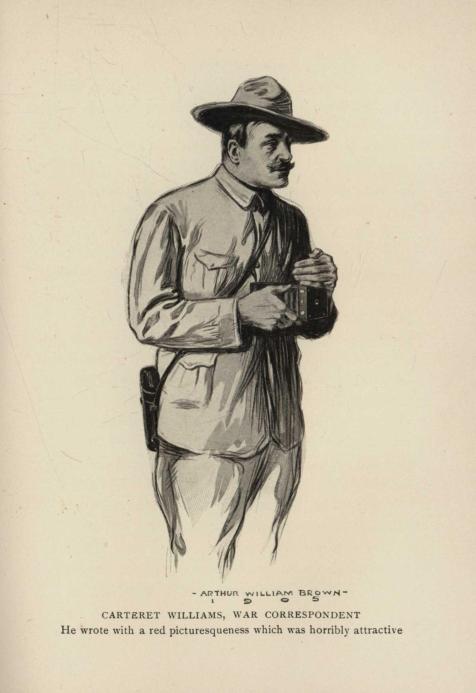
CARTERET WILLIAMS, WAR CORRESPONDENT. He wrote with a red picturesqueness which was horribly attractive
"What, is it really Bunting?" roared Bob, eagerly.
"He says his name's Bunting," replied Williams. "But he's very difficult to handle."
"Oh, Tim can box," said Bob. "But is he our Bunting?"
"Whichever Bunting he is, you are welcome to him," said the enraged war correspondent.
"I must go up and see," said Bob. "Do you think he threw Mr. Plant and Mr. Gordon down, too? I met 'em just now, and they looked as if he had."
"I'm sure he's capable of it," said Williams, bitterly. "Here, take this book with you. I don't want it."
And Bob climbed up, hugging several pounds' weight of Greek with him. He stood at the door and listened, and heard a man inside snorting violently and slamming things about as if he was very much disturbed in his mind. Bob knocked at the door, and it was opened suddenly. The man who opened it was in deep shadow.
"It is—it is. No, it isn't," said Bob, quite aloud.
"Are you another of 'em?" asked the occupier of the rooms.
"Oh, it isn't," said Bob. And, choking down his disappointment, his politeness returned.
"Is this your Greek dictionary?" he asked, courteously. "I found it lying on Mr. Carteret Williams on the next landing, and he said he didn't want it."
The man named Bunting seized the dictionary, and then took Bob by the shoulder and led him in. Bob went like a lamb, for this Mr. Bunting was six feet high, about three feet across the chest, more or less, and had a grip like clip-hooks on a bale.
"Was that man named Williams?" he asked.
"Yes," said Bob.
"You know him?"
"Why, of course," said Bob. "I know 'em all."
"All I've thrown down-stairs this afternoon?"
"I think so," said Bob, modestly. "At least, I met Mr. Plant and Mr. Gordon, who looked very much as if they had fallen down-stairs. And I think the little gentleman you dropped out of the window on the grass must have been Mr. Austin de Vere."
"Oh," said Mr. Bunting, "sit down, boy, and look at me. Do I look mad?"
Bob looked at him and then at the room.
"The room looks mad," he replied. And it certainly did.
"That was the last one," said Mr. Bunting. "He was very troublesome."
"He's a war correspondent," said Bob. "But why is your name Bunting?"
"How the devil do I know?" asked the other, in reply. "Perhaps, as you seem to know them, you can explain what it all means?"
"I will try, sir, if you will tell me what occurred," said Bob.
"First of all," said the outraged member of All Saints, "the American person knocked and came in, and he said: 'Is your name Bunting?' And I said, 'Yes, confound you, for your infernal impudence, and what is yours?' And he said, 'What the devil do you mean by saying you have married her?' And I said I'd said nothing of the kind, and I said if he didn't get out in two shakes of a lamb's tail, I'd throw him out. And he was furious, and couldn't and wouldn't explain, so I did throw him out. And, as he tumbled down-stairs, he said he'd married her himself. And he went away, and I sat down to read Thucydides. He's under the sofa now somewhere. And then the Jew came, and he said: 'You mutht contradict the report of your being married to her at onth,' and that made me very cross, and I said I wouldn't, and that made him very wild, so I said I was married to her just as he said he was—"
"Oh," said Bob, "and are you? Oh, dear, I am so confused! Are you really, really married to Pen?"
"I shall drop you out of the window in a minute," said Mr. Bunting. "I said it to annoy him, and it did, and he said I was a liar. So I opened the door and took him by the neck and dropped him down-stairs, and he howled awfully. And I said to him over the bannisters, 'I am married to her, and have been married for years to her, and she loves me very much, and we are going to acknowledge it as soon as I've taken my B.A.' And he went away holding his neck, and then the little man came in. Did you say he was a poet?"
"A very good poet, too," said Bob. "And I sell him bulldogs."
"Oh," said Mr. Bunting, blankly, "you do, do you? Why?"
"Because Pen thought they would do him good."
Mr. Bunting shook his head.
"Thicksides is lucid compared with this!" he murmured. "But patience, patience, and I shall construe it yet."
"And what did Mr. de Vere say?" asked Bob.
"The same thing. He stood there and said I must contradict it. And he said of course it was very kind of her to have me educated, but that, if I had a spark of decency, I should know that a man who had once occupied the position I had couldn't possibly marry her. And, by the way, what position had I occupied in regard to her?"
"A groom," said Bob. "You were supposed to have been a groom."
"Dear me," said Mr. Bunting, "how interesting and remarkable. Still no light, no real light! And of course I said I had married her, and I asked him did he think I would desert the lady now? And he went scarlet. Why did he go scarlet do you think?"
"I know," said Bob, "it must have been on account of the baby!"
Mr. Bunting smote his forehead.
"So it must," he said. "I never thought of that. What a fearful complication! And then he, too, said I was a liar. So I took him by the collar and led him to the window, and I opened it and dropped him out. And then the one you call Williams came, and he also was indignant, and said I was to deny it, and I wouldn't of course. And then we fought, and the furniture was much disarranged and Thicksides went under the sofa, and at last I got him outside, and finished him with Liddell and Scott. And now you know all! In your turn you can explain what it means. I beg you to do it, and then we will have some tea."