Front matter (continued 5)
Reading edition
"I hate earls," said Jimmy, jealously. He added with extraordinary irrelevance, "But I'm glad she adopted him."
No doubt he referred to the infant.
CHAPTER XXVI.
While Pen and Bob and the baby were going as fast as they could toward Upwell Castle, Pen wept at intervals and hugged the child that all the "horde" were glad she had adopted.
"My only darling," said Pen, convulsively.
Bob shook his head.
"I say, Pen, I really don't understand you, you know! I say, this is rot! You mustn't cry; I can't stand it. And you keep on saying it's your only one in a very silly way. You irritate me very much, Pen!"
"Why, Bob?" asked the desolate creature at his side.
"You could stop all this if you wanted to!"
"Not now," said Pen, "since we've quarrelled!"
"Rot!" said Bob. "You tell me who it is and I'll bring him along. But I'm glad it isn't Timothy, you know."
Timothy was now with Geordie in the other car.
"I can't tell you," said Pen.
"Then don't snivel, please," said Bob, crossly, "or I shall drive into something and kill the baby."
"Oh!" said Pen, "oh, please don't!"
"I think it's very hard lines," said Bob, "especially as Geordie and Tim know, and Miss Mackarness. If they know, I ought to."
"I had to tell them, Bob. Besides, they knew him," said the incautious Pen.
Bob's eyebrows lifted, and he drove rather fast down the next straight bit of road.
"I say," he said to himself, "I ought to make something of that."
He thought very hard and did not speak for a mile. He thought all the more.
"Tim knows 'em all, of course. And Geordie may, though I remember his saying he didn't. But who does Miss Mackarness know? If I can spot that, I can spot the winner."
He went back to the time of Pen's youth, which he only knew by hearsay, as he wasn't much more than born then, and went through the list one by one.
"By Jove!" he said, suddenly, and Penelope started.
"Yes, Bob."
"No," said Bob, thoughtfully; "no, I'm not sure."
"What aren't you sure of, dear?"
"Him," said Bob, and Penelope sighed.
After another mile's silence, Bob spoke again.
"By Jove!"
"You said that before," cried Pen, irritably. He turned his eyes upon her, and she saw them full of strange intelligence.
"Oh, what is it?" she asked, in alarm.
Bob shook his head.
"You've told me who it is," he said.
"I haven't."
"You have," said Bob. "Pen, you're a wonder! I say, are all girls like you?"
Penelope said she didn't know, and demanded his meaning.
"If they are, they're interesting but trying," said Bob. "You couldn't have made more fuss about it if it had been Bunting. Pen, you are a wonder. Well, I don't mind; I like him well enough. He's all right. I hope Bill will like him."
"You are an annoying, irritating boy," said Pen, crossly. "And you know nothing."
"Bar him and Miss Mackarness and Timothy and Smith, I'm the only one that does," said Bob, drily. "I know you, Pen. You were ashamed of him, after all you used to say. All right, don't get angry. I'm all right. I'll keep it dark till you say pull up the blinds. It's not my business. But I'm glad I know. For granny doesn't, and no one has guessed, not even Baker. And he's had great experience with girls in all parts of the world, just as he has had with dogs."
Pen wept.
"You are saying all this to worry me. How can you know?" she cried.
"I'll tell you some day," said Bob. "But because you haven't told me yourself, and have made me find out, I won't tell you who it is till I want to. But one thing I'll say, I don't think your brother Bill really likes him."
He whistled and let the car out till she fairly hummed. Pen was exceedingly cross, and hugged the baby, hoping that they would both be killed at once.
"I don't know what's going to happen," she said. "I've done my best, and nothing but trouble comes of it. If I had to begin again, I don't think I'd try to reform anything. I—I hate reform!"
In the meantime Miss Mackarness's ideas got sadly altered. She did not mind dying at first, but when Bob really went fast, it seemed to her that she loved life better than she thought.
"If I am to die," she said, "I would rather die in my bed, much rather. I want peace, and my dear lady gives me none. This young wretch is no better than a murderer. He laughs. I can't laugh. I can't even speak. The wind stops my screaming. I want to get out and die quietly."
They pulled up close to a village to let a wagon loaded with long timbers get into a side road. Miss Mackarness seized her chance, and, opening the door, jumped to the ground.
"If you please, my lady, I'm going no farther. I will come on later in a cart."
Penelope remonstrated with her. Bob was urgent and impatient.
"We may be caught any minute," he said. "Pen, let her come on in a cart."
"If you prefer it," said Penelope.
"My lady, I much prefer it," said the housekeeper.
Bob let the car go, and Geordie, coming on behind, pulled up to interview Miss Mackarness.
"Sooner than go in one a mile farther," she said, firmly, "I would lie down and die."
"That's silly, ma'am," said Geordie.
"I would rather live silly than die wise," replied Miss Mackarness. "I may be used to much and past surprises, but I can't stomach these cars."
They left her in the road. And now they drove fast, for Bob set the pace, and made it a rapid one.
"I say, Geordie," said Timothy, about twenty miles farther on, "don't you think you could go slower?"
"How can I, with the other car ahead, man?" demanded Geordie.
"Well, I feels queer inside," said poor Timothy. "I'd rather ride a bucking man-eater than go another yard. Set me down!"
"Not me," said Geordie. "Be a man, Tim!"
"I won't," said Tim. "Set me down. I'll walk."
"Or come on in a cart," sneered Geordie. "Why, Mary here don't mind, do you, Mary?"
Mary did mind, but she adored Geordie, and said she didn't. She preferred to die with Geordie than to ride with Miss Mackarness in a cart.
"I don't care," said Tim; "if Mary wants to die in a blazin' fiery mass of petrol under a wreck, I don't. Let me down."
And Geordie let him down.
"A mad bull sooner," said Tim. "And, though I 'ates walkin', bein' a groom, I'd rather walk to hell than motor into paradise."
But peace was established in the cars by now. Geordie and Mary sat side by side, and whenever the pace was hot, she grabbed him so tightly that he remonstrated.
"My dear, I'd rather you hugged me when we go slow," he said at last.
"Lor', Mr. Smith, I wasn't huggin' you," remonstrated the blushing Mary.
"To an outsider it would appear so," said Geordie. "When a young lady puts her arms around a man's neck, it looks like huggin'. Mind I don't say I object, but I might run into the hedge."
"What a very amusin' gentleman you are," said Mary. "I've a very small opinion of Mr. Bunting except upon an 'orse. I'm surprised he preferred to walk."
"I'm not," said Geordie. "I expected it, and if we went really fast, you'd want to walk."
"Never," said Mary. "I love goin' fast. There's great po'try in a motor-car, Mr. Smith."
"Poetry, well, maybe," said Geordie. "To my mind, there's more machinery and oil. I wonder what the next thing will be with my lady, Mary."
"Ah," said Mary, "that's more than I can say. She's very sweet and kind, but I've give up tryin' to understand 'er. And such an 'usband, too. If I 'ad an 'usband, I'd like to show 'im off, if I was proud of 'im, and I would."
"Would you be?" asked Geordie.
"I 'ope so," said Mary.
"I guess you'd expect him to do what you wanted, like my lady," said Geordie.
"Oh, no, never," said Mary. "I'd do hexactly as I was told by 'im I loved. I don't believe in a woman 'angin' on a man and tellin' 'im to do this or that!"
And just then a mighty fine stretch of road opened before them, and Bob, half a mile in front, turned his car loose at the top speed. Geordie put his on the third, and Mary squealed.
"Hush your row, my dear," said Geordie. "Why, bless me, what's the matter with the girl!"
She had him tight by the neck.
"Oh, I'm frightened, Mr. Smith. Don't go so fast," she screamed.
"Lemme go," gasped Geordie, whom she was nearly strangling. "Lemme go, girl!"
"Never, never!" said Mary, settling on him tighter still. "Stop, stop!"
"I won't," said Geordie. "D'ye think I'll let that young un get away from me?"
"You must," screamed Mary, "or I'll get out."
"Then get out," said Geordie, rudely.
"Oh, you cruel, cruel Mr. Smith!" wailed Mary. "Let me down before I'm killed."
Geordie wrenched himself free.
"D'ye mean it?" he asked.
"Yes, you brute!" said Mary, "I does mean it."
He put her down there and then.
"You're no gentleman," said Mary.
"I never said I was," retorted Geordie, with his eyes on the vanishing Bob.
"And I hate you, you coward," sobbed Mary.
"There's a village a mile up the road," said Geordie. And he left her, disappearing in a whirlwind.
"Oh, I'm a sad, des'late, disappinted, jilted woman, with thin shoes and three and tuppence in my pocket," said Mary. "And I don't know where I am!"
She sat on a pile of road metal and cried bitterly. She took it much harder than the bishop did in a similar situation.
"Well, it can't be helped," said Geordie, "and I don't know that I'm sorry. She'd have proposed if I'd kept her at the second speed, I know that; so perhaps I'm well out of it."
He whirled after Bob and his lady, and soon caught them up.
There was peace on that car, too, for Bob hadn't been able to keep his discovery to himself.
"Yes, you're right, Bob," sighed Penelope. "But what could I do after what I'd said? And what can I do now?"
"Cheer up!" said Bob. "I'll fix it for you somehow. Do you know, Pen, I begin to think that after all women aren't as difficult to understand as Baker says."
They came to Upwell in the early afternoon, and were ignorant that the world was on their track. Bob sent a telegram to "Mr. Bramwell" as soon as they got there.
CHAPTER XXVII.
The bishop was excited. There is no doubt about it. Nor is it any wonder, for the sporting element exists even on the episcopal bench, and the hunting of Penelope was peculiar and choice sport. The clergy of his diocese were moderately tame, and when he pointed his episcopal gun at them, they said they would come down, just as the celebrated squirrel did when Colonel Crockett raised his weapon. Not for a long time had he felt so pleased with himself. He was quite certain that Penelope was to be run to earth in the neighbourhood of Spilsby, and, when he had found her, he proposed to speak to her like a father.
"I shall certainly suggest a religious ceremony in the cathedral," he said, blandly. "Oh, yes, I shall insist on it."
"You'll do what?" asked Bradstock, who was with him and the duchess in the early train to Spilsby. "You'll do what?"
The bishop rubbed his hands.
"As the one who christened her, I shall insist on a religious ceremony," he replied.
"Will you?" asked Bradstock.
"To be sure I shall," said the bishop.
"Did you ever hear of Mrs. Partington?" asked Bradstock, "or of King Canute, or of any other celebrated character in history or fiction whose insistence did not come off?"
"I scarcely understand you, Bradstock," said the bishop, with dignity. "I can hardly imagine that you mean to hint, not altogether obscurely, that Lady Penelope will treat any suggestion of mine with disrespect."
Bradstock intimated that that was what he did mean, and Titania, who had got up too early and felt like it, said that she expected nothing from Penelope now but the worst.
"I don't know why I am here, or why I am going there," she said. "I cannot imagine why any of us are doing anything but hiding our disgraced heads in the remoter parts of the country, while Penelope flaunts a black, adopted, illegitimate child in some peculiar part of Lincolnshire, while she is being chased on motor-cars by remorseful scoundrels, of whom I saw about a dozen as we left Spilsborough. Little did I think that I should be running after her with Augustin and you, bishop, while the duke stays at Goring saying she is sport, and Robert is with her when he ought to be at home with Mr. Guthrie learning to spell. And as a result of Penelope's being away like this, that disgraceful Chloe Cadwallader, of whom I shall always have the lowest opinion, is living in her house in Piccadilly, and I dare say spending her money right and left. The marchioness said she knew, on the highest authority, that this was so. The marchioness always goes on the principle of believing the worst, though, of course, she hopes the best. I hope the best for Penelope, but I'm sure the worst is before us. I'm sure of it."
The bishop asked her to cheer up, and Augustin stroked her hand to calm her. But nothing calmed or cheered her.
"I am calm," she said. "I am even peaceful. What can be worse than the worst? I am cheerful, for I believe there is a better world than this, in which even a duchess may find some kind of rest on the highest authority. I shall be glad to go there, and leave you all."
"Don't say so," said Augustin.
"I do say so," said the duchess. "I say it firmly and with faith. You don't dare to deny there is a better world than this, Augustin?"
"Certainly not, in the presence of the bishop," replied Augustin. "Though, in looking out of the windows, I should not be surprised to learn that there is a more exciting spot than Spilsby."
For they had arrived.
"I will make inquiries," said the bishop, "while you look after the duchess in the waiting-room. I see that my wishes have been attended to. I telegraphed for a carriage to be in attendance, and it is in attendance. I will speak with the driver."
He spoke to the driver, who was much intimidated by the apron and the gaiters of the clerical dignitary.
"This is the carriage I ordered, I think," said the bishop. "I want to drive to—to Lady Penelope Brading's house. Do you know it?"
"No, sir," said the driver. "I never heard owt of it, sir."
"Dear me, dear me!" said the bishop. "Well, well! But that is easily explicable, my good man, for my young friend is in the peculiar position of having several names. This is rare; yes, rare I admit, but not altogether so very rare. Can you tell me if there is any one lately come to this neighbourhood known, let us say, as Mrs.—Mrs. Plant, for instance?"
"No, sir, there be not as I knows," said the driver.
"Or Mrs. Gordon, shall I say?"
The driver scratched his head.
"I never heard of her," he replied.
"How remarkable," said the bishop, smiling. "But I am not surprised. Indeed, in this last case I am almost gratified, though I withhold my reasons for saying so. Are you then acquainted with any one called De Vere? No; or with a Mrs. Carteret Williams?"
Light dawned in the driver's face at last. "Mrs. Williams! Ay, sure enif. She do sell sweets and tobacco."
"Indeed," said the bishop, "indeed, how remarkable! But I don't think she will do. Have you heard of a Mrs. Rivaulx or a Mrs. Goby? Perhaps I surprise you in this part of Lincolnshire, but in London it is not at all uncommon for married ladies to have several names, not at all uncommon."
"No, sir, I never heard o' none of 'em," returned the driver, thinking that this gentleman talked most remarkable "cat-blash."
"Good heavens!" said the bishop, "this new custom is trying. Do you then know a Mrs. Carew or Mrs. Bramber?"
Again the man scratched his head and shook it. What did this strange person in gaiters mean?
"Oh! ah!" he said at last. "There be a Mrs. Bramwell at the Moat House."
"Indeed," said the bishop. "Perhaps that may be the lady. At the Moat House! Do you know Mr. Bramwell?"
"I've seen un," said the driver.
"What is he like?" asked the bishop. "Is he fair or dark, or tall or short?"
"He's fairish to dark and betwixt and between," said the driver, wishing to be accurate, "and mostly goes in big spectacles in his engine."
"Ha!" said the bishop, "we are on the scent! And what is Mrs. Bramwell like?"
"She do mostly go in the engine with specs on, too, sir. But my wife do say she be a very fine woman."
The bishop nodded.
"I think you may drive us to the Moat House," he said. "I will bring my friends out."
He rubbed his hands and congratulated himself on the skill with which he had discovered the object of his search.
"I really believe I have found her," he said, when he entered the waiting-room. "I really believe it."
"No!" said the duchess.
"Yes," said the bishop. "By a series of skilful questions and the exercise of a little pardonable deceit, I have learnt that there is a Mrs. Bramwell here, who is said to be a very fine woman, and goes out in goggles in a motor-car with her husband, who is fairish to dark and tall and short and also wears goggles."
Augustin nodded.
"This looks like—something," he said, hopefully. "Bramwell! Perhaps really Bramber, Titania."
"No, no," said Titania. "I expect disaster. I anticipate the Jew or Williams."
"But Bramwell—the first syllable being Bram," suggested the bishop.
"I cannot build on Bram," said the duchess. "We are an unfortunate family. Lord Bramber may be an earl at any minute, and she has married a coal-heaver, of course! Let us go at once."
When they got into the carriage, the bishop told the man to drive to the Moat House.
"Did you say Moat House?" asked the duchess.
"I did," replied the bishop.
"Augustin, do you remember that Penelope's mother loved houses with moats? I think the bishop may be right. I tremble with nervousness."
She had more reason to tremble in a moment, for a big motor-car shaved them and scared the horse.
"Perhaps—" she cried.
"No," said Augustin, "it's Plant and Williams and Carew!"
The duchess gasped. And before she could say another word, another car swept by them.
"Perhaps—" she cried.
"No," said the bishop; "in spite of goggles, I recognize the marquis and Mr. Gordon and Mr. Austin de Vere. This is very remarkable, and not a little annoying. We shall all descend upon Penelope at once, and I fear it will somewhat disturb her. I should have much preferred to see her quietly in order to bring her to a just sense of her peculiar, and our painful, position."
When they got to the house, they found all the lovers but Bramber assembled at the gates. If it hadn't been for the illness of the Earl of Pulborough, he would have been there, they knew.
"Oh, which is it?" moaned Titania. "They all said they were married to her, and I know it's none of 'em."
The bishop greeted the crowd in the most courteous manner. He shook hands with those he knew, and bowed to those he hoped to know.
"I think, gentleman, that, with your permission, I will go in first and see Lady Penelope before any one else does."
And while he went up the carriage drive, Titania glared at the lovers.
"Don't look at 'em like that, Titania," said Augustin.
"Like what, Augustin?"
"Like a Gorgon, Titania," said Augustin.
"I look as I feel," said Titania. "I hate them all. I shall not be able to restrain myself when I see Penelope. I shall shake her. I shall say what I think. No, I won't be wise, Augustin! I decline to be wise. I am full of bitterness. From her earliest youth, she has been a thorn. And it is your fault; you encouraged her in reform, in anarchism. Don't speak to me! I shall explode!"
And Augustin got out just as the bishop rang the door-bell across the moat. Instead of the kind of servant he expected to see, he was greeted by a bent old woman, whose chief glory was her rheumatism, though her claim on Bob had been her stupidity.
"Is Mrs. Bramwell at home?" asked the bishop, with a beaming smile.
"Naw," said the old lady, not beaming in the least.
"No? Then when will she be back?"
"I don't know," replied the caretaker.
"You don't know! Will it be soon?"
"She never said," snarled the old lady.
"Did she go early?"
"Maybe an hour ago, maybe two."
"Will she be back late?"
"Eh? I'm 'ard of 'earin'."
"Will she be back late?" roared the bishop.
"She didn't say."
"What did she say, then?"
"Nothin' as I knows of."
"Where did she go, my good woman?"
"She didn't say."
"Dear me, how vexing!" said the bishop.
"I'm 'ard of 'earin', I tell ye," said the old dame.
"Who went with her?"
"All of 'em, so I 'eard."
"Who were they?" asked the desperate bishop.
"All as was 'ere. There ain't one left."
"Was a boy with her?"
"To be sure, a young gentleman as fetched me 'ere, and give me a shillin'."
"What was his name?"
"'E didn't say," said the old woman, and the bishop wiped his fevered brow and tried again.
"Was Mr. Bramwell with her?"
"I never seed un."
"How did they go?"
"In two engines."
"Ha!" sighed the bishop, "in two motor-cars."
"Likely."
"Will they be back to-night?"
"I 'ope not," said the woman.
"Why do you hope not?" asked the wretched bishop.
"Because of fifteen bob a week, to be sure."
"Then Mrs. Bramwell has gone, has left?"
"Ain't I been sayin' so this last hour?" asked the exasperated old person. "Me, with rheumatics, standin' on cold stones for hours arglin' that she and all have gone in engines!"
"Good heavens!" said the bishop, "she has escaped! She has eluded us! She has kept her word and has fled! This is remarkable; it is annoying. I feel nearer losing my temper than I have done with any one but the dean for the last ten years. I must go back and tell them."
He went back to the gate.
"Is it—" they cried.
"This is her house," said the bishop, who looked rather flushed, "but I have discovered by a series of skilfully devised questions that she is no longer here. Duchess, Lord Bradstock, marquis, and gentlemen, she went away this morning in two motorcars with all her household, leaving behind her no one but a caretaker who, in my humble opinion, ought to be taken care of in an idiot asylum!"
The duchess sighed.
"Then she has kept her word! Finding out that we are still pursuing her, she has fled from us. Oh, I think it wicked of her, wicked to all of us. When I get hold of Robert, I shall take steps to show him what I think of him. Do you give it up, bishop?"
The bishop's eyes flashed with indignation.
"Never!" he said. "I propose that we pursue her at once. She cannot have thought we should be here so soon. If we find out which road she took, we may yet overtake her."
"In what?" asked Bradstock, with his hand on the ramshackle landau the duchess sat in. "In this conveyance, for instance?"
The bishop looked at the two big motor-cars, and at their wretched owners, Plant and Rivaulx.
"Taking my courage in both hands," he said, bravely, "I propose that we lose no time. I will go in this car with the marquis, if he will take me."
The marquis said through his clenched teeth that he would.
"Bradstock, you will escort the duchess back to Spilsborough."
"Certainly not," said the duchess. "I am coming, too. I must and I will. Whatever the condition of Penelope may now be, it is my duty. I come with you!"
"And so do I," said Bradstock.
They packed themselves in the cars, and moved away from the deserted house of the moat. In the village they soon discovered that "Mrs. Bramwell" had gone northwest by the road to Horncastle, and a moment later the bishop said, "Oh!" as Rivaulx fairly launched his car into space. Even Bradstock in Plant's car said something, and the duchess, losing the repose which stamps all duchesses the moment they become duchesses, uttered a scream. Gordon consoled the bishop, being very much pleased to find himself with one, by saying that he had been in a balloon with Rivaulx, and found him careful and very trustworthy.
"I do not think any one who goes in a balloon," gasped his lordship, "can properly be described by any such terms."
Williams said he didn't care if he was killed, as soon as Penelope had acknowledged she was married to him. Gordon, who was desperately scared of Williams, said nothing, but gave the bishop to understand by signs that the war correspondent was mad. Carew, who was still suffering from influenza, sat in his corner and wept at intervals.
In Plant's car the duchess and Goby and De Vere got on admirably. Bradstock sat by Plant and prepared to die. The duchess held Captain Goby's hand. De Vere said some poetry before the speed was very great. Afterward he said his prayers, and wished he was at home with his bulldogs.
"What does anything matter?" he asked, as he clutched Goby's offside.
And all of a sudden Rivaulx's motor pulled up so quickly that the bishop was nearly precipitated upon the road. A scared, oldish woman in respectable and sub-freak garments had done her best to get run over. Rivaulx swore terrible French oaths, and the bishop, who knew French far better than he dared acknowledge except in a literary conversation on Rabelais or argot, sympathized with him in awestruck silence.
"You accursed old lady! Why?" demanded Rivaulx.
"Hush, hush!" said the bishop, and, leaning from the car, he said: "It is all right, my good woman. I hope we have not alarmed you."
Miss Mackarness said they had. It was very hard to have got out of one car and then to be almost killed by another. Then the car behind came up, and the duchess looked at the lady who had given her a little respite. The duchess absolutely screamed again.
"Augustin, it is Miss Mackarness! I remember her well!"
"Who the deuce is Miss Mackarness?" grumbled Bradstock.
But Titania paid no attention to him. Her eyes brightened. She became clever all at once.
"I remember," she said, "I remember!"
She called to the stranger in the road.
"I am so pleased to see you again after such a long time, Miss Mackarness," she said, kindly. "Are you still at Upwell Castle?"
"I'm going there now, ma'am," said the housekeeper, who didn't recognize her Grace.
"Are you walking?" asked Titania, kindly. "It is a long way to walk. You don't remember me, I see."
"No, ma'am," said Miss Mackarness.
"I am the Duchess of Goring," said Titania.
"Oh, your Grace! I beg your Grace's pardon, but, of course, you are," gasped Miss Mackarness.
"And I am going to Upwell now to see my niece."
Miss Mackarness gasped again and could not speak.
"To see Mrs. Bramwell, you know," said Titania, sweetly. "Of course, I know all about it, Miss Mackarness."
"To be sure, your Grace," replied her victim, not knowing what to do or say.
"Then good-bye," said the duchess. "I hope you will enjoy your walk, Miss Mackarness. It's such pleasant weather for a walk."
They left the poor woman in the middle of the road, an easy victim to the slowest vehicle in the county.
"Oh, I've done wrong, I know!" said Pen's housekeeper. "What shall I do now?"
"I said that on purpose," said Titania, viciously. "She has known all along, and ought to have told me. But now we know all about it, Augustin!"
"What about 'Mr. Bramwell'?" asked Augustin. Goby and De Vere turned pale, and the duchess threw up her hands.
"I might have asked her!" she cried.
"Captain Goby looked at her severely," said Augustin, "and so did De Vere."
Goby and De Vere denied it.
"Never mind," said the duchess, "this time she can't escape. We are on the track."
They passed a man a few miles farther on, and only Augustin noticed him.
"You are right, Titania; we are certainly on the track. That man was Timothy Bunting," he said. "Pen has been shedding her retainers all along the road. I suspect Bob of furious driving."
A few miles farther, at the foot of a steep rise, they saw a young and pretty woman weeping on a heap of stones.
"I wonder if that is another of 'em," said Augustin.
It was Mary, whom Geordie had deposited on the road half-way between two villages.
"Have two motor-cars gone this way?" asked Bradstock.
"Yes, sir," sobbed Mary.
"Why are you crying?" asked the sympathetic peer.
"Because Geordie Smith is no gentleman," said Mary.
"That's Mrs. Bramwell's driver, isn't it? I know her well," said Bradstock.
"Yes, it is, and he ain't a gentleman. He drove so fast he frightened me, and I got out."
"How sad," said Bradstock. "We are going on to Upwell Castle now. Can we help you?"
"I would rather walk to Australia than get in another one of 'em," said Mary.
"You are right," said Augustin. "Titania, you are right. In half an hour we shall see Penelope."
"And I shall see Bob," said Titania, viciously.
But the bishop felt rather pleased with Bob now. He was in a car driven by Rivaulx. And Rivaulx was desperate. And when Rivaulx was desperate he lacked consideration for others.
CHAPTER XXVIII.
As all antiquarians know, Upwell Castle consists of two wings and a kind of centrepiece joining two civilizations and two divergent schools of architecture. The right wing is Tudor, and ruined; the left is Georgian, and habitable; the centre is nondescript and pseudo-Palladian. It cost a great deal to keep up, and nothing could keep it from falling down. Penelope's mother fell in love with it on first sight, and fell out with her husband about the price. Its value has fallen since then, for landed property is the only stable thing which always falls. There were pictures in it that connoisseurs gloated over, and some that picture-cleaners had restored till they were as valuable as a Gothic cathedral brought up to date by a resurrected Vandal. There were carvings by Grinling Gibbons to be seen, and some that were not by Grinling Gibbons. There were some rooms decorated by Adams that would have made Adam ill. There was an oak staircase there that a thousand intoxicated noblemen had fallen down; there was another that no sober gentleman could go up. It was ruinous, romantic, and rat-haunted; tapestry waved in its corridors, ghosts loved its precincts; there was a room stained with something that the servants said was blood, and that the skeptical averred to be port wine. The only thing against the latter theory was that the dining-room was not stained, though some said it had been so flooded all over that nothing showed. It was a delightful place, and Penelope never stayed there. Miss Mackarness did, but then she was a Scotchwoman, and didn't count. Bob adored it, but then Bob was Bob, and nothing could change him.
"I'll fix this all up," said Bob, "and make her happy. She's silly. I'll blow the gaff, as Baker says. She's up-stairs now, crying her eyes out, and making the baby bellow."
He wandered about the grounds, and wondered where Mary and Bunting and Miss Mackarness were.
"Silly fools!" said Bob; "the idea of being afraid of going in a motor-car. By Jove, I wonder what's become of my man at Spilsborough! I suppose those people in Regent Street think I've stolen the car. What fun!"
He explored the ruined wing, and ruined it a little more, and came out again into the Queen Anne garden.
"By Jove, I do wish I knew where they all were!" he said. "I wonder what granny is doing. Is she having fits, and Dr. Lumsden Griff to look after 'em? I think Griff's a soft-soapy ass. He says, 'Well, how are we this morning?' By Jove, all the rest of 'em will have fits, too. They will be sick. But I'm glad they're out of it. I wonder where Lord Bradstock is. He'll pull my wig when he sees me. And the bishop! Well, he's not a bad old boy. I rather like bishops, but their legs are queer. By Jove, but it's fun having skipped and done them! If they ever get to Spilsby and find us gone, they'll be mad!"
He walked around the corner of the house, and paff came a motor-car and made him jump. Another one followed like a streak of light. Bob went quite pale for a boy with a complexion like an ancient red brick, and made a bolt for the door. He was too late, for Bradstock and the bishop stood in his way. Bob slowed down, put his hands in his pockets and whistled.
"I say," said Bob, "how did you find this place out?"
"I own to being surprised and disappointed with you, Robert," said the bishop; "very much surprised and greatly disappointed."
Bob wagged his head to and fro.
"Why, what about?" he asked.
"At your not returning, sir," said his lordship. "You treated me and Lord Bradstock, I regret to say, with great disrespect."
"I'm very sorry," said Bob, "but I couldn't help it. Pen—Oh, Lord! there's granny!"
The duchess intervened.
"Robert, where is Penelope?"
Bob hesitated.
"Gone to—t-to London for Paris and Marseilles and Australia," said Bob, hurriedly. "She said she couldn't wait, but had an appointment there somewhere. And she said I was to say she was sorry if any one called."
"Robert," said the duchess, severely, "do not keep your eyes fixed upon the distant landscape. Look me in the face. Are you speaking the truth?"
Bob wriggled and shuffled.
"No, I'm not," he said. "It's a beastly lie. But she did say the other day that she would go to the ends of the earth. And that's Australia, ain't it?"
"Bob," said the bishop, "this is very painful to me. Speak the truth like a man."
"I won't," said Bob; "it isn't my truth. I won't give Pen away to any one."
His vision cleared, and he saw the lovers ranked behind his grandmother and the bishop.
"Oh, Mr. Gordon," he cried, "do come and help me! Would you tell if you were me?"
"No," said Gordon, "no, of course not."
"I always liked you," said Bob, "so I won't."
"I command you," said Titania, looking at Gordon furiously.
"It's no good," said Bob, rapidly; "Pen's a great way off, far enough, that is, and I swore I'd never disclose the secret of her whereabouts to any one. At least, if I didn't swear it, I said it, and, if I said it, my lord, and broke my promise, it wouldn't be honourable, would it?"
"I don't care," began Titania.
"Would it, my lord?" asked Bob.
"I'm afraid not," said the bishop, "though perhaps in the circumstances, which are very peculiar—"
"Well, I won't," said Bob, "and that's flat. Goby wouldn't, I know, would you, Captain Goby?"
But the duchess waved Goby into the background.
"I mean to have the truth. Shall we listen to your foolish scruples now? If you won't tell us where she is, tell us whom she has married. Is it one of these gentlemen?"
"I won't give any of 'em away," said Bob.
"Then you know?"
"Of course I know," said Bob.
"Ah," sighed the duchess, "then she is married?"
"She says so," said Bob, "and, if it's true, as I suppose, I know who it is. But Pen, before she went up—before she went, said I wasn't to speak."
Bradstock smiled.
"Titania, Penelope is in the house. Let us go in," he said, and he marched up the steps. Bob shook himself free from the duchess and darted indoors before Bradstock. He bolted up-stairs to Penelope, and burst in upon her like a whirlwind.
"Pen, they're all here, all the gang! I couldn't keep 'em out!"
"Who are here?" asked Pen, in awful dismay.
"All of 'em, and the bishop and Bradstock and granny!"
"Oh, what shall I do?" wailed Penelope.
"I'll tell you," said Bob. "Let's sneak down the back way and steal one of their cars now, and get away!"
"No, no," said Penelope, "it wouldn't be dignified. I must be dignified, Bob, I must be; I will go down and see them."
"No," said Bob.
"I will," said Penelope.
"And tell 'em the truth?"
Penelope started.
"I can't, I can't, because we've quarrelled. But I will see them; I must."
She went red and white and red again, and once more as pale as dawn. She kissed the sleeping, adopted, illegitimate, normal-coloured infant as he sprawled upon an historic bed, and went to the door.
"Come with me, Bob."
"I'll hold your hand, Pen. I say, you shake!"
"Squeeze my hand till you hurt me," said Pen. "Now come!"
She swept down the big staircase, with Bob in tow, and found herself in the presence of the entire "gang," as Bob had called them.
"Penelope!" said Titania, recoiling.
"Oh, Pen," said Bradstock, advancing.
"My dear Lady Penelope," said the bishop, sweetly, "do you recollect that I christened you at the early age of three months?"
"No," said Penelope.
"No!" said the bishop, "no, to be sure, how could you? But I did."
"It—it was very kind of you," said Penelope. Titania recovered herself and advanced. Gordon and the rest hung about in the distance, looking as wretched as the ruined wing of the castle.
"Are you married, Penelope?" asked Titania.
"Yes," said Penelope.
"Of course she is," said Bob.
"Hold your tongue, Robert," said his grandmother. "And to whom?"
"I won't say," replied Penelope. "I told you I wouldn't, and I won't."
"I said she wouldn't," cried Bob.
Titania pointed her hand at the shrinking horde.
"Every single one of these gentlemen, to say nothing of Lord Bramber, who is with his invalid father at the present moment, came to me and said he was married to you! Every one of them without an exception!"
"I am very much obliged to them," said Pen. "In the circumstances, I think it was noble of them."
"Are you alluding to the advertisement in the Times?" asked Titania. "Are you aware that every one now says that you have adopted an infant?"
"What rot!" said Bob.
"Robert," cried his grandmother, "be silent, I command you. I will not be interrupted by you. Are you aware, Penelope, that it is said all over England and Europe and the blatant United States that you have adopted an infant?"
Penelope shook her head.
"It's the first I've heard of it," said Penelope, who was the colour of a rose.
"Is it true? Do not evade my question," cried Titania.
"I don't see, granny, what right you have to ask 'em," said the irrepressible Bob. "I sent you a wire to say it wasn't black, and it isn't."
"Augustin, silence that boy," said Titania.
But Augustin shook his head.
"Don't you answer anything, Pen," said Bob. "No one has any right to ask you anything."
He marched over to Gordon.
"Don't look so sad, Mr. Gordon."
"I can't help it, my boy," said Gordon. "It's a horrid situation. I don't care whether it's adopted or not. If she'll marry me, I'll have her."
Bob squeezed his hand.
"I ain't absolutely sure it isn't you yet," he said. "Pen hasn't told me all, you know. By the way, Mr. Gordon, did that speculation come off?"
"Not so well as I thought by ten thousand," said Gordon.
"Oh, I say," said Bob, "but, after all, it doesn't matter. I'll make fifty or sixty thousand do."
"You're a fine boy," said Gordon. "But, Bob, I would like to strangle your grandmother."
"Would you?" asked Bob, eagerly. "I dare say Pen does, too. Grandmothers and aunts are very trying. At least, I find them so."
The duchess's voice rose now quite above the limits of social decency, except when any one is playing or singing.
"I will not be put off, Penelope. You will say who it is, and you will be married again by the bishop in his fine Gothic cathedral—"
"Mr. Dean's cathedral," interjected the bishop.
"With a proper service and the usual hymns, breathing over Eden, or I will stay here till you do."
"Steady, Titania," said Bradstock. "If she won't, she won't."
"But she shall," shrieked Titania. "Gentlemen, which of you is it? I am now entirely desperate; which of you is it?"
No one said a word.
"Marquis, is it you?" asked the duchess. "You said so before."
"How can I say?" asked poor Rivaulx. "She says no one must."
"Quite right," said Bradstock. "Who will believe any one, Titania? Let's have lunch and be friendly and stop this. I'm very hungry, Pen. And let's see the baby."
The duchess shivered.
"I cannot and will not see it," said Titania. "For by all accounts, it is an adopted illegitimate child. If Penelope will send it back to the person she got it of, and own the truth, I will forgive her and have lunch, for I am very faint."
"I want to see the baby, Pen," said Augustin, with his hand on Pen's shoulder. "You know, Pen, they still say it's rather dusky."
Penelope was very indignant.
"He's not," she cried. "They sha'n't say it any more. Bob, tell that girl up-stairs to bring him down."
And Bob ran up-stairs like a monkey up a stick.
"I decline to see it," said Titania. "A baby without a name is a terrible object to me. It is an insult to the bishop and to the Church to bring one into the room. I will retire into the open air and try to breathe again."
Goby assisted her outside.
"This is a calamity," said Titania. "It's a catastrophe. What is the truth, Captain Goby? Are you a liar, too?"
Goby sobbed.
"How can I say?" he asked. "You know I can't."
He looked out into the park.
"Here's some one coming in a motor," he cried. They all ran to the windows. But just then Bob and the nurse came down with the infant, who, though evidently awed by the number of creatures he saw about him, behaved like a gentleman, and not in the least like an adopted child.
"I congratulate you, Pen," said Bradstock. "The mother must be a devilish pretty woman! Does she miss it much, Pen? Oh, Pen, what a queer, mad darling you are! I begin to see daylight."
But nobody else did. Penelope blushed and hugged the baby tenderly, while Bob danced around her in the wildest state of excitement.
"I say, Captain Goby, come and look at it! Mr. de Vere! I say, marquis! Ain't it a ripper, and as fat as a pup, and hardly a squeal out of it day or night! Granny dear, won't you look at it?"
"No, no," said Titania. "I cannot, cannot bring myself to do so!"
"You'll soon be jolly sorry, I can tell you," cried the loving grandson. "I'll bet you'll be sorry."
He ran to Pen.
"I say, Pen, give the kid to me, or you'll drop it."
"Drop him!" exclaimed Penelope. "Oh, Bob, is it likely?"
"Very likely," said Bob, "if you knew that I sent a telegram to some one just as soon as we got here!"
Pen flushed scarlet. But not with anger.
"Oh, Bob!"
"I did! You ain't angry?"
"Oh, Bob!"
"I don't care," said Bob, as he took the child. "I don't care a hang. I'm ruined with all these jossers now. De Vere will never buy any more dogs of me. I say, who's that?"
A motor-car stopped outside the great hall door, and a gentleman in black got out. He came up the steps rapidly, and stopped dead when he found all the world in front of him.
"I thought so," said Bradstock. "Now the catalogue is complete."
"Lord Bramber!" cried the others. Penelope stood in the centre of the great hall as if she were turned to marble. But no marble ever had so sweet a colour.
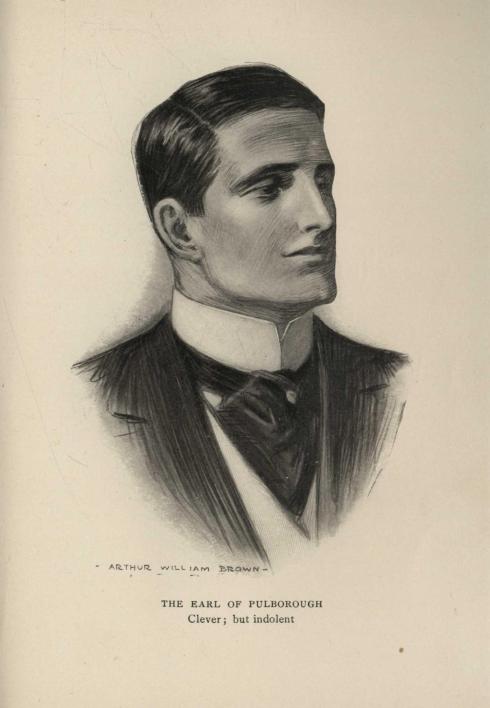
THE EARL OF PULBOROUGH. Clever; but indolent
"I believe it is now the Earl of Pulborough," said Bradstock, gravely, to the newcomer.
"Yes," he replied. "Penelope, you sent for me?"
Pen fell upon his neck before them all and did not deny it.
And, as they stood still in great amazement, Bob danced the baby up and down till that young gentleman made up his mind to roar as soon as he got his breath.
"This—this is Lord Bramber," howled Bob, triumphantly. "Now admit you feel sorry you spoke, granny!"
He gave the baby to the nurse, and grabbed Goby by the arm.
"I say, I'm awfully sorry, but it isn't my fault, Captain Goby, and Ethel Mytton is a very nice girl, and dead in love with you."
"Is she?" sighed Goby.
"Mr. de Vere, I've got a bulldog—"
"Damn bulldogs!" said De Vere.
Bob seized Gordon.
"Do you feel very bad, Mr. Gordon?" he asked, sympathetically. "I almost wish it had been you."
"It can't be helped," said Gordon, gloomily. "I never had a chance. Come and see me in the city next week, Bob."
Rivaulx and Carew and Williams took their hats and slipped from the house, while Bob did what he could to soften things for them.
"I'll come and see you all very often," he cried. "Good-bye now!"
An hour later, when Titania had the baby upon her capacious lap, and said how certain she had been the whole time that Bramber was Penelope's choice, Bob walked around the garden with the bishop and Lord Bradstock.
"Oh, it's quite easy to understand," said Bob. "After all she said, you expected she would marry some outsider, and you see she took the pick of the basket, and of course was ashamed. Oh, I know Pen."
"You are a wonder, Bob," said Bradstock.
The bishop said that upon adequate reflection he was inclined to agree with Bradstock.
"Well, Pen's all right," said Bob.
THE END.
* * * * * * * *
L. C. Page and Company's Announcement List of New fiction
The Flight of Georgiana
A ROMANCE OF THE DAYS OF THE YOUNG PRETENDER. By ROBERT NEILSON STEPHENS, author of "The Bright Face of Danger," "An Enemy to the King," "The Mystery of Murray Davenport," etc.
Library 12mo, cloth decorative, illustrated . . . $1.50
Mr. Stephens's novels all bear the hall-mark of success for his men are always live, his women are always worthy of their cavaliers, and his adventures are of the sort to stir the most sluggish blood without overstepping the bounds of good taste.
The theme of the new novel is one which will give Mr. Stephens splendid scope for all the powers at his command. The career of "Bonnie Prince Charlie" was full of romance, intrigue, and adventure; his life was a series of episodes to delight the soul of a reader of fiction, and Mr. Stephens is to be congratulated for his selection of such a promising subject.
Mrs. Jim and Mrs. Jimmie
By STEPHEN CONRAD, author of "The Second Mrs. Jim."
Library 12mo, cloth decorative, illustrated . . . $1.50
This new book is in a sense a sequel to "The Second Mrs. Jim," since it gives further glimpses of that delightful stepmother and her philosophy. This time, however, she divides the field with "Mrs. Jimmie," who is quite as attractive in her different way. The book has more plot than the former volume, a little less philosophy perhaps, but just as much wholesome fun. In many ways it is a stronger book, and will therefore take an even firmer hold on the public.
The Story of Red Fox
Told by CHARLES G. D. ROBERTS, author of "The Watchers of the Trails," "The Kindred of the Wild," "Barbara Ladd," etc.
Library 12mo, cloth decorative, with fifty illustrations and cover design by Charles Livingston Bull . . . $2.00
Mr. Roberts's reputation as a scientifically accurate writer, whose literary skill transforms his animal stories into masterpieces, stands unrivalled in his particular field.
This is his first long animal story, and his romance of Red Fox, from babyhood to patriarchal old age, makes reading more fascinating than any work of fiction. In his hands Red Fox becomes a personality so strong that one entirely forgets he is an animal, and his haps and mishaps grip you as do those of a person.
Mr. Bull, as usual, fits his pictures to the text as hand to glove, and the ensemble becomes a book as near perfection as it is possible to attain.
Return
A STORY OF THE SEA ISLANDS IN 1739. By ALICE MACGOWAN and GRACE MACGOWAN COOKE, authors of "The Last Word," etc. With six illustrations by C. D. Williams.
Library 12mo, cloth . . . $1.50
A new romance, undoubtedly the best work yet done by Miss MacGowan and Mrs. Cooke. The heroine of "Return," Diana Chaters, is the belle of the Colonial city of Charles Town, S.C., in the early eighteenth century, and the hero is a young Virginian of the historical family of Marshall. The youth, beauty, and wealth of the fashionable world, which first form the environment of the romance, are pictured in sharp contrast to the rude and exciting life of the frontier settlements in the Georgia Colony, and the authors have missed no opportunities for telling characterizations. But "Return" is, above all, a love-story.
We quote the opinion of Prof. Charles G. D. Roberts, who has read the advance sheets: "It seems to me a story of quite unusual strength and interest, full of vitality and crowded with telling characters. I greatly like the authors' firm, bold handling of their subject."
Lady Penelope
By MORLEY ROBERTS, author of "Rachel Marr," "The Promotion of the Admiral," etc. With nine illustrations by Arthur W. Brown.
Library 12mo, cloth . . . $1.50
Mr. Roberts certainly has versatility, since this book has not a single point of similarity with either "Rachel Marr" or his well-known sea stories. Its setting is the English so-called "upper crust" of the present day. Lady Penelope is quite the most up-to-date young lady imaginable and equally charming. As might be expected from such a heroine, her automobiling plays an important part in the development of the plot. Lady Penelope has a large number of suitors, and her method of choosing her husband is original and provocative of delightful situations and mirthful incidents.
The Winged Helmet
By HAROLD STEELE MACKAYE, author of "The Panchronicon," etc. With six illustrations by H. C. Edwards.
Library 12mo, cloth . . . $1.50
When an author has an original theme on which to build his story, ability in construction of unusual situations, skill in novel characterization, and a good literary style, there can be no doubt but that his work is worth reading. "The Winged Helmet" is of this description.
The author gives in this novel a convincing picture of life in the early sixteenth century, and the reader will be delighted with its originality of treatment, freshness of plot, and unexpected climaxes.
A Captain of Men
By E. ANSON MORE.
Library 12mo, cloth, illustrated . . . $1.50
A tale of Tyre and those merchant princes whose discovery of the value of tin brought untold riches into the country and afforded adventures without number to those daring seekers for the mines. Merodach, the Assyrian, Tanith, the daughter of the richest merchant of Tyre, Miriam, her Hebrew slave, and the dwarf Hiram, who was the greatest artist of his day, are a quartette of characters hard to surpass in individuality. It has been said that the powerful order of Free Masons first had its origin in the meetings which were held at Hiram's studio in Tyre, where gathered together the greatest spirits of that age and place.
The Paradise of the Wild Apple
By RICHARD LEGALLIENNE, author of "Old Love Stories Retold," "The Quest of the Golden Girl," etc.
Library 12mo, cloth decorative . . . $1.50
The theme of Mr. LeGallienne's new romance deals with the instinct of wildness in human nature,—the wander spirit and impatience of tame domesticity, the preference for wild flowers and fruits, and the glee in summer storms and elemental frolics. A wild apple-tree, high up in a rocky meadow, is symbolic of all this, and Mr. LeGallienne works out in a fashion at once imaginative and serious the romance of a young man well placed from the view of worldly goods and estate, who suddenly hungers for the "wild apples" of his youth. The theme has limitless possibilities, and Mr. LeGallienne is artist enough to make adequate use of them.
The Grapple
Library 12mo, cloth decorative . . . $1.50
This story of a strike in the coal mines of Pennsylvania gives both sides of the question,—the Union and its methods, and the non-Union workers and their loyal adherents, with a final typical clash at the end. The question is an absorbing one, and it is handled fearlessly.
For the present at least "The Grapple" will be issued anonymously.
Brothers of Peril
By THEODORE ROBERTS, author of "Hemming the Adventurer."
Library 12mo, cloth decorative, illustrated . . . $1.50
"Brothers of Peril" has an unusual plot, dealing with a now extinct race, the Beothic Indians of the sixteenth century, who were the original inhabitants of Newfoundland when that island was merely a fishing-station for the cod-seeking fleets of the old world.
The story tells of the adventures of a young English cavalier, who, left behind by the fleet, finds another Englishman, with his daughter and servants, who is hiding from the law. A French adventurer and pirate, who is an unwelcome suitor for the daughter, plays an important part. Encounters between the Indians and the small colony of white men on shore, and perilous adventures at sea with a shipload of pirates led by the French buccaneer, make a story of breathless interest.
The Black Barque
By T. JENKINS HAINS, author of "The Wind Jammers," "The Strife of the Sea," etc. With five illustrations by W. Herbert Dunton.
Library 12mo, cloth . . . $1.50
According to a high naval authority who has seen the advance sheets, this is one of the best sea stories ever offered to the public. "The Black Barque" is a story of slavery and piracy upon the high seas about 1815, and is written with a thorough knowledge of deep-water sailing. This, Captain Hains's first long sea story, realistically pictures a series of stirring scenes at the period of the destruction of the exciting but nefarious traffic in slaves, in the form of a narrative by a young American lieutenant, who, by force of circumstances, finds himself the gunner of "The Black Barque."
Cameron of Lochiel
Translated from the French of PHILIPPE AUBERT DE GASPÉ by PROF. CHARLES G. D. ROBERTS.
Library 12mo, cloth decorative . . . $1.50
The publishers are gratified to announce a new edition of a book by this famous author, who may be called the Walter Scott of Canada. This interesting and valuable romance is fortunate in having for its translator Professor Roberts, who has caught perfectly the spirit of the original. The French edition first appeared under the title of "Les Anciens Canadiens" in 1862, and was later translated and appeared in an American edition now out of print.
Patriotism, devotion to the French-Canadian nationality, a just pride of race, and a loving memory for his people's romantic and heroic past, are the dominant chords struck by the author throughout the story.
Castel del Monte
By NATHAN GALLIZIER. Illustrated by H. C. Edwards.
Library 12mo, cloth . . . $1.5O
A powerful romance of the fall of the Hohenstaufen dynasty in Italy, and the overthrow of Manfred by Charles of Anjou, the champion of Pope Clement IV. The Middle Ages are noted for the weird mysticism and the deep fatalism characteristic of a people believing in signs and portents and the firm hand of fate. Mr. Gallizier has brought out these characteristics in a marked degree.
Slaves of Success
By ELLIOTT FLOWER, author of "The Spoilsmen," etc. With twenty illustrations by different artists.
Library 12mo, cloth . . . $1.50
Another striking book by Mr. Flower, whose work is already so well known, both through his long stories and his contributions to Collier's, the Saturday Evening Post, etc. Like his first success, "The Spoilsmen," it deals with politics, but in the broader field of state and national instead of municipal. The book has recently appeared in condensed form as a serial in Collier's Magazine, where it attracted wide-spread attention, and the announcement of its appearance in book form will be welcomed by Mr. Flower's rapidly increasing audience. The successful delineation of characters like John Wade, Ben Carroll, Azro Craig, and Allen Sidway throws new strong lights on the inside workings of American business and political "graft."
Silver Bells
By COL. ANDREW C. P. HAGGARD, author of "Hannibal's Daughter," "Louis XIV. in Court and Camp," etc. With cover design and frontispiece by Charles Livingston Bull.
Library 12mo, cloth . . . $1.50
Under the thin veneer of conventionality and custom lurks in many hearts the primeval instinct to throw civilization to the winds and hark back to the ways of the savages in the wilderness, and it often requires but a mental crisis or an emotional upheaval to break through the coating. Geoffrey Digby was such an one, who left home and kindred to seek happiness among the Indians of Canada, in the vast woods which always hold an undefinable mystery and fascination. He gained renown as a mighty hunter, and the tale of his life there, and the romance which awaited him, will be heartily enjoyed by all who like a good love-story with plenty of action not of the "stock" order. "Silver Bells," the Indian girl, is a perfect "child of nature."
Selections from L. C. Page and Company's List of Fiction
WORKS OF ROBERT NEILSON STEPHENS
Captain Ravenshaw; OR, THE MAID OF CHEAPSIDE. (40th thousand.) A romance of Elizabethan London. Illustrations by Howard Pyle and other artists.
Library 12mo, cloth . . . $1.50
Not since the absorbing adventures of D'Artagnan have we had anything so good in the blended vein of romance and comedy. The beggar student, the rich goldsmith, the roisterer and the rake, the fop and the maid, are all here: foremost among them Captain Ravenshaw himself, soldier of fortune and adventurer, who, after escapades of binding interest, finally wins a way to fame and to matrimony.
Philip Winwood. (70th thousand) A Sketch of the Domestic History of an American Captain in the War of Independence, embracing events that occurred between and during the years 1763 and 1785 in New York and London. Written by his Enemy in War, Herbert Russell, Lieutenant in the Loyalist Forces. Presented anew by ROBERT NEILSON STEPHENS. Illustrated by E. W. D. Hamilton.
Library 12mo, cloth . . . $1.50
"One of the most stirring and remarkable romances that have been published in a long while, and its episodes, incidents, and actions are as interesting and agreeable as they are vivid and dramatic."—Boston Times.
The Mystery of Murray Davenport. (30th thousand.) By ROBERT NEILSON STEPHENS, author of "An Enemy to the King," "Philip Winwood," etc.
Library 12mo, cloth, with six full-page illustrations by H. C. Edwards . . . $1.50
"This is easily the best thing that Mr. Stephens has yet done. Those familiar with his other novels can best judge the measure of this praise, which is generous."—Buffalo News.
"Mr. Stephens won a host of friends through his earlier volumes, but we think he will do still better work in his new field if the present volume is a criterion."—N. Y. Com. Advertiser.
An Enemy to the King. (60th thousand.) From the "Recently Discovered Memoirs of the Sieur de la Tournoire." Illustrated by H. De M. Young.
Library 12mo, cloth . . . $1.50
An historical romance of the sixteenth century, describing the adventures of a young French nobleman at the Court of Henry III., and on the field with Henry of Navarre.
"A stirring tale."—Detroit Free Press.
"A royally strong piece of fiction."—Boston Ideas.
"Interesting from the first to the last page."—Brooklyn Eagle.
"Brilliant as a play; it is equally brilliant as a romantic novel."—Philadelphia Press.
The Continental Dragoon: A ROMANCE OF PHILIPSE MANOR HOUSE IN 1778. (43d thousand.) Illustrated by H. C. Edwards.
Library 12mo, cloth . . . $1.50
A stirring romance of the Revolution, the scene being laid in and around the old Philipse Manor House, near Yonkers, which at the time of the story was the central point of the so-called "neutral territory" between the two armies.
The Road to Paris: A STORY OF ADVENTURE. (25th thousand.) Illustrated by H. C. Edwards.
Library 12mo, cloth . . . $1.50
An historical romance of the 18th century, being an account of the life of an American gentleman adventurer of Jacobite ancestry, whose family early settled in the colony of Pennsylvania.
A Gentleman Player: HIS ADVENTURES ON A SECRET MISSION FOR QUEEN ELIZABETH. (38th thousand.) Illustrated by Frank T. Merrill.
Library 12mo, cloth . . . $1.50
"A Gentleman Player" is a romance of the Elizabethan period. It relates the story of a young gentleman who, in the reign of Elizabeth, falls so low in his fortune that he joins Shakespeare's company of players, and becomes a friend and protégé of the great poet.
WORKS OF CHARLES G. D. ROBERTS
Barbara Ladd. With four illustrations by Frank Verbeck.
Library 12mo, gilt top . . . $1.50
"From the opening chapter to the final page Mr. Roberts lures us on by his rapt devotion to the changing aspects of Nature and by his keen and sympathetic analysis of human character."—Boston Transcript.
The Kindred of the Wild. A BOOK OF ANIMAL LIFE. With fifty-one full-page plates and many decorations from drawings by Charles Livingston Bull.
Small quarto, decorative cover . . . $2.00
"Professor Roberts has caught wonderfully the elusive individualities of which he writes. His animal stories are marvels of sympathetic science and literary exactness. Bound with the superb illustrations by Charles Livingston Bull, they make a volume which charms, entertains, and informs."—New York World.
"... Is in many ways the most brilliant collection of animal stories that has appeared ... well named and well done."—John Burroughs.
The Forge in the Forest. Being the Narrative of the Acadian Ranger, Jean de Mer, Seigneur de Briart, and how he crossed the Black Abbé, and of his Adventures in a Strange Fellowship. Illustrated by Henry Sandham, R.C.A.
Library 12mo, cloth, gilt top . . . $1.50
A romance of the convulsive period of the struggle between the French and English for the possession of North America. The story is one of pure love and heroic adventure, and deals with that fiery fringe of conflict that waved between Nova Scotia and New England. The Expulsion of the Acadians is foreshadowed in these brilliant pages, and the part of the "Black Abbé's" intrigues in precipitating that catastrophe is shown.
The Heart of the Ancient Wood. With six illustrations by James L. Weston.
Library 12mo, decorative cover . . . $1.50
"One of the most fascinating novels of recent days."—Boston Journal.
"A classic twentieth-century romance."—New York Commercial Advertiser.
A Sister to Evangeline. Being the story of Yvonne de Lamourie, and how she went into Exile with the Villagers of Grand Pré.
Library 12mo, cloth, gilt top, illustrated . . . $1.50
This is a romance of the great expulsion of the Acadians, which Longfellow first immortalized in "Evangeline." Swift action, fresh atmosphere, wholesome purity, deep passion, searching analysis, characterize this strong novel.
By the Marshes of Minas.
Library 12mo, cloth, gilt top, illustrated . . . $1.50
This is a volume of romance, of love and adventure in that picturesque period when Nova Scotia was passing from the French to the English regime. Each tale is independent of the others, but the scenes are similar, and in several of them the evil "Black Abbé"," well known from the author's previous novels, again appears with his savages at his heels—but to be thwarted always by woman's wit or soldier's courage.
Earth's Enigmas. A new edition, with the addition of three new stories, and ten illustrations by Charles Livingston Bull.
Library 12mo, cloth, uncut edges . . . $1.50
"Throughout the volume runs that subtle questioning of the cruel, predatory side of nature which suggests the general title of the book. In certain cases it is the picture of savage nature ravening for food—for death to preserve life; in others it is the secret symbolism of woods and waters prophesying of evils and misadventures to come. All this does not mean, however, that Mr. Roberts is either pessimistic or morbid—it is nature in his books after all, wholesome in her cruel moods as in her tender."—The New York Independent.
WORKS OF LILIAN BELL
Hope Loring. Illustrated by Frank T. Merrill.
Library 12mo, cloth, decorative cover . . . $1.50
"Lilian Bell's new novel, 'Hope Loring,' does for the American girl in fiction what Gibson has done for her in art.
"Tall, slender, and athletic, fragile-looking, yet with nerves and sinews of steel under the velvet flesh, frank as a boy and tender and beautiful as a woman, free and independent, yet not bold—such is 'Hope Loring,' by long odds the subtlest study that has yet been made of the American girl."—Dorothy Dix, in the New York American.
Abroad with the Jimmies. With a portrait, in duogravure, of the author.
Library 12mo, cloth, decorative cover . . . $1.50
"A deliciously fresh, graphic book. The writer is so original and unspoiled that her point of view has value."—Mary Hartwell Catherwood.
"Full of ozone, of snap, of ginger, of swing and momentum."—Chicago Evening Post.
"... Is one of her best and cleverest novels ... filled to the brim with amusing incidents and experiences. This vivacious narrative needs no commendation to the readers of Miss Bell's well-known earlier books."—N. Y. Press.
The Interference of Patricia. With a frontispiece from drawing by Frank T. Merrill.
Small 12mo, cloth, decorative cover . . . $1.00
"There is life and action and brilliancy and dash and cleverness and a keen appreciation of business ways in this story."—Grand Rapids Herald.
"A story full of keen and flashing satire."—Chicago Record-Herald.
A Book Of Girls. With a frontispiece.
Small 12mo, cloth, decorative cover . . . $1.00
"The stories are all eventful and have effective humor."—New York Sun.
"Lilian Bell surely understands girls, for she depicts all the variations of girl nature so charmingly."—Chicago Journal.
The above two volumes boxed in special holiday dress, per set, $2.50.
The Red Triangle. Being some further chronicles of Martin Hewitt, investigator. By ARTHUR MORRISON, author of "The Hole in the Wall," "Tales of Mean Streets," etc.
Library 12mo, cloth decorative . . . $1.50
This is a genuine, straightforward detective story of the kind that keeps the reader on the qui vive. Martin Hewitt, investigator, might well have studied his methods from Sherlock Holmes, so searching and successful are they.
"Better than Sherlock Holmes."—New York Tribune.
"The reader who has a grain of fancy or imagination may be defied to lay this book down, once he has begun it, until the last word has been reached."—Philadelphia North American.
"If you like a good detective story you will enjoy this."—Brooklyn Eagle.
"We have found 'The Red Triangle' a book of absorbing interest."—Rochester Herald.
"Will be eagerly read by every one who likes a tale of mystery."—The Scotsman, England.
Prince Hagen. By UPTON SINCLAIR, author of "King Midas," etc.
Library 12mo, cloth decorative . . . . $1.50
In this book Mr. Sinclair has written a satire of the first order—one worthy to be compared with Swift's biting tirades against the follies and abuses of mankind.
"A telling satire on politics and society in modern New York."—Philadelphia Public Ledger.
"The book has a living vitality and is a strong depiction of political New York."—Bookseller, Newsdealer, and Stationer.
The Silent Maid. By FREDERIC W. PANGBORN.
Large 16mo, cloth decorative, with a frontispiece by Frank T. Merrill . . . $1.00
A dainty and delicate legend of the brave days of old, of sprites and pixies, of trolls and gnomes, of ruthless barons and noble knights. "The Silent Maid" herself, with her strange bewitchment and wondrous song, is equalled only by Undine in charm and mystery.
"Seldom does one find a short tale so idyllic in tone and so fanciful in motive. The book shows great delicacy of imagination."—The Criterion.
The Spoilsmen. By ELLIOTT FLOWER, author of "Policeman Flynn," etc.
Library 12mo, cloth . . . $1.50
"The best one may hear of 'The Spoilsmen' will be none too good. As a wide-awake, snappy, brilliant political story it has few equals, its title-page being stamped with that elusive mark, 'success.' One should not miss a word of a book like this at a time like this and in a world of politics like this."—Boston Transcript.
"Elliott Flower, whose 'Policeman Flynn' attested his acquaintance with certain characteristic aspects of the American city, has written a novel of municipal politics, which should interest many readers.... The characters are obviously suggested by certain actual figures in local politics, and while the conditions he depicts are general in large cities in the United States, they will be unusually familiar to local readers.... Ned Bell, the 'Old Man,' or political boss; Billy Ryan, his lieutenant; 'Rainbow John,' the alderman, are likely to be identified.... and other personages of the story are traceable to their prototypes."—Chicago Evening Post.
Stephen Holton. By CHARLES FELTON PIDGIN, author of "Quincy Adams Sawyer," "Blennerhassett," etc. The frontispiece is a portrait of the hero by Frank T. Merrill.
One vol., library 12mo, cloth, gilt top . . . $1.50
"In the delineation of rural life, the author shows that intimate sympathy which distinguished his first success, 'Quincy Adams Sawyer.'"—Boston Daily Advertiser.
"'Stephen Holton' stands as his best achievement."—Detroit Free Press.
"New England's common life seems a favorite material for this sterling author, who in this particular instance mixes his colors with masterly skill."—Boston Globe.
Asa Holmes; OR, AT THE CROSS-ROADS. A Sketch of Country Life and Country Humor. By ANNIE FELLOWS JOHNSTON. With a frontispiece by Ernest Fosbery.
Large 16mo, cloth, gilt top . . . $1.00
"'Asa Holmes; or, At the Cross-Roads' is the most delightful, most sympathetic and wholesome book that has been published in a long while. The lovable, cheerful, touching incidents, the descriptions of persons and things are wonderfully true to nature."—Boston Times.
A Daughter Of Thespis. By JOHN D. BARRY, author of "The Intriguers," "Mademoiselle Blanche," etc.
Library 12mo, cloth decorative . . . $1.50
"I should say that 'A Daughter of Thespis' seemed so honest about actors and acting that it made you feel as if the stage had never been truly written about before."—W. D. Howells, in Harper's Weekly.
"This story of the experiences of Evelyn Johnson, actress, may be praised just because it is so true and so wholly free from melodrama and the claptrap which we have come to think inseparable from any narrative which has to do with theatrical experiences."—Professor Harry Thurston Peck, of Columbia University.
"Certainly written from a close and shrewd observation of stage life."—Chicago Record-Herald.
The Golden Dog: A ROMANCE OF QUEBEC. By WILLIAM KIRBY. New authorized edition, printed from new plates. Illustrated by J. W. Kennedy.
One vol., library 12mo, cloth . . . $1.25
"A powerful romance of love, intrigue, and adventure in the times of Louis XV. and Madame de Pompadour, when the French colonies were making their great struggle to retain for an ungrateful court the fairest jewels in the colonial diadem of France. It is a most masterly picture of the cruelties and the jealousies of a maiden, Angelique des Melloises—fair as an angel and murderous as Medea. Mr. Kirby has shown how false prides and ambitions stalked abroad at this time, how they entered the heart of man to work his destruction, and particularly how they influenced a beautiful demon in female form to continued vengeances."—Boston Herald.
The Last Word. By ALICE MACGOWAN. Illustrated with seven portraits of the heroine.
Library 12mo, cloth, gilt top . . . $1.50
"When one receives full measure to overflowing of delight in a tender, charming, and wholly fascinating new piece of fiction, the enthusiasm is apt to come uppermost. Miss MacGowan has been known before, but her best gift has here declared itself."—Louisville Post.
"The story begins and ends in Western Texas. Between chapters, there is the ostensible autobiography of a girl who makes her way in New York journalism. Out of it all comes a book, vivid, bright, original—one of a kind and the kind most welcome to readers of the hitherto conventional."—New York World.
The Captain's Wife. By W. CLARK RUSSELL, author of "The Wreck of the Grosvenor." With a frontispiece by C. H. Dunton.
Library 12mo, cloth decorative . . . $1.50
"Mr. Russell's descriptions of the sea are vivid and full of color, and he brings home to the reader the feeling that he is looking upon the real thing drawn by one who has seen the scenes and writes from knowledge."—Brooklyn Eagle.
"Every page is readable and exciting."—Baltimore Herald.
"This story may be considered as one of the best of his excellent tales of the sea."—Chicago Post.
"There are suggestions of Marryat in it, and reminders of Charles Reade, but mostly it is Clark Russell, with his delightful descriptions and irresistible sea yarns."—Phila. North American.
The Mate of the Good Ship York. By W. CLARK RUSSELL, author of "The Wreck of the Grosvenor," etc. With a frontispiece by C. H. Dunton.
Library 12mo, cloth decorative . . . $1.50
"One of the breeziest, most absorbing books that have come to our table is W. Clark Russell's 'The Mate of the Good Ship York.'"—Buffalo Commercial.
"For a rousing, absorbing, and, withal, a truthful tale of the sea, commend me to W. Clark Russell. His novel, 'The Mate of the Good Ship York,' is one of the best, and the love romance that runs through it will be appreciated by every one."—Philadelphia North American.
"Romantic adventures, hairbreadth escapes, and astounding achievements keep things spinning at a lively rate and hold the reader's attention throughout the breezy narrative."—Toledo Blade.
The Golden Kingdom. By ANDREW BALFOUR, author of "Vengeance Is Mine," "To Arms!" etc.
Library 12mo, cloth decorative . . . $1.50
This is a story of adventure on land and sea, beginning in England and ending in South Africa, in the last days of the seventeenth century. The scheme of the tale at once puts the reader in mind of Stevenson's "Treasure Island."
"Every one imbued with the spirit of adventure and with a broad imaginative faculty will want to read this tale."—Boston Transcript.
"'The Golden Kingdom' is the rarest adventure book of them all."—N. Y. World.
The Schemers: A Tale of Modern Life.
By EDWARD F. HARKINS, author of "Little Pilgrimages Among the Men Who Have Written Famous Books," etc. With a frontispiece by Ernest Fosbery.
Library 12mo, cloth . . . $1.50
A story of a new and real phase of social life in Boston, skilfully and daringly handled. There is plenty of life and color abounding, and a diversity of characters—shop-girls, society belles, men about town, city politicians, and others. The various schemers and their schemes will be followed with interest, and there will be some discerning readers who may claim to recognize in certain points of the story certain happenings in the shopping and the society circles of the Hub.
"A faithful delineation of real shop-girl life."—Milwaukee Sentinel.
"This comes nearer to the actual life of a modern American city, with all its complexities, than any other work of American fiction. The book shows an unusual power of observation and a still more unusual power to concentrate and interpret what is observed."—St. Louis Star.
The Promotion of The Admiral. By MORLEY ROBERTS, author of "The Colossus," "The Fugitives," "Sons of Empire," etc.
Library 12mo, cloth decorative, illustrated . . . $1.50
This volume contains half a dozen stories of sea life,—fresh, racy, and bracing,—all laid in America,—stories full of rollicking, jolly, sea-dog humor, tempered to the keen edge of wit.
"If any one writes better sea stories than Mr. Roberts, we don't know who it is; and if there is a better sea story of its kind than this it would be a joy to have the pleasure of reading it."—New York Sun.
"To read these stories is a tonic for the mind; the stories are gems, and for pith and vigor of description they are unequalled."—New York Commercial Advertiser.
"There is a hearty laugh in every one of these stories."—The Reader.
"Mr. Roberts treats the life of the sea in a way that is intensely real and intensely human."—Milwaukee Sentinel.
"The author knows his sea men from A to Z."—Philadelphia North American.