KOBO (continued 7)
Reading edition
Sing-Cheng's eyes gleamed as he saw the stronghold of his enemy. He stretched his right arm towards the place and began to speak excitedly. Bob pulled him behind a rock. It was not unlikely that Chang-Wo among his many precautions had set a sentry to watch this part of the surroundings of the fort, even though the ravine rendered it unassailable from this direction.
Keeping well in cover, Bob himself took a long look at the stronghold that was now more important to him than anything else in the world. What he saw was an irregular fortress, probably a hundred yards in diameter, built on the edge of the ravine, which appeared a black strip in the distance. There were five flanking towers, two resting on the ravine, the other three disposed somewhat irregularly on the outer wall; this was evidently of considerable height. In the whole enceinte there was, so far as Bob could see, only one gateway, on the farther side. Allowing for his distance from it, and for the slight slope of the intervening country, he estimated that the ravine was wide; and from the general lie of the land, and his own experiences of the lower course of the river, he knew that it must be of great depth. On the near side of the ravine, almost exactly opposite the fort, he noticed that the edge was broken by a narrow cleft running at right angles to it. Beyond the fort the country was bare and rolling to the north, but to the west and south was much broken up by knolls and plantations of fir.
The gray stone walls stood out in clear relief against the background. Within the enclosure scores of figures were moving about between the low buildings; it was like an ant-hill for activity; and on the rising ground beyond the farther wall Bob descried more than one ragged encampment, confirming what had been told in the inn about the careful guard maintained on the only practicable line of approach.
As he took in these details, Bob realized with a new clearness how Chang-Wo had made himself a power and terror in the land. With such a fastness to fall back upon, and supported by a numerous band of desperadoes, he could defy Russian and Chinese alike; it was easy to understand that neither had been eager to try conclusions with him. The fort was so situated and so massively constructed that it might mock at any attempt at capture, short of a regular siege enforced by heavy artillery.
Yet it might be in this solitary mountain stronghold, the lair of the Mountain Tiger, that, dead or alive, Kobo San lay. As Bob let his eyes dwell on it with anxious care, he felt his heart sink within him. What had he come for? What could he do, with two helpers however willing, however earnest, to rescue Kobo if Kobo was indeed immured within those strong towers? How could he discover whether his friend was there? The strength of Samson could not tear down those massive walls; the wiles of Ulysses could not avail to win entrance through that single gateway; only an eagle could ascend from the depth of the ravine, and even had he eagle's wings he would ascend in vain. Why had he come on this wild enterprise? Now that he had seen with his own eyes, what remained to him but to acknowledge the hopelessness of his quest, and quit this region of tyranny and death?
Long he mused, weighed down by a despair more bitter than had burdened him when he lay under sentence of death at Antung. He felt a strange certainty that Kobo was there a prisoner, and alive; humanity, gratitude, affection combined to produce an intense longing to save his friend, yet even his longing was clouded by a sense of powerlessness, his activity seemed paralysed.
Ah-Sam had been watching him out of his slant expressionless eyes. For a time he stood by his master mutely, noting every shade of feeling that flitted across his tired face. At last he touched him lightly on the arm.
"Massa no can do not'ing. Allo wailo this-tim'."
Bob started as if stung. The words were but the echo of his own despair, yet they provoked him to almost violent repudiation.
"Impossible!" he said. "Nothing is impossible. We have ourselves done things people would have said impossible. At the gully—at the temple! What has been done can be done again. I am going into the fort. When it begins to get dark I shall go and find out a way. We haven't come all this distance to go back without making an effort. We'll have a try, Ah-Sam,—a try, anyhow."
"Allo lightee, massa; tly, no fear."
In his cold unexcitable manner he told Sing-Cheng what his master had said. The man grunted approval; he saw no way of accomplishing their purpose; he did not care for that; the Englishman had scattered Chang-Wo's Manchus with curses from a brazen bell, and he was ready to follow the Englishman anywhere.
"That's right," said Bob heartily. "Please God, we'll find a way."
Till dusk he waited, thinking, puzzling. The first move must be to spy out the position—the surroundings of the fort, especially the ravine. He resolved that this was a task for himself alone; the risk of being seen would be trebled if he took his companions. He wondered whether the moon would give him light; without it he could discover little or nothing, with it he might himself be discovered. The afternoon had been cloudy; a high wind had swept dense cumulus across the sky; but the cloud mass had been broken, not continuous, and the fitful gleams he might expect if the moon rose would serve his purpose better than a steady shine.
It was not yet dark when he started, but sufficiently gloomy.
"Wait here till I return," he said to Ah-Sam. "If you are discovered, save yourselves as best you can."
He crept cautiously down the long slope. Shrubs, mounds, irregularities in the soil, gave him cover for a considerable distance. A belt of low trees apparently fringed the ravine; if he could gain that, he thought he would be safe. He came to it, passed through, and found that it did not extend quite to the edge of the ravine; a space of a few yards had at some time been cleared, but was now becoming overgrown with brushwood. He threw himself on his face, crawled behind a thick clump, and found himself on the brink. For a few moments he waited, wondering whether, as' he moved, his light-coloured garments had been descried from the fort. He heard the sound of many voices from the other side, the whinny of a horse, the clink of metal; but there was nothing to indicate any unusual circumstance, and drawing himself a little forward, still keeping as much as possible in the shadow of the bush, he peeped over.
The ravine was deep, deeper even than he had expected. Even in the gloom he could see its opposite side and the walls of the fort, but he could not see the bottom of the ravine; he only heard the swirl of the water over the rocks far below, and fancied he could just discern an occasional dash of white foam. Opposite rose the grim wall of the fort. Bob scanned it anxiously for the sign of a sentry; there was none. He realized that none was needed. Below the fort the ground shelved rapidly for several yards to the edge of the ravine, then bent inwards before it became a perpendicular wall to the invisible bottom. Bob looked all along the space from left to right, and marked one spot where the inward curve was broken by what appeared to be a horizontal rocky platform, like those large flat slabs sometimes encountered exceptionally among jagged rocks on the sea-shore. Beyond this platform, up the shelving bank, he espied a narrow winding path which was visible for a few yards, then disappeared into the face of the cliff to the left of the fort. In the cliff-wall itself, just above the platform, he caught sight of what appeared to be an iron staple, though this seemed so unlikely that he thought his eyes might have deceived him.
"A sentry's post, I suppose," said Bob to himself, "though it is evidently never required. Only a bird could cross the ravine. I wonder what its width is."
It was difficult in the growing darkness to make a guess; still, it could hardly be less than eighty feet across. The width varied a little to right and left of his position, but only by a few feet at the most. Bob saw only too well that the fort was indeed, as his informants had said, on this side inaccessible. The question suggested itself: Could it be reached from the bottom of the ravine at some remote point to left or right? At the spot where he lay the descent on both sides was too precipitous to be scaled even by an expert mountaineer; but it was possible that at some distance the cliffs would be lower as well as less steep. In that case he could descend on one side and ascend on the other. But he might need assistance in his climbing. He remembered that Alpine climbers roped themselves together for safety's sake; it would be a reasonable precaution to return for Ah-Sam and the chief, so that with their joined straps they might help him in case of need.
It was now so nearly dark that the risk of being discovered was much lessened. Rising on hands and knees, he prepared to make his way back up the hillside; but he suddenly remembered the cleft he had noticed on this side of the ravine, at right angles to it, and it occurred to him that he ought to take a cursory look at this also. Crawling within the belt of trees, he rose to his feet and walked rapidly as long as it was safe, then wriggled along from bush to bush till he came to the edge of the opening, and looking over found that it was in the shape of a long wedge, like a slice cut out of a large cake. The sides of this also were precipitous, and the bottom was out of sight.
He looked along the cleft from the narrow inner end to the wider outer end, and there noticed a long dark object lying transversely across it. He thought at first that it was possibly a sapling which had been uprooted and fallen, but this idea was negatived on his approaching the spot. The object lay, not on top of the cliff on either side, but a foot or two below. Walking, still with caution, close up to the place, he was surprised to find that the two sides of the cleft were connected by a stout bar of iron, the nearer end of which he felt was firmly embedded in the rock, reminding him of similar poles used at home to support unsteady arches or prop up tottering houses. Obviously no such purpose could have been intended for this bar, and he vaguely wondered why and when it had been placed in position. It had clearly been there a long time; it was much rusted, flakes of rust coming off as he touched it.
Leaving the cleft, he returned as quickly as possible to the spot where he had left Ah-Sam and the chief. The former rose to meet him.
"Well," said Bob, "has all been quiet?"
"Yes, massa; no piecee man come this-side, no bobbely, not'ing."
"I want you to come along with me. Hide your baskets under the shrubs, but bring the straps; we may require them."
In a few moments he was leading the way in a direction at an angle to the path he had taken, past the narrow end of the cleft, and then on a line parallel with the edge of the ravine. He walked for nearly a mile, finding as he proceeded that the ground, while undulating, was in general on almost the same level as his starting-place. Suddenly, however, it made a sharp dip, and going to the edge of the ravine he saw that the cliffs on both sides were less precipitous and less lofty. The sky had for some time been growing lighter, indicating the rising of the moon; and peering over the edge he saw the water of the torrent sweeping along in foamy current below. The sides of the ravine were covered with stunted trees, by means of which he saw that descent or ascent might be facilitated. Telling Ah-Sam to join the three straps together, he took one end and climbed down the rocky slope, carefully placing his feet, and stopping at intervals to allow the men to make sure their footing behind him. Having reached the brink of the stream, he bade his followers remain hidden among the trees; then he waded into the water, and began to ascend the opposite side, carrying the strap with him to assist in his descent by and by.
The moon, emerging now and then from among the flying clouds, threw a fitful radiance over the scene as Bob scrambled up the steep acclivity. Stepping with great care, pulling himself up by overhanging branches after he had tested them, endeavouring not to displace loose stones, he at last with one final heave gained the top, where he sat down to recover breath and look around him. The white moonlight clothed the neighbourhood with a ghostly glamour, throwing up in bold relief the grim outlines of the fort far up the ravine. No tree or other obstacle interposed between it and him; the ground for some distance from the edge had probably been kept bare purposely. But some hundred and fifty yards to his left there stood a dark patch of firs, he could not tell of what extent; to gain that would at any rate bring him a little nearer to the fort. Throwing himself on his face, he crawled towards it, pausing every few moments to listen. It seemed a long time before he reached the firs: it was really only a few minutes; but at last he gained their shelter, and stood erect, stretching himself in relief.
A light wind sighed in notes of gentle melancholy among the branches, though above his head he saw between the tree-tops the heavy clouds drifting rapidly across the sky. He moved carefully among the firs, pausing now and then to listen and to take his bearings, for he was anxious to avoid the risk of losing his way as he returned. The trees at the edge of the clump were set far apart, and between their trunks he saw three firs forming a group on the other side of the ravine. These he took as his landmark. Then he walked into the heart of the patch, where the trees grew thicker, treading lightly on the deep compost of fir cones, wondering whither his steps were leading him.
Suddenly he halted. A faint sound had touched his ears from a point ahead—a sound like the clink of steel. He listened, his body bent forward resting on his right foot, his left foot raised upon its toes. The sound had ceased; he now heard nothing but the rustle of the wind. He went on again, but after a few steps he was again arrested by the same sound, the same slight clink. Again he waited, for a longer time. Hearing nothing, he took a few more steps, and emerged almost unawares upon a small clear space. Instantly he darted on tiptoe behind the nearest trunk. In the centre of the clearing a figure had caught his eye, a motionless form whose outlines in the suddenness of its discovery he had had no time to distinguish. He waited, scarcely daring to breathe; his heart thumped against his ribs, he heard its thuds. But there was no sound from before him—yes, he caught again the clink-clink, louder, more prolonged.
He waited, then ventured to peep out from behind the trunk. The figure was still there, in the same spot, in the same attitude, motionless. Strain his eyes as he might, Bob could detect, in the darkness of an overshadowing cloud, no sign of movement. A gust of wind came sighing through the copse; yes, the figure does move, and as it moves there comes again the clink-clink. Then all is still again. A nameless uneasiness seized upon Bob; a cold, clammy perspiration broke from every pore; he watched the figure as if fascinated. Again a gust of wind; again the slight swaying movement; again the soft clink-clink; again the perfect stillness.
Bob could bear the suspense no longer. Between himself and the figure stood one slender sapling, an accident of growth. With heart wildly beating, he stole out and tiptoed towards this fragile cover. He reached it just as a stronger gust swept through the plantation, and at the same moment a sudden beam shot from beneath a cloud and filtered wanly through the tree-tops. The figure swayed more violently; the clink-clink became the rattle of chains; and in the moonlight Bob saw with horror, but at the same time with unspeakable relief, that the form was a human skeleton, chained upright to a post.
He remembered what Ah-Sam had learnt in the inn. This no doubt was some hapless wretch who had been caught wandering on the spot and chained there, with who could tell what accompaniment of cruelty, to die of starvation or exhaustion. Grim reminder to Bob of what his own fate would be if he fell into the hands of this Wild Man of the Hills; of what perhaps Kobo's fate had already been! For a moment he paused, surveying the grisly object. "Poor wretch!" he murmured. Then with lips resolutely set he pursued his way.
Keeping as nearly as he could judge a course parallel with the edge of the ravine, he crossed the clearing and plunged into the firs on the other side. In a few minutes the copse thinned, then came to an end; there was nothing but open country, rough, but clear of trees, between him and the fort. The ravine, he thought, must be about five hundred yards on his right. In that direction, where the ground sloped down to the edge, he saw a low hut; a similar building lay at almost equal distance on his left. Were they the huts of sentries? he wondered. He waited at the edge of the copse. From the hut on the right came no sign, but on the left he saw in the moonlight a figure emerge from behind the building and walk slowly towards him. Bob stood motionless. Surely he had not been seen? No, the man approached but a few steps, then returned and disappeared.
Bob's pulse had resumed its natural beat; he felt cold and strangely tired, but the suspense, the uncertainty, the eeriness of waiting for he knew not what, had gone. All his senses, all his intelligence, were bent towards the fulfilment of his purpose. He must go on, whatever the risk. Waiting for the moon once more to ride behind a cloud, he stole forward between the huts. For a quarter of a mile all was dark, then a gleam shot forth; he dropped to the ground and lay still. He waited long, turning on his side to watch the black clouds scudding overhead. At last the moon was again obscured; again he stole forward, and he had come within an arrow's flight of the fort, and was hidden from the huts by a dip in the ground, before the moon reappeared.
He could now take a leisurely view of this face of the stronghold, bathed and blanched as it was by the moonbeams. Two figures were moving up and down upon the wall, two others on the top of the flanking tower to his left. He saw the opening, black and ominous, of the fort's only gateway. Here and there around him the grass was blackened as if by a temporary encampment. If he moved, his light clothes would show against these dark patches. He wondered whether it would not almost be safer if, avoiding them, he should continue his progress only when the moon shone.
He still lay watching, vainly trying to imagine some means of entering the fort, when he heard the clang of arms, then a great creaking and groaning. Hardly daring to peer over the brim of the hollow in which he lay, he saw the huge gate swung open outwards. Even as the thought struck him that this was surely an unusual incident at such a time of night, a man on horseback came out, set his horse to a fast trot, and clattered by within a hundred yards of Bob's position. He flattened himself against the ground and held his breath; he felt the tremor of the earth under the horses' hoofs; he heard his heart beating. But the horseman did not slacken his pace; the clatter became fainter. Again there was a groaning and creaking, and the great gate clanged to. All was silent.
For a full hour Bob lay there, while the light of the moon came and went, vainly endeavouring to think out a means of accomplishing his ends. It seemed to him that he had come in truth on a wild-goose chase. The walls of the fort rose sheer from the ground to a height of at least twenty feet, smooth, regular, with not a foothold from base to crown. He could not hope to scale them. Even if he could do so, what chance had he of finding Kobo? He must himself be instantly discovered. The walls were out of the question. What of the gateway? As he had just seen, the massive gate was shut at night; no doubt it was closely guarded by day. Supposing an opportunity offered of slipping in in disguise, how could he make use of it? He knew nothing of the language. He would gain admittance only to be detected, arrested, and despatched.
Thus all his puzzling was in vain. At length, with a feeling of despair, he rose during a temporary darkening of the moon, and made his stealthy way back towards the patch of firs. He groped his way through, shuddering as he heard the clinking of the chained figure, emerged on the opposite side, and finding the three trees he had chosen as his landmark, safely reached the edge of the ravine. There he waited. The moon had sunk behind the distant hills; in the darkness he would run the risk of alarming his enemies if he attempted to descend, for this side of the ravine was steep, as he knew, and he could not get down without making some noise. So, crouched under the edge out of sight from above, he waited, cold, tired, and heavy of heart, through the night till the chill dawn. Then with infinite care he let himself down from tree to tree, passing the strap round a trunk and holding firmly to it until his feet were secure below. He reached the stream, waded through, and found his two companions waiting with oriental patience where he had left them.
"My say no can do not'ing," said Ah-Sam, glancing at his master's drawn, pale features.
Bob was too tired to reply. Under cover of the trees the three threaded their way back to the spot where they had left their provisions concealed, and there, making sure that no alarm had been raised in the fort, they sat down to their breakfast. Bob had no appetite. He forced himself to eat, for he knew not what further trial of endurance might be before him; then, feeling the need of sleep, he lay down behind a spreading bush, and bade the other two keep watch in turn.
The day passed alternately in sleeping and in discussing the situation. Neither Ah-Sam nor Sing-Cheng had any suggestion to offer. The former stolidly adhered to his opinion that nothing was possible. The latter said in effect, "Don't ask me to plan. Tell me what to do, and I will do it."
Bob got neither help nor comfort from them. The stock of food was rapidly diminishing. The two Chinamen ate without sparing; and if only for this reason, either something must be done at once or they must all return on their tracks. The sense of his powerlessness stung Bob like a goad. At one moment he was on the point of giving up; then with the thought of Kobo in the power of Chang-Wo came a fresh spurt of determination. All through the day fits of despair alternated with renewed efforts to solve the difficulty, until his mood of nervous irritability was almost past enduring. Ah-Sam and the chief talked constantly in low whispers, and with such solemn looks of concern that Bob felt they would help him if they could. It occurred to him once to ask them what point they were discussing so gravely, and he could have knocked their heads together in sheer vexation when Ah-Sam replied:
"My tellum Sing-Cheng littee pussy boilum stew, makee numpa one topside chow-chow. Hai yah!"
At last, thoroughly worn out with the strain, as darkness sank over the hills Bob fell into an uneasy sleep. It was crowded with dreams—of recent happenings, of his school-days, of his childhood among the Cumbrian dales. He turned restlessly from side to side, sometimes muttering, sometimes calling to his friends, giving his two companions, as they in turn took watch, matter for wonder and concern. At last he found himself on his back, with eyes wide open, staring up into the starlit void, his pulse beating furiously, his nerves aquiver. He had awoke at a moment when in his dream a terrible accident was on the point of happening. The scene was the school gymnasium. He was swinging on one of the ropes of the giant-stride, and seemed to have worked up a velocity only to be obtained in dreamland. On the next rope before him swung his chum, and he felt that some demon of speed was whirling him down upon the boy, with such force that he must inevitably do him serious hurt. Only by his own agility and muscular strength was the injury averted; and he woke trembling from the nightmare—to a scene of absolute peace beneath the clear cold stars.
Suddenly he sat bolt upright, uttering a low exclamation that caught the ear of Ah-Sam, taking his turn of duty.
"I have it! I have it!" he cried. "Ah-Sam, wake the chief. There is a long journey before you."
Sing-Cheng was soon roused from his snoring slumbers. Then Bob, his nerves still quivering with excitement, told Ah-Sam what he must do. With the chief he was to set off at once for the large village of which they had heard. It lay probably about sixteen miles away over the hills. They were to enter the village and explain that their master's mule-cart had broken down several miles away through the snapping of the traces. They required ten yards of new rope. When they had bought this they were to say, as by an after-thought, that, rope being very dear in their village far to the north, they would like to purchase a larger quantity to have a stock always in reserve, and to sell again to neighbouring farmers. They were to ask for at least one hundred yards. Further, they must procure more food, and return with their loads as soon as possible.
The chief looked discontented when this errand was explained to him. He had evidently expected some scheme for the instant conquest of the fort. But Ah-Sam reminded him of his promise to do anything he was bidden, and he assented with a shrug.
The moon was up.
"If you start at once," said Bob, "you will cover several miles before the moon sets. When it is too dark to see your way, rest. On your return, don't come within five miles of the fort by daylight. Wait until dusk, then hurry back to me with all speed. Ah-Sam, I trust to you; be careful, be quick."
The men took the money he gave them, and with the customary low obeisance marched away. At the same time Bob stole down to the wedge-shaped cleft in the side of the ravine, and, keeping under cover, spent some time in looking up and down it, and across to the fort. The moon was disappearing when he returned and threw himself down again to rest and think.
CHAPTER XXIV
In the Enemy's Gates
A Long Rope—A Trial Trip—A Miss—As a Thief in the Night—Chang-Wo Takes His Ease—Tantalus
The next day passed so slowly that it seemed as though it would never end. Bob was full of all kinds of apprehension as to what had befallen Ah-Sam and the chief. He wished he had accompanied them; then saw how unwise it would have been so to do; his presence would only have been a source of danger, and, except in an actual fight, he could be of no use. He ate sparingly of the remaining food; till the men returned he could not be sure of their being able to procure a fresh supply. If they proved unsuccessful, all three would be on short commons indeed.
Dusk fell. There had been time for them to go and return. Bob waited anxiously. Hour after hour passed; the moon rose, and climbed higher and higher into the sky. Where were the men? He was anxious about their fate; but he fretted also because, even if they returned in safety, it was growing too late to do anything that night. He walked up and down like a sentry, stopping at the end of his beat to listen, how often he did not count. At last, when he judged it must be nearing midnight, he heard a soft footfall, and in a moment saw a man's form approaching. Holding his pistol ready, he waited until the man came within a few yards of him, then called softly, "Who are you?"
"My Ah-Sam, allo lightee," came the answer in a whisper.
Bob lowered the pistol, and the Chinaman stepped forward panting, and dropped a heavy bundle at his feet.
"Where is Sing-Cheng?"
"He one piecee li wailo, he hidee. Chang-Wo look-see. 'Ch'hoy! two piecee man', he say; 'my catchum, killum'; one piecee man no makee muchee bobbely; he come this-side allo lightee; Chang-Wo no can look-see he."
"I see, you come one at a time; Sing-Cheng will give you time to get here, then come himself. A good idea of yours, Ah-Sam. Now tell me how you got on."
They had reached the village at early morning, said Ah-Sam, and made their purchases with no difficulty. On leaving the place they had thought it advisable to make a slight circuit, and had unluckily, after an hour's march, come plump upon two of Chang-Wo's men on horseback. One of the men had instantly recognized Sing-Cheng, and attempted to lay hands on him, while the other made at Ah-Sam with his spear.
"And how did you get away?" asked Bob.
"Killum, one, two," replied Ah-Sam simply.
"The horses?"
"He lun wailo chop-chop; my no can catchee."
"Towards the fort?"
"No, massa; lun far far wailo that-side."
He pointed in the opposite direction. Bob gave a sigh of relief.
"Did you see any more of the brigands as you came?" he asked.
"Look-see one, two, t'lee; he makee my hidee; my come this-side velly slow, galaw!"
In a few minutes the chief arrived, bearing his share of the burden. Both he and Ah-Sam were exhausted; in any case it was too late to attempt anything that night; and Bob told the men to eat and rest, for there would be work for them on the morrow.
When, next day, dusk was deepening into night, a sentry on the wall of the fort abutting on the ravine might possibly have seen, if it had occurred to him to look, a figure moving by almost imperceptible degrees along the face of the cleft opposite. The course followed was along a narrow ledge some feet below the top, leading from the inner end of the cleft to a spot immediately below the stout iron girder whose presence and purpose had given Bob so much food for conjecture. Arriving at the girder, the figure reached up, cautiously passed the looped end of a long rope over it, and, threading the other end through the loop, drew it tight over the girder and pushed it gently with the stripped branch of a sapling towards the centre. Then he retraced his steps along the ledge, carrying the loose end of the rope. The slack, dangling in the cleft, displaced a stone, which fell with a rattle to the bottom. The stealthy form hurried his pace to reduce the length of the slack, fearing for a moment lest the fall of the stone might have been heard in the fort. But there was little risk; stones must frequently drop down the sides of the ravine; and in any case the rope, in the almost total obscurity of the narrow cleft, was invisible from the farther side.
At the nearer end of the ledge Bob rejoined Ah-Sam and the chief, who were crouching by a couple of stout saplings that overhung the deep gorge beneath. Making fast to one of the saplings the rope he carried, he sat down and spoke in low tones to the Chinaman, explaining the scheme which he had devised after hours of meditation.
The situation was a simple one, yet one that called for nerve and unbounded courage. Immediately opposite the cleft, on the other side of the ravine, was the small rocky platform, with a staple in the wall above. The width of the ravine, as Bob estimated, was some eighty feet, but it was impossible to make any more accurate calculation; it might be more than eighty, it might be less; and a few feet one way or the other would make all the difference in the plan he had conceived. He had come to the conclusion that the iron girder which had so much piqued his curiosity had an intimate connection with the platform and staple. It had been there in the old chief's time; nobody knew when or why it had been placed in position, but Bob felt convinced that girder and platform had been intended to serve as a means of ingress to or egress from the fort if it should chance to be invested. A besieging force, relying on the apparent impossibility of scaling the side of the ravine, would be unlikely to maintain a guard there. But Bob's idea was that, suspended from a rope fastened to the girder, an active man could swing across the chasm, and, if the length of the rope were properly adjusted, could land gently on the platform, make good his footing by grasping the staple, and thereby prevent himself from falling backward with the return swing of the rope. If the rope were too long, he would of course run the risk of being dashed against the wall of the ravine beneath the platform. If it were too short, he would fail to reach the staple and swing back into the cleft; and as the return swing would obviously not carry him to his starting-point, he would again swing across the ravine, and so the pendulous movement would continue until he came to rest perpendicularly beneath the girder. He would then either have to climb the eighty feet of rope until he reached the iron bar, or drop the sheer two hundred feet to the bottom of the cleft. There was a further danger. On the return swing the man might, owing to oscillation in the rope, fail to enter the cleft, and be carried against its jagged edge, probably with sufficient force to stun, disable, or even kill him. Clearly the attempt would be full of danger; but it was this hazardous feat that Bob had resolved to attempt.
One necessary precaution could be taken in advance. It was to discover by experiment the length of rope needed. Bob guessed that the ledge on which he stood, at the narrow end of the cleft farthest from the ravine, must always have formed the springing-ground; its position therefore governed the length. Having explained to his two companions what he had in mind, he cut their expostulations short by borrowing some of their upper garments, which he made into a soft bundle. He weighted this with some heavy stones, tied it to the rope, and then, as the moon threw a dim light on the opposite side of the ravine, he placed the bundle in Ah-Sam's hands and made his way to the neighbourhood of the girder. Arriving there, he lifted his hand as a signal to the Chinaman to loose his hold on the bundle, and anxiously watched its course. It swept through the cleft, across the ravine, came to rest apparently within a yard of the platform, then swung back, making a giddy oscillation and narrowly escaping the wall of the cleft, until as it approached the ledge Ah-Sam caught it by means of a noose in a shorter rope. Its unsteady return journey gave Bob some alarm, but he surmised that with the greater weight of a man the rope would probably have risen higher and taken a more direct backward swing.
The experiment was sufficiently satisfactory, and then Bob explained to his amazed listeners what he proposed to do. He would himself risk the attempt. If he got safely across he would fix the rope to the staple and make a preliminary investigation of the pathway leading upwards from the platform. Should he require assistance he would return and loosen the rope, which would then swing back to a position perpendicularly under the girder. Ah-Sam meanwhile was to crawl to the extreme end of the ledge just below the bar; he was to obtain a hold of the rope as it swung loose, return to the innermost end of the cleft, and swing across the ravine as Bob had done. On the other hand, if Bob found that nothing could be done from the platform, or if he were detected, Ah-Sam was to cover his retreat with the revolver.
"What Sing-Cheng do allo tim'?" asked Ah-Sam when he had grasped his own instructions.
"He will remain behind. Tell him so."
When the chief understood this he was greatly indignant, and began to protest in loud tones. Bob checked him peremptorily. He felt that if he gained admittance to the fort precious time would be wasted if he had to give orders to Sing-Cheng through Ah-Sam, while if two men were unable to effect their purpose it was unlikely that three would succeed. He did not consider it necessary to argue with the chief, but pacified him by saying that, if Ah-Sam crossed over, he was to take the Chinaman's place at the end of the cleft and watch carefully lest it proved necessary to cover the retreat of the two from the other side.
All was now ready. But Bob waited for nearly an hour until the moonlight fell full upon the platform and the staple above it. Then he rose, placed his right foot in the loop of rope from which he had removed the experimental bundle, and stood on the ledge, grasping the rope firmly with his right hand. It was an anxious moment. He felt a sudden shudder run through his body as he hesitated on the brink, looking at the black gulf before him, and realizing that he was in very truth taking his life into his hands. But his hesitation was but momentary. With a determination and a hope that were themselves prayer he set his lips, pulled the rope taut, and dropped, his companions holding their breath as they watched him. There was little jerk as he fell, but it seemed an eternity before the swift motion through the air began to slacken on the upward swing. Suddenly, just as he felt that he was coming to a stop, he saw the staple above him slightly to his right. He jerked himself up and sideways in the effort to catch it with his unoccupied left hand; he touched it with the tips of his fingers; then the sagging rope became taut again; he fell swiftly downwards, felt a slight jerk at the lowest point of the rope's course, twirled round and round, and grazing the wall, it seemed by an inch, shot upwards towards the ledge. He had only time to wonder whether Ah-Sam would catch him with the loop when he again came to rest and began to fall downwards. There was a sudden constriction about his waist; he felt a sharp pain; then, to his relief, though to his discomfort also, he was steadily hauled in, and landed breathless, exhausted, and dazed on the ledge beside Ah-Sam.
When he was again able to take stock of his surroundings, he observed that Ah-Sam had fastened to one of the saplings one end of the rope by which he had been landed. But for this precaution the two men on the ledge could scarcely have arrested his fall, but would probably have been dragged themselves headlong into the cleft.
"That was well thought of," said Bob to Ah-Sam. "Now, I must have another try."
"No, no," returned Ah-Sam. "Massa too muchee tired; Ah-Sam tly one tim'; massa no can do evelyting."
"Your turn by and by. When I have rested a little I'll drop again. It can be done. It will not be so strange and breathless the second time."
He waited until he felt completely recovered from the experience, which, though lasting only a few seconds, had been a very trying one; then he rose for the second attempt. This time he placed his left foot in the loop and grasped the rope with his left hand, leaving his right free. He sprang off with his right foot, down into the gulf. He went through the same series of sensations as before, except that he was more conscious of the motion and more alert at the end of the swing. There was the staple again; again on his right side; he flung out his arm as rapidly as he could, touched the iron, caught it, obtained a good grip. As he did so, the whole weight of his body was thrown on his right hand; but the strain was only momentary, for instinctively advancing the right leg he reached the edge of the platform, and with a forward jerk he stood safe but breathless on firm rock.
Waiting for a few moments to steady himself, he released his left foot from the rope. Then hitching the end to the staple, he made his way cautiously up the path. It was broader than it had seemed from the opposite side of the ravine. At the point where the path had appeared to vanish into the cliff he now saw that it entered a low tunnel. Going into this, treading warily, he found that he had come to a flight of narrow steps. It was pitch dark. With his hands lightly touching the wall on either side he crept up, waiting after each step, anxious, suspicious, his ears strained to catch every sound, his eyes peering for any light above him. Suddenly the steps ceased; he was on level ground again; he stole forward on tiptoe for what he thought must be between twenty and thirty yards. From the direction of the tunnel he guessed that he must now be near one of the flanking towers: the left-hand one overhanging the ravine. There was still no light, still no sound; this was not surprising, for the whole garrison save the sentries were probably asleep. Yet, if he found no light, his enterprise almost certainly must fail. He went on, groping, conscious of the musty atmosphere of the passage. He could see nothing: his hands were outstretched, and he moved them now to the right, now to the left, touching the walls on both sides.
All at once his right hand came upon an obstacle immediately in front of him. It was either the blind end of the tunnel or a door. His heart sank as the thought crossed his mind that the tunnel, so long in disuse, might have been bricked up. But moving his hand over the obstructing surface he felt that it was of wood, and in a moment he touched something cold that projected an inch or two towards him. He pressed it gently, pushed it, tried to lift it, then bore down upon it; it yielded suddenly, and from the other side came the unmistakable click of a latch. He held his breath, waiting motionless for more than a minute, fearful lest the sound should have been heard by someone on the other side. All was still as death. Keeping the latch depressed, he pushed the door gently, then more firmly. There was no yielding. Again his heart sank; was the door bolted on the inside? Had he come thus far only to be baulked at last? But doors might open outwards as well as inwards. He pulled gently at the catch, and stopped with a start, for he heard the dreaded creak of a hinge. The door had begun to open towards him; through the inch-wide opening a draught of cold air played upon his face.
Had the creak been heard? He waited, listening. The silence was still unbroken. Then he began to pull the door towards him by almost infinitesimal degrees, and with every least movement there was a faint creak that sent a thrill through him. Yet it was better to risk many slight and interrupted sounds than one loud and prolonged; and he continued, lessening the strain on the hinges by giving an upward pressure upon the catch.
It seemed an age before the door was sufficiently open to allow him to wriggle through. He waited again; then moved slowly and warily forward, to find within a few paces that his foot was arrested by another step. He had come to a staircase. This time the flight wound round and round, and as he rose higher a glint of moonlight fell through a narrow slit in the right-hand wall; he must be on a winding stair within the tower. He left the dim light behind and came again into inky blackness; then, at another turn, another slit gave entrance to the pale beam. At last, after mounting until it seemed that his winding course would never end, he came into open air and full moonlight; he was on the roof of the tower. Before stepping out from the shelter of the stairway he glanced eagerly to right and left. The roof was vacant. It was hexagonal in shape. He wondered whether it was overlooked by other towers. Dropping on his knees, he crawled under cover of the wall that intercepted the moonlight, and made his way thus to the parapet. With relief he saw that the other towers were no higher, but apparently indeed a few feet lower. Completing the circuit of the roof, he came to another stairway immediately opposite the one he had just left. He entered cautiously, and found that this also was a winding stair, differing from the other only in the fact that there were no patches of light from slits in the wall. He went down step by step, quietly, until at a turn he was brought to a sudden pause by the sight of a small lamp burning in a niche opposite a heavily-barred door. For a minute he stood still; then stepped silently down until he came to the door. He listened; he ventured to place his ear against the wood: there was no sound. Waiting for a brief space, he hovered between advancing and retiring; then, with quickening breath, he moved on past the door until he came to the foot of the staircase.
He there perceived that he was in a narrow passage, with matting underfoot. It was dark, except at the farther end, which was slightly illuminated by a dull glow, evidently the reflection of a light from some point round the corner. Proceeding with cautious movements towards it, he came to a spot where the passage made a sharp turn to the right. He dropped to the floor, and, after listening to make sure that no one was approaching, ventured to peep round. At the end of the passage he saw a half-open door, through which the light was streaming; and now he heard the low hum of voices, and in the distance a faint clatter as of cooking utensils. On his left was a massive door clamped with plates of iron. It was shut. Bob guessed that he had been following a passage that led round the inner wall of the tower, and that the iron door was the principal entrance to the tower from the central courtyard of the fort. On the right hand, opposite this door, he saw a broad corridor or entrance-hall, illuminated by a large oil-lamp. He rose and peeped round the corner; the corridor ended with another door richly hung with silk.
He waited for a moment. If either door should be suddenly thrown open he was lost. He almost feared lest someone should hear the beating of his heart, so madly was it thumping. It was touch and go. The risk was great, but he had a great purpose. He stepped into the corridor, and crept along towards the silk-hung door.
Lifting the curtain, he found that the door stood slightly ajar. He held his breath as he peeped round, and spied, in the midst of a magnificently-furnished apartment, crowded with the rich spoils of many a raid, the one-eared Manchu Chang-Wo, reclining on a divan, and smoking. He wore a loose jacket of blue silk above his pantaloons, and a skullcap. His features had the same impassivity that always characterized him; from his face one could never have guessed whether he was happy or the reverse. As Bob looked, Chang-Wo raised his hand, and with the knuckles struck a small gong that stood by his side. Bob wondered with no little alarm from what quarter the summons would be answered, and gripped his revolver. From a door on the left of the apartment a burly Manchu entered. To him Chang-Wo addressed a few curt words; whereupon the man kow-towed and disappeared through the doorway. There was a sound of voices, then light footsteps in the passage at the end of the corridor—a continuation of the passage up which Bob himself had come. He flattened himself against the wall just as three figures crossed the end of the corridor in front of the iron door, and went along the passage towards the staircase by which he had descended. They were no doubt carrying out the order Chang-Wo had just given. What if, on their return, they should take the nearest way to their chief's room and come down the corridor instead of along the passage and through the door leading, as Bob conjectured, to the kitchen? In that case they would certainly discover him. He could not risk discovery, so tiptoeing along the corridor he followed the men, calculating his pace by the sound of their shuffling footsteps ahead.
He came in a few moments to the foot of the staircase, and knew by the hollow sounds coming down that the three men had ascended. Their mission apparently was either to the roof or to the heavily-barred door he had passed on his descent. The passage led on past the opening of the staircase, and as it was quite dark in that direction Bob resolved to go on for a few steps and await the men's return, trusting to the darkness to conceal him. Listening near the foot of the stairs he heard the clatter of the bolts as they were withdrawn at the door above, then the creak of rusty hinges. There was an interval; then he heard the men returning, and as they came down, with the sound of their voices was mingled the clank of chains.
They descended slowly, and as with care. They reached the bottom; they entered the passage; and then in the dim glow Bob saw that there were not three men now, but four. The fourth, a smaller man than the rest, was being half pushed, half dragged along, and all the time his every movement was accompanied by the clank-clank of metal. Bob felt a rush of blood to his face; his fingers tingled as though with galvanism. He pressed on after the group. They came, as he had done, to the great iron door. As he had done, they turned into the corridor opposite; and they passed into Chang-Wo's hall by the draped door where Bob himself had but a few minutes before been peeping. Almost reckless of consequences he followed them. They left the door half open, and from the folds of a silken hanging he beheld a piteous scene.
Between two of the Manchu guards Kobo was held up before his enemy. He was but the shadow of his former self. Bob could not see his face, but he saw his thin manacled wrists, he saw the hollows in his neck, and these, with the drooping helplessness of his attitude, were evidence of something too terrible for words.
Chang-Wo was speaking. He took the pipe from his mouth and jerked a word at the third Manchu, who went into the kitchen and returned with a metal can. Then Chang-Wo spoke to Kobo, snapping out the syllables in a harsh staccato that matched well the cold cruelty of his stony face. It mattered little to Bob that he could not understand what the Manchu said, or what Kobo replied in a thin husky whisper, scarcely audible. He heard a mocking note in Chang-Wo's voice; he saw the cup held before Kobo's face, but just beyond his reach; he saw Kobo's head move slowly from side to side as if making the gesture of refusal; and he guessed that this was the extremity of torture to which his friend had been put: that he had been kept without water, and that a brimming cup was now being offered to him in the hope of tempting him to betray his country.
For some minutes the scene continued—Chang-Wo's cold metallic voice addressing the fainting Japanese; Kobo murmuring his steadfast refusal; the Manchu offering the cup. Then suddenly it ceased; Chang-Wo, his expression never changing, flung up his hand; the water was taken away; the two guards wheeled Kobo round, and in the moment before Bob turned to retreat he caught one glimpse of his friend's face.
"God in heaven!" he muttered, and, white to the lips, went silently over the matting to the foot of the staircase.
CHAPTER XXV
Nemesis
Gagged and Bound—Flight—Into the Depths—Too Late—Last Wishes—Taru—At Rest
Bob went up the winding stair, past the door now unbarred, until he came to a spot where, unseen, he could see. After him, at a slower pace, ascended the Manchus with their haggard, tottering captive. They hauled him into the room, shut and barred the door upon him, and descended to their quarters. Bob waited till their footsteps had died away, then he too descended again; if he was to accomplish his purpose he must fix the positions of the rooms so firmly in his mind that he could move without error or stumble. He stole once more along the passage around the wall, down the corridor leading from it to Chang-Wo's room, back to the passage and along it farther until he came to a door opening to the kitchen, from within which he heard the voices of the servants. Then he returned to the stairway, mounted to the roof, went down the outer stair, and so through the tunnel to the platform above the ravine. He looked across to see whether the moonlight would reveal the form of Ah-Sam at his appointed post; but the Chinaman had kept out of sight. Bob himself could be seen; he loosened the rope from the staple and sent it flying downwards. It was caught as it swung under the iron girder. A few minutes passed, then he saw the form of a man swinging across towards him. Holding on to the staple, Bob caught Ah-Sam at the end of the swing, once more secured the rope, then retreating to the shelter of the tunnel he explained in a whisper to the amazed and breathless Chinaman what he had discovered and what he meant to do.
For some hours the two waited there in silence, until Bob thought the occupants of the tower must be asleep. Then he led Ah-Sam by the way he himself had traversed until they reached the passage at the foot of the inner stairs. Bidding Ah-Sam remain there, he stole forward to reconnoitre. As he came down the stairs he had seen that the lamp opposite Kobo's dungeon was still burning, though dimly; he now saw that the lamp in the corridor also was still alight. Did Chang-Wo keep these lamps constantly burning? Was he, like all tyrants, fearful of assassination? The constant lights, the massive iron-barred door in the passage, suggested that he did not trust his followers; he himself was a usurper and an assassin; might not the measure he had meted to others be measured to him again? He ruled by fear; when men ceased to fear him his authority would vanish like a pricked bubble.
Bob went along until he came to the door into the kitchen. It was half open, and peeping in, he was concerned to see that the three men were immersed in a game of "go"; two playing, the third looking on. He wished they were asleep. Scarcely daring to breathe, he stood in the passage for what seemed hours, ready to flee or to fight as the moment might require. The players were absorbed in the game, exchanging only rare monosyllables. They were no doubt gambling, and to them the stakes were important.
At last the looker-on, the man who had answered Chang-Wo's summons, turned away, retreated to a corner of the room near the door of his master's apartment, and curled himself up for the night. Bob gave an inaudible gasp of relief. The other two played on; when would this long game be ended? The minutes lengthened themselves into at least an hour before one of the men rose with a sudden exclamation of anger, and, seizing his opponent, knocked his head smartly against the floor. Having taken this revenge for his losses, he went to his corner, spread his couch, and prepared for sleep. The victor, a much smaller man, bore the assault with a patient shrug, and, rubbing his head, tied his paltry winnings in a bag which he took from somewhere among his clothes. Then he too retired to rest, leaving the lamp burning.
As soon as heavy breathing and snores in three different tones told that all were asleep, Bob returned for Ah-Sam. He whispered a few words to him, then both tiptoed along the passage until they came to the kitchen door. Ah-Sam entered alone. A few minutes elapsed; he returned to the passage, and handed Bob a soft pad of cloth a few inches long and a strip of cord, himself retaining a shorter piece. Bob looked his approval of his follower's quiet and successful search, and both went into the room.
The big fellow lying nearest Chang-Wo's door was clearly the toughest customer of the three, and Bob had decided to tackle him first. He was lying on his back, and his mouth was wide open. Bob crept to his head, Ah-Sam stood at his feet. With a sudden pounce Bob slipped the pad of cloth between his jaws; at the same moment Ah-Sam seized his feet and began to tie them together, and Bob endeavoured to pinion his arms. The Manchu's position rendered this difficult; he wriggled over, and his arm striking against the floor, roused one of his companions, who half rose upon his elbow. Seeing that Ah-Sam had firmly bound the feet, Bob left him to complete the trussing of the first man and rushed over to deal with the second. The half-dazed fellow had just sat up and begun to look about him when Bob dropped upon him, dealing him a blow that rendered him for the moment harmless. But before Bob could recover his balance, he was himself pulled to the ground by the third man, who had awakened in full possession of his senses. Giving a shout, he got his left hand upon his assailant's throat; Bob was upon the floor, helpless to resist the horrid clutch. He writhed, he was choking; he felt already that all was over, when the pressure suddenly relaxed; the Manchu fell, a huddled heap, to the ground. Ah-Sam had disobeyed orders. He saw what was happening to his master, and, finding the first man still wriggling, had given him his quietus with the knife, and then darted across the room, to deal in the same way with Bob's opponent.
Bob sprang to his feet. Chang-Wo must by this time have been awakened by the commotion, and might escape by the farther door. There was no time to lose. Pulling the dead Manchu from before the door, Bob flung himself against it. The catch on the inside gave way; he burst into the room; there was a blinding flash, and a bullet crashed through the woodwork within a few inches of his head. In the middle of the room stood the Manchu chief, with a pistol in his hand. Bob made a dash for him, but keeping his eyes on Chang-Wo he failed to notice a pile of quilts on the floor. He tripped. The figure of Ah-Sam coming in support was seen by Chang-Wo, who waited no longer, but rushed to the door leading into the corridor, and slamming it behind him, disappeared.
Bob was after him in a moment. The door, he already knew, had no fastening on the outside. He pulled it open, and, followed by Ah-Sam, dashed into the corridor after the fugitive. He heard the pad of rapid footsteps ascending the stairway. Springing up as fast as the narrow winding steps allowed, he gained the roof just in time to see, in the thin light of dawn, the gigantic Manchu disappearing through the opening opposite. Bob leapt across the roof to follow. Down the stairs he plunged, staggering, recovering himself, gaining on the heavier man in front of him. So eagerly did he pursue that he forgot the existence of the door at the foot of this staircase, until, coming suddenly full tilt against it, he was brought up with a painful shock that rendered him almost breathless. He remembered that the door fastened on the other side; had there been time for Chang-Wo to slip the bolt against him? He pressed it; it did not yield; he went back a few steps and flung himself against it. There was a creak, a slight yielding; pray heaven the bolt is old! Ah-Sam is by his side. Together they hurl themselves against the door with all the force the confined space admits. The bolt is torn from the woodwork, the door flies open, and the two dash through.
But with this interruption Bob bethought him of the man he had felled in the kitchen. He might, he would, recover consciousness, and alarm the garrison.
"Back!" he cried to Ah-Sam, halting for an instant. "Back, and secure that man. Do not kill him."
The Chinaman, after a moment's hesitation, ran to do his master's bidding. Bob ran on, stumbling through the tunnel, down the path, towards the platform. Then he saw that a rope-ladder hung from the staple. Chang-Wo must have kept it in readiness in the passage or on the stairs, and snatched it up as he ran. As Bob emerged on to the narrow platform the bandit was facing about to take the first step downwards. But with the quickness that had always served him, he saw in a flash that, once upon the ladder, he would be at the mercy of his pursuers, who could cut the rope and hurl him infallibly to destruction. One bound, and he caught at the rope by which Bob had crossed, slipped the noose over the staple, and, with a desperate courage that extorted Bob's admiration, flung himself off the platform into the abyss, just as Bob came within arm's length of him. At the brink Bob stopped, watching as if spellbound the hazardous course of the swinging figure. It grazed the angle of the cleft by a hair's breadth, spinning round and round at the end of the rope; then as its speed decreased on the upward flight, and it finally stopped, to begin the backward swing, Bob caught sight of another figure, a crouching form on the ledge below the girder—it was Sing-Cheng, who, obedient to instructions, had spent the livelong night watching in silent patience on the spot where Ah-Sam formerly had been. The sun was just rising across the opposite hills, and Bob saw the face of the Chunchuse chief, and noticed its expression of rage and hatred as he peered over the precipice at the swinging figure. In his right hand he grasped his revolver. Bob had an impulse to call to him, and bid him spare the wretch beneath; but even with the thought he recognized its hopelessness. Nothing could now intervene between the hunter and his prey. The drama must play itself out.
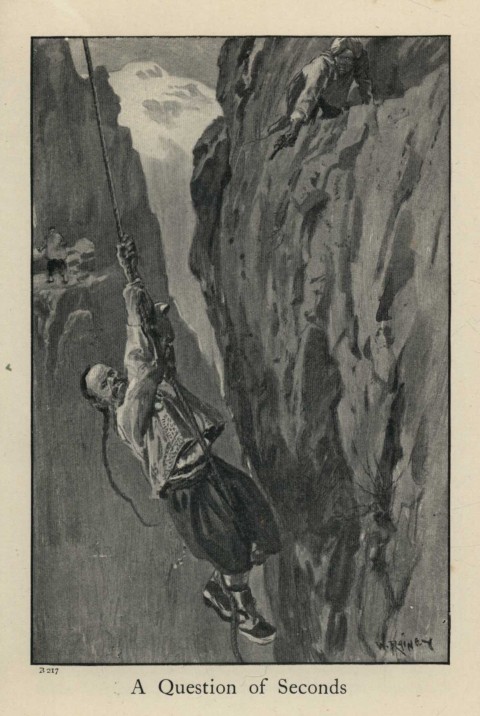
A Question of Seconds
Meanwhile beneath the girder the rope swung heavily backwards and forwards for some time before it came almost to rest. Then, all unconscious of the fierce eyes watching him from above, the Manchu began to climb up the rope, slowly, painfully, carefully, for he knew the cleft and its ragged bottom two hundred feet below. Foot by foot he ascends; he is more than half-way up; thirty more feet and he is safe—when he suddenly catches sigh of the stooping enemy on the ledge above. He stops his upward progress, twisting his legs round the rope to ease his straining arms. For a few seconds he remains thus; Bob, watching with fascinated eyes, sees not a shade of emotion on his face. Above, the ruthless enemy; below, the jagged rocks; both alternatives are fearful. To drop is certain death; to ascend is to meet an armed foe. But a man may miss his aim; it is here a chance in a million. It is the only chance, and Chang-Wo takes it.
He climbs up a few more feet; his eyes are now fixed unswervingly upon the waiting enemy. Reading their expression of vengeful hate, he stops again. At that instant a shot rings out, and from behind Bob a flight of birds spring with clattering wings into the air, almost smothering a scream of pain from the dangling figure. He has loosed his hold with the right hand; the right arm falls helpless to his side. He swings round, still clinging to the rope with the left hand, though he knows full well that with one hand he can never raise himself. For half a minute he hangs thus, swaying; the strain is unendurable; he lets go his hold, and without a cry falls into the gulf.
A moment afterwards there was a sharp report from the wall of the fort above Bob, followed by a babel of shouts. Bob, who had watched the scene before him in silent horror, saw a puff of dust struck from the side of the cleft just above the spot where Sing-Cheng lay peering gloatingly down upon his lifeless enemy. The chief instantly rose to his feet, glared for an instant towards the fort, then raised his hand and shouted a few words to the men who, as Bob surmised, though he could not see them, were now lining the wall. Whatever the words signified, they had an instantaneous effect. The clamour ceased. Then the chief raised himself to his full height, and began to harangue the crowd, turning this way and that, pointing with his finger, using many strange gestures to emphasize the words that fell in a rapid staccato from his lips. He spoke long, and the crowd heard him in complete silence. When his speech came to an end, he put the tips of his fingers together, and made three dignified movements with his head. Then he stood waiting.
Immediately afterwards Bob heard a great bustle and chatter from the unseen crowd. All seemed to be talking at once; the noise was like that of a hundred parrots holding a parliament. Again silence fell, and from the wall a loud voice shouted what was apparently a brief question to the stolid, immobile figure on the other side of the ravine. The answer came instantly, with a proud gesture, and was received with a storm of approving shouts from the crowd.
At this moment Ah-Sam came from the tunnel and stood beside Bob, who turned to him and asked:
"Is all safe in the tower?"
"Yes, massa; one piecee man makee no bobbely; he tied velly muchee tight, galaw!"
"Ask Sing-Cheng yonder what is happening."
Ah-Sam stepped forward and called across the ravine. The chief replied in a few words.
"What does he say?" asked Bob.
"He say come this-side velly soon; he hab catchee allo piecee man, now allo belongey he."
"Made friends with the enemy, has he? How is he coming here?"
"He go long down that side; come lound chop-chop. He velly muchee topside man this-tim', galaw!"
"Tell him he will find me in the tower."
Bob did not understand what means of persuasion Sing-Cheng had found, but he had complete faith in the man's discretion. As soon as the chief had disappeared up the cleft, Bob went in haste with Ah-Sam back into the tower; he felt with a deep sense of relief that there was now nothing to prevent the release of Kobo.
They returned to the kitchen. Bob suspected that the keys of the dungeon would be found on the person of the big Manchu who had slept by Chang-Wo's door, and told Ah-Sam to search him. In half a minute the keys were in his possession, and with eager steps he hastened along the corridor, up the staircase, until he came to the doorway. The lamp had burnt itself out; the passage was so dark that he had to feel for the keyhole. Then he threw open the door and entered the room. It was in darkness, save for the thin light filtering through a narrow slit high up in the wall. In the middle of the room lay, amid his chains, the huddled figure of the Samurai. Bob went up to him, stooped, and touched him on the shoulder. In a low, husky whisper came an exclamation that he did not understand.
"Speak to him," murmured Bob to Ah-Sam; he feared lest the sound of an English voice might prove disastrous to the overwrought prisoner. At Ah-Sam's first words the prostrate man stirred and opened his eyes. He tried to lift his hand, but it fell back, and the chain clinked against the stone floor.
"Mr. Fawcett!" he murmured. "Water, water!"
Reproaching himself for forgetting, in the excitement of the moment, the scene he had witnessed in Chang-Wo's room, Bob sent Ah-Sam back to the kitchen, whence he returned with a full cup. Handing this to his master, he knelt down and raised the prisoner's head. Bob held the cup to Kobo's lips, allowing him to take only one sip at a time. The Japanese gave a sigh of ineffable content; for several minutes not a word was spoken by any of the three; Bob's heart was too full for speech. Presently Kobo signified that he had drunk enough, and Bob placed the cup beside him on the floor.
"Thank God I came in time to save you!" he said, laying his hand on Kobo's. He had a terrible sinking of the heart as he felt the thin hand—it was mere skin and bone, the hand of a skeleton; it was clammy to his touch.
"I thank you, Mr. Fawcett," said Kobo feebly. "I thank you, but it is too late. I am dying."
"Don't say that," replied Bob. "We'll take you out of this horrible place. In the fresh air and sunshine, with good food, you will be yourself again."
"Tell me," went on the prisoner, in the same low, difficult tones, "did you give my message to the general?"
"Yes; I remained with him, and was able to do something to guide the Twelfth Division. We are across the Yalu, sir."
"Banzai! Banzai!" exclaimed Kobo with sudden vigour. "The Russians are beaten?"
"Thoroughly—driven from all their positions; we captured forty of their guns."
"Banzai! My country! She will win. I know it. We have crossed the Yalu: then we shall drive the enemy before us—from Kiu-lien-cheng to Liao-yang, from Liao-yang to Mukden, from Mukden to Harbin, from Harbin— Ah! why should we drive them farther? Dai Nippon shall come to her own."
"But yourself, sir; we must take you out of this. You will be more comfortable in Chang-Wo's room, and then, when you have rested and eaten, we will take you slowly into the Japanese lines, and you will live to see the triumph you have done so much to secure."
Kobo shook his head.
"I cannot stand," he said. "I shall die. But what is death?—Rest, peace, eternal quiet."
Bob felt a lump in his throat.
"Help me lift Kobo San," he said, turning to the Chinaman.
Tenderly they carried the slight figure between them down the stairs into Chang-Wo's room, where they laid him on the soft quilts that still bore the impress of his enemy's form. And then Bob saw that there was indeed no hope. Kobo was almost unrecognizable. He was haggard, emaciated to a shadow; but for his open eyes he would have seemed a corpse. At Bob's orders Ah-Sam hurriedly prepared some food, but after one or two mouthfuls Kobo refused to take any more.
"Rest," he said; "I want rest, that is all. I thank you."
His eyes roved round the room as though in search of something or someone.
"Your enemy will not trouble you again," said Bob. "Chang-Wo is dead."
"He died first! He has starved me, beaten me; he kept me without water—how many days? I do not know. He tempted me, held a cup before me; I might drink if I would do as he wished: betray my country. We Japanese do not fear death.—My servant! Have you any news of him?"
"No, I have not seen him since I left you."
"No matter. Taru will know how to die. If he should survive, and you meet him, tell him to return to Nikko; my wife will have need of him. And my son, my boy Takeo in England. You will see him? You will tell him?"
"Yes; I will go to him as soon as I can."
"I thank you. Will you give me a little water?"
Kobo lay back on the padded quilts, and his eyes spoke his thanks. Bob was troubled, and watched him in silence. Ah-Sam, with stolid countenance, was busy preparing a meal for his master. Suddenly through the walls of the tower penetrated the sound of a multitudinous discharge of firearms. Bob rose to his feet, and leaving Kobo in Ah-Sam's charge hurried to the top of the tower, his mind filled with apprehension. Was Kobo's end to be disturbed? From the roof he saw a strange sight. The inner wall of the fortress was thronged with the garrison, who were shouting and gesticulating with excitement. The huge gate stood wide open, and beyond, half a mile across the green plain, a tall figure had just mounted a beautiful horse, which had evidently been taken out to meet him by three men from the garrison. The horseman rode up slowly, and as he approached, Bob saw that it was his late companion, Sing-Cheng.
At the gate of the fortress the chief halted and made a speech to the men, who responded with loud cries and another discharge of their rifles. Then he rode through the gate into the courtyard. Looking up, he caught sight of the solitary figure on the roof of the tower. Instantly springing from his horse, he bowed himself low to the ground, and ordered the surprised Manchus to do the same. The kow-towing over, he sent a man to knock at the outer door of the tower. Bob hurried down, and bade Ah-Sam open the door. Sing-Cheng entered, bowed humbly to the Englishman, and followed him into Chang-Wo's room. He gave one glance to the figure prostrate on the floor, looked a mute question at Ah-Sam, and then explained what had happened.
As he stood at the edge of the cleft, looking towards the wall, he had recognized among the crowd one who had been his comrade when he himself had served the old chief. Addressing him by name, he had reminded him of his own former importance in the band before the chieftainship had been usurped by Chang-Wo. He explained that Chang-Wo had met a terrible fate through his ill-considered adhesion to the Russian side in the great struggle now desolating the country. Chang-Wo was dead; if he had lived, the extermination of the whole band could only have been a matter of time. But now he, Sing-Cheng, the chief of a rival band, had disposed of his old enemy and proved himself a better man. Let them accept him, therefore, as their new chief. He would lead them with more success; under him let them relinquish the losing side and do yeoman service for the conquering Japanese. The alternative? If they did not accept his leadership he would deliver them into the hands of an army of Japanese whom he had guided into the neighbourhood, and they would be slain to a man. The strong tower of the fortress was already in the hands of two powerful friends of his, who had crossed the ravine by an unheard-of means, had faced the Mountain Tiger in his lair, and driven him headlong to destruction.
The bold offer had been accepted. Sing-Cheng had demanded that an escort of three men, with a horse suited to his dignity, should meet him at the distance of a li from the fortress, and, as Bob had seen, he had ridden in to receive the submission of the garrison.
The chief's story was hardly finished when one of the garrison came running in with a message. Sing-Cheng instantly went out into the courtyard.
"He say Manchu hab catchee one piecee Japanee," explained Ah-Sam.
"Follow the chief, and bring me word what is happening," said Bob.
A few minutes passed. Kobo was restless, his eyes wide open with a look of strained eagerness, his breath coming and going in quick feeble pants. Bob sat by his side, moistening his lips at intervals. Presently the door opened, and Ah-Sam first appeared, restraining a small gray-headed man, who seemed to be in haste to enter.
"One piecee boy Kobo San," said Ah-Sam to his master.
The man came forward eagerly, and Bob saw that it was Taru, his friend's servant. The little Japanese flung himself down at his master's feet, and muttered a few words brokenly. Kobo smiled. Beckoning to Ah-Sam, Bob went out of the room, leaving the two lifelong friends, master and man, together. Outside he learnt what had happened. The rider whom he had seen leave the fortress on the memorable night when he had reconnoitred the position had returned, bringing with him the disguised Japanese servant, who had been making his way by devious routes to the haunt of his old enemy. Taru had explained to Ah-Sam that while in Yongampo he had heard that his master had been captured by Chang-Wo, and had instantly set out to track him; if possible to rescue him; if not, to die with him. He had come safely to within two miles of the fortress, and then fallen into the hands of a small party led by the Manchu courier.
For half an hour Bob remained in conversation with the chief, discussing through Ah-Sam the measures that were to be taken to consolidate his new authority, and to do service to his new allies, the Japanese. Then Taru came hurriedly from the tower, and asked Bob to return with him. They found Kobo now raised to a sitting posture. His eyes were closed, but he opened them as Bob entered. He was pale with the pallor of death.
"I am going—to my fathers," he whispered.
Bob sat down by his side, and looked at him with dim eyes. He breathed painfully; Taru, on the other side, gave him at intervals a spoonful of water.
"I rejoice to have—two faithful friends," said Kobo. "Mr. Fawcett, Taru will—return to Nikko; you will remember—Takeo, my son in England. I shall rest."
He closed his eyes and remained silent. Taru took one hand and held it fast, Bob held the other. He waited, sad at heart, grieved that Japan was to lose one who had served her so well. He thought of the long hours of agony this hero must have suffered; the tortures of hunger and thirst, the fierce temptation that must have assailed him. Kobo had been reticent of details, but Bob understood that he might have purchased his life by disclosing the methods of the Japanese secret service. How small a thing, thought Bob, to meet death bravely in the heat of battle! in a moment a man passes from full life to quietude. But to endure such horrors as Kobo had faced without flinching needed another kind of courage, a higher mind, a greater soul. Bob thrilled with sympathy and admiration, and all the time felt an aching disappointment that he had not been able to avert this tragic martyrdom.
Kobo's eyes slowly opened. In tones almost inaudible he said a few words in Japanese to his servant. Taru bent to the floor, and placed his master's hand upon his head. Kobo looked at Bob, and attempted feebly to press his hand.
"It is good-bye," he said. "I am going into the dark—which is rest. Good-bye."
Bob could not speak. There was a moment of silence. The dying man gasped painfully.
"Taru," he murmured. "Taru—sayonara!"
His head sank. Taru waited a few moments; then, lifting Kobo's hand, he rose saying:
"Be at peace, dear master."
CHAPTER XXVI
Old Friends and New Prospects
Compulsory Leave—Andrew B. Charteris—Looking Ahead—The Busy Bee—Smuggling Ah-Sam—Schwab Proposes—A Blessing
Kobo was buried in a glade among the trees near the fort. Bob placed over the grave a stone from the ravine—a flat slab washed smooth and white by the torrent; and upon this Taru scratched a simple inscription in Japanese characters. The chief meanwhile had sent men to find the body of Chang-Wo. What indignities the already mangled corpse might have suffered but for Bob's presence need not be told; Bob insisted on a decent burial, and made the chief promise that the grave should not be desecrated. The dead man's effects were thoroughly examined, and a discovery was made which threw light on a matter always puzzling to Bob—the presence of Chang-Wo in Tokio. Among his belongings were many papers, charts, and maps of Japan and the surrounding seas, plans of the Japanese ports, memoranda of military details—all probably intended for Russian use in an invasion of the islands, and kept by the Manchu until he could depend on getting a good price for them. These Bob made into a bundle; then he prepared to return with Taru and Ah-Sam to the Japanese head-quarters.
A few days later the services of one of the army doctors with General Kuroki's force were required for a young Englishman who had just been brought into camp by four coolies, led by a Japanese and a Chinaman. Sunstroke had laid Bob low on the day after leaving the fort. The unusual exertions which he had undergone since his adventure with the Cossacks had tried his constitution more than he was aware, and the final excitement and strain of Kobo's rescue had left him too weak to withstand the effect of the sudden heat. He was unconscious when he reached General Kuroki's quarters, and the doctor who examined him looked grave.
It was some days before he came fully to himself, and then the doctor, though he foretold a complete recovery, declared that it would be a matter of time and rest, and emphatically forbade Bob to think of active service for months to come.
"But I must get back to the fleet," protested Bob. "I'm a kind of deserter, and though I couldn't help being captured, and everything else has followed from that, I sha'n't be able to help feeling guilty when I report myself to Admiral Togo."
"You'll do nothing of the kind. We're a long way from the coast; in any case we can't spare a cruiser to carry you to Port Arthur; and if we could, I shouldn't allow you to go."
"What's to become of me, then? I can't follow the army; and I'm sure I don't want to be left behind in a Manchurian village."
The doctor's reply was interrupted by the entrance of General Kuroki himself. After greeting Bob, the general took the doctor aside, and for some minutes the two were engaged in conversation. They spoke in Japanese, and Bob, with the impatience of an invalid, felt annoyed at being the subject of a discussion which he could not follow. At length General Kuroki turned to him and said:
"I hear you want to rejoin the fleet, Mr. Fawcett. That is an entirely creditable wish; but the doctor is quite right, you must not think of it. You need not be disturbed about your quarters, however; we shall not leave you to the tender mercies of the Manchus. I'm going to send you to Yokohama. Stay," he added, as Bob began to protest, "it is quite fixed; you will be escorted to Chemulpo as soon as the doctor gives permission. For my part, I shall be glad to be rid of you." The general smiled. "Don't take that personally; I have had the pleasure of sending a report to the illustrious Emperor detailing the services you have rendered us since you left the fleet, and your adventurous expedition for the rescue of Kobo San. You have good friends, sir. Ever since you started on your quest I have been pestered by telegrams from a lady, first from Seoul, then from Yokohama—a Mrs. Pottle, who has been most energetic in enquiring after your welfare. Mrs. Pottle has given me more trouble than all the press correspondents together, and that is saying a good deal. I wired to the lady when you were brought in, telling her of your illness, and hoped that I should hear no more from her. But her telegram has now become a daily event, and only this morning she wired: 'Send him right along, I will nurse him like a mother'. So you see, Mr. Fawcett, that in getting rid of you I get rid, as I hope, of Mrs. Pottle."
For all his disappointment, Bob could not help smiling.
"She is a most determined woman," he said; "quite capable of leading your army, sir, with her umbrella. Well, I'm in your hands, general; it's very kind of you to be bothered with me at all. I only wish I had a chance of doing something; but I suppose that when I am quite well again the war will be over."
"I hope so," said the general gravely. "We have hard work before us; many good lives will be lost; but we shall persevere, and who knows—?"
Bob was welcomed by Mrs. Pottle at Yokohama literally with open arms. He had never been so much fussed over in his life as he was during the next few days. His health had improved with the voyage; but he was still only the shadow of his former self, and Mrs. Pottle showed that she had undertaken in all earnestness the duties of nurse. Bob found her energy rather trying, but he endured her ministrations with patience, for they were alleviated by the presence of Ethel Charteris, whose enthusiasm was displayed in a quieter and more winning manner. Mrs. Pottle was by no means short-sighted, and after a time she began to leave Bob more and more in her niece's hands, much to his contentment.
One day she returned from her usual morning expedition through the town accompanied by a stranger—a tall grizzled gentleman, sparse, keen, yet bearing an undefinable resemblance to the lady. Ethel was seated at Bob's side on the veranda of the hotel when she saw the two figures approaching.
"Good gracious! It's poppa!" she exclaimed, and fled to meet him.
Mrs. Pottle came up first, rustling in Japanese silk under a chrysanthemum parasol.
"See what you're responsible for!" she exclaimed. "Here's my brother, Andrew B. Charteris, come right out to fetch us. Says he couldn't make head or tale of our letters, and couldn't size up the attractions of Yokohama, and so he's left his business in a critical situation to see what his sister and daughter are doing. I hope you and Andrew will get along, Mr. Fawcett. He's a silent man, but a real good hand at taking stock of things. Here he is."
Mr. Andrew B. Charteris came up with Ethel clinging to his arm. The introductions were made.
"Heard a lot about you, sir," said Mr. Charteris. "Real glad to meet you in the flesh."
"There, Andrew, you don't mean anything; but if you had known Mr. Fawcett before, you wouldn't have said just that. Poor boy! he's little enough flesh on his bones now."
"H'm! Nature has wonderful recuperative powers," said Mr. Charteris, who after this profound remark walked on into the hotel with his daughter.
A week passed—a time of quiet enjoyment to Bob, who had still more of Ethel's company now that Mrs. Pottle had her brother to pilot round, as she put it. There was only one drawback to his happiness. One day he was surprised by a visit from a high court functionary, who had come to command his attendance at the palace in Tokio at a certain hour next day. Bob made a wry face when the functionary was gone. He guessed that this unexpected honour was due to General Kuroki's report to the Mikado, and was sufficiently boyish yet to hate all fuss, as he told Ethel.
"I think you are quite wrong," she replied. "You have done splendidly, and it is only right that the Mikado should thank you himself. Why, I know young men in San Francisco who'd give their eyes to be invited to see a real live emperor."
He went to Tokio, and certainly did not look unhappy when he returned. Mrs. Pottle bombarded him with questions about what had happened.
"Oh, it was all right," said Bob. "He's a very good sort; so's the Empress. It wasn't the formal affair I expected. They had me in their private apartments and gave me some tea, and the Emperor said uncommonly nice things, and presented me with—this."
He held up a ribbon with a gold ornament attached.
"My!" exclaimed Mrs. Pottle, "what's that?"
"It's the insignia of the order of the Sacred Treasure."
"Mysakes! Only think of that! Well, I'll say this; it's no more than you deserve. There!"
"I'm so glad," said Ethel.
"What's it worth in cash?" drawled Mr. Charteris.
"Oh, poppa, you unromantic, practical, shocking old man! The idea! It's perfectly priceless. Mr. Fawcett wouldn't part with it for anything, I'm sure."
"I sha'n't tempt him. I don't cotton to fal-lals of that sort. A thumping cheque would have been more to the point. Say, Mr. Fawcett, you ain't a rich man?"
Bob flushed at the blunt question, and Ethel blushed in sympathy.
"No offence!" added the old man, his eyes twinkling. "It's just this way. I've been thinking for a week, Mr. Fawcett. It ain't right for that tramp of yours across the Manchurian hills to be thrown slick away. How long do you suppose this war will last out?"
"That's more than I can even imagine," replied Bob. "I don't see how Port Arthur can hold out much longer; they are closing in on it; and as to the land campaign, the Japanese generals are driving the Russians from pillar to post. If the Russians are wise, the war will end with the fall of Port Arthur."
"Ah! and then?"
"What do you mean, sir?"
"Well, I suppose the Japs—"
"Poppa!" interrupted Ethel. "Don't use that horrid word—call them Japanese."
"Anything to please you, my love. I was going to say that I suppose the Japs—Japanese, I mean—are not running this war for nothing. They'll want to develop the country—what?"
"No doubt."
"And they'll keep an 'open door', eh? Well, what I've been thinking is this. When the war ends, it'll be time for me to slip in with a syndicate to work out some of the minerals—what! And it seems to me, from what I've heard and seen of you—especially what I've seen—that you're the right sort to be of use. You know the country; say, you've had a practical training—not wasted too much time on defunct languages, eh? and what's most to the point, you've got a pretty level head, and I'll go bail you ain't afraid of work. So, if you're agreeable, we'll strike a bargain. What?"
"I accept your offer with pleasure, sir," said Bob, his face flushed, his eyes shining. "I've always wanted to live an active life, and—"
"Shake!" said the American, relapsing into his usual laconic mode of utterance. Mrs. Pottle gleamed benevolence through her eye-glasses, and Bob's eyes sought Ethel's.
A few days later, one of the liners of the Pacific Mail was steaming across the ocean from Yokohama towards San Francisco. On the deck sat a group of three—the same three who had foregathered on the voyage out to Nagasaki seven months before. Morton and Desjardins, finding that their chances of seeing anything of the actual fighting were not improving, had asked to be recalled, and were returning by way of New York. Bob, with sick-leave from the Japanese government, had accepted an invitation to spend a few weeks with Mr. Charteris in San Francisco. The three were lolling on their deck-chairs, when a fourth figure was seen slowly rising from the companion-way.
"Well, Schwab, feel better?" shouted Morton.
"Zanks, Mr. Morton, I am vat you call fairly gumfortable. Ze sea-illness attack me not zis time so bad. Indeed," he added expansively, "I gommence to enjoy myself."