KOBO (continued 4)
Reading edition
Bob had had no little difficulty in remembering that he was dumb. After their meal in the inn that morning Ah-Sam had roughly ordered him to make himself useful and help to harness the mules, pouring out upon him a torrent of Chinese which Bob judged from its tone to be highly abusive. He went submissively enough to work, but being new to the job fumbled a good deal, and was several times on the point of asking how this or that was to be done. But he always caught himself up in time, turning what he intended to say into such inarticulate grunts as even a dumb man can utter. When, however, the inn and the village were left behind, and no human being was in sight, he thought it safe to throw off his restraint, and ventured to address a question to Ah-Sam in the front of the cart. He found the Chinaman's pidgin English at first rather difficult to understand, but after half an hour's conversation had gained sufficient familiarity with the idiom to get a fair idea of the man's meaning. He learnt that the talk in the inn had been of two matters: first, the great entrenchments which the Russians were making around Antung and Kiu-lien-cheng; and secondly, the annihilation of a Cossack detachment by a band of Chunchuses, the bandits of the country, some distance away in the hills.
"Russians belongey allo muchee mad," said Ah-Sam. "He say catchee killum allo piecee Chunchuses, galaw!"
Bob was about to ask for particulars of the Chunchuses, when, from round a corner, appeared a native driving a laden ox. Ah-Sam instantly put his finger to his lips, reminding Bob of his dumbness. When the native appeared, Ah-Sam stopped for a talk. This occupied some time; then the teamsters parted and went on their several ways. The route followed by Ah-Sam was rather a foot-path than a cart-track; and but for the snow, which filled the ruts and formed a fairly hard and even roadway, it would have been impassable for wheeled traffic. As it was, the progress of the cart was very slow and toilsome.
About mid-day they came to a dip in the hills where Ah-Sam decided to halt, take a meal, and feed his team. This done he remounted to his place, Bob sprang on to the tail of the cart, and the slow journey was resumed. But they had barely begun the ascent of the upward slope when from the left, across the snowy waste, a troop of horsemen were seen galloping rapidly towards them. The riders soon defined themselves by the bright yellow of their uniforms as a sotnia of Cossacks. Ah-Sam at first affected not to notice them, stolidly driving on; but turning his head at length in response to their loud shouts, he drew rein, muttered a warning to Bob and an order to run to the head of the team, and sprang from his perch in time to make half a dozen rapid kow-tows before the Cossacks reached him. He continued his obeisances as the captain of the troop roughly addressed him in Chinese, but suddenly stood erect and began to expostulate in voluble yet obsequious tones when, in response to an order, two of the Cossacks dismounted and approached the cart with drawn swords, evidently with the intention of cutting the traces. Bob, holding the head of one of the mules which was plunging excitedly, of course understood not a word of the colloquy; if he had known Chinese he would have heard the captain curtly inform Ah-Sam that the mules were required for the Russian service, and Ah-Sam's protest that they were already engaged in that service. He had just delivered, he said, a load of millet and forage stuffs to the honourable contractor to the honourable governor of Antung, and was on his way back to a farm at Kuan-tien to fetch another load. If the honourable captain took his mules, he would be unable to fulfil his commission. The roads, as the honourable captain saw, were so bad that with his team, small enough as it was, he was already behind time. He needed more mules, not less; he had begged the honourable contractor to give him three more, but none were to be found. His strong and capable assistant had been taken away to work in the Russian trenches, and he had been forced to hire at the last moment a big, loutish, dumb fool of a Korean, who could do nothing but eat, and who at this moment, as the honourable captain saw, was an absolutely useless, incapable, soft-muscled—
He was interrupted by a general hullabaloo among the mules, which, unused to the handling of a European, were kicking and plunging and threatening to involve the whole team in an inextricable tangle. Stretching his arm, Ah-Sam flicked two or three of the mules with his long whip, roundly abused Bob, and, apparently in ungovernable rage, struck him also with the lash, which cut through the wadding of his trousers and caused him to utter a smothered growl, at which the Cossacks laughed with enjoyment.
The mules having been reduced to order, Ah-Sam returned to face the captain, kow-towed again, and repeated his story. The Russian had already countermanded the order to his men, and was clearly hesitating. He was a good-tempered-looking fellow, thought Bob,—a young clean-limbed captain, picturesque in his long silver-ornamented coat and astrakhan cap. Interrupting Ah-Sam's shrill sing-song of protest, he demanded to see the receipts which the muleteer doubtless possessed if his story was true. The Chinaman instantly produced a number of papers from a bag tied beneath his coat, and handed them to the captain, who examined them carefully. They were unmistakably receipts, in proper Chinese form, and recognizing that he might get into hot water with the authorities if he delayed the procuring of the supplies so urgently needed, he at length said that he would be satisfied with three of the mules, and when these had been unyoked, gave the Chinaman permission to proceed.
Before he rode off, however, he asked, as by an afterthought, a question which appeared to be incomprehensible to Ah-Sam, who looked puzzled, then asked a question in return. The captain smiled as he explained to his lieutenant what the Chinaman had said; both laughed heartily; then the word was given, and the troop rode off in the opposite direction to that from which they had come.
Bob had been waiting for an opportunity to tackle Ah-Sam on the matter of the whip. While it was well, no doubt, to keep up their character as master and man, he had a suspicion that the Chinaman had laid on with unnecessary vigour, perhaps to experiment on the quality of the foreigner he was escorting. When, therefore, the Cossacks were safely out of earshot, Bob went forward and sat beside Ah-Sam.
"What was the Russian laughing at?" he said.
"Ch'hoy! He say, hab my see one piecee Yinkelis man what lun wailo? My say, what likee Yinkelis man my savvy tiger, bear, monkey, hairy Ainu; Yinkelis man belongey likum he?"
"Oh! And I suppose you hit me with the whip to make it quite clear that I was not an Englishman. You hit me like this, you know."
Bob suddenly rose, took the Chinaman's whip, and gave him a smart cut. Ah-Sam yelled.
"He hurtee velly muchee," he said, rubbing the place.
"Yes, I know. If we meet any more Russians, perhaps you can prove I am not the runaway Englishman without using your whip."
"My no hit massa no mo'e; my member plenty too muchee, no fear!"
CHAPTER XIV
Mrs. Isidore G. Pottle
Fair Captives—Pidgin—Among the Chunchuses—Seeking Cover—A Breathing Space—A Picnic
The travellers pursued their journey without incident through the rest of the day. Occasionally they met a native with whom Ah-Sam exchanged a few words, and in these conversations he learnt that the Russians were in great strength between them and the river, and had impressed hundreds of Manchurians to work on the fortifications. This forced labour was by no means to their taste, and many of the inhabitants were therefore in hiding, so that the travellers need not be surprised at the comparatively deserted condition of the country through which they passed. From this information it was clear that to turn southwards would be dangerous as yet. Ah-Sam accordingly drove on in an easterly direction, making long detours to avoid climbing the hills, which became higher and higher as they advanced. They spent the night in a solitary inn, smaller than the first, and fortunately less crowded. Early on the following morning they pushed on again. Ah-Sam told Bob that they were now passing beyond the region which he knew intimately. He had only a general knowledge of the country, and must trust to passing wayfarers to keep him in the right way.
So that day passed. On the next, Ah-Sam thought that they had probably by this time turned the Russian positions on the Yalu, and might safely take a southerly course. The country was very wild; the hills were higher and more precipitous than those in the district already traversed. But there were signs of spring. The snow was thawing in the valleys and the less exposed parts of the hills, and the ice of the streams they crossed was rotten, the cart often crashing through. But these being shallow hill rivulets, no harm was done; the only inconveniences were the having sometimes to cut a way to the opposite bank, and the strain on the mules in drawing the heavy cart over the rocky beds and up the rugged slopes. It was easier to make progress at early morning or late at night, for then the snow was still crisp and the ice still solid.
About mid-day they were slowly following the valley of a stream somewhat broader than those hitherto encountered, hoping that it would bring them out some distance up the Yalu about the neighbourhood of Sukuchen. As they proceeded, they came almost unawares upon a remarkable cleft in the hills to their right—a wild and rocky gorge, strewn with irregular masses of rock small and large, and narrowing as it led upwards to a sparse clump of trees at the top. Even in broad daylight it formed a dark forbidding gully, the hills rising sheer precipices on either side, showing masses of granite too steep even to give lodgment to the snow. From a point high up, a thin waterfall plunged over the crags and wormed its way down among the boulders. The travellers stopped for a few moments to observe the scene. Suddenly Ah-Sam pointed upwards: on a ledge of rock almost at the summit, near a narrow fissure, he had descried the form of a bear motionless on its haunches. Following the Chinaman's outstretched finger, Bob at last made out the distant form. For a moment the instinct of the British sportsman prompted him to attempt to stalk the animal, but even as he looked it suddenly disappeared, and he remembered then that as a menial Korean he would have cut an absurd and outrageous figure in pursuit of a bear.
He was still regretting the impossibility of obtaining the skin, when he was startled by the sound of a high-pitched voice coming from some spot ahead of them. The valley here rounded a prominent bluff; no human form was to be seen. Before he had quite collected himself he heard the voice again; it was a woman's voice, speaking in accents of distress, or at least excited remonstrance, and he fancied that it had a very British ring. Springing from the cart, and bidding Ah-Sam follow him quickly, he hurried on ahead, turned the bend, and saw before him, hastening up the slope, five persons, two of them little more than a hundred yards away, the other three at a somewhat greater distance. He was amazed to see that two of the five were ladies, in European costume. The nearer was a young lady, tall, in a costume of grey tweed; her right wrist was in the grasp of a native. The farther was a lady of maturer years, equally tall, very stout, wearing a heavy sealskin jacket, her bonnet awry, her arms pinioned by two natives who were urging her along. The captors were obviously Manchus; they wore the pigtails, the wide-brimmed hats, cotton blouses and loose pantaloons common to the country.
It was from the elder lady that the cries had proceeded and were still proceeding. They were not cries of fear or appeals for mercy, but rather outpourings of wrath and indignation. Her head was being shaken vigorously from side to side, threatening to dislodge her already disordered head-gear. She was evidently not merely protesting, but resisting with all her might, and as she dwarfed the men in both height and breadth, she was giving them no little trouble. The younger lady was causing no such commotion. She was walking quietly by her captor's side, unresisting, saying nothing, accepting the situation resignedly.
Bob took in these details in a few seconds. Then, without counting the odds, he rushed forward, fumbling in the slit of his wadded pantaloons for the pistol he carried there. In the soft snow his footfall made no sound that was not smothered by the unceasing denunciation of the stout lady, and the Manchus were too much occupied with their captives to be alive to the presence of strangers. Bob noticed that the man leading the younger lady held in his right hand a musket or rifle. Making rapidly up on him, Bob stooped just as the Manchu at last heard his tread and was turning, snatched the weapon from his grasp, thrust it between his legs and tripped him up. Then without waiting he dashed on, came within a few feet of the Manchus by the time they had contrived to face round, the lady still struggling between them, and pointing his pistol full at the head of one of them, shouted in English:
"Hands up!"
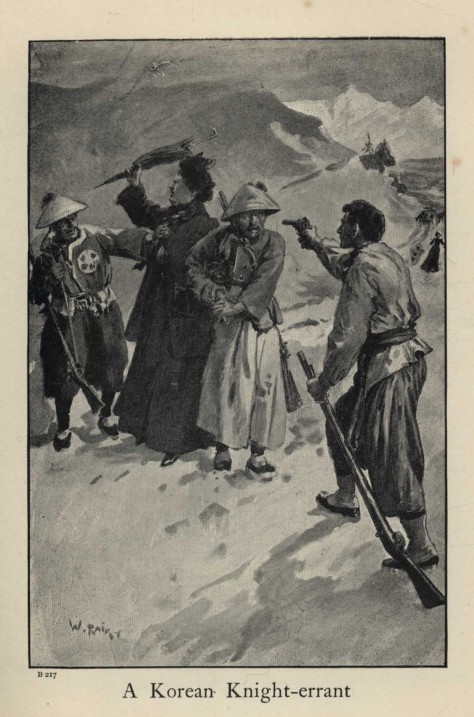
A Korean Knight-errant
The very sight of a Korean with a pistol in his hand was enough to throw a Manchu bandit off his balance. The Koreans are a soft, inert, unwarlike race; even their soldiers are never known to fight; and yet here was a Korean, without a topknot and therefore of no social account, actually pointing a pistol and uttering a menace which sounded all the fiercer because it was in a language never heard in these parts from Korean lips before. Bob did not give the bandits time to recover from their amazement. Rushing up to them he sent one spinning over with a right-hander, and wrested the weapon from the other. The large and indignant lady being now released, struck this man smartly over the head with her umbrella, and then, marched down the hill to meet the younger lady, who was coming rapidly towards her with an air of mingled astonishment and relief. Behind came Ah-Sam, who had left his team at the foot of the slope, and was driving before him, in cowed amazement, the Manchu who had held the girl. For a moment it seemed as if the three Manchus, trusting in their numerical superiority, were inclined to retaliate, but there was something in Bob's manner that warned them in time, and they slunk away, muttering curses Manchurian but unmistakable. As they did so, the elder lady stood watching them with menace in her mien, her left hand clasping the hand of the girl now by her side, her right retaining a determined grip of her umbrella. Bob meanwhile walked slowly down the hill towards her. He was a little out of breath, and a great deal astonished. His lips twitched with amusement at the sight of the elder lady, so large, and so unconscious of her disarray, like a ruffled hen in her attitude. The girl seemed partly to share his feeling, for he detected a slight twinkle in her dark eyes as they met his. When the Manchus were out of sight, the elder lady's features relaxed, and becoming aware that the stranger to whose intervention she owed her release was within arm's length, she turned to him and said quickly:
"You speakee English?"
"Yes, madam."
Before Bob could explain himself further, the lady, with a capacious sigh of relief, said:
"That's a comfort, Ethel. Now I guess we shall find a track out of this horrid country." Then, in the pidgin English of literature, she added, addressing Bob: "You plenty muchee goodee Chinee boy. Me givee you heapee thankee—plenty muchee cashee. You belongee this country?"
"No, madam——"
Again his explanation was forestalled.
"Me wantee go Seoulee. You savvy Seoulee?"
"Yes, madam. I—"
"You takee us rightee there—can do?"
During this interrupted monologue the younger lady had shown signs of increasing embarrassment. With flushed checks she half interposed between her companion and Bob, touched the lady's arm, and said quickly:
"Auntie, don't you see?—you are making a mistake; this gentleman is not a—"
"Is not what?" said the lady, putting up her eye-glass, and adding with some asperity: "Then what is he?"
"Let me introduce myself," said Bob, bowing. "My name is Fawcett—an Englishman, at your service."
The lady put up her eyeglass and stared with unfeigned amazement, exclaiming under her breath:
"A Britisher! Well, of all the extraordinary—You will excuse my surprise, Mr.—Fawcett, I think you said? The circumstances are so remarkable. I fear I owe you an apology, but really—" she turned to her companion and began to tie her bonnet-strings—"it just beats anything."
Here Ah-Sam, who had been hovering restlessly in the background, came up and said:
"No tim' belongey this-side, massa. Plenty Chunchu man come this-side chop-chop, makee big bobbely, supposey catchee, he killum allo piecee massa, two-piecee girley, Ah-Sam all-same."
"What does the man say?" asked the lady, staring at the Chinaman as at some strange animal.
"He says that we must not remain here. The men, Chunchuses apparently, threatened to return, and if they do—well, we shall all be in a very awkward fix. Perhaps if you would let me know who these people are—"
"Why certainly. My niece and I are doing Asia. We got as far as Mukden, and there the Russians tried to stop us—said it would not be safe, war was expected. I told them it was all nonsense. They insisted; I persisted. They set a guard over us—free citizens of the United States. Intolerable! We slipped away; naturally;—bribery, of course; very disgusting, but the only way. We struck east for Gensan; got among the hills. Our Chinese guide lost his way, or pretended to, and we were snapped up by a party of brigands, who figured that we spelt dollars, and have kept us with them ever since."
"Then you are Mrs.—Mrs. Isidore—?"
Bob hesitated, endeavouring to recall a name that for the moment eluded him.
"I guess you're on the right track," replied the lady with a look of surprise. "Pottle—Mrs. Isidore G. Pottle; though it beats me how you happened on my name."
Bob then explained that he had learnt of Mrs. Pottle's disappearance from the columns of a San Francisco paper at Tokio. But he cut explanations short, looking anxiously in the direction in which the brigands had disappeared, and parried the questions which he saw Mrs. Pottle was eager to put, by asking for information as to the strength and position of the band. The three men he had seen belonged to a gang of some sixty or seventy, whose last camp was about a mile distant from that spot. Mrs. Pottle was uncertain of the exact number, for it differed from day to day, and that morning the whole band had ridden away with the exception of the three in whose hands Bob had found the ladies, and a few left to guard the camp. Such absences were common. They lasted sometimes only a few hours, sometimes for several days. The brigands were all mounted, and when the camp was changed the ladies were always sent on foot in advance, since nothing on earth would induce Mrs. Pottle to ride pillion on a wild horse behind a wild man. The brigands had done them no harm; they were well fed with atrocious food. Mrs. Pottle said she thought there could be nothing worse than a Russian hotel till she met the Chunchuses. Their Chinese guide had decamped with everything they possessed, including Mrs. Pottle's purse, though she still had her cheque-book, note-book, and umbrella.
"I am not alarmed for myself," said Mrs. Pottle in conclusion; "I am an old traveller, tough, seasoned. But dear Ethel—this is her first tour, and though the poor child bears up well, I am terribly afraid these hardships will ruin her constitution, and then I shall not be able to look her poppa in the face."
"Auntie, I am quite well," said the younger lady, who indeed looked, as Bob thought, the picture of health, with her fresh cheeks and bright eyes. "I am only afraid that your nerves will break down."
"Nerves! I never had any. But Mr.—Fawcett, I think?—what are we to do?—Well, of all the—a Britisher, and in Korean dress!..."
Bob asked the ladies to walk down the hill while he took a look round. He really wanted a few minutes to think over the situation alone. He was beset by perplexities. Difficult as his own position was, it was doubly difficult now that he had someone else to think of. It was most embarrassing—to have to act as squire of dames in such a clumsy, ridiculous costume. Mrs. Pottle's state of mind, he could see, was unmixed amazement; but her niece evidently had a sense of humour. "If she wasn't so confoundedly pretty!—", and then Bob caught himself up, and bent his mind to the problem before him. If the brigands returned in force, he could hardly hope to escape them. If he did, it might be only to fall among another gang: brigandage is an organized profession in Manchuria. Supposing he escaped all danger on that side, he might encounter Russians, and though he himself might pass unmolested as a dumb Korean in company with a Chinese carter, the presence of two ladies in European dress would awake suspicion and provoke the most dangerous enquiries.
Yet he could not leave the ladies: that was out of the question. He secretly suspected that the portly and strong-minded Mrs. Isidore G. Pottle was capable of brow-beating and scaring any number of Manchus or Russians, but her niece!—He looked again at the trim figure.
"That white tam o' shanter makes her—h'm! ... What in the world are we to do, Ah-Sam?" he asked of the Chinaman, who had remained at his side.
"My no can tinkee. One piecee velly largo woman; he makee plenty bobbely; one piecee littee girley, he too muchee fliten, evelyting makee cly-cly, galaw! Supposey you hab larn fightee pidgin, you no can cham-tow allo velly bad tief-man, all-same."
This speech fell on deaf ears, for in the middle of it Bob caught sight of several horsemen in single file far up the hillside in front. Noticing that his eyes were fixed on some distant object, Ah-Sam turned in that direction also, looked hard for a moment, and then exclaimed:
"Chunchuses! Bimeby allo come this-side. What can do? Catchee killum one-tim'."
Now that danger was actually upon him, Bob prepared instantly to meet it. In a flash he remembered the gully he had passed recently with Ah-Sam, and recognized that it was the nearest, indeed the only, defensible position within reach. It was so narrow that, near its summit, it might be held, he thought, by a few against a host. He at once ordered Ah-Sam to turn the cart and drive it as quickly as possible back to the spot where the waterfall emptied itself into the stream, and then up the steep, rocky gorge. In a few minutes the team was plunging through the broken ice at a great pace. Nothing but a Manchurian cart could have stood the strain. It was flung about at all angles; it cannoned against rocks, now one wheel, now the other disappearing in mud or snow; but it survived every shock, and drawn by its four sturdy beasts with Ah-Sam at their head, it groaned and creaked on its upward course until it reached an abrupt twist in the gorge about three hundred yards from its lower extremity.
Meanwhile Bob had led the two ladies diagonally across the hillside by a shorter route than that taken by the cart. Mrs. Pottle bravely panted along, making tremendous exertions under her thick sealskin jacket to keep pace with Bob, who assisted her with his arm. Her niece stepped along as lightly as a doe, her cheeks flushed with excitement, and her wavy black hair escaping in disorder below her white tam o' shanter.
Gaining a point above the bend at which the cart had just arrived, Bob saw that the stream flowed around a huge granite boulder which had slipped, apparently at no very distant date, from the almost perpendicular cliffs above, blocking up the greater part of the already narrow defile. Here Bob shouted to Ah-Sam to stop and wedge the cart between the boulder and the opposite wall of the ravine. Looking round, he saw, some fifty feet above, to the left of the stream, the cleft near which the bear had been seated. It was visible now as a fault in the rock, a few yards across. The fissure narrowed towards its base, and from it a shelf of rock ran horizontally outwards, meeting the stream at an acute angle about a hundred yards from where Bob stood. Beyond this junction the gorge rapidly narrowed, and became extremely steep. Leaving the ladies to rest, Bob climbed up the rocky bed to explore, and found that after a time further progress was blocked by a perpendicular wall that rose sheer two hundred feet.
Returning, he reassured the ladies with a word, and then took Ah-Sam with him down the gully. The mouth, some thirty yards wide, was jagged and strewn with rocks, and formed so eminently defensible a position that Bob hesitated whether to attempt to hold it or to retire at once to the still more difficult post behind the cart. It would be a hazardous matter to turn his position; before this could be effected he could inflict severe loss on his assailants. But in a few moments he gave up the idea of holding the lower ground. To begin with, he had no desire to come to blows if a fight could be avoided, for, apart from the risk of being overpowered by the Chunchuses, there was the likelihood that the sound of shots would bring the Russians on the scene. They must be in great force no more than twenty or thirty miles away, engaged on the Yalu entrenchments, and firing in the hills would almost certainly be heard by scouting parties. If the Russians came up, the Chunchuses could disperse with their accustomed celerity, but Bob would be unable to save himself unless he were prepared to abandon the ladies who had so strangely fallen under his care. They would no doubt be well treated if entrusted to an officer of rank; but if the Russians happened to be an ordinary troop of Cossacks, Bob doubted whether he might not as well leave the ladies to the Chunchuses as to them. First of all, at any rate, he had the Chunchuses to deal with. He hoped that when they saw how strongly he was posted behind the cart and the boulder they would draw off. In any case, Ah-Sam's forethought had stocked the cart with enough provisions to last through a siege of some days, and in view of that contingency it was wise to do what he could to strengthen his position still further.
The distant specks on the mountain-side had disappeared. Slowly scanning every portion of the horizon, neither Bob nor Ah-Sam saw any sign of life. They retraced their steps towards the boulder, halting now and then to roll down the steep slope such loose rocks as might give cover to an attacking force. The ladies met them as they reached the cart.
"Well, Mr. Fawcett," said Mrs. Pottle, "did you see anything way down there?"
"Nothing. But if those were your friends the brigands, we shall have them upon us in half an hour."
"Oh! what shall we do, then? You had some plan in bringing us here?"
"Yes. Ah-Sam and I are going to fortify ourselves; it is our only chance."
"Good gracious! They have guns, and I've only my umbrella!"
"We have our pistols and a couple of rifles."
"Against a hundred, perhaps. Still, two determined men, behind rocks—could you spare a pistol for me?"
"If necessary, but I hope we sha'n't have to fight. They will probably tire of besieging us here."
"A siege! But, my dear boy, we can't stand a siege without food, and I confess, Mr. Fawcett, I am hungry. Really, I must eat, and I will say this for the brigands: they did give us food, of a sort."
"Ah-Sam has plenty of food—of a sort," said Bob, smiling. "And perhaps, Mrs. Pottle, while we are doing what we can to strengthen the position, you won't mind preparing a meal."
"Of course not. If only I could get a cup of tea!"
"Ah-Sam has tea, and rice, and millet, and a few other things."
"The dear man! But a kettle?"
"He has a pot, and an oil-lamp, anu plenty of matches."
"A treasure! Let us have the things, and I will turn up my sleeves and set to work. There is water in the stream. Ethel, my love, we shall have a cup of tea for the first time in six weeks. Come and help me."
Bob admired Mrs. Pottle's spirit. Leaving the ladies to themselves, he assisted Ah-Sam to unyoke the team and drag them higher up the ravine, where they tethered the animals to the trunks of some overhanging trees, and supplied them with fodder from the cart. Then, with some difficulty, they pushed and rolled some of the smaller boulders in front of the vehicle, arranging them in such a way that loopholes were left between them covering every part of the approach. The position was now such that the little party was effectually concealed from the road below; but Bob knew that their presence could not remain undiscovered, for the cart and the animals had left very distinct traces in the snow and mud.
Everything possible having now been done, Bob went once more to the mouth of the gully to reconnoitre. There was as yet no sign of the brigands. He was still looking out across the hills when Ah-Sam came up, carrying a pot of rice.
"Chow-chow allo leady, massa," he said. "My fetchee chow-chow this-side; ch'hoy! women boilum tings, spoilum tea; China boy no can dlink it; too muchee stlong for China side; no allo plopa; Yinkelis man hab got numpa one tummy; can dlink anyting."
"I'm afraid we do make it too strong. But I'll explain to the ladies; you shall have some made specially weak for you. Stay here and keep watch while I get something to eat, and come back at once if you see any sign of the Chunchuses."
"Allo lightee, massa. My hab catchee plenty chow-chow. No fear!"
Bob returned to the ladies.
"Come, Mr. Fawcett," cried Mrs. Pottle. "I've just finished my fourth cup. Capital tea, even without cream and sugar. But I don't understand your man. I thought Chinamen liked tea, and I gave Ah-Sam a particularly strong cup. He was positively rude—used most sinful language, and actually threw it away. You must be thirsty; now do drink this, and here is some rice—chow, your man called it; I thought that was the Chinese for dog?"
"Yes," said Bob with a twinkle, "or any other form of food."
"Disgusting!" exclaimed Ethel. "Surely it is not true?"
"I'm afraid it is. Fido is quite a standing dish in China."
Mrs. Pottle looked horrified.
"I wonder," she said reflectively, "what that stew was they gave us yesterday?..."
Her speculations were broken in upon by the sight of Ah-Sam running up the gully.
"Massa," he cried, "my look-see plenty piecee Chunchu come this-side chop-chop, galaw!"
CHAPTER XV
Fortifying the Gully
Stopping a Rush—The Trappers Trapped—Allies—A Manchu Marksman—A Sighting Shot—Building a Barrier—Velly Good Fighty Man—Ah-Sam at the Front
Mrs. Pottle grasped her umbrella as Bob sprang up, leapt over the boulders, and hurried to the mouth of the ravine. In the distance, to the right, he saw a band of mounted men, about sixty in number, easily recognizable by their nondescript dress and long lances as the redoubtable bandits of Manchuria. They disappeared in the bend of the valley. Again they emerged into view, now only a quarter of a mile away, heading straight for the gully over the trail of the cart. Bob hurried back to his place behind the boulders, and took the rifle handed him by Ah-Sam, who retained the other.
"You won't kill them if you can help it, will you?" said Ethel, whose cheeks had become a little pale.
"Nonsense, Ethel," interrupted Mrs. Pottle; "don't be sentimental. I don't wish them any harm, but—"
She did not finish the sentence, for at this moment the horsemen arrived at the mouth of the gully, and halted, evidently in some hesitation, as though fearing a trap. Their leaders spoke together for a few moments; then the whole band dismounted, and, leaving their horses in charge of some of their number, began to climb up the gorge. Bob felt that it was high time to check them.
"Call, Ah-Sam," he said, "and tell them that if they move another step forward I fire."
"Hai yah!" shouted the Chinaman. The little man had a shrill piercing voice, and his exclamation brought the bandits to a sudden halt two hundred yards beneath. He then gave them in Chinese Bob's message, and as he spoke, they strained their eyes upward as if to pierce the barricade. There was a short consultation among them, and then one of them advanced a step and shouted a reply.
"What does he say?" asked Bob.
"One piecee Chunchu say-lo, 'Come this-side, ha-loy! he no killum China-boy, two piecee girley; massa fightee man, he catchee ling-ch'ih'."
"What's that?" asked Bob.
Ah-Sam looked puzzled; his vocabulary was evidently for the moment at a loss. Then he said:
"Ling-ch'ih he killum velly velly slow; he cuttee slicee allo littee piecee: velly long-tim' die-lo galaw!—velly annoying!"
Mrs. Pottle gathered the gist of what Ah-Sam said, and burst forth in great indignation.
"The fiends! I will not allow it. They are arrant cowards. Drive them off. They were frightened of my umbrella. You shall not fall into their power through us. Drive them off!"
Bob considered for a moment. If by delivering himself up he could have ensured a safe-conduct for the two ladies he might have taken the risk; but he was not at all sure that his surrender would satisfy the bandits, incensed at the loss of the prisoners, for whom they expected a good ransom, and at the rough treatment dealt out to the three men. On the other hand, by putting a bold face on it he might scare them off, especially in view of the presence of Russians in the neighbourhood.
"Tell them," he said, "that we refuse to surrender. If they move forward, I fire."
Ah-Sam translated the message. There was another short consultation; then with a shout the bandits rushed up the steep gully straight at the barricade. Mrs. Pottle still grasped her umbrella and walked to and fro in high indignation; Ethel sat with clasped hands, her lips firmly pressed together, her eyes fixed upon Bob.
"Don't fire!" said Bob to Ah-Sam. Resting his own rifle between two boulders, he took careful aim at the foremost of the attacking party, who presented an easy mark as he came directly towards the barricade. He did not wish to kill the man, being anxious not to drive the brigands to extremities; yet it was necessary to teach them a lesson. Seizing a moment when the man's pace was checked by an awkward rock, Bob fired. It was a well-aimed shot, at about a hundred yards' range, and took effect where he intended, in the lower part of the man's leg. A howl of pain announced that the shot had told. Mrs. Pottle exclaimed "There!" with a note of satisfaction; her niece gave a little gasp; neither could see that the man had fallen like a log.
"One piecee hab catchee hot!" muttered Ah-Sam.
The wounded man howled and howled again, and as the others halted in hesitation, Bob thrust the barrel of his rifle conspicuously through the loophole. Next moment the whole band turned tail, and bolted down the slope, leaving their injured comrade behind them, and not pausing until they were out of sight round the corner of the gully.
"Allo lun wailo chop-chop," said Ah-Sam.
"But the poor wounded man!" exclaimed Ethel, starting up. "He must be in terrible pain."
"Nonsense!" said Mrs. Pottle. "He is not killed if he can howl like that."
Ethel got up and looked through an interstice between the boulders, while Mrs. Pottle proceeded to give Bob her views on the situation. Minute after minute passed; there was no sign of a renewed attack by the Chunchuses. Mrs. Pottle brewed more tea and talked on; Ethel moved restlessly about, starting up whenever a groan was heard from the wounded man, and looking more and more concerned as she saw him more than once make a futile attempt to reach his friends. They did not come to his assistance. He tried to crawl down the rocky slope, but each time fell back with a groan, and at last lay perfectly still. Bob had watched Ethel's movements, and saw, though she said nothing, that she was becoming uneasy about the wounded Manchu. He would undoubtedly bleed to death if something were not done for him; his friends were unwilling to face the marksman up the slope. Bob wondered whether he ought to run the risk of going down. Between his boulder and the man there were many rocks which would afford cover for the greater part of the way. If he reached the man, the Chunchuses would probably hesitate to fire lest they hit their comrade; and it had become apparent to Bob that one reason, probably the strongest, why they had not developed their attack was that they feared to bring their enemies, the Russians, upon the scene. At last, unable any longer to resist Ethel's mute plea, he rose, bade Ah-Sam cover him with his rifle, and, crossing the barricade, made his way as quickly as possible down the gully, dodging from rock to rock.
The last dozen yards were open ground, fully exposed to the attack of the Chunchuses. He ran across them, and stooped to the wounded man. At the foot of the gully several of the Chunchuses now showed themselves and watched his proceedings. He first tied his handkerchief round the injured limb, then lifted the man and turned to make his way back. He took two steps, then staggered; the man was heavy, and the necessity of carrying him in a horizontal position, in order to check the flow of blood to his wounded leg, made him a cumbrous burden on so steep an ascent. Bob was doubting whether he would be able unaided to bring the man into safety, when Ah-Sam appeared. He had marked the difficulty, and, seeing that an attack from below was for the time improbable, had run to his master's assistance. Together then they carried the Chunchuse up the gully, and carefully lifted him over the barricade, and Bob was rewarded by a grateful glance and a murmured word of thanks from Ethel, who at once bent down to assist the man. Mrs. Pottle, for all her outward truculence, had a kind heart. Protesting all the time that it was ridiculous to waste sympathy on a brigand, she lent her niece willing aid, and soon the limb was well bandaged, and the man was supplied with food and tea.
By this time the Chunchuses had congregated about the mouth of the gully, where they stood discussing the situation with some excitement. Bob guessed that the appearance of a Korean capable of fighting, in company with a Chinaman of courage and assurance, had somewhat astonished them; and though it was impossible for Ah-Sam to hear what they were saying, it was not difficult to guess that they were divided in opinion, some being inclined to renew the attack, others to seek a compromise. It was Bob's policy to wait. Suddenly the colloquy below was interrupted; there was a sound of galloping horses, and immediately the Chunchuses were scattering, seeking cover behind boulders at the mouth of the ravine. Behind them came one or two of the men they had left in the road in charge of the horses. For a few moments there was wild confusion, a clamour of mingled shouts, the clash of arms, the stampeding of horses. A shot rang out, the babel ceased, and a man was seen hurrying up the gully, holding a piece of torn and dirty rag upon his musket.
"Tell him to stop," said Bob to Ah-Sam when the Chunchuse had come within fifty yards of the barricade.
"What is happening now?" asked Mrs. Pottle, endeavouring to peep over a boulder.
"Please go back, Mrs. Pottle," said Bob earnestly. "I don't know what may happen yet. It appears to be a flag of truce."
"I decline to have any parley with the brigands," said Mrs. Pottle decisively; "I firmly decline. They are outlaws, and—"
"Auntie, Mr. Fawcett wishes to speak to the man," interposed Ethel mildly.
The emissary had stopped at Ah-Sam's bidding, and was now speaking rapidly in answer to the Chinaman's questions. His features wore an anxious look. From Ah-Sam's translation of his speech, Bob learnt that the commotion he had recently witnessed was due to the sudden appearance of a mixed force of Russians and Manchus, who had ridden up in two parties, one from each side of the valley, and closed in upon the Chunchuses at the gully's mouth. Sheltered by the large scattered rocks, the brigands were able for the moment to keep the Russians at bay; but at any moment their position might be rushed. They knew that they could expect no mercy from the Russians, and they were now in a terrible dilemma: on the one side the Cossacks, on the other the armed men, they did not know how many in number, behind the barricade. Between two fires they would be utterly annihilated. As a counsel of desperation the flag-bearer had come to beg the leader of the party more favourably posted to admit the Chunchuses behind his entrenchments, where they might make common cause against the Russians.
This was a critical moment which Bob had not foreseen. Obviously there was little time for deliberation. Though no more shots had been fired, he had no doubt that the Russians were only awaiting a favourable opportunity for swooping on the band of Chunchuses, and after they had been disposed of it would not be long before he too, with his companions, must fall into their hands. The ladies might be safe with them, of course; but he himself durst not appear; they were hunting him for his life. It was thus impossible for him to remain neutral. Recent events had in fact made him a natural ally of the Chunchuses. They might be brigands, but they were at the same time patriots, fighting on their own soil against an alien invader. Their methods were not perhaps commendable from a western stand-point, but the Russians themselves, as he himself had seen during his wanderings in Korea, were not always too scrupulous. There was only one consideration that made him hesitate, and that was, would the sudden friendliness of the Chunchuses last after the pressing danger was past?
Bob was not long in making up his mind.
"Tell them," he said to Ah-Sam, "that I will help them if they will help us in return. If they succeed in beating off the Russians, they must afterwards help us to cross the Yalu and come safely within the Japanese lines. Will they do that?"
"My talkee, massa."
Ah-Sam put the case to the man, who stood impatiently awaiting Bob's decision. The answer was voluble, and accompanied by gestures which to Bob were very mysterious. Ah-Sam explained that the Chunchuse had at once accepted the offered terms, and had emphasized his promise by swearing by the graves of his ancestors that he would make his words good.
"Is he to be trusted?" asked Bob.
"Oh yes. He one piecee head man; he talkee velly good; he velly muchee aflaid joss angly, spoilum allo piecee Chunchuses this-tim', supposey no do what he hab say do. He allo lightee, massa."
"Very well. Tell him I will see what can be done."
"What are you going to do, Mr. Fawcett?" asked Mrs. Pottle. "I strongly object to have any dealings with the brigands, and I declare—"
"Auntie," interposed Ethel gently, "don't you think we had better trust to Mr. Fawcett to do what he thinks best?"
"Well, I wash my hands of the whole business. China boy, fetchee more water from the streamee; we wantee makee more tea."
Thanking the girl with a glance, Bob sprang over the barricade, and, with a parting order to Ah-Sam to remain with the ladies, set off to join his late enemy. At the mouth of the gully he found that the Chunchuses had taken up positions behind every available rock. They were somewhat tightly packed, and as some of them moved from their places to meet their returning leader, and for a moment left cover, the Russians began to take snap shots at them from the crest of a hillock about six or seven hundred yards away. One man was hit just as Bob reached the band. There was a reply from several of the Chunchuses; but it was clear that they were hopelessly outranged. Their muskets did indeed carry the distance of the Russian position, but with no accuracy, and as the Russians were careful to present no considerable target, they were unlikely to suffer any loss.
Peering cautiously round the edge of a boulder, Bob looked across the valley in the direction pointed out to him. At first he could see nothing; then, on the crest of the hillock, he saw one or two moving objects which by and by resolved themselves into the caps of men on the other side. He wondered why the Russians, armed as they were with good weapons, did not advance boldly to the attack; but the explanation soon suggested itself. The horses of the Chunchuses having been stampeded, escape for the latter was impossible. The Cossacks recognized that they had them in a trap, but were disinclined to throw away lives by coming to close quarters in broad daylight with a strongly entrenched enemy. At nightfall, however, the odds would be all in their favour. They outnumbered the Chunchuses by at least two to one; under cover of night they could easily rush the position through the wide gaps between the boulders; and in a hand-to-hand fight their superior numbers were bound to tell. Bob had no doubt that they would defer their attack until night, and that was a serious danger to be provided against.
He was still watching the hillock, wondering how many men were encamped on the farther slope, when he noticed a dark shape rise upon the crest. Its outlines were clearly visible in contrast with the snow-covered ground, and in a moment Bob recognized the form as the head and shoulders of a Manchu. The man had apparently just spread his cloak before him, for he bent down face forwards, until only his head was visible, a dark motionless patch at the summit of the hill. A minute or two passed, then Bob saw a faint puff of smoke just below the crouching Manchu, and immediately afterwards a metallic "splat" was heard on the rock close to Bob's elbow. The man had evidently posted himself with the object of taking pot-shots at any of the Chunchuses who incautiously afforded him a target. His rifle was a good one, and that he was a good marksman was soon proved, for a second puff of smoke was followed, not by the sound of a bullet striking the rock, but by a howl of pain from one of the defenders, whose arm, overlapping the edge of the rock behind which he stood, had been pierced by the Manchu's shot. Only half a minute later, a third shot was even more accurate; a man's head showed above a rock, and with a suddenness that startled everyone he fell back, dead.
The movements which had exposed the defenders to the aim of the Manchu marksman were partly due to the impatient rage of the Chunchuses at their inability to retaliate. Bob saw that a succession of such incidents would destroy their nerve and demoralize them. He was himself a good marksman; at eight hundred yards he had more than once scored a possible on the butts at Darnley; and the sight of the dead man by his side banished his last feeling of compunction at taking an active part. Removing his cloak and cap to reduce his height and bulk as much as possible, he cautiously made his way to the boulder at which the Chunchuses were least huddled. As he ran across a few yards of exposed space, bullets pattered all around him; a man at the edge of the boulder for which he was making raised his hand to his cheek, and withdrew it covered with blood; a splinter of lead or rock had inflicted a slight jagged wound. The man looked at his hand with stolid indifference, and wiped it on his coat. It was evident that there were other marksmen on the crest of the hill, though only the Manchu was in sight. This incident had the curious effect of steadying Bob's nerve, and when he reached the boulder he was able to take a quiet look round.
A few feet to the right there lay an isolated rock much lower than the one whose shelter he had gained. Throwing himself flat on the ground, he crawled slowly forward, and noticed when he came to the smaller boulder that, still farther to the right, and a little in advance, there was a yet smaller rock, the lateral interval between the two being so narrow that he thought it unlikely he could be seen by the Russians if he used it as a peep-hole. It turned out as he surmised. He found that, while himself invisible, he commanded a view of about one-sixth of the space occupied by the Russians. As he looked, he saw that the Manchu who had been so troublesome had disappeared; the line of the hill-crest was unbroken. Bob feared that the man had escaped him, but in a moment he caught sight of his head and shoulders again, at a point somewhat to the left of his former position. He lowered himself as before, and bent forward on his elbow, waiting a favourable opportunity to test his marksmanship. The moment came; some incautious Chunchuse had no doubt exposed himself, for Bob saw the Manchu lift his rifle in the attitude of taking aim. He was destined never to pull the trigger. From his first movement Bob had covered him; while he was still aiming, the crack of a rifle was heard in the gully, and the Manchu's head fell forward, his rifle forming a dark streak on the snow. So instantaneous had been the effect of his shot that Bob was for the moment doubtful; but it was impossible to mistake the attitude of the inert form on the hillside. The man was dead.
The fact came home to Bob with a sort of shock. A soldier in the heat of battle has no time to reflect; his duty is to shoot straight and keep his nerve. But this single shot had not been fired in the rush of fight; it had scarcely caused his nerves to tingle more than in a keenly-contested musketry competition at home. For the moment he felt guilty as though he had committed a crime, and, rifle in hand, stared spell-bound at the prostrate figure. Then he was startled from his reverie by the sound of a hail of bullets whistling through the air and pattering on the rocks, and around him the discharge of a dozen antiquated pieces within the space of a few yards filled the air with the pungent smell of war.
After some minutes the din ceased. For an hour afterwards the firing was merely spasmodic. Bob was confirmed in his conclusion that the Russians were only putting in time until nightfall. Knowing that it would be impossible to hold the wide gaps at the mouth of the gully against a rush of superior forces, he saw that sooner or later the Chunchuses would have to take refuge higher up; but he was anxious to defer this movement, and cast about for some means of at least inflicting a temporary check upon the enemy. The Chunchuses themselves were making no preparations for the changed conditions that must arise, and being ignorant of their language, Bob was unable to consult with them. He therefore called Ah-Sam to his side, and through him asked the leader of the brigands what he proposed to do. The man replied that when night came he meant to retreat up the gorge behind the barricade; his men were too few to hold their present position; they would be overwhelmed at the first assault. Bob pointed out that it was bad policy to retire within their inmost defences except as a last resource. Cooped up in the narrow space, above, they would be in desperate straits if the enemy found a means of climbing the hills and taking them in the rear. The man at once answered that the hills were unscaleable. Nobody had ever been known to ascend them from this side. He was ready to make a stand at the mouth of the gully if it were possible, but the honourable stranger himself saw that it was out of the question.
Bob considered for a few moments. Dusk was creeping on, and if anything was to be done it must be done quickly.
"Tell him," he said at length to Ah-Sam, "that if he and his men will do what I ask them, we can make this position very strong. It will not take longer than about half an hour."
The Chunchuse at once agreed, and Bob proceeded to explain his plan. As soon as it was dark enough he proposed to send out ten of the best-armed and most skilful marksmen in skirmishing order to a distance of a hundred yards beyond the mouth of the gully, with orders to give instant warning of the enemy's approach. Twenty of the rest were to act as a reserve behind the boulders. There were some thirty men left; these he proposed to divide into squads of five, and they were to roll or drag towards the entrance of the ravine the loose boulders that lay scattered along the banks of the stream above. The reserve meanwhile would load the muskets of the whole body, and hold these in readiness for instant use at various points, to which the workers would hasten, each to his appointed spot, at the first alarm.
The suggestion was immediately approved by the leader, and received with eagerness by his men when it was explained to them. Since Bob had appeared on the scene, and especially since he had shot the Manchu on the hill, the brigands had regarded him with a good deal of respect. When the country had become sufficiently dark for their movements to escape the notice of the Russians, the plan was immediately put into operation. Bob himself superintended the work of the thirty. Under his directions they rolled and dragged the rocks downward, blocking up the gaps at the foot of the ravine. The task was arduous and unequal. Bob added a man to a squad at one point where the stone to be moved was unusually heavy, taking one from a neighbouring squad that happened to be less taxed. During the first quarter of an hour the work went on at a great rate. There was a good supply of manageable boulders near at hand, and the men were encouraged when they saw a continuous breastwork beginning to fill the gaps which had appeared to them indefensible. But as the nearest stones became used up, the task grew in difficulty, for higher up the ravine the boulders were larger and required much greater exertions to move them. It was becoming colder as the darkness increased, but the ground was as yet not sufficiently hardened to be slippery, and the huge masses of rock often sank into holes and were obstructed by irregularities in the ground, so that the half-hour had long been exceeded before the breastwork was finished. The task, however, was completed at last. The new barrier was rough and uneven, but promised to be quite adequate to its purpose.
There was still no sign of the enemy. No doubt they were waiting until they might suppose the defenders lulled to security; perhaps they were having a meal in preparation for their attack. As the idea struck Bob, he asked whether the Chunchuses had any provisions with them, and was alarmed to find that they were almost foodless, their supplies having been on their horses' backs. They carried in their wallets no more than one day's food. This was unfortunate; it might prove a calamity. The coming struggle was likely to be severe, and the brigands, however much inured to hardship they might be, could not fight well if they were hungry. Bob advised the men to husband their little stock as much as possible; he feared that nothing could be spared from what Ah-Sam had brought in the cart, and already foresaw the ultimate destiny of the little Chinaman's team.
Recalling seven of the scouts outside, leaving three still to keep a vigilant look-out for signs of the advancing enemy, he leant on the breastwork, and peered out into the darkness, wondering whether anything had been left undone. As he looked at the few yards of snow-covered ground still visible before him, an idea suddenly flashed across his mind. Calling up Ah-Sam, he sent him to bring his four spades from the cart. Removing a small boulder at one extremity of the barricade, he borrowed a spear, went outside to a distance of ten paces, and with the spear drew a line across the mouth of the gully parallel with the barrier. Four feet beyond this line he drew another parallel with it, then returned within the defences. In a few minutes Ah-Sam came back with the spades, and Bob was astonished to see that he was accompanied by Ethel.
"I have brought you some tea," she said; "it will refresh you. Auntie is very anxious to know what you are doing. I could hardly persuade her not to come and see."
"It is very good of you. Please go back, Miss—" He paused. Mrs. Pottle had omitted to mention her niece's surname. He saw a faint smile in Ethel's face.
"Auntie never stands much on ceremony," she said, "and she has taken you quite for granted. My father's name is Charteris."
"Do, please, go back. The Russians may be upon us at any moment, and you will be in danger. Tell Mrs. Pottle that we are doing our best. Ah-Sam, go back with Miss Charteris, and remain with the ladies."
"My no likee go that-side," protested Ah-Sam. "My velly good fighty man; my no tinkee—"
"Come, Ah-Sam!" said Ethel.
Ah-Sam looked from one to the other, then without another word, but with a very downcast countenance, he walked behind the girl up the hill.
Bob had no difficulty in making the Chunchuse leader understand by signs that he required the services of four spademen. These were at once forthcoming—four strapping fellows, who soon showed by the way they handled their implements that before they became brigands they were husbandmen. He set them to dig a trench between the parallel lines he had drawn, placing one man at each end, and the other two back to back in the centre, with orders to work towards their comrades at the fastest rate of which they were capable. After five minutes he relieved them by another squad, and while these were working it struck him that if the Russians attacked suddenly, and the diggers tried to scramble over the barrier, they would come directly in the line of fire and either lose their lives or cause the loss of precious time to the firing party. He therefore removed a small rock at each end, and when he sent out the next relieving squad he gave them express orders to make for the barrier, each man for the gap nearest him, if the alarm were given. The men worked so energetically that in a short time a trench four feet broad and two deep stretched across the entrance to the gully. The men were then withdrawn. They joined their comrades in disposing of the scanty rations at command. All being now in readiness to meet an attack, the scouts also were recalled, and Bob, feeling that he had done all that he could, sat down to rest and await the event.
The time dragged slowly on. The whole band maintained almost absolute silence; no sound was to be heard save the rush of the stream. Waiting in the dark, all his senses on the alert, Bob wondered whether the enemy had drawn off. It was unlike them so to do; the Russians were implacable where Manchurian brigands not on their side were concerned. The existence of these armed bands within their lines was at all times a serious menace. The whole population, save for parties of hired desperadoes, was hostile to the Russian cause. If in the coming conflict with the hosts of Japan the Russians were beaten, the news would rapidly spread through the country, and each isolated band of Chunchuses would become the nucleus to which thousands would flock, harassing the retreating army, and threatening a catastrophe like that which befell Napoleon's grand army in its retreat from Moscow. It was therefore most unlikely that the little force of which Bob now found himself the virtual commander would be left unmolested. The Russian captain had much to gain with his superiors by extirpating the band.
Bob was turning things over in his mind, when suddenly Ah-Sam made his reappearance. This was somewhat surprising. The average Chinaman has no stomach for a fight; he will die at his post if need be, but as a rule he shows no dissatisfaction at being ordered to the rear. Bob had expected that Ah-Sam would be more than glad to have the opportunity of remaining in safety with the ladies.
"What are you doing here?" he demanded. "I ordered you to remain above."
"My savvy, massa. My velly muchee aflaid largo piecee woman. She say my come back chop-chop bottom-side; massa want gib orders allo piecee Chunchuses; no can do supposey China-boy no this-side helpum talkee. Littee piecee missy say all-same; my no can stay topside no longer, galaw!"
Bob already knew Mrs. Pottle well enough not to be surprised at her taking a different view from his own. The fact that Ethel Charteris had acquiesced in her aunt's command to Ah-Sam to return showed that she was in no fear; and reassured on this score, Bob reflected that certainly Ah-Sam would be very useful, even indispensable, to him.
"Very well," he said, "keep close at hand, and we'll see what sort of a fighting man you are when the time comes."
Bob turned his back on the gully, and once more looked earnestly into the darkness. He therefore did not see the look of gleeful satisfaction on the quaint face of his henchman, nor hear the chuckle he uttered as he sat down to wait beside his master.
CHAPTER XVI
Hemmed In
The Deadly Breach—Yinkelis-fashion—Chang-Wo is Surprised—Short Commons—Enfiladed—On the Ledge—The Ammunition Question—Chang-Wo Disappears—Footsteps
The minutes passed. The air grew colder. Only the dim flickering of the stars threw a faint light over the scene. One or two of the men had fallen asleep; the rest waited, some stolidly, some restlessly, for the expected encounter. Bob remained at the breastwork, intently watching.
At length one of the men who had been out as scouts whispered hurriedly to the leader; he had heard a slight sound from the distance. The sleepers were roused; every man stood to arms; all were on the instant doubly alert. After the first rustle there was an extraordinary stillness; the watchers seemed scarcely to breathe. Bob heard nothing, but in a moment the scout whispered again. The Russians were coming! Through Ah-Sam the message was passed from the chief to Bob. Ten minutes passed in tense and breathless expectancy, then there came a sound which every man behind the barrier heard. It was the clash of wood against steel; one of the enemy had stumbled and clumsily allowed his weapon to strike that of a comrade. No other sound followed. The enemy were evidently advancing with extreme caution, hoping, as Bob conjectured, either to surprise the Chunchuses, or at any rate to approach sufficiently close unseen to carry the defences with a rush.
In a whisper Bob bade Ah-Sam repeat a caution he had already impressed upon the chief. Not a man should fire until the word was given. The reserve were to withhold their fire altogether until the enemy had reached the wall, or until their comrades had reloaded. Another period of waiting, shorter; then the crisp footfalls of a body of men creeping over the freezing ground were distinctly heard. Suddenly, about thirty yards away, a dark mass of figures came into view; there was a low word of command, and the whole body of Russians and Manchus sprang forward with a yell in which every dialect was represented from the Danube to the Yalu.
Would the obedience of the bandits be equal to the strain of waiting for the word? Bob had hardly time to wonder, for the enemy had swept over the first twenty yards dividing them from the rocky breastwork; behind it, all was silent. Then as if by magic the mass seemed to melt away; the attacking party had, as Bob expected, failed to see the shallow trench; the first line stepping into it fell headlong, the second tripped over them, and next moment the majority of the men were floundering affrighted on the snow-covered ground. Then Bob gave the word. The muskets roared, and bullets fell thick into the midst of the struggling heap immediately under the muzzles of the defenders' weapons. An awful cry ascended from the heaving mass. It was impossible to distinguish what was going on, for the men upon the ground were a tangled medley, some trying to regain their feet and flee from the spot, others writhing with wounds, too badly hit to rise, a few pressing madly forward to the breastwork, which they strove to scale. Then the reserve opened fire; the clamour was redoubled, and the survivors turned their backs, and, jumping or scrambling over their fallen comrades, fled amazedly away into the darkness.
Yells of exultation and defiance burst from the throats of the defenders, now at last able to give vent to the feelings pent up during hours of silent waiting. The leader was eager to spring across the breastwork and slaughter the wounded wretches, whose groans were heard as the tumult subsided. Bob hauled him back by main force, and ordered him to send out a few scouts to discover whether the Cossacks were within striking distance. Learning soon that the enemy had all retreated beyond the hill, he posted five men at intervals about four hundred yards out to keep watch, and proceeded to attend to the wounded. Among the defenders only one man had been hurt by the bayonet of a gallant Russian, who had come right up to the wall and fallen dead beneath a Chunchuse bullet. But in and around the trench there were twenty-eight prone forms, and of these Bob soon saw that eleven had keen killed outright. They were partly Russians, partly Manchus. As Bob went along the trench, carefully examining the survivors in turn, he came upon one lying on his right side, and groaning. He turned the man over, and started—even in the dim light he fancied he recognized his features. Thrilling with expectancy he went to the man's other side and stooped to him. Yes, the right ear was gone; it was without doubt the Manchu, Chang-Wo! Bob rose, and calling to Ah-Sam, bade him carry the wounded man within the barricade; he himself followed, wondering at the strange fate which had connected him with the Manchu ever since his arrival in Japan. He was perplexed as to what could be done for the rest of the injured, whose moans gave him many a pang. He was in no position to deal with them—he had no surgical appliances, no food; yet he could not leave them to perish miserably. What could he do? A thought struck him. Why not deliver them to their own friends? It might be difficult; neither party could trust the other; but he was determined that it should be attempted, even though the Russians regarded it as a trap.
With Ah-Sam's assistance he explained the matter to the leader of the Chunchuses, whose name, he learnt, was Sing-Cheng. The man was wholly at a loss to understand Bob's object. He had acquiesced unwillingly in the order not to butcher the wounded, partly because he knew they would probably die of themselves if left. But that they should actually be given up, living, to their comrades, seemed to him a foolish proposal. Why had they been shot if the effects of the bullets were to be disregarded?
It was no time to explain. Bob, indeed, felt that it might be a difficult task to reconcile such opposites in a Chunchuse mind. He merely asked Ah-Sam to say that it was his wish, and that he had a good reason for it. A colloquy ensued between Ah-Sam and Sing-Cheng. Then the former turned to Bob and said:
"He say velly well, massa, but no can tinkey so-fashion. He say massa plenty good fightee man. Can makee place velly stlong, shoot allo lightee. He tinkey one piecee Yinkelis topside man. He no savvy what-for massa helpee spoilum Roshians. Ch'hoy! He do what massa say this-time."
"Very well," said Bob.
It was necessary to send a message to the Cossack commander. He could not entrust a verbal message to a Chunchuse; he could not dispense at present with Ah-Sam. He must write his proposal, and he had neither paper nor pencil.
"No doubt Mrs. Pottle will have both," he said to himself.
Leaving instructions with the Chunchuses to keep a strict look-out, he hurried up the gully. The ladies must have been alarmed by the firing, and he could fulfil his errand and reassure them at the same time. He spoke to them before he reached the inner barricade, and, when he arrived, found them standing within the line of boulders, ready to meet him. Even Mrs. Pottle was subdued; the terrors of the past half-hour had shaken her. He noticed that she grasped her umbrella.
"Oh, Mr. Fawcett!" she exclaimed; "what has happened?"
"We have beaten off the Russians—once," Bob replied quietly.
"You are not hurt?" said Ethel, leaning towards him, her face very pale.
"No; only one of our party is injured—very slightly. Don't be alarmed. I don't think we shall be troubled any more to-night. I came to borrow some writing materials. Some of the enemy are badly wounded, and I want to send a message to their officer asking him to carry them away."
"Oh, how thoughtful of you! Auntie, a leaf from your block-book. Here is a pencil."
Mrs. Pottle tore a leaf from the book in which she had noted down her impressions of travel in the East, and gave it to Bob.
"Come back soon, Mr. Fawcett," she said. "I am very nervous. That horrid shooting keeps throbbing in my head."
Promising to return if possible, Bob hastened down to the breastwork, and on a boulder, by the light of matches struck for him by Ah-Sam, he wrote in French to the Russian officer. Explaining that he was unable to tend the wounded, he suggested that six men at a time should be sent unarmed to carry them off; he would guarantee their safety. Meanwhile he held one of the wounded men as a hostage.
He despatched the note by a scout, who, venturing about half-way to the Russian position, called aloud for someone to come out and meet him. After some delay a Cossack cautiously approached and received the note. Half an hour elapsed, during which his communication, Bob surmised, had been discussed in the Russian camp; then a Manchu came forward and told the messenger in his own tongue that the terms were accepted. If treachery were practised, the Russians would hang every man caught in the gully. Bob smiled when Ah-Sam translated the message. He knew that, treachery or no treachery, hanging or worse would be the fate of any prisoner; there was no mercy for the Chunchuses.
It took more than an hour to remove the wounded, whom Bob had had carefully carried to a distance of a hundred yards from the breastwork, in order that his defences might not be too closely inspected. When the last had disappeared, Bob went to the spot where his wounded prisoner had been laid. Chang-Wo had now recovered consciousness. He was suffering from a severe scalp wound, which had already been roughly dressed. At Bob's orders Ah-Sam struck a match and held it close to the Manchu's face. He blinked and scowled, then stared at Bob for a moment with a very puzzled expression; he was clearly trying to reconcile the features of the man before him with the Korean dress. Then he glared; a look of rage and chagrin darkened his villainous face. Bob saw that he was recognized. The Manchu attempted to rise, but fell back and groaned. Bob said never a word to him, but giving orders that he should be made as comfortable as possible, he arranged with the chief to keep half the men on duty during the night, while the others rested; and then with Ah-Sam he returned to the ladies in the lonely refuge above.
Mrs. Pottle in his company soon regained her self-confidence, and insisted on a full account of the fight below. Bob told her as much as he thought she should know, and all the time Ethel, like Desdemona, hung upon his words.
"You cannot hoodwink me," exclaimed Mrs. Pottle at the conclusion of the story. "It was you planned it all; I know it was. I have been six weeks with the Chunchuses, and they've no brains. If it had not been for your quickness, Mr. Fawcett, we should have been bound to the Russian cart-wheels by this time."
"Oh no!" returned Bob. "But I must not conceal from you that we are still in a difficult position, Mrs. Pottle, and it is not too late for you still to escape all danger by seeking safety with the Russians."
"I positively refuse; I will not hear of it. I have had enough of the Russians. Besides, what could they do? It appears to me that they've overreached themselves in undertaking to conquer Japan. And mercy me! I don't want to be sent back via Siberia! No, Mr. Fawcett, I'm nearer my country here, and here I shall stay—to the bitter end!"
"But Miss Charteris—"
"She has no wish apart from mine, and of course where I am she must be."
"Well, Mrs. Pottle, you know the position. I will do my best. Now I think you should try to get some sleep. You have had a most exhausting day, and will be quite done up."
"Oh, I couldn't sleep a wink. I should dream. No, I must get the China boy to boil some water; tea will keep us awake. Ethel, my love, you are not sleepy?"
"I think I am, auntie. I think I could sleep now I know that—that—"
"That what? Well, well! Ah-Sam, fetchee cloakees, ruggies, anythingy, from the cartee; missy wantee go sleepy."
But it was Bob who brought all the available wraps from the cart, and made a comfortable couch on the rock for the ladies. After all, it was Mrs. Pottle that fell asleep first. She slept calmly through the night, though she declared when Bob made his appearance that she had scarcely shut her eyes.
The night had passed peacefully. Bob himself had not dared to slumber, for fear lest the attack should be renewed. When morning dawned, he saw the Russians in their old position on the hillock. An occasional shot when one of the garrison exposed himself showed that they were still on the alert, but hour after hour went by and no attack in force was made. Thinking over the situation, Bob could not but conclude that the enemy were either bent on starving him out, or had sent for reinforcements. As nearly as he could judge, their original strength had been some eighty Cossacks and sixty Manchus. At least thirty men must now be subtracted as dead or incapacitated, and as it was likely that many who had escaped after the night attack were more or less badly hit, it was natural that they should hesitate before again approaching the fatal gully.
With either of the two alternatives, Bob recognized that the prospects of the garrison were anything but good. The food question had confronted them the night before; if the Russians persisted in a blockade they would soon be face to face with starvation. There were so many mouths to feed—the ladies first of all, for whom the supply of rice and millet in the cart might suffice for a few days. There was almost nothing for the brigands, who, in fact, had already skinned and cut up Ah-Sam's pony. Ah-Sam had only sufficient fodder in the cart to last his mules two days, even at the most economical rate, and there was not a vestige of herbage in the neighbourhood.
Bob kept as much as possible out of Mrs. Pottle's reach during that day. She had a most uncomfortable habit of asking pressing questions that he found it impossible to evade. But at nightfall she had an opportunity of making the enquiry on the matter that had troubled her all day—this very matter of food.
"We have done very well," she said. "Ah-Sam's rice is excellent, and his millet cakes passable, though I can't trust him to make the tea. But what have you had, Mr. Fawcett? You have not shared in one of our meals to-day."
"No, I shared with Ah-Sam."
"But what did he have? He refused to take any rice or millet."
"He shared with the Chunchuses."
"Yes, but that's what I don't understand. They had nothing left yesterday: where did they get food to-day?"
Bob hesitated, but knowing that the truth must come out sooner or later, he at last said:
"We had a little beef—horse-beef, in fact; very like the real thing."
Ethel shuddered. Mrs. Pottle gasped, then cried indignantly:
"I am ashamed of you, Mr. Fawcett. I am not thinking of the poor beast. It is a shame to deceive me. You could have had rice: I would have boiled it for you myself."
"But, my dear Mrs. Pottle, we don't know how long we may be cooped up here; and if I used your rice you would be reduced to eating the mules."
Mrs. Pottle looked at him. Her plump cheeks turned a little green. Then with a forced laugh she said:
"Well, by all accounts I've eaten worse. I don't say I relish mules, but if it comes to that—"
"Don't worry, auntie," interposed Ethel. "There is still some rice left. Mr. Fawcett will find a way out of this difficulty, I am sure."
Bob privately wished that he felt anything like the same assurance. Two days passed, during which his anxiety did but deepen. No movement was made by the Russians. This fact only increased his uneasiness, for it was a proof that the worst of the position had yet to be faced. One of the mules had been killed and cut up; Bob found, indeed, that the Chunchuses were almost reckless in their consumption of the flesh, and he had to impress upon Sing-Cheng the necessity of putting them on fixed rations. At best the fare was meagre; the animals were hardy and muscular, but with no superfluous flesh; and what flesh there was was not too wholesome without vegetable food. The men ate their scanty rations without grumbling, but they objected to the feeding of Chang-Wo; in him, indeed, Sing-Cheng had recognized an enemy against whom he bore an old-standing private grudge. He was for killing the Manchu out of hand; he reeled off to Ah-Sam a long and passionate account of the evils he had done. But Bob insisted that the prisoner must be fed exactly as themselves, and kept him bound hand and foot to the cart.
On the third day, shortly after dawn, Bob was disconcerted to find that the enemy had achieved what Sing-Cheng had declared to be impossible. Shots from a point high up the cliff on his left told him that in some way, probably by making a considerable detour, the Russians had gained a position whence they could enfilade his encampment behind the boulder. The new danger to which he was exposed was soon brought home to him. The enemy, themselves for the most part under cover, began to pick off the Chunchuses, while their comrades on the hill in front kept up a hot fire which showed that escape in that direction was impossible. The unfortunate garrison were placed in a desperate plight. If they shifted their ground to avoid the flank attack they exposed themselves to the enemy on the hill. To neither could they make any effective reply. In the first place their arms were ineffective at the range, and secondly, the Russians had all the advantage of cover. Bob himself, with his more accurate rifle, managed to put hors de combat one or two of the enemy who exposed themselves; though he dared not shoot as often as opportunity offered, for his stock of ammunition was small, and it was necessary to husband it.
As his men dropped one by one he recognized at length that the position was untenable. He must withdraw them behind the barricade above, which was protected by the contour of the hill from the marksmen on the cliff. But this raised the question, what was he to do with the ladies? There were two reasons against their remaining where they were. First, seventy Chunchuses huddled in the small free space behind the barricade were scarcely fit company for them; secondly, they themselves would be in the way if the Russians pushed home an attack. Both Mrs. Pottle and Ethel had up to the present borne the stress of the situation with good heart, and under Ah-Sam's tuition had become adepts in the cooking of rice and millet, which, with tea, brewed in diminishing strength daily, was their only sustenance. Bob did his best to disguise from them the full gravity of the position, but felt all the time that they must see the hollowness of his assurances.
While he was wondering what to do for the best, his eye lit on the fissure in the rock above which had attracted his attention when he first came along the road. Was it deep enough, he wondered, to afford protection to the two ladies? At the mouth it was exposed to the enfilading fire of the Russians, but if it extended for any considerable distance into the rock, it might form a place of refuge. He resolved to explore it. It could only be approached by the shelf of rock that abutted on the mountain stream, and this for the greater part of its length was sheltered from the enemy. But there was a strip of some twenty yards lying in the interval between two shelving rocks, and this was quite open. It would be a case of running the gauntlet. He looked round in final search of another way; there was none; he must himself take the risk.
But it was necessary first to ensure the safety of his little force during his absence. He therefore withdrew the greater part from the wall at the mouth of the gorge, leaving only a dozen men, who were protected from the fire of the Russians on the heights by a projecting spur of the hill. These being the best marksmen could probably hold the enemy in check for a time, but Bob ordered them to withdraw behind the upper barricade if the Russians, realizing the weakness of the defending force, should at last attempt a rush. Meanwhile the men he had withdrawn were set to construct with boulders a small fort high up the gorge just under the waterfall; this would form excellent vantage ground in case the Russians occupied the lower portion of the gully.
These arrangements having been made, Bob left the ladies in charge of Ah-Sam and started on his hazardous expedition. Knowing that the fissure, if of any considerable depth, must be quite dark, he took with him a torch improvised out of a piece of sacking smeared with mule fat, and a box of matches. He climbed over the intervening rocks, turned a corner, reached the ledge, and walked along until he came to the exposed portion, where he halted for a moment. Then, springing forward like a sprinter, he dashed over the narrow shelf at the imminent risk of stumbling and falling to the rocky bed of the stream fifty feet below. He was seen by the Russians on the hill, and in the few seconds he took to complete the passage he heard a patter of bullets on the rocks, and one or two even followed him as he gained the opening and plunged in. But he had escaped unhurt, and safe in the fissure he paused to take breath and to light his torch, reflecting that he would run double danger in coming out, for the Russians would doubtless be on the watch for him.
Making his way into the cleft, he found that it was broader than he had expected. After about twenty yards it took a sudden curve to the left, and then widened into a jagged irregular passage some four yards in breadth, and of varying height. At one moment, torch in hand, he had to stoop to avoid a sharp edge of rock; a little later the passage was at least twenty feet high. He had penetrated as nearly as he could judge for about fifty yards, when his steps were arrested by the faint sounds of firing behind him, and he hurried back. As he approached the opening the sound became so loud and continuous that he felt sure a stiff fight was in progress. Keeping close to the less-exposed wall of the cleft at its mouth, he saw from his elevated position that the Russians were at last making the long-expected attack. From the hill a hot fire was being brought to bear upon the mouth of the gully, while a number of the enemy were just emerging from round the hillside to the right, being protected from the fire of the dozen Chunchuses by the boulders. They were making for the right extremity of the barrier, a point which it was impossible to defend because of the direct and rapid firing from the hill.
Clearly the twelve men gallantly holding their own at the mouth of the gully were in danger of being cut off. Bob only took a second or two to recognize the urgency of the case; then, springing on to the ledge at the mouth of the cleft, he rushed along it at breakneck speed, and owed his safety to his quick movements, for before the Russians caught sight of him, occupied as they were with keeping down the fire from the barrier beneath, he had covered several yards, and the snap shots they then took flew wide of the mark. Arriving at the corner, he shouted to Ah-Sam below an order to recall the men from the breastwork. The command was instantly given, and the brigands, running like cats from rock to rock, scrambled up the gully and flung themselves pell-mell through a small gap left for them in the barricade above, one or two of them being hit by Russian bullets. The advancing enemy at once occupied the far side of the abandoned breastwork, and opened fire on the upper defences; but when a few attempted to cross and move up the gully the fire of the Chunchuses proved too hot for them, and they hastily retreated.
Except that the defenders were now driven into a more confined space, the general situation had from the Russian point of view improved but little. The Russians dared not press forward up the gorge, for it had been so thoroughly cleared of boulders for the construction of the barricades that it was almost wholly devoid of cover for an attacking force. The double entrenchments above were even stronger than the breastwork below, and could only be carried at a terrible cost.
By this time Bob had clambered down among his men. Unpleasant news was in waiting for him. Through Ah-Sam the brigand leader informed him that the men's ammunition was running short; they had only an average of five rounds a man remaining. This was an irremediable misfortune. Only one course was possible. All the available ammunition was collected and distributed, principally among the twenty best shots in the band. Ten of these men were stationed at the barricade by the carts, and ten in the fort recently constructed higher up the gully. The remainder of the garrison were given one round apiece, and this was only to be used on an emergency. They were to make no attempt to reply to the fire of the Russians. Bob stationed himself by the cart where Chang-Wo was still bound, and fired a shot at intervals whenever an incautious member of the attacking force presumed on the general silence of the besieged and emerged from cover. More than once his shots took effect, and as a result the enemy became more cautious, keeping well behind the shelter of the rocks, and settling themselves to establish a strict blockade.
Thus the day passed. At the approach of night, Bob for the first time informed Mrs. Pottle of the place of safety he had found for her and her niece. The strain of the siege was beginning to tell on the elder lady, who quite meekly accepted Bob's proposal, and prepared to climb with him to the cleft. He was as much pleased as surprised to find that Ethel became cooler and more self-possessed as her aunt grew more nervous. When she learnt of the new habitation in the heart of the rock she was eager to visit it; clearly the romance of the situation appealed to her more strongly than the danger.
Bob did not care to risk lighting his torch. It was therefore a task of no little difficulty for him and Ah-Sam to conduct the ladies along the narrow ledge to the mouth of the cleft. But the passage was successfully made, and Mrs. Pottle, panting for breath, heaved a sigh of relief when she found herself seated on the sacks placed by Ah-Sam within the entrance. Then Bob lit his torch, and by its light the ladies saw the rugged sides and roof of their new abode.
"You must leave me the torch, Mr. Fawcett," said Mrs. Pottle. "I cannot be left in this gloomy place in the dark."
"I will give you the materials for one," said Bob, "but it will be unwise to keep a light constantly burning. The Russians would see it from their hill, and I don't want them to frighten you by firing shots into the cleft."
"But in the morning," said Ethel, "we shall want to communicate with you. Will it not be dangerous for you to come and see us if the opening is exposed to the Russians' fire?"
"We will guard against that," said Bob. "Ah-Sam and I will pile up some boulders at the opening, and at the edge of that shelf of rock, and then we shall be pretty safe. And for your own security here I have brought a pistol; use it on the least provocation. Either I or Ah-Sam will be near at hand; when we are not on guard at the barricade we shall get a little sleep in a recess round the corner, just before the ledge begins; we shall hear you if you call."
"Well, Mr. Fawcett," said Mrs. Pottle, "I guess you're a real nice boy, and if we get out of this alive I don't know how I shall be able to show my gratitude. Anyhow, your name shall be known throughout the United States, from Texas to Oregon. Ethel, will you take the pistol or shall I?"
"You have your umbrella, aunt," replied Ethel with a sly look at Bob.
Leaving the ladies to settle the point between themselves, he returned to the edge of the gully, and succeeded in obtaining a few hours' sleep. He was awakened by the voice of Ah-Sam addressing him urgently.
"Topside piecee Manchu no belongey no more this-side," said the Chinaman. "Hab gone wailo other-side, galaw!"
"Gone?"
"Lun wailo chop-chop, massa; my no can find he."
"How did that happen? What was the sentry doing?"
"One piecee man gone dead."
Bob hurried to the cart, and found that it was indeed as Ah-Sam had said: Chang-Wo had escaped. The cords that had bound him to the cart lay loose; they were uncut. On the ground beside them lay the dead body of one of the Chunchuses; he had been stabbed to the heart. No one could give any information of the escape. The sentry had been changed at intervals according to Bob's instructions; no sound had been heard during the night; the Manchu had somehow managed to free himself from his bonds and stolen away in silence. Bob was vexed, even more at the slackness of the guard than at the disappearance of Chang-Wo, and he did not fail to point the moral in a serious talk with Sing-Cheng, who for his part was almost beside himself with rage. Nothing could be done, the Manchu was gone. Bob wondered whether their paths would ever cross again.