KOBO (continued 2)
Reading edition
It was now past ten o'clock, and in the distance the heights above Port Arthur appeared a black ridge against the faintly moonlit sky, throwing deep shadows on the waters of the harbour. Between the Mikasa and the roadstead several small black spots could be seen dotting the surface of the sea. The four torpedo-boats crept gradually closer; they came unsuspected upon the outermost vessel of the Russian fleet. Suddenly the sounds of three muffled explosions, at intervals of a few seconds, vibrated through the air. Bob held his breath; this was the beginning of things: what had happened? In a moment, from the far distance, came the rattle of machine-guns, followed by the deeper boom of quick-firers, growing in volume until it seemed as if the whole armament of the Russian fleet was engaged. On board the Mikasa there was the clang of a bell. The vessel slowed down, then stopped; the other battle-ships followed her example; and as search-lights flashed from the Russian vessels and the forts, cutting brilliant white cones through the lesser radiance of the moon, Bob caught a glimpse for the fraction of a second of the low hull of a Japanese torpedo-boat speeding forward to discharge its deadly missile. Hard by was the vast bulk of a cruiser, and stretched in a long line in the roads lay a dozen other war-ships of varying sizes, from the huge Petropavlovsk, instantly recognizable by her monstrous form, to the few Russian torpedo-boats which alone seemed to be alert.
After a time the firing almost ceased; but the flashlights continued to make wild gyrations, and every now and then there was a renewed rattle of machine-guns from the Russian ships. Not a shot was fired from the Japanese fleet. In advance of the battle-ships the cruisers had steamed forward to support the torpedo-boats; but the general bombardment which Bob expected had not begun.
He was beginning to think that all was over, and wondering what had actually taken place, when a dull explosion broke the silence, followed by two other shocks. Immediately the Russian search-lights swept round towards the harbour, and the forms of the vessels were silhouetted against the illumination.
"They have got in behind them—under the shadow of the hills," said Yamaguchi in Bob's ear. The little Japanese was panting with excitement. "Caught napping, if ever enemy was! You see? They expected another attack from the open. Our boats have got between them and the harbour; if only it were morning light!"
It was as Yamaguchi said. Buried in the dense blackness cast by the frowning heights above the harbour, the Japanese torpedo flotilla had stealthily crept to the rear of the vessels lying outside. It was a stroke cunningly planned and boldly executed. On board the Mikasa men and officers waited eagerly to learn the result. They had not a doubt of its success. At length Admiral Togo received a wireless message from the admiral of the advanced squadron announcing that four Russian vessels had been struck by torpedoes, and as the news was circulated through the ship, the manner in which it was received impressed Bob with a sense of the confidence, and at the same time the self-restraint, of these allies of Britain. There was no excessive elation; not a cheer was raised; every man seemed to regard the event as inevitable. The fleet at once wheeled round and ran out to sea, so as to be at dawn out of range of the Russian batteries.
The sun rose very red over Korea; the south wind blew steadily, topping the swelling sea with snowy crests. On the far horizon could be descried three Japanese cruisers, and the lower hulls of several destroyers, stationed like watch-dogs on the skirts of the Russian fleet. Soon after eight the cruisers were seen to be approaching, and behind them appeared the funnels of several Russian vessels in chase. Admiral Togo immediately signalled his fleet to stand in to the support of the cruisers, and the crew of the Mikasa braced themselves in eagerness for the expected fray. A sigh of disappointment broke from them as they saw the Russians almost at once retire towards Port Arthur, and anchor under the protection of the batteries on the heights. Surely the enemy, whose every word and action hitherto had indicated supreme contempt of their opponent, would not lamely accept the previous night's attack without attempting a counterstroke. But it was not known on the Mikasa that Admiral Alexieff had devotedly informed his majesty the Tsar that two of his battle-ships, the Retvisan and the Tsarevitch, and the cruiser Pallada, had been so seriously damaged by the Japanese torpedoes that they now lay helpless in the channel, where in all probability they would remain ingloriously out of action for some time to come.
Bob wondered why the Russians seemed disinclined to run out and risk a fair and square fight in the open. Admiral Togo was not the man to wait for an invitation. Between ten and eleven the order to steam ahead was given, the fighting flag was hoisted, and the Mikasa, her collision mats on, led the way.
All hands were piped to dinner. Profiting by the experience gained when he commanded the Naniwa in the Chinese war, Admiral Togo wisely resolved to give his crew a good square meal before the action began. Bob went forward among the men, interested to see them dispose of their strange mixture of Japanese and European food, and to observe their cheerful demeanour. While he was with them a summons reached him to go to the gunnery officer on the bridge. He found that some slight adjustment was needed for the delicate mechanism of the range-finder, which occupied him but a few minutes. He remained by the officer's side, and looked eagerly through his powerful glasses in the direction of Port Arthur, which presently came into view, a long bent line on the horizon. The gunnery officer pointed out to him the entrance to the harbour, between a range of bluffs on the east and a low-lying peninsula running almost due north and south. He learnt the locality of the Huang-chin-shan fort and the Lao-mu-chu battery on the bluffs, and the approximate position of a series of fortifications on the island, commanding the entrance to the channel and the roadstead beyond.
Then, looking through the eye-pieces of the range-finder, he saw a line of Russian war-ships extended outside the harbour. The scale indicated that they were at least six miles distant. There were five battle-ships, six cruisers, a gun-boat, and seventeen smaller craft—destroyers and torpedo-boats. The mosquito flotilla was grouped close to the entrance of the navigable channel. Just beyond them Bob descried the funnels of three large vessels apparently aground. These were the victims of the night's operations—the vessels whose unhappy plight was soon to result in the removal of Admiral Stark from the command of the fleet his laxity had jeopardized.
It was a fine sunny day, there was a gentle swell on the surface of the sea, and the Mikasa, steaming eighteen knots, drew rapidly nearer to the great fortress. Bob, looking steadily through his glass, singled out the flagship, the Peresviet, on which he expected the Mikasa's attack would be directed. The gunnery officer's eyes were now riveted to the range-finder. At length, whispering "Three miles and a half" in Bob's ear, he touched an electric apparatus at his side. The clang of bells was soon afterwards heard, signal-flags were run up at the vessel's fore, and Bob distinguished a curious clinking sound from an invisible point below him.
"Twelve-inch breech swung open," said the gunnery officer quietly. "Keep your eye on the Peresviet."
Almost immediately afterwards there came to Bob's ears a strange hoarse cough; the vessel seemed to wince. A few seconds of suspense, then Bob saw a small puff of smoke beneath the bows of the Peresviet: a column of water rose high into the air, and as the wind separated its particles into spray, it appeared as if a shower of many-coloured glass were falling over the deck of the Russian vessel.
"Beautiful shot!" said the gunnery officer. "We must alter the range."
Before a second shot could be fired from the Mikasa, however, one of her consorts had followed her example, and Bob saw a patch of dirty smoke on one of the bluffs near the Lao-mu-chu battery.
"Hasn't got the range yet," said the gunnery officer. "Now for ours."
Again the coughing sound, again the staggering recoil, and the Shimose shell burst on the armour plating of the Peresviet, which was at once obscured by a cloud of dense black smoke. The bombardment had begun.
Only a few seconds after the Mikasa's second shot, Bob felt the air vibrate, and the sea around the vessel was churned white by shells fired from the Russian ships and the batteries on shore. Now also the other vessels of the Japanese fleet joined in the fray, manoeuvring with beautiful precision so as to present moving targets to the Russian gunners and baffle their aim. The din all around was appalling; guns of all sizes and species were making fierce practice against the enemy; Maxims rattling, quick-firers shrieking and wailing. A column of black smoke rose from the deck of the Peresviet, showing that she had been hit near the base of her forward funnel. Then, as the eager sailors learnt the success of the shot, Bob heard the first cheer of the day. Immediately afterwards a projectile whistled over his head, exploded in the air beyond the vessel, and threw a rain of iron into the sea, the splinters falling like stones cast by some giant's hand.
"Better go down out of harm's way, sir," said the Japanese officer.
Bob went down, not so much to be out of harm's way as to see the gunners at their work. He looked in at one of the box-batteries. The gun crew of six men were busy with the shells that came up from the magazines on the ammunition hoists; one was placed in the breech, behind his bullet-proof shield the gun-captain laid his vast weapon, the men flung themselves on their faces, and the shot sped away on its terrible mission. Then the breech was swung open, another shell was heaved into position, the sight was taken, and the vessel winced as the huge projectile flew on its way.
Hitherto the aim of the Russian gunners had been far from accurate; indeed, all through the fight their shells did little damage, telling only too clearly of insufficient practice at moving targets. But it was different with the gunners in the forts. As they got the range, shells hurtled around the Mikasa; and Admiral Togo at once signalled to the Hatsuse and the Asahi to turn their attention to the fort, and the concentrated fire of the three vessels was brought to bear upon it. So dense was the smoke now that Bob could not distinguish the effects of the shots. Indeed, he was almost dazed by the noise around him—the clang of bells, the crash of the guns, the din of the working engines. All the time the captain stood on the conning-tower calm and unmoved, telephoning his orders to the captains of the guns as though it was a case of target practice instead of deadly war.
Bob had seen nothing of Yamaguchi since early morning, and he wondered how the gallant little lieutenant was faring. So few shots from the Russians had actually struck the Mikasa that Bob had ceased to fear anything for his personal safety. He knew that Yamaguchi was captain of the crew of a gun in one of the starboard batteries, and stepping over a coil of hose placed in readiness for extinguishing any fire that might break out, he made his way along the deck to find his friend.
There he was, peering through his glass to watch the effect of the last shot from his gun. Bob stood unnoticed behind. A huge projectile had just come up on the hoist, and two men were steering it to its place above the breech. Suddenly, somewhere above his head, there was a whistle, a hiss, a sharp ringing noise, then a terrible crash, a blinding light, and volumes of yellow suffocating smoke. A shell had burst on the armour casing near the muzzle of the gun. Bob was flung heavily against the breech-block, which had been swung open to receive the shell. He was half stunned; there was a strange ringing in his ears; he gasped for breath, felt that he was choking, and believed that in a few moments he must lose consciousness. But it was not in his nature to give in without a struggle. Collecting himself with a desperate effort, he managed to grope his way, half-staggering, half-crawling, out of the battery, away from the terrible fumes that still filled the confined space, hanging a thick yellow mist over the guns and settling down like a blanket upon the deck. Away from the noisome stench he quickly recovered so far as to be able to think again. What, he instantly asked himself, had become of the gun's crew?—what had become of Yamaguchi? Men were now hurrying up from all parts of the ship, but before they could enter the battery Bob was ahead of them, peering through the smoke for signs of the luckless gunners. The mist eddied, caught by a gust of wind, and through a break he saw, prone on the deck, two of the gallant crew shattered beyond recognition. And there—yes, a little to the left of them, stretched on his face, to all appearances lifeless—there lay his friend Yamaguchi. One bound and he was at the lieutenant's side. He stooped to lift him, and though he husbanded his breath the deadly fumes lying low over the deck made him gasp and turn sick. He felt that his strength was again slipping from him, but exerting all the will-power of which he was capable he raised the inert body, stumbled with it across the battery, and fell with his burden into the willing arms of the sailors who were crowding to the rescue.
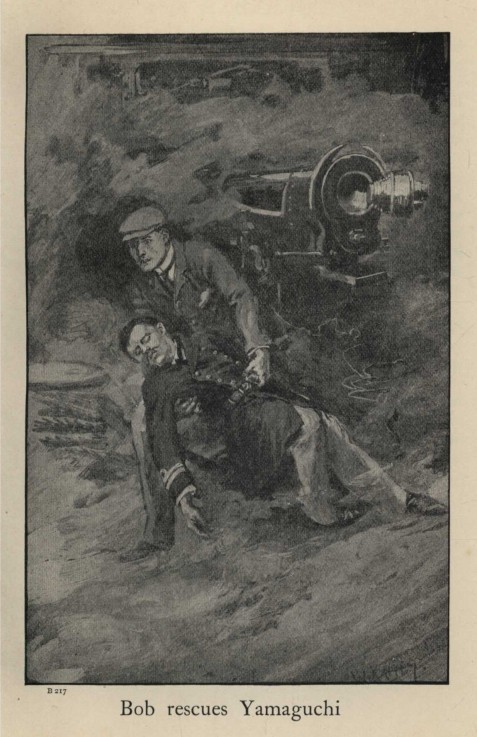
Bob rescues Yamaguchi
At the same moment there was a sudden cessation of the din. Admiral Togo had signalled the fleet to cease fire; the vessels wheeled round, and were soon running full steam ahead into the open sea. But signals, commands, movements, all escaped Bob Fawcett. Overcome by the deadly fumes from the exploded shell, he lay on the deck beside Yamaguchi, unconscious, ignorant that the first bombardment of Port Arthur was over.
CHAPTER VI
Helping-to-Decide
A Torpedo-destroyer—Sea Legs—At Chemulpo—A Recognition—Stopping a Runaway—Mystification
For nearly a week after his adventure in the box-battery Bob was laid up. The sickening fumes had upset his system, and the ship's doctor insisted on his remaining in his bunk until he was thoroughly recovered. His first question on regaining consciousness had been for Yamaguchi, and he was rejoiced to hear that the lieutenant, though slightly wounded by a splinter from the shell, had been rescued from the poison-filled battery just in time.
"He owes his life to your plucky action," said Captain Igichi warmly, when he visited him the day after the bombardment. "His wound alone would not have been serious, but another minute in the battery would have done for him."
Bob made light of the matter, and was embarrassed to find that he was regarded with even more warmth of friendliness than before. The Japanese officers did not overwhelm him with praise, courage was too much a matter of course with them for that; but though they said little, Bob felt that they now looked on him as one who had proved his right to their comradeship, and he knew that to a Japanese this meant a great deal.
He was no sooner fit for duty again than he was transferred to the Mikasa's sister ship the Hatsuse, whose range-finder was urgently needing attention. The standard on which the tube containing the telescope rested had been broken by the fragment of a shell, though fortunately the mechanism itself had been but slightly damaged. With the aid of the ship's clever artificers Bob was able to repair the injury in a very short time.
He remained on the Hatsuse for more than a fortnight, during which he witnessed the first plucky dash of the Japanese torpedo-destroyers on Port Arthur, the attempt by five stone-laden steamers to block the channel, and the second bombardment, in which the Japanese vessels received no damage. Then one morning he was unexpectedly transferred to a torpedo-destroyer which had been ordered to Chemulpo. He was there to place himself under the orders of Admiral Uriu, if that officer were still at the port.
There was a considerable swell on, but it was a calm, bright, cold day when Bob left the monster battle-ship, which scarcely felt the motion of the waves, for the tiny Kasumi, rolling and pitching beneath. A boat was lowered from the Hatsuse, and but for his experience in yachting on the lower reaches of the Clyde Bob might have had some qualms as to how he was to mount the rope-ladder let down over the side of the Kasumi. Though he failed to make the ascent with the nimbleness of a deep-sea pilot, he was on his mettle, and did not disgrace himself in the eyes of the crews of the Hatsuse and Kasumi, critically watching him from their respective vessels.
On reaching the deck of the destroyer he was as much surprised as pleased to meet Yamaguchi. He knew that the sub-lieutenant on his recovery had been promoted and appointed to a torpedo vessel, but until this moment he had been unaware to which. Their meeting was very cordial; Yamaguchi looked on Bob as his preserver, and Bob on his part was delighted to find that he was to make the passage to Chemulpo in company with one whom he already regarded as a friend.
Besides Yamaguchi, the officers on board were two sub-lieutenants, a doctor, and an engineer.
"We are fifty-five all told," added Yamaguchi, after introducing their new mess-mate.
"Where do you stow them all?" asked Bob in surprise.
"Come and see."
The lieutenant showed him first his own cabin, in the after part of the vessel—a room about ten feet square by seven high, with about as much accommodation as a small bathing-machine. Next to it was the ward-room, a trifle larger in area, in which Yamaguchi proposed that Bob should make his sleeping quarters on a small settee.
"It's half a mile too short for you," he said with a smile.
"I can lengthen it, or double myself up," replied Bob, who was indeed more than satisfied with his quarters when he saw the space allotted to the officers—four tiny cabins, each of which could have stood comfortably on an ordinary four-poster bedstead. Amidships were the engine-room and stoke-holds, shimmering with a white light from the furnaces, so intense that the stokers had to wear coloured glass goggles to preserve their eyes from blindness. The stokers, strong of arm and steady of nerve, looked like small demons from the Inferno as they kept cheerful watch on the gauges, cooped up as they were within the length of a man's body from the blazing mouths.
On the fo'c'sle forward were the conning-tower and the captain's bridge, with the Kasumi's single heavy gun—a twelve-pounder. Beneath, in a compartment about half as long again as a full-sized billiard-table, was the bed- and sitting-room of the crew; three rows of hammocks were slung along each side, one beneath another. In a heavy sea the whole deck, in spite of the steel breastwork on each side of the conning-tower was liable to be swept with water from end to end. Bob was not squeamish, but he shuddered as he imagined the conditions under which the crew spent their watch below. It was a lucky thing, he thought, that the Japanese require even less than the limited space indispensable to the British Jack-tar.
The Kasumi was rolling and pitching so inconsiderately when Bob boarded her, that in making his way along the deck in Yamaguchi's wake he had to cling to every available means of support. And yet the swell had only been sufficient to give a pleasant, slow, rocking movement to the Hatsuse he had just left. But it was not until the gallant craft began to drive her nose at speed into a head sea that Bob began to realize what life on a torpedo-destroyer really was. There was perhaps a little less roll, but the pitching was a revelation of what a boat can suffer without breaking her back. Bob clung to a stanchion, expecting every moment that the huge mass of water breaking over the fore-bridge and flooding the deck amidships would rend the vessel asunder. It seemed impossible that the hull, of merely egg-shell thickness, could survive the strain. The low bow slugged into a monstrous bank of green water. "Now she's done for!" thought Bob. But a moment later she was balanced giddily on the crest of the wave, and began to switchback into the abyss beneath. All the time the mighty heart of the vessel was throbbing strenuously; Bob caught himself counting the pulse with a kind of anxiety lest the engines should prove unequal to their task.
"How do you like this?" said Yamaguchi in Bob's ear.
"Pretty well; it's rather be-wild—"
He was choked by a shower of spray, which left him gasping.
"You'll soon get used to it," said Yamaguchi with a smile.
It was some hours, however, before Bob was sufficiently accustomed to the Kasumi's eccentricities to be able to move about with any freedom. He found meal-time in the little ward-room particularly trying. The food was served out in tins; the officers sat at the table with feet planted firmly on the floor, and managed to gulp their soup between the rolls of the vessel. But Bob was not sufficiently practised to time his movements properly. He would raise the tin to his lips, only to find that he opened his mouth on empty air, or that the soup made a premature sally and covered a considerable part of his face and clothes, a mere starvation portion entering at the proper gate.
There was an even more unpleasant experience in store for him when he turned in for the night. Do what he could he was unable to avoid being tossed off the settee, rolled under the table, and brought up with a jolt at the opposite side of the room. The most ingeniously-contrived breastwork of cushions proved of no avail; it might survive a roll and a pitch separately, but when the motions were combined it was incapable of the complicated resistance necessary, and Bob, just dropping off to sleep, found himself sprawling among his bastions and outworks beneath the table.
"Hang it!" he growled, groping upwards after one of these mishaps; "better stay where I'm chucked!"
He pulled his coverlets off, and making a bed beneath the settee and one leg of the table, managed to reduce the area of his gyrations by clutching the table leg whenever his equilibrium was in jeopardy.
It was a still, fair morning when, on awaking from his troubled sleep and going on deck, he saw before him the city of Chemulpo rising from the sea-front up a steep snow-clad hill. It looked very picturesque in the sunlight. The quay was crowded with Koreans in their strange black mitre-shaped caps and long tasselled coats; coolies trudging along under burdens pendent to yokes of forked sticks bound to their shoulders; greatcoated Japanese soldiers, just landed from the transports in the harbour, moving with a brisk purposeful alacrity. Brawny Korean boatmen were propelling heavy-laden sampans from the transports to the quay; children in blue padded garments were running about, watching everything with wide curious eyes, and getting in everybody's way.
But what attracted most attention and caused most excitement on the Kasumi was the sight of the wrecks of the Russian ships sunk after the action of February 8. In one case a part of the hull, in the other only the funnel and mast, stood up a little above the waterline in the harbour,—shattered remnants of the Korietz and Variag; and as the Kasumi steamed past, Bob had his first opportunity of seeing at close quarters something of the effects of modern weapons of destruction. But there was no sign of any Japanese war-ships; as Bob afterwards learnt, they had left harbour some time previously for an unknown destination.
Bob, in company with Yamaguchi, was punted to the quay in a sampan, and he could not but admire the dexterity with which the muscular boatman, standing in the bows, drove the tapering-prowed boat through the bewildering maze of small craft. There was no time to explore the town, for Yamaguchi at once made for the railway-station. He had told Bob that he was the bearer of a communication from Admiral Togo to General Kuroki at Seoul, and Bob, having nothing to do in Admiral Uriu's absence, was ready enough to accept his invitation to accompany him. Soon the train was bearing them over snow-covered flats, past rough huts, round the bases of the white hills, into the more open country, and finally over a broad ice-bound river to the terminus some distance from the walls of Seoul. There, instead of hiring a rickshaw as Bob expected, Yamaguchi hastened into the city through one of the arched and towered gateways, and passing up the crowded main street, boarded a small electric tram-car, in which the Korean passengers were as much at home as any European.
"Up to date, you see," said Yamaguchi.
"Yes; upon my word the Far East is going ahead. Fancy electric cars in Korea!"
"Japanese, my friend. Owned by a Japanese company; driver, conductor, all the employees are Japanese."
"A peaceful conquest of the country to begin with."
"Now I must leave you," said Yamaguchi, as they stepped out of the car. "You won't mind waiting for me for a few minutes?"
The few minutes lengthened themselves out to nearly an hour before the lieutenant returned, but Bob found the time short, so much did he see that interested him. He watched the people passing. Some of the men, he noticed, were hatless, and wore their hair long; others had short hair, and through their transparent flower-pot-shaped hats he could see a curious top-knot on their heads, the distinguishing mark, as he afterwards learnt, of the married men. One old man, as he passed, opened out a fan-shaped bundle of oil-paper which dangled from his belt, and tied it over his hat, which it served in the office of an umbrella against a light shower of snow then falling. Everybody wore huge padded trousers and a short bell-shaped coat with wide sleeves, and walked along on strange sandal-like shoes bound to the feet by many strands of paper cord. Scarcely any women were to be seen; the Korean ladies are kept secluded, and do not go out into the streets except at night. The few women whom Bob saw were almost hidden by their long green cloaks, with which they hastily covered their heads at the appearance of a stranger.
While waiting for Yamaguchi outside the pagoda-shaped house in which General Kuroki was staying, Bob saw a Chinaman come out, whom he instantly recognized as the younger of the two men who had so opportunely run to his assistance at Sasebo. On the impulse of the moment Bob stepped forward to speak to the man, but remembered suddenly that he knew no English. The Chinaman passed by without giving any sign of recognition. Soon afterwards Yamaguchi appeared, and, announcing that he found it necessary to remain in Seoul until the next morning, offered to show Bob some of the curiosities of the town. The rest of that day was spent in wandering through the broad streets and side alleys, blocked with wares encroaching from the shops, and crowded with noisy, dirty little children playing happily in the filthy gutters. Yamaguchi explained how greatly the city had been improved of recent years, chiefly through the energy of Mr. M'Leavy Brown, the brilliant Scotsman who had so long and so wisely held the administration of the Customs.
Next morning Yamaguchi again had an interview with General Kuroki. As he left the house with Bob, the Chinaman whom the latter had seen on the previous day came up in the opposite direction, and Bob thought he saw a faint sign of recognition pass between him and the Japanese.
"Who is he?" asked Bob, when the Chinaman had passed. "I saw him yesterday, and a month ago at Sasebo, and I can't help thinking I had seen him somewhere before that."
"All Chinamen are pretty much alike, don't you think?"
Bob saw that Yamaguchi had evaded his question and was not disposed to give any information. Such silence only piqued his curiosity, and as they went on he found himself speculating still more deeply on the identity of the Chinese merchant, and endeavouring to recall the circumstances of their first meeting, which had not been, he was sure, at Sasebo.
New transports had evidently just arrived, for the streets were filled with Japanese soldiers, guns, and baggage-trains, preparing to move up country. Bob noticed, at the entrance of a side street, a Korean gentleman of high rank, to judge by his rich dress, waiting on horseback for a troop of cavalry to pass. Beside him was a group of Koreans, apparently his servants, and among them a low palanquin, elaborately decorated, through the open side of which Bob caught a glimpse of a veiled lady. The bearers, two fine-looking coolies, in white robes and round hats, stood at the front and rear of the palanquin.
The cavalry trotted by, and Bob, as he walked after them, remarked with a smile to Yamaguchi that they were not very easy riders.
"That is true," replied Yamaguchi, "but in the mud and snow of Korea they'll prove more useful than your Life Guards."
They had barely gone a quarter of a mile up the street, when Bob noticed a sudden commotion among them. The horse of one of the rearmost troopers, startled by the sudden appearance at the end of an alley of a bull heavily laden with bundles of straw, began to prance and curvet, then wheeled round, bucked, and, throwing its rider, set off on a mad gallop down the street. Bob instinctively looked behind him to see what there was to check the animal's mad career. He saw that the Korean gentleman had resumed his journey, being propped up by a servant on each side lest he should topple over on his high saddle; with the palanquin and his servants, he took up almost the whole width of the street. By this time people were shouting, and the clatter of the horse's hoofs was coming ever nearer. With one consent the Korean's servants ran to the sides of the street, the palanquin bearers dropped their poles and left the conveyance in the middle of the road, while the gentleman himself struggled with his horse, which had been rendered restive by the ever-increasing clamour.
Nothing stood between the palanquin and the runaway steed but Bob and Yamaguchi. Clearly, unless the animal's progress was checked, in a few moments it would dash into the palanquin, and that, being constructed chiefly of bamboo and lacquer, was certain to be utterly wrecked, while its occupant would probably be killed, or at any rate seriously injured.
The danger of the situation was instantly manifest. Bob dashed forward a few yards to meet the advancing horse; then, having placed a sufficient distance between himself and the palanquin, he halted suddenly and stood full in the pathway of the runaway animal. It came straight down upon him at a mad gallop. As it passed Bob sprang slightly aside, and seizing its hanging bridle dragged on it with all his might. Fortunately it was a light horse, standing only some fourteen hands; but in spite of this Bob felt as though his arm were being wrenched from its socket as he clutched at the reins. He was dragged along and almost pulled off his feet; but Yamaguchi came to his assistance, and the frightened animal was brought to a stop within a yard of the palanquin. There it stood with heaving flanks and panting nostrils, quivering.
Bob retained the bridle, and was beginning to lead the the horse up the street towards his rider, who was more chagrined than hurt, when the Korean gentleman overtook him on foot. He was extremely agitated, and, making a low bow, began to pour out his thanks in the strange monotonous jerky language of the country. Yamaguchi, interrupting him, spoke a few words in the same tongue. The Korean stopped, made a still lower obeisance, and said slowly in a strange compound of colloquial English and journalese that tickled Bob's sense of humour:
"I thank you very much, hon'ble sir. You do me gigantic favour. You save my wife—better-half, by your daring courage. It was jolly close thing. Accept, hon'ble sir, my profound thanks."
Bob bowed his acknowledgments, but his embarrassment was rather increased when the polite Korean, untying one of several little bags of orange-coloured silk that hung at his waist-band and served him as pockets, produced a limp visiting-card, and handed it with another low bow to his benefactor. Bob thanked him, and looked in some perplexity at the incomprehensible hieroglyphics on the card.
"You do not understand?" said the Korean. "My name, hon'ble sir, is San-Po. I am—" He stopped and looked puzzled, evidently at a momentary loss for an English word. Then his brow cleared, and he added rapidly: "I am helping-to-decide in His Imperial Majesty's War Office. If, hon'ble sir, you do me honour of a visit in my house towards An-ju, I shall esteem it greatest hon'ble favour—jolly well pleased."
Yamaguchi was smiling, evidently enjoying the situation. He did not offer to help Bob out of his embarrassment.
"Thank you, sir," said Bob, "I am afraid I am not coming that way just now, but another time—perhaps—"
He finished the sentence with a bow, to which the Korean responded with a lavish acknowledgment of his condescension. As Bob turned to continue his journey with Yamaguchi, he became aware that Korean courtliness has its obverse. Though he did not understand the words, there was no mistaking the tenor of the vehement harangue which the gentleman was addressing to his absconding bearers, who had now slunk back to their poles.
"What in the world does he mean by helping-to-decide in the War Office?" asked Bob.
"Oh, the war minister, the Pan-Go, or decisive signature, has what you call under-secretaries, the Cham Pan, which means help to decide; and under them are the Cham Wi, which means help to discuss. Our polite friend is one of the Cham Pan. But it really doesn't matter, for the whole army is quite useless. It never fights."
"All shams together," said Bob with a smile.
"San-Po spent a year or two in England: entered at Lincoln's Inn, I believe: that explains his command of English."
"It's a fearful and wonderful mixture. Mr. Helping-to-decide is rather an oddity. I'd rather like to see him at home, though I don't suppose I should enjoy it so much as my visit to Nikko. I never had a better time than with one of your countrymen there, Kobo San."
"Kobo San!" ejaculated Yamaguchi, with an accent of surprise.
"Yes. Do you know him?"
"I've met him," replied the lieutenant shortly, with another change of tone. Bob looked at him, but his face was inscrutable.
CHAPTER VII
The Battle of the Destroyers
A Chance for the Destroyers—Flotillas in Action—Winged—Repairing Damages—To the Yalu
Yamaguchi's business in Seoul being completed, he lost no time in returning to Chemulpo. In default of other instructions, he decided to keep Bob with him, and half an hour after his arrival, the Kasumi steamed out of the harbour to rejoin the fleet. Its fringe came into sight some ninety miles south-east of the Liau-ti-shan promontory. Through his glass Bob saw a destroyer detach itself from the squadron and come rapidly towards the Kasumi.
"Coming to make sure who we are," remarked Yamaguchi.
When the identity of the new-comer had been satisfactorily established, the other boat ran up signals, from which Yamaguchi learnt the position of the main fleet. Two hours later the Kasumi, going at half-speed, sighted the cruiser squadron, and about five miles beyond them the forest of military tops belonging to the Japanese battle-ships. Running close up to the Mikasa, Yamaguchi went off in a boat to make his report to Admiral Togo, and returned in high feather at having been ordered to place himself at the disposal of Captain Asai, who was in command of three destroyers that formed the first division of the Japanese torpedo flotilla.
"What about me?" asked Bob.
"Not a word. The fact is, I forgot all about you. I didn't mention you, neither did the admiral."
"Out of sight out of mind," remarked Bob. "But I'm delighted to hear it, for now that I'm used to this cockle-shell's little eccentricities I'm perfectly at home. Is there any chance of your going into action?"
"Every chance, I should think. I fancy we're going to have another slap at the enemy."
"The whole fleet, you mean?"
"No I don't. I've an idea the admiral wants to see how we mosquitoes can sting. Feel jumpy?"
"Not in the slightest. There's nothing I'm more anxious to see."
"Well, it may be pluck, but I call it sheer ignorance. Here we are in mid-ocean, a mere egg-shell—you know that; but we've enough explosives in our magazines to send half London sky-high, and a single fortunate shot plumping into us would separate us all into our elementary atoms."
The desired order came sooner than was expected. Late in the afternoon of Wednesday, March 9, Admiral Togo signalled two divisions of destroyers to approach Port Arthur, the one division to watch the entrance while the other laid mines at various points along the coast. The former duty was allotted to Captain Asai's division. Darkness had fallen, and the sea was rolling high, when the two flotillas, followed at a considerable distance by a couple of cruisers, broke off from the rest of the fleet and steamed northwards towards Port Arthur. On the Kasumi there was none of the orderly bustle of clearing for action that Bob had observed on the Mikasa. A destroyer must always be ready. The ward-room and the warrant officer's mess were fitted up as hospitals for wounded; the trolley for bringing torpedoes from the magazine under the turtle-back deck to the tubes aft was tested along the rails; Yamaguchi had a short colloquy with the engineer; and then he went to his place on the fore-bridge, confident that all was right.
The flotilla opened up the lights of the port about midnight. The presence of the boats was soon discovered by Russian scouts, for at irregular intervals the guns of the forts tried long-range shots at them. Within a few miles of the port the divisions separated, the second steaming straight for the harbour, where it proceeded to lay mines from the mouth of the channel along the coast towards Dalny. Captain Asai's three vessels meanwhile cruised off the Liau-ti-shan promontory.
Bob remained all night with Yamaguchi on the bridge, finding it less chilly there than below. In spite of the blazing furnaces he had never felt cold so keenly as in the captain's cabin when he dived down the small circular hatchway to fetch Yamaguchi an extra jacket. At about three o'clock in the morning they began to run down the coast. There was a head sea, which broke in great masses over the fore-deck, the driving spray being carried high over the canvas screens surrounding the bridge. Dawn was just breaking when the look-out descried the low hulls of several destroyers far-off on the horizon. The intelligence was at once signalled to Captain Asai on the Akatsuki. From his bridge he soon discovered that the approaching vessels were six in number; obviously they could not belong to the Japanese squadron. The order was instantly given to attack. Everything was already prepared for immediate action; every man was at his post; and the three vessels, cutting at the rate of an express train through the heavy seas, bore straight down on the six Russian destroyers.
"It's long odds on the Russians," remarked Bob to Yamaguchi.
The Japanese shrugged. "They're not islanders," he said; "we're like you Britishers, sea-dogs from birth, and our seamanship is a trifle better than theirs, I fancy. Besides, we're probably better armed. A Russian destroyer only has three-pounder quick-firers besides its twelve-pounders. Their shots can pierce our egg-shell, of course, but our six-pounder shots will do far more damage to their interiors."
"Won't you use your torpedoes, then?"
"No. Dog doesn't eat dog: we keep our torpedoes for larger game."
"You are not using the conning-tower?" asked Bob, noticing that Yamaguchi showed no sign of leaving the bridge.
"No; it is better to take one's risk in the open. Those peep-holes are rather worrying when you want to have a good look at the enemy."
The three vessels were now in line ahead—steaming straight for the Russian flotilla, the Akatsuki leading, the Kasumi a quarter of a mile behind, and the Asashio making a good third at the same distance. Bob on the fore-bridge was tingling with exhilaration. All his faculties seemed to be braced up. He had no sense of danger, in spite of his knowledge that one lucky shot from the Russians might explode the magazine beneath him and destroy the ship and every soul on board. His strongest feeling was one of impatience. The vessel was bounding along at more than race-horse speed; yet it appeared to be going slowly, too slowly, and he felt he would have liked to cry "Hurry up! hurry up! faster! faster!"
Two minutes had passed since the order "Full speed ahead!" Then from the fore-bridge of the Akatsuki the six-pounder shrieked. From that moment Bob saw and heard nothing except what went on in his own vessel. Immediately after the Akatsuki had opened fire, Yamaguchi gave his first order. There was an ear-splitting report; the vessel seemed almost to pause momentarily in its career, like a racer pulled up on its haunches; and a second or two later Bob saw a cloud of smoke over the fore-deck of the leading Russian boat, which, travelling at thirty knots, instantly shook off the pall and emerged from it with one funnel completely shattered. Bob did not hear the explosion of the shell; the din from the Kasumi and the other Japanese vessels, and from the approaching Russians, was too great to allow individual sounds, except within a few feet, to be distinguished. Almost before he was aware of it, the two flotillas had met and passed; they were within a few yards of each other, so near that the faces of the Russian seamen were easily visible; but Bob afterwards remembered few details, for the actual time of transit could be measured by seconds. The vessels sped past at a combined speed of some sixty miles an hour.
As the Kasumi came abreast of the leading Russian boat, which had already received a battering from the Akatsuki, her twelve-pounder added a growling bass to the whining of the lighter guns, now firing at their maximum speed. At this moment a shot from a three-pounder struck the compass-box on the fore-bridge, just above the chart-room, and a few feet from where Bob was standing. A splinter from the bursting shell hit the gunner serving the six-pounder on the bridge; the man was killed in an instant; a comrade came imperturbably to take his place. Immediately afterwards a twelve-pounder shell carried away the ventilator of the aft stokehold, and a three-pounder, penetrating the hull as though it were of paper, exploded in the ward-room, severely injuring a man waiting there to receive the wounded. Then the rearmost vessels of the two squadrons passed, and the Kasumi's twelve-pounder astern got in a parting shell, which took effect apparently among the boilers of the Russian, for when the smoke from the bursting charge had cleared away, the vessel was seen to be enveloped in a vast cloud of steam. Bob was surprised at the small total effect of such vigorous firing on both sides, though he realized afterwards that at the rate at which the vessels were steaming it was still more surprising that the effect was so great as it was.
But the fight was not yet over. At a signal from the Akatsuki the Japanese vessels spun round almost within their own length, and started in pursuit of the enemy, now steaming at half-speed to cover the retreat of the damaged boat. The Russian flotilla was somewhat bunched; presumably the boats had been hard hit, and either their commander had no definite plan of action, or their mechanism had been so much damaged as to retard their movements. Two had turned, but three others were manoeuvring in a small space, hampering one another, while the sixth, the lame duck, was making the best of its solitary way in the direction of Port Arthur. Captain Asai was quick to seize his opportunity. Slightly altering his course so as to cut obliquely across the path of the Russians, he brought the whole of his port-side guns to bear upon the huddled enemy; then before the Russians had time to take advantage of the broad target offered to them, he reverted to the line-ahead formation, and bore straight down upon them.
This time the two flotillas passed at such close quarters that a man could have thrown a line from one ship to the deck of its opponent. They were moving at less speed than in the former encounter, and the effects of their mutual bombardment were correspondingly greater. For the first time Bob was conscious of a tremor, not of personal fear, but a reflex of the wild scene around. It seemed to him as if nothing could survive the hail of shells that screamed and whistled through the air, to burst with ear-splitting crash whenever one was fortunate enough to find its billet in the hull or upper works of the gallant Kasumi. One shell, apparently from a three-pounder, ricochetted off the turtle-back deck beneath the forebridge, and burst in the air about ten yards to starboard, the splinters breaking a hole in the aftermost funnel and knocking a corner off the compass-box that stood within a few feet of it.
"There goes our second compass. We have only the standard left," said Yamaguchi.
Almost at the same moment there was a crash just below the spot where Bob was standing. A twelve-pounder shell had passed clean through the chart-room without exploding.
"A narrow squeak!" said Bob.
"Yes; we'll give that fourth Russian a little pepper," replied Yamaguchi, his face lit with the joy of service.
He gave an order, and all the Kasumi's port six-pounders let fly at the Russian destroyer, several shells ploughing into her hull just above the water-line. Bob noticed the strained expression on the faces of the Russian seamen, and one vivid picture flashed upon his retina and was gone—the picture of a man, struck by a fragment of a Japanese shell, falling with outstretched arms across his gun. A few seconds more and the Kasumi again came abreast of the last vessel in the Russian line. She replied so feebly to Yamaguchi's skilfully-aimed broadside that it was evident she had already been severely handled by the Asashio, now leading. But as the vessels passed, a big Russian picked up a tin canister and hurled it with such good aim at the Kasumi that it fell on the platform of the fore-bridge between Yamaguchi and Bob. The latter instantly lifted it to throw into the sea, but Yamaguchi stayed his hand.
"There's no danger," he said; "it will not explode now. We'll keep it; I'll make you a present of it."
At that instant a three-pounder shell exploded in the aft stoke-hold, bursting a steam-pipe, and dangerously wounding one of the engineers.
"Poor Minamisawa!" said Yamaguchi, when he heard of it. "He was twice commended for gallantry during the attack on Port Arthur a month ago."
By this time the flotillas had again passed each other. But on turning once more to renew the fight, Captain Asai found that the enemy had had enough of it. They were steaming full speed ahead towards the harbour. The order was given to pursue; but the Russians had obtained too great a start to permit of their being overhauled before gaining the protection of their cruisers and shore batteries. The pursuit had necessarily to be abandoned, and the Japanese commanders turned their attention to making good the damage sustained during the action.
The full results of this spirited forty minutes' engagement were not known on board the Kasumi until some time afterwards. Near the entrance to the harbour two of the Russian destroyers were intercepted by the second Japanese flotilla. The Russians, battered as they had been, showed no lack of courage. There was a short, sharp fight, during which one of the boats slipped past the enemy and got away. The second, however, the Stereguschitshi, was not so fortunate. She fell a prey to a Japanese destroyer, and was taken in tow. But she was leaking badly; the tow-rope was snapped like a thread of cotton by a heavy sea, and, left to her fate, the Stereguschitshi went down.
Meanwhile the three vessels of Captain Asai's division lay for about an hour with only steering-way on, until the extent of their injuries should have been ascertained and as far as possible repaired. On the Kasumi two compass-boxes had been damaged, part of the fore-bridge carried away, one funnel breached, the chart-room almost entirely wrecked; but the most serious injury was the shattering of the steam-pipe, throwing one engine out of action. The other two vessels stood by while some repairs were being made; it was not safe to leave the Kasumi to face alone the risk of the appearance of the Russian cruiser squadron. The work was barely completed, indeed, when two cruisers, the Bayan and the Novik, the latter flying Admiral Makaroff's flag, steamed out of Port Arthur and ran down towards the three destroyers. But at the same moment a forest of military masts appeared on the horizon: the Japanese fleet was evidently coming up in support; and the two Russians, fearful of being cut off, retired, fighting at long range with the leading Japanese cruisers until they ran in under shelter of the forts.
"Another bombardment coming off?" said Bob to Yamaguchi, as the splendid battle-ships went by.
"Perhaps. The flagship is signalling us."
"What are the signals?"
"Nothing important; the admiral merely says he is satisfied with us."
The flush of pleasure was not on Yamaguchi's cheeks, but on Bob's. He remembered the historic "Well done, Condor!" and felt a sympathetic glow.
The battle-ships steamed past, and took up a position whence they could neither see the Russian vessels nor be seen by them. Depending on high-angle fire from their twelve-inch guns, they sent shell after shell into the town and harbour, the effect of their shots being signalled by wireless telegraphy from the cruiser squadron stationed round the point. The bombardment lasted for nearly four hours, during which several outbreaks of fire were seen in the town, and a distant explosion announced that a magazine had been blown up. There was but little reply from the Russians, and about two o'clock Admiral Togo, having accomplished his immediate purpose, retired, accompanied by the cruiser and destroyer squadrons.
Two hours later Yamaguchi was signalled to go aboard the flagship. It was blowing hard at the time, and seas were sweeping the deck of the Kasumi, tossing her about, and rendering the launching of her boat a matter of no little difficulty. By the time the little lieutenant reached the Mikasa he must have been drenched through and through.
"Well," said Bob, when he returned, "are you promoted again?"
"No; but you are."
"What do you mean?"
"The admiral has remembered you, that's all. This morning, being forgotten, you were at zero; you may be soon at boiling-point. I am to put you on board the Yoshino—if I can."
"Ugh! it won't be a dry passage. If you can, you say?"
"Yes; I am ordered to the mouth of the Yalu, and shall drop you on the way, if I can do so without losing time."
"In a hurry, then?"
But Yamaguchi made no reply. He was telephoning to the engine-room. In a few minutes the Kasumi was slugging through the sea, half-speed ahead, in a north-easterly direction. The wind increased to half a gale; huge seas broke continually with thud and swish over the vessel, and Bob did not relish the prospect of the swamping he must undergo if he were to reach the Yoshino's side. He was overjoyed when he saw that the distance between the destroyer and the cruiser squadron was increasing instead of diminishing. Yamaguchi had clearly given up the idea of putting him aboard the Yoshino. From his manner Bob had already guessed that the expedition on which he was now speeding was one of some importance, and when at length the lieutenant turned to him and said, laconically, "Can't waste time over you", his pulse leapt at the thought that he was still to remain on the Kasumi and share in whatever adventure there might be in store.
CHAPTER VIII
Cut Off
Secret Service—Yamaguchi Returns—A Quick Change—A Bleak Ride—On the Trail
For some time Yamaguchi was too intently occupied in navigating the vessel between the Elliott and the Blonde islands to concern himself with Bob. But when he was through the strait he left the bridge and went below to get something to eat. Then for the first time he told Bob what his mission was. He had been ordered to survey the coast-line of Korea Bay as far as the Yalu, to report on the state of the ice, and especially to examine the condition of things at the mouth of the river. If he could at the same time pick up any information as to the disposition of the Russian forces along the shore, so much the better; but though he might run any personal hazards, he was on no account to risk his vessel; in war time destroyers cannot easily be replaced.
"You're fixed up for ten days, you see," he said to Bob. "I'm to be back in that time, and you're bound to remain with me."
"You'll have to go ashore, I suppose," said Bob.
"Yes, if I can get through the ice. And I think I can. I've been this way before; I suppose that's why the admiral selected me for the job. Unless it's because one of our engines is out of action. The ice usually clings to the shore till some time after this, but just before we reach Taku-shan there's a spit of land where, by some movement of the currents, the ice is sometimes loosened; and if I'm lucky, there'll be passage-way for a boat, if not for the destroyer herself."
"I say, you'll let me go with you."
"Certainly not. I'm already one notch down through not being able to put you on the Yoshino, and I can't afford to report you gone for good."
"But why shouldn't I go where you go?"
"Well, for one thing, it's my job and not yours. The admiral has plenty of lieutenants, but only one Bob Fawcett! Besides, why take you into danger? If the Russians catch me, I'm shot. Well, that's part of my work; but you—you'd be shot too, and an Englishman is worth—how many of any other nation?"
"Too many to count," said Bob smiling.
"Anyhow, you're twice as heavy as me, and nearly twice as tall; and another thing, you'd find it hard to pass for a Chinaman."
"Oh! you're going in for disguises, then."
"Yes, I shall stick on a pigtail; I won't be caught if I can help it."
"D'you know, I've an idea. Your mention of a disguise makes me wonder if that Chinaman I saw in Seoul wasn't a Chinaman after all. I saw him before at Sasebo with another fellow; there was something about them I seemed to know. D'you think they were really Japanese I had caught sight of in Tokio?"
"It's possible, of course; but I shouldn't jump to conclusions. Their disguise must have been pretty feeble if you saw through it after only a casual glimpse in Tokio."
"Ah! I've a good memory for faces. But let us go on deck, it's so horribly cold down here."
By this time the vessel had left the Elliott Islands some ten knots on her port quarter. Looking out in that direction, Bob drew Yamaguchi's attention to the masts of several vessels that stood up among the islands. The lieutenant smiled, but said nothing. Bob, in spite of himself somewhat annoyed at his friend's reticence, formed his own conclusion: the ships were probably transports landing men or supplies on the islands, or preparing the way for a Japanese army-corps in anticipation of a siege of Port Arthur.
Keeping well out in the bay, the Kasumi thrashed her way through a head-sea on a course north-east by east. Darkness came on, and loth though he was to go below and shiver, Bob at length was so tired that he had to turn in. He spent a by no means comfortable night. It was like sleeping under a blanket of ice. During the hours of darkness, in order to save coal, the Kasumi went at less than half-speed, and it was nearing dawn when she arrived off Taku-shan. All that day Yamaguchi kept her far out, so that she should not be seen from the shore, which was fringed with ice. The wind had dropped, leaving only a long swell on the waters of the bay. At nightfall the Kasumi ran in, careful soundings being taken at various points; and Yamaguchi found, as he had hoped, that the current had kept open a narrow waterway between Takushan and the island of Talu. Announcing his decision to go ashore, he went to the ward-room, and soon returned, transformed into a very presentable young Chinaman, drooping moustache, skull-cap, pigtail, and all. A boat was lowered, and the lieutenant departed, saying that he would probably return by daylight.
That was the first of several short expeditions Yamaguchi made at night to the shore. Bob could never induce him to speak of what he did, but noticed that he always appeared abundantly satisfied. On all these occasions the same plan was followed: Yamaguchi was rowed in the darkness as near to the shore as the ice-fringe allowed; he finished the distance on the ice; and the boat returned to the Kasumi until just before dawn, when it again went shorewards and brought him off.
Four days thus passed away, and on the evening of the fourth, when the Kasumi had come opposite the mouth of the Yalu, Yamaguchi told Bob that he was now going on the last of these night journeys, and hoped, on his return, to rejoin the fleet and make his report to Admiral Togo.
"I may be away longer this time," he said.
"Can't I go? Every time you have been away I have been in a perfect stew lest you shouldn't come back, and I find it all precious slow."
"Very sorry, but it's impossible."
"How long do you expect to be away this time?"
"I can't say, but I have three days' rice stowed away in my pockets. I hope I shall not be so long as that. You had better amuse yourself by playing 'go'."
"But what if the Russian fleet comes up while you're away? For my part, I don't understand a commander leaving his vessel like this."
"You are not the admiral, you see. I don't think you need trouble about the Russians. The Port Arthur fleet daren't come, and the Vladivostock one probably can't. Good-bye."
Two days passed away, and by the end of the second Bob was almost tired of his life; he had played "go" till he went nearly mad. He wandered all over the vessel, examining for the tenth time every nook and cranny of it, until he felt that he could have drawn plans of its construction from memory. He got one of the gunners who knew something of English to teach him a little Japanese—common phrases like Nodo ga kawakimashita, "I am thirsty", which to a Japanese is "throat has dried"; and "I am hungry"—O naka ga sukimashita, "honourable inside has become empty"; and "it is horribly cold"—O samu gozaimasu, "honourably cold augustly is", until he wondered whether it would be correct Japanese to say "I'll augustly punch your honourable head". But even such amusement as this palled; and to his own restlessness was presently added anxiety about Yamaguchi, for whom he felt sincere affection. At sundown on both evenings the boat went off towards the shore in accordance with the captain's instructions, but on both occasions it returned without him. On the third evening, Bob decided to accompany the boat. The sky was clearer than it had been for many nights past; the moon was rising, and whatever danger there had previously been of the boat being seen from the shore was now more than doubled. Bob felt anxious, and, as he sat in the bows, peered through his glass towards the snow-covered flats and low hills that stretch on either side of the Yalu estuary.
The sailors pulled in to the verge of the ice, then lay on their oars. Many minutes passed. The crew waited in silence, and as the moon rose higher and its rays were reflected from the snow, it became almost as light as day. The sea heavily lapped the sides of the boat and swished against the jagged edges of the ice; otherwise there was no sound.
Suddenly, against the white background, a small dark form was seen, apparently rising from the other side of a hillock whose contour was indistinguishable in the universal white. The object soon defined itself as a small man running, and at headlong pace. Bob stood up in some excitement, wondering whether this was Yamaguchi at last. Immediately afterwards he saw other forms appear upon the crest, and he drew in his breath sharply as he recognized that these were men on horseback. They came rapidly over the hillock, and began to descend towards the sea after the running figure. Bob raised his glass to his eyes; yes, the runner was Yamaguchi, and the horsemen wore the fur caps and carried the long lances of Cossacks. It was a race for life!
The hillock was nearly half a mile away. Between it and the boat lay an almost level stretch of mud flats, covered for many inches by recently-fallen snow, and fifty yards of ice, now of course indistinguishable from the land. Could Yamaguchi reach the boat in time? He had the start of his pursuers, but they were mounted, and, as Bob now saw, there were eight of them. It was almost impossible that the runner could escape. Yet it seemed impossible to help him. The seamen in the boat had rifles, but now that pursuers and pursued had descended the declivity and come to the flat, a shot, however well aimed, might hit the man it was intended to assist.
In one tense moment Bob seemed to live a lifetime. Then, with a cry to the men to remain where they were—which, not knowing English, they understood rather by the tone than by the words—he sprang over the side of the boat on to the ridge of ice. It creaked and sank under him, but he leapt on towards the shore, intent on assisting the flagging footsteps of the Japanese, who was evidently near the end of his endurance. The ice crackled and groaned as Bob raced on. He reached the softer snow, and his pace was checked; he heard a shot from one of the pursuing Cossacks ring past his ear; he shouted a word of encouragement to the panting lieutenant, and then, leaping, floundering, staggering over the intervening yards, he caught Yamaguchi by the arm and turned to run with him towards the boat, feeling all the time that theirs was a hopeless case, for the foremost horseman, distancing his comrades, was now but a dozen yards away.
All at once a shot flashed from the boat. Bob heard a strange sobbing sigh behind him. A moment after he felt the impact of a heavy body, he was thrown violently on his face, and a riderless horse galloped madly on towards the sea.
Bob lay for a few moments dazed on the snow. The cold brought him to his senses. He heard several shots ring out, and lifting his head cautiously he saw four Cossacks galloping on to the ice, and three standing by the side of their horses, taking aim at the boat across their saddles. Then came the crack of ice beneath the horses' hoofs; loud cries of distress rose on the air as men and horses floundered in the water; and a fusillade continued between the dismounted Cossacks on the shore and the crew of the boat, which was now being rapidly pulled out to sea. Bob saw his opportunity; it might last but a moment, he had no time to lose. Rising to his feet, still dizzy from the blow, he saw a few feet behind him the outstretched body of the dead Cossack; his horse had returned and was now standing patiently by his side. He stooped down, quickly relieved the Cossack of his cap, cloak, and arms; then, going quietly to the animal, he sprang upon its back, saw at a side-glance that the surviving Cossacks were still occupied, and touching the horse with his heel, trotted away southward on a line parallel with the coast, towards a clump of trees looming black against the moonlit sky more than half a mile away.
Having arrived there, and being out of sight from the scene of his late adventure, he pulled up to consider his position. Yamaguchi, he hoped, was by this time well on his way to the Kasumi; if only he himself could remain in hiding until the morning, and the vessel were still lying off the mouth of the river, it might be possible then to get on board. All depended on whether the Cossacks who had survived the fray would notice his disappearance, and the fact that their dead comrade had been despoiled. That they would not do so was in both cases very unlikely. His only chance, therefore, would be to make his way southward, in the hope of coming upon the outposts of one of the Japanese forces which he knew had been landed in the country. That course would be attended with considerable danger. News of the recent incident was bound to bring a larger force of Cossacks upon the scene; parties of Russians would soon be scouring the country, not only to discover traces of the fugitive, but to keep an eye open for the torpedo boat destroyer. It was well-known on the Japanese fleet that Cossacks were employed to ride up and down the coast and signal the approach of hostile vessels, and these would scarcely fail to note and follow up the tracks of his horse in the snow.
"This is a precious fix to be in," he thought; and the more he reflected the more awkward his position appeared. The chance of getting in touch with the Kasumi was very remote, for if he emerged from hiding and went down to the shore he could scarcely hope to escape discovery by Russian patrols. On the other hand, if he hid during the day he would not be seen from the destroyer. Besides, the Kasumi was due to rejoin the fleet; and though he knew that Yamaguchi, if a free agent, would do anything to serve him, he knew also that, with a Japanese, duty came inexorably first, and it was vain to expect Yamaguchi to cruise about indefinitely on the chance of picking him up. Supposing he left hiding and rode towards the south, there seemed little likelihood of his reaching the Japanese lines. Their outposts were probably not less than a hundred miles away. Between them and him many detached parties of Russians were no doubt patrolling the country. Even if he escaped the Russians he might fall into the hands of the Koreans, and that would perhaps prove a case of out of the frying-pan into the fire. Much as the Koreans hated the Japanese, by all accounts they hated the Russians still more; and being mounted on a Cossack's horse, and wearing Cossack uniform, knowing, moreover, nothing of the Korean language, he would have short shrift if he stumbled among the natives. Yet another consideration. Both he and his horse must have food. A bundle of hay was tied to the latter, sufficient perhaps for one feed; and on rummaging in the saddle-bags he found a little black rye bread and a flask of vodka. But this was very precarious sustenance, and he would be forced under stress of hunger to enter a village within twenty-four hours at the latest.
Of all the dangers besetting him the prospect of being followed up by the Cossacks of Yongampo was the most immediate, and Bob shut his eyes to the other contingencies in order to provide against this. Obviously the farther he got from the scene of the fight the better. He rode carefully through the clump of bare trees southward, and, emerging into the open, set his horse at a sharp trot. The ground was covered with snow to a depth of several feet, and as the horse's feet sank into it slightly, he concluded that the frost was yielding. Guiding himself by the sound of the waves lapping against the ice on the shore, which creaked and groaned, and now and again broke with a sharp report, he struck along the coast in the direction, as he believed, of Seng-cheng. The Cossack's deep saddle was very comfortable, but he wished that the stirrups were lower: his knees were a good deal nearer his nose than he was accustomed to.
The moon was going down, but there was still sufficient light to show that, except for a few scattered clumps of wood, the country was very open, and he knew that in the daytime he could be seen for miles. As he rode, he therefore looked eagerly about in search of some hiding-place where he might spend the rest of the night in tolerable security. After some three or four miles he found that the country was becoming increasingly difficult. On his left the irregular hills rose more and more steeply, and he was forced more and more towards the ice. Warned by his recent experience of the Cossacks, he edged away until he reached at length the summit of a slope some distance above the sea. Great banks of cloud were looming up across the sea; the wind was rising, and the air had that incisive rawness that portends snow. To be caught in a snowstorm in this bleak latitude would be a calamity, and Bob looked more anxiously around for shelter.
Some distance above him he saw, outlined against a clear patch of sky not yet reached by the clouds, a large dark building, which from its size he thought must be a place of some importance. It was in shape unlike anything he had previously seen. As he looked towards it, he caught sight of the last horn of the moon apparently in the very centre of the building. Evidently the place was a ruin. Whatever hesitation Bob might have had in approaching an inhabited dwelling-house disappeared; he made his way towards it with some difficulty, the horse floundering through drifts which more than once threatened to engulf him. Arriving at the building, Bob found that it was the ruin of a large stone pagoda, probably at one time part of a monastery. The wind howled eerily through its dilapidated walls, but it provided shelter of a sort; and, what was more important, being situated on a slight eminence it would give him a good outlook in the morning, not only far across the sea, but also landward towards the mouth of the Yalu. In this lonely place, then, Bob determined to pass the remainder of the night.
His first care was to rub down his horse; then he gave it half the bundle of hay. Then he unstrapped one of the blankets from the saddle and proceeded to make himself as comfortable as possible. He swallowed a few mouthfuls of the bitter bread, took one sip (more than sufficient) of the burning vodka, and being tired out soon dropped into an uneasy sleep, from which, with the instinct of one accustomed to early rising, he awoke at the first pale glint of dawn. Rising stiffly to his feet, he again fed the horse, ate a little bread, and went outside to look round.
Northwards, in the direction from which he had come the previous night, he could see with the naked eye for several miles across the snow; and through his glass, which he had luckily brought with him, he descried what was evidently a small town—no doubt Yongampo. Over the whole white stretch intervening there was no sign of life. Looking then seaward, he saw a leaden sky, white-crested waves lashed by the high wind and breaking in angry foam on the ice—nothing more. There was not a speck on the sea. The Kasumi had left him to his fate.
"And I dare say Yamaguchi is even more sorry than I am," he thought.
Then he turned again to the land and swept the horizon with his glass. What is that? In the far distance, towards Yongampo, he discerns two dark specks. He gazes intently, his hands so numbed with cold that he can scarcely hold the glass steadily. The specks are growing larger. Both are approaching him, one coming southward in a straight line, the other making a trend somewhat to his right. For some minutes he gazes at them; the specks become masses, and gradually define themselves as bodies of horsemen. Doubtless they are Cossacks; it is time to be up and away.
CHAPTER IX
Chased by Cossacks
A View-Halloo—Cossacks at Fault—Bluff—Suspicious Hospitality—On the Pekin Road—A Hill Tiger
The situation was desperate. One band of Cossacks was evidently following the tracks of his horse, the other taking a short cut to head him off. The Mandarin road from Pekin to Seoul could not be far away; the Russians had probably assumed that he would ride in that direction, and acquainted as they no doubt were with the neighbourhood, they would have a great advantage over him. His only hope lay in his horse, which was fortunately a good one, and in the pink of condition. He must ride, and ride, and ride.
Returning to the pagoda, he found that the horse had eaten the last wisp of hay. He led it out, down the slope on the side farthest from the pursuers, through a dip between two low hills; then coasting round a somewhat steeper hill which hid the pagoda from sight, he judged it safe to mount, and was soon cantering over the snow-covered ground. It was rolling country; at one minute he was as it were on the crest of a wave, the next he would be in a trough. The snow was soft, and the horse's hoofs left deep pits in the yielding surface by which the course of his flight could be easily tracked. Soon he lost sight of the sea, and had nothing by which to take his bearings; the sky all around was one unbroken lead-gray. As he rode on, he saw with misgiving that the hills were becoming lower and lower; he would be in full sight of the Cossacks when they reached the heights he had just left. There was no alternative but to push on. Of refuge there was none; the whole country seemed to be desert, with no marks of human habitation except here and there a native hut perched on the edge of a clump of trees, the abandoned home of some wood-cutter.
Every now and then he reined up his horse and turned in the saddle to see if his pursuers were in sight. Struggling up a long slope, and halting at the top to breathe the animal, he saw before him an almost level stretch, and behind him—yes, there they were at last, a band of at least twenty, who had probably dodged round some of the hills which he had laboriously climbed. He looked eagerly round; there was no way of eluding the pursuers. Should he set his steed at the gallop and try to distance them? That was a vain hope; it would exhaust his panting horse, and the Cossacks would wear him down, following untiringly upon his track like wolves. He must on again, and husband the animal's strength as much as possible.
Down the slope, then, he rode, the horse's breath leaving a trail of vapour in the cold air. The sky was growing blacker, the wind, which had been blowing in gusts, dropped; there was no sound but the soft glugging of the hoofs as they plunged into the snow. Suddenly Bob heard a faint shout behind him. He knew well what it meant; the Cossacks had reached the crest of the hill and seen him cantering before them. He looked over his shoulder; they were no more than a mile distant. In half an hour they would close in upon him; perhaps the second band had already come round upon his flank and was now ahead of him; for all he knew, he might have been riding in a circle. Still he must ride on. He quickened his horse's pace; some ten minutes later he heard the distant crack of shots, but as no ping of the bullets followed he guessed that they had flown wide. But the fact that the Cossacks were firing was ominous. They were accustomed to take flying shots from the backs of their steeds; at any moment a luckily-aimed bullet might hit him. He lay upon the horse's neck and called upon the beast to gallop. More shots, more shouts pursued him, but the sounds were fainter. The gap between him and the Cossacks must be widening; could the advantage be maintained?
He spoke encouragingly to the animal, which galloped along with wonderful sure-footedness. Suddenly Bob felt a damp, cold dab upon his brow, then another; he lifted his head, and gave a quick gasp of relief when he saw that snow was falling. The lowering sky had opened at last; in a few moments the rider was making his way through a dense shower of whirling snowflakes, which filled eyes and ears and shut out all objects beyond a hundred yards. By favour of this white screen he might yet escape.
To the left he saw a small dark clump of trees stretching up the hillside. Pushing on until he came level with the furthermost edge he wheeled round, struck through the fringe of the clump where the trees were thin, and ascended the hill at right angles to his former course, in hope that his pursuers, losing him from sight, might overshoot the spot where he diverged before they discovered their mistake. The blinding fall of snow must now be fast obliterating his tracks; to distinguish them the Russians would have to slacken speed; and the few minutes he thus gained might enable him to escape them altogether. But he dared not wait; the Cossacks, finding that they failed to overtake him, would soon cast back and probably scatter in the direction they would guess him to have taken, and how could he expect to elude them all? Walking his horse for a few minutes to allow it to recover breath, he again urged it on, hoping that his luck would yet serve.
The air was still thick with the falling snow; to follow a certain course was impossible. He rode on. Suddenly he heard a dull thud not far to his right; could it be the sound of the Cossacks returning already? Quick as thought he reined up behind a large tree, and peering round the trunk saw, through the whirling flakes, a number of shadowy forms flit past in the opposite direction to that in which he had been going. Mingled with the thudding hoofs came the muffled sound of voices. He could not distinguish the riders, yet he felt sure that they were his pursuers. Waiting till all sounds were quenched, he cantered slowly ahead, knowing now that could he but keep a straight course the Cossacks would be unable, while the snowfall lasted, to find his trail. But for an accident he was safe.
Safe, indeed, from the pursuers; but there were still dire perils to face. He had been riding hard for three hours; the horse had for some time been showing signs of fatigue; he had no food either for it or for himself, and he was himself ravenously hungry. He was in a wild, desolate, sparsely-populated region; should he encounter natives he would be taken for a Russian; he could not speak their language; even if his horse's strength held out until he reached an advanced Japanese outpost, he might be shot before he could make himself understood. Yet, unless he fell in with someone who would give him shelter and food, he and his horse alike must succumb to fatigue and cold, and he would have escaped the Scylla of Russian hands only to meet death from the Charybdis of the elements. Chilled, tired, hungry as he was, for a brief moment his mind was crossed by the shadow of despair; but he pulled himself together, shook the reins, straightened himself, and once more rode on.
It seemed to him that he was wandering on a vast white Sahara, or adrift on a wide sea without chart or compass. All at once, on his left hand, a hut such as he had previously seen from the sea-shore loomed up, like an excrescence from the white plain. He pulled up, dismounted, and led his horse towards the building. It was partially ruined. The doorway was too low to admit the animal, but going round to the back he found a large gap in the rough mud wall just wide enough to allow the horse to pass. Here at least there was temporary shelter for both man and beast. True, there was some risk of the Cossacks appearing even yet; but the horse could go no farther; while it was resting the snow-storm might cease, and with a lifting sky he might be able to take his bearings and strike out a definite course. Leading the animal into the hovel, he scraped the snow from its body, rubbed it as dry as possible with the cloths he unrolled from the saddle, and sat down on a billet of wood, cold, hungry, and depressed.
Thinking, dreaming, he at length fell into a doze. When he awoke, he noticed that the snow had ceased, and the sky was clearing. It was four o'clock. Rising stiff with cold, he went outside the hut and observed a streak of dull red on the horizon.
"That must be the setting sun," he said to himself. "I wonder if, guiding myself by that, I could by and by reach a village and get food. Poor old horse! I hope you are not feeling as hungry and miserable as I am."
He led the beast out and mounted. It was now freezing hard; the snow gave a metallic crunch under the hoofs as he rode away. Westward, towards the setting sun, must lie the sea; in that direction there was nothing to hope for. Northward were the Russians, southward the Japanese, but how far away? His course must be eastward, for sooner or later he must strike the high-road, and when once on the high-road he must in time reach a village. There would always be the risk of meeting Russians, but he could only chance that. Eastward, therefore, he set his horse. His advent in a Korean village would not be without danger; but one peril balanced another, and his plight could scarcely be more desperate.
He had ridden, as he guessed, some three miles farther across the valley, when suddenly, in the dusk before him, he descried a cluster of huts. "At last!" he said to himself with a sigh of relief. Here at any rate were people; where people were, there must be food—and food, both for himself and his horse, must be obtained, whatever the risk. The hamlet might harbour a Cossack patrol; but at this stage Bob felt that it was no worse to fall into Russian hands than to die of famine on the snow-clad hills. On the other hand, if there were no Cossacks in the hamlet, his own appearance in Russian guise would be sufficient to procure him supplies. The Korean as a fighting man was not, Yamaguchi had told him, very formidable, so that even if the villagers proved hostile he felt that he could manage to hold his own.
Taking the Cossack's pistol from the holster, Bob rode on boldly into the hamlet. To assure himself that it sheltered no Russians, he cantered right through the narrow street, then turned his horse and made his way to what appeared to be the principal house. Like all Korean villages of the poorer sort, this one was dirty and cramped, consisting of a few one-story houses of mud with thatched roofs. The street was now deserted; the few people who had been in it when he cantered through had scattered into their houses when they saw him turn, regarding him no doubt as the pioneer of a body of Cossacks. He dismounted at the closed door of the hut, and knocked. There was no reply; save for the bark of a dog the whole village was shrouded in silence. He knocked again, and a third time, still without effect; the fourth time he battered insistently on the door with his pistol. Then he heard a sound within; the door opened, and by the dim light of a foul-smelling oil-lamp he saw a very fat elderly Korean spreading himself across the entrance.
Bob knew no Korean, no Russian, no Chinese, and only a few words of Japanese. These he had perforce to rely on.
"Komban wa!" he said politely, giving the evening greeting.
The man snapped out something in gruff tones.
"Tabe-mono!" added Bob, taking a few Japanese coins out of his pocket. "Uma! Pan taberu daro!"
The Korean shook his head and began to jabber words incomprehensible to Bob. His meaning, however, was obvious; he was not inclined to supply the food for horse and man for which his visitor had asked. Bob was in no mood to brook reluctance or even dilatoriness. Raising his pistol and pointing it full at the man's head, he poured out a torrent of the first abuse that came to him, which happened to be phrases he had heard addressed to the referee at football matches in the Celtic Park. No Korean, as he had expected, could stand up against this. In a short time a feed of corn was brought for his horse; he tied the beast up at the door, and returning to the room sat down on the stone floor, awaiting food for himself, and wishing that the furnace in the cellar beneath were not quite so hot. The air inside the hovel was foul and suffocating, but a man can put up with a good deal of discomfort when he is starving, and Bob did not turn up his nose at the evil-smelling mixture by and by set before him. It was a dish of which the poorer Koreans are fond—a compound of raw fish, pepper, vinegar, and slabs of fat pork, and the odour was like mingled collodion and decaying sea-weed. He tasted it, tried to swallow a mouthful, found it impossible, and then, in a burst of scarcely feigned rage, demanded meshi or boiled rice, which he had reason to suppose would be at once more palatable and more trustworthy. This was in due course forthcoming, and with the aid of a spoon, the only one the house contained, he succeeded in disposing of a quantity of food which would have astonished anyone but a Korean. His host had now become cringingly polite. Bob questioned him, partly by signs, partly by means of his few words of Japanese, regarding the direction of Seng-cheng and the Pekin road. The former, he learnt, was 70 li (about 21 miles) over the hills, the latter 10 li due east. Thinking over the situation, he resolved to make boldly for the road, which he knew led direct to Ping-yang, and on reaching it to travel by night and rest in hiding during the day. Having made a hearty meal, with a moderate potation of a thin rice beer which he found very refreshing, he rose to leave, and offered the Korean a yen, which, as prices go in the country, was probably four times the value of what he and his horse had consumed. The man, with many bows and protestations, refused to accept payment. Bob insisted, the Korean resisted, and, pointing to a wooden pillow-block on the floor and a quilt hanging on a peg, tried to persuade his visitor to stay the night. This invitation was politely declined, whereupon the Korean in his turn became insistent, so that Bob grew suspicious. The man's refusal to accept money was no doubt an attempt to ingratiate himself with the Cossack patrol to which he supposed Bob belonged; his pressing invitation was capable of a less amicable explanation. Bob in his guise as a Cossack would never think of spending the night alone in a Korean village; if he fell asleep he might never awaken. Shaking his head resolutely, he made signs that he wished the remains of his meal to be put up for him in one of the lacquer boxes he saw in the room. This having been done with manifest reluctance by his host, he moved forward his horse, the Korean following him still with pressing entreaty. All the time that Bob was bundling up a supply of fodder for his horse the man stood jabbering at his side, but he withstood these persevering efforts to detain him, and was just about to mount his horse, when he saw dimly in the dusk, at the end of the street by which he had entered the village, a body of men whom even in the distance he recognized by their quaint caps and baggy clothes as Korean infantry.
Instantly he vaulted into the saddle. At the same moment he heard the bang-bang of rifles and a volley of shouts. His fat host flung himself flat on his face, and Bob galloped up the street, smiling at the ineffectiveness of the Koreans' aim, and wondering how long it would take them to reload. At a turn of the street, even more to their surprise than to his own, he came plump upon another body of Koreans marching in no great order in the opposite direction. Evidently a clumsy attempt had been made to surround him. There was no alternative. He dashed straight at this new body; they scurried like rabbits to the sides of the road, yelling with fright, and by the time they had recovered sufficiently to remember that they were soldiers of the emperor, Bob was out of sight.
Only a few minutes after Bob had thus routed a Korean detachment, two Chinamen rode in at the other end of the village. They were shorter than the average Chinaman; yet, mounted as they were on the high saddles usual in Korea, their feet nearly touched the ground at the sides of their diminutive and sorry-looking ponies. They dismounted at the door of the house that Bob had lately left, and then it could be seen that the younger of the two was dressed like a respectable Chinese merchant, the other being evidently his servant.
The merchant enquired of the Korean at the door what was the meaning of the sounds of firing he had heard.
"The soldiers were honourably shooting at a Russian," replied the man.
"Did he have his lance?" asked the Chinaman instantly.
"No; but a pistol."
"You are sure he was not a Japanese dressed in Russian clothes?"
"Yes; he was tall, his cheeks were red, his eyes were blue, his hair the colour of ripe corn; there is no doubt at all that he was a red-haired barbarian."
The merchant spoke a few words to his servant; then both remounted, and set off as fast as their Lilliputian steeds could carry them after the departed Cossack.
Bob meanwhile had been hastening on. During the day his horse had had nearly five hours' rest, and after its good meal was again comparatively fresh. Scrambling over the hills, in no little danger of coming to grief in the darkness, he at length struck the beaten track over the snow that alone marked the course of the high-road. It rang hard under the horse's hoofs; much heavy sled traffic must have passed over it—no doubt supplies for the Russian cavalry, scattered over the whole of Northern Korea. All the way as he rode, Bob was alert to catch any sound of approaching troops, but the highway was deserted; he met neither man nor beast. After covering about ten miles he thought it best to leave the road and strike off into the hills on his left, with the object of skirting round Seng-cheng, which he felt sure was occupied by a Russian force, large or small. Choosing a spot where the highway edged a clump of wood, he rode some yards among the trunks, dismounted, and then carefully smoothed over his horse's tracks on the snow, leaving no track himself by retreating in the hoof-marks. Then he plunged deeper into the wood, in a direction at right angles to the road, leading his horse in order to avoid collision with the trees, and hoping by and by to reach some woodman's hut where he might safely pass the rest of the night. A faint moonlight began to shine through the leafless skeletons, assisting his progress. After half an hour he came suddenly upon a somewhat extensive clearing, in the midst of which he saw a small cluster of huts similar to those he had left behind. He was about to turn sharply off to avoid them, when something in their appearance struck him as unusual. Leaving his horse, he advanced cautiously, and found that the huts were deserted and in ruins; the blackened thatch and mud told a tale of burning, and Bob surmised that here was evidence of a Cossack raid. After a little search he found a hovel that had suffered less than the rest. He easily broke a way through its wall for the horse, returned and led the animal in, barricaded the opening with debris from the other huts, and made himself as comfortable as he could by means of the cloak and horsecloths rolled up before and behind the saddle. Then, being by this time dead beat, he soon fell asleep.