KOBO (continued 6)
Reading edition
Perplexed and almost despondent, he went back to the abbot's house to consult Kobo. As he entered, it happened that the light from a small oil-lamp was reflected in his face from the polished brass of the gramophone. With its wide bell-shaped mouth projecting upwards it bore a certain resemblance to a mortar. Bob was not surprised that the abbot had mistaken it for a piece of ordnance, and he caught himself idly wishing that it were indeed a heavy gun of some kind. Kobo saw his look, and with a smile gave voice to Bob's unuttered thought.
"Unfortunately, it only discharges words," he said.
Bob stood stock-still. An idea had struck him—an idea that, even as his intelligence seized on it, amused him by its whimsicality. Why not? Before now, in the history of the world, a speech had proved more effective than the heaviest artillery. Kobo and the ladies watched with curiosity the changing expressions on his face.
"Where is the abbot?" he cried.
"My lun chop-chop find he," said Ah-Sam. It was some time before he returned; he had found the venerable man prostrate before the high altar in the temple, intoning with constant genuflection a formula of which even he had no notion of the meaning—the mystic words Na-mu-Ami Tabul, handed down through generations from the time when Buddhism was a spiritual power. Ah-Sam had not dared to interrupt; he knew that the abbot would not heed an interruption. Only when his prayers were finished did the old man rise and accompany Ah-Sam, and Bob saw that his eyes still bore the rapt, far-away look of devotion. A few questions and answers passed; then Bob sent for Sing-Cheng and several of his men, and asked them whether they had ever seen an instrument like the one before them. They looked solemnly at the gramophone. Not one gave an affirmative answer.
"Do they think Chang-Wo or any of his men has seen such a thing?" he asked.
"He say no ting likum belongey this-side no tim'," interpreted Ah-Sam.
"Ask him whether one of his men has a fine loud voice and can curse well."
"He say one piecee man hab got velly big loud sing-song; he one tim' bonze, hab got sack cos he velly bad bonze, makee plenty too much bobbely in joss-house. He can do swear first-chop: topside galaw!"
"The very man!" exclaimed Bob, unconscious of the broad smile with which Kobo was now regarding him, or of the look of mystification on the faces of the ladies. He got the chief to send for the whilom Buddhist priest who had been expelled from his monastery. While waiting for the man to appear he examined the gramophone; saw that it was in order and ready for use; and found, as the abbot's reply to his questions had led him to expect, that there were several spare cylinders for taking records. As he moved about, too intent on his proceedings to notice anything around him, a light dawned on Mrs. Pottle.
"Well, I never!" she exclaimed in a loud whisper. "The boy's a right-down genius, Ethel; I told you so."
Ethel put her fingers to her lips, as the messenger returned, accompanied by a bullet-headed scowling individual whom Bob had already remarked as one of the most determined of his fighters. The man looked somewhat suspicious of the company, still more when Ah-Sam explained why he had been sent for. He had never been asked to curse professionally before. But he brightened, up when he at last understood that his powers of denunciation were to be employed against the enemy. He was touched on a point of personal pride, and declared that his curses had no match in all Manchuria. Bob invited him to curse the Manchus as loudly and venomously as he was able, and the bonze was soon launched on a full tide of invective which, though in a strange tongue, Bob felt to be quite overpowering. Ah-Sam explained to him afterwards that every one of the enemy had been signalized by a special curse, embracing not only himself but his ancestors for a thousand years. The man wound himself up to such a pitch of frenzy that he was quite oblivious of the fact that he was yelling, by Bob's careful manipulation, full into the brazen mouth of the gramophone, whose whirring was wholly smothered by his virulent bellow. Kobo was silently laughing; the ladies tried not to look shocked; Ah-Sam nodded his head and beamed approval, though he was as ignorant as the man himself of the true inwardness of the situation. The capacity of the cylinder was exhausted long before the unfrocked bonze; he was streaming with perspiration when he at length drew his lurid declamation to a close. And he went away a happy man when Bob thanked him fervently, assuring him that such terrible cursing would no doubt avail where all else had failed.
After an interval, Bob took the gramophone to the remotest corner of the settlement, where, shutting himself up in a disused house, he tested the instrument under a covering of blankets. Satisfying himself that the latest record was effective, he got Ah-Sam to carry the machine into the open space in front of the gate. He formed a connection between it and the abbot's house by leading a thread of strong silk from it beneath small rocks into the courtyard. Having proved that the connection was complete, he sat down to wait for the onslaught of the Manchus, which he expected to take place as soon as morning dawned.
No one thought of going to sleep that night. Mrs. Pottle wrote diligently in her note-book, and Bob, without neglecting any precautions for the guarding of the camp, found several opportunities of conversation with Ethel. In a far corner of the large hall Kobo spent several hours in writing alone. By and by he folded the paper, and beckoned Bob to his side.
"I hope much from your device, Mr. Fawcett," he said. "It is a clever idea of yours—to turn the superstitions of these people to account. I think you will succeed. But you must use your success without me. I am so useless that I should only be an encumbrance to you. But my information must not be lost; I have therefore written it down here, and I give you this paper, and entreat you, when you get away, to deliver it as speedily as possible to our general."
"But what will become of you?"
"I shall remain here. Perhaps Chang-Wo will not trouble about me after you are gone. If he finds me—well, I shall then kill myself, as many of my ancestors did; but my life belongs to my country, and while there is any chance of living to do service, I shall not take the extreme step."
"But the Manchus will torture you if they catch you."
"That is likely enough. It is the fortune of war."
"I cannot agree to it," said Bob flatly. "I will not take your despatch unless you make an effort to escape with us. In any case I cannot leave the rest of the wounded to fall into Chang-Wo's hands, and you, Kobo San—no, I certainly shall not go without you."
Kobo endeavoured to induce Bob to change his mind, but finding him obdurate, he at length unwillingly consented to share the fortunes of the rest of the party. As it was now drawing towards dawn, Bob had the horses saddled in readiness to seize the moment when the gramophone should have done its work, and one of the animals was specially fitted up for Kobo, with a rest for the wounded leg. Then he went the round of the defences, giving the men instructions how they were to act.
At the wall, as dawn stole over the sky, stood Bob anxiously waiting. It was still half dark when he saw the enemy cautiously approach. They had conceived too great a respect for the defenders to attempt to take the position at a rush; for they were unaware how much the garrison had been reduced in the combat of the previous night. They took every advantage of cover, flitting in the half light from tree to tree and clump to clump until they had come within a few yards of the walls. Then they halted, puzzled apparently by the strange stillness and the seeming desertion of the position. Bob himself was hidden by an angle of the wall; not a man of the garrison was to be seen. For all the Manchus knew, the defenders might be crowding under shelter of the wall. Bob saw a man climb a tall birch from which the greater part of the settlement could be seen. Discovering from his perch no sign of the Chunchuses, the Manchu shouted excitedly to his comrades, and they rushed forward all along the line. The central body at once came upon the gramophone, which stood lifting its great brazen mouth towards the rising sun. From his secret nook Bob saw them recoil; they evidently took it to be a gun of some kind. Then, finding that nothing happened, and no doubt reflecting that a gun needs a man to fire it, some of the bolder among them approached the instrument cautiously and walked round it, keeping at a safe distance. The rest were now hidden by the wall, under which they crouched until they should receive the command to burst into the courtyard.
Bob felt that the moment had come. He pulled the silken cord, and saw the Manchus nearest the instrument start and look round in apprehension. They heard the preliminary whirring. Then, though the mouth was pointing away from him, Bob could hear in the still morning air the first few words of the bonze's speech. The Manchus stood as if spellbound; one or two edged towards the trees. What was this incredible thing? They looked in alarm at one another; no man but themselves was in sight; it must be from the seeming gun that this voice proceeded, calling down upon them and their ancestors the most terrible defilements and atrocities. This strange monster must be in league with the devils against them. The blatant voice from the gramophone rose louder and louder; curse rolled upon curse, shaming Ernulfus for ever; the passionate tones rose higher and higher towards the peroration, till they became a shriek. The Manchus did not wait for the end. With one accord they bolted under cover; anathema remorselessly pursued them through the trees, over the rocks; and before the bell emitted its final howl the scared enemy had rushed pell-mell down the hill, round the bend, and out of sight.
CHAPTER XX
Herr Schwab Gomblains
Heavy Odds—War and Commerce—Dead Sea Fruit—A Handicap—Kuroki—Mrs. Pottle is Indiscreet—A Parting
The moment the last of the Manchus disappeared round the bend, Bob gave the order to mount. He knew that though for the moment scared out of their wits by the mysterious voice, they would soon recover when they found it was after all a voice and nothing more. Further, he was disturbed by the absence of Chang-Wo. That redoubtable warrior had not been among the discomfited throng; he had not come within hearing of the anathema; it was scarcely likely that he would relinquish his purpose for an unknown cause. Bob therefore got his little party into order. Mrs. Pottle with her niece and Ah-Sam led the way down the hill, accompanied by half a dozen of the best of the Chunchuses, all mounted on the fastest horses. They went down on the opposite side from that taken by the Manchus, and Bob gave orders to Ah-Sam to conduct them with all possible speed in the direction of Ping-yang. Mrs. Pottle pleaded to be allowed to ride with the main body, but Bob explained that the presence of ladies would prove a source of weakness to him, and that they might do good service by pushing on and sending, if possible, a Japanese force to the relief of the others. Bob had wished also to entrust Kobo's despatch to Ah-Sam for delivery to the Japanese general, but Kobo replied that though the Chinaman had proved a loyal and devoted servant, he preferred that Bob himself should retain the message.
"It is to your courage, presence of mind, and resource that the safety of the party is due," he said, "and I know that if anyone can carry the message through, it will be you. One word only: if you should be wounded, pass the despatch to someone else. If that is not possible, destroy it, for though I wrote in Japanese characters the Russians would no doubt get someone to read them, and it is of vital importance that they should know nothing of what I have written. I still hope to see the general myself and give him my news; but I am very weak, and I fear that I may not be able to keep up with you."
Scarcely three minutes after the ladies and their escort had disappeared down the hill the main body followed. A dozen unwounded men rode in advance; then came the wounded with Kobo; then a few men bringing up the rear to give warning of pursuit. Nothing was seen of the enemy as the band moved downwards and struck off to the south in the track of the ladies. The necessity of sparing the wounded caused the pace to be very slow, scarcely more than four miles an hour; but as hour after hour passed, and still no enemy appeared, Bob began to think that the scare had been so effectual that the Manchus had utterly lost heart.
Suddenly there reached his ears a shout of alarm, followed by several rapid shots, and he saw his advanced guard galloping back upon the main body. A quarter of a mile behind them, round the brow of the hill, came Chang-Wo dashing along at the head of a hundred yelling Manchus. They must have made a circuit with the intention of heading off the fugitives. To evade them was impossible; only one course was open, and the odds were all in favour of the enemy. Bob had scarcely forty men left, but spurring his horse towards the Manchus, he waved the spear he had caught up at the moment of departure, and called on the chief and all the unwounded men to follow him. So great was the confidence with which he had inspired them that they obeyed instantly. Uttering strange guttural cries little resembling a British cheer, they set their horses to the gallop. There was no attempt to secure a regular formation, but in this respect the enemy had no advantage; they came, each man for himself, a scattered group. The ground was rough and strewn with stones, but the riders on either side gave no heed to the horses' footsteps; they had eyes only for each other. In a few seconds the two parties met in the shock of battle. Bob, slightly in advance of his men, rode straight for Chang-Wo, whose head, he noticed, was bandaged; he had been wounded in the fight at the monastery. The Manchu carried a long Chinese sword, with which he parried the thrust of Bob's spear; but before he in his turn could make an offensive stroke, Bob was past him, and, shortening his weapon, had driven it through the Manchu immediately behind. At the same moment he heard a great shouting in front of him, and even as he wondered whether this portended a reinforcement of the enemy, he felt a stinging blow upon the head, staggered, lost grip of the reins, and, falling upon his horse's neck, was thrown violently to the ground.
"It is an outrage! I, Hildebrand Schwab, say it. It vill be a casus belli, sure as a gun, between Gairmany and Japan. Vizout doubt I vill send a telegram to our kaiser, who is in Berlin. I let you know I am a beaceable Gairman sobjeck; notvithstanding vich I am arrested, my liberty is in constraint, my dignity—the dignity of a Gairman sobjeck—is alltopieces. It is, I say it, monstrous; it is onbearable; it is a zink zat I nefer, nefer oferlook!"
Bob was gradually aroused to full consciousness by Herr Schwab's loud voice in bitter complaint. A soft, polite, bored Japanese voice replied:
"The hon'ble correspondent must know that hon'ble correspondents are not allowed beyond Ping-yang. It is plainly written in the instructions issued by his excellency the general for the guidance of hon'ble correspondents, and I regret to say that the hon'ble correspondent has only himself to blame."
"Instructions! You say instructions! Donnerwetter noch einmal! Vat are ze instructions? Ze instructions are to do nozink, see nozink, say nozink. Vat is zat for a kind of var gorresbondence? I rebresent ze Düsseldörfer Tageblatt. I am instructed to agombany ze Japanese field-army. Zey are my instructions—nozink else!"
"I regret I cannot allow the hon'ble correspondent to proceed."
"Vell zen, I brotest; I emphatically brotest. All ze same, I ask you to agombany me backwards to ze next village. Business are business. Zere I make vun deal viz a nice Korean gentleman vat give me order for gomblete set Brockhaus Encyglobaedia. But zere vas ozer zinks: I ask you agombany me back till I gomblete my business."
"I regret it is impossible. I must return as rapidly as possible to Chong-ju. The hon'ble correspondent will kindly excuse me."
The Japanese officer turned away, leaving Schwab to retrace his steps in sullen and indignant rage. Bob was amused. A moment later the Japanese came into the hut where he was lying, and finding him awake and conscious, asked how he felt.
"Pretty shaky. I am glad to find myself in Japanese hands. Tell me, did Miss Charteris—did the ladies get in safely?"
"Yes. Two ladies rode into my camp this morning with a Chinese attendant, and told me that an English gentleman was hard pressed by a gang of Manchus. I sent the ladies on to Chong-ju, and rode out to assist you. Fortunately I came up at the critical moment. You had apparently just been knocked off your horse. The Manchus did not wait to receive us. You have had a very nasty knock, hon'ble sir."
"And Kobo—"
"Kobo San! What do you mean?"
"Did you not find him?" Bob started up anxiously. "He was with us. He was wounded. Surely you helped him to escape?"
"I am very sorry, sir. I heard that a wounded Chinaman belonging to your party was missing—presumably captured by the Manchus. I had no idea that he was a Japanese disguised, still less that he was Kobo San."
"The ladies said nothing of him?"
"Nothing. They were exhausted with hard riding, and much agitated. They mentioned no name but your own."
Bob lay back in mute hopelessness. Kobo had fallen into the hands of his enemy! Something must be done to save him. Bob dared not think of the nameless tortures he might suffer at the cruel hands of Chang-Wo.
"How long ago did this happen?" he asked.
"Six hours ago. It is now five o'clock."
"Can't you do something to help him? You know him—how valuable he is to your country. Surely something can be done."
"I regret more than I can say. I would do anything possible for Kobo San, but I must obey orders. I should have pursued the fleeing Manchus had I not been instructed not to advance beyond a certain line. Kobo San will know how to die for Japan."
Bob could say no more. At that moment he almost wished that he could exchange places with Kobo. He knew that Kobo himself would meet his fate with the serenity that characterized his every thought and action; but the knowledge that so brave and heroic a man, when safety was in sight, should have fallen at the eleventh hour into the clutches of his vindictive and merciless enemy, was a bitter disappointment.
The two companies of Japanese infantry who had rescued Bob and his party occupied a small adjacent village that night. Herr Schwab had to submit to the further indignity of being kept under guard. In the morning Bob, who had recovered somewhat from his blow and subsequent fall, asked to be taken to see the implacable correspondent. He found Herr Schwab busily writing.
"No, it is not var gorresbondence," said the German, without looking up, "it is business; so you, Mr. Japanese, vill besokind as leave me in beace."
"And how is business, Mr. Schwab?" asked Bob.
"Vat!" said Schwab, turning with a start; "do I see Mr. Fawcett? It is vonderful, it is incredible! I am glad indeed to meet vat I may viz bermission call a friend. My heart is fery heafy. It is years since I make a so disastrous journey. Vat hafe I done? Nozink. My egsbenses—vere are zey? I do not bay vun shilling in ze bound. My embloyers—zey regard me as colossal humbug. I write letters—yes, dree golumns ze day: 'Imbressions of Japan', 'Views in Korea', 'A Gairman at ze Front'; and zey vire me, four shillings ze vord, 'Gife us var news'. Var news!"
Herr Schwab laughed bitterly.
"Vat can ve know of var news? Zat is vat I ask. Zere vas myself, Mr. Morton, and Monsieur Desjardang, viz ozer gorresbondents—var gorresbondents!"—(Herr Schwab again laughed bitterly)—"at Ping-yang, sixty miles away from ze var. Ze Japanese declare it is great concession ve are allowed so glose—so glose! And ze regulations—potztausend! scarcely dare ve look towards ze nort. It vas heartbreaking—veek after veek pass by; our egsbenses run on."
Bob looked as sympathetic as possible.
"It must have been very rough. Still, you managed to get away apparently."
"Yes, sir. I egsblain to my friends it is onbearable. For myself, if I do not gife ze Japanese ze slip I get ze sack. I offer my friends to agombany me; ve share egsbenses. But Mr. Morton he say somezink about 'blay ze game'; Monsieur Desjardang he talk about ze vord of a Frenchman; but I, Hildebrand Schwab, I retort 'business are business'. So I take off ze vite band vat Japanese red-tape seal on my left arm, and ze same night I am on my vay to ze Yalu. I suffer much hardship, but do I murmur? No; I book seferal orders for Schlagintwert Gombany. But, sir, as you see, I am again in bondage. Vile I am making deal viz Korean excellency, whom I meet on tour of insbection, lo! ve are surbrise by Japanese. Ze order for ze Conversationslexicon, I hafe it; but ze order for ze bianola, zat is gombletely gone lost."
Herr Schwab's gloom was depicted in his features, when suddenly an idea seemed to strike him. Laying his hand confidentially on Bob's arm, he said:
"Stay, all is not lost. If you, Mr. Fawcett, can conclude ze transaction, I shall hafe great bleasure to bay you fipercent commission. Ze gentleman is San-Po of ze Imperial Korean Var-office: you vill find him vizout difficulty. Fipercent, Mr. Fawcett!"
Bob had started in surprise at hearing the name of his friend Mr. Helping-to-decide. At the same moment, looking out of the hut, he saw a cavalcade passing the door. At the head rode a high Korean official—a well-remembered figure, with the regulation hat, topknot, and white baggy garments. Mounted on a diminutive pony, his feet almost touched the ground, and his equilibrium was maintained in the customary Korean manner by two sturdy attendants, who supported him on either side. No sooner had Schwab's eyes lighted on this rider than he started forward with an exclamation, saying to Bob:
"Vizout offence you vill permit me to vizdraw my brobosition: egsguse me."
He rushed out in unwieldy haste, wresting from his pocket a capacious note-book as he ran. After him darted a nimble Japanese sentry in full cry. Bob chuckled as he watched the scene. Mr. Helping-to-decide, hearing a guttural hail behind him, half turned upon his saddle (on which Bob recognized the skin of the tiger he had killed), and seeing that he was pursued did not stay to decide why or by whom, but whipped up his pony in haste to escape. Swaying from side to side, he was held up with difficulty by his two supporters, and unsteadily turned a corner, followed within a couple of yards by the lolloping form of Herr Schwab, who in his turn was, but a yard or two ahead of the Japanese.
An hour or two later the whole detachment moved out towards Chong-ju. Bob was provided with a pony, from whose back he saw Schwab trudging disconsolately along in charge of two little Japanese infantrymen. The white band, with his name and the name of his paper in red Japanese characters, was again bound to his left sleeve, labelling him "war correspondent".
On arriving at Chong-ju, which was crowded with Japanese troops, Bob enquired first for Mrs. Pottle and her niece, and learnt that they had already departed under escort for Anju. His next question was for the headquarters of General Kuroki. Learning that these were at Anju, he explained to the officer in command that he had important information for the general, which he had been instructed to deliver personally, and asked to be allowed to proceed at once. The colonel in charge suggested that Bob might give him the information, which he would then forward. He thought Bob looked hardly fit to travel farther on horseback, and there were no carts to spare. But Bob was determined that he would confide Kobo's paper to none but General Kuroki himself, hoping to be able to induce the general to organize a rescue-party on Kobo's behalf. He accordingly rode on with a small escort, and arrived at Anju on the Seoul road late at night, and dead beat.
Fatigued as he was, he at once sent a message to the general asking the favour of an interview. Within half an hour he was in the presence of the commander-in-chief. He felt a little nervous as he looked at the great soldier. General Kuroki was somewhat taller than the average Japanese. His face was deeply bronzed, his hair and moustache gray and bristly. The sternness of his features was relieved by a humorous twinkle in his dark eyes as he glanced at Bob, who felt that the general's undoubted strength of character was combined with tenderness and humanity. He handed him Kobo's small folded paper, and waited while he read it.
"I thank you, Mr. Fawcett," he said at length, refolding the paper and handing it to an aide-de-camp. "Kobo San's intelligence is of the highest importance, and I am greatly in your debt for having brought it to me at such risk. Kobo San does not say why he has not returned. Do you know where he is?"
"I am very sorry to say, sir, that he is a prisoner. He was wounded in crossing the hills, and I very much fear that he is now in the hands of Chang-Wo, the Manchu brigand."
"Indeed! That is deplorable. Tell me, please, all you know. You were, I think, with Lieutenant Yamaguchi in Seoul; I shall be glad to know of the circumstances which have brought you here. Sit down, you look very tired. Perhaps, indeed, you would rather wait till the morning?"
"No, sir, I would rather tell you now."
He proceeded to relate as briefly as possible his experiences from the time he last saw Yamaguchi to the final escape from the Korean monastery. General Kuroki listened without remark, a faint smile crossing his face when he heard of the novel use made of the gramophone.
"You have had a desperately hard time," he said at the conclusion of the story. "I had already heard part of the circumstances from the American ladies who came in some time ago. I can quite understand their warm praise of you. And, let me say, you are to be congratulated on your escape from the Manchu Chang-Wo; he is a desperate villain—an old enemy of Kobo San, as perhaps you know. But now tell me; you came through the mountains north of the Yalu; is the road practicable for guns?"
"It might, I think, with some labour be made practicable for guns for some miles up to the spot where we first struck the Yalu; but I don't think the path we subsequently followed could be so used."
"That path is marked, I think, tentatively on our maps. Look at this; that is the path, is it not?"
"Yes," said Bob, after a glance at the map unrolled before him.
"It would be of the greatest importance to us if it were practicable. Did any of the Chunchuses with whom you have been acting come in with you?"
"Unfortunately no, sir. I learnt that they slipped away immediately after we were relieved by your cavalry."
"They are free lances, and probably thought if they came in they would have to act under our orders, or more probably be disbanded. No doubt they are making their way back by devious paths to their old haunts in Manchuria. It is a pity they have gone. I should have liked to employ some of them as guides."
"May I offer my services, sir?" said Bob instantly. "I couldn't find my way back from here to the hills, but once there I think I could act as guide over the path in question."
"Thank you. I accept your offer at once. I must, of course, wire to Tokio for permission to employ you, as otherwise your duty would be to rejoin the fleet. I will do that at once, and the answer will no doubt come early in the morning. Now, Mr. Fawcett, I will not keep you longer. You need a thorough rest after your trying experiences: that knock on the head will trouble you for some days, I fear; but I hope a good rest will set you up again. My aide-de-camp will provide you with quarters—rough, but the best at my disposal. I shall send for you in the morning."
Only now that the strain was relaxed did Bob realize how desperately tired and worn he was. When he reached the lodging allotted to him, he dropped on to the bed just as he was, and fell fast asleep. It was nearly noon when he awoke. Ah-Sam came to his side, carrying over his arm a suit of clothes.
"My hab catchee tings for massa," he said. "Aflaid massa no can get iniside."
"Well, I can only try," said Bob with a smile. "Get me something to eat, Ah-Sam. Stay, where are the ladies?"
"He in house topside-pidgin man—velly nice. He go Seoul bimeby."
"Oh! Just run and tell them I'm here—"
"Allo savvy. My tellum allo 'bout massa long tim' ago."
"Ask them not to go until I have seen them, then get my breakfast."
"Allo lightee, massa. Littee missy wantchee look-see what—"
"Don't stand talking. Run at once, or they may gone."
"No fear! My savvy littee missy no can wailo 'cept—"
"Go at once!" shouted Bob, and the Chinaman fled.
About an hour later Bob, clad in a Japanese uniform, which left a good deal to be desired about the sleeves and the trousers, was conducted by Ah-Sam to the missionary's house in which the ladies had been hospitably lodged.
"My dear boy, how glad I am to see you!" exclaimed Mrs. Pottle, coming forward with outstretched hands. "We were afraid that you had not escaped from that dreadful brigand. If I had not had Ethel to take care of, I should certainly have ridden back myself—even with nothing but my umbrella that you make fun of."
Bob, from his knowledge of Mrs. Pottle, felt that the fair American was quite equal to that or any other hazardous adventure.
"I am glad indeed there was no occasion," he said. "I wouldn't have you come within fifty miles of that desperate gang."
"That would have been no worse, not a bit, for I haven't slept a wink worrying about you, neither has Ethel; indeed, the dear child has lost all her colour, as you see."
Bob looked at the younger lady, but found that her cheeks were warm with a charming little blush, which deepened as she avoided his glance.
"Oh, Aunt Jane," she said, "you really shouldn't exaggerate—I—"
"There now! I've done it again. I am always putting my foot in it. But all's well that ends well. You're here safe—but dear me, poor boy, you've lost your colour. We shall have to take care of you, I can see that."
"Oh, it's nothing," said Bob; "a rap over the head, that's all. I shall be right in a day or two."
"But you will let us do what we can," said Ethel. "We owe you so much, Mr. Fawcett, and there is so little that we can do."
Bob looked, as he felt, rather uncomfortable. Mrs. Pottle noted the fact.
"Don't go, Mr. Fawcett," she said with a smile. "There, I promise, you sha'n't hear another word of thanks. I knew it: you look quite relieved already."
Bob laughed, and the ladies joined him, while Ah-Sam looked on gravely, in evident wonder at what had caused the merriment.
"Can I do anything to help you on your way?" asked Bob. "I'm afraid I shall soon have to say good-bye."
The ladies looked at him in surprise.
"But are you not going to Seoul?" asked Mrs. Pottle.
"Not yet, I'm sorry to say. I have something yet to do."
"We are not in a hurry. We could quite well wait a day or two."
"It is not a matter of days, unfortunately. It may be weeks or even months."
"You are not going back?" said Ethel, vainly endeavouring to conceal her anxiety. Bob afterwards remembered that there was a tremor in her voice.
"Yes," he said, "I am going north again. General Kuroki thinks I can be of some use to him, and afterwards—well, I have to find my friend Kobo."
"But, Mr. Fawcett, surely that is quixotic," said Mrs. Pottle. "You could not hope to find him. Indeed, poor man! if that villain Chang-Wo has captured him, his life will not be worth a moment's purchase. Think of the risk you would run: it is terrible."
"Yes, indeed," added Ethel earnestly. "Please do not go. Think of—of your friends."
"Believe me, I will run no needless risks, but I must do what I can to find my friend or learn his fate. Remember what I owe to him."
"Yes, we ought not to forget that," said Ethel; "you owe him—what we owe to you."
She turned away. Mrs. Pottle put her arm about her niece's waist.
"Is it to be good-bye, then?" she asked.
Before Bob could reply, Ah-Sam, who had left the room for a few minutes, returned hurriedly.
"One piecee Japanee come fetchee ladies Seoulee side. Hab got horses; wantchee lide wailo chop-chop: topside fightee pidgin."
A few questions asked of Ah-Sam, and Bob explained to Mrs. Pottle that an officer was about to start on military business for Seoul, and the occasion had been seized to provide the American ladies with an escort. He would arrive within a few minutes. Bob despatched Ah-Sam with an answer, then turned to Mrs. Pottle.
"Yes," he said, "it is good-bye."
"But not for long," she replied with forced cheerfulness. "We shall stay, anyhow, two months at Yokohama, and you must come right along as soon as you can."
"Good-bye, Mr. Fawcett," said Ethel, giving him her hand. "We shall pray for your success. Good-bye!"
CHAPTER XXI
The Battle of the Yalu River
The Impossible—Stage Properties—Outwitted—The Battle Opens—Russians at Bay—Yamaguchi's Experiences
"It is clear, Mr. Fawcett, that you have the bump of locality."
"I am not sure of that, sir. What I remember of these hills is due to the Manchu Chang-Wo. We were continually looking back, expecting to see him on our track."
"At any rate you seem to have brought away a remarkably vivid impression of the country—fortunately for us. This path, bad as it is, has saved us an immensity of labour, and—what is more important—time."
General Inouye pulled up his horse as he spoke, and looked back upon the long line of troops zigzagging up the face of the mountain. The blue uniforms of the Japanese soldiers showed up clearly against the bare ochreous rocks of the hillside, offering a conspicuous mark to the enemy, had the enemy been there to see. But these rugged, precipitous hills had always been regarded as impracticable for troops; the Russians had no fear of attack from this quarter, and had made no attempt to occupy them.
There was an unusually large prospect from the spur overhanging the deep gully on which General Inouye and Bob stood side by side. Above them the road disappeared abruptly round the face of the mountain; below, it wound erratically down the boulder-strewn slope, here and there plunging out of sight in a hollow, to emerge again, it might be hundreds of yards lower down, as a narrow ledge on the face of a perpendicular crag, on which the Japanese troops seemed in the distance like an army of ants on the march.
These were the hills through which Bob and his party had made their perilous journey some weeks earlier. They lay on the left flank of the Russian army drawn up around Kiu-lien-cheng, and on the banks of the Yalu, to hurl back the Japanese when they attempted to set foot in Manchuria. General Sassulitch fondly hoped that these hills would afford a complete protection to his flank: as the event was ordered, it was from them that he sustained his most crushing blow. The Twelfth Division, known to the Japanese as the Sampo Shidan in consequence of its large equipment of mountain-guns, was chosen to make the hazardous passage, and to any troops of less endurance than the Japanese, the task might well have proved impossible; for they were not only required to cross a series of steep mountain ridges, but to do so within a very limited time, and to bring their guns with them. Bob watched the steady progress of the column with many a thrill of admiration, and with pride that he was privileged to bear a small part in this momentous movement. Burdened with its artillery, ammunition, and supplies, the column moved steadily forward; now crawling with infinite pains up almost perpendicular slopes, the willing little soldiers pushing, hauling, at times almost carrying the wretched horses and ponies groaning under guns, gun-carriages, or boxes of shell; then with no less strain staggering, slipping, sliding down the opposite face of the hill, to begin another climb in this unending series of bluffs and chasms.
The march had begun early in the day; it was now late in the afternoon, and Bob more than once saw General Inouye looking anxiously westward. They rounded the shoulder of a steep hill; half a mile or more ahead a small body of cavalry thrown out in advance had halted, evidently in doubt as to their further course.
"To the left," said Bob, answering General Inouye's unspoken question, "across that small spur, and straight up the farther slope."
The general translated the instructions to an aide-de-camp, who clattered down the hill at the imminent risk of his neck.
"You say, Mr. Fawcett, that in another hour we should open up the Ai-ho river?"
"Yes, sir. As far as I remember we sighted the river from the crest of yonder hill." Bob pointed, as he spoke, to a conical hill about two miles ahead, behind which the sun was now setting in a blaze of glory. Within the hour General Inouye and his staff had gained the crest of the hill, and were looking down on the noisy little river hurrying through a narrow valley to join the Yalu some miles below. On the far side of the stream was another range of hills, upon which, as General Inouye was aware, the main Russian force was concentrated. It was against these hills that the Twelfth Division would hurl itself at dawn on the following day.
Approaching the Ai-ho the hills became somewhat less rugged, facilitating the deployment of General Inouye's force along the left bank of the river. The Twelfth Division had arrived in good time at the appointed place; with guns unlimbered for action, it waited only for the word.
"Good-night, Mr. Fawcett," said General Inouye when they separated; "good-night, and thank you. You have rendered us a most valuable service—how valuable the events of to-morrow may show."
Bob spent the night in the bivouac of the staff. Even the prospect of the coming struggle failed to disturb his sleep. He had gone through too many experiences of late not to take full advantage of any chance of rest.
The position of the two armies that lay facing each other through the long summer night was in many respects an extraordinary one. The river Yalu is joined nearly opposite Wiju by the Ai-ho; above and below the confluence its channel is dotted with numerous large islands, between which the stream threads a tortuous and at times impetuous course. At the angle formed by the two rivers is Tiger Hill, a steep bluff jutting far out into the channel. Just below the hill runs the Mandarin road from Seoul to Pekin, passing from Wiju on the south bank, across two sandy islands connected by a ferry, and thence to Kiu-lien-cheng, on the Manchurian side, a short distance to the north of the river.
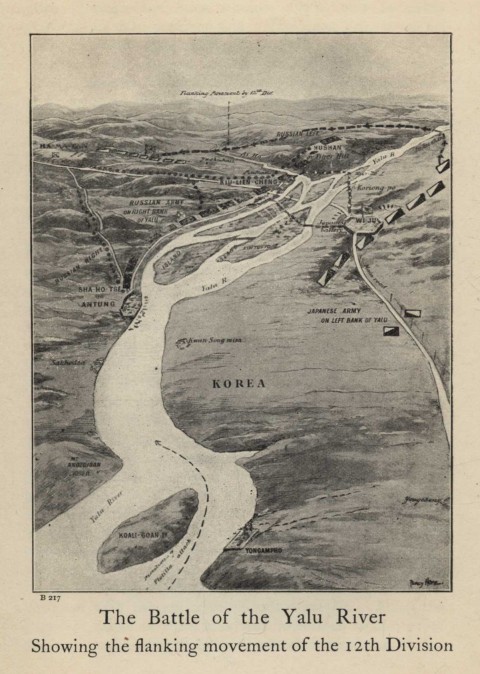
The Battle of the Yalu River Showing the flanking movement of the 12th Division
The Russian front, before the development of General Kuroki's attack, extended from a point opposite Yongampo at the mouth of the Yalu to Sukuchin, some thirty miles up the river, and above Wiju. The main body was massed around Kiu-lien-cheng, the left wing having its outposts on Tiger Hill and the islands in the river above that point, while the right had outposts on the larger islands opposite Wiju. A strong force was held in reserve at Antung.
On his ride up from Wiju Bob had been greatly puzzled by a series of huge screens of brushwood, matting, and stalks placed along or across the roadway. What object, he wondered, could they serve? It was not until he reached the high ground near the Yalu that their purpose became clear to him. He saw then that the heights on the Russian side of the river completely overlooked the lower hills on the Korean bank; in ordinary circumstances every movement could be observed from the Russian lines; the numbers and dispositions of troops, the construction of fortifications and batteries, could all be noted with the aid of strong field-glasses. From the Japanese point of view this was a serious weakness of the position. Secrecy is so essential a condition of the Japanese system of conducting warfare that General Kuroki was led to adopt a novel and somewhat extraordinary method of baffling the curiosity of the enemy. Looking back from a point of vantage near the river, Bob saw a force of blue-coated Japanese infantry marching to the front along the Mandarin road. Suddenly they disappeared behind a leafy screen, and though he watched carefully, expecting to see them emerge again farther along the highway, he was unable to detect any further sign of their presence. The incident recalled a conjuring trick of Mr. Maskelyne; and to the Russians beyond the river it must have been both puzzling and irritating. Thanks to this system of screens they could neither form an estimate of the strength of the Japanese opposed to them, nor make any likely guess as to the probable point of attack. Their position was one of extreme strength; but uncertainty regarding General Kuroki's movements largely discounted the advantages they enjoyed as a defensive force entrenched among rugged hills. Here and there, indeed, General Kuroki allowed them to obtain a hint of his arrangements; they snapped at the bait—with what result is now written in history.
It was nearly ten years since the Japanese Field-marshal Yamagata had forced the passage of the Yalu in the face of a Chinese army supposed to be impregnably entrenched in the positions now held by the Russians. The main crossing had been made opposite Wiju, but the principal movement was greatly assisted by the passage of a column higher up the river at Sukuchin. General Sassulitch must anxiously have asked himself whether the Japanese would or would not repeat this operation. Patriotic self-complacency probably suggested the answer. Was it likely that the Japanese would dare to repeat against a trained and disciplined Russian army the manoeuvre, necessarily hazardous, which they had risked against raw Chinese levies? Emphatically no. And in arriving at this conclusion the Russian general was assisted by an ingenious feint on the part of his opponent. With an openness that should have inspired distrust, General Kuroki collected a large amount of bridging material on the Korean shore at Yongampo and higher up the river opposite Antung, while a strong naval flotilla, comprising torpedo-boats, destroyers, and gun-boats, fought its way some distance up-stream, as though in support of a projected crossing in the lower reaches. To meet the expected attack in this quarter the Russian general kept a large body of troops elaborately entrenched in readiness at Antung, and allowed his attention to be diverted from the point thirty miles higher up, at which the first crossing had been made ten years earlier.
General Kuroki had completely taken the measure of his adversary. Having persuaded General Sassulitch to disperse his troops over an unnecessarily large front, he made careful dispositions to ensure a successful passage of the river at Sukuchin, and under cover of a flank attack from this quarter he proposed to pass the main body of his army across the island-strewn channel opposite Wiju. The Twelfth Division, entrusted with the flank movement, had easily driven away a small Russian force stationed on the right bank opposite Sukuchin, thrown a pontoon bridge across the river, and established itself on the right bank almost without opposition. The Russians made no attempt to correct their mistake, so convinced were they that the real danger lay towards the mouth of the river. Besides, were they not sufficiently protected by the chain of impassable ridges that stretched far inland between the Yalu and the Ai-ho? Yet it was across these impassable ridges that the Twelfth Division had orders to make its way, and establish itself on the left bank of the tributary stream in readiness for a general attack on the Russian position. This movement, as we have seen, was duly carried out. It was the eve of May-day.
A fierce artillery duel had meanwhile been fought between the Japanese batteries near Wiju and the Russian positions around Kiu-lien-cheng. In this battle of the giants the Russians were completely outmatched—another triumph of Japanese secrecy and prevision. Unknown to the enemy the Japanese had brought by sea to the Yalu a large number of quick-firers and heavy guns, and, most important of all, several howitzers. To these the Russians could only oppose a limited number of field-pieces. A movement of Japanese infantry towards the crest of the hills on the Korean side drew the fire of the Russian batteries and disclosed their position. They were at once answered by an appalling cannonade from the Japanese batteries. From the islands in the river, from the heights north and south of Wiju, the Japanese rained a murderous fire of shell and shrapnel upon the luckless Russian gunners. There was no escape, for they had not reckoned with the howitzers cunningly placed in pits on the islets beneath, and able to search the whole Russian position with high-angle fire. The hills seemed to wilt under the storm; the earth was riddled, the very rocks were rent with the hail of lead and steel scattered by the bursting charges of the terrible Shimose powder. A thick pall of poisonous smoke hung over the devoted Russian batteries; nothing could live under this shattering bombardment. The Russians stuck to their guns like heroes; never certainly did soldiers deserve better of their country. But gradually their fire slackened, then died away: the gunners lay dead at their posts.
That night the Guards and the Second Division of the Japanese army were passed by two bridges across the river, and took up a position on the right bank, sheltered under the bluffs or in the hollows in the sandy bed of the stream. The Second Division had crossed somewhat below Wiju to an island on the far side of the channel, the Guards immediately opposite Tiger Hill. The Russians were now threatened with a frontal attack by these two divisions—the Second operating direct from the Yalu, the Guards across the mouth of the Ai-ho—while the Twelfth Division, higher up the Ai-ho, was ready to attack them in flank.
Bob was tingling with excitement when he awoke on the auspicious morning of May-day. The air was crisp and keen, but spring had come at last; spring, and with it the dawn of a new era for Japan. General Inouye's camp was early astir; the sturdy little soldiers, in their trim blue uniforms, went about their morning duties with quiet cheerfulness, ready to launch themselves at the word upon the grim hills opposite, where death, they knew, awaited some; glory, they hoped, all.
Too late the Russian general had realized his fatal error in allowing the Twelfth Division to march unopposed across the hills. Too late he had taken such feverish steps as were now possible in the attempt to retrieve it. He had withdrawn in haste a considerable force from Antung to hold the bluffs on the right bank of the Ai-ho, and hurriedly begun to throw up entrenchments. General Inouye smiled when he learnt of these tardy efforts to stay him; plans carefully thought out for years were not likely to be foiled by bustle at the eleventh hour.
Hardly had the sun risen when the battle was begun by a general outburst of artillery fire along the whole of the Japanese lines. There was no response from the enemy; it almost seemed as if the position were already deserted. But soon the order was given to the Japanese infantry to advance to the assault. The three divisions moved forward simultaneously. Bob could not see what the other two were doing, but he watched with tense eagerness as the Twelfth Division dashed down the hillside to the bank of the Ai-ho. A murderous rifle-fire was opened upon them from the Russian trenches. But never a man faltered. Springing on nimbly, some taking what cover the ground afforded, others disdaining precaution, they reached the stream. They plunged in, holding their rifles and pouches above their heads, and forcing their way against the rapid current that swept along breast-high. They had now entered the zone of fire; the surface of the river boiled under the hail of Russian bullets; the turbid waters were red with Japan's best blood; but to Bob, watching intently from the hill above, the sound of their war-song came floating upon the morning breeze—
"Oh! it is easy to cross the Yalu river!"
and, with sublime and happy indifference, they struggled on.
Look: they are gaining the farther bank. At last—it seems an eternity!—the river is crossed. Up, up they scramble, scaling the bluffs in grim silence now. The air rattles with the crack of rifles, throbs with the thud of heavy guns. Men are falling fast, but the survivors are still pressing on, up the murderous heights, ever drawing nearer to the enemy on the crest. Bob, his whole body a-tingle, can bear his inaction no longer. He turns to a senior officer of the staff:
"May I follow them up, sir? I have nothing to do now."
"You had better stay with us," replied the officer with a smile, lowering his field-glass; "still, if you wish—"
Bob does not wait for second thoughts. He races down the hill, wades the river, and springs up the bluff in time to overtake the rear of the advancing line. What impels him he knows not; all he feels is that he must be there—there, at the supreme moment of the conflict. He gains the crest and looks eagerly ahead. Ah! the Russians are falling back, and back, and back; not in rout, but sullenly retreating to the next ridge, turning there at bay, occupying every post of vantage, and pouring thence their terrible fire. They will not wait, then, for push of pike? No; and when they have discharged their rifles they run again. Nothing stays the advance. The Japanese swarm up and over every new position, the enemy scurry like rabbits before them, and now, as the pace quickens, and the victors drive the fugitives up hill and down dale across these rugged pathless hills, the retreat becomes a rout, and the little soldiers raise a great shout of joy.
While the Twelfth Division had thus triumphantly performed the great operation entrusted to them, their comrades of the Second and Guards Divisions had pressed home their attacks on the Russian front. The whole of General Sassulitch's army was in full flight on Homatan and Feng-huang-cheng. General Kuroki had only a small force of cavalry to pursue the retreating enemy; he had to rely largely on the speed and endurance of his infantry, and they pressed on the heels of the Russians with a relentless activity which, in this mountainous country, no cavalry could have equalled. The guns, even the mountain batteries, specially equipped for speedy transit, were left miles behind, and three of the leading Japanese companies, having outstripped the rest of the pursuing infantry, found themselves terribly outmatched when the Russians at last turned at bay on the plateau of Homatan. The three companies of Japanese were suddenly confronted by a battalion of infantry and two battalions of artillery, strongly posted on the plateau; but with magnificent determination they stuck like bull-dogs to their grip, and engaged the enemy, holding them in fierce fight until reinforcements should come up. The Japanese had only their rifles to oppose to the combined artillery and musketry fire of the Russians. In the company to which Bob had attached himself three out of every four men were either killed or wounded, yet the gallant survivors stuck to their posts. Bob marvelled how he came unscathed through the hail of shot and shell; it seemed that the little force must be annihilated. Still the gallant remnant held on; and at length, when they were at their last cartridge, help came. Other companies of Japanese infantry swarmed up to the plateau. The Russian gunners, seeing that all was lost, wrenched the breech-blocks from the guns, hammered the sights, and broke the levers. Then came a terrible three minutes' mêlée, in which the bayonet did its murderous work. Most of the Russians died at their posts; three hundred were captured, together with the guns of the two batteries. It would be hard to say whether the fight at Homatan was more glorious to the victors or to the vanquished.
This was the last stand of the Russian army. The pursuit from this point was taken up by the small force of Japanese cavalry, and the wearied infantry, after an action almost unparalleled in military history, bivouacked on the field.
The officers of the company extended to Bob a hearty welcome to their mess; the menu consisted of the usual rations of the rank and file: rice, dried fish and pickles, washed down in water from a neighbouring mountain stream.
Bob was eating as heartily as the rest when he was startled by a familiar voice behind him.
"How do, Bob?"
He sprang up, and almost choked himself in the eagerness with which he welcomed no other than his friend Yamaguchi.
"Well—I'm—blowed!" he ejaculated, shaking hands so vigorously that Yamaguchi at length laughingly protested. "How in the world do you come here?"
"You don't bear me a grudge, then? I was very sorry; but I had to leave you with those Cossacks, you know."
"Don't mention it; I'm only too glad you got away safely—though, in truth, your dastardly desertion of me has landed me in a pretty pickle of fish. But I'll forgive you; I'd forgive anybody to-day. Isn't this glorious, old fellow? Did you see the fight?"
"I had a little part in it. We've been working in the lower reaches of the river. General Kuroki deluded the Russians into the belief that our main crossing was to be effected there. Sassulitch swallowed it whole. I had to land some men yesterday on a small island above Yongampo. We were stormed by the enemy. I withdrew the survivors in boats, and unluckily my boat sank and I was knocked over by a splinter from a Russian shell. They picked me up and carried me off to Antung, and then towards Feng-huang-cheng, but our cavalry came up and released me, and here I am."
"Got a bad knock?" asked Bob, noticing that his left arm was bound up.
"Oh no! a bit of the muscle torn away, that's all. But come, I'm sure you've more to tell than I have. I want to know what you've been about since you deserted the Kasumi."
Bob's story necessarily occupied a long time in the telling, but Yamaguchi listened with growing excitement, never interrupting until Bob came to the point where Kobo had rescued him from the tower.
"Ah!" said the Japanese. "You came across Kobo? I put you off the scent, didn't I? Of course it was he I was in communication with on those night expeditions from the Kasumi. But go on; your story's quite a romance."
Bob proceeded with his narrative. When he told how Kobo had been captured almost within sight of safety, Yamaguchi looked distressed.
"That's a national loss," he said. "We can't spare a man like Kobo San. That monster Chang-Wo will torture him—to wrench information out of him if he can—of course he can't—in sheer devilry at any rate. And the worst of it is nothing can be done for him—nothing."
"I'm going to try," said Bob quietly.
"You! You've had enough adventure, I should think, to last you a lifetime. You'll be made mincemeat of yourself if Chang-Wo gets hold of you."
"Nevertheless, I'm going to try. Kobo saved my life. I should be an ungrateful beast if—Well, it won't bear discussion. I shall see General Kuroki as soon as I can, and get his leave."
"You're a good fellow—upon my word, you are. I wish you luck. If another than Kobo were concerned I'd do my best to hold you back, but for him—I'd do it myself if I could. He's worth it. But I have to be off to Antung to-morrow, and then rejoin my ship. Shall we see you on board again?"
"I don't know. Perhaps—if I find Kobo."
CHAPTER XXII
A Dumb Chinaman
Sing-Cheng Vows Vengeance—At Head-quarters—Tracking the "Mountain Tiger"—Deaf and Dumb—A Hill Fastness—Tracked—Strategy—Chang-Wo's Way
General Kuroki's brilliant victory had been won at great cost. Such dash, such persistence, such fearless disregard of death had not perhaps been seen on any battle-field since the days when arms of precision were unknown, and the rival combatants fought man to man at deadly grips. The whole day after the battle was occupied in burying the dead and helping the wounded, and Bob, assisting in the sad work, saw many new signs of the invincible stoicism of his country's allies. Many a sturdy little soldier, though maimed beyond repair, accepted his fate and bore his pain without a murmur, his deepest hurt being in the knowledge that for the rest of the campaign, perhaps for the rest of his life, he would be unable to do further service.
Towards evening, as Bob with Ah-Sam passed over an outlying corner of the position, where there remained a number of prostrate bodies still uncollected, he fancied he heard a groan. He stopped and listened. In a moment he heard the sound again, faint, but distinct, less a groan of pain than the tired gasp of a man utterly spent. Over a comparatively small area lay some thirty bodies close together, and Bob saw by their dress that they were not Japanese, but Manchurian natives. Picking his way carefully through them towards the sound, he at length saw a white-sleeved arm move, and when he bent down, he found that, pinned beneath a cold body, lay a man still alive. The wounded man was soon released, and then Bob saw that it was the chief of the Chunchuses, Sing-Cheng, the man with whom he had spent his memorable fortnight of peril and adventure.
He was somewhat seriously wounded. Giving him a drink of water from his flask, Bob searched carefully the surrounding ground for any other man in whom life still remained. He found only one; the rest were dead. With Ah-Sam's assistance he then carried the chief into the Japanese camp, where his wounds were attended to, afterwards sending a couple of men to bring in his still more gravely wounded comrade.
Next morning Bob visited the chief, and was glad to see that he was already giving promise of a quick recovery. With Ah-Sam's aid he questioned the man, being curious to know what had become of him after the last desperate brush with Chang-Wo's Manchus. He learnt that the chief had struck due east with his band, marching through the hills to avoid both Russians and Japanese, and had forded the Yalu some fifty miles higher up. They had then made their way towards his village, intending to recuperate there and await a favourable opportunity for resuming their usual occupation of brigandage. But on arriving they found that Chang-Wo had been before them. Furious at his recent rebuff, he had slain every man, woman, and child in the place, including the chief's family, not one escaping to tell the tale. Without waiting longer than to learn from the country-people, who gave him the news, in what direction the Manchus had gone, the chief started on their trail, but lost touch, and had not found them until the afternoon of the day on which Bob discovered him. Chang-Wo had fallen upon him while he lay there in hiding; his men had been taken by surprise, and, as Bob saw, the band had been annihilated.
Bob was tempted to ask why the Chunchuses had been in hiding at that spot—-a place obviously of some danger. But he had a shrewd suspicion of their purpose. He had little doubt that both Sing-Cheng's band and Chang-Wo's had been hovering like vultures about the field, waiting for the fall of night to begin their work, when Chang-Wo had discovered his enemy and swooped down upon him with all the advantage of the first blow.
The chief's story had been many times interrupted by frenzied outbursts against his enemy. He himself would recover, he was told; he would live for nothing but to exact vengeance. His family were killed, the graves of his ancestors had been defiled, his band was exterminated; he was alone. But alone he would follow Chang-Wo to the ends of the earth, and when he found him, he would take such a terrible revenge that all Manchuria should shake with the horror of it.
Sing-Cheng's threats, made with a set grimness of determination, started Bob upon a train of thought. He himself had a strong motive for tracking down the Manchu brigand. It was Chang-Wo who had-captured Kobo; where he was, there Kobo, if he were still alive, would be found. To save Kobo was the dearest wish of Bob's heart; could he avail himself of the chief's thirst for revenge, and enlist his aid?
"Ask him whether he knows where Chang-Wo's haunt is," said Bob to Ah-Sam.
Years ago, the chief replied, he had himself been a member of the brigand band, when the stronghold had been in the hands of Chang-Wo's predecessor—an old wise chief, a man of matchless cunning and resource. This man had been treacherously assassinated by Chang-Wo, who had made himself the master of the band. For a time Sing-Cheng served under Chang-Wo, but he had left him, at the risk of his life, and pointing to a deep scar upon his neck he mutely indicated the reason of his leaving. Since then he and Chang-Wo had been bitter enemies, but Chang-Wo had always commanded the larger band, and Sing-Cheng had been obliged to keep out of his way. Now, however, come what might, he would soon or late take his enemy's life, though he lost his own. He knew his mountain stronghold; he would make his way thither, and wait like a tiger until the moment came for leaping on his prey.
"Where is this stronghold?" asked Bob.
It was three days' journey among the hills. It lay cunningly concealed in a wild region, accessible by only one difficult path.
"Then it can be surrounded?"
No, for on the other side it was protected oy a deep rocky gorge, through which ran a rapid torrent. Ascent from the gorge was impossible, because a wall of granite rose sheer for several hundred feet, and at the top indeed overhung the ravine, affording no foothold, even if it were possible to cut steps in the rock. On that side the fortress was impregnable; and even on the other, access was so difficult that any attempt to capture it must be hazardous in the extreme.
Bob left the man and pondered on the information he had obtained. Valuable as Kobo was, he could not hope that General Kuroki would send a force into hostile country on the poor chance of saving him. If Kobo was to be saved, it must be by some private enterprise. Bob wondered whether he could raise a force of Manchus and storm the place. He reflected that even if such an expedition proved successful, it might fail in the very object with which it had been designed; for Chang-Wo, the moment he felt himself in danger, would assuredly kill Kobo, if till then he had kept him alive. It was clear, then, that to win success in its main object, the rescue of Kobo, any expedition must be organized and carried through with secrecy.
Several days passed before Sing-Cheng had recovered sufficiently to move about freely. During these days Bob spent many anxious hours in thinking and thinking again. He consulted nobody. If Yamaguchi had been at hand, Bob would have discussed every detail of the problem with him; but he did not care to unbosom himself to strange Japanese officers, and he hesitated to go to General Kuroki himself until he could put before him a scheme that was reasonable and likely to command his approval. He put many questions to Ah-Sam and the chief—questions which sometimes puzzled them, and to which he obtained sometimes useless answers; but all the time he was fitting together the bits of information he obtained, and slowly outlining a plan.
At length one day he went to head-quarters and asked for an interview with the general.
"Well, Mr. Fawcett," said Kuroki on seeing him, "are you ready to rejoin the fleet?"
"Are there any orders for me, sir?" asked Bob anxiously. "I hope not."
"At present you remain with me—at my request. But why do you say you hope not?"
"Because I wished to be still at your orders, sir. I have been thinking about Kobo San. You remember, sir, he is presumed to have been captured by the Manchu brigand Chang-Wo; is there any chance of a force being sent to rescue him?"
"None at all. I answer you quite frankly. Useful as Kobo San has been and might still be to us, he is now, if Chang-Wo's prisoner, in a part of the country remote from my line of advance, and an expedition on his behalf is out of the question. Besides, it would be labour and time lost. His life would not be worth a moment's purchase if we made an attack in force on Chang-Wo."
"I had thought of that, sir. But I wondered, that being the case, whether you would allow me with my Chinese boy and a Chunchuse chief to go secretly to Chang-Wo's haunt, and discover if we can whether Kobo San is there and still alive, and communicate with him if possible."
"That would be a dangerous business, Mr. Fawcett."
"Possibly, sir; but I have been over the mountains before, and the Chunchuse knows the district well, and was in fact at one time a member of the same gang. I should like to make the attempt, for Kobo San has been a good friend to me."
General Kuroki smiled.
"Kobo San's public services are likely to weigh more with me, Mr. Fawcett. Before I say more, have you any definite plan?"
"My idea was for all three of us to go as Chinamen, with a story that our farm has been burnt down by the Russians, and that we are going to Gensan to find employment with an uncle of my boy Ah-Sam—a master stevedore there."
"But you don't speak Chinese?"
"No, sir; but I was a dumb Korean for a day or two, and it won't be any more difficult to be dumb in Chinese."
"True," said the general, smiling. "Well, you seem to have concocted a sufficiently plausible scheme. I will not stand in your way. You go at your own risk. I shall be very glad if you succeed; if you fail—"
General Kuroki gave him an expressive glance, which seemed to say that sympathy would in any case be vain, for failure would possibly involve death. Bob thanked the general and withdrew.
A day was spent in making preparations. Bob was carefully disguised as a Chinaman; the chief altered his dress somewhat, and did what he could to hide his scar; and both he and Ah-Sam got together a number of small portable Chinese objects such as might have been saved from the wreck of a farm. Then early one morning the party of three set off on foot. They carried no arms, except each a revolver concealed with a supply of cartridges in a special pocket in their baggy trousers. As Chang-Wo's haunt did not lie in a straight line between Kiu-lien-cheng, their starting-place, and Gensan, their ostensible destination, they struck at first north-eastwards, in order to approach the fortress from a direction that would lend colour to their story.
For two days they tramped on. Their account of themselves found easy credence at the hamlets where they stopped for rest and food, and Bob was secretly amused to watch the cleverness with which Ah-Sam feigned a sorrowful indignation to match that of the chief. On the evening of the second day they arrived at a village which, as they entered it, Sing-Cheng explained was a little more than ten miles from Chang-Wo's stronghold. They made their way to an inn, and Ah-Sam, who for safety's sake was allowed to be spokesman on these occasions, once more glibly repeated the story about the raided farm and the purpose of finding shelter with his uncle in Gensan. The landlord, an active little Chinaman, appeared to Bob to give the travellers an anxious warning, and as they continued in conversation, the other guests in the inn formed a group and took a voluble part. Bob sat upon the k'ang, wishing with all his heart that he could understand what was being said, but doing his best to keep up the semblance of being deaf and dumb by munching away at the food given him and letting his eyes rove round the room with a half-vacant stare.
He learnt later from Ah-Sam what the matter of the conversation had been. The landlord, on hearing of the travellers' destination, had expressly warned them against approaching too near the fortress of the Manchu brigand. His guests added their warning to his. They were for the most part peasants of the neighbourhood, and the manner in which they spoke of Chang-Wo showed how terribly they were afraid of him. They did not even name him directly, but referred to him in circumlocutions, calling him variously the Mountain Tiger, the Wild Man of the Hills, and the One-eared Devil. For ten miles around his haunt not a building was left standing. No stranger who penetrated within the zone came out alive. If an intruder was caught he was killed on the spot, and his corpse was chained to a post as a warning to others. The method of execution was the slow torturing penalty common in China; the victim was crucified.
There was special danger at the present time, for the Mountain Tiger had returned to his lair a few days ago, laden with booty obtained from the slain in a great battle that had been fought down the river. The Russians, the hated barbarians from the west, had been victorious, largely by the Wild Man's help; and as the landlord repeated this story, industriously circulated by the brigand's men, a deep groan was uttered by several of the company. Had he brought back any Japanese prisoners? asked Ah-Sam. There was none to bring, was the reply; all the Japanese had been killed save those who fled. But one of the guests mentioned that nearly a month ago a prisoner had been brought to the fortress—a small man dressed in Chinese garb, but really a Japanese, an old enemy of Chang-Wo's, and, it was whispered, a man of consequence. Woe to the enemy who fell into the One-eared Devil's hands!
Ah-Sam at once asked whether the prisoner was still alive, or had he suffered the penalty. Only a few days ago, was the reply, a man had come into the village from the stronghold, released from his duties by the return of his chief. For a fortnight he had been on constant guard, scarcely daring to sleep, for nameless tortures would have been his fate if he had allowed the prisoner to escape, or even if he had been found absent from his post. He had signalized his release from duty by getting drunk, and drunk he had remained ever since.
Ah-Sam affected the greatest alarm at hearing all this. With well-feigned nervousness he asked how the region of danger could be avoided. Where did it begin? Was it guarded?
Before these questions could be answered a new-comer entered the inn and demanded food. He was a tall muscular Manchu, of most forbidding countenance, and as he pushed his way through the group he gave a lowering suspicious glance around, and allowed his eyes to rest on the solitary figure seated on the k'ang. The conversation was stilled. The new guest wore the leggings and carried the fowling-piece of a Manchurian hunter. Having obtained his supply of food from the landlord he went to the k'ang, where he arranged a comfortable place for himself, and, squatting there, began to eat his meal in silence.
For a few moments the rest of the company conversed in subdued tones, making no reference to the topic that had engaged them when the new-comer entered. Once or twice this latter glanced round at Bob, who was within a yard of him, still looking listlessly about, and idly fingering a small metal image which was among the native objects he had brought with him. At length the man addressed a few words to him. Bob did not turn his head or alter his movements. The Manchu spoke to him again in still louder tones. Again Bob paid no heed; he felt the necessity of being doubly on his guard; the man for all he knew might be a spy in Chang-Wo's pay. A third time he was addressed, in still louder and more impatient tones. This time the landlord cried out that the young man was deaf and dumb, and half an idiot to boot. The Manchu gave a grunt, and shoved a huge mass of rice into his mouth, emptying the copper vessel in which it had been contained. Feeling that the man's eyes were off him, Bob watched him narrowly, wondering whether he would be satisfied with the explanation, and keeping a firm hold upon himself in case the man should suddenly put him to a test. His precaution was justified, for with a sudden movement the Manchu tossed the pan upon the floor, where it fell with a resounding clang, and at the same time swung round and fixed his evil eyes on the squatting figure not two yards away. Bob did not even start; he ceased fingering the idol and watched the pan as it rolled across the floor and came to rest; then he looked round with his empty stare, smiled vacuously, and took up the idol once more. The Manchu drank a heavy draught of rice-beer, then threw himself backward and was soon snoring.
Bob caught a look of approval in Ah-Sam's eyes. The stranger being asleep, the company resumed the conversation at the point where his entrance had interrupted it. Where did the dangerous region begin? Some three miles from that inn. It was impossible to enter it without being discovered; no one indeed wished to enter it; if some incautious traveller did intrude within its borders, his only wish, and that a vain one, was to make his way out. The reason of its being so carefully guarded was that once the Mountain Tiger had narrowly escaped being surprised by a sotnia of Cossacks, and he had determined never to be caught napping again. On the outer edge of the prohibited district there were patrols by day and by night, and surprise visits were paid to every hamlet in the neighbourhood. Within, at a distance of about two miles from the fortress, there was a series of posts about a quarter of a mile apart, and the ground between them was studded with innumerable and unexpected obstacles. One only path led to the stronghold, and upon this men were constantly encamped. These particulars had been learnt at various times from members of the garrison when they came out on brief spells of furlough, and neither the landlord nor the man who had spoken most could vouch for the truth of all the details they had thus picked up.
Ah-Sam enquired whether the obstacles mentioned completely encircled the fort. The question was answered by an old man who had hitherto taken little part in the conversation. There was no need, he said, for artificial obstacles on the farther side of the fort. He had been in it on one occasion many years ago, in the time of the old chief, and he knew therefore more about it than anyone present in that inn. Had any other of the company ever entered the stronghold? No, none had but himself alone. Sing-Cheng had just opened his mouth to contradict him when Ah-Sam gave a loud sneeze, the snoring figure on the k'ang stirred, and in the general rustle Ah-Sam whispered to the impetuous chief to be more carefully upon his guard. The old man continued, speaking in low tones and with a solemn air of mystery. On the other side of the fort, he said, was a ravine, so wide, so deep, so precipitous, that no other defence was needed. He remembered that, when he was a young man, one of the inmates of the fort had incautiously stepped too near the edge; he had fallen, and his mangled body was washed and battered by the foaming torrent until the vultures had picked his bones clean.
The incident impressed the company. There was a moment's silence. The snores of the prone figure on the k'ang had ceased. Then Ah-Sam asked again: Could the fort be seen from that village? No, it was too far away, said the landlord; but it could be seen from a low hill about nine miles to the south-east, the direction which he advised the travellers to take. But it was so distant that it looked scarcely larger than a hut upon the hillside. Ah-Sam said that he must get a glimpse of the stronghold next day; he had never before heard of such a terrible place, and he would like to be able to tell his uncle, when he reached Gensan, that he had seen with his own eyes the dread haunt of the Mountain Tiger.
The conversation dragged on for some time longer, turning upon the great struggle then in progress between Russia and Japan. Bob was thoroughly tired when at length the voices ceased, the evil-smelling lamps were put out, and the guests sought their several couches. He was burning with eagerness to learn from Ah-Sam what he had discovered; but it was too dangerous to attempt to talk to him in the inn, and he had perforce to wait until the morning.
Early next morning they purchased as large a stock of provisions as they could carry in their wicker-baskets, and set off towards the hill of which the landlord had spoken. Bob felt that the eyes of the people in the inn were upon them as they left. The late-comer of the previous evening stood at the door watching them with his furtive eyes. Ah-Sam, in obedience to a cautious whisper of Bob's, had made particular enquiries regarding the road to their alleged destination. The nearest village of any consequence, he had learnt, was about twenty miles distant, on the far slope of a range of high hills just visible against the morning sky. Towards this, then, the three took their course, in a direction that would lead some four miles outside the forbidden district of the Mountain Tiger. The country was rolling and sparsely wooded, becoming more and more broken as it approached the hills that stretched across the horizon from south-west to north-east.
When they were fairly away from the inn, Bob whispered to Ah-Sam that on no account must he or the chief look behind. Presently the path led them through a clump of trees, and Bob seized the opportunity to look back, from behind a trunk, along the path towards the inn. He was just in time to see, about a third of a mile away, the figure of a man scuttling along in their wake. Even in the distance Bob was almost sure that he recognized the beetle-browed guest who had so persistently addressed him in the inn. Again impressing upon his two companions the importance of not looking back, he set a steady but not hurried pace, and now that he was well out of earshot, got from Ah-Sam a full account of what he had learnt in the inn. They tramped on for two hours before resting on the slope of a low hill, which from the Chinaman's general description appeared to be the hill from whose summit Chang-Wo's fort could be seen. But, in order to avoid the appearance of curiosity, Bob called a halt some distance down the slope rather than at the top. Then pursuing their way after a short rest, still careful to show no suspicion of being followed, they gained the crest of the hill, and saw a wide expanse of country spread out before them. They did not pause now, but Bob, taking his observations as he walked, noted in the far distance to the left a bright spot against the dark background of a hill. It gradually defined itself as an extensive building perched on a precipitous spur. The intervening country was bare; and at two or three spots upon it he descried small moving patches, which he surmised to be bodies of horsemen. One of these patches, from its size consisting of from twenty to thirty riders, was much nearer than the others, and apparently heading in his direction. It was still very far away, and since it was not coming from the direction of the inn he hoped that the horsemen were not concerned with him. He would have liked to hurry his pace, but recognized that he would thus awaken the suspicion of the man behind, who, as he had perceived by a hasty glance some time before, was still following.
The situation was clearly somewhat awkward. If the horsemen were indeed coming on the track of the party of three, Bob suspected that they would not be satisfied with explanations, but would arrest them and carry them to the fortress for examination by Chang-Wo himself. In that case nothing could save them, for Bob at any rate must be instantly recognized. If they were not actually on his track, they might be set upon it by the Manchu coming up behind. It was important, at any rate, to know whether they were working in concert with that dogged pursuer, and Bob decided that his best course was to dodge the latter until this point could be cleared up.
What could be done? There was no time for making experiments; if the attempt at eluding the Manchu did not succeed at once, it would fail miserably and entirely. Bob looked anxiously around. For some distance the path had led over loose, rocky ground, alternating with small copses of hill trees where the rainfall had washed the soil into hollows. The copse nearest to the spot on which he now stood was a ragged clump of stunted pines, which in the late Manchurian spring had scarcely begun to show signs of new growth. In any case it would prove an insecure place of hiding, for it would be instantly searched by his pursuers. But half a mile farther on he spied a narrow watercourse zigzagging almost at right angles to the track. It was a mountain stream which had been so swollen by the frost and rains that it had cut a bed some feet deep in the face of the hill. Except where it crossed the path it was concealed by the shelving bank.
As Bob's eyes fell upon it, a sudden idea struck him. Hurrying his pace, he led the way towards it, and found that on the other side was a stretch of damp, mossy ground, leading up to an irregular group of rocks somewhat to the left of the path. These rocks were the lower fringe of a vast extent of broken country—a country of large boulders separated by narrow, tortuous fissures. Without telling his companions what was in his mind, he waded through the stream, the water of which was still icy cold, and stepped on to the wet, oozing ground. The two Chinamen followed him; the footsteps of the three left deep prints in the moss, filled instantly by water. They gained the rocks beyond; then Bob, instead of pursuing the same course, which would have been among the inhospitable boulders, turned sharp to the left, and describing a rough semicircle came back to the stream.
His followers tramped along behind him, saying never a word, wondering what his purpose was, and confident that this doubling on their track was not without some important end in view. Along the bed of the stream, the water rising almost to his knees, he made his way as rapidly as possible, crossed his former path, and continued his march for some hundred and fifty yards beyond, till he came to a spot where the bank on the right was low, scarcely above the level of the water. There he left the stream, and wading through a small swamp, bore continually to the right until he arrived almost at the path again, more than a hundred yards from the stream. He had thus made a complete circuit, and come to a point where the hillside rose steeply above the path and was strewn with several fallen trees uprooted or overthrown by the previous autumn's storms. Creeping forward with great caution under cover of the prostrate trunks and of the few standing trees which the elements had spared, the little party came to a spot almost immediately over the path, but completely screened from the sight of anyone below. There they lay in cold silence and waited.
Hardly more than two minutes passed when they heard the rapid shuffle of footsteps upon the stony path, and the hard breathing of a man. Peering cautiously over, Bob saw that it was their Manchu pursuer. He was moving with swiftness on his clogs, seeming uneasy at having lost sight of the party. He did not look up; indeed, he would never have suspected the hiding-place above him, for no one could have reached it directly from the path without being seen by him. Panting and perspiring, he had only just passed the concealed party, when Bob heard the clink of approaching hoofs, and a few moments later a group of riders dashed over the crest of a hillock some distance on the other side of the path and bore down immediately on the Manchu, who stopped, wheeled round, and stood waiting.
With a thrill of uneasiness Bob saw that the foremost of the horsemen was Chang-Wo himself. Sing-Cheng also recognized his old enemy; Bob heard him pant, and for a moment feared lest an incautious exclamation should betray him. But Ah-Sam was on the watch; he laid his hand on the chief's arm, and the man restrained his pent-up rage.
Chang-Wo rode up to the Manchu and eagerly questioned him. Bob was, of course, unable to follow their brief conversation, but from their gestures and demeanour—the man pointing along the path ahead, his leader's face gleaming with malignant satisfaction—he divined what its purport was. With a grunt of approval Chang-Wo rode on; his troop followed him. Bob counted sixteen horsemen. Then the Manchu, his features relaxing in the relief of a task accomplished, sat down contentedly beside the path, untied his wallet, and brought out a handful of dried fish, which he proceeded to devour.
The party in hiding waited on, cramped and chilled, not daring yet to rise. The man was only a few yards below them; they could hear the working of his jaws, the smacking of his lips, his grunts of appreciation; between the mouthfuls any movement they might make would assuredly be heard by him. Half an hour passed slowly by; once or twice Bob noticed that the man paused in his eating and looked somewhat anxiously in the direction in which the horsemen had disappeared; but hearing nothing, seeing nothing, he returned to his fish until his appetite was appeased. He had just retied his wallet preparatory to rising, when the sound of hoofs scattering the loose stones was heard. A few seconds later Chang-Wo dashed up, followed at a little distance by fourteen out of his sixteen men. He almost rode down the Manchu, who, having scrambled to his feet, stood in cowering alarm as the brigand chief pulled up his horse with a jerk, and rained down upon the man a shower of furious questions. Vainly the poor wretch tried to make reply; at the first word Chang-Wo shortened the long spear he carried, and with ungovernable rage drove it through him. The man fell without a groan. Then Chang-Wo, riding his horse over the prone body, roared an order to eight of his men, and with the remaining six galloped away over the crest of the hill.
CHAPTER XXIII
The Tiger's Lair
A Tramp by Night—A Distant View—Across the Ravine—The Cleft in the Gully—Scouting—Light and Shadow—Baffled—An Inspiration
Bob and his men still crouched behind their fallen log. Here indeed had been an expressive object-lesson in the methods of the Mountain Tiger. The sight of the dead man gave Bob a sickening sense of horror. Had his friend Kobo suffered a similar, perhaps a worse fate? Or was he still alive, with a more awful fate in store? As these questions suggested themselves Bob felt his courage renewed, his determination strengthened. Be the issue what it might, for Kobo he must and would dare all.
The eight men left by Chang-Wo had evidently been ordered to continue the search. They spread out fan-wise, and began to ride slowly in the direction in which the three fugitives had been last seen to be going. Bob watched them anxiously. Fortunately they spread from a point almost opposite to the hidden three. It did not occur to them that the fugitives had made a circuit, doubling on their tracks. They tried to find traces of footsteps on the ground, and drew gradually farther away from the hiding-place. As soon as the last of them had disappeared, Bob scrambled down to the path, followed by his men. He shuddered as he passed the dead Manchu; Sing-Cheng with no compunction stooped and rifled his clothes; then all three set off in the direction Chang-Wo had taken: there would be less danger in following him. Thus, keeping a sharp look-out, they retraced their steps for nearly two miles. Then, noting a patch of scrub on the left which offered a resting-place sufficiently secure from observation, Bob plunged into it, found it deeper than it had appeared, and decided to remain there for the rest of the day.
Night fell; the sky was clear and starlit, and taking the stars as their guide the party of three resumed their journey, following a course due south. All through the night they marched, eyes and ears alert, but seeing nothing save rocks and trees and their grim shadows, hearing nothing but the faint calls of wild beasts. At daybreak they were dead beat; their journey had been arduous, and they knew not whither their path would lead. Even Sing-Cheng was unfamiliar with this region.
At dawn they found themselves nearly at the top of a range of hills, which the chief recognized as being near the large village mentioned in the inn. It was wild desolate country; there were occasional patches of grass among the hills; on sheltered slopes mountain trees grew in clumps; but in those latitudes the signs of spring appear late, and the prospect had all the bleak dreariness of winter. Choosing a spot defended from the cutting morning wind by a wall of rock, they snatched a few hours' sleep, taking it in turns to keep guard; then after a meal they pressed on again, bearing to the east with the object of coming upon the fort from the side of the ravine. Bob hoped that Sing-Cheng could have led him direct to this spot, but when Ah-Sam asked him the Chunchuse said that he had never approached the place from this quarter, and could only guess at its whereabouts.
By and by they came to a stream of some size, flowing north and south. Bob guessed that this must be the stream that ran through the ravine; it gave him hope that he was on the right track. He looked along the surface of the water for the roughness that would indicate a ford. At that spot they crossed, tying themselves together with the straps of their baskets to prevent themselves from being swept away by the rapid current. Having crossed, they pushed on without a halt, up the left bank, and arrived somewhat late in the afternoon at an elevated spot, where they came suddenly in sight of the fort, a mile or more below them.