KOBO (continued 3)
Reading edition
Just as dawn was breaking, he was startled from his heaviness by the loud snorting of his horse. Springing up on his elbow, he saw in the wan light the animal, its ears thrown back, its eyes protruding, tugging at the reins by which Bob had secured it to one of the beams supporting the roof. It was panting, trembling, frantic with fear. Wide awake in an instant, Bob reached for the case containing his rifle, which he had worn slung over his shoulder and removed on lying down. Even as he did so the faint light filtering through the loosely-barricaded doorway was obscured. There was a thump and the crash of falling woodwork, and a heavy body, in the suddenness of its onset looking even larger than it was, sprang between him and the horse. A shrill scream of fright, followed instantly by a dull thud, then a deep growl, and Bob, though he had never heard it before, was in no doubt what the sound implied: it was the warning growl of a tiger after a kill. Stretched upon the inanimate horse, he saw in the uncertain light a huge tawny form. Its back was towards him; its tail was lashing the ground within a few feet of where he had lain; in a moment it must scent him. To gain the door, even had there been any prospect of safety in flight, he would have to pass immediately behind the brute, which at the sound would turn in far less time than he would take to rush past. The beast was still growling and lashing the floor. Bob remained still as death, in the reclining posture in which the tiger's entrance had surprised him. In a flash he saw that his only chance lay in one shot so well aimed as to kill or maim the brute; if he missed, nothing could save him; yet the slightest click or rustle would not escape its sensitive ears. Even as he raised the rifle to his shoulder with all his care, the tiger heard the movement and half-turned its head. But its head was still too much covered by the length of its body for Bob to risk a shot at its brain, and he knew that in the sudden volte-face that was now bound to come the movement would be so rapid that he might very easily miss. Instantly leaning forward, he brought the muzzle of the rifle within a foot of the animal's body at the region of the heart, and fired. There was a scream of rage, a convulsive twist of the huge body, a leap, and Bob was on the floor, beneath the tiger, unconscious.
CHAPTER X
The One-Eared Man
Mr. Helping-to-decide on Tour—Watched—The Tragedy of the Topknot—A Vampire—Mr. Helping-to-decide at Home—An Unholy Alliance—Cross-Examined
"How do you do, sir? I trust you enjoy excellent health and spirits."
These were the first words Bob heard when he came to himself. He was surrounded by a group of Korean soldiers, about whom there was nothing martial but the blood-red band in their hats. In the centre, just alighted from a palanquin, was a Korean in long white cloak and a hat like an inverted flower-pot; he was bowing and smiling with a mingled expression of amiability and concern. Bob recognized him in a moment; it was Mr. Helping-to-decide.
"Thank you, I'm rather shaky," said Bob looking round. "What has become of that brute?"
"Outside, sir. You stop horses; you stop tigers too. You kill him stone dead, sir."
"Did I really? The last I remember is an uneasy idea that the tiger was going to kill me. D'you mind giving me your hand. I feel rather giddy and battered."
With Mr. Helping-to-decide's eager assistance he rose to his feet and staggered out of the hut. There lay the tiger, a fine animal nearly twelve feet long. Beside it was the horse, whose skull had been broken by a single blow from the tiger's massive paw.
"I wonder I escaped," said Bob.
"A good, a famous shot, sir," said the Korean; "but you have a scratch, an abrasion, on your nob just where your hair begins."
"Have I? I am lucky it is no worse. But how is it I have the pleasure of seeing you here, sir?"
Then Mr. Helping-to-decide explained that he was on the way to his country house some fifteen miles distant. He had been sent by his government to watch the Russians at Seng-cheng, and had gone into the town with the full determination to let nothing escape his attention. But the Russians objected to being watched. They peremptorily ordered him out of their lines, and compelled him to disband his troops, allowing him to retain only the small escort which Bob saw with him. He was following his wife and family, who had preceded him along the road, when the sound of a shot had arrested his progress, and on searching he had found the tiger in the throes of death, and underneath it the inanimate form of the man to whom he owed eternal gratitude. If only he had been a little earlier he might have killed the tiger before it made its spring, and so have saved his honourable benefactor the bruises he was sure he bore on his body and the cut he saw on his head. Still, he hoped that he might some day have an opportunity of doing something in return for the Englishman's condescending kindness.
It was now several years since Mr. Helping-to-decide had eaten his dinners at Lincoln's Inn, but he spoke with extreme volubility, and was seldom at a loss for a word. Law lecturers, London landladies, leader-writers and cabmen had all assisted to form his style.
"Many thanks," said Bob. "Really you are too kind. I am very glad to have met you, as, knowing the country, you may be able to assist me to escape."
"Certainly, sir, with the greatest pleasure. If you will come with me, no wild beasts will dare to molest you."
"I wasn't thinking of wild beasts," said Bob with a smile. "I was thinking of Russians. The Cossacks are after me."
An instantaneous change took place in the expression of Mr. Helping-to-decide's features. He glanced round with a quick movement like that of a startled hare, and peered among the trees as though expecting to find a Cossack behind every one of them.
"I don't think they are here just now," added Bob, repressing a smile. He proceeded to give an account of the circumstances that had brought him to that spot, the Korean listening with gathering apprehension.
"This is a most astounding fix," he said. "The Russians are very hostile, very unkind. They are on all sides" (he made a wide sweep with his arm); "they will find you, and then, hon'ble sir, what in the name of goodness will you do? You are more than a match for a horse, you have considerable facility with tigers, but with a Russian—ah! that is ultra vires. Why, would you believe it?—they treat me, who help to decide in the War Department of his Imperial Majesty—they treat even me as if I were a dog! It is a jolly astounding fix!"
The little man looked so sincerely perturbed that Bob made an effort to keep a grave face.
"It is very kind of you," he said, "to feel so much anxiety on my account. After a short rest I shall be well enough to push on. I shall have to do so on foot, unless one of your men will sell me his horse. I could give him a bill on Yokohama."
"On no account whatever, hon'ble sir. I am still head over ears in your debt. Do I not owe to you preservation of my better half? Yes, by gum! Now, sir, if you will do me the honour to ride in my insignificant conveyance, I will have you transported to my humble roof, where the weary are at rest, and we can there enjoy sweet converse about via media in these awkward circs."
Bob did not much relish the idea of proceeding over the roads cooped up in the narrow space of a palanquin carried by coolies, but the Korean's anxiety that he should keep out of sight was so evident that he decided to accept the offer. He returned to the hut to fetch the Cossack's cap, cloak, and rifle, and his own glass, but when he reappeared with them, Mr. Helping-to-decide again looked startled and begged him to leave them behind. Bob yielded, except as to the glass. A Korean cap was found among the official's belongings, and with this perched on his head Bob crept into the palanquin, prepared to endure an uncomfortable journey.
Just as the party was about to move off, one of the escort approached Mr. Helping-to-decide, and, first humbly kow-towing, said something in a tone of supplication. The functionary explained. The men would like the horse; would he allow them to cut up the animal? Bob declared that he had no objection whatever; whereupon Mr. Helping-to-decide told the men that they might have the horse if they first skinned the tiger. A dozen men at once set to work, and in half an hour the double operation was performed; the dismembered horse was distributed among the escort, the tiger's skin was entrusted to the head coolie, and after this long delay the party resumed their northward journey.
As they left the group of huts, no one noticed two Chinamen crouching in a ruined cabin, within a few feet of Bob and Mr. Helping-to-decide. They had seen and heard all that passed since the arrival of the Koreans. When the party had finally departed, the Chinamen left their place of concealment, struck through the trees in a north-westerly direction, and presently reappearing on their little ponies, made off towards the Ping-yang road.
Mr. Helping-to-decide rode by the side of the palanquin, the top of which was lifted up, and showed himself anxious to keep up his guest's spirits by a never-ceasing flow of conversation, to which Bob listened with a fearful joy. He explained that the Koreans were deeply interested in the result of the war, for it appeared inevitable that the country must come under the dominating influence either of Russia or of Japan. They would rather have neither, but if it must be one or the other, they preferred Japan to Russia. But there was one particular grudge they had against Japan. It was due to Japanese influence that the Emperor of Korea, some years before, had decreed the abolition of the topknot and plunged the whole nation into despair.
"Dear me!" said Bob. "I should have thought it the other way about. The cultivation of the topknot must give you a good deal of trouble."
"Ah! You are a barbarian—excuse me, a foreigner; you do not understand. How should you? In your country what do they do to a man when he is grown up and becomes married?"
"I don't know that they do anything—except send in tax-papers, and that sort of thing."
"Well, in my country we wear cranial ornament—topknot to wit. In Korea the topknot is a sine qua non; without it a Korean has no locus standi: he is a vulgar fraction—of no importance. Let me inform you, hon'ble sir, a gray-beard, though of respectable antiquity, if minus a topknot, is to all intents and purposes a baby-in-arms. That is our Korean custom. Now, hon'ble sir, can you imagine our unutterable consternation, perturbation of spirit, nervous prostration, when an Imperial decree issues—every conjugal Korean's topknot shall be abbreviated, cut off instanter! There is dire tribulation, sore perplexity. All Korea plumps into the depths of despair. Besides, it is the height of absurdity. How, hon'ble sir, shall distinction henceforth be drawn between celibate irresponsible and self-respecting citizen with hostages to fortune? That is what we ask ourselves, and echo answers, how? I pause for a reply."
Bob, chuckling inwardly at Mr. Helping-to-decide's wonderful command of the English tongue, looked sympathetic, and said:
"It was very awkward certainly. But what happened?"
"At promulgation of decree I was residing at my eligible country house. By gum, I think, such humiliating necessity cannot embrace the Cham-Wi—hon'ble helping-to-discuss in his Majesty's War Office. Perish the thought! But, hon'ble sir, stern duty calls me to metropolitan city. I arrive at the outer gate. Lo! I am arrested, I the Cham-Wi, by guardian of the peace—copper, who stands outside with huge shears ferociously brandished. I make myself scarce—bunk. Alas! vain hope: a brawny arm seizes me from behind; one, two, the deed is done; my topknot—where is it? It is beyond recall. I am dishonoured. Behold me on my beam ends!"
The recollection moved Mr. Helping-to-decide almost to tears. Having recovered, he went on to explain that a domestic revolution soon afterwards removed the emperor from the influence of his evil advisers. The decree was abrogated; and since then the Koreans had cultivated topknots anew, and had again become honourable men.
In spite of this bad business of the topknot, Mr. Helping-to-decide was quite emphatic in his preference of the Japanese to the Russians, and he was glad to know of the successes of the former at Port Arthur. He was able to give Bob some information about the progress they were making in Korea. Their armies now stretched in a long front of some fifty miles, and were only waiting for the break-up of the ice to press forward to the Yalu. Between their present position and Wiju there were five rivers in all, which would require to be bridged, but this would give little trouble to the Japanese engineers, who were exceedingly quick and capable. They had also exact information of the Russian dispositions. Many Japanese, disguised as Chinese or Koreans, were constantly moving in and out among the Russians, carrying their lives in their hands. Several had been caught and shot, but more had escaped detection and brought valuable information to their generals. The Russians were doubly incensed at this because they were unable to play the same game. While the Japanese were perfectly at home in the country, and were moreover very skilful in disguising themselves, no Russian could easily pass for a Chinaman or a Korean, for even if his physique were not against him, his ignorance of the languages would prove a serious drawback.
"That makes me wonder what I am to do," said Bob. "I want to reach the Japanese lines, and the disadvantages of the Russian are disadvantages in my case also."
"You must come to my house; we will disguise you,—make you look quite the lady. Then you can ride in a palanquin to the south, and I will send trusty men to guide you and bring you o.k. to the Japanese."
Bob was not enamoured of the suggestion, and hoped that some other means would offer. Meanwhile, having no alternative to suggest, he said nothing.
Twelve miles of the journey had been accomplished, at a terribly slow pace, and three more remained to be covered, when an old and weather-beaten Korean riding a pony appeared rounding the shoulder of a hill not far ahead. He quickened his pace when he saw the cavalcade, and on meeting Mr. Helping-to-decide entered into grave conversation with him. Bob, watching the functionary's face, saw its expression become more and more agitated and alarmed. He came at length to the palanquin, and explained that the rider was the sergeant in charge of the village they were approaching, and had come to report that during the past few days a notorious Manchu brigand, in Russian pay, had been raiding within ten miles of the village under pretence of reconnoitring. He was a man whom the people had long had reason to dread. During the war in 1894 he had committed terrible atrocities in Northern Korea, and had since infested the upper reaches of the Yalu with a band of desperadoes, terrorizing a district several hundred square miles in extent. His head-quarters were supposed to be in a mountain fastness some distance beyond the Yalu. Before the outbreak of the present war the Russians had more than once attempted to extirpate his gang, but he had always proved too clever for them. They had now come to terms with him, and were utilizing his great knowledge of the country and his undoubted genius for leadership. He was a most accomplished linguist, speaking every dialect of the Korean-Manchurian borderland, besides having a good knowledge of Japanese, a smattering of Russian, and a certain command of pidgin English. In his early youth he had been a trader on the Chinese coast, but it having been discovered that he was in league with pirates, he had suddenly disappeared, being next heard of as ringleader of his desperate band of brigands. He was utterly unscrupulous, and the fact that he was now acting with the Russians only increased the gravity of the news that he was in the neighbourhood of Mr. Helping-to-decide's home.
The Korean was much depressed during the remainder of the journey, and spoke but little. He cheered up, however, when the village at length came in sight. It was evening; only women were to be seen in the street, for it is the Korean custom for the men to remain indoors after nightfall, and leave the streets free for their women folk. Mr. Helping-to-decide rode through the village till he came to the only house of stones and tiles which it contained, where, dismounting, he politely invited the honourable sir to deign to enter his contemptible abode. Bob was very glad to stretch his limbs after many hours in the palanquin, and, slipping off his boots at the door, found himself for the first time an inmate of a Korean house of the better sort.
He could not help comparing it unfavourably with the Japanese interior he had found so pleasant at Nikko. There was a striking lack of the simple grace of Kobo's house. The room to which his host led him was small and bare. The tiled roof was supported on a thick beam running the whole length of the house. In place of the spotless mats of Kobo's rooms there was a dirty leopard-skin and an expanse of yellowish oil-paper covering the whole floor. The walls were of mud and plaster, with sliding lattices covered with tissue-paper that also appeared to have been well oiled. One or two jars and a lacquer box completed the furniture.
He saw nothing of Mrs. Helping-to-decide. The evening meal was shared by himself and his host alone. The food brought in by the female servants was sufficient for a much larger company. It consisted first of all of some questionable sweetmeats; these were followed by raw fish, underdone pork chops, rice in various forms, radishes of gigantic size, and fruit, including dried apples and very tough and indigestible persimmons. Bob knew that he would be regarded as impolite if he refused to partake of all these dishes. He did his best, but found it difficult to swallow anything but the rice, in the cooking of which the Korean excels. His poor trencher-work was, however, put to shame by Mr. Helping-to-decide himself, who disposed of course after course with a gusto which would have amazed his visitor had he not heard extraordinary stories of the capacity of the Koreans in this respect. When the meal was over, Bob was not surprised to see his host fall asleep, and being thus left to his own resources, he rolled himself up in his cloak and a silk coverlet provided by one of the maids, and made himself as comfortable as possible on the floor.
He passed a most uneasy night. He had not been long asleep when he half woke with the feeling that his right side was scorching. He turned over sleepily, only to find by and by that the left side was even hotter than the right had been. Whatever position he chose, he could not escape this totally unnecessary heat, which, combined with the unpleasant odour from the oiled-paper carpet, made him wish he could go back to the cold ruined hut in which he had spent the previous night. The explanation was, that beneath the floor was a cellar in which a fire had been lit, and the coolie had piled on enough fuel to last through the night. This was a simple means of heating the house, but Bob could not help wondering whether a refrigerator would not perhaps form a more satisfactory bed-chamber than an oven.
He was glad when morning came, and Mr. Helping-to-decide, awaking from his heavy sleep, had sufficiently regained his senses to discuss ways and means. It soon appeared that the trusty Korean servant who was to have assisted Bob towards the Japanese lines was absent, having gone to keep a watch on the Manchu brigands. Mr. Helping-to-decide accordingly proposed that Bob should remain with him until the man returned, and impressed upon him the advisability of keeping within doors in order not to attract attention. Bob was by no means pleased at the prospect of spending even one day within these close walls, but seeing no help for it he submitted with a good grace.
It was a dreary time. During the morning he was left to himself, and to while away the hours he found nothing better to do than to look out, through a slit in one of the tissued lattices, at what went on in the street. But after the mid-day meal, Mr. Helping-to-decide proposed a game of "go", which Bob knew from previous experience might be spun out to any length. They were in the midst of the game, when there was a great shouting and hurry-scurry in the street; then the clatter of galloping horses. Mr. Helping-to-decide sprang up in agitation, and Bob, going to his slit, saw a troop of Cossacks headed by a tall Manchu galloping up the street, followed by a band of riders, whom from their features and habiliments he concluded to be Manchu bandits. Mr. Helping-to-decide stood in quivering helplessness. The horsemen reined up before his house; some of them went round it in both directions, and the terrified owner turned his white face to Bob and groaned.
When the house was surrounded, the commander of the Cossacks shouted something which neither Bob nor the Korean understood. But the cry was immediately repeated in the vernacular by the tall Manchu; he had dismounted and was approaching the house with the apparent intention of forcing an entrance through the sliding lattice.
"What does he say?" asked Bob.
"He says, hon'ble sir, 'Bring out the spy'," faltered Mr. Helping-to-decide. "This is indeed a critical moment. I am at a loss—flabbergasted. I am driven to conclusion it is all u.p."
The Manchu had now come to the wall of the house, and bellowed what was evidently a threatening message.
"'If the spy is not brought out instanter,'" translated Mr. Helping-to-decide, "'he will conflagrate this residence and adjacent village, with incidental murder of inhabitants.'"
Mr. Helping-to-decide wrung his hands in impotent despair.
"I shall give myself up," said Bob.
His host's agitation at once gave place to polite admiration and a show of confidence at which Bob almost laughed. He recognized that it was no laughing matter. The ruined state of the hamlet in which he had met the tiger was clear evidence that the invader's threat was no empty one, and the tales he had heard of the Cossacks' brutality did not promise a pleasant experience to any prisoner who fell into their power. But Bob felt that he had no alternative. There was just a hope that as a British subject he would come off with a whole skin, but in any case it was impossible to let the whole village suffer through any weakness of his. He therefore pulled aside the lattice, stepped out, and with a bold bearing that ill-matched his inward quaking, delivered himself up to the enemy.
The Cossack captain sat his horse side by side with the Manchu a few paces in advance of his troop. As Bob approached, amid perfect silence, he noticed that the Manchu leant quickly forward and peered at him with an interest greater than the circumstances seemed to warrant. Something in the man's face was familiar to Bob, who, as the Manchu turned half round to speak to the Russian officer, saw that he had only one ear. He remembered him clearly now. He was the man who had been saved from drowning by the Sardinia,—the man from whom Bob himself had saved Kobo's half-throttled servant Taru in the Ueno Park. It was Kobo's old enemy, the Manchu Tartar, Chang-Wo. The discovery did not tend to reassure Bob, but for all his tremors at the dangerous possibilities of the situation, he knew that his only chance was to maintain an air of utter fearlessness, and no one could have guessed from his undaunted attitude that he felt he was in a very tight place.
The Cossack captain looked hard at him for a moment, then gruffly addressed him, presumably in Russian.
Bob shook his head, saying, in the best French he could command, that he was sorry he was not familiar with the Russian tongue. To his surprise, the Cossack did not understand him. Bob had believed that every educated Russian knew French, and such ignorance seemed to prove this officer a boor.
"So much the worse for me," thought Bob.
The Cossack said a few words to the Manchu, who bent over and began a catechism in pidgin English, interpreting each answer as he received it to the Russian. Bob was surprised: on board the Sardinia the man had professed to know no English. He had some difficulty at first in understanding the strange idiom, but the general purport of Chang-Wo's questions was clear.
"What-side belongey?"
"I am a British subject."
"What you pidgin?"
"I am in the Japanese service."
"What-for you Japan-side?"
Bob hesitated. It was not likely that the Manchu would know what a range-finder was. He made an attempt to explain, but the circumlocutions he had to use aroused the Manchu's suspicion, and he interrupted impatiently:
"What you hab catchee in Korea?"
"I was left behind."
"What pidgin makee you hab got behind-side?"
"It was my bad luck—an accident."
"What-tim' you hab catchee accident?"
"Three days ago."
"What-side?"
"Near Yongampo."
"Supposey you tellum allo 'bout it?"
"Well, I got mixed up in a fight between Cossacks and Japanese, and I was bowled over."
"Bowled over! What that say?"
"Hit, tumbled on the ground: savvy?"
"How hab got wailo?"
"On a horse."
"How horso belongey you?"
"Caught it."
"What-side horso this-tim'?"
"Dead."
"You come this-side sampan?"
"In a ship."
"What callum ship?'
"That I can't tell you."
"No savvy?"
"Oh yes, I know; but I can't say."
"What-for no tellum?"
"Because I'm in the Japanese service."
"What namee Japanese that-tim' Yongampo?"
"What do you mean?"
"Japanese belongey you come Yongampo. He namee—what?"
"I can't tell you that."
"What-for no tellum?"
"For the same reason as before."
"Muss tellum—velly soon."
"Very sorry; it's quite impossible."
"You belongey too muchee sassy. You no tellum, my hab got whip."
Bob gave him a look, but said nothing. The Manchu raised his whip and dealt him a sharp blow with the stock, which struck his shoulder, only escaping his head because he swerved suddenly aside as he saw it coming. The next moment the Manchu lay sprawling on the ground. Bob had sprung at him and hit him so heavily and unexpectedly beneath the jaw that he lost his balance and fell backwards over his horse's haunches. He picked himself up, and drawing his sword rushed at Bob, who stood with flaming eyes and clenched fists ready to defend himself. But the Cossack officer moved his horse a pace or two forward and interposed. He spoke a few rapid words to the Manchu, saying in effect that the prisoner was too valuable to be killed in a fit of temper; information could no doubt be got out of him in course of time; and meanwhile he should have a foretaste of the discipline awaiting him.
The Manchu gave way with a sullen scowl, and remounted his horse. Then the captain gave an order; a trooper dismounted, and came towards Bob with a narrow leather thong in his hand. Bob instantly guessed what was to be done, and seeing the utter vanity of resistance, he submitted quietly, while the thong was firmly bound about his right wrist and then knotted to the near stirrup of the captain's horse. Another order was then given; the whole troop set off at a trot down the deserted street, and as Bob was dragged by the side of the horse, the last object he remembered seeing was the pale, terror-stricken face of Mr. Helping-to-decide peeping through the broken lattice of his house.
CHAPTER XI
Tried and Sentenced
Under Escort—A Court-Martial—Leading Questions—The Bear's Claw
Bob's sensations were by no means agreeable as he kept pace perforce with the Cossack's horse. The trot, fortunately, soon slackened to a quick amble, or he must soon have been utterly exhausted. In spite of the cold, the exertion of walking fast, heavily clothed as he was, made him uncomfortably hot, and his physical temperature was matched by his mental condition. He was in a rage; not at being made a prisoner: that was only to have been expected: but at being tied up like a dog, reminding him of the curs he had seen chained to bakers' carts in French villages. Anger, however, was a mere waste of energy, as he soon saw; at present he could only make the best of a bad case,—keep up his courage and his pace without reminders from the evil-looking knout he saw ready to the Cossack's hand.
As he trudged along, two reflections were uppermost in his mind. One was that, having been captured and treated with indignity, he was justified in regarding himself now as a combatant; this gave him a little consolation. The other was, that in Chang-Wo, the Manchu, he had an enemy of a particularly dangerous kind. He remembered Kobo's story of him; and the knowledge that this same man was doing desperate work for the Russians in Korea was not reassuring. The Manchu had evidently recognized him as the stranger who had saved the little Japanese from his vengeance in the Ueno Park, and clearly bore him no good-will on that account.
The road was a difficult one, leading over the rugged hills. Darkness fell, and still the troop pushed on. At length, when Bob felt on the point of collapsing, they rode into a town or village of fair size, which, as he afterwards learnt, was Yong-cheng, on the Pekin high-road. He expected that now at least he would be allowed rest and food, but as soon as the Cossacks arrived at the place they took him before a Russian officer of some rank, apparently a lieutenant-colonel. When preliminary explanations had been given, the colonel ordered the prisoner to stand before him, and in peremptory tones began to question him in French. Bob's French was not very fluent, but he answered as well as he could, repeating the replies he had previously given. He refused to say who had been in his company before he made off on the Cossack's horse, and assured the Russian that he knew absolutely nothing of any communications that may have passed between this person and spies on shore. His persistence made the officer more and more angry, until at last the latter shouted:
"You're a liar! Tell me the truth, or I'll hang you on the spot."
"I have already told you the truth," said Bob quietly. "I don't know whom my friend may have met at Yongampo, and if I did, I could not tell you—surely you must see that?"
"You're an insolent puppy. A means will be found to loosen your tongue. I'll give you a night to come to your senses.—Take him away."
Bob, almost fainting with fatigue and hunger, was led away to a close and dirty hovel, where he was given a hunk of coarse bread and a fat sausage to eat, and there he remained in the custody of two Cossacks through the night. At sunrise, feeling stiff and dispirited, he was again taken before the officer, and again put through an interrogatory, a trooper standing at his elbow holding a knout ostentatiously in his view. But the colonel was again baffled; he received no more information than before; and at length, with a curse of impatience, he roared an order to his men. Bob expected the knout to be immediately applied to his back, but to his surprise he was led out into the open, and after a period of suspense he was ordered to mount a horse that was brought up. A few minutes later he was riding out of the village, a Cossack with cocked pistol on each side of him, and the Manchu in the rear.
The explanation of this change in his destiny was that the Russian colonel had not given up hope of obtaining information, and was sending him to General Sassulitch at Wiju, where perhaps he would be brought to reason. The Cossacks were ordered to guard him carefully, but not to ill-use him, and Bob was somewhat surprised, after what he had heard of the brutality of these reckless soldiers, to find that he was treated with some consideration. The whole of that day was occupied in the journey to Wiju. The country was hilly and rugged, and Bob realized, from the slow rate of progress of himself and his escort, that the transport of a whole army would take much time, especially in this winter weather.
At various points along the road parties of Russian soldiers were met with, but it was not until the three riders came within a few miles of Wiju that Bob had striking evidence of the Russian occupation. To the south of that frontier town large gangs of coolies were at work throwing up entrenchments under the direction of Russian officers. Bob was led close to a numerous party near the high-road, employed in excavating a shelter trench. Their sullen looks and reluctant movements indicated that they were forced labourers, and in the hands of several of the Russians Bob noticed ominous-looking whips. He was not surprised, for if they trusted to the efficacy of the knout in their own army and navy, it was unlikely that they would spare it in the case of Korean peasants.
Like almost all Korean towns, Wiju stands on a hill; on one side it overlooks a plain, on the other the river Yalu. Bob was glad enough when, entering its walls and passing up the long straggling street, filled with Russian soldiers, he was halted and dismounted at a house over which a flag was flying. He was prepared by this time for the worst. Several times on the way explanations on his account had passed between his escort and enquiring soldiers, and he inferred from their smiles and gestures that he must look for short shrift. He expected now to be placed on trial as a spy, or perhaps summarily disposed of without trial, probably after another attempt to extort information from him. But after an hour's detention in the house, during which he was given a scanty allowance of food, he saw the Manchu Chang-Wo enter and deliver a message to the officer in charge. He was immediately ordered out and made to remount; his weary journey was evidently not yet ended. His Cossack escort grunted their displeasure, and scowled at him with dark looks, while the Manchu, who again accompanied them, urged them to hasten their pace and complete their unwelcome task.
They rode smartly down the hill. Presently Bob saw in the dark the waters of what was no doubt the Yalu before him, banked by rugged bluffs on the other side. This, then, was the famous boundary river dividing Korea from Manchuria. On the Korean side the channel was still frozen over; but the current was deeper and swifter under the Manchurian bank, where it was hemmed in by a large island occupying a considerable part of what must be in time of flood the bed of the river. In this part of the river large blocks of ice were floating down with the stream. Bob had forborne to put any questions to the Manchu; he would have liked to ask now what was to be done with him, but on second thoughts he decided still to hold his tongue. But in the course of the long wearisome ride he distinguished the name Sassulitch more than once in a grumbling conversation between his escort and the Manchu, though he was not then aware that the owner of the name was a general of division.
It was late at night when they at length reached Antung, a low-lying town on the river-side; dark as it was, Bob could see that the place was substantially built. He was taken to a large go-down which had been transformed into a barracks, and locked up in a room by himself. He was very tired, and threw himself wearily down on the straw mattress spread on the floor, hoping that for a few hours at least he would not be interfered with. But he had barely fallen asleep when he was roused by a heavy touch upon his arm. Sitting up, he saw an armed Cossack holding a lighted taper. The man motioned to him to get up, and feeling more dead than alive he followed his guide out of the room, where he was joined by a squad with fixed bayonets, then through the streets, until he arrived at a large house more freely illuminated than any other, and guarded by a sentry. In a few moments he found himself in a lofty room, standing before a table on the other side of which sat a number of Russian officers. On the table were placed a few flaring tallow candles set in clumsy candlesticks, and a couple of circular oil-lamps resembling those of English railway-carriages. At each end stood a Russian foot-soldier with fixed bayonet. In conversation with one of the officers Bob saw the big Manchu, the one-eared Chang-Wo.
For some moments he stood there, the object of keen scrutiny to the officers, who stared at him with various degrees of curiosity, and with varying expressions on their faces. Then the officer who was evidently of the highest rank among them,—it was General Sassulitch himself,—motioned the Manchu aside and said a few words in Russian to the younger officer at his right. The latter at once addressed Bob, speaking in excellent English, with but faint foreign accent.
"Prisoner, you are charged with being a Japanese spy. You are English by nationality, it appears; what have you to say to the charge?"
"I am an Englishman, it is true, sir," replied Bob. "As to the rest, I am certainly not a spy."
"You had better give an account of yourself."
"My name is Robert Fawcett, and I am an engineer. I was sent out a few months ago by my firm, at the request of the Japanese government, to be at hand in case the range-finders on their ships required attention. The vessel on which I was happened to come to the mouth of the Yalu, and I had just landed when I was unlucky enough to be knocked over by a Cossack's horse, and when I recovered I thought the simplest way out of the difficulty was to make my escape on the animal; its master was dead. The horse was killed by a tiger. Since then I have been wandering about until I gave myself up to a troop of your men. I have nothing more to say."
This reply was interpreted to the other officers, whose manner of receiving it betokened for the most part blank incredulity. A few words were exchanged among them, then the interpreter spoke again.
"You shot the Cossack whose horse you stole?"
"No."
"Who did?"
"I don't know. He was shot from the boat."
"You were armed?"
"No; I had nothing but my field-glass."
"You are not a soldier?"
"No; I am an engineer."
"A naval engineer?"
"Not specially. I've no naval experience except what I have picked up."
"In what ships have you been?"
Bob hesitated for a moment. Then he reflected that there could be no possible harm in mentioning the names of the vessels in which he had served.
"In the Mikasa and Hatsuse."
"But neither of these brought you to Yongampo."
"No."
"What was the name of the vessel that did?"
Bob again hesitated. The Kasumi was engaged in secret service. It was impossible for him to know what might be the ultimate effect of betraying her identity. In so doing he would in any case associate her commander with the expedition to Yongampo. He made his decision.
"That, if you don't mind, I'd rather not say."
When this was explained to the officers they began to talk with some excitement, and one of them thumped the table. The interpreter continued:
"The general insists on knowing the name of the vessel."
"I am sorry, sir, but I can't tell you that."
"You know the consequence of refusing?"
"I'm not sure that I do," said Bob with a faint smile; "but in any case I can't tell."
A short consultation took place at the table, then the officer resumed his questioning.
"You had just landed from the boat, you say. Had you not been to Yongampo?"
"No."
"Who had?"
"I cannot say."
"Why did you land?"
"To help a friend of mine who was hard pressed by the Cossacks."
"Had he been to Yongampo?"
"I cannot say."
"Who was he?"
"I really cannot tell you any more about him."
"Whom had he been to see?"
"I do not know."
"Was he also an Englishman?"
"I really cannot answer that question."
"Do you speak Japanese?"
"No."
"Chinese?"
"No."
"What language did you speak in Yongampo?"
"I have never been in Yongampo."
"How long have you been in the country?"
"In Manchuria?"
"Don't prevaricate. How long have you been in these parts—Manchuria or Korea?"
"A few days."
"How came you to be on friendly terms with the native in whose house you were captured?"
"Excuse me, I gave myself up. As to your question, I happened to do a little service, quite accidentally, to the Korean gentleman, and he was more grateful than the circumstances really called for."
"When did you do him this service?"
"A week or two ago."
"Where?"
"In Seoul."
"What were you doing in Seoul?"
"Nothing—merely visiting the place."
Bob felt as soon as he had spoken that this, the literal truth, would certainly be scouted by his judges as wildly improbable. For some time, indeed, the officers had been showing signs of impatience. Worn out as he was, Bob held himself erect before them; he had replied to all his interrogator's questions in the same self-possessed and courteous manner; and while one or two of the Russians seemed impressed by his bearing, the majority were growing more and more angry as they saw how barren was the examination. They now formed a group about General Sassulitch, and discussed the matter in excited tones. Then the Manchu was called up and questioned, and from his gestures Bob guessed that he was making very positive assertions. The discussion continued for some time; then the Manchu was again dismissed, the group separated, and the young officer standing beside General Sassulitch said:
"Prisoner, the officers of His Majesty the Tsar here assembled cannot accept your denials. You were found within our lines; you were undoubtedly associated with a Japanese who landed from some vessel to enter into communications with a spy in Yongampo; we have a witness here who declares that he saw you in Tokio, then in Seoul, and recently in Yongampo—"
"Pardon my interrupting, sir, but that is false."
"Denial is useless. Our evidence is positive. By your own confession you were concerned in the serious loss inflicted upon a troop of Cossacks during the pursuit of the fugitive, who in all probability was yourself; you confess to have made your escape on the horse of a Cossack killed at that time; and you were captured at the house of a Korean who is suspected on good grounds of sympathy with the Japanese. There is no doubt in the mind of the court that you are a spy; your claim to British citizenship cannot be accepted as any palliation of your crime; the court condemns you to the penalty of a spy: you will be shot."
Bob flushed slightly. There was a silence, then at a sign from the officer the two soldiers at the end of the room approached him. He gave a quick glance along the table; noticed one officer leaning forward on his arms, his handsome face wearing a quizzical smile; another lolling back in his chair with an air of boredom; a third rolling a cigarette as though the matter were of complete indifference to him; the general, stern and inscrutable, in the midst. Then, between his two guards with fixed bayonets, he was marched to his prison.
It was a longer walk this time. He was not taken back to the go-down where he had expected to pass the night, but to a tower or keep built on the wall by the riverbank. It was now too dark to see anything clearly; but as he was led into the building one of his guards struck a light, and as he mounted the narrow stairway to the fourth story he noticed several padlocked doors, showing that here were other prisoners besides himself. He was taken into a small room at the top of the building, a thick rug was thrown in after him, the door was slammed, bolted, and padlocked, and he was left to his meditations.
CHAPTER XII
At Midnight
Waiting—A Russian Offer—A Farewell Letter—What the Case Held—Kite-flying Extraordinary—Prison-breaking—Free
Bob was so exhausted that he fell asleep at once, notwithstanding the gravity of his position. When he awoke some hours after daylight, he found some black bread and a plate of preserved beef and a jug of vodka by his side.
"To keep up my courage," he said to himself. He was hungry, and the bread and meat soon disappeared; but he found the vodka too fiery for his palate, and wondered if he would be allowed some water. He was to be shot, of course; when would that be? Shot! For the first time the reality of last night's scene forced itself on his mind. He had been so tired, and so strung-up in the determination to say nothing that would betray Yamaguchi, that the matter as it affected himself had not troubled him. But now—the thought of death struck him for the first time. It was a strange idea. He was well and strong; rather stiff and cramped, indeed, but that could easily be cured. Yet in a short time he was to be dead. He could not realize it; on board the Japanese vessels, in the poisonous box-battery on the Mikasa, on the Kasumi's shot-pelted deck, the idea of death had never been present to his mind. The oddness of it struck him most of all. It seemed absurd that he should die, and for what reason? His explanations had been too simple to be believed! He thought over the past days; there was nothing in his actions he could have altered, even if he had known that death was to come so soon. "Well, it can't be helped," he concluded. "I only hope I sha'n't funk it at the end."
Life was so vigorous in him at present, that he looked round his narrow room in an instinctive quest for some means of escape. It was about twelve feet square. The outer wall was of stone, some eighteen inches thick, pierced by a single unglazed splay window, narrowing from twenty inches broad on the inside to seven on the outside. The bottom of the window was about three feet above the floor, and it extended upwards for about an equal distance. Below it, embedded in the wall, projected a narrow platform about a foot high, which, Bob guessed, was intended to accommodate a watchman or possibly a marksman, for the tower had evidently been built as a watch-tower. Clambering up into the window-recess, Bob looked through the open slit, and saw that it commanded a view across the river, which flowed past at a depth of some eighty feet. The water-course was obstructed by ice; to plunge into it was impossible.
Returning to the floor, Bob noticed that the inner walls were of brick, comparatively new in contrast with the mouldering stonework of the outer wall. He concluded that at one time the whole story had formed a single chamber, and that it had been partitioned off recently, though in all probability before the advent of the Russians. The door was of massive make, and hung on ponderous iron clamps; it opened inwards, and there was no keyhole on the inner side.
"Things look black," thought Bob, as he convinced himself that there was no means of escaping from his dungeon. He tramped up and down with bent head, idly speculating on the scenes the old tower must have witnessed. How often in bygone days, he wondered, had Chinese, Korean, or Japanese flotillas passed under its walls up and down the Yalu? What romances might be woven about the spot, going back into ages long anterior to ironclads and machine-guns! He wished he knew something of the history of these far Eastern countries, and was resolving to look it up on the first opportunity when he suddenly remembered that he was to die, and the remembrance brought him to a stand-still and gave his imagination pause.
Looking again through the narrow opening, he saw in the distance a troop of Cossacks picking their way across the hills. He watched them with idle interest as they gained the summit and disappeared at a trot over the crest. He followed them in fancy; they were soldiers going perhaps to their death; and he wished that he too might meet with death in some active, heroic way, instead of tamely as the target of a firing-party. He was drawn from his reverie by the entrance of a soldier with a plate and jug. The man set the food down on the stone platform and left without a word.
Alternately pacing the room, sitting on the platform, or listlessly looking out upon the river, Bob passed the rest of the day. He saw no ray of hope. The room was bare; it contained nothing but his rug; everything had been taken from him; he had not even a penknife with which to while away the hours, as many a prisoner had done before him, in scratching initials or diagrams upon the walls.
"I wish they'd hurry up," he said to himself restlessly.
But the long day passed, and he was not summoned to his doom. At night he was given another meal. He was standing when it was brought him, and he moved towards the open door, without any hope of escaping. Outside, by the dim light of the lamp carried by the man inside, he saw another soldier armed with a rifle. The way was effectually guarded. He spoke to the man, asking when his execution was to take place. The man shook his head, evidently understanding not a word. The door was shut, bolted, and padlocked, and he was again left alone with his thoughts.
Next morning the soldier who brought him his food was accompanied by the officer who had acted as interpreter at his summary trial two nights before.
"Is my time up?" asked Bob almost eagerly.
"Not yet. The general will allow you another chance. Tell me what you know of the Japanese spies in Yongampo and of the Japanese with whom you landed, and the general will spare your life and keep you as a prisoner of war until peace is signed in Tokio."
Bob looked at the officer in silence.
"Come, why be obstinate? It isn't much to ask of you, and if you're an Englishman and a non-combatant the Japanese are nothing to you."
"You think I'll adopt that plea?" said Bob, with a touch of scorn. "No thank you. You've treated me as a combatant; very well, I've told you all I mean to tell you."
"You'll think better of it by and by. You've a day to think it over."
"I've thought it over."
"Well, think it over again. You'll come round, never fear."
The officer smiled as he went out. Bob spent the rest of the day in tramping his cell, which was very cold, looking out of the window, and wishing that they would not prolong his suspense. He expected to receive another visit from the officer before night, but saw no more of him until breakfast-time next morning.
"Well," said the Russian as he entered, "have you taken my advice?"
"No."
"Still obstinate! Your execution is fixed for to-morrow morning—the general gives you a long rope first, you see."
"That's a pleasant jest."
"Well, it's a pity for a young fellow like you to be so absurdly obstinate. You've only to mention a couple of names and give us a few particulars about men who can't possibly be of any interest to you, and—"
"Excuse me; I am in the Japanese service."
"Nonsense, you're an Englishman. What have you in common with the race of venomous conceited dwarfs who have dared to measure themselves against the might of an empire like ours?"
Bob stood with his hands in his pockets looking at his tempter.
"They may be all that you say, though, as far as the war has gone, it scarcely becomes a Russian to say it; but you, sir, ought to know perfectly well that, whatever they may be, it is impossible for me to betray them. I can't say any more; and I'd really be obliged to you if you'd drop the subject. Your general has decided that I'm a spy. I'm not a spy, but I can say nothing more to convince him. He has made up his mind, and so have I. You said to-morrow morning?"
The officer looked at Bob with mingled annoyance and admiration.
"What folly!" he exclaimed. "I can't but admire your constancy, but I'm sorry for you. Yes, to-morrow morning, at dawn. You needn't imagine you'll be let off, the general is determined."
"Very well."
"You can tell the man who brings you food if you change your mind."
"I will—if I do!"
The officer turned away. As he was going out at the door, Bob took a step forward, and spoke, with a little hesitation, and in a different tone.
"One moment. Could you do me a favour?"
"What is that?" asked the Russian quickly.
"Send me pencil and paper and an envelope. I have some friends at home—my father and mother—I should like—"
"I understand. You shall have the writing materials."
"And you will see that the letter is sent off?"
"Yes, yes; but it will not be necessary. Think over it." And he hurried away.
It was some time before Bob touched the food that had been brought to him. He was tired of waiting for the end. He longed for life; yet if he was to die, he wished it over and done with; the attempt to overcome his determination, the appeal to his self-interest against his honour, wearied and troubled him. For a time he tramped restlessly up and down, thinking gravely; then, catching sight of the food, on the stone slab, he reflected that he could meet his fate better fed than fasting, and he set-to with a will upon the ample supply of beef and black bread and tea, which he had asked for instead of vodka. After a while, however, he again fell into a fit of abstraction; he ate mechanically, musing on many things. Breaking one of the hard-crusted loaves, he saw a glitter like that of a golden coin buried in the bread. For a moment his curiosity overcame the gloom into which his long pondering had thrown him. He picked the bread away from the strange intruder, and discovered that what he had taken for a coin was the end of an empty cartridge-case.
"How did it get there?" he wondered, holding the case before him. He remembered how puzzled King George had been to account for the presence of the apple in the dumpling, and laughed aloud.
"No doubt about the bakery this bread came from," he thought. "Well, better a cartridge-case than a beetle."
He was seated on his rug by the wall opposite the window, where he was farthest away from the cutting wind that had been blowing in all the morning. Raising his arm, he shied the cartridge-case at the narrow opening; it struck the wall at the side of the recess, fell on the sill, and rolled down the slight inward slope on to the floor.
"Wretched bad shot!" remarked Bob to himself and the four walls. Then with a sudden start he remembered what was to happen on the morrow. He shuddered involuntarily, and dreaded the possibility of flinching when he stood actually face to face with death. Yet why should he flinch? He remembered the fearless manner with which the Japanese went open-eyed into mortal peril. He thought of Kobo's serene, unperturbed manner. Was it for him, an Englishman and a Christian, to show any more fear? The question answered itself, and he fell into a quiet reverie.
Thus passed some hours; how many he could not tell, for his watch had been removed. He was roused by the entrance of a man with writing materials. Receiving them silently, he sat and pondered. What could he say to the old folks at home? He wrote a full account of all that had happened since his last letter, then tore it up. His letter might be opened by the Russians; he must not give them any information. At last, with a full heart, he penned a few words intended for his parents' eyes alone. Then he sealed the letter, and placed it in his pocket to give to the officer at the last moment.
He felt now cramped and chilled, and, rising, began to pace the floor, walking from door to window and back from window to door. As he did so, his eye lighted on the cartridge-case. At first he merely glanced at it and passed on; then, spying it again, he looked a little longer; the third time he began to feel some curiosity and interest; the fourth time he stooped and picked it up, wondering again what strange chance had brought it into so unlikely a resting-place. To whom had it belonged? Whose rifle had fired it? How had it come into the bakery? What careless fingers had worked it into the dough? What a strange irony of fate, that a case once filled with an instrument of death, should now be choked with bread, an instrument of life!
"A bad match!" he thought. "Out with you!"
He felt for his penknife to scrape out the bread from the case, then remembered that his jailer had removed it. What was he to do? Feeling by force of habit in his waistcoat pocket, he came upon a little hole in the lining, and pushing his finger through, he touched a single lucifer match that had found its way down. He enlarged the hole, took out the match, and began to prise the caked flour bit by bit from the cartridge-case. He was, glad of any little activity that would enable him to kill time. Soon a little heap of crumbs lay on the sill of the window-recess. Then, drawing the match once more from the case, he saw that this time it had impaled, not a crumb, but a piece of some white fluffy substance.
"What is this?" he thought, and with growing curiosity inserted the match again. More fluff came out; it appeared to be cotton wool.
"Very odd!" he mused. He wetted the end of the match and inserted it again. A little more of the wool adhered, but the next time the match came out bare. He pushed it in again; but though he held it with the extreme tips of his fingers, it touched nothing.
"Empty at last, I suppose. Yet it didn't touch the bottom of the case. I wonder if it is empty."
He turned his back on the window and held the case up so that the light fell into it. But it was too narrow for him to see anything, supposing anything were there. He held it vertically, and shook it. Something fell from it, and rolled across the floor of the room. It was like a pea. Bob stooped and picked it up. It was a pea—no, it was a small pellet of paper!
Quick as thought Bob slipped it into his pocket, glancing instinctively towards the door and then to the opening in the wall. There was no one to see him. He smiled and took the pellet from his pocket. Unrolling it with infinite care, he found that it was a slip of very thin rice-paper, and on it—yes, in small letters, faintly traced in Indian ink, he saw the words:
"Be at window above river at dusk to-night."
That was all; there was no address, no signature. Yet, looking again at the writing, Bob felt that he had seen it somewhere before. Where? He could not remember, and as he stood trying to recall, he heard the heavy tread of his jailer in the passage outside. Instantly he slipped the paper into his pocket, flung the cartridge-case far out into the river, and was walking up and down when the soldier threw open the door and entered with his second meal.
That afternoon seemed to Bob interminable. He paced up and down like a caged lion, waiting for the dark. He wondered who the writer of the message was, what it implied, what possible plan of deliverance was in contemplation—for surely it must mean that someone was planning on his behalf. Many times he gazed out of the window, searching the whole vista from the horizon to the river below, knowing all the time that during the daylight nothing would be done, yet looking and looking again. The hours passed slowly, lingeringly. As night began to shadow the hills he ceased his restless walk and remained fixed at the recess in the wall. The sky darkened, his outlook shortened; he lost sight of the hills, at length he could not see the opposite bank. He leant forward in the recess, till his head touched the sides of the outer opening. The wind was fresh and cold, but he heeded nothing. His eyes tried to penetrate the dark until he felt that they were almost projecting from his head. Thus he waited, waited, and shivered, looking, listening, seeing nothing, hearing only the slow gurgle of the river as it rolled down between its frozen borders, and the creaking and grinding of the ice as the floating masses met, and parted, and met again.
So the hours passed, and Bob began to lose heart. Was the message a Russian trap? Yet what could it gain? Was it genuine, but his unknown correspondent had been prevented in some way from keeping the implied appointment? A bugle-call struck his ear; and when its echoes had died away the world relapsed into the same silence, save for the occasional bark of a dog, the dull noises of the ice-laden stream, and the sighing of the wind over the snowy wastes beyond. It became colder; the wind blew more and more keen; and at length, his limbs cramped, his fingers numbed, Bob had perforce to move, and lift his rug from the floor and wrap it round him.
What was that? His hearing was now so acute that he fancied he could have heard the world roll round. What was it? A rustle in the dark; a faint rustle outside the window, like the scraping of a bird's wing against the wall. He strained his eyes; stars were glimmering cold and clear, but there was no moon, and he saw nothing. Again, the same rustle. He tried to grope near enough to the opening to thrust forth his head, and his shoulders stuck; it was impossible, unless—yes, by turning on his side he could wriggle himself to the slit, and he put his head out sideways. Something touched his face, with the cold, filmy touch of a spider's web. He put out his hand; it was gone. Would it return? He waited. Again the same insubstantial contact; and now he seemed to see, against the starlit sky, a gossamer thread. He clutched at it, but it eluded his fingers and disappeared. He waited again, how long he knew not, but it seemed an hour; then the thin line scraped along the outside of the wall until it reached him. He grasped at it, almost fearing to touch it lest it broke and floated away. He held it, and drew it towards him. It was a thin silken cord!
He wriggled back slowly through the recess into the room, holding the cord with gentle firmness. As he pulled it, he felt that only the upper part yielded; the lower part was fixed or held below. He drew the upper string towards him, feeling as if he were playing a fish. For a few moments it came unresisting, then there was a sharp tug, as though the captured object, whatever it was, was making an effort to escape. Suddenly the resistance ceased; even in the darkness the opening in the wall was darkened, and with a somewhat disconcerting scrape against the wall Bob hauled in a large triangle of paper stretched on a light bamboo frame. It stuck in the opening. He had once more to crawl into the recess, and with some difficulty he coaxed the pliant framework through the narrow aperture. It was done. The bent rods sprang back to their former shape, and Bob at last understood what had been puzzling him. It was a kite!
All was now plain; the rustle, the elusive string, the reluctant captive. He remembered how interested he had been at Tokio, in watching the dexterous kite-flying of boys and men; in Japan, as in China, it is more than a pastime: it is an art. The string was attached to a kite, and the person flying it was below. He tugged gently at the cord as a signal that the kite had reached him, and instantly he felt that the line was loose. His pulse beat high. Cautiously he hauled in the slack; foot after foot it came through his hands; would the end of it never come? Yes, here it was; the silken cord was tied to a stretch of twine, and this—how long it was!—to a thicker rope. With eager care Bob drew this last up hand over hand; it was knotted at intervals, and as he pulled he felt the weight increase. At length it resisted his pull, yet gave slightly when he pulled again. Crawling again to the aperture, never letting go his hold, he found that the entrance was barred by a bundle, apparently of cotton waste. By turning this longways he found he could draw it through. No precaution, he perceived, had been neglected; the soft wrapping had deadened any sound.
Hastily untying the bundle, he found by the touch, for it was too dark to see, a chisel, a crowbar, and a hammer faced with flannel. He needed no prompting. It was impossible to loosen the stones in the time he had at his disposal. He knew not, indeed, what the time was; but it must be late, and if he did not escape before daybreak his doom was sealed. The stones of the wall were large blocks firmly cemented, and though the cement at its surface showed signs of crumbling, it was no doubt strong inside. All that he could do was to chip away a few inches on each side of the window, so as to enlarge the space sufficiently to admit of the passage of his shoulders. At the edges the stone was greatly weathered, at the farther end of the recess it was already peeling off. If he could widen the opening by some five inches, he thought it would be possible for him to squeeze through.
This had flashed through his mind in a moment. He started work instantly. Beginning at the outer right edge of the aperture, he applied the chisel to the stonework, and was delighted to find that by the mere pressure of his arm it came away in flakes, which fell to the ground eighty feet below. Working quickly, he had soon scratched away an inch of rotted stone for a distance of two feet along each edge of the opening. But as he went on, he found that the stone was becoming harder; it was necessary to exert more force. It would take long to chip the stone away as he had seen masons do. How could he shorten the labour? Cautiously working with the chisel, he slowly bored a hole two inches deep in the wall, at about the same distance from the outer edge. Then inserting the crowbar, he pressed upon it in an outward direction with all the strength he could exert in his cramped position. To his joy the stonework gave way, and pieces fell with a sharp clatter upon the ground. He waited anxiously, wondering whether any of his guards would have heard the sound. All was silent. Feeling with his hand, he found that the stone had broken irregularly, leaving a jagged surface, and this he proceeded to trim with the chisel. He went through the same double process on each side of the opening.
At last, after hours of work, when muscles of hand and arm ached unendurably, and his whole body felt bruised from lying so long on the hard stone, he thought that the opening must be large enough. Tying one end of the rope to the crowbar, he paid the other out. A slight tug below told him that it had been received: his unknown helper was still in waiting. Then he tied his rug to the twine, and let it gently down. This, too, being caught, he placed the crowbar horizontally across the window on the inner wall, turned on his side, and began to wriggle out of the opening feet foremost, always holding firmly to the rope. Had his work been successful? The question forced itself upon him as he moved painfully towards the outer air. Alas! half-way through he stuck; his jacket and vest were riding up into a ridge; it would increase the more he struggled; he must return to the room.
It was more difficult to get back than it had been to wriggle out. With a great effort he worked his way along the recess, and had just reached the floor of the room when his foot kicked the chisel, and it sped with a clatter across the floor. Immediately afterwards he heard a step in the passage. His jailer must have detected the noise, and would certainly come to discover its cause. It would be impossible to strip off jacket and waistcoat and wriggle out before the man entered, discovered his flight, and gave the alarm or perhaps cut the rope. With a sinking of the heart Bob listened. Was he to fail at the last moment? Perhaps the man would not come in after all. But no; the steps halt at the door; there is a light in the crack below. Bob hears the man fumbling for his keys; a key is inserted in the padlock; the bolt is drawn. By this time Bob, with lightning decision, is behind the door. It opens heavily on its rusty hinges, and half the room is lit up by the dim lantern carried by a Siberian infantryman, who peers into the room, and seeing nothing to his left, advances a few paces to light up the other half. At this moment Bob springs at him like a tiger. One crushing blow beneath the jaw, and the Russian falls backward like a log, his lantern clattering to the floor and being instantly extinguished.
Two seconds passed, seconds crowded with the most rapid thinking hard-pressed prisoner ever accomplished. The noise would draw the man's comrades from below. They must be kept out at all costs. But even if they were excluded, the soldier might be only stunned, or perhaps dazed, and would recover in time to cut the rope. There was nothing at hand with which to tie him up, no time to cut a piece off the rope and retie it to the crowbar. He might kill the man, but the thought was banished the same instant that it occurred to him. Two seconds; then, even as he heard the shouts of men and the trampling of heavy footsteps far below, Bob stooped, lifted the ponderous figure, and, with a strength of which he would not have believed himself capable, hurled him out into the corridor across the head of the staircase.
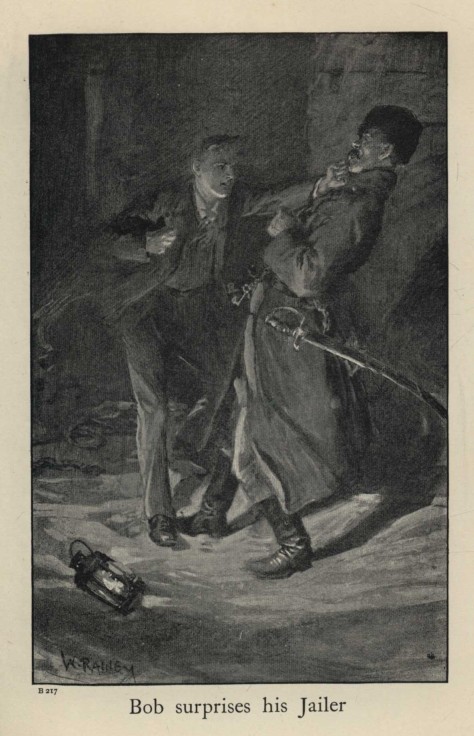
Bob surprises his Jailer
Then back into the room. He slams the door, picks up the chisel, and drives it with the hammer between the heavy oak and the floor. Off with his jacket, off with his vest; he rolls them up and forces them through the window. Everything must be dared now! Then feet foremost into the window-recess; out, out, grasping the rope; his legs are through, his body follows. Is the gap wide enough? He jerks himself on; it is a tight fit; his shoulders are through; he is dangling in the air, his arms almost forced from their sockets. Down he goes, hand over hand; his feet find the rope; he hears the clamour of blows on the door above. Down, down, faster and faster, the strain upon his muscles increasing with every foot of distance; down into what seems an immeasurable gulf. His feet touch the projecting sill of a window; he finds a momentary relief; then down again into space; there can be no delay, even for a moment. At last, panting for breath, his hands sore and bleeding, Bob feels a pair of arms supporting him; he loosens his grip of the rope, and falls half-insensible to the ground. But only for an instant. He sees as in a mist the outlines of two men, who drag him to his feet. The next moment, as though impelled by some higher will, he is racing down the frozen bank between the two shorter figures, over the creaking ice, towards the middle of the stream. Shouts pursue him, reflections of lights dance before his dazzled eyes, a shot is fired, there is a babel along the walls. Hauled up on the ice lies a small sampan. One of his supporters half pushes, half hurls Bob into it, then both urge it over the sagging ice into the stream. The edge gives way, the sampan slides with a glug into deep water, the two men leap on board with the agility of panthers, and the light craft bounds forward on its way to the sea.
CHAPTER XIII
Ah-Sam
A Silent Journey—An Old Friend—Circumstances Alter Cases—Enter Ah-Sam—A Manchurian Inn—Held Up—Chinese Receipts
Not a word was said as the sampan floated down the river. For some minutes Bob was too much amazed to take in anything beyond the mere fact that he had escaped from his prison; his brain was in a whirl; the events of the last few hours seemed a dream. He crouched in the boat, covered by the cloak thrown over him by one of his rescuers: his outer garments had been left at the foot of the tower. But collecting himself by degrees, he noticed that one of the men stood in the bow with a long pole fending off the spars of ice that jutted out into the stream, while the other lay almost horizontal in the boat. Both were Chinamen, as he judged from their pigtails. There was floating ice on all sides, and the progress of the sampan was a succession of bumps. Sometimes it came to a stop, and the curved bow was pushed on to a large floe by the pressure of ice behind. But the man with the pole knew his work. A touch here, a push there, or a vigorous shove sent the light craft on its way again; and all the time the second Chinaman lay motionless, saying never a word.
Meanwhile the noise of alarm and pursuit from Antung struck Bob's ears, and his thoughts were divided between wonder concerning the identity of his preservers, the strangeness of their intervention, and anxiety lest it should after all prove vain. He heard a deep bell booming, the blare of bugles, the shouts of men: by and by from the right came the sound of galloping horses. At this moment the man in the bow dropped silently into the boat beside his comrade, and the vessel was left to take its course. It was scarcely more than level with the surface of the water, and must have been invisible in the dark night at the distance of a few yards. Even if it were seen from the bank, the horsemen dared not approach the waterway owing to the rotten state of the ice: all that they could do was to fire at it, with no certainty of aim. Gradually the sounds from the shore diminished, and at last died away; the Chinaman resumed his work with the pole, and floating, jolting, stopping, jerking forward again, the sampan went safely on its way.
Still not a word had been spoken. Bob wished that one of the two figures would say something, no matter in what language. He had a strange longing for the sound of a friendly voice. But even when, two hours after their flight from Antung, the second Chinaman at last raised himself from his prone position, he gave the first an order by signs, not by words. With a combined push the two men drove the sampan with a swish and creak upon the ice on the right bank, where it remained stationary. They leapt overboard. At a sign from the second man Bob followed them; both then pushed the boat back into the stream, watched it for a moment as it circled irresolutely in the current, and then, as it gained its head and bounded more buoyantly on its way, they set off rapidly in a direction at right angles to the river, the second man now leading, and Bob making the best of his way with his companion.
Every now and then the leader paused to get his bearings, and altered his direction to right or left with little hesitation. At one point, when they came to a beaten track, he motioned to the others to remain where they were, and went ahead alone. In a few minutes he returned, and the silent march was resumed. The course led from the river-bed over country that became more and more hilly, and Bob was almost dropping with fatigue when, after walking rapidly for some eight or nine miles as he guessed, they came almost suddenly upon a high wall. Skirting the wall, they reached a gate, giving access to a courtyard. The gate was locked; the two Chinamen assisted Bob to climb it; a dog barked, but was instantly silenced by a sharp exclamation from one of the men mounting immediately behind Bob. Before them stood a low farmhouse, with still lower structures adjoining, which Bob found later were pig-styes and cow-byres not very different from similar appurtenances of farms at home. One of the Chinamen tapped twice at a window-frame latticed and filled with paper; there was no reply; he rapped again, twice, but slightly louder. In a moment a glimmer appeared within; a movement was heard; the frame was drawn aside, and against the dim light of a small bowl-lamp the form of a Chinaman was outlined. The moment he distinguished the features of the man who had tapped, he closed his fists, pressed them together against his chest, and bowed almost to the ground.
The three entered; the movable window-frame was replaced. Then one of the Chinamen turned suddenly to Bob, held out his hand, and with a smile and a bow said in careful clear-cut tones:
"I am glad to meet you again, Mr. Fawcett."
Bob stared at him in amazement. He recognized him now as the younger of the two Chinamen who had rescued him from the drunken students in Sasebo, who knew no English, and whom subsequently he had seen in the streets of Seoul. But though this was what he saw, the voice, the accent, the manner, reminded him of another person, not a Chinaman, but the Samurai who had been his host in Nikko. Grasping the outstretched hand, he said, with a gasp of amazement:
"Kobo!"
"Rokuro Kobo San," corrected the voice of Taru.
"Pardon me, sir; you will understand that I am—"
"A little taken aback, Mr. Fawcett? Yes, I understand. But you must be very tired and very hungry. You will permit my friend here to give you some food, and provide you with a jacket, then we can talk more at our ease."
In a few moments Bob, clad in a new silk jacket, was resting his weary limbs on a wadded quilt unrolled on the floor, eating with a good appetite and without enquiry the dishes placed before him. Kobo shared his meal, at the same time entering into explanations.
"You have no doubt guessed," he said, "that both myself and my servant Taru are on secret service. Our Japanese system is very elaborate. It has been most carefully organized since the Chinese war. No quarter of Manchuria has not been surveyed by our agents; many of the inhabitants are in sympathy with us, many of them are in our pay."
Bob glanced at their host.
"No," said Kobo, smiling, "he is not a Chinaman; he is a Japanese, like myself."
"But he has a pigtail!"
"So have I! Mine, however, was assumed a few weeks ago, its hold is precarious; our host's is natural, it was grown for the purpose. We have seen this war coming for ten years; and two or three suffice for the growth of a pigtail, if one sets about cultivating it in earnest. Our friend, with hundreds more, was sent over to settle in this country; some have cultivated the pigtail and become good Chinamen, others with equal success have devoted themselves to the topknot and are passable Koreans."
"Your motto is 'thorough'," said Bob admiringly.
"Yes, even to the loss of our heads. You see now why I was unable to recognize you in Sasebo and Seoul, though I half believed that in Seoul at any rate you recognized me. I could say nothing. There are Russian spies also in all parts of the country, and a single incautious sign might have compromised me and led to my discovery and suicide."
"Suicide!"
"Of course. Any Japanese would kill himself rather than do harm to his country's cause."
"Evidently one might never know when one is meeting a Japanese. May I ask—is Mr. Helping-to-decide a Japanese?"
"No, no," returned Kobo, laughing outright. "He is a real Korean; he means to help, but he never can decide. Now I want you to tell me how you met him; indeed, to give me a full account of what has happened to you. I have a reason for asking."
Bob rapidly sketched an outline of his adventures since he left Japan.
"Yes," said Kobo, when his story was ended. "Of course I learnt from Yamaguchi in Yongampo that you were with him. I heard of the fight on the shore; I did not know you had so thoughtfully come to Yamaguchi's assistance; in fact, I followed you as a Cossack despatch-rider until you killed your first tiger—"
"You knew that!" exclaimed Bob in surprise. He had said nothing about that incident.
"Yes, I came in at the death; that is to say, I was present when Mr. Helping-to-decide came upon the scene, and having satisfied myself that the man I had been following was not a Russian, I resumed my journey northward. I was proceeding to Feng-huang-cheng when I heard that you had fallen into the hands of Chang-Wo—an old enemy of mine, as you know—and had been sentenced to death. I came back at once to Antung. Fortunately the baker who contracts for the Russians' ammunition-bread in Antung is a Japanese agent. He discovered the place of your imprisonment, and bribed one of the Siberian guards—an easy matter, I assure you—to see that a special loaf was delivered to you. The rest you know; and let me say, you did your part much more rapidly than I had supposed possible."
"It was really extremely good of you to—"
"Not at all, not at all," interrupted Kobo; "it was my duty—in the circumstances."
"In what circumstances?"
"They had sentenced you to death. You will understand my position. If I had been perfectly sure that, with the prospect of death before you, you would have acted as you did—refused to give them any information,—it would have been my duty to go straight to my destination."
"I should have been shot?"
"Undoubtedly. Personal considerations are immaterial. Only reasons of state can override reasons of state. Another time—let us hope it will never occur—I need not trouble; I can go on my way—now that I know you are to be trusted."
This gave Bob something to think about. It was a view that had not struck him till then. He could not but recognize that it was strictly logical. One life was of no account compared with the vast national issues at stake. Kobo could allow nothing to delay him but the public service. Logical as it was, however, Bob had somewhat of a shock when it was brought so nearly home to him that Japan, if not the world at large, was governed by logic; and though he had a passing pang at the thought that Kobo, after a few days' knowledge of him, was not convinced of his trustworthiness, his soreness was a good deal relieved when he remembered that but for Kobo's caution he would now be lying in a Russian grave.
"Now, Mr. Fawcett," said Kobo after a pause, "you no doubt feel the need of a good sleep. But I will ask you to wait a little longer, while we discuss your future movements. It will soon be daylight, and I must then be gone; I must continue the journey you have twice unwittingly interrupted. You cannot, of course, accompany me. I do not wish to carry you into danger, nor can I endanger my mission by being encumbered with you. On the other hand, you cannot remain here, for Chinese houses, as you see, are not built for secrecy, and you would certainly be discovered ere long by the Russians. It will be best for you to make another attempt to reach our lines. You must go alone; I would willingly lend you my servant Taru, but that I myself require him. But our host here has a Chinese servant who is familiar with the country; he will act as your guide."
"Does he speak English?" asked Bob.
"Yes, pidgin English; indeed, he considers himself an accomplished linguist. As to your route, it will be dangerous to attempt to cross the Yalu anywhere between Antung and the sea. The Russians will naturally be on the alert, the more so because of the recent appearance of destroyers off the coast. All the fords between Antung and Wiju will be narrowly watched. When they discover the sampan they will probably connect it with your escape, and suspect that you have taken the shortest way to our lines. Your best course will be to go northward and make a circuit as soon as it is safe to do so."
"But will there not be a danger of meeting Russians northward also? I can't pass for a native, unluckily."
"Not as you now appear, but we can alter that. I think your guide had better travel as a carter; you will go as his man. Our host will dye your hair and stain your face and dress you as a Korean."
"But I shall never be able to manage the topknot."
"True, but that will not be necessary. Being unmarried, I presume—"
"Certainly."
"You will not require a topknot, which is the monopoly of the married men. Your hair is sufficiently long for you to pass as a bachelor, which, you will take care to remember, is an inferior and ignominious condition. As a further precaution, you had better pretend to be dumb whenever you encounter people. Your guide should, I think, set off with his cart in the morning towards Tang-shan until he finds an opportunity of crossing the main road. In order not to attract attention you follow at night, and do not join the cart until it has crossed. If a strange Korean were seen leaving this house it might arouse suspicion, and the fact might be reported by spies to the Russians. Your further course must be determined as circumstances dictate, and may safely be left to your guide. I think all is arranged, then; it only remains to introduce the Chinese boy to you."
Kobo said a few words to their host, who called in a loud tone. In a few moments a stout little Chinaman appeared, salaaming as he entered the room. His round hairless face was impassive, his slanting eyes looked intelligent, and he kow-towed profoundly when Kobo briefly introduced him.
"This, Mr. Fawcett, is Ah-Sam. Ah-Sam, Mr. Fawcett is an Englishman; he does not speak Chinese; you will be able to turn your knowledge of his language to account."
"My speakee Yinkelis first-chop so-fashion," said the Chinaman, giving Bob some qualms as to the possibility of using this dialect of English as a means of communication.
Kobo then proceeded to explain to Ah-Sam in his own language the scheme of action he had arranged. The Chinese listened gravely, nodding his head from time to time. When his instructions were concluded, he went off silently to prepare for his journey. Kobo then gave Bob detailed particulars of the road he was to follow on the next evening, and finally bade him farewell.
"I hope I shall see you again," said Bob after warmly thanking him once more for his rescue.
"I hope so. We cannot tell. Good-bye!"
Bob slept for many hours. When he awoke he had to undergo a long process of disguising at the hands of his host, from which he emerged completely transformed in complexion, appearance, and dress. His hair from light-brown had become black, his cheeks sallow. He wore the Korean national costume—huge cotton trousers padded with cotton wool, tied round his waist with a long tasselled ribbon; a short bell-shaped coat, also padded, with long sleeves; padded socks, in which the ends of the trousers were tucked; and paper shoes, fastened to the feet like sandals. These last were much more durable than they appeared. He wore no hat, but as it was cold, and there was a prospect of snow, he was provided with a large umbrella on a bamboo frame that fitted the head, so that in case of need he might carry some means of protection.
At nightfall he left the house with his host, who offered to accompany him until he overtook the cart. Both were mounted on small Korean ponies. After three or four hours' riding over snow-covered hills they struck the high-road, and leaving this at an angle in a north-easterly direction, they ascended into another low chain of hills, and in about two hours reached a small village. Here, as the Japanese host had anticipated, they found Ah-Sam awaiting them in an inn. The Japanese then took his leave, and Bob was left to his new guide.
The aspect of the inn was not very inviting. Bob's nose as he entered was assailed by the strong smell of pork and vegetables stewing in two huge cauldrons, one on each side of the door. The place consisted of one room, about forty feet long, with a low platform called a k'ang running the whole length of the wall, covered with dirty matting, sheep-skin coats, pedlars' packs, and miscellaneous frippery, with a score of rough labourers and carters lolling on them, eating, drinking, and smoking a very pungent tobacco. The k'ang, Bob found, covered the heating apparatus of the place, and was, in fact, a kind of flue. The middle of the room was occupied by what appeared to be a rough altar, but which turned out to be a kitchen-range—an oblong brick structure about three feet high, hollow in the centre, with an arched covering pierced with holes, above which various cooking pots were placed during the evening.
As Bob entered, Ah-Sam came from his perch at the end of the k'ang nearest the door, putting his finger to his lips. Bob suddenly remembered that he was to feign dumbness. He therefore made no reply to the remarks addressed to him, presumably in Korean, by the boy, but submissively accepted a bowl of soup, the mere odour of which was nauseating. He went through the forms of eating, but soon gave it up, and making a virtue of necessity, settled himself to sleep at the cleanest part of the k'ang, picked out for him by Ah-Sam.
At daybreak next morning they set off, and Bob had his first experience of riding on a Manchurian cart. It was rather more unpleasant than jolting in a four-wheeler over the cobbles of the Glasgow streets. The framework of the cart, about fifteen feet long by four wide, rested on a huge axle-tree between two wooden wheels whose iron tyres were more than an inch thick. There were no springs. On each side ran a low wooden rail, intended to support so much of the load as overlapped from the body of the cart. There was a small pony in the shafts, and in front of it six mules three abreast, attached by long hempen ropes to iron hooks in the framework. The mules had neither bit nor bridle; they were guided wholly by the driver's voice and whip, the latter twelve feet long in the handle, with a thong of equal length, and so heavy that both hands were required to wield it. Ah-Sam sat on the front of the cart, and gave Bob a place behind, where he helped to balance the vehicle on its two wheels. The cart was but lightly loaded; it contained a few empty sacks, some fodder for the animals, a supply of food, and a couple of spades. Beneath the framework, cunningly hidden between the wheels, there were two rifles and a good stock of ammunition.