Front matter (continued 6)
Reading edition
In this gloomy vault-like building prayers are said, as in all Nestorian churches, at sunrise and sunset by the priest in his ordinary clothing, the villagers being summoned by the beating of a mallet on a board.[41]
The church is a place of refuge when a Kurdish attack is expected. Nine years ago the people carried into it all their movables that they valued most, believing it to be secure, but the Kurds broke in in force and took all they wanted. The few sacred treasures of the village and the Eucharistic leaven are hidden in an elevated recess in the wall. The graveyard, which contains only a few flat slabs imbedded in the soil, is the only possible camping-ground; but though it is clean and neat, it looked so damp and felt so cold that I preferred to accept a big room with walls six feet thick in the priest's house, even though it overhangs the torrent with its thunder and clash.
Many a strange house I have seen, but never anything so striking as the dwelling of Qasha Ishai. Passing through the rude verandah, and through a lofty room nearly dark, with a rough stone dais, on which were some mattresses, and berths one above another, I stumbled in total darkness into a room seventy feet by forty, and twenty feet or more high in its highest part. It has no particular shape, and wanders away from this lofty centre into low irregular caverns and recesses excavated in the mountain side. Parts of the floor are of naked rock, parts of damp earth. In one rocky recess is a powerful spring of pure water. The roofs are supported on barked stems of trees, black, like the walls, wherever it was possible to see them, with the smoke of two centuries. Ancient oil lamps on posts or in recesses rendered darkness visible. Goat-skins, with the legs sticking out, containing butter, hanging from the blackened cross-beams, and wheat, apples, potatoes, and onions in heaps and sacks, piles of wool, spinning-wheels, great wooden cradles here and there, huge oil and water jars, wooden stools, piles of bedding, ploughs, threshing instruments, long guns, swords, spears, and gear encumbered the floor, while much more was stowed away in the dim caverns of the rock.
I asked the number of families under the roof. "Seven ovens," was the reply. This meant seven families, and it is true that three generations, seventy-two persons, live, cook, sleep, and pursue their avocations under that patriarchal roof.
The road is a bad one for laden beasts, and very dangerous besides, and the few travellers who visit Kochanes usually take the caravan route from Urmi viâ Diza, and the fact of an English person passing through Marbishu with a letter to the Turkish authorities was soon "noised abroad," and I was invited to spend the evening in this most picturesque house. All the inmates were there, and over a hundred of the villagers besides; and cooking, baking, spinning, carding wool, knitting, and cleaning swords and guns went on all the time. There were women and girls in bright red dresses; men reclining on bedding already unrolled on the uneven floor, or standing in knots in their picturesque dresses leaning on their long guns, with daggers gleaming in their belts; groups seated round the great fire, in the uncertain light of which faces gleamed here and there in the dim recesses, while the towering form of Qasha Ishai loomed grandly through the smoke, as the culmination of the artistic effect.
The subject discussed was equally interesting to the Syrians and to me,—the dangers of the pass and the number of guards necessary. We talked late into the night, and long before I left the female and juvenile part of the family had retired to their beds. Again I heard of Hesso's misdeeds, of the robbery of 1400 sheep; of the driving off on the previous morning of thirty sheep which they were about to barter for their winter supply of wheat; of the oppressive taxation, 100 liras (nearly £100) on 100 houses; of the unchecked depredations of the Kurds, which had increased this summer and autumn, leaving them too poor to pay their taxes; of a life of peril and fear and apprehension for their women, which is scarcely bearable; of the oppression of man and the silence of God. Underlying all is a feeling of bitter disappointment that England, which "has helped the oppressed elsewhere, does nothing for us." They thought, they said, "that when the English priests came it was the beginning of succour, and that the Lord was no longer deaf, and our faces were lightened, but now it is all dark, and there is no help in God or man."
I now find myself in the midst of a state of things of which I was completely ignorant, and for which I was utterly unprepared, and in a region full of fear and danger, in which our co-religionists are the nearly helpless prey of fanatical mountaineers, whose profession is robbery.
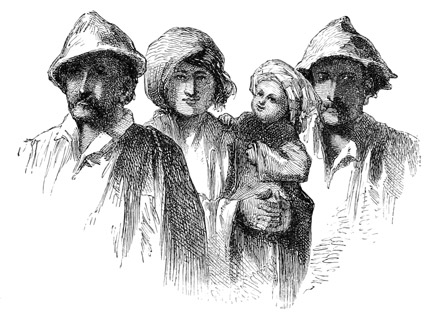
A SYRIAN FAMILY.
Looking round on the handsome men and comely women, who would greet the sunrise with Christian prayer and praise, and whose ancestors have worshipped Christ as God for fourteen centuries in these mountain fastnesses, I wondered much at my former apathy concerning them. It is easier to feel them our fellow-Christians on the spot than to put the feeling into words, but writing here in the house of their Patriarch, the Catholicos of the East, I realise that the Cross signed on their brows in baptism is to them as to us the symbol of triumph and of hope; that by them as by us the Eucharistic emblems are received for the life of the soul, "in remembrance of Christ's meritorious Cross and Passion"; that through ages of accumulating wrongs and almost unrivalled misery, they like us have worshipped the crucified Nazarene as the crowned and risen Christ, that to Him with us they bend the adoring knee, and that like us they lay their dead in consecrated ground to await through Him a joyful resurrection.
There were five degrees of frost during the night, and as I lay awake from cold the narratives I had heard and the extraordinary state of things in which I so unexpectedly found myself made a very deep impression on me. There, for the first time in my life, I came into contact with people grossly ignorant truly, but willing to suffer "the loss of all things," and to live in "jeopardy every hour" for religious beliefs, which are not otherwise specially influential in their lives. My own circumstances, too, claimed some consideration, whether to go forward, or back to Urmi. It is obvious from what I hear that the bringing my journey to Erzerum to a successful issue will depend almost altogether on my own nerve, judgment, and power of arranging, and that at best there will be serious risks, hardships, and difficulties, which will increase as winter sets in. After nearly coming to the cowardly decision to return, I despised myself for the weakness, and having decided that some good to these people might come from farther acquaintance with their circumstances, I fell asleep, and now the die is cast.
We were ready at daybreak the next morning, but for the same reasons as those given at Merwana did not start till seven for an eleven hours' march. I took two armed horsemen and six armed footmen, all fine fellows used to the work of reconnoitring and protecting. Three of them scouted the whole time high up on the sides of the pass, not with the purposeless sensational scouting of Persian sowars, but with the earnestness of men who were pledged to take us safely through, and who live under arms to protect their property and families.
After five hours of toiling up the Drinayi Pass, taking several deep fords, and being detained by a baggage horse falling fifty feet with his load, we crossed the summit, and by a long descent through hills of rounded outlines covered with uncut sun-cured hay, reached the plain of Gawar, where the guards left us. On the way we passed the small Christian hamlet of Eyal, which was robbed of its sheep with the sacrifice of the shepherd's life the following night. At the village of Yekmala on the plain the Kurdish katirgis by a shameful exaction got us into great trouble, and there was a fight, in which Johannes's gun was wrested from him, and some of my things were taken, the Kurds meantime driving off their animals at a fast trot. The aspect of affairs was so very bad and the attack on my men so violent that I paid the value of the Kurdish depredations, and we got away. A little farther on the katirgis were extremely outrageous, and began to fulfil their threat of "throwing down their loads," but I persuaded Qasha ——, who was alarmed and anxious, to leave them behind, and they thought better of it.
The mountain-girdled plain of Gawar is a Paradise of fertility, with abundant water, and has a rich black soil capable of yielding twenty or thirtyfold to the cultivator. On it is the town of Diza, chiefly Armenian, which is a Turkish customs station, a military post, and the residence of a Kaimakam. There are over twenty Christian as well as some Moslem villages on Gawar, and a number of Kurdish hamlets and "castles" on the slopes and in the folds of the hills above it.
The sun was sinking as we embarked on the plain, and above the waves of sunset gold which flooded it rose the icy spires and crags of the glorious Jelu ranges and the splintered Kanisairani summits. The plain has an altitude of over 6000 feet, and there was a sharp frost as we dismounted at the village of Pirzala and put up at the house of the Malek David, having been eleven and a half hours in the saddle. After consulting with him and other village worthies I dismissed the katirgis and paid them more than their contract price. The next morning they swore by the Prophet's beard, and every other sacred thing, that they had not been paid, and when payment was proved by two respectable witnesses, they were not the least abashed. Poor fellows! They know no better and are doubtless very poor. I was glad to get rid of their sinister faces and outbreaks of violence, but for some days it was impossible, being harvest-time, to obtain transport to Kochanes, though I was able to leave Pirzala for other villages.
The next day mists rolled down the mountains, and a good cold English rain set in, in which I had a most pleasant ride to Diza, which was repeated the following day in glorious weather, the new-fallen snow coming half-way down the mountain sides. I was surreptitiously on Turkish soil, and it was necessary to show my passport to the Diza officials, get a permit to travel, and have my baggage examined. Ishu, the present Malek of the plain, through whom all business between the Christians and the Government is transacted, accompanied us to the Mutessarif of Julamerik.
Diza is an unwalled town on an eminence crowned by barracks. The garrison of 200 men was reduced to six during the summer. The Kurds evidently took the reduction as a hint to them to do what they liked, and they have mercilessly ravaged and harried the plain for months past.[42] An official assured me that 15,000 sheep have been driven off from the Gawar Christian villages between the middle of June and the 17th of October, partly by the nomad Herkis. There are now sixty soldiers at Diza, and the Mutessarif of Julamerik is there, having come down to capture Abdurrahman Bey, one of the great oppressors of the Christians,—an attempt rendered abortive (it is said) by a bribe given by the Bey to the commanding officer of the troops.
I was interested in my first visit to a Turkish official. His room was above a stable, with a dark and difficult access, and the passages above were crowded with soldiers. The Mutessarif sat on a divan at the upper end of a shabby room, an elderly man much like Mr. Gladstone, very courteous and gentlemanly, with plenty of conversation and savoir-faire. He said that the letter I carry is "a very powerful document," that it supersedes all the usual formalities, that my baggage would not even be looked at, and that I should not require a teskareh or permit. By his advice I called on the Kaimakam, and in each room a soldier brought in delicious coffee. The Kaimakam was also very courteous, and talked agreeably and intelligently, both taking the initiative, as etiquette demands.
In this and in the general tone there was a marked difference between Persian and Turkish officialdom. The Persian Governor is surrounded by civilians, the Turkish by soldiers, and in the latter case the manner assumed by subordinates is one of the most profound respect. The sealing of my passport took a considerable time, during which, with Qasha ——, I paid several visits, was regaled with Armenian cookery, tried to change a mejidieh at the Treasury, but found it absolutely empty, and went to see a miracle-working New Testament, said to be of great antiquity, in an Armenian house. It was hanging on the wall in a leather bag, from which depended strings of blue and onyx beads. Sick people come to it even from great distances, as well as the friends of those who are themselves too ill to travel. The bag can only be opened by a priest. The power of healing depends on a sum of money being paid to the priest and the owners. The sick person receives a glass bead, and is forthwith cured.
On Gawar Plain I lodged in the village houses, either in semi-subterranean hovels, in which the families live with their horses and buffaloes, or in rooms over stables. Very many sick people came to me for medicines, and others with tales of wrong for conveyance to "the Consul" at Erzerum. No one seemed to trust any one. These conversations were always held at night in whispers, with the candle hidden "under a bushel," the light-holes filled up with straw, the door barred or a heavy stone laid against it, and a watch outside.
The Gawar Christians are industrious and inoffensive, and have no higher aspiration than to be let alone, but they are the victims of a Kurdish rapacity which leaves them little more than necessary food. Their villages usually belong to Kurdish Aghas who take from them double the lawful taxes and tithes. The Herkis sweep over the plain in their autumn migration "like a locust cloud," carrying off the possessions of the miserable people, spoiling their granaries and driving off their flocks. The Kurds of the neighbouring slopes and mountains rob them by violence at night, and in the day by exactions made under threat of death. The latter mode of robbery is called "demand." The servants of a Kurdish Bey enter and ask for some jars of oil or roghan, a Kashmir shawl, women's ornaments, a jewelled dagger, or a good foal, under certain threats, or they show the owner a bullet in the palm of the hand, intimating that a bullet through his head will be his fate if he refuses to give up his property or informs any one of the demand.
In this way (among innumerable other instances) my host at ——,[43] a much-respected man, had been robbed of five valuable shawls, such as descend from mother to daughter, four handsome coats, and 300 krans in silver. In the last two years ten and fifteen loads of wheat have been taken from him, and four four-feet jars filled with oil and roghan. Four hundred and fifty sheep have likewise been seized by violence, leaving him with only fifteen; and one night while I was at his house fifty-three of the remaining village sheep, some of which were his, were driven off in spite of the guards, who dare not fire. I was awakened by the disturbance, and as it was a light night I saw that the Kurds who attacked the sheepfold were armed with modern guns. The reis of that village and this man's brother have both been shot by the Kurds.
Testimony concurred in stating that the insecurity of life and property has enormously increased this summer, especially since the reduction of the Diza garrison; that "things have grown very much worse since the Erzerum troubles;" that the Kurds have been more audacious in their demands and more reckless of human life; and that of late they have threatened the Christians as such, saying that the Government would approve of "their getting rid of them." Very little of any value, the people said, was left to them, and the extreme bareness of their dwellings, and the emptiness of their stables and sheepfolds, while surrounded with possibilities of pastoral and agricultural wealth, tend to sustain their statements. "The men of Government," they all said, "are in partnership with the Kurds, and receive of their gains. This is our curse."
Many women and girls, especially at Charviva and Vasivawa, have been maltreated by the Kurds. A fortnight ago a girl, ten years old, going out from ——, to carry bread to the reapers, was abducted. It became known that two girls in —— were to be carried off, and they were hidden at first in a hole near ——. Their hiding-place last week was known only to their father, who carried them food and water every second night. He came to me in the dark secretly, and asked me to bring them up here, where they might find a temporary asylum. Daily and nightly during the week of my visit Gawar was harried by the Kurds, who in two instances burned what they could not carry away, the glare of the blazing sheaves lighting up the plain.
The people of Gawar express great anxiety for teachers. The priests and deacons must work like labourers, and cannot, they say, go down to Urmi for instruction. A priest, speaking for two others, and for several deacons who were present, said, "Beseech for a teacher to come and sit among us and lighten our darkness before we pass away as the morning shadows. We are blind guides, we know nothing, and our people are as sheep lost upon the mountains. When they go down into the darkness of their graves we know not how to give them any light, and so we all perish."
This request was made in one of the large semi-subterranean dwellings, which serve for both men and beasts in Kurdistan. The firelight flickered on horses and buffaloes, receding into the darkness, and the square mud-platform on which we sat was framed by the long horns and curly heads of mild-eyed oxen.
I answered that it would be very difficult to raise money for such an object in England. "But England is very rich," the priest replied. I looked round, and the thought passed across my mind of Him "who though He was rich yet for our sakes became poor," whose life of self-denial from the stable at Bethlehem to the cross on Calvary is the example for our own, and whose voice, ringing down through ages of luxury and selfishness, still declares that discipleship involves a love for our brethren equal to His own. Yes, "England is very rich," and these Syrians are very poor, and have kept the faith through ages of darkness and persecution.
This plain, the richest in Kurdistan, is also most beautiful. In winter a frozen morass, it is not dry enough for sowing till May, and even June. This accounts for the lateness of the harvest. The Jelu mountains, the highest in Central Kurdistan,—a mass of crags, spires, and fantastic parapets of rock, with rifts and abysses of extraordinary depth,—come down almost directly upon it. There is no wood. The villages are all alike, surrounded just now by piles of wheat and straw on their threshing-floors, with truncated cones of fodder, and high smooth black cones of animal fuel. These are often the only signs of habitations. One may ride over the roofs without knowing that houses are below.
Being entirely baffled by the difficulty of obtaining transport, I went on to Gahgoran, and put up at the house of the parish priest, where the subterranean granary allotted to me was so completely dark that I sat all day in the sheepfold in order to be able to write and work, shifting my position as the sun shifted his. A zaptieh had been sent from Diza, who guarded me so sedulously that Qasha —— dared not speak to me, lest the man should think he was giving me information.
Gahgoran was full of strangers. The Patriarch had come down from Kochanes, and occupied the only room in the village, whither I went to pay my respects to him. The room was nearly dark, and foggy with tobacco smoke, but a ray of light fell on Mar Gauriel, Bishop of Urmi, a handsome full-bearded man in a Nestorian turban, full trousers, a madder-red frock with a bright girdle in which a khanjar glittered, and a robe over all, a leader of armed men in appearance. I had met him in Urmi, and he shook hands and presented me to Mar Shimun, a swarthy gloomy-looking man. In his turn he presented me to Mar Sergis, Bishop of Jelu, a magnificent-looking man with a superb gray beard, the beau-ideal of an Oriental ecclesiastic. Maleks and headmen of villages sat round the room against the wall, not met for any spiritual conclave but for stern business regarding the taxes, for the Patriarch is a salaried official of the Turkish Government. All rose when I entered, and according to a polite custom stood till I sat down. They held out no hope of getting baggage animals, and I returned to the sheepfold.
It was a long day. The servants did not arrive till night, and Kochanes receded hourly! Many people came for medicine, and among them a very handsome man whose house was entered by Kurds a month ago, who threatened him with death unless he surrendered his possessions. After this he and his brothers fled and hid among the wheat, but fearing to be found and killed, they concealed themselves for a fortnight in the tall reeds of a marsh. He is now subject to violent fits of trembling. "My illness is fear," the poor fellow said. Three hundred sheep had been taken from him and twenty-five gold liras; his grass had been burned, "and now," he said, "the oppressor Hazela Bey says, 'give me the deeds of your lands, if not I will kill you.'" He had been a Malek, and was so rich that he entertained travellers and their horses at all times. Now his friends have to give him wheat wherewith to make bread.
The house of Qasha Jammo has granaries at each side of the low door, a long dark passage leading into a subterranean stable with a platform for guests, and a living-room, on a small scale, like the one at Marbishu. A space was cleared in the granary for my bed among wheat, straw, ploughs, beetles, starved cats, osier graintubs coated with clay, six feet high, and agricultural gear of all sorts. It was a horrid place, and the door would not bolt. After midnight I was awakened by a sound as if big rats were gnawing the beams. I got up and groping my way to the door heard it more loudly, went into the passage, looked through the chinks in the outer door, and saw a number of Kurds armed with guns. I retreated and fired my revolver in the granary, which roused the dogs, and the dogs roused the twenty strangers who were receiving the priest's hospitality. In the stable were fourteen horses, including my own two, and several buffaloes. The Kurds had dug through the roof of the granary opposite mine, and through its wall into the stable, and were on the point of driving out the horses through the common passage when the hardy mountaineers rushed upon them. The same night, though it was light and clear, another house in Gahgoran was dug into, and a valuable horse belonging to a man in the Patriarch's train was abstracted. A descent was also made on the neighbouring village of Vasivawa, which has suffered severely. Eight zaptiehs employed by the villagers at a high price to watch the threshing-floor, and my own zaptieh escort, were close at hand.
Horses having at last been obtained from a Kurdish Bey, I left on Tuesday, the Gahgoran people being stupefied with dismay at the growing audacity of the Kurds. The mountain road was very dangerous, but I travelled with Mar Gauriel and his train, thirteen well armed and mounted men, besides armed servants on foot. The ice was half an inch thick, but the sun was very hot. The mountain views were superb, and the scenery altogether glorious, but the passes and hillsides are not inhabited. We were ten hours on the journey, owing to the custom of frequent halts for smoking and talking.
In the afternoon a party of Syrians with some unladen baggage mules came over the crest of a hill, preceded by a figure certainly not Syrian. This was a fair-complexioned, bearded man, with hair falling over his shoulders, dressed in a girdled cassock which had once been black, tucked up so as to reveal some curious nether garments, Syrian socks, and a pair of rope and worsted shoes, such as the mountaineers wear in scaling heights. On his head, where one would have expected to see a college "trencher," was a high conical cap of white felt with a pagri of black silk twisted into a rope, the true Tyari turban. This was Mr. Browne, one of the English Mission clergy, who, from living for nearly four years among the Syrians of the mountains, helping them and loving them, has almost become one of them. He was going to Diza to get winter supplies before his departure for one of the most inaccessible of the mountain valleys, but with considerate kindness turned back to Kochanes with me, and remains here until I leave. This fortunate rencontre adds the finishing touch to the interest of this most fascinating Kurdistan journey.
Crossing the Kandal Pass, we descended on the hamlet of Shawutha, superbly situated on a steep declivity at the head of a tremendous ravine leading to the Zab, blocked apparently by mountains violet-purple against a crimson sky, with an isolated precipitous rock in the foreground, crowned by an ancient church difficult of access. Below the village are fair shelving lawns, with groups of great walnut trees, hawthorn, and ash, yellow, tawny, and crimson—a scene of perfect beauty in the sunset, while the fallen leaves touched the soft green turf with ruddy gold. The camping-grounds were very fair, but the villagers dared not let me camp. The Kurds were about, and had exacted a ewe and lamb from every house. Owing to the influx of strangers, it was difficult to get any shelter, and I slept in a horse and ox stable, burrowed in the hillside, the passage to the family living-room, without any air holes, hot and stifling, and used my woollen sheets for curtains. The village is grievously smitten by the "cattle plague." In telling me of the loss of "four bulls" within three days, my host used an expression which is not uncommon here, "By the wealth of God, and the head of Mar Shimun."
Yesterday we descended 1500 feet, alongside of a torrent fringed with scarlet woods, and halted where the Shawutha, Kochanes, and Diz valleys meet at the fords of the Zab, here known as "the Pison, the river of Eden." The Zab, only fordable at certain seasons, is there a fast-flowing dark green river, fully sixty yards wide, deep enough to take the footmen up to their waists, and strong enough to make them stagger, with a lawn bright with autumnal foliage below the savage and lofty mountains on its right bank.
From the Zab we ascended the gorge of the Kochanes water by a wild mountain path, at times cut into steps or scaffolded, and at other times merely a glistening track over shelving rock, terminating in a steep and difficult ascent to the fair green alp on which Kochanes stands at the feet of three imposing peaks of naked rock—Quhaibalak, Qwarah, and Barchallah.
Thus I beheld at last the goal of my journey from Luristan, and was not disappointed. Glorious indeed is this Kurdistan world of mountains, piled up in masses of peaks and precipices, cleft by ravines in which the Ashirets and Yezidis find shelter, every peak snow-crested, every ravine flaming with autumn tints; and here, where the ridges are the sharpest, and the rock spires are the most imposing, on a spur between the full-watered torrents of the Terpai and the Yezidi, surrounded on three sides by gorges and precipices, is this little mountain village, the latest refuge of the Head of a Church once the most powerful in the East.
Kochanes consists of a church built on the verge of a precipice, many tombs, a grove of poplars, a sloping lawn, scattered village houses and barley-fields extending up the alp, and nearly on the edge of a precipitous cliff the Patriarch's residence, a plain low collection of stone buildings, having an arched entrance and a tower for refuge or defence. The houses of his numerous relations are grouped near it. Everything is singularly picturesque. The people, being afraid of an attack from the Kurds, would not suffer me to pitch my tent on their fair meadow, and Sulti, the Patriarch's sister, has installed me in a good room in the house, looking across the tremendous ravine of the Terpai upon savage mountains, the lower skirts of which are clothed with the tawny foliage of the scrub oak, and their upper heights with snow.
I. L. B.
LETTER XXIX
Kochanes, Oct. 27.
After two days the Patriarch arrived from Gahgoran with nearly forty persons. To realise what this house is like, one must go back four centuries, to the mode of living of the medieval barons of England. Mar Shimun is not only a spiritual prince, but the temporal ruler of the Syrians of the plains and valleys, and of the Ashirets or tribal Syrians of the mountains of Central Kurdistan, as well as a judge and a salaried official of the Turkish Government. He appoints the maleks or lay rulers of each district, where the office is not hereditary, and possesses ecclesiastical patronage. For over four centuries the Patriarch has been of the family of Shimun, which is regarded as the royal family; and he is assisted in managing affairs by a "family council." Kochanes is thus the ecclesiastical and political metropolis of the Syrian nation, and the innumerable disputes which arise among the people of this region are brought here for judgment and arbitration.
It is a crowded life. From sunrise to sunset the pavement outside the rude hall of entrance, the great room, like that at Marbishu, where Sulti presides, and the guest-chambers, are always thronged with men waiting to be received by the Patriarch, sleeping on the big settle in the hall, or cleaning swords and guns, or wrestling, performing feats of horsemanship, playing chess, and eating. Sixty persons more or less are guests here. Every one coming into the valley is received, and horses are stabled while men are fed. Outside, sheep and fowls are being continually killed, two or three sheep being required daily; mules are departing for Diza for stores, or are returning with flour and sugar; oxen are bringing in hay, and perpetual measuring and weighing are going on. The cost of provisioning such an army of guests is enormous, and presses heavily on the Patriarch's slender resources. Intrigues are rife. In some ways every man's hand is against his fellow, and the succession to the Patriarchate, although nominally settled, is a subject of scheming, plotting, rivalries, and jealousies. Then there are various appointments, secular and spiritual, to be wrangled for, the difficult relations with Turkey to be managed, and such a wavering policy to be shaped towards Rome and American Presbyterianism as shall absolutely break with neither.
Among the guests who come and go as they please, unquestioned, are refugees from the barbarities of the Kurds, among the most pitiable of whom is Mar ——, Bishop of ——, bereft under threat of death of his Episcopal seal, and a fugitive from his diocese, which is almost destroyed by violence and exactions. Few hours pass in which some fresh tale of bloodshed, or the driving off of flocks, or the attacking of travellers, or the digging into houses, is not brought up here. A piteous state of alarm prevails. Mar Shimun, naturally feeble and irresolute, and his family council are helpless. His dual position aggravates his perplexities. Counsels are divided and paralysed. No one knows where to turn for help on earth, and "the Lord is deaf," some of the people say.
On entering the house by an archway, where the heavily-bossed door stands always open, a busy scene is to be witnessed in the hall, which is roughly paved with irregular slabs of stone. On the rude stone settle men are sitting or sleeping, or a carpenter is using it as his bench, or a sheep is being cut up on it. At the end of a passage is the "house," a high, big, blackened room, with shelving floors of earth and rock, ovens in the floors, great quaraghs holding grain, piles of wood, men sawing logs, huge pots, goat-skins of butter hanging from the rafters, spinning-wheels, a loom, great roughly-cut joints of meat, piles of potatoes, women ceaselessly making blankets of bread, to be used as tablecloths before being eaten, preparations for the ceaseless meals involved by the unbounded hospitality of the house, and numbers of daggered serving-men, old women, and hangers-on. This room is only lighted from the doors and from a hole in the roof. Nearly opposite is a low dark lobby, from which opens my room, sixteen feet square, with walls three feet thick, and Mar Shimun's room, about the same size, which serves him for sleeping, eating, reception-room, and office.
On the same side of the hall are two guest-rooms, now packed to their utmost capacity, and a large room in which Ishai, the Patriarch's half-brother, a young man of exceeding beauty, lives, with his lovely wife, Asiat, and their four children. In a ruinous-looking tower attached to the main building Mr. Browne has his abode, up a steep ladder. Below there are houses inhabited by the Patriarch's relations, one of whom, Marta, is a dignified and charming woman, and the mother of Mar Auraham, the Patriarch-designate, whose prospective dignity is the subject of much intrigue.
The presiding genius of the Patriarch's household is his sister Sulti, a capable woman of forty, who has remained unmarried in order to guide his house, and who rules as well as guides. When she sleeps I know not. She is astir early and late, measuring, weighing, directing, the embodiment of Proverbs chap. xxxi. No little brain-power must be required for the ordering of such a household and the meeting of such emergencies as that of to-day, when twenty Jelu men arrived unexpectedly.
The serving-men all look like bandits. The medieval Jester is in existence here, Shlimon, a privileged person, who may say and do anything, and take all manner of liberties, and who, by his unlimited buffooneries, helps the Patriarch and his family through the dulness of the winter days. He and another faithful fellow, said to be equally quick with his tongue and his dagger, are Mar Shimun's personal servants. At fixed hours the latter carries food to his lord in tinned copper bowls on a large round tray, knives and forks not having penetrated to Kochanes.
The routine of the day is as follows. The Patriarch rises very early, and says prayers at dawn, after which those who have the entrée are served with pipes and coffee in his room, and talk ad libitum. Business of all sorts follows; a siesta is taken at mid-day, then there is business again, and unlimited talk with unlimited smoking till five, when the Patriarch goes to prayers at church, after which everybody is at liberty to attend his levée, and talking and smoking go on till 9 or 10 p.m. It is a life without privacy or quiet. The affairs of the mountains, litigation, tribal feuds, the difficulty of raising the tribute, the gossip of the village, and just now, above all else, the excesses of the Kurds, form the staple of conversation, as I understand from Qasha ——, who, as a personal friend, spends much of the day in the Patriarch's room. In winter, when Kochanes is snowed up, chess and the pranks and witticisms of the Jester fill up the time.
The curious little court, the rigid etiquette, the clank of arms, the unbounded hospitality, and the political and judicial functions exercised by the Patriarch, with the rude dwelling and furnishings, combine to re-create the baronial life as it might have been lived in Roslin or Warkworth Castles.
Though I had half-seen Mar Shimun at Gahgoran, I was only formally presented after his arrival here. It is proper for a woman to cover her head before him, and I put on my hat and took off my shoes. His room is well paved, the plaster is newly coloured, and there is a glazed window with a magnificent prospect. There were rugs at one end, on which the Patriarch was seated, with two chairs at his left hand. He rose to receive me, and, according to custom, I kissed his hand. He took my letter of introduction, and put it under a cushion, as etiquette demanded, and asked me to be seated. On the floor along the walls were bishops, priests, deacons, Jelu and Tyari mountaineers, lowlanders from Urmi, and men of the Shimun family, all most picturesquely dressed and smoking long wooden pipes. On each subsequent occasion, when I paid my respects to him, he was similarly surrounded. Mr. Browne acted as interpreter, but nothing but very superficial conversation was possible when there was the risk that anything said might be twisted into dangerous use. Mar Shimun is a man about the middle height, with large dark eyes, a sallow complexion, a grizzled iron-gray beard, and an expression of profound melancholy, mingled with a most painful look of perplexity and irresolution. He cannot be over fifty, but the miseries and intrigues around him make him appear prematurely old. When I approached the subject of the anarchy of the country he glared timidly and fearfully round, and changed the subject, sending me a message afterwards that Qasha —— and Kwaja Shlimon, a Chaldæan educated in Paris, are in possession of all that he could tell me, and would speak for him.
He and his family are very proud both of ancestry and position. Within limits his word is law; a letter from him is better than any Government passport or escort through the nearly inaccessible fastnesses of the Ashirets; "By the Head of Mar Shimun," and "By the House of Mar Shimun" are common asseverations, but he and his are exposed constantly to indignities and insults from minor Turkish officials and from Kurdish chiefs, and the continual disrespect to his person and office is said to be eating into his soul.
He wears a crimson fez with a black pagri, a short blue cloth jacket with sleeves wide at the bottom and open for a few inches at the inner seam, blue cloth trousers of a sailor cut, a red and white striped satin shirt, the front and sleeves of which are very much en évidence, and a crimson girdle, but without the universal khanjar.
This is the man who is the head at once of a church and nation, the temporal and spiritual ruler of the Syrian people, the hereditary Patriarch, the Catholicos of the East, whose dynastic ancestors ranked as sixth in dignity in the Catholic Church in its early ages. It was not, however, till the early part of the fifth century, when the Church of the East threw in her lot with Nestorius, after his condemnation in 431 by the Council of Ephesus for "heretical" views on the nature of our Lord, that the Catholicos of the East assumed the farther title of Patriarch. As I look on Mar Shimun's irresolute face, and see the homage which his people pay to him, I recall the history of a day when this church, which only survives as an obscure and hunted remnant, planted churches and bishoprics in Persia, Central Asia, Tartary, and China; its missionaries, full of zeal and self-sacrifice, brought such legions into its fold that in the sixth century the ecclesiastical ancestor of this Patriarch, then resident at Baghdad, ruled over twenty-five metropolitical provinces extending from Jerusalem to China; and when in the fourteenth century it was not only the largest communion in Christendom, but outnumbered the whole of the rest of Christendom, east and west, Roman, Greek, and other churches put together. It is truly a marvel not only that Baghdad, Edessa, and Nisibis possessed Nestorian schools of divinity and philosophy, but that Christian colleges, seminaries, and theological schools flourished in Samarcand, Bokhara, and Khiva! How this huge church melted away like snow, and how the tide of Christianity ebbed, leaving as a relic on its high-water mark within the Chinese frontier a stone tablet inscribed with the Nestorian creed, and how Taimurlane pursued the unfortunate Christian remnant with such fury that the Catholicos himself with a fugitive band was forced to fly into these mountains, are matters of most singular historic interest. Most fascinating indeed is it to be here. Each day seems but an hour, so absorbing are the interests, so deep the pathos, so vivid the tableaux, so unique the life in this hamlet of Kochanes, on its fair green alp at a height of 6000 feet among these wild mountains of Kurdistan, musical with the sound of torrents fed by fifty snow-drifts, dashing down to join "the Pison, the river of Eden" (as the Patriarch calls the Zab), on its way to the classic Tigris.
The afternoon I arrived, Sulti, Marta, Asiat, and several other women courteously visited me, and the next day I returned their visits in their simple pleasant houses. These formalities over, I have enjoyed complete liberty, and have acquainted myself with the whole of Kochanes, and with many of the people and their interests, and have had small gatherings of men in my room each evening, Qasha —— or Mr. Browne interpreting their tales of strife or wrong.
"Fear is on every side," the fear of a people practically unarmed, for their long guns, some of them matchlocks, are of no use against the rifles of the Kurds, nor dare they fire in self-defence. Travelling is nearly suspended. A company of people whose needs call them to Urmi dare not run the risk of the journey till they can go down with Mar Gauriel and his large escort. It is evident that the Patriarch and his people hoped for a British protectorate as one result of "the Archbishop of Canterbury's Mission," and that they are bitterly disappointed that their condition is growing worse.
"How can we listen to teaching," say some of them, "when we have no rest? How can we believe in God when He lets these things happen to us? The Almighty is deaf, and we cease to pray. Can we hear teaching when the wolf is on us by night and day? If we let go the Cross we might be rich and safe. Night by night we ask, 'Shall we see the morning?' for our oppressors wax fiercer daily."
Mar ——, Bishop of ——, mentioned previously as a fugitive from his diocese, is a fine, pleasant-looking middle-aged man, more like a sailor than an ecclesiastic. Late one night, in a whisper, with a trusty watch at the door, he told his story, through Qasha ——, in the following words:
"I fled, fearing for my life, because many times I had spoken against the oppressions. The Kurds have carried away most of the sheep and goats, besides taking all they wished to have, and they entered through the houses, plundering everything, and burning two in ——. Their words are 'give or die.' I petitioned Government regarding the oppressions, and Mohammed Bey came, and by threat of death he got my seal, and wrote in my name a letter, saying it was all false, there were no oppressions, and he was a very good man, and he signed it with my seal, and it went to Stamboul. My seal has now been for one year in the hands of Mohammed Bey, who has killed about thirty Christians in Berwar. Three months ago I fled to save my life.
"Seventeen years the oppressions have begun; but it was ten years ago when we could easily keep ourselves and raise our bread—now we cannot. In ——, five years ago, all had plenty of dress and bread, and every family kept two cows and two hundred or more of sheep. But now, when I visited them, I would shame to look at the female persons, so naked were they, and so did they hide themselves for shame in the dark parts of their houses, for their dress was all in pieces, so that their flesh was seen. I was thirsty and asked for milk, and they made reply, 'Oh, we have not a cow, or a sheep, or a goat: we forget the taste of milk!' And most of their fine fields were gone out of their hands by oppressions, for they could no longer find money wherewith to pay taxes, and they sold them for a vile price.
"K—— was the best village in Sopana, and more wealthy than any village of Kurds or Christians. There I went and asked for some milk. They said, 'Never a goat, or a sheep, or a cow have we.' I ask of all the families their condition, and they make reply, with many tears, 'All that we have has left our hands, and we fear for our lives now. We were rich, now we have not bread to eat from day to day.' Seventeen years ago the village of B—— had fifty families of wealthy villagers, but now I only find twelve, and those twelve could scarcely find bread. I had asked bread, but I could not find it. By day their things were taken by force out of their houses: at night their sheep and cattle were driven off. They could keep nothing. Our wheat, our sheep, our butter is not our own. The chief, Mohammed Bey, and his servants ask of us, saying, 'Give, or we will kill you.'"
This is a sample of innumerable tales to which I listen daily. Some are probably grossly exaggerated, others, and this among them, are probably true in all essential particulars. Daily, from all quarters, men arrive with their complaints of robbery and violence, and ask the Patriarch to obtain redress for them, but he is powerless.
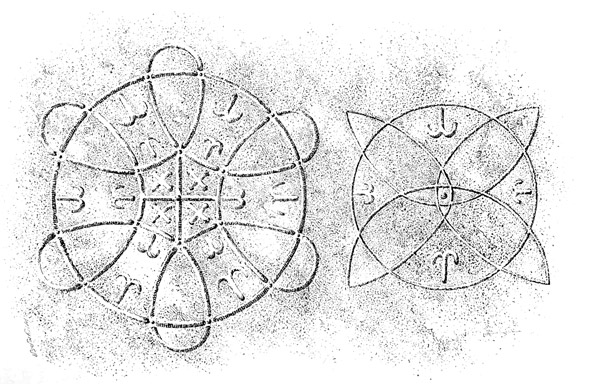
DESIGNS ON TOMBS AT KOCHANES.
My favourite walk is down the fair green lawn outside the village, on which is a copse of poplars, with foliage of reddening gold. Beside it, on the verge of the precipitous heights above the Terpai, is a bold group of rocks, on which the church dedicated to Mar Shalita is built. The ruins of a former church, dedicated to Mart Mariam, are higher up the alp. Below the rocks are a great number of tombstones, with incised ornaments upon them bearing the general name of crosses. The church has nothing specially ecclesiastical in its appearance. It has some resemblance to a keep with out-buildings, and its irregular form seems to have been dictated by the configuration of the rock. It has no windows, and the cruciform slits at a great height look like loopholes. It is indeed the ultimate refuge of the Patriarch and the villagers in case of a descent of the Kurds. I walked all round it, through the poplar grove, with its mirthful waters, among the tombs, and back by the edge of the ravine to the west side without finding a door. In truth the only entrance is up a rude and very steep ladder, about ten feet high, with a rude door at the top six inches thick, but only three feet high. How old and infirm people get up and down I cannot tell. So difficult is the access that I was glad to avail myself of the vigorous aid of Mar Gauriel, who, having visited England, is ready on all occasions with courteous attentions to a lady. The reason of the low doors is said to be that all may bow their heads on entering the house of God, and that the Moslems may not stable their cattle in the church. The entrance harmonises with the obvious pervading motive of the design, which is inaccessibility.

SYRIAN CROSS.
The door opens into a small courtyard, partly protected by a wooden roof. At its farther end, in a recess in its massive wall, is a small altar. Its west wall is pierced so that the approach can be commanded. In this courtyard the daily prayers are frequently said during the warm weather. A few steps lead from this into a building of two stories, a rude little house in fact, once occupied by one of the Patriarchs, and latterly by the late Rabban Yonan, a holy man, almost a hermit, whose reputation for sanctity has extended far beyond the limits of Kurdistan.
Removing our shoes, we entered the church through a sort of porch, the lintel of which is ornamented with bas-reliefs consisting of a cross in knot-work and side ornaments of the same, very rudely executed. The threshold is elevated, and the lintel of the door only three feet four inches high, so that the worshipper must bend again before entering. It was a gloomy transition from the bright October sunshine to the dark twilight within, and even with the aid of candles the interior was only dimly seen. It consists of a nave, about thirty-four feet long, with a sanctuary, and a sacristy which also serves as the baptistery, at the east end. The nave is lofty and without seats. The worshippers stand during divine service, even the aged and infirm only rest by leaning on their cross-handled staffs. In the nave, below the screen of the sanctuary, are three altars. On one, the "altar of prayers," the anthem books are laid; on another, the "altar of the Gospels," is a copy of the Gospels wrapped in a cloth, on which is a cross, which it is customary to kiss; on the third there is also a cross. A very thick wall separates the nave from the eastern chamber, which in its turn is divided unequally into two parts. This wall is pierced by a narrow chancel arch, and there is a narrow platform behind the altars of prayer, etc., ascended by three steps, at which the people receive the Eucharistic elements. Through the arch is dimly seen the altar, over which is a stone canopy, or baldachino, supported on four pillars. In the sacristy is a narrow but deep font, in which the infant is baptized by being dipped in the water up to the knees at the name of the Father, up to the waist at the name of the Son, and wholly immersed at the name of the Holy Ghost, the priest repeating, "Thou art baptized in the name of the Father, Amen, and of the Son, Amen, and of the Holy Ghost, Amen." Before the rite the infant's forehead is anointed with oil in the church, and it is completely anointed in the baptistery before being plunged into the font. Every infant has two god-parents, who act as sponsors at its subsequent marriage. These persons by undertaking this office are placed in a relationship of affinity close enough to be a bar to marriage. After the baptism the child is confirmed in the nave with oil and the imposition of the priest's hands, and after being very tightly bound up in its swaddling clothes is handed to the god-parents. Infant communion is the rule of the Church, but the elements are rarely received at the time of baptism.
Baptism is only valid when celebrated by a priest and in a consecrated church. Private baptisms are unlawful, but there is a form of prayer appointed for use if a child is dangerously ill, during which the priest signs a basin of water with the sign of the Cross, saying, "In the strength of our Lord may this water be of blessing in the name," etc. The mother afterwards bathes the child in the water, and if it dies they "trust it to the mercy of God." If it recovers it must be taken to church to be baptized in the usual manner. The Holy Communion, the Kourbana, ought by rule to precede baptism in the very early morning, and the baptismal rite ought to be administered on the eighth day, but it is often postponed till the annual village festival, at which the Kourbana is always celebrated.[44]
The whole interior of the church of Kochanes is covered by a plain vaulted stone roof. At the west end of the nave is a row of oblong stone tombs, four feet high, in which several of the patriarchs are buried; and a steep narrow stone stair leads from these to a small door high up in the north wall, which gives access to a small chamber in which the priest prepares and bakes the bread for the Holy Communion. The flour for this purpose is preferably of wheat which has been gleaned by girls. It is ground in a hand-mill and is mixed with "holy leaven," handed on from sacrament to sacrament. The bread is made into round cakes, a quarter of an inch thick and two and a half inches in diameter, which are stamped with a cross. Great importance is attached to the elements, and the water used for mixing with the sacramental wine is always brought from the purest spring within reach.[45]
On one side of this upper chamber, at a height of four feet, there is the mouth of a sort of tunnel which runs between the flat exterior roof and the vaulted ceiling of the nave. This is used for concealing the Liturgies and the other poor valuables of the church in times of peril. Secret as this hiding-place is, the Kurds discovered it some years ago, and carried off and destroyed whatever of value had been hidden, including a firman and a knife which (it is said) were given by Mohammed to a former Catholicos, and which are now in Stamboul.
The general arrangement of the church is a pathetic protest against chronic insecurity and persecution. The interior, and especially the sanctuary, are as black as smoke can make them, although very few candles are ordinarily used, the clergy holding rolls of thin wax taper in their hands when they require light on the Liturgies and Gospel. There is little architectural ornament except some sculptured stones, and two recesses with scallop-shell roofs at the sides of the chancel arch. The church is in good repair, for if any rain gets into a sacred building it has to be reconsecrated.
Towards five o'clock the sounding-board is beaten, and the Patriarch, the two bishops, and some other men, all in secular dress, saunter down to evening prayers, which are usually said by the Patriarch himself, and consist of a few prayers, a short lesson, and some psalms. The custom is for the people on entering to kiss the Cross, the Gospels, and the Patriarch's hand, and to lay their daggers in the church porch. Clerical vestments are not worn at these services. The Liturgies and Gospels are magnificent specimens of caligraphy, and the Syriac characters are in themselves beautiful.
It is appointed that the whole Psalter be recited in three days, and though I imagine that some abridgment is made, the priests and people, contrary to rule, are apt to sit on the floor during the antiphonal singing of the psalms, owing to their extreme length. The chanting is very discordant, as each man adopts the key which suits himself.
The "kiss of peace" is an interesting and decorous feature of the daily worship, and is always given at the beginning, even if it should be omitted at the close. On entering the church the priest crosses himself and kisses the Cross, which always lies on the altar on the north side, saying, "Glory be to God in the highest." After this the people come forward and kiss first the Cross and then the priest's hand, and each passing on touches the hands of those who before him have kissed the sacred emblem and raises his own hand to his lips. It is the custom always to kiss the hand of a bishop or priest on meeting him in the road or elsewhere and the salutation is performed in a reverential manner.
The church furniture and vestments show the great poverty of the people. The altar cloth is figured white cotton. Two tarnished and battered candlesticks stand on the altar, and a very sordid cross in the recess behind it. The chalice is a silver bowl, tarnished, almost blackened, by neglect, and the paten is a silver tray in the same state. There are a bronze censer, an antique, with embossed scripture figures upon it, and a branched lamp-stand surmounted by a bird, both of the rudest construction, and greatly neglected. Dust and cobwebs of ancient date, droppings from candles and bits of candle wicks offend Western eyes in the sacristy and elsewhere.
The clerical dress is very simple and of the poorest materials. The priest wears an alb, a girdle, and a stole crossed over the breast, and at the Kourbana a calico square with crosses in coloured cotton sewn upon it, thrown over the shoulders, and raised at times to cover the head, or to form a screen between him and the congregation. The deacon wears an alb or "church shirt" with coloured cotton crosses on the breast and back, a blue and white girdle, and a stole which is crossed over the right shoulder and has its ends tucked into the girdle. The only difference in the dress of a bishop is that he wears a stole reaching to the ankles and not crossed upon the breast. The ordinary attire of the clergy and laity is the same, and the same similarity pervades their occupations. Even bishops may be seen hard at work in the fields. The sanctuary is held in great reverence, and Mar Gauriel, who is more like a jolly sailor than a priest, put on a girdle and stole before entering it when he showed it to me. Strange to say, the priests and deacons officiating at the Holy Communion retain their shoes and remove their turbans. The graves round the church are very numerous, and are neatly kept. One burial has taken place since I came. The corpse, that of a stranger, was enclosed in a rough wooden coffin, and the blowing of horns, beating of drums, carrying of branches decorated with handkerchiefs and apples, and the wailing of the women and other demonstrations of grief, such as men jumping into the grave, beating their breasts and uttering cries of anguish, distressing scenes which are usual at Syrian funerals, were consequently absent. The burial service is very striking and dramatic, and there are different "orders" for bishops, priests, deacons, laymen, women, and children. The whole, if recited at full length, takes fully five hours! Besides prayers innumerable both for the departed and the survivors, there are various dialogues between the mourners and the departed, and between the departed and the souls of those already in Hades.[46]
In spite of the perils around, "marrying and giving in marriage" go on much as usual. Mar Gauriel, Bishop of Urmi, has come up on nothing less important than a matrimonial errand, to ask for the hand of the Patriarch's niece, a small child of eight years old, the daughter of Ishai and Asiat, for his nephew, a boy of fourteen. Girls may marry at twelve, and the beautiful Asiat, the child's mother, is only twenty. I was invited to tea when the proposals were made in a neutral house, where Mr. Browne interpreted the proceedings for me. Mar Gauriel, handsomely dressed in red, with a khelat or "coat of honour" given him by the Shah over his usual clothes, looked as blithe and handsome as a suitor should. He sat on one side of the floor with a friend to help his suit, and on the other were seated Sulti, Asiat, and the child.
Conversation was general for a time; then the Bishop, with a change of face which meant business, produced a small parcel, and laid on the floor, with a deliberate pause between the articles, carbuncle and diamond rings, gold-headed pins, gold bracelets, a very fine pink coral necklace, with a gold and turquoise pendant, and finally a long chain of hollow balls of massive filigree silver, beautiful enough to "fetch" any woman. The mother and aunt sat rigidly, assumed stony faces, and would not admire. But Mar Gauriel had other weapons in his armoury, and produced from a large bundle articles of dress of full size, among which were Constantinople gauze gowns sprigged with gold, a green silk gown covered with embroidery, and lastly a sort of coat of very rich cloth of gold, a costly thing. The child's eyes sparkled at this. The Bishop looked up from it at the two women, but a look of contempt alone flitted across their stony faces.
Then he began his plea, which was loud and eloquent. He said he could get a hundred brides for his nephew, who would be good workers, but the daughter of Asiat should be a princess, and have servants to wait upon her, and have nothing to do. He said he would wait four years for her, he only wanted a promise. He was not tactful. He set forth the advantages of an alliance with himself too strongly for a suitor. The house of Mar Shimun is very proud and its connection is courted by all, and the ladies were obdurate and literally frowned on his plea, looking with well-acted contempt upon the glittering display on the floor. Two days later the Patriarch himself rejected Mar Gauriel's suit, saying, "It would be a shame for the House of Mar Shimun—it would be a shameful example to betroth so young a girl." There the matter must rest, for a time at least.
An actual marriage is arranged, and this time the bride, Sanjani, is a handsome and very attractive girl of fourteen years old, with a strong will and individuality. She has been several times to see me, and I have become quite interested in her. Yesterday a number of men were seen descending the dizzy zigzags which lead from Jelu down the mountain on the other side of the Terpai ravine, and later, after a few shots had been fired, a party of Jelu mountaineers superbly dressed came up into Kochanes, also on a matrimonial errand. Some of these men are quite blond. They came on behalf of a youth of high position in Jelu, and the bargaining was keen, for the girl is of the House of Mar Shimun. Eventually they gave twenty liras, a mule, a gun, thirty sheep, and a revolver for her, as well as presents to the negotiators. She wept most bitterly at the prospect of leaving Kochanes. The money is spent on the trousseau, and the bride's parents give a present to the bridegroom.
Shortly after the betrothal, Mar Sergis, Bishop of Jelu, arrived, with fifty Jelu men, the young bridegroom, and some matrons. The Bishop, who is a grand-looking man, was dressed in a robe, red shulwars, and a turban; the other men were in silks and gold embroideries, and carried jewelled khanjars, revolvers, and long guns with the stocks curiously inlaid with ivory and silver. As they climbed up through the bushes of the ravine they simulated an attack by skirmishers, firing guns and revolvers. A few Kochanes men fired as if in defence, but most of the people decided not to show this "sign of joy," because news had come that the Kurds had driven off the sheep of the father of Asiat. So with this feint of attack and capture the brilliant throng reached the top of the ascent, Mar Sergis and others riding mules, musicians playing a drum and flageolets, and five or six men with drawn swords in their right hands and leather shields on their left arms escorting the bridegroom to the hospitalities of the Patriarch's house. The roofs were crowded with villagers, but the bride was hidden in her father's house. The father had beaten her on her head with a long wooden spoon, and she was lying down!
On that and the two following evenings there was dancing in the house late into the night, and the days were spent in feasting, sword-dances, and masquerading. It is regarded as a very "good" marriage for Sanjani. The marriage ceremony, which is private, was performed in the church at sunrise on the fourth day. There were present Mar Sergis the bridegroom's uncle, the bridegroom, "the bridegroom's friend," and Sanjani and her mother, who were preceded to the church by a fifer. The marriage service, which took half an hour, was performed at the west end of the nave. At the conclusion wine and water (but not as a Eucharistic symbol), mixed with a little earth from the church precincts, were administered to the married couple. The ring is used as with us. The most curious part of the ceremony is that while the service or "Blessing," as it is called, is proceeding, the groomsman holds up a light wooden frame, to which fruits are attached. This is also hung over the bridegroom's head at the father-in-law's house, and is carried with him when he goes out to dance. It is broken on the last day of the feasting, and the pair and their friends eat the fruit. The festivities were prolonged for three days more, after which the bride, with music and firing of guns, was taken away in charge of the matrons to her husband's house in Jelu, where there were to be rejoicings and feastings for other seven days. As the bride's procession passes, the bridegroom, attended by his young men-friends, takes his place on a roof, with a store of apples beside him, which, after signing himself with the Cross, he throws among the crowd, the hitting of the bride being regarded as a sign of good luck.
Bishops are not allowed to marry, but to priests after their ordination both first and second marriages are permitted. The law of divorce is very lax, even according to the Church canons, and Canon Maclean says that the practice is very bad, and that it is a great temptation to the bishops, several of whom are very poor, to grant divorces for the sake of the fees.
Friday was a severe fast in the Patriarch's household, as in all others. The fasts of the Syrian Church, it has been said, "can only be described as prodigious." A Syrian fast means serious self-denial, for it involves not only abstinence from meat, but from fish, honey, eggs, milk, butter, cheese, and all animal products, and the Syrian eats nothing but rice cooked in walnut oil, raisins, walnuts, treacle, beans, plain potatoes, and bread. All Wednesdays and Fridays in the year this strict regimen is adhered to, and the members of the Old Church also fast for fifty days in Lent, and twenty-five in Advent, and keep the very severe three days' fast of the Ninevites. Most adults keep also the fast of St. Mary, the first fourteen days of August. No religious observance is more rigidly adhered to by the nation than these severe and prolonged abstinences, and it is difficult for the Syrians to believe in the piety of any who do not, by the same methods, mortify the body and bring it into subjection.
Mar Auraham, son of Marta, a man of twenty-six, Patriarch-designate, and a bishop without a diocese, has returned, and spent part of yesterday evening in my room. He looks delicate, but has a bright, intelligent, charming face, and his conversation was thoughtful and interesting. He really cares about his church and its discipline, is regarded as honourable and straightforward in a marked degree, and as preferring the spiritual to the temporal interests of his nation. He is apparently a warm friend of the English Mission, and if he should succeed to the chair of Mar Shimun great progress might be expected; but intrigues are surging round him, and the patriarchal family is not without its ambitions, to which he may possibly be sacrificed.
The succession to the Patriarchate and Episcopate is the subject of a peculiar arrangement, which makes these offices practically hereditary. In the Mar Shimun family there has been provided for more than three centuries a regular succession of youths called Nazarites, who have never eaten meat or married, and whose mothers ate no meat for many months before they were born. One of these is chosen by the Patriarch as his successor, and then some of the disappointed youths take to eating meat like other men. At the present time, though Mar Auraham has been designated, there are one or two boy-relatives of the Patriarch who are being brought up not to eat meat. The same prohibition applies to a bishop. He also usually has one or more Nazarites, frequently nephews or cousins, who have been brought up by him not to eat meat, one of whom, if there be more than one, he chooses as his successor. If he neglects to make a choice, the Bishopric at his death falls like a fief to the Patriarch, who has an enormous diocese, while three of the Bishops have only a few villages to look after.
Bishops, priests, and deacons are very poor. Occasionally a church has a field or two as an endowment, or the villagers contribute a small sum annually, or plough the priest's fields, or shear his sheep, but the fees given for baptisms, marriages, and other occasional offices would be his sole dependence unless he followed some secular calling. In some places there is a plethora of supernumerary priests, and it is shrewdly said that these obtain holy orders from the Bishops for the sake of the loaves of sugar paid as fees. There are great abuses connected with ordination. One of the present bishops was consecrated when quite a young boy, and deacons are often ordained at sixteen, and even much earlier. Mar Auraham must have been consecrated before he was twenty. The only qualification for ordination is the ability to read old Syriac. The gaily-dressed and fully-armed young mountaineers whom I have seen as representing the diaconate look far more like bandits than deacons. In one large village there are at present fifty deacons and fifteen priests attached to one church!!
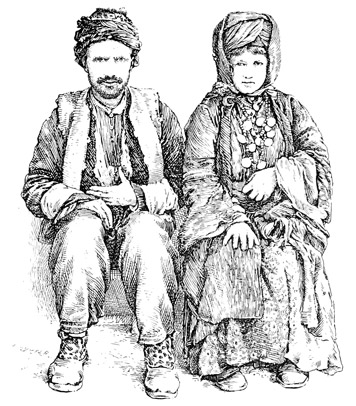
SYRIAN PRIEST AND WIFE.
The Kourbana cannot be celebrated without the assistance of a deacon. It is almost entirely confined to the great festivals and the feast of the patron saint of each village. After the making of the bread with the "holy leaven," and certain preliminaries by the clergy, the congregation comes into church, summoned by blows on the wooden sounding-board. The men stand in front, the women behind, all taking off their shoes and kissing the Cross. When the elements are to be received the priest advances to the door of the sanctuary, and a deacon, completely enveloped by the curtain before the entrance, holds the paten while the priest gives the bread to the men first, then to the women and to the little children, held up either by father or mother. The adults receive the cup in order from the deacon, who passes it through a hole in a wall about six feet high, which runs parallel with the wall of the sanctuary, but at a little distance from it. On leaving the church after communion each person takes a piece of ordinary bread from a tray near the door. The priests and deacons communicate after the people when the sanctuary veil has again been drawn. The Eucharist is always celebrated at or before daybreak, except in the case of certain fast days and at funerals, when it is considered a devotional act to fast till mid-day. During parts of the communion service one deacon swings a censer and another "clangs" a cymbal.
The Kourbana as celebrated in the Syrian villages reminds me both of the great communion gatherings of the Scottish Highlands and the Church service which, in my childhood, ushered in the revelry of the village wake or feast. The festivals which, as in England, fall on the feast of the patron saint of the village are the great gaieties of Syrian life, and even the Kurd cannot altogether overshadow them. After the celebration of the Kourbana at dawn, when the crowds are frequently so great that the church is filled by several successive congregations of communicants, the day is spent in visiting, and in every house fruit, sweetmeats, and tea are provided for all comers, and arak, if it be obtainable, forms a part of the entertainment. Dances and games are kept up all day, and at its close many are drunk and disorderly. These are the occasions when fighting with the Moslems is apt to take place.
Men and women, of course, dance separately, and the women much in the background. The dancing, as I have seen it, is slow and stately. A number of either sex join hands in a ring, and move round to slow music, at times letting go each other's hands for the purpose of gesticulation and waving of handkerchiefs. It is not unlike the national dance of the Bakhtiaris. The women not only keep in retirement on this but on all occasions. They never sit at meat with the men, but take their food afterwards in private—indeed, I strongly suspect that they eat the leavings of their superiors. It is not, however, only the women who occupy a subordinate position. Young men treat not only their fathers but their elder brothers with extreme respect; and when there are guests at table the sons do not sit down with the fathers, but wait on the guests, and take their own meals, like the women, afterwards.
The Syrians call Easter "The Great Feast" and Christmas "The Little Feast." At the former, eggs coloured red are lavishly bestowed. The festival of the Epiphany also receives great honour, but it is curious that a people who believe that they owe their Christianity to the Wise Men should not keep this feast so much in commemoration of them as of our Lord's baptism. So much does the latter view preponderate, that the Urmi Christians call it by a name which means "The New Waters." Here in the mountains, however, it is called "The Brightness." During the night before the celebration of the Kourbana on the Feast of the Epiphany it is customary to plunge into frozen pools! "One Lord, one faith, one baptism" they hold with us, and it is of great interest to recognise this fact in the midst of many superstitions and even puerilities.
It is impossible by any language to convey an idea of the poverty and meanness, the blackness and accumulations of dust, the darkness and the gloom of the Syrian churches, of which this one is a favourable specimen, typifying, I fear, too truly the gross ignorance, indifference, and superstition in which bishops, priests, and people are buried. And yet they are "faithful unto death." My daily wonder is that people who know so little will for that little suffer the loss of all things. Apostasy would be immediate emancipation from terror and ruin, but it is nearly unknown. Their churches are like the catacombs. Few things can be more pathetic than a congregation standing in the dark and dismal nave, kissing the common wooden cross, and passing from hand to hand the kiss of peace, while the priest, in dress like their own, with girdle and stole of the poorest material, moves among the ancient Liturgies in front of the dusty sanctuary, leading the worshippers in prayers and chants which have come down from the earliest ages of Christianity; from the triumphant Church of the East to the persecuted remnant of to-day.
I. L. B.
LETTER XXIX (Continued)
Who is or is not in this house it is hard to say. Mirza tells me that there are 115 guests to-day! Among them are a number of Tyari men, whose wild looks, combined with the splendour of their dress and arms, are a great interest. Their chief man has invited me to visit their valley, and they say if I will go to them they will give me "a fine suit of clothes." I need it much, as doubtless they have observed! Their jackets are one mass of gold embroidery (worked by Jews), their shirts, with hanging sleeves, are striped satin; their trousers, of sailor cut, are silk, made from the cocoons of their own silkworms, woven with broad crimson stripes on a white ground, on which is a zigzag pattern; and their handsome jack-boots are of crimson leather. With their white or red peaked felt hats and twisted silk pagris, their rich girdles, jewelled daggers, and inlaid pistols, they are very imposing. Female dress is very simple.
These Tyari men come from one of the wildest and most inaccessible valleys of Central Kurdistan, and belong to those Ashirets or tribal Syrians who, in their deep and narrow rifts, are practically unconquered by the Turks and unmolested by the Kurds, and maintain a fierce semi-independence under their maleks (lit. kings) or chiefs. They are wild and lawless mountaineers, paying taxes only when it suits them; brave, hardy, and warlike, preserving their freedom by the sword; fierce, quarrelsome among themselves, and having little in common with the rayahs or subject Syrians of the plains except their tenacious clinging to their ancient Church, with its Liturgies and rites, and their homage to our Lord Jesus as divine. They and their priests, many of whom cannot even read, are sunk in the grossest ignorance. They love revenge, are careless of human life, and are wilder and more savage than their nominal masters. It is among these people, who purchase their freedom at the cost of absolute isolation, that Mr. Browne is going to spend the coming winter, in the hope of instructing their priests and deacons, to whom at present guns are more than ordinances. He has been among them already, and has won their good-will.
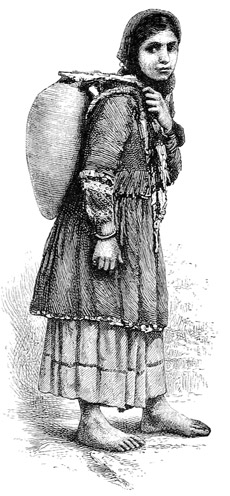
A SYRIAN GIRL.
These Ashirets, of whom the Tyari guests are specimens, are quite unlike the Syrian lowlanders, not only in character but in costume and habits. As they have naturalised numbers of Kurdish words in their speech, so their dress, with its colour, rich materials and embroideries, and lavish display of decorated and costly arms, is almost altogether Kurdish. If report speaks truly their fierce tribal feuds and readiness with the dagger are Kurdish also. Their country is the country of the hunted. Its mountains rise nearly perpendicularly to altitudes of over 12,000 feet, and the valleys, such as Tyari, Tkhoma, Baz, Diz, and Jelu, are mere slits or gashes, through which furious tributaries of the greater Zab take their impetuous course. Above these streams the tribes have built up minute fields by raising the lower sides on stone walls a few feet above the rivers, the upper being the steep hill slope. So small are these plots that it is said that the harvest of some of them would only fill a man's cap! Occasionally heavy floods sweep away the rice and millet cultivation of a whole district, and the mountaineers are compelled to depend for their food entirely on the produce of their flocks.
If they could sustain themselves and their animals altogether within their own fastnesses, they would be secure from molestation either from Kurds or Turks, for the only possible entrances to their valleys are so narrow and ruggedly steep as scarcely to be accessible for a pack-horse, and ten men could keep any number at bay. But unfortunately the scanty herbage of their mountains is soon exhausted, and they have to feed their flocks outside their natural fortifications, where the sheep are constantly being carried off by the Kurds, who murder the shepherds and women. The mountaineers are quick to revenge themselves; they carry off Kurdish sheep, and savage warfare and a life under arms are the normal condition of the Ashirets. The worst of it is, that they are disunited among themselves, and fight and spoil each other as much as they fight the Kurds, even at times taking part with them against their Christian brethren. Travellers are scarcely safer from robbery among them than among the Kurds, but fierce, savage, and quarrelsome as they are, and independent both of Turk and Kurd, they render a sort of obedience to Mar Shimun, who rules them, through their maleks. There is not only enmity between tribe and tribe, but between village and village, and, as in parts of the Bakhtiari country, guides refuse to conduct travellers beyond certain spots, declaring that "blood" bars their farther progress.
Besides the Kurdish and Ashiret inhabitants of these mountains of Kurdistan there are Yezidis, usually called devil-worshippers, and a few Jews and Armenians. Probably there is not a wilder population on the face of the earth, or one of whose ideas, real beliefs, and ways Europeans are so ignorant. What, for instance, do we really know of the beliefs which underlie the religious customs of the Kizilbashes and Yezidis, and of the Christianity to which these semi-savage Ashirets are so passionately attached?
If I were to leave Mr. Browne unnoticed I should ignore the most remarkable character in Kochanes. Clothed partly as a Syrian and living altogether like one,—at this time speaking Syriac more readily than English; limited to this narrow alp and to the narrower exile of the Tyari valley; self-exiled from civilised society; snowed up for many months of the year; his communications even with Van and Urmi irregular and precarious; a priest without an altar; a teacher without pupils; a hermit without privacy; his time at the disposal of every one who cares to waste it; harassed by Turkish officialism and obstruction, and prohibited by the Porte from any active "mission work," it yet would be hard to find a sunnier, more loving, and more buoyant spirit. He has lived among these people for nearly four years as one of themselves, making their interests completely his own, suffering keenly in their persecutions and losses, and entering warmly even into their most trivial concerns, till he has become in fact a Syrian among Syrians. He sits on the floor in native fashion; his primitive and unpalatable food, served in copper bowls from the Patriarch's kitchen, is eaten with his fingers; he is nearly without possessions, he sleeps on the floor "among the spiders" without a mattress, he lives in a hovel up a steep ladder in a sort of tower out of repair—Syrian customs and etiquette have become second nature to him.
He has no "mission work" to report. He is himself the mission and the work. The hostility of the Turkish Government and the insecurity of the country prevent him from opening schools, he cannot even assemble a few boys and teach them their letters; he got a bit of land and the stones for erecting a cottage, but is not allowed to build; his plans are all frustrated by bigotry on one side and timidity on the other, and he is even prevented from preaching by the blind conservatism of the patriarchal court. It has not been the custom to have preaching at Kochanes. "Sermons were dangerous things that promoted heresy," the Patriarch said. But Mr. Browne is far from being idle. People come to him from the villages and surrounding country for advice, and often take it. They confide all their concerns to him, he acts effectively the part of a peacemaker in their quarrels, he is trusted even by the semi-savage chiefs and priests of the mountain tribes, and his medical skill, which is at the service of all, is largely resorted to at all hours of the day. Silenced from preaching and prohibited from teaching, far better than a sermon is his own cheery life of unconscious self-sacrifice, truth, purity, and devotion. This example the people can understand, though they cannot see why an Englishman should voluntarily take to such a life as he leads. His power lies in his singular love for them, and in his almost complete absorption in their lives and interests.
His room is most amusing. It is little better than a Kerry hovel. He uses neither chair, table, nor bed; the uneven earthen floor is covered with such a litter of rubbish as is to be seen at the back of a "rag and bone" shop, dusty medicine bottles predominating. There is a general dismemberment of everything that once was serviceable. The occupant of the room is absolutely unconscious of its demerits, and my ejaculations of dismay are received with hearty laughter.[47]
Humbly following his example, I have become absorbed in the interests of the inhabitants of Kochanes, and would willingly stay here for some weeks longer if it were not for the risk of being blocked in by snow on the Armenian highlands. The cattle plague is very severe, in addition to other misfortunes. The village has already lost 135 of its herd, and I seldom go out without seeing men dragging carcasses to be thrown over the cliff. The people believe that the men will die next year.
My future journey and its safety are much discussed. If I had had any idea of the "disturbed" state of the region that I have yet to pass through I should never have entered Turkey, but now I have resolved to go viâ Bitlis to Erzerum. If the road is as dangerous as it is said to be, and if the rumours regarding the state of the Christians turn out to have much truth in them, the testimony of a neutral observer may be useful and helpful. At all events the risk is worth running. My great difficulty is that Qasha —— must leave me here to return to Urmi with Mar Gauriel's escort, and that I have no competent man with me in case of difficulty. Mirza not only does not speak Turkish, but has no "backbone," and Johannes, besides having the disadvantage of being an Armenian, is really half a savage, as well as disobedient, bad-tempered, reckless, and quarrelsome. He fought with a Turk at Yekmala, and got me into trouble, and one of his first misdemeanours here was to shoot the church doves, which are regarded as sacred, thereby giving great offence to the Patriarch.
It is most difficult to get away. The Julamerik muleteers are afraid of being robbed on the route I wish to take, and none of them but a young Kurd will undertake my loads, and though he arrived last night the zaptiehs I applied for have failed me. They were to have been here by daylight this morning, and the loads were ready, but nine o'clock came without their appearance. I wanted to take armed men from Kochanes, but Mar Shimun said that twelve Christians would be no protection against the Kurds, and that I must not go without a Government escort, so things were unpacked. Late this evening, and after another messenger had been sent to Julamerik, one zaptieh arrived with a message that they could not spare more, and the people protest against my leaving with such insufficient protection.
Another difficulty is the want of money. Owing to the "boom" in silver in Persia, and the semi-panic which prevailed, the utmost efforts of my friends in Urmi could only obtain £10 for a £20 note, and this only in silver mejidiehs, a Turkish coin worth about 4s. As no money is current in the villages change cannot be procured, and on sending to Julamerik for small coins, only a very limited quantity could be obtained—Russian kopecks locally current at half their value, Turkish coins the size of a crown piece, but so debased that they are only worth 1s., a number of pieces of base metal the size of sixpences, and "groats" and copper coins, miserably thin. It took me an hour, even with Mr. Browne's help, to count 8s. in this truly execrable money. The Julamerik shroff sent word that the English sovereign is selling at 16s. only.
So, owing to these delays, I have had another day here, with its usual routine of drinking coffee in houses, inviting women to tea in my room, receiving mountaineers and others who come in at all hours and kiss my hand, and smoke their long pipes on my floor, and another opportunity of walking in the glory of the sunset, when the mountain barriers of beautiful Kochanes glow with a colouring which suggests thoughts of "the land which is very far off." Good Mr. Browne makes himself one with the people, and is most anxious for me to identify everybody, and say the right thing to everybody—no easy task, and as I hope and fear that this is my last evening, I have tried to "leave a pleasant impression" by spending it in the great gathering-place, called pre-eminently the "house"! Mirza says that the people talk of nothing but "guns, Kurds, the harvest, and the local news," but the conversation to-night had a wider range, and was often very amusing, taking a sombre turn only when the risks of my journey were discussed, and the possible misconduct of my Kurdish katirgi. Ishai, who describes him as "a very tame man" (not at all my impression of him), has told him that "if he gives any trouble the House of Mar Shimun will never forget it."
Nothing could exceed the picturesqueness of the "house" to-night. There were doubtless fifty people there, but the lamps, which look as old as the relentless sweep of Taimurlane, hanging high on the blackened pillars, only lighted up the central group, consisting of Sulti and Marta in the highest place, the English priest in his turban and cassock, the grotesque visage of Shlimon the Jester, and the beautiful face and figure and splendid dress of Ishai the Patriarch's brother, as proud as proud can be, but sitting among the retainers of his ancient house playing on a musical instrument, the hereditary familiarity of serf and lord blending with such expressions of respect as "your foot is on my eyes," and the favourite asseveration, "by the Head of Mar Shimun." The blackness in which the lofty roof was lost, the big ovens with their busy groups, the rows of men, half-seen in the dimness, lounging on natural ledges of rock, and the uphill floor with its uncouth plenishings, made up such a picture as the feudalism of our own middle ages might have presented.
My letter[48] from the Turkish Ambassador at Tihran was sent to Julamerik this afternoon, and has produced another zaptieh, and an apology!
I. L. B.
LETTER XXX
Kotranis, Kurdistan, Oct. 28.
Here, in one of the wildest of mountain hamlets, I hoped to indulge in the luxury of my tent, and it was actually unrolled, when all the village men came to me and with gestures of appeal besought me not to pitch it, as it would not be safe for one hour and would "bring trouble upon them." The hamlet is suffering terribly from the Kurds, who are not only robbing it of its sheep and most else, but are attempting to deprive the peasants of their lands in spite of the fact that they possess title-deeds. This Berwar-Lata valley has been reduced from a condition of pastoral wealth to one of extreme poverty. Kotranis, and Bilar a little lower down, from which the best hones are exported, are ruined by Kurdish exactions. The Christians sow and the Kurds reap: they breed cattle and sheep and the Kurds drive them off when they are well grown. One man at —— a few miles off, had 1000 sheep. He has been robbed of all but sixty. This is but a specimen of the wrongs to which these unhappy people are exposed. The Kurds now scarcely give them any respite in which "to let the sheep's wool grow," as their phrase is.
Kotranis is my last Syrian halting-place, and its miseries are well fitted to leave a lasting impression. It is included in the vilayet of Van, in which, according to the latest estimates, there are 80,000 Syrian Christians. The rayahs either own the village lands or are the dependants or serfs of a Kurdish Agha or master. In either case their condition is deplorable, for they have practically no rights which a Kurd or Turk is bound to respect. In some of their villages they have been robbed till they are absolutely without the means of paying taxes, and are beaten, till the fact is established beyond dispute. They are but scantily supplied with the necessaries of life, though their industry produces abundance. Squeezed between the rapacity and violence of the Kurds and the exactions of the Turkish officials, who undoubtedly connive at outrages so long as the victims are Christians, the condition of these Syrians is one of the most pitiable on earth. They have no representatives in the cities of Europe and Asia, and no commercial instincts and habits like the Armenians. They have the Oriental failings of untruthfulness and avarice, and the cunning begotten by centuries of oppression, but otherwise they are simple, grossly ignorant, helpless shepherds and cultivators; aliens by race and creed, without a rich or capable man among them, hemmed in by some of the most inaccessible of mountain ranges, and by their oppressors the Kurds; without a leader, adviser, or friend, rarely visited by travellers, with no voice which can reach Europe, with a present of intolerable bondage and a future without light, and yet through all clinging passionately to the faith received by tradition from their fathers.
As I have no lodging but a dark stable, I am utilising the late afternoon, sitting by the village threshing-floor, on which a mixed rabble of animals is treading corn. Some buffaloes are lying in moist places looking amiable and foolish. Boy is tied to my chair. The village women knit and stare. Two of the men, armed with matchlock guns, keep a look-out for the Kurds. A crystal stream tumbles through the village, over ledges of white quartz. Below, the valley opens and discloses ranges bathed in ineffable blue. The mountain sides are aflame with autumn tints, and down their steep paths oxen are bringing the tawny gold of the late harvest on rude sledges. But the shadow of the Kurd is over it all. I left English-speaking people so lately that I scarcely realise that I am now alone in Central Kurdistan, in one of the wildest parts of the world, among fierce predatory tribes, and a ravaged and imperilled people.