Front matter (continued 4)
Reading edition
At sunset, as in all Persian towns, a great hush falls on Hamadan. Only people who have business are seen in the streets, the bazars are closed, and from sunset to sunrise there would be complete silence were it not for the yelping and howling of the scavenger dogs and the long melancholy call to prayer from the minarets. If it is necessary to go out at night a person of either sex is preceded by a servant carrying a lantern near the ground. These lanterns have metal tops and bottoms, and waxed, wired muslin between, which is ingeniously arranged to fold up flat. They are usually three feet long, but may be of any diameter, and as your consideration is evidenced by the size of your lantern there is a tendency to carry about huge transparencies which undulate very agreeably in the darkness.
This is the Moharrem or month of mourning, for Hassan and Houssein, the slain sons of Ali, who are regarded by the Shiahs as the rightful successors of the Prophet and as the noblest martyrs in the Calendar. During this period the whole Persian community goes into deep mourning, and the streets and bazars are filled with black dresses only. In this month is acted throughout the Empire the Tazieh or Passion Play, which has for its climax the tragic deaths of these two men.[17]
I arrived in Hamadan on what should have been the first day of Moharrem, but there had been a difference of opinion among the mollahs as to the date, and it was postponed to the next day, for me a most fortunate circumstance, as no Christian ought to be seen in the streets at a time when they are filled with excited throngs frenzied by religious fanaticism. On the following day the quiet of the city was interrupted by singular cries, and by children's voices, high pitched, singing a chant so strange and weird that one both longs and dreads to hear it repeated. The Christians kept within their houses. Business was suspended. Bands of boys carrying black flags perambulated the town, singing one of the chants of the Passion Play. As night came on it was possible to feel the throb of the excitement of the city, and till the small hours the march of frenzied processions was heard, and the loud smiting on human breasts and the clash of the chains with which the dervishes beat themselves, were intermingled with a united rhythmic cry of anguish—Ah Houssein! Wai Houssein! (O Houssein! Woe for Houssein!) Ya Houssein! Ya Hassan! and in the flickering light of the torches black flags were waving, and frenzied men were seen beating their bare breasts.
In some of the cities these processions are a sickening spectacle. Throngs move along the streets, escorting large troops of men either stripped to their waists or wearing only white shirts which expose the bosom. Beating their breasts with their right hands in concert till they make them raw, gashing themselves on their heads with daggers, streaming with blood, and maddened by religious frenzy, they pass from street to street, and the yell rises from all quarters, Ya Houssein! Wai Houssein! Occasionally men drop down dead from excitement, and others, falling from loss of blood, are carried away by their friends. It is at the end of the month of mourning that these processions, called testeh, increase so much in frenzy and fanaticism as to be dangerous to the good order of cities, clashing with each other, and sometimes cutting their way through each other with loss of life. To join in a testeh is to perform a "pious act," and atones for sin committed and to be committed. The Tazieh or Passion Play itself, acted in splendour before the Shah, is repeated everywhere throughout Persia, lasting from ten to twelve days, the frenzy with which the different incidents are received culminating on the last day, when the slaughter of Houssein is represented. On the whole the Tazieh is among the most remarkable religious phenomena of our age.
Under the rule of the present Prince Governor complete religious toleration exists in Hamadan, and the missionaries have a fair field, though it must never be forgotten that a proselytising Christian, rendering honour to Christ as God, by his mere presence introduces a disturbing element into a Moslem population. In consequence of this tolerant official spirit there are a few Moslem girls among the sixty boarders here. In addition there are a large number of day pupils.
The girls live in native fashion, and wear native dresses of red cotton printed with white patterns, white chadars, and such ornaments as they possess. They sit on the floor at their meals, at each of which one of the ladies is present. They have excellent food, meat once a day in summer and twice in winter, bread, tea, soup, curds, cheese, melons, cucumbers, pickles, and gourds. The winter supplies are now being laid in, and caravans of asses are arriving daily with firewood, cheeses, and melons. The elder girls cook, and all the washing, making, and mending are done at home, each elder girl in addition having a small family of young ones under her care. The only servant is the bheestie or water-carrier. The dormitories, class-rooms, eating-room, and hammam are large and well ventilated, but very simple.
A plain but thorough education of the "National School" type is given, in combination with an industrial training, fitted for girls whose early destiny is wifehood and maternity. Some of the teachers are men, but the religious instruction, on which great stress is laid, is given by the ladies themselves, and is made singularly interesting and attractive. Music and singing are regarded as among the recreations. The discipline is perfect, and the dirtiest, roughest, lumpiest, and most refractory raw material is quickly transformed into cleanliness, brightness, and docility, partly by the tone of the school and the influence of the girls who have been trained in it, but chiefly by the influence of love.
The respect with which the office of a teacher is regarded in the East allows of much more apparent familiarity than would be possible with us. Out of school hours the ladies are accessible at all times even to the youngest children. Many a little childish trouble finds its way to their maternal sympathies, and they are just as ready to give advice about the colour and making of dolls' clothes as about more important matters. The loving, cheerful atmosphere of an English home pervades the school. I write English rather than American because the ladies are Prince Edward Islanders and British subjects.
Some of the girls who have been trained here are well married and make good wives, and the school bids fair to be resorted to in the future by young men who desire companionship as well as domestic accomplishments in their wives. The ordinary uneducated Armenian woman is a very stupid lump, very inferior to the Persian woman. Of the effect of the simple, loving, practical, Christian training given, and enforced by the beauty of example it is easy to write, for not only some of the girls who have left the school, but many who are now in it show by the purity, gentleness, lovingness, and self-denial of their lives that they have learned to follow the Master, a lesson the wise teaching of which is, or should be, I think, the raison d'être of every mission school. Christianity thus translated into homely lives may come to be the disinfectant which will purify in time the deep corruption of Persian life.
The cost of this school under its capable and liberal management is surprising—only £3:15s. per head per annum! Its weak point (but at present it seems an inevitable blemish) is, that the board and education are gratuitous.
There is a High School for boys, largely attended, under the charge of Mr. Watson, the clerical missionary, with an Armenian Principal, Karapit, educated in the C.M.S. school in Julfa, a very able man, and he is assisted by several teachers. There is also a large school of Jewish girls, who are often maltreated on their way to and from it.
There are a flourishing medical mission and dispensary under Dr. Alexander's charge, with a hospital nearly finished for the more serious cases. There is another dispensary at Sheverin, and both there and here the number of patients is large. A small charge is made for medicines. Mirza Sa'eed, a medical student of mature years and remarkable capacities, occasionally itinerates in the distant villages, and, being a learned scholar in the Koran, holds religious disputations after his medical work is done. He was a Moslem, and having embraced Christianity preaches its doctrines with much force and enthusiasm. He is popular in Hamadan, and much thought of by the Governor in spite of his "perversion." He also gives addresses on Christianity to the patients who assemble at the dispensary. Any person is at liberty to withdraw during this religious service, but few avail themselves of the permission. Miss —— speaks on Christianity to the female patients at Sheverin, and befriends them in their own homes.
The day's work here begins at six, and is not over till 9 p.m. An English class for young men is held early, after which people on business and visitors of all sorts and creeds are arriving and departing all day, and all are welcome. On one day I counted forty-three, and there were many more than these. The upper class of Persian women announce their visits beforehand, and usually arrive on horseback, with attendants to clear the way. No man-servant must enter the room with tea or anything else during their visits. The Armenian women call at all hours, and the Jewish women in large bands without previous announcement. Tea à la Russe is provided for all, and Ibrahim goes to the door and counts the shoes left outside in order to know how many to provide for. "Khanum," he exclaimed one day after this inspection, "there are at least twenty of them!"
Some call out of politeness or real friendliness, others to see the tamasha (the sights of the house), many from the villages to talk about their children, and some of the Jewish women, who have become Bābis, ask to have the New Testament read to them in the hope of hearing something which they may use in the propagation of their new faith. A good many women have called on me out of politeness to my hostesses. Persian gentlemen invariably send the day before to know if a visit can be conveniently received, and on these occasions the ladies always secure the chaperonage of one of the men missionaries. The concierge has orders not to turn any one away, and it is a blessing when sunset comes and the stream of visitors ceases.
All meet with a genial reception, and the ladies usually succeed not only in lifting the conversation out of the customary frivolous grooves, but in awaking more or less interest in the religion which they are here to propagate. They are missionaries first and everything else afterwards, and Miss ——, partly because of her goodness and benevolence to all, and partly because of an uncompromising honesty in her religious beliefs which the people thoroughly appreciate, has a remarkable influence in Hamadan, and is universally respected. Her jollity and sense of humour are a great help. She thoroughly enjoys making people laugh.
I have never been in any place in which the relations with Moslems have been so easy and friendly. The Sartip Reza Khan told me it would be a matter of regret to all except a few fanatics if the ladies were to leave the city. From the Prince Governor downwards courtesy and kindness are shown to them, and their philanthropic and educational work is approved in the highest quarters, though they never blink the fact that they are proselytisers.[18]
There is an Armenian Protestant congregation with a native pastor and a fine church, and nothing shows more plainly the toleration which prevails in Hamadan than the number of Moslems to be seen every Sunday at the morning service, which is in Persian. In this church total abstinence is a "term of communion," and unfermented wine is used in the celebration of the Eucharist.
This wine is very delicious, and has the full flavour and aroma of the fresh grape even after being three years in bottle. It is not boiled, as much "unfermented wine" is here, but the grapes are put into a coarse bag, through which the juice drops without pressure. The gluten being retained by the bag, fermentation does not take place, and a bottle of the juice, even if left without a cork, retains its excellence till it dries up.
Hamadan, September 15.—"Revenons à nos moutons"—the moutons in this instance being my travelling arrangements. Three roads go to Urmi from Hamadan, one, the usual caravan route viâ Tabriz, the commercial capital of Persia, and round the north end of Lake Urmi, very long, but safe; another called the "Kurdistan route," which no charvadar will take by reason of its danger; and a third by Sujbulāk, the capital of Persian Kurdistan, twenty marches, only five of which are reported as risky. I decided on the last, but it was only two days ago that I was able to get a charvadar willing to undertake the journey. "It is too late," they say, "there are robbers on the road," they "don't know the way," or "provender is dear," or "snow will come on" before they can return. Kerbelai, the excellent fellow who brought my loads from Burujird, wished to go, and I engaged him gladly, but afterwards his father came and declared he could not let him go, for he did not know the way, and would be robbed. Another man was engaged, but never reappeared.
Soon after I came a tall, well-dressed rich Turk, the owner of sixty mules, applied for the engagement, and we think that by certain underhand proceedings, familiar to the Persian mind, he has driven off other competitors, and made himself my last resource. I engaged him on Saturday, and the mules and Mirza went off this morning. An agreement was drawn up in Persian and English placing five mules under my absolute control, to halt or march as I desire, at thirteen pence a day each so long as I want them, with two men, "handing over the mules and men" to me till I reach Urmi, which arrival is to suit my own convenience. This was read over twice, and the Turk sealed it in presence of four witnesses. All his other mules are going with loads to Urmi, and this accounts for his great desire to send the five with me. I have expressly stipulated that I am to have nothing to do with the big caravan, but am to take my own time. This Turk has good looks and plausible manners, and the animals have sound backs, but I distrust him.
The servant difficulty, which threatened to keep me here indefinitely, is also adjusted. Hassan left me when I arrived, being unwilling to go to the north of Persia so late, and he bought a new opium pipe, saying that he cannot bear the pain and craving of being without it. He was a fair travelling servant for a Persian, not unreasonably dishonest, and I am sorry to lose him. In the attempt to replace him a maze of lies, fraud, and underhand dealing has been passed through. I have at last engaged Johannes, a strong-looking young Armenian, speaking Turkish and Persian besides Armenian. He has never served Europeans, but has learned baking and the wine trade. He looks much of a cub. For appearance sake I have armed him with a long gun. He and Mirza are alike incompetent to make any travelling arrangements or overcome any difficulties, to discover where escorts are needed and where they may be dispensed with, or to meet any emergencies, and as Persian will be considerably replaced by Turki en route Mirza will be of less and less use as an interpreter. I cannot get any recent information about the route, and very little at all. I see endless difficulties ahead, and a prospect of illustrating in my own experience the dictum often dinned into my ears, that "No lady ought to travel alone in Persia."
This will be my last opportunity of posting a letter for nearly a month. The Persian post is only exceeded in unreliability by the Persian telegraph. To register letters is the only way of securing their safe arrival, and it is necessary to send a trustworthy man to the Post Offices, who, after seeing the effacing stamp put upon the postage stamp, will further insist upon seeing the postmaster put the letters in the bag. In Tihran the Europeans make much use of the Legation bags, and the merchants prefer to trust their letters to private gholams rather than to the post, while at Isfahan people are often glad to send their letters by the monthly telegraph chapar rather than run a postal risk. However, a foreign letter, registered, is pretty safe. The telegraph is worse; you often have to bribe the telegraph clerk to send the message, and unless you see it sent it will probably be destroyed. Of five messages sent by me from Hamadan one was returned because the British agent in Isfahan was "not known" (!), two were slower than letters sent the same day, the fourth took a week, and of the fifth there is "no information." Even in this important commercial city the Post Office is only open for a short time on two days in the week.
I. L. B.
LETTER XXV
Gaukhaud, Sept. 18.
This is a difficult journey. The road is rarely traversed by Europeans, the marches are long, and I am really not well enough to travel at all, not having been able to shake off the fever. Cooler days and cold nights are, however, coming to the rescue.
My Hamadan friends gave me a badraghah (a parting escort)—Miss C. M——, Mr. Watson, Pastor Ovannes and his boy, all on horseback; Mrs. Watson and her baby on an ass; several servants on foot, and Miss M—— and Mrs. Alexander in a spidery American buggy with a pair of horses; Dr. Alexander, a man six feet two inches high and very thin, "riding postilion" on one of them to get the buggy over difficult places; Ibrahim, the ladies' factotum, with a gun slung behind him, following on horseback. Two of the ladies and the native pastor stayed at night. It was not a pleasant return to camp life, for Johannes is quite ignorant of it, and everything was at sixes and sevens. Nor was the first morning pleasant, for the head charvadar, Sharban, came speaking loud with vehement gesticulation, saying that if I did not march with the big caravan and halt when it did, they would only give me one man, and added sundry other threats. Miss M—— scolded him, reminding them of their agreement, and Ibrahim told them that if they violated it in the way they threatened they would have to "eat more wood than they had ever eaten in their lives on going back to Hamadan." ("Eating wood" is the phrase for being bastinadoed.) A squabble the first morning is a usual occurrence, and Miss M—— thought it would be all right, and advised me to go on to Kooltapa, the first stage put down by the charvadars.
Cultivation extends over the eight miles from Hamadan to Bahar. There are streams, and willows, and various hamlets with much wood, and Bahar is completely buried in orchards and poplars. It is a place of 1500 people, and has well-built houses, small mosques, and mollahs' schools. It makes gelims (thin carpets), and grows besides wheat, barley, cotton, and oil seeds, an immense quantity of fruit, which has a ready market in the city.
Miss M—— and Pastor Ovannes escorted me for the first mile, and, meeting the caravan on their way back, gave Sharban a parting exhortation. As soon as they were out of sight he sent back one man, and, in spite of Mirza's remonstrances, drove my yabus with the big caravan—a grievance to start with, as his baggage animals were so heavily loaded that they could not go even two miles an hour, and I have taken five, though I only need three, in order to get over the ground at three miles an hour. I am obliged to have Johannes with me, as comparatively little Persian is spoken by the common people along this road.
Beyond Bahar the road lies over elevated table-lands, destitute of springs and streams, and now scorched up. One or two small villages, lying off the track, and some ruinous towers on eminences, built for watching robbers, scarcely break the monotony of this twenty-four miles' march.
At three, having ascended nearly 1000 feet, we reached the small and very poor walled village of Kooltapa, below which are some reservoirs, a series of pools connected by a stream, and the camping-ground, a fine piece of level sward, much of which was already occupied by two Turkish caravans, with 100 horses in each, and a man to every ten. The loads were all carefully stacked, covered with rugs, and watched by very large and fierce dogs.
I lay down in the shuldari, feeling really ill. Four o'clock, five o'clock, sunset came, but no caravan. Johannes was quite ill, but went to the village to hire a samovar, and to try to get tea and supplies. There was neither tea nor samovar, and no supplies but horse food and some coarse cheese and blanket bread, too sour and dirty to be eaten. Long after dark they brought a little milk. Boy was locked up in a house, and I rolled myself in his blanket and the few wraps I had with me, and, making the best of circumstances, tried to sleep; but it was too cold, and the position too perilous, and Johannes, who had loaded his gun with ball, overcome with fatigue, instead of watching was sound asleep. At eleven Mirza's voice, though it said, "Madam, these charvadars won't do for you, they are wicked men," was very welcome. They had stopped half-way, and four of them, including Sharban's father, had dragged him off his horse with some violence, and had unloaded it. He appealed to the village headman, who, after wrangling with them for some hours, persuaded them to let him have a mule, and come to Kooltapa with the servants' tent, my bed, and other comforts, and sent two armed guides with him.
The larger tent was pitched and I went to bed, and not having the nettings which hang from the roof of my Cabul tent, and are a complete security against mere pilferers, I put all I could under the blankets and arranged the other things within reach of my hand in the middle of the tent. I also burned a light, having learned that Kooltapa is a dangerous place. At midnight the Turkish caravans started with noise inconceivable, yells of charvadars, shouts of village boys, squeals of horses, barking of big dogs, firing of guns, and jangling of 200 sets of bells, all sobering down into a grandly solemn sound as of many church steeples on the march.
I went out to see that all was right, found my servants sleeping heavily and had not the heart to awake them, found the mercury a degree below the freezing point, and lay down, covering my head with a blanket, for the shivering stage of fever had come on. The night was very still, and after some time I heard in the stillness the not uncommon noise of a dog (as I thought) fumbling outside my tent. I took no notice till he seemed getting in, when I jumped up with an adjuration, saw the floor vacant, and heard human feet running away. I ran out and fired blank cartridge several times in the direction of the footsteps, hoping that the flashes would reveal the miscreant, but his movements had been more agile than mine. Mirza ran into the village and informed the ketchuda, but he took it very quietly and said that the robbers were Turks, which was false. I offered a large reward, but it was useless.
When daylight came and I investigated my losses I found myself without any of the things which I have come to regard as indispensable. My cork helmet, boots, gloves, sun umbrella, stockings, scanty stock of underclothing, all my brushes, towels, soap, scissors, needles, thread, thimble, the strong combination knife which Aziz coveted and which was used three or four times every day, a large silk handkerchief a hundred years old which I wore as a protection from the sun, my mask, revolver case, keys, pencils, paint brushes, sketches, notes of journeys, and my one mug were all gone. If anything could be worse, my gold pen, with which I have written for the last eighteen years, had also disappeared. Furthermore, to relieve the tedium of the long wait during the pitching of my tent, and of the hour's rest which I am obliged to take on my bed after getting in, I was "doing" a large piece of embroidery from an ancient Irish pattern, arabesques on dark, apricot-coloured coarse silk in low-toned greens, pinks, and blues, all outlined in gold. This work has been a real pleasure to me, and I relied on it for recreation for the rest of my journey. Gone too, with all the silks and gold for finishing it! Now I have nothing to do when the long marches are over, and as I can scarcely write with this pen and have also lost my drawing materials, a perspective of dulness opens out before me. If Sharban had not disobeyed orders and stayed behind with my tent all this would not have happened. I now realise what it is to be without what to a European are "the necessaries of life," and I can scarcely replace any of them for three weeks.
The caravan came in at nine, and I soon got into my tent and spent much of the day in making a head-cover by rolling lint and wadding in handkerchiefs and sewing them up into a sort of turban with a leather-needle and packthread obtained from Mirza. I was able to get from a villager a second-hand pair of ghevas,—most serviceable shoes, with "uppers" made of stout cotton webbing knitted here by the women and among the Bakhtiaris by the men, and with soles of rag sewn and pressed tightly together and tipped with horn. These and the "uppers" are connected with very stout leather brought to a point at the toe and heel. Ghevas are the most comfortable, and for dry weather and mountain-climbing the most indestructible of shoes. Thus provided I have to face the discomfort caused by the other losses as best I may. "It's no use crying over spilt milk!"
The day before, when the charvadars pulled Mirza off his mule and he threatened them with the agreement, they replied that it was false that they had made any agreement except to take me to Urmi in twenty days, and that they were not afraid of the Prince Governor of Hamadan, "for he is always asleep, and the Feringhi is only a Khanum." I sent to them that I wished to leave Kooltapa at noon. They replied that they were not going to move. I was in their power, for they had received advance pay for seven days, and I said no more about moving. However, at noon I sent Mirza to read the agreement to them, and Sharban and his father could not deny the authenticity of the seal, and a superior villager, who could read, testified that Mirza had read it correctly.
They then saw that they had put themselves into a "tight place," and sent that they desired to humble themselves, saying, "your foot is on our eyes," a phrase of humility. I took no notice of them all day, but at sunset sent for Sharban, and telling Mirza not to soften down my language, spoke to him in few words. "You have broken your agreement, and you will have to take the consequences. Your conduct is disgraceful and abominable, so cowardly that you don't deserve to be called a man, it is only what one would expect from a pidar sag. Do you mean to keep your agreement or not?" He began to whine, and threw himself at my feet, but I reluctantly assumed a terrific voice, and saying "Khamosh! Bero!" (Be silent! Begone!), shut the tent.
Bijar, September 21.—No Persian ever believes your word, and these poor fellows did not believe that I had letters to the governors en route. They are now terribly frightened, and see that a Feringhi, even though "only a Khanum," cannot be maltreated with impunity. When I arrived here, even before I sent my letter of introduction, the Governor sent a farash-bashi with compliments and offers of hospitality, and afterwards a strong guard. Then Sharban piteously entreated that I would not take him before the Governor, and would not make him "eat wood," and his big caravan at last has chimed away on its northward journey to be seen no more. Thus, by acting a part absolutely hateful to me, the mutiny was quelled, and things are now going on all right, except that Sharban avails himself of small opportunities of being disobliging. I do sincerely detest the cowardliness of the Oriental nature, which is probably the result of ages of oppression by superiors.
It is so vexing that the policy of trust which has served me so well on all former journeys has to be abandoned, and that one of suspicion has to be substituted for it. I am told by all Europeans that from the Shah downwards no one trusts father, brother, wife, superior, or inferior. Every one walks warily and suspiciously through a maze of fraud and falsehood. If one asks a question, or any one expresses an opinion, or tells what passes for a fact, he looks over each shoulder to see that no one is listening.[19]
A noble Persian said to me, "Lying is rotting this country. Persians tell lies before they can speak." Almost every day when one is wishing to be trustful, kind, and considerate, one encounters unmitigated lying, cowardly bluster, or dexterously-planned fraud, and the necessity of being always on guard is wearing and repulsive.
Here is another specimen of the sort of net which is woven round a traveller. At Kooltapa, after the theft, I sent to the ketchuda for a night-watchman, and he replied that he could not give one without an order, and that as he knew only Turki, my letter in Persian from the Prince Governor of Hamadan was nothing to him. Later, a sowar, who said he was also a "road-guard," came and said that he only was responsible for the safety of travellers, and that I could not get a watchman from the ketchuda, as no one could pass the gates after sunset without his permission. I already knew that there were no gates. He said he was entitled to five krans a night for protecting the tents. (The charge is one kran, or under exceptional circumstances two.) I told him we were quite capable of protecting ourselves. Late in the evening an apparently respectable man came and warned us to keep a good look-out, as this sowar and another had vowed to rob our tents out of revenge for not having been employed. These men, acting as road-guards, are a great terror to the people. They levy blackmail on caravans and take food for their horses and themselves, "the pick of everything," without payment. The people also accuse them of committing, or being accessory to, the majority of highway robberies. The women who came to condole with me on my losses accused these men of being the thieves, but it was younger feet which clattered away from my tent.
Sharban, thoroughly subdued for the time, and his servant watched, and to show that they were awake fired their guns repeatedly. The nightly arrangement now is to secure a watchman from the ketchuda; to walk round the camp two or three times every night to see that he is awake, and that Boy is all right; to secure the yekdan to my bed with a stout mule-chain, and to rope the table and chair on which I put my few remaining things also to the bed, taking care to put a tin can with a knife in it on the very edge of the table, so that if the things are tampered with the clatter may awake me.
After leaving Kooltapa, treeless country becomes bushless, and nothing combustible is to be got but animal fuel. Manure is far too precious for this purpose to be wasted on the fields. Men with asses follow caravans and collect it in bags. The yards into which the flocks and herds are driven at night have now been cleaned out, and in every village all the women are occupied in moulding the manure into kiziks or cakes fully a foot long and four inches thick. These, after being dried in the sun, are built up into conical stacks, often exceeding twenty feet in height, and are plastered with a layer of the same material. The making of this artificial fuel is one of the most important industries of Persia, and is exclusively in the hands of women. The preparation of the winter stock takes from six to fourteen weeks, and is very hard wet work. The fuel gives out a good deal of heat, but burns fast. Its combustible qualities are increased by an admixture of cut straw. At this season, between the colossal black stacks of fuel and the conical piles of winter "keep" upon the roofs, the villages are almost invisible.
The march to Gaukhaud was over twenty miles of rolling scorched table-lands—baked mud, without inhabitants. Gaukhaud and the villages for fifty miles farther are unwalled, but each house, with its cattle-yard and upper and underground folds, has a massive mud wall sloping slightly inwards, with an entrance closed by a heavy wooden gate, strengthened with iron. The upper sheep-folds have thick stone doors three feet square. Each house is a fortress, and nothing is to be seen above its walls but a quantity of beehive roofs and a number of truncated cones of winter fodder on a central platform.
The female costume is also different. The women, unveiled, bold-faced, and handsome in the Meg Merrilees style, wear black sleeveless jackets vandyked and tasselled, red skirts, and black handkerchiefs rolled round their heads. Little Persian is spoken or even understood, and everything indicates that the limit of Persia proper, i.e. the Persia of Persians, has been passed. Gaukhaud is a village of 350 houses, grows wheat, barley, grapes, and melons; and though a once splendid caravanserai on a height is roofless and ruined, and the village has no better water than an irrigation ditch, it is said to be fairly prosperous.
The march to Babarashan is for twenty miles along a featureless irrigated valley about a mile wide, with grass and stubble, several beehive villages, and mud hills never over 150 feet high on either side. Crossing a brick bridge over a trifling stream, and passing through the large village of Tulwar, where men who were burying a corpse politely laid fried funeral-cakes flavoured with sesamum on my saddle-bow, we ascended over low scorched hills, much ploughed for winter sowing, to the beehive village of Babarashan, of 180 houses, abundantly supplied with water, where we camped close to some tents of the Kara Tepe and a large caravan. The dust blown across the camp from the threshing-floors was obnoxious but inevitable. The "sharp threshing instruments having teeth" are not used in this region, but mobs of animals, up to a dozen, tied together, oxen, cows, horses, and asses, are driven over the wheat.
I am finding the disadvantages of having an untrained servant. Johannes that evening ran hither and thither without method, never finished anything, spent an hour in bargaining for a fowl, failed to get his fire to burn, consequently could not cook or make tea, and I went supperless to bed. The same confusion prevailed the next morning, but things have been better since. No life is so charming as camp life, but incompetent servants are a great drawback.
Another uninteresting march of twenty miles over high table-lands and through a valley surrounded by mud hills, with quaint outcrops of broken rock on their summits, and a pass through some picturesque rocky hills brought us into a basin among mountains, in which stands the rather important town of Bijar in the midst of poplars, willows, apricots, and vines. Bijar is said to have 5000 inhabitants. It has a Governor for itself and the surrounding district, and a garrison of a regiment of infantry and 100 sowars to keep the turbulent frontier Kurds in order. It has ruinous mud walls, no regular bazars, only shops at intervals; fully a third is in ruins, and most of the houses and even the Governor's palace are falling into decay. It is, however, accounted a thriving place, and is noted for gelims and carpenters' work. It has four caravanserais, hardly habitable, however, seven hammams, and a few mosques and mollahs' schools. It has an air of being quite out of the world. I have been here two days, and as foreigners are very rarely seen, the greater part of the population has strolled past my tent.
I camped as usual outside the walls, near a small spring, and soon a farash-bashi came from the Governor, with a message expressive of much annoyance at my having "camped in the wilderness when I was their guest, and they would have given me a safe camping-ground in the palace garden." Mirza took my introduction to him, and he sent a second message saying that the next three marches were "very dangerous," and appointed an hour for an interview. Soon eight infantrymen, well uniformed and set up, with rifles and fixed bayonets, arrived and mounted guard round my tent, changing every six hours. This completed Sharban's discomfiture.
Various difficulties arose on Sunday, and much against my will I had to call on the Governor. He received me in a sort of durbar. A great number of men, litigants and others, crowded the corridors and reception-rooms. He looked bloated and dissipated, and seemed scarcely sober. He sat on cushions on the floor, with a row of scribes and mollahs on his right, and many farashes and soldiers stood about the door. Seyyids, handsome and haughty, glanced at me contemptuously, and the drunken giggle of the Khan and the fixed scowl of the motionless row of scribes were really overpowering. Tea was produced, but the circumstances were so disagreeable that I did not wait for the conventional third cup. The Khan said that the ladies are in the country a few miles off, and hoped I would visit them, that some marches on the road are unsafe, and that he would give me a letter which would be useful in procuring escorts after I left his jurisdiction, and he has since sent it. He was quite courteous, as indeed all Persians of the upper classes are, but I hope never again to pass through the ordeal of calling upon a Moslem without a European escort.
Later, the principal wife of the military commander of the district called with a train of shrouded women, followed by servants bringing an abundant dinner, with much fruit. She came to ask me to take up my quarters in the very handsome house which is her husband's, very near my tent. After a good deal of intelligent conversation she asked if I had a husband and children, and on my replying in the negative she expressed very kindly sympathy, but added, "There are things far worse, things which can never be where, as among you, there is only one wife. One may have a husband and children, and yet, God knows, be made nearly mad by troubles," and she looked as if indeed her sorrows were great. Doubtless a young wife has been installed as favourite, or there is a divorce impending.
Takautapa, September 24.—This is a great grain-growing region, and by no means unprosperous, but it only yields one crop a year, the land is ploughed immediately after harvest, and the irrigation is cut off until sowing-time. Consequently nothing can exceed the ugliness of the aspect of the country at this time. There is not one redeeming feature, and on the long marches there is rarely anything to please or interest the eye. On the march from Bijar there was not a green thing except some poplars and willows by a stream, not a blade of grass, not a green "weed,"—nothing but low mud hills, with their sides much ploughed and the furrows baked hard, and unploughed gravelly stretches covered sparsely with scorched thistles.
Eight miles of an easy descent of 1500 feet brought us to the Kizil Uzen, a broad but fordable stream, on the other side of which is Salamatabad, a village consisting chiefly of the large walled gardens and houses of the Governor of Bijar. A little higher up there is a solid eight-arched stone bridge, over 300 feet long. This Kizil Uzen is one of the most important streams in north Persia. It drains a very large area, and after a long and devious course enters the Caspian Sea under the name of the Sefid Rud. Eleven miles from this place I crossed the lofty crest of the ridge which divides the drainage basins of the Kizil Uzen and Urmi. A number of sowars came out and escorted me through a gateway down a road with high walls and buildings on both sides to an inner gateway leading to the Khan's andarun. Here we all dismounted, but the next step was not obvious, for the heavy wooden gate which secludes the andarun was strongly barred, and showed no symptoms of welcome. An aged eunuch put his melancholy head out of a hole at the side, and said that the ladies were expecting me and that food was ready for the animals and the servants, but still the gate moved not. I asked if Mirza could go with me to interpret, the sowars suggesting that he could be screened behind a curtain, quite a usual mode of disposing of such a difficulty. The eunuch returned, and with him the Khan's mother, a fiendish-looking middle-aged woman, who looked through the peep-hole, but on seeing a good-looking young man drew back, and said very definitely that no man could be admitted, especially in the absence of the Khan. All the men were warned off, and the door was opened so as just to allow of my entrance and no more.
The principal wife received me in a fine lofty room with fretwork windows opening on a courtyard with a fountain in it and a few pomegranates, and a crowd of Persian, Kurdish, and negro women, with all manner of babies. The lady is from Tihran, and her manners have some of the ease and polish of the capital. It is still the Moharrem, and she was enveloped in a black chadar, and wore as her sole ornament a small diamond-studded watch as a locket. Her mother-in-law, who, like many mothers-in-law in Persia, fills the post of duenna to the establishment, frightened me by the expression of her handsome face and her sneering, fiendish laugh. It must be admitted that there was much to amuse her, for my slender stock of badly-pronounced Persian is the Persian of muleteers rather than of polite circles, and she mimicked every word I uttered, looking all the time like one of Michael Angelo's "Fates."
The room was very prettily curtained, and furnished with Russian materials, they told me, and the lithographs, the photographs and their frames, and the many "knick-knacks" which adorned the tables and recesses were all Russian. They showed me several small clocks and very ingenious watches, all Russian also. They said that the goods in the shops at Bijar are chiefly Russian, and added, "The English don't try to suit our taste as the Russians do." The principal lady expressed a wish for greater liberty, though she qualified it by saying that men who love their wives could not let them go about as the English ladies do in Tihran. Dinner had been prepared, a huge Persian dinner, but they kindly allowed me to take tea instead, and produced with it gaz (manna) and a cake flavoured with asafœtida. When I came to an end of my Persian, and they of their ideas, I said farewell, and was followed to the gate by the mocking laugh of the duenna.
The sowars asserted that the next farsakh was "very dangerous," so we kept together. Wild, desolate, rolling, scrubless open country it is, the spurs of the Kurdish hills. The sowars were very fussy and did a great deal of galloping and scouting, saying that bands of robber horsemen are often met with on this route, who, being Sunnis, would rejoice in attacking Shiahs. Doubtless they magnified the risk in order to enhance the value of their services. In the early afternoon we reached the Kurdish village of Karabulāk, sixty mud hovels, on the flaring mud hillside, the great fodder stacks on the flat roofs alone making the houses obvious. The water is very bad and limited in quantity, and of milk there was none. The people are very poor and unprosperous, and a meaner set of donkeys and oxen than those which were treading out the corn close to my tent I have not seen.
Though most of the inhabitants are Kurds, there are some Persians and Turks, and each nationality has its own ketchuda. Towards evening the sowars came to me with the three ketchudas, who, they said, would arrange for a guard, and for my escort the next day. I did not like this, for the sowars had good double-barrelled guns, and were in Persian uniform, and had been given me for three days, but there was no help for it. The ketchudas said that they could not guarantee my safety that night with less than ten men, and I saw in the whole affair a design on my very slender purse. A monetary panic set in before I reached Hamadan: the sovereign had fallen from thirty-four to twenty-eight krans, the Jews would not take English paper at any price, I could not cash my circular notes, and it was only through the kindness of the American missionaries that I had any money at all, and I had only enough for ordinary expenses as far as Urmi. I told them that I could only pay two men, and dismissed the sowars with a present quite out of proportion to the time they had been with me.
During these arrangements the hubbub was indescribable, but the men were very pleasant. Three hours later the sowars returned, saying that after riding eight miles they had met a messenger with a letter from the Khan, telling them to go on another day with me. I asked to see the letter, and then they said it was a verbal message. They had never been outside of Karabulāk! I tell this in detail to show how intricate are the meshes of the net in which a traveller on these unfrequented roads is entangled.
Later, ten wild-looking Kurds with long guns, various varieties of old swords, and long knives, lighted great watch-fires on either side of my tent, and put Boy between them. This pet likes fires, and lies down fearlessly among the men, close to the embers.
A little below my camp was a solitary miserable-looking melon garden with a low mud wall. At midnight I was awakened by the loud report of several guns close to my tent, and confused shouts of men, with outcries of women and children. The watchmen saw two men robbing the melon garden, shot one, and captured both. I gave a present to the guards in the morning, and the ketchudas took half of it.
The march to Jafirabad is over the same monotonous country, over ever-ascending rolling hills, with small plateaux among them, very destitute of water, and consequently of population, the village of Khashmaghal, with 150 houses, and two ruined forts, being the one object of interest.
On the way to Jafirabad is the small village of Nasrabad, once a cluster of semi-subterranean hovels, inhabited by thieves. Some years ago the present Shah halted near it on one of his hunting excursions, and observing the desolation of the country, and water running to waste, gave money and lands to bribe a number of families to settle there. There are now sixty houses surrounded by much material wealth. The Shah still divides 100 tumans yearly among the people, and takes a very small tribute. Nasr-ed-Din has many misdeeds to answer for, many despotic acts, and some bloodshed, but among the legions of complaints of oppression and grinding exactions which I hear in most places, I have not heard one of the tribute fixed by him—solely of the exactions and merciless rapacity of the governors and their subordinate officials.
Jafirabad, a village of 100 houses in the midst of arable land, has one of those camping-grounds of smooth green sward at once so tempting and so risky, and we all got rheumatism in the moist chilliness of the night. The mercury is still falling slowly and steadily, and the sun is only really hot between ten and four. Jafirabad is a prosperous village, owned, as many in this region are, by the Governor of Tabriz, who is merciful as to tribute.
Everything was wet, even inside my tent. It was actually cold. In the yellow dawn I heard Mirza's cheerful voice saying, "Madam, they think your horse is dead!" The creature had been stretched out motionless for two hours in the midst of bustle and packing. I told them to take off his nose-bag, which was nearly full, but still he did not move. I went up to him and said sharply, "Come, get up, old Boy" and he struggled slowly to his feet, shook himself, and at once fumbled in my pockets for food, thumping me with his head as usual when he failed to find any. He was benumbed by sleeping on the damp ground in the hoar-frost. The next night he chose to sleep under the verandah of my tent, snoring loudly. He has became quite a friend and companion.
The sowars finally left me there, and I was escorted by the ketchuda, a very pleasant intelligent man of considerable property, with his two retainers. The next stage has the reputation of being "very dangerous," and many people anxious to go to the next village joined my caravan. My tents were guarded by eight wild-looking village Kurds, armed with clubbed sticks and long guns. I asked the ketchuda if two were not enough, and he said that I should only pay for two, the others were there for his satisfaction, that two might combine to rob me, but that more would watch each other, and that the robbers of this region do not pilfer in ones and twos, but swoop down on tents in large parties.
The next march is chiefly along valleys among low hills. The ketchuda did much scouting, not without good reason, and we all kept close together. A party of well-mounted men rode down upon us and joined us. Mirza sidled up to me, and in his usual cheery tones said "Madam, these are robbers." They were men of a well-known band, under one Hassan Khan. They spoke Persian, and Mirza kept me informed of what they were saying. They said they had been out a night and a day without success, and they must take my baggage and horse—they wanted horses badly. The ketchuda, to whom they were well known, remonstrated with them, and the parley went on for some time, they insisting, and he threatening them with the regiment from Bijar, but all he said was of no use, till he told them that I was the wife of the Governor of Tabriz, that I had been paying a visit to Hamadan, and was then going to be the guest of the ladies of Hadji Baba, Governor of Achaz, that I had been committed to him, and that he was answerable for my safety. "You know I am a man of my word," was the conclusion of this brilliant lie, which served its purpose, for they said they knew him, and would not rob me then.
They rode with us for some miles, in fact the leader, a sinister-looking elderly man, in a turban and brown abba like an Arab, rode so close to me that the barrel of his gun constantly touched my saddle. They carried double-barrelled guns besides revolvers. On coming to a part of the country where the ketchuda said the road became safe, I sent the caravan on with the servants, the band having gone in another direction, and halted for two hours. Riding on again, and turning sharply round a large rock, there they all were, dismounted, and rushed out upon us. A mêlée ensued, and as I then had only two men they were two to one, and would certainly have overpowered my escort had not several horsemen appeared in the distance, when they mounted and rode away. One of the horses was scratched, and I got an accidental cut on my wrist. They believed that I had a considerable sum of money with me. The ketchuda of Takautapa said that they had robbed his village of some cattle a few days before.
Takautapa is a village of thirty-five houses, with two shops, and a gunsmith who seemed to drive a "roaring trade." For three days I have scarcely seen an unarmed man. Shepherds, herdsmen, ploughmen, travellers, all carry arms. Mirza went to the Governor of Achaz, six miles off, with my letter from the Governor of Bijar, and he was most courteous. He sent his secretary to ask me to spend a day or two at his house, and told him, in case I could not, to remain for the night to arrange for my comfort and safety, an order very efficiently carried out.[20]
He sent word also that if I could not accept his hospitality I was still to be his guest, and not to pay for anything—a kindness which, for several reasons, I never accept. He added, that though the road was safe, he should send three sowars "to show the Khanum honour," and they had received strict orders not to accept any present. The men who attempted to rob my caravan spent the night here, and, as they had robbed them before, the villagers were very glad of the protection of the Governor's scribe and my sowars.
Sujbulāk, October 2.—Having been "courteously entreated," I sent on the caravan and servants at daybreak, and, having the sowars with me, was able to make the march to Geokahaz at a fast pace. The sowars were three wild-looking Kurds, well mounted, and in galloping Boy had to exert himself considerably to keep up with them, and they obviously tried to force his pace.
The day was cool, cool enough for a sheepskin coat, and the air delightful. The halcyon season for Persian travelling has come, the difficulties are over, and the fever has left me. Brown, bare, and bushless as are the rolling hills over which the road passes, it would be impossible not to enjoy the long gallops over the stoneless soil, the crisp, bracing air, the pure blue of the glittering sky, and the changed altitude of the sun, which, from having been my worst foe is now a genial friend. True, the country over which I pass is not interesting, but, as everywhere in Persia, craggy mountains are in sight, softened by a veil of heavenly blue, and the country, though uninteresting, suggests pleasant thoughts of fertility, an abundant harvest, and an industrious and fairly prosperous people.[21] Turki is now almost exclusively spoken.
The whole of that day's route was an ascent, and the halting-place was nearly 9000 feet in altitude. I crossed the Sarakh river by a three-arched brick bridge, and afterwards the Gardan-i-Tir-Machi, from which there is an extensive view, and reached Geokahaz by a rough path on the hillside frequently dipping into deep gulches, now dry. The wettest of these is close to the village, and is utilised for a flour-mill. Springs abound, and as Persian soil brings forth abundantly wherever there is water, the village, which is Kurdish, confessed to being extremely prosperous. Its seven threshing-floors were in the full tide of winnowing with the fan, and so complete is the process that nothing but the wheat is left on the firm, hardened gypsum floor, recalling the Baptist's words, "Whose fan is in his hand, and he will throughly purge his floor." The wheat was everywhere being gathered "into the garner"—the large upright clay receptacles holding twenty bushels each with which every house is supplied.
This village of only 200 houses owns 7000 sheep and goats, 60 horses and mares, and 400 head of cattle, and its tribute is only 230 tumans. It and very many other villages belong to Haidar Khan, Governor of Achaz, of whom the villagers speak as a lenient lord. Apricot and pear orchards abound, and on a piece of grass in one of these I found my camp most delectably pitched. The ketchuda and several other men came to meet me; indeed, the istikbal consisted of over twenty Kurdish horsemen. The village was absolutely crowded with men and horses, 200 pilgrims being lodged there for the night.
The road at intervals all day had been enlivened by long files of well-mounted men in bands of 100 each on their way to the shrines of Kerbela, south of Babylon, to accumulate "merit," receive certificates, and be called Kerbelai for the remainder of their lives. Superb-looking men in the very prime of life most of them are, cheerful and ruddy, wearing huge black sheepskin caps shaped like mushrooms, high tan-leather boots, gaily embroidered, into which their full trousers are tucked, and brown sheepskin coats covering not only themselves but the bodies of their handsome fiery horses. A few elderly unveiled women were among them. They ride mostly on pads with their bedding and clothing under them, and their kalians and cooking utensils hanging at the sides. All are armed with guns and swords. I met over 1000 of them, most of them Russian subjects, and those who had occasion to pass in front of my tent vindicated their claim to be the subjects of a civilised power by bowing low as often as they saw me. They are really splendid men, and had many elements of the picturesque.
The 200 who halted in Geokahaz were under the command of a Seyyid who, before starting, beat about for recruits, and levied from them about five krans per head. On the journey he receives great honour as a descendant of the Prophet. He has a baggage mule and a tent, and the "pilgrims" under his charge gratefully cook his food, wait on him, groom his animal, water the dusty ground round his tent, shampoo his limbs, keep the flies from him, and are rewarded for the performance of all menial offices by being allowed to kiss his hand. On his part he chooses the best stations and the most fortunate days for starting, and he pledges himself to protect his flock from the woful plots of malignant genii and the effects of the evil eye. On the journey he both preaches and recites tales.
The Seyyid in charge of this party was a man of commanding physique and deadly pallor of countenance. As frigid as marble, out of which his statuesque face might well have been carved, he received the attention paid to him with the sublime indifference of a statue of Buddha. The odour of an acknowledged sanctity hung about him, and pride of race and pride of asceticism dwelt upon his handsome features. He spent the evening in preaching a sermon, and, by a carefully-arranged exhibition of emotion, studied to perfection, wound up his large audience to a pitch of enthusiasm. The subject was the virtues of Houssein, and what preacher could take such a text without enlarging finally upon the martyrdom of that "sainted" man? Then the auditors wept and howled and beat their breasts, and long after I left the singular scene, trained "cheers" for the Prophet, for Ali, and for the martyred Hassan and Houssein, led by the Seyyid, rang out upon the still night air. At midnight, and again at four, a solitary bell-like voice proclaimed over the sleeping village, "There is but one God, and Mohammed is His prophet, and Ali is His lieutenant"; and 200 voices repeated grandly in unison, "There is but one God, holy and true, and Mohammed is His prophet, and Ali is His lieutenant." The addition of the words "holy and true" to the ordinary formula is very striking, and is, I believe, quite unusual. The Seyyid preached in Persian, and the pilgrims speak it.
In such caravans a strictly democratic feeling prevails. All yield honour to the Seyyid, but otherwise all are equal. No matter what the social differences are, the pilgrims eat the same food, lodge in the same rooms, sit round the same bivouac fire, and use towards each other perfect freedom of speech—a like errand and a like creed constituting a simple bond of brotherhood.
Geokahaz is the first Kurdish village in which I have really mixed with the people. I found them cordial, hospitable, and in every way pleasant. The ketchuda's wife called on me, and later I returned the visit. Each house or establishment has much the same externals, being walled round, and having between the wall and house an irregular yard, to which access is gained by a gate of plaited osiers. Within are very low and devious buildings, with thick mud walls. The atrium, an alcove with plastered walls, decorated with circles and other figures in red, is the gathering-place of the men, with their guns and pipes.
It is necessary to stoop very low to enter the house proper, for the doorway is only three feet high, and is protected by a heavy wooden door strengthened by iron clamps. The interior resembles a cavern, owing to the absence of windows, the labyrinth of rooms not six feet high, the gnarled, unbarked trees which support the roofs, the dimness, the immense thickness of the mud walls, the rays of light coming in through protected holes in the roof, the horses tethered to the tree-trunks, and the smoke. The "living-room" is a small recess, rendered smaller by a row of clay receptacles for grain as high as the roof on one side, and a row of oil-jars, each large enough to hold a man, on the other. A fire of animal fuel in a hole in the middle of the floor emitted much pungent smoke and little heat. A number of thick wadded quilts were arranged for me, and tea was served in Russian glass cups from a Russian samovar.
The wife was handsome, and never in any country have I seen a more beautiful girl than the daughter, who might have posed for a Madonna. They told me that for the five months of winter the snow comes "as high as the mouth," and that there is no egress from the village. The men attend to the horses and stock, and the women weave carpets, but much of the time is spent by both in sleep.
Accompanied by this beautiful girl, who is graceful as well as beautiful, and an old servant, I paid many visits, and found all the houses arranged in the same fashion. I was greatly impressed by their scrupulous cleanliness. The floors of hardened clay are as clean as sweeping can make them, and the people are clean in dress and person. The women, many of whom are very handsome, are unveiled, and do not even wear the chadar. The very becoming head-dress is a black coronet, from which silver coins depend by silver chains. A red kerchief is loosely knotted over the back of the head, on which heavy plaits of hair are looped up by silver pins. This girl passed with me through the crowds of strange men unveiled, with a simplicity and maidenly dignity which were very pleasing. It was refreshing to see the handsome faces, erect carriage, and firm, elastic walk of these Kurdish women after the tottering gait of the shrouded, formless bundles which pass for Persian women. The men are equally handsome, and are very manly-looking.
These Kurdish villagers are Sunnis, and are on bad terms with their neighbours, the Shiahs, and occasionally they drive off each other's cattle.
On leaving this pleasant place early next morning the ketchuda and a number of men escorted me for the first farsakh, and with my escort of sowars increased by four wild-looking "road-guards," riding as it seemed good to them, in front or behind, sometimes wheeling their horses at a gallop in ever-narrowing circles, sometimes tearing up and down steep hills, firing over the left shoulders and right flanks of their horses, lunging at each other with much-curved scimitars, and singing inharmonious songs, we passed through a deep ravine watered by a fine stream which emerges through gates of black, red, and orange rock into a long valley, then up and up over long rolling hills, and then down and down to a large Ilyat camp beside a muddy and nearly exhausted stream, where they feasted, and I rested in my shuldari.
Two or three times these "road-guards" galloped up to shepherds who were keeping their flocks, and demanded a young sheep from each for the return journey, and were not refused. The peasants fear these men much. They assert that, so far from protecting caravans and travellers, they are answerable for most of the robberies on the road, that they take their best fowls and lambs without payment, and ten pounds of barley a day for their horses, and if complaints are made they quarter themselves on the complainant for several days. For these reasons I object very strongly to escorts where they are not absolutely needed for security. I pay each man two krans a day, and formerly gave each two krans daily as "road money" for himself and his horse, but finding that they took the food without paying for it, I now pay the people directly for the keep of the men and horses. Even by this method I have not circumvented the rapacity of these horsemen, for after I have settled the "bill" they threaten to beat the ketchuda unless he gives them the money I have given him.
The Ilyat women from the camp crowded round me with a familiarity which, even in savages, is distressing, a contrast to the good manners and unobtrusiveness of the women of Geokahaz.
On the way to Sanjud, a Kurdish village in a ravine so steep that it was barely possible to find a level space big enough for my tent, there is some very fine scenery, and from the slope of Kuh Surisart, on the east side of the Gardan-i-Mianmalek, the loftiest land between Hamadan and Urmi, the view is truly magnificent. The nearer ranges stood out boldly in yellow and red ochre, in the valleys indigo shadows lay, range beyond range of buff-brown hills were atmospherically glorified by brilliant cobalt colouring, and the hills which barred the horizon dissolved away in a blue which blended with the sky. In that vast solitude the fine ruins of the fortress palace of Karaftu, where the fountain still leaps in the deserted courtyard, are a very conspicuous object.
From the Mianmalek Pass there is a descent of 5000 feet to the Sea of Urmi, and the keen edge of the air became much blunted ere we reached Sanjud. Nearly the whole of the road from Hamadan has been extremely solitary. We have not met or passed a single caravan, and on this march of seven hours we did not see a human being. Yet there are buff-brown villages lying in the valleys among the buff-brown hills, and an enormous extent of country is under tillage. In fact, this region is one of the granaries of Persia.
Sanjud is a yellow-ochre village of eighty houses built into a yellow-ochre hillside, above which rises a high hill of red mud. It is not possible to give an idea of the aspect of the country at this season. Sheep and goats certainly find pickings among the rocks, but the visible herbage has all been eaten down. The thistles and other fodder plants have been cut and stacked in the villages. Most of the streams are dry, and the supplies of drinking water are only pools, much fouled by cattle. The snows which supply the sources of the irrigation channels have all melted, and these channels are either dry or stopped. There has scarcely been a shower since early April, and for nearly six months the untempered rays of the Persian sun have been blazing upon the soil. The arable land, ploughed in deep furrows, has every furrow hardened into sun-dried brick. Villages of yellow or whitish baked mud, supporting on their dusty roofs buff stacks of baked fodder, are hardly distinguishable from the baked hillsides. The roads are a few inches deep in glaring white dust. Over the plains a brown dust haze hangs.
This rainless and sun-scorched land lives by the winter snows, and the snowfall of the Zagros ranges is the most interesting of all subjects to the cultivator of Western Persia. If the country were more populous, and the profits of labour were secure, storage for the snow-water would be an easy task, and barren wastes might sustain a prosperous people; for the soil, when irrigated, is prolific, and the sun can always be relied upon to do his part. The waste of water is great, as considerably more than half the drainage of the empire passes into kavirs and other depressions. The average rainfall on the central plateau is estimated by Sir Oliver St. John at five inches only in the year.
My arrival at Sanjud was not welcome. The ketchuda sent word that he was not prepared to obey the orders of the Sartip of Achaz. I could buy, he said, what I could get, but he would furnish neither supplies nor guards for the camp. I did not wonder at this, for a traveller carrying an official letter is apt to be palmed off on the villagers as a guest, and is not supposed to pay for anything.
I went to see the ketchuda, and assured him that I should pay him myself for all supplies, and a night's wages to each watchman, and the difficulty vanished. Many of the handsome village women came to see me. The ketchuda made me a feast in his house, and when I bade him farewell in the morning he said solemnly, "We are very glad you have been our guest, we have suffered no loss or inconvenience by having you, we should like to be protected by the great English nation." This polite phrase is frequently used.
The Persian Kurds impress me favourably as a manly, frank, hospitable people. The men are courteous without being cringing, and the women are kind and jolly, and come freely and unveiled to my tent without any obtrusiveness.
The ketchuda sent eight guards to my camp at night, saying it was in a very dangerous place, and he did not wish his village disgraced by a stranger being robbed so near it. He added, however, that six of these men were sent for his own satisfaction, and that I was only to pay for the two I had ordered.
My journey, which is through a wild and little frequented part of Persia, continues to be prosperous. The climate is now delightful, though at these lower altitudes the middle of the day is rather hot.
It was a fertile and interesting country between Sanjud and Sain Kala, where I halted for Sunday. The road passes through the defiles of Kavrak, along with the deep river Karachai, from the left bank of which rises precipitously, at the narrowest part of the throat, the fine mountain Baba Ali. A long valley, full of cultivation and bearing fine crops of cotton, a pass through the red range of Kizil Kabr, and a long descent brought us to a great alluvial plain through which passes the river Jagatsu on its way to the Dead Sea of Urmi. Broad expanses of shingle, trees half-buried, and a number of wide shingly water-channels witness to the destructiveness of this stream. A severe dust storm rendered the end of the march very disagreeable, as the path was obliterated, and it was often impossible to see the horses' ears. In winter and spring this Jagatsu valley is completely flooded, and communication is by boats. There are nearly 150 villages in the district, peopled almost entirely by Kurds and Turks, and there are over 200 nomad tents. The Jagatsu is celebrated for its large fish.
When the storm abated we were close to Sain Kala, a picturesque but ruinous fort on a spur of some low hills, with a town of 300 houses at its base. In the eastern distance rises the fine mountain Pira Mah, and between it and Sain Kala is a curious mound—full of ashes, the people said—a lofty truncated cone, evidently the site of an Atash-Kardah, or fire-temple. This town is in the centre of a very fertile region. Its gardens and orchards extend for at least a mile in every direction, and its melons are famous and cheap—only 6d. a dozen just now.
It is a thriving and rising place. A new bazar is being built, with much decorative work in wood. The junction of the roads to Tabriz from Kirmanshah and Hamadan, with one route to Urmi, is in the immediate neighbourhood, and the place is busy with the needs of caravans. It looks much like a Chinese Malay settlement, having on either side of its long narrow roadway a row of shops, with rude verandahs in front. Among the most prominent objects are horse, mule, and ass shoes; pack-saddles, khurjins, rope, and leather. Fruiterers abound, and melons are piled up to the roofs. Russian cottons and Austrian lamps and mirrors repeat themselves down the long uncouth alley.
The camping-ground is outside the town, a windy and dusty plain. Here my eight guards left me, but the ketchuda shortly called with a message from the Sartip commanding a detachment of soldiers and the town, saying that a military guard would be sent before sunset. Sain Kala is in the government of Sujbulāk, and its people are chiefly Kurds with an admixture of Turks, a few Persians, mainly officials, and the solitary Jew dyer, who, with his family, is found in all the larger villages on this route.
An embroidery needle was found sticking in my dhurrie a few days ago, and I had the good fortune not only to get some coarse sewing-cotton but some embroidery silks at Sain Kala, and having a piece of serge to work on, and an outline of a blue centaurea, I am no longer destitute of light occupation for the mid-day halt.
Truly "the Sabbath was made for man"! Apart from any religious advantages, life would be very grinding and monotonous without the change of occupation which it brings. To stay in bed till eleven, to read, to rest the servants, to intermit the perpetual driving, to obtain recuperation of mind and body, are all advantages which help to make Sundays red-letter days on the journey; and last Sunday was specially restful.
In the afternoon I had a very intelligent visitor, a Hakīm from Tabriz, sent on sanitary duty in consequence of a cholera scare—a flattering, hollow upper-class Persian. He introduced politics, and talked long on the relative prospects of Russian or English ascendency in Asia. England, he argued, made a great mistake in not annexing Afghanistan, and his opinion, he said, was shared by all educated Persians. "You are a powerful nation," he said, "but very slow. The people, who know nothing, have too much share in your government. To rule in Asia, and you are one of the greatest of Asiatic powers, one must not introduce Western theories of government. You must be despotic and prompt, and your policy must not vibrate. See here now, the Shah dies, the Zil-i-Sultan disputes the succession with the Crown Prince, and in a few days Russia occupies Azirbijan with 200,000 men, captures Tihran, and marches on Isfahan. Meanwhile your statesmen talk for weeks in Parliament, and when Russia has established her prestige and has organised Persia, then your fleet with a small army will sail from India! Bah! No country ruled by a woman will rule in Asia."
In the evening the ketchuda and two other Persian-speaking Kurds hovered so much about my tent that I invited them into the verandah, and had a long and pleasant talk with them, finding them apparently frank and full of political ideas. They complained fiercely of grinding exactions, which, they said, "keep men poor all their lives." "The poorest of men," they said, "have to pay three tumans (£1) a year in money, besides other things; and if they can't pay in money the tax-gatherer seizes their stock, puts a merely nominal value upon it, sells it at its real value, and appropriates the difference." They did not blame the Shah. "He knows nothing." They execrated the governors and the local officials.[22] If they keep fowls, they said, they have to keep them underground or they would be taken.
At the Shah's death, they said, Persia will be divided between Russia and England, and they will fall to Russia. "Then we shall get justice," they added. I remarked that the English and the Kurds like each other. They said, "Then why is England so friendly with Turkey and Persia, which oppress us, and why don't travellers like you speak to the Sultan and the Shah and get things changed." They said that at one time they expected to fall under English rule at the Shah's death, "but now we are told it will be Russia."
After a long talk on local affairs we turned to lighter subjects. They were much delighted with my folding-table, bed, and chair, but said that if they once began to use such things it would increase the cost of living too much, "for we would never go back to eating and sleeping among the spiders as Mohammedans do." They said they had heard of Europeans travelling in Persia to see mines, to dig among ruins for treasure, and to collect medicinal herbs, but they could not understand why I am travelling. I replied that I was travelling in order to learn something of the condition of the people, and was interested likewise in their religion and the prospects of Christianity. "Very good, it is well," they replied; "Islam never recedes, nor can Christianity advance."
LETTER XXV (Continued)
The following morning the Sartip turned out in my honour all the road-guards then in Sain Kala to the number of twelve to escort me to the castle of Muhammad Jik, a large village, the residence and property of the Naib Sartip. This was the wildest escort I have had yet. These men were dressed in full Kurdish finery, and besides guns elaborately inlaid with silver and ivory, and swords in much-decorated scabbards, they carried daggers with hilts incrusted with turquoises in their girdles. They went through all the usual equestrian performances, and added another, which consists in twirling a loaded and clubbed stick in a peculiar manner, and throwing it as far ahead as possible while riding at full gallop, the one who picks it up without dismounting being entitled to the next throw. Very few succeeded in securing it in the regulation manner, and the scrimmage for this purpose was often on the point of becoming a real fight. They worked themselves up to a pitch of wild excitement, screamed, yelled, shouted, covered their horses with sweat and foam, nearly unhorsed each other, and used their sharp bits so unmercifully that the mouth of every horse dripped with blood.
After they received bakhsheesh they escorted me two miles farther "to honour the Khanum," fired their guns in the air, salaamed profoundly, and with shrieks and yells left me at a gallop.
The village of Muhammad Jik has a well-filled bazar and an aspect of mixed prosperity and ruin. The castle, a large, and, at a distance, an imposing pile, a square fort with flanking towers, is on an eminence, and has a fine view of the alluvial plain of the Jagatsu, studded with villages and cultivated throughout.
Here, for a rarity, the Seigneur lives a stately life among those who are practically his serfs in good old medieval fashion. Large offices are enclosed within an outer wall, and are inhabited by retainers. Rows of stables sheltered a number of fine and well-groomed horses from the sun. Bullocks were being brought in from ploughing; there were agricultural implements of the best Persian type, fowls, ducks, turkeys, angora goats; negroes and negresses, grinning at the stranger; mounted messengers with letters arriving and departing; scribes in white turbans and black robes lounging—all the paraphernalia of position and wealth.
It was nearly nine, and the great man had not risen, but he sent me a breakfast of tea, kabobs, cracked wheat, curds, sharbat, and grapes. The courtyard is entered by a really fine gateway, and the castle is built round a quadrangle. The andarun and its fretwork galleries are on one side, and on another is what may be called a hall of audience, where the Sartip hears village business and decides cases.
He offered me a few days' hospitality, paid the usual compliments, said that no escort was needed from thence to Sujbulāk, where my letter to the Governor would procure me one if "the roads were unsettled," hoped that I should not suffer from the hardships of the journey, and offered me a kajaveh and mule for the next marches.
A level road along the same prosperous alluvial plain leads to Kashava, a village of 100 houses embosomed in fruit trees and surrounded by tobacco and cotton. It has an old fort, a very fine spring, and a "resident proprietor," who, as soon as he heard of my arrival, sent servants with melons and tea on silver trays, stabled my horse, and provided me with a strong guard, as the camping-ground was much exposed to robbers. Such attentions, though pleasant, are very expensive, as the greater the master the greater are the expectations of the servants, and the value of such a present as melons must be at least quadrupled in bakhsheesh.
While halting the next day the horses eagerly ate the stalks and roots of a strongly-scented bulb which lay almost on the surface of the ground, and were simultaneously seized with a peculiar affection. Their hair stood out from their bodies like bristles, and they threw their heads up and down with a regular, convulsive, and apparently perfectly involuntary motion, while their eyes were fixed and staring. This went on for two hours, Boy following me as usual; but owing to this most distressing jerk, over which he had no control, he was unable to eat the dainties which his soul loves, and which I hoped would break up the affection—a very painful one to witness. After the attack both animals perspired profusely. The water literally ran off their bodies. The jerks gradually moderated and ceased, and there were no after effects but very puffy swellings about the throat. Both had barley in their nose-bags, but pawed and wriggled them off in order to get at this plant, a species of allium.
When Boy was well enough to be mounted we descended into an immense plain, on which were many villages and tracks. This plain of Hadji Hussein is in fact only another part of the alluvial level of the Jagatsu, which, with a breadth of from four to ten miles, extends for nearly forty miles, and is fertile and populous for most of its length. At the nearest village all the men were busy at the threshing-floor, and they would not give me a guide; at the next the ketchuda sent a young man, but required payment in advance.
After crossing the plain, on which villages occur at frequent intervals on gravelly islands surrounded by rich, stiff, black soil, we forded the broad Jagatsu and got into the environs of, not an insignificant village, as I expected, but an important town of 5000 people. A wide road, planted and ditched on both sides, with well-kept irrigated gardens, shaded by poplars, willows, and fruit trees, runs for a mile from the river into the town, which is surrounded by similar gardens on every side, giving it the appearance of being densely wooded. The vineyards are magnificent, and the size and flavour of the grapes quite unusual. Melons, opium, tobacco, cotton, castor oil, sesamum, and bringals all flourish.
Miandab is partly in ruins, but covers a great extent of ground with its 1000 houses, 100 of which are inhabited by Jews and twenty by Armenians. People of five tribes are found there, but unlike Sain Kala, where Sunnis and Shiahs live peaceably, the Mussulmans are all Shiahs, no Sunni having been allowed to become a permanent inhabitant since the Kurdish attack ten years ago, when Sunnis within the city betrayed it into the hands of their co-religionists.
It has several mosques, a good bazar with a domed roof, a part of which displays very fine copper-work done in the town, and a garrison of 100 men. I saw the whole of Miandab, for my caravan was lost, and an hour was spent in hunting for it, inquiring of every one if he had seen a caravan of four yabus, but vainly, till we reached the other side, where I found it only just arrived, and the men busy tent-pitching in a lonely place among prolific vineyards. Sharban had lost the way, and after much marching and counter-marching had reached the ford of the Jagatsu, which I had been told to avoid, where the caravan got into deep strong water which carried the yabus off their feet, and he says that they and the servant were nearly drowned. Mirza had to go back into the town to obtain a guard from an official, as the camping-ground was very unsafe, and it was 11 p.m. before dinner was ready.
The next day I was ill, and rode only twelve miles, for the most part traversing the noble plain of Hadji Hussein, till the road ascends by tawny slopes to the wretched village of Amirabad—seventeen hovels on a windy hill, badly supplied with water. Partly sunk below ground, this village, at a short distance off, is only indicated by huge stacks of the Centaurea alata and tall cones of kiziks, which, being neatly plastered, are very superior in appearance to the houses which they are intended to warm.
The western side of the great plain was studded with Ilyat camps of octagonal and umbrella-shaped tents with the sides kept out by stout ribs. Great herds of camels, and flocks of big fat-tailed sheep, varying in colour from Vandyke brown to golden auburn, camels carrying fodder, and tribesmen building it into great stacks, round which, but seven feet off, they place fences of a reed which is abundant in swampy places, gave life and animation. Ilyat women brought bowls of milk and curds, and offered me the hospitality of their tents.
As I passed through a herd of grazing camels, an ancient, long-toothed, evil-faced beast ran at Boy with open mouth and a snarling growl. Poor Boy literally gasped with terror (courage is not his strong point) and dashed off at a gallop; and now whenever he sees camels in the distance he snorts and does his best to bolt to one side, showing a cowardice which is really pitiable.
It was very cold when I left Amirabad the next morning at 6.30, and hoar-frost lay on the ground. The steadiness with which the mercury descends at this season is as interesting as its steady ascent in the spring, and its freedom from any but the smallest fluctuations in the summer. The road to Sujbulāk passes over uplands and hill-slopes, tawny with sun-cured grass, and after crossing some low spurs, blue with the lovely Eryngium cæruleum, descends into a long rich valley watered by the river Sanak. This valley, in which are situated Inda Khosh and other large villages, is abundantly irrigated, and is cultivated throughout. Well planted with fruit trees, it is a great contrast to the arid, fiery slopes which descend upon it.
Long before reaching Sujbulāk there were indications of the vicinity of a place of some importance, caravans going both ways, asses loaded with perishable produce, horsemen and foot passengers, including many fine-looking Kurdish women unveiled, and walking with a firm masculine stride, even when carrying children on their backs.
A few miles from the town two sowars met me, but after escorting me for some distance they left me, and taking the wrong road, I found myself shortly on a slope above the town, not among the living but the dead. Such a City of Death I have never seen. A whole hour was occupied in riding through it without reaching its limits. Fifty thousand gravestones are said to stand on the reddish-gray gravel between the hill and the city wall, mere unhewn slabs of gray stone, from six inches to as many feet in height, row beyond row to the limit of vision—300,000 people, they say, are buried there. There is no suggestion of "life and immortality." Weird, melancholy, and terribly malodorous, owing to the shallowness of the graves, the impression made by this vast cemetery is solely painful. The tombs are continued up to the walls and even among the houses, and having been much disturbed there is the sad spectacle of human skulls and bones lying about, being gnawed by dogs.
The graveyard side of Sujbulāk is fouler and filthier than anything I have seen, and the odours, even in this beautiful weather, are appalling. The centre of each alley is a broken channel with a broken pavement on each side. These channels were obviously constructed for water, but now contain only a black and stagnant horror, hardly to be called a fluid, choked with every kind of refuse. The bazars are narrow, dark, and busy, full of Russian commodities, leather goods, ready-made clothing, melons, grapes, and pop-corn. The crowds of men mostly wore the Kurdish or Turkish costume, but black-robed and white-turbaned Seyyids and mollahs were not wanting.
Sujbulāk, the capital of Northern Persian Kurdistan, and the residence of a governor, is quite an important entrepôt for furs, in which it carries on a large trade with Russia, and a French firm, it is said, buys up fur rugs to the value of several hundred thousand francs annually. It also does a large business with the Kurdish tribes of the adjacent mountains and the Turkish nomads of the plains, and a considerable trade in gall-nuts. It has twenty small mosques, three hammams, some very inferior caravanserais, and a few coffee-houses. Its meat bazar and its grain and pulse bazars are capacious and well supplied.
It has a reputed population of 5000 souls. Kurds largely predominate, but there are so many Turks that the Turkish Government has lately built a very conspicuous consulate, with the aspect of a fortress, and has appointed a consul to protect the interests of its subjects. There are 120 Armenians, who make wine and arak, and are usurers, and gold and silver smiths. The Jews get their living by money-lending, peddling drugs, dyeing cotton goods, selling groceries, and making gold and silver lace. There is a garrison, of 1000 men nominally, for the town and district are somewhat turbulent, and a conflict is always imminent between the Kurds and Turks, who are Sunnis, and the small Persian population, which is Shiah. The altitude of Sujbulāk is 4770 feet. Here I have come upon the track of Ida Pfeiffer, who travelled in the Urmi region more than forty years ago, when travelling in Persia was full of risks, and much more difficult in all respects than it is now.
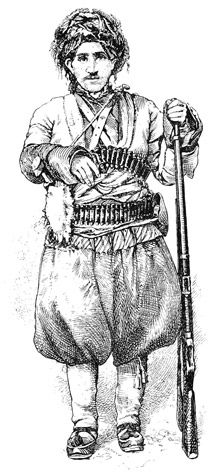
KURD OF SUJBULĀK.
The Sanak, though clear and bright, is fouled by many abominations, and by the ceaseless washing of clothes above the town; there are no pure wells, and all people who care about what they drink keep asses constantly bringing water from an uncontaminated part of the river, two miles off. Even the Governor has to depend on this supply. Sujbulāk looks very well from this camp, with the bright river in the foreground, and above it, irregularly grouped on a rising bank, the façade, terraces, and towers of the Governor's palace, the fort-like Turkish consulate, and numbers of good dwelling-houses, with balakhanas painted blue or pink, or covered with arabesques in red, with projecting lattice windows of dark wood, and balconies overhanging the water.
This shingle where I am encamped is the Rotten Row of the town, and is very lively this evening, for numbers of Kurds have been galloping their horses here, and performing feats of horsemanship before the admiring eyes of hundreds of promenaders, male and female, most of the latter unveiled. As all have to cross the ford where the river is some inches above a man's knees, the effect is grotesque, and even the women have no objection to displaying their round white limbs in the clear water. The ladies of the Governor's andarun sent word that food and quarters had been prepared for me since noon, but I excused myself on the plea of excessive fatigue. This message was followed by a visit from the Governor's foster-mother, an unveiled jolly woman, of redundant proportions, wearing remarkably short petticoats, which displayed limbs like pillars. A small woman attended her, and a number of Kurd men, superbly dressed, and wearing short two-edged swords, with ebony hilts ornamented with incrustations of very finely-worked filigree silver. These weapons are made here. The lady has been to Mecca, and evinces much more general intelligence than the secluded women. She took a dagger from one of the attendants, and showed me with much go how the thrusts which kill are made.
All were much amused with Boy's gentle ways. He had been into the town for supplies, and, as usual, asked me to take off his bridle by coming up and putting his ears under my chin, when, if I do not attend to him at once, he lifts his head and gives me a gentle push, or rubs his nose against my cheek. The men admired his strong, clean limbs, which are his best points. Last night I heard snoring very near me, and thinking that the watchmen were sleeping under the flys, I went out to waken them, and found the big beast stretched out fast asleep in the verandah of the tent, having retired there for warmth. I accompanied my visitors to the ford, followed by Boy, to their great amusement, as it was to mine to see the stout lady mount nimbly on a Kurd's back, and ride him "pickaback" through the water!