Front matter (continued 7)
Reading edition
I bade the Patriarch farewell at six this morning, and even at that early hour men were seated all round his room. After shaking hands with about thirty people, I walked the first mile accompanied by Mr. Browne, who then left me on his way to seek to enlighten the wild tribesmen of the Tyari valley. From the top of the Kamerlan Pass, above Kochanes, the view was inconceivably beautiful. On the lovely alp on which the village stands a red patch of autumnal colouring flamed against the deep indigo and purple mountains of Diz and Shawutha, which block up the east end of the lofty valley; while above these rose the Jelu ranges, said to be from 12,000 to 15,000 feet in altitude, bathed in rich pure blue, snow-fields on their platforms, new-fallen snow on their crests, indigo shadows in their clefts and ravines,—a glorious group of spires, peaks, crags, chasms, precipices, rifts, parapets, and ridges perfect in their beauty as seen in the calm coloured atmosphere in which autumn loves to die. Higher up we were in vast solitudes, among splintered peaks and pasturages where clear streams crashed over rock ledges or murmured under ice, and then a descent of 1800 feet by steep zigzags, and a seven hours' march in keen pure air, brought us through rounded hills to this village.
Van, November 1.—There was a night alarm at Kotranis. A number of Kurds came down upon the threshing-floor, and the zaptiehs were most unwilling to drive off the marauders, saying that their only orders were to protect me. The Kurds, who were at least ten to one, retired when they saw the Government uniforms, but the big dogs barked for the rest of the night.
The next day's march occupied eleven hours. It was very cold, "light without heat," superb travelling weather. One zaptieh was a Moslem, the other an Armenian, and there were strong differences of opinion between them, especially when we halted to rest at a Christian village, and the Kurdish katirgi took several sheaves of corn from a threshing-floor without paying for them. The Moslem insisted that he should not pay and the Christian that he should, and it ended by my paying and deducting the sum from his bakhsheesh. The zaptiehs are usually men who have served five years with the colours. In Eastern Asia Minor they are well clothed in dark blue braided uniforms, and have ulsters in addition for cold weather. They provide their own horses. Their pay is eighty piastres a month, with rations of bread for themselves and of barley for their animals, but the pay is often nine months in arrear, or they receive it in depreciated paper. They are accused of being directly or indirectly concerned in many robberies, and of preying on the peasantry. They are armed with Snider rifles, swords, and revolvers. From the top of a high pass above Kotranis there was a final view of the Jelu mountains, and the remainder of the day was spent among hills, streams, and valleys, with rich fertile soil and abundant water, but very thinly peopled.
A very ingenious plough has taken the place of the primitive implement hitherto used. The share is big and heavy, well shod with iron, and turns up the soil to a great depth. The draught is from an axle with two wheels, one of them two feet in diameter and the other only ten inches. The big wheel runs in the last furrow, and the little one on the soil not yet upturned, the axle being level. Some of these ploughs were drawn by eight buffaloes, with a boy, singing an inharmonious tune, seated facing backwards on each yoke. After the ploughing, water is turned on to soften the clods, which are then broken up by the husbandmen with spades.
There is a great charm about the scenery as seen at this season, the glorious colouring towards sunset, the fantastic forms and brilliant tints of the rocks, and the purity of the new-fallen snow upon the heights; but between Kotranis and Van, except for a little planting in the "Valley of the Armenians," there is scarcely a bush. If I had warm clothing I should regard the temperature as perfect, nearly 50° at noon, and falling to about 25° at night. After a severe march, a descent and a sudden turn in the road brought us in the purple twilight to Merwanen, the chief village of Norduz, streamily situated on a slope—a wretched village, semi-subterranean; a partly finished house, occupied by a newly arrived Kaimakam and a number of zaptiehs, rising above the miserable hovels, which, bad as they are, were all occupied by the Kaimakam's attendants. Zaptiehs, soldiers, Kurds, and villagers assured me that there was no room anywhere, and an officer, in a much-frogged uniform, drove my men from pillar to post, not allowing us standing room on the little dry ground that there was. I humbly asked if I could pitch my tent, but a rough negative was returned. A subterranean buffalo stable, where there was just room among the buffaloes for me to lie down in a cramped position, was the only available shelter, and there was none for the servants. I do not much mind sharing a stable with Boy, but I "draw the line" at buffaloes, and came out again into the frosty air, into an inhospitable and altogether unprepossessing crowd.
Then there was a commotion, with much bowing and falling to the right and left, and the Kaimakam himself appeared, with my powerful letter in his hand, took me into the unfinished house, at which he had only arrived an hour before, and into a small room almost altogether occupied by two beds on the floor, on one of which a man very ill of fever was lying, and on the other an unveiled Kurdish beauty was sitting. The Kaimakam, though exceedingly "the worse of drink," was not without a certain dignity and courtesy. He apologised profoundly for the incivility and discomfort which I had met with, and for his inability to entertain me "with distinction" in "so rough a place," but said that he would give up his own room to so "exalted a personage," or if I preferred a room outside it should be made ready. Of course I chose the latter, with profuse expressions of the gratitude I sincerely felt, and after a cup of coffee bade him good-night.
The room was the justice or injustice room over the zaptieh barracks, and without either door or glazed windows, but cold and stiff as I was after an eleven hours' march, I was thankful for any rest and shelter. Shortly my young Kurdish katirgi, a splendid fellow, but not the least "tame," announced that he must leave me in order to get the escort of some zaptiehs back to Julamerik. He said that "they all" told him that the road to Van was full of danger, and that if he went on he would be robbed of his mules and money on the way back. No transport however, was to be got, and he came on with me very pluckily, and has got an escort back, at least to Merwanen. In the morning the Kaimakam rose early to do me honour, but was so tipsy that he could scarcely sit upright on his chair on a stone dais amidst a rabble of soldiers and scribes. We were all benumbed with cold, and glad that the crossing of an expanse of frozen streams rendered walking a necessity. A nine hours' march through mountains remarkable for rocky spires and needles marvellously coloured, and for the absence of inhabitants, took us to the Armenian village of Khanjarak, finely situated in a corrie upon a torrent bank; but it is so subterranean, and so built into the hillside, that a small square church and conical piles of kiziks are the only obvious objects, and I rode over the roofs without knowing what was underneath.
All the women and children, rabbit-like, came out of their holes, clothed in red rags, and some wore strings of coins round their heads. The men were dressed like Kurds, and were nearly as wild-looking. They protested against my tent being pitched. They said the Kurds were always on the watch, and would hack it with their swords in half an hour to get at its contents, that they had only three matchlock guns, and that the Kurds were armed with rifles. I felt that I could scarcely touch a lower depth in the matter of accommodation than when they lodged me in a dark subterranean stable, running very far back into the hill, with a fire of animal fuel in the middle giving off dense and acrid fumes. A recess in this, with a mud bench, was curtained off for me, and the rest of the space was occupied by my own horses and baggage mules, and most of the village asses, goats, cows, calves, and sheep. Several horses belonging to travellers and to my own escort were also there, and all the zaptiehs, servants, travellers, and katirgis were lodged there. There were legions of fleas revelling in a temperature which rose to 80° at midnight, though there were 5° of frost outside. In the part of the roof which projected from the hill there were two holes for light, but at night these were carefully closed with corks of plaited straw.
The wretched poverty of the people of this place made a very painful impression on me. They may have exaggerated when they told me how terribly they are oppressed by the Kurds, who, they say, last year robbed them of 900 sheep and this year of 300, twenty-five and some cattle having been driven off a few days before, but it is a simple fact that the night of my visit the twenty-four sheep for which there was no room in the stable were carried away by a party of well-armed Kurds in the bright moonlight, the helpless shepherds not daring to resist. It is of no use, they say, to petition the Government; it will not interfere. The Kurds come into their houses, they say, and terrify and insult their women, and by demands with violence take away all they have. They say that the money for which they have sold their grain, and which they were keeping to pay their taxes with, was taken by the Kurds last week, and that they will be cruelly beaten by the zaptiehs because they cannot pay. Their words and air expressed abject terror.[49]
Their little church is poorer than poverty itself, a building of undressed stone without mortar, and its length of thirteen feet includes the rude mud dais occupied by the yet ruder altar. Its furniture consists of an iron censer, an iron saucer containing oil and a wick, and an earthen flagon. There are no windows, and the rough walls are black with candle smoke. The young man who showed the church took a Gospel from the dais, kissing the cross upon it before handing it to me, and then on seeing that I was interested went home and brought a MS. of St. Matthew's Gospel, with several rudely-illuminated scenes from our Lord's life. "Christos," he said with a smile, as he pointed to the central figure in the first illustration, and so on as he showed me the others, for in each there was a figure of the Christ, not crowned and risen, but suffering and humiliated. Next morning, in the bitter cold of the hour before sunrise, the clang of the mallet on the sounding-board assembled the villagers for matins, and to the Christ crowned and risen and "sitting on the right hand of power" they rendered honour as Divine, though in the midst of the grossest superstition and darkness, and for Him whom they "ignorantly worship" they are at this moment suffering the loss of all things. Their empty sheepfold might have been full to-day if they had acknowledged Him as a Prophet and no more.[50]
Leaving this wretched hamlet, where the unfortunate peasants are as avaricious as they are poor and dirty, and passing a Kurdish village with a stone fort picturesquely situated, we crossed a pass into a solitary valley, on which high rounded hills descend in harmonised buffs and browns, both hills and valleys covered with uncut hay. The zaptiehs said that this was a specially dangerous place, and urged the caravan to its utmost speed. We met three Armenian katirgis in their shirts. They complained most bitterly that they had been robbed an hour before of five mules with their equipments, as well as of their clothing and money. The ascent and the very tedious descent of the Kasrik Kala Pass brought us into the large and fertile plain of Haizdar, the "plain of the Armenians," sprinkled with Armenian villages, and much cultivated.
Mirza and one zaptieh had gone back for a blanket which had been dropped, and after halting in an orchard till I was half-frozen I decided to proceed without them, having understood that we could reach Van in three hours. I started my party by signs, and after an hour's riding reached a village where Johannes spoke fluently in an unknown tongue, and the zaptieh held up five fingers, which I learned too late meant that Van was five hours off. I thought that they were asking for instructions, and at every pause I repeated Van.
After a brief consultation we went up among the hills, the young Kurdish katirgi jumping, yelling, singing, and howling, to keep his mules at a trot, the zaptieh urging them with his whip, and pointing ominously at the fast sinking sun. On we clattered with much noise, nor did we slacken speed till we gained a high altitude among desert solitudes, from which we looked down upon the Dead Sea of Van, a sheet of water extending in one direction beyond the limits of vision, lying red and weird, with high mountains jutting into it in lofty headlands hovered over by flame-coloured clouds. High up along the mountain side in a wavy line lay the path to Van in the deepening shadows, and the zaptieh, this time holding up three fingers, still urged on the caravan, and the Kurd responded by yells and howls, dancing and jumping like a madman.
Just as it was becoming dark, four mounted men, each armed with two guns, rode violently among the mules, which were in front of me, and attempted to drive them off. In the mêlée the katirgi was knocked down. The zaptieh jumped off his horse, threw the bridle to me, and shouldered his rifle. When they saw the Government uniform these Kurds drew back, let the mules go, and passed on. The whole affair took but a few seconds, but it was significant of the unwillingness of the Kurds to come into collision with the Turks, and of the power the Government could exercise in the disturbed districts if it were once understood that the marauders were not to be allowed a free hand.
After this attack not a word was spoken, the bells were taken off the mules, the zaptieh, as fine and soldierly a man as one could wish to see, marched in front, quiet and vigilant, and so in a darkness in which I could not see my horse's ears we proceeded till, three hours later, the moon rose as we entered Van. It was one of the eeriest rides I ever made, and I had many painful reflections on having risked through ignorance the property of my faithful Kurdish katirgi. The first light of Van was a welcome sight, though after that there was a long ride to "the gardens," a large wooded suburb chiefly inhabited by Armenians, in which the American missionaries live. Dr. Reynolds, the medical missionary, has given me a most hospitable welcome, though his small house is more than full with new arrivals from America. I wanted to re-engage my jolly katirgi for Bitlis, but he went back at once with the zaptieh, and after the obvious perils of the road it would not have been fair to detain him. Visitors are scarce here. Van does not see more than one non-official European in three years. The Vice-Consul says that he should have doubted the sanity of any one who had proposed to travel from Urmi to Van by the route I took, but now that the journey is safely over I am glad that no one at Urmi knew enough to dissuade me from it. The Vice-Consul and all the mission party are as kind as they can be, and Van is for me another oasis.
I. L. B.
LETTER XXXI
Van,[51] Armenia, Nov. 4.
Van and its surroundings are at once so interesting and picturesque that it is remarkable that they are comparatively seldom visited by travellers. Probably the insecurity of the roads, the villainous accommodation en route, and its isolated position account for the neglect.[52] Here as elsewhere I am much impressed with the excellence of the work done by the American missionaries, who are really the lights of these dark places, and by their exemplary and honourable lives furnish that moral model and standard of living which is more efficacious than preaching in lifting up the lives of a people sunk in the depths of a grossly corrupted Christianity. The boys' and girls' schools in Van are on an excellent basis, and are not only turning out capable men and women, but are stimulating the Armenians to raise the teaching and tone of their own schools in the city, with one of which I was very greatly pleased. The creation of churches, strict in their discipline, and protesting against the mass of superstitions which smother all spiritual life in the National Armenian Church, is undoubtedly having a very salutary effect far beyond the limited membership, and is tending to force reform upon an ancient church which contains within herself the elements of resurrection. Great honour is due to Dr. Reynolds for the way in which, almost single-handed, he has kept the valuable work of this Mission going for years, and now that colleagues have arrived a considerable development may be hoped for.
I have confessed already to a prejudice against the Armenians, but it is not possible to deny that they are the most capable, energetic, enterprising, and pushing race in Western Asia, physically superior, and intellectually acute, and above all they are a race which can be raised in all respects to our own level, neither religion, colour, customs, nor inferiority in intellect or force constituting any barrier between us. Their shrewdness and aptitude for business are remarkable, and whatever exists of commercial enterprise in Eastern Asia Minor is almost altogether in their hands. They have singular elasticity, as their survival as a church and nation shows, and I cannot but think it likely that they may have some share in determining the course of events in the East, both politically and religiously. As Orientals they understand Oriental character and modes of thought as we never can, and if a new Pentecostal afflatus were to fall upon the educated and intelligent young men who are being trained in the colleges which the American churches have scattered liberally through Asia Minor, the effect upon Turkey would be marvellous. I think most decidedly that reform in Turkey must come through Christianity, and in this view the reform and enlightenment of the religion which has such a task before it are of momentous importance.
Islam is "cabined, cribbed, confined." Its forms of belief and thought and its social and political ideas remain in the moulds into which they were run at its rise. Expansion is impossible. The arrogance which the Koran inculcates and fosters is a dead weight on progress. If the Turk had any disposition to initiate and carry out reforms his creed and its traditions would fetter him. Islam, with its fanaticism, narrowness, obstructiveness, and grooviness is really at this moment the greatest obstacle to every species of advance both in Turkey and Persia, and its present activity and renewed proselytising spirit are omens of evil as much for political and social progress as for the higher life of men.
The mission houses and schools are on fairly high ground more than two miles from Van, in what are known as "the Gardens," where most of the well-to-do Armenians and Turkish officials reside. These gardens, filled with vineyards and all manner of fruit trees, extend for a distance of five miles, and being from two to three miles wide their mass of greenery has a really beautiful effect. Among them are many very good houses, and the roads and alleys by which they are intersected are well planted with poplars and willows, shading pleasant streams which supply the water for irrigation.
The view from the roof is a glorious one. Looking west over the gardens, which are now burning with autumn tints, the lofty crests of the huge crater of Nimrud Dagh are always visible across the lake of Van, intensely blue in the morning, and reddening in the sunsets of flame and gold. In the evenings too, the isolated rock on which the castle of Van is built bulks as a violet mass against the sinking sun, with a foreground of darkening greenery. The great truncated cone of the Sipan Dagh looms grandly over the lake to the north; to the east the rocky mass of the Varak Dagh, with white villages and monasteries in great numbers lying in its clefts and folds, rises precipitously to a height of 10,500 feet; and to the south the imposing peaks of Ardost, now crested with snow, and Mount Pelu, projecting into the lake, occupy prominent positions above the lower groups and ridges.
The town of Van is nearly a mile from the lake, and is built on an open level space, in the midst of which stands a most picturesque and extraordinary rock which rises perpendicularly to a height of about 300 feet. It falls abruptly at both extremities, and its outline, which Colonel Severs Bell estimates at 1900 yards in length, is emphasised by battlemented walls, several towers, and a solitary minaret rising above the picturesque irregularity of the ancient fortifications. Admission to the interior of the castle is refused, consequently I have not seen the chambers in the rock, supposed to have been the tombs of kings. The most celebrated of the cuneiform inscriptions cut on tablets smoothed in the rock is on the south side in an inaccessible position, and was with difficulty copied by the murdered traveller Schulz with the aid of a telescope. It is well seen from below, looking, as has been remarked, like an open copy of a newspaper. Like the tablets of Persepolis and Mount Elwend, it relates in august language the titles and deeds of Xerxes.
The founding of Van is ascribed to Semiramis, who, according to Armenian history, named it Shemiramagerd, and was accustomed to resort to its gardens, which she had herself planted and watered, to escape from the fierce heat of the summer at Nineveh. The well of Semiramis and other works attributed to her bring her name frequently into conversation—indeed she is mentioned as familiarly as Queen Elizabeth is among us!
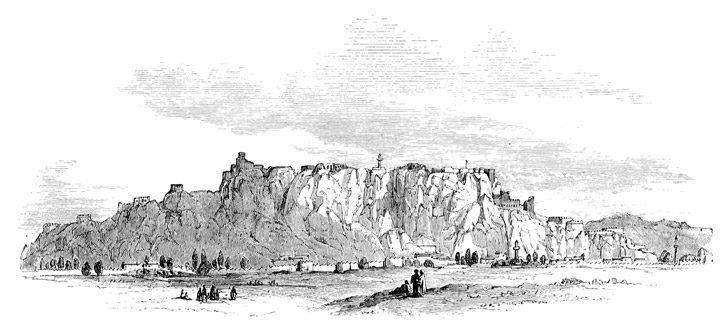
ROCK AND CITADEL OF VAN.
The town, which is walled, is not particularly attractive, but there is one very handsome mosque, and a very interesting Armenian church, eleven centuries old, dedicated to St. Peter and St. Paul. The houses are mean-looking, but their otherwise shabby uniformity is broken up by lattice windows. The bazars are poorly built, but are clean, well supplied, and busy, though the trade of Van is suffering from the general insecurity of the country and the impoverishment of the peasantry. It is very pleasant that in the Van bazars ladies can walk about freely, encountering neither the hoots of boys nor the petrifying Islamic scowl.
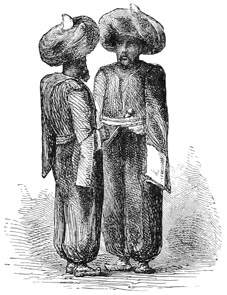
KURDS OF VAN.
Fifty years ago Venetian beads were the only articles imported from Europe. Now, owing to the increasing enterprise of the Armenians, every European necessary of life can be obtained, as well as many luxuries. Peek and Frean's biscuits, Moir's and Crosse and Blackwell's tinned meats and jams, English patent medicines, Coats' sewing cotton, Belfast linens, Berlin wools, Jæger's vests, and all sorts of materials, both cotton and woollen, abound. I did not see such a choice and abundance of European goods in any bazar in Persia, and in the city of Semiramis, and beneath the tablet of Xerxes, there is a bazar devoted to Armenian tailors, and to the clatter of American sewing machines stitching Yorkshire cloth! One of these tailors has made a heavy cloth ulster for me, which the American ladies pronounce perfect in fit and "style!"
The Armenians, with their usual industry and thrift, are always enlarging their commerce and introducing new imports. Better than this, they are paying great attention to education, and several of their merchants seem to be actuated by a liberal and enlightened spirit. It is, however, to usury not less than to trade that they owe their prosperity. The presence of Europeans in Van, in the persons of the missionaries and vice-consuls, in addition to the admirable influence exerted by the former, has undoubtedly a growing tendency towards ameliorating the condition of the Christian population.
In the vilayet of Van it is estimated by Colonel Severs Bell that the Christians outnumber the Moslems by 80,000, the entire population being estimated at 340,000. In the city of Van, with a population estimated by him at 32,000, the Christians are believed to be as 3 to 1.[53]
The formalities required for Turkish travelling are many and increasing, and from ignorance of one of them Johannes has been arrested, and Mirza marched to the Consulate by the police. I have been obliged to part with the former and send him back to Hamadan, as it would not be safe to take the risky journey to Erzerum with such an inexperienced and untrustworthy servant. Through Mr. Devey's kindness I have obtained an interpreter and servant in Murphy O'Rourke, a British subject, but a native of Turkey, and equally at home in English, Turkish, and Armenian, though totally illiterate.
I. L. B.
LETTER XXXII
Bitlis, Nov. 10.
I arrived here two days ago, having ridden the ninety miles from Van in three and a half days. Dr. Reynolds accompanied me, and as we had a couple of zaptiehs on good horses we deserted the caravan, and came along at as good a pace as the mountainous nature of the road would allow. The early winter weather is absolutely perfect for travelling. All along I am quite impressed with the resemblance which the southern shores of Lake Van bear to some of the most beautiful parts of the Italian Riviera—Italian beauty seen under an Italian sky. Travellers lose a great deal by taking the easier route round the north shore of the lake.
The first day's half march ended at Angugh, an Armenian village on the river Hashal, on the plain of Haizdar or Haigatsor, where the people complained of some Armenian women having been despoiled of their jewels by some Kurds during the afternoon. The views are magnificent en route, especially of the Christian village of Artemid, on a spur on a height, with a Moslem village in gardens below, with green natural lawns sloping to the lake. At Angugh I was well accommodated in a granary on a roof, and as there was no room for my bed, found a comfortable substitute in a blanket spread upon the wheat. The next day's march was through exquisitely beautiful scenery, partly skirting deep bays on paths cut in the rock above them, among oaks and ferns, and partly crossing high steep promontories which jut out into the lake. A few villages, where strips of level ground and water for irrigation can be obtained, are passed, and among them the village of Vastan, the "Seat of Government" for the district, and a Turkish telegraph station, but in the eleventh century the residence of the Armenian royal family of Ardzrauni.
Art aids nature, and there are grand old monasteries on promontories, and Kurdish castles on heights, and flashing streams and booming torrents are bridged by picturesque pointed arches. There are 150 monasteries in this region, and the towers of St. George at the mountain village of Narek, high on a rocky spur above one of the most beautiful of the many wooded valleys which descend upon the lake of Van, lend an air of medieval romance to a scene as fair as nature can make it. Nearly all the romantic valleys opening on the lake are adorned with one or more villages, with houses tier above tier in their rocky clefts, and terrace below terrace of exquisite cultivation below, of the vivid velvety green of winter wheat. These terraces often "hang" above green sward and noble walnut trees. Occasionally the villages are built at the feet of the mountains, on small plateaux above steep-sided bays, and are embosomed in trees glowing with colour, from canary-yellow to crimson and madder-red, and mountains, snow-crested and forest-skirted tower over all. Lake Van, bluer than the blue heavens, with its huge volcanic heights—Sipan Dagh, Nimrud Dagh, and Varak Dagh, and their outlying ranges—its deep green bays and quiet wooded inlets; its islets, some like the Bass Rock, others monastery-covered; its pure green shadows and violet depths; its heavy boats with their V-shaped sails; and its auburn oak-covered slopes, adds its own enchantment, and all is as fair as fair can be.
Though the state of things among the Christians is not nearly so bad as in some of the Syrian valleys, the shadow of the Kurd is over this paradise. The Armenians complain of robbery with violence as being of constant occurrence, and that they have been plundered till they are unable to pay the taxes, and it is obvious that travellers, unless in large companies, are not safe without a Government escort. In each village the common sheepfold is guarded from sunset to sunrise by a number of men—a heavy burden on villagers whose taxation should ensure them sufficient protection from marauders.
In one of the fairest bays on this south side of the lake is the island rock of Akhtamar, crowned with a church and monastery built of red sandstone. The convent boat, which plies daily to the mainland for supplies, is available for travellers. Eleven monks with their pupils inhabit the rock. It is a very ancient foundation, dating from a.d. 633, and the church is attributed to the Armenian King Kakhik, who reigned in the tenth century. It is a cruciform building, with a hexagonal tower and a conical terminal at the intersection of the cross. The simple interior is decorated with some very rude pictures, and a gilded throne for the Patriarch stands at the east end. This Patriarchate of Akhtamar, the occupant of which has at times claimed the title of Catholicos, was founded in 1113 by an archbishop of Akhtamar who declared himself independent of the Catholicos of the Armenian Church who resides in Echmiadzin, but at the present time he has only a few adherents in the immediate neighbourhood of Van, and has the reputation of extreme ignorance, and of being more of a farmer than an ecclesiastic. He was at Haikavank, at the fine farm on the mainland possessed by the convent, but we had not time to call.
Plain as is the interior of the Church of Akhtamar, the exterior is most elaborately ornamented with bas-reliefs, very much undercut. Three of the roofs rest on friezes on which birds and beasts in singularly vigorous action are portrayed, and there are besides two rows of heads in high relief, and a number of scripture subjects very boldly treated, in addition to some elaborate scroll-work, and bands of rich foliage. On this remarkable rock Dr. Reynolds and his family took refuge a few years ago, when it was apprehended that Van would be sacked by the Kurds.
The vivid colouring of the lake is emphasised by a line of pure white deposit which runs round its margin, and vivacity is given to its waters by innumerable wild fowl, flamingoes, geese, ducks, pelicans, cormorants, etc. From a reedy swamp near it ducks rose in such numbers as literally to darken the air. Carbonate of soda and chloride of sodium are obtained from the lake water by evaporation, but it is not nearly so salt as that of the Sea of Urmi. Not very far from the south shore a powerful fresh-water spring bubbles up in the midst of the salt water. The only fish known of is a species said to be like a small herring. These are captured in enormous quantities in the spring as they come up into the streams which feed the lake.
On the last two nights at Undzag and Ghazit I had my first experiences of the Turkish odah or village guest-house or khan, of which, as similar abodes will be my lodgings throughout my journey to Erzerum, I will try to give you an idea. Usually partially excavated in the hillside and partly imbedded in the earth, the odah is a large rambling room with an irregular roof supported on rough tree-stems. In the centre, or some other convenient place, is a mud platform slightly raised; in the better class of odahs this has a fireplace in the wall at one end. Round this on three sides is a deep manger, and similar mangers run along the side walls and into the irregular recesses, which are lost in the darkness. The platform is for human beings, and the rest of the building for horses, mules, oxen, asses, and buffaloes, with a few sheep and goats probably in addition. The katirgis and the humbler class of travellers sleep among the beasts, the remainder, without distinction of race, creed, or sex, on the enclosed space. Light enters from the door and from a few small holes in the roof, which are carefully corked up at night, and then a few iron cups of oil with wicks, the primitive lamp in general use, hanging upon the posts, give forth a smoky light.
In such an odah there may be any number of human beings cooking, eating, and sleeping, and from twenty to a hundred animals, or more, as well as the loads of the pack-horses and the arms of the travellers. As the eye becomes accustomed to the smoke and dimness, it sees rows of sweet ox faces, with mild eyes and moist nostrils, and wild horse faces surrounding the enclosure, and any number more receding into the darkness. Ceaseless munching goes on, and a neigh or a squeal from some unexpected corner startles one, or there is a horse fight, which takes a number of men to quell it. Each animal is a "living stove," and the heat and closeness are so insupportable that one awakes quite unrefreshed in the morning in a temperature of 80°. The odah is one of the great features of travelling in Eastern Asia Minor. I dined and spent the evenings in its warmth and cheeriness, enjoying its wild picturesqueness, but at Undzag I pitched my small tent at the stable door, and at Ghazit on the roof, and braved the cold in it.
Boy is usually close to me, eating scraps from my dinner, and gently biting the back of my neck when he thinks that I am forgetting his presence. He amuses all the men everywhere by his affectionateness, and eating out of my hand, and following me like a dog. I never saw so gentle and trustworthy a creature. His hair has grown very long, thick, and woolly, and curls in parts like that of a retriever. His sweet ways have provided him with a home after his powerful legs and big feet have trudged with me to Trebizond, for my hosts here, who are old and somewhat frail, have taken such a fancy to his gentleness and winsomeness that he is to return to them when the roads open in the spring.
It was a grand ride from Undzag over lofty mountain passes to the exquisitely-situated village of Ghazit, built in a deep cul de sac above the lake. Terraces, one above another, rise from the lake shore, so beautifully cultivated as to realise Emerson's description of the appearance of English soil, "Tilled with a pencil instead of a plough." A church stands on a height, and the village, almost hidden among magnificent walnuts, is crowded upon a terrace of green sward at the foot of a semicircle of mountains which wall it in from the world. The narrow village road, with its low, deep-eaved stone houses, was prettily brightened by colour, for all the women were dressed more or less in red, and wore high red coronets with dependent strings of coins, and broad aprons, reaching from the throat to the feet, of coarse dark blue cotton, completely covered with handsome patterns worked in cross-stitch in silk.
Fine walnut trees are one of the specialities of this part of Turkey. They provide much of the oil which is used during the long fasts which both Armenians and Syrians observe, and they develop very large woody excrescences or knots, the grain and mottling of which are peculiarly beautiful. These are sought for by buyers for Paris houses even in the remote valleys of Kurdistan for use in the making and veneering of furniture, especially of pianos. Fortunately the removal of this growth does not kill the tree, and after a time the bark grows over much of the uncovered portion of the trunk, only a scar being left.
At sunset that evening 800 sheep were driven into the village sheepfold just below the roof on which my tent was pitched, and it was a very picturesque scene, men pushing their way through them to find their own sheep by ear-mark, women with difficulty milking ewes here and there, big dogs barking furiously from the roofs above, and all the sheep bleating at once. In winter they are all housed and hand fed. The snow lies six feet deep, and Ghazit can communicate neither with Bitlis nor Van. It is the "milk of the flocks" which is prized. Cows' milk is thought but little of. I made my supper of one of the great articles of diet in Turkey, boiled cracked wheat, sugar, and yohoort, artificially soured milk, looking like whipped cream.
I was glad to escape to my tent from the heat and odours of the odah, even though I had to walk over sheep's backs to get up to the roof. I had a guard of two men, and eight more armed with useless matchlock guns watched the sheepfold. I was awakened by a tremendous noise, the barking of infuriated dogs close to me, the clashing of arms and the shouts of men, mixed up with the rapid firing of guns not far off on the mountain side, so near, indeed, that I could see the flashes. It was a Kurdish alarm, but nothing came of it. A village which we passed a few hours later was robbed of 600 sheep, however.
Leaving beautiful Ghazit before the sun rose upon it the next morning, we spent some hours in skirting the lake, and in crossing elevated passes and following paths along hillsides covered with oaks, the russet leaves of which are being cut for winter "keep." The dwarf juniper is also abundant. After crossing a pass on the top of which are graves covered with heavy stone slabs with inscriptions on their sides, and head-stones eight feet high inscribed with epitaphs in Kufic or early Arabic, we descended upon the great plain of Rahwan, separated from the plain of Mush only by a very low ridge, which, however, is a remarkable water-parting, dividing the drainage systems of the Tigris and the Euphrates. On this solitary plain there are the ruins of a magnificent building, known as "the Persian Khan," built of large blocks of hewn stone. Parts of it are still available for shelter during snowstorms. It has courtyards with stately entrances, domes, arches, and vaulted chambers, and is a very striking object. Two other khans are placed as refuges in the valley nearer Bitlis.
Shortly afterwards we reached the meeting-place of three valleys and three roads, leading respectively to the plain of Mush, the lake of Van, and Bitlis. It is in this neighbourhood that the eastern source of the Tigris is situated, and here there is also the great interest of coming upon one of the landmarks on the retreat of the Ten Thousand. Scholars appear to agree in general that this gallant band must have come up by these eastern sources of the Tigris, for then, as now, the only practicable entrance into Armenia from the Karduchi territory, the modern Kurdistan, was by this route.[54]
The march was very long and fatiguing, and as we were compelled to rest for two hours at the beautifully-situated village of Toogh, evening was coming on with a gray sky and a lurid sunset before we left the Rahwan plain, after which we had a ride of more than three hours down the wild and stony Bitlis valley before we reached our destination. If I had made this march in spring, when herbage and flowers drape the nakedness of the rocky and gravelly mountains and precipices, it would not have made such an impression upon me as it did, but seeing the apparently endless valley for ever winding and falling to the south, with two bars of lurid light for ever lying across what never proved to be its opening, and the higher peaks rising snow-crested into a dark and ominous-looking sky, I think it one of the weirdest and wildest rides I ever took.
The infant Tigris is rapidly augmented by a number of streams and torrents. The descent was like taking leave of the bright upper world to go down into some nether region, from which there would be no exit. The valley, at times narrowing into a ravine, is hemmed in by sterile mountains, so steep as not to afford sites for villages. There are parapetless ancient arches of stone, flung across torrents which have carved hideous pathways for themselves through hideous rocks, scoriæ, and other signs of volcanic action, rough gulches, with narrow paths hanging on their sides, and in spite of many climbs upwards the course is on the whole downwards.
Darkness settled upon the valley long before lights, in what looked like infinite depths, and straggling up remarkable heights, trees, stone walls, and such steep ups and downs that it felt as if the horses were going to topple over precipices, denoted that we had entered Bitlis. Then came a narrow gateway, a flagged courtyard choked with mules and men, a high house with heavily-barred windows, a steep outside stair, and at the top sweet faces and sweet voices of European women, and lights and warm welcomes.
Bitlis, November 12.—This is the most romantically-situated city that I have seen in Western Asia. The dreamy impressions of height and depth received on the night of my arrival were more than realised the following morning. Even to the traveller arriving by daylight Bitlis must come as a great surprise, for it is situated in a hole upon which the upper valley descends with a sudden dip. The Bitlis-chai or Eastern Tigris passes through it in a series of raging cataracts, and is joined in the middle of the town by another torrent tumbling down another wild valley, and from this meeting of the waters massive stone houses rise one above another, singly, and in groups and terraces, producing a singularly striking effect. Five valleys appear to unite in Bitlis and to radiate from a lofty platform of rock supported on precipices, the irregular outlines of which are emphasised by walls and massive square and circular towers, the gigantic ruins of Bitlis Castle.
The massiveness of the houses is remarkable, and their courtyards and gardens are enclosed by strong walls. Every gate is strengthened and studded with iron, every window is heavily barred, all are at a considerable height, and every house looks as if it could stand a siege. There is no room to spare; the dwellings are piled tier above tier, and the flagged footways in front of them hang on the edges of precipices. Twenty picturesque stone bridges, each one of a single arch, span the Tigris and the torrents which unite with it. There are ancient ruins scattered through the town. It claims immense antiquity, and its inhabitants ascribe its castle and some of its bridges to Alexander the Great, but antiquarians attribute the former either to the Saracens or to the days when an ancient Armenian city called Paghesh occupied the site of the present Bitlis. It seems like the end of the world, though through the deep chasms below it, through which the Tigris descends with great rapidity to the plains, lies the highway to Diabekir. Suggestions of the ancient world abound. The lofty summits towering above the basin in which this extraordinary city lies are the termination of the Taurus chain, the Niphates of the ancients, on the highest peak of which Milton localised the descent of Satan.[55]
Remote as Bitlis seems and is, its markets are among the busiest in Turkey, and its caravan traffic is enormous for seven or eight months of the year. Its altitude is only 4700 feet, and the mercury in winter rarely falls to zero, but the snowfall is tremendous, and on the Rahwan Plain snow frequently lies up to the top of the telegraph poles, isolating the town and shutting up animals in their stables and human beings in their houses for weeks, and occasionally months, at a time. Bitlis produces a very coarse, heavy cotton cloth which, after being dyed madder red or dark blue, is largely exported, and is used for the embroidered aprons which the Armenian women wear. It also exports loupes, the walnut whorls or knots of which I have written before, oak galls, wax, wool, and manna, chiefly collected from the oak. The Bitlis people, and even some Europeans, regard this as a deposit left by the aromatic exhalations which the wind brings in this direction from Arabia, and they say that it lies on any plant without regard to its nature, and even on the garments of men. The deposit is always greatest in dry years. In addition to the white manna, obtained by drying the leaves and allowing the saccharine matter to fall off—and the green, the result of steeping the leaves in water, which is afterwards strained, there is a product much like golden syrup, which is used for the same purposes.
Bitlis is one of the roughest and most fanatical and turbulent of Turkish cities, but the present Governor, Raouf Pasha, is a man of energy, and has reduced the town and neighbourhood to some degree of order. Considerable bodies of troops have been brought in, and the garrison consists of 2500 men. These soldiers are thoroughly well clothed and equipped, and look remarkably clean in dress and person. They are cheery, soldierly-looking men, and their presence gives a little confidence to the Christians.
The population of Bitlis is estimated at 30,000, of which number over 20,000 are Kurds. Both men and women are very handsome, and the striking Kurdish costume gives a great brilliancy and picturesqueness to this remarkable city. The short sleeveless jackets of sheepskin with the black wool outside which the men are now wearing over their striped satin vests, and the silver rings in the noses of the girls give them something of a "barbarian" look, and indeed their habits appear to be much the same as those of their Karduchi ancestors in the days of Xenophon, except that in the interval they have become Moslems and teetotallers! Here they are Sunnis, and consequently do not clash with their neighbours the Turks, who abhor the Kurds of the mountains as Kizilbashes. The Kurdish physique is very fine. In fact I have never seen so handsome a people, and their manly and highly picturesque costume heightens the favourable effect produced by their well-made, lithe, active figures.
The cast of their features is delicate and somewhat sharp; the mouth is small and well formed; the teeth are always fine and white; the face is oval; the eyebrows curved and heavy; the eyelashes long; the eyes deep set, intelligent, and roving; the nose either straight or decidedly aquiline, giving a hawk-like expression; the chin slightly receding; the brow broad and clear; the hands and feet remarkably small and slender.
The women when young are beautiful, but hard work and early maternity lead to a premature loss of form, and to a withered angularity of feature which is far from pleasing, and which, as they do not veil, is always en évidence.
The poorer Kurds wear woollen socks of gay and elaborate patterns; cotton shoes like the gheva of the Persians; camlet trousers, wide at the bottom like those of sailors; woollen girdles of a Kashmir shawl pattern; short jackets and felt jerkins without sleeves. The turban usually worn is peculiar. Its foundation is a peaked felt cap, white or black, with a loosely-twisted rope of tightly-twisted silk, wool, or cotton wound round it. In the girdle the khanjar is always seen. Over it the cartridge belt is usually worn, or two cartridge belts are crossed over the chest and back. The girdle also carries the pipe and tobacco pouch, a long knife, a flint and steel, and in some cases a shot pouch and a highly-ornamented powder horn.
The richer Kurds dress like the Syrians. The under-garment, which shows considerably at the chest and at the long and hanging sleeves, is of striped satin, either crimson and white or in a combination of brilliant colours, over which is worn a short jacket of cloth or silk, also with long sleeves, the whole richly embroidered in gold. Trousers of striped silk or satin, wide at the bottom; loose medieval boots of carnation-red leather; a girdle fastened with knobbed clasps of silver as large as a breakfast cup, frequently incrusted with turquoises; red felt skull-caps, round which they wind large striped silk shawls, red, blue, orange, on a white or black ground, with long fringed ends hanging over the shoulders, and floating in the wind as they gallop; and in their girdles they carry richly-jewelled khanjars and pistols decorated with silver knobs, besides a number of other glittering appointments. The accoutrements of the horses are in keeping, and at marriages and other festivities the head-stalls, bridles, and breast-plates are completely covered with pendent silver coins.
The dress of the women is a foil to that of their lords. It consists of a blue cotton shirt; very wide trousers, drawn in at the ankles; a silver saucer on the head, from which chains depend with a coin at the end of each; a square mantle hanging down the back, clasped by two of its corners round the neck, and many strings of coins round the throat; a small handkerchief is knotted round the hair, and in presence of a strange man they hold one end of this over the mouth. The Turks in Bitlis are in a small minority, and the number of Armenian Christians is stated at from 2000 to 5000. The Old Church has a large monastery outside the town and several churches and schools. The Protestant Armenians have a substantial church edifice, with a congregation of about 400, and large boarding-schools for boys and girls.
The population is by far the wildest that I have seen in any Asiatic city, and is evidently only restrained from violence by the large garrison. It is not safe for the ladies of this mission to descend into the Moslem part of the city, and in a residence of more than twenty years they have never even passed through the bazars. The missionaries occupy a restricted and uncertain position, and the Armenian Christians are subject to great deprivations and restraints, and are distrusted by the Government. Of late they have been much harassed by the search for arms, and Christian gunsmiths have been arrested. Even their funeral ceremonies are not exempt from the presence of the police, who profess to believe that firearms are either carried in the place of a corpse or are concealed along with it. Placed in the midst of a preponderating and fully-armed Kurdish population, capable at any moment of being excited to frenzy against their faith, they live in expectation of a massacre, should certain events take place which are regarded as probable within two or three years.
It was not to see the grandeur and picturesqueness of Bitlis that I came here so late in the season, but to visit the American missionaries, especially two ladies. My hosts, Mr. and Mrs. Knapp, have returned from a visit to America to spend their last days in a country which has been their home for thirty years, and have lately been joined by their son, who spent his boyhood in Bitlis, and after graduating in an American university has come back, like so many sons of missionaries, to cast in his lot with a people to whom he is bound by many links of sympathy, bringing his wife with him. The two Misses ——, who are more than half English, and are highly educated and accomplished, met Mr. and Mrs. Knapp long ago in a steamer on the Mediterranean, and decided to return with them to this dangerous and outlandish place, where they have worked among the women and girls for twenty-three years, and are still full of love and hope. The school for girls, in which fifty boarders are received in addition to fifty day pupils, has a kindergarten department attached to it. The parents of all are expected to contribute in money or in kind, but their increasing poverty is telling on their ability to do so, and this winter the supply of food contributed by them is far short of the mark.
The tastefulness and generosity of these ladies have produced as bright and beautiful a schoolroom as could be found anywhere, and ivy trained round the windows, growing plants, and pictures which are not daubs give a look of home. With them "Love is the fulfilling of the law"—love in every tone, look, and touch, and they have that true maternity of spirit which turns a school into a family, and trains as well as educates. They are now educating the children, and even grandchildren, of their earliest pupils, and have the satisfaction of seeing how very much their school has effected in permeating the household and social relationships of the Armenian women with the tone of Christian discipleship, so that one would scarcely hear from the lips of any of their married pupils the provoking question, "We are only women, what can we do?" Many of them have gone to homes in the roughest and wildest of mountain villages, where they sweeten village life by the gentle and kindly ways acquired in the Bitlis school. These ladies conduct a mothers' meeting, and I thought that the women were much developed in intelligence and improved in manner as compared with the usual run of Armenian women. On being asked to address them, I took their own words for my text, "We are only women," etc., and found them intelligent and sympathetic.
These ladies have endured great hardships, and their present position is one of continual deprivation and frequent risk. One of them was so severely stoned in Bitlis that she fell unconscious from her horse. In the winter Miss —— itinerates among the Armenian villages of the Mush and Rahwan Plains and the lake shore, travelling over the crust of the enormously deep snow in a hand-sled drawn by a man, braving storms which have nearly cost her her life, sleeping and living for a month or more at a time chiefly in odahs, and fearlessly encountering the very roughest of Kurds and others in these dim and crowded stables. The danger of village expeditions, and the difficulty of obtaining zaptiehs without considerable expense, have increased of late, and the Mush Plain especially has been ravaged all the summer and autumn by the Kurds, with many barbarities and much loss of life, so that travelling for Christians even in companies has been dangerous. Caravans have lately been attacked and robbed, and in the case of one large mixed caravan the Christians were robbed but the Moslems were unmolested. A traveller was recently treacherously murdered by his katirgis, and Miss ——, having occasion to employ the same men a few days ago, saw and heard them rehearse his dying agonies more than once for the amusement of Kurds on the road.
Luxury is unknown in this mission house. It is so small that in order to receive me the ladies are sleeping in a curtained recess in the kitchen, and the reception-room for the natives is the eating and living room of the family. Among them all there is a rare devotion, and lives spent in cheerful obedience to God and in loving service for man have left on their faces the impress of "the love which looks kindly and the wisdom which looks soberly on all things." The mission has had a severe struggle. The life on this mountain slope above the fanatical city is a very restricted one,—there is nothing of what we are accustomed to regard as "necessary recreation," and a traveller is not seen here above once in two or three years. All honour to those who have courage and faith to live such a life so lovingly and cheerfully!
I. L. B.
LETTER XXXIII
Pikhruz, Nov. 14.
I was indeed sorry to leave the charming circle at the Mission House and the wild grandeur of Bitlis, but a certain wan look in the sky and peculiar colouring on the mountains warned my friends that winter might set in any day, and Dr. Reynolds arranged for katirgis and an escort, and obtained a letter from the Governor by means of which I can procure additional zaptiehs in case of need. My Turkish katirgi, Moussa, is rich, and full of fun and jollity. He sings and jokes and mimics Mirza, rides a fine horse, or sprawls singing on its back, and keeps every one alive by his energy and vitality. My loads are very light, and his horses are strong, and by a peculiar screech he starts them off at a canter with no other object than the discomfiture of Mirza, who with all his good qualities will never make a horseman. Unluckily he has a caravan of forty horses laden with ammunition for the Government on the road, so things may not be always so smooth as they are now. Descending by a track more like a stair than a road, and crossing the Tigris, my friends and I performed the feat of riding through some of the bazars, even though Mr. Knapp and I had been pelted with stones on an open road the day before. There was no molestation, for the people are afraid of the zaptiehs' swords. Bitlis is busy, and it is difficult to get through its crowded markets, low, narrow, and dark as they are, the sunbeams rarely entering through their woven roofs. The stalls were piled with fruits, roots, strange vegetables, red home-dyed cottons, gay gear for horses, daggers and silver chains such as Kurds love, gay Kurdish clothing, red boots with toes turned up for tying to the knees, pack-saddles, English cottons ("Mankester"), mostly red, and pipes of all kinds. There was pottery in red and green, huge earthen jars for the storage of water, brooms, horse-shoes, meat, curds, cheeses, and everything suited to the needs of a large and mixed population, and men seated in the shops plied their curious trades.
Emerging into the full sunlight on the waggon road to Erzerum, we met strings of girls carrying water-jars on their backs from the wells, and long trains of asses and pack-bullocks bringing in produce, mixed up with foot passengers and Kurds on showy horses. Bitlis rejoices in abundant streams, wells, fountains, and mineral springs, some strongly chalybeate, others resembling the Vichy waters. The grandly picturesque city with its piled-up houses, its barred windows suggestive of peril, its colossal ruins, its abounding waters, its bridges, each one more remarkable than the other, its terraced and wooded heights and the snow-crested summits which tower above them, with their cool blue and purple shadows, disappeared at a turn of the road, and there too my friends left me to pursue my perilous journey alone.
The day was superb, and full of fine atmospheric effects. As we crossed the Rahwan Plain the great mountains to the west were enshrouded in wild drifting mists, through which now and then peaks and ledges, white with recent snow, revealed themselves, to be hidden in blackness the next moment. Over the plain the blue sky was vaulted, and the sun shone bright and warm, while above the mountains to the south of Lake Van white clouds were piled in sunlit masses. After halting at Tadvan, a pleasant village among streams, fountains, gardens, and fruit trees, we skirted the lake along pleasant cultivated slopes and promontories with deep bays and inlets to Gudzag, where I spent the evening in an odah, retiring to sleep in my small tent, pitched in the village, where a big man with a gun, and wearing a cloak of goatskin reaching to his feet, kept up a big fire and guarded me till morning. The water froze in my basin during the night. The odah was full of Armenians, and Murphy interpreted their innumerable tales of wrong and robbery. "Since the Erzerum troubles," so the tales ran, "the Kurds kill men as if they were partridges." On asking them why they do not refuse to be robbed by "demand," they replied, "Because the Kurds bring big sticks and beat us, and say they will cut our throats." They complained of the exactions of the zaptiehs and of being tied to the posts of their houses and beaten when they have not money wherewith to pay the taxes.
Starting at sunrise on the following morning I had a very pleasant walk along the sweet shore of the lake, while water, sky, and mountains were blended in a flood of rose and gold, after which, skirting a wooded inlet, on the margin of which the brown roofs of the large village of Zarak were scarcely seen amidst the crimson foliage, and crossing a low range, we descended upon a plain at the head of a broad bay, on the farther side of which, upon a level breezy height, rose the countless monoliths and lofty mausoleums of Akhlat, which I had made a long detour to see. The plain is abundantly watered, and its springs were surrounded with green sward, poplars, and willows, while it was enlivened by numerous bullock-carts, lumbering and creaking on their slow way with the latest sheaves of the harvest.
After winding up a deep ravine we came upon a great table of rock scarped so as to be nearly perpendicular, at the base of which is a stone village. On the other side is a fine stream. I had purposed to spend the night at Akhlat, but on riding up the village street, which has several shops, there was a manifest unfriendliness about its Turkish inhabitants, and they went so far as to refuse both lodgings and supplies, so I only halted for a few hours. Few things have pleased me more than Akhlat, and the dreamy loveliness of the day was altogether propitious.
I first visited the Kharaba-shahr or "ruined city." The table rock is honeycombed with a number of artificial chambers, some of which are inhabited. Several of these are carefully arched. A very fine one consists of a chamber with an arched recess like a small chancel, and a niche so resembling a piscina at one side that one involuntarily looks for the altar. These dwellings are carefully excavated, and chisel marks are visible in many places. Outlining this remarkable rock, and above these chambers, are the remains of what must have been a very fine fortress, with two towers like those of the castle of Bitlis springing from below the rock. The whole of it has been built of hewn red sandstone. The walls have been double, with the centre filled up with rough stones and mortar, but not much of the stone facing remains, the villages above and below having been built of it. Detached pieces of masonry, such as great masses of walls, solitary arches, and partially-embedded carved fragments extend over a very large area, and it is evident that investigators with time and money might yet reap a rich reward. Excavators have been recently at work—who or what they were I could not make out, and have unearthed, among other objects of interest, a temple with the remains of a dome having a cornice and frieze, and two small circular chambers, much decorated, the whole about twenty-five feet long.
Akhlat Kalessi, or the castle of Akhlat, stands on the sea-shore, on which side it has no defences. It is a fortress with massive walls, with round and square towers at intervals, and measures about 700 paces from the water to the crest of the slope, and about 330 across. The enclosure, which is entered by two gates, contains two ancient mosques solidly built, and a few houses among fruit trees, as well as some ruins of buildings. The view of the Sipan Dagh from this very striking ruin is magnificent.
There are many Circassian villages on the skirts of the Sipan Dagh, and their inhabitants bear nearly as bad a reputation as that of the Kurds. They are well armed, and defy the local government. They are robbers and pilferers, and though they receive, or did receive, an allowance raised by a tax on the general community, they wring what they please out of the people among whom they live.
A mile from Akhlat, on a table-land of smooth green sward high above the silver sea, facing southwards, with a glorious view of the mountains of Central Kurdistan whitened with the first snows of winter, lies in an indescribable loneliness—the city of the dead. The sward is covered though not crowded with red sandstone monoliths, from six to fourteen feet in height, generally in excellent preservation. Each has a projecting cornice on the east side with carved niches, and the western face is covered with exquisite tracery in arabesques and knot-work, and inscriptions in early Arabic. On the graves are either three carved stones arranged on edge, or a single heavy hewn stone with a rounded top, and sides decorated with arabesques. Few of these beautiful monoliths have fallen, but some are much time-worn, and have a growth of vivid red or green lichen upon them.
Besides these there are some lofty turbehs or mausoleums, admirably preserved and of extreme beauty. The form is circular. The sepulchre is a closed chamber, with another above it open half-way round on the lake side, and a colonnade of very beautiful pillars supports round arches, above which are five exquisitely-carved friezes. The whole is covered with a conical roof of carved slabs of red stone, under which runs an Arabic inscription. Each of these buildings is decorated with ornament in the Saracenic style, of a richness and beauty of which only photography could give any adequate representation. Close to the finest of these turbehs is an old mosque with a deeply-arched entrance, over which is a recess, panelled and carved like one in the finest of the rock chambers. The lintels of the door are decorated with stone cables. Mirza counted more than 900 monoliths.
As I sketched the finest of these beautiful mausoleums some mollahs came up and objected to the proceeding, and Moussa urged me to desist, as the remainder of the march was "very dangerous," he said, and must be "got over" in full daylight. This phrase "very dangerous," as used in Armenia, means that there is a serious risk of having the baggage and horses driven off, and the men stripped to a single garment. Such things are happening constantly, and even Moussa ceases his joking when he speaks of them.[56] The remaining march was over great solitary sweeps of breezy upland to Pikhruz, an Armenian village of 100 houses, which has an intelligent Protestant teacher with sixty boys in his school. The villagers possess 4000 sheep, and have not been much harassed by the Kurds. They employ Kurdish shepherds and four night watchmen, two of whom are Kurds. The head-dresses of the women are heavy with coins, and they wear stomachers and aprons so richly embroidered that no part of the original material is visible.
The khan is an exceptionally bad odah, and is absolutely crowded with horses, oxen, and men, and dim with the fumes of animal fuel and tobacco. It is indeed comically wretched. The small space round the fire is so crowded with zaptiehs, katirgis, and villagers that I have scarcely room for my chair and the ragamuffin remains of my baggage. Murphy is crouching over a fire which he is trying to fan into a state in which it will cook my unvarying dinner—a fowl and potatoes. Moussa is as usual convulsing the company with his stories and jokes, and is cracking walnuts for me; the schoolmaster is enlarging to me on that fruitful topic—"the state of things," the sabres and rifles of my escort gleam on the blackened posts, the delectable ox and horse faces wear a look of content, as they munch and crunch their food, the risk of sleeping in a tent is discussed, and meanwhile I write spasmodically with the candle and ink on a board on my lap. I am fast coming to like these cheery evenings in the odahs, where one hears the news of the country and villages. The khanji, the man who keeps the guest-house, provides fire, light, horse-food, and the usual country diet at so much per head, and obtains the daily fowl, which costs about 6d., and is cooked while warm. Milk can be got from one of the cows in the stable. My expenses for food and lodging are from 4s. to 6s. a night.
Matchetloo, November 19.—One of the most unpleasant parts of the routine of the journey is the return to the odah at 5 a.m. after a night in the fresh air, for the atmosphere is so heated and foul as almost to knock one down. The night frosts are sharp, and as we start before sunrise we are all glad to walk for the first hour. The night in my tent at Pikhruz was much disturbed, and I realised that it is somewhat risky for me to have my servants out of hearing in the depths of a semi-subterranean dwelling. The village dogs raged at times as though the Kurds were upon them, and every half-hour the village guards signalled to each other with a long mournful yell. I was awakened once by a confusion of diabolical sounds, shots, shrieks, roars, and yells, which continued for some time and then died away. In the morning the guards said that the Kurds had attacked a large caravan on the plain below, but had been repulsed, and that men on both sides had been wounded.
The following day's march by the silver sheet of the Kuzik Lake, alive with ducks, divers, and other water fowl, was very charming. Snow had fallen heavily, and the Sipan Dagh and the Nimrud Dagh were white more than half-way down their sides. From the summit of a very wild pass we bade adieu to the beautiful Sea of Van, crossed a plain in which is a pretty fresh-water lake with several villages and much cultivation on its margin, and, after some hours of solitary mountain travelling, came down upon the great plain of Norullak, sprinkled with large villages, very fertile, and watered by the Murad-chai, the eastern branch of the Euphrates.
I was to have had an easy march of five hours, and to have spent Sunday at Shaoub in the comfortable house of a Protestant pastor with an English-speaking wife, but the zaptiehs took the wrong road, and as twilight came on it was found that Shaoub had been left hours behind. I have been suffering very much from the fatigue of the very long marches, and only got through this one by repeatedly lying down by the roadside while the zaptiehs went in search of information. After it was quite dark and we were still astray, news came that Shaoub was occupied by 400 Turkish soldiers, and that there were neither supplies nor accommodation, and after two more hours of marching and counter-marching over ploughed lands and among irrigation ditches, we emerged on the Erzerum road, six inches deep in dust, forded a river in thick darkness, got very wet, and came out upon the large village of Yangaloo, a remarkable collection of 170 ant-hills rather than houses, with their floors considerably below the ground. The prospects in this hummocky place were most unpromising, and I was greeted by Moussa, who, on finding that Shaoub was full of troops, had had the wits to go on to Yangaloo, with the information that there was "no accommodation."
A womanly, Christian grip of my arm reassured me, and I was lodged for Sunday in the Protestant church, the villagers having arranged to worship elsewhere. A building forty feet long with small paper-covered windows under the eaves was truly luxurious, but the repose of Sunday morning was broken by loud and wearisome noises, lasting for several hours, which received a distressing explanation. I was informed by the priests and several of the leading men of the village that Yangaloo for some time past had suffered severely from the Kurds, and that just before a heavy demand for taxes had been made by the Government, the three days' grace usually granted having been refused. The local official had seized the flax seed, their most profitable crop, at half-price, and had sold it for full price, his perquisite amounting to a large sum. Fifteen arabas, each one loaded with seven large sacks of "linseed," were removed in the morning.
The people were very friendly. All the "brethren" and "sisters" came to kiss hands, and to wish that my departure "might be in great peace," and on Sunday evening I was present at a gathering of men in a room with the door carefully bolted and guarded, who desired me to convey to "the Consul" at Erzerum, with the attestation of the names of the priests of the Old and Reformed Churches, certain complaints and narratives of wrong, which represented a condition of living not to be thought of without grief and indignation, and not to be ignored because it is partially chronic.
Yangaloo is a typical Armenian village, its ant-hill dwellings are half-sunk, and the earth which has been excavated is piled up over their roofs and sides. The interior of each dwelling covers a considerable area, and is full of compartments with divisions formed by low clay walls or by the posts which support the roof, the compartments ramifying from a widening at the inner end of a long dark passage. In Yangaloo, as in other villages on the plains, the earth is so piled over the houses as to render them hardly distinguishable from the surrounding ground, but where a village burrows into a hill-side only a small projection needs an artificial roof. The people live among their live stock; one entrance serves for both, and in winter time the animals never leave the stables. The fireplace or tandūr is in the floor, but is only required for cooking purposes, as the heat and steam of the beasts keep the human beings comfortably warm. From two to five families live in every house, and the people are fairly healthy.[57]
All the male members of a family bring their brides to live under the parental roof, and one "burrow" may contain as many as three generations of married couples with their families. On becoming an inmate of her father-in-law's house, each Armenian bride, as in the country districts of Persia, has to learn the necessity of silence. Up to the day of the birth of the first child she is the family drudge, and may not speak to any one but her husband, and not to him in the presence of his parents. Maternity liberates her tongue; she may talk to her child, and then to the females of the household; but she may not speak freely till some years of this singular novitiate have passed by. She then takes a high place in the house, and eventually rules it if she is left a widow. The Armenian women are veiled out of doors, but only in deference to the Moslems, who regard an uncovered head as the sign of a bad woman. The girls are handsome, but sheepish-looking; their complexions and eyes are magnificent.
Sunday was windy, with a gray sky, and the necessity of getting over the Ghazloo Pass before the weather absolutely broke was urged upon me by all. On the plain of Norullak, not far from Yangaloo, I forded the Euphrates,—that is, the Murad-chai, a broad, still, and deep river, only fordable at certain seasons. The fine mountain Bijilan is a landmark in this part of the country. Leaving the Euphrates we ascended for some hours through bleak uninteresting regions to Kara Kapru, and on the road passed thirty well-armed Kurds, driving a number of asses, which the zaptiehs said had been driven off from two Christian villages, which they pointed out. I was interested in the movements of some mounted men, who hovered suspiciously about my caravan, and at one time galloped close up to it, but retired on seeing the Government uniforms, and were apparently "loafing about" among the valleys. The zaptiehs said that they were notorious robbers, and would not go home without booty. Towards evening they reappeared with several bullocks and asses which they had driven off from the village of ——, the headman of which came to me in the evening and asked me to report the robbery to "the Consul," adding that this was the third time within a week that his village had been robbed of domestic animals, and that he dared not complain.
At Kara Kapru, the best-looking Armenian village I have seen, while I was looking for an odah, Moussa, in spite of Murphy and the zaptiehs, dashed off with his horses at full speed, and never stopped till he reached Ghazloo, three hours farther on. This barbarous conduct was occasioned by his having heard that two of his forty horses ahead had broken down, and he hurried on to replace them with two of mine! I was so tired and in so much pain that I was obliged to lie down on the roadside for a considerable time before I could proceed, and got a chill, and was so wretched that I had to be tied on my horse. It was pitch dark, the zaptiehs continually lost the way, heavy rain came on, and it was 9 p.m. when we reached Ghazloo, a village high up on a hill-slope, where Mirza and Murphy carried me into a small and crowded stable, and later into my tent, which was pitched in the slime at the stable door. Moussa was repentant, borrowed a kajaveh, and said he would give me his strong horse for nothing!
Torrents of rain fell, changing into sleet, and sleet into snow, and when the following day dawned dismally my tent was soaked, and standing in slush and snow. My bed was carried into the stable, and I rested while the loading was going on. Suleiman, my special zaptieh, said that the khanji was quadrupling the charges, and wanted me not to pay him anything. The khanji retorted that I gave the zaptieh money to pay, and that he gave only a few coppers to the people—a glaring untruth, for Murphy pays everything in my presence. Thereupon Suleiman beat the khanji with his scabbarded sword, on which the man struck him, and there was a severe fight, in the course of which the combatants fell over the end of my bed. So habituated does one become to scenes of violence in this country that I scarcely troubled myself to say to Murphy, "Tell them to fight outside."
It was a severe day's march over the Bingol Dagh, and I know little about the country we passed through. We skirted a bleak snowy hillside, first in rain and then in a heavy snowstorm, made a long ascent among drifting snow clouds, saw an ass abandoned by a caravan shivering in the bitter wind, with three magpies on its back picking its bleeding wounds, and near the summit of the Ghazloo Pass encountered a very severe "blizzard," so severe that no caravan but my own attempted to face it, and sixty conscripts en route for Bitlis in charge of two officers and some cavalry turned back in spite of words and blows, saying, "We may be shot; better that than to die on the hillside"! Poor fellows, they are wretchedly dressed, and many of them have no socks. The "blizzard" was very awful—"a horror of great darkness," a bewildering whirl of pin-like snow coming from all quarters at once, a hurricane of icy wind so fearful that I had to hold on by the crupper and mane to avoid being blown out of the saddle; utter confusion, a deadly grip at my heart, everything blotted out, and a sense of utter helplessness. Indeed I know of no peril in which human resources count for so little. After reaching the summit of the pass the risk was over, but we were seriously delayed in forcing a passage through the drift, which was fully seven feet deep. The men were much exhausted, and they say that "half an hour of it would have finished them." All landmarks were lost in the storm, and after some hours of struggling through snow, and repeatedly losing the way, the early darkness compelled us to take refuge in a Kurdish village of bad repute on a bleak mountain side.
The odah was not only the worst I have yet seen, but it was crammed with handsome, wild-looking Kurds, and with the conscripts who had turned back at the pass, some of whom were suffering from fever, and with cavalrymen and their horses, every man trying to get near the fire. I cannot say that any of them were rude, indeed the Kurds did their best for what they supposed to be my comfort. I spent the evening among them, but slept in my tent outside, in two feet of snow, 100 yards from the stable, in spite of the protestations of the zaptiehs. In fact I trusted to Kurdish watchmen, who turned out faithful, and when an attempt was made to rob my tent in the night they sprang on the robbers, and after a struggle got two of them down and beat them with their guns, both sides yelling like savages. When I left the odah for the tent two Kurds gripped my arms and led me to it through the deep snow. It was better to run some risk than to be suffocated by the heat and overpowering odours of the stable, but it was an eerie place.
November 21.—The weather considerably delayed my farther progress. The days were severe, and the nights were spent in a soaked tent, pitched in slush or snow. Mist and snow concealed the country, and few travellers were stirring. We marched with the powder caravan for the sake of the escort and for its services in beating the track, and Moussa and his men watched at night. The going was very bad, and both Moussa and I fell down hill slopes with our horses, but the animals luckily alighted on their feet. Moussa's jollity was very useful. He is a capital mimic, and used to "take off" Mirza in the odahs at night, and as Murphy lost no opportunity of showing up the poor fellow's want of travelling savoir-faire, he would have had a bad time but for his philosophical temperament and imperturbable good-nature. I suffered very much from my spine, but the men were all kind, and tried to make things easy for me, and the zaptiehs were attentive and obliging.
Kurdistan is scarcely a "geographical expression," and colloquially the word is used to cover the country inhabited by the Kurds. They are a mysterious people, having maintained themselves in their original seats and in a condition of semi-independence through all the changes which have passed over Western Asia, though they do not exceed numerically two and a quarter millions of souls. Such as they were when they opposed the retreat of the Ten Thousand they seem to be still. War and robbery are the business of Kurdish life.
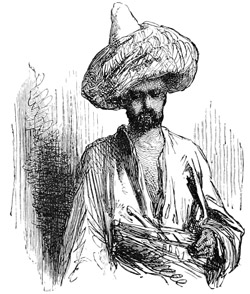
A HAKKIARI KURD.
One great interest of this journey is that it lies through a country in which Kurds, Turks, and Armenians live alongside each other—the Kurds being of two classes, the tribal, who are chiefly nomads, owning no law but the right of the strongest; and the non-tribal or settled, who, having been conquered by Turkey, are fairly orderly, and are peaceable except in their relations with the Christians. The strongholds of the tribal Kurds are in the wild mountains of Kurdistan, and especially in the Hakkiari country, which is sprinkled with their rude castles and forts. An incurable love of plunder, a singular aptitude for religious fanaticism, a recklessness as to the spilling of blood, a universal rapacity, and a cruel brutality when their passions are roused, are among their chief vices. The men are bold, sober, and devoted to their kinsmen and tribe; and the women are chaste, industrious, and maternal. Under a firm and equitable Government, asserting vigorously and persistently the supremacy of law and the equal rights of race and creed, they would probably develop into excellent material.
The village Turk, as he is described by Europeans well acquainted with him and speaking his language, and as I have seen him on a long journey, is a manly, hospitable, hard-working, kindly, fairly honest fellow, domestic, cheerful, patriotic, kind to animals, usually a monogamist, and usually also attentive to his religious duties.
The Christians, who, in this part of Kurdistan, are all Armenians by race, live chiefly on the plains and in the lower folds of the hills, and are engaged in pastoral and agricultural pursuits. My letters have given a faithful representation of them as dwelling with their animals in dark semi-subterranean hovels. The men are industrious, thrifty, clannish, domestic, and not given to vices, except that of intoxication, when they have the means and opportunity, and the women are hardworking and chaste. Both sexes are dirty, hardy, avaricious, and superstitious, and ages of wrong have developed in them some of the usual faults of oppressed Oriental peoples. They cling desperately to their historic church, which is represented among the peasants by priests scarcely less ignorant than themselves. Their bishops constitute their only aristocracy.
They are grossly ignorant, and of the world which lies outside the sandjak in which they live they know nothing. The Sultan is to them a splendid myth, to whom they owe and are ready to pay a loyal allegiance. Government is represented to them by the tax-gatherer and his brutalities. Of justice, the most priceless product of good government, they know nothing but that it is a marketable commodity. With the Armenian trading communities of the cities they have slender communication, and little except nationality and religion in common.
As a rule, they live in villages by themselves, which cluster round churches, more or less distinguishable from the surrounding hovels, but there are also mixed villages in which Turks and Armenians live side by side, and in these cases they get on fairly well together, though they instinctively dislike each other, and the Turk despises his neighbour both for his race and creed. The Armenians have not complained of being maltreated by the Turkish peasants, and had there been any cause for complaint it would certainly have reached my ears.
On this journey hundreds of stories have been told to me by priests of both the Old and Protestant Churches, headmen, and others, of robbery by demand, outrages on women, digging into houses, killing, collectively and individually, driving off sheep and cattle, etc., etc.[58]
On the whole, the same condition of alarm prevails among the Armenians as I witnessed previously among the Syrian rayahs. It is more than alarm, it is abject terror, and not without good reason. In plain English, general lawlessness prevails over much of this region. Caravans are stopped and robbed, travelling is, for Armenians, absolutely unsafe, sheep and cattle are being driven off, and outrages, which it would be inexpedient to narrate, are being perpetrated. Nearly all the villages have been reduced to extreme poverty by the carrying off of their domestic animals, the pillage, and in some cases the burning, of their crops, and the demands made upon them at the sword's point for every article of value which they possess, while at the same time they are squeezed for the taxes which the Kurds have left them without the means of paying.
The repressive measures which have everywhere followed "the Erzerum troubles" of last June,—the seizure of arms, the unchecked ravages of the Kurds, the threats of the Kurdish Beys, who are boldly claiming the sanction of the Government for their outrages, the insecurity of the women, and a dread of yet worse to come,—have reduced these peasants to a pitiable state.
The invariable and reasonable complaint made by the Christians is, that though they are heavily taxed they have no protection from the Kurds, or any advantage from the law as administered in Kurdistan, and that taxes are demanded from them which the Kurds have left them without the means of paying. They complain that they are brutally beaten when they fail to produce money for the payment of the Government imposts, and they allege with great unanimity that it is common for the zaptiehs to tie their hands behind them, to plaster their faces with fresh cow-dung, and throw pails of cold water at their eyes, tie them to the posts of their houses and flog them severely. In the village of ——, which has been swept bare by the Kurds, the people asserted that the zaptiehs had tied twenty defaulters together, and had driven them round and round barefooted over the thistles of the threshing-floor, flogging them with their heavy whips. My zaptiehs complain of the necessity they are under of beating the people. They say (and I think correctly) that they can never know whether a man has a hoard of buried money or not without beating him. They tell me also that they know that half the peasants have nothing to pay their taxes with, but that unless they beat them to "get what they can out of them" they would be punished themselves for neglect of duty.
On the plains to the west and north-west of the lake of Van, where the deep, almost subsoil, ploughing and carefully-constructed irrigation channels testify to the industry of a thrifty population, great depredations are even now being committed, and though later the intense cold and tremendous depths of snow of the Armenian highlands will proclaim the "Truce of God," the Kurds are still on the alert. Nor are their outrages confined to small localities, neither are they the result of "peculiar local circumstances," but from the Persian frontier near Urmi, along a more or less travelled road of several hundred miles, there is, generally speaking, no security for life, traffic, or property, and I hear on good authority that on the other side of Erzerum, even up to the Russian frontier, things are if possible worse.
I have myself seen enough to convince me that in the main the statements of the people represent accurately enough the present reign of terror in Armenia, and that a state of matters nearly approaching anarchy is now existing in the vilayet of Erzerum. There is no security at all for the lives and property of Christians, law is being violated daily, and almost with perfect impunity, and peaceable and industrious subjects of the Porte, taxed to an extent which should secure them complete protection, are plundered without redress. Their feeble complaints are ignored, or are treated as evidence of "insurrectionary tendencies," and even their lives are at the mercy of the increased audacity and aroused fanaticism of the Kurds, and this not in nearly inaccessible and far-off mountain valleys, but on the broad plains of Armenia, with telegraph wires above and passable roads below, and with a Governor-General and the Fourth Army Corps, numbering 20,000 seasoned troops, within easy distance!
I have every reason to believe that in the long winter evenings which I have spent in these sociable odahs, the peasants have talked to me freely and frankly. There are no reasons why it should be otherwise, for my zaptiehs are seldom present, Moussa is looking after his horses in distant recesses, quite out of hearing, and my servants are Christians. If the people speak frankly, I am compelled to believe that the Armenian peasant is as destitute of political aspirations as he is ignorant of political grievances; that if he were secured from the ravages of Moslem marauders he would be as contented as he is loyal and industrious; and that his one desire is "protection from the Kurds" and from the rapacity of minor officials, with security for his life and property. Not on a single occasion have I heard a wish expressed for political or administrative reform, or for autonomy. The Armenian peasants are "of the earth, earthy," and the unmolested enjoyment of material good is their idea of an earthly Paradise.
With regard to the Kurds, they have been remorseless robbers for ages, and as their creed scarcely hesitates to give the appropriation of the goods of a Kafir a place among the virtues, they prey upon the Syrian and Armenian peasants with clear consciences. To rob them by violence and "demand," month after month and year after year, till they have stripped them nearly bare, to cut their throats if they resist, to leave them for a while to retrieve their fortunes,—"to let the sheep's wool grow," as their phrase is,—and then to rob them again, is the simple story of the relations between Kurd and Christian. They are well armed with modern rifles and revolvers. I have rarely seen a Kurd with an old-fashioned weapon, and I have never seen a Christian with a rifle, and their nearly useless long guns have lately been seized by the Government. The Kurds hate and despise the Turks, their nominal rulers; but the Islamic bond of brotherhood is stronger than the repulsion either of hatred or contempt, and the latent or undisguised sympathy of their co-religionists in official positions ensures them, for the most part, immunity for their crimes, for the new Code, under which the evidence of a Christian has become nominally admissible in a court of law, being in direct opposition to the teaching of the Koran, to the practice of centuries, to Kurdish fanaticism, and to the strong religious feelings and prejudices of those who administer justice, is practically, so far as the Christians are concerned, a dead letter.[59]