Front matter (continued 5)
Reading edition
This has not been a comfortable afternoon. The Governor has been out all day hunting, and his deputy either at the bath or a religious function. Milk can only be got in the Jewish quarter, where smallpox is prevailing; the Sanak water is too foul to be used for tea, and no man will go two miles so late for a pure supply. Johannes, who is most disobedient as well as incompetent, has brought no horse food, and poor Boy has been calling for it for two hours, coming into my tent, shaking the bag in which the barley is usually kept, and actually in his hunger clearing the table of melons and grapes. These, however, are only among the very small annoyances of travelling.
9 p.m.—The Governor has returned, and has sent a guard of twenty-five soldiers, with an invitation to visit the ladies before I start to-morrow.
I. L. B.
LETTER XXVI
Turkman, Oct. 6.
Rising very early on Friday morning to keep my appointment with the ladies of the Governor of Sujbulāk, as well as to obtain a letter from him, I reached the palace entrance a little after sunrise, the hour agreed upon. The walls and gateway are crumbling, the courtyard is in heaps, the glass windows of the façade and towers are much broken, the plaster is mangy—a complete disappointment. The Kurdish guard slept soundly at the entrance; only a big dog, more faithful than man, was on the alert. The Governor was not yet awake, nor the ladies. It would be an "intolerable crime," the sentry said, to waken them. He looked as if he thought it an "intolerable crime" that his own surreptitious slumbers had been disturbed. It is contrary to Persian etiquette to waken persons of distinction till they please. I waited at the entrance for half an hour and then reluctantly departed, very sorry not to give the ladies the opportunity they ardently desired of seeing a European woman. They had sent word that they had only once in their lives seen one!
The march to the poor village of Mehemetabad was over uninteresting low rounded hills and through a valley without habitations, opening upon a fine plain, at the south-east end of which the village stands. The camping-ground was a green fallow near some willows and a stream. After marching for some hours under a glittering sky and a hot sun over scorched, glaring yellow soil, a measure of greenness just round the tent is most refreshing to eyes which are suffering from the want of the coloured glasses which were ground under a yabu's hoofs a fortnight ago.
The Khan of the village was very courteous, and sent a tray of splendid grapes, and six watchmen. Buffalo bulls of very large size were used there for burden. Buffaloes are a sure sign of mitigated aridity, for they must bathe, i.e. lie down in water three times daily, if they are to be kept in health, and if the water and mud are not deep enough for this, boys go in along with them and pour water over them with a pannikin. In these regions they are almost exclusively used for burdens, draught, and milk, and everywhere their curved flat horns and sweet, calm, silly faces are to be seen above the water of the deep irrigation ditches. The buffalo, though usually mild enough to be driven by small children, has an uncertain temper, and can be roused to frightful ferocity. In Persian Kurdistan, if not elsewhere, this is taken advantage of, and in the spring, when the animals are in good condition after the winter's rest, the people have buffalo fights, in which cruel injuries would be inflicted were it not for the merciful provision of nature in giving these animals flat incurved horns.[23]
As I sat at my tent door a cloud of dust moved along the road towards the village, escorting an indefinite something which loomed monstrously through it. I have not seen a cart for nine months, and till the unmistakable creak of wooden wheels enlightened me I could not think what was approaching. Actually every village on these plains has one or more buffalo-carts, with wooden wheels without tires, and hubs and axles of enormous size and strength, usually drawn by four buffaloes. A man sits on the front of the cart and drives with a stick, and a boy facing backwards sits on the yoke between the two foremost beasts. He croons a perpetual song, and if this ceases the buffaloes stop. For every added pair (and on the next plain I saw as many as six yoke) there is an additional boy and an additional song.
This apparition carried a light wooden frame, which was loaded to a preposterous height with the strong reeds which are used to support the mud roofs, heavily weighted as these are with stacks of fodder.
One would think one was in the heart of the Bakhtiari country and not on a caravan route, from the difficulty of getting any correct guidance as to the road, distance, safety, or otherwise, etc. Sharban has never been this way, and is the prey of every rumour. Between his terror of having to "eat wood" on his return, and his dread of being attacked and robbed of his yabus, he leads an uneasy life, and when, as at Mehemetabad, there is no yard for his animals, he watches all night in the idea that the guards are the "worst robbers of all." I think he has all the Mussulman distrust of arrangements made by a woman! Hitherto the guards have been faithful and quiet. I always ask them not to talk after 8 p.m., and I have not once been disturbed by them; and when I walk as usual twice round the camp during the night I always find them awake by their big watch-fires.
The village Khan, an intelligent man, spent some time with me in the afternoon. The fields of his village are not manured at all, and the yield is only about tenfold. Willows are grown for the sake of the osiers, which are a necessity, and not for fuel, and the whole of the manure is required for cooking and heating purposes. He said that his village becomes poorer annually owing to the heavier exactions of the officials and the larger sums demanded to "buy off robbers." The latter is a complaint often made in the villages which are near the Turkish frontier, a boundary which from all accounts needs considerable "rectification." The people say that Kurds cross the border, and that unless they bribe them they drive off their sheep and cattle and get over it again safely, but I doubt the truth of these statements.
I got away at sunrise for a march of nominally fourteen miles, but in reality twenty-four. Sharban not only stated the distance falsely but induced others to do the same thing, and when he passed me at midday, saying the halting-place was only two miles ahead, he went on for twelve miles, his desire being to rejoin that bugbear, the "big caravan," which he heard had reached Urmi. The result is that I have had to rest for two days, and he has gained two days' pay, but has lost time.
After some serious difficulties in crossing some swampy streams and a pitiable display of cowardice on Boy's part, we embarked on the magnificent plain of Sulduz, where Johannes, with a supreme self-confidence which imposed on me, took the wrong one of two tracks, and we rode west instead of east, to within a few hours' journey of a pass into Turkey through the magnificent range of the Zibar mountains, which even at this advanced season are in some places heavily patched with last winter's snow.
To regain the caravan route we had to cross the greater part of this grand plain, which I had not then seen equalled in Persia for fertility and population. It possesses, that crown of blessings, an abundant water supply, indeed so abundant that in the spring it is a swamp, and the spring sowing is delayed till May. It has several large villages, slightly raised and well planted, a few of them with the large fortified houses of resident proprietors overtopping the smaller dwellings. Evidences of material prosperity meet the eye everywhere, a prosperity which needs to be guarded, however, for every shepherd, cowherd, ploughman, and buffalo-driver goes about his work armed.
Large herds of mares with mule foals, of big fat cattle, and of buffaloes, with plenty of mud to wallow in, stacks of real hay and of fine reeds, buffalo carts moving slowly near all the villages carrying the hay into security, grass uncut and unscorched, eighteen inches high, a deep, black, stoneless soil, impassable at certain seasons, towering cones of animal fuel, for export as well as use, an intensely blue sky above, a cool breeze, and the rare sight of cloud-shadows drifting over waving grass and flecking the cobalt sides of the Zibar mountains, combined to form a picture I would not willingly have missed, impatient as I was for the first view of the Sea of Urmi.
Beyond there are low stony hills, which would be absolutely bare now but for the Eryngium cæruleum and the showy spikes of a great yellow mullein, a salt lake, most of which is now a salt incrustation, mimicking ice from beneath which the water has been withdrawn, but with an odour which no ice ever has, then a gradual ascent to a windy ridge, and then—the Dead Sea of Urmi or Urumiya.
Dead indeed it looked from that point of view, and dead were its surroundings. It lay, a sheet of blue, bluer even than the heavens above it, stretching northwards beyond the limits of vision, and bounded on the east, but very far away, by low blue ranges, seen faintly through a blue veil. On the west side there are mountains, which recede considerably, and descend upon it in low rounded buff slopes or downs, over which the track, keeping near the water, lies. There was not a green thing, not a bush, or house, or flock of sheep, or horseman, or foot passenger along the miles of road which were visible from that point. The water lay in the mocking beauty of its brilliant colouring, a sea without a shore, without a boat, without a ripple or flash of foam, lifeless utterly, dead from all time past to all time to come. Dead, too, it is on closer acquaintance, and its odour, which can be discerned three miles off, is that odour of corruption known to science as sulphuretted hydrogen. Now and then there is a shore, a shallow bay or inlet, in which the lake, driven by the east wind, evaporates, leaving behind it a glaring crust of salt, beyond which a thick, bubbly, blackish-green scum lies on the blue water. In such places only the expressive old-fashioned word stench can describe the odour, which was strong enough nearly to knock over the servants and charvadars. No description can give an idea of the effluvium which is met with here and there beside this great salt lake, which has a length of eighty miles and an average breadth of twenty-four.
A few miles from Dissa the lake-water is brought into tanks and evaporated, and many donkeys were being loaded with the product, which, like all salt which is sold in Persia, is impure, and for European use always requires a domestic and tedious process of purification.
After a solitude of several miles villages appear, lying off the road in folds of the hills, which gradually recede so far as to leave a plain some miles broad and very fertile. At the end of an eleven hours' march we reached the important village of Dissa, with large houses and orchards, abundant water, a detachment of soldiers as a garrison, a resident proprietor's house, to which in his absence I was at once invited by his wife, and so surrounded by cultivation that a vacant space could only be found for the camp in a stubble-field.
The caravan had only just come in, and there was neither fuel nor drinking water within easy reach. I was so completely worn out that I was lifted off the horse and laid on the ground in blankets till the camp was in order late at night. Sharban, knowing that his deception was discovered, had disappeared with his yabus without helping as usual to pitch my tent. Mirza, always cheerful and hard-working, though always slow, and Johannes did their best, but it is very hard on servants who are up before five not to bring them in till sunset, when their work is scarcely over till near midnight, and has to be done in the dark. The next day there were a succession of dust storms and half a gale from noon to sunset, but my tent stood it well, and the following day this was repeated. These strong winds usually prevail in the afternoon at this season.
Urmi, October 8.—A march over low and much-ploughed hills, an easy descent and a ford brought us down upon the plain of Urmi, the "Paradise of Persia," and to the pleasant and friendly hamlet of Turkman, where I spent the night and made the half-march into Urmi yesterday morning. This plain is truly "Paradise" as seen from the hill above it, nor can I say that its charm disappears on more intimate acquaintance. Far from it!
I have travelled now for nine months in Persia and know pretty well what to expect—not to look for surprises of beauty and luxuriance, and to be satisfied with occasional oases of cultivation among brown, rocky, treeless hills, varied by brown villages with crops and spindly poplars and willows, contrasting with the harsh barrenness of the surrounding gravelly waste.
But beautiful Urmi, far as the eye can reach, is one oasis. From Turkman onwards the plain becomes more and more attractive, the wood-embosomed villages closer together, the variety of trees greater. Irrigation canals shaded by fruit trees, and irrigation ditches bordered by reeds, carry water in abundance all through the plain. Swampy streams abound. Fair stretches of smooth green sward rejoice the eye. Big buffaloes draw heavy carts laden with the teeming produce of the black, slimy, bountiful soil from the fields into the villages. Wheat, maize, beans, melons, gourds, potatoes, carrots, turnips, beets, capsicum, chilis, bringals, lady's fingers, castor-oil (for burning), cotton, madder, salsify, scorzonera, celery, oil-seeds of various sorts, opium, and tobacco all flourish. The orchards are full of trees which almost merit the epithet noble. Noble indeed are the walnuts, and beautiful are the pomegranates, the apricots, the apples, the peach and plum trees, and glorious are the vineyards with their foliage, which, like that of the cherry and pear, is passing away in scarlet and gold. Nature has perfected her work and rests. It is autumn in its glories, but without its gloom.
Men, women, and children are all busy. Here the wine-press is at work, there girls are laying clusters of grapes on terraces prepared for the purpose, to dry for raisins; women[24] are gathering cotton and castor-oil seeds, little boys are taking buffaloes to bathe, men are driving and loading buffalo-carts, herding mares, ploughing and trenching, and in the innumerable villages the storehouses are being filled; the herbs and chilis are hanging from the roofs to dry, the women are making large cakes of animal fuel (of which they have sufficient for export), and are building it into great conical stacks, the crones are spinning in the sun, and the swaddled infants bound in their cradles are lying in the fields and vineyards, while the mothers are at work. This picture of beauty, fertility, and industry is framed by the Kurdistan mountains on the one side, and on the other by long lines of poplars, through which there are glimpses of the deep blue waters of the Urmi Sea. These Kurdistan mountains, a prolongation of the Taurus chain, stern in their character, and dwarfing all the minor ranges, contrast grandly with the luxuriant plains of Sulduz and Urmi.
As I passed northwards the villages grew thicker, the many tracks converged into a wide road which was thronged with foot passengers, horsemen, camel and horse caravans, and strings of asses loaded with melons and wood. Farther yet the road passes through beautiful orchards with green sward beneath the trees; mud walls are on both sides, and over them droop the graceful boughs and gray-green foliage of an elægnus, with its tresses of auburn fruit.
At the large village of Geog-tapa a young horseman overtook me, and said in my native tongue, "Can you speak English?" He proved to be a graduate of the American College at Urmi, and a teacher in Shamasha Khananeshoo's school (known better to his supporters in England as Deacon Abraham). He told me that I was expected, and shortly afterwards I was greeted by the son of the oldest missionary in Urmi, Dr. Labaree.
The remaining four miles were almost entirely under the shade of fine trees, past the city walls and gates, put into tolerable repair after the Kurdish invasion ten years ago, and out into pretty wooded country, with the grand mountains of the frontier seen through the trees, where a fine gateway admitted us into the park in which are the extra-mural buildings of the American Presbyterian Mission, now more than half a century old. These are on high ground, well timbered, and the glimpses through the trees of the mountains and the plain are enchanting.
Through the kindness of my friends at Hamadan, who had written in advance, I am made welcome in the house of Dr. Shedd, the Principal of the Urmi College.[25]
Within two hours of my arrival I had the pleasure of visits from Canon Maclean and Mr. Lang of the English Mission, and from Dr. Labaree and the ladies of the Fiske Seminary, the English, French, and American missionaries being the only European residents in Urmi.
I. L. B.
NOTES ON PROTESTANT MISSIONS IN URMI[26]
A sketch of Urmi would present few features of general interest if it did not embrace an outline of the mission work which is carried on there on a large scale, first by the numerous agents, lay and clerical, male and female, of the American Presbyterian Board of Foreign Missions, and next by the English Mission clergy and the Sisters of Bethany, who form what is known as "The Archbishop of Canterbury's Mission to the Assyrian Christians."
Besides these there is a Latin Mission of French Lazarists, aided by Sisters of St. Vincent de Paul, which has been at work in Urmi and on the plain of Salmas for forty years.
Urmi, the reputed birthplace of Zoroaster, and in past ages the great centre of Fire Worship, was made the headquarters of the American Mission to the Nestorians in 1834, which, with the exception of the C.M.S. Mission in Julfa, was the only Protestant Mission in Persia up to the year 1885.
At present there are four ordained American missionaries, several ladies, and a medical missionary working in Urmi. Under their superintendence are thirty ordained and thirty-one licentiate pastors, ninety-three native helpers, and three Bible-women. The number of Nestorians or Syrians employed as teachers in the College and the Fiske Seminary for girls, as translators, as printers, and as medical assistants, is very considerable.
The whole plain of Urmi, with its innumerable villages, and the eastern portion of the Kurdish mountains, with its Syrian hamlets, are included within the sphere of Mission work.
This Mission has free access to Syrians, Armenians, and Jews, but for Moslems there can be no public preaching or teaching, nor can a Moslem openly profess Christianity, or even frequent the Syrian services, without being a marked man. Hence, while all opportunities are embraced of conversation with Mohammedans, and of circulating the Bible among them, the mission work is chiefly among nominal Christians.
The Americans own a very large amount of property at Urmi. The Fiske Seminary—a High School, in which a large number of girls receive board as well as education—is within the city walls, as well as some of the houses of both clerical and lady missionaries. About a mile outside they have acquired a beautiful and valuable estate of about fifteen acres, plentifully wooded and watered, and with some fine avenues of planes. On this are the large buildings of the Urmi College, the professors' houses, the Dispensary, and the Medical Mission Hospitals for the sick of both sexes.
A very high-class education is given in the Urmi College, and in addition to the general course there are opportunities for both theological and medical education. Last year there were 151 students, of which number eighteen graduated.
The education given is bringing about a result which was not anticipated. The educated Syrian and Armenian young men, far from desiring generally to remain in their own country as pastors and teachers, and finding no opportunities of "getting on" otherwise, have of late been seized with a craze for leaving Persia for America, Russia, or any other country where they may turn their education to profitable account. It is hardly necessary to add that the admirable training and education given in the Fiske Seminary do not produce a like restlessness among its "girl graduates." The girls marry at an early age, make good housewives, and are in the main intelligent and kindly Christians.
Possibly the education given in the Urmi College is too high and too Western for the requirements of the country and the probable future of the students. At all events similar regrets were expressed in Urmi, as I afterwards heard, regarding some of the American Mission Colleges in Asia Minor. The missionaries say that the directly religious results are not so apparent as could be desired, that the young men are not ready to offer themselves in any numbers for evangelistic work, and that the present tendency is to seek secular employment and personal aggrandisement.
Though this secular tendency comes forward strongly at this time, a number of evangelistic workers scattered through Persia, Turkey, and Russia[27] owe their education and religious inspiration to the teachings of the Urmi College. At present a few of the young men have banded themselves together to go forth as teachers and preachers with the object of carrying the Gospel to all, without distinction of nationality. The hopefulness of this movement is that it is of native origin, and that the young men are self-supporting. A capable Syrian physician and a companion are also preaching and healing at their own cost, only accepting help towards the expense of medicines.
The Medical Mission at Urmi, with its well-equipped Dispensary and its two admirable Hospitals, is of the utmost value, as such missions are all the world over.
Dr. Cochrane, from his courtesy and attention to the niceties of Persian etiquette, is extremely acceptable to the Persian authorities, and has been entrusted by them more than once with missions involving the exercise of great tact and ability. He is largely trusted by the Moslems of Urmi and the neighbourhood, and mixes with them socially on friendly and easy terms.
He and some of the younger missionaries were born in Persia, their fathers having been missionaries before them, and after completing their education in America they returned, not only with an intimate knowledge of etiquette and custom, as well as of Syriac and Persian, but with that thorough sympathy with the people whom they are there to help and instruct, which it is difficult to gain in a single generation, and through languages not acquired in childhood. Dr. Cochrane has had many and curious dealings with the Kurds, the dreaded inhabitants of the mountains which overhang the beautiful plain of Urmi, and a Kurd, who appears to be in perpetual "war-paint," is the gatekeeper at the Dispensary. One of the most singular results of the influence gained over these fierce and predatory people by the "Missionary Hakīm" occurred in 1881, when Obeidullah Khan, with 11,000 Kurds, laid siege to Urmi.
Six months previously, at this Khan's request, Dr. Cochrane went up a three days' journey into the mountains, where he remained for ten days, during which time he cured the Khan of severe pneumonia, and made the acquaintance of several of the Kurdish chiefs. Before the siege began Obeidullah Khan sent for Dr. Cochrane, saying that he wished to know his residence and who his people were, so as to see that none of them suffered at the hands of his men. Not only this, but he asked for the names of the Christian villages on the plain, and gave the Hakīm letters with orders that nothing should be touched which belonged to them. The mission families were assembled at the College, and 500 Christians, with their cattle and horses, took refuge in the College grounds, which were close to the Kurdish lines. The siege lasted seven weeks, with great loss of life and many of "the horrors of war," as time increased the fury of both Kurds and Persians. But Obeidullah kept his word, and for the sake of the Hakīm and his healing art, not only was not a hair on the head of any missionary touched, but the mixed multitude within the gates and the herds were likewise spared.
Mrs. Cochrane, the widow of the former medical missionary, superintends the food and the nursing in the hospitals, and I doubt whether the most fanatical Kurd or Persian Moslem could remain indifferent to the charm of her bright and loving presence. The profession of Dr. Cochrane opens to him homes and hearts everywhere. All hold him as a friend and benefactor, and he has opportunities, denied to all others, of expounding the Christian faith among Moslems. A letter from him is a safe-conduct through some parts of the Kurdish mountains, and the mere mention of his name is a passport to the good-will of their fierce inhabitants.
The work of the mission is not confined to the city of Urmi. Among the villages of the plain there are eighty-four schools, taught chiefly in Syriac, seven of which are for girls only. The mission ladies itinerate largely, and are warmly welcomed by Moslem as well as Christian women, and even by those families of Kurds who, since their defeat in 1881, have settled down to peaceful pursuits, some of them even becoming Christians.
In fifty years the American missionaries have gained a very considerable and wide-spread influence, not only by labours which are recognised as disinterested, but by the purity and righteousness of their lives; and the increased friendliness and accessibility of the Moslems of Urmi give hope that the purer teachings of Christianity and the example of the life of our Lord are regarded by them with less of hostility or indifference than formerly.
The history of the mission is best given in the words of Dr. Shedd, one of its oldest members.[28]
The communicants of the "Evangelical Syriac Church," which might be termed, from its organisation and creed, the Presbyterian Syriac Church, numbered 216 in 1857 and 2003 in 1887.
Apart from the results of Christian teaching and example, there can be, I think, no doubt that the residence of righteous foreigners in Urmi for over half a century has had a most beneficial effect on the condition of the Nestorians. At the time when the first American missionaries settled in Urmi the yoke of Islam was hardly bearable. The Christians were oppressed and plundered, their daughters were taken by violence, and they were scarcely allowed to practise the little religion left to them. The Persian Government, sensitive as it is to European opinion, has gradually remedied a state of matters upon which the reports of the missionaries were justly to be dreaded, and at the present time the Christians of Urmi and the adjacent plain have comparatively very little to complain of.
At the same time the Syriac Church was at its lowest ebb, absolutely sunk in ignorance and superstition. It had no exposition of the Bible, and all worship was in the ancient Syriac tongue, then as now "not understanded of the people." It had no books or any ability to establish schools. Bibles were scarce, and a single copy of the Psalms could not be bought for less than 32s. The learned nuns and deaconesses of the early days were without successors. Women were entirely neglected, and it was regarded as improper for the younger among them to be seen at church. In Urmi not a woman could read, and in the whole Nestorian region they were absolutely illiterate, with the exception of the Patriarch's sister and two or three nuns.
The translation of the Bible into modern Syriac, a noble work, now undergoing revision; the College; the Female Seminary; the translation and publication of many luminous books; the circulation of a periodical called Rays of Light, together with fifty years of intercourse with men and women whose chief aim is the religious and intellectual elevation of the people among whom they dwell, have wrought a remarkable change, though that the change is menaced with perils, and is not an absolutely unmixed good, cannot be gainsaid.
It is for the future to decide whether the Reform movement in Umri or elsewhere could survive in any strength the removal of the agency which inaugurated it, and whether a Church without a ritual and with a form of government alien to the genius of the East and the traditions of the fathers, can take root in the affections of an eminently conservative people.
The Mission, founded by the present Archbishop of Canterbury at the request of the Catholicos of the East, Mar Shimun, the Patriarch of the Syrian Church, arrived in Urmi in the autumn of 1885. At the time of my visit it consisted of five mission priests, graduates of Oxford and Cambridge Universities, and an ordained Syrian, four of whom were at the headquarters in Urmi, one in the Kurdish mountains, and one on the Urmi Plain. Four Sisters of Bethany arrived in the spring of 1890 for the purpose of opening a boarding-school for girls and instructing the women.
It is hardly necessary to say that the lines on which the Anglican and American missions proceed are diametrically different, and the modes of working are necessarily in opposition. The one is practically a proselytising agency, and labours to build up a Presbyterian Church in Persia; the other purposes to "bring back an ancient church into the way of truth, and so prepare it for its union with its mother church, the Orthodox Church of the East." The objects of the latter and its ecclesiastical position are stated briefly in the note below.[29]
The actual work to be done by the Mission is thus summed up by its promoters: "The work of the Mission is in the first place to train up a body of literate clergy; secondly, to instruct the youth generally in both religious and secular knowledge; and thirdly, to print the very early liturgies and service-books, to which the Assyrians are much attached, which have never been published in the original, and of which the very primitive character is shown by their freedom from doubtful doctrine. The Mission in no way seeks to Anglicanise the Assyrians on the one hand, nor, on the other, to condone the heresy which separated them from the rest of Christendom or to minimise its importance."
The English clergy are celibates, receive no stipends, and live together, with a common purse, each receiving £25 per annum for personal expenses.
It is not a proselytising mission. It teaches, trains, and prints. It has one High School at Urmi for boys under seventeen, and two upon the Urmi Plain, but the work to which these may be regarded as subsidiary is the Urmi Upper School for priests, deacons, and candidates for holy orders. In these four establishments there are about 200 pupils, mostly boarders. There are also seventy-two village day-schools, and the total attendance last year was—boys 1248, girls 225. Seventy-six deacons and young men above seventeen are in the Upper School at Urmi.
The education given in the ordinary schools is on a level with that of our elementary schools. In the school of St. Mary and St. John, which contains priests, deacons, and laymen, some being mountaineers, the subjects taught are Holy Scripture, catechism, Scripture geography, universal history, liturgy, preaching, English, Persian, Osmanli Turkish, arithmetic, and Old Syriac.[30] Preaching is taught practically. A list of 100 subjects on a systematic theological plan has been drawn up, and each week two of the deacons choose topics from the list and write sermons upon them.
In 1887 the Mission clergy drew up a catechism containing between 200 and 300 questions, with "Scripture proofs," which the scholars in all their schools are obliged to learn by heart.
The boys of the Urmi High School and of the Upper School board in the mission house, and are under the constant supervision of the clergy. Their food and habits of living are strictly Oriental. All imitations of Western manners and customs are forbidden, the policy of the Mission being to make the Syrians take a pride in their national customs, which as a rule are adapted to their circumstances and country, and to look down upon those who ape European dress and manners. Denationalisation is fought against in every possible way.
A year and a half ago work among women was begun by four ladies of the community of the Sisters of Bethany. The position of Syrian women, in spite of its partial elevation by means of the Fiske Seminary, is still very low, and within the Old Church there is an absolute necessity for raising it, and through it the tone of the home life and the training of children. These ladies have thirty boarders in their school between the ages of eight and sixteen, a previous knowledge of reading acquired in the village schools being a condition of admission. The daily lessons consist of Bible teaching, the catechism before referred to, ancient and modern Syriac, geography, arithmetic, and all branches of housework and needle-work. Due regard is paid to Syrian customs, and the picturesque Syrian costume is retained.
Since these ladies have acquired an elementary knowledge of Syriac they have been itinerating in the Urmi villages, holding Bible classes, giving instruction, and distributing medicines among the sick. The ignorance and superstition of the Christian women are almost past belief. One great difficulty which the "sisters" have to encounter arises from the early marriages of the girls, child-brides of eleven and twelve years old being quite common. It may reasonably be expected that the presence and influence, the gentleness and self-sacrifice of these refined and cultured Christian ladies will tell most favourably upon their pupils, and strengthen with every month of their residence in Urmi. The Moslems understand and respect the position of voluntarily celibate women, and speak of them as "those who have left the world."
The Mission clergy of late have striven to instruct the adult Syrian population of the Urmi Plain by preaching among them systematically, explaining in a very elementary manner the principles of Christianity, and their application to the life of man. They have also set up a printing press, and have already printed in Syriac type a number of school books, the Catechism, the Liturgy of the Apostles, the most venerable of the Syrian Liturgical documents, the Second and Third Liturgies, the Baptismal Office, ancient and modern Syriac grammars, and a Lectionary.
It is the earnest hope of the promoters of this Mission that if this ancient Oriental church, once the first mission agency in the world, can be reformed and enlightened, she may yet be the means of evangelising the two great sects of Moslems by means of missionaries akin to them in customs, character, and habits of thought—"Orientals to Orientals."
The subject of Christian missions in Persia is a very interesting one, and many thoughtful minds are asking whether Christianity is likely to be a factor in the future of the Empire? As things are, no direct efforts to convert Moslems to Christianity can be made, for the death penalty for apostasy is not legally abolished, and even if it were, popular fanaticism would vent itself upon proselytes. It must be recognised that the Christian missionary is a disturbing element in Persia. He is tolerated, not welcomed, and tolerated only while his efforts to detach people from the national faith are futile. Missions have been in operation in Persia for more than fifty years, and probably at the present time there are over seventy-five missionaries at work in the country. If the value of their work were to be judged of by the number of Moslem converts they have made it must be pronounced an absolute failure.
The result of the impossibility of making any direct attack upon Islam is that these excellent men and women are at present ostensibly engaged in the attempt to purify the faith and practice of the Syrian and Armenian churches, to enlighten their members religiously and intellectually, and to Christianise the Jews, waiting patiently for the time when an aggressive movement against Islam may be possible. In the meantime the Holy Scriptures are being widely disseminated; the preacher of Christianity itinerates among the villages, the Christian religion is greatly discussed, and missionary physicians, the true pioneers of the faith, are modifying by their personal influence the opposition to the progress of the missionaries with whom they are associated.
On the whole, and in spite of slow progress and the apparently insurmountable difficulties presented by hostility or indifference, I believe that Christian missions in Persia, especially by their educational agencies and the circulation of the Bible, are producing an increasing under-current, tending towards secular as well as religious progress, and are gaining an ever-growing influence, so that, lamentably slow as the advance of Christianity is, its prospects cannot justly be overlooked in considering the probable future of Persia.[31]
LETTER XXVII
Urmi, Oct. 14.
Very few European travellers visit Urmi and its magnificent plain, the "Paradise of Persia," though it is only 112 miles from Tabriz. Gardens come up to the city walls, and the plain, about fifty miles long by eighteen broad, is cultivated throughout, richly wooded, very populous, and bounded on the east not by a desert with its aridity, but by the blue waters of the Urmi Sea, and on the west by the magnificent mountains of Kurdistan. The city is some miles to the west of the lake.
Urmi is on the whole very pretty and in good repair. The Christian quarter is almost handsome, well built and substantial, and the houses are generally faced with red bricks. The bazars are large and well supplied, and trade is active. The walls and gateways are in good repair, and so is the deep ditch, which can be filled with water, which surrounds them. Every gate is approached by an avenue of noble elægnus and other fruit trees. The gardens within the walls are very fine, and orchards and vineyards, planes and poplars testify to the abundance of water and the excellent method of its distribution. The altitude is stated at 4400 feet. The estimate of the population varies from 12,000 to 20,000.
Though the Sea of Urmi receives fourteen rivers, some of them by no means insignificant, and has no known outlet, it recedes rather steadily, leaving bare a soil of exceeding richness, and acres of dazzling salt. It has very few boats, and none suited for passenger traffic. Its waters are so salt that fish cannot live in them.
The antiquarian interests of Urmi consist in the semi-subterranean Syrian church of Mart-Mariam, said to have been built by the Magi on their return from Bethlehem! a tower and mosque of Arab architecture seven centuries old, and some great mounds outside the walls, from sixty to one hundred feet in height, composed entirely of ashes, marking the site of the altars at which the rites of one of the purest of the ancient faiths were celebrated. As the birthplace of Zoroaster, and for several subsequent ages the sacred city of the Fire Worshippers and the scene of the restoration of the Mithraic rites, Urmi must always remain interesting.
The Christian population of the city is not very large, though it is estimated that there are 20,000 Syrian Christians in the villages of the plain. The city Syrians are mostly well-to-do people, who have come into Urmi to practise trades. The best carpenters, as well as the best photographers and tailors, are Syrians, and though in times past the Moslems refused to buy from the Christians on the ground that things made by them are unclean, the prejudice is passing away.
There is a deputy-governor called the Serperast, whose duty it is to deal with the Christians. The office seems to have been instituted for their protection at the instigation of the British Government, but the Europeans regard it simply as a means of oppression and extortion, and desire its abolition. Canon Maclean goes so far as to say, "The multiplication of judges in Persia means the multiplication of injustice, and of the number of persons who can extort money from the unfortunate people." The Serperast depends chiefly for his living and for keeping up a staff of servants on what he can get out of the Christians in the way of fines and bribes, and consequently he foments quarrels and encourages needless litigation on all hands, the Syrians being by all accounts one of the most litigious of peoples.
I write of the Christians of Urmi and its plain as Syrians because that is the name by which they call themselves. We know them at home as Nestorians, but this is a nickname given to them by outsiders, and I know of no reason why we should use a nomenclature which attaches to a nation the stigma of an ancient "heresy." They are sometimes called Chaldæans,[32] and the present Archbishop of Canterbury has brought into currency the term "Assyrians," which, however, is never used by themselves, or by any Orientals in speaking of them. The Moslems apply the name Nasara (Nazarenes) solely to the Syrian Christians. They claim that Christianity was introduced among them by the Magi on their return from Bethlehem. The highest estimate of their numbers is 120,000, and of these more than 80,000 are in Turkey. The Persian Syrians inhabit the flat country, chiefly the plains of Urmi and Salmas, where the fertile lands are most carefully cultivated by their industry.
In my last letter I remarked upon the prosperity and garden-like appearance of the Urmi Plain. Its 20,000 Syrian inhabitants usually live in separate villages from the Kurds, Persians, and Armenians, and are surrounded on all sides by Moslems of the Shiah sect. The landlords or Aghas of their villages are generally Moslems, who govern their tenants in something of feudal style. Land is a favourite investment in Persia, and owing to the industrious habits of the Syrians, the "Agha-ship" of their villages commands a high price. The Aghas often oppress the peasants, but the tenure of houses is fairly secure, and according to Canon Maclean, to whom I am indebted for my information, a system much like the Scotch feuing system (though without feu charters) is in force. If a man wishes to build a house he takes a present of a few sugar-loaves or a few krans with him, and applies to an Agha for a site. After it is granted he pays an annual ground rent of 4s. 9d., but he can build his house as he pleases, and it cannot be taken from him so long as he pays his ground rent. Moreover, he can sell the house and give a title-deed to the purchaser, with the sole restriction that the new possessor must become a vassal of the Agha.
In addition to the payment of the ground rent, the tenant is taxed annually by the Agha for every female buffalo 2s., for every cow 1s., and for every ewe and she-goat 6d., after they have begun to bear young. The Agha also receives from each householder annually two fowls, a load of kiziks, some eggs, three days' labour or the price of it, and a fee on every occasion of a marriage. Each house pays also a tax of 8d. a year and gives a present of firewood to the Serperast of Urmi, the Mussulman governor of the Christians. In his turn the Agha pays to the Shah from a third to a half of the total taxation.
A village-house, even when built of sun-dried bricks, rarely costs more than £35, and often not the half of that sum.[33] The great feature of a Syrian dwelling is what is called emphatically "the house"; the combined living-room, bedroom, smoking-room, kitchen, bakery, and workroom of one or more families. This room cannot possess a balakhana, as its openings for light and air are in the roof. A stable, store-rooms, and granary are attached to it.
Vineyards are the chief reliance of the Syrians of the Urmi Plain, their produce, whether as grapes, raisins, or wine, being always marketable. They are held on the same tenure as the houses, and as long as the vine-stocks remain in the ground, and the ground rent, which is 7s. a year for the tanap, a piece of ground 256 yards square, is paid, the tenant cannot be evicted. Where vineyards are sub-let for a year a fair rent is from 10s. to 12s. a tanap. If a tenant buys a property from an Agha the yearly taxation is 5s. a tanap; grass fields and orchards are held on the same tenure as vineyards, and at the same rent. With ploughed land the case is different. If the tenant provides the seed, etc., he gives the Agha a third of the produce, and if the Agha provides seed the tenant returns two-thirds. The tenant of ploughed land may be changed annually.
This paying the rent in kind is going on just now in every village, and the Aghas secure themselves against dishonesty by requiring that the grain shall be threshed on their floors. In addition, their servants watch night and day by turns, in an erection similar to the "lodge in a garden of cucumbers" or melons, an arbour of boughs perched at a height of seven or eight feet upon four poles. The landlord's nasr appears at intervals to take away his master's share of the grain. It is all delightfully primitive.
The arrangements sound equitable, the taxes are moderate, and in some respects the Christians are not more victimised by their landlords than are their Mohammedan neighbours. The people acknowledge readily that as regards oppression they are much better off than they were, and that in this respect the presence of the American missionaries in Urmi has been of the greatest advantage to them, for these gentlemen never fail to represent any gross case of oppression which can be thoroughly substantiated to the Governor of Urmi, or in the last resort to the Governor of Azerbijan. The oppressions exercised by the Aghas consist in taking extra taxes, demanding labour without wages, and carrying off Christian girls for their harams. The laws which affect Christians specially and injuriously are—
1. That the evidence of a Christian is not received against a Mussulman.
2. That if any member of a Christian family becomes a Moslem, he or she becomes entitled to claim the whole property of the "house," which as often as not consists of two or three families. The apostatising member of a household is usually a girl, who either falls in love with or is carried off by a young Mohammedan, who declares truly or falsely that she has embraced his creed. A good governor is careful in these matters, and in some cases gives the girl only her share of the family property, but a bad governor may at any time carry out the law, or use it as a means for extorting ruinous bribes.[34]
Every Christian man above the age of sixteen pays a poll tax of 3s. annually for exemption from military service, but from this impost the headman of a village, who is at once its tax-gatherer and its spokesman, is free. He ranks next to the priest, and is treated by the villagers with considerable respect. I have found the Syrian kokhas as polite and obliging as the Persian ketchudas.
Although the Persian Government has been tolerably successful in subduing the Kurds within its territory, the Christians of the slopes of the Urmi Plain are exposed to great losses of sheep and cattle from Kurdish mountaineers, who (it is said) cross the Turkish frontier, and return into Turkey with their booty.[35]
The American and English missionaries do not paint the Syrians couleur de rose, though the former during their long residence in the country must have lifted up several hundreds to the blessings of a higher life, and these in rising themselves must have exercised an unconscious influence on their brethren. Since I came I have seen several women whose tone would bear comparison with that of the best among ourselves, and who owe it gratefully to the training and influence of the Fiske Seminary. I like the women much better than the men.
The Christians complain terribly of the way in which "justice" is administered, and doubtless nothing can be worse, but the Europeans say that the people bring much of its hardship upon themselves by their frightful litigiousness, and their habit of going to law about the veriest trifles. Intense avarice seems to be a characteristic of the Syrians of the Persian plains, and they fully share with other Orientals in the failings of untruthfulness and untrustworthiness. They are said to be very drunken as well as grossly ignorant and superstitious, and the abuses and unutterable degradation of their church perpetuate all that is bad in the national character. The women are spoken of as chaste, and some of the worst forms of vice are happily unknown among the Syrians, though they are practised by the Moslems around them. Their hospitality, their sufferings for the faith, and their family attachment are justly to be reckoned among their virtues, but on the whole I think that the extraordinary interest attaching to them, and which I feel very strongly myself, is due rather to their Past than to their Present.
On this plain the dress of the men is much assimilated to that of the Persians, but the women wear their national costume. The under-garment is a coloured shirt, over which is worn a sleeved waistcoat of a different colour, and above this is an open-fronted coat reaching to the knees. Loose trousers, so full as to look like a petticoat, are worn, and frequently an apron and a heavy silver belt are added. The head-dress is very becoming, and consists of a raised cap of cloth or silk, embroidered or jewelled, with a white muslin veil over it and the head, but the face is exposed, except in the case of married women, who draw a part of the veil over the mouth. It is not proper that the hair should be seen.
There is something strikingly Biblical about their customs and speech. At dinner at Geog-tapa I noticed that it is a mark of friendship for a man to dip a piece of bread (a sop) into the soup and give it to another, a touching reminiscence. A priest is greeted with "Hail, Master," a teacher is addressed as "Rabban," the salutation is "Peace be with you," and such words as Talitha cumi and Ephphatha occasionally startle the ear in the midst of unintelligible speech, suggesting that the Aramaic of our Lord's day was very near akin to the old Syriac, of which the present vernacular is a development. As among the Moslems, pious phrases are common. A Syrian receiving a kindness often replies, "May God give you the kingdom of Heaven," and when a man makes a purchase, or enters on a new house, or puts on a new garment, it is customary to say to him, "May God bless your house, your garment," etc. A child learning the letters of the alphabet is taught to say at the close, "Glory to Christ our King." A copyist begins his manuscript by writing within an ornamental margin, "In the strength of our Lord Jesus Christ we begin to write," and a man entering on a piece of work honours the Apostolic command by saying, "If the Lord will I shall accomplish it."[36] My friends tell me that I shall find the Syrians of the mountains a different people, and a mountaineer is readily recognised in the streets by the beauty and picturesqueness of his dress.
The eight days in Urmi have been a very pleasant whirl, a continual going to and fro between the College and the Fiske Seminary, the English clergy house and the Sisters' house, receiving Syrian visitors at home and holding a reception for them in the city, calling on the Governor, visiting the English upper school, where deacons, in the beautiful Syrian costume, with daggers in their girdles, look more like bandits than theological students, and spending a day at Geog-tapa, where I saw Shamasha Khananeshoo's (Deacon Abraham's) orphanage, dined with him and his charming wife, and a number of other Syrians in Syrian style, and went to the crowded Geog-tapa church, where the part of the floor occupied by the women looked like a brilliant tulip-bed. Here, in the middle of the service, the Qasha or priest said that the people, especially the women, were very anxious to know for what reason I was travelling, to which evidence of an enlightened curiosity I returned a reply through an interpreter, and reminded them of the glories of their historic church and its missionary fervour.
Geog-tapa (cerulean hill) possesses one of the largest of the Zoroastrian mounds of ashes. It is a pity that these are not protected, and that the villagers are allowed to carry away the soil for manure, and to break up the walls and cells (?) which are imbedded in them for building materials. This vandalism has brought to notice various curious relics, such as earthenware vessels of small size and unique shape, and a stone tomb containing a human skeleton, with several copper spikes from four to five inches long driven into its skull. In another mound, at some distance from this one, a large earthen sarcophagus was discovered, also containing a skeleton with long nails driven into its skull.
Deacon Abraham's work is on the right lines, being conducted entirely by Syrians. It is most economically managed, and the children are trained in the simple habits of Syrian peasants. The religious instruction is bright and simple. The boys receive an elementary education, a practical training in agriculture on some lands belonging to the Orphanage, and in various useful handicrafts. As much of the money for the support of this work is raised in England, it is satisfactory to know that the accounts are carefully audited by the American missionaries.
The days have flown by, for, in addition to the social whirl, I have been occupied in attempts, only partially successful, to provide myself with necessaries for the journey, and in an endeavour, altogether unsuccessful, to replace Johannes by a trustworthy servant. The kind friends here have lent me a few winter garments out of their slender stock, and have helped me in every way.
It has been most difficult to get charvadars. The country on the other side of the frontier is said to be "unsettled," no Persians will go by the route that I wish to take, and two sets of Kurds, after making agreements to carry my loads, have disappeared. Various Syrians have come down from the mountains with stories of Kurdish raids on their sheep and cattle, but as such things are always going on, and the impression that "things are much worse than usual" does not rest on any ascertained basis, my friends do not advise me to give up the journey to Kochanes, and I am just starting en route for Trebizond.
I. L. B.
FAREWELL IMPRESSIONS OF PERSIA
In the letters by which this chapter is preceded few general opinions have been expressed on Persia, its government, and its people, but now that I contemplate them with some regard to perspective, and have reversed some of my earlier and hastier judgments, I will, with the reader's permission, give some of the impressions formed during a journey extending over nine months, chiefly in the western and south-western portions of the Empire.
On the pillared plain of Persepolis, on the bull-flanked portals which tower above the Hall of Xerxes, the Palace of Darius, and the stairways with the sculptured bas-reliefs, which portray the magnificence, the military triumphs, and the religious ceremonial of the greatest of the Persian monarchs, runs the stately inscription: "I am Xerxes the King, the Great King, the King of Kings, the King of the many-peopled countries, the Upholder of the Great World, the son of Darius the King, the Achæmenian"; and on the tablets on the rock of Besitun is inscribed in language as august the claim of Darius the Mede to a dominion which in his day was regarded as nearly universal.
The twenty-four centuries which have passed since these claims were made have seen the ruin of the Palace-Temples of Persepolis, the triumph of Islam over Zoroastrianism, the devastating sweep of the hordes of Taimurlane and other semi-barbaric conquerors, the destruction of ancient art and frontiers, and the compression of the Empire within comparatively narrow limits.
Still, these limits include an area about thrice the size of France, the sovereign has reassumed the title of King of Kings, Persia takes her own place—and that not a low one—in the comity of nations, and the genuine Persians retain vitality enough to compel the allegiance of the numerically important tribes included within their frontiers, though scarcely more than 30,000 soldiers are with the colours at any given time.
Still, under a land system fourteen centuries old, Persia produces cereals enough for home consumption with a surplus for export; her peasants are thrifty and industrious, and their methods of tillage, though among the most ancient on earth, are well adapted to their present needs and the conditions of soil and climate.
Her merchants are able and enterprising, and her sagacious liberality in the toleration of Christians and Jews has added strength to her commercial position.
Though she has lost the high order of civilisation which she possessed centuries before Christ, she has in no sense relapsed into barbarism, and on the whole good order and security prevail.
The condition of modern Persia has to be studied along with that of the configuration of the country. The traveller through Khorasan and Seistan, from the Gulf to Yezd, or from Bushire to Tihran, views it as a sparsely-peopled region—a desert with an occasional oasis, and legitimately describes it as such. The traveller through the "Bakhtiari mountains," and from Burujird through Western Persia up to the Sea of Urmi, seeing the superb pasturages and perennial streams of the Zard-Kuh, the Sabz-Kuh, and the Kuh-i-Rang, and the vast area of careful cultivation, sprinkled with towns and villages, which extends from a few miles north of Burujird to the walls of Urmi and far beyond, may with equal fidelity describe it as a land of abounding waters, a peopled and well-watered garden.
The direction of my journey has been fully indicated. It is only from the descriptions of others that I know anything of the arid wastes of Eastern Persia or of the moist and malarious provinces bordering on the Caspian Sea, with their alluvial valleys and rice grounds, and their jungle and forest-covered mountains, or of the verdureless plains and steppes of Kerman and Laristan.
Persia proper, the country which has supplied the race which has evinced such a remarkable vitality and historic continuity, may be described as a vast plateau from 3500 to 6000 feet in altitude, extending on the east into Afghanistan, on the north-west into Armenia, and overlooking the Caspian to the north, and the Persian Gulf and the vast levels of Mesopotamia to the south and south-west.
To reach this platform from the south, lofty ranges, which include the kotals of Shiraz, must be crossed. From the Tigris valley on the west it is only accessible by surmounting the Zagros chain and lesser ranges; and to attain it from the north the traveller must climb the rocky pathways of the Elburz mountains. This great "Iranian plateau," except in Eastern Persia, is intersected both by mountain ranges and detached mountain masses, which store up in their sunless hollows the snowfall on which all Persian agriculture depends, the rainfall being so scanty as to be of little practical value.
Thus the possibility of obtaining supplies of water from the melting snows dictates the drift of population, and it seems unlikely that the plains of Eastern Persia, where no such supplies exist, were ever more populous than now. It was otherwise with parts of Central Persia, now lying waste, for the remains of canals and kanaats attest that a process of local depopulation has been going on. It is the configuration of the country rather than anything else which accounts for the unpeopled wastes in some directions, and the constant succession of towns and populous villages in others.
Of the population thus distributed along hill slopes and on the plains at the feet of the ranges, there is no accurate record, and the total has been variously estimated at from six to nine millions. Estimates of the urban and village populations were in most cases supplied to me by the Persian local officials, but from these I am convinced that it is necessary to make a very liberal deduction. General Schindler, a gentleman for some years in the Persian Government service, who has travelled over a great part of Persia with the view of ascertaining its resources and condition, in the year 1885 estimated its population at 7,653,000. In his analysis the Christian and the Bakhtiari and Feili Lur populations are, according to present information, greatly under-estimated.
If I may venture to hazard an opinion, after travelling over a considerable area of Western Persia, it would be that the higher estimate is nearest the mark, for the natural increase in time of peace, as accepted by statists, is three-quarters per cent per annum, and Persia has had peace and freedom from famine for very many years.[37]
The country population consists of rayats or permanent cultivators, and Ilyats or nomadic pastoral tribes. Coal-fields and lead and iron may hereafter produce commercial centres, but the industry of Persia at present may be said to be nearly altogether agricultural.
The settled peasant population, so far as I am able to judge, is well fed and fairly well clothed, and the habitations suit the climate. The people are poor, but not with the poverty of Europe—that is, except in famine years, there is no scarcity of the necessaries of life, with the single exception of fuel.
The wages of the agricultural labourer vary from 5d. a day with food to 9d. without; a skilled mason earns 1s. 6d., a carpenter 1s. 4d. Men-servants get from 17s. to £2 per month, nominally without board, but with modakel and other pickings; female servants much less. Prices are, however, low. Clothing, tea, coffee, and sugar cost about the same as in Europe. The cotton worn by the poor is very cheap. Wheat, which is sold by weight, costs at harvest-time from 7s. 6d. to 15s. per load of 320 lbs. I have been told by several cultivators that a man can live and bring up an average family on something under £6 a year.
I did not see anything like "grinding poverty" in the villages. If it existed, the old and helpless could scarcely be supported by their relatives, and the women, in spite of the seclusion of custom and faith, would be compelled to work in the fields, a "barbarism" which I never saw in Persia among Moslems.
In both town and country the working classes appeared to me to be as comfortable and, on the whole, as happy as people in the same condition in life in most other countries, with the exception, and that not a small one, of their liability to official exactions. The peasants are grossly ignorant, hardy, dirty, bigoted, domestic, industrious, avaricious, sober, and tractable, and ages of misrule have developed in them many of the faults of oppressed Oriental peoples. Of the country outside of the district in which they live they usually know nothing, they detest the local governors, but to the Shah they willingly owe, and are ready to pay, a right loyal allegiance.
My impression of the Persians of the trading and agricultural classes is that they are thoroughly unwarlike, fairly satisfied if they are let alone, unpatriotic, and apparently indifferent to the prospect of a Russian "occupation." Their bearing is independent rather than manly; their religious feelings are strong and easily offended; their sociability and love of fun come out strongly in the freedom of their bazars. Europeans do not meet with anything of the grovelling deference to which we are accustomed in India. If there be obsequiousness in stereotyped phraseology, there is none in manner. We are treated courteously as strangers, but are made to feel that we are in no wise essential to the well-being of the country, and a European traveller without introductions to the Provincial authorities finds himself a very insignificant person indeed.
Governors and the governed are one. They understand each other, and are of one creed, and there is no ruling alien race to interfere with ancient custom or freedom of action, or to wound racial susceptibilities with every touch. Even the traditional infamies of administration are expected and understood by those whom they chiefly concern.
The rich men congregate chiefly in the cities. It is very rare to find any but the poorer Khans, Aghas or proprietors of villages, men little removed from the peasants around them, living on their own properties. The wealthy Seigneur, the lord of many villages, resides in Tihran, Kirmanshah, or Isfahan; pays a nasr, who manages his estate and fleeces his tenants, and spends his revenues himself on urban pleasures. The purchase of villages and their surrounding lands is a favourite investment. This system of absenteeism not only prevents that friendly contact between landowner and peasant which is such a desirable feature of proprietorship, but it leaves the villages exposed to the exactions of the nasr, and without a semblance of protection from the rapacious demands of the provincial authorities. It is noteworthy that fortunes made in trade are seeking investment in land.
The upper classes in Persia appear to me to differ widely from Orientals, as they are supposed to be, and often really are. They love life intensely, fill it with enjoyment, and neither regard existence as a task to be toiled through nor as a burden to be got rid of. Handsome, robust, restless, intelligent, imaginative, accumulative, vivacious, polished in manner and speech, many of them excellent linguists, well acquainted with their own literature, especially with their poets; lavish, alike in expenditure on personal luxuries and in charity to the poor; full of artistic instincts, and loving to surround themselves with the beautiful, inquisitive, adaptable; addicted to sport and out-of-doors life, untruthful both from hereditary suspiciousness and excess of courtesy—the Persian gentleman has an individuality of his own which is more nearly akin to the French or Russian than to the Oriental type.
My impressions of the morals both of the Persian peasantry and the Bakhtiari Lurs are, as to some points, rather favourable than the reverse, and I think and hope that there is as much domestic affection and fidelity as is compatible with a religion which more or less effectually secures the degradation of woman. The morals of the upper classes are, I believe, very easy. In various carefully written papers, one of them at least official, very painful glimpses have been given incidentally into the state of Persian upper-class morality, and undoubtedly the intrigues of the andarun are as unfavourable to purity as they are to happiness.
For the traveller the greater part of Persian territory is absolutely safe. I have ridden on horseback through it at every season of the year, in some regions without an escort, in others with Persian or Kurdish guards supplied by the local authorities, and was never actually the victim of any form of robbery, except the pilfering from an unguarded tent. Though travelling with only an Indian servant, I found the provincial authorities everywhere courteous, and ready to aid my journey by every means within their power, though in Persia as elsewhere I never claimed, and indeed never received, any special favour on the ground of sex.
A few darker shadows remain to be put in. There is no education truly so called for Persians, except in Tihran, and under the existing system the next generation is not likely to be more enlightened than the present. All the towns and the larger villages possess mosque schools, in which the highest education bestowed is a smattering of Arabic and a knowledge of the tales of Saadi. The Persian characters are taught, and some attention is paid to caligraphy, for a man who can write well is sure to make a fair living. The parrot-like reading of the Koran in Arabic is the summum bonum of the teaching. Very few of the boys in the village schools learn to write, but if a clever lad aspires to be a mirza or secretary he pays great attention to the formation of the Persian characters, and acquires that knowledge of compliment, phrase, and trope which is essential to his proposed calling.
Pleading, waiting, and the elements of arithmetic are usual among the bazar class and merchants, but with the rest the slight knowledge of reading acquired in childhood is soon forgotten, and the ability to repeat a few verses from the Koran and a few prayers in Arabic is all that remains of the mosque school "education." School discipline is severe, and the rope and pulley and bastinado are used as instruments of punishment.
A few young men in the cities, who are destined to be mollahs, hakīms, or lawyers, proceed to the Medressehs or Colleges, where they acquire a thorough knowledge of Arabic, do some desultory reading, and "hang on" to their teachers, at whose feet they literally sit on all occasions, and after a few years have been spent in rather a profitless way they usually find employment.
Government employés, courtiers, the higher officers in the army, diplomats, and sons of wealthy Khans receive the rudiments of a liberal education in the College at Tihran, where they frequently acquire a very creditable knowledge of French.
The admirable schools established by the American and English missionaries at Urmi, Tihran, Tabriz, Hamadan, and Julfa affect only the Armenians and Syrians and a few Jews and Zoroastrians. Outside of these there is neither intellectual nor moral training, and even the simplest duties of life, such as honesty, truthfulness, and regard for contract, are never inculcated.
It may be supposed that in conformity with the Moslem axiom, "not to open the eyes of a woman too wide," the bulk of Persian women are not thought worthy of any education at all. A few of the daughters of rich men can read the Koran, but without comprehending it, and can both read and recite poetry.
Throughout the country, law, that is the Urf or unwritten law, a mass of precedents and traditions orally handed down and administered by secular judges—is not held in any respect at all, and while the rich can override it by bribery, the poor regard it only as a commodity which is bought and sold, and which they are too poor to buy.
The other department of Persian law, the Shāhr, which is based upon the Koran, and is administered by religious teachers, takes cognisance chiefly of civil cases, and its administration is nearly as corrupt as that of the Urf. Law, in the sense in which we understand it, as the avenger of wrong and the sublimely impartial protector of individual rights and liberties, has no existence at all in Persia.
The curse of the country is venal mal-administration. It meets one at every turn, and in protean shapes. There is no official conscience, and no public opinion to act as a check upon official unscrupulousness. Of Government as an institution for the good of the governed there is no conception. The greed, which is among the most painful features of Persian character, finds its apotheosis in officialism. From the lowest to the highest rounds of the official ladder unblushing bribery is the modus operandi of promotion.
It is very obvious that the Shah himself is the Government. He is an absolute despot, subject to no controlling influences but the criticisms of the European press, and the demands of the European Legations. He is the sole executive. His ministers are but servants of the highest grade, whose duties consist in carrying out his orders. The lives and properties of all his subjects are held only at his pleasure. His sons are but his tools, to be raised or degraded at his will, and the same may be said of the highest personages in the Empire. The Shah is the State,—irresponsible and all-powerful.
Nasr-ed-Din is a most diligent ruler. No pleasures, not even the chase, to which he is devoted, divert his attention from business. He takes the initiative in all policy, guides with a firm hand the destinies of Persia, supervises every department, appoints directly to all offices of importance, and by means known to absolute rulers has his eyes in every part of his dominions. He is regarded as a very able man,—his European travels have made him to some extent an enlightened one.
His reign of forty-two years has been disfigured, especially in its earlier portion, by some acts which we should regard as great crimes, but which do not count as such in Oriental judgment; neither are the sale of offices, the taking of bribes under the disguise of presents, the receiving of what is practically modakel, or exactions upon rich men, repugnant in the slightest degree to the Oriental mind.
Remembering the unwholesome traditions of his throne and dynasty, we must give him full credit for everything in which he makes a new departure. Surrounded by intrigue, hampered by the unceasing political rivalry between England and Russia, thwarted by the obstructive tactics of the latter at every turn, and with the shadow of a Russian occupation of the northern provinces of the Empire looming in a not far distant future, any step in the direction of reform taken by the Shah involves difficulties of which the outer world has no conception, not only in braving the antagonism of his powerful neighbour, and her attempted interference with the internal concerns of Persia, but in overcoming the apathy of his people and the prejudices of his co-religionists.
As it is, under him Persia has awakened partially from her long sleep. The state of insecurity described by the travellers of thirty and forty years ago no longer exists. Far feebler than Turkey, Persia, through the resolute will of one man, has eclipsed Turkey altogether in suppressing brigandage, in subduing the Kurds and other nomadic tribes, in securing safety for travellers and caravans even on the remoter roads, and in producing tolerable contentment among the Armenian and Nestorian populations.
Under him the authority of the central Government has been consolidated, the empty treasury has been filled, the semi-independence of the provincial governors has been broken, Persia has been re-created as a coherent Empire, certain roads have been made, posts and telegraphs have been inaugurated, an Imperial Bank with branches in some of the principal towns has been formed, foreign capital has been encouraged or at least permitted to enter the country, a concession for the free navigation of the Karun has been granted, and the Nasiri Company, the most hopeful token of native progress, has received Imperial favour.
But under all this lies the inherent rottenness of Persian administration, an abyss of official corruption and infamy without a bottom or a shore, a corruption of heredity and tradition, unchecked by public opinion or the teachings of even an elementary education in morals and the rudiments of justice. There are few men pure enough to judge their fellows or to lift clean hands to Heaven, and power and place are valued for their opportunities for plunder.
In no part of Persia did I hear any complaint of the tribute levied by the Shah. It is regarded as legitimate. But in most districts allegations concerning the rapacity and exactions of the provincial governors were universal, and there is unfortunately great reason for believing them well founded. The farming of the taxes, the practical purchase of appointments, the gigantic system of bribery by which all offices are obtained, the absence of administrative training and supervision, the traditions of office, and the absolute dependence of every official on the pleasure of a Sovereign surrounded by the intrigues of an Oriental court, are conditions sufficient to destroy the virtue of all but the best of men.
Where all appointments are obtained practically by bribery, and no one has any security in the tenure of an office of which slander, bribery, or intrigue at Court may at any moment deprive him, it is natural that the most coveted positions should be those in which the largest perquisites can be made, and that their occupants should feel it their bounden duty to "make hay while the sun shines,"—in other words, to squeeze the people so long as there is anything left to squeeze. The great drawback of the Persian peasant's life is that he has no security for the earnings of labour. He is the ultimate sponge to be sucked dry by all above him. Every official squeezes the man below him, and the highest is squeezed by the Crown.
Little, if any, of the revenue drawn from the country is spent on works of public utility, and roads, bridges, official buildings, fortifications, and all else are allowed to fall into disrepair. In downright English the administration of government and law is execrable, and there can be little hope of a resurrection for Persia until the system under which she is impoverished be reformed or swept away.
But who is to cleanse this Augean stable? Who will introduce the elementary principles of justice? Are tools of the right temper to work with to be found among the men of this generation? Is the dwarfing and narrowing creed[38] of Islam to be replaced or in any way to be modified by Christianity? It looks very much as if the men to initiate and carry out administrative and financial reforms are not forthcoming, and that, unless the Shah is willing to import or borrow them, the present system of official corruption, mendacity, bribery, and obstruction may continue to prevail.
The inherent weakness of Persia lies in her administrative system rather than in her sparse population and paucity of fuel and water, a paucity arising partly out of misgovernment. In the felt evils of this system, and in the idea that law, equitable taxation, and security for the earnings of labour are distinctively European blessings, lies a part of the strength of Russia in Persia. I have elsewhere remarked upon the indifference with which Russian annexation is contemplated. A reformed system of administration, by giving the Persian people something to live for and die for, would doubtless evoke the dormant spirit of patriotism, and render foreign conquest, or acquisition without conquest, a less easy task.
After living for ten months among the Persian people, and fully recognising their faults, I should regret to see them absorbed by the "White Czar" or any other power. A country which for more than 2000 years has maintained an independent existence, and which possesses customs, a language, a civilisation, and a nationality of its own, and works no injury to its neighbours, has certainly a raison d'être.
My early impressions of Persia were of effeteness and ruin, but as I learned to know more of the vitality, energy, and industry of her people, and of the capacities of her prolific soil, I have come to regard her resurrection under certain circumstances as a possibility, and cordially to echo the wish eloquently expressed by the Marquis of Salisbury on the occasion of the Shah's last visit to England: "We desire above all things that Persia shall not only be prosperous, but be strong,—strong in her resources, strong in her preparations, strong in her alliances,—in order that she may pursue the peaceful path on which she has entered in security and tranquillity."
I. L. B.
LETTER XXVIII
Kochanes, Oct. 23.
The Kurdish katirgis turned out very badly. They came at twelve instead of eight, compelling me to do only a half-day's march. Then they brought six horses instead of the four which had been bargained for, and said they would "throw down the loads" if I did not take them. Each night they insisted on starting the next morning at daybreak, but no persuasions could get them off before eight. They said they could not travel with a Christian except in broad daylight. They would only drive a mile an hour, and instead of adhering to their contract to bring me here in four days, took four to come half-way. On the slightest remonstrance they were insolent and violent, and threatened to "throw down the loads" in the most inconvenient places, and they eventually became so mutinous that I was obliged to dismiss them at the half-way halt at the risk of not getting transport any farther.[39]
The "throw on the road" from Urmi was a very large one, and consisted of nearly all the English and American Mission clergy and two Syrians, all on screaming, biting, kicking horses. It was a charming ride through fruitful country among pleasant villages to Anhar. The wind was strong and bracing. Clouds were drifting grandly over the splendid mountains to the west, the ranges to the north were glorified by rich blue colouring, purple in the shadows; among mountains on the east the Urmi sea showed itself as a turquoise streak, and among gardens and vineyards in the middle distance rose Zoroastrian cones of ashes, and the great mound, which tradition honours as the scene of the martyrdom of St. George.
When all my kind friends left me, and I walked alone in the frosty twilight on the roof of my comfortable room in the Qasha's house, and looked towards the wall of the frontier mountains through which my journey lay, I felt an unwonted feeling of elation at the prospect before me, which no possible perils from Kurds, or from the sudden setting-in of winter could damp, and thus far the interest is much greater even than I expected.
The next morning I was joined by Qasha ——, a Syrian priest, a man of great learning and intelligence, a Turkish subject and landed proprietor, who knows everybody in this region, and speaks English well. He is fearfully anxious and timid, partly from a dread of being robbed of his splendid saddle mule, and partly from having the responsibility of escorting an English lady on a journey which has turned out full of peril.
On the long ascent from Anhar a bitter wintry wind prevailed, sweeping over the tattered thistles and the pale belated campanulas which alone remain of the summer flora, but the view from the summit was one of rare beauty. The grandly drifting clouds of the night before had done their work, and had draped the Kurdish mountains half-way down with the first snows of winter, while the valley at their feet, in which Merwana lies, was a smiling autumn scene of flowery pasturage and busy harvest operations under the magic of an atmosphere of living blue.
Merwana is a village of 100 houses, chiefly Christian, though it has a Kurdish ketchuda. It is a rich village, or was, being both pastoral and agricultural. The slopes are cultivated up to a great height, and ox sleds bring the sheaves to the threshing-floor. The grain is kept in great clay-lined holes under ground, covered with straw and earth. I write that the village was rich. Lately a cloud of Kurds armed with rifles swooped down upon it towards evening, drove off 900 sheep, and killed a man and woman. The villagers appealed to Government, after which Hesso, a redoubtable Kurdish chief in its pay, went up with a band of men to Marbishu, a Christian village in Turkey, drove off 1460 sheep, and offered to repay Merwana with the stolen property. As matters now stand 700 of the poorest of the sheep have been restored to Marbishu, Merwana loses all, and Hesso and his six robber brothers have gained 760. The sole hope of the plundered people of both villages is in the intercession of Dr. Cochrane with the Governor of Azerbijan.[40]
As I reached Merwana at 10 a.m., and the katirgis, after raging for an hour, refused to proceed, I took Mirza and Qasha Bardah, the priest under whose hospitable roof I lodged, with me, and went up the valley to Ombar, the abode of Hesso, with the vague hope of "doing something" for the poor people. The path lay among bright streams and flowery pastures, the sun was warm, the air sharp, the mountains uplifted their sunlit snows into a heaven of delicious blue, the ride was charming. Hesso's village, consisting of a few very low rough stone houses, overshadowed by great cones of kiziks, is well situated on a slope above a torrent issuing from a magnificent cleft in the mountain wall, at the mouth of which is a square keep on a rock.
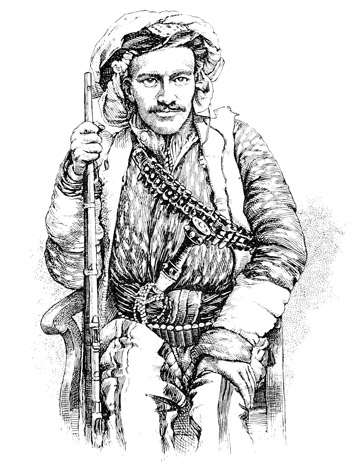
HESSO KHAN.
Hesso's house is just a "but and a ben," with a door which involves stooping. Its rough stone walls are unplastered, and the only light admitted comes from a hole in the roof, which serves to let out the smoke. I confess to a feeling of trepidation when I asked to see the Kurdish chief, and I felt the folly of my errand. A superbly-dressed Kurd took us into a room dense with tobacco smoke, which, from its darkness, the roughness of its walls, and the lowness of its rude roof, resembled a cave rather than a house. Yet Hesso receives £200 a year from the Persian Government, and has apparently unlimited opportunities for plunder.
There were some coarse mats on the floor, and a samovar with some Russian glass tea-cups. Two Persian officials and a number of well-armed and splendidly-dressed Kurds, with jewelled khanjars and revolvers in their girdles and rifles by their sides, sat or reclined against the wall. Hesso himself leaned against a roll of bedding at the upper end of the room, and space was made for us on the floor at his left hand. A superb stage brigand he looked, in fitting surroundings, the handsomest man I have seen in Persia, a large man, with a large face, dark prominent eyes, a broad brow, a straight nose, superb teeth, a fine but sensual mouth, a dark olive complexion, and a false smile. A jewelled Kurdish turban with much crimson, a short jacket and full trousers of a fine cream-coloured woollen fabric, an embroidered silk shirt, socks of an elaborate pattern, a girdle of many yards of Kashmir stuff, with eight knots, one above another, in the middle, and a khelat or coat of honour of rich Kerman brocade formed his striking costume. In his girdle he wore a khanjar, with an ebony hilt and scabbard ornamented with filigree gold knobs incrusted with turquoises, attached to the girdle by a silver chain two yards long, of heavy filigree balls, a beautiful piece of work. Hesso's brothers, superb men, most picturesquely dressed, surrounded him. The Kurds who handed round the tea and the jewelled kalians looked fantastic brigands. The scene was a picture.
Of course my errand failed. I could not speak about the sheep through the priest of the robbed village, and Hesso said that he could not speak on any "political" subject before the Persians who were present. The conversation was not animated, and Qasha Bardah was very nervous till Hesso turned round, and with an awakened expression of face asked how it was that "England had allowed Turkey to grow so feeble that her frontier and Armenia are in a state of anarchy"? Hesso's handsome face is that of a villain. He does not look more than thirty. He has 200 well-mounted marksmen at his disposal. The father of this redoubtable Kurdish chief died in prison, where he was confined by order of the Shah, and the son revenged himself by harrying this part of the Shah's dominions, and with sixty men, including his six brothers, successfully resisted a large Persian force sent against him, and eventually escaped into Turkey, doing much damage on his way. Hesso on arriving in Kerbela obtained a letter from the Sheikh, or chief Mollah there, saying that he offered his submission to the Shah, and went to Tihran, where after seeing the Shah's splendour he said that if he had known it before, he would not have been in rebellion.
Before this the Persians took a strong castle from the Kurds, and garrisoned it with an officer and a company of soldiers. Up to it one day went Hesso boldly, keeping the six men who went with him out of sight, and thumped upon the gate till it was opened, saying he was a bearer of despatches. He first shot the sentry dead, and next the officer, who came to see what the disturbance was about. Meantime the six men, by climbing on each other's shoulders, scaled the castle wall, and by confused shouts and dragging of the stone roller to and fro over the roof they made the garrison believe that it was attacked by a large force, and it surrendered at discretion. The lives of the soldiers were spared, but they were marched out in their shirts, with their hands above their heads.
The Merwana threshing-floor was guarded at night by ten men. The following morning we were to have started an hour before daylight, but the katirgis refused to load, and the Kurdish ketchuda, with his horsemen, declined to start till an hour after sunrise, because he could not earlier "tell friends from foes." The ground was covered with hoar-frost, and the feathery foliage of the tamarisk was like the finest white coral.
Turning into the mountains, we spent nine hours in a grand defile, much wooded, where a difficult path is shut in with the Marbishu torrent. The Kurds left us at Bani, when two fine fellows became our protectors as far as a small stream, crossing which we entered Turkey. At a Kurdish semi-subterranean village, over which one might ride without knowing it, a splendidly-dressed young Khan emerged from one of the burrows, and said he would give us guards, but they would not go farther than a certain village, where two of his men had been killed three days before. "There is blood between us and them," he said. After that, for five hours up to Marbishu, the scenery is glorious. The valley narrows into a picturesque gorge between precipitous mountains, from 2000 to 4000 feet above the river, on the sides of which a narrow and occasionally scaffolded path is carried, not always passable for laden mules. Many grand ravines came down upon this gorge, their dwarf trees, orange, tawny, and canary-yellow, mingled with rose-red leafage. The rose bushes are covered with masses of large carnation-red hips, the bramble trailers are crimson and gold, the tamarisk is lemon-yellow. Nature, like the dolphin, is most beautiful in dying.
The depths were filled with a blue gloom, the needle-like peaks which tower above glittered with new-fallen snow, the air was fresh and intoxicating—it was the romance of travel. But it soon became apparent that we were among stern and even perilous realities. A notorious robber chief was disposed to bar our passage. His men had just robbed a party of travellers, and were spread over the hill. They took a horse from Johannes, but afterwards restored it on certain conditions. Farther on we met a number of Kurds, with thirty fat sheep and some cattle, which they were driving off from Marbishu. Then the katirgis said that they would go no farther than the village, for they heard that robbers were lying in wait for us farther on!
In the wildest part of the gorge, where two ravines meet, there is fine stoneless soil, tilled like a garden; the mountains fall a little apart—there are walnuts, fruit trees, and poplars; again the valley narrows, the path just hangs on the hillside, and I was riding over the roofs of village houses for some time before I knew it. The hills again opened, and there were flourishing breadths of turnips, and people digging potatoes, an article of food and export which was introduced by the missionaries forty years ago. The glen narrowed again, and we came upon the principal part of Marbishu—rude stone houses in tiers, burrowing deeply into the hills, with rock above and rock below on the precipitous sides of a noisy torrent, crossed by two picturesque log bridges, one of the wildest situations I have ever seen, and with a wintry chill about it, for the sun at this season deserts it at three. Rude, primitive, colourless, its dwellings like the poorest cowsheds, its church like a Canadian ice-house, clinging to mountain sides and spires of rock, so long as I remember anything I shall remember Marbishu.
Steep narrow paths and steep rude steps brought us to a three-sided yard, with a rough verandah where cooking and other operations were going on, and at the entrance we were cordially welcomed by Qasha Ishai, the priest. After ascertaining that it would be very dangerous to go farther, I crossed the river to the church, which is one of the finest in the country, and a place of pilgrimage. The village is noted for its religious faithfulness. The church is said to be 850 years old—a low, flat-roofed, windowless stone building. Either it was always partially subterranean, or the earth has accumulated round it, for the floor is three feet below the ground outside. The entrance is by a heavy door two feet six inches high. Inside it is as nearly dark as possible. Two or three circular holes at a great height in the enormously thick wall let in as many glimmers, but artificial light is necessary. There are several small ante-chapels. In two are rude and ancient tombs of ancient bishops, plain blocks of stone, with crosses upon them. In another is a rough desk, covered with candle droppings, on which the Liturgy of the Apostles lay open, and on it a cross, which it is the custom to kiss. A fourth is used for the safe keeping of agricultural implements. Two are empty, and one of these serves the useful purpose of a mortuary chapel. The church proper is very small and high. The stone floor has been worn into cavities by the feet of worshippers; the walls, where not covered with lengths of grimy printed cotton, are black with the candle smoke of ages. The one sign of sacred use is a rude stone screen at the east end, at openings in the front of which the people receive the Eucharist. Behind this is the sanctuary, into which the priest alone, and he fasting, may enter. Old brass lamps and candelabra, incrusted with blackened tallow, hang from the roof, and strings of little bells from wall to wall, which are plucked by each recipient of the sacred elements as he returns to his "stand."