REGISTRATION AND ORNAMENTS OF BACH’S ORGAN WORKS
Wallace Goodrich translation
It is well known how important is the rôle played in the execution of organ music by the registration, and the skilful combination of the keyboards.
Bach left but few directions upon this subject; but with their aid, and the assistance of other hints derived from tradition or found in works of that period, and by placing before the reader the specifications of the principal organs which Bach may have had at his disposal during his long career, we will try to form an idea of what Forkel calls "the exquisite art with which he combined the various registers of the organ, and his manner of treating them."[148]
And our task is now the more delicate, because we cannot draw our conclusions from expressions which bore, at Bach's time, a significance quite different from that which we ascribe to them to-day. Furthermore, we would not lay down any absolute rules in the matter, which in truth is, above all, subjective, the artistic province of the executant. We shall simply point out what Bach indicated in certain definite instances; and, on the other hand, that which was customary at his time. In fact, in authoritative works of the centuries just past, veritable methods of registration exist; and without reverting to the documentary evidence (valuable, though too concise), inserted ad hoc by Scheidt at the end of his Tabulatura nova (Hamburg, 1624), we often find, at the head of pieces written at the end of the seventeenth, or during the eighteenth century, indications of the registration to be employed; given by composers less discreet than Bach. Among the number are not a few Frenchmen, and those men not to be despised; on the contrary, we shall prove how Bach frequently borrowed from their highly picturesque art of registration. No wonder if he provoked a renewed interest in their original "mélanges."
He copied a suite in A major by Nicolas de Grigny, organist at Rheims, and a suite in F minor by Dieupart,[149] and added to them a table of twenty-nine ornaments, with their interpretation. And he was acquainted with the works of Marchand, Nivers, d'Anglebert, and particularly of François Couperin. I doubt whether the intrinsic value of these compositions, despite their entertaining nature in some cases (for instance, Couperin's descriptive pieces), succeeded in holding his attention for any length of time; Bach could learn nothing from their technique, so often elementary; but he knew how to draw profit from their accessory qualities. Certain combinations of registers seem to us, in fact, to have been directly inspired by the study of their livres d'orgues, just as certain ornaments appear to have been borrowed from the "Agrémens" of their clavecin pieces.
I
We have said that one must not invariably interpret, by their present meaning, certain expressions whose significance is no longer the same as when Bach wrote.
First of all, the term Organo pleno, sometimes the sole indication given by Bach for preludes, fugues, or fantasies; one is often tempted to interpret it, on modern organs, by calling into requisition the uproar of all the registers combined, to whatever family they may belong.
Let us see what was understood in Bach's time by organo pleno, or volles Werk. "The volles Werk," says Mattheson,[150] "consists of principals, Sordunen (the bourdons of to-day), salicionals, octaves, quints, mixtures, Scharffen (small-scale mixtures of three ranks), of the quintadena, cymbale, nazard,[151] twelfth, sesquialtera,[152] and of super-octaves; with the Posaunen in the pedal, but not upon the manual; for the Posaunen are reeds, which are not drawn upon the manual with full organ, where, on account of the higher pitch, they would be too rasping; in the pedal, on the contrary, through the sonority of their tones, they produce a majestic effect, especially if the mouths of the pipes are covered, as is desirable."
In a former work, Mattheson had laid down the following rule for omitting the reeds from the ensemble of the registers:[153] "A reed-stop may not be drawn with the flutes upon the same keyboard, unless it be in the pedal." He makes an exception only in case the organ is not sufficiently powerful to keep a choir from wandering from the pitch and into chaos, when advantage must be taken of all resources.
The combination indicated above was, moreover, in accordance with general usage;[154] it corresponded to what the French called the plein-jeu. Nivers,[155] for instance, wrote: "The plein-jeu is composed of the Prestant, the Bourdon, the Doublette, the Cymbale, and the Fourniture; to those may be added the other sixteen- and eight-foot stops, if any there be; if there be no Prestant, the Flute may be drawn."
The same combinations are found in Le Bègue, Clairembault, André Raison. The last-named presents a curious example of the contrast of the plein-jeu to the reeds, in the "Kyrie in the first mode for the plein-jeu accompanied on the pedal by a Trompette en taille."[156]
This absence of the reeds from the volles Werk, to which other writers also bear witness, is, from a practical point of view, worthy of perpetuation, especially if we consider the very considerable place in certain modern organs occupied by this family, and the intensity of timbre due to their harmonic construction.
These registers were not numerous in organs of that time, at least in Germany, and, it must be added, badly voiced; they were often nothing but antiquated imitations of the thin and shrill Regal.
Andreas Werckmeister, known through his works upon the temperament of tones as applied to the organ, wrote (Orgelprobe, 1681):
Schnarrwerk Ist unterweilen Narrwerk; Ist es aber frisch und guth, So erfrischt es Herz und Muth.[157]
In old-fashioned proverbial guise Werckmeister shows us quite well what was expected from this class of stops; slow of speech, of a sharp, cutting timbre, they would not have blended with the foundation stops combined with the mixtures—an ensemble which lends extraordinary harmonic fulness to the polyphony when the combinations are judiciously made. The reeds were fitted rather to voice a serious and quiet melody, as a solo. Thanks to their sometimes strange tones, which seem, as Goethe said, to herald the advent of past centuries, echoes of supernatural voices, where the human voice, with its individual character, would lose the power of expression—the antique chorale-melody is illuminated, detached from the accompaniment, and comes as from on high; it is the gold and scarlet illumination of the missals, whereon the sacred words are brought into relief, themselves devoid of ornament, in their regular lines, but interlaced by ingenious arabesques of a softer tone, almost effaced by the brightness of the whole.
One direction of Bach's proves that he adopted this usage: in No. 2 of the Orgelbüchlein (Gottes Sohn ist kommen) the chorale is played upon the eight-foot trumpet in the pedal; the chorale In Dulci Jubilo, composed about the same time, undoubtedly demands the same registration.
It is well known that these two chorales possess a pedal-part extending unusually high (F and F sharp); this was the Cöthen pedal. In playing them upon an ordinary instrument, Bach undoubtedly played the pedal an octave lower, with a four-foot register. The organs of that period usually contained a four-foot reed-stop on the pedal, called a Cornet (which must not be confounded with the mixture of that name), or a Chalumeau (Schalmey), sometimes even of two feet. This use of stops of a higher pitch in the pedal was an old tradition; Samuel Scheidt availed himself of them in playing the chorale, and we find them expressly called for in several of six chorales published at Zella by Schübler, with the Bach annotations.[158]
Besides the reeds—trumpet, chalumeau, clarion, or vox humana—other combinations were permitted for the execution upon one manual of an accompanied solo. Mattheson (Der vollkommene Kapellmeister) gives us some examples; among others, the viola da gamba played alone, the eight-foot principal, and the cornet, the Flauto traverso, the eight-foot bourdon, and a two-foot Waldflöte.
By their particular qualities, these different combinations of registers, now in higher, now in lower relief, were suited to the performance even of the chorales. In fact, it may be said that without doubt the reeds were reserved, within the limits which we have defined, for the joyous chorales of the feast-days; the organists were governed by the necessity of adapting their manner of playing to the joyful or mournful solemnities of the liturgical year. "One plays much stronger at Easter," says Adlung,[159] "than for the funeral service; for Good Friday one must, if possible, use still more discretion." The employment of softer registers for the more serious chorales, and for funeral chants, is also recommended by Christoph Raupach, of Stralsund.[160]
We know how Bach brought out the significance of these chorales, interpreted with such supereminence, by the deft combination of the parts. The execution of a design did not make him oblivious of the interest attached to the coloring. We have already spoken of the chorale In dir ist Freude; who knows whether Bach did not intend still further to accentuate its joyous character by picturesque registration? Adlung speaks of the carillon (Glockenspiel) as being particularly fitted to symbolize gladness; and says that use was made of it only at the most joyous festivals. Mark the spiritedness of this chorale; and, further, the repetition of the chaconne subject presented in the bass, singularly suggestive of a chime of bells; and consider the period to which this composition belongs, bearing in its form the distinct impress of the organists of the North. Without serious error, could we not ascribe it to the years 1708 or 1709, the time when Bach, occupied with the restoration of the organ in Mühlhausen, wished to add, in the pedal, a carillon of his own invention? Would not the contrast of those metallic tones of four-foot pitch[161] with the deep resonance of the Untersatz of thirty-two, which he also demanded, have produced all the harmonic overtones of real bells?... But this is only an hypothesis, though a plausible one, and one which it would be amusing to justify by trying its effect in actual performance.
Gathered from the indications of J.G. Walther, the registration of another chorale appears to bear the marks of more positive authenticity. We refer to the Lutheran chorale, Ein' feste Burg ist unser Gott, mentioned in a previous chapter. Walther thus annotates it: "Für 3 clav."; for the left hand he directs "Fagotto"; for the right, "Sesquialtera." First of all must we notice this combination of a mutation stop with a reed; it is derived directly from the French organists. In Grigny,[162] for instance—we cite him especially because of Bach's study of his works—may be found in various instances a Bass Trumpet, or Cromorne en taille, accompanied by the Tierce or Cornet.[163] To a certain extent the Fagotto corresponds to the Cromorne, whose tone appeared somewhat veiled. This register, which Adlung tells us bore various names—Portunen, Dulcian, or Basson, among others—was sometimes added to the lower half of the great organ only, and was "of good effect in playing the basso continuo." Moreover, it was of small scale; even on the pedal it was not a noisy stop. As for the Sesquialtera, composed of the fifth and the tenth, it resembled more or less certain mutation stops of old French organs. It is noteworthy that the employment of a reed with a mixture is not mentioned by contemporary German writers; on the other hand, it would seem from the context[164] that this piece was played at the inauguration of the Mühlhausen organ, for whose restoration Bach had prepared the plans. He had demanded, among other improvements, that a Tierce be added to one of the manuals, in order that, by drawing it with a Quint, a good Sesquialtera might be produced; this in order to carry out all sorts of musical inventions of his own.
It is interesting to learn the details of this project, which, it is true, was not realized in its integrity; and it furnishes us with the most curious data upon the subject of Bach's ideas on registration and organ-building, and his own tastes.
Here it is in full:
Disposition of the new repairs upon the organ of St. Blasius.
1. Three new bellows, carefully installed, should insure a sufficiency of wind to feed the great organ, the choir, and the new swell.
2. The pressure should be increased in the four old bellows, to give speech to the new Subbass of thirty-two feet, and to the lower pipes of the other stops.
3. The old soundboards of all the bass pipes to be renewed, and the wind-supply so to be regulated that when playing with only a single stop drawn all the remaining registers may be brought on suddenly without producing unsteadiness, as has been the case up to the present time; this being of the greatest importance.
4. To be added is the Subbass of thirty-two feet, called the Untersatz, which will be made of wood, to serve as the best possible foundation for the weight of the ensemble. These pipes should have a special soundboard.
5. The Bombarde is to be furnished with new and larger resonators, and the mouths of the pipes shaped differently, in order to obtain more roundness in the emission of the tone.
6. As to the new features—the Glockenspiel on the pedal, composed of twenty-six bells of four-foot pitch, desired by the parishioners, who will have them made at their own expense; while the manufacturer must see that they are rendered playable.
As to the great organ, the Trumpet, which is to be removed, will be replaced by:
7. A Fagotto (Bassoon) of sixteen feet, which will permit of all sorts of new combinations, and whose tone is to be very délicat for the musique.[165]
In place of the Gemshorn (Chamois horn) which will also be removed:
8. A Viol da Gamba of eight feet, which will blend admirably with the four-foot Salicional in the choir.
Item, if the Quint of three feet be removed, it may be replaced by
9. A Nassat of three feet.
All the other stops of the great, and all those of the choir organ, may be retained, provided they be revoiced.
10. The new swell is to be arranged as follows:
Three Principalia en montre[166] (im Gesichte).
1. Quint of three feet,}in good tin of 14 "loth" [i.e., 14 parts pure tin to 2 parts alloy].
2. Octave of two feet,}
3. Chalumeau of eight feet,}
4. Mixture of three ranks,}
5. A Tierce, with which can be formed, by adding certain other stops, a fine Sesquialtera.
6. Fleute douce (sic—a soft flute) of four feet; and, finally,
7. Stillgedackt (a species of Bourdon) of eight feet, which will blend perfectly with the "music."[167] As it will be made of good wood, it will be much more resonant than if of metal.
11. Between the swell[168] and the great organ a coupler shall be constructed. Finally, the whole instrument shall be revoiced, and the tremulant made to vibrate regularly.
II
The document just cited, which is preserved in the archives of Mühlhausen, is full of interest; we will now make a further study of two of its sections, which treat of the same subject.
I refer to the combination of organ with orchestra in the performance of the cantatas.
First, Bach speaks of the Fagotto, whose tone so easily assimilated with that of instruments; here he agrees with his contemporaries, who recommended the use of a sixteen-foot stop of more definite timbre than the bourdons, although not stronger,—it was also called Dulcian,—"dolce suono,"—in performing the basso continuo. The employment of the Stillgedackt, the softest stop in the organ, interests us in its use as a means of filling out this same figured bass. Such a register evidently lacked power, but was sought for that quality of indefiniteness, even of vacuity, which it possessed (still, in German, means quiet); this produced more the effect of diaphony, of a harmonic filling-in, like the sostenuto of certain of our wind-instruments, than of polyphony in real parts, which one could not distinguish.
These lines of J. Th. Mosewius[169] will give us, further, an idea of the rôle which the organ played in the orchestras of Bach and Händel: "It is a widely prevailing impression, and one confirmed by the new instrumentation which Mozart and Mosel made for the Händel oratorios, that by their use of the organ these two masters (Bach and Händel) supplied those features of our instrumentation which were then lacking. Such an opinion is correct, if nothing more is meant than that in concert rooms where no organ is available, it must be replaced by other instruments.[170] It must not be inferred that this new instrumentation maintains reciprocal relations with the original accompaniment. In the former it is the string-quartet which serves as the foundation of the harmony, and it is only the wind-instruments which affect the color. With Händel (and Bach) the organ, which fills out the figured bass, serves as a background for all the other instruments; the color is added by all the other voices of the orchestra, whether strings or wind."
Nothing could be more just than this statement of Mosewius; the organ serves to combine all the parts of the orchestra, unifying them without betraying its agency by any too assertive quality; a gray background, if you will, upon which some livelier colors are displayed, as in paintings of the school of Panselinos.
This testimony of Bach himself, specifying in his plans stops of a very soft and well-rounded quality for the accompanying organ, is corroborated by his contemporaries.
Scheibe, Adlung, and others permitted in the accompaniment of arias and recitatives but a single bourdon of eight feet, called, from its use for such purposes, Musikgedackt. A recitative, especially, was to be sustained lightly, for fear of covering the voice of the singer; a few prolonged notes to guide him, occasional soft chords, and, curiously enough, if one believe in the strict treatment of the organ, arpeggios, as upon a clavecin.
The staccato was generally employed in playing the bass; but this license stopped here, and for ordinary organ pieces Bach exacted from his pupils the strictest legato.
Even in playing in the choruses, and with full orchestra, the organ had to be content with the "half-tone" tint; neither reeds nor mixtures, said Schröter,[171] organist in Nordhausen; Petri[172] made a similar recommendation.
Moreover, the accompaniment, at least such of it as was contrapuntal in nature or consisted of successive chords, was played usually upon the positif (choir), whose pipes were less powerful than those of the great organ; the bass was executed upon the latter manual in the manner already indicated, sometimes also legato. The pedal itself might be added here; in certain passages it only marked the accents with stops of more emphatic quality, when it was desirable to emphasize the breadth of the rhythm, or to avoid confusion, when the movement was too rapid. This is confirmed by Saint-Lambert (Traité d'accompagnement, p. 58): "When the tempo is so rapid," says he, "that the accompanist cannot conveniently play all the notes, it will suffice if he play and accompany only the first notes of each measure, leaving to the basses the task of performing all the notes, which they will be able to accomplish much more easily, having no accompaniment to play in addition. Very rapid tempi are not suited to accompanying instruments; on this account, if particularly quick passages are encountered, even in a slow movement, the accompagneur (sic) may leave them to the other instruments; or, if he play them himself, he may so modify them as to play only the principal notes of such passages; that is to say, the notes which fall upon the principal beats of the measure."
Again, the organist was obliged to take into consideration the small number of orchestral players and of voices. Bach, in a memorandum of August 23, 1730, enumerates twelve singers and eighteen players, besides the organist; the Kapelle over which Gerlach held sway in the new Protestant church at Leipzig, was still smaller: four singers and ten players.
It is true that Bach, first of all an organist himself, did not always bequeath such an ungrateful task to the organ; besides the organ of accompaniment, he gives us examples of what he calls organo obligato. Numerous cantatas furnish such instances; we find one in the Passion according to St. Matthew, with the added interest of an indication of the registration. It is where the chorus, in unison, sings the chorales, O Lamm Gottes, unschuldig, and O Mensch, bewein' dein' Sünde gross.[173] The register which Bach prescribes here is the Sesquialtera, undoubtedly in combination with some foundation stops. The character of this register, thus particularly selected, seems to call for the tasto solo; without doubt Bach demanded it because of its decisive quality, for the purpose of bringing out the chorale sung by the ripieno against the other two choruses and the two orchestras, which he treated independently. The brightness of the Sesquialtera would seem to recommend it also for the sinfonie, or prelude, of the cantata composed for the election of the Council[174] (August, 1731). This idea is supported by the fact that a Sesquialtera was undoubtedly added to the positif of the organ in St. Thomas' Church in 1730 or 1731, by the organ-builder, J. Scheibe.
A register of quite opposite effect was used to support the whole orchestra in the Reformation Cantata[175] (1717). The Luther chorale-melody is here entrusted to the sixteen-foot Bombarde on the pedal, accompanied in the orchestra by the violoncello and the violone, a similar instrument.
In these particular instances we see that Bach departed from the general custom of omitting the reeds and mutation stops;[176] but here the organ derived from its own resources sonorities most individual in character, the accompaniment being furnished by a second instrument (the orchestra). Moreover, as W. Rust, the authorized editor of the Bach cantatas, says, "When the organ is obbligato it does not present itself in a polyphonic capacity, for then it would cover up all the other instruments; but it should be treated as a solo part, like a flute or an oboe."[177]
With regard to Bach's orchestra, we should remember that the cantata Die Himmel erzählen ("The heavens declare the glory of God") suggests the registration for the first movement of the sonata in E minor. True, it will be said that Bach wrote these trios for pedal-clavecin; but their performance upon the organ, too, should not be neglected. Certain adagios, by reason of their long-sustained notes, demand an instrument capable of prolonging the tone. This first movement, in fact, is but a transcription of the Sinfonie (adagio and vivace) which serves as an overture to the cantata just mentioned. The instrumentation: Oboe d'amore, Viola da gamba, and continuo. These are timbres to be found in all organs; we may add that the Viola da gamba of the organ was one of Bach's favorite stops. It is not unwarranted to consider that in many chorales the cantus, placed in the tenor, was played with this register upon a separate manual, just as Bach would have given it to the violoncellos in the orchestra.
For we must take into consideration this practice of Bach's of transferring to the organ resources of the orchestra, to the orchestra those of the organ. Thus, in the Pastorale (Hirtengesang) of the Christmas Oratorio, Bach produces the effect of an organ whose manuals respond to each other, the one with foundation stops contrasted with the chorus of oboes upon another.
This passing from one manual to another Bach seldom indicates in his organ compositions; one piece, however, furnishes us with directions which are authentic beyond question, and extremely interesting. It is the great prelude in E flat major, published in Part III of the Clavierübung. On comparing these indications with others, particularly with those in the D minor (Doric) Toccata, one may decide to play upon the great manual (Oberwerk)[178] all that is written with pedal; where the pedal is silent, one may change to the choir (Rückpositif). In carrying this deduction to its limits, one might even formulate the rule that when the parts are reduced to two, they should be played upon the swell (Brustwerk).
III
In connection with the foregoing it will be interesting to learn the specifications of the principal organs of which Bach was able to avail himself during his long career. We find details concerning them in various works, notably in Adlung (Musica mechanica organoedi), or in the supplement which J.F. Agricola, an esteemed pupil of Bach, added to this work, published after the death of its author; and in the contemporary writings of local historians.
The organ at Arnstadt, the first at which Bach held the position of organist, possessed twenty-four registers, divided among two manuals and the pedal:[179]
Great Organ.
1.Principal,8'
2.Viola da Gamba,8'
3.Quintatön,16'
4.Gedackt (Bourdon),8'
5.Quinte,6'
6.Octave,4'
7.Mixtur, 4 ranks
8.Gemshorn,8'
9.Cymbel, 2 ranks
10.Trompete,8'
11.Tremulant
12.Cymbelstern[180]
Choir Organ.
1. Principal,4'
2. Lieblich Gedackt,8'
3. Spitzflöte,4'
4. Quinte,3'
5. Sesquialter
6. Nachthorn (night horn),4'
7. Mixtur, 2 ranks
Pedal Organ.
1. Principalbass,8'
2. Subbass,16'
3. Posaunenbass (trombone),16'
4. Flötenbass4'
5. Cornetbass,2'[181]
The organ in the palace at Weimar contained the following stops, according to A. Wette:[182]
Great.
1. Principal,8'
2. Quintatön,16'
3. Gemshorn,8'
4. Gedackt,8'
5. Quintatön,4'
6. Octave,4'
7. Mixture, 6 ranks
8. Cymbel, 3 ranks
9. Glockenspiel
Choir.
1. Principal,8'
2. Violdigamba,8'
3. Gedackt,8'
4. Trompete,8'
5. Kleingedackt (small bourdon),4'
6. Octave,4'
7. Waldflöte2'
8. Sesquialtera
Pedal.
1. Gross-Untersatz,32'
2. Subbass,16'
3. Posaun-Bass,16'
4. Violon-Bass,16'
5. Principal-Bass,8'
6. Trompeten-Bass,8'
7. Cornett-Bass,4'
We have mentioned the special feature of the organ in Cöthen: a pedal which boasted of two octaves and a half, from great C to f' sharp; we should further emphasize in this organ, otherwise not especially noteworthy, the quality of the Principal[183] in the great organ, and of the eight-foot Trumpet in the pedal.
The organ in the University church in Leipzig, of which Bach made an expert examination December 17, 1717, was a remarkable instrument, which he was very fond of playing. It was one of the masterworks of the manufacturer Scheibe. It had the following registers:
Great.
1.Gross Principal (of pure tin),16'
2.Gross Quintatön,16'
3.Klein Principal,8'
4.Schalmei,8'
5.Flûte allemande,8'
6.Gemshorn,8'
7.Octave,4'
8.Quinte,3'
9.Quint-Nasat,3'
10.Octavina,2'
11.Waldflöte,2'
12.Grosse Mixtur, of 5 and 6 ranks
13.Cornetti, of 3 ranks
14.Zink (a species of cornett), of 2 ranks
Echo.
1.Principal (in front),8'
2.Viola di Gamba naturelle,8'
3.Grobgedackt (large scale bourdon)8'
4.Octave,4'
5.Rohrflöte,4'
6.Octave,2'
7.Nasat,3'
8.Sedecima,1'
9.Schweizerpfeife,1'
10.Largo.[184]
11.Mixtur, of 3 ranks
12.Helle (bright) Cymbel, of 2 ranks
Choir.
1.Leiblich gedackt,8'
2.Quintatön,8'
3.Flûte douce,4'
4.Quinta decima,4'
5.Decima nona,3'
6.Hohlflöte,2'
7.Viola,2'
8.Vigesima nona,1½'
9.Weitpfeife,1'
10.Mixtur, of 3 ranks
11.Helle Cymbel, of 2 ranks
12.Sertin (serpent?),8'
Pedal.
1.Gross Principal,16'
2.Gross Quintatön,16'
3.Octave,8'
4.Octave,4'
5.Quinte,3'
6.Mixtur, of 5 and 6 ranks
7.Grosse Quintenbass,6'
8.Jubal (open flute),8'
9.Nachthorn,4'
10.Octave,2'
11.Second Principal,16'
12.Subbass,16'
13.Posaune,16'
14.Trompete,8'
15.Hohflöte,1'
16.Mixtur, of 4 ranks
Finally, the specification of the principal organ in the Thomaskirche in Leipzig, installed in 1525, twice rebuilt during the seventeenth century, enlarged in 1670; and considerably repaired, in 1721, by Johann Scheibe:[185]
Great.
1. Principal,16'
2. Principal,8'
3. Quintatön,16'
4. Octave,4'
5. Quinte,3'
6. Superoctave,2'
7. Spielpfeife (a species of flute),8'
8. Sesquialtera
9. Mixtur, of 6, 8, and 10 ranks
Echo (Brustwerk).
1. Grobgedackt,8'
2. Principal,4'
3. Nachthorn,4'
4. Nasat,3'
5. Gemshorn,2'
6. Cymbel, of 2 ranks
7. Sesquialtera
8. Regal,8'
9. Geigenregal[186] (Violin-regal),4'
Choir.
1.Principal8'
2.Quintatön,8'
3.Lieblich Gedackt,8'
4.Kleingedackt,4'
5.Querflöte (Flauto traverso),4'
6.Violine,2'
7.Rauschquinte doppelt
8.Mixtur, of 4 ranks
9.Sesquialtera
10.Spitzflöte,4'
11.Schallflöte,1'
12.Krummhorn,[187]16'
13.Trompete,8'
Pedal.
1. Subbass (of metal),16'
2. Posaune,16'
3. Trompete,8'
4. Schalmei,4'
5. Cornett,3'
The St. Thomas church possessed in addition a small organ. This instrument, at one time abandoned, and later again brought into service, stood at Bach's time in a gallery, opposite the large organ. It possessed a stop called Trichter-Regal, a sort of Vox humana. This organ was used in performance of the St. Matthew Passion music, in coöperation with the other.
When Bach played for strangers, he was fond of astonishing them by his originality in registration. "After having first of all censured as ill-advised the combination of certain stops," says Forkel,[188] "the listeners were greatly surprised upon hearing the admirable effect produced by these very combinations, suddenly drawing from the organ a sonority at once original and varied, whose attainment might have been vainly sought by following older methods....
"In trying an unfamiliar organ, his first step was to draw all the registers and to play upon the great manual with all couplers. He was in the habit of saying, jestingly, that he wished at the outset to know if the instrument possessed good lungs."
With this art in registration was combined the greatest facility in improvisation.
"It was often the case," writes Kirnberger,[189] "that friends asked Bach to play to them at times other than during religious service. Then he would choose some theme and treat it in every form of organ composition, playing without interruption for two hours or more, yet without exhausting his resources. Perhaps he made use of his subject first in a prelude and fugue for all the foundation stops. Then his genius in registration was displayed in a movement in three, or in four, parts, always upon the same theme. Now followed a chorale, and the subject served as a counterpoint to the chorale-melody, in ingenious imitations in three or four voices. Finally he concluded by a fugue for organo pleno, based upon the same subject, interweaving the previous variations of it he had made."
IV
In a technical work compiled for his son Friedemann, Bach left us an explanation of the signs employed by him to indicate the various ornaments which he calls Manieren. They are thus illustrated:
Audio content is not currently supported on your device. [MusicXML]
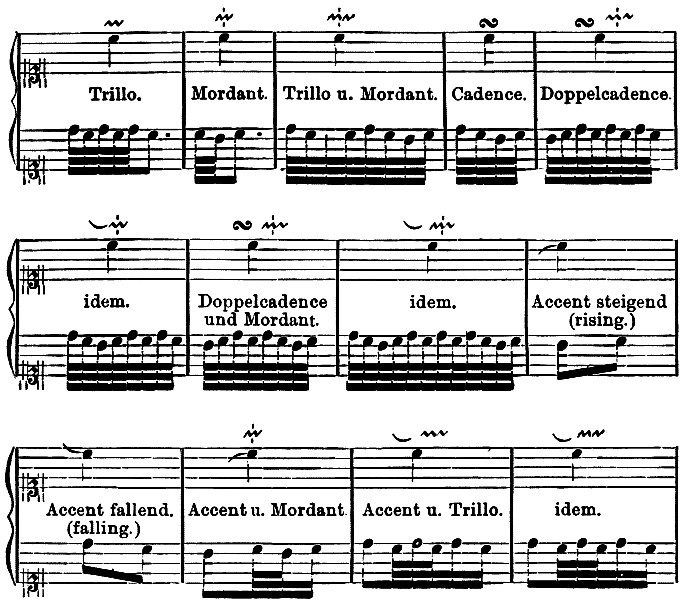
Trillo. Mordant. Trillo u. Mordant. Cadence. Doppelcadence.
idem. Doppelcadence und Mordant. idem. Accent steigend. (rising.)
Accent fallend. (falling.) Accent u. Mordant. Accent u. Trillo. idem.
The greater number of these ornaments,[190] as we see by the table, do not begin upon the given note. However, if a turn occur at the beginning of a piece, or if it ornament a characteristic interval (as, for example, in the fugue in F minor), the essential note should be struck first; even if such a rendering produce a discord with the other parts.
The mordent—it is the pincé simple or the "pluck" of Chambonnières, Couperin, and Le Bègue, who had borrowed it from lute-players[191]—is generally diatonic, although with this exception: if the note which it affects be marked with an accidental in the same measure, the accidental must be observed in executing the mordent.
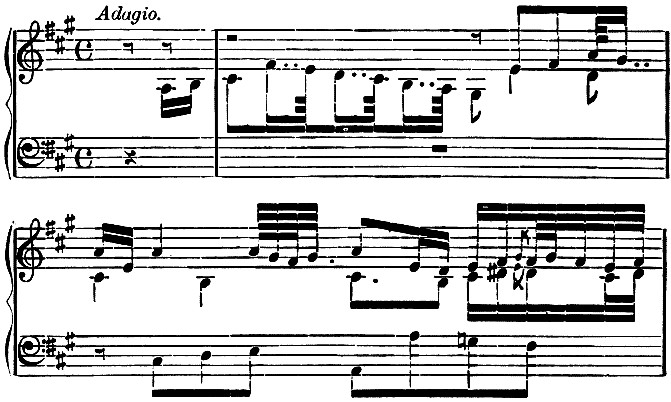
These ornaments should be played "with regard for their value and upon the beat";[192] however, an excessive rigor in this respect should not be affected; Bach did not exact such precision, and did not attach to these figures such great importance that he did not feel at liberty to substitute for them, in copies of these same pieces made by himself, other and practically equivalent ones. Certain of them are, moreover, quite rare; for example, the accent. We find it employed, at least in the organ compositions, only in an arrangement of the chorale Allein Gott in der Höh' sei Ehr' (Gloria in excelsis). No piece could be more elaborated than this one; and in it are introduced a majority of the signs employed by Bach; we borrow from Mr. E. Dannreuther's interesting work, "Musical Ornamentation,"[193] the transcription of the first six measures of this chorale, fully written out. Such an example will be more instructive than all we could say upon this subject, if the reader will take pains to compare this interpretation with the musical text as found in the well-known editions:[194]
Audio content is not currently supported on your device. [MusicXML]
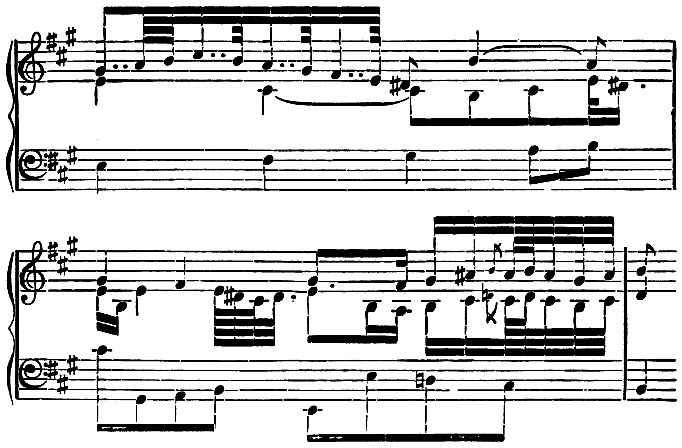
This is evidently a species of appoggiatura, as also in the chorale Vater unser im Himmelreich (Clavierübung, Part III). But in this case, Bach uses a special notation:
Audio content is not currently supported on your device. [MusicXML]

In his Method for clavecin Ph. E. Bach, in speaking of a similar figure, thus explains it: "The first note of this figure must not be made too short, if the tempo be slow or moderate; for the second would then be held too long. It should be gently dwelt upon, not suddenly hammered."
"Play flautato," says W. Rust[195] upon the subject of such a fugue in an orchestral part; one should thus anticipate the beat with the flutist's stroke of the tongue, according to Quantz (Essai d'une méthode pour apprendre à jouer de la Flûte traversière. Berlin, 1752); that is to say, that the first of the two notes should be considered as written thus:
Audio content is not currently supported on your device. [MusicXML]
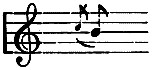
In a solfeggio lesson by J.G. Walther,[196] written in 1708, this indication, called punctus serpens, signifies that the notes are to be slurred; that is, bound together, two by two. This is, undoubtedly, the most correct interpretation, which fairly corresponds to what S. Scheidt calls "imitatio violistica."