THE PRELUDES AND FUGUES OF J.S. BACH TOCCATAS—FANTASIAS—THE PASSACAGLIA—THE SONATAS
Wallace Goodrich translation
The organ compositions of J.S. Bach (especially such of them as are free in style, and in which he made no use of the chorale) may be classified under three chronological periods, according to their structural characteristics.
It is of great interest to note the continued conquests which Bach placed to his credit; his first productions saying little that had not been said by others, but establishing, as it were, the specification of actual resources of which he might avail himself. The latest works, on the other hand, complete and final in their authority, demonstrate the prodigious career based upon that beginning, and thus define the exact measure of all that properly may be attributed to the author of Die Kunst der Fuge.
It would be puerile to ask one's self if Bach proposed to create, or even to reform; these chronological periods, which prescribe for us the limits of an historical and æsthetic analysis, are but the expression of our own conception. Although in the beginning Bach imitated his contemporaries or his precursors, he was unable to produce at once positive results in a branch of art in which technique alone holds so important a place. Besides, let us suppose that he had retained in his own possession these first attempts, permitting us to become acquainted only with his greater compositions, in which he could appear in his full strength—the earlier works being regarded as mere studies or sketches—then undoubtedly we should behold a spectacle which would astound the historians: the sudden production of such works in a state of perfection. Bach did not gratify his amour propre in this manner, he never dreamed of doing so; we realize that this little German organist, who was content modestly to produce a chorale or a fugue each Sunday, simply did the best he knew, always happy and interested in his work; and one day we see his genius fully established, as the result of all this previous and conscientious labor, together with something which he added to it—something of himself. With this element, which is characteristic of genius, we wish to become more intimately acquainted; but alas! as in every analysis, we cannot penetrate its being, and we must be satisfied to regard it from an objective point of view.
During the first period Bach assembled his resources; of his fellow-countrymen he acquired, from Buxtehude some characteristics of movement, his picturesqueness of rhythm, from Pachelbel that personal quality which is not unlike what we describe as "German" in speaking of certain popular Lieder. From the French he borrowed the ornaments, more artificial than spontaneous, and that splendor, often majestic, which recalls, in this case as well, the "Grand Roi"; from the Italians, gracefulness and perfection of proportions: the invaluable inheritance from antiquity, never cut off.
We repeat that these first productions are in nature a sort of assembling of resources; it matters little whether they be considered as pasticcii or as centoni;[54] as little, perhaps, as to know that the child Michael Angelo often copied this or that antique statue; although with this difference, that the latter may have despaired of attaining such heights, while Bach, for aught we know, may have considered that what had already been achieved in his art was, after all, little more than so many sketches.
To Buxtehude, Pachelbel, Froberger, F. Couperin, Frescobaldi, and still others—why name them all here?—belongs the proud distinction of having provided a medium for Bach; and still their importance is not lessened by such a fact any more than is Bach's; in any case, it is very difficult to judge a man of genius without reference to chronological succession. Neither in the domain of art nor of science is furnished an example of a man creating a standard, of which his original conception has not been aided by one influence or another. Did Aristotle invent the syllogism, or did he not merely gather from about him some fragments of rudimentary procedure? And is not Bach the Aristotle of music, the master of musical reasoning, giving speech to his syllogisms in a form beautiful in itself, without taking into consideration the thought which it clothes? And is a fugue anything but a syllogism? Jenner (and we voluntarily take as examples fame become banale) did not intuitively discover vaccine. By a happy chance he established the fact that certain herds were immune from small-pox; accidentally hit on the truth, by following his conclusion to its cause. The man of genius is undeniably Pasteur, who generalizes a century later, assisted by the addition to the literature upon the subject of a mass of treatises, those of Davaine, of Villemain.... To cite Jenner in connection with our subject is more than amusing; but consider Frescobaldi—is he not the Jenner of the Fugue?...
But let us avoid the necessity of classifying great men in the order of their merit; it is the evolution of Bach's genius which we wish to study. There is in this field an aspect of psychological analysis which we trust will prove of interest; but it is by no means our wish that any inference shall be drawn from the foregoing which could lead to an undervaluation of the originality of Johann Sebastian Bach.
Now as to the first period. Bach studied daily the technical methods of Buxtehude, or those of Pachelbel. He availed himself of these methods, he copied Pachelbel, he copied Buxtehude; furthermore, he imitated their pupils, and even those of lesser ability among them. He did not yet generalize. If at this moment he should disappear, should cease to write, his work would present no other characteristic than the decided manifestation of a temperament remarkably capable of assimilation. This interest will become augmented, if we scrutinize what comes later; therefore we may legitimately consider as embryonic that which, at this epoch, proceeds from his individuality.
The second period is one of formation; Bach begins to generalize. One of the compositions of this epoch, taken by itself, will not so strongly recall the work of his forerunners. Imitative in nature as they are, drawn from such various sources, and so composite, containing in one mosaic nuances of such different character, yet the whole is moulded by a hand whose touch is already characteristic, and over which skill is dominant. What Bach has dissected, he now reconstructs after a diathesis of his own. As an artist exhumes the fragments of an ancient reredos, primitive in sculpture, his personality betrays itself in the new connection which he establishes between these relics of a past age, which dictate to him no relationship incapable of alteration. And thus with Bach.... Still more, as the painter who would wrest from every form of human beauty whatever it possesses of the superhuman, seeking absolute beauty as his aim in the selection of a type.
Was Apelles able to portray a divine image, working upon human lines? His contemporaries claim that he was; and we know nothing about it, so subjective is history, reduced to testimonies from various sources. We have to go but a step further, and we find in the works of Bach, particularly in those of the last period, the evidence that from all these sources he evolved at least that which no one else could wrest from him, for since his time no one has been able even to follow him in his own domain, I will not say to equal him. As with the symphonies of Beethoven, he himself closed that particular way, and forced his disciples who would be masters in their particular realms to develop other lines.
We will proceed by chronological analysis, as far as it is possible to fix the succession, to demonstrate to the reader the ground for the classification of Bach's works which we are now to study; it being fully understood that these limits are in no way absolute, serving rather as dividing points in our work.
I
While the first period apparently ends during the early years at Weimar, about 1712—later we will explain why—it is difficult to fix definitely the date of its commencement, which perhaps takes us back to the years of study at Lüneburg. To this witness is borne by a prelude and fugue in C minor.[55]
The inexperience of the young composer betrays itself in every measure; the timidity with which he availed himself of the resources of the organ indicates even more the fear of venturing beyond the limits of a virtuosity which, while perhaps precocious, was not yet master of the instrument. Observe the treatment of the pedal, the touchstone of an organist; in the prelude it serves only as a foundation for the harmony, often doubling the notes given to the left hand. And truly is it not a weak artifice, this recitative upon which reliance is placed from the beginning, as if to attract notice to a certain technical dexterity which is suddenly forced to labor strenuously, as soon as the attention is distracted by the entrance of the other parts? And likewise in the fugue; the pedal does not take up the theme (truly one of a funeral march, with its doleful recurrence of the same figure, now interrupted, now repeated in different positions) until after the entire polyphony is at an end; it seems to appear only as an indication of the conclusion, which is, moreover, retarded by a sort of ill-timed coda. As to the workmanship of the fugue, it is far from perfect; the parts are built up one upon the other, the subject always being allotted to the higher part, thinly accompanied by the others; without being long, it is wearisome, and interest is awakened only by the entrance of the pedal, when the fugal character is no longer predominant.
The tonality of C minor, expressive of profound sadness, was apparently a favorite one with Bach at that time; another fugue in the same key[56] appears to be contemporaneous with the foregoing.
The same general characteristics are noticeable; the pedal is even more insignificant; but in the poetical conception of the piece, even in its incompleteness, there is a world of meaning.
While leaving to Schubert the "Signification of Tonalities," and not without distrusting this hobby—so absurd at times are the results of the analysis of every piece of music by reducing it to its exterior characteristics—still we cannot deny that to a certain extent this fugue is the reflex of everything of indecision in the life of Bach up to this time. The rhythm of the theme is established only at the end of the third measure, and each of its fragments serves to mark the close of a harmonic progression, despite the fact that the general tonality does not make itself plainly felt. This twofold ambiguity lends to the whole a touch of undefined regret, of a desire whose very existence is not suspected. Is this not wholly characteristic of the temperament of a youth?
We are reminded of Pachelbel by these two works, in their general lines, through this same exaggeration of an innate emotion into a condition of melancholy, a tendency peculiar to Bach. In point of technique the works sustain this reminiscence: the counterpoint is not yet fully developed. Further, compare them (particularly the second fugue) with certain of Pachelbel's compositions, especially with the fugue in E minor, whose theme we cited in our chapter upon this musician.
Other similarities appear in the variations in tempo with which these works are brought to a close; these new forms were of the North German school, whose illustrious representatives were Reinken and Buxtehude.
Bach had obtained of Boehm the key to their style; no composition of Pachelbel did he ever imitate with the zeal with which he set out to copy the preludes and fugues of Buxtehude; perhaps because he was already more like the former in point of natural qualities.
Even before his journey to Lübeck Bach began to write pieces in this style of several movements. We will examine a prelude in G major,[57] and a fugue in A minor accompanied by a prelude in the same key.[58]
The prelude in G major seems to us to date further back than Bach's study of Buxtehude, from the fact of its evident inspiration by a prelude of Bruhns, written in the same key.[59]
It is true that Bruhns was one of Buxtehude's best pupils, but he was nothing more; it would seem as if Bach, appreciating the value of the master, did not gauge with sufficient accuracy the capabilities of the pupils.
We find the same spirit, the same cheerfulness as in Bruhns's compositions; but the piece is less abrupt, and, by way of contrast, is interrupted by moments of sadness. In the expression of joy, was it Bach's intention to remind us that happiness is never complete, that it is always accompanied by mourning?
These few measures, in a minor and not even the relative tonality, in syncopated rhythm, come suddenly upon us in the midst of all this joyfulness, like a memento mori; and they suffice to alter the effect of the second part of this work, to the benefit of a more lofty ideal. When the joyous motive reappears, it is no longer with the same worldly bearing; restricted to a series of imitations which only render it indefinite, moderating the swiftness of movement in favor of breadth of tone, it seems rather to be proclaiming a peace which will know no end.
This prelude is already of much importance from an artistic standpoint; but we cannot say as much of the prelude and fugue in A minor which we mentioned at the same time. There is no doubt that it also dates back further than the journey in 1705; Bach must have sadly misconstrued the true significance of Buxtehude's works to have indulged in plagiarism so unskilfully.
He reproduced only the faults of his model; he followed him only into the by-ways, augmenting his mistakes by the awkwardness with which he set about his task. In fact, the work is little more than an omnium-gatherum of ideas picked up at random and strung together upon the mere excuse of a tonality. After a short prelude devoid of interest, we find the theme of the fugue to be of peculiar dryness, supported by equally barren counterpoint. The interlude which follows is a succession of incorrect harmonic progressions, peculiarly disagreeable in effect;—even as he thought to imitate Buxtehude's freedom of movement[60] in the restlessness of the prelude and fugue, so Bach hoped to acquire the expressiveness of his harmonic progressions, so audacious for their time[61]—and introduces a new treatment of the fugue, monotonous, but finally coming to a close in a more interesting fashion.
More happily inspired in his emulations, or better served by his talents, we behold Bach in a composition in three movements, little known up to this time: a "Fantasie" in G major.[62]
The first two movements are still rather weak, perhaps influenced by the Italian music heard and played during the few months preceding, when Bach was a violinist in the orchestra of Prince Ernest of Weimar.
The third movement is remarkable, at least with regard to its depth of thought, and to its adoption of all that was most to be desired in Buxtehude's style. The upper parts cross each other upon the scale given out by the bass, as in a Chaconne; it is the resistance of surging waves to the slow rising of the stream, expressed by the implacable repose of the fundamental theme, whose intensity, with its own imperturbable repetitions, overcomes all resistance.
In many of Bach's works we encounter these ascending and descending scales, but they are of varying significance. We find them again in a piece closely allied to the foregoing: a Fantasia,[63] also in G major, where the diatonic scale serves as the foundation of harmonies, whose interest, cleverly held in check, is augmented by the uninterrupted progression of five real parts.
These works are no longer mere plagiarisms; a glimmer of individuality discloses itself. For example, let us look at the prelude and fugue in E minor.[64] If Buxtehude is here brought in mind, it is because of that quality of his which is most neutral, and no longer through his peculiar originality, his personal resources; in trying to avoid which a mere imitator must always come to grief. Many a detail in construction is derived from the Lübeck organist; for instance, those detached chords, which so successfully set off that plaintive syncopated progression, the sobbing of whose notes is thereby rendered always more intense; the last sections repeating the first, now broken into two still more earnest entreaties.
And of this fugal theme, beginning in two separate fragments upon the dominant, we have seen examples in Buxtehude; but there this repetition of the subject expressed in its intensity a joyous declaration.[65]
It is here a tremulous, hesitating interrogation, which seems to dread its answer; the prelude is full of lonely sadness, as deep as it is despairing; in the fugue it converses in dialogue with itself, one might say in accents which proclaim a public misfortune.
But if one may not seek "in a musical work the expression of any condition of the soul, or the narration of any story of the heart,"[66] one can hardly deny that music expresses "the being, even the personal will"[67] of psychological phenomena, at least in the sense that the interest of certain works of art, aside from every æsthetic consideration, is correlative to the mental condition in which one receives them. This may explain the position occupied among the works of Bach by this piece, whose many weaknesses are revealed to us by a technical analysis.
This intimate nature finds an antithesis in the Toccata and Fugue in D minor,[68] which belongs chronologically to the same period; it is still Buxtehude, but it is conceived throughout in a picturesque style. It lacks only an argument to establish by every right its character as "program music." The two rapid and dazzling flashes, a peal of thunder, rumbling heavily in the reverberations of a chord slowly broken, and above the vibration of the deep pedal, augmented in intensity by its duration; wind, then hail;—we are in the midst of the classic tempest. Entirely a thing of virtuosity, appreciated even by those who take account of nothing in the arts but the illusion gained, the Toccata earned brilliant success for Bach upon his journey to the smaller German courts, and contributed in large measure toward the extension of his fame.
This composition belongs to a whole series of virtuosic works, as well as the prelude and fugue,[69] in E major in the edition of W. Rust (Bach-Gesellschaft), and in C in Griepenkerl's (Peters); and, above all, the celebrated fugue in D major.[70]
Despite the advance in technique, this prelude and fugue are still in the earlier manner; certain characteristics, such as the division into several movements, indicate that the early influences which governed Bach are still potent. Nevertheless, there is in the stately prelude something of the dignity of the French overture; in the Alla Breve[71] a recollection of the Italian compositions of the same name is natural. Thus later studies betray themselves more in certain details than in the work as a whole; the subject of the fugue reveals its similarity to Buxtehude in its general style, and in its movement (see the theme in F quoted previously).
Another inheritance from Buxtehude is the prelude and fugue in G minor;[72] especially the prelude, with its wealth of harmonies suddenly broken off, hardly to be employed again; the fugue, with the repeated notes in its subject. An advance over all the fugues of which we have thus far spoken, this one is notable for its strict maintenance of four-part polyphony; the facility and the spirit which we observe in the counterpoint, especially at the entrances of the subject, and the flexibility of the imitations, indicate the presence of a new wealth of resource, and a surety of technique which is master of itself.
We must also include in the product of this period a set of eight preludes and fugues,[73] which, although very simple, are already the work of a fine hand. They are undoubtedly compositions which Bach destined for his pupils.
Bach is now about to cast himself free from the restrictions placed about him by the study of his first masters; finally in possession of all their resources, he will acquire those of others, enlarging his field of vision, already marvelously well-prepared by his earlier labors to make room for the results of his search after new conquests.
II
During Bach's first years in Weimar a new factor enters into his evolution, or rather forces itself upon it, quite without seeking on his part; it is simply the result of the experience gained in the fulfilment of his new duties.
Ever since this epoch Weimar has been distinguished among the German courts by a more refined culture, a taste for art which up to the present time has never diminished.
In this instance the impetus did not emanate from the reigning prince. Wilhelm Ernst was a man of education, it is true, and in his service were good artists; but, absorbed in a solitary life[74] of exceeding piety, and occupied with good works, the duke entrusted to his nephew, Johann Ernst,[75] the duty of encouraging his musicians. Johann Ernst was skilled in music, playing the harpsichord and the violin; he had even studied the elements of composition with Walther;[76] music was made to cater to his sickly constitution, especially the Italian chamber music, for solo instruments and orchestra, whose subtle charm was well suited to this invalid; for he himself could take part in its performance.
Bach's temperament, so entirely different, was certain to draw its lesson from association with such works; the precise moment has now arrived when, by his own determination, he shall profit by it; he is master of his own virtuosity; and both his manual dexterity and his present position make it possible for him to choose what he will retain of the ideas which crowd upon his imagination in such profusion. To succeed in such a choice were already to produce a work of art; but to bring these ideas into their proper relative order, the selection once made, is the achievement of a great artist.
The Italians had for a long time possessed precisely this sense of correct succession; this architectural aspect of the art could not fail to attract, by its harmony of proportions, those who had always displayed so much taste in works of sculpture.
It is particularly to be noted that what the Germans were able to acquire from these composers, they derived from the concerted music for stringed instruments. In fact, it may be said without exaggeration that, while the Germans were well-informed, not only upon organ composition, but upon vocal writing as well, still they possessed no violinists,[77] in the sense that among them there was no one who wrote for that instrument with the clearness or sentiment which it demanded. The Italians brought them something more, if not something essentially different: the interesting and varied movements, the perfect balance between the musical phrases, the elaboration and refinement of design for which they always strove; for it was with them that monody first dawned, and was afterwards developed. It is easy to conceive that with instruments the conditions are varied; although that is not saying that a manner of writing suited to one instrument may not also be fitted to another; in writing for strings the same style recommended itself to the Italians as that which had enriched the school of organ composition. We refer particularly to the sonatas and concertos.
While the sonata still lacked that unity resulting from the development and ingenious combination of two themes of necessary co-relationship, which P.E. Bach was to impart to it later, it already possessed three well-defined divisions at least, as is indicated by the variety of the movements: the first one rapid in tempo, assertive; the second slow, full of sentiment; while the third finished gaily, often recalling the rhythms of popular dances.
As to the concerto, it was on the whole nothing more than a sonata for one, sometimes for more than one solo instrument, accompanied by the orchestra, whose interludes produced new effects through the contrast between the soli and the tutti.
The facilities offered by the organ, with its several keyboards, for the delineation of these designs, rendered it particularly appropriate that they should be transcribed for that instrument. This Bach did. In addition to sixteen transcriptions for the harpsichord, he left us arrangements for the organ of three of Vivaldi's[78] concertos, and the first movement of a fourth.[79] They are arrangements, rather than integral reproductions; and if we take a certain interest in this transcription for the organ, by special methods, of works not originally intended for that instrument, it is an interest like that inspired by a well-made translation.
Possibly Bach regarded it in another light; for him it may have been a means of penetrating to the core of such compositions, of analyzing their inherent qualities.
We now see him quite preoccupied with this three-movement form; take, for instance, the Toccata in C major.[80]
The Prelude itself is subdivided. First we find an introduction,[81] free in style; then an Allegro, built, as is very important to notice, upon two different and well-defined themes.[82]
An Adagio follows; a sort of instrumental solo sustained by a homophonic accompaniment, examples of which are comparatively rare in Bach; and accentuated by a continuo, like the pizzicato of the orchestra. A short succession of chords à la Buxtehude and quasi-recitativo[83] separates this Adagio from the fugue; the rapid tempo of this latter is still of the earlier period, and recalls, in its progressions in thirds, various subjects of Buxtehude.
Bach was not content with writing in the Italian forms. In the fugue in B minor[84] he borrowed themes from the Corelli[85] sonatas, and in the one in C minor[86] he levied tribute upon works of Legrenzi; upon which one of the latter is not definitely known.
In this connection we see what further profit Bach derived from his study of Italian chamber music, not only in the logic of composition in general, but in certain species of writing, particularly in that in three parts.
But all this did not satisfy him; he wished to know the organ works of Italian composers. We have seen that he copied with his own hand the Fiori musicali of Frescobaldi.
This copy is dated 1714; it thus belongs to the Weimar period. The canzona in D minor[87] must have been written shortly after the completion of this task; at any rate, it is interesting to trace the characteristics of this piece to that source.
Notice first of all the theme; it is found in the Canzon Dopo la Pistola (sic), on page 77 of the Fiori musicali (edition of 1635), where it appears as the answer to the principal subject. Frescobaldi presents it in this form:
Audio content is not currently supported on your device. [MusicXML]

The chromatic countersubject is also found in the Fiori musicali, in the fifth verse of the Kyrie delli Apostoli (Christe, p. 38).
Audio content is not currently supported on your device. [MusicXML]
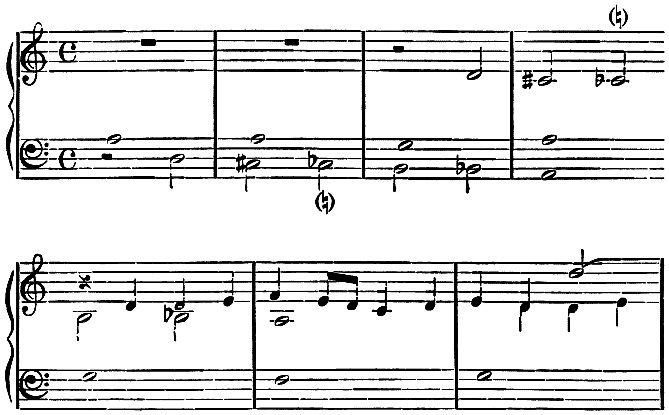
Further, in comparing the sixth measure of this Christe with the tenth part of the Canzona of Bach, we see why these two themes, although quite in the style of Bach, still are obviously the result of his study of Frescobaldi; in fact, this measure contains a fragment of the theme just quoted, with the very alteration afterwards made by Bach.
In this present case of the employment of a chromatic countersubject Bach evidently had Frescobaldi in mind; considering, and rightly, the frequent use of motives of this kind to be characteristic of the latter. But while Bach believed himself in so far indebted to an Italian master, he was in reality only following the traditions of Sweelinck,[88] who had already furnished him noteworthy examples of this style.
In fact, Frescobaldi acquired these resources during his stay in Flanders; perhaps he obtained them from Sweelinck himself, whom he undoubtedly knew in Amsterdam. A Fantasie by Sweelinck, edited by R. Eitner,[89] is written wholly upon this form of the Ionic tetrachord:
Audio content is not currently supported on your device. [MusicXML]

We may compare the counterpoint which accompanies it with those of Frescobaldi and of Bach:
Audio content is not currently supported on your device. [MusicXML]
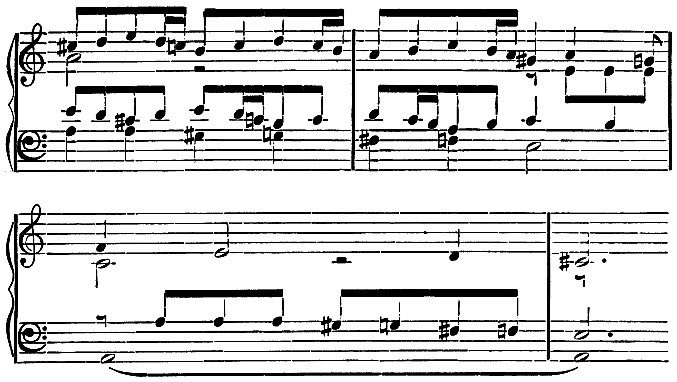
These characteristics of treatment found great favor with Flemish organists, by whom they were introduced. Peter Philipps, an organist of Soignies, makes use of them in a "Gagliarda," and in the "Pavana dolorosa"; composed in prison, according to an addition in a strange hand in the manuscript. S. Scheidt, a pupil of Sweelinck, avails himself of them in various instances (Fantaisie super "Io son ferito casso", "Fuga quadruplici," etc.).
This mannerism prevailed for some years; we again find it in the works of Froberger (Toccata fatto a Bruxellis Anno 1650) and in a fugue in E flat by Christopher Bach, of which the following is the subject:
Audio content is not currently supported on your device. [MusicXML]

Finally, to illustrate the employment of this sort of theme, we will quote the beginning of a "Point d'orgue sur les Grands Jeux," by Grigny.[90]
Audio content is not currently supported on your device. [MusicXML]
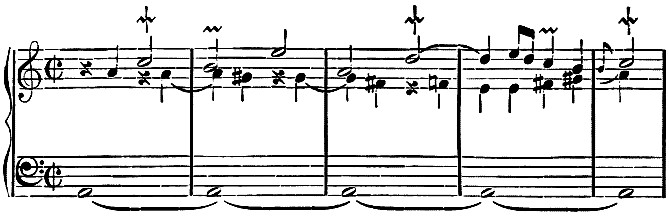
In secular music composers exhibited the same fondness for this chromatic style of progression, employed to express sorrow or dread (it is interesting to note that at every musical epoch this or that motive or chord, later certain instruments, express certain definite emotions).
Thus, in the following example from G. Andrea Bontempi, taken from the opera "Paride" produced at Dresden in 1662:
Audio content is not currently supported on your device. [MusicXML]
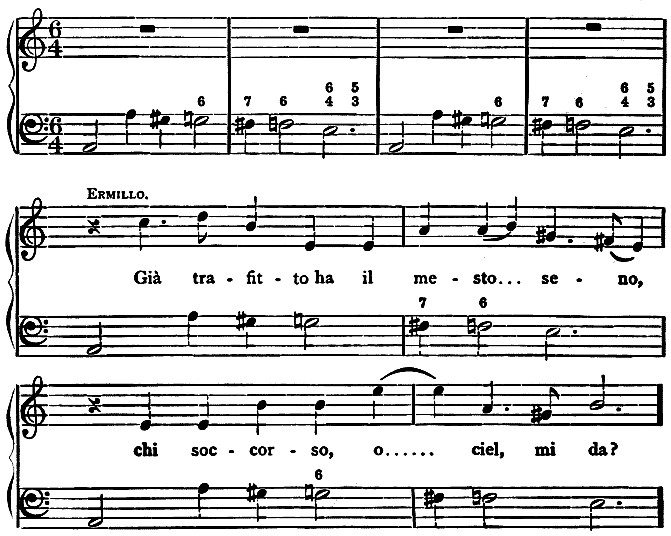
Ermillo.
Già trafitto ha il mesto seno, chi soccorso, o ciel, mi da?
In the second Sonate à Programme of Kuhnau this phrase must impress one with the depth of Saul's melancholy:[91]
Audio content is not currently supported on your device. [MusicXML]
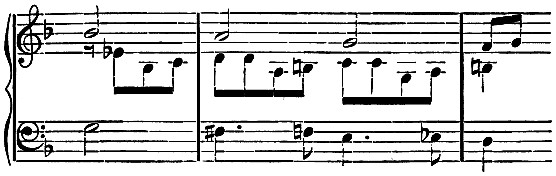
Purcell,[92] in the "Orpheus brittanicus" (London, 1706) gives us still further examples of this character. Among others, "O let me weep" (Book I, p. 171),
Audio content is not currently supported on your device. [MusicXML]

and "Here the Deities approve" (Book I, p. 206):
Audio content is not currently supported on your device. [MusicXML]

We repeat, it is undoubtedly in intentional recollection of the "Fiori musicali" that Bach here makes use of a mannerism which, moreover, was so familiar to him; it is through details of this sort that one is able to gain the mastery of a style which one desires to imitate. As for that, we must not forget that Bach wrote after nearly a century had elapsed. If you will, it is like an ancient painting copied by a modern master, who, although able to correct the perspective, would cause the picture to lose none of its archaic charm, while he would impart to it a certain quality of warmth. Thus, in the canzona, notice that progression of the soprano (beginning at the 48th measure) which ascends like the broad sweep of violins, then falls gracefully back upon a well-rounded line—a contrast expressing great tenderness, compared with the austere rigidity of the scholastic rhythm with which the countersubject at the same time pursues its heavy course, in an obsolete style of counterpoint.
Here is truly the cantable,[93] as Bach called it, never hesitating to coin French words; the second part of the Canzona which follows this species of march is written in 3/2 time, after the established rule; it is more abstract, and not without prolixity.
If all the grace, the melodic freedom of the Canzone of Frescobaldi are surpassed in this work, an Alla Breve[94] in D major reminds us more of the studied style, of the continuous movement of the Ricercare, with some reminiscence of a piece which Pachelbel wrote under the same title and in the same key.[95]
The Passacaglia[96] again exemplifies the discreet cleverness which Bach henceforth displays in his imitations; he realizes that he has risen above his models, and he now chooses his colors with a critical eye. In this instance he takes us back to Buxtehude.
Among the works of the latter are various pieces of this same order, Passacaglias or Chaconnes, written over an ostinato; which is not necessarily confined to the bass in its original form, but which modulates here and there into closely related keys, or appears in other parts.
The seriousness of the beginning of the Bach Passacaglia cannot cause us to forget that calm entrance, in its very reserve so sad, of the Passacaglio (sic) of Buxtehude (ed. Spitta, No. I, p. 1):
Audio content is not currently supported on your device. [MusicXML]
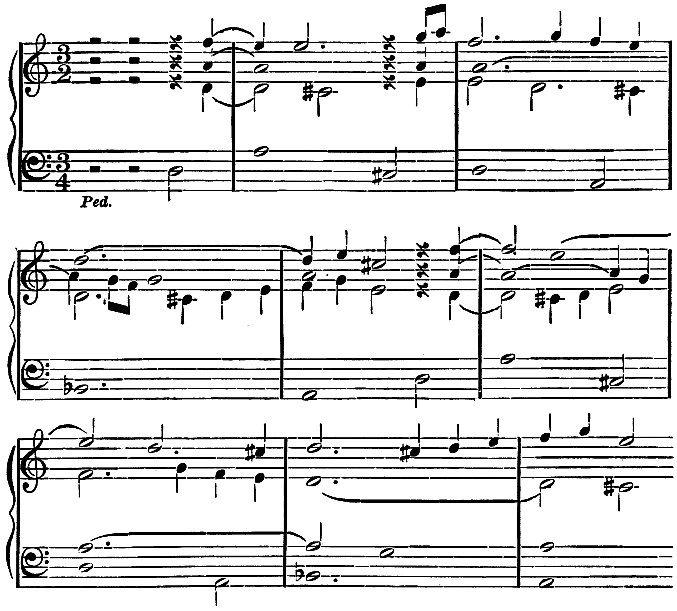
or the profound melancholy of the commencement of the Ciacona (ibid., No. II, p. 6):
Audio content is not currently supported on your device. [MusicXML]
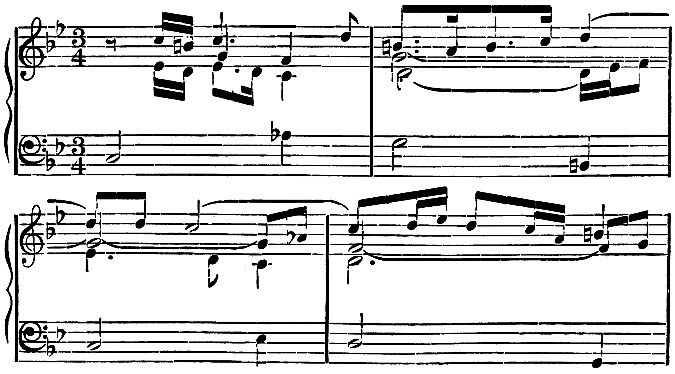
The majority of the details of the Passacaglia, moreover, establish its relationship to the two works which we have just cited.
For example, the broken chords (beginning with the 113th measure), which remind us of the following (Ciacona, p. 10):
Audio content is not currently supported on your device. [MusicXML]
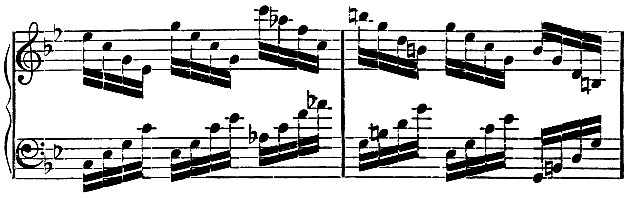
Also the rapid progressions accompanied by solid chords (Ciacona, p. 11):
Audio content is not currently supported on your device. [MusicXML]
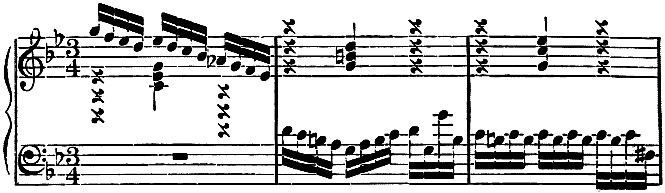
finally the sixteenth-notes in triplets (Passacaglio, p. 4).
The idea of joining a fugue to the Passacaglias was also derived from Buxtehude, who united a chaconne and a fugue (ibid., No. V).
All this is only incidental, it is true; and we recognize Bach in the length of the work (293 measures) and especially in the skilful counterpoint of the fugue.
From our point of view, the Passacaglio and the Canzone express the whole philosophy of this second period. Bach attains, in these two works, the highest point which it was then possible for him to reach; he comes into his first maturity in treating, it is true, established forms, through which he acquires the necessary mastership for the exploration of new fields.
From this moment progress is manifest. Take the prelude and fugue in F minor;[97] no more superfluous ornaments in the prelude, and, what is especially noteworthy, it is founded entirely, not yet upon a clearly defined subject, but still upon a figure which affects the whole ensemble, imparting to it added coherency.
Up to this time Bach had not achieved such unity, such directness of meaning; and the rapid, stormy passage at the end is more than a mere brilliant cadence: it bears the musical distinction of adding to the dignity of the peroration by emphasizing the tonality, the threads of which are thus united.
In the two preludes in C minor which bear the title of Fantaisies[98] these characteristics are still more pronounced; it is from a veritable subject that they derive the somewhat elegiac character common to both, as well as certain details and even the general outlines; the one is, nevertheless, somewhat more individual because of the use of two themes. Less varied, the character of the other is more intimate, although more uniform.
To the three fugues which we have mentioned must undoubtedly be added two others, from a chronological point of view, belonging to preludes of a later date; they are the fugues of the Toccata in F major,[99] and of a prelude in C minor.[100] There is truly a remarkable analogy between these five fugues, both in the character of their themes—no longer agitated in movement, but approaching in a slight degree the melodious seriousness of the chorale—and in their treatment. In each of them the interest increases with the development, and the introduction of an accessory subject toward the middle portion (afterwards related to the principal theme), either as a countersubject or for the purpose of preparing the reëntrance of the principal theme, is common to them all.
The Toccata[101] in the Dorian mode and the accompanying fugue are perhaps contemporary; this imposing composition still partakes of that character of studied virtuosity which Bach was destined completely to abandon in his later years.
III
After resigning his post at the palace in Weimar, Bach never again occupied an official position as organist. Not that he renounced the instrument which he so loved to play, but he was no longer obliged to fulfil the requirements of regular service; his earlier compositions he could gather together and correct at his ease, and finally bring out no new ones that were not thoroughly in accordance with his ideals.
The number of these new organ compositions also diminished in an extraordinary degree; for from all the thirty-three years embraced in this last period, but about twenty works exist for our study.
Although Bach no longer bore the title of organist while at Cöthen, it must not be inferred that access to the organs of the town was denied him; for instance, to the instrument in the St. Agnuskirche, the pedal of which was unusually extended in compass. We learn, in fact, from a work of C.F. Hartmann's,[102] published at the beginning of this century, that the pedal of this organ was two and a half octaves in range, extending up to f'♯[103] inclusive, while the organs of that period usually possessed but two octaves in the pedal, from C to c', with sometimes c'♯ and d' in addition.
This instrument, although of modest dimensions, responded to the touch with remarkable precision and promptness. And we have good reason for believing that Bach had it in mind when he wrote the Toccata in F major;[104] this piece has always been played, traditionally, at a very rapid tempo; and one encounters at various points high f's and e's in the pedal part. If Bach, who was continually seeking new instruments or improvements hitherto ignored, had not had at his disposition a pedalier upon which he could play this pedal part, he undoubtedly would have so written it as to make it generally practicable for performance. It seems evident, on the contrary, that he composed this work only in order to take advantage of a resource which he had not encountered before; thus the date of this Toccata appears to be between the years 1717 and 1723, the period of Bach's residence in Cöthen.
While remarkably brilliant, this work bears the stamp of a certain dryness; it is somewhat too much of a "show-piece,"[105] perhaps the best one of this type which Bach wrote; quite different, in so far, from the fugue in A major joined to the prelude in the same key.[106]
This fugue (also from the Cöthen period, as well as the prelude, to judge them by the pedal, which extends to e') occupies an entirely individual position among the works of Bach—one which is shared by no other work. One would say that in writing this fugue he had relaxed from the severity which the grandeur of the instrument inspired in him, lending to the work the intimate charm of a somewhat effeminate grace of movement.
The elusive rhythm of the subject, and even the theme in its entirety (though a different way), bear a strange resemblance to this fugue subject:
Audio content is not currently supported on your device. [MusicXML]

given out by the oboe, repeated first by the flute, then by the viola d'amore, and finally by the viola da gamba, above the continuo in the cantata "Tritt auf die Glaubensbahn."[107]
Certain portions of the fugue in A major, further, produce the effect of concerted music, conceived for different tone-colors, rather than that of a polyphony of like sounds, especially where broken chords occur in the counterpoint. At other times, when the pedal is silent, a trio-sonata is suggested. This does not surprise us; Bach was still preoccupied with the forms of Italian chamber music. We have noted the transformation which his preludes underwent under this influence, they now being constructed upon distinct subjects; and we have seen in the Toccata in C how Bach sought to write a work in three movements, each one of a different character and tempo, in imitation of the concertos and sonatas. Here and there again, as in this instance, we find attempts at three-part writing clearly defined;[108] not merely because the pedal remains silent, but by reason of a plainly indicated design.
Bach aligned these endeavors in definite order, classified their essentials, and embodied them in the sonatas, or rather trios, for two manuals and pedal.[109]
Play these trios upon the organ, and you will divert them from their original destination. Bach composed them for the clavecin with two manuals and pedal, between the years 1722 and 1727,[110] for the purpose, Forkel tells us, of instructing his eldest son, Wilhelm Friedemann, in organ-playing, through their use in home practice.
The structure of these sonatas is analogous to that of the six violin sonatas of Bach with clavecin accompaniment; they still lack the definite form of the modern sonata;[111] they are more, as has been said, "lyric pieces."
If Bach wrote these trios to accustom his son to the technical difficulties of the organ, perchance considering them only a set of studies, and for himself an interesting occupation by which he might profit, his motives in writing the Fantasie and Fugue in G minor[112] were, apparently, very different, and may be definitely connected with the journey which he made to Hamburg in 1720. This is an hypothesis which is sustained by a whole chain of circumstances.
First of all, Mattheson, in his treatise upon thorough-bass,[113] furnishes the ground for our premise; he cites the following fugue subject as having been given to a candidate who was undergoing an examination for an organ position:
Audio content is not currently supported on your device. [MusicXML]
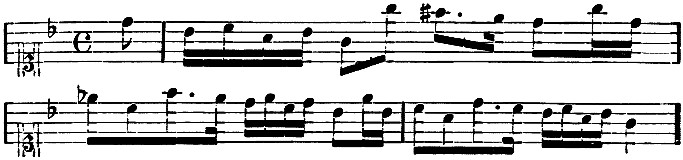
with this countersubject:
Audio content is not currently supported on your device. [MusicXML]

He adds that this theme was well known, and that it had been chosen to assist the candidate in his task, since he would already have had an opportunity of hearing it treated; he says, further, that its origin was not unknown, and that it was well known who had been the first to make use of it with success.
Mattheson, who wrote this about 1725, seems to be speaking of a theme unusually familiar. Was it not from Bach himself—the examination took place at Hamburg—that the candidate, who was from that city or a neighboring locality, would probably have heard a fugue composed upon this same subject?
Moreover, an examination of the prelude will confirm this opinion. Through his study of the works of Buxtehude and of Reinken, the venerable organist, Bach had possessed himself of all their secrets. The opportunity had come for him to demonstrate to the organists of Hamburg how, in imitating them, he could surpass them on their own ground.
For the characteristics of the prelude resemble those of the works of these men; recitatives, rapid passages which cover the entire compass of the manuals; chord progressions with bold, unforeseen modulations; subjects treated in imitation. But the recitatives are of an expressive, declamatory character which was then unheard of; the rapid passages are the forerunners of "those scales, those tremendous ascending and descending scales which rise and fall like the waves of the sea in a storm,"[114] which Mozart wrote in the overture to Don Giovanni; the chord progressions, with a daring which had never been exceeded, leading to that gigantic passage (measures 31 to 40), a veritable orchestral crescendo, where all resources of sonority deploy themselves in radiation, taking on new force with each strong beat; it serves also as an example of the crescendo which may be obtained upon the organ without recourse to modern appliances. Finally, the motive treated in imitation (measures 9 to 13) vouchsafes us a period of repose, corresponding to a point of temporary rest in the midst of chaotic agitation; it is the calm supplication of prayer which alternates with the power of the elements freed from their fetters.
The opposition of these varied means of expression imparts to this piece a value which the works of Buxtehude, despite their valuable qualities, will never possess. I refer to those designs, in the absence of which music stifles, giving the impression of a drawing without perspective; such qualities are essential, especially in music composed for the organ, whose manuals, of different intensity, so easily accomplish the display of the various phases, emphasizing one subject while leaving another in the background.
Pölchau, in the 18th century, declared that the fugue accompanying this prelude was the "best work with pedal ever written by Bach." It is rarely allowable to pronounce such absolute judgments, or even to subscribe to them; that it is one of the best, however, there can be no doubt; still greater through that unity of opposition, through the effect of continuity which it produces, like the uninterrupted course of a great river, contrasted with the boiling torrent which terrifies our imagination.
It now remains for us to speak only of the prelude and fugue in E flat major, and of the six preludes and fugues which have been surnamed "the great." These latter, which are found together in the manuscript, were, perhaps, assembled by Bach for publication; that was not, however, accomplished.
Of all the compositions which we have cited thus far, only the prelude and fugue in E flat were published during the composer's life.
The prelude stands at the head of the third part of the Clavierübung[115] and the fugue ends that volume. In any case, there is no doubt that these two pieces belong together. Griepenkerl, who in his edition[116] united them for the first time, declares that he did not do so arbitrarily, but that he was justified by Forkel, who in turn derived his authority from Bach's sons.
Moreover, a comparison of these two pieces will show their similarity; while the prelude is more grandiose, the character of the fugued portions is quite the same in the one as in the other; moreover, the polyphony, in each case in five parts, indicates an evident unity of composition.[117]
The publication of the Clavierübung may be fixed at about the year 1739. The prelude and fugue in E minor[118] are probably anterior to this work; a minute study of the autographs has given Ph. Spitta reason to place the composition between 1727 and 1736.
In the strict succession broadly established by a prelude developed at length (137 measures), follows the fugue, of still greater dimensions (231). It is the longest of all the Bach fugues, but, despite its proportions, the interest does not flag for a moment. Here again Bach constructed his subject upon that same chromatic progression to which he already owed so many expressive combinations; but the theme soon retires into the background of this fugue; it is but the excuse for a counter-theme of singular pathos, which assumes the importance of a symphonic subject, freely treated.
We should place by the side of this masterpiece the prelude and fugue in B minor.[119] The beauties of this composition are of a character quite as lofty, to which no analysis can do justice. It is a sort of soul-language, of which Hegel says, in his Aesthetik: "If we consider all intercourse of the soul with the beautiful as a deliverance, as a release from all trouble, it is in music that we must seek the completeness of that liberation."
Undoubtedly it is also "that internal harmony which lifts us for an instant out of the infinite depths of longing, which delivers the soul from the oppression of the will, which diverts our attention from all that is importunate, showing us things divested of all the influences of anticipation, of every personal interest, becoming objects of disinterested contemplation, and not of covetousness; thus this repose, vainly sought along the open paths of desire, but which has always eluded us, appears to us, as it were, of its own volition, and vouchsafes the realization of peace in plenty. This free condition of sadness Epicurus pronounced the chief of all good, the happiness of the gods."[120]
To the six greater preludes and fugues also belong the prelude in C major[121]—which, reproduced in an altered form by Bach himself upon another occasion, recalls in both its forms the beginning of the Concerto in C major for two clavecins—and the prelude in C minor,[122] the fugue of which (as we have already seen) must be earlier in date. Otherwise the great fugue in A minor,[123] the prelude of which, included with the fugue in this series, is still replete with souvenirs of Buxtehude, and would thus revert to the Weimar period.
Finally, we would mention the prelude in C major in 9-8 time[124]; it recalls in its movement a fantasia by Froberger.
It is curious to observe that the fugue which follows it played a part in the inspiration of Die Meistersinger, in its analogous figures, and in resuming the subject at the close, this time in augmentation, like a chorale melody.
Is it not of some interest to see brought together, in a work of Bach's, these extremes in music? Froberger, with all his inheritance of past centuries; Wagner, proclaiming the dawn of a new art?