THE PRECURSORS OF BACH FRESCOBALDI—FROBERGER—PACHELBEL—BUXTEHUDE
Wallace Goodrich translation
Frescobaldi was born at Ferrara in 1583, and the same year at his baptism in the Cathedral received the Christian names Girolamo and Alessandro.
His first teacher was his father, who was organist at one of the churches in Ferrara. According to his own testimony he afterward studied under the direction of Luzzasco Luzzaschi,[6] to whom Claudio Merulo, himself an excellent organist and thus a competent judge, accorded the title of the "first organist in Italy"; Vincenzo Galilei ranked Luzzaschi among the four greatest musicians of his day. To the instruction given by this master, well known for the clear and thoughtful conception of his works, were added the counsels of Francesco Milleville,[7] likewise an organist at Ferrara. Milleville was of French descent, brought up upon the old traditions of the Flemish contrapuntists, and the part which he played in the musical development of young Girolamo is worthy of emphasis; for this interchange or commerce of ideas between the northern countries and Italy produced the greatest musicians of the sixteenth century. Josquin de Près,[8] born at Cambrai in 1445, and a pupil of Ockeghem, completed his education at Rome while he was a member of the papal choir. Willaert, born in Flanders, studied in Rome, and in Venice became the head of the Flemish school. Finally, Palestrina was a pupil of Goudimel, a Frenchman.
Frescobaldi was not destined to depart from the footsteps of such illustrious predecessors; desiring to pursue further the studies for which he had acquired a taste from Milleville, he, too, set out for Flanders while still young.[9] The exact date of that journey has never been determined; it seems probable that it was in the year 1607. For in that year Cardinal Guido Bentivoglio, archbishop of Rhodes and legate of Pope Paul V., was sent to the Netherlands (Guido Bentivoglio was born at Ferrara in 1579); and, moreover, on January 10, 1608, Frescobaldi dedicated to him one of his finest works, a collection of five-part madrigals, which was published by Peter Phalesius in Antwerp. Again, it would not be strange if Frescobaldi, in 1607, had followed to another country a compatriot whom he regarded as his protector. According to Fétis (preface to Trésor des Pianistes, by Farrenc), Frescobaldi occupied from this time the position of organist at the Church of St.-Rombaut, in Malines.
But he did not retain this position long, for in 1608 we find him again in Milan. From this time the events of his life are unknown until 1614, when upon the death of Ercole Pasquini, organist of St. Peter's in Rome, Frescobaldi became his successor. If we may believe Abbé Baini, the fame of Frescobaldi was already so widespread that upon the day when he assumed his new duties he played to thirty thousand people.
Musical criticism at the time, represented by Della Valle and Lelio Guidiccioni, records that while his style was less profound, it was more elastic and agreeable than that of his predecessors. Such a criticism, especially coming from Guidiccioni, who was most exacting upon the subject of technique,[10] would indicate that Frescobaldi possessed a genuine advantage over his contemporaries. At the present day one would say that he played the organ with a pianist's touch; if one replace this criticism in its historic frame, one may imagine the continuous use of trills, scales, mordents and appoggiaturas: an inheritance from the German "colorists." While perhaps a mistaken usage, how else could one have made one's self heard throughout the immense nave of St. Peter's, upon an organ of fourteen registers, with but one manual and an incomplete pedal? Boldness and dash, that which we understand by brio, had to compensate for paucity of tone.
Although he was comparatively sparing of ornaments in his compositions, particularly those destined especially for religious services, he never departed from a florid style in his improvisations, which bristled with feats of skill and agility of technique. Abbé Maugars, who knew him at Rome in 1639, still praised the ornamentation and the marvellous cleverness of his improvised Toccatas.
In 1643 Frescobaldi retired, having already enjoyed leave of absence from 1628 to 1633; these years he spent at Florence, in the service of Ferdinand II., Grand Duke of Tuscany.
He did not long survive his retirement in 1643, which, however, was not absolute, for he took up the position of organist at the little Church of St. Lawrence in montibus. He died March 2, 1644; and was buried in the Church of the Holy Apostles.
Frescobaldi's works—which cover the entire period of his life—are very numerous;[11] they were written, as a rule, for organ or harpsichord indifferently; one of his compositions, published at Rome in 1638, even bears the following title, "Canzoni a 1, 2, 3, 4 voci, written to be sung or to be played by all varieties of instruments." In some of his works a certain predetermination is nevertheless evident, recognizable either through their appropriateness for religious service, or by their obbligato pedal part, as in the Toccatas.
The collection of Fiori musicali[12] belongs to this category, for, with the exception of such pieces as the Bergamasca or the Girolameta, it contains only selections designed for performance during church service.
Apart from their intrinsic value, these compositions comprising the Fiori musicali bear for us this very potent interest: they are, without exception, copied entirely by the hand of Bach;[13] which shows the importance he attached to them and the pains he took to study them.
This collection includes three masses: the Missa della Domenica, delli (sic) Apostoli, and della Madonna, each one consisting of a Toccata for a prelude, of the versets of the Kyrie, and of pieces written to correspond to the various portions of the office, suitably designated; thus (p. 49), Recercar cromaticho post il Credo, or (p. 77), Canzon dopo la pistola (sic).
The versets of the Kyrie, in the three masses, are for the greater part more properly "Ecclesiastical songs without words," as Ambrose said, than compositions of a purely instrumental character; in fact, they are written strictly within the compass of the voice, and only the long duration of single notes (as in the alto on page 7, or in the soprano on page 8) precludes the possibility of their being sung.
Curious is the effect of the pedal notes, sustained from the beginning to the end of a verse; and we find remarkable examples of a polyphonic accompaniment to the text, doubly interesting because of the continual reappearance of the theme, either in its integrity or slightly modified.
Further, while making use of the accidentals required by the modulation of the parts in the counterpoint, and especially in cadences, Frescobaldi respects as much as possible the diatonic character of the Gregorian scale; he adheres to it with as little variation as possible, particularly when he brings it into prominence. The mode, the Dorian, remains uppermost in the mind of the auditor, and the counterpoint is most often derived from the same tone, sometimes in imitation, at others in ingenious inversions of the melody which it accompanies. One of the more elaborate of these versets, the Kyrie ultimo of the Missa della domenica, ends with an allegro, a veritable alla breve.[14]
If in nature these versets partake somewhat of the character of compositions for voices, we find in other numbers of the Fiori musicali a very close affiliation with vocal music. We refer to that grace and flexibility of proportion which prompts us to say of this theme, of that counterpoint, "It is musical!" Especially in the canzoni do we find these expressive qualities.
It is well known that the instrumental fugue was born of this species of composition, which was also called canzon francese; the responses to a subject, sometimes of popular origin, and most often in this rhythm (a traditional one): Audio content is not currently supported on your device. [MusicXML] became answers, and the alternation of double with triple rhythm gave rise to the fugue in several movements, such as Buxtehude, in particular, often wrote.

The steps of this transformation may be traced in the canzoni of Frescobaldi: the canzone in the fourth mode of the Fiori musicali (p. 66) is an instance of an altered answer to a subject, and the Canzone IV (p. 53) of the second book (Toccatas, Canzoni, etc.[15]) begins like a veritable fugue:
Audio content is not currently supported on your device. [MusicXML]
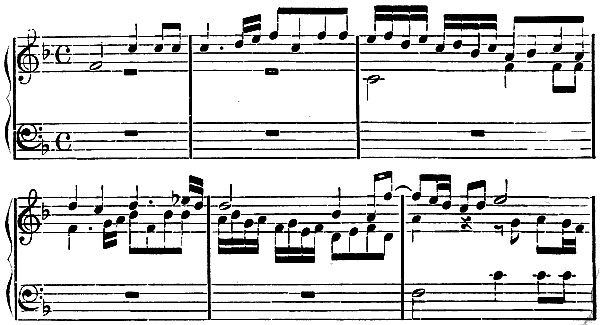
For us the recercare possess an interest of another kind; Frescobaldi had introduced an innovation in creating the initial form of the fugue, unconsciously guided by the necessity of establishing the modern tonality which forced itself upon his senses; particularly in the Ricercatas and in certain of the Toccatas he contrives to become master of a new resource, which had suggested this tonality to him: the chromatic scale.
This enables him to discover new harmonies, although he is sometimes led astray, and to modulate with endless freedom. The dissonance is no longer a "necessary evil" to him; it is an important factor in new effects. With his absolute command of the instrument and his marvellous facility of improvisation, this ability to distance his contemporaries in a field which up to this time no one had had the courage to explore, places the organist of St. Peter's in a position closely allied to that occupied by the Cantor of Leipzig; at least considering what Frescobaldi was able to accomplish in his time, obliged to create a new language for himself, as it were; and he sometimes lost his way, in propounding to himself problems which were insoluble in the existing stage of musical advancement.
Possibly Frescobaldi realized this impossibility of a personal participation in something which he foresaw, as yet only in a confused way, but whose advent he regarded as a certainty. For since he could neither ordain a "music of the future," to use an expression already more or less familiar, nor define its fundamental principles, he was often obliged to deny himself any part in even the development of his art, confined as he was to the limits of obsolete rules; did he also conclude that his too fertile imagination would lead him into extravagances, and did he voluntarily restrain this creative faculty, confining it to the laborious construction of too subtle enigmas? Certain of his compositions suggest such a condition of mind; above all, the Recercar con obligo di cantare la Quinta Parte senza toccarla (Fiori musicali, p. 84).[16]
At the head of this composition stands the following motive, like a motto:
Audio content is not currently supported on your device. [MusicXML]

upon which, moreover, is based the entire Ricercata.
But this piece is in duple time, and this fifth part is in 3/1, the tempus perfectum of mensurable music, indicated by a circle.[17] Where could the entrances be effected? This the performer must decide for himself, for Frescobaldi never did anything to assist him in his decision; "intenda mi chi può, che m'intend' io" ("let him comprehend me who can, I understand myself"), he tells us. We find the same challenge at the beginning of one of his caprices, the tenth in the first book[18] (pp. 77-86).
This same volume contains a Ricercata upon the hexachord (pp. 1-14), remarkably developed, and exhibiting a determination suggestive of scholastic restraint; and a recercar with four subjects (p. 137).
In the Canzoni, grace and interest of movement particularly are revealed; in some pieces expressive themes of a chromatic character lend a certain sentimental charm, while others, for instance those of which mention has already been made, serve chiefly as examples of ingenuity and cleverness. But the Toccatas of Frescobaldi combine all these characteristics, sometimes contrasted with or dominated by, in addition, a stately dignity, an incomparable breadth. And, moreover, they were conceived expressly for the organ, in their more lofty character, and written upon the staff then in use for that instrument.[19] They display all its resources, within a legitimate compass, although limited by the ability of the executants and by the deficiencies of the Italian organ manufacture of the period; the performers being little accustomed to the use of the pedal, and the Italian manufacture less advanced than that of the Germans. In fact, little could be demanded of the organist beyond long-sustained pedal-notes; and never do these works indicate that organs with several manuals were at that time constructed in Italy.
While in the Toccatas[20] the themes are developed noticeably in what we may term sections or plans, these are strictly contrasts of movement rather than of intensity of sound.
Frescobaldi placed more confidence in the finger dexterity of his pupils than in their facility with the pedals. To the more apt ones among them were addressed these words: "Chi questa Bergamasca sonerà, non pocho imparerà," written at the beginning of his variations upon the popular melody of the "Bergamasca";[21] and, again, at the end of the ninth Toccata in the second book: "Non senza fatiga si giunge al fine."
As examples of another style must also be mentioned the Pastorale, or rather the Capriccio fatto sopra la Pastorale, the themes of which were borrowed later by Händel from the same popular source from which Frescobaldi obtained them; this caprice has a pedal part, which proves it to have been expressly designed for the organ.[22]
The picturesque quality reappears in the imitative trumpet-calls in the Battaglia, while in the numerous partite, or suites upon the Romanesca, the Frescobalda, the Aria di Monicha,[23] the Aria di Ruggiero, Frà Jacopino,[24] Frescobaldi acceded to the demands of the times for transcriptions and variations upon popular tunes.[25]
In several cases Frescobaldi gives us hints as to the execution of his works: "music in this style is not to be performed with invariable strictness of tempo...." he says in the preface to the second volume of toccatas, etc.[26] (1637). "It should be played slowly at the beginning, and in an arpeggiated manner, the tempo then being gradually accelerated. The end of a trill or phrase should be marked by the prolongation of the last note, that one phrase may be separated from the other. Cadences, even though written in short notes, should be retarded more and more toward the end.... If it be necessary to play a trill in one hand against a phrase in the other, the trill should be performed not note against note with the passage in the other hand, but independently; the phrase being played with repose and expression. Passages in eighth- or sixteenth-notes written for both hands must not be taken at a too rapid tempo; of two sixteenth-notes the second should always be slightly dwelt upon. In quick passages for two hands, hold back a little upon the next to the last beat; then finish brilliantly, displaying the agility of the hand. For the Partitas, which are characterized by expressive subjects, it will be well to adopt a broad tempo, as well as for the Toccatas; such of the latter as are not too exacting in their demands upon technique maybe taken faster; here the choice of tempi is left to the ready discernment and good taste of the performer...."
We perceive that Frescobaldi demanded the same qualities of imagination for the performance of his works that he exercised in their composition. They are, in fact, an example of a continual rubato. In the preface to the first book of caprices he gives us similar directions; adding: "movements in 3/1 and 6/2 should be taken adagio (he wrote adasio); those in 3/2 a little faster, those in 3/4 allegro." He also charges the performer to conform to the style of his works; serious in the Ricercatas, more brilliant in the Caprices.
"Frescobaldi marks one of the turning-points in the evolution of Music, and is himself the personification of the successful and unsuccessful endeavors, of the victories and defeats, of these periods of transition. His works, upon which is imprinted the stamp of genius, appear as classics in comparison with the inefficient products of that reign of Monody.... That with one hand they point backward to a great Art-epoch just terminated, while with the other they point forward to the hopeful future of a new Musical Art, lends to them an individual and wondrous charm."
This judgment of Ambros[27] sums up in a remarkable manner the rôle which Frescobaldi fills in the history of music. In the history of organ music, taken alone, he more than represents a period of transition; he stands as a creator, who brought into view, although framed in obsolete mannerisms, a whole hereafter; his inability to partake of which is the cause of the melancholy regret which he often unsuccessfully attempts to cloak under a certain amount of affectation.
II
Johann Jakob Froberger, the son of a cantor in Halle, was born in that city; the exact date of his birth is uncertain, but may perhaps be fixed at between 1610 and 1620.[28]
A Swedish ambassador, temporarily in Halle, took Froberger with him to Vienna, says Walther (Lexicon, Leipzig, 1732); he was charmed with the fine voice of the youth—who was fifteen years of age—and astonished at his rare musical talent. Soon Froberger became a member of the imperial choir. In the treasury records of the Hofburg we find him designated as organist of the palace from January 1, 1637, to September 30 of the same year.[29] After this he left Vienna for Rome to study with Frescobaldi. This move had previously been decided upon; the records above mentioned contain the following entry upon the subject: "J.J. Froberger requests that he be sent to Rome, to Frescobaldi, as he was promised. The sum of 200 florins is granted him." After four years of study he resumed his service at court, April 1, 1641. In 1645 he obtained leave of absence. Where did he pass this time? Perhaps he remained in Vienna, where his ability as a clavecinist was highly appreciated; at any rate he was there in 1649. William Swann, chevalier lettré et grand amateur de musique, wrote from Vienna, September 15, 1649, to Constantin Huygens,[30] a councillor to the Prince of Orange, that he was sending him "some pieces given me by a Monsieur Froberger, who has great talent for the spinet."[31]
Still further, the manuscript of the second volume of Froberger's compositions is dated "Vienna, li 29 Settembre 1649."[32] This book he dedicated to Emperor Ferdinand III.,[33] his patron; this act of homage perhaps gave him an opportunity to beg for the extension of his leave.[34]
Froberger took this occasion to go to Brussels; witness to his presence there is borne by the following record, found upon one of the Toccatas: "fatto a Bruxellis, anno 1650." This toccata is included in a manuscript collection preserved in Paris, together with other pieces, one of which[35] indicates that he went to Paris at about the same period. His stay there brought him into touch with Galot and Gautier, whose style of playing the harpsichord he acquired, Mattheson tells us. Thus he endowed the German school with that profusion of ornaments which characterized the performance of these virtuosi, renowned for their skill in playing the lute.[36]
April 1, 1653, Froberger again assumed his duties as organist, retaining his position until June 30, 1657. It is said that he was obliged to retire, having fallen into disgrace; the death of his patron, Ferdinand III., which occurred the same year, may also have led him to decide to leave the court, where he no longer enjoyed the favor which he had been accustomed to receive from the Emperor.
Several years were devoted to travels; he visited Mayence and England, being in the latter country at the time of the marriage of Charles II. in 1662.
This journey to England has inspired a certain romance, very free in its details. It may be admitted that Froberger was shipwrecked on the way; but something which passes the bounds of probability and becomes but an absurd fable is the representation that, having been relieved of his money by pirates, he was forced to apply for the position of organ-blower at Westminster—he, who had been organist to the Imperial Court in Vienna! Moreover, Froberger did not fail to establish certain relations in England, particularly through the intermediation of Chevalier Swann, of whom we have already spoken.
His last years were spent with the Dowager Princess Sibylle de Montbéliard,[37] born Duchess of Württemberg. An attack of apoplexy ended his life May 7, 1667, at Héricourt; he was buried at Bavilliers (Department of Belfort).
In his compositions Froberger was the lineal descendant of Frescobaldi; but his conception of his art was not that of his master. Despite his more elaborate style and his more fully developed technique, especially in the fugue form, he never attained the classic beauty, the impressive repose, which characterized the works of the latter. Froberger was essentially a court musician; as such, he strove to please. Furthermore, his musical character was wholly superficial. What he feared above all things was that his music should be tedious, a judgment which has since often been passed upon it. Under his touch the rhythm would become more flexible; he would delight the listener, holding his attention by cleverly combined modulations; but his labors were devoted to the development only of forms already established—at least, upon the organ. The literature of the harpsichord is naturally more indebted to him, considering his temperament. He was one of the first to give to this instrument an individual style, by writing the Suites; an inheritance from the Partitas of Frescobaldi, it is true, but more closely forerunners of the sonata. In general, these suites[38] consist of an Allemande, a Courante, a Sarabande, and a Gigue, sometimes all upon a single theme, and often, as is noteworthy from the standpoint of the development of this style of music, connected simply by their tonality.
From a general point of view, Froberger's importance is due to his having brought into South Germany the style of Frescobaldi, as well as something of French music. And his works are worthy of perpetuation less because of their intrinsic value than for the influence they exercised.
This influence did not make itself felt until long after his death. Save for a few manuscripts (among them those in Vienna and Paris, which were little used, and a few pieces published separately; for example, the caprice upon the hexachord[39] brought out in 1650 by P. Athanasius Kircher in the Musurgia universalis), the "Diverse Ingegniosissime, Rarissime et non may più viste Couriose Partite, di Toccate, Canzoni, Ricercate, Alemande, Correnti, Sarabande et Gigue di Cembali, Organi et Instromenti" were not published until 1693, by Louis Burgeat, in Frankfort.
Of chief interest to us are the Toccatas in this volume, since they were written more specifically for the organ. Froberger here recalls his master only in certain details; it is more the work of a great virtuoso who, when he writes, always keeps in view the display of his own facility of execution.
His ingenious chatter, interesting combinations, and novelty of rhythm and of cadences,[40] attracted even Bach, Adlung[41] tells us: "Bach, of Leipzig, now deceased, always admired the compositions of J.J. Froberger, although they are somewhat antiquated."[42]
III
We have remarked that Froberger's importance is derived especially from his introduction of the traditions of Frescobaldi, although he impressed upon them the stamp of his own individuality and less exalted ambitions.
Johann Pachelbel was also destined to absorb some of the reflected genius of the great organist, two generations later; but he availed himself of it in a wholly individual manner, imbuing it with his own keen sense of the religious. Caspar Kerl,[43] who had studied in Rome at a time when the influence of Frescobaldi was still potent, gave Pachelbel his first insight into the characteristics of the master's work.
They became acquainted in Vienna; Kerl was organist at St. Stephen's, and Pachelbel was sufficiently advanced in his art to warrant his engagement as substitute for the former. Excepting his stay in Vienna, Pachelbel led a somewhat restless life, although in a smaller circle than that traversed by Froberger. Born at Nuremberg (September 1, 1653), he learned the elements of composition from Prentz, at Regensburg, after which he occupied several positions as organist, the succession of which is not accurately known, as regards dates; we know, however, that he was at Eisenach from 1675 to 1678. The other years were divided between Erfurt, Stuttgart, and Gotha; finally, upon the death of the organist Wecker, he settled in Nuremberg, in 1695. He died there March 3, 1706.
Despite this apparent restlessness, Pachelbel's life was quiet, full of that peace of mind which is characteristic of a profoundly pious nature.
His works betray the influence of such a sentiment, although he did not force upon his compositions that religious tone which a more studied method of procedure would have imparted to them. Their inherent character is purely emotional. To his chorale-preludes he lends a mystical significance, a devotional intimacy which was then unparalleled. While following the example of Scheidt in announcing or accompanying every melodic phrase by a counterpoint based upon a fragment of the phrase itself, he greatly improved the whole by making the movement more flowing; again, by a more intelligent choice of themes he attained the unity of expression demanded by the true sentiment of the chorale. These counterpoints are often symbolic in nature, as is so often the case with Bach; and the harmony is most expressive of that calm and plenitude which suggests the infinite, the essence of all religious music.
Pachelbel rarely varied the melody of the chorale. Heralded by the figuration of the accompanying parts, the cantus establishes itself over all, intensifying in its progression in even notes (for the most part diatonic) the exalted seriousness of the sacred text.
The Chorale is charged with having accustomed the German people, for the past three hundred years, to express their sorrows and their rejoicings in the same tone;[44] especially is ascribed to it that heavy rhythm, which has been likened to a "parade step." But precisely from this contrast between a melody which moves, wholly impersonally, ever onward upon its dignified course, while the sentiments of joy, of sadness are expressed in the embellishing counterpoint, is the inherent grandeur of such compositions derived.
The versets of Frescobaldi alone succeeded in suggesting to Pachelbel the idea of this form; up to this time none of the German organists had understood how to give such importance to a liturgical melody, despite the resources of their instruments with several manuals; the chorale-preludes of S. Scheidt (1587-1654) were of an analogous character, it is true; but they lacked the serenity of Pachelbel's compositions in this form, and most of the other musicians were still under the influence of the bad taste of the "colorists," seeking to impart to the melody, by means of diminutions and florid ornaments, the very expressiveness which they were incapable of taking away from it.
The following is an example of the manner in which Pachelbel wrote his chorales; it is the beginning of the first verse of "Vater unser im Himmelreich,"[45] the melody of which was used by Mendelssohn as the subject of his sixth organ sonata. Each verse is similarly introduced by a few measures in fugued style, the subject of which was borrowed from the corresponding portion of the melody.
When, in connection with Bach, we speak of Chorales conceived in the style of Pachelbel, it is to this type that we refer:
Audio content is not currently supported on your device. [MusicXML]
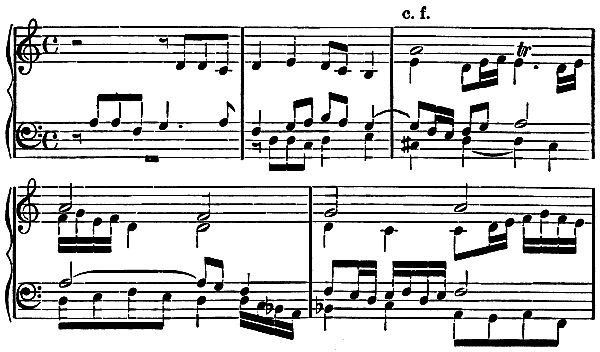
For the last verse:
Audio content is not currently supported on your device. [MusicXML]

Pachelbel preludizes in this manner:
Audio content is not currently supported on your device. [MusicXML]
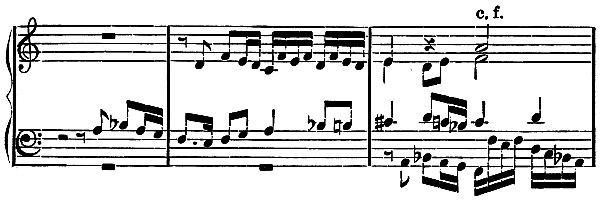
In addition to numerous chorales we have quite a number of fugues by Pachelbel.
Here is noticeable this great advance step: the majority are tonal. Their subjects are broader, and of a melodic character which distinguishes them from the themes of their contemporaries, which were simple phrases, or parts of a progression, with no "respiration."
Thus, while in the sixth Toccata of Muffat,[46] one of the most remarkable composers of his time, we find this scanty theme (we have chosen it from among the better developed ones of that epoch),
Audio content is not currently supported on your device. [MusicXML]

we encounter this in Pachelbel:
Audio content is not currently supported on your device. [MusicXML]
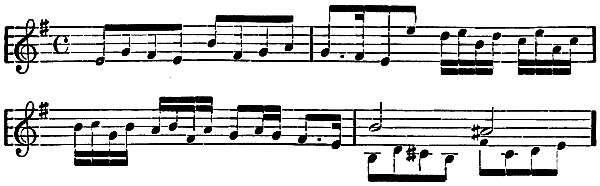
or this:
Audio content is not currently supported on your device. [MusicXML]

The developments, too, are more consistently polyphonic in nature; they are more extended, by the simple logic of musical speech, without having recourse to foreign devices.
In his Toccatas, Pachelbel generally presents to us passages in sixths or tenths for the hands, firmly sustained by pedal notes of long duration, sometimes with changes of rhythm of extremely happy effect. One among others[47] contains a pastoral theme; and this is not an isolated example, for Pachelbel seems to have been fond of popular melodies. Some of these subjects, with their 12/8 rhythm, express the good-nature and simplicity of rustic tunes.
The greater part of Pachelbel's compositions may be found in the first volume of the Musica sacra. Others are published in various collections; we would mention in particular a Toccata and a Ciaccona, until now never published, which G.A. Ritter presents in his work Zur Geschichte des Orgelspiels.
Thanks to these publications, we may form an opinion of Pachelbel's music, always conservative and markedly religious in character.
Pachelbel had many pupils; so great was his fame that many organists, desirous of making a name for themselves, claimed to have been under his tutelage; but "every one cannot have been a pupil of Pachelbel," said Mattheson in the course of a celebrated discussion with one of them, the organist Buttstedt.[48]
This honor (of so much importance to us is this fact) did fall to the lot of Christoph Bach, elder brother of Johann Sebastian, and from whom the latter received his first lessons.
IV
In bringing to a close this study of the precursors of Bach, it remains for us to speak of Buxtehude, the master of his choice.
Dietrich Buxtehude was a Dane. He was born in 1637, at Helsingör, where his father was organist to the Church of St. Olaf, and also was probably his only teacher. At about the age of thirty years the younger Buxtehude went to Lübeck, where he succeeded Tunder, organist of the Marienkirche.[49]
The organ of St. Mary's was one of the most famous of that time; its specification comprised fifty-four stops, divided among three manuals and the pedals, and the position was lucrative. And Buxtehude did not seek to exchange for another place a post so favorable; he retained it until his death, the 9th of May, 1707.
Thanks to the edition of Philipp Spitta,[50] Buxtehude's works have been brought within the reach of all; it is thus possible for every one to consult them at leisure, and to make one's own technical analysis of them. But meanwhile I shall endeavor to establish the affiliation between Buxtehude and Bach through a study of certain characteristics of their works.
And this we will not attempt to achieve through the medium of a general comparison from all points of view, which at best is but vague and indefinite. That Bach was richer in inspiration, that his work in point of breadth and imagination stands upon a relatively higher plane, are facts universally recognized, even though they are difficult to define, to prove specifically; we will concern ourselves only with the matter of structure. Take, for instance, the second chaconne of Buxtehude.
From the very first measures polyphonic interest asserts itself; the pedal, although impassive, so to speak, with its half- and quarter-notes, progresses in the dignified manner peculiar to the chaconne, the upper parts accompanying it in a timid figuration; sometimes leading it, sometimes characterized by clever retardations in dotted notes, unobtrusive and thoughtful in their imitative response, ... and that the theme may be well established in its progression and in the general plan, the sixty-four measures, less one note, transposed with such charm, are repeated like an echo, in the exquisite puerility of a design at once simple and devoid of affectation. Later on, toward the end of this little poem, the continuity of this angular theme is broken; it appears in fragments in the upper parts, affecting cleverness, and always easily recognized by an ear ever so little attentive, ... but, before he allows himself to indulge in such boldness—for boldness it was at that time—Buxtehude exhausts to a certain degree in the other parts every resource of movement and of melody; and it is when their voices subside to little more than whispers or subdued murmurs that the bass makes itself heard, forgetful of the quiet hitherto enjoined upon it, and becomes more free and animated, almost to the point of becoming divided into sixteenth-notes; striking tones which are repeated, and are no longer sustained, as if this sudden power were the product of its long restraint or the force of a malicious will....
We can hardly justify ourselves in designating as variations the changes undergone by the chaconne after this new exposition of the fundamental theme; the tie which binds its different portions is too inflexible. Try to take one of them away, attempt an interpolation, and you will be unsuccessful. While the various sections are distinct from each other, it is like a gradation of colors whose harmony arises only from the order of their selection. This series of strokes produces something more than the feeling of continuity, it frees itself of an intensity of expression which is increased at every measure; but the climax is attained with stately chords, in five real parts, the bass emphasizing them by a quarter-note upon each beat.[51]
The following page contains rapid and brilliant passages of many notes, which the pedal, at present omitted, could not follow, until finally the pace is slackened, and the movement becomes quiet; a plaintive harmonic progression is welcomed as a peaceful, serious word, when suddenly the movement is again quickened, even involving the pedal, then abandoning it, only to take it up again just before the cadence in major, which is now awaited.
By the side of a study of this little lyric, for such the chaconne is, together with the Passacaglia, we must point out the exuberant imagination displayed in the preludes and fugues. These compositions, moreover, partake of a definite design, evolved from the canzone in so far as that the same subject serves for various developments, clothed in different rhythms. Often even the various themes succeed each other, leaving to the ensemble only unity of tonality. Thus the fugue in E minor has successively three themes:[52]
Audio content is not currently supported on your device. [MusicXML]

then:
Audio content is not currently supported on your device. [MusicXML]

and finally
Audio content is not currently supported on your device. [MusicXML]

Each of these fugues is connected with the others by those brilliantly florid interludes for which Bach derived a taste, at least in his earlier years, from the influence of his studies of Buxtehude.
In the chorale, Buxtehude does not interest us in so great a degree as does Pachelbel; he is another of the "colorists." Furthermore, he was always more worldly than religious, even transforming St. Mary's Church into a concert-hall—for sacred concerts, if you will. But churches are not temples erected to the Fine Arts; while it may be true that the latter approach most closely the divine spirit, yet it must be recognized that pantheism, a philosophic teaching, has never been followed as a religion.[53]