Preface
Wallace Goodrich translation
"If Beethoven appears to our generation as a Greek statue, Bach, on the contrary, impresses us as one of those Sphinxes of Egypt whose towering head commands the wide expanse of the desert."
The comparison is imaginative, but seems to me only partially just.
Sphinx in vastness of proportions, I admit; but the image is destroyed when character is taken into consideration. Bach is indisputably the mightiest of musicians; one is seized with awe in perusing the extraordinary catalogue of his works, so seemingly impossible are its dimensions; in casually looking over those forty and more folio volumes; in pausing for an instant to examine more closely any one of the pages, where the smallest detail seems to have been long considered and predetermined, while over all soars the essential thought, always profound and original. But was there ever a thinker less enigmatical?
Surely this majestic figure dominates his surroundings; but that frank look, those luminous, kindly eyes, are hardly those of a Sphinx. It is rather the heroic statue of Common Sense.
An eminent virtuoso recently declared to me that he should be more or less uncomfortable in dining alone with Beethoven; "but with 'Father Bach,' how different! With him I see myself perfectly at home, pipe in mouth, elbows upon the table; chatting informally about a thousand and one interesting things, over a big stein of beer, as in the good old days." How true!
Bach was a good citizen, an admirable father, as M. Prudhomme would say, a devoted friend; socially affable, and possessed of a rare artistic modesty. Were he asked how he had attained such heights, he would answer: "I was obliged to work; whoever will strive as I did, will succeed as well." He availed himself of every opportunity to become familiar with the works of other composers; Händel he esteemed highly, Couperin interested him; when accorded three weeks' leave that he might hear Buxtehude, Bach so far forgot himself as to allow three months to go by while listening, from a secluded corner of the church, to the justly celebrated organist of St. Mary's in Lübeck.
Bach was a great and good man; never did a more marvellous mechanism perform the functions of a human brain; never has been known a mind that was sounder, better balanced, contained in a more robust body; never were a musician's nerves better controlled.
It required the atrocious harmonizations of Görner to cause Bach one day to turn upon him and hurl his wig at the face of the poor accompanist: "Sie sind ein Schuster" (You are a bungler)!
These fits of anger were, however, rare, despite the astonishing vitality of his constitution; for Bach was naturally patient and kind-hearted.
Note him with his pupils; during the first year nothing but exercises—trills, scales, passages in thirds and sixths, practice in changing fingers—work of every description to insure the equability of the hand. He supervised everything, devoting the minutest attention to the clearness and precision of the touch. If one pupil or the other became discouraged, he good-naturedly wrote little pieces containing in a disguised form the difficulties to be surmounted.
When Bach became organist of the New Church in Arnstadt—he was very young, but eighteen years of age—he had studied the compositions and methods of the following celebrated clavecinists of his time:
Froberger (1615[?]-1667), a protégé of Emperor Ferdinand III., by whom he had been sent, in early life, to study with Frescobaldi in Rome.
Fischer, Capellmeister to the Margrave of Baden.
Johannes Caspar Kerl, a rival of Froberger, also under the protection of Ferdinand III., and entrusted to the care of Carissimi in Rome.
Pachelbel (1653-1706), formerly assistant organist of St. Stephen's in Vienna, then successively organist at Eisenach, Erfurt, Stuttgart, and Nuremberg.
Buxtehude (1637-1707), the celebrated organist at Lübeck.
Bruhns, his pupil.
Böhm, organist of St. John's Church in Lüneburg.
It was through Froberger and Kerl that Bach became acquainted with Frescobaldi's works, and the Italian school; the sonata form was revealed to him by the French "suites" played by the orchestra of the ducal court at Celle, an organization which greatly interested him; but the greatest influence upon his youth was exercised by Buxtehude. It was from him that Bach learned in their integrity the old German traditions.
When, at Hamburg, the aged Reinken heard Bach improvise for more than a half-hour upon the chorale An Wasserflüssen Babylons, he cried out, embracing him, "I thought that this art were dead; but I see that in you it still lives."[1]
These traditions he handed down later to his two oldest sons, Wilhelm Friedemann and Carl Philipp Emanuel—two musicians whose merit is universally recognized,—and to a whole galaxy of brilliant pupils:
Johannes Caspar Vogler, a musician whom Mattheson considered more able than Bach himself. Vogler was organist at Weimar. Some preludes of his are published and written in the form of chorales for two manuals and pedal.
Homilius, of Dresden, a composer of church music.
Transchel, of Dresden, a distinguished clavecinist.
Goldberg, of Königsberg, composer of pieces called "Bagatelles pour dames," which no one could play, such was their difficulty. (He frequently found amusement in playing music of every variety from the inverted score.)
Krebs, organist at Altenburg; not only a performer of the first rank, but a prolific composer. For nine years he enjoyed the invaluable supervision of Bach.
Altnikol, organist at Naumburg; Bach's son-in-law.
Agricola, composer to the King of Prussia, known through his theoretical works.
Müthel, of Riga.
Kirnberger, court musician at Berlin. "He loved his art with a fervor at once enthusiastic and sincere," says Forkel. "Not only has he informed us in detail as to Bach's methods of teaching composition, but the musical world is still his debtor for the first logical system of harmony, founded upon the works of his master. The first of these sources of information is his book, Die Kunst des reinen Satzes; the second, Grundsätze zum Gebrauch der Harmonie. He furthered the interests of musical art by other treatises as well as by his compositions. Particularly charming are his works for the clavecin. Princess Amelia of Prussia was one of his pupils."
Kittel, organist at Erfurt. He was the only one of Bach's pupils still living at the time Forkel, himself an organist and the director of music at the University of Göttingen, wrote his Ueber J.S. Bach's Leben, Kunst und Kunstwerke (Leipzig, 1802). [The Life, Art, and Works of J.S. Bach.]
Forkel was intimately associated with Wilhelm Friedemann and Philipp Emanuel Bach, and with Agricola, Kirnberger, and several others of Sebastian Bach's illustrious pupils. He collaborated with Schicht, a man of education and a distinguished harmonist, who later became Cantor of St. Thomas's Church. With him Forkel undertook the publication of works by Bach for organ and for clavecin, an enterprise to which frequent allusion is made in his book. Forkel had accumulated a fine musical library; with the aid of this and of that of the University of Göttingen he was enabled to procure a considerable amount of material for his Geschichte der Musik [History of Music], which was to comprise six volumes; of which, however, only the first two appeared.
Forkel reserved for the last volume of this compilation the memoranda concerning Bach and his works; but "foreseeing the impossibility of completing during his life this veritable encyclopædia of music, he appears, at least in his book upon the life and works of Bach, to have been desirous of losing no time in rendering to that great man a sincere and merited tribute of homage and gratitude...."
Kittel (1732-1802) was Rinck's teacher; the latter relates that his master invariably ended his conversations upon Bach with the words Ein sehr frommer Mann, "a very good man."
Dr. Fétis, of Brussels, while teaching me the principles of counterpoint and fugue, often spoke of Rinck, whom he had visited; of Kittel, his musical father, and of their great common ancestor, Sebastian Bach. Rinck, when asked the cause of his neglect of the fugue form, would reply: "Bach is a Colossus, dominating the musical world; one can hope to follow him in his domain only at a distance, for he has exhausted all resources, and is inimitable in what he has done. I have always considered that if one is to succeed in composing something worthy of being heard and approved, one's attention must be turned in another direction."
Poor Rinck!
We are to study in this work only the organist Bach. Since M. André Pirro has so conscientiously analyzed the specific work of the master, I have to concern myself only with his technique as a virtuoso.
Bach played the clavecin in the following manner: "The five fingers so curved that their tips fell perpendicularly upon the keys, over which they formed a parallel line, ever ready to obey. The finger was not raised vertically upon leaving the key, but was drawn back, almost gliding toward the palm of the hand; in the passage from one key to another this sliding motion seemed to impart to the succeeding finger exactly the same degree of pressure, thereby ensuring perfect equality; a touch neither 'heavy,' nor yet dry (sec)." This we learn from Philipp Emanuel.
Bach's hand was comparatively small; the movement of his fingers was hardly perceptible, extending only to the first joints. His hand preserved its rounded shape even in the most difficult passages, Forkel tells us; the fingers were raised very little above the keyboard, hardly more than in a trill; as soon as a finger was no longer needed, he took pains to replace it in its normal position.... "The other parts of his body took no part in the performance, contrary to the habit of many people whose hands are incapable of sufficient agility."
To-day we no longer play the harpsichord; and the pianoforte, which has happily replaced it, makes demands never dreamed of in those days.
As to the character of organ touch, no change has taken place in two centuries. Possibly at the time of Bach the keys of the pedals were slightly different from those of our day; undoubtedly in his youth he made much less use of the heel than of the toe, since the pedal-keys were extremely short. But he soon recognized the necessity of perfecting the bass keyboard of the organ both by extending its compass and by lengthening the pedal-keys to their present dimensions.
He played with the body inclined slightly forward, and motionless; with an admirable sense of rhythm, with an absolutely perfect polyphonic ensemble, with extraordinary clearness, avoiding extremely rapid tempi; in short, master of himself, and, so to speak, of the beat, producing an effect of incomparable grandeur.
His contemporaries speak enthusiastically of his exquisite taste in the combination of registers, and of his manner of treating them, at once so unexpected and original.
Nothing could escape him which was related to his art, adds Forkel. He observed with the most minute attention the acoustic properties of the room where he was to play. On his visit to Berlin in 1747, he was conducted to the auditorium of the new opera house. He recognized at a glance the advantages and defects of this monumental edifice, in its relation to music. He was shown the grand foyer adjacent. Standing in the mezzanine gallery, he glanced up toward the ceiling and remarked immediately, without giving himself the trouble of further examination, that in it the architect had constructed "a work of great merit," perhaps unawares.
The foyer was in the form of a parallelogram; if a person standing in a corner of it, face toward the wall, spoke a few words, another person standing in the same position in the corner diagonally opposite could distinctly hear them, while the public, scattered here and there through the hall, would be unable to catch anything of this dialogue.
When distinguished strangers asked to hear Bach at the organ, at times other than during services, he usually selected some theme and amused himself by treating it in various ways, perhaps playing without interruption for over an hour. First he made use of the subject for a prelude and fugue, upon the foundation stops of the chief manual, thereafter deftly varying his registration through a series of episodes in two, three, or four parts. Then came a chorale, the melody of which was interrupted here and there by fragments of the original subject; and he finally concluded with a fugue for full organ,[2] in which "he contented himself with treating the subject either alone, or in combination with other themes derived from it."
And if he tried a new organ? He first drew all the registers and played upon the principal manual (with all couplers), "in order to test the lung-power of the instrument," as he laughingly expressed it. Then he proceeded to a detailed inspection of every part of the organ. This expert examination once over, he gave free rein to his fancy. And now he showed himself truly "the prince of all virtuosi of the universe, upon the harpsichord and organ," as he was one day hailed by his amazed colleague, the organist Sorge, of Lobenstein, in an outburst of enthusiasm.
No, the art of organ playing has not changed since Johann Sebastian Bach; but, on the other hand, our organs are growing distinctly better. Go and listen to those of Saint-Sulpice, of Notre-Dame, in Paris; hear the instrument of Saint-Ouen, at Rouen!
In the organs of Bach's time the reeds were scarcely used except in the capacity of basses, reinforcing the pedal; or as solo registers, for instance, hautbois and cromornes; our profusion of sonorous clarions, trumpets, and bombardes was totally unknown. Organo pleno did not signify a full battery of 4, 8, 16, and 32-foot stops, but simply the combination of some prestants and mixtures with a diapason or a bourdon.[3] As for a means of varying the intensity of the same tone, such a thing was never thought of.
As I have said elsewhere, it is hardly farther back than to the end of the last century that we trace the invention of the "swell-box," the English contrivance which the aged Händel pronounced admirable, and which Abbé Vogler recommended to the German builders some years later.
To-day, to non-professionals, our instruments appear to have become capable of nearly as much expression as the orchestra.
But this is a serious error. I repeat here: that expression which is a characteristic of the modern organ can but be subjective; it is born of mechanical means and possesses nothing of spontaneity. While the stringed and wind instruments of the orchestra, the pianoforte, and the voice, hold sway only by their instantaneity of accent, by the unexpectedness of their attack, the organ, limited to the confines of its own inherent majesty, speaks with the voice of philosophy. Of all instruments, it is the only one which can indefinitely prolong the same volume of sound, and thus create the religious impression of the infinite.
A serious organist will never avail himself of these means of expression, unless architecturally; that is to say, by straight lines and by designs. By lines, when he passes slowly from piano into forte, by a gradient almost imperceptible, and in constant progression, without break or jolt. By designs, when he takes advantage of a second of silence to close the swell-box abruptly between a forte and a piano.
Seek to reproduce the expressive quality of an E-string, or of the human voice, and we shall no longer hear an organ; it will have become an accordeon.
The most striking characteristic of the organ is grandeur; that is to say, determination and power. Every illogical variation in the intensity of the sound, every nuance which, graphically, cannot be represented by a right line, is a crime, the offence of artistic lèse-majesté.
In fact, we should declare to be criminals, and hold up to the contempt of the public, those who make an accordeon of the organ; those who arpeggiate, who do not play legato, whose rhythm is but passable.
With the organ, as in the orchestra, precision must rule; the perfect ensemble of feet and hands is absolutely necessary, whether in attacking or leaving the keyboard. All notes placed in the same perpendicular by the composer must be made to speak and to cease speaking at the same time, obedient to the bâton of a single conductor. Here and there are still seen unfortunates who suffer their feet to trail along the pedals, and who forget them and leave them there, although the piece is long since finished. It reminds us of the old viola player at the Opéra, who regularly went to sleep during the fourth act, to be charitably wakened by his comrades at the end of the evening. It was a tradition. But one fine day the management changed hands; tradition had to change, too, and it was forbidden to waken the sleeper. They were giving "The Prophet." Neither the crash of the introduction, the collapse of the Palace blown up with dynamite, the din of the orchestra, nor the tumult of players and audience leaving the theatre, could cut short his dreams. When he finally opened his eyes in the profound darkness, he believed himself, like Orpheus, in the infernal regions, and on attempting to make his exit pitched head-foremost into the kettledrums, which collapsed. The next day his eligibility to retirement was recognized.
I should like to know what an orchestral conductor would say, after having given the last stroke of his bâton, if his third trombone player should permit himself tranquilly to continue to prolong his note? From what savage cave can such a barbarous custom have emerged? Yet some years ago it was a generally prevailing fashion, a veritable epidemic.
Culpable are the organists who do not play the four parts of the polyphony with a rigorous legato, tenor as well as soprano, the alto like the bass. Examine Bach's gigantic series of works; in them all you will find but two or three passages, but two or three measures exceeding the limitations of the hand. But admire the skill of the great man; an instant before, a second after, pauses are cleverly inserted; that is, opportunities to withdraw and then again to add the 16-foot registers of the pedal, in order that in the interim the notes which cannot be played smoothly by the hands may be performed by the pedals, coupled to the manuals. Save for these two or three exceptions, which themselves are fully justified by the progression of the parts, all of Bach's works are admirably written, from this point of view as well as from others.
Here begins a parenthesis; it concerns the Phrasing.
A pianoforte hammer may strike a string ten times per second, and our ear will still easily perceive the ten attacks, the sound immediately decreasing in intensity; with the organ, that we may clearly hear the repetitions of a note in a quick movement, or even in moderate tempo, there must intervene between the repetitions periods of silence equal to the duration of the sound; from which we may formulate this law: every repeated note loses one-half of its value.
Example:
Audio content is not currently supported on your device. [MusicXML]

Execution:
Audio content is not currently supported on your device. [MusicXML]

The periods of silence have a time-value exactly equal to that of the sixteenth-notes.
With regard to notes of larger value, in slow movements, it is clear that the spirit rather than the letter of our law is to be regarded.
In the following example:
Audio content is not currently supported on your device. [MusicXML]
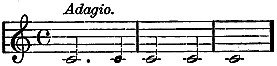
it would obviously be absurd to shorten the first dotted note by one-half; this rendering seems to me the proper one:
Audio content is not currently supported on your device. [MusicXML]

taking great pains to allow to rests of equal value uniform duration.
The free staccato is not admissible upon the organ. Here every detached note becomes a staccato one, as in the case of instruments played with a bow; that is to say, a series of equal tones separated from each other by rests of like duration. The staccato is executed by holding the fingers as near as possible to the keys, the wrist slightly depressed.
Example:
Audio content is not currently supported on your device. [MusicXML]
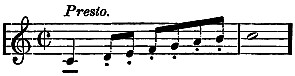
Execution:
Audio content is not currently supported on your device. [MusicXML]

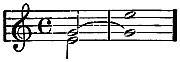
When one part succeeds another upon the same note, the note is held and not repeated.
Example:
Audio content is not currently supported on your device. [MusicXML]
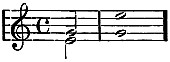
Execution:
Audio content is not currently supported on your device. [MusicXML]
A moment ago, in my category of crimes against Art, I included that of indifference to rhythm.
What is rhythm?
The constant manifestation of determination, or will, upon the periodical recurrence of the accented beats. It is only by rhythm that one wins attention. Particularly with the organ, all accents, all effects are dependent upon it. You may bear upon the keyboard with the weight of pounds, with all the strength of your shoulders—you will gain nothing by it. But delay by a tenth of a second the attack of a chord, or prolong this same chord the very least, and judge of the effect produced! Upon a manual not provided with a swell-box one may obtain a crescendo without the aid of a mechanism of any kind: by the simple augmentation of the duration allowed successive chords or detached phrases.
To play upon an organ is to deal with chronometric values.
Woe be unto you if your tempo is not absolutely regular, if your will does not manifest itself at every breathing-point of the phrase, at every "lift"; if you unconsciously permit yourself to "hurry"!
Would you like a lesson in rhythm? Listen to those immense locomotives dragging behind them tons of merchandise; admire the formidable piston stroke which marks every recurrence of the accent, slowly but relentlessly; well may you believe that you hear the march of Fate itself. It causes one to shudder.
To be master of one's self it is necessary to abstain from every superfluous movement, from any displacement of the body. A good organist sits firmly, well-balanced upon his bench, inclining slightly towards the manuals, never permitting his feet to rest upon the frame which surrounds the pedals, but letting them glide lightly along over the keys; heels and knees riveted, so to speak, together.
Nature has vouchsafed us two guides of the greatest value; with the heels pressed one against the other, the maximum separation of the other extremities of the feet gives us a fifth; with the knees held similarly together, the maximum interval obtainable should be an octave.
Precision and confidence will never be obtained except by adopting this method; holding the two limbs as if bound together, the two feet unceasingly in contact with each other.
The foot should not attack the pedal vertically, but from well to the rear towards the front, as close to the key as possible; gliding slightly, or "skating," the toe to within a half-inch of the black keys.
Considering the degree of perfection attained in our contemporary manufacture, we must be careful not to become dazzled in the midst of the wealth of resources thereby offered us, and thus led far astray from the right path. Let us not forget that upon the organ, as in the orchestra or chorus, all music is based upon the quartet. It is the true foundation of the language. With the organ, our quartet is embodied in the noble and flowing sonority of the 8-foot foundation stops. The basso continuo of certain organists, who have fallen asleep over their pedals, soon becomes an intolerable nuisance for the audience. We should go wild at a performance of a symphony in which the double-basses played uninterruptedly from the first note to the last. Plain-song itself, thus interpreted, loses its eloquence; although the apparent monotony of its design, closely confined within the limits of an octave, would, above all, seem to be better adapted than any other form of music to a continuous bass.
But not at all! This apparent monotony exists in reality only for those who see not with their eyes, neither hear with their ears.
Plain-song is of a complex species; it has two faces, like Janus.[4] To be understood, it must be listened to at once from a literary and a musical standpoint. It is this synthesis which the "decadent" poets or musicians have, in late years, striven to revive.
The superb rhythm of the pedal when the organ responds to the choir[5] should emphasize the text, sustain it in outbursts of exaltation, and not vulgarize it by a continual and unintelligent abuse.
The organ is a wind instrument; it requires opportunity to take breath. Like the literary sentence, the musical phrase has its commas, its periods, its paragraphs. As a speaker changes his intonation, so must the organ vary its "designs." Is anything more exasperating than an improvisation in four parts, wandering now here, now there—monotonous in color, devoid of determination, repose, contrast, or purpose, having neither beginning, middle, nor end? A veritable macaroni au fromage!
Cornets and mixtures, and the other registers of the organ of Bach's time—these furnish the proper tone-material for Plain-song, assimilating perfectly with the polyphony of the masters of the sixteenth century.
Distributed to a certain extent over all lands, coming originally from Athens, Jerusalem, and Rome, Plain-chant is our heritage from the Middle Ages, assiduously cultivated within that sunny domain of counterpoint, of which Palestrina was the last custodian. As it has been bequeathed to us by the old masters, so must we preserve it for our descendants. The teachings of the Paris Conservatory during the past fifty years will always be perpetuated; the treatment in florid counterpoint, be the melody in soprano or bass, or the accompaniment in strict counterpoint, note against note, as in the Church.
Some of our contemporary organ builders in France have made a serious mistake in regarding as a foregone conclusion the undesirability of perpetuating the characteristics of registration of earlier days, and in thus considering them hardly worthy of further notice. What a pity!
In July of this year at Notre-Dame, whose superb instrument has just been restored by Cavaillé-Coll, we admired the effect produced by different specimens of those mutation stops, producing in the Pedal a fundamental of 32, upon the Bombarde one of 16, and upon the Grand-Chœur one of 8-foot pitch. Indescribable is the effect of the Chorales of the great Sebastian Bach, reverberating with crystalline sonority under those wonderful arches.
The days of "deluges" upon the organ are over; of thunder and tremulants, of choruses of goats called the vox humana, and all such childish trifles. "At the opening of the organ in X, Mr. Z. contributed to the programme a tempest, which he really should have prefaced by a few flashes of genius!..."
For the great advancement achieved by French workmanship in our day, we are indebted to Cavaillé-Coll and his masterpieces, which lend themselves to the perfect expression of any idea, be it of the past or of the present.
Since Cavaillé-Coll, the study of Bach has begun. Will you believe that sixty years ago one would have searched Paris in vain to find two organists who knew the fugue in B minor? I know of none but conscientious Boëly, of Saint-Germain-l'Auxerrois; the published compositions bear witness to the ideal of those times, an ideal without a name.
Finally becoming disgusted with this state of affairs, a few young men, more curious than their elders, began to inquire into the contents of the dusty volumes of the great Sebastian; they seemed to them at first somewhat dry, although interesting, at least in point of execution. One might learn something in that direction! And soon they were greatly surprised to find their souls touched, while working with their fingers. And when, acquiring a taste for further search, they went through the volumes of Chorales, and finally arrived at the Cantatas...!
I shall never forget the hours devoted by the Concordia, whose conductor I was, to the study and performance, at the Conservatoire, of that splendid series of lyric works, which we crowned with the "Passion according to Saint Matthew...."
In justice to our elders it must be said that in Germany as well Bach had been long neglected. All honor to Mendelssohn, who conducted this prodigious work at the Singakademie in Berlin, March 29, 1829; it had been sleeping in the depths of a library for just one hundred years, the first performance of the work having been on Good Friday, 1729, in Leipzig.
In 1840 Mendelssohn gave an organ concert in St. Thomas's Church upon the instrument which so long before had been played by the great Bach himself; the object of the concert was the augmentation of the subscription for a monument to his memory.
The following was the programme:
Fugue in E flat.
Improvisation upon themes from Bach.
Prelude and Fugue in A minor.
Passacaglia.
Pastorale. Toccata.
Fantasia upon some of the chorales.
April 4th of the following year, in the same church, Mendelssohn conducted the St. Matthew Passion, from the same spot where Bach himself had directed it, 112 years before.
Finally, on March 23, 1843, a great symphony concert was given:
1. Orchestral Suite (overture, arioso, gavotte, trio, bourrée, and gigue).
2. Motet for double chorus a cappella.
3. Concerto for harpsichord (the solo part of which Mendelssohn himself played).
4. Aria from the St. Matthew Passion (Ich will bei meinem Jesu wachen).
5. Fantasia upon a theme by Bach (performed by Mendelssohn).
6. Cantata (for the election of the Stadtrath [council] of the city of Leipzig).
7. Prelude for violin (played by Ferdinand David).
8. Sanctus (from the Mass in B minor).
The subscription had resulted successfully, and the monument had been erected.
Following the concert, the draperies were withdrawn which concealed the bust of the master of masters.
Ch.-M. Widor.