Sir Percy FitzPatrick (continued 7)
Reading edition
All day long he failed to find game; whenever there seemed to be a chance an angry honey-bird would appear ahead of him and cry a warning to the game; and that night as he came back, empty-handed and hungry, all the portents of bad luck came to him in turn. An owl screeched three times over his head; a goat-sucker with its long wavy wings and tail flitted before him in swoops and rings in most ghostly silence—and there is nothing more ghostly than that flappy wavy soundless flitting of the goat-sucker; a jackal trotted persistently in front looking back at him; and a striped hyena, humpbacked, savage, and solitary, stalked by in silence, and glared.
At night as he lay unable to sleep the bats came and made faces at him; a night adder rose up before his face and slithered out its forked tongue—the two black beady eyes glinting the firelight back; and whichever way he looked there was a honey-bird, silent and angry, yet with a look of satisfaction, as it watched. So it went all night: no sleep for him; no rest!
In the morning he rose early and taking his gun and chopper set out in search of hives: he would give all to the honey-bird he had cheated, and thus make amends.
He had not gone far before, to his great delight, there came a welcome chattering in answer to his low whistle, and the busy little fellow flew up to show himself and promptly led the way, going ahead ten to twenty yards at a flight. Jantje followed eagerly until they came to a small donga with a sandy bottom, and then the honey-bird calling briskly, fluttered from tree to tree on either bank, leading him on.
Jantje, thinking the hive must be near by, was walking slowly along the sandy bed and looking upwards in the trees, when something on the ground caught his eye and he sprang back just as the head of a big puff-adder struck where his bare foot had been a moment before. With one swing of his chopper he killed it; he took the skin off for an ornament, the poison-glands for medicine, and the fangs for charms, and then whistled and looked about for the honey-bird; but it had gone.
A little later on, however, he came upon another, and it led him to a big and shady wild fig tree. The honey-bird flew to the trunk itself and cheeped and chattered there, and Jantje put down his gun and looked about for an easy place to climb. As he peered through the foliage he met a pair of large green eyes looking full into his: on a big limb of the tree lay a tiger, still as death, with its head resting on its paws, watching him with a cat-like eagerness for its prey. Jantje hooked his toe in the reim sling of his old gun and slowly gathered it up without moving his eyes from the tiger’s, and backing away slowly, foot by foot, he got out into the sunshine and made off as fast as he could.
It was the honey-bird’s revenge: he knew it then!
He sat down on some bare ground to think what next to do; for he knew he must die if he did not find honey and make good a hundred times what he had cheated.
All day long he kept meeting honey-birds and following them; but he would no longer follow them into the bad places, for he could not tell whether they were new birds or the one he had robbed! Once he had nearly been caught; the bird had perched on an old ant-heap, and Jantje, thinking there was a ground hive there, walked boldly forward. A small misshapen tree grew out of the ant-heap, and one of the twisted branches caught his eye because of the thick ring around it: it was the coil of a long green mamba; and far below that, half hidden by the leaves, hung the snake’s head with the neck gathered in half-loop coils ready to strike at him.
After that Jantje kept in the open, searching for himself among rocks and in all the old dead trees for the tell-tale stains that mark the hive’s entrance; but he had no luck, and when he reached the river in the early afternoon he was glad of a cool drink and a place to rest.
For a couple of hours he had seen no honey-birds, and it seemed that at last his pursuer had given him up, for that day at least. As he sat in the shade of the high bank, however, with the river only a few yards from his feet he heard again a faint chattering: it came from the river-side beyond a turn in the bank, and it was too far away for the bird to have seen Jantje from where it called, so he had no doubt about this being a new bird. It seemed to him a glorious piece of luck that he should find honey by the aid of a strange bird and be able to take half of it back to the hive he had emptied the day before and leave it there for the cheated bird.
There was a beach of pebbles and rocks between the high bank and the river, and as Jantje walked along it on the keen lookout for the bird, he spotted it sitting on a root half-way down the bank some twenty yards ahead. Close to where the chattering bird perched there was a break in the pebbly beach, and there shallow water extended up to the perpendicular bank. In the middle of this little stretch of water, and conveniently placed as a stepping-stone, there was a black rock, and the bare-footed Jantje stepped noiselessly from stone to stone towards lit.
An alarmed cane-rat, cut off by Jantje from the river, ran along the foot of the bank to avoid him; but when it reached the little patch of shallow water it suddenly doubled back in fright and raced under the boy’s feet into the river.
Jantje stopped! He did not know why; but there seemed to be something wrong. Something had frightened the cane-rat back on to him, and he stared hard at the bank and the stretch of beach ahead of him. Then the rock he meant to step on to gave a heave, and a long blackish thing curved towards him; he sprang into the air as high as he could, and the crocodile’s tail swept under his feet!
Jantje fled back like a buck—the rattle on the stones behind him and crash of reeds putting yards into every bound.
For four days he stayed in camp waiting for some one to find a hive and give him honey enough to make his peace; and then, for an old snuff-box and a little powder, he bought a huge basket full of comb, young and old, from a kaffir woman at one of the kraals some miles away, and put it all at the foot of the tree he had cleaned out.
Then he had peace.
The boys believed every word of that story: so, I am sure, did Jantje himself. The buffalo story was obviously true, and Jantje thought nothing of it: the honey-bird story was not, yet he gloried in it; it touched his superstitious nature, and it was impossible for him to tell the truth or to separate fact from fancy and superstition.
How much of fact there may have been in it I cannot say: honey-birds gave me many a wild-goose chase, but when they led to anything at all it was to hives, and not to snakes, tigers and crocodiles. Perhaps it is right to own up that I never cheated a honey-bird! We pretended to laugh at the superstition, but we left some honey all the same—just for luck! After all, as we used to say, the bird earned its share and deserved encouragement.
Round the camp fire at nights it was no uncommon thing to see some one jump up and let out with whatever was handiest at some poisonous intruder. There was always plenty of dead wood about and we piled on big branches and logs freely, and as the ends burnt to ashes in the heart of the fire we kept pushing the logs further in. Of course, dead trees are the home of all sorts of ‘creepy-crawly’ things, and as the log warmed up and the fire eat into the decayed heart and drove thick hot smoke through the cracks and corridors and secret places in the logs the occupants would come scuttling out at the butt ends. Small snakes were common—the big ones usually clearing when the log was first disturbed—and they slipped away into the darkness giving hard quick glances about them; but scorpions, centipedes and all sorts of spiders were by far the most numerous.
Occasionally in the mornings we found snakes under our blankets, where they had worked in during the night for the warmth of the human body; but no one was bitten, and one made a practice of getting up at once, and with one movement, so that unwelcome visitors should not be warned or provoked by any preliminary rolling. The scorpions, centipedes and tarantulas seemed to be more objectionable; but they were quite as anxious to get away as we were, and it is wonderful how little damage is done.
One night when we had been watching them coming out of a big honeycombed log like the animals from the Ark, and were commenting on the astonishing number and variety of these things, I heard Jantje conveying in high-pitched tones fanciful bits of information to the credulous waggon-boys. When he found that we too were listening—and Jantje had the storyteller’s love for a ‘gallery’—he turned our way and dropped into a jargon of broken English, helped out with Hottentot-Dutch, which it is impossible to reproduce in intelligible form.
He had made some allusion to ‘the great battle,’ and when I asked for an explanation he told us the story. It is well enough known in South Africa, and similar stories are to be found in the folklore of other countries, but it had a special interest for us in that Jantje gave it as having come to him from his own people. He called it “The Great Battle between the Things of the Earth and the Things of the Air.”
For a long time there had been jealousy between the Things of the Earth and the Things of the Air, each claiming superiority for themselves; each could do something the others could not do; and each thought their powers greater and their qualities superior. One day a number of them happened to meet on an open plain near the river’s bank, and the game of brag began again as usual. At last the Lion, who was very cross, turned to the old Black Aasvogel, as he sat half asleep on a dead tree, and challenged him.
“You only eat the dead: you steal where others kill. It is all talk with you; you will not fight!”
The Aasvogel said nothing, but let his bald head and bare neck settle down between his shoulders, and closed his eyes.
“He wakes up soon enough when we find him squatting above the carcase,” said the Jackal. “See him flop along then.”
“When we find him!” the Aasvogel said, opening his eyes wide. “Sneaking prowler of the night! Little bastard of the Striped Thief!”
“Come down and fight,” snarled the Hyena angrily. “Thief and scavenger yourself!”
So the Things of the Air gathered about and joined in backing the Black Aasvogel; and the Things of the Earth kept on challenging them to come down and have it out; but nobody could hear anything because the Jackal yapped incessantly and the Go’way bird, with its feathers all on end and its neck craned out, screamed itself drunk with passion.
Then the Eagle spoke out:
“You have talked enough. Strike—strike for the eyes!” and he swept down close to the Lion’s head, but swerving to avoid the big paw that darted out at him, he struck in passing at the Jackal, and took off part of his ear.
“I am killed! I am killed!” screamed the Jackal, racing for a hole to hide in. But the other beasts laughed at him; and when the Lion called them up and bade them take their places in the field for the great battle, the Jackal walked close behind him holding his head on one side and showing each one what the Eagle had done.
“Where is my place?” asked the Crocodile, in a soft voice, from the bank where no one had noticed him come up.
The Things of the Earth that were near him moved quietly away.
“Your place is in the water,” the Lion answered. “Coward and traitor whom no one trusts! Who would fight with his back to you?”
The Crocodile laughed softly and rolled his green eyes from one to another; and they moved still further away.
“What am I?” asked the Ostrich. “Kindred of the Birds, I am of the winged ones; yet I cannot fight with them!”
“Let him fly!” said the Jackal, grinning, “and we shall then see to whom he belongs! Fly, old Three Sticks! Fly!”
The Ostrich ran at him, waltzing and darting with wings outspread, but the Jackal dodged away under the Lion and squealed out, “Take your feet off the ground, Clumsy, and fly!”
Then it was arranged that there should be two Umpires, one for each party, and that the Umpires should stand on two high hills where all could see them. The Ostrich was made Umpire for the Things of the Air, and as long as the fight went well with his party he was to hold his head high so that the Things of the Air might see the long thin neck upright and, knowing that all was well, fight on.
The Jackal asked that he might be Umpire for the Things of the Earth.
“You are too small to be seen!” objected the Lion gruffly.
“No! No!” urged the Jackal, “I will stand on a big ant-heap and hold my bushy tail on high where all will see it shining silver and gold in the sunlight.”
“Good!” said the Lion. “It is better so, perhaps, for you would never fight; and as soon as one begins to run, others follow!”
The Things of the Air gathered in their numbers, and the Eagle led them, showing them how to make up for their weakness by coming swiftly down in numbers where they found their enemies alone or weak; how to keep the sun behind them so that it would shine in their enemies’ eyes and blind them; and how the loud-voiced ones should attack on the rear and scream suddenly, while those with bill and claw swooped down in front and struck at the eyes.
And for a time it went well with the Things of the Air. The little birds and locusts and butterflies came in clouds about the Lion and he could see nothing as he moved from place to place; and the Things of the Earth were confused by these sudden attacks; and, giving up the fight, began to flee from their places.
Then the Jackal, believing that he would not be found out, cheated: he kept his tail up to make them think they were not beaten. The Lion roared to them, so that all could hear, to watch the hill where the Jackal stood and see the sign of victory; and the Things of the Earth, being strong, gathered together again and withstood the enemy and drove them off.
The battle was going against the Things of the Air when the Go’way bird came to the Eagle and said:
“It is the Jackal who has done this. Long ago we had won; but, Cheat and Coward, he kept his tail aloft and his people have returned and are winning now.”
Then the Eagle, looking round the field, said, “Send me the Bee.”
And when the Bee came the Eagle told him what to do; and setting quietly about his work, as his habit is, he made a circuit through the trees that brought him to the hill where the Jackal watched from the ant-heap.
While the Jackal stood there with his mouth open and tongue out, laughing to see how his cheating had succeeded, the Bee came up quietly behind and, as Jantje put it, “stuck him from hereafter!”
The Jackal gave a scream of pain and, tucking his tail down, jumped from the ant-heap and ran away into the bush; and when the Things of the Earth saw the signal go down they thought that all was lost, and fled.
So was the Great Battle won!
Chapter Twenty One.
Monkeys and Wildebeeste.
Mungo was not a perfect mount, but he was a great improvement on Snowball; he had a wretched walk, and led almost as badly as his predecessor; but this did not matter so much because he could be driven like a pack donkey and relied on not to play pranks. In a gallop after game he was much faster than Snowball, having a wonderfully long stride for so low a pony.
A horse made a good deal of difference in the hunting in many ways, not the least of which was that some sort of excursion was possible on most days. One could go further in the time available and, even if delayed, still be pretty sure of catching up to the waggons without much difficulty.
Sometimes after a long night’s trekking I would start off after breakfast for some ‘likely’ spot, off-saddle there in a shady place, sleep during the heat of the day, and after a billy of tea start hunting towards the waggons in the afternoon.
It was in such a spot on the Komati River, a couple of hundred yards from the bank, that on one occasion I settled down to make up lost ground in the matter of sleep, and with Mungo knee-haltered in good grass and Jock beside me, I lay flat on my back with hat covering my eyes and was soon comfortably asleep.
The sleep had lasted a couple of hours when I began to dream that it was raining and woke up in the belief that a hail storm—following the rain—was just breaking over me. I started up to find all just as it had been, and the sunlight beyond the big tree so glaring as to make the eyes ache. Through half-closed lids I saw Mungo lying down asleep and made out Jock standing some yards away quietly watching me.
With a yawn and stretch I lay back again; sleep was over but a good lazy rest was welcome: it had been earned, and, most comforting of all, there was nothing else to be done. In the doze that followed I was surprised to feel quite distinctly something like a drop of rain strike my leg, and then another on my hat.
“Hang it all, it is raining,” I said, sitting up again and quite wide awake this time. There was Jock still looking at me, but only for the moment of moving, it appears; for, a minute later he looked up into the tree above me with ears cocked, head on one side, and tail held lazily on the horizontal and moving slowly from time to time.
It was his look of interested amusement.
A couple of leaves fluttered down, and then the half-eaten pip of a ‘wooden orange’ struck me in the face as I lay back again to see what was going on above. The pip gave me the line, and away up among the thick dark foliage I saw a little old face looking down at me; the quick restless eyes were watchfully on the move, and the mouth partly opened in the shape of an O—face and attitude together a vivid expression of surprise and indignation combined with breathless interest.
As my eyes fairly met those above me, the monkey ducked its head forward and promptly ‘made a face’ at me without uttering a sound. Then others showed up in different places, and whole figures became visible now as the monkeys stole softly along the branches to get a better look at Jock and me: there were a couple of dozen of them of all sizes.
They are the liveliest, most restless, and most inquisitive of creatures; ludicrously nervous and excitable; quick to chattering anger and bursts of hysterical passion, which are intensely comical, especially when they have been scared. They are creatures whose method of progress most readily betrays them by the swaying of a branch or quivering of leaves, yet they can steal about and melt away at will, like small grey ghosts, silent as the grave.
I had often tried to trap them, but never succeeded: Jantje caught them, as he caught everything, with cunning that out-matched his wilder kindred; pitfalls, nooses, whip-traps, fall-traps, foot-snares, drags, slip-knots of all kinds, and tricks that I cannot now remember, were in his repertory; but he disliked showing his traps, and when told to explain he would half sulkily show one of the common kind.
The day he caught the monkey he was well pleased, and may possibly have told the truth. Baboons and monkeys, he said, can count just like men, but they can only count two! If one man goes into a mealie field and waits for them with a gun, their sentry will see him, and he may wait for ever; if two go and one remains, it is useless, for they realise that only one has come out where two went in; but if three go in, one may remain behind to lie in wait for them, for the monkeys, seeing more than one return, will invade the mealie field as soon as the two are safely out of the way. That was only Jantje’s explanation of the well-known fact that monkeys and baboons know the difference between one and more than one.
But, as Jantje explained, their cleverness helped him to catch them. He went alone and came away alone, leaving his trap behind, knowing that they were watching his every movement, but knowing also that their intense curiosity would draw them to it the moment it seemed safe. The trap he used was an old calabash or gourd with a round hole in it about an inch in diameter; and a few pumpkin seeds and mealies and a hard crust of bread, just small enough to get into the calabash, formed the bait.
After fastening the gourd by a cord to a small stump, he left it lying on its side on the ground where he had been sitting. A few crumbs and seeds were dropped near it and the rest placed in the gourd, with one or two showing in the mouth. Then he walked off on the side where he would be longest in view, and when well out of sight sped round in a circuit to a previously selected spot where he could get close up again and watch.
The foremost monkey was already on the ground when he got back and others were hanging from low branches or clinging to the stems, ready to drop or retreat. Then began the grunts and careful timid approaches, such as one sees in a party of children hunting for the hidden ‘ghost’ who is expected to appear suddenly and chase them; next, the chattering garrulous warnings and protests from the timid ones—the females—in the upper branches; the sudden start and scurry of one of the youngsters; and the scare communicated to all, making even the leader jump back a pace; then his angry grunt and loud scolding of the frightened ones—angry because they had given him a fright, and loud because he was reassuring himself.
After a pause they began the careful roundabout approach and the squatting and waiting, making pretences of not being particularly interested, while their quick eyes watched everything; then the deft picking up of one thing—instantly dropped again, as one picks up a roasted chestnut and drops it in the same movement, in case it should be hot; and finally the greedy scramble and chatter.
I have seen all that, but not, alas, the successful ending, when trying to imitate Jantje’s methods. Jantje waited until the tugs at the gourd became serious, and then, knowing that the smaller things had been taken out or shaken out and eaten and that some enterprising monkey had put its arm into the hole and grabbed the crust, he ran out.
A monkey rarely lets go any food it has grabbed, and when, as in this case, the hand is jammed in a narrow neck, the letting go cannot easily be done instinctively or inadvertently; the act requires a deliberate effort. So Jantje caught his monkey, and flinging his ragged coat over the captive sat down to make it safe. By pushing the monkey’s arm deeper into the gourd the crust became released and the hand freed; he then gradually shifted the monkey about until he got the head into the shoulders of the loose old coat, and thence into the sleeve; and worked away at this until he had the creature as helpless as a mummy with the head appearing at the cuff-opening and the body jammed in the sleeve like a bulging overstuffed sausage. The monkey struggled, screamed, chattered, made faces, and cried like a child; but Jantje gripping it between his knees worked away unmoved.
He next took the cord from the calabash and tied one end securely round the monkey’s neck, to the shrinking horror of that individual, and the other end to a stout bush stick about seven or eight feet long; and then slipped monkey cord and stick back through the sleeve and had his captive safe; the cord prevented it from getting away, and the stick from getting too close and biting him. When they sat opposite and pulled faces at each other the family likeness was surprising.
The grimacing little imps invariably tempt one to tease or chase them, just to see their antics and methods; and when I rose, openly watching them and stepping about for a better view, they abandoned the silent methods and bounded freely from branch to branch for fresh cover, always ducking behind something if I pointed the gun or a stick or even my arm at them, and getting into paroxysms of rage and leaning over slang and cheek me whenever it seemed safe.
Jock was full of excitement, thoroughly warmed up and anxious to be at them, running about from place to place to watch them, tacking and turning and jumping for better views, and now and then running to the trunk and scraping at it. Whenever he did this there was a moment’s silence; the idea of playing a trick on them struck me and I caught Jock up and put him in the fork of a big main branch about six feet from the ground. The effect was magical: the whole of the top of the tree seemed to whip and rustle at once, and in two seconds there was not a monkey left.
Then a wave in the top of a small tree some distance off betrayed them and we gave chase—a useless romping schoolboy chase. They were in the small trees away from the river and it was easy to see and follow them; and to add to the fun and excitement I threw stones at the branches behind them. Their excitement and alarm then became hysterical, and as we darted about to head them off they were several times obliged to scamper a few yards along the ground to avoid me and gain other trees. It was then that Jock enjoyed himself most: he ran at them and made flying leaps and snaps as they sprang up the trees out of reach. It was like a caricature of children in one of their make-believe chases; the screams, grimaces, and actions were so human that it would have seemed like a tragedy had one of them been hurt. They got away into the big trees once more, to Jock’s disappointment but greatly to my relief; for I was quite pumped from the romp and laughter.
The river at this point was broken into several sluices by islands formed of piles of rocks on which there were a few stunted trees and dense growths of tall reeds, and here and there little spits and fringes of white sand were visible. There was plenty of small game in that part, and it was a great place for crocodiles. As we were then about half a mile below where Mungo had been left I strolled along the bank on the look out for a shot, frequently stopping to examine suspicious-looking rocks on the sand spits or at the borders of the reed fringes on the little islands.
The shooting of crocodiles was an act of war: it was enmity and not sport or a desire for trophies that prompted it, and when it did not interfere with other chances we never missed a practice shot at these fellows. I picked out several ‘rocks,’ so suspicious looking that I would have had a shot at them had there been a clear chance, and twice, while I was trying to make them out, they slid silently into the water before there was time to fire.
However, further on there came a better chance than any: there was something so peculiar about the look of this ‘rock’ that I picked a good spot and sat down to watch it; and presently the part nearest me turned slightly, just enough to show that it was a crocodile lying on the flat sand with his nose towards me and his tail hidden in the reeds. It was fifty yards away, and from where I sat there was not much to aim at, as a Martini bullet would glance from almost any part of that polished hard case if it struck at such an angle.
I was sitting on the bank above the shelving beach of the river on which a dense mass of reeds grew, and the waving feathery tops partly obscured the sight. I know the bullet hit him somewhere, because he bounded with astonishing strength and activity several feet in the air and his tail slashed through the reeds like a mighty scythe. The huge jaws opened and he gave a horrible angry bellow—something between a roar and a snarl—as he plunged into the river, sending masses of spray and water flying every way. He made straight across, apparently at me, swimming on top of the water at amazing speed and throwing up a wave on either side and a white swirl of foam from the propelling tail.
It was certainly a most surprising and unheard-of proceeding, and as he reached my side of the stream, and because hidden from me by the screen of reeds at my feet, I turned and bolted. It may be that he came at me with murderous intent; or it may be that, blinded by rage or pain, he came towards me simply because he happened to be facing that way; but, whatever the reason, it was painfully clear that if he meant business he would be on to me before it was possible to see him in the reeds. That was enough for me. It had never occurred to me that there was going to be any fun in this for the crocodile; but one’s sense of humour and justice was always being stimulated in the Bushveld.
With twenty yards of open ground between us I turned and waited; but no crocodile appeared, nor was there a sound to be heard in the reeds. A few minutes wait; a cautious return; a careful scrutiny; and then resort to sticks and stones; but all to no purpose: there was neither sign nor sound of the crocodile; and not being disposed to go into the reeds to look for something which I did not want, but might want me, I returned to Mungo—a little wiser, it is true, but not unduly ‘heady’ on that account.
Half an hour’s jogging along the bank having failed to propose anything, I struck away from the river taking a line through the bush towards camp, and eventually came across a small herd of blue wildebeeste. Mungo’s pricked ears and raised head warned me; but the grass being high it was not easy to see enough of them from the ground to place an effective shot, and before a chance offered they moved off slowly. I walked after them, leading Mungo and trying to get a fair opening on slightly higher ground.
Presently half a dozen blackish things appeared above the tall grass; they were the heads of the wildebeeste—all turned one way, and all looking at us with ears wide spread. Only the upper halves of the heads were visible through the thinner tops of the grass, and even an ordinary standing shot was not possible. I had to go to a tree for support in order to tip-toe for the shot, and whilst in the act of raising my rifle the heads disappeared; but I took chance and fired just below where the last one had shown up.
The wildebeeste were out of sight, hidden by grass six feet high, but a branch of the tree beside me served as a horizontal bar and hoisting myself chin high I was able to see them again. In front of us there was a dry vlei quite free of bush, some two hundred yards across and four hundred yards long, and the wildebeeste had gone away to the right and were skirting the vlei, apparently meaning to get round to the opposite side, avoiding the direct cut across the vlei for reasons of their own. It occurred to me that there must be a deep donga or perhaps a mud hole in front which they were avoiding; but that it might be possible for me to get across, or even half-way across, in time to have another shot at them the next time they stopped to look back, as they were almost certain to do; so I ran straight on.
One does not have to reason things out like that in actual practice: the conclusion comes instantly, as if by instinct, and no time is lost. To drop from the branch, pick up the rifle, and start running were all parts of one movement. Stooping slightly to prevent my bobbing hat from showing up in the grass tops, and holding the rifle obliquely before me as a sort of snowplough to clear the grass from my eyes, I made as good pace as the ground would allow.
No doubt the rifle held in front of me made it difficult to notice anything on the ground; but the concentrated stare across the vlei in the direction of the galloping wildebeeste was quite as much the cause of what followed. Going fast and stooping low, with all my weight thrown forward, I ran right into a wildebeeste cow. My shot had wounded her through the kidneys, completely paralysing the hind quarters, and she had instantly dropped out of sight in the grass. The only warning I got was a furious snort, and the black looking monster with great blazing blood-shot eyes rose up on its front legs as I ran into it.
To charge into a wounded wildebeeste ready to go for you, just when your whole attention is concentrated upon others two hundred yards beyond, is nearly as unpleasant as it is unexpected; it becomes a question of what will happen to you, rather than of what you will do. That at any rate was my experience. The rifle, if it had hindered me, also helped: held out at arms length it struck the wildebeeste across the forehead and the collision saved my chest from the horns. There was an angry toss of the big head and the rifle was twirled out of my hand, as one might flip a match away.
I do not know exactly what happened: the impression is of a breathless second’s whirl and scramble, and then finding myself standing untouched five yards away, with the half-paralysed wildebeeste squatting like a dog and struggling to drag the useless hind quarters along in its furious efforts to get at Jock who had already intervened to help me.
The rifle lay within the circle of the big hooked horns; and the squatting animal, making a pivot of its hind quarters, slewed round and round, making savage lunges at Jock and great heaves at me each time I tried to get the rifle. It often happens that shots touching the kidneys produce a paralysis, temporarily severe, which passes off to a great extent after some minutes and leaves the wounded animal well able to charge: it happened to me some years later while trying to photograph a wounded sable.
I tried to hook the gun out with a stick but the wildebeeste swung round and faced me at once, snapping the sticks and twirling them out of my hands with surprising ease and quickness. I then tried another game, and by making feint attacks from the other side at last got the animal gradually worked away from my gun; and the next attempt at raking was successful.
When the excitement was over and there was a chance of taking stock of the position, I found that Jock had a pretty good ‘gravel rash’ on one hip and a nasty cut down one leg; he had caught the wildebeeste by the nose the instant I ran into it, and it had ‘wiped the floor’ with him and flung him aside.
I found my bandolier with a broken buckle lying on the grass; one shirt sleeve was ripped open; the back of the right hand cut across; hands and knees were well grated; and there were lumps and bruises about the legs for which there was no satisfactory explanation. I must have scrambled out like an unwilling participant in a dog fight.
It was a long job skinning, cutting up, and packing the wildebeeste, and when we reached the outspan the waggons had already started and we had a long tramp before us to catch them.
I drove Mungo before me, keeping him at an easy-jog. We had been going for possibly an hour and it was quite dark, except for the stars and the young moon low down on our right; the road was soft and Mungo’s jogging paces sounded like floppy pats; there was no other sound at all, not even a distant rumble from the waggons to cheer us; Mungo must have been sick of it and one might have thought him jogging in his sleep but for the occasional pricking of his ears—a trick that always makes me wonder how much more do horses see in the dark than we do. I walked like a machine, with rifle on shoulder and glad to be rid of the broken bandolier, then transferred to Mungo; and Jock trotted at my heels.
This tired monotonous progress was disturbed by Mungo: his ears pricked; his head went up; and he stopped, looking hard at a big low bush on our left. I gave him a tap with the switch, and without an instant hesitation he dashed off to the right making a half circle through the veld and coming into the road again fifty yards ahead, and galloped away leaving a rising column of dust behind him.
I stood and faced the bush that Mungo had shied at, and the first thing that occurred to me was that my bandolier and cartridges were with the pony. Then Jock growled low and moved a few steps forward and slightly to the right, also sheering off from that bush. I felt that he was bristling all over, but there was neither time nor light to watch him. I stepped slowly sideways after him gripping the rifle and looking hard at the bush.
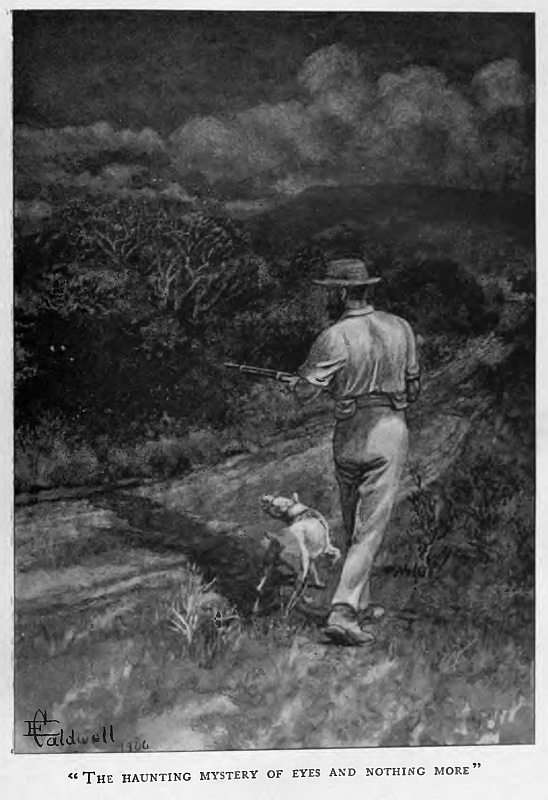
Our line was much the same as Mungo’s and would take us some seven or eight paces off the road—more than that was not possible owing to the barrier of thorns on that side. When we got abreast of the bush two large spots of pale light appeared in the middle of it, apparently waist high from the ground.
It is impossible to forget the tense creepy feeling caused by the dead stillness, the soft light, and the pale expressionless glow of those eyes—the haunting mystery of eyes and nothing more!
It is not unusual to see eyes in the night; but this was a ‘nervy’ occasion, and there is no other that comes back with all the vividness and reality of the experience itself, as this one does. And I was not the only nervous one. Mungo incontinently bolted—probably what he saw warranted it; Jock, as ever, faced it; but when my foot touched his hind leg as we sidled away he flew round with a convulsive jump. He too was strung to concert pitch.
As we moved on and passed the reflecting angle of the moon, the light of the eyes went out as suddenly and silently as it had appeared. There was nothing then to show me where danger lay; but Jock knew, and I kept a watch on him. He jogged beside me, lagging slightly as if to cover our retreat, always looking back. A couple of times he stopped entirely and stood in the road, facing straight back and growling; and I followed suit. He was in command; he knew!
There was nothing more. Gradually Jock’s subdued purring growl died down and the glances back became fewer. I found Mungo a long way on, brought to a standstill by the slipping of his load; and we caught up to the waggons at the next outspan.
Chapter Twenty Two.
The Old Crocodile.
We reached the Crocodile River drift on a Sunday morning, after a particularly dry and dusty night trek. ‘Wanting a wash’ did not on such occasions mean a mild inclination for a luxury: it meant that washing was badly needed. The dust lay inches deep on the one worn veld road, and the long strings of oxen toiling along kicked up suffocating clouds of fine dust which there was seldom any breeze to carry off: it powdered white man and black to an equal level of yellowy red. The waggons were a couple of hundred yards from the river; and, taking a complete change, I went off for a real clean up.
We generally managed to get in a couple of bathes at the rivers—real swims—but that was only done in the regular drifts and when there were people about or waggons crossing. In such conditions crocodiles rarely appeared; they prefer solitude and silence. The swims were very delightful but somewhat different from ordinary bathes; however remote may have been the risk of meeting a crocodile when you dived, or of being grabbed by one as you swam, the idea was always there and made it more interesting.
Being alone that day I had no intention of having a swim or of going into the open river, and I took a little trouble to pick a suitable pool with a rock on which to stand and dress. The water was clear and I could see the bottom of the pool. It was quite shallow—three feet deep at most—made by a scour in the sandy bed and divided from the main stream by a narrow spit of sand a couple of yards wide and twenty long. At the top end of the sand spit was a flat rock—my dressing table.
After a dip in the pool I stood on to the sand spit to scrub off the brown dust, keeping one unsoaped eye roving round for intrusive crocodiles, and the loaded rifle lying beside me. The brutes slide out so silently and unexpectedly that in that exposed position, with water all round, one could not afford to turn one’s back on any quarter for long. There is something laughable—it seemed faintly humorous even then—in the idea of a naked man hastily washing soap out of his eyes and squeezing away the water to take a hurried look behind him, and then after careful survey, doing an ‘altogether’ dowse just as hastily—blowing and spluttering all the time like a boy after his first dive.
The bath was successful and ended without incident—not a sign of a crocodile the whole time! Breakfast was ready when I reached the waggons, and feeling very fit and clean in a fresh flannel shirt and white moleskins, I sat down to it. Jim Makokel’ brought the kettle of coffee from the fire and was in the act of pouring some into a big mug when he stopped with a grunt of surprise and, looking towards the river, called out sharply, “What is it?”
One of the herd boys was coming at a trot towards us, and the drivers, thinking something had happened to the oxen, called a question to him. He did not answer until he reached them and even then spoke in so quiet a tone that I could not catch what he said. But Jim, putting down the kettle, ran to his waggon and grabbing his sticks and assegais called to me in a husky shouting whisper—which imperfectly describes Jim’s way of relieving his feelings, without making the whole world echo: “Ingwenye, Inkos! Ingwenye Umkulu! Big Clocodile! Groot Krokodil, Baas!”
Then abandoning his excited polyglot he gabbled off in pure Zulu and at incredible speed a long account of the big Crocodile: it had carried off four boys going to the goldfields that year; it had taken a woman and a baby from the kraal near by, but a white man had beaten it off with a bucket; it had taken all the dogs, and even calves and goats, at the drinking-place; and goodness knows how much more. How Jim got his news, and when he made his friends, were puzzles never solved.
Hunting stories, like travellers tales, are proverbially dangerous to reputations, however literally true they may be; and this is necessarily so, partly because only exceptional things are worth telling, and partly because the conditions of the country or the life referred to are unfamiliar and cannot be grasped. It is a depressing but accepted fact that the ideal, lurid—and, I suppose, convincing—pictures of wild life are done in London, where the author is unhampered by fact or experience.
“Stick to the impossible, and you will be believed: keep clear of fact and commonplace, and you cannot be checked.”
Such was the cynical advice given many years ago by one who had bought his experience in childhood and could not forget it. Sent home as a small boy from a mission station in Zululand to be educated by his grandparents, he found the demand for marvels among his simple country relatives so great that his small experience of snakes and wild animals was soon used up; but the eager suggestive questions of the good people, old and young, led him on, and he shyly crossed the border. The Fields of Fancy were fair and free; there were no fences there; and he stepped out gaily into the Little People’s country—The Land of Let’s Pretendia! He became very popular.
One day, however, whilst looking at the cows, he remarked that in Zululand a cow would not yield her milk unless the calf stood by.
The old farmer stopped in his walk, gave him one suspicious look, and asked coldly, “What do they do when a calf is killed or dies?”
“They never kill the calves there;” the boy answered, “but once when one died father stuffed the skin, with grass and showed it to the cow; because they said that would do.”
The old man, red with anger, took the boy to his room, saying that as long as he spoke of the lions, tigers and snakes that he knew about, they believed him; but when it came to farming! No! Downright lying he would not have; and there was nothing for it but larruping.
“It was the only piece of solid truth they had allowed me to tell for months,” he added thoughtfully, “and I got a first-class hiding for it.”
And was there no one who doubted Du Chaillu and Stanley and others? Did no one question Gordon Cumming’s story of the herd of elephants caught and killed in a little kloof? and did not we of Barberton many years later locate the spot by the enormous pile of bones, and name it “Elephants’ Kloof?”
There are two crocodile incidents well-known to those whom time has now made old hands, but believed by no one else; even in the day of their happening they divided men into believers and unbelievers. The one was of ‘Mad’ Owen—only mad, because utterly reckless—riding through Komati Drift one moonlight night alone and unarmed, who, riding, found his horse brought to a stop, plunging, kicking and struggling on the sand bank in mid-stream where the water was not waist deep. Owen looking back saw that a crocodile had his horse by the leg. All he had was a leaded hunting-crop, but, jumping into the water he laid on so vigorously that the crocodile made off, and Owen remounted and rode out.
There are many who say that it is not true—that it cannot be true; for no man would do it. But there are others who have an open mind, because they knew Owen—Mad Owen, who for a wager bandaged his horse’s eyes and galloped him over a twenty foot bank headlong into the Jew’s Hole in Lydenburg; Owen, who when driving four young horses in a Cape cart flung the reins away and whipped up the team, bellowing with laughter, because his nervous companion said he had never been upset and did not want to be; Owen, who— But too many things rise up that earned him his title and blow the ‘impossible’ to the winds.
Mad Owen deserves a book to himself; but here is my little testimony on his behalf, given shamefaced at the thought of how he would roar to think it needed.
I crossed that same drift one evening and on riding up the bank to Furley’s store saw a horse standing in a dejected attitude with one hind leg clothed in ‘trowsers’ made of sacking and held up by a suspender ingeniously fastened across his back.
During the evening something reminded me of the horse, and I asked a question; and the end of Furley’s answer was, “They say it’s all a yarn about ‘horsewhipping’ a crocodile: all we know is that one night, a week ago, he turned up here dripping wet, and after having a drink told us the yarn. He had the leaded hunting-crop in his hand; and that’s the horse he was riding. You can make what you like of it. We’ve been doctoring the horse ever since, but I doubt if it will pull through!”
I have no doubt about the incident. Owen did not invent: he had no need to; and Furley himself was no mean judge of crocodiles and men. Furley kept a ferry boat for the use of natives and others when the river was up, at half a crown a trip. The business ran itself and went strong during the summer floods, but in winter when the river was low and fordable it needed pushing; and then Furley’s boatman, an intelligent native, would loiter about the drift and interest travellers in his crocodile stories, and if they proved over-confident or sceptical, would manoeuvre them a little way down stream where, from the bank, they would usually see a big crocodile sunning himself on a sand spit below the drift. The boys always took the boat. One day some police entered the store and joyously announced that they had got him—“bagged the old villain at last!”; and Furley dropped on a sack of mealies groaning out “Glory, Boys! The ferry’s ruined. Why, I’ve preserved him for years!”
The other crocodile incident concerns “Lying Tom”—brave merry-faced blue-eyed Tom; bubbling with good humour; overflowing with kindness; and full of the wildest yarns, always good and amusing, but so steep that they made the most case-hardened draw a long breath.
The name Lying Tom was understood and accepted by every one in the place, barring Tom himself; for, oddly enough, there was another Tom of the same surname, but no relation, and once when his name cropped up I heard the real Simon Pure refer to him as “my namesake—the chap they call Lying Tom.” To the day of his death Tom believed that it was the other Tom who was esteemed the liar.
Tom was a prospector who ‘came in’ occasionally for supplies or licences; and there came a day when Barberton was convulsed by Lying Tom’s latest.
He had been walking along the bank of the Crocodile River, and on hearing screams ran down just in time to see a kaffir woman with a child on her back dragged off through the shallow water by a crocodile. Tom ran in to help—“I kicked the dashed thing on the head and in the eyes,” he said, “and punched its ribs and then grabbed the bucket that the woman had in her hand and hammered the blamed thing over the head till it let go. By Jimminy, Boys, the woman was in a mess: never saw any one in such a fright!”
Poor Tom suffered from consumption in the throat and talked in husky jerks broken by coughs and laughter. Is there one among them who knew him who does not remember the breezy cheeriness, the indomitable pluck, the merry blue eyes, so limpidly clear, the expressive bushy eyebrows, and the teeth, too perfect to be wasted on a man, and ever flashing with his unfailing smiles?
Tom would end up with—“Niggers said I was ‘takati’: asked for some of my medicine! Blamed got no pluck: would’ve let the woman go.”
Of course this story went the rounds latest and best; but one day we turned up in Barberton to deliver our loads, and that evening a whisper went about and men with faces humorously puzzled looked at one another and said “Lying Tom’s a fraud: the crocodile story is true!”
For our party, shooting guinea-fowl in the kaffir lands along the river, came upon a kraal where there sat a woman with an arm so scarred and marked that we could not but ask what had caused it. There was no difference in the stories, except that the kaffirs after saying that the white man had kicked the crocodile and beaten it with the bucket, added “and he kicked and beat with the bucket the two men who were there, saying that they were not men but dogs, who would not go in and help the woman. But he was bewitched: the crocodile could not touch him!”
Some of Tom’s stories were truly incredible, but not those in which he figured to advantage: he was too brave a man to have consciously gained credit he did not deserve. He died, slowly starved to death by the cruel disease—the brave, kindly, cheery spirit, smiling unbeaten to the end.
That was what Jim referred to when he called me to kill the murderer of women and children. It pleased him and others to say that this was the same crocodile; and I believe it was. The locality was the same, and the kraal boys said that it was in the old place from which all its murderous raids had been made; and that was all we knew.
I took the rifle and went with the herd boy; Jim followed close behind, walking on his toes with the waltzy springy movement of an ostrich, eager to get ahead and repeatedly silenced and driven back by me in the few hundred yards’ walk to the river.
A queer premonitory feeling came over me as I saw we were making straight for the bathing pool; but before reaching the bank the herd boy squatted down, indicating that somewhere in front and below us the enemy would be found. An easy crawl brought me to the river bank and, sure enough, on the very spot where I had stood to wash, only fifty yards from us, there was an enormous crocodile. He was lying along the sand spit with his full length exposed to me. Such a shot would have been a moral certainty, but as I brought the rifle slowly up it may have glinted in the sun, or perhaps the crocodile had been watching us all the time, for with one easy turn and no splash at all he slid into the river and was gone.
It was very disgusting and I pitched into Jim and the other boys behind for having made a noise and shown themselves; but they were still squatting when I reached them and vowed they had neither moved nor spoken. We had already turned to go when there came a distant call from beyond the river. To me it was merely a kaffir’s voice and a sound quite meaningless: but to the boys’ trained ears it spoke clearly. Jim pressed me downwards and we all squatted again.
“He is coming out on another sandbank,” Jim explained.
Again I crawled to the bank and lay flat, with the rifle ready. There was another sand streak a hundred yards out in the stream with two out-croppings of black rock at the upper end of it—they were rocks right enough, for I had examined them carefully when bathing. This was the only other sandbank in sight: it was higher than it appeared to be from a distance and the crocodile whilst hidden from us was visible to the natives on the opposite bank as it lay in the shallow water and emerged inch by inch to resume its morning sun bath. The crocodile was so slow in showing up that I quite thought it had been scared off again, and I turned to examine other objects and spots up and down the stream; but presently glancing back at the bank again I saw what appeared to be a third rock, no bigger than a loaf of bread. This object I watched until my eyes ached and swam; it was the only possible crocodile; yet it was so small, so motionless, so permanent looking, it seemed absurd to doubt that it really was a stone which had passed unnoticed before.
As I watched unblinkingly it seemed to grow bigger and again contract with regular swing, as if it swelled and shrank with breathing; and knowing that this must be merely an optical delusion caused by staring too long, I shut my eyes for a minute. The effect was excellent: the rock was much bigger; and after that it was easy to lie still and wait for the cunning old reptile to show himself.
It took half an hour of this cautious manoeuvring and edging on the part of the crocodile before he was comfortably settled on the sand with the sun warming all his back. In the meantime the waggon-boys behind me had not stirred; on the opposite side of the river kaffirs from the neighbouring kraal had gathered to the number of thirty or forty, men, women and children, and they stood loosely grouped, instinctively still silent and watchful, like a little scattered herd of deer. All on both sides were watching me and waiting for the shot. It seemed useless to delay longer; the whole length of the body was showing, but it looked so wanting in thickness, so shallow in fact, that it was evident the crocodile was lying, not on the top, but on the other slope of the sand spit; and probably not more than six or eight inches—in depth—of body was visible.
It was little enough to aim at, and the bullet seemed to strike the top of the bank first, sending up a column of sand, and then, probably knocked all out of shape, ploughed into the body with a tremendous thump.
The crocodile threw a back somersault—that is, it seemed to rear up on its tail and spring backwards; the jaws divided into a huge fork as, for a second, it stood up on end; and it let out an enraged roar, seemingly aimed at the heavens. It was a very sudden and dramatic effect, following on the long silence.
Then the whole world seemed to burst into indescribable turmoil; shouts and yells burst out on all sides; the kaffirs rushed down to the banks—the men armed with sticks and assegais, and the women and children with nothing more formidable than their voices; the crocodile was alive—very much alive—and in the water; the waggon-boys, headed by Jim, were all round me and all yelling out together what should or should not be done, and what would happen if we did or did not do it. It was Babel and Bedlam let loose.
With the first plunge the crocodile disappeared, but it came up again ten yards away thrashing the water into foam and going up stream like a paddle-boat gone reeling roaring mad—if one can imagine such a thing! I had another shot at him the instant he reappeared, but one could neither see nor hear where it struck; and again and again I fired whenever he showed up for a second. He appeared to be shot through the lungs; at any rate the kaffirs on the other bank, who were then quite close enough to see, said that it was so. The waggon-boys had run down the bank out on to the first sand spit and I followed them, shouting to the kaffirs opposite to get out of the line of fire, as I could no longer shoot without risk of hitting them.
The crocodile after his first straight dash up stream had tacked about in all directions during the next few minutes, disappearing for short spells and plunging out again in unexpected places. One of these sudden reappearances brought him once more abreast, and quite near to us, and Jim with a fierce yell and with his assegai held high in his right hand dashed into the water, going through the shallows in wild leaps. I called to him to come back but against his yells and the excited shouts of the ever-increasing crowd my voice could not live; and Jim, mad with excitement, went on. Twenty yards out, where increasing depth steadied him, he turned for a moment and seeing himself alone in the water called to me with eager confidence, “Come on, Baas.”
It had never occurred to me that any one would be such an idiot as to go into water after a wounded crocodile. There was no need to finish off this one, for it was bound to die, and no one wanted the meat or skin. Who, then, would be so mad as to think of such a thing? Five minutes earlier I would have answered very confidently for myself; but there are times when one cannot afford to be sensible. There was a world of unconscious irony in Jim’s choice of words “Come on!” and “Baas!”
The boy giving the lead to his master was too much for me; and in I went!
I cannot say that there was much enjoyment in it for the first few moments—not until the excitement took hold and all else was forgotten. The first thing that struck me was that in the deep water my rifle was worth no more than a walking-stick, and not nearly as useful as an assegai; but what drove this and many other thoughts from my mind in a second was the appearance of Jock on the stage and his sudden jump into the leading place.
In the first confusion he had passed unnoticed, probably at my heels as usual, but the instant I answered Jim’s challenge by jumping into the water he gave one whimpering yelp of excitement and plunged in too; and in a few seconds he had outdistanced us all and was leading straight for the crocodile. I shouted to him, of course in vain—he heard nothing; and Jim and I plunged and struggled along to head the dog off.
As the crocodile came up Jock went straight for him—his eyes gleaming, his shoulders up, his nose out, his neck stretched to the utmost in his eagerness—and he ploughed along straining every muscle to catch up. When the crocodile went under he slackened and looked anxiously about, but each fresh rise was greeted by the whimpering yelps of intense suppressed excitement as he fairly hoisted himself out of the water with the vigour of his swimming.
The water was now breast-high for us, and we were far out in the stream, beyond the sand spit where the crocodile had lain, when the kaffirs on the bank got their first chance and a flight of assegais went at the enemy as he rose. Several struck and two remained in him; he rose again a few yards from Jim, and that sportsman let fly one that struck well home. Jock, who had been toiling close behind for some time and gaining slowly, was not five yards off then; the floundering and lashing of the crocodile were bewildering, but on he went as grimly and eagerly as ever. I fired again—not more than eight yards away—but the water was then up to my arms, and it was impossible to pick a vital part; the brain and neck were the only spots to finish him, but one could see nothing beyond a great upheaval of water and clouds of spray and blood-stained foam.
The crocodile turned from the shot and dived up stream, heading straight for Jock: the din of yelling voices stopped instantly as the huge open-mouthed thing plunged towards the dog; and for one sick horrified moment I stood and watched—helpless.
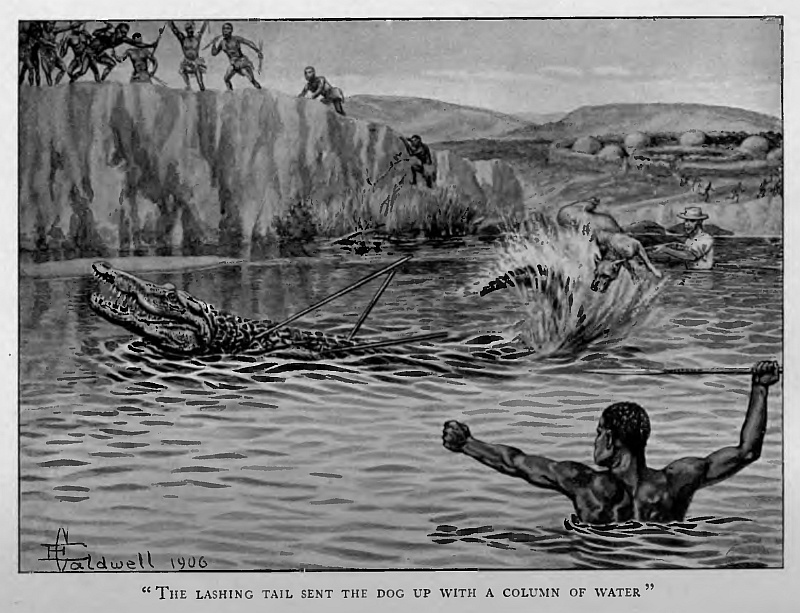
Had the crocodile risen in front of Jock that would have been the end—one snap would have done it; but it passed clear underneath, and, coming up just beyond him, the great lashing tail sent the dog up with the column of water a couple of feet in the air. He did as he had done when the koodoo bull tossed him: his head was round straining to get at the crocodile before he was able to turn his body in the water; and the silence was broken by a yell of wild delight and approval from the bank.
Before us the water was too deep and the stream too strong to stand in; Jim in his eagerness had gone in shoulder high, and my rifle when aimed only just cleared the water. The crocodile was the mark for more assegais from the bank as it charged up stream again, with Jock tailing behind, and it was then easy enough to follow its movements by the shafts that were never all submerged. The struggles became perceptibly weaker, and as it turned again to go with the stream every effort was concentrated on killing and landing it before it reached the rocks and rapids.
I moved back for higher ground and, finding that the bed shelved up rapidly down stream, made for a position where there would be enough elevation to put in a brain shot. The water was not more than waist high then, and as the crocodile came rolling and thrashing down I waited for his head to show up clearly. My right foot touched a sloping rock which rose almost to the surface of the water close above the rapids, and anxious to get the best possible position for a last shot, I took my stand there. The rock was the ordinary shelving bedrock, uptilted at an easy angle and cut off sheer on the exposed side, and the wave in the current would have shown this to any one not wholly occupied with other things; but I had eyes for nothing except the crocodile which was then less than a dozen yards off, and in my anxiety to secure a firm footing for the shot I moved the right foot again a few inches—over the edge of the rock. The result was as complete a spill as if one unthinkingly stepped backwards off a diving board: I disappeared in deep water, with the knowledge that the crocodile would join me there in a few seconds.
One never knows how these things are done or how long they take: I was back on the rock—without the rifle—and had the water out of my eyes in time to see the crocodile roll helplessly by, six feet away, with Jock behind making excited but ridiculously futile attempts to get hold of the tail; Jim—swimming, plunging and blowing like a maddened hippo—formed the tail of the procession, which was headed by my water-logged hat floating heavily a yard or so in front of the crocodile.
While a crowd of yelling niggers under the generalship of Jim were landing the crocodile, I had time to do some diving, and managed to fish out my rifle.
My Sunday change was wasted. But we got the old crocodile; and that was something, after all.
Chapter Twenty Three.
The Fighting Baboon.
On the way to Lydenburg, not many treks from Paradise Camp, we were outspanned for the day. Those were the settled parts; on the hills and in the valleys about us were the widely scattered workings of the gold diggers or the white tents of occasional prospectors.
The place was a well-known and much-frequented public outspan, and a fair-sized wayside store marked its importance. After breakfast we went to the store to ‘swap’ news with the men on the spot and a couple of horsemen who had offsaddled there.
There were several other houses of sorts; they were rough wattle and daub erections which were called houses, as an acknowledgment of pretensions expressed in the rectangular shape and corrugated iron roof. One of these belonged to Seedling, the Field Cornet and only official in the district. He was the petty local Justice who was supposed to administer minor laws, collect certain revenues and taxes, and issue passes. The salary was nominal, but the position bristled with opportunities for one who was not very particular; and the then occupant of the office seemed well enough pleased with the arrangement, whatever the public may have thought of it.
He was neither popular nor trusted: many tales of great harshness and injustice to the natives, and of corruption and favouritism in dealing with the whites, added to habitual drunkenness and uncertain temper, made a formidable tally in the account against him; he was also a bully and a coward, and all knew it; but unfortunately he was the law—as it stood for us!
Seedling, although an official of the Boer Government, was an Englishman; there were several of them on the goldfields in those days, and for the most part, they were good fellows and good officials—this one was an exception. We all knew him personally: he was effusively friendly; and we suffered him and—paid for the drinks. That was in his public capacity: in his private capacity he was the owner of the fighting baboon of evil and cruel repute.
If ever fate’s instruments moved unconscious of their mission and the part they were to play, it is certain that Jock and Jim Makokel’ did so that day—the day that was the beginning of Seedling’s fall and end.
It is not very clear how the trouble began. We had been sitting on the little store-counter and talking for over an hour, a group of half a dozen, swapping off the news of the goldfields and the big world against that from Delagoa and the Bushveld; Seedling had joined us early and, as usual, began the morning with drinks. We were not used to that on the road or out hunting; indeed, we rarely took any drink, and most of us never touched a drop except in the towns. The transport-rider had opportunities which might easily become temptations—the load often consisting of liquor, easy to broach and only to be paid for at the end of the trip; but we had always before us the lesson of the failures. Apart from this, however, we did not take liquor, because we could not work as well or last as long, run as fast or shoot as straight, if we did. And that was reason enough!
We had one round of drinks which was ‘called’ by one of the horsemen, and then, to return the compliment, another round called by one of us. A few minutes later Seedling announced effusively that it was his ‘shout.’ But it was only ten in the morning, and those who had taken spirits had had enough, indeed, several had only taken a sip of the second round in order to comply with a stupid and vicious custom; I would not and could not attack another bottle of sour gingerbeer; and thus Seedling’s round was reduced to himself and the proprietor. No man however thirsty would drink alone in those days—it was taken a mark of meanness or evidence of ‘soaking’—and the proprietor had to be ready at any time to ‘take one for the good of the house.’
A quarter of an hour passed, and Seedling, who had said nothing since his ‘shout’ was declined, turned away and strolled out, with hands thrust deep in the pockets of his riding breeches and a long heavy sjambok dangling from one wrist. There was silence as he moved through the doorway, and when the square patch of sunlight on the earth floor was again unbroken the man behind the counter remarked,—
“Too long between drinks for him! Gone for a pull at the private bottle.”
“Is that how it’s going?”
“Yah! all day long. Drinks here as long as any one’ll call, but don’t do much shoutin’ on his own, I tell you! That’s the first time I seen him call for a week. He wanted to get you chaps on the go, I reckon. He’ll be wrong all day to-day. I know him!”
“Cost him two bob for nothing, eh!”
“Well, it ain’t so much that; ye see, he reckoned you’d all shout your turns, and drinks’d come regular; but he sees you’re not on. Twig? I’m not complainin’ mind you—Lord no! He don’t pay any way! It’s all ‘chalked up’ for him, an’ I got to wipe it off the slate when the next loads comes and he collects my customs’ duties. His liquor’s took him wrong to-day—you’ll see!”
We did see; and that before very long. We had forgotten Seedling, and were hearing all about the new finds reported from Barberton district, when one of the waggon-boys came running into the store calling to me by my kaffir name and shouting excitedly, “Baas, Baas! come quickly! The baboon has got Jock: it will kill him!”
I had known all about the vicious brute, and had often heard of Seedling’s fiendish delight in arranging fights or enticing dogs up to attack it for the pleasure of seeing the beast kill the over-matched dogs. The dog had no chance at all, for the baboon remained out of reach in his house on the pole as long as it chose, if the dog was too big or the opening not a good one, and made its rush when it would tell best. But apart from this the baboon was an exceptionally big and powerful one, and it is very doubtful if any dog could have tackled it successfully in an open fight. The creature was as clever as even they can be; its enormous jaws and teeth were quite equal to the biggest dog’s, and it had the advantage of four ‘hands.’ Its tactics in a fight were quite simple and most effective; with its front feet it caught the dog by the ears or neck, holding the head so that there was no risk of being bitten, and then gripping the body lower down with the hind feet, it tore lumps out of the throat, breast, and stomach—pushing with all four feet and tearing with the terrible teeth. The poor dogs were hopelessly out-matched.
I did not see the beginning of Jock’s encounter, but the boys’ stories pieced together told everything. It appears that when Seedling left the store he went in to his own hut and remained there some little time; on coming out again he strolled over to the baboon’s pole about half-way between the two houses and began teasing it, throwing pebbles at it to see it dodge and duck behind the pole, and then flicking at it with the sjambok, amused by its frightened and angry protests. While he was doing this, Jock, who had followed me to the store, strolled out again making his way towards the waggons. He was not interested in our talk; he had twice been accidentally trodden on by men stepping back as he lay stretched out on the floor behind them; and doubtless he felt that it was no place for him: his deafness prevented him from hearing movements, except such as caused vibration in the ground, and, poor old fellow, he was always at a disadvantage in houses and towns.
The baboon had then taken refuge in its box on top of the pole to escape the sjambok, and when Seedling saw Jock come out he commenced whistling and calling softly to him. Jock, of course, heard nothing: he may have responded mildly to the friendly overtures conveyed by the extended hand and patting of legs, or more probably simply took the nearest way to the waggon where he might sleep in peace, since there was nothing else to do. What the boys agree on is that as Jock passed the pole Seedling patted and held him, at the same time calling the baboon, and then gave the dog a push which did not quite roll him over but upset his balance; and Jock, recovering himself, naturally jumped round and faced Seedling, standing almost directly between him and the baboon. He could not hear the rattle of the chain on the box and pole, and saw nothing of the charging brute, and it was the purest accident that the dog stood a few inches out of reach. The baboon—chained by the neck instead of the waist, because it used to bite through all loin straps—made its rush, but the chain brought it up before its hands could reach Jock and threw the hind quarters round with such force against him that he was sent rolling yards away.
I can well believe that this second attack from a different and wholly unexpected quarter thoroughly roused him, and can picture how he turned to face it.
It was at this moment that Jim first noticed what was going on. The other boys had not expected anything when Seedling called the dog, and they were taken completely by surprise by what followed. Jim would have known what to expect: his kraal was in the neighbourhood; he knew Seedling well, and had already suffered in fines and confiscations at his hands; he also knew about the baboon; but he was ignorant, just as I was, of the fact that Seedling had left his old place across the river and come to live in the new hut, bringing his pet with him.
It was the hoarse threatening shout of the baboon as it jumped at Jock, as much as the exclamations of the boys, that roused Jim. He knew instantly what was on, and grabbing a stick made a dash to save the dog, with the other boys following him.
When Jock was sent spinning in the dust the baboon recovered itself first, and standing up on its hind legs reached out its long ungainly arms towards him, and let out a shout of defiance. Jock regaining his feet dashed in, jumped aside, feinted again and again, as he had learnt to do when big horns swished at him; and he kept out of reach just as he had done ever since the duiker taught him the use of its hoofs. He knew what to do, just as he had known how to swing the porcupine: the dog—for all the fighting fury that possessed him—took the measure of the chain and kept outside it. Round and round he flew, darting in, jumping back, snapping and dodging, but never getting right home. The baboon was as clever as he was: at times it jumped several feet in the air, straight up, in the hope that Jock would run underneath; at others, it would make a sudden lunge with the long arms, or a more surprising reach out with the hind legs to grab him. Then the baboon began gradually to reduce its circle, leaving behind it slack chain enough for a spring; but Jock was not to be drawn. In cleverness they were well-matched—neither scored in attack; neither made or lost a point.
When Jim rushed up to save Jock, it was with eager anxious shouts of the dog’s name that warned Seedling and made him turn; and as the boy ran forward the white man stepped out to stop him.
“Leave the dog alone!” he shouted, pale with anger.
“Baas, Baas, the dog will be killed,” Jim called excitedly, as he tried to get round; but the white man made a jump towards him, and with a backhand slash of the sjambok struck him across the face, shouting at him again:
“Leave him, I tell you.”
Jim jumped back, thrusting out his stick to guard another vicious cut; and so it went on with alternate slash and guard, and the big Zulu danced round with nimble bounds, guarding, dodging, or bearing the sjambok cuts, to save the dog. Seedling was mad with rage; for who had ever heard of a nigger standing up to a Field Cornet? Still Jim would not give way; he kept trying to get in front of Jock, to head him off the fight, and all the while shouting to the other boys to call me. But Seedling was the Field Cornet, and not one of them dared to move against him.
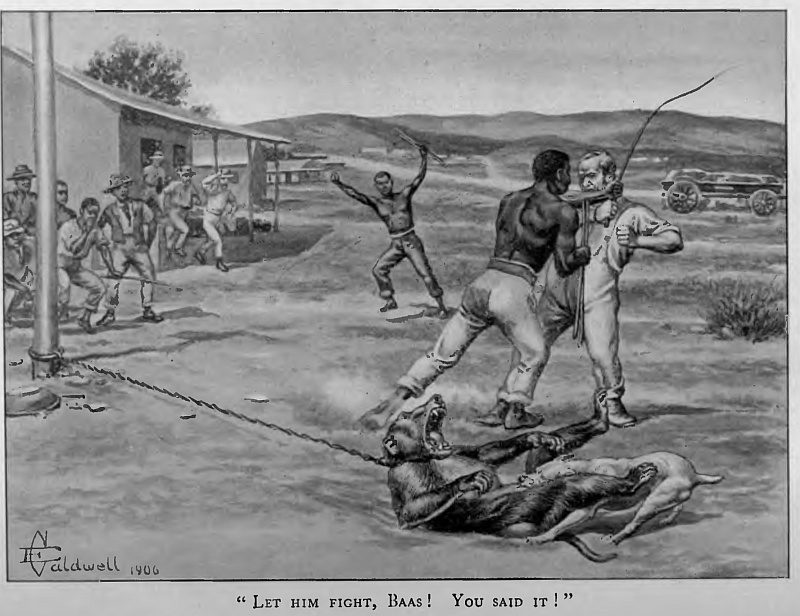
At last the baboon, finding that Jock would not come on, tried other tactics; it made a sudden retreat and, rushing for the pole, hid behind it as for protection. Jock made a jump and the baboon leaped out to meet him, but the dog stopped at the chain’s limit, and the baboon—just as in the first dash of all—overshot the mark; it was brought up by the jerk of the collar, and for one second sprawled on its back. That was the first chance for Jock, and he took it. With one spring he was in; his head shot between the baboon’s hind legs, and with his teeth buried in the soft stomach he lay back and pulled—pulled for dear life, as he had pulled and dragged on the legs of wounded game; tugged as he had tugged at the porcupine; held on, as he had held when the koodoo bull wrenched and strained every bone and muscle in his body.
Then came the sudden turn! As Jock fastened on to the baboon, dragging the chain taut while the screaming brute struggled on its back, Seedling stood for a second irresolute, and then with a stride forward raised his sjambok to strike the dog. That was too much for Jim; he made a spring in and grasping the raised sjambok with his left hand held Seedling powerless, while in his right the boy raised his stick on guard.
“Let him fight, Baas! You said it! Let the dog fight!” he panted, hoarse with excitement.
The white man, livid with fury, struggled and kicked, but the wrist loop of his sjambok held him prisoner and he could do nothing.
That was the moment when a panic-stricken boy plucked up courage enough to call me; and that was the scene we saw as we ran out of the little shop. Jim would not strike the white man: but his face was a muddy grey, and it was written there that he would rather die than give up the dog.
Before I reached them it was clear to us all what had happened; Jim was protesting to Seedling and at the same time calling to me; it was a jumble, but a jumble eloquent enough for us, and all intelligible. Jim’s excited gabble was addressed with reckless incoherence to Seedling, to me, and to Jock!
“You threw him in; you tried to kill him. He did it. It was not the dog. Kill him, Jock, kill him. Leave him, let him fight. You said it—Let him fight! Kill him, Jock! Kill! Kill! Kill!”
Then Seedling did the worst thing possible; he turned on me with,—
“Call off your dog, I tell you, or I’ll shoot him and your nigger too!”
“We’ll see about that! They can fight it out now,” and I took the sjambok from Jim’s hand and cut it from the white man’s wrist. “Now! Stand back!” And he stood back.
The baboon was quite helpless. Powerful as the brute was, and formidable as were the arms and gripping feet, it had no chance while Jock could keep his feet and had strength to drag and hold the chain tight. The collar was choking it, and the grip on the stomach—the baboon’s own favourite and most successful device—was fatal.
I set my teeth, and thought of the poor helpless dogs that had been decoyed in and treated the same way. Jim danced about, the white seam of froth on his lips, hoarse gusts of encouragement bursting from him as he leant over Jock, and his whole body vibrating like an over-heated boiler. And Jock hung on in grim earnest, the silence on his side broken only by grunting efforts as the deadly tug—tug—tug went on. Each pull caused his feet to slip a little on the smooth worn ground; but each time he set them back again, and the grunting tugs went on.
It was not justice to call Jock off; but I did it. The cruel brute deserved killing, but the human look and cries and behaviour of the baboon were too sickening; and Seedling went into his hut without even a look at his stricken champion.
Jock stood off, with his mouth open from ear to ear and his red tongue dangling, blood-stained and panting, but with eager feet ever on the move shifting from spot to spot, ears going back and forward, and eyes—now on the baboon and now on me—pleading for the sign to go in again.
Before evening the baboon was dead.
The day’s excitement was too much for Jim. After singing and dancing himself into a frenzy round Jock, after shouting the whole story of the fight in violent and incessant gabble over and over again to those who had witnessed it, after making every ear ring and every head swim with his mad din, he grabbed his sticks once more and made off for one of the kraals, there to find drink for which he thirsted body and soul.
In the afternoon the sudden scattering of the inhabitants of a small kraal on the hillside opposite, and some lusty shouting, drew attention that way. At distances of from two to five hundred yards from the huts there stood figures, singly or grouped in twos and threes, up to the highest slopes; they formed a sort of crescent above the kraal; and on the lower side of it, hiding under the bank of the river, were a dozen or more whose heads only were visible. They were all looking towards the kraal like a startled herd of buck. Now and then a burly figure would dart out from the huts with wild bounds and blood-curdling yells, and the watchers on that side would scatter like chaff and flee for dear life up the mountain side or duck instantly and disappear in the river. Then he would stalk back again and disappear, to repeat the performance on another side a little later on.
It was all painfully clear to me. Jim had broken out.
We were loaded for Lydenburg—another week’s trekking through and over the mountains—and as we intended coming back the same way a fortnight later I decided at once to leave Jim at his kraal, which was only a little further on, and pick him up on the return journey.
I nearly always paid him off in live stock or sheep: he had good wages, and for many months at a time would draw no money; the boy was a splendid worker and as true as steel; so that, in spite of all the awful worry I had a soft spot for Jim and had taken a good deal of trouble on his account. He got his pay at the end of the trip or the season, but not in cash. It was invested for him—greatly to his disgust at the time, I am bound to say—in live stock, so that he would not be able to squander it in drink or be robbed of it while incapable.
Jim’s gloomy dignity was colossal when it came to squaring up and I invited him to state what he wished me to buy for him. To be treated like an irresponsible child; to be chaffed and cheerfully warned by me; to be met by the giggles and squirts of laughter of the other boys, for whom he had the most profound contempt; to see the respectable Sam counting out with awkward eager hands and gleaming eyes the good red gold, while he, Makokela the Zulu, was treated like a piccanin—Ugh! It was horrible! Intolerable!
Jim would hold aloof in injured gloomy silence, not once looking at me, but standing sideways and staring stonily past me into the far distance, and not relaxing for a second the expression of profound displeasure on his weather-beaten face. No joke or chaff, no question or reason, would move him to even look my way. All he would do was, now and again, give a click of disgust, a quick shake of the head, and say: “Aug! Ang-a-funa!” (“I do not desire it!”)
We had the same fight over and over again, but I always won in the end. Once, when he would not make up his mind what to buy, I offered him instead of cash two of the worst oxen in his span at the highest possible valuation, and the effect was excellent; but the usual lever was to announce that if he could not make his choice and bargain for himself I would do it for him. In the end he invariably gave way and bargained with his kaffir friends for a deal, venting on them by his hard driving and brow-beating some of the accumulated indignation which ought to have gone elsewhere.
When it was all over Jim recovered rapidly, and at parting time there was the broadest of grins and a stentorian shout of “Hlala Kahle! Inkos!” and Jim went off with his springy walk, swinging his sticks and jabbering his thoughts aloud, evidently about me, for every now and again he would spring lightly into the air, twirl the stick, and shout a deep throated “Inkos!” full of the joy of living. A boy going home for his holiday!
This time Jim was too fully wound up to be dealt with as before, and I simply turned him off, telling him to come to the camp in a fortnight’s time.
I was a day behind the waggons returning, and riding up to the camp towards midday found Jim waiting for me. He looked ill and shrunken, wrapped in an old coat and squatting against the wall of the little hut. As I passed he rose slowly and gave his “Sakubona! Inkos!” with that curious controlled air by which the kaffir manages to suggest a kind of fatalist resignation or indifference touched with disgust. There was something wrong; so I rode past without stopping—one learns from them to find out how the land lies before doing anything.
It was a bad story, almost as bad as one would think possible where civilised beings are concerned. Jim’s own story lacked certain details of which he was necessarily ignorant, it also omitted the fact that had been drunk; but in the main it was quite true.
This is what happened, as gleaned from several sources: several days after our departure Jim went down to the store again and raised some liquor; he was not fighting, but he was noisy, and was the centre of a small knot of shouting, arguing boys near the store when Seedling returned after a two days’ absence. No doubt it was unfortunate that the very first thing he saw on his return was the boy who had defied him and who was the cause of his humiliation; and that that boy should by his behaviour give the slenderest excuse for interference was in the last degree unlucky. Seedling’s mind was made up from the moment he set eyes on Jim. Throwing the reins over his horse’s head he walked into the excited gabbling knot, all unconscious of his advent, and laid about him with the sjambok, scattering and silencing them instantly; he then took Jim by the wrist saying, “I want you”; he called to one of his own boys to bring a reim, and leading Jim over to the side of the store tied him up to the horse rail with arms at full stretch. Taking out his knife he cut the boy’s clothing down the back so that it fell away in two halves in front of him; then he took off his own coat and flogged the boy with his sjambok.
I would like to tell all that happened for one reason: it would explain the murderous man-hunting feeling that possessed us when we heard it! But it was too cruel: let it be! Only one thing to show the spirit: twice during the flogging Seedling stopped to go into the store for a drink.
Jim crawled home to find his kraal ransacked and deserted, and his wives and children driven off in panic. In addition to the flogging Seedling had, in accordance with his practice, imposed fines far beyond the boy’s means in cash, so as to provide an excuse for seizing what he wanted. The police boys had raided the kraal; and the cattle and goats—his only property—were gone.
He told it all in a dull monotone: for the time the life and fire were gone out of him; but he was not cowed, not broken. There was a curl of contempt on his mouth and in his tone that whipped the white skin on my own back and made it all a disgrace unbearable. That this should be the reward for his courageous defence of Jock seemed too awful. We went inside to talk it over and make our plans. The waggons should go on next day as if nothing had happened, Jim remaining in one of the half tents or elsewhere out of sight of passers-by. I was to ride into Lydenburg and lodge information—for in such a case the authorities would surely act. That was the best, or at any rate the first, course to be tried.