Sir Percy FitzPatrick (continued 6)
Reading edition
“They’re after the wounded buffalo!” he said. “Come on, man, before they get their dogs, or we’ll never see him again.”
Knowing then that the buffalo was a long way ahead, we scrambled on as fast as we could whilst holding to his track; but it was very hot and very rough and, to add to our troubles, smoke from a grass fire came driving into our faces.
“Niggers burning on the slopes; confound them!” Francis growled.
They habitually fire the grass in patches during the summer and autumn, as soon as it is dry enough to burn, in order to get young grass for the winter or the early spring, and although the smoke worried us there did not seem to be anything unusual about the fire. But ten minutes later we stopped again; the smoke was perceptibly thicker; birds were flying past us down wind, with numbers of locusts and other insects; two or three times we heard buck and other animals break back; and all were going the same way. Then the same thought struck us both—it was stamped in our faces: this was no ordinary mountain grass fire; it was the bush.
Francis was a quiet fellow, one of the sort it is well not to rouse. His grave is in the Bushveld where his unbeaten record among intrepid lion-hunters was made, and where he fell in the war, leaving another and greater record to his name. The blood rose slowly to his face, until it was bricky red, and he looked an ugly customer as he said:
“The black brutes have fired the valley to burn him out. Come on quick. We must get out of this on to the slopes!”
We did not know then that there were no slopes—only a precipitous face of rock with dense jungle to the foot of it; and after we had spent a quarter of an hour in that effort, we found our way blocked by the krans and a tangle of undergrowth much worse than that in the middle of the terrace. The noise made by the wind in the trees and our struggling through the grass and bush had prevented our hearing the fire at first, but now its ever growing roar drowned all sounds. Ordinarily, there would have been no real difficulty in avoiding a bush fire; but, pinned in between the river and the precipice and with miles of dense bush behind us, it was not at all pleasant.
Had we turned back even then and made for the poort it is possible we might have travelled faster than the fire, but it would have been rough work indeed; moreover, that would have been going back—and we did want to get the buffalo—so we decided to make one more try, towards the river this time. It was not much of a try, however, and we had gone no further than the middle of the terrace again when it became alarmingly clear that this fire meant business.
The wind increased greatly, as it always does once a bush fire gets a start; the air was thick with smoke, and full of flying things; in the bush and grass about us there was a constant scurrying; the terror of stampede was in the very atmosphere. A few words of consultation decided us, and we started to burn a patch for standing room and protection.
The hot sun and strong wind had long evaporated all the dew and moisture from the grass, but the sap was still up, and the fire—our fire—seemed cruelly long in catching on. With bunches of dry grass for brands we started burns in twenty places over a length of a hundred yards, and each little flame licked up, spread a little, and then hesitated or died out: it seemed as if ours would never take, while the other came on with roars and leaps, sweeping clouds of sparks and ash over us in the dense rolling mass of smoke.
At last a fierce rush of wind struck down on us, and in a few seconds each little flame became a living demon of destruction; another minute, and the stretch before us was a field of swaying flame. There was a sudden roar and crackle, as of musketry, and the whole mass seemed lifted into the air in one blazing sheet: it simply leaped into life and swept everything before it.
When we opened our scorched eyes the ground in front of us was all black, with only here and there odd lights and torches dotted about—like tapers on a pall; and on ahead, beyond the trellis work of bare scorched trees, the wall of flame swept on.
Then down on the wings of the wind came the other fire; and before it fled every living thing. Heaven only knows what passed us in those few minutes when a broken stream of terrified creatures dashed by, hardly swerving to avoid us. There is no coherent picture left of that scene—just a medley of impressions linked up by flashes of unforgettable vividness. A herd of koodoo came crashing by; I know there was a herd, but only the first and last will come to mind—the space between seems blurred. The clear impressions are of the koodoo bull in front, with nose out-thrust, eyes shut against the bush, and great horns laid back upon the withers, as he swept along opening the way for his herd; and then, as they vanished, the big ears, ewe neck, and tilting hind quarters of the last cow—between them nothing but a mass of moving grey!
The wildebeeste went by in Indian-file, uniform in shape, colour and horns; and strangely uniform in their mechanical action, lowered heads, and fiercely determined rush.
A rietbuck ram stopped close to us, looked back wide-eyed and anxious, and whistled shrilly, and then cantered on with head erect and white tail flapping; but its mate neither answered nor came by. A terrified hare with its ears laid flat scuttled past within a yard of Francis and did not seem to see him. Above us scared birds swept or fluttered down wind; while others again came up swirling and swinging about, darting boldly through the smoke to catch the insects driven before the fire.
But what comes back with the suggestion of infinitely pathetic helplessness is the picture of a beetle. We stood on the edge of our burn, waiting for the ground to cool, and at my feet a pair of tock-tockie beetles, hump backed and bandy-legged, came toiling slowly and earnestly along; they reached the edge of our burn, touched the warm ash, and turned patiently aside—to walk round it!
A school of chattering monkeys raced out on to the blackened flat, and screamed shrilly with terror as the hot earth and cinders burnt their feet.
Porcupine, ant-bear, meerkat! They are vague, so vague that nothing is left but the shadow of their passing; but there is one other thing—seen in a flash as brief as the others, for a second or two only, but never to be forgotten! Out of the yellow grass, high up in the waving tops, came sailing down on us the swaying head and glittering eyes of a black mamba—swiftest, most vicious, most deadly of snakes. Francis and I were not five yards apart and it passed between us, giving a quick chilly beady look at each—pitiless, and hateful—and one hiss as the slithering tongue shot out: that was all, and it sailed past with strange effortless movement. How much of the body was on the ground propelling it, I cannot even guess; but we had to look upwards to see the head as the snake passed between us.
The scorching breath of the fire drove us before it on to the baked ground, inches deep in ashes and glowing cinders, where we kept marking time to ease our blistering feet; our hats were pulled down to screen our necks as we stood with our backs to the coming flames; our flannel shirts were so hot that we kept shifting our shoulders for relief. Jock, who had no screen and whose feet had no protection, was in my arms; and we strove to shield ourselves from the furnace-blast with the branches we had used to beat out the fire round the big tree which was our main shelter.
The heat was awful! Live brands were flying past all the time, and some struck us; myriads of sparks fell round and on us, burning numberless small holes in our clothing, and dotting blisters on our backs; great sheets of flame leaped out from the driving glare, and, detached by many yards from their source, were visible for quite a space in front of us. Then, just at its maddest and fiercest there came a gasp and sob, and the fire devil died behind us as it reached the black bare ground. Our burn divided it as an island splits the flood, and it swept along our flanks in two great walls of living leaping roaring flame.
Two hundred yards away there was a bare yellow place in a world of inky black, and to that haven we ran. It was strange to look about and see the naked country all round us, where but a few minutes earlier the tall grass had shut us in; but the big bare ant-heap was untouched, and there we flung ourselves down, utterly done.
Faint from heat and exhaustion—scorched and blistered, face and arms, back and feet; weary and footsore, and with boots burnt through—we reached camp long after dark, glad to be alive.
We had forgotten the wounded buffalo; he seemed part of another life!
There was no more hunting for us: our feet had ‘gone in,’ and we were well content to sleep and rest. The burnt stubbly ends of the grass had pierced the baked leather of our boots many times; and Jock, too, had suffered badly and could hardly bear to set foot to the ground next day. The best we could hope for was to be sound enough to return to our own waggons in two or three days’ time.
The camp was under a very large wild fig tree, whose dense canopy gave us shade all through the day. We had burnt the grass for some twenty or thirty yards round as a protection against bush fires; and as the trees and scrub were not thick just there it was possible to see in various directions rather further than one usually can in the Bushveld. The big tree was a fair landmark by day, and at night we made a good fire, which owing to the position of the camp one could see from a considerable distance. These precautions were for the benefit of strayed or belated members of the party; but I mention them because the position of the camp and the fire brought us a strange visitor the last night of our stay there.
There were, I think, seven white men; and the moving spirit of the party—old Teddy Blacklow of Ballarat—was one of the old alluvial diggers, a warmhearted, impulsive, ever-young old boy, and a rare good sportsman. That was Teddy, the ‘man in muddy moleskins,’ who stretched out the hand of friendship when the Boy was down, and said “You come along o’ me!” one of ‘God’s sort.’
Teddy’s spirits were always up; his presence breathed a cheery optimism on the blankest day; his humour lighted everything; his stories kept us going; and his language was a joy for ever. In a community, in which such things savoured of eccentricity, Teddy was an abstainer and never swore; but if actual profanity was avoided, the dear old boy all unconsciously afforded strong support to those who hold that a man must find relief in vigorous expression. To do this, without violating his principles, he invented words and phrases, meaningless in themselves but in general outline, so to say, resembling the worst in vogue; and the effect produced by them upon the sensitive was simply horrifying. Teddy himself was blissfully unconscious of this, for his language, being scrupulously innocent, was deemed by him to be suited to all circumstances and to every company. The inevitable consequence was that the first impression produced by him on the few women he ever met was that of an abandoned old reprobate whose scant veil of disguise only made the outrage of his language more marked. Poor old Teddy! Kindest and gentlest and dearest of souls! How he would have stared at this, speechless with surprise; and how we used to laugh at what some one called his ‘glittering paro-fanities!’ Pity it is that they too must go; for one dare not reproduce the best of them.
It was between eight and nine o’clock on the last day of our stay; Francis and I were fit again, and Jock’s feet, thanks to care and washing and plenty of castor oil, no longer troubled him; we were examining our boots—re-soled now with raw hide in the rough but effective veld fashion; Teddy was holding forth about the day’s chase whilst he cut away the pith of a koodoo’s horns and scraped the skull; others were busy on their trophies too; and the kaffirs round their own fire were keeping up the simultaneous gabble characteristic of hunting boys after a good day and with plenty of meat in camp.
I was sitting on a small camp stool critically examining a boot and wondering if the dried hide would grip well enough to permit of the top lacings being removed, and Jock was lying in front of me, carefully licking the last sore spot on one fore paw, when I saw his head switch up suddenly and his whole body set hard in a study of intense listening. Then he got up and trotted briskly off some ten or fifteen yards, and stood—a bright spot picked out by the glare of the camp fire—with his back towards me and his uneven ears topping him off.
I walked out to him, and silence fell on the camp; all watched and listened. At first we heard nothing but soon the call of a wild dog explained Jock’s movements; the sound, however, did not come from the direction in which he was looking, but a good deal to the right; and as he instantly looked to this new quarter I concluded that this was not the dog he had previously heard, or else it must have moved rapidly. There was another wait, and then there followed calls from other quarters.
There was nothing unusual in the presence of wild dogs: hyenas, jackals, wild dogs and all the smaller beasts of prey were heard nightly; what attracted attention in this case was the regular calling from different points. The boys said the wild dogs were hunting something and calling to each other to indicate the direction of the hunt, so that those in front might turn the buck and by keeping it in a circle enable fresh or rested dogs to jump in from time to time and so, eventually, wear the poor hunted creature down. This, according to the natives, is the system of the wild pack. When they cannot find easy prey in the young, weak or wounded, and are forced by hunger to hunt hard, they first scatter widely over the chosen area where game is located, and then one buck is chosen—the easiest victim, a ewe with young for choice—and cutting it out from the herd, they follow that one and that alone with remorseless invincible persistency. They begin the hunt knowing that it will last for hours—knowing too that in speed they have no chance against the buck—and when the intended victim is cut out from the herd one or two of the dogs—so the natives say—take up the chase and with long easy gallop keep it going, giving no moment’s rest for breath; from time to time they give their weird peculiar call and others of the pack—posted afar—head the buck off to turn it back again; the fresh ones then take up the chase, and the first pair drop out to rest and wait, or follow slowly until their chance and turn come round again. There is something so hateful in the calculated pitiless method that one feels it a duty to kill the cruel brutes whenever a chance occurs.
The hunt went on round us; sometimes near enough to hear the dogs’ eager cries quite clearly; sometimes so far away that for a while nothing could be heard; and Jock moved from point to point in the outermost circle of the camp fire’s light nearest to the chase.
When at last hunters and hunted completed their wide circuit round the camp, and passed again the point where we had first heard them, the end seemed near; for there were no longer single calls widely separated, but the voices of the pack in hot close chase. They seemed to be passing half a mile away from us; but in the stillness of the night sound travels far, and one can only guess. Again a little while and the cries sounded nearer and as if coming from one quarter—not moving round us as before; and a few minutes more, and it was certain they were still nearer and coming straight towards us. We took our guns then, and I called Jock back to where we stood under the tree with our backs to the fire.
The growing sounds came on out of the night where all was hidden with the weird crescendo effect of a coming flood; we could pick them out then—the louder harsher cries; the crashing through bush; the rush in grass; the sobbing gasps in front; and the hungry panting after. The hunt came at us like a cyclone out of the stillness, and in the forefront of it there burst into the circle of light an impala ewe with open mouth and haunting hunted despairing eyes and wide spread ears; and the last staggering strides brought her in among us, tumbling at our feet.
A kaffir jumped out with assegai aloft; but Teddy, with the spring of a tiger and a yell of rage, swung his rifle round and down on assegai arm and head, and dropped the boy in his tracks.
“Go-sh!—Da-ll! Cr-r-r-i-miny! What the Hex are you up to?” and the fiery soft-hearted old boy was down on to his knees in a second, panting with anger and excitement, and threw his arms about the buck.
The foremost of the pack followed hot foot close behind the buck—oblivious of fire and men, seeing nothing but the quarry—and at a distance of five yards a mixed volley of bullets and assegais tumbled it over. Another followed, and again another: both fell where they had stopped, a dozen yards away, puzzled by the fire and the shooting; and still more and more came on, but, warned by the unexpected check in front, they stopped at the clearing’s edge, until over twenty pairs of eyes reflecting the fire’s light shone out at us in a rough semicircle. The shot guns came in better then; and more than half the pack went under that night before the others cleared off. Perhaps they did not realise that the shots and flashes were not part of the camp fire from which they seemed to come; perhaps their system of never relinquishing a chase had not been tried against the white man before.
One of the wild dogs, wounded by a shot, seemed to go mad with agony and raced straight into the clearing towards the fire, uttering the strangest maniac-like yaps. Jock had all along been straining to go for them from where I had jammed him between my feet as I sat and fired, and the charge of this dog was more than he could bear: he shot out like a rocket, and the collision sent the two flying apart; but he was on to the wild dog again and had it by the throat before it could recover. Instantly the row of lights went out, as if switched off—they were no longer looking at us; there was a rustle and a sound of padded feet, and dim grey-looking forms gathered at the edge of the clearing nearest where Jock and the wounded dog fought. I shouted to Jock to come back, and several of us ran out to help, just as another of the pack made a dash in. It seemed certain that Jock, gripping and worrying his enemy’s throat, had neither time nor thought for anything else; yet as the fresh dog came at him he let go his grip of the other, and jumped to meet the new-comer; in mid-spring Jock caught the other by the ear and the two spun completely round—their positions being reversed; then, with another wrench as he landed, he flung the attacker behind him and jumped back at the wounded one which had already turned to go.
It looked like the clean and easy movement of a finished gymnast. It was an affair of a few seconds only, for of course the instant we got a chance at the dogs, without the risk to Jock, both were shot; and he, struggling to get at the others, was haled back to the tree.
While this was going on the impala stood with wide spread legs, dazed and helpless, between Teddy’s feet, just as he had placed it. Its breath came in broken choking sobs; the look of terror and despair had not yet faded from the staring eyes; the head swayed from side to side; the mouth hung open and the tongue lolled out; all told beyond the power of words the tale of desperate struggle and exhaustion. It drank greedily from the dish that Teddy held for it—emptied it, and five minutes later drank it again and then lay down.
For half an hour it lay there, slowly recovering; sometimes for spells of a few minutes it appeared to breathe normally once more; then the heavy open-mouthed panting would return again; and all the time Teddy kept on stroking or patting it gently and talking to it as if he were comforting a child, and every now and then bursting out with sudden gusty execrations, in his own particular style, of wild dogs and kaffirs. At last it rose briskly, and standing between his knees looked about, taking no notice of Teddy’s hands laid on either side and gently patting it. No one moved or spoke. Jock, at my feet, appeared most interested of all, but I am afraid his views differed considerably from ours on that occasion, and he must have been greatly puzzled; he remained watching intently with his head laid on his paws, his ears cocked, and his brown eyes fixed unblinkingly; and at each movement on the buck’s part something stirred in him, drawing every muscle tense and ready for the spring—internal grips which were reflected in the twitching and stiffening of his neck and back; but each time as I laid a hand on him he slackened out again and subsided.
We sat like statues as the impala walked out from its stall between Teddy’s knees, and stood looking about wonderingly at the faces white and black, at the strange figures, and at the fire. It stepped out quite quietly, much as it might have moved about here and there any peaceful morning in its usual haunts; the head swung about briskly, but unalarmed; and ears and eyes were turned this way and that in easy confidence and mild curiosity.
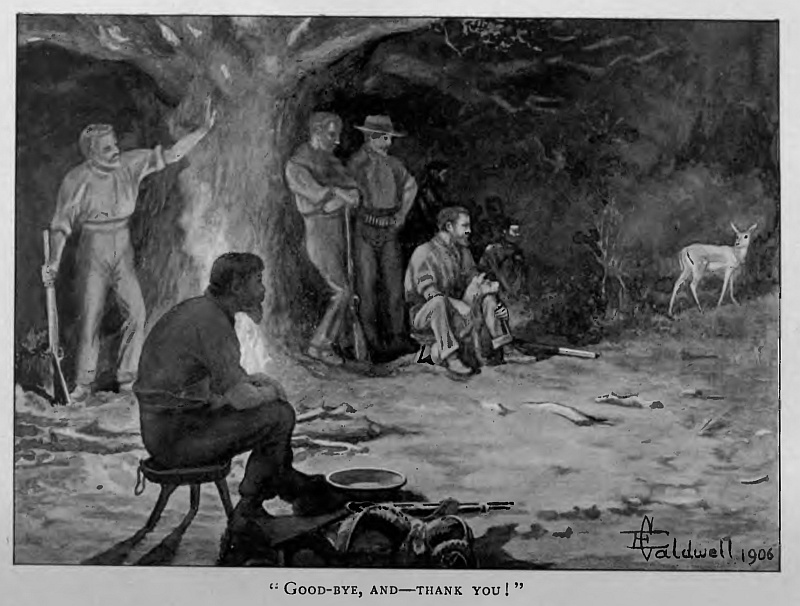
With a few more steps it threaded its way close to one sitting figure and round a bucket; stepped daintily over Teddy’s rifle; and passed the koodoo’s head unnoticed.
It seemed to us—even to us, and at the moment—like a scene in fairyland in which some spell held us while the beautiful wild thing strolled about unfrightened.
A few yards away it stopped for perhaps a couple of minutes; its back was towards us and the fire; the silence was absolute; and it stood thus with eyes and ears for the bush alone. There was a warning whisk of the white tail and it started off again—this time at a brisk trot—and we thought it had gone; but at the edge of the clearing it once more stood and listened. Now and again the ears flickered and the head turned slightly one way or another, but no sound came from the bush; the out-thrust nose was raised with gentle tosses, but no taint reached it on the gentle breeze.
All was well!
It looked slowly round, giving one long full gaze back at us which seemed to be “Good-bye, and—thank you!” and cantered out into the dark.
Chapter Eighteen.
Snowball and Tsetse.
Snowball was an ‘old soldier’—I say it with all respect! He had been through the wars; that is to say, he had seen the ups and downs of life and had learnt the equine equivalent of “God helps those who help themselves.” For Snowball was a horse.
Tsetse was also an old soldier, but he was what you might call a gentleman old soldier, with a sense of duty; and in his case the discipline and honour of his calling were not garments for occasion but part of himself. Snowball was no gentleman: he was selfish and unscrupulous, a confirmed shirker, often absent without leave, and upon occasions a rank deserter—for which last he once narrowly escaped being shot.
Tsetse belonged to my friend Hall; but Snowball was mine! What I know about him was learnt with mortification of the spirit and flesh; and what he could not teach in that way was ‘over the head’ of the most indurated old dodger that ever lived.
Tsetse had his peculiarities and prejudices: like many old soldiers he was a stickler for etiquette and did not like departures from habit and routine; for instance, he would not under any circumstances permit mounting on the wrong side—a most preposterous stand for an old salted shooting horse to take, and the cause of much inconvenience at times. On the mountains it often happened that the path was too narrow and the slope too steep to permit one to mount on the left side, whereas the sharp rise of the ground made it very easy on the right. But Tsetse made no allowance for this, and if the attempt were made he would stand quite still until the rider was off the ground but not yet in the saddle, and then buck continuously until the offender shot overhead and went skidding down the slope. To one encumbered with a rifle in hand, and a kettle or perhaps a couple of legs of buck slung on the saddle, Tsetse’s protest was usually irresistible.
Snowball had no unpractical prejudices: he objected to work—that was all. He was a pure white horse, goodness knows how old, with enormously long teeth; every vestige of grey or other tinge had faded out of him, and his eyes had an aged and resigned look: one warmed to him at sight as a “dear old pet of a Dobbin!” who ought to be passing his last years grazing contentedly in a meadow and giving bareback rides to little children. The reproach of his venerable look nearly put me off taking him—it seemed such a shame to make the dear old fellow work; but I hardened my heart and, feeling rather a brute, bought him because he was ‘salted’ and would live in the Bushveld: beside that, all other considerations were trivial. Of course he was said to be a shooting horse, and he certainly took no notice of a gun fired under his nose or from his back—which was all the test I could apply at the time; and then his legs were quite sound; his feet were excellent; he had lost no teeth yet; and he was in tip top condition. What more could one want?
“He looks rather a fool of a horse!” I had remarked dubiously to Joey the Smith, who was ‘willin’ to let him go,’ and I can recall now the peculiar glint in Joey’s eye and the way he sort of steadied himself with a little cough before he answered feelingly:
“He’s no fool, sonny! You won’t want to get a cleverer horse as long as you live!” And no more I did—as we used to say! Snowball had one disfigurement, consisting of a large black swelling as big as a small orange behind his left eye, which must have annoyed him greatly; it could easily have been removed, and many suggestions were made on the subject but all of them were firmly declined. Without that lump I should have had no chance against him: it was the weak spot in his defence: it was the only cover under which it was possible to stalk him when he made one of his determined attempts to dodge or desert; for he could see nothing that came up behind him on the left side without turning his head completely round; hence one part of the country was always hidden from him, and of course it was from this quarter that we invariably made our approaches to attack.
So well did Snowball realise this that when the old villain intended giving trouble he would start off with his head swung away to the right, and when far enough away to graze in security—a hundred yards or so was enough—would turn right about and face towards the waggons or camp, or wherever the danger-quarter was; then, keeping us well in view, he would either graze off sideways, or from time to time walk briskly off to occupy a new place, with the right eye swung round on us like a search-light.
Against all this, however, it is only fair to admit that there were times when for days, and even weeks, at a stretch he would behave admirably, giving no more trouble than Jock did. Moreover he had qualities which were not to be despised. He was as sound as a bell, very clever on his feet, never lost his condition, and, although not fast, could last for ever at his own pace.
Experience taught me to take no chances with Snowball. After a hard day he was apt to think that ‘enough was as good as a feast,’ and then trouble might be expected. But there was really no safe rule with him; he seemed to have moods—to ‘get out of bed on the wrong side’—on certain days and, for no reason in the world, behave with a calculated hostility that was simply maddening.
Hunting horses live almost entirely by grazing, as it is seldom possible to carry any grain or other foods for them and never possible to carry enough; and salted horses have therefore a particular value in that they can be turned out to graze at night or in the morning and evening dews when animals not immunised will contract horse-sickness; thus they feed during the hours when hunting is not possible and keep their condition when an unsalted horse would fall away from sheer want of food.
According to their training, disposition, and knowledge of good and evil, horses are differently treated when ‘offsaddled’; some may be trusted without even a halter, and can be caught and saddled when and where required; others are knee-haltered; others are hobbled by a strap coupling either both fore feet, or one fore and one hind foot, with enough slack to allow walking, but not enough for the greater reach of a trot or gallop; whilst some incorrigibles are both knee-haltered and hobbled; and in this gallery Snowball figured upon occasion—a mournful and injured innocent, if appearances went for anything!
It was not, as a rule, at the outspan, where many hands were available, that Snowball gave trouble, but out hunting when I was alone or with only one companion. A trained shooting horse should stop as soon as his rider lays hand on mane to dismount, and should remain where he is left for any length of time until his master returns; some horses require the reins to be dropped over their heads to remind them of their duty but many can safely be left to themselves and will be found grazing quietly where left.
Snowball knew well what to do, but he pleased himself about doing it; sometimes he would stand; sometimes move off a little way, and keep moving—just out of reach—holding his head well on one side so that he should not tread on the trailing reins or the long weighted reimpje which was attached to his bit for the purpose of hindering and catching him; sometimes, with a troop of buck moving on ahead or perhaps a wounded one to follow, this old sinner would rightabout-face and simply walk off—only a few yards separating us—with his ears laid back, his tail tucked down ominously, and occasional little liftings of his hind quarters to let me know what to expect—and his right eye on me all the while; and, if I ran to head him off, he would break into a trot and leave me a little worse off than before; and sometimes, in familiar country, he would make straight away for the waggons without more ado.
It is demoralising in the extreme to be expecting a jerk when in the act of aiming—and Snowball, who cared no more for shooting than a deaf gunner, would plunge like a two-year-old when he was play-acting—and it is little better, while creeping forward for a shot, to hear your horse strolling off behind and realise that you will have to hunt for him and perhaps walk many miles back to camp without means of carrying anything you may shoot. The result of experience was that I had to choose between two alternatives: either to hook him up to a tree or bush each time or hobble him with his reins, and so lose many good chances of quick shots when coming unexpectedly on game; or to slip an arm through the reins and take chance of being plucked off my aim or jerked violently backwards as I fired. But it was at the ‘offsaddles’ on long journeys across country or during the rest in a day’s hunt that trouble was most to be feared, and although hobbling is dangerous in a country so full of holes, stumps, and all sorts of grass-hidden obstacles, there were times when consideration for Snowball seemed mighty like pure foolishness, and it would have been no grief to me if he had broken his neck!
To the credit of Snowball stand certain things, however, and it is but justice to say that, when once in the ranks, he played his part well; and it is due to him to say that during one hard season a camp of waggons with their complement of men had to be kept in meat, and it was Snowball who carried—for short and long distances, through dry rough country, at all times of day and night, hot, thirsty and tired, and without a breakdown or a day’s sickness—a bag that totalled many thousands of pounds in weight, and the man who made the bag.
“That wall-eyed brute of yours” was launched at me in bitterness of spirit on many occasions when Snowball led the normally well-behaved ones astray; and it is curious to note how strength of character or clear purpose will establish leadership among animals, as among men. Rooiland the restless, when dissatisfied with the grass or in want of water, would cast about up wind for a few minutes and then with his hot eyeballs staring and nostrils well distended choose his line, going resolutely along and only pausing from time to time to give a low moan for signal and allow the straggling string of unquestioning followers to catch up. When Rooiland had ‘trek fever’ there was no rest for herd boys. So too with old Snowball: he led the well-behaved astray and they followed him blindly. Had Snowball been a schoolboy, a wise headmaster would have expelled him—for the general good and discipline of the school.
On one long horseback journey through Swaziland to the coast, where few white men and no horses had yet been seen, we learned to know Snowball and Tsetse well, and found out what a horse can do when put to it. It was a curious experience on that trip to see whole villages flee in terror at the first sight of the new strange animals—one brown and one white: in some places not even the grown men would approach, but too proud to show fear, they stood their ground, their bronze faces blanching visibly and setting hard as we rode up; the women fled with half-stifled cries of alarm; and once, when we came unexpectedly upon a party of naked urchins playing on the banks of a stream, the whole pack set off full cry for the water and, jumping in like a school of alarmed frogs, disappeared. Infinitely amused by the stampede we rode up to see what had become of them, but the silence was absolute, and for a while they seemed to have vanished altogether; then a tell-tale ripple gave the clue, and under the banks among the ferns and exposed roots we picked out little black faces half submerged and pairs of frightened eyes staring at us from all sides. They were not to be reassured, either: the only effect produced by our laughing comments and friendly overtures being that the head which deemed itself pointedly addressed would disappear completely and remain so long out of sight as to make us feel quite smothery and criminally responsible.
It is in the rivers that a man feels the importance of a good horse with a stout heart, and his dependence on it. There were no roads, and not even known tracks, there; and when we reached the Black Umbelusi we picked a place where there was little current and apparently an easy way out on the opposite side. It was much deeper than it looked; however, we were prepared, and thirty yards of swimming did not trouble us; yet it certainly was a surprise to us when the horses swam right up to the other bank without finding bottom and, turning aside, began to swim up stream. Looking down into the clear depths we saw that there was a sheer wall of rock to within a few inches of the surface. Now, a horse with a man on his back swims low—only the head and half the neck showing above water—and by what instinct or means the horses realised the position I do not know, but, with little hesitation and apparently of one accord, they got back a yard or two from the ledge and, raising first one fore foot and then the other, literally climbed out—exactly as a man or a dog does out of a swimming bath—hoisting their riders out with them without apparent difficulty. That was something which we had not thought possible, and to satisfy ourselves we dismounted and tried the depth; but the ten foot reeds failed to reach bottom.
When it came to crossing the Crocodile River we chose the widest spot in the hope that it would be shallow and free of rocks. We fired some shots into the river to scare the crocodiles, and started to cross; but to our surprise Tsetse, the strong-nerved and reliable, who always had the post of honour in front, absolutely refused to enter.
The water of the Crocodile is at its best of amber clearness and we could not see bottom, but the sloping grassy bank promised well enough and no hint reached us of what the horses knew quite well. All we had was on our horses—food, blankets, billy, rifles and ammunition. We were off on a long trip and, to vary or supplement the game diet, carried a small packet of tea, a little sugar, flour, and salt, and some beads with which to trade for native fowls and thick milk; the guns had to do the rest. Thus there were certain things we could not afford to wet, and these we used to wrap up in a mackintosh and carry high when it came to swimming, but this crossing looked so easy that it seemed sufficient to raise the packs instead of carrying part of them.
Tsetse, who in the ordinary way regarded the spur as part of the accepted discipline, promptly resented it when there seemed to him to be sufficient reason; and when Hall, astonished at Tsetse’s unexpected obstinacy, gave him both heels, the old horse considerately swung round away from the river, and with a couple of neatly executed bucks shot his encumbered rider off the raised pack, yards away on to the soft grass—water-bottle, rifle, bandolier and man landing in a lovely tangle.
I then put old Snowball at it, fully expecting trouble; but the old soldier was quite at home; he walked quietly to the edge, sat down comfortably, and slid into the water—launching himself with scarce a ripple just like an old hippo. That gave us the explanation of Tsetse’s tantrum: the water came up to the seat of my saddle and walking was only just possible. I stopped at once, waiting for Tsetse to follow; and Hall, prepared for another refusal, sat back and again used his spurs. No doubt Tsetse, once he knew the depth, was quite satisfied and meant to go in quietly, and the prick of the spur must have been unexpected, for he gave a plunge forward, landing with his fore feet in deep water and hind quarters still on the bank, and Hall shot out overhead, landing half across old Snowball’s back. There was a moment of ludicrous but agonised suspense! Hall’s legs were firmly gripping Tsetse behind the ears while he sprawled on his stomach on Snowball’s crupper, with the reins still in one hand and the rifle in the other. Doubled up with suppressed laughter I grabbed a fist full of shirt and held on, every moment expecting Tsetse to hoist his head or pull back and complete the disaster, while Hall was spluttering out directions, entreaties and imprecations; but good old Tsetse never moved, and Hall handing me the rifle managed to swarm backwards on to Tsetse’s withers and scramble on to the pack again.
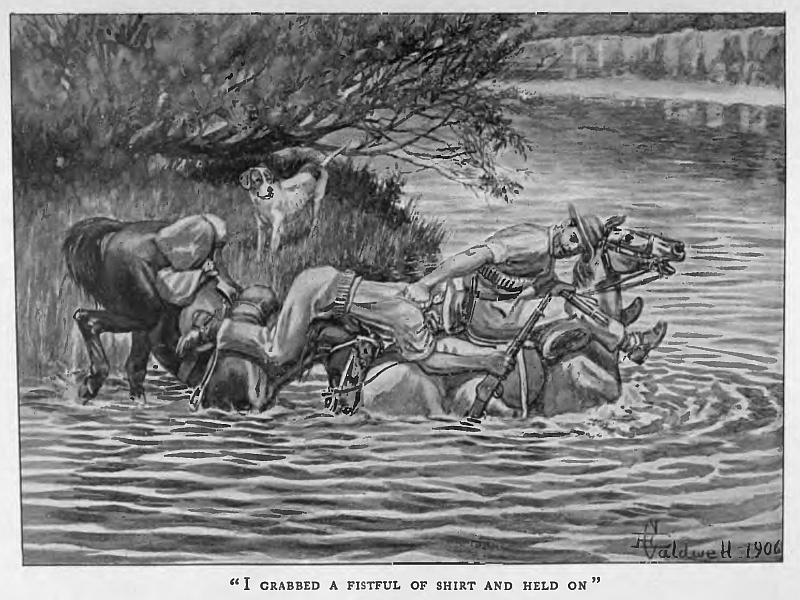
Then, saddle-deep in the river—duckings and crocodiles forgotten—we sat looking at each other and laughed till we ached.
The river was about three hundred yards wide there with a good sandy bottom and of uniform depth, but, to our disappointment, we found that the other bank which had appeared to slope gently to the water edge was in fact a sheer wall standing up several feet above the river level. The beautiful slope which we had seen consisted of water grass and reed tops; the bank itself was of firm moist clay; and the river bottom close under it was soft mud. We tried a little way up and down, but found deeper water, more mud and reeds, and no break in the bank; there was not even a lagavaan slide, a game path, or a drinking-place. There seemed to be nothing for it but to go back again and try somewhere else.
Hall was ‘bad to beat’ when he started on anything—he did not know how to give in; but when he looked at the bank and said, “We’ll have a shot at this,” I thought at first he was joking. Later, to my remark that “no horse ever born would face that,” he answered that “any way we could try: it would be just as good as hunting for more places of the same sort!”
I do not know the height of the bank, as we were not thinking of records at that time, but there are certain facts which enable one to guess fairly closely.
Tsetse was ranged up beside the bank, and Hall standing in the saddle threw his rifle and bandolier up and scrambled out himself. I then loosened Tsetse’s girths from my seat on Snowball, and handed up the packed saddle—Hall lying down on the bank to take it from me; and we did the same with Snowball’s load, including my own clothes, for, as it was already sundown, a ducking was not desirable, I loosened one side of Tsetse’s reins, and after attaching one of mine in order to give the necessary length to them threw the end up to Hall, and he cut and handed me a long supple rod for a whip to stir Tsetse to his best endeavours. The water there was rather more than half saddle-flap high; I know that because it just left me a good expanse of hind quarters to aim at when the moment came.
“Now!” yelled Hall, “Up, Tsetse! Up!”; and whack went the stick! Tsetse reared up, right on end; he could not reach the top but struck his fore feet into the moist bank near the top, and with a mighty plunge that soused Snowball and me, went out. The tug on the leading rein, on which Hall had thrown all his weight when Tsetse used it to lever himself up, had jerked Hall flat on his face; but he was up in a minute, and releasing Tsetse threw back the rein to get Snowball to face it while the example was fresh.
Then for the first time we thought of the crocodiles—and the river was full of them! But Snowball without some one behind him with a stick would never face that jump, and there was nothing for it but to fire some scaring shots, and slip into the water and get the job over as quickly as possible.
Snarleyow was with us—I had left Jock at the waggons fearing that we would get into fly country on the Umbelusi—and the bank was too high and too steep for him; he huddled up against it half supported by reeds, and whined plaintively.
To our relief Snowball faced the jump quite readily; indeed, the old sinner did it with much less effort and splash than the bigger Tsetse. But then came an extremely unpleasant spell. Snowball got a scare, because Hall in his anxiety to get me out rushed up to him on the warty side to get the reins off; and the old ruffian waltzed around, dragging Hall through the thorns, while Snarleyow and I waited in the water for help.
At that moment I had a poorer opinion of Snowball and Snarley than at any other I can remember. I wished Snarley dead twenty times in twenty seconds. Crocodiles love dogs; and it seemed to me a million to one that a pair of green eyes and a black snout must slide out of the water any moment, drawn to us by those advertising whines! And the worst of it was, I was outside Snarley with my white legs gleaming in the open water, while his cringing form was tucked away half hidden by the reeds. What an age it seemed! How each reed shaken by the river breeze caught the eye, giving me goose-flesh and sending waves of cold shudders creeping over me! How the cold smooth touch of a reed stem against my leg made me want to jump and to get out with one huge plunge as the horses had done! And even when I had passed the struggling yowling Snarley up, the few remaining seconds seemed painfully long. Hall had to lie flat and reach his furthest to grip my hand; and I nearly pulled him in, scrambling up that bank like a chased cat up a tree.
When one comes to think it out, the bank must have been nine feet high. It was mighty unpleasant; but it taught us what a horse can do when he puts, his back into it!
Chapter Nineteen.
Jock’s Mistake.
Half-way between the Crocodile and Komati Rivers, a few miles south of the old road, there are half a dozen or more small kopjes between which lie broad richly grassed depressions, too wide and flat to be; called valleys. The fall of the country is slight, yet the rich loamy soil has been washed out in places into dongas of considerable depth. There is no running water there in winter, but there are a few big pools—long narrow irregularly shaped bits of water—with shady trees around them. I came upon the place by accident one day, and thereafter we kept it dark as our own preserve; for it was full of game, and a most delightful spot. It was there that Snarleyow twice cleaned out the hunter’s pot.
Apart from the discovery of this preserve, the day was memorable for the reason that it was my first experience of a big mixed herd; and I learned that day how difficult the work may be when several kinds of game run together. After a dry and warm morning the sight of the big pool had prompted an off-saddle; Snowball was tethered in a patch of good grass, and Jock and I were lying in the shade.
When he began to sniff and walk up wind I took the rifle and followed, and only a little way off we came into dry vlei ground where there were few trees and the grass stood about waist high. Some two hundred yards away where the ground rose slightly and the bush became thicker there was a fair-sized troop of impala, perhaps a hundred or more, and just behind, and mostly to one side of them, were between twenty and thirty tsessebe. We saw them clearly and in time to avoid exposing ourselves: they were neither feeding nor resting, but simply standing about, and individual animals were moving unconcernedly from time to time with an air of idle loitering. I tried to pick out a good tsessebe ram, but the impala were in the way, and it was necessary to crawl for some distance to reach certain cover away on the right.
Crawling is hard work and very rough on both hands and knees in the Bushveld, frequent rests being necessary; and in one of the pauses I heard a curious sound of soft padded feet jumping behind me, and looking quickly about caught Jock in the act of taking his observations. The grass was too high for him to see over, even when he stood up on his hind legs, and he was giving jumps of slowly increasing strength to get the height which would enable him to see what was on. I shall never forget that first view of Jock’s ballooning observations; it became a regular practice afterwards and I grew accustomed to seeing him stand on his hind legs or jump when his view was shut out—indeed sometimes when we were having a slow time I used to draw him by pretending to stalk something; but it is that first view that remains a picture of him. I turned at the instant when he was at the top of his jump; his legs were all bunched up, his eyes staring eagerly and his ears had flapped out, giving him a look of comic astonishment. It was a most surprisingly unreal sight: he looked like a caricature of Jock shot into the air by a galvanic shock. A sign with my hand brought him flat on the ground, looking distinctly guilty, and we moved along again; but I was shaking with silent laughter.
At the next stop I had a look back to see how he was behaving, and to my surprise, although he was following carefully close behind me, he was looking steadily away to our immediate right. I subsided gently on to my left side to see what it was that interested him, and to my delight saw a troop of twenty to twenty-five Blue Wildebeeste. They, too, were ‘standing any way,’ and evidently had not seen us.
I worked myself cautiously round to face them so as to be able to pick my shot and take it kneeling, thus clearing the tops of the grass; but whilst doing this another surprising development took place. Looking hard and carefully at the wildebeeste two hundred yards away, I became conscious of something else in between us, and only half the distance off, looking at me. It had the effect of a shock; the disagreeable effect produced by having a book or picture suddenly thrust close to the face; the feeling of wanting to get further away from it to re-focus one’s sight.
What I saw was simply a dozen quagga, all exactly alike, all standing alike, all looking at me, all full face to me, their fore feet together, their ears cocked, and their heads quite motionless—all gazing steadily at me, alive with interest and curiosity. There was something quite ludicrous in it, and something perplexing also: when I looked at the quagga the wildebeeste seemed to get out of focus and were lost to me; when I looked at the wildebeeste the quagga ‘blurred’ and faded out of sight. The difference in distance, perhaps as much as the very marked difference in the distinctive colourings, threw me out; and the effect of being watched also told. Of course I wanted to get a wildebeeste, but I was conscious of the watching quagga all the time, and, for the life of me, could not help constantly looking at them to see if they were going to start off and stampede the others.
Whilst trying to pick out the best of the wildebeeste a movement away on the left made me look that way: the impala jumped off like one animal, scaring the tsessebe into a scattering rout; the quagga switched round and thundered off like a stampede of horses; and the wildebeeste simply vanished. One signal in one troop had sent the whole lot off. Jock and I were left alone, still crouching, looking from side to side, staring at the slowly drifting dust, and listening to the distant dying sound of galloping feet.
It was a great disappointment, but the conviction that we had found a really good spot made some amends, and Snowball was left undisturbed to feed and rest for another two hours. We made for the waggons along another route taking in some of the newly discovered country in the home sweep, and the promise of the morning was fulfilled. We had not been more than a few minutes on the way when a fine rietbuck ram jumped up within a dozen yards of Snowball’s nose. Old Rocky had taught me to imitate the rietbuck’s shrill whistle and this one fell to the first shot. He was a fine big fellow, and as Snowball put on airs and pretended to be nervous when it came to packing the meat, I had to blindfold him, and after hoisting the buck up to a horizontal branch lowered it on to his back.
Snowball was villainously slow and bad to lead. He knew that whilst being led neither whip nor spur could touch him, and when loaded up with meat he dragged along at a miserable walk: one had to haul him. Once—but only once—I had tried driving him before me, trusting to about 400 pounds weight of koodoo meat to keep him steady; but no sooner had I stepped behind with a switch than he went off with a cumbrous plunge and bucked like a frantic mule until he rid himself of his load, saddle and all. The fact is one person could not manage him on foot, it needed one at each end of him, and he knew it: thus it worked out at a compromise: he carried my load, and I went his pace!
We were labouring along in this fashion when we came on the wildebeeste again. A white man on foot seems to be recognised as an enemy; but if accompanied by animals, either on horseback, driving in a vehicle, leading a horse, or walking among cattle, he may pass unnoticed for a long while: attention seems to be fixed on the animals rather than the man, and frank curiosity instead of alarm is quite evidently the feeling aroused.
The wildebeeste had allowed me to get close up, and I picked out the big bull and took the shot kneeling, with my toe hooked in the reins to secure Snowball, taking chance of being jerked off my aim rather than let him go; but he behaved like an angel, and once more that day a single shot was enough.
It was a long and tedious job skinning the big fellow, cutting him up, hauling the heavy limbs and the rest of the meat up into a suitable tree, and making all safe against the robbers of the earth and the air; and most troublesome of all was packing the head and skin on Snowball, who showed the profoundest mistrust of this dark ferocious-looking monster.
Snowball and I had had enough of it when we reached camp, well after dark; but Jock I am not so sure of: his invincible keenness seemed at times to have something in it of mute reproach—the tinge of disappointment in those they love which great hearts feel, and strive to hide! I never outstayed Jock, and never once knew him ‘own up’ that he had had enough.
No two days were quite alike; yet many were alike in the sense that they were successful without hitch and without interest to any but the hunters; many others were marked by chases in which Jock’s part—most essential to success—too closely resembled that of other days to be worth repeating. On that day he had, as usual, been the one to see the wildebeeste and had ‘given the word’ in time; the rest was only one straight shot. That was fair partnership in which both were happy; but there was nothing to talk about.
There was very little wanton shooting with us, for when we had more fresh meat than was required, as often happened, it was dried as ‘bultong’ for the days of shortage which were sure to come.
I started off early next morning with the boys to bring in the meat, and went on foot, giving Snowball a rest, more or less deserved. By nine o’clock the boys were on their way back, and leaving them to take the direct route I struck away eastwards along the line of the pools, not expecting much and least of all dreaming that fate had one of the worst days in store for us: “From cloudless heavens her lightnings glance” did not occur to my mind as we moved silently along in the bright sunshine.
We passed the second pool, loitering a few minutes in the cool shade of the evergreens to watch the green pigeons feeding on the wild figs and peering down curiously at us; then moved briskly into more open ground. It is not wise to step too suddenly out of the dark shade into strong glare, and it may have been that act of carelessness that enabled the koodoo to get off before I saw them. They cantered away in a string with the cows in the rear, between me and two full-grown bulls. It was a running shot—end on—and the last of the troop, a big cow, gave a stumble; but catching herself up again she cantered off slowly. Her body was all bunched up and she was pitching greatly, and her hind legs kept flying out in irregular kicks, much as you may see a horse kick out when a blind fly is biting him.
There was no time for a second shot and we started off in hot pursuit; and fifty yards further on where there was a clear view I saw that the koodoo was going no faster than an easy canter, and Jock was close behind.
Whether he was misled by the curious action, and believed there was a broken leg to grip, or was simply over bold, it is impossible to know. Whatever the reason, he jumped for one of the hind legs, and at the same moment the koodoo lashed out viciously. One foot struck him under the jaw close to the throat, ‘whipped’ his head and neck back like a bent switch, and hurled him somersaulting backwards.
I have the impression—as one sees oneself in a nightmare—of a person throwing up his arms and calling the name of his child as a train passed over it.
Jock lay limp and motionless, with the blood oozing from mouth, nose, and eyes. I recollect feeling for his heart-beat and breath, and shaking him roughly and calling him by name; then, remembering the pool near by, I left him in the shade of a tree, filled my hat with water, ran back again and poured it over him and into his mouth, shaking him again to rouse him, and several times pressing his sides—bellows fashion—in a ridiculous effort to restore breathing.
The old hat was leaky and I had to grip the rough-cut ventilations to make it hold any water at all, and I was returning with a second supply when with a great big heart-jump, I saw Jock heel over from his side and with his fore legs flat on the ground raise himself to a resting position, his head wagging groggily and his eyes blinking in a very dazed way.
He took no notice when I called his name, but at the touch of my hand his ears moved up and the stumpy tail scraped feebly in the dead leaves. He was stone deaf; but I did not know it then. He lapped a little of the water, sneezed the blood away and licked his chops; and then, with evident effort, stood up.
But this is the picture which it is impossible to forget. The dog was still so dazed and shaken that he reeled slightly, steadying himself by spreading his legs well apart, and there followed a few seconds’ pause in which he stood thus; and then he began to walk forward with the uncertain staggery walk of a toddling child. His jaws were set close; his eyes were beady black, and he looked ‘fight’ all over. He took no notice of me; and I, never dreaming that he was after the koodoo, watched the walk quicken to a laboured trot before I moved or called; but he paid no heed to the call. For the first time in his life there was rank open defiance of orders, and he trotted slowly along with his nose to the ground. Then I understood; and, thinking he was maddened by the kick and not quite responsible for himself, and—more than that—admiring his pluck far too much to be angry, I ran to bring him back; but at a turn in his course he saw me coming, and this time he obeyed the call and signal instantly, and with a limp air of disappointment followed quietly back to the tree.
The reason for Jock’s persistent disobedience that day was not even suspected then; I put everything down to the kick; and he seemed to me to be ‘all wrong,’ but indeed there was excuse enough for him. Nevertheless it was puzzling that at times he should ignore me in positively contemptuous fashion, and at others obey with all his old readiness: I neither knew he was deaf, nor realised that the habit of using certain signs and gestures when I spoke to him—and even of using them in place of orders when silence was imperative—had made him almost independent of the word of mouth. From that day he depended wholly upon signs; for he never heard another sound.
Jock came back with me and lay down; but he was not content. Presently he rose again and remained standing with his back to me, looking steadily in the direction taken by the koodoo. It was fine to see the indomitable spirit, but I did not mean to let him try again; the koodoo was as good as dead no doubt, yet a hundred koodoo would not have tempted me to risk taking him out: to rest him and get him back to the camp was the only thought. I was feeling very soft about the dog then. And while I sat thus watching him and waiting for him to rest and recover, once more and almost within reach of me he started off again. But it was not as he had done before: this time he went with a spring and a rush, and with head lowered and meaning business. In vain I called and followed: he outpaced me and left me in a few strides.
The koodoo had gone along the right bank of the donga which, commencing just below the pool, extended half a mile or more down the flat valley. Jock’s rush was magnificent, but it was puzzling, and his direction was even more so; for he made straight for the donga.
I ran back for the rifle and followed, and he had already disappeared down the steep bank of the donga when, through the trees on the opposite side, I saw a koodoo cow moving along at a slow cramped walk. The donga was a deep one with perpendicular sides, and in places even overhanging crumbling banks, and I reached it as Jock, slipping and struggling, worked his way up the other wall writhing and climbing through the tree roots exposed by the floods. As he rushed out the koodoo saw him and turned; there was just a chance—a second of time: a foot of space—before he got in the line of fire; and I took it. One hind leg gave way, and in the short sidelong stagger that followed Jock jumped at the koodoo’s throat and they went down together.
It took me several minutes to get through the donga, and by that time the koodoo was dead and Jock was standing, wide-mouthed and panting, on guard at its head: the second shot had been enough.
It was an unexpected and puzzling end; and, in a way, not a welcome one, as it meant delay in getting back. After the morning’s experience there was not much inclination for the skinning and cutting up of a big animal and I set to work gathering branches and grass to hide the carcase, meaning to send the boys back for it.
But the day’s experiences were not over yet: a low growl from Jock made me look sharply round, to see half a dozen kaffirs coming through the bush with a string of mongrel hounds at their heels.
So that was the explanation of the koodoo’s return to us! The natives, a hunting party, had heard the shot and coming along in hopes of meat had met and headed off the wounded koodoo, turning her back almost on her own tracks. There was satisfaction in having the puzzle solved, but the more practical point was that here was all the help I wanted; and the boys readily agreed to skin the animal and carry the four quarters to the camp for the gift of the rest.
Then my trouble began with Jock. He flew at the first of the kaffir dogs that sneaked up to sniff at the koodoo. Shouting at him produced no effect whatever, and before I could get hold of him he had mauled the animal pretty badly. After hauling him off I sat down in the shade, with him beside me; but there were many dogs, and a succession of affairs, and I, knowing nothing of his deafness, became thoroughly exasperated and surprised by poor old Jock’s behaviour.
His instinct to defend our kills, which was always strong, was roused that day beyond control, and his hatred of kaffir dogs—an implacable one in any case—made a perfect fury of him; still, the sickening awful feeling that came over me as he lay limp and lifeless was too fresh, and it was not possible to be really angry; and after half a dozen of the dogs had been badly handled there was something so comical in the way they sheered off and eyed Jock that I could only laugh. They sneaked behind bushes and tried to circumvent him in all sorts of ways, but fled precipitately as soon as he moved a step or lowered his head and humped his shoulders threateningly. Even the kaffir owners, who had begun to look glum, broke into appreciative laughter and shouts of admiration for the white man’s dog.
Jock kept up an unbroken string of growls, not loud, of course, but I could feel them going all the while like a volcano’s rumbling as my restraining hand rested on him, and when the boys came up to skin the koodoo I had to hold him down and shake him sharply. The dog was mad with fight; he bristled all over; and no patting or talking produced more than a flicker of his ears. The growling went on; the hair stood up; the tail was quite unresponsive; his jaws were set like a vice; and his eyes shone like two black diamonds. He had actually struggled to get free of my hand when the boys began to skin, and they were so scared by his resolute attempt that they would not start until I put him down between my knees and held him.
I was sitting against a tree only three or four yards from the koodoo, and the boys, who had lighted a fire in anticipation of early tit-bits which would grill while they worked, were getting along well with the skinning, when one of them saw fit to pause in order to hold forth in the native fashion on the glories of the chase and the might of the white man. Jock’s head lay on his paws and his mouth was shut like a rat-trap; his growling grew louder as the bombastic nigger, all unconscious of the wicked watching eyes behind him, waved his blood-stained knife and warmed to his theme.
“Great you thought yourself,” proclaimed the orator, addressing the dead koodoo in a long rigmarole which was only partly understood by me but evidently much approved by the other boys as they stooped to their work, “Swift of foot and strong of limb. But the white man came, and—there!” I could not make out the words with any certainty; but whatever the last word was, it was intended as a dramatic climax, and to lend additional force to his point the orator let fly a resounding kick on the koodoo’s stomach.
The effect was quite electrical! Like an arrow from the bow Jock flew at him! The warning shout came too late, and as Jock’s teeth fastened in him behind the terrified boy gave a wild bound over the koodoo, carrying Jock like a streaming coat-tail behind him.
The work was stopped and the natives drew off in grave consultation. I thought that they had had enough of Jock for one day and that they would strike work and leave me, probably returning later on to steal the meat while I went for help from the waggons. But it turned out that the consultation was purely medical, and in a few minutes I had an interesting exhibition of native doctoring. They laid the late orator out face downwards, and one burly ‘brother’ straddled him across the small of the back; then after a little preliminary examination of the four slits left by Jock’s fangs, he proceeded to cauterise them with the glowing ends of sundry sticks which an assistant took from the fire and handed to him as required. The victim flapped his hands on the ground and hallooed out “My babo! My babo!” but he did not struggle; and the operator toasted away with methodical indifference.
The orator stood it well!
I took Jock away to the big tree near the pool: it was evident that he, too, had had enough of it for one day.
Chapter Twenty.
Jantje.
There was no hunting for several days after the affair with the koodoo cow. Jock looked worse the following day than he had done since recovering consciousness: his head and neck swelled up so that chewing was impossible and he could only lap a little soup or milk, and could hardly bend his neck at all.
On the morning of the second day Jim Makokel’ came up with his hostile-looking swagger and a cross worried look on his face, and in a half-angry and wholly disgusted tone jerked out at me, “The dog is deaf. I say so! Me! Makokela! Jock is deaf. He does not hear when you speak. Deaf! yes, deaf!”
Jim’s tone grew fiercer as he warmed up; he seemed to hold me responsible. The moment the boy spoke I knew it was true—it was the only possible explanation of many little things; nevertheless I jumped up hurriedly to try him in a dozen ways, hoping to find that he could hear something. Jim was right; he was really stone deaf. It was pathetic to find how each little subterfuge that drew his eyes from me left him out of reach: it seemed as if a link had broken between us and I had lost my hold. That was wrong, however! In a few days he began to realise the loss of hearing; and after that, feeling so much greater dependence on sight, his watchfulness increased so that nothing escaped him. None of those who saw him in that year, when he was at his very best, could bring themselves to believe that he was deaf. With me it made differences both ways: something lost, and something gained. If he could hear nothing, he saw more; the language of signs developed; and taking it all round I believe the sense of mutual dependence for success and of mutual understanding was greater than ever.
Snowball went on to the retired list at the end of the next trip.
Joey the Smith stood at the forge one day, trimming a red-hot horse-shoe, when I rode up and dropping the reins over Snowball’s head, sang out “Morning, Joey!”
Joey placed the chisel on the shoe with nice calculation of the amount he wanted to snip off; his assistant boy swung the big hammer, and an inch cube of red-hot iron dropped off. Then Joey looked up with, what seemed to me, a conflict of innocent surprise and stifled amusement in his face. The boy also turned to look, and—the insignificant incident is curiously unforgettable—trod upon the piece of hot iron. “Look where you’re standing,” said Joey reproachfully, as the smoke and smell of burning skin-welt rose up; and the boy with a grunt of disgust, such as we might give at a burned boot, looked to see what damage had been done to his ‘unders.’ It gave me an even better idea of a nigger’s feet than those thorn digging operations when we had to cut through a solid whitish welt a third of an inch thick.
Joey grinned openly at the boy; but he was thinking of Snowball.
“I wonder you had the heart, Joey, I do indeed!” I said, shaking my head at him.
“You would have him, lad, there was no refusin’ you! You arst so nice and wanted him so bad!”
“But how could you bear to part with him, Joey? It must have been like selling one of the family.”
“’Es, Boy, ’es! We are a bit stoopid—our lot! Is he still such a fool, or has he improved any with you?”
“Joey, I’ve learned him—full up to the teeth. If he stops longer he will become wicked, like me; and you would not be the ruin of an innocent young thing trying to earn a living honestly, if he can?”
“Come round behind the shop, Boy. I got a pony’ll suit you proper!” He gave a hearty laugh, and added “You can always get what you arsk for—if it ain’t worth having. Moril! Don’t arsk! I never offered you Snowball. This one’s different. You can have him at cost price; and that’s an old twelve month account! Ten pounds. He’s worth four of it! Salted an’ shootin’! Shake!” and I gripped his grimy old fist gladly, knowing it was jonnick and ‘a square deal.’
That was Mungo Park—the long, strong, low-built, half-bred Basuto pony—well-trained and without guile.
I left Snowball with his previous owner, to use as required, and never called back for him; and if this should meet the eye of Joey the Smith he will know that I no longer hope his future life will be spent in stalking a wart-eyed white horse in a phantom Bushveld. Mungo made amends.
There was a spot between the Komati and Crocodile rivers on the north side of the road where the white man seldom passed and nature was undisturbed; few knew of water there; it was too well concealed between deep banks and the dense growth of thorns and large trees.
The spot always had great attractions for me apart from the big game to be found there. I used to steal along the banks of this lone water and watch the smaller life of the bush. It was a delightful field for naturalist and artist, but unfortunately we thought little of such things, and knew even less; and now nothing is left from all the glorious opportunities but the memory of an endless fascination and a few facts that touch the human chord and will not submit to be forgotten.
There were plenty of birds—guinea-fowl, pheasant, partridge, knoorhaan and bush pauw. Jock accompanied me of course when I took the fowling-piece, but merely for companionship; for there was no need for him on these occasions. I shot birds to get a change of food and trusted to walking them up along the river banks and near drinking pools; but one evening Jock came forward of his own accord to help me—a sort of amused volunteer; and after that I always used him.
He had been at my heels, apparently taking little interest in the proceedings from the moment the first bird fell and he saw what the game was; probably he was intelligently interested all the time but considered it nothing to get excited about. After a time I saw him turn aside from the line we had been taking and stroll off at a walking pace, sniffing softly the while. When he had gone a dozen yards he stopped and looked back at me; then he looked in front again with his head slightly on one side, much as he would have done examining a beetle rolling his ball.
There were no signs of anything, yet the grass was short for those parts, scarce a foot high, and close, soft and curly. A brace of partridges rose a few feet from Jock, and he stood at ease calmly watching them, without a sign or move to indicate more than amused interest. The birds were absurdly tame and sailed so quietly along that I hesitated at first to shoot; then the noise of the two shots put up the largest number of partridges I have ever seen in one lot, and a line of birds rose for perhaps sixty yards across our front. There was no wild whirr and confusion: they rose in leisurely fashion as if told to move on, sailing infinitely slowly down the slope to the thorns near the donga. Running my eye along the line I counted them in twos up to between thirty and forty; and that I could not have been more than half. How many coveys had packed there, and for what purpose, and whether they came every evening, were questions which one would like answered now; but they were not of sufficient interest then to encourage a second visit another evening. The birds sailed quietly into the little wood, and many of them alighted on branches of the larger trees. It is the only time I have seen a partridge in a tree; but when one comes to think it out, it seems commonsense that, in a country teeming with vermin and night-prowlers, all birds should sleep off the ground. Perhaps they do!
There were numbers of little squirrel-like creatures there too. Our fellows used to call them ground-squirrels and “tree-rats”; because they live underground, yet climb trees readily in search of food; they were little fellows like meerkats, with bushy tails ringed in brown, black and white, of which the waggon-boys made decorations for their slouch hats.
Jock wanted a go at them: they did not appear quite so much beneath notice as the birds.
Along the water’s edge one came on the lagavaans, huge repulsive water-lizards three to four feet long, like crocodiles in miniature, sunning themselves in some favourite spot in the margin of the reeds or on the edge of the bank; they give one the jumps by the suddenness of their rush through the reeds and plunge into deep water.
There were otters too, big black-brown fierce fellows, to be seen swimming silently close under the banks. I got a couple of them, but was always nervous of letting Jock into the water after things, as one never knew where the crocodile lurked. He got an ugly bite from one old dog-otter which I shot in shallow water; and, mortally wounded as he was, the otter put up a rare good fight before Jock finally hauled him out.
Then there were the cane-rats, considered by some most excellent and delicate of meats, as big and tender as small sucking-pigs. The cane-rat, living and dead, I was one of the stock surprises, and the subject of jokes and tricks upon the unsuspecting: there seems to be no sort of ground for associating the extraordinary fat thing, gliding among the reeds or swimming silently under the banks, with either its live capacity of rat or its more attractive dead rôle of roast sucking-pig.
The hardened ones enjoyed setting this treat before the hungry and unsuspecting, and, after a hearty meal, announcing—“That was roast rat: good, isn’t it?” The memory of one experience gives me water in the gills now! It was unpleasant, but not equal to the nausea and upheaval which supervened when, after a very savoury stew of delicate white meat, we were shown the fresh skin of a monkey hanging from the end of the buck-rails, with the head drooping forward, eyes closed, arms dangling lifeless, and limp open hands—a ghastly caricature of some hanged human, shrivelled and shrunk within its clothes of skin. I felt like a cannibal.
The water tortoises in the silent pools, grotesque muddy fellows, were full of interest to the quiet watcher, and better that way than as the “turtle soup” which once or twice we ventured on and tried to think was good!
There were certain hours of the day when it was more pleasant and profitable to lie in the shade and rest. It is the time of rest for the Bushveld—that spell about middle-day; and yet if one remains quiet, there is generally something to see and something worth watching. There were the insects on the ground about one which would not otherwise be seen at all; there were caterpillars clad in spiky armour made of tiny fragments of grass—fair defence no doubt against some enemies and a most marvellous disguise; other caterpillars clad in bark, impossible to detect until they moved; there were grasshoppers like leaves, and irregularly shaped stick insects, with legs as bulky as the body, and all jointed by knots like irregular twigs—wonderful mimetic creatures.
Jock often found these things for me. Something would move and interest him; and when I saw him stand up and examine a thing at his feet, turning it over with his nose or giving it a scrape with his paw, it was usually worth joining in the inspection. The Hottentot-gods always attracted him as they reared up and ‘prayed’ before him; quaint things, with tiny heads and thin necks and enormous eyes, that sat up with fore legs raised to pray, as a pet dog sits up and begs.
One day I was watching the ants as they travelled along their route—sometimes stopping to hobnob with those they met, sometimes hurrying past, and sometimes turning as though sent back on a message or reminded of something forgotten—when a little dry brown bean lying in a spot of sunlight gave a jump of an inch or two. At first it seemed that I must have unknowingly moved some twig or grass stem that flicked it; but as I watched it there was another vigorous jump. I took it up and examined it but there was nothing unusual about it, it was just a common light brown bean with no peculiarities or marks; it was a real puzzle, a most surprising and ridiculous one. I found half a dozen more in the same place; but it was some days before we discovered the secret. Domiciled in each of them was a very small but very energetic worm, with a trap-door or stopper on his one end, so artfully contrived that it was almost impossible with the naked eye to locate the spot where the hole was. The worm objected to too much heat and if the beans were placed in the sun or near the fire the weird astonishing jumping would commence.
The beans were good for jumping for several months, and once in Delagoa, one of our party put some on a plate in the sun beside a fellow who had been doing himself too well for some time previously: he had become a perfect nuisance to us and we could not get rid of him. He had a mouth full of bread, and a mug of coffee on the way to help it down, when the first bean jumped. He gave a sort of peck, blinked several times to clear his eyes, and then with his left hand pulled slightly at his collar, as though to ease it. Then came another jump, and his mouth opened slowly and his eyes got big. The plate being hollow and glazed was not a fair field for the jumpers—they could not escape; and in about half a minute eight or ten beans were having a rough and tumble.
With a white scared face our guest slowly lowered his mug, screened his eyes with the other hand, and after fighting down the mouthful of bread, got up and walked off without a word.
We tried to smother our laughter, but some one’s choking made him look back and he saw the whole lot of us in various stages of convulsions. He made one rude remark, and went on; but every one he met that day made some allusion to beans, and he took the Durban steamer next morning.
The insect life was prodigious in its numbers and variety; and the birds, the beasts, and the reptiles were all interesting. There is a goodness-knows-what-will-turn-up-next atmosphere about the Bushveld which is, I fancy, unique. The story of the curate, armed with a butterfly net, coming face to face with a black-maned lion may or may not be true—in fact; but it is true enough as an illustration; and it is no more absurd or unlikely than the meeting at five yards of a lioness and a fever-stricken lad carrying a white green-lined umbrella—which is true! The boy stood and looked: the lioness did the same. “She seemed to think I was not worth eating, so she walked off,” he used to say—and he was Trooper 242 of the Imperial Light Horse who went back under fire for wounded comrades and was killed as he brought the last one out.
I had an old cross-bred Hottentot-Bushman boy once—one could not tell which lot he favoured—who was full of the folklore stories and superstitions of his strange and dying race, which he half humorously and half seriously blended with his own knowledge and hunting experiences. Jantje had the ugly wrinkled dry-leather face of his breed, with hollow cheeks, high cheek-bones, and little pinched eyes, so small and so deeply set that no one ever saw the colour of them; the pepper-corns of tight wiry wool that did duty for hair were sparsely scattered over his head like the stunted bushes in the desert; and his face and head were seamed with scars too numerous to count, the souvenirs of his drunken brawls. He resembled a tame monkey rather than a human creature, being, like so many of his kind without the moral side or qualities of human nature which go to mark the distinction between man and monkey. He was normally most cheery and obliging; but it meant nothing, for in a moment the monkey would peep out, vicious, treacherous and unrestrained. Honesty, sobriety, gratitude, truth, fidelity, and humanity were impossible to him: it seemed as if even the germs were not there to cultivate, and the material with which to work did not exist. He had certain make-believe substitutes, which had in a sense been grafted on to his nature, and appeared to work, while there was no real use for them; they made a show, until they were tested; one took them for granted, as long as they were not disproved: it was a skin graft only, and there seemed to be no real ‘union’ possible between them and the tough alien stock. He differed in character and nature from the Zulu as much as he did from the white man; he was as void of principle as—well, as his next of kin, the monkey; yet, while without either shame of, or contempt for, cowardice; he was wholly without fear of physical danger, having a sort of fatalist’s indifference to it; and that was something to set off against his moral deficit. I put Jantje on to wash clothes the day he turned up at the waggons to look for work, and as he knelt on the rocks stripped to the waist I noticed a very curious knotted line running up his right side from the lowest rib into the armpit. The line was whiter than his yellow skin; over each rib there was a knot or widening in the line; and under the arm there was a big splotchy star—all markings of some curious wound.
He laughed almost hysterically, his eyes disappearing altogether and every tooth showing, as I lifted his arm to investigate; and then in high-pitched falsetto tones he shouted in a sort of ecstasy of delight, “Die ouw buffels, Baas! Die buffels bull, Baas!”
“Buffalo! Did he toss you?” I asked. Jantje seemed to think it the best joke in the world and with constant squeals of laughter and graphic gestures gabbled off his account.
His master, it appears, had shot at and slightly wounded the buffalo, and Jantje had been placed at one exit from the bush to prevent the herd from breaking away. As they came towards him he fired at the foremost one; but before he could reload the wounded bull made for him and he ran for dear life to the only tree near—one of the flat-topped thorns. He heard the thundering hoofs and the snorting breath behind, but raced on hoping to reach the tree and dodge behind it; a few yards short, however, the bull caught him, in spite of a jump aside, and flung him with one toss right on top of the thorn-tree.
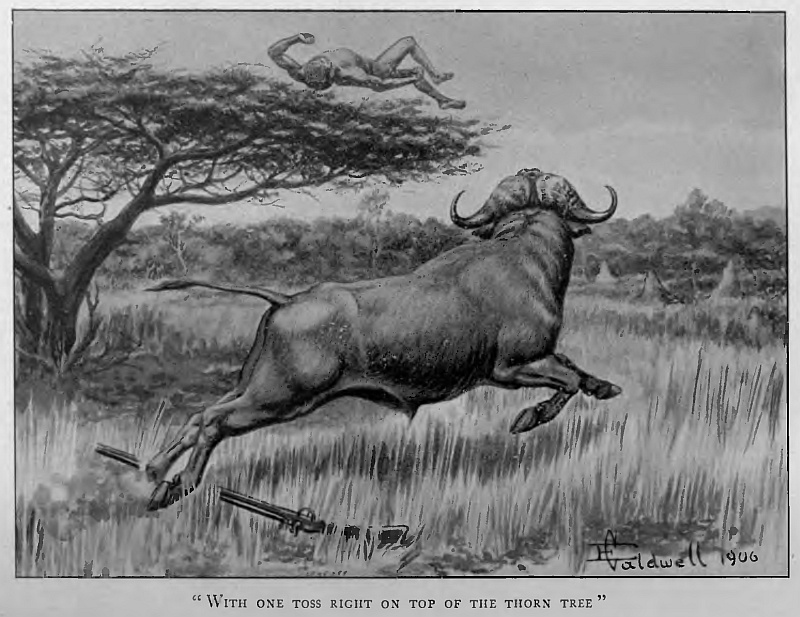
When he recovered consciousness he was lying face upwards in the sun, with nothing to rest his head on and only sticks and thorns around him. He did not know where he was or what had happened; he tried to move, but one arm was useless and the effort made him slip and sag, and he thought he was falling through the earth. Presently he heard regular tramping underneath him and the breath of a big animal: and the whole incident came back to him. By feeling about cautiously he at last located the biggest branch under him, and getting a grip on this he managed to turn over and ease his right side. He could then see the buffalo: it had tramped a circle round the tree and was doing sentry over him. Now and again the huge creature stopped to sniff, snort and stamp, and then resumed the round, perhaps the reverse way. The buffalo could not see him and never once looked up, but glared about at its own accustomed level; and, relying entirely on its sense of smell, it kept up the relentless vengeful watch for hours, always stopping in the same place, to leeward, to satisfy itself that the enemy had not escaped.
Late in the afternoon the buffalo, for the first time, suddenly came to a stand on the windward side of the tree, and after a good minute’s silence turned its tail on Jantje and with angry sniffs and tosses stepped swiftly and resolutely forward some paces. There was nothing to be seen; but Jantje judged the position and yelled out a warning to his master whom he guessed to be coming through the bush to look for him, and at the same time he made what noise he could in the tree top to make the buffalo think he was coming down. The animal looked round from time to time with swings and tosses of the head and threatening angry sneezes, much as one sees a cow do when standing between her young calf and threatened danger: it was defending Jantje, for his own purposes, and facing the danger.
For many minutes there was dead silence: no answer came to Jantje’s call, and the bull stood its ground glaring and sniffing towards the bush. At last there was a heavy thud below, instantly followed by the report of the rifle—the bullet came faster than the sound; the buffalo gave a heavy plunge and with a grunting sob slid forward on its chest.
Round the camp fire at night Jantje used to tell tales in which fact, fancy, and superstition were curiously mingled; and Jantje when not out of humour was free with his stories. The boys, for whose benefit they were told, listened open-mouthed; and I often stood outside the ring of gaping boys at their fire, an interested listener.
The tale of his experiences with the honey-bird which he had cheated of its share was the first I heard him tell. Who could say how much was fact, how much fancy, and how much the superstitions of his race? Not even Jantje knew that! He believed it all.
The Honey-bird met him one day with cheery cheep-cheep, and as he whistled in reply it led him to an old tree where the beehive was: it was a small hive, and Jantje was hungry; so he ate it all. All the time he was eating, the bird kept fluttering about, calling anxiously, and expecting some honey or fat young bees to be thrown out for it; and when he had finished, the bird came down and searched in vain for its share. As he walked away the guilty Jantje noticed that the indignant bird followed him with angry cries and threats.