Sir Percy FitzPatrick (continued 2)
Reading edition
After a little while, when my chance of getting one of the good puppies seemed hopeless and I got used to the idea that I would have to take the odd one, I began to notice little things about him that no one else noticed, and got to be quite fond of the little beggar—in a kind of way. Perhaps I was turning my sand into gold, and my geese into swans; perhaps I grew fond of him simply because, finding him lonely and with no one else to depend on, I befriended him; and perhaps it was because he was always cheerful and plucky and it seemed as if there might be some good stuff in him after all. Those were the things I used to think of sometimes when feeding the little outcast. The other puppies would tumble him over and take his food from him; they would bump into him when he was stooping over the dish of milk and porridge, and his head was so big and his legs so weak that he would tip up and go heels over head into the dish. We were always picking him out of the food and scraping it off him: half the time he was wet and sticky, and the other half covered with porridge and sand baked hard by the sun.
One day just after the waggons had started, as I took a final look round the outspan place to see if anything had been forgotten, I found the little chap—who was only about four inches high—struggling to walk through the long grass. He was not big enough or strong enough to push his way—even the stems of the down-trodden grass tripped him—and he stumbled and floundered at every step, but he got up again each time with his little tail standing straight up, his head erect, and his ears cocked. He looked such a ridiculous sight that his little tragedy of “lost in the veld” was forgotten—one could only laugh.
What he thought he was doing, goodness only knows; he looked as proud and important as if he owned the whole world and knew that every one in it was watching him. The poor little chap could not see a yard in that grass; and in any case he was not old enough to see much, or understand anything, for his eyes still had that bluish blind look that all very young puppies have, but he was marching along as full of confidence as a general at the head of his army. How he fell out of the waggon no one knew; perhaps the big puppies tumbled him out, or he may have tried to follow Jess, or have climbed over the tail-board to see what was the other side, for he was always going off exploring by himself. His little world was small, it may be—only the bed-plank of the waggon and the few square yards of the ground on which they were dumped at the outspans—but he took it as seriously as any explorer who ever tackled a continent.
The others were a bit more softened towards the odd puppy when I caught up to the waggons and told them of his valiant struggle to follow; and the man who had docked the puppies’ tails allowed, “I believe the rat’s got pluck, whatever else is the matter with him, for he was the only one that didn’t howl when I snipped them. The little cuss just gave a grunt and turned round as if he wanted to eat me. I think he’d ’a’ been terrible angry if he hadn’t been so s’prised. Pity he’s such an awful-looking mongrel.”
But no one else said a good word for him: he was really beneath notice, and if ever they had to speak about him they called him “The Rat.” There is no doubt about it he was extremely ugly, and instead of improving as he grew older, he became worse; yet, I could not help liking him and looking after him, sometimes feeling sorry for him, sometimes being tremendously amused, and sometimes—wonderful to relate—really admiring him. He was extraordinarily silent; while the others barked at nothing, howled when lonely, and yelled when frightened or hurt, the odd puppy did none of these things; in fact, he began to show many of Jess’s peculiarities; he hardly ever barked, and when he did it was not a wild excited string of barks but little suppressed muffled noises, half bark and half growl, and just one or two at a time; and he did not appear to be afraid of anything, so one could not tell what he would do if he was.
One day we had an amusing instance of his nerve: one of the oxen, sniffing about the outspan, caught sight of him all alone, and filled with curiosity came up to examine him, as a hulking silly old tame ox will do. It moved towards him slowly and heavily with its ears spread wide and its head down, giving great big sniffs at this new object, trying to make out what it was. “The Rat” stood quite still with his stumpy tail cocked up and his head a little on one side, and when the huge ox’s nose was about a foot from him he gave one of those funny abrupt little barks. It was as if the object had suddenly ‘gone off’ like a cracker, and the ox nearly tumbled over with fright; but even when the great mountain of a thing gave a clumsy plunge round and trotted off, “The Rat” was not the least frightened; he was startled, and his tail and ears flickered for a second, but stiffened up again instantly, and with another of those little barks he took a couple of steps forward and cocked his head on the other side. That was his way.
He was not a bit like the other puppies; if any one fired off a gun or cracked one of the big whips the whole five would yell at the top of their voices and, wherever they were, would start running, scrambling and floundering as fast as they could towards the waggon without once looking back to see what they were running away from. The odd puppy would drop his bone with a start or would jump round; his ears and tail would flicker up and down for a second; then he would slowly bristle up all over, and with his head cocked first on one side and then on the other, stare hard with his half-blind bluish puppy eyes in the direction of the noise; but he never ran away.
And so, little by little, I got to like him in spite of his awful ugliness. And it really was awful! The other puppies grew big all over, but the odd one at that time seemed to grow only in one part—his tummy! The poor little chap was born small and weak; he had always been bullied and crowded out by the others, and the truth is he was half starved. The natural consequence of this was that as soon as he could walk about and pick up things for himself he made up for lost time, and filled up his middle piece to an alarming size before the other parts of his body had time to grow; at that time he looked more like a big tock-tockie beetle than a dog.
Besides the balloon-like tummy he had stick-out bandy-legs, very like a beetle’s too, and a neck so thin that it made the head look enormous, and you wondered how the neck ever held it up. But what made him so supremely ridiculous was that he evidently did not know he was ugly; he walked about as if he was always thinking of his dignity, and he had that puffed-out and stuck-up air of importance that you only see in small people and bantam cocks who are always trying to appear an inch taller than they really are.
When the puppies were about a month old, and could feed on porridge or bread soaked in soup or gravy, they got to be too much for Jess, and she used to leave them for hours at a time and hide in the grass so as to have a little peace and sleep. Puppies are always hungry, so they soon began to hunt about for themselves, and would find scraps of meat and porridge or old bones; and if they could not get anything else, would try to eat the raw-hide nekstrops and reims. Then the fights began. As soon as one puppy saw another busy on anything, he would walk over towards him and, if strong enough, fight him for it. All day long it was nothing but wrangle, snarl, bark and yelp. Sometimes four or five would be at it in one scrum; because as soon as one heard a row going on he would trot up hoping to steal the bone while the others were busy fighting.
It was then that I noticed other things about the odd puppy: no matter how many packed on to him, or how they bit or pulled him, he never once let out a yelp; with four or five on top of him you would see him on his back, snapping right and left with bare white teeth, gripping and worrying them when he got a good hold of anything, and all the time growling and snarling with a fierceness that was really comical. It sounded as a lion fight might sound in a toy phonograph.
Before many days passed, it was clear that some of the other puppies were inclined to leave “The Rat” alone, and that only two of them—the two biggest—seemed anxious to fight him and could take his bones away. The reason soon became apparent: instead of wasting his breath in making a noise, or wasting strength in trying to tumble the others over, “The Rat” simply bit hard and hung on; noses, ears, lips, cheeks, feet and even tails—all came handy to him; anything he could get hold of and hang on to was good enough, and the result generally was that in about half a minute the other puppy would leave everything and clear off yelling, and probably holding up one paw or hanging its head on one side to ease a chewed ear.
When either of the big puppies tackled the little fellow the fight lasted much longer. Even if he were tumbled over at once—as generally happened—and the other one stood over him barking and growling, that did not end the fight: as soon as the other chap got off him he would struggle up and begin again; he would not give in. The other puppies seemed to think there was some sort of rule like the ‘count out’ in boxing, or that once you were tumbled over you ought to give up the bone; but the odd puppy apparently did not care about rules; as far as I could see, he had just one rule: “Stick to it,” so it was not very long before even the two big fellows gave up interfering with him. The bites from his little white teeth—sharp as needles—which punctured noses and feet and tore ears, were most unpleasant. But apart from that, they found there was nothing to be gained by fighting him: they might roll him over time after time, but he came back again and worried them so persistently that it was quite impossible to enjoy the bone—they had to keep on fighting for it.
At first I drew attention to these things, but there was no encouragement from the others; they merely laughed at the attempt to make the best of a bad job. Sometimes owners of other puppies were nettled by having their beauties compared with “The Rat,” or were annoyed because he had the cheek to fight for his own and beat them. Once, when I had described how well he had stood up to Billy’s pup, Robbie caught up “The Rat,” and placing him on the table, said: “Hats off to the Duke of Wellington on the field of Waterloo.” That seemed to me the poorest sort of joke to send five grown men into fits of laughter. He stood there on the table with his head on one side, one ear standing up, and his stumpy tail twiggling—an absurd picture of friendliness, pride and confidence; yet he was so ugly and ridiculous that my heart sank, and I whisked him away. They made fun of him, and he did not mind; but it was making fun of me too, and I could not help knowing why; it was only necessary to put the puppies together to see the reason.
After that I stopped talking about him, and made the most of the good points he showed, and tried to discover more. It was the only consolation for having to take the leavings of the litter.
Then there came a day when something happened which might easily have turned out very differently, and there would have been no stories and no Jock to tell about; and the best dog in the world would never have been my friend and companion. The puppies had been behaving very badly, and had stolen several nekstrops and chewed up parts of one or two big whips; the drivers were grumbling about all the damage done and the extra work it gave them; and Ted, exasperated by the worry of it all, announced that the puppies were quite old enough to be taken away, and that those who had picked puppies must take them at once and look after them, or let some one else have them. When I heard him say that my heart gave a little thump from excitement, for I knew the day had come when the great question would be settled once and for all. Here was a glorious and unexpected chance; perhaps one of the others would not or could not take his, and I might get one of the good ones... Of course the two big ones would be snapped up: that was certain; for, even if the men who had picked them could not take them, others; who had been promised puppies before me would exchange those they had already chosen for the better ones. Still, there were other chances; and I thought of very little else all day long, wondering if any of the good ones would be left; and if so, which?
In the afternoon Ted came up to where we were all lying in the shade and startled us with the momentous announcement:
“Billy Griffiths can’t take his pup!”
Every man of us sat up. Billy’s pup was the first pick, the champion of the litter, the biggest and strongest of the lot. Several of the others said at once that they would exchange theirs for this one; but Ted smiled and shook his head.
“No,” he said, “you had a good pick in the beginning.” Then he turned to me, and added: “You’ve only had leavings.” Some one said “The Rat,” and there was a shout of laughter, but Ted went on; “You can have Billy’s pup.”
It seemed too good to be true; not even in my wildest imaginings had I fancied myself getting the pick of the lot. I hardly waited to thank Ted before going off to look at my champion. I had seen and admired him times out of number, but it seemed as if he must look different now that he belonged to me. He was a fine big fellow, well built and strong, and looked as if he could beat all the rest put together. His legs were straight; his neck sturdy; his muzzle dark and shapely; his ears equal and well carried; and in the sunlight his yellow coat looked quite bright, with occasional glints of gold in it. He was indeed a handsome fellow.
As I put him back again with the others the odd puppy, who had stood up and sniffed at me when I came, licked my hand and twiddled his tail with the friendliest and most independent air, as if he knew me quite well and was glad to see me, and I patted the poor little chap as he waddled up. I had forgotten him in the excitement of getting Billy’s pup; but the sight of him made me think of his funny ways, his pluck and independence, and of how he had not a friend in the world except Jess and me; and I felt downright sorry for him. I picked him up and talked to him; and when his wizened little face was close to mine, he opened his mouth as if laughing, and shooting out his red tongue dabbed me right on the tip of my nose in pure friendliness. The poor little fellow looked more ludicrous than ever: he had been feeding again and was as tight as a drum; his skin was so tight one could not help thinking that if he walked over a mimosa thorn and got a scratch on the tummy he would burst like a toy balloon.
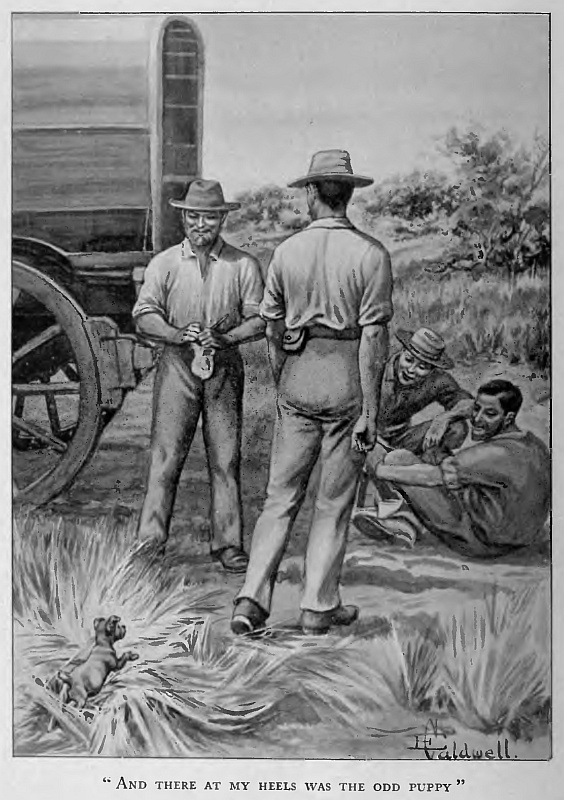
I put him back with the other puppies and returned to the tree where Ted and the rest were sitting. As I came up there was a shout of laughter, and—turning round to see what had provoked it—I found “The Rat” at my heels. He had followed me and was trotting and stumbling along, tripping every yard or so, but getting up again with head erect, ears cocked and his stumpy tail twiddling away just as pleased and proud as if he thought he had really started in life and was doing what only a ‘really and truly’ grown-up dog is supposed to do—that is, follow his master wherever he goes.
All the old chaff and jokes were fired off at me again, and I had no peace for quite a time. They all had something to say: “He won’t swap you off!”
“I’ll back ‘The Rat’!” “He is going to take care of you!”
“He is afraid you’ll get lost!” and so on; and they were still chaffing about it when I grabbed “The Rat” and took him back again.
Billy’s failure to take his puppy was so entirely unexpected and so important that the subject kept cropping up all the evening. It was very amusing then to see how each of those who had wanted to get him succeeded in finding good reasons for thinking that his own puppy was really better than Billy’s. However they differed in their estimates of each other’s dogs, they all agreed that the best judge in the world could not be certain of picking out the best dog in a good litter until the puppies were several months old; and they all gave instances in which the best looking puppy had turned out the worst dog, and others in which the one that no one would look at had grown up to be the champion. Goodness knows how long this would have gone on if Robbie had not mischievously suggested that “perhaps ‘The Rat’ was going to beat the whole lot.” There was such a chorus of guffaws at this that no one told any more stories.
The poor little friendless Rat! It was unfortunate, but the truth is that he was uglier than before; and yet I could not help liking him. I fell asleep that night thinking of the two puppies—the best and the worst in the litter. No sooner had I gone over all the splendid points in Billy’s pup and made up my mind that he was certainly the finest I had ever seen, than the friendly wizened little face, the half-cocked ears and head on one side, the cocky little stump of a tail, and the comical dignified plucky look of the odd puppy would all come back to me. The thought of how he had licked my hand and twiddled his tail at me, and how he dabbed me on the nose, and then the manful way in which he had struggled after me through the grass, all made my heart go soft towards him, and I fell asleep not knowing what to do.
When I woke up in the morning, my first thought was of the odd puppy—how he looked to me as his only friend, and what he would feel like if, after looking on me as really belonging to him and as the one person that he was going to take care of all his life, he knew he was to be left behind or given away to any one who would take him. It would never have entered his head that he required some one to look after him; from the way he had followed me the night before it was clear he was looking after me; and the other fellows thought the same thing. His whole manner had plainly said: “Never mind old man! Don’t you worry: I am here.”
We used to make our first trek at about three o’clock in the morning, so as to be outspanned by sunrise; and walking along during that morning trek I recalled all the stories that the others had told of miserable puppies having grown into wonderful dogs, and of great men who had been very ordinary children; and at breakfast I took the plunge.
“Ted,” I said, bracing myself for the laughter, “if you don’t mind, I’ll stick to ‘The Rat.’”
If I had fired off a gun under their noses they would have been much less startled. Robbie made a grab for his plate as it slipped from his knees.
“Don’t do that sort of thing!” he protested indignantly. “My nerves won’t stand it!”
The others stopped eating and drinking, held their beakers of steaming coffee well out of the way to get a better look at me, and when they saw it was seriously meant there was a chorus of: “Well, I’m hanged.”
I took him in hand at once—for now he was really mine—and brought him over for his saucer of soaked bread and milk to where we sat at breakfast. Beside me there was a rough camp table—a luxury sometimes indulged in while camping or trekking with empty waggons—on which we put our tinned-milk, treacle and such things to keep them out of reach of the ants, grasshoppers, Hottentot-gods, beetles and dust. I put the puppy and his saucer in a safe place under the table out of the way of stray feet, and sank the saucer into the sand so that when he trod in it he would not spill the food; for puppies are quite stupid as they are greedy, and seem to think that they can eat faster by getting further into the dish. He appeared to be more ravenous than usual, and we were all amused by the way the little fellow craned his thin neck out further and further until he tipped up behind and his nose bumping into the saucer see-sawed him back again. He finished it all and looked round briskly at me, licking his lips and twiddling his stumpy tail.
Well, I meant to make a dog of him, so I gave him another lot. He was just like a little child—he thought he was very hungry still and could eat any amount more; but it was not possible. The lapping became slower and more laboured, with pauses every now and then to get breath or lick his lips and look about him, until at last he was fairly beaten: he could only look at it, blink and lick his chops; and, knowing that he would keep on trying, I took the saucer away. He was too full to object or to run after it; he was too full to move. He stood where he was, with his legs well spread and his little body blown out like a balloon, and finished licking the drops and crumbs off his face without moving a foot.
There was something so extraordinarily funny in the appearance and attitude of the puppy that we watched to see what he would do next. He had been standing very close to the leg of the table, but not quite touching it, when he finished feeding; and even after he had done washing his face and cleaning up generally, he stood there stock-still for several minutes, as though it was altogether too much trouble to move. One little bandy hind leg stuck out behind the table-leg, and the bulge of his little tummy stuck out in front of it; so that when at last he decided to make a move the very first little lurch brought his hip up against the table-leg. In an instant the puppy’s appearance changed completely: the hair on his back and shoulders bristled; his head went up erect; one ear stood up straight and the other at half cock; and his stumpy tail quivered with rage. He evidently thought that one of the other puppies had come up behind to interfere with him. He was too proud to turn round and appear to be nervous: with head erect he glared hard straight in front of him, and, with all the little breath that he had left after his big feed, he growled ferociously in comical little gasps. He stood like that, not moving an inch, with the front foot still ready to take that step forward; and then, as nothing more happened, the hair on his back gradually went flat again; the fierceness died out of his face; and the growling stopped.
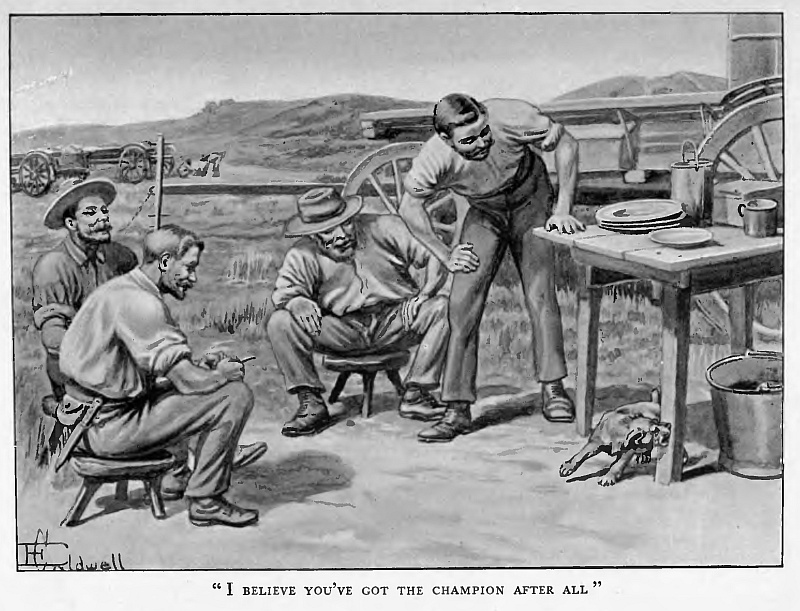
After a minute’s pause, he again very slowly and carefully began to step forward; of course exactly the same thing happened again, except that this time he shook all over with rage, and the growling was fiercer and more choky. One could not imagine anything so small being in so great a rage. He took longer to cool down, too, and much longer before he made the third attempt to start. But the third time it was all over in a second. He seemed to think that this was more than any dog could stand, and that he must put a stop to it. The instant his hip touched the leg, he whipped round with a ferocious snarl—his little white teeth bared and gleaming—and bumped his nose against the table-leg.
I cannot say whether it was because of the shout of laughter from us, or because he really understood what had happened, that he looked so foolish, but he just gave one crestfallen look at me and with a feeble wag of his tail waddled off as fast as he could.
Then Ted nodded over at me, and said: “I believe you have got the champion after all!” And I was too proud to speak.
Chapter Five.
Jock’s Schooldays.
After that day no one spoke of “The Rat” or “The Odd Puppy,” or used any of the numberless nicknames that they had given him, such as “The Specimen,” “The Object,” “Number 6,” “Bully-Beef,” (because he got his head stuck in a half-pound tin one day), “The Scrap”; and even “The Duke of Wellington” ceased to be a gibe. They still laughed at his ridiculous dignity; and they loved to tease him to see him stiffen with rage and hear his choky little growls; but they liked his independence and admired his tremendous pluck. So they respected his name when he got one.
And his name was “Jock.”
No one bothered about the other puppies’ names: they were known as “Billy’s pup,” “Jimmy’s pup,” “Old Joe’s Darling,” “Yellow Jack,” and “Bandy-Legged Sue”; but they seemed to think that this little chap had earned his name, fighting his way without anybody’s help and with everything against him; so they gave up all the nicknames and spoke of him as “Jock.”
Jock got such a good advertisement by his fight with the table-leg that every one took notice of him now and remarked about what he did; and as he was only a very young puppy, they teased him, fed him, petted him, and did their best to spoil him. He was so young that it did not seem to matter, but I think if he had not been a really good dog at heart he would have been quite spoilt.
He soon began to grow and fill out; and it was then that he taught the other puppies to leave him alone. If they had not interfered with him he might perhaps have left them alone, as it was not his nature to interfere with others; but the trouble was they had bullied him so much while he was weak and helpless that he got used to the idea of fighting for everything. It is probably the best thing that could have happened to Jock that as a puppy he was small and weak, but full of pluck; it compelled him to learn how to fight; it made him clever, cool, and careful, for he could not afford to make mistakes. When he fought he meant business; he went for a good spot, bit hard, and hung on for all he was worth; then, as the enemy began to slacken, he would start vigorously worrying and shaking. I often saw him shake himself off his feet, because the thing he was fighting was too heavy for him.
The day Jock fought the two big puppies—one after the other—for his bone, and beat them off, was the day of his independence; we all saw the tussle, and cheered the little chap. And then for one whole day he had peace; but it was like the pause at low water before the tide begins to flow the other way. He was so used to being interfered with that I suppose he did not immediately understand they would never tackle him again.
It took a whole day for him to realise this; but as soon as he did understand it he seemed to make up his mind that now his turn had come, and he went for the first puppy he saw with a bone. He walked up slowly and carefully, and began to make a circle round him. When he got about half-way round the puppy took up the bone and trotted off; but Jock headed him off at once, and again began to walk towards him very slowly and stiffly. The other puppy stood quite still for a moment, and then Jock’s fierce determined look was too much for him: he dropped the bone and bolted.
There was mighty little but smell on those bones, for we gave the puppies very little meat, so when Jock had taken what he could off this one, he started on another hunt. A few yards away Billy’s pup was having a glorious time, struggling with a big bone and growling all the while as if he wanted to let the world know that it was as much as any one’s life was worth to come near him. None of us thought Jock would tackle him, as Billy’s pup was still a long way the biggest and strongest of the puppies, and always ready to bully the others.
Jock was about three or four yards away when he caught sight of Billy’s pup, and for about a minute he stood still and quietly watched. At first he seemed surprised, and then interested, and then gradually he stiffened up all over in that funny way of his; and when the hair on his shoulders was all on end and his ears and tail were properly up, he moved forward very deliberately. In this fashion he made a circle round Billy’s pup, keeping about two feet away from him, walking infinitely slowly and glaring steadily at the enemy out of the corners of his eyes; and while he was doing this, the other fellow was tearing away at his bone, growling furiously and glaring sideways at Jock. When the circle was finished they stood once more face to face; and then after a short pause Jock began to move in closer, but more slowly even than before.
Billy’s pup did not like this: it was beginning to look serious. He could not keep on eating and at the same time watch Jock; moreover, there was such a very unpleasant wicked look about Jock, and he moved so steadily and silently forward, that any one would feel a bit creepy and nervous; so he put his paw on the bone and let out a string of snarly barks, with his ears flat on his neck and his tail rather low down. But Jock still came on—a little more carefully and slowly perhaps, but just as steadily as ever. When about a foot off the enemy’s nose he changed his direction slightly, as if to walk past, and Billy’s pup turned his head to watch him, keeping his nose pointed towards Jock’s, but when they got side by side he again looked straight in front of him.
Perhaps he did this to make sure the bone was still there, or perhaps to show his contempt when he thought Jock was going off. Whatever the reason was, it was a mistake; for, as he turned his head away, Jock flew at him, got a good mouthful of ear, and in no time they were rolling and struggling in the dust—Jock’s little grunts barely-audible in the noise made by the other one. Billy’s pup was big and strong, and he was not a coward; but Jock was worrying his ear vigorously, and he could not find anything to bite in return. In less than a minute he began to howl, and was making frantic efforts to get away. Then Jock let go the ear and tackled the bone.
After that he had no more puppy fights. As soon as any one of the others saw Jock begin to walk slowly and carefully towards him he seemed to suddenly get tired of his bone, and moved off.
Most dogs—like most people—when their hearts fail them will try to hide the truth from one another and make some sort of effort or pretence to keep their dignity or self-respect or the good opinion of others. You may see it all any day in the street, when dogs meet and stop to ‘size’ each other up. As a rule the perfectly shameless cowards are found in the two extreme classes—the outcasts, whose spirits are broken by all the world being against them; and the pampered darlings, who have never had to do anything for themselves. Many dogs who are clearly anxious to get out of fighting will make a pretence of bravery at the time, or at least cover up their cowardice, with a ‘wait-till-I-catch-you-next-time’ air, as soon as they are at a safe distance. Day after day at the outspans the puppies went through every stage of the business, to our constant amusement and to my unconcealed pride; for Jock was thenceforth cock of the walk. If they saw him some distance off moving towards them or even staring hard and with his ears and tail up, the retreat would be made with a gloomy and dignified air, sometimes even with growls just loud enough to please themselves without provoking him; if he was fairly close up when spotted they wasted no time in putting on airs, but trotted off promptly; but sometimes they would be too busy to notice anything until a growl or a rustle in the grass close behind gave warning; and it was always followed by a jump and a shameless scuttle, very often accompanied by a strangled sort of yowling yelp, just as if he had already got them by the ear or throat.
Some of them became so nervous that we could not resist playing practical jokes on them—making sudden strange noises, imitating Jock’s growls, tossing bits of bark at them or touching them from behind with a stick while they were completely occupied with their bones—for the fun of seeing the stampede and hearing the sudden howls of surprise and fright.
One by one the other puppies were taken away by their new masters, and before Jock was three months old he and Jess were the only dogs with the waggons. Then he went to school, and like all schoolboys learnt some things very quickly—the things that he liked; and some things he learnt very slowly, and hated them just as a boy hates extra work in play-time. When I poked about with a stick in the banks of dongas to turn out mice and field-rats for him, or when I hid a partridge or a hare and made him find it, he was as happy as could be; but when I made him lie down and watch my gun or coat while I pretended to go off and leave him, he did not like it; and as for his lessons in manners! well, he simply hated them.
There are some things which a dog in that sort of life simply must learn or you cannot keep him; and the first of these is, not to steal. Every puppy will help himself until he is taught not to; and your dog lives with you and can get at everything. At the outspans the grub-box is put on the ground, open for each man to help himself; if you make a stew, or roast the leg of a buck, the big three-legged pot is put down handy and left there; if you are lucky enough to have some tinned butter or condensed milk, the tins are opened and stood on the ground; and if you have a dog thief in the camp, nothing is safe.
There was a dog with us once—a year or two later—who was the worst thief I ever knew. He was a one-eyed pointer with feet like a duck’s, and his name was Snarleyow. He looked the most foolish and most innocent dog in the world, and was so timid that if you stumbled as you passed him he would instantly start howling and run for the horizon. The first bad experience I had of Snarley was on one of the little hunting trips which we sometimes made in those days, away from the waggons. We travelled light on those occasions, and, except for some tea and a very little flour and salt, took no food; we lived on what we shot and of course kept ‘hunter’s pot.’
‘Hunter’s pot’ is a perpetual stew; you make one stew, and keep it going as long as necessary, maintaining a full pot by adding to it as fast as you take any out; scraps of everything go in; any kind of meat—buck, bird, pig, hare—and if you have such luxuries as onions or potatoes, so much the better; then, to make the soup strong, the big bones are added—the old ones being fished out every day and replaced by a fresh lot. When allowed to cool it sets like brawn, and a hungry hunter wants nothing better.
We had had a good feed the first night of this trip and had then filled the pot up leaving it to simmer as long as the fire lasted, expecting to have cold pie set in jelly—but without the pie-crust—for early breakfast next morning before going off for the day; but, to our amazement, in the morning the pot was empty. There were some strange kaffirs—camp followers—hanging on to our trail for what they could pick up, and we suspected them. There was a great row, but the boys denied having touched the pot, and we could prove nothing.
That night we made the fire close to our sleeping-place and moved the kaffirs further away, but next morning the pot was again empty—cleaned and polished as if it had been washed out. While we, speechless with astonishment and anger, were wondering who the thief was and what we should do with him, one of the hunting boys came up and pointed to the prints of a dog’s feet in the soft white ashes of the dead fire. There was only one word: “Snarleyow.” The thief was lying fast asleep comfortably curled up on his master’s clothes. There could be no mistake about those big splayed footprints, and in about two minutes Snarleyow was getting a first-class hammering, with his head tied inside the three-legged pot for a lesson.
After that he was kept tied up at night; but Snarleyow was past curing. We had practically nothing to eat but what we shot, and nothing to drink but bush tea—that is, tea made from a certain wild shrub with a very strong scent; it is not nice, but you drink it when you cannot get anything else. We could not afford luxuries then, but two days before Ted’s birthday he sent a runner off to Komati Drift and bought a small tin of ground coffee and a tin of condensed milk for his birthday treat. It was to be a real feast that day, so he cut the top off the tin instead of punching two holes and blowing the milk out, as we usually did in order to economise and keep out the dust and insects. What we could not use in the coffee that day we were going to spread on our ‘dough-boys’ instead of butter and jam. It was to be a real feast!
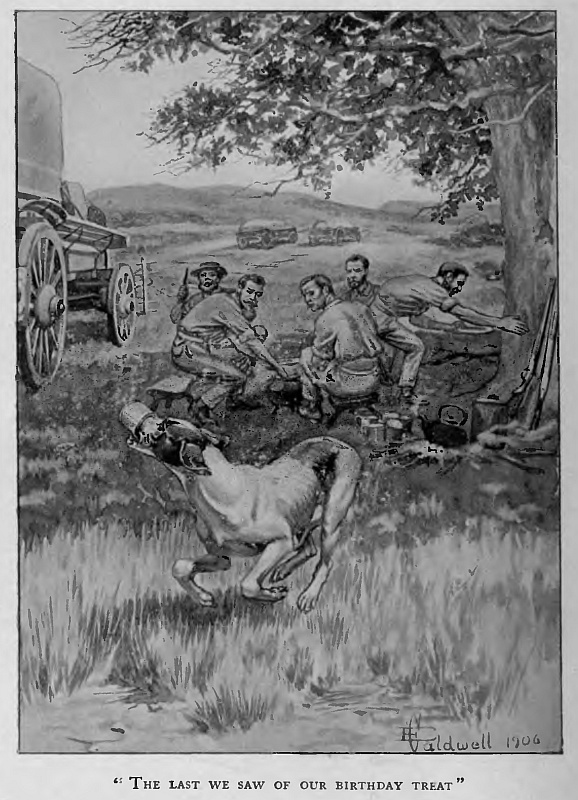
The five of us sat down in a circle and began on our hunter’s pot, saving the good things for the last. While we were still busy on the stew, there came a pathetic heartbreaking yowl from Snarleyow, and we looked round just in time to see him, his tail tucked between his legs and his head high in the air, bolting off into the bush as hard as he could lay legs to the ground, with the milk tin stuck firmly on to his nose. The greedy thief in trying to get the last scrap out had dug his nose and top jaw too far in, and the jagged edges of the tin had gripped him; and the last we saw of our birthday treat was the tin flashing in the sunlight on Snarley’s nose as he tore away howling into the bush. Snarleyow came to a bad end: his master shot him as he was running off with a ham. He was a full-grown dog when he came to our camp, and too old to learn principles and good manners.
Dogs are like people: what they learn when they are young, whether of good or of evil, is not readily forgotten. I began early with Jock, and—remembering what Rocky had said—tried to help him. It is little use punishing a dog for stealing if you take no trouble about feeding him. That is very rough on the dog; he has to find out slowly and by himself what he may take, and what he may not. Sometimes he leaves what he was meant to take, and goes hungry; and sometimes takes what was not intended for him, and gets a thrashing. That is not fair. You cannot expect to have a good dog, and one that will understand you, if you treat him in that way. Some men teach their dogs not to take food from any one but themselves. One day when we were talking about training dogs, Ted told one of the others to open Jess’s mouth and put a piece of meat in it, he undertaking not to say a word and not even to look at her. The meat was put in her mouth and her jaws were shut tight on it; but the instant she was free she dropped it, walked round to the other side of Ted and sat close up to him. He waited for a minute or so and, without so much as a glance at her, said quietly “All right.” She was back again in a second and with one hungry bite bolted the lump of meat.
I taught Jock not to touch food in camp until he was told to ‘take it.’ The lesson began when he got his saucer of porridge in the morning; and he must have thought it cruel to have that put in front of him, and then to be held back or tapped with a finger on the nose each time he tried to dive into it. At first he struggled and fought to get at it; then he tried to back away and dodge round the other side; then he became dazed, and, thinking it was not for him at all, wanted to walk off and have nothing more to do with it. In a few days, however, I got him to lie still and take it only when I patted him and pushed him towards it; and in a very little time he got on so well that I could put his food down without saying anything and let him wait for permission. He would lie down with his head on his paws and his nose right up against the saucer, so as to lose no time when the order came; but he would not touch it until he heard ‘Take it.’ He never moved his head, but his little browny dark eyes, full of childlike eagerness, used to be turned up sideways and fixed on mine. I believe he watched my lips; he was so quick to obey the order when it came.
When he grew up and had learned his lessons there was no need for these exercises. He got to understand me so well that if I nodded or moved my hand in a way that meant ‘all right,’ he would go ahead: by that time too he was dignified and patient; and it was only in his puppyhood that he used to crouch up close to his food and tremble with impatience and excitement.
There was one lesson that he hated most of all. I used to balance a piece of meat on his nose and make him keep it there until the word to take it came.
Time after time he would close his eyes as if the sight of the meat was more than he could bear, and his mouth would water so from the savoury smell that long streels of dribble would hang down on either side.
It seems unnecessary and even cruel to tantalise a dog in that way; but it was not: it was education; and it was true kindness. It taught him to understand his master, and to be obedient, patient, and observant; it taught him not to steal; it saved him from much sickness, and perhaps death, by teaching him not to feed on anything he could find; it taught him manners and made it possible for him to live with his master and be treated like a friend.
Good feeding, good care, and plenty of exercise soon began to make a great change in Jock. He ceased to look like a beetle—grew bigger everywhere, not only in one part as he had done at first; his neck grew thick and strong, and his legs straightened up and filled out with muscle. The others, seeing him every day, were slow to notice these things, but my sand had been changed into gold long ago, and they always said I could not see anything wrong in Jock.
There was one other change which came more slowly and seemed to me much more wonderful. After his morning feed, if there was nothing to do, he used to go to sleep in some shady place, and I remember well one day watching him as he lay. His bit of shade had moved away and left him in the bright sunshine; and as he breathed and his ribs rose and fell, the tips of the hairs on his side and back caught the sunlight and shone like polished gold, and the wavy dark lines seemed more distinct and darker, but still very soft. In fact, I was astonished to see that in a certain light Jock looked quite handsome. That was the first time I noticed the change in colour; and it made me remember two things. The first was what the other fellows had said the day Billy gave up his pup, “You can’t tell how a puppy will turn out: even his colour changes;” and the second was a remark made by an old hunter who had offered to buy Jock—the real meaning of which I did not understand at the time.
“The best dog I ever owned was a golden brindle,” said the old man thoughtfully, after I had laughed at the idea of selling my dog. I had got so used to thinking that he was only a faded wishy-washy edition of Jess that the idea of his colour changing did not occur to me then, and I never suspected that the old man could see how he would turn out; but the touch of sunlight opened my eyes that day, and after that whenever I looked at Jock the words “golden brindle” came back to my mind, and I pictured him as he was going to be—and as he really did grow up—having a coat like burnished gold with soft, dark, wavy brindles in it and that snow-white V on his chest.
Jock had many things to learn besides the lessons he got from me—the lessons of experience which nobody could teach him. When he was six months old—just old enough, if he had lived in a town, to chase a cat and make a noise—he knew many things that respectable puppies of twice his age who stay at home never get a chance of learning.
On trek there were always new places to see, new roads to travel, and new things to examine, tackle or avoid. He learnt something fresh almost every day: he learnt, for instance, that, although it was shady and cool under the waggon, it was not good enough to lie in the wheel track, not even for the pleasure of feeling the cool iron tyre against your back or head as you slept; and he knew that, because one day he had done it and the wheel had gone over his foot; and it might just as easily have been his back or head. Fortunately the sand was soft and his foot was not crushed; but he was very lame for some days, and had to travel on the waggon.
He learned a good deal from Jess: among other things, that it was not necessary to poke his nose up against a snake in order to find out what it was. He knew that Jess would fight anything; and when one day he saw her back hair go up and watched her sheer off the footpath wide into the grass, he did the same; and then when we had shot the snake, both he and Jess came up very very cautiously and sniffed at it, with every hair on their bodies standing up.
He found out for himself that it was not a good idea to turn a scorpion over with his paw. The vicious little tail with a thorn in it whipped over the scorpion’s back, and Jock had such a foot that he must have thought a scorpion worse than two waggons. He was a very sick dog for some days; but after that, whenever he saw a thing that he did not understand, he would watch it very carefully from a little way off and notice what it did and what it looked like, before trying experiments.
So, little by little, Jock got to understand plenty of things that no town dog would ever know, and he got to know—just as some people do—by what we call instinct, whether a thing was dangerous or safe, even though he had never seen anything like it before. That is how he knew that wolves or lions were about—and that they were dangerous—when he heard or scented them; although he had never seen, scented or heard one before to know what sort of animal it might be. You may well wonder how he could tell whether the scent or the cry belonged to a wolf which he must avoid, or to a buck which he might hunt, when he had never seen either a wolf or a buck at the time; but he did know; and he also knew that no dog could safely go outside the ring of the camp fires when wolf or lion was about. I have known many town-bred dogs that could scent them just as well as Jess or Jock could, but having no instinct of danger they went out to see what it was, and of course they never came back.
I used to take Jock with me everywhere so that he could learn everything that a hunting dog ought to know, and above all things to learn that he was my dog, and to understand all that I wanted to tell him. So while he was still a puppy, whenever he stopped to sniff at something new or to look at something strange, I would show him what it was; but if he stayed behind to explore while I moved on, or if he fell asleep and did not hear me get up from where I had sat down to rest, or went off the track on his own account, I used to hide away from him on top of a rock or up a tree and let him hunt about until he found me.
At first he used to be quite excited when he missed me, but after a little time he got to know what to do and would sniff along the ground and canter away after me—always finding me quite easily. Even if I climbed a tree to hide from him he would follow my track to the foot of the tree, sniff up the trunk as far as he could reach standing up against it, and then peer up into the branches. If he could not see me from one place, he would try another—always with his head tilted a bit on one side. He never barked at these times; but as soon as he saw me, his ears would drop, his mouth open wide with the red tongue lolling out, and the stump of a tail would twiggle away to show how pleased he was. Sometimes he would give a few little whimpery grunts: he hardly ever barked; when he did I knew there was something worth looking at.
Jock was not a quarrelsome dog, and he was quick to learn and very obedient, but in one connection I had great difficulty with him for quite a little time. He had a sort of private war with the fowls; and it was due to the same cause as his war with the other puppies: they interfered with him. Now, every one knows what a fowl is like: it is impudent, inquisitive, selfish, always looking for something to eat, and has no principles.
A friend of mine once told me a story about a dog of his and the trouble he had with fowls. Several of us had been discussing the characters of dogs, and the different emotions they feel and manage to express, and the kind of things they seem to think about. Every one knows that a dog can feel angry, frightened, pleased, and disappointed. Any one who knows dogs will tell you that they can also feel anxious, hopeful, nervous, inquisitive, surprised, ashamed, interested, sad, loving, jealous, and contented—just like human beings.
We had told many stories illustrating this, when my friend asked the question: “Have dogs a sense of humour?” Now I know that Jock looked very foolish the day he fought the table-leg—and a silly old hen made him look just as foolish another day—but that is not quite what my friend meant. On both occasions Jock clearly felt that he had made himself look ridiculous; but he was very far from looking amused. The question was: Is a dog capable of sufficient thinking to appreciate a simple joke, and is it possible for a dog to feel amused. If Jess had seen Jock bursting to fight the table-leg would she have seen the joke? Well, I certainly did not think so; but he said he was quite certain some dogs have a sense of humour; and he had had proof of it.
He told the story very gravely, but I really do not even now know whether he—Well, here it is: He had once owned a savage old watch-dog, whose box stood in the back-yard where he was kept chained up all day; he used to be fed once a day—in the mornings—and the great plague of his life was the fowls. They ran loose in the yard and picked up food all day, besides getting a really good feed of grain morning and evening; possibly the knowledge of this made the old dog particularly angry when they would come round by ones or twos or dozens trying to steal part of his one meal. Anyhow, he hated them, and whenever he got a chance killed them. The old fowls learned to keep out of his way and never ventured within his reach unless they were quite sure that he was asleep or lying in his kennel where he could not see them; but there were always new fowls coming, or young ones growing up; and so the war went on.
One Sunday morning my friend was enjoying a smoke on his back stoep when feeding time came round. The cook took the old dog’s food to him in a high three-legged pot, and my friend, seeing the fowls begin to gather round and wishing to let the old dog have his meal in peace, told the cook to give the fowls a good feed in another part of the yard to draw them off. So the old fellow polished off his food and licked the pot clean, leaving not a drop or a speck behind.
But fowls are very greedy; they were soon back again wandering about, with their active-looking eyes searching everything. The old dog, feeling pretty satisfied with life, picked out a sandy spot in the sunshine, threw himself down full stretch on his side, and promptly went to sleep—at peace with all the world. Immediately he did this, out stepped a long-legged athletic-looking young cockerel and began to advance against the enemy. As he got nearer he slowed down, and looked first with one eye and then with the other so as to make sure that all was safe, and several times he paused with one foot poised high before deciding to take the next step. My friend was greatly amused to see all the trouble that the fowl was taking to get up to the empty pot, and, for the fun of giving the conceited young cockerel a fright, threw a pebble at him. He was so nervous that when the pebble dropped near him, he gave one great bound and tore off flapping and screaming down the yard as if he thought the old dog was after him. The old fellow himself was startled out of his sleep, and raised his head to see what the row was about; but, as nothing more happened, he lay down again, and the cockerel, finding also that it was a false alarm, turned back not a bit ashamed for another try.
The cockerel had not seen the old dog lift his head; my friend had, and when he looked again he saw that, although the underneath eye—half buried in the sand—was shut, the top eye was open and was steadily watching the cockerel as he came nearer and nearer to the pot. My friend sat dead still, expecting a rush and another fluttering scramble. At last the cockerel took the final step, craned his neck to its utmost and peered down into the empty pot. The old dog gave two gentle pats with his tail in the sand, and closing his eye went to sleep again.
Jock had the same sort of trouble. The fowls tried to steal his food; and he would not stand it. His way of dealing with them was not good for their health: before I could teach him not to kill, and before the fowls would learn not to steal, he had finished half a dozen of them one after another with just one bite and a shake. He would growl very low as they came up and, without lifting his head from the plate, watch them with his little eyes turning from soft brown to shiny black; and when they came too near and tried to snatch just one mouthful—well, one jump, one shake, and it was all over.
In the end he learned to tumble them over and scare their wits out without hurting them; and they learned to give him a very wide berth.
I used always to keep some fowls with the waggons, partly to have fresh meat if we ran out of game, but mainly to have fresh eggs, which were a very great treat; and as a rule it was only when a hen turned obstinate and would not lay that we ate her. I used to have one old rooster, whose name was Pezulu, and six or eight hens. The hens changed from time to time—as we ate them—but Pezulu remained.
The fowl-coop was carried on top of everything else, and it was always left open so that the fowls could go in and out as they liked. In the very beginning of all, of course, the fowls were shut in and fed in the coop for a day or two to teach them where their home was; but it is surprising how quickly a fowl will learn and how it observes things. For instance, the moving of the coop from one waggon to another is not a thing one would expect the fowls to notice, all the waggons being so much alike and having no regular order at the outspans; but they did notice it, and at once. They would first get on to the waggon on which the coop had been, and look about in a puzzled lost kind of way; then walk all over the load apparently searching for it, with heads cocked this way and that, as if a great big coop was a thing that might have been mislaid somewhere; then one after another would jerk out short cackles of protest, indignation and astonishment, and generally make no end of a fuss. It was only when old Pezulu led the way and perched on the coop itself and crowed and called to them that they would get up on to the other waggon.
Pezulu got his name by accident—in fact, by a misunderstanding. It is a Zulu word meaning ‘up’ or ‘on top,’ and when the fowls first joined the waggons and were allowed to wander about at the outspan places, the boys would drive them up when it was time to trek again by cracking their big whips and shouting “Pezulu.” In a few days no driving or whip-cracking was necessary; one of the boys would shout “Pezulu” three or four times, and they would all come in and one by one fly and scramble up to the coop. One day, after we had got a new lot of hens, a stranger happened to witness the performance. Old Pezulu was the only one who knew what was meant, and being a terribly fussy nervous old gentleman, came tearing out of the bush making a lot of noise, and scrambled hastily on to the waggon. The stranger, hearing the boys call “Pezulu” and seeing him hurry up so promptly, remarked: “How well he knows his name!” So we called him Pezulu after that.
Whenever we got new fowls Pezulu became as distracted as a nervous man with a large family trying to find seats in an excursion train. As soon as he saw the oxen being brought up, and before any one had called for the fowls, he would begin fussing and fuming—trying all sorts of dodges to get the hens up to the waggons. He would crow and cluck-cluck or kip-kip; he would go a few yards towards the waggons and scratch in the ground, pretending to have found something good, and invite them to come and share it; he would get on the disselboom and crow and flap his wings loudly; and finally he would mount on top of the coop and make all sorts of signals to the hens, who took not the least notice of him. As the inspanning went on he would get more and more excited; down he would come again—not flying off, but hopping from ledge to ledge to show them the easy way; and once more on the ground he would scrape and pick and cluck to attract them, and the whole game would be played over again and again. So even with new fowls we had very little trouble, as old Pezulu did most of the teaching.
But sometimes Pezulu himself was caught napping—to the high delight of the boys. He was so nervous and so fussy that they thought it great fun to play tricks on him and pretend to go off and leave him behind. It was not easy to do this because, as I say, he did not wait to be called, but got ready the minute he saw the oxen coming up. He was like those fussy people who drive every one else crazy and waste a lot of time by always being half an hour early, and then annoy you by boasting that they have never missed a train in their lives.
But there was one way in which Pezulu used to get caught. Just as he knew that inspanning meant starting, so, too, he knew that outspanning meant stopping; and whenever the waggons stopped—even for a few minutes—out would pop his head, just like the fussy red-faced father of the big family looking out to see if it was their station or an accident on the line. Right and left he would look, giving excited inquisitive clucks from time to time, and if they did not start in another minute or two, he would get right out and walk anxiously to the edge of the load and have another good look around—as the nervous old gentleman gets half out, and then right out, to look for the guard, but will not let go the handle of the door for fear of being left. Unless he saw the boys outspanning he would not get off, and if one of the hens ventured out he would rush back at her in a great state and try to bustle her back into the coop. But often it happens while trekking that something goes wrong with the gear—a yokeskey or a nek-strop breaks, or an ox will not pull kindly or pulls too hard where he is, and you want to change his place; and in that way it comes about that sometimes you have to outspan one or two or even more oxen in the middle of a trek.
That is how Pezulu used to get caught: the minute he saw outspanning begin, he would nip off with all the hens following him and wander about looking for food, chasing locusts or grasshoppers, and making darts at beetles and all sorts of dainties—very much interested in his job and wandering further from the waggons at every step. The boys would watch him, and as soon as they were fixed up again, would start off without a word of warning to Pezulu. Then there was a scene. At the first sound of the waggon-wheels moving he would look up from where he was or walk briskly into the open or get on to an ant-heap to see what was up, and when to his horror he saw the waggon actually going without him, he simply screamed open-mouthed and tore along with wings outstretched—the old gentleman shouting “Stop the train, stop the train,” with his family straggling along behind him. It never took him long to catch up and scramble on, but even then he was not a bit less excited: he was perfectly hysterical, and his big red comb seemed to get quite purple as if he might be going to have apoplexy, and he twitched and jerked about so that it flapped first over one eye and then over the other. This was the boys’ practical joke which they played on him whenever they could.
That was old Pezulu—Pezulu the First. He was thick in the body, all chest and tail, short in the legs, and had enormous spurs; and his big comb made him; look so red in the face that one could not help thinking he was too fond of his dinner. In some old Christmas number we came across a coloured caricature of a militia colonel in full uniform, and for quite a long time it remained tacked on to the coop with “Pezulu” written on it.
Pezulu the Great—who was Pezulu the Second—was not like that: he was a game cock, all muscle and no frills, with a very resolute manner and a real love of his profession; he was a bit like Jock in some things; and that is why I fancy perhaps Jock and he were friends in a kind of way. But Jock could not get on with the others: they were constantly changing; new ones who had to be taught manners were always coming; so he just lumped them together, and hated fowls. He taught them manners, but they taught him something too—at any rate, one of them did; and one of the biggest surprises and best lessons Jock ever had was given him by a hen while he was still a growing-up puppy.
He was beginning to fancy that he knew a good deal, and like most young dogs was very inquisitive and wanted to know everything and at once. At that time he was very keen on hunting mice, rats and bush squirrels, and had even fought and killed a meerkat after the plucky little rikkitikki had bitten him rather badly through the lip; and he was still much inclined to poke his nose in or rush on to things instead of sniffing round about first.
However, he learned to be careful, and an old hen helped to teach him. The hens usually laid their eggs in the coop because it was their home, but sometimes they would make nests in the bush at the outspan places. One of the hens had done this, and the bush she had chosen was very low and dense. No one saw the hen make the nest and no one saw her sitting on it, for the sunshine was so bright everywhere else, and the shade of the bush so dark that it was impossible to see anything there; but while we were at breakfast Jock, who was bustling about everywhere as a puppy will, must have scented the hen or have seen this brown thing in the dark shady hole.
The hen was sitting with her head sunk right down into her chest, so that he could not see any head, eyes or beak—just a sort of brown lump. Suddenly we saw Jock stand stock-still, cock up one ear, put his head down and his nose out, hump up his shoulders a bit and begin to walk very slowly forward in a crouching attitude. He lifted his feet so slowly and so softly that you could count five between each step. We were all greatly amused and thought he was pointing a mouse or a locust, and we watched him.
He crept up like a boy showing off until he was only six inches from the object, giving occasional cautious glances back at us to attract attention. Just as he got to the hole the hen let out a vicious peck on the top of his nose and at the same time flapped over his head, screaming and cackling for dear life. It was all so sudden and so surprising that she was gone before he could think of making a grab at her; and when he heard our shouts of laughter he looked as foolish as if he understood all about it.
Chapter Six.
The First Hunt.
Jock’s first experience in hunting was on the Crocodile River not far from the spot where afterwards we had the great fight with The Old Crocodile. In the summer when the heavy rains flood the country the river runs ‘bank high,’ hiding everything—reeds, rocks, islands, and stunted trees—in some places silent and oily like a huge gorged snake, in others foaming and turbulent as an angry monster. In the rainless winter when the water is low and clear the scene is not so grand, but is quiet, peaceful, and much more beautiful. There is an infinite variety in it then—the river sometimes winding along in one deep channel, but more often forking out into two or three streams in the broad bed. The loops and lacings of the divided water carve out islands and spaces of all shapes and sizes, banks of clean white sand or of firm damp mud swirled up by the floods, on which tall green reeds with yellow tasselled tops shoot up like crops of Kaffir corn. Looked down upon from the flood banks the silver streaks of water gleam brightly in the sun, and the graceful reeds, bowing and swaying slowly with the gentlest breeze and alternately showing their leaf-sheathed stems and crested tops, give the appearance of an ever-changing sea of green and gold. Here and there a big rock, black and polished, stands boldly out, and the sea of reeds laps round it like the waters of a lake on a bright still day. When there is no breeze the rustle of the reeds is hushed, and the only constant sound is the ever-varying voice of the water, lapping, gurgling, chattering, murmuring, as it works its way along the rocky channels; sometimes near and loud, sometimes faint and distant; and sometimes, over long sandy reaches, there is no sound at all.
Get up on some vantage point upon the high bank and look down there one day in the winter of the tropics as the heat and hush of noon approach, and it will seem indeed a scene of peace and beauty—a place to rest and dream, where there is neither stir nor sound. Then, as you sit silently watching and thinking, where all the world is so infinitely still, you will notice that one reed down among all those countless thousands is moving. It bows slowly and gracefully a certain distance, and then with a quivering shuddering motion straightens itself still more slowly and with evident difficulty, until at last it stands upright again like the rest but still all a-quiver while they do not move a leaf. Just as you are beginning to wonder what the reason is, the reed bows slowly again, and again struggles back; and so it goes on as regularly as the swing of a pendulum. Then you know that, down at the roots where you cannot see it, the water is flowing silently, and that something attached to this reed is dragging in the stream and pulling it over, and swinging back to do it again each time the reed lifts it free—a perpetual seesaw.
You are glad to find the reason, because it looked a little uncanny; but the behaviour of that one reed has stopped your dreaming and made you look about more carefully. Then you find that, although the reeds appear as still as the rocks, there is hardly a spot where, if you watch for a few minutes, you will not see something moving. A tiny field-mouse climbing one reed will sway it over; a river rat gnawing at the roots will make it shiver and rustle; little birds hopping from one to another will puzzle you; and a lagavaan turning in his sunbath will make half a dozen sway outwards.
All feeling that it is a home of peace, a place to rest and dream, leaves you; you are wondering what goes on down below the green and gold where you can see nothing; and when your eye catches a bigger, slower, continuous movement in another place, and for twenty yards from the bank to the stream you see the tops of the reeds silently and gently parting and closing again as something down below works its way along without the faintest sound, the place seems too quiet, too uncanny and mysterious, too silent, stealthy and treacherous for you to sit still in comfort: you must get up and do something.
There is always good shooting along the rivers in a country where water is scarce. Partridges, bush-pheasants and stembuck were plentiful along the banks and among the thorns, but the reeds themselves were the home of thousands of guinea-fowl, and you could also count on duiker and rietbuck as almost a certainty there. If this were all, it would be like shooting in a well-stocked cover, but it is not only man that is on the watch for game at the drinking-places. The beasts of prey—lions, tigers, hyenas, wild dogs and jackals, and lastly pythons and crocodiles—know that the game must come to water, and they lie in wait near the tracks or the drinking-places. That is what makes the mystery and charm of the reeds; you never know what you will put up. The lions and tigers had deserted the country near the main drifts and followed the big game into more peaceful parts; but the reeds were still the favourite shelter and resting-place of the crocodiles; and there were any number of them left.
There is nothing that one comes across in hunting more horrible and loathsome than the crocodile: nothing that rouses the feeling of horror and hatred as it does: nothing that so surely and quickly gives the sensation of ‘creeps in the back’ as the noiseless apparition of one in the water just where you least expected anything, or the discovery of one silently and intently watching you with its head resting flat on a sand spit—the thing you had seen half a dozen times before and mistaken for a small rock. Many things are hunted in the Bushveld; but only the crocodile is hated. There is always the feeling of horror that this hideous, cowardly, cruel thing—the enemy of man and beast alike—with its look of a cunning smile in the greeny glassy eyes and great wide mouth, will mercilessly drag you down—down—down to the bottom of some deep still pool, and hold you there till you drown. Utterly helpless yourself to escape or fight, you cannot even call, and if you could, no one could help you there. It is all done in silence: a few bubbles come up where a man went down; and that is the end of it.
We all knew about the crocodiles and were prepared for them, but the sport was good, and when you are fresh at the game and get interested in a hunt it is not very easy to remember all the things you have been warned about and the precautions you were told to take. It was on the first day at the river that one of our party, who was not a very old hand at hunting, came in wet and muddy and told us how a crocodile had scared the wits out of him. He had gone out after guinea-fowl, he said, but as he had no dog to send in and flush them, the birds simply played with him: they would not rise but kept running in the reeds a little way in front of him, just out of sight. He could hear them quite distinctly, and thinking to steal a march on them took off his boots and got on to the rocks. Stepping bare-footed from rock to rock where the reeds were thin, he made no noise at all and got so close up that he could hear the little whispered chink-chink-chink that they give when near danger. The only chance of getting a shot at them was to mount one of the big rocks from which he could see down into the reeds; and he worked his way along a mud-bank towards one. A couple more steps from the mud-bank on to a low black rock would take him to the big one. Without taking his eyes off the reeds where the guinea-fowl were he stepped cautiously on to the low black rock, and in an instant was swept off his feet, tossed and tumbled over and over, into the mud and reeds, and there was a noise of furious rushing and crashing as if a troop of elephants were stampeding through the reeds. He had stepped on the back of a sleeping crocodile; no doubt it was every bit as frightened as he was. There was much laughter over this and the breathless earnestness with which he told the story; but there was also a good deal of chaff, for it seems to be generally accepted that you are not bound to believe all hunting stories; and Jim and his circus crocodile became the joke of the camp.
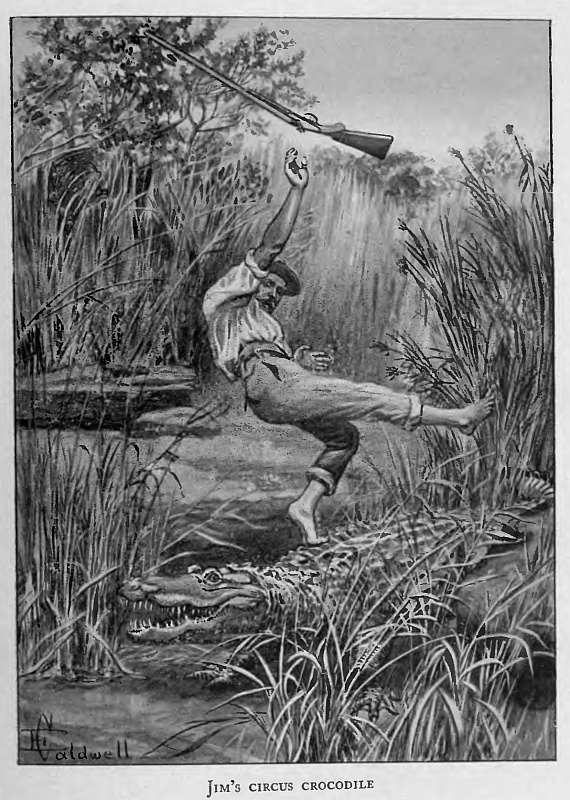
We were spending a couple of days on the river bank to make the most of the good water and grazing, and all through the day some one or other would be out pottering about among the reeds, gun in hand, to keep the pot full and have some fun, and although we laughed and chaffed about Jim’s experience, I fancy we were all very much on the look-out for rocks that looked like crocs and crocs that looked like rocks.
One of the most difficult lessons that a beginner has to learn is to keep cool. The keener you are the more likely you are to get excited and the more bitterly you feel the disappointments; and once you lose your head, there is no mistake too stupid for you to make, and the result is another good chance spoilt. The great silent bush is so lonely; the strain of being on the look-out all the time is so great; the uncertainty as to what may start up—anything from a partridge to a lion—is so trying that the beginner is wound up like an alarum clock and goes off at the first touch. He is not fit to hit a haystack at twenty yards; will fire without looking or aiming at all; jerk the rifle as he fires; forget to change the sight after the last shot; forget to cock his gun or move the safety catch; forget to load; forget to fire at all: nothing is impossible—nothing too silly.
On a later trip we had with us a man who was out for the first time, and when we came upon a troop of koodoo he started yelling, war-whooping and swearing at them, chasing them on foot and waving his rifle over his head. When we asked him why he, who was nearest to them, had not fired a shot, all he could say was that he never remembered his rifle or anything else until they were gone.
These experiences had been mine, some of them many times, in spite of Rocky’s example and advice; and they were always followed by a fresh stock of good resolutions.
I had started out this day with the same old determination to keep cool, but, once into the reeds, Jim’s account of how he had stepped on the crocodile put all other thoughts out of my mind, and most of my attention was given to examining suspicious-looking rocks as we stole silently and quietly along.
Jock was with me, as usual; I always took him out even then—not for hunting, because he was too young, but in order to train him. He was still only a puppy, about six months old, as well as I remember, and had never tackled or even followed a wounded buck, so that it was impossible to say what he would do; he had seen me shoot a couple and had wanted to worry them as they fell; but that was all. He was quite obedient and kept his place behind me; and, although he trembled with excitement when he saw or heard anything, he never rushed in or moved ahead of me without permission. The guinea-fowl tormented him that day; he could scent and hear them, and was constantly making little runs forward, half crouching and with his nose back and tail dead level and his one ear full-cocked and the other half-up.
For about half an hour we went on in this way. There was plenty of fresh duiker spoor to show us that we were in a likely place, one spoor in particular being so fresh in the mud that it seemed only a few minutes old. We were following this one very eagerly but very cautiously, and evidently Jock agreed with me that the duiker must be near, for he took no more notice of the guinea-fowl; and I for my part forgot all about crocodiles and suspicious-looking rocks; there was at that moment only one thing in the world for me, and that was the duiker. We crept along noiselessly in and out of the reeds, round rocks and mudholes, across small stretches of firm mud or soft sand, so silently that nothing could have heard us, and finally we came to a very big rock, with the duiker spoor fresher than ever going close round it down stream. The rock was a long sloping one, polished smooth by the floods and very slippery to walk on. I climbed it in dead silence, peering down into the reeds and expecting every moment to see the duiker.
The slope up which we crept was long and easy, but that on the down-stream side was much steeper. I crawled up to the top on hands and knees, and raising myself slowly, looked carefully about, but no duiker could be seen; yet Jock was sniffing and trembling more than ever, and it was quite clear that he thought we were very close up. Seeing nothing in front or on either side, I stood right up and turned to look back the way we had come and examine the reeds on that side. In doing so a few grains of grit crunched under my foot, and instantly there was a rush in the reeds behind me; I jumped round to face it, believing that the crocodile was grabbing at me from behind, and on the polished surface of the rock my feet slipped and shot from under me, both bare elbows bumped hard on the rock, jerking the rifle out of my hands; and I was launched like a torpedo right into the mass of swaying reeds.
When you think you are tumbling on to a crocodile there is only one thing you want to do—get out as soon as possible. How long it took to reach the top of the rock again, goodness only knows! It seemed like a life-time; but the fact is I was out of those reeds and up that rock in time to see the duiker as it broke out of the reeds, raced up the bank, and disappeared into the bush with Jock tearing after it as hard as ever he could go.
One call stopped him, and he came back to me looking very crestfallen and guilty, no doubt thinking that he had behaved badly and disgraced himself. But he was not to blame at all; he had known all along that the duiker was there—having had no distracting fancies about crocodiles—and when he saw it dash off and his master instantly jump in after it, he must have thought that the hunt had at last begun and that he was expected to help.
After all that row and excitement there was not much use in trying for anything more in the reeds—and indeed I had had quite enough of them for one afternoon; so we wandered along the upper banks in the hope of finding something where there were no crocodiles, and it was not long before we were interested in something else and able to forget all about the duiker.
Before we had been walking many minutes, Jock raised his head and ears and then lowered himself into a half crouching attitude and made a little run forward. I looked promptly in the direction he was pointing and about two hundred yards away saw a stembuck standing in the shade of a mimosa bush feeding briskly on the buffalo grass. It was so small and in such bad light that the shot was too difficult for me at that distance, and I crawled along behind bushes, ant-heaps and trees until we were close enough for anything. The ground was soft and sandy, and we could get along easily enough without making any noise; but all the time, whilst thinking how lucky it was to be on ground so soft for the hands and knees, and so easy to move on without being heard, something else was happening. With eyes fixed on the buck I did not notice that in crawling along on all-fours, the muzzle of the rifle dipped regularly into the sand, picking up a little in the barrel each time. There was not enough to burst the rifle, but the effect was surprising. Following on a painfully careful aim, there was a deafening report that made my head reel and buzz; the kick of the rifle on the shoulder and cheek left me blue for days; and when my eyes were clear enough to see anything the stembuck had disappeared.
I was too disgusted to move, and sat in the sand rubbing my shoulder and thanking my stars that the rifle had not burst. There was plenty to think about, to be sure, and no hurry to do anything else, for the noise of the shot must have startled every living thing for a mile round.
It is not always easy to tell the direction from which a report comes when you are near a river or in broken country or patchy bush; and it is not an uncommon thing to find that a shot which has frightened one animal away from you has startled another and driven it towards you; and that is what happened in this case. As I sat in the shade of the thorns with the loaded rifle across my knees there was the faint sound of a buck cantering along in the sand; I looked up; and only about twenty yards from me a duiker came to a stop, half fronting me. There it stood looking back over its shoulder and listening intently, evidently thinking that the danger lay behind it. It was hardly possible to miss that; and as the duiker rolled over, I dropped my rifle and ran to make sure of it.
Of course, it was dead against the rules to leave the rifle behind; but it was simply a case of excitement again: when the buck rolled over everything else was forgotten! I knew the rule perfectly well—Reload at once and never part with your gun. It was one of Rocky’s lessons, and only a few weeks before this, when out for an afternoon’s shooting with an old hunter, the lesson had been repeated. The old man shot a rietbuck ram, and as it had been facing us and dropped without a kick we both thought that it was shot through the brain. There was no mark on the head, however, and although we examined it carefully, we failed to find the bullet-mark or a trace of blood; so we put our rifles down to settle the question by skinning the buck. After sawing at the neck for half a minute, however, the old man found his knife too blunt to make an opening, and we both hunted about for a stone to sharpen it on, and while we were fossicking about in the grass there was a noise behind, and looking sharply round we saw the buck scramble to its feet and scamper off before we had time to move. The bullet must have touched one of its horns and stunned it. My companion was too old a hunter to get excited, and while I ran for the rifles and wanted to chase the buck on foot he stood quite still, gently rubbing the knife on the stone he had picked up. Looking at me under bushy eyebrows and smiling philosophically, he said:
“That’s something for you to remember, Boy. It’s my belief if you lived for ever there’d always be something to learn at this game.”
Unfortunately I did not remember when it would have been useful. As I ran forward the duiker tumbled, struggled and rolled over and over, then got up and made a dash, only to dive head foremost into the sand and somersault over; but in a second it was up again and racing off, again to trip and plunge forward on to its chest with its nose outstretched sliding along the soft ground. The bullet had struck it in the shoulder, and the broken leg was tripping it and bringing it down; but, in far less time than it takes to tell it, the little fellow found out what was wrong, and scrambling once more to its feet was off on three legs at a pace that left me far behind. Jock, remembering the mistake in the reeds, kept his place behind, and I in the excitement of the moment neither saw nor thought of him until the duiker, gaining at every jump, looked like vanishing for ever. Then I remembered and, with a frantic wave of my hand, shouted, “After him, Jock.”
He was gone before my hand was down, and faster than I had ever seen him move, leaving me ploughing through the heavy sand far behind. Past the big bush I saw them again, and there the duiker did as wounded game so often do: taking advantage of cover it changed direction and turned away for some dense thorns. But that suited Jock exactly; he took the short cut across to head it off and was close up in a few more strides. He caught up to it, raced up beside it, and made a jump at its throat; but the duiker darted away in a fresh direction, leaving him yards behind. Again he was after it and tried the other side; but the buck was too quick, and again he missed and overshot the mark in his jump. He was in such deadly earnest he seemed to turn in the air to get back again and once more was close up—so close that I the flying heels of the buck seemed to pass each side of his ears; then he made his spring from behind, catching the duiker high up on one hind leg, and the two rolled over together, kicking and struggling in a cloud of dust. Time after time the duiker got on its feet, trying to get at him with its horns or to break away again; but Jock, although swung off his feet and rolled on, did not let go his grip. In grim silence he hung on while the duiker plunged, and, when it fell, tugged and worried as if to shake the life out of it.