Sir Percy FitzPatrick (continued 3)
Reading edition
What with the hot sun, the heavy sand, and the pace at which we had gone, I was so pumped that I finished the last hundred yards at a walk, and had plenty of time to see what was going on; but even when I got up to them the struggle was so fierce and the movements so quick that for some time it was not possible to get hold of the duiker to finish it off. At last came one particularly bad fall, when the buck rolled over on its back, and then Jock let go his grip and made a dash for its throat; but again the duiker was too quick for him; with one twist it was up and round facing him on its one knee, and dug, thrust, and swept with its black spiky horns so vigorously that it was impossible to get at its neck. As Jock rushed in the head ducked and the horns flashed round so swiftly that it seemed as if nothing could save him from being stabbed through and through, but his quickness and cleverness were a revelation to me. If he could not catch the duiker, it could not catch him: they were in a way too quick for each other, and they were a long way too quick for me.
Time after time I tried to get in close enough to grab one of the buck’s hind legs, but it was not to be caught. While Jock was at it fast and furious in front, I tried to creep up quietly behind—but it was no use: the duiker kept facing Jock with horns down, and whenever I moved it swung round and kept me in front also. Finally I tried a run straight in; and then it made another dash for liberty. On three legs, however, it had no chance, and in another minute Jock had it again, and down they came together, rolling over and over once more. The duiker struggled hard, but he hung on, and each time it got its feet to the ground to rise he would tug sideways and roll it over again, until I got up to them, and catching the buck by the head, held it down with my knee on its neck and my Bushman’s Friend in hand to finish it.
There was, however, still another lesson for us both to learn that day; neither of us knew what a buck can do with its hind feet when it is down. The duiker was flat on its side; Jock, thinking the fight was over, had let go; and, before I could move the supple body doubled up, and the feet whizzed viciously at me right over its head. The little pointed cloven feet are as hard and sharp as horns and will tear the flesh like claws. By good luck the kick only grazed my arm, but although the touch was the lightest it cut the skin and little beads of blood shot up marking the line like the scratch of a thorn. Missing my arm the hoof struck full on the handle of the Bushman’s Friend and sent it flying yards out of reach. And it was not merely one kick: faster than the eye could follow them the little feet whizzed and the legs seemed to buzz round like the spokes of a wheel. Holding the horns at arm’s length in order to dodge the kicks, I tried to pull the duiker towards the knife; but it was too much for me, and with a sudden twist and a wrench freed itself and was off again.
All the time Jock was moving round and round panting and licking his chops, stepping in and stepping back, giving anxious little whimpers, and longing to be at it again, but not daring to join in without permission. When the duiker broke away, however, he waited for nothing, and was on to it in one spring—again from behind; and this time he let go as it fell, and jumping free of it, had it by the throat before it could rise. I ran to them again, but the picking up of the knife had delayed me and I was not in time to save Jock the same lesson that the duiker had just taught me.
Down on its side, with Jock’s jaws locked in its throat, once more the duiker doubled up and used its feet. The first kick went over his head and scraped harmlessly along his back; but the second caught him at the point of the shoulder, and the razor-like toe ripped his side right to the hip. Then the dog showed his pluck and cleverness. His side was cut open as if it had been slashed by a knife, but he never flinched or loosened his grip for a second; he seemed to go at it more furiously than ever, but more cleverly and warily. He swung his body round clear of the whizzing feet, watching them with his little beady eyes fixed sideways and the gleaming whites showing in the corners; he tugged away incessantly and vigorously, keeping the buck’s neck stretched out and pulling it round in a circle backwards so that it could not possibly double its body up enough to kick him again; and before I could catch the feet to help him, the kicks grew weaker; the buck slackened out, and Jock had won.
The sun was hot, the sand was deep, and the rifle was hard to find; it was a long way back to the waggons, and the duiker made a heavy load; but the end of that first chase seemed so good that nothing else mattered. The only thing I did mind was the open cut on Jock’s side; but he minded nothing: his tail was going like a telegraph needle; he was panting with his mouth open from ear to ear, and his red tongue hanging out and making great slapping licks at his chops from time to time; he was not still for a second, but kept walking in and stepping back in a circle round the duiker, and looking up at me and then down at it, as if he was not at all sure that there might not be some fresh game on, and was consulting me as to whether it would not be a good thing to have another go in and make it all safe.
He was just as happy as a dog could be, and perhaps he was proud of the wound that left a straight line from his shoulder to his hip and showed up like a cord under the golden brindle as long as he lived—a memento of his first real hunt.
Chapter Seven.
In the Heart of the Bush.
When the hen pecked Jock on the nose, she gave him a useful lesson in the art of finding out what you want to know without getting into trouble. As he got older, he also learned that there are only certain things which concerned him and which it was necessary for him to know. A young dog begins by thinking that he can do everything, go everywhere, and know everything; and a hunting dog has to learn to mind his own business, as well as to understand it. Some dogs turn sulky or timid or stupid when they are checked, but an intelligent dog with a stout heart will learn little by little to leave other things alone, and grow steadily keener on his own work. There was no mistake about Jock’s keenness. When I took down the rifle from the waggon he did not go off into ecstasies of barking, as most sporting dogs will do, but would give a quick look up and with an eager little run towards me give a whimper of joy, make two or three bounds as if wanting to stretch his muscles and loosen his joints, then shake himself vigorously as though he had just come out of the water, and with a soft suppressed “Woo-woo-woo” full of contentment, drop silently into his place at my heels and give his whole attention to his work.
He was the best of companions, and through the years that we hunted together I never tired of watching him. There was always something to learn, something to admire, something to be grateful for, and very often something to laugh at—in the way in which we laugh only at those whom we are fond of. It was the struggle between Jock’s intense keenness and his sense of duty that most often raised the laugh. He knew that his place was behind me; but probably he also knew that nine times out of ten he scented or saw the game long before I knew there was anything near, and naturally wanted to be in front or at least abreast of me to show me whatever there was to be seen.
He noticed, just as surely and as quickly as any human being could, any change in my manner: nothing escaped him, for his eyes and ears were on the move the whole time. It was impossible for me to look for more than a few seconds in any one direction, or to stop or even to turn my head to listen, without being caught by him. His bright brown eyes were everlastingly on the watch and on the move: from me to the bush, from the bush back to me. When we were after game, and he could scent or see it, he would keep a foot or two to the side of me so as to have a clear view; and when he knew by my manner that I thought there was game near, he kept so close up that he would often bump against my heels as I walked, or run right into my legs if I stopped suddenly. Often when stalking buck very quietly and cautiously, thinking only of what was in front, I would get quite a start by feeling something bump up against me behind. At these times it was impossible to say anything without risk of scaring the game, and I got into the habit of making signs with my hand which he understood quite as well.
Sometimes after having crawled up I would be in the act of aiming when he would press up against me. Nothing puts one off so much as a touch or the expectation of being jogged when in the act of firing, and I used to get angry with him then, but dared not breathe a word; I would lower my head slowly, turn round, and give him a look. He knew quite well what it meant. Down would go his ears instantly, and he would back away from me a couple of steps, drop his stump of a tail and wag it in a feeble deprecating way, and open his mouth into a sort of foolish laugh. That was his apology! “I beg your pardon: it was an accident! I won’t do it again.”
It was quite impossible to be angry with him, he was so keen and he meant so well; and when he saw me laughing softly at him, he would come up again close to me, cock his tail a few inches higher and wag it a bit faster.
There is a deal of expression in a dog’s tail: it will generally tell you what his feelings are. My friend maintained that that was how he knew his old dog was enjoying the joke against the cockerel; and that is certainly how I knew what Jock was thinking about once when lost in the veld; and it showed me the way back.
It is easy enough to lose oneself in the Bushveld. The Berg stands up some thousands of feet inland on the west, looking as if it had been put there to hold up the High veld; and between the foothills and the sea lies the Bushveld, stretching for hundreds of miles north and south. From the height and distance of the Berg it looks as flat as the floor, but in many parts it is very much cut up by deep rough dongas, sharp rises and depressions, and numbers of small kopjes. Still, it has a way of looking flat, because the hills are small, and very much alike; and because hill and hollow are covered and hidden mile after mile by small trees of a wonderful sameness, just near enough together to prevent you from seeing more than a few hundred yards at a time. Most people see no differences in sheep: many believe that all Chinamen are exactly alike; and so it is with the Bushveld: you have to know it first.
So far I had never lost my way out hunting. The experiences of other men and the warnings from the old hands had made me very careful. We were always hearing of men being lost through leaving the road and following up the game while they were excited, without noticing which way they went and how long they had been going. There were no beaten tracks and very few landmarks, so that even experienced hunters went astray sometimes for a few hours or a day or two when the mists or heavy rains came on and nothing could be seen beyond fifty or a hundred yards.
Nearly every one who goes hunting in the Bushveld gets lost some time or other—generally in the beginning before he has learned to notice things. Some have been lost for many days until they blundered on to a track by accident or were found by a search-party; others have been lost and, finding no water or food, have died; others have been killed by lions, and only a boot or a coat—or, as it happened in one case that I know of, a ring found inside a lion—told what had occurred; others have been lost and nothing more ever heard of them. There is no feeling quite like that of being lost—helplessness, terror, and despair! The horror of it is so great that every beginner has it before him; every one has heard of it, thought of it, and dreamed of it, and every one feels it holding him to the beaten track, as the fear of drowning keeps those who cannot swim to shallow water. That is just in the beginning. Presently, when little excursions, each bolder than the previous, have ended without accident, the fear grows less and confidence develops. Then it is, as a rule, that the accident comes and the lesson is learned, if you are lucky enough to pull through.
When the camp is away in the trackless bush, it needs a good man always to find the way home after a couple of hours’ chase with all its twists and turns and doublings; but when camp is made on a known road—a long main road that strikes a fair line between two points of the compass—it seems impossible for any one to be hopelessly lost. If the road runs east and west you, knowing on which side you left it, have only to walk north or south steadily and you must strike it again. The old hands told the beginners this, and we were glad to know that it was only a matter of walking for a few hours, more or less, and that in the end we were bound to find the road and strike some camp. “Yes,” said the old hands, “it is simple enough here where you have a road running east and west; there is only one rule to remember: When you have lost your way, don’t lose your head.” But indeed that is just the one rule that you are quite unable to observe.
Many stories have been told of men being lost: many volumes could be filled with them for the trouble of writing down what any hunter will tell you. But no one who has not seen it can realise how the thing may happen; no one would believe the effect that the terror of being lost, and the demoralisation which it causes, can have on a sane man’s senses. If you want to know what a man can persuade himself to believe against the evidence of his senses—even when his very life depends upon his holding to the absolute truth—then you should see a man who is lost in the bush. He knows that he left the road on the north side; she loses his bearings; he does not know how long how fat, or how far he has walked; yet if he keep his head he will make due south and must inevitably strike the road. After going for half an hour and seeing nothing familiar, he begins to feel that he is going in the wrong direction; something pulls at him to face right about. Only a few minutes more of this, and he feels sure that he must have crossed the road without noticing it, and therefore that he ought to be going north instead of south, if he hopes ever to strike it again. How, you will ask, can a man imagine impossible to cross a big dusty road twenty or thirty feet wide without seeing it? The idea seems absurd; yet they do really believe it. One of the first illusions that occurs to men when they lose their heads is that they have done this, and it is the cause of scores of cases of ‘lost in the bush.’ The idea that they may have done it is absurd enough; but stranger still is the fact that they actually do it.
If you cannot understand a man thinking he had done such a thing, what can you say of a man actually doing it? Impossible, quite impossible, you think. Ah! but it is a fact: many know it for a fact and I have witnessed it twice myself, once in Mashonaland and once on the Delagoa road. I saw men, tired, haggard and wild-eyed, staring far in front of them, never looking at the ground, pressing on, on, on, and actually cross well-worn waggon roads, coming from hard veld into a sandy wheel-worn track and kicking up a cloud of dust as they passed, and utterly blind to the fact that they were walking across the roads they had been searching for—in one case for ten hours, and in the other for three days. When we called to them they had already crossed and were disappearing again into the bush. In both cases the sound of the human voice and the relief of being ‘found,’ made them collapse. The knees seemed to give way: they could not remain standing. The man who loses his head is really lost. He cannot think, remember, reason, or understand; and the strangest thing of all is that he often cannot even see properly—he fails to see the very things that he most wants to see, even when they are as large as life before him. Crossing the road without seeing it is not the only or the most extraordinary example of this sort of thing. We were out hunting once in a mounted party, but to spare a tired horse I went on foot and took up my stand in a game run among some thorn-trees on the low spur of a hill, while the others made a big circuit to head off a troop of koodoo. Among our party there was one who was very nervous: he had been lost once for six or eight hours, and being haunted by the dread of being lost again, his nerve was all gone and he would not go fifty yards without a companion. In the excitement of shooting at and galloping after the koodoo probably this dread was forgotten for a moment: he himself could not tell how it happened that he became separated, and no one else had noticed him.
The strip of wood along the hills in which I was waiting was four or five miles long but only from one to three hundred yards wide, a mere fringe enclosing the little range of kopjes; and between the stems of the trees I could see our camp and waggons in the open a quarter of a mile away. Ten or twelve shots faintly heard in the distance told me that the others were on to the koodoo, and knowing the preference of those animals for the bush I took cover behind a big stump and waited. For over half an hour, however, nothing came towards me, and believing then that the game had broken off another way, I was about to return to camp when I heard the tapping of galloping feet a long way off. In a few minutes the hard thud and occasional ring on the ground told that it was not the koodoo; and soon afterwards I saw a man on horseback. He was leaning eagerly forward and thumping the exhausted horse with his rifle and his heels to keep up its staggering gallop. I looked about quickly to see what it was he was chasing that could have slipped past me unnoticed, but there was nothing; then thinking there had been an accident and he was coming for help, I stepped out into the open and waited for him to come up. I stood quite still, and he galloped past within ten yards of me—so close that his muttered “Get on, you brute; get on, get on!” as he thumped away at his poor tired horse, were perfectly audible.
“What’s up, sportsman?” I asked, no louder than you would say it across a tennis-court; but the words brought him up, white-faced and terrified, and he half slid, half tumbled, off the horse gasping out, “I was lost, I was lost!” How he had managed to keep within that strip of bush, without once getting into the open where he would have seen the line of kopjes to which I had told him to stick or could have seen the waggons and the smoke of the big camp fire, he could never explain. I turned him round where he stood, and through the trees showed him the white tents of the waggons and the cattle grazing near by, but he was too dazed to understand or explain anything.
There are many kinds of men. That particular kind is not the kind that will ever do for veld life: they are for other things and other work. You will laugh at them at times—when the absurdity is greatest and no harm has been done. But see it! See it—and realise the suspense, the strain, and the terror; and then even the funniest incident has another side to it. See it once; and recall that the worst of endings have had just such beginnings. See it in the most absurd and farcical circumstances ever known; and laugh—laugh your fill; laugh at the victim and laugh with him, when it is over—and safe. But in the end will come the little chilling thought that the strongest, the bravest, and the best have known something of it too; and that even to those whose courage holds to the last breath there may come a moment when the pulse beats a little faster and the judgment is at fault.
Buggins who was with us in the first season was no hunter, but he was a good shot and not a bad fellow. In his case there was no tragedy; there was much laughter and—to me—a wonderful revelation. He showed us, as in a play, how you can be lost; how you can walk for ever in one little circle, as though drawn to a centre by magnetic force, and how you can miss seeing things in the bush if they do not move.
We had outspanned in a flat covered with close grass about two feet high and shady flat-topped thorn trees. The waggons, four in number, were drawn up a few yards off the road, two abreast. The grass was sweet and plentiful; the day was hot and still; and as we had had a very long early morning trek there was not much inclination to move. The cattle soon filled themselves and lay down to sleep; the boys did the same; and we, when breakfast was over, got into the shade of the waggons, some to sleep and others to smoke.
Buggins—that was his pet name—was a passenger returning to “England, Home, and Beauty”—that is to say, literally, to a comfortable home, admiring sisters and a rich indulgent father—after having sought his fortune unsuccessfully on the goldfields for fully four months. Buggins was good-natured, unselfish, and credulous; but he had one fault—he ‘yapped’: he talked until our heads buzzed. He used to sleep contentedly in a rumpled tarpaulin all through the night treks and come up fresh as a daisy and full of accumulated chat at the morning outspan, just when we—unless work or sport called for us—were wanting to get some sleep.
We knew well enough what to expect, so after breakfast Jimmy, who understood Buggins well, told him pleasantly that he could “sleep, shoot, or shut up.” To shut up was impossible, and to sleep again—without a rest—difficult, even for Buggins; so with a good-natured laugh he took the shot gun, saying that he “would potter around a bit and give us a treat.” Well, he did!
We had outspanned on the edge of an open space in the thorn bush; there are plenty of them to be found in the Bushveld—spaces a few hundred yards in diameter, like open park land, where not a single tree breaks the expanse of wavy yellow grass. The waggons with their greyish tents and buck-sails and dusty wood-work stood in the fringe of the trees where this little arena touched the road, and into it sallied Buggins, gently drawn by the benevolent purpose of giving us a treat. What he hoped to find in the open on that sweltering day he only could tell; we knew that no living thing but lizards would be out of the shade just then, but we wanted to find him employment harmless to him and us.
He had been gone for more than half an hour when we heard a shot, and a few minutes later Jimmy’s voice roused us.
“What the dickens is Buggins doing?” he asked in a tone so puzzled and interested that we all turned to watch that sportsman. According to Jimmy, he had been walking about in an erratic way for some time on the far side of the open ground—going from the one end to the other and then back again; then disappearing for a few minutes in the bush and re-appearing to again manoeuvre in the open in loops and circles, angles and straight lines. Now he was walking about at a smart pace, looking from side to side apparently searching for something. We could see the whole of the arena as clearly as you can see a cricket-field from the railings—for our waggon formed part of the boundary—but we could see nothing to explain Buggins’s manoeuvres. Next we saw him face the thorns opposite, raise his gun very deliberately, and fire into the top of the trees.
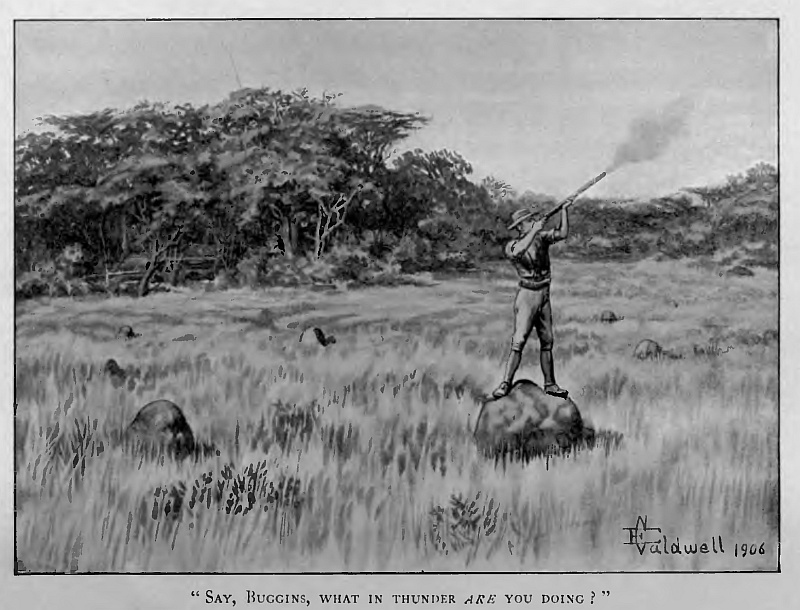
“Green pigeons,” said Jimmy firmly; and we all agreed that Buggins was after specimens for stuffing; but either our guess was wrong or his aim was bad, for after standing dead still for a minute he resumed his vigorous walk. By this time Buggins fairly fascinated us; even the kaffirs had roused each other and were watching him. Away he went at once off to our left, and there he repeated the performance, but, again made no attempt to pick up anything and showed no further interest in whatever it was he had fired at, but turned right about face and walked across the open ground in our direction until he was only a couple of hundred yards away. There he stopped and began to look about him and making off some few yards in another direction climbed on to a fair-sized ant-heap five or six feet high, and balancing himself cautiously on this he deliberately fired off both barrels in quick succession. Then the same idea struck us all together, and “Buggins is lost” came from several—all choking with laughter.
Jimmy got up and, stepping out into the open beside the waggon, called, “Say, Buggins, what in thunder are you doing?”
To see Buggins slide off the ant-heap and shuffle shamefacedly back to the waggon before a gallery of four white men and a lot of kaffirs, all cracking and crying with laughter, was a sight never to be forgotten.
I did not want to get lost and be eaten alive, or even look ridiculous, so I began very carefully: glanced back regularly to see what the track, trees, rocks, or kopjes looked like from the other side; carefully noted which side of the road I had turned off; and always kept my eye on the sun. But day after day and month after month went by without accident or serious difficulty, and then the same old thing happened: familiarity bred contempt, and I got the beginner’s complaint, conceit fever, just as others did: thought I was rather a fine fellow, not like other chaps who always have doubts and difficulties in finding their way back, but something exceptional with the real instinct in me which hunters, natives, and many animals are supposed to have; though, in fact, I could not get lost. So each day I went further and more boldly off the road, and grew more confident and careless.
The very last thing that would have occurred to me on this particular day was that there was any chance of being lost or any need to take note of where we went. For many weeks we had been hunting in exactly the same sort of country, but not of course in the same part; and the truth is I did not give the matter a thought at all, but went ahead as one does with the things that are done every day as matters of habit.
Chapter Eight.
Lost in the Veld.
We were outspanned near some deep shaded water-holes, and at about three o’clock I took my rifle and wandered off in the hope of dropping across something for the larder and having some sport during the three hours before the evening trek would begin; and as there was plenty of spoor of many kinds the prospects seemed good enough.
We had been going along slowly, it may be for half an hour, without seeing more than a little stembuck scurrying away in the distance, when I noticed that Jock was rather busy with his nose, sniffing about in a way that looked like business. He was not sure of anything; that was clear, because he kept trying in different directions; not as you see a pointer do, but very seriously silently and slowly, moving at a cautious walk for a few yards and then taking a look about.
The day was hot and still, as usual at that time of the year, and any noise would be easily heard, so I had stopped to give Jock a chance of ranging about. At the moment we were in rather open ground, and finding that Jock was still very suspicious I moved on towards where the bush was thicker and we were less likely to be seen from a distance. As we got near the better cover there was a rasping, squawky cry in a cockatoo’s voice, “Go ’way; go ’way; go’ way!” and one of those ugly big-beaked Go ’way birds came sailing up from behind and flapped on to the trees we were making for. No doubt they have another name, but in the Bushveld they were known as Go ’way birds, because of this cry and because they are supposed to warn the game when an enemy is coming. But they are not like the tick bird or the rhinoceros bird, who stick close to their friends and as soon as they see or hear anything suspicious flutter straight up filling the air with twittering cries of alarm; the Go ’way birds do not feed on ticks and have nothing to do with the game; you find them where there is no game, and it always seemed to me that it is not concern for the game at all, but simply a combination of vulgar curiosity, disagreeableness and bad manners, that makes them interfere as they do.
The reason why I do not believe the Go ’way birds care a rap about the game and only want to worry you is that often one of them will make up its mind to stick to you, and you can turn twist and double as many ways as you like, but as soon as you begin to walk on again the wretched thing will fly over your head and perch twenty yards or so in front of you, screeching out “Go ’way” at the top of its voice. There it will sit ready to fly off again as you come on, its ugly head on one side and big hooked bill like an aggressive nose, watching you mercilessly, as vigilant as a hungry fowl and as cross as a tired nurse in a big family. They seem to know that you cannot shoot them without making more row and doing more harm than they do.
I stood still for a few minutes to give this one a chance to fly away, and when it would not do so, but kept on screeching and craning its neck at me, I threw a stone at it. It ducked violently and gave a choking hysterical squawk of alarm and anger as the stone whizzed close to its head; then flying on to another tree a few yards off, screamed away more noisily than ever. Evidently the best thing to do was to go ahead taking no notice of the creature and trusting that it would tire and leave me alone; so I walked off briskly.
There was a slight rustling in the bush ahead of us as I stepped out, and then the sound of feet. I made a dash for the chance of a running shot, but it was too late, and all we saw was half a dozen beautiful koodoo disappearing among the tree stems.
I turned towards that Go ’way bird. Perhaps he did not like the look on my face or the way I held the rifle; for he gave one more snarling shriek, as if he was emptying himself for ever of his rage and spite, and flapped away.
Jock was standing like a statue, leaning slightly forward but with head very erect, jaws tightly closed, and eyes looking straight in front, as bright as black diamonds.
It was a bad disappointment; for that was the first time we had fairly and squarely come upon koodoo. However, it was still early and the game had not been scared, but had gone off quietly; so hoping for another chance we started off at a trot along the fresh spoor.
A big koodoo bull stands as high as a bullock, and although they have the small shapely feet of an antelope the spoor is heavy enough to follow at a trot except on stony ground. Perhaps they know this, for they certainly prefer the rough hard ground when they can get it. We went along at a good pace, but with many short breaks to make sure of the spoor in the stony parts; and it was pretty hot work, although clothing was light for hunting. A rough flannel shirt, open at the throat, and moleskin trousers dyed with coffee—for khaki was unknown to us then—was the usual wear; and we carried as little as possible. Generally a water-bottle filled with unsweetened cold tea and a cartridge belt were all we took besides the rifle. This time I had less than usual. Meaning to be out only for a couple of hours at most and to stick close to the road, I had pocketed half a dozen cartridges and left both bandolier and water-bottle behind.
It was not long before we came upon the koodoo again; but they were on the watch. They were standing in the fringe of some thick bush, broadside on but looking back full at us, and as soon as I stopped to aim the whole lot disappeared with the same easy movement, just melting away in the bush.
If I had only known it, it was a hopeless chase for an inexperienced hunter: they were simply playing with me. The very things that seemed so encouraging to me would have warned an old hand that running on the trail was quite useless. When they moved off quietly, it was not because they were foolhardy or did not realise the danger. When they allowed us to catch up to them time after time, it was not because they did not expect us. When they stood on the edge of thick bush where we could see them, it was not stupidity. When they could disappear with an easy bound, it was not accident. It was all part of the game. They were keeping in touch with us so that we could not surprise them, and whenever they stopped it was always where they could see us coming through the thinner bush for a long way and where they themselves could disappear in the thick bush in a couple of strides. Moreover, with each fresh run they changed their direction with the object of making it difficult for us to follow them up, and with the deliberate purpose of eventually reaching some favourite and safe haunt of theirs.
An old hand might have known this; but a beginner goes blindly along the spoor—exactly where they are expecting him. The chase was long and tiring, but there was no feeling of disappointment and no thought of giving it up: each time they came in sight we got keener and more excited, and the end seemed nearer and more certain. I knew what the six animals were—four cows, one young bull, and a magnificent old fellow with a glorious head and great spiral horns. I carried his picture in my eye and could pick him out instantly wherever he stood and however motionless; for, incredibly difficult as it is to pick out still objects in the bush before your eye becomes accustomed to it, it is wonderful what you can do when your eye is in and you are cool and intent and know what you are looking for. I had the old bull marked down as mine, and knew his every detail—his splendid bearing, strong shaggy neck with mane to the withers and bearded throat, the soft grey dove-colour of the coat with its white stripes, the easy balancing movement in carrying the massive horns as he cantered away, and the trick of throwing them back to glide them through the bush.
The last run was a long and hard one; and the koodoo seemed to have taken matters seriously and made up their minds to put a safe distance between us and them. The spooring was often difficult and the pace hot. I was wet through from the hard work, and so winded that further effort seemed almost impossible; but we plodded away—the picture of the koodoo bull luring me on, and Jock content with any chase. Without him the spoor would have been lost long before; it was in many places too faint and scattered for me to follow, but he would sniff about quietly, and, by his contented looks back at me and brisk wagging of that stumpy tail, show that he was on it again, and off we would go on another tired straggling trot. But at last even his help was not enough: we had come to the end of the chase, and not a spoor, scratch, or sign of any sort was to be seen.
Time had passed unnoticed, and it was only when it became clear that further search would be quite useless that I looked at my watch and found it was nearly five o’clock. That was rather a shock, for it seemed reasonable to think that, as we had been out for pretty nearly two hours and going fast for most of the time, it would take almost as long to get back again.
I had not once noticed our direction or looked at the sun, yet when it came to making for camp again the idea of losing the way never occurred to me. I had not the slightest doubt about the way we had come, and it seemed the natural thing to go back the same way.
A short distance from where we finally gave up the chase there was a rise crowned by some good-sized rocks and bare of trees; it was not high enough to be fairly called a kopje, but I climbed it on chance of getting a view of the surrounding country—to see, if possible, how far we had come. The rise was not sufficient, however, to give a view; there was nothing to be seen, and I sat down on the highest rock to rest for a few minutes and smoke a cigarette.
It is over twenty years since that day, but that cigarette is not forgotten, and the little rise where we rested is still, to me, Cigarette Kopje. I was so thoroughly wet from the heat and hard work that the matches in the breast pocket of my shirt were all damp, and the heads came off most of them before one was gently coaxed into giving a light. Five minutes rest was enough. We both wanted a drink, but there was no time then to hunt for water in such a dry part as that, so off we started for camp and jogged along for a good time, perhaps half an hour. Then little by little I began to feel some uncertainty about the way and to look about from side to side for reminders.
The start back had been easy enough: that part of the ground where we had lost the spoor had been gone over very thoroughly and every object was familiar; but further back, where we had followed the spoor at a trot for long stretches and I had hardly raised my eyes from the ground before me, it was a very different matter. I forgot all about those long stretches in which nothing had been noticed except the koodoo spoor, and was unconsciously looking out for things in regular succession which we had passed at quite long intervals. Of course, they were not to be found, but I kept on looking out for them—first feeling annoyed, then puzzled, then worried. Something had gone wrong, and we were not going back on our old tracks. Several times I looked about for the koodoo spoor as a guide; but it might be anywhere over a width of a hundred yards, and it seemed waste of precious time to search the dry grass-grown and leaf-strewn ground for that.
At the first puzzled stop I tried to recall some of the more noticeable things we had passed during the chase. There were two flat-topped mimosas, looking like great rustic tables on a lawn, and we had passed between them; there was a large ant-heap, with a twisty top like a crooked mud chimney, behind which the koodoo bull had calmly stood watching us approach; then a marula tree with a fork like a giant catapult stick; and so on with a score of other things, all coming readily to mind.
That was what put me hopelessly wrong. I began to look for particular objects instead of taking one direction and keeping to it. Whenever a flat-topped thorn, a quaint ant-heap, a patch of tambookie grass, or a forked marula came in sight, I would turn off to see if they were the same we had passed coming out. It was hopeless folly, of course; for in that country there were hundreds and thousands of such things all looking very much alike, and you could walk yourself to death zigzagging about from one to another and never get any nearer home: when it comes to doing that sort of thing your judgment is gone and you have lost your head; and the worst of it is you do not know it and would not believe it if any one could tell you so. I did not know it; but it was nevertheless the fact.
As the sun sank lower I hurried on faster, but never long in one line—always turning this way and that to search for the particular marks I had in mind. At last we came to four trees in a line, and my heart gave a great jump, for these we had certainly passed before. In order to make quite sure I hunted for koodoo spoor; there was none to be seen, but on an old molehill there was the single print of a dog’s foot. “Ha, Jock’s!” I exclaimed aloud; and Jock himself at the sound of his name stepped up briskly and sniffed at his own spoor. Close beside it there was the clear mark of a heeled boot, and there were others further on. There was no doubt about it, they were Jock’s and mine, and I could have given a whoop of delight; but a chilly feeling came over me when I realised that the footprints were leading the same way as we were going, instead of the opposite way. What on earth did it mean?
I laid the rifle down and sat on an old stump to think it out, and after puzzling over it for some minutes came to the conclusion that by some stupid blunder I must have turned round somewhere and followed the line of the koodoo, instead of going back on it. The only thing to be done was to right about face and go faster than ever; but, bad as the disappointment was, it was a certain consolation to know that we were on the track at last. That at any rate was a certainty; for, besides the footprints, the general appearance of the country and many individual features were perfectly familiar, now that I took a good look at them from this point.
At that moment I had not a shadow of doubt about the way—no more, indeed, than if we had been on the road itself: no suspicion of the truth occurred to me; yet the simple fact is we were not then on the koodoo trail at all, but, having made a complete circle, had come on to our own trail at the molehill and were now doing the circle the second time—but the reverse way now.
The map on the opposite page is an attempt to show what happened; the details are of course only guesswork, but the general idea is correct. The koodoo themselves had moved in a rough circle and in the first attempt to return to the waggons I had started back on their trail but must have turned aside somewhere, and after that, by dodging about looking for special landmarks, have made a complete circle. Thus we eventually came back to the track on which we had started for home, and the things that then looked so convincingly familiar were things seen during the first attempt to return, and not, as I supposed, landmarks on the original koodoo trail. Jock’s footprints in the molehill were only a few hundred yards from the Cigarette Kopje and about the same distance from where we had lost the koodoo spoor; and we were, at that moment, actually within a mile of the waggons.
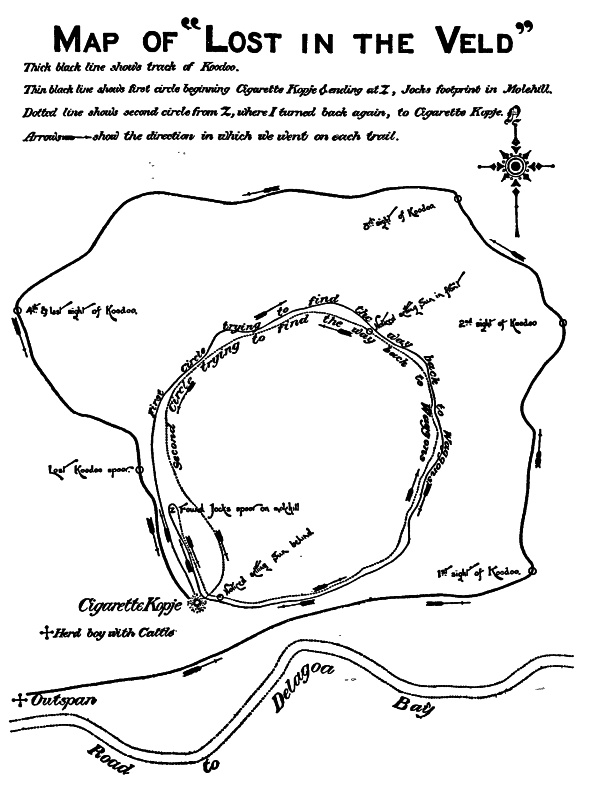
It seems incredible that one could be so near and not see or understand. Why should one walk in circles instead of taking a fairly straight line? How was it possible to pass Cigarette Kopje and not recognise it, for I must have gone within fifty yards or less of it? As for not seeing things, the answer is that the bush does not allow you to see much: the waggons, for instance, might as well have been a hundred miles away. As for Cigarette Kop—things do not look the same unless seen from the same point; moreover there are heaps of things easily visible which you will never see at all because you are looking only for something else: you carry a preconceived idea, a sort of picture in your eye, and everything that does not fit in with that is not noticed—not even seen. As for walking in circles, it is my belief that most people, just like most horses, have a natural leaning or tendency towards one side or the other, and unless checked unconsciously indulge it. When riding in the veld, or any open country, you will notice that some horses will want to take any turn off to the right, others always go to the left, and only very few keep straight on. When out walking you will find that some people cannot walk on your right hand without coming across your front or working you into the gutter; others ‘mule’ you from the left. Get them out in open country, walk briskly, and talk; then give way a little each time they bump you, and in a very little while you will have done the circle. If you have this tendency in the Bushveld, where you cannot see any distant object to make for as a goal, any obstacle straight in front of you throws you off to the side you incline to; any openings in the trees which look like avenues or easy ways draw you; and between any two of them you will always choose the one on your favourite side. Finally, a little knowledge is a dangerous thing in the veld, as elsewhere. When you know enough to recognise marks without being able to identify or locate them—that is, when you know you have seen them before but are not sure of the when and the where—goodness only knows what conclusion you will come to or what you will do.
I had passed Cigarette Kopje, it’s true; but when coming towards it from a new side it must have looked quite different; and besides that, I had not been expecting it, not looking for it, not even thinking of it—had indeed said good-bye to it for ever. When we turned back at the molehill, beginning to do the circle for the second time, we must have passed quite close to Cigarette Kopje again, but again it was from a different opening in the bush, and this time I had thought of nothing and seen nothing except the things I picked out and recognised as we hurried along. To my half-opened beginner’s eyes these things were familiar: we had passed them before; that seemed to be good enough: it must be right; so on we went, simply doing the same circle a second time, but this time the reverse way. The length of my shadow stretching out before me as we started from the molehill was a reminder of the need for haste, and we set off at a smart double. A glance back every few minutes to make sure that we were returning the way we had come was enough, and on we sped, confident for my part that we, were securely on the line of the koodoo and going straight for the waggons.
It is very difficult to say how long this lasted before once more a horrible doubt arose. It was when we had done half the circle that I was pulled up as if struck in the face: the setting sun shining into my eyes as we crossed an open space stopped me; for, as the bright gold-dust light of the sunset met me full, I remembered that it was my long shadow in front of me as we started from the molehill that had urged me to hurry on. We had started due east: we were going dead west! What on earth was wrong? There were the trees and spaces we had passed, a blackened stump, an ant-bear hole; all familiar. What then was the meaning of it? Was it only a temporary swerve? No! I tested that by pushing on further along the track we were following, and it held steadily to the west. Was it then all imagination about having been there before? No, that was absurd! And yet—and yet, as I went on, no longer trotting and full of hope but walking heavily and weighted with doubt, the feeling of uncertainty grew until I really did not know whether the familiar-looking objects and scenes were indeed old acquaintances or merely imagination playing tricks in a country where every style and sample was copied a thousand times over.
A few minutes later I again caught sight of the sunset glow—it was on my direct right: it meant that the trail had taken another turn, while I could have sworn we were holding a course straight as an arrow. It was all a hopeless tangle. I was lost then—and knew it. It was not the dread of a night out in the bush—for after many months of roughing it, that had no great terrors for me—but the helpless feeling of being lost and the anxiety and uncertainty about finding the road again, that gnawed at me and made me feel tucked-up and drawn. I wondered when they would begin to look for me, if they would light big fires and fire shots, and if it would be possible to see or hear the signals. The light would not last much longer; the dimness, the silence, and the hateful doubts about the trail made it more and more difficult to recognise the line; so I thought it was time to fire a signal shot.
There was no answer. It was silly to hope for one; for even if it had been heard they would only have thought that I was shooting at something. Yet the clinging to hope was so strong that every twenty yards or so I stopped to listen for a reply; and when, after what seemed an eternity, none came, I fired another. When you shoot in the excitement of the chase the noise of the report does not strike you as anything out of the way; but a signal shot when you are alone and lost seems to fill the world with sound and to shake the earth itself. It has a most chilling effect, and the feeling of loneliness becomes acute as the echoes die away and still no answer comes.
Another short spell of tip-toe walking and intent listening, and then it came to me that one shot as a signal was useless; I should have fired more and at regular intervals, like minute-guns at sea. I felt in my pocket: there were only four cartridges there and one in the rifle; there was night before me, with the wolves and the lions; there was the food for to-morrow, and perhaps more than to-morrow! There could be no minute-guns: two shots were all that could be spared, and I looked about for some high and open ground where the sound would travel far and wide. On ahead of us to the right the trees seemed fewer and the light stronger; and there I came upon some rising ground bare of bush. It was not much for my purpose, but it was higher than the rest and quite open, and there were some rocks scattered about the top. The same old feeling of mixed remembrance and doubt came over me as we climbed it: it looked familiar and yet different. Was it memory or imagination?
But there was no time for wonderings. From the biggest rock, which was only waist high, I fired off two of my precious cartridges, and stood like a statue listening for the reply. The silence seemed worse than before: the birds had gone to roost; even the flies had disappeared; there was no sound at all but the beat of my own heart and Jock’s panting breath.
There were three cartridges and a few damp matches left. There was no sun to dry them now, but I laid them out carefully on the smooth warm rock, and hoped that one at least would serve to light our camp fire. There was no time to waste: while the light lasted I had to drag up wood for the fire and pick a place for the camp—somewhere where the rocks behind and the fire in front would shelter us from the lions and hyenas, and where I could watch and listen for signals in the night.
There was plenty of wood near by, and thinking anxiously of the damp matches I looked about for dry tindery grass so that any spark would give a start for the fire. As I stooped to look for the grass I came on a patch of bare ground between the scattered tufts, and in the middle of it there lay a half-burnt match; and such a flood of relief and hope surged up that my heart beat up in my throat. Where there were matches there had been men! We were not in the wilds, then, where white men seldom went—not off the beaten track: perhaps not far from the road itself.
You must experience it to know what it meant at that moment. It drew me on to look for more! A yard away I found the burnt end of a cigarette; and before there was time to realise why that should seem queer, I came on eight or ten matches with their heads knocked off.
For a moment things seemed to go round and round. I sat down with my back against the rock and a funny choky feeling in my throat. I knew they were my matches and cigarette, and that we were exactly where we had started from hours before, when we gave up the chase of tie koodoo. I began to understand things then: why places and landmarks seemed familiar; why Jock’s spoor in the molehill had pointed the wrong way; why my shadow was in front and behind and beside me in turns. We had been going round in a circle. I jumped up and looked about me with a fresh light; and it was all clear as noonday then. Why, this was the fourth time we had been on or close to some part of this same rise that day, each time within fifty yards of the same place; it was the second time I had sat on that very rock. And there was nothing odd or remarkable about that either, for each time I had been looking for the highest point to spy from and had naturally picked the rock-topped rise; and I had not recognised it, only because we came upon it from different sides each time and I was thinking of other things all the while.
All at once it seemed as if my eyes were opened and all was clear at last. I knew what to do: just make the best of it for the night; listen for shots and watch for fires; and if by morning no help came in that way, then strike a line due south for the road and follow it up until we found the waggons. It might take all day or even more, but we were sure of water that way and one could do it. The relief of really understanding was so great that the thought of a night out no longer worried me.
There was enough wood gathered, and I stretched out on the grass to rest as there was nothing else to do. We were both tired out, hot, dusty, and very very thirsty; but it was too late to hunt for water then. I was lying on my side chewing a grass stem, and Jock lay down in front of me a couple of feet away. It was a habit of his: he liked to watch my face, and often when I rolled over to ease one side and lie on the other he would get up when he found my back turned to him and come round deliberately to the other side and sling himself down in front of me again. There he would lie with his hind legs sprawled on one side, his front legs straight out, and his head resting on his paws. He would lie like that without a move, his little dark eyes fixed on mine all the time until the stillness and the rest made him sleepy, and he would blink and blink, like a drowsy child, fighting against sleep until it beat him; and then—one long-drawn breath as he rolled gently over on his side, and Jock was away in Snoozeland.
In the loneliness of that evening I looked into his steadfast resolute face with its darker muzzle and bright faithful eyes that looked so soft and brown when there was nothing to do but got so beady black when it came to fighting. I felt very friendly to the comrade who was little more than a puppy still; and he seemed to feel something too; for as I lay there chewing the straw and looking at him, he stirred his stump of a tail in the dust an inch or so from time to time to let me know that he understood all about it and that it was all right as long as we were together.
But an interruption came. Jock suddenly switched up his head, put it a bit sideways as a man would do, listening over his shoulder with his nose rather up in the air. I watched him, and thinking that it was probably only a buck out to feed in the cool of the evening, I tickled his nose with the long straw, saying, “No good, old chap; only three cartridges left. We must keep them.”
No dog likes to have his nose tickled: it makes them sneeze; and many dogs get quite offended, because it hurts their dignity. Jock was not offended, but he got up and, as if to show me that I was frivolous and not attending properly to business, turned away from me and with his ears cocked began to listen again.
He was standing slightly in front of me and I happened to notice his tail: it was not moving; it was drooping slightly and perfectly still, and he kept it like that as he stepped quietly forward on to another sloping rock overlooking a side where we had not yet been. Evidently there was something there, but he did not know what, and he wanted to find out.
I watched him, much amused by his calm businesslike manner. He walked to the edge of the rock and looked out: for a few minutes he stood stock-still with his ears cocked and his tail motionless; then his ears dropped and his tail wagged gently from side to side.
Something—an instinct or sympathy quickened by the day’s experience, that I had never quite known before—taught me to understand, and I jumped up, thinking, “He sees something that he knows: he is pleased.” As I walked over to him, he looked back at me with his mouth open and tongue out, his ears still down and tail wagging—he was smiling all over, in his own way. I looked out over his head, and there, about three hundred yards off, were the oxen peacefully grazing and the herd boy in his red coat lounging along behind them.
Shame at losing myself and dread of the others’ chaff kept me very quiet, and all they knew for many months was that we had had a long fruitless chase after koodoo and hard work to get back in time.
I had had my lesson, and did not require to have it rubbed in and be roasted as Buggins had been. Only Jock and I knew all about it; but once or twice there were anxious nervous moments when it looked as if we were not the only ones in the secret. The big Zulu driver, Jim Makokel’—always interested in hunting and all that concerned Jock—asked me as we were inspanning what I had fired the last two shots at; and as I pretended not to hear or to notice the question, he went on to say how he had told the other boys that it must have been a klipspringer on a high rock or a monkey or a bird because the bullets had whistled over the waggons. I told him to inspan and not talk so much, and moved round to the other side of the waggon.
That night I slept hard, but woke up once dreaming that several lions were looking down at me from the top of a big flat rock and Jock was keeping them off.
Jock was in his usual place beside me, lying against my blankets. I gave him an extra pat for the dream, thinking, “Good old boy; we know all about it, you and I, and we’re not going to tell. But we’ve learned some things that we won’t forget.” And as I dropped off to sleep again I felt a few feeble sleepy pats against my leg, and knew it was Jock’s tail wagging “Good night.”
Chapter Nine.
The Impala Stampede.
Not all our days were spent in excitement—far far from it. For six or seven months the rains were too heavy, the heat too great, the grass too rank, and the fever too bad in the Bushveld for any one to do any good there; so that for more than half of the year we had no hunting to speak of, as there was not much to be done above the Berg. But even during the hunting season there were many off-days and long spells when we never fired a shot. The work with the waggons was hard when we had full loads, the trekking slow and at night, so that there was always something to do in the daytime—repairs to be done, oxen to be doctored, grass and water to be looked for, and so on; and we had to make up sleep when we could. Even when the sport was good and the bag satisfactory there was usually nothing new to tell about it. So Jock and I had many a long spell when there was no hunting, many a bad day when we worked hard but had no sport, and many a good day when we got what we were after and nothing happened that would interest any one else. Every hunt was exciting and interesting for us, even those in which we got nothing; indeed some of the most interesting were those in which the worst disappointments occurred, when after hard work and long chases the game escaped us. To tell all that happened would be to tell the same old story many times over; but indeed, it would not be possible to tell all, for there were some things—the most interesting of all, perhaps—which only Jock knew.
After the fight with the duiker there was never any doubt as to what he would do if allowed to follow up a wounded animal. It made a deal of difference in the hunting to know that he could be trusted to find it and hold on or bay it until I could get up. The bush was so thick that it was not possible to see more than a very few hundred yards at best, and the country was so dry and rough that if a wounded animal once got out of sight only an expert tracker had any chance of finding it again. Jock soon showed himself to be better than the best of trackers, for besides never losing the trail he would either pull down the buck or, if too big for that, attack and worry even the biggest of them to such an extent that they would have to keep turning on him to protect themselves and thus give me the chance to catch up.
But the first result of my confidence in him was some perfectly hopeless chases. It is natural enough to give oneself the benefit of any doubt; the enthusiastic beginner always does so, and in his case the lack of experience often creates a doubt where none should have existed; and the doubt is often very welcome, helping him out with explanations of the unflattering facts. For the listener it is, at best and worst, only amusing or tiresome; but for the person concerned it is different—for, as Rocky said, ‘It don’t fool any one worth speakin’ of ’cept yerself.’ And ‘there’s the rub.’ Whenever a bullet struck with a thud, and no dust appeared to show that it had hit the ground, I thought that it must have wounded the buck; and once you get the idea that the buck is hit, all sorts of reasons appear in support of it. There is hardly anything that the buck can do which does not seem to you to prove that it is wounded. It bounds into the air, races off suddenly, or goes away quite slowly; it switches its tail or shakes its head; it stops to look back, or does not stop at all; the spoor looks awkward and scrappy; the rust on the grass looks like dry blood. If you start with a theory instead of weighing the evidence all these things will help to prove that theory: they will, in fact, mean exactly what you want them to mean. You ‘put up a job on yerself’—to quote Rocky again—and with the sweat of your brow and vexation of spirit you have to work that job out.
Poor old Jock had a few hard chases after animals which I thought were wounded but were not hit at all—not many, however, for he soon got hold of the right idea and was a better judge than his master. He went off the instant he was sent, but if there was nothing wounded—that is, if he could not pick up a ‘blood spoor’—he would soon show it by casting across the trail, instead of following hard on it; and I knew then there was nothing in it. Often he would come back of his own accord, and there was something quite peculiar in his look when he returned from these wild-goose chases that seemed to say, “No good: you were quite wrong. You missed the whole lot of them.” He would come up to me with his mouth wide-open and tongue out, a bit blown, and stand still with his front legs wide apart, looking up at me with that nothing-in-it sort of look in his eyes and not a movement in his ears or tail and never a turn of his head to show the least interest in anything else. I got to know that look quite well; and to me it meant, “Well, that job was a failure—finished and done for. Now is there anything else you can think of?”
What always seemed to me so curious and full of meaning was that he never once looked back in the direction of the unwounded game, but seemed to put them out of his mind altogether as of no further interest. It was very different when he got on to the trail of a wounded buck and I had to call him off, as was sometimes necessary when the chase looked hopeless or it was too late to go further. He would obey, of course—no amount of excitement made him forget that; but he would follow me in a sort of sideways trot, looking back over his shoulder all the time, and whenever there was a stop, turning right round and staring intently in the direction of the game with his little tail moving steadily from side to side and his hind legs crouched as if ready to spring off the instant he got permission.
Twice I thought he was lost for ever through following wounded game. The first occasion was also the first time that we got among the impala and saw them in numbers. There is no more beautiful and fascinating sight than that of a troop of impala or springbuck really on the move and jumping in earnest. The height and distance that they clear is simply incredible. The impala’s greater size and its delicate spiral horns give it a special distinction; the springbuck’s brilliant white and red, and the divided crest which fans out along the spine when it is excited, are unique. But who can say which of the many beautiful antelopes is the most beautiful? The oldest hunter will tell you of first one, then another, and then another, as they come to mind, just as he saw them in some supreme unforgettable moment; and each at that moment has seemed quite the most beautiful animal in the world.
It is when they are jumping that the impala are seen at their best. No one knows what they really can do, for there are no fences in their country by which to judge or guess, and as they run in herds it is practically impossible ever to find the take-off or landing-place of any single animal. Once when hunting along the Wenhla Mohali River we managed to turn seven of them into an old run ending in a rocky gorge; but suspecting danger they would not face the natural outlet, and turning up the slope cleared a barrier of thick thorn scrub and escaped. When we looked at the place afterwards we found that the bushes were nine feet high. We were not near enough to see whether they touched the tops or cleared them; all we were sure of was that they did not hesitate for a second to face a jump nine feet high at the top of a sharp rise, and that all seven did it in follow-my-leader order with the most perfect ease and grace.
Every hunter has seen a whole troop, old and young, following the example of the leader, clear a road or donga twenty feet wide, apparently in an effortless stride. It is a fine sight, and the steady stream of buck makes an arch of red and white bodies over the road looking like the curve of a great wave. You stand and watch in speechless admiration; and the first gasp at a glorious leap is followed by steady silent wonder at the regularity of the numbers. Then suddenly you see one animal—for no apparent reason: it may be fright or it may be frolic—take off away back behind the others, shoot up, and sail high above the arch of all the rest, and with head erect and feet comfortably gathered, land far beyond them—the difference between ease and effort, and oh! the perfect grace of both! Something is wrung from you—a word, a gasp—and you stand breathless with wonder and admiration until the last one is gone. You have forgotten to shoot; but they have left you something better than a trophy, something which time will only glorify—a picture that in daylight or in dark will fill your mind whenever you hear the name Impala.
Something of this I carried away from my first experience among them. There were a few minutes of complete bewilderment, a scene of the wildest confusion, and flashes of incident that go to make a great picture which it is impossible to forget. But then there followed many hours of keen anxiety when I believed that Jock was gone for ever; and it was long before that day found its place in the gallery of happy memories.
We had gone out after breakfast, striking well away from the main road until we got among the thicker thorns where there was any amount of fresh spoor and we were quite certain to find a troop sooner or later. The day was so still, the ground so dry, and the bush so thick that the chances were the game would hear us before we could get near enough to see them. Several times I heard sounds of rustling bush or feet cantering away: something had heard us and made off unseen; so I dropped down into the sandy bed of a dry donga and used it as a stalking trench. From this it was easy enough to have a good look around every hundred yards or so without risk of being heard or seen. We had been going along cautiously in this way for some time when, peering over the bank, I spied a single impala half hidden by a scraggy bush. It seemed queer that there should be only one, as their habit is to move in troops; but there was nothing else to be seen; indeed it was only the flicker of an ear on this one that had caught my eye. Nothing else in the land moved.
Jock climbed the bank also, following so closely that he bumped against my heels, and when I lay flat actually crawled over my legs to get up beside me and see what was on. Little by little he got into the way of imitating all I did, so that after a while it was hardly necessary to say a word or make a sign to him. He lay down beside me and raised his head to look just as he saw me do. He was all excitement, trembling like a wet spaniel on a cold day, and instead of looking steadily at the impala as I was doing and as he usually did, he was looking here there and everywhere; it seemed almost as if he was looking at things—not for them. It was my comfortable belief at the moment that he had not yet spotted the buck, but was looking about anxiously to find out what was interesting me. It turned out, as usual, that he had seen a great deal more than his master had.
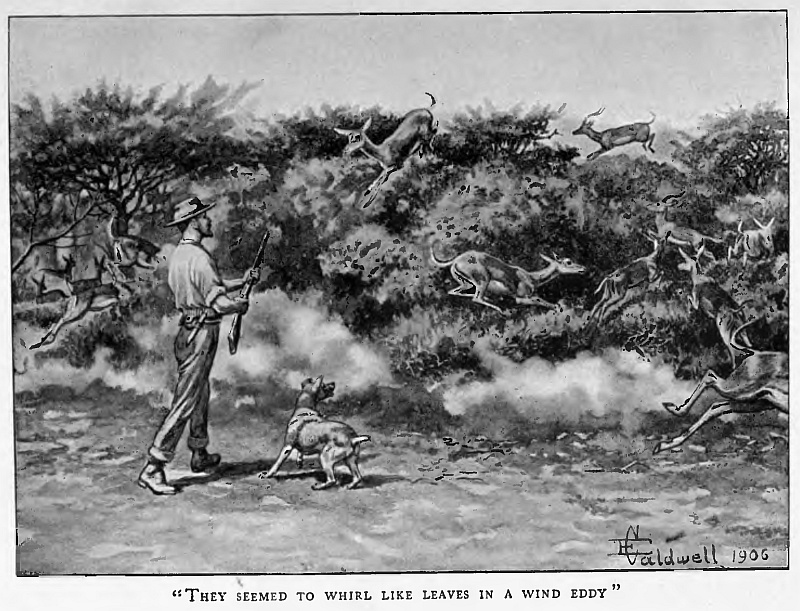
The stalking looked very easy, as a few yards further up the donga there was excellent cover in some dense thorns, behind which we could walk boldly across open ground to within easy range of the buck and get a clear shot. We reached the cover all right, but I had not taken three steps into the open space beyond before there was a rushing and scrambling on every side of me. The place was a whirlpool of racing and plunging impala; they came from every side and went in every direction as though caught suddenly in an enclosure and, mad with fear and bewilderment, were trying to find a way out. How many there were it was quite impossible to say: the bush was alive with them; and the dust they kicked up, the noise of their feet, their curious sneezy snorts, and their wild confusion completely bewildered me. Not one stood still. Never for a moment could I see any single animal clearly enough or long enough to fire at it; another would cross it; a bush would cover it as I aimed; or it would leap into the air, clearing bushes, bucks and everything in its way, and disappear again in the moving mass. They seemed to me to whirl like leaves in a wind eddy: my eyes could not follow them and my brain swam as I looked.
It was a hot day; there was no breeze at all; and probably the herd had been resting after their morning feed and drink when we came upon them. By creeping up along the donga we had managed to get unobserved right into the middle of the dozing herd, so they were literally on every side of us. At times it looked as if they were bound to stampede over us and simply trample us down in their numbers; for in their panic they saw nothing, and not one appeared to know what or where the danger was. Time and again, as for part of a second I singled one out and tried to aim, others would come racing straight for us, compelling me to switch round to face them, only to find them swerve with a dart or a mighty bound when within a few paces of me.
What Jock was doing during that time I do not know. It was all such a whirl of excitement and confusion that there are only a few clear impressions left on my mind. One is of a buck coming through the air right at me, jumping over the backs of two others racing across my front. I can see now the sudden wriggle of its body and the look of terror in its eyes when it saw me and realised that it was going to land almost at my feet. I tried to jump aside, but it was not necessary: with one touch on the ground it shot slantingly past me like a ricochet bullet. Another picture that always comes back is that of a splendid ram clearing the first of the dense thorn bushes that were to have been my cover in stalking. He flew over it outlined against the sky in the easiest most graceful and most perfect curve imaginable. It came back to me afterwards that he was eight or ten yards from me, and yet I had to look up into the sky to see his white chest and gracefully gathered feet as he cleared the thorn bush like a soaring bird.
One shot, out of three or four fired in desperation as they were melting away, hit something; the unmistakable thud of the bullet told me so. That time it was the real thing, and when you hear the real thing you cannot mistake it. The wounded animal went off with the rest and I followed, with Jock ahead of me hot on the trail. A hundred yards further on where Jock with his nose to the ground had raced along between some low stones and a marula tree I came to a stop—bush all round me, not a living thing in sight, and all as silent as the grave. On one of the smooth hot stones there was a big drop of blood, and a few yards on I found a couple more. Here and there along the spoor there were smears on the long yellow grass, and it was clear enough, judging by the height of the blood-marks from the ground, that the impala was wounded in the body—probably far back, as there were no frothy bubbles to show a lung shot. I knew that it would be a long chase unless Jock could head the buck off and bay it; but unless he could do this at once, he was so silent in his work that there was little chance of finding him. The trail became more and more difficult to follow; the blood was less frequent, and the hot sun dried it so quickly that it was more than I could do to pick it out from the red streaks on the grass and many-coloured leaves. So I gave it up and sat down to smoke and wait.
Half an hour passed, and still no Jock. Then I wandered about whistling and calling for him—calling until the sound of my own voice became quite uncanny, the only sound in an immense silence. Two hours passed in useless calling and listening, searching and waiting, and then I gave it up altogether and made back for the waggons, trying to hope against my real conviction that Jock had struck the road somewhere and had followed it to the outspan, instead of coming back on his own trail through the bush to me.
But there was no Jock at the waggons; and my heart sank, although I was not surprised. It was nearly four hours since he had disappeared, and it was as sure as anything could be that something extraordinary must have happened or he would have come back to me long before this. No one at the waggons had seen him since we started out together; and there was nothing to be done but to wait and see what would happen. It was perfectly useless to look for him: if alive and well, he was better able to find his way than the best tracker that ever lived; if dead or injured and unable to move, there was not one chance in a million of finding him.
There was only one kaffir whom Jock would take any notice of or would allow to touch him—a great big Zulu named Jim Makokel’. Jim was one of the real fighting Zulu breed; and the pride he took in Jock, and the sort of partnership that he claimed in tastes, disposition and exploits, began the day Jock fought the table-leg and grew stronger and stronger to the end. Jim became Jock’s devoted champion, and more than once, as will be seen, showed that he would face man or beast to stand by him when he needed help.
This day when I returned to the waggons Jim was sitting with the other drivers in the group round the big pot of porridge. I saw him give one quick look my way and heard him say sharply to the others, “Where is the dog? Where is Jock?” He stood there looking at me with a big wooden spoon full of porridge stopped on the way to his mouth. In a few minutes they all knew what had happened; the other boys took it calmly, saying composedly that the dog would find his way back. But Jim was not calm: it was not his nature. At one moment he would agree with them, swamping them with a flood of reasons why Jock, the best dog in the world, would be sure to come back; and the next—hot with restless excitement—would picture all that the dog might have been doing and all that he might still have to face, and then break off to proclaim loudly that every one ought to go out and hunt for him. Jim was not practical or reasonable—he was too excitable for that; but he was very loyal, and it was his way to show his feelings by doing something—generally and preferably by fighting some one. Knowing only too well how useless it would be to search for Jock, I lay down under the waggon to rest and wait.
After half an hour of this Jim could restrain himself no longer. He came over to where I lay and with a look of severe disapproval and barely controlled indignation, asked me for a gun, saying that he himself meant to go out and look for Jock. It would be nearer the mark to say that he demanded a gun. He was so genuinely anxious and so indignant at what he considered my indifference that it was impossible to be angry; and I let him talk away to me and at me in his exciting bullying way. He would take no answer and listen to no reason; so finally to keep him quiet I gave him the shot gun, and off he went, muttering his opinions of every one else—a great springy striding picture of fierce resolution.
He came back nearly three hours later, silent, morose, hot and dusty. He put the gun down beside me without a word—just a click of disgust; and as he strode across to his waggon, called roughly to one of the drivers for the drinking water. Lifting the bucket to his mouth he drank like an ox and slammed it down again without a word of thanks; then sat down in the shade of the waggon, filled his pipe, and smoked in silence.
The trekking hour came and passed; but we did not move. The sun went down, and in the quiet of the evening we heard the first jackal’s yapping—the first warning of the night. There were still lions and tigers in those parts, and any number of hyenas and wild dogs, and the darker it grew and the more I thought of it, the more hopeless seemed Jock’s chance of getting through a night in the bush trying to work his way back to the waggons.
It was almost dark when I was startled by a yell from Jim Makokel’, and looking round, saw him bound out into the road shouting, “He has come, he has come! What did I tell you?” He ran out to Jock, stooping to pat and talk to him, and then in a lower voice and with growing excitement went on rapidly, “See the blood! See it! He has fought: he has killed! Dog of all dogs! Jock, Jock!” and his savage song of triumph broke off in a burst of rough tenderness, and he called the dog’s name five or six times with every note of affection and welcome in his deep voice. Jock took no notice of Jim’s dancing out to meet him, nor of his shouts, endearments and antics; slowing his tired trot down to a walk, he came straight on to me, flickered his ears a bit, wagged his tail cordially, and gave my hand a splashy lick as I patted him. Then he turned round in the direction he had just come from, looked steadily out, cocked his ears well up, and moved his tail slowly from side to side. For the next half-hour or so he kept repeating this action every few minutes; but even without that I knew that it had been no wild-goose chase, and that miles away in the bush there was something lying dead which he could show me if I would but follow him back again to see.
What had happened in the eight hours since he had dashed off in pursuit can only be guessed. That he had pulled down the impala and killed it seemed certain—and what a chase and what a fight it must have been to take all that time! The buck could not have been so badly wounded in the body as to be disabled or it would have died in far less time than that: then, what a fight it must have been to kill an animal six or eight times his own weight and armed with such horns and hoofs! But was it only the impala? or had the hyenas and wild dogs followed up the trail, as they so often do, and did Jock have to fight his way through them too?
He was hollow-flanked and empty, parched with thirst, and so blown that his breath still caught in suffocating chokes. He was covered with blood and sand; his beautiful golden coat was dark and stained; his white front had disappeared; and there on his chest and throat, on his jaws and ears, down his front legs even to the toes, the blood was caked on him—mostly black and dried but some still red and sticky. He was a little lame in one fore leg, but there was no cut or swelling to show the cause. There was only one mark to be seen: over his right eye there was a bluish line where the hair had been shaved off clean, leaving the skin smooth and unbroken. What did it? Was it horn, hoof, tooth, or—what? Only Jock knew.
Hovering round and over me, pacing backwards and forwards between the waggons like a caged animal, Jim, growing more and more excited, filled the air with his talk his shouts and savage song. Wanting to help, but always in the way, ordering and thrusting the other boys here and there, he worked himself up into a wild frenzy: the Zulu fighting blood on fire and he ‘saw red’ everywhere.
I called for water. “Water!” roared Jim, “bring water”; and glaring round he made a spring—stick in hand—at the nearest kaffir. The boy fled in terror, with Jim after him for a few paces, and brought a bucket of water. Jim snatched it from him and with a resounding thump on the ribs sent the unlucky kaffir sprawling on the ground. Jock took the water in great gulpy bites broken by pauses to get his breath again; and Jim paced up and down—talking, talking, talking! Talking to me, to the others, to the kaffirs, to Jock, to the world at large, to the heavens, and to the dead. His eyes glared like a wild beast’s and gradually little seams of froth gathered in the corners of his mouth as he poured out his cataract of words, telling of all Jock had done and might have done and would yet do; comparing him with the fighting heroes of his own race, and wandering off into vivid recitals of single episodes and great battles; seizing his sticks, shouting his war cries, and going through all the mimicry of fight with the wild frenzy of one possessed. Time after time I called him and tried to quiet him; but he was beyond control.
Once before he had broken out like this. I had asked him something about the Zulu war; and that had started a flood of memories and excitement. In the midst of some description I asked why they killed the children; and he turned his glaring eyes on me a and said, “Inkos, you are my Inkos; but you are white. If we fight to-morrow, I will kill you. You are good to me, you have saved me; but if our own king says ‘Kill!’ we kill! We see red; we kill all that lives. I must kill you, your wife, your mother, your children, your horses, your oxen, your dog, the fowls that run with the waggons—all that lives I kill. The blood must run.” And I believed him; for that was the Zulu fighting spirit. So this time I knew it was useless to order or to talk: he was beyond control, and the fit must run its course.
The night closed in and there was quiet once more. The flames of the camp fires had died down; the big thorn logs had burnt into glowing coals like the pink crisp hearts of giant water-melons; Jock lay sleeping, tired out, but even in his sleep came little spells of panting now and then, like the after-sobs of a child that has cried itself to sleep; we lay rolled in our blankets, and no sound came from where the kaffirs slept. But Jim—only Jim—sat on his rough three-legged stool, elbows on knees and hands clasped together, staring intently into the coals. The fit worked slowly off, and his excitement died gradually away; now and then there was a fresh burst, but always milder and at longer intervals, as you may see it in a dying fire or at the end of a great storm; slowly but surely he subsided until at last there were only occasional mutterings of “Ow, Jock!” followed by the Zulu click, the expressive shake of the head, and that appreciative half grunt, half chuckle, by which they pay tribute to what seems truly wonderful. He wanted no sleep that night: he sat on, waiting for the morning trek, staring into the red coals, and thinking of the bygone glories of his race in the days of the mighty Chaka.