Sir Percy FitzPatrick (continued 4)
Reading edition
That was Jim, when the fit was on him—transported by some trifling and unforeseen incident from the hum-drum of the road to the life he once had lived with splendid recklessness.
Chapter Ten.
Jock’s Night Out.
Jock was lost twice: that is to say, he was lost to me, and, as I thought, for ever. It came about both times through his following up wounded animals and leaving me behind, and happened in the days when our hunting was all done on foot; when I could afford a horse and could keep pace with him that difficulty did not trouble us. The experience with the impala had made me very careful not to let him go unless I felt sure that the game was hard hit and that he would be able to pull it down or bay it. But it is not always easy to judge that. A broken leg shows at once; but a body shot is very difficult to place, and animals shot through the lungs, and even through the lower part of the heart, often go away at a cracking pace and are out of sight in no time, perhaps to keep it up for miles, perhaps to drop dead within a few minutes.
After that day with the impala we had many good days together and many hard ones: we had our disappointments, but we had our triumphs; and we were both getting to know our way about by degrees. Buck of many kinds had fallen to us; but so far as I was concerned there was one disappointment that was not to be forgotten. The picture of that koodoo bull as he appeared for the last time looking over the ant-heap the day we were lost was always before me. I could not hear the name or see the spoor of koodoo without a pang of regret and the thought that never again would such a chance occur. Koodoo, like other kinds of game, were not to be found everywhere; they favoured some localities more than others, and when we passed through their known haunts chances of smaller game were often neglected in the hope of coming across the koodoo.
I could not give up whole days to hunting—for we had to keep moving along with the waggons all the time—or it would have been easy enough in many parts to locate the koodoo and make sure of getting a good bag. As it was, on three or four occasions we did come across them, and once I got a running shot, but missed. This was not needed to keep my interest in them alive, but it made me keener than ever. Day by day I went out always hoping to get my chance, and when at last the chance did come it was quite in accordance with the experience of many others that it was not in the least expected.
The great charm of Bushveld hunting is its variety: you never know what will turn up next—the only certainty being that it will not be what you are expecting.
The herd boy came noon to say that there buck feeding among the oxen only a couple of hundred yards away. He had been quite close to it, he said, and it was very tame. Game, so readily alarmed by the sight of white men, will often take no notice of natives, allowing them to approach to very close quarters. They are also easily stalked under cover of cattle or horses, and much more readily approached on horseback than on foot. The presence of other animals seems to give them confidence or to excite mild curiosity without alarm, and thus distract attention from the man. In this case the bonny little red-brown fellow was not a bit scared; he maintained his presence of mind admirably; from time to time he turned his head our way and, with his large but shapely and most sensitive ears thrown forward examined us frankly while he moved slightly one way or another so as to keep under cover of the oxen and busily continue his browsing.
In and out among some seventy head of cattle we played hide-and-seek for quite a while—I not daring to fire for fear of hitting one of the bullocks—until at last he found himself manoeuvred out of the troop; and then without giving me a chance he was off into the bush in a few frisky skips. I followed quietly, knowing that as he was on the feed and not scared he would not go far.
Moving along silently under good cover I reached a thick scrubby bush and peered over the top of it to search the grass under the surrounding thorn-trees for the little red-brown form. I was looking about low down in the russety grass—for he was only about twice the size of Jock, and not easy to spot—when a movement on a higher level caught my eye. It was just the flip of a fly-tickled ear; but it was a movement where all else was still, and instantly the form of a koodoo cow appeared before me as a picture is thrown on a screen by a magic-lantern. There it stood within fifty yards, the soft grey-and-white looking still softer in the shadow of the thorns, but as clear to me—and as still—as a figure carved in stone. The stem of a mimosa hid the shoulders, but all the rest was plainly visible as it stood there utterly unconscious of danger. The tree made a dead shot almost impossible, but the risk of trying for another position was too great, and I fired. The thud of the bullet and the tremendous bound of the koodoo straight up in the air told that the shot had gone home; but these things were for a time forgotten in the surprise that followed. At the sound of the shot twenty other koodoo jumped into life and sight before me. The one I had seen and shot was but one of a herd all dozing peacefully in the shade, and strangest of all, it was the one that was farthest from me. To the right and left of this one, at distances from fifteen to thirty yards from me, the magnificent creatures had been standing, and I had not seen them; it was the flicker of this one’s ear alone that had caught my eye. My bewilderment was complete when I saw the big bull of the herd start off twenty yards on my right front pass away like a streak in a few sweep-strides. It was a matter of seconds and they were all out of sight—all except the wounded one, which had turned off from the others. For all the flurry and confusion I had not lost sight of her, and noting her tucked-up appearance and shortened strides set Jock on her trail, believing that she would be down in a few minutes.
It is not necessary to go over it all again: it was much the same as the impala chase. I came back tired, disappointed and beaten, and without Jock. It was only after darkness set in that things began to look serious. When it came to midnight, with the camp wrapped in silence and in sleep, and there was still no sign of Jock, things looked very black indeed.
I heard his panting breath before it was possible to see anything. It was past one o’clock when he returned.
As we had missed the night trek to wait for Jock I decided to stay on where we were until the next evening and to have another try for the wounded koodoo, with the chance of coming across the troop again.
By daybreak Jock did not seem much the worse for his night’s adventures—whatever they were. There were no marks of blood on him this time; there were some scratches which might have been caused by thorns during the chase, and odd-looking grazes on both hind quarters near the hip-bones, as though he had been roughly gravelled there. He seemed a little stiff, and flinched when I pressed his sides and muscles, but he was as game as ever when he saw the rifle taken down.
The koodoo had been shot through the body, and even without being run to death by Jock must have died in the night, or have lain down and become too cold and stiff to move. If not discovered by wild animals there was a good chance of finding it untouched in the early morning; but after sunrise every minute’s delay meant fresh risk from the aasvogels. There is very little which, if left uncovered, will escape their eyes. You may leave your buck for help to bring the meat in, certain from the most careful scrutiny that there is not one of these creatures in sight, and return in half an hour to find nothing but a few bones, the horns and hoofs, a rag of skin, and a group of disgusting gorged vultures squatting on a patch of ground all smeared, torn and feather-strewn from their voracious struggles.
In the winter sky unrelieved by the least fleck of cloud—a dome of spotless polished steel—nothing, you would think, can move unseen. Yet they are there. In the early morning, from their white-splashed eeries on some distant mountain they slide off like a launching ship into their sea of blue, and, striking the currents of the upper air, sweep round and upwards in immense circles, their huge motionless wings carrying them higher and higher until they are lost to human sight. Lie on your back in some dense shade where no side-lights strike in, but where an opening above forms a sort of natural telescope to the sky, and you may see tiny specks where nothing could be seen before. Take your field-glasses: the specks are vultures circling up on high! Look again, and far, far above you will see still other specks; and for aught you know, there may be others still beyond. How high are they? And what can they see from there? Who knows? But this is sure, that within a few minutes scores will come swooping down in great spiral rushes where not one was visible before. My own belief is that they watch each other, tier above tier away into the limitless heavens—watching jealously, as hungry dogs do, for the least suspicious sign—to swoop down and share the spoil.
In the dewy cool of the morning we soon reached the place where Jock had left me behind the evening before; and from that on he led the way. It was much slower work then; as far as I was concerned, there was nothing to guide me, and it was impossible to know what he was after. Did he understand that it was not fresh game but the wounded koodoo that I wanted? And, if so, was he following the scent of the old chase or merely what he might remember of the way he had gone? It seemed impossible that scent could lie in that dry country for twelve hours; yet it was clearly nose more than eyes that guided him. He went ahead soberly and steadily, and once when he stopped completely, to sniff at a particular tuft of grass, I found out what was helping him. The grass was well streaked with blood: quite dry, it is true; still it was blood.
A mile or so on we checked again where the grass was trampled and the ground scored with spoor. The heavy spoor was all in a ring four or five yards in diameter; outside this the grass was also flattened, and there I found a dog’s footprints. But it had no further interest for Jock; while I was examining it he picked up the trail and trotted on. We came upon four or five other rings where they had fought. The last of these was curiously divided by a fallen tree, and it puzzled me to guess how they could have made a circle with a good-sized trunk some two feet high intersecting it. I examined the dead tree and found a big smear of blood and a lot of coarse greyish hair on it. Evidently the koodoo had backed against it whilst facing Jock and had fallen over it, renewing the fight on the other side. There were also some golden hairs sticking on the stumpy end of a broken branch, which may have had something to do with Jock’s scraped sides.
Then for a matter of a hundred yards or more it looked as if they had fought and tumbled all the way. Jock was some distance ahead of me, trotting along quietly, when I saw him look up, give that rare growling bark of his—one of suppressed but real fury—lower his head, and charge. Then came heavy flapping and scrambling and the wind of huge wings, as twenty or thirty great lumbering aasvogels flopped along the ground with Jock dashing furiously about among them—taking flying leaps at them as they rose, and his jaws snapping like rat-traps as he missed them.
On a little open flat of hard-baked sand lay the stripped frame of the koodoo: the head and leg-bones were missing; meat-stripped fragments were scattered all about; fifty yards away among some bushes Jock found the head; and still further afield were remains of skin and thigh-bones crushed almost beyond recognition.
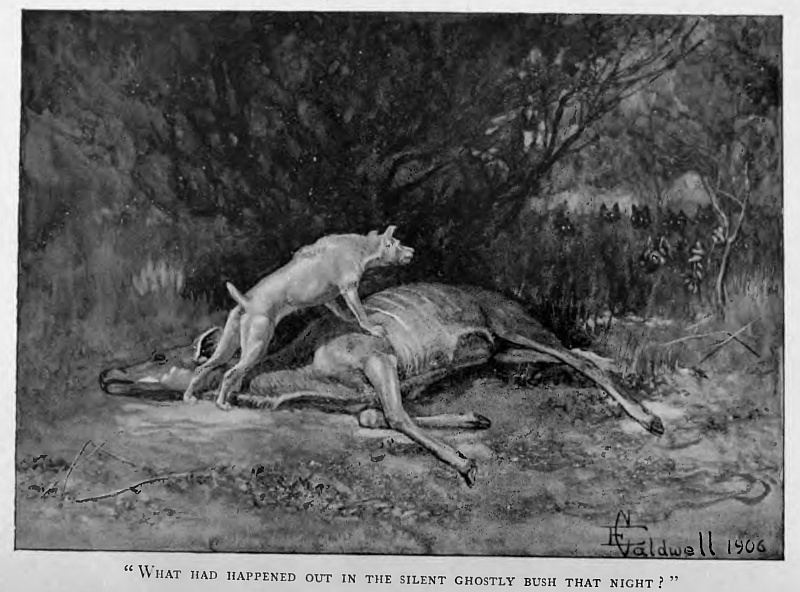
No aasvogel had done this: it was hyenas’ work. The high-shouldered slinking brute, with jaws like a stone-crusher, alone cracks bones like those and bigger ones which even the lion cannot tackle. I walked back a little way and found the scene of the last stand, all harrowed bare; but there was no spoor of koodoo or of Jock to be seen there—only prints innumerable of wild dogs, hyenas and jackals, and some traces of where the carcase, no doubt already half-eaten, had been dragged by them in the effort to tear it asunder.
Jock had several times shown that he strongly objected to any interference with his quarry; other dogs, kaffirs, and even white men, had suffered or been badly scared for rashly laying hands on what he had pulled down. Without any doubt he had expected to find the koodoo there and had dealt with the aasvogels as trespassers; otherwise he would not have tackled them without word from me. It was also sure that until past midnight he had been there with the koodoo, watching or fighting. Then when had the hyenas and wild dogs come? That was the question I would have given much to have had answered. But only Jock knew that!
I looked at him. The mane on his neck and shoulders which had risen at the sight of the vultures was not flat yet; he was sniffing about slowly and carefully on the spoor of the hyenas and wild dogs; and he looked ‘fight’ all over. But what it all meant was beyond me; I could only guess—just as you will—what had happened out in the silent ghostly bush that night.
Chapter Eleven.
The Koodoo Bull.
Jock had learned one very clever trick in pulling down wounded animals. It often happens when you income unexpectedly upon game that they are off before you see them, and the only chance you have of getting anything is with a running shot. If they go straight from you the shot is not a very difficult one, although you see nothing but the lifting and falling hind quarters as they canter away; and a common result of such a shot is the breaking of one of the hind legs between the hip and the hock. Jock made his discovery while following a rietbuck which I had wounded in this way. He had made several tries at its nose and throat, but the buck was going too strongly and was out of reach; moreover it would not stop or turn when he headed it, but charged straight on, bounding over him. In trying once more for the throat he cannoned against the buck’s shoulder and was sent rolling yards away. This seemed to madden him: racing up behind he flew at the dangling leg, caught it at the shin, and thrusting his feet well out, simply dragged until the buck slowed down, and then began furiously tugging sideways. The crossing of the legs brought the wounded animal down immediately and Jock had it by the throat before it could rise again.
Every one who is good at anything has some favourite method or device of his own: that was Jock’s. It may have come to him, as it comes to many, by accident; but having once got it, he perfected it and used it whenever it was possible. Only once he made a mistake; and he paid for it—very nearly with his life.
He had already used this device successfully several times, but so far only with the smaller buck. This day he did what I should have thought to be impossible for a dog of three or four times his size. I left the scene of torn carcase and crunched bones, consumed by regrets and disappointment; each fresh detail only added to my feeling of disgust, but Jock did not seem to mind; he jumped out briskly as soon as I started walking in earnest, as though he recognised that we were making a fresh start, and he began to look forward immediately.
The little bare flat where the koodoo had fallen for the last time was at the head of one of those depressions which collect the waters of the summer floods and, changing gradually into shallow valleys, are eventually scoured out and become the dongas—dry in winter but full charged with muddy flood in summer—which drain the Bushveld to its rivers. Here and there where an impermeable rock formation crosses these channels there are deep pools which, except in years of drought, last all through the winter; and these are the drinking-places of the game. I followed this one down for a couple of miles without any definite purpose until the sight of some greener and denser wild figs suggested that there might be water, and perhaps a rietbuck or a duiker near by. As we reached the trees Jock showed unmistakable signs of interest in something, and with the utmost caution I moved from tree to tree in the shady grove towards where it seemed the water-hole might be.
There were bushy wild plums flanking the grove, and beyond them the ordinary scattered thorns. As I reached this point, and stopped to look out between the bushes on to the more open ground, a koodoo cow walked quietly up the slope from the water, but before there was time to raise the rifle her easy stride had carried her behind a small mimosa tree. I took one quick step out to follow her up and found myself face to face at less than a dozen yards with a grand koodoo bull. It is impossible to convey in words any real idea of the scene and how things happened. Of course, it was only for a fraction of a second that we looked straight into each other’s eyes; then, as if by magic, he was round and going from me with the overwhelming rush of speed and strength and weight combined. Yet it is the first sight that remains with me: the proud head, the huge spiral horns, and the wide soft staring eyes—before the wildness of panic had stricken them. The picture seems photographed on eye and brain, never to be forgotten. A whirlwind of dust and leaves marked his course, and through it I fired, unsteadied by excitement and hardly able to see. Then the right hind leg swung out, and the great creature sank for a moment, almost to the ground; and the sense of triumph, the longed for and unexpected success, ‘went to my head’ like a rush of blood.
There had been no time to aim, and the shot—a real snap shot—was not at all a bad one. It was after that that the natural effect of such a meeting and such a chance began to tell. Thinking it all out beforehand does not help much, for things never happen as they are expected to; and even months of practice among the smaller kinds will not ensure a steady nerve when you just come face to face with big game—there seems to be too much at stake.
I fired again as the koodoo recovered himself, but he was then seventy or eighty yards away and partly hidden at times by trees and scrub. He struck up the slope, following the line of the troop through the scattered thorns, and there, running hard and dropping quickly to my knee for steadier aim, I fired again and again—but each time a longer shot and more obscured by the intervening bush; and no tell-tale thud came back to cheer me on.
Forgetting the last night’s experience, forgetting everything except how we had twice chased and twice lost them, seeing only another and the grandest prize slipping away, I sent Jock on and followed as fast as I could. Once more the koodoo came in sight—just a chance at four hundred yards as he reached an open space on rising ground. Jock was already closing up, but still unseen, and the noble old fellow turned full broadside to me as he stopped to look back. Once more I knelt, gripping hard and holding my breath to snatch a moment’s steadiness, and fired; but I missed again, and as the bullet struck under him he plunged forward and disappeared over the rise at the moment that Jock, dashing out from the scrub, reached his heels.
The old Martini carbine had one bad fault; even I could not deny that; years of rough and careless treatment in all sorts of weather—for it was only a discarded old Mounted Police weapon—had told on it, and both in barrel and breech it was well pitted with rust scars. One result of this was that it was always jamming, and unless the cartridges were kept well greased the empty shells would stick and the ejector fail to work; and this was almost sure to happen when the carbine became hot from quick firing. It jammed now, and fearing to lose sight of the chase I dared not stop a second, but ran on, struggling from time to time to wrench the breach open.
Reaching the place where they had disappeared, I saw with intense relief and excitement Jock and the koodoo having it out less than a hundred yards away. The koodoo’s leg was broken right up in the ham, and it was a terrible handicap for an animal so big and heavy, but his nimbleness and quickness were astonishing. Using the sound hind leg as a pivot he swung round, always facing his enemy; Jock was in and out, here, there and everywhere, as a buzzing fly torments one on a hot day; and indeed, to the koodoo just then he was the fly and nothing more; he could only annoy his big enemy, and was playing with his life to do it. Sometimes he tried to get round; sometimes pretended to charge straight in, stopping himself with all four feet spread—just out of reach; then like a red streak he would fly through the air with a snap for the koodoo’s nose. It was a fight for life and a grand sight; for the koodoo, in spite of his wound, easily held his own. No doubt he had fought out many a life and death struggle to win and hold his place as lord of the herd and knew every trick of attack and defence. Maybe too he was blazing with anger and contempt for this persistent little gad-fly that worried him so and kept out of reach. Sometimes he snorted and feinted to charge; at other times backed slowly, giving way to draw the enemy on; then with a sudden lunge the great horns swished like a scythe with a tremendous reach out, easily covering the spot where Jock had been a fraction of a second before. There were pauses too in which he watched his tormentor steadily, with occasional impatient shakes of the head, or, raising it to full height, towered up a monument of splendid and contemptuous indifference, looking about with big angry but unfrightened eyes for the herd—his herd—that had deserted him; or with a slight toss of his head he would walk limpingly forward, forcing the ignored Jock before him; then, interrupted and annoyed by a flying snap at his nose, he would spring forward and strike with the sharp cloven fore foot—zip-zip-zip—at Jock as he landed. Any one of the vicious flashing stabs would have pinned him to the earth and finished him; but Jock was never there.
Keeping what cover there was I came up slowly behind them, struggling and using all the force I dared, short of smashing the lever, to get the empty cartridge out. At last one of the turns in the fight brought me in view, and the koodoo dashed off again. For a little way the pace seemed as great as ever, but it soon died away; the driving power was gone; the strain and weight on the one sound leg and the tripping of the broken one were telling; and from that on I was close enough to see it all. In the first rush the koodoo seemed to dash right over Jock—the swirl of dust and leaves and the bulk of the koodoo hiding him; then I saw him close abreast, looking up at it and making furious jumps for its nose, alternately from one side and the other, as they raced along together. The koodoo holding its nose high and well forward, as they do when on the move, with the horns thrown back almost horizontally, was out of his reach and galloped heavily on completely ignoring his attacks.
There is a suggestion of grace and poise in the movement of the koodoo bull’s head as he gallops through the bush which is one of his distinctions above the other antelopes. The same supple balancing movement that one notes in the native girls bearing their calabashes of water upon their heads is seen in the neck of the koodoo, and for the same reason: the movements of the body are softened into mere undulations, and the head with its immense spiral horns seems to sail along in voluntary company—indeed almost as though it were bearing the body below.
At the fourth or fifth attempt by Jock a spurt from the koodoo brought him cannoning against its shoulder, and he was sent rolling unnoticed yards away. He scrambled instantly to his feet, but found himself again behind: it may have been this fact that inspired the next attempt, or perhaps he realised that attack in front was useless; for this time he went determinedly for the broken leg. It swung about in wild eccentric curves, but at the third or fourth attempt he got it and hung on; and with all fours spread he dragged along the ground. The first startled spring of the koodoo jerked him into the air; but there was no let go now, and although dragged along the rough ground and dashed about among the scrub, sometimes swinging in the air, and sometimes sliding on his back, he pulled from side to side in futile attempts to throw the big animal. Ineffectual and even hopeless as it looked at first, Jock’s attacks soon began to tell; the koodoo made wild efforts to get at him, but with every turn he turned too, and did it so vigorously that the staggering animal swayed over and had to plunge violently to recover its balance. So they turned, this way and that, until a wilder plunge swung Jock off his feet, throwing the broken leg across the other one; then, with feet firmly planted, Jock tugged again, and the koodoo trying to regain its footing was tripped by the crossed legs and came down with a crash.
As it fell Jock was round and fastened on the nose; but it was no duiker, impala or rietbuck that he had to deal with this time. The koodoo gave a snort of indignation and shook its head: as a terrier shakes a rat, so it shook Jock, whipping the ground with his swinging body, and with another indignant snort and toss of the head flung him off, sending him skidding along the ground on his back. The koodoo had fallen on the wounded leg and failed to rise with the first effort; Jock while still slithering along the ground on his back was tearing at the air with his feet in his mad haste to get back to the attack, and as he scrambled up, he raced in again with head down and the little eyes black with fury. He was too mad to be wary, and my heart stood still as the long horns went round with a swish; one black point seemed to pierce him through and through, showing a foot out the other side, and a jerky twist of the great head sent him twirling like a tip-cat eight or ten feet up in the air. It had just missed him, passing under his stomach next to the hind legs; but, until he dropped with a thud and, tearing and scrambling to his feet, he raced in again, I felt certain he had been gored through.
The koodoo was up again then. I had rushed in with rifle clubbed, with the wild idea of stunning it before it could rise, but was met by the lowered horns and unmistakable signs of charging, and beat a retreat quite as speedy as my charge.
It was a running fight from that on: the instant the koodoo turned to go Jock was on to the leg again, and nothing could shake his hold. I had to keep at a respectful distance, for the bull was still good for a furious charge, even with Jock hanging on, and eyed me in the most unpromising fashion whenever I attempted to head it off or even to come close up.
The big eyes were blood-shot then, but there was no look of fear in them—they blazed with baffled rage. Impossible as it seemed to shake Jock off or to get away from us, and in spite of the broken leg and loss of blood, the furious attempts to beat us off did not slacken. It was a desperate running fight, and right bravely he fought it to the end.
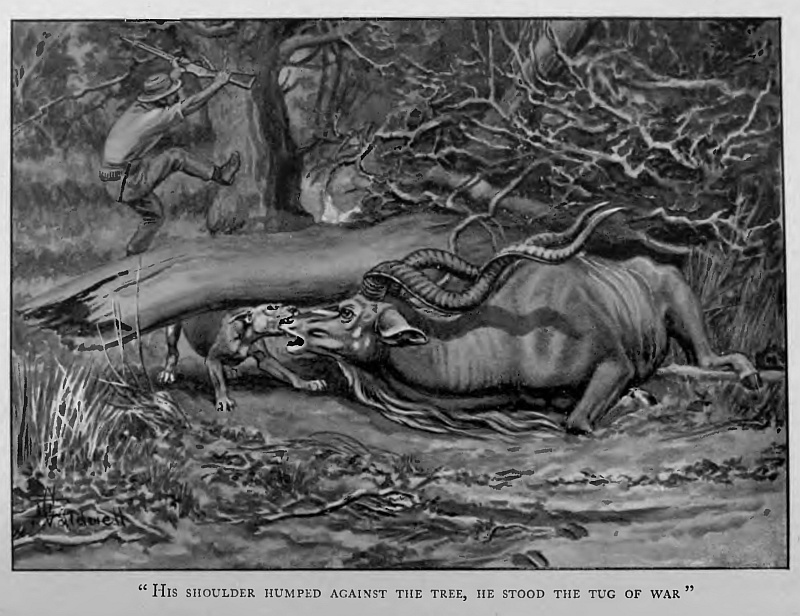
Partly barring the way in front were the whitened trunks and branches of several trees struck down by some storm of the year before, and running ahead of the koodoo I made for these, hoping to find a stick straight enough for a ramrod to force the empty cartridge out. As I reached them the koodoo made for me with half a dozen plunges that sent me flying off for other cover; but the broken leg swayed over one of the branches, and Jock with feet planted against the tree hung on; and the koodoo, turning furiously on him, stumbled, floundered, tripped, and came down with a crash amongst the crackling wood. Once more like a flash Jock was over the fallen body and had fastened on the nose—but only to be shaken worse than before. The koodoo literally flogged the ground with him, and for an instant I shut my eyes; it seemed as if the plucky dog would be beaten into pulp. The bull tried to chop him with its fore feet, but could not raise itself enough, and at each pause Jock, with his watchful little eyes ever on the alert, dodged his body round to avoid the chopping feet without letting go his hold. Then with a snort of fury the koodoo, half rising, gave its head a wild upward sweep, and shook. As a springing rod flings a fish the koodoo flung Jock over its head and on to a low flat-topped thorn-tree behind. The dog somersaulted slowly as he circled in the air, dropped on his back in the thorns some twelve feet from the ground, and came tumbling down through the branches. Surely the tree saved him, for it seemed as if such a throw must break his back. As it was he dropped with a sickening thump; yet even as he fell I saw again the scrambling tearing movement, as if he was trying to race back to the fight even before he reached ground. Without a pause to breathe or even to look, he was in again and trying once more for the nose.
The koodoo lying partly on its side, with both hind legs hampered by the mass of dead wood, could not rise, but it swept the clear space in front with the terrible horns, and for some time kept Jock at bay. I tried stick after stick for a ramrod, but without success; at last, in desperation at seeing Jock once more hanging to the koodoo’s nose, I hooked the lever on to a branch and setting my foot against the tree wrenched until the empty cartridge flew out and I went staggering backwards.
In the last struggle, while I was busy with the rifle, the koodoo had moved, and it was then lying against one of the fallen trunks. The first swing to get rid of Jock had literally slogged him against the tree; the second swing swept him under it where a bend in the trunk raised it: about a foot from the ground, and gaining his foothold there Jock stood fast—there, there, with his feet planted firmly and his shoulder humped against the dead tree, he stood this tug-of-war. The koodoo with its head twisted back, as caught at the end of the swing, could put no weight to the pull; yet the wrenches it gave to free itself drew the nose and upper lip out like tough rubber and seemed to stretch Jock’s neck visibly. I had to come round within a few feet of them to avoid risk of hitting Jock, and it seemed impossible for bone and muscle to stand the two or three terrible wrenches that I saw. The shot was the end; and as the splendid head dropped slowly over, Jock let go his hold.
He had not uttered a sound except the grunts that were knocked out of him.
Chapter Twelve.
Jim Makokel’.
I am very much afraid that most people would consider him rather a bad lot. The fact of the matter is he belonged to another period and other conditions. He was simply a great passionate fighting savage, and, instead of wearing the cast-off clothing of the white man and peacefully driving bullock waggons along a transport road, should have been decked in his savage finery of leopard skin and black ostrich-feathers, showing off the powerful bronzed limbs and body all alive with muscle, and sharing in some wild war-dance; or, equipped with shield and assegais, leading in some murderous fight. Yes, Jim was out of date: he should have been one of the great Chaka’s fighting guard—to rise as a leader of men, or be killed on the way. He had but one argument and one answer to everything: Fight! It was his nature, bred and born in him; it ran in his blood and grew in his bones. He was a survival of a great fighting race—there are still thousands of them in the kraals of Zululand and Swaziland—but it was his fate to belong to one of the expelled families, and to have to live and work among the white men under the Boer Government of the Transvaal.
In a fighting nation Jim’s kraal was known as a fighting one, and the turbulent blood that ran in their veins could not settle down into a placid stream merely because the Great White Queen had laid her hand upon his people and said, “There shall be peace!” Chaka, the ‘black Napoleon’ whose wars had cost South Africa over a million lives, had died—murdered by his brother Dingaan—full of glory, lord and master wherever his impis could reach. “Dogs whom I fed at my kraal!” he gasped, as they stabbed him. Dingaan his successor, as cruel as treacherous, had been crushed by the gallant little band of Boers under Potgieter for his fiendish massacre of Piet Retief and his little band. Panda the third of the three famous brothers—Panda the peaceful—had come and gone! Ketshwayo, after years of arrogant and unquestioned rule, had loosed his straining impis at the people of the Great White Queen. The awful day of ’Sandhl’wana—where the 24th Regiment died almost to a man—and the fight on H’lobani Mountain had blooded the impis to madness; but Rorke’s Drift and Kambula had followed those bloody victories—each within a few hours—to tell another tale; and at Ulundi the tides met—the black and the white. And the kingdom and might of the house of Chaka were no more.
Jim had fought at ’Sandhl’wana, and could tell of an umfaan sent out to herd some cattle within sight of the British camp to draw the troops out raiding while the impis crept round by hill and bush and donga behind them; of the fight made by the red-coats as, taken in detail, they were attacked hand to hand with stabbing assegais, ten and twenty to one; of one man in blue—a sailor—who was the last to die, fighting with his back to a waggon-wheel against scores before him, and how he fell at last, stabbed in the back through the spokes of the wheel by one who had crept up behind.
Jim had fought at Rorke’s Drift! Wild with lust of blood, he had gone on with the maddest of the victory-maddened lot to invade Natal and eat up the little garrison on the way. He could tell how seventy or eighty white men behind a little rampart of biscuit-tins and flour-bags had fought through the long and terrible hours, beating off five thousand of the Zulu best, fresh from a victory without parallel or precedent; how, from the burning hospital, Sergeant Hook, V.C., and others carried sick and wounded through the flames into the laager; how a man in black with a long beard, Father Walsh, moved about with calm face, speaking to some, helping others, carrying wounded back and cartridges forward—Father Walsh who said “Don’t swear, boys: fire low;” how Lieutenants Chard and Bromhead—V.C.s too for that day’s work—led and fought, and guided and heartened their heroic little band until the flour-bags and biscuit-tins stood lower than the pile of dead outside, and the Zulu host was beaten and Natal saved that day.
Jim had seen all that—and Ulundi, the Day of Despair! And he knew the power of the Great White Queen and the way that her people fight. But peace was not for him or his kraal: better any fight than no fight. He rallied to Usibepu in the fight for leadership when his King, Ketshwayo, was gone, and Jim’s kraal had moved—and moved too soon: they were surrounded one night and massacred; and Jim fought his way out, wounded and alone. Without kith or kin, cattle, king, or country, he fled to the Transvaal—to work for the first time in his life!
Waggon-boys—as the drivers were called—often acquired a certain amount of reputation on the road or in the locality where they worked; but it was, as a rule, only a reputation as good or bad drivers. In Jim’s case it was different. He was a character and had an individual reputation, which was exceptional in a Kaffir. I had better say at once that not even his best friend would claim that that reputation was a good one. He was known as the best driver, the strongest nigger, the hardest fighter, and the worst drinker on the road.
His real name was Makokela, but in accordance with a common Zulu habit, it was usually abbreviated to Makokel’! Among a certain number of the white men—of the sort who never can get any name right—he was oddly enough known as McCorkindale. I called him Jim as a rule—Makokel’, when relations were strained. The waggon-boys found it safer to use his proper name. When anything had upset him it was not considered wise to take the liberty of shouting “Jim”: the answer sometimes came in the shape of a hammering.
Many men had employed Jim before he came to me, and all had ‘sacked’ him for fighting, drinking, and the unbearable worry he caused. They told me this, and said that he gave more trouble than his work was worth. It may have been true: he certainly was a living test of patience, purpose, and management; but, for something learnt in that way, I am glad now that Jim never ‘got the sack’ from me. Why he did not, is not easy to say; perhaps the circumstances under which he came to me and the hard knocks of an unkind fate pleaded for him. But it was not that alone: there was something in Jim himself—something good and fine, something that shone out from time to time through his black skin and battered face as the soul of a real man.
It was in the first season in the Bushveld that we were outspanned one night on the sand-hills overlooking Delagoa Bay among scores of other waggons dotted about in little camps—all loading or waiting for loads to transport to the Transvaal. Delagoa was not a good place to stay in, in those days: liquor was cheap and bad; there was very little in the way of law and order; and every one took care of himself as well as he could. The Kaffir kraals were close about the town, and the natives of the place were as rascally a lot of thieves and vagabonds as you could find anywhere. The result was everlasting trouble with the waggon-boys and a chronic state of war between them and the natives and the banyans or Arab traders of the place. The boys, with pockets full of wages, haggled and were cheated in the stores, and by the hawkers, and in the canteens; and they often ended up the night with beer-drinking at the kraals or reprisals on their enemies. Every night there were fights and robberies: the natives or Indians would rob and half-kill a waggon-boy; then he in turn would rally his friends, and raid and clear out the kraal or the store. Most of the waggon-boys were Zulus or of Zulu descent, and they were always ready for a fight and would tackle any odds when their blood was up.
It was the third night of our stay, and the usual row was on. Shouts and cries, the beating of tomtoms, and shrill ear-piercing whistles, came from all sides; and through it all the dull hum of hundreds of human voices, all gabbling together. Near to us there was another camp of four waggons drawn up in close order, and as we sat talking and wondering at the strange babel in the beautiful calm moonlight night, one sound was ever recurring, coming away out of all the rest with something in it that fixed our attention. It was the sound of two voices from the next waggons. One voice was a kaffir’s—a great, deep, bull-throated voice; it was not raised—it was monotonously steady and low; but it carried far, with the ring and the lingering vibration of a big gong.
“Funa ’nyama, Inkos; funa ’nyama!” (“I want meat, Chief; I want meat!”) was what the kaffir’s voice kept repeating at intervals of a minute or two with deadly monotony and persistency.
The white man’s voice grew more impatient, louder, and angrier, with each refusal; but the boy paid no heed. A few minutes later the same request would be made, supplemented now and then with, “I am hungry, Baas, I can’t sleep. Meat! Meat! Meat!” or, “Porridge and bread are for women and piccaninnies. I am a man: I want meat, Baas, meat.” From the white man it was, “Go to sleep, I tell you!”
“Be quiet, will you?”
“Shut up that row!”
“Be still, you drunken brute, or I’ll tie you up!” and “You’ll get twenty-five in a minute!”
It may have lasted half an hour when one of our party said, “That’s Bob’s old driver, the big Zulu. There’ll be a row to-night; he’s with a foreigner chap from Natal now. New chums are always roughest on the niggers.”
In a flash I remembered Bob Saunderson’s story of the boy who had caught the lion alive, and Bob’s own words, “a real fine nigger, but a terror to drink, and always in trouble. He fairly wore me right out.”
A few minutes later there was a short scuffle, and the boy’s voice could be heard protesting in the same deep low tone: they were tying him up to the waggon-wheel for a flogging. Others were helping the white man, but the boy was not resisting.
At the second thin whistling stroke some one said, “That’s a sjambok he’s using, not a nek-strop!” Sjambok, that will cut a bullock’s hide! At about the eighth there was a wrench that made the waggon rattle, and the deep voice was raised in protest, “Ow, Inkos!”
It made me choke: it was the first I knew of such things, and the horror of it was unbearable; but the man who had spoken before—a good man too, straight and strong, and trusted by black and white—said, “Sonny, you must not interfere between a man and his boys here; it’s hard sometimes, but we’d not live a day if they didn’t know who was baas.”
I think we counted eighteen; and then everything seemed going to burst.
The white man looked about at the faces close to him—and stopped. He began slowly to untie the outstretched arms, and blustered out some threats. But no one said a word!
The noises died down as the night wore on, until the stillness was broken only by the desultory barking of a kaffir dog or the crowing of some awakened rooster who had mistaken the bright moonlight for the dawn and thought that all the world had overslept itself. But for me there was one other sound for which I listened into the cool of morning with the quivering sensitiveness of a bruised nerve. Sometimes it was a long catchy sigh, and sometimes it broke into a groan just audible, like the faintest rumble of most distant surf. Twice in the long night there came the same request to one of the boys near him, uttered in a deep clear unshaken voice and in a tone that was civil but firm, and strangely moving from its quiet indifference.
“Landela manzi, Umganaam!” (“Bring water, friend!”) was all he said; and each time the request was so quickly answered that I had the guilty feeling of being one in a great conspiracy of silence. The hush was unreal; the stillness alive with racing thoughts; the darkness full of watching eyes.
There is, we believe, in the heart of every being a little germ of justice which men call conscience! If that be so, there must have been in the heart of the white man that night some uneasy movement—the first life-throb of the thought which one who had not yet written has since set down:
“Though I’ve belted you and flayed you, By the living God that made you, You’re a better man than I am, Gunga Din!”
The following afternoon I received an ultimatum. We had just returned from the town when from a group of boys squatting round the fire there stood up one big fellow—a stranger—who raised his hand high above his head in Zulu fashion and gave their salute in the deep bell-like voice that there was no mistaking, “Inkos! Bayete!”
He stepped forward, looking me all over, and announced with calm and settled conviction, “I have come to work for you!” I said nothing. Then he rapped a chest like a big drum, and nodding his head with a sort of defiant confidence added in quaint English, “My naam Makokela! Jim Makokel’! Yes! My catchum lion ’live! Makokela, me!”
He had heard that I wanted a driver, had waited for my return, and annexed me as his future ‘baas’ without a moment’s doubt or hesitation.
I looked him over. Big, broad-shouldered, loose-limbed, and as straight as an assegai! A neck and head like a bull’s; a face like a weather-beaten rock, storm-scarred and furrowed, rugged and ugly, but steadfast, massive and strong! So it looked then, and so it turned out: for good and for evil Jim was strong.
I nodded and said, “You can come.”
Once more he raised his head aloft, and, simply and without a trace of surprise or gratification, said:
“Yes, you are my chief, I will work for you.” In his own mind it had been settled already: it had never been in doubt.
Jim—when sober—was a splendid worker and the most willing of servants, and, drunk or sober, he was always respectful in an independent, upstanding, hearty kind of way. His manner was as rough and rugged as his face and character; in his most peaceful moments it was—to one who did not understand him—almost fierce and aggressive; but this was only skin deep; for the childlike simplicity of the African native was in him to the full, and rude bursts of Titanic laughter came readily—laughter as strong and unrestrained as his bursts of passion.
To the other boys he was what his nature and training had made him—not really a bully, but masterful and over-riding. He gave his orders with the curtness of a drill sergeant and the rude assurance of a savage chief. Walking, he walked his course, giving way for none of them. At the outspan or on the road or footpath he shouldered them aside as one walks through standing corn, not aggressively but with the superb indifference of right and habit unquestioned. If one, loitering before him, blocked his way unseeing, there was no pause or step aside—just “Suka!” (“Get out”) and a push that looked effortless enough but sent the offender staggering; or, if he had his sticks, more likely a smart whack on the stern that was still more surprising; and not even the compliment of a glance back from Jim as he stalked on. He was like the old bull in a herd—he walked his course; none molested and none disputed; the way opened before him.
When sober Jim spoke Zulu; when drunk, he broke into the strangest and most laughable medley of kitchen-Kaffir, bad Dutch, and worse English—the idea being, in part to consider our meaner intelligences and in part to show what an accomplished linguist he was. There was no difficulty in knowing when Jim would go wrong: he broke out whenever he got a chance, whether at a kraal, where he could always quicken the reluctant hospitality of any native, at a wayside canteen, or in a town. Money was fatal—he drank it all out; but want of money was no security, for he was known to every one and seemed to have friends everywhere; and if he had not, he made them on the spot—annexed and overwhelmed them.
From time to time you do meet people like that. The world’s their oyster, and the gift of a masterful and infinite confidence opens it every time: they walk through life taking of the best as a right, and the world unquestioningly submits.
I had many troubles with Jim, but never on account of white men: drunk or sober, there was never trouble there. It may have been Rorke’s Drift and Ulundi that did it; but whatever it was, the question of black and white was settled in his mind for ever. He was respectful, yet stood upright with the rough dignity of an unvanquished spirit; but on the one great issue he never raised his hand or voice again. His troubles all came from drink, and the exasperation was at times almost unbearable—so great, indeed, that on many occasions I heartily repented ever having taken him on. Warnings were useless, and punishment—well, the shiny new skin that made patterns in lines and stars and crosses on his back for the rest of his life made answer for always upon that point.
The trials and worries were often great indeed. The trouble began as soon as we reached a town, and he had a hundred excuses for going in, and a hundred more for not coming out: he had some one to see, boots to be mended, clothes to buy, or medicine to get—the only illness I ever knew him have was ‘a pain inside,’ and the only medicine wanted—grog!—some one owed him money—a stock excuse, and the idea of Jim, always penniless and always in debt, posing as a creditor never failed to raise a laugh, and he would shake his head with a half-fierce half-sad disgust at the general scepticism and his failure to convince me. Then he had relations in every town! Jim, the sole survivor of his fighting kraal, produced ‘blulus,’ ‘babas,’ ‘sisteles,’ and even ‘mamas,’ in profusion, and they died just before we reached the place, as regularly as the office-boy’s aunt dies before Derby Day, and with the same consequence—he had to go to the funeral.
The first precaution was to keep him at the waggons and put the towns and canteens ‘out of bounds’; and the last defence, to banish him entirely until he came back sober, and meanwhile set other boys to do his work, paying them his wages in cash in his presence when he returned fit for duty.
“Is it as I told you? Is it just?” I would ask when this was done.
“It is just, Inkos,” he would answer with a calm dispassionate simplicity which appealed for forgiveness and confidence with far greater force than any repentance; and it did so because it was genuine; it was natural and unstudied. There was never a trace of feeling to be detected when these affairs were squared off, but I knew how he hated the treatment, and it helped a little from time to time to keep him right.
The banishing of him from the waggons in order that he might go away and have it over was not a device to save myself trouble, and I did it only when it was clear that he could stand the strain no longer. It was simply a choice of evils, and it seemed to me better to let him go, clearly understanding the conditions, than drive him into breaking away with the bad results to him and the bad effects on the others of disobeying orders. It was, as a rule, far indeed from saving me trouble, for after the first bout of drinking he almost invariably found his way back to the waggons: the drink always produced a ravenous craving for meat, and when his money was gone and he had fought his fill and cleared out all opposition, he would come back to the waggons at any hour of the night, perhaps even two or three times between dark and dawn, to beg for meat. Warnings and orders had no effect whatever; he was unconscious of everything except the overmastering craving for meat. He would come to my waggon and begin that deadly monotonous recitation, “Funa ’nyama, Inkos! Wanta meat, Baas!” There was a kind of hopeless determination in the tone conveying complete indifference to all consequences: meat he must have. He was perfectly respectful; every order to be quiet or go away or go to bed was received with the formal raising of the hand aloft, the most respectful of salutations, and the assenting, “Inkos!” but in the very next breath would come the old monotonous request, “Funa ’nyama, Inkos,” just as if he was saying it for the first time. The persistency was awful—it was maddening; and there was no remedy, for it was not the result of voluntary or even conscious effort on his part; it was a sort of automatic process, a result of his physical condition. Had he known it would cost him his life, he could no more have resisted it than have resisted breathing.
When the meat was there I gave it, and he would sit by the fire for hours eating incredible quantities—cutting it off in slabs and devouring it when not much more than warmed. But it was not always possible to satisfy him in that way; meat was expensive in the towns and often we had none at all at the waggons. Then the night became one long torment: the spells of rest might extend from a quarter of an hour to an hour; then from the dead sleep of downright weariness I would be roused by the deep far-reaching voice; “Funa ’nyama, Inkos” wove itself into my dreams, and waking I would find Jim standing beside me remorselessly urging the same request in Zulu, in broken English, and in Dutch—“My wanta meat, Baas,” “Wil fleisch krij, Baas,” and the old, old, hatefully familiar explanation of the difference between “man’s food” and “piccanins’ food,” interspersed with grandiose declarations that he was “Makokela—Jim Makokel’,” who “catchum lion ’live.” Sometimes he would expand this into comparisons between himself and the other boys, much to their disadvantage; and on these occasions he invariably worked round to his private grievances, and expressed his candid opinions of Sam.
Sam was the boy whom I usually set to do Jim’s neglected work. He was a ‘mission boy,’ that is a Christian kaffir—very proper in his behaviour, but a weakling and not much good at work. Jim would enumerate all Sam’s shortcomings; how he got his oxen mixed up on dark nights and could not pick them out of the herd—a quite unpardonable offence; how he stuck in the drifts and had to be ‘double-spanned’ and pulled out by Jim; how he once lost his way in the bush; and how he upset the waggon coming down the Devil’s Shoot.
Jim had once brought down the Berg from Spitzkop a loaded waggon on which there was a cottage piano packed standing upright. The road was an awful one, it is true, and few drivers could have handled so top-heavy a load without capsizing—he had received a bansela for his skill—but to him the feat was one without parallel in the history of waggon driving; and when drunk he usually coupled it with his other great achievement of catching a lion alive. His contempt for Sam’s misadventure on the Devil’s Shoot was therefore great, and to it was added resentment against Sam’s respectability and superior education, which the latter was able to rub in in safety by ostentatiously reading his Bible aloud at nights as they sat round the fire. Jim was a heathen, and openly affirmed his conviction that a Christian kaffir was an impostor, a bastard, and a hypocrite—a thing not to be trusted under any circumstances whatever. The end of his morose outburst was always the same. When his detailed indictment of Sam was completed he would wind up with, “My catchum lion ’live. My bling panyanna fon Diskop (I bring piano from Spitzkop). My naam Makokela: Jim Makokel’. Sam no good; Sam leada Bible (Sam reads the Bible). Sam no good!” The intensity of conviction and the gloomy disgust put into the last reference to Sam are not to be expressed in words.
Where warning and punishment availed nothing threats would have been worse than foolish. Once, when he had broken bounds and left the waggons, I threatened that if he did it again I would tie him up, since he was like a dog that could not be trusted; and I did it. He had no excuse but the old ones; some one, he said, had brought him liquor to the waggons and he had not known what he was doing. The truth was that the craving grew so with the nearer prospect of drink that by hook or by crook he would find some one, a passerby or a boy from other waggons, to fetch some for him; and after that nothing could hold him.
If Jim ever wavered in his loyalty to me, it must have been the day I tied him up: he must have been very near hating me then. I had caught him as he was leaving the waggons and still sober; brought him back and told him to sit under his own waggon where I would tie him up like a dog. I took a piece of sail twine, tied it to one wrist, and, fastening the other end to the waggon-wheel, left him.
A kaffir’s face becomes, when he wishes it, quite inscrutable—as expressionless as a blank wall. But there are exceptions to every rule; and Jim’s stoicism was not equal to this occasion. The look of unspeakable disgust and humiliation on his face was more than I could bear with comfort; and after half an hour or so in the pillory I released him. He did not say a word, but, heedless of the hot sun, rolled himself in his blankets and, sleeping or not, never moved for the rest of the day.
Chapter Thirteen.
The Allies.
Jock disliked kaffirs: so did Jim. To Jim there were three big divisions of the human race—white men, Zulus, and niggers. Zulu, old or young, was greeted by him as equal, friend and comrade; but the rest were trash, and he cherished a most particular contempt for the Shangaans and Chopis, as a lot who were just about good enough for what they did—that is, work in the mines. They could neither fight nor handle animals; and the sight of them stirred him to contempt and pricked him to hostilities.
It was not long before Jim discovered this bond of sympathy between him and Jock, and I am perfectly sure that the one bad habit which Jock was never cured of was due to deliberate encouragement from Jim on every possible opportunity. It would have been a matter of difficulty and patience in any case to teach Jock not to unnecessarily attack strange kaffirs. It was very important that he should have nothing to do with them, and should treat them with suspicion as possible enemies and keep them off the premises. I was glad that he did it by his own choice and instinct; but this being so, it needed all the more intelligence and training to get him to understand just where to draw the line. Jim made it worse; he made the already difficult task practically impossible by egging Jock on; and what finally made it quite impossible was the extremely funny turn it took, which caused such general amusement that every one joined in the conspiracy and backed up Jock.
Every one knows how laughable it is to see a person dancing about like a mad dervish, with legs and arms going in all directions, dodging the rushes of a dog, especially if the spectator knows that the dog will not do any real harm and is more intent on scaring his victim, just for the fun of the thing, than on hunting him. Well, that is how it began.
As far as I know the first incident arose out of the intrusion of a strange kaffir at one of the outspans. Jock objected, and he was forcing a scared boy back step by step—doing the same feinting rushes that he practised with game—until the boy tripped over a camp stool and sat plump down on the three-legged pot of porridge cooking at the camp fire. I did not see it; for Jock was, as usual, quite silent—a feature which always had a most terrifying effect on his victims: it was a roar like a lion’s from Jim that roused me. Jock was standing off with his feet on the move forwards and backwards, his head on one side and his face full of interest, as if he would dearly love another romp in; and the waggon-boys were reeling and rolling about the grass, helpless with laughter.
A dog is just as quick as a child to find out when he can take liberties; he knows that laughter and serious disapproval do not go together; and Jock with the backing of the boys thoroughly enjoyed him-self. That was how it began; and by degrees it developed into the great practical joke. The curious thing to note was the way in which Jock entered into the spirit of the thing, and how he improved and varied his methods. It was never certain what he would do; sometimes it would be a wild romp, as it was that day; at other times he would stalk the intruder in the open, much as a pointer approaches his birds in the last strides, and with eyes fixed steadily and mouth tightly pursed-up, he would move straight at him with infinite slowness and deliberation until, the boy’s nerve failed, and he turned and ran. At other times again he trotted out as if he had seen nothing, and then stopped suddenly. If the boy came on, Jock waited; but if there was any sign of fear or hesitation, he lowered his head, humped up his shoulders—as a stagey boxer does when he wants to appear ferocious—and gave his head a kind of chuck forward, as if in the act of charging: this seldom failed to shake the intruder’s nerve, and as soon as he turned or backed, the romp began. Still another trick was to make a round in the bush and come up behind unobserved, and then make a furious dash with rumbly gurgly growls; the startled boy invariably dropped all he had, breaking into a series of fantastic capers and excited yells, to the huge delight of Jim and the others.
But these things were considered trifles: the piece that always ‘brought the house down’ was the Shangaan gang trick, which on one occasion nearly got us all into serious trouble. The natives going to or from the goldfields travel in gangs of from four or five to forty or fifty; they walk along in Indian-file, and even when going across the veld or walking on wide roads they wind along singly in the footsteps of the leader. What prompted the dog to start this new game I cannot imagine: certainly no one could have taught it to him; and as well as one could judge, he did it entirely ‘off his own bat,’ without anything to lead up to or suggest it.
One day a gang of about thirty of these Shangaans, each carrying his load of blankets, clothing, pots, billies and other valuables on his head, was coming along a footpath beside the road some twenty yards away from the waggons. Jock strolled out and sat himself down in the middle of the path; it was the way he did it and his air, utterly devoid of hostile or even serious purpose, that attracted my attention without rousing any doubts. The leader of the gang, however, was suspicious and shied off wide into the veld; he passed in a semicircle round Jock, a good ten yards away, and came safely back to the path again, and the dog with his nose in the air merely eyed him with a look of humorous interest and mild curiosity. The second kaffir made the loop shorter, and the third shorter still, as they found their alarm and suspicions unjustified; and so on, as each came along, the loop was lessened until they passed in safety almost brushing against Jock’s nose. And still he never budged—never moved—except, as each boy approached, to look up at his face and, slowly turning his head, follow him round with his eyes until he re-entered the path. There was something extremely funny in the mechanical regularity with which his head swung round. It was so funny that not only the boys at the waggons noticed it and laughed; the unsuspecting Shangaans themselves shared the joke. When half a dozen had passed round in safety, comments followed by grunts of agreement or laughter ran along the line, and then, as each fresh boy passed and Jock’s calm inspection was repeated, a regular chorus of guffaws and remarks broke out. The long heavy bundles on their heads made turning round a slow process, so that, except for the first half-dozen, they were content to enjoy what they saw in front and to know by the laughter from behind that the joke had been repeated all down the line.
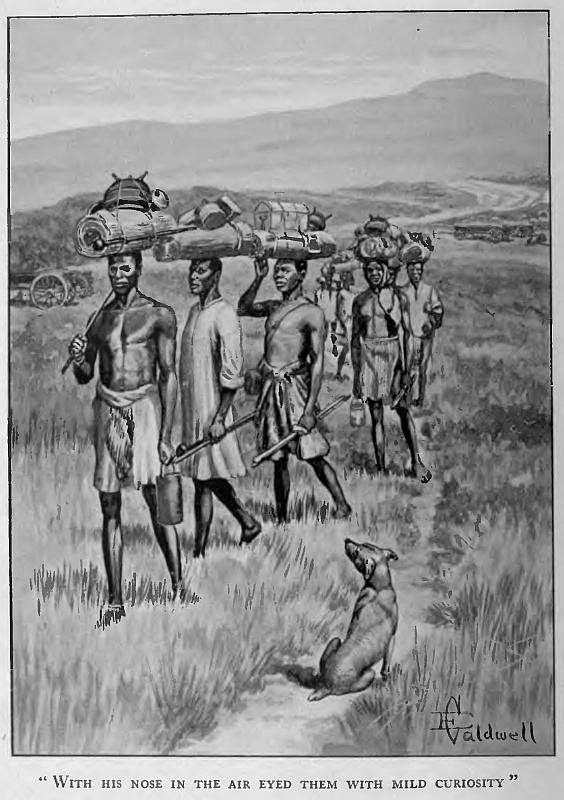
The last one walked calmly by; but as he did so there came one short muffled bark, “Whoop!” from Jock as he sprang out and nipped the unsuspecting Shangaan behind. The boy let out a yell that made the whole gang jump and clutch wildly at their toppling bundles, and Jock raced along the footpath, leaping, gurgling and snapping behind each one he came near, scattering them this way and that, in a romp of wild enjoyment. The shouts of the scared boys, the clatter of the tins as their bundles toppled down, the scrambling and scratching as they clawed the ground pretending to pick up stones or sticks to stop his rushes, and the ridiculous rout of the thirty Shangaans in every direction, abandoning their baggage and fleeing from the little red enemy only just visible in the grass as he hunted and harried them, were too much for my principles and far too much for my gravity. To be quite honest, I weakened badly, and from that day on preferred to look another way when Jock sallied out to inspect a gang of Shangaans. Between them, Jim and Jock had beaten me.
But the weakening brought its own punishment and the joke was not far from making a tragedy. Many times while lying some way off in the shade of a tree or under another waggon I heard Jim, all unconscious of my presence, call in a low deep voice, almost a whisper, “Jock, Jock; kaffirs; Shangaans!” Jock’s head was up in a moment, and a romp of some sort followed unless I intervened. Afterwards, when Jock was deaf, Jim used to reach out and pull his foot or throw a handful of sand or a bunch of grass to rouse him, and when Jock’s head switched up Jim’s big black fist pointing to their common enemy was quite enough.
Jim had his faults, but getting others into mischief while keeping out of it himself was not one of them. If he egged Jock on, he was more than ready to stand by him, and on these occasions his first act was to jump for his sticks, which were always pretty handy, and lie in readiness to take a hand if any of the gang should use what he considered unfair means of defence, such as throwing stones and kerries or using assegais or knives; and Jim—the friend of Jock, the avoided enemy of all Shangaans, aching for an excuse to take a hand in the row himself—was not, I fear, a very impartial judge.
There was a day outside Barberton which I remember well. We were to start that evening, and knowing that if Jim got into the town he might not be back and fit to work for days, I made him stay with the waggons. He lay there flat out under his waggon with his chin resting on his arms, staring steadily at the glistening corrugated iron roofs of the town, as morose and unapproachable as a surly old watch-dog. From the tent of my waggon I saw him raise his head, and following his glance, picked out a row of bundles against the sky-line. Presently a long string of about fifty time-expired mine-boys came in sight. Jim on his hands and knees scrambled over to where Jock lay asleep, and shook him; for this incident occurred after Jock had become deaf.
“Shangaans, Jock; Shangaans! Kill them; kill, kill, kill!” said Jim in gusty ferocious whispers. It must have seemed as if Fate had kindly provided an outlet for the rebellious rage and the craving for a fight that were consuming him.
As Jock trotted out to head them off Jim reached up to the buck-rails and pulled down his bundle of sticks and lay down like a tiger on the spring. I had had a lot of trouble with Jim that day, and this annoyed me; but my angry call to stop was unavailing. Jim, pretending not to understand, made no attempt to stop Jock, but contented himself with calling to him to come back; and Jock, stone deaf, trotted evenly along with his head, neck, back, and tail, all level—an old trick of Jess’s which generally meant trouble for some one. Slowing down as he neared the Shangaans he walked quietly on until he headed off the leader, and there he stood across the path. It was just the same as before: the boys, finding that he did nothing, merely stepped aside to avoid bumping against him. They were boys taking back their purchases to their kraals to dazzle the eyes of the ignorant with the wonders of civilisation—gaudy blankets, collections of bright tin billies and mugs, tin plates, three-legged pots, clothing, hats, and even small tin trunks painted brilliant yellow, helped to make up their huge bundles. The last boy was wearing a pair of Royal Artillery trousers; and I have no doubt he regarded it ever afterwards as nothing less than a calamity that they were not safely stowed away in his bundle—for a kaffir would sacrifice his skin rather than his new pants any day. It was from the seat of these too ample bags that Jock took a good mouthful; and it was the boy’s frantic jump, rather than Jock’s tug, that made the piece come out. The sudden fright and the attempts to face about quickly caused several downfalls; the clatter of these spread the panic; and on top of it all came Jock’s charge along the broken line, and the excited shouts of those who thought they were going to be worried to death.
Jim had burst into great bellows of laughter and excited—but quite superfluous—shouts of encouragement to Jock, who could not have heard a trumpet at ten yards.
But there came a very unexpected change. One big Shangaan had drawn from his bundle a brand new side-axe: I saw the bright steel head flash, as he held it menacingly aloft by the short handle and marched towards Jock. There was a scrambling bound from under the waggon, and Jim, with face distorted and grey with fury, rushed out. In his right hand he brandished a tough stout fighting stick; in his left I was horrified to see an assegai, and well I knew that, with the fighting fury on him, he would think nothing of using it. The Shangaan saw him coming, and stopped; then, still facing Jim, and with the axe raised and feinting repeatedly to throw it, he began to back away. Jim never paused for a second: he came straight on with wild leaps and blood-curdling yells in Zulu fighting fashion and ended with a bound that seemed to drop him right on top of the other. The stick came down with a whirr and a crash that crimped every nerve in my body; and the Shangaan dropped like a log.
I had shouted myself hoarse at Jim, but he heard or heeded nothing; and seizing a stick from one of the other boys I was already on the way to stop him, but before I got near him he had wrenched the axe from the kicking boy and, without pause, gone headlong for the next Shangaan he saw. Then everything went wrong: the more I shouted and the harder I ran, the worse the row. The Shangaans seemed to think I had joined in and was directing operations against them: Jim seemed to be inspired to wilder madness by my shouts and gesticulations; and Jock—well, Jock at any rate had not the remotest doubt as to what he should do. When he saw me and Jim in full chase behind him, his plain duty was to go in for all he was worth; and he did it.
It was half an hour before I got that mad savage back. He was as unmanageable as a runaway horse. He had walloped the majority of the fifty himself; he had broken his own two sticks and used up a number of theirs; on his forehead there was a small cut and a lump like half an orange; and on the back of his head another cut left by the sticks of the enemy when eight or ten had rallied once in a half-hearted attempt to stand against him.
It was strange how Jim, even in that mood, yielded to the touch of one whom he regarded as his “Inkos.” I could not have forced him back: in that maniac condition it would have needed a powerful combination indeed to bring him back against his will. He yielded to the light grip of my hand on his wrist and walked freely along with me; but a fiery bounding vitality possessed him, and with long springy strides he stepped out—looking excitedly about, turning to right and left or even right about, and stepping sideways or even backwards to keep pace with me—yet always yielding the imprisoned arm so as not to pull me about. And all the time there came from him a torrent of excited gabble in pure Zulu, too fast and too high-flown for me to follow, which was punctuated and paragraphed by bursting allusions to ‘dogs of Shangaans,’ ‘axes,’ ‘sticks,’ and ‘Jock.’
Near the waggons we passed over the ‘battlefield,’ and a huge guffaw of laughter broke from Jim as we came on the abandoned impedimenta of the defeated enemy. Several of the bundles had burst open from the violence of the fall, and the odd collections of the natives were scattered about; others had merely shed the outside luggage of tin billies, beakers, pans, boots and hats. Jim looked on it all as the spoils of war, wanting to stop and gather in his loot there and then, and when I pressed on, he shouted to the other drivers to come out and collect the booty.
But my chief anxiety was to end the wretched escapade as quickly as possible and get the Shangaans on their way again; so I sent Jim back to his place under the waggon, and told the cook-boy to give him the rest of my coffee and half a cup of sugar to provide him with something else to think of and to calm him down.
After a wait of half an hour or so, a head appeared just over the rise, and then another and another, at irregular intervals and at various points: they were scouting very cautiously before venturing back again. I sat in the tent-waggon out of sight and kept quiet, hoping that in a few minutes they would gain confidence, collect their goods, and go their way again. Jim, lying flat under the waggon, was much lower than I was, and—continuing his gabble to the other boys—saw nothing. Unfortunately he looked round just as a scared face peered cautiously over the top of an ant-heap. The temptation was, I suppose, irresistible: he scrambled to his knees with a pretence of starting afresh and let out one ferocious yell that made my hair stand up; and in that second every head bobbed down and the field was deserted once more.
If this went on there could be but one ending: the police would be appealed to, Jim arrested, and I should spend days hanging about the courts waiting for a trial from which the noble Jim would probably emerge with three months’ hard labour; so I sallied out as my own herald of peace. But the position was more difficult than it looked: as soon as the Shangaans saw my head appearing over the rise, they scattered like chaff before the wind, and ran as if they would never stop. They evidently took me for the advance guard in a fresh attack, and from the way they ran seemed to suspect that Jim and Jock might be doing separate flanking movements to cut them off. I stood upon an ant-heap and waved and called, but each shout resulted in a fresh spurt and each movement only made them more suspicious. It seemed a hopeless case, and I gave it up.
On the way back to the waggons, however, I thought of Sam—Sam, with his neatly patched European clothes, with the slouchy heavy-footed walk of a nigger in boots, with his slack lanky figure and serious timid face! Sam would surely be the right envoy; even the routed Shangaans would feel that there was nothing to fear there. But Sam was by no means anxious to earn laurels; he was clearly of the poet’s view that “the paths of glory lead but to the grave;” and it was a poor-looking weak-kneed and much dejected scarecrow that dragged its way reluctantly out into the veld to hold parley with the routed enemy that day.
At the first mention of Sam’s name Jim had twitched round with a snort, but the humour of the situation tickled him when he saw the too obvious reluctance with which his rival received the honour conferred on him. Between rough gusts of laughter Jim rained on him crude ridicule and rude comments; and Sam slouched off with head bent, relieving his heart with occasional clicks and low murmurs of disgust. How far the new herald would have ventured, if he had not received most unexpected encouragement, is a matter for speculation. Jim’s last shout was to advise him not to hide in an ant-bear hole; but, to Sam’s relief, the Shangaans seemed to view him merely as a decoy, even more dangerous than I was; for, as no one else appeared, they had now no idea at all from which quarter the expected attack would come. They were widely scattered more than half a mile away when Sam came in sight; a brief pause followed in which they looked anxiously around, and then, after some aimless dashes about like a startled troop of buck, they seemed to find the line of flight and headed off in a long string down the valley towards the river.
Now, no one had ever run away from Sam before, and the exhilarating sight so encouraged him that he marched boldly on after them. Goodness knows when, if ever, they would have stopped, if Sam had not met a couple of other natives whom the Shangaans had passed and induced them to turn back and reassure the fugitives.
An hour later Sam came back in mild triumph, at the head of the Shangaan gang; and, ‘clothed in a little brief authority,’ stood guard and superintended while they collected their scattered goods—all except the axe that caused the trouble. That they failed to find. The owner may have thought it wise to make no claim on me; Sam, if he remembered it, would have seen the Shangaans and all their belongings burned in a pile rather than raise so delicate a question with Jim; I had forgotten all about it—being anxious only to end the trouble and get the Shangaans off; and that villain Jim ‘lay low.’ At the first outspan from Barberton next day I saw him carving his mark on the handle, unabashed, under my very nose.
The next time Jim got drunk he added something to his opinion of Sam:
“Sam no good: Sam leada Bible! Shangaan, Sam; Shangaan!”
Chapter Fourteen.
The Berg.
The last day of each trip in the Bush veld was always a day of trial and hard work for man and beast. The Berg stood up before us like an impassable barrier. Looked at from below the prospect was despairing—from above, appalling. There was no road that the eye could follow. Here and there a broad furrowed streak of red soil straight down some steep grass-covered spur was visible: it looked like a mountain timber-slide or the scour of some tropical storm; and that was all one could see of it from below. For perhaps a week the towering bulwarks of the High veld were visible as we toiled along—at first only in occasional hazy glimpses, then daily clearer higher and grander, as the great barrier it was.
After many hard treks through the broken foothills, with their rocky sideling slopes and boulder-strewn torrent beds, at last the Berg itself was reached. There, on a flat-topped terrace-like spur where the last outspan was, we took breath, halved our loads, double-spanned, and pulled ourselves together for the last big climb.
From there the scoured red streaks stood out revealed as road tracks—for, made road there was none; from there, lines of whitish rock and loose stones and big boulders, that one had taken for the beds of mountain torrents, stood revealed as bits of ‘road,’ linking up some of the broken sections of the route; but even from there not nearly all the track was visible. The bumpy rumbling and heavy clattering of waggons on the rocky trail, the shouts of drivers and the crack of whips, mixed with confusing echoes from somewhere above, set one puzzling and searching higher still. Then in unexpected places here and there other waggons would be seen against the shadowy mountains, creeping up with infinite labour foot by foot, tacking at all sorts of angles, winding by undetected spur and slope and ridge towards the summit—the long spans of oxen and the bulky loads, dwarfed into miniature by the vast background, looking like snails upon a face of rock.
To those who do not know, there is not much difference between spans of oxen; and the driving of them seems merely a matter of brute strength in arm and lung. One span looks like another; and the weird unearthly yells of the drivers, the cracks—like rifle-shots—of the long lashes, and the hum and thud of the more cruel doubled whip, seem to be all that is needed. But it is not so: heart and training in the cattle, skill and judgment in the driver, are needed there; for the Berg is a searching test of man and beast. Some, double-spanned and relieved of half their three-ton loads, will stick for a whole day where the pull is steepest, the road too narrow to swing the spans, and the curves too sharp to let the fifteen couples of bewildered and despairing oxen get a straight pull; whilst others will pass along slowly but steadily and without check, knowing what each beast will do and stand, when to urge and when to ease it, when and where to stop them for a blow, and how to get them all leaning to the yoke, ready and willing for the ‘heave together’ that is essential for restarting a heavy load against such a hill. Patience, understanding, judgment, and decision: those are the qualities it calls for, and here again the white man justifies his claim to lead and rule; for, although they are as ten or twenty to one, there is not a native driver who can compare with the best of the white men.
It was on the Berg that I first saw what a really first-class man can do. There were many waggons facing the pass that day; portions of loads, dumped off to ease the pull, dotted the roadside; tangles of disordered maddened spans blocked the way; and fragments of yokes, skeys, strops, and reims, and broken disselbooms, told the tale of trouble.
Old Charlie Roberts came along with his two waggons. He was ‘old’ with us—being nearly fifty; he was also stout and in poor health. We buried him at Pilgrim’s Rest a week later: the cold, clear air on top of the Berg that night, when he brought the last load up, brought out the fever. It was his last trek.
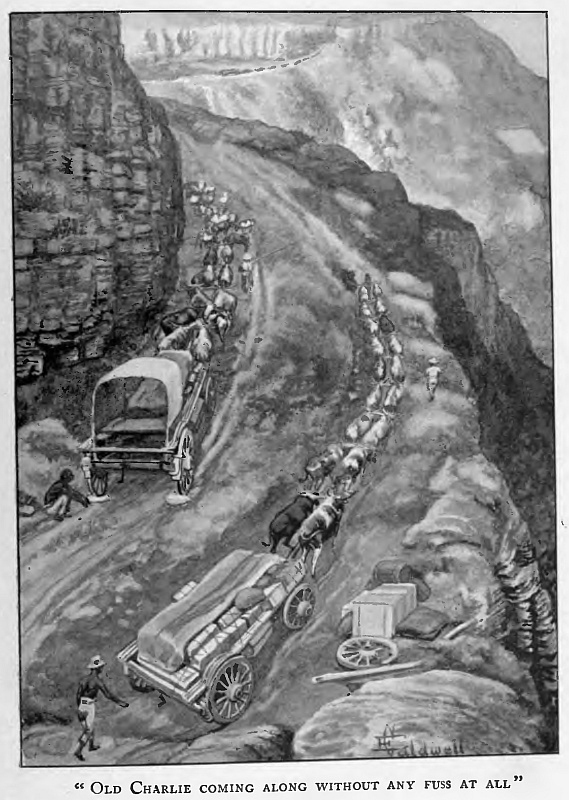
He walked slowly up past us, to “take a squint at things,” as he put it, and see if it was possible to get past the stuck waggons; and a little later he started, making three loads of his two and going up with single spans of eighteen oxen each, because the other waggons, stuck in various places on the road, did not give him room to work double-spans. To us it seemed madness to attempt with eighteen oxen a harder task than we and others were essaying with thirty; we would have waited until the road ahead was clear.
We were half-way up when we saw old Charlie coming along steadily and without any fuss at all. He had no second driver to help him; he did no shouting; he walked along heavily and with difficulty beside the span, playing the long whip lightly about as he gave the word to go or called quietly to individual oxen by name, but he did not touch them; and when he paused to ‘blow’ them he leaned heavily on his whip-stick to rest himself. We were stopped by some break in the gear and were completely blocking the road when he caught up. Any one else would have waited: he pulled out into the rough sideling track on the slope below, to pass us. Even a good span with a good driver may well come to grief in trying to pass another that is stuck—for the sight and example are demoralising—but old Charlie did not turn a hair; he went steadily on, giving a brisker call and touching up his oxen here and there with light flicks. They used to say he could kill a fly on a front ox or on the toe of his own boot with the voorslag of his big whip.
The track he took was merely the scorings made by skidding waggons coming down the mountain; it was so steep and rough there that a pull of ten yards between the spells for breath was all one could hope for; and many were thankful to have done much less. At the second pause, as they were passing us, one of his oxen turned, leaning inwards against the chain, and looked back. Old Charlie remarked quietly, “I thought he would chuck it; only bought him last week. He’s got no heart.”
He walked along the span up to the shirking animal, which continued to glare back at him in a frightened way, and touched it behind with the butt of his long whip-stick to bring it up to the yoke. The ox started forward into place with a jerk, but eased back again slightly as Charlie went back to his place near the after-oxen. Once more the span went on and the shirker got a smart reminder as Charlie gave the call to start, and he warmed it up well as a lesson while they pulled. At the next stop it lay back worse than before.
Not one driver in a hundred would have done then what he did: they would have tried other courses first. Charlie dropped his whip quietly and outspanned the ox and its mate, saying to me as I gave him a hand:
“When I strike a rotter, I chuck him out before he spoils the others!” In another ten minutes he and his stalwarts had left us behind.
Old Charlie knew his oxen—each one of them, their characters and what they could do. I think he loved them too; at any rate, it was his care for them that day—handling them himself instead of leaving it to his boys—that killed him.
Other men had other methods. Some are by nature brutal; others, only undiscerning or impatient. Most of them sooner or later realise that they are only harming themselves by ill-treating their own cattle; and that is one—but only the meanest—reason why the white man learns to drive better than the native, who seldom owns the span he drives; the better and bigger reasons belong to the qualities of race and the effects of civilisation. But, with all this, experience is as essential as ever; a beginner has no balanced judgment, and that explains something that I heard an old transport-rider say in the earliest days—something which I did not understand then, and heard with resentment and a boy’s uppish scorn.
“The Lord help the beginner’s boys and bullocks: starts by pettin’, and ends by killin’. Too clever to learn; too young to own up; swearin’ and sloggin’ all the time; and never sets down to think until the boys are gone and the bullocks done!”
I felt hot all over, but had learned enough to keep quiet; besides, the hit was not meant for me, although the tip, I believe, was: the hit was at some one else who had just left us—one who had been given a start before he had gained experience and, naturally, was then busy making a mess of things himself and laying down the law for others. It was when the offender had gone that the old transport-rider took up the general question and finished his observations with a proverb which I had not heard before—perhaps invented it:
“Yah!” he said, rising and stretching himself, “there’s no rule for a young fool.”
I did not quite know what he meant, and it seemed safer not to inquire.
The driving of bullocks is not an exalted occupation: it is a very humble calling indeed; yet, if one is able to learn, there are things worth learning in that useful school. But it is not good to stay at school all one’s life.
Brains and character tell there as everywhere; experience only gives them scope; it is not a substitute. The men themselves would not tell you so; they never trouble themselves with introspections and analyses, and if you asked one of them the secret of success, he might tell you “Commonsense and hard work,” or curtly give you the maxims ‘Watch it,’ and ‘Stick to it’—which to him express the whole creed, and to you, I suppose, convey nothing. Among themselves, when the prime topics of loads, rates, grass, water and disease have been disposed of, there is as much interest in talking about their own and each other’s oxen as there is in babies at a mothers’ meeting. Spans are compared; individual oxen discussed in minute detail; and the reputations of ‘front oxen,’ in pairs or singly, are canvassed as earnestly as the importance of the subject warrants—for, “The front oxen are half the span,” they say. The simple fact is that they ‘talk shop,’ and when you hear them discussing the characters and qualities of each individual animal you may be tempted to smile in a superior way, but it will not eventually escape you that they think and observe, and that they study their animals and reason out what to do to make the most of them; and when they preach patience, consistency and purpose, it is the fruit of much experience, and nothing more than what the best of them practise.