Book 9 — LAST WORDS.
Reading edition
This Memoir of Jenny Lind has touched its appointed close, now that she has finally and for ever shaken herself free from that theatrical career into which she had been thrown from her very infancy, and within which she had developed and matured all her artistic capacities. We have seen how she had deliberately and spontaneously cast it all away behind her, at the very moment when her wonderful histrionic powers were at the very height of their fulfilment. We know that she did this in obedience to the rooted convictions of her innermost self—convictions which had grown up within her secret will until they had become an imperious call on her spirit which no resistance or plea from without could break down, and no alluring fame or promise of wealth could beguile. She had done it in spite of all the world could do to prevent it. And now that it was done, she has found, as we have seen, that the path of Art is open as ever to her. She still can exercise her allotted mission to mankind; still can appeal to men through her marvellous gift of song; still can wake to finest issues all the nobility and purity and joy that lie asleep in human souls until the kiss of music breaks their sealing slumber.
Such would be, for years to come, her public career, full as ever of magnificent opportunities triumphantly used. And, just in order to verify our words to the minds and imaginations of our readers, we will venture to give a rapid glance, before closing this volume, down the long line of musical events which marked the life that now lay ahead of her. But, first, we must recall one domestic fact of primary importance. The life ahead, however artistically continuous with the life which had preceded it, was now carried on under vitally changed conditions; for on the 5th February, 1852, at the house of Mr. S. Grey Ward in Boston, she was married, by Bishop Wainwright of New York, to Mr. Otto Goldschmidt. We remember the beginnings of their intimacy: 449how they had met again and again at Lübeck and Hamburg; how they were drawn together by the common memory of Mendelssohn; how close were their musical sympathies. So it was, that when it appeared probable that Julius Benedict would part company with her in the midst of the American tour, communications began to pass between her and Mr. Goldschmidt’s family, without his knowledge, pressing the expediency of his coming out to take up the part of pianist as soon as it was vacant. He was then still young, but she had an enthusiastic admiration of his talent, and especially delighted in his sympathetic power as an accompanist—a gift on which she set the highest value. “Whether he accompanies me,” she wrote to Judge Munthe in October, 1851, “or I accompany myself, it is absolutely the same thing.”
The venture was made, and with entire success. He arrived at the end of May, 1851, and brought to her, in the thick of the loud and racketting distractions, the touch of that serious Art which they had both learned to revere in the great master gone from them. He helped her to fight through the noisy turmoil that beset her. The intimacy quickly deepened, and in him she learned that she could find “all”—so she wrote—“that her heart ever yearned after and loved.” The letters that she sent home immediately after the marriage, on the 16th of February, to his parents and to her dear friend, Mrs. Stanley, who had known her so well in her old trouble, prove how profoundly her whole being, in all its deepest motives and aspirations, had gone out into this happy union. And we know a little, from our record of her career, all that it would mean to her. It meant that the old life of the wandering musician, carrying wares from east to west, with its homelessness, its isolation, its insecurity, was all to end. We know too, how she had hated the condition of the unattached and unsteady wandering—the lodging with its forlorn emptiness, the inn with its naked publicity. The friendships, formed by the way, warm and intense as they had been, could but be as passing gleams, as broken suggestions of that reposeful home for which her spirit pined. And now the release had come; she was lifted clean out of the tumult and the loneliness; she was received into the warmth of endearing affection, and into the happy honour of wifehood.
And this promise of good things with which this marriage 450opened to her was never to fail her. For the remaining thirty-five years of her life, whatever troubles they might bring with them to her, as to all, she was never to miss the sense of this sympathetic understanding, of this secure loyalty, of this delicate trust, always there at her side. With her rigorous idealism, with her artistic emotion, she could not be herself without putting to full proof the strength of the tie that bound them. And it bore every test with a quiet steadfastness which nothing could seriously weaken or disturb. It was knit fast by entire community of interests and tastes, as well as by the more intimate sympathies. Both shared the same religious convictions; both enjoyed the same type of work, of amusement, of society; both found their delight in the same circle of friends; each had a heart-whole admiration for the other’s gifts. Moreover, outward circumstances favoured their union from first to last; and no loss, or damage, or misfortune, broke for a moment the even tenor of their days. To those who had the privilege of intimacy within their inner household for the last twenty or thirty years, it seems difficult to imagine how any marriage could have brought to her more steadiness or smoothness of tone and harmony and habit.
With their marriage the American tour came to a close. They gave, together, during May, 1852, three farewell concerts in New York, and then, after lingering in England through June, for Mr. Goldschmidt to be introduced to her old friends there, they crossed to Hamburg; and after touring in Switzerland, etc. settled finally at Dresden in the autumn, where they remained for the next five years. It was there that a son was born to them in 1853, and a daughter in 1857.
In 1858 they were finally drawn to England, and decided on establishing their home there. After some years in Argyll Lodge, a villa looking out on Wimbledon Common, where their third child was born, they bought some ground and built a house, which was named Oak Lea, on the fringe of Wimbledon Park, at a spot where, in her early London seasons, she used to ride down with Mrs. Grote to picnic and listen to the nightingales. In 1874, finding themselves too remote from the musical life of London, they left Oak Lea and bought a house in Moreton Gardens, which was their home until her death.
Such, in briefest outline, was her married life; and even these 451few lines are enough to reveal the contrast between its steady quietude and fixity, and the old helter-skelter days of incessant disturbance.
And now let us sketch, with a like brevity, the record of the main musical engagements which occupied their married years, just to convince ourselves how richly she continued to fulfil her artistic career. In all the work here recorded she enjoyed the active co-operation, and often the leadership, of her husband.
She sang during the early half of 1854 in Dresden, Berlin, Leipzig, Vienna, and Pesth. In 1855, after concerts in Hamburg and Bremen, she made a most brilliant tour from March to May in Holland, singing at Amsterdam, Rotterdam, Leyden, Utrecht, the Hague, Haarlem, Dortrecht, and in Friesland. In the June of that year, she began her visits to the Lower Rhenish Festival at Düsseldorf, which she repeated in 1863 and 1866. From December, 1855, to June, 1856, she made a round of England, Scotland, and Wales, accompanied by a strong band of supporters—F. Lablache, Weiss, Ernst, Sainton, Swift, and Piatti—and had a most extraordinary success.
It was in the midst of this tour, on March 11, that together they gave a most famous concert in Exeter Hall, on behalf of the Nightingale Fund, to which they paid in the whole of the receipts—£1,872. In recognition of this, besides a special vote of thanks, they received as a memorial a beautiful bust of the Queen, presented to them, at the Mansion House, by the hand of the Lord Mayor.
In December, 1855, they gave a musical evening at Windsor Castle before the Queen; and both appeared at a royal performance in Buckingham Palace in May, 1856. In the June of that year, under the leadership of Sterndale Bennett, she introduced to England Schumann’s Paradise and the Peri at a concert of the Philharmonic Society in the Hanover Square Rooms.
In 1857–58, besides singing at Dresden, Prague, Breslau, Königsberg, Danzig, and Posen, she made a momentous appearance in the Messiah, at Halle, for the completion of the Handel monument.
In 1859 she went round the chief Irish towns, assisted by Belletti and Joachim; while in 1861–62 she sang in concerts and oratorios in England and Scotland, with the assistance of Belletti, 452Sims Reeves, and Piatti; besides giving three oratorios, for charitable purposes, at Exeter Hall during the time of the International Exhibition.
Besides these, Elijah, given on October 22nd, on behalf of “London Over the Border,” and in special succour of a hard-pressed and persecuted clergyman struggling with the misery of North Woolwich, roused an immense enthusiasm. “What was written of this remarkable exhibition,” says The Times in its notice of the performance, “years ago, might be re-written now without a syllable to withdraw, without an epithet of admiration to change or modify.”
In May and July of 1863 she took part in the historic revival of Handel’s music to the Allegro and the Penseroso of Milton, and this music she sang again in the autumn at Liverpool and Manchester.
In the years that followed she would sing whenever a special occasion arose. It might be in the Messiah for the Clergy Fund Corporation in January, 1865; or at Cannes at her one Concert on French soil in 1866, for the Civic Hospital; or the Musical Festival at Hereford in 1867; or in Mr. Goldschmidt’s Ruth in 1869, in Hamburg and London; and again at Düsseldorf and in London in 1870 and 1871. She took an intense interest in this oratorio of her husband’s. In April, 1871, it is pleasant to see her take part in one more concert with Madame Schumann at No. 14, Hyde Park Gardens. In May, 1873, she sang in Northumberland House before it was swept away by the new improvements; and after helping the Turkish Refugee Fund in February, 1877, and singing on behalf of the Albert Institute in a Royal Concert at Windsor in May, 1880, she made her last public appearance at a concert given for the Railway Servants’ Benevolent Fund at the Spa, Malvern Hills, on July 23rd, 1883. From 1876 to 1883 her main musical interest lay in leading and training the soprani of the Bach Choir; while from 1883 to 1886 she threw all her energies into her work for the School of Singing, in the Royal College of Music.
Such was the after-life. And we part from her, then, in midcareer, in the full confidence that all will be well with her, and that half her triumph as an Artist is to come.
Yes! The voice—the perfected use of the voice—will remain to enthral and to exalt. But yet, we must confess that something 453is gone, which will never be again—the freedom of the Actress to place at the disposal of her voice all the resources of her imaginative passion. This is gone for ever; and the question may still haunt us, Did she never regret the decision taken? Those accumulated stores of experience gained from childhood, exercised and trained by twenty years of work and of success—was it nothing to her that these were thrown to the winds? Did not the gift itself within her, so instinctive, so deep, stir at times and yearn for an outlet? Did she never, in all the long years, feel for the warmth and the inspiration of some heroic hour, when she had drawn men, spell-bound, into the sway of the passion to which she alone could give expression? Is it possible that any one should possess the power, and not, at times, desire to use it?
The answer is absolute. No traces of such a regret are recorded, even by those most intimate with her, to have ever crossed her mind. Far from falling under even the passing influence of such a regret at the step once taken, she does not appear to have been even moved by the impulse from within now and again just to liberate her pent-up skill. Not that she recoiled from the Stage itself with any repugnance or moral condemnation. On the contrary, she would often go to the play; and would take an interest in this or that new actor or actress. She was, on these occasions, a rather merciless critic; and she would be very severe on any defect in technical training, or any stupidity of mannerism. All this came from her genuine appreciation of dramatic Art: she still recognised its high capabilities; she had not withdrawn her sympathies from it. And yet it never crossed her imagination that she might herself find joy in wielding the strange dominion again. She found a childlike delight in private, sometimes, in letting loose her marvellous gift of merry mimicry. Once, for instance, when quite alone with an intimate Swedish friend, she began to revel in making her laugh with the most whimsical imitations of the various celebrities of the Stage at that day; and, after overflowing with brilliant fun over it, she exclaimed: “You see, I have not lost my old art!” as if she was glad to feel it was there. But, nevertheless, nothing seemed ever to suggest to her: “Would you not love to exercise that art as of old?”
Her fixed and unwavering sentiments are given in a very vivid letter, written, years after, to the same Herr Forsberg, of the 454War Office, to whom she wrote on the death of her mother.[167] His deep interest in the theatre had led him to send her a poem called ‘Thalia’ in honour of the drama, which might wake up old memories. She, in answer, tells him how she came to see that all the tears shed on the stage were sham tears; and how, unsatisfied by success, she opened her Bible and there came upon these words (written on the margin of some text, by herself, as we suppose) “my newly-found Lord, who first taught me to shed the genuine tears.” Her new religious experiences seem to have made the emotions of the Stage feel hollow, and superficial.
She, then, recalls the physical agonies that it entailed, of which she is vividly reminded by a scene of home-happiness. “Walter” (her son), she writes, “is just at this moment rushing into the room dressed up in my jacket of the ‘Figlia,’ in which he is acting coachman, and is supremely happy: he has got a huge hat on, with a real cockade, and is offering to take me for a drive in his carriage, which is made out of chairs piled up on the table! I cannot refrain from comparing the present purpose of the jacket, and the anguish I felt when it covered my poor limbs. There is Walter, quite enchanted: and I was trembling all over while I wore it!”
This is, of course, an after-view which needs many qualifications; but it embodies the permanent impression left on her memory—a memory of bodily and mental misery. The Art was exercised at too heavy a cost. It took too much out of her.
In estimating the cost, we must remember her mode of acting. There is one form of the dramatic gift which lies in the power of self-abandonment, of absorption in a character foreign to the natural self—in a character taken up, assumed, worn, penetrated, as a study, by the intensity of the imagination. The actor leaves himself behind; and only imagines what that other character would feel under given circumstances. Such an actor keeps his own inner store of emotion unused; when he acts, he is not himself, but another person. But Jenny Lind has told us herself that she worked on the exactly opposite method. She carried herself into her parts. She could not act any character which she could not adopt for her own, or imagine herself to be. For the time, she was it. This is what limited her range. This is what debarred her from acting an evil character. She could not do it merely as a scientific impersonation; she must picture 455herself as inside the part; she must surrender herself to the sway of the evil passion to be portrayed.
Now, such a method would, no doubt, have overwhelming effect on happy occasions; but it is terribly expensive. It draws on the private resources; it exhausts the personal powers; it carries all the tumult and pain of the Drama within the secret recesses of the self. Such a process tears at the heart of life. It spends more than it can reclaim.
No wonder, that, as she looked back, the prevailing thought was mainly of the tortured nerves and exhausted vitality which such acting as this involved.
And not only did she escape from the torture of exhausted nerves: but more than that. She evidently felt a positive gain in inner freedom. Something there was in her deepest self, which sprang up into a liberated life when once she found herself a musician only, and not an actress as well. That is why she could never even feel as if she missed any fulfilment of her full powers.
And this element in her which found itself free was just that in her which constituted the very core of her artistic gift. For in herself, as in her art, she was a passionate Idealist. She had none of the realistic instincts, which delight in burrowing inside the crust of facts and incidents, ugly and repellent though they be, in order to drag out their inner secret. Her native tendency was, not to dig beneath the coarse rind, and pluck out its mystery, but to escape and soar away from all that was common and gross; she was like her chosen emblem the skylark,—
“That singing still doth soar, and soaring ever singeth.”
Perplexities, shocks, obstacles,—these did not evoke in her a wish to master them; rather they jarred against her conscience; they drove her to indignant protest, and anxious inquiry. That was her temperament, and therefore it was that she was not sure of herself in the stress of action, in the thick of facts. She could not trust her own judgment. She was greatly subject to changing impressions, and to inconsequent influences. She lost her confidence. The field of active life was not her true ground. She was an Idealist. Only when aloof from the shift of bewildering Circumstance, did she rise to her full supremacy, and move with perfect consistency, and absolute security of foot.
456She was an Idealist; that was her dominant self. And, therefore, it was, that she felt herself free and self-possessed when she had, once and for ever, cast out the theatrical interests which were dragging her in a cross direction. The Stage compelled her to be in constant contact with all the whirl, and noise, and jar of circumstance. It pinned her down to all the pettiness, the dishonourable inferiorities, of a restless conflict with a hard and unworthy environment. It imprisoned her within those jangling conditions from which her instinctive idealism was ever urging her to take wings and fly away. It could not go on. And, when once the effort of escape was over, she could not but feel herself rescued as from a prison. Her innermost being could put itself out, now, in music, with as little jar or fret from external accidents as was humanly possible. She could pass straight on to the concert platform from her inner musings, and could there deliver herself of her full message, just as it burned within her to give it, with nothing to consider except how to set it free in that form which her own inward judgment commended to her.
Music, then, gave to her idealism uninterrupted scope, while the accidental and external conditions of the Drama were incessantly traversing it; and it was, therefore, the musician that gained, at the cost of abandoning the actress. But yet further; behind the idealist lay the woman, with certain deep-root instincts which only won their freedom through the surrender of the Stage. Of these instincts we have spoken already. They were, first, the domestic instinct, with its intense desire for the stability of home. And, secondly, the religious instinct, with its yearning for inward peace. These emotions had no easy way in her, at the very best. The artist in her was very strong; she had all the ebbs and flows of impulse, the rapid susceptibility to changing influences, the shifts of temper, the sweeps of emotion, which make the artistic nature so perilous, and so difficult to control. She had to get all this in hand; she had to set herself to master all that aggravates the morbid humours of irritable nerves. It was all she could do so to manage that these deeper desires for stable peace could get forward towards their fulfilment. They needed every succour that external life could supply. And how then would they ever survive, so long as the impulsive and sensitive self was shaken and kindled by all the turbulence of a dramatic career? How would they have a chance of winning their footing, until she 457was released from that houseless wandering, amid uncongenial strangers, which such a career involves?
It was these twin instincts which suffered most obviously and most acutely, from the disturbance inevitable to the Stage; and it was their imperious pressure which impelled her to cut herself loose from that which hindered their freedom. Two little stories illustrate how she felt herself drawn to what she did. The first is domestic. In America, they tell how, at the very height of that unparalleled triumph, with all that great world ringing with her praise, she visited a young mother, and, after kissing the tiny, rosy baby, according to some Swedish fashion, on its ear and its heel, she turned to the mother and cried—“Ah, how I envy you! you have something to live for!” There is the woman’s cry, breaking through the artist. It must not be taken for more than it is worth. She would often acknowledge the sufficiency of Art, hallowed to its highest purpose; and would be alive to the danger that besets Art from the domestic side. But, for all that, the voice spoke genuinely, out of her very soul. The fuller her artistic passion, the deeper grew her longing for a something at the background which should be, not the expression of life, but life itself.
And, then as to the religious motive. Once an English friend found her sitting on the steps of a bathing-machine, on the sands, with a Lutheran Bible open on her knee, and looking out into the glory of a sunset that was shining over the waters. They talked, and the talk drew near to the inevitable question, “Oh, Madame Goldschmidt, how was it that you ever came to abandon the Stage, at the very height of your success?” “When, every day,” was the quiet answer, “it made me think less of this” (laying a finger on the Bible) “and nothing at all of that” (pointing out to the sunset). “What else could I do?” The answer is obviously dramatic; not literal. She is using the immediate situation, in which she spoke, as a symbol of what she intended to convey. She is not giving the actual motives which took her from the Stage; but she is interpreting the inner experience, which, for her, justified the original step, and which made it impossible to regret it. There, as she sat on the beach, she saw one more confirmatory instance, before her very eyes, of that secret which made her abandonment of the Stage so intelligible, and so satisfactory. The Bible, and the Sunset! 458There is what she always needed! There is what she wished at all cost to preserve. Each of them is closed and barred, to all who cannot bring to them a certain spiritual tone: and it was this tone which she found it impossible to preserve amid the disquieting distractions of an actress’s life. There is nothing morbid, or morose in this judgment of hers. She is not bringing to bear upon the theatre any exaggerated temper of religious puritanism. Even if, at the moment of the actual withdrawal, she was possessed by influences which disturbed her normal conscience, yet even then she repudiated, with hot indignation, any aspersion which implied contempt for her profession. And her determination to withdraw ran back far behind the time when that special form of religious puritanism affected her: and it lasted on, with undiminished strength, long after she had recovered, again, her more habitual judgment. No! It was religion, if you will, that moved her; but it was the simple and wholesome religion of a pious soul, who felt that she must retain the plain and primitive peace, which is the secret of all high and noble living—that she must sacrifice all, rather than suffer the turmoil of the world to blind her eyes to those mysterious visions that are thrown open through the gates of a sunset, or are set stirring by the still voices of the Bible. So she deliberately judged; and for that judgment she alone could know fully the grounds; and she alone can bear the responsibility. Only, let us be clear what that responsibility exactly involved. It was not that she withdrew from man’s service the gifts entrusted to her for his use: for she always felt that her best gift, that of song, gained, rather than lost, by her sacrifice of the Stage. She was not, then, sacrificing her proper mission for the sake of the woman’s need of relief, and peace; rather she felt herself to be paying the price that her full artistic mission to mankind asked of her. And the whole of her after-life seemed to be to justify the decision taken. She never saw any cause to doubt but that what God had asked of her, that she had done. And, certainly, the choice she made did justify itself by its spiritual results. By it she did retain the eyes which could look out into the sunset, and the heart that could read the Bible. By it she did keep herself, to the last, “unspotted by the world,” untouched by meaner motives, untainted by the breath of jealousy, or by the suspicion of earthly ambition. Nothing ever brought low that 459strange nobility of mind which was her mark, and her possession. Nothing ever clouded or discoloured that strain of haughty purity, which penetrated her being. Always she was shut away from the fever and the fret, that harries high spirits into disquietude, and vexes them with the miserable sense that they have slipped down from their true estate. Faults she had; blunders she made; we have not disguised or ignored them. But they were the faults and blunders to which such a character as we have here attributed to her, is liable. They were of the kind which belong, naturally enough, to the high-strung intensity of her life. They came from the misjudgments of genius; from the recoil of a noble and trustful innocence; from the reaction of vehement aspirations; from the disproportion to which artistic inspiration is so prone. Such failings and infirmities are, themselves, the evidence of the strain laid upon the will by the force of the ideal towards which it is set. Life, for her, was difficult to manage rightly, and smoothly, just because she had kept her spiritual temper unflawed and unbeguiled. Still, through all her perplexities, and bewilderments, she never ceased to walk, with the star of a divine mission clear above her head. She kept the heart and the simplicity of a child. She had the same faith in God with which a child looks for a father’s blessing, and trusts in the pardon of Jesus.
So we have watched her pass unscathed from out of the rough and dangerous obscurity in which her days began, through all the temptations with which the most overmastering and bewildering success can encompass and perplex the path of a world’s favourite—until we leave her, lifted high above the perils that beset the lower way, secure of herself, secure of a home, secure of spiritual peace.
There are few careers which have a more fascinating tale to tell of rapid and brilliant passage out of darkness into triumph, out of poverty and harshness into a blaze of glory. But there is no career which can leave a deeper impression of the entire supremacy, over all the world can bring, of the spiritual motive. She is given everything; and yet all is as nothing, if it does not leave her free to sit alone by the sea-shore, and to look at the sunset, and at the old Lutheran Bible, with the pure eyes that can see God.
That was the verdict of Jenny Lind; and that verdict was the 460secret of her peculiar power. Therefore it is, that she has left in men’s memories the name of one who, rare and splendid as were her gifts, was yet, herself, greater than her gifts—of one whose voice sang to them as no other ever sung, because it came charged with some high message that “no ear hath ever heard.” In all this, her life was a standing witness against the fallacy that haunts the popular use of the phrase, “Art for Art’s sake.” Nothing, indeed, could sunder, or weaken her loyalty to Art. She was an artist of the artists. She was true, in her artistic allegiance, to the very backbone; and would suffer no alien dominion within the frontiers that Art might claim. But with her whole soul, she disbelieved in any attempt to allot to Art a domain separate from the integral and central self; and that integral and central self was spiritual; and, if spiritual, then, of inward and inherent necessity, moral. Art could never be isolated from this animating principle of which it was the expression and the embodiment. It was, in itself, however subtle and delicate its mechanical organisation, yet but a lifeless body, unless it were filled, and penetrated, and transfigured by the breath of this spiritual soul. Here, then, lay its spring of strength. And it is Art itself, therefore, that demands of the artist the sacrifice of all that hinders the purity of its central source. Yes! the very treasures and gifts of Art might have to be surrendered in order to preserve the life itself. The right eye might have to be plucked out, the right hand cut off, rather than that the spiritual faculty, which alone could use the hand and the eye, should be itself ruined, or lost. That, we repeat, was Jenny Lind’s unswerving creed: and, under the sanction of that creed, she counted the magnificence of her dramatic triumphs as a very little thing, in comparison with the duty of retaining her highest gift in its noblest exercise.
We have spoken of this act of hers as of a renunciation, a sacrifice; how else could we speak of it, when we recall the splendid fame that she abandoned? And, yet, was there any one who ever bore upon her less sign of effort or of struggle in her surrender? It hardly seemed to have cost her a pang to let it go, so strong upon her was the motive-pressure of the ideal for the sake of which she cast it all behind her. Indeed, she was most strangely independent, not merely of fame, but even of that free and public exercise of her gifts which many a high artistic soul 461craves as its essential environment. Not only in the resignation of the Stage, but in after years, also, when she had practically withdrawn from public singing, she seemed to make her surrender with the same ease. She had no instinctive hunger for opportunities of self-manifestation. There was no restless desire to feel her old power at work. The musical ideal was high, and serious as ever; but she could nurse it alone, or with the few who knew. And the firmer the ideal, the more rooted grew her horror of all the friction and the harshness of publicity.
So she lived, without a passing shadow of regretful ambition, for thirty-seven years after her great decision. At home in England, her adopted land, she saw grow up, about her feet, her children,[168] and her children’s children; and to the very last, she found her deepest joy in the simplicities of children’s feasts, and in the sweet homeliness of country-scenes. So she lived, quiet and aloof, in honourable dignity, in freedom and in beneficence, unvexed by clamour, untraversed by intrigue. The affections of friends she had ever about her, intimate and reverential: and the repose of home; and the trustfulness of wedded love. This was the background she vitally needed in order to secure herself against the ruin of unrest, and to retain, in their integrity, her native nobility of soul, her spiritual solemnity, her perfect purity of tone. So she remained to the very end, original, separate, exalted; leaving, when she died,[169] to all those who loved her, the impression of something unique and incomparable,—
——“the memory of what has been
And never more will be.”
Never more here, on earth! Never more will men listen enthralled by the sound of that singing in which the very soul of poetry and holiness seemed to have found for itself a living vehicle, a spiritual body.
No! Never more here! But all the gifts that were in her, penetrated as they were by spiritual significance, told of immortality. Such a presence as hers, erect and prophetic, was itself a pledge that its life cannot be spilt as water in the dust. It 462may be burdened, as she was, by the perplexities that encompass it with darkness, but it cannot doubt the secret which it holds in itself: it cannot doubt its own unconquerable hope: it cannot doubt its own witness to the necessity of an eternal home where that which here was but suggested will be achieved—that which here did but begin shall be fulfilled. Of her, if of any, is the poet’s word true—
“Sorrow is hard to bear; and doubt is slow to clear;
Each sufferer says his say, his scheme of the weal and woe:
But God has a few of us whom He whispers in the ear;
The rest may reason and welcome: ’tis we musicians know!”[170]
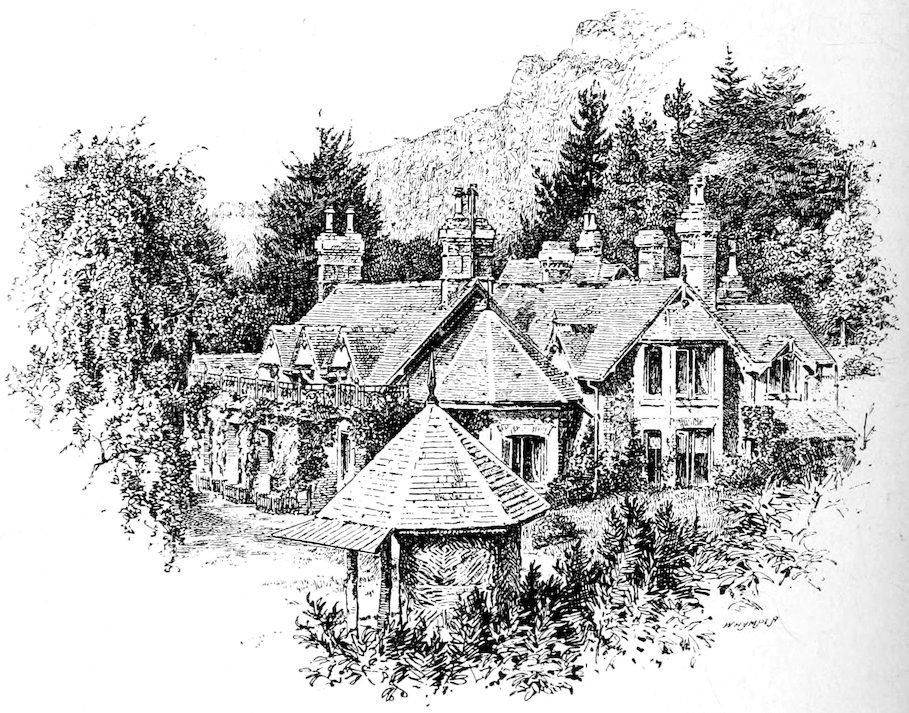
WYND’S POINT, MALVERN HILLS, MADAME GOLDSCHMIDT’S COUNTRY HOME, IN WHICH SHE SPENT MUCH OF THE LAST YEARS OF HER LIFE, AND IN WHICH SHE DIED IN NOVEMBER 1887.
463