Book 9 — CHAPTER V. DEPARTURE.
Reading edition
She left her country with a happy sense of the goodwill that was faithfully following her career, as it opened out into paths that carried her far afield. She had a few engagements to fulfil on her way across Europe, before she joined her companions, Benedict and Belletti, who were awaiting her in London.
She crossed quickly through England, only sleeping a couple of nights in London, and reaching Crumpsall, near Manchester, the home of her faithful friends the Schwabes, in time to rest a few days before fulfilling her engagements at Liverpool on the 16th and 19th of August. Both Mr. and Mrs. Schwabe accompanied her; and she had, therefore, the comfort of affectionate intimacy to help her through the racket and distress of the final start.
The two concerts were to raise money towards paying for the new hall of the Liverpool Philharmonic Society in which they were given. The first of these, on the 16th, was noticeable only for “causing an excitement,” according to the Times of August 19th, “to which the musical annals of Liverpool can find no parallel.” “The enthusiasm went far beyond fever-height.” She sang her famous pieces, ‘Qui la Voce;’ ‘Und ob die Wolke,’ from the Freischütz; ‘Non paventar,’ from the Flauto Magico; a Duet from the Turco in Italia, with Belletti; and, then (after a new Song by Benedict, called ‘Take this Lute’), the Norwegian Echo Song, accompanying herself.
So far she was on old ground; but, at the second concert, a very different and a vital departure was made. It was her first singing of the Messiah, in which, in later years, she proved herself incomparable.
The excitement of expectation was intense. On August 19th, the Times critic[162] reports that as he writes his despatch, on Saturday 17th,
433
“The rehearsal for the Messiah is now proceeding at the Philharmonic Hall, the precincts of which are besieged by a mob anxious to obtain a glimpse of Jenny Lind. The greatest curiosity prevails about this performance; for Mdlle. Lind has never sung in an Oratorio of Handel’s since her arrival in this country. Monday night will show whether she will achieve the same success in the Messiah as in the Creation, and the Elijah.”
As to the rehearsal, he records with warm commendation that,
“Mdlle. Lind was, as usual, the first to arrive, the last to depart, and the most attentive to her own music, and to the indications of the conductor. If every one were as painstaking and zealous at rehearsals as Mdlle. Jenny Lind, the critic would have much less to complain of.”
On the 20th, the critic telegraphs the result for the Times of August 21st.
“Jenny Lind’s singing surpassed anticipation. Her energy, and brilliant execution of ‘Rejoice greatly’; her expression in ‘He shall feed His flock’; her tenderness in ‘How beautiful are the feet’; her fervid devotion in ‘I know that my Redeemer liveth’; and her fine rendering of the last air, ‘If God be for us,’ which made it a new and unexpected feature, raised unbounded enthusiasm. In the Recitatives, besides the excellence of her vocalisation, the pointed, articulate manner in which she pronounced the English words, excited general admiration.”
After praising Belletti, and the chorus, and criticising the band, he tells how, at the close, the National Anthem was sung,
“Jenny Lind giving the two principal verses. The scene that ensued defies description. The walls of the building reverberated with cheers. Hats, sticks, handkerchiefs were waved in every direction. The platform of the orchestra was covered with bouquets and wreaths, many of which fell upon the head and the shoulders of the songstress. It was a leave-taking such as even Jenny Lind has rarely experienced.”
In the Times of the 22nd, Mr. Davison contributes a detailed criticism of her delivery of the numbers in Messiah. He has much to say, which comes with the authority of a most skilful and experienced judgment. 434
“Mdlle. Lind’s performance, in the Messiah, has,” he considers, “enhanced, if possible, her reputation. ‘Rejoice greatly’ is a veritable Bravura, not a mere senseless display of roulades and fioriture, but a gush of melody in which the exultant feeling of the text is expressed with a power that springs from inspiration. The elaborate divisions of the Song demand the greatest flexibility, while its peculiar vocal character can only be expressed by a voice at once strong and brilliant, combined with a free command of the upper notes. These physical requisites are among the peculiar gifts of Mdlle. Jenny Lind, whose well-known intelligence and reverence for the text enabled her to employ them with the finest effect.”
“The air ‘He shall feed His flock’ requires a simplicity which derives effect from the innate and unobtrusive beauty of the music. This divine melody fell from her lips like soft water from a spring. The reading of the words was perfect; and the shake at the end,—the legitimate and only ornament introduced—was executed with a finished neatness and a command over the sotto voce which afforded the fullest satisfaction to the ear.”
Again,
“‘For now is Christ risen’ had in it something of positive inspiration. The termination—strictly according to the text without even a concluding shake—was far more effective than all the singer’s art could have made it, exercised without that feeling of veneration which teaches that to touch such music is to spoil it.”
In conclusion, he considers that—
“The depth and sublimity of the music exhibited Mdlle. Lind’s talents in a totally new light.”
So triumphant was the first historical opening on the field with which she so intimately identified herself in later years. It was a wonderful passage from the atmosphere of the Figlia to that of the Messiah; but the English knew, now, at what level her supreme gifts lay; and they welcomed her on to the ground of their famous Oratorio with a heartiness of recognition which she cordially recognised. It was to the English that she specially loved to sing the music of the Oratorio.
Her last day at Liverpool was taken up with visits to view the new wing of the Southern and Toxteth Hospital, due to her last year’s singing; and with receiving there a silver tea-kettle and a pair of silver candlesticks.
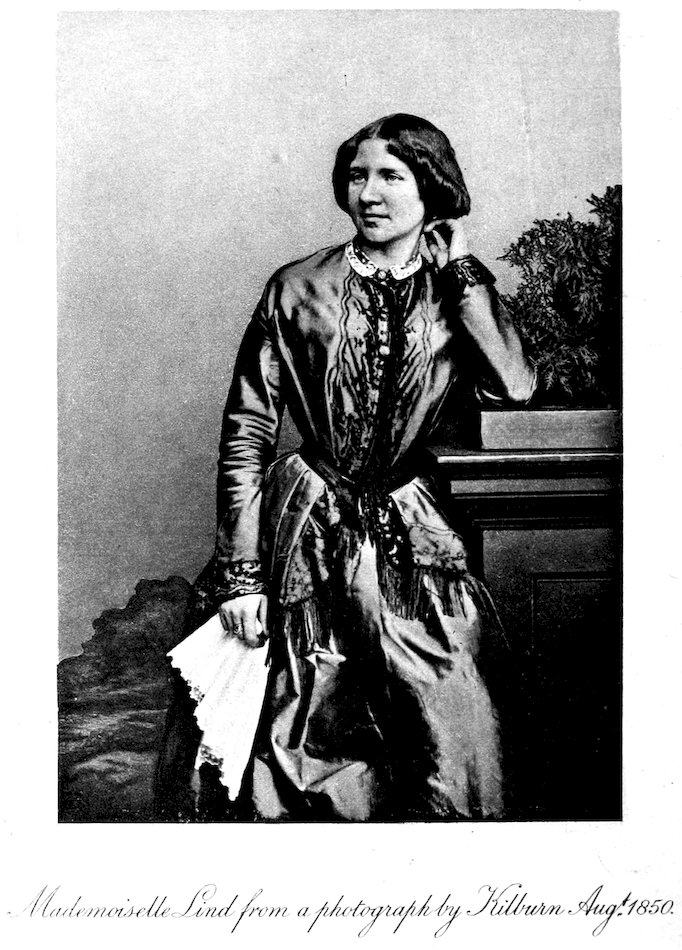
Mademoiselle Lind from a photograph by Kilburn Augt. 1850.
435On the evening before sailing, her Swedish heart was at work; she could not let herself go on this new and strange experiment without desiring the sanction and the blessing of the “old folk at home.” Back to father and mother her thoughts were travelling; she must feel herself covered by their authority; she must let her last words be to them. So, on the evening before the start, she sat down and wrote the following letter, with its buoyant hope, with its tender daughterly humility.
The daguerreotype, to which she refers, is the one from which the picture on the opposite page is taken. It was engraved in the Illustrated London News of the day: but the present picture is taken fresh from the old plate, which has, by diligent search, been recovered, and used.
“Liverpool, 20th Aug., 1850.
“My dear Parents,
“May these lines find you in the enjoyment of good health. I have been very well since I left Sweden, and am now starting for the New World. For we leave to-morrow morning at half-past ten.
“I have been eight days in England, and have sung here in two concerts, both of which have been most successful, and the English public has greeted me as if I belonged to them. I am met everywhere with heartiness and love. Oh, may I succeed in deserving them more and more!
“I have been to see the steamer which will take us over to America, and nothing grander of its kind, I should think, could be found in any country. The vessel is 300 feet by 80, and is decorated so magnificently that one can fancy oneself in a rich private house.
“I look forward to the sea—the ocean!
“When I have got across, I shall let you hear again. As my mother wished to have a Daguerreotype of my poor features, I have sat for one in London. I hope it will have succeeded. Farewell, good mamma and papa! Think of me with friendliness, and give me now and then your blessing, for a parents’ blessing is something good to travel with. Let me hear occasionally how you are at Pommern.[163] Remember to look into the books which I gave you, while stopping with you there—and may the Lord Himself enlighten and bless you! Thus prays most sincerely
“Your attached “Daughter.”
436There is a quaint touch of parental authority in the last sentence of the letter, which blends curiously with the beautiful and childlike simplicity with which she asks for the parents’ blessing on her going-forth. The whole letter is a delightful foil to the following account of the wild popular excitement that was fermenting, at this moment, round the girl who was herself engaged in writing those plain, quiet, humble messages, so full of domestic affection and simple piety, to the two wondering parents in the old country.
Jenny Lind’s Departure for America.[164]
“Liverpool, Wednesday night.
“Jenny Lind is gone—gone amid a scene of triumph which was not more a tribute to her own surpassing work and talent, than to the art which it is her honour to profess and to which she does so much honour. Ere these few hasty lines are before the reader, this incomparable songstress will have performed one-fourth of her voyage to the United States, where, we are assured, a reception awaits her which will cast in the shade even the splendid ovation which has just attended her departure from among her European admirers.
“Fresh as I am from this magnificent display of public feeling and sympathy, I can scarcely enter into details. With ears still deafened with the booming of cannon, and the shouts of the thousands who were assembled on either side of the Mersey, and eyes dazzled by the gay effect of innumerable craft, which were illumined by the sunlight as they ran to and fro on the river, or followed in the wake of the Atlantic, I can scarcely give you a sober description of this extraordinary scene.
“The authorities foresaw there would be a great demonstration, and took their precautions accordingly. Fancy what must be the interest excited by Jenny Lind, when the police thought it necessary to notify to Mr. Barnum’s agent, that if the lady took her departure from the quay at the hour generally expected, they could not ensure the safety of life and limb. We doubt much whether any sovereign was compelled to change the programme of his movements for such a reason. Yet so it was; and much hurrying to and fro was there in consequence. Instead of leaving at nine or ten o’clock, as had been arranged, Jenny Lind was obliged to slip out privately at a quarter to eight, and go down all manner of back streets to be able to get to the pier unperceived. 437In this she was successful; and while the intending sightseers were disposing of their muffins and coffee, the little woman whom they were all going out to see had quietly gone on board the Atlantic in a river steamer; but not until after she had been annoyed (during a few minutes’ stay on the pier) by a crowd of idlers who pressed round her in the most rude manner, and could scarcely be kept off by the police.
“When at last the hundred and fifty passengers who had engaged all the berths were received on board, with all their luggage, and had taken leave of all their friends, and when the sound of a gun booming across the water from the bows of the steamer announced that all was ready for departure, what was certainly a ‘great scene’ commenced. The immense floating mass began to move, and, as if by magic, all the craft that had been playing about on the surface of the river, formed into lines, and made a sort of procession. As the Atlantic steamed up from her moorings, past the Albert Docks, she turned her head inshore, in the direction of the town, and slowly passed in front of the magnificent line of quays, amidst the enthusiastic shouts of thousands of human beings who lined the shore, not merely on the Liverpool side, but also all along the Cheshire coast, from Birkenhead onwards to the mouth of the great arm of the sea. Salutes were fired from the shore, and were returned from the Atlantic; and the whole scene,—such an army of craft of all sorts and kinds floating, with pennants flying—such a shouting—such a roaring of cannon—such a bright sunlight (which broke out suddenly, as if to afford presage of fair weather)—was really one of the most extraordinary sights we ever witnessed. Every eye was strained to get a sight of Jenny Lind. There the little woman stood on the paddle-box, with her arm in that of Captain West, and waving her handkerchief enthusiastically in return for the greeting of the crowds who had assembled to witness her departure.”
Such was her farewell, as she passed from the Old World to the New, travelling out over the unknown waters, to discover whether Music had power to draw towards her the hearts of these immense populations in far-away cities, with the same security with which it had knit to her the affections of all those to whom her voice had spoken, in the land that lay about her home. So she sails, wafted out, for her adventure, on the wings of all the favouring hopes with which it was possible for that Old World to send her forward. Those ringing cheers, those crowded boats, those fluttering handkerchiefs, those straining eyes, which followed her 438out of Liverpool, spoke to her of all the wonderful days in Europe that lay behind her—days that had never once failed to bring her their unceasing tribute of praise and welcome and love, as often as she invoked them, ever since she first babbled out her earliest speeches as a little child on the boards of the Stockholm Theatre.
And this unfailing triumph had never limited itself to a mere admiration. Always it had been an admiration that was transfigured, by its own inward force, into genuine affection. Always it had felt the power of her personality; and had understood her deeper motives, and her serious intention. She had never been wholly misunderstood in her desire that, by her Art, she should touch the finer issues of the religious consciousness, and enlarge the resources of a human charity.
All this was behind her, to forward and cheer her, as she tempted the new Atlantic seas. Nor did the promise of high fortune belie itself. The pledge was redeemed in a measure that ran over and over. It is not our present part to follow her in this adventure, nor to tell the familiar tale of the boundless enthusiasm that awaited her every step from the moment that she touched American shores. Our special part ends at this point, where the old European career, in its special sense, closes. Up till now, her Dramatic and Artistic life had developed, step by step and stage by stage, in an orderly sequence of gradations. She has now touched the final level on which her future career is to move; there is no new fashion it is to take. The platform of the concert-room is the ultimate spot of vantage from which she is to reach the world of men. It is needless to expand a record which would merely repeat in detail the same typical success. We have seen enough already to prove that, in her abandonment of the stage, she had not surrendered her chance of delivering her Artistic message. On the contrary, though her marvellous histrionic gift was put aside, she found a freedom of scope, a glad outlet, for her singing, which rather increased than diminished the exercise of her sway. The fervour that accompanied her concert-singing was in no degree less than that which, of old, had besieged the doors of the theatres. The opportunities which it offered her for beneficence were, at least, as magnificent as before. Moreover, in the Oratorio, she more and more found the most congenial and adequate of all the fields in which she could 439exercise the full force of her powers, and attain the noblest realisation of her ideal.
We send her out, then, on her American visit, with no sense that her career, in touching its final level, has less triumph in store for her than any of the steps which led to it. We shall leave her to go ever forward, still encouraged, from New York to Savannah, with the same passion of devotion, the same thrill of a unique experience, which she had evoked already in Stockholm and Berlin, in Vienna and London.
But, though we do not follow her steps farther, we cannot part with her without recording a message or two which she herself sends back, as from the new land, to those who watch after her in the old countries. And the messages are to those who have been our companions through this book; and we shall be glad to feel that they receive good news from her, and that they and she are still undivided, though the Atlantic rolls between.
And as her last letter, at the moment of leaving Europe, had been written to her parents, so let the first that we quote from America be due to the same filial loyalty. It gives her simple enjoyment and wonder at the great voyage.
“Boston, 27th September, 1850.
“My dear Parents,
“It does seem strange to be so far from home, so far from Europe! I trust these lines find you in perfectly good health. I take for granted that you have been informed long ago of my safe arrival at New York, 1st September.
“The voyage was in every respect extremely interesting. True, eleven days on the sea is a good deal, but the sight of the ocean, under all its various aspects, was oh! so grand!—the rising and setting of the sun, moonlight, the new stars, the rainbows, the phosphorus, porpoises and seals, storm, fog, and then again a surface calm as a mirror. All these changes we could watch in turn. We had a magnificent boat, and a particularly clever, attentive, and charming Captain. I was not ill in the least, but kept wonderfully well all the time. I went on deck to have a look at the storm; it was splendid! We lay deep sunk in the trough of the waves, the colossal ship floating like a tiny eggshell on the immeasurable expanse of the waters. The ship’s guns were flung hither and thither, ropes as thick as my waist came sweeping in piles across the deck, the waves, as high as big houses, of the most intensely beautiful light green, dashing towards the bridge with such violence as to overthrow and injure three sailors and one of 440the officers. After the storm, which lasted twenty-four hours, it turned fine, and then we had all kinds of glorious sights.
“I sat up, quite on the very edge of the prow, close to the old man blowing his horn (the ‘old man,’ I must add, was of wood!), with a few friends and the Captain, who made it their business to take care of me, and I really felt elated by the superb spectacle before me.
“We gave a concert (on the ocean!) for the crew, and once or twice we had a merry bit of dancing; and in this way time flew by quickly enough.
“New York, as to its situation, reminds me very much of Stockholm.
“I was met with quite an astonishing reception. I have already given six concerts there, in a hall with room for 11,000 people; it has been crowded each time, and we shall most likely be able to give about forty to fifty concerts in New York alone.
“Here everything is done on a large scale. The first ticket sold the day before yesterday in this city for to-day’s concert (the first one given here) was sold for as much as——625 dollars! The tickets, you must know, were sold by auction. It is amazing what heaps of money they seem to have here.
“My health is, as usual, thank God, in excellent condition; my voice is fresh and strong, and I am looking forward extremely to some plan—after this ‘tournée’ is over—for enjoying peace and rest; for, indeed, in these two matters, so precious to us, human beings, I seem to be given but a very small share, torn and bothered as I am from morning to night. Still, it is touching to see such goodwill and kindness; people seem not to know how to do enough to show their favour and the genuine interest they take in me.
“I wish I could send home to Pommern some of the lovely flowers and the splendid fruit which are continually sent to me. The peaches are delicious, and grow here in great abundance. We have still warm weather, and ever a divinely blue sky.
“October 1st—Time does pass! I shall now soon be thirty years of age! How happy I am to become an ‘ould hag’! Every day I see round me numbers of new faces,—so many, in fact, that I find it a bore—but I am going to try and terminate my engagement as quickly as possible—perhaps in a year! When we meet I shall have heaps to tell you, which now I have no time to relate. It is already more than three months since I was taking part in the country dances round the maypole at Pommern. It does seem so strange!
“I wish I could soon hear that you both are well. Now, pray do take care of yourselves, so that still many a green spring and 441many a chirping bird may gladden your soul! Rest assured that all I have said or written has been done with the truest and best intentions; and pray remember with tenderness your far-distant
“Daughter.”
That letter will, certainly, bring relief, and joy to the little house at Pommern, where she had so lately “danced round the maypole.” She, like her own favourite skylark, is ever—
“True to the kindred points of heaven, and home.”
The next of the letters repeats how freely and cheerfully things are going. It is written from Boston, on October 2nd, 1850, to her Guardian, Herr Munthe.
“I have given eight concerts, and hitherto the success has been unparalleled. I devoted the first two in New York to charities, because they had raised such enormous prices (by auction)—that I considered this to be a plain duty. My agreement with Mr. Barnum has been quite altered; and Mr. Barnum has shown, and is still showing himself, extremely generous, and reasonable; and seems to have made it his first object to see me satisfied. I understand that we rarely make less than $10,000 at a concert. Hitherto the receipts have varied between $12,000, $14,000, $16,000! And thus my share for six concerts is about $30,000!”
Good news, this, for the kindly old judge at home! His warm heart would kindle over the triumphant success, even though he foresaw a big job ahead for his prudence and his wits, when it came to the dispensing of these vast sums in accordance with the scruples and the anxieties of her beneficence.
On November 8th she wrote again from Boston to her Guardian a letter full of her characteristic temper.
“It is indeed a great joy, and a gift from God, to be allowed to earn so much money and afterwards to help one’s fellow-men with it. This is the highest joy I wish for in this life; everything else has disappeared from the many-coloured course of my path on earth. Few know, though, what a beautiful and quiet inner life I am living. Few suspect how unutterably little the world and its splendour have been able to turn my mind giddy. Herrings and potatoes—a clean wooden-chair, and a wooden-spoon to eat milk-soup with—that would make me skip like a 442child, for joy! And this—without the slightest trace of exaggeration, or that sort of thing.
“Benedict and Belletti are kind and pleasant. Benedict and I play nice little duets on the piano, and the time goes quickly and happily.
“The bird-song, ‘I know not why I am singing,’ and Herr Berg’s song with the long-sustained notes, and the Norwegian echo-song—these are the standing pieces which I must sing at every concert.”
This speaks straight from her heart. It holds in it her deepest motives—motives, strong from the first, but which have gained in strength as she developed. Her original sense that her singing was God-given has been intensified by the more positive religious influences which had flowed in upon her through her English Evangelical friends, and expresses itself, now, in the desire for inner peace in the quiet recesses of the soul: while the hope of beneficent service to her fellow-men has become absorbing. Still, with all the growth, there is no change whatever in the “Jenny” who would “skip for joy over the herring and the potatoes, and the clean wooden-spoon” That declaration is instinct with her very breath. She never lost, either the spontaneous simplicity of plain living, or the buoyant gleefulness of the dancing child.
And, now, to part with her best friends with whom we have seen her spend such happy days, and to whom she pours out her fondest affections—the Wichmanns. They are not forgotten in the novel whirl of American affairs.
“My dearly beloved Amalia,” she writes from Philadelphia on December 5th, 1850, to Madame Wichmann, “I feel so great a desire to write you some lines that I cannot keep silence any longer. I long to know how you all fare; and would like, too, to tell you something about myself; for I know well how great an interest you take in my fate. I will no longer restrain myself; for I find my thoughts all flying to you with such love and confidence that I feel grateful and happy in the mere act of communing in spirit with you. And, surely you have not forgotten me!
“What are they doing in Germany? I am in great anxiety over the situation there. Will there really be war? Where will you go in that case? For God’s sake, write me a line about that.
“If all goes ill in Europe you might come to America, and 443fetch me away. How is Otto?[165] Is he stronger? I was so glad to see him in Baden; and fancied that in him I saw you all.
“... I and all of us are extremely well. My head is quite re-established: and my voice is better than ever. The climate here is very good. Nearly the whole autumn we have had a clear blue sky, such as we had at Meran, when it was at its best....
“Mr. Barnum behaves extremely well towards me: and I could not wish for anything better.
“In the month of July we hope to be back in Europe, for we hope to see the Great Exhibition. Ah! if you were to come there! You, Amalia, have never been in London; how interesting it would be to see it! Think it over, dearly beloved Frau!
“If you see Taubert, tell him, please, that they will not listen here to anything but his song ‘I must be singing.’ Since I got a very nice translation of it in English, I have to sing it at every concert. Greetings to all my friends—Herr Taubert—Professor Werder—Magnus—Madame Mendelssohn, etc.
“I wept for joy the other day, when the Prussian Envoy, Herr von Gerolt, brought us greetings from Her Majesty the Queen of Prussia. When next you meet His Excellency Herr von Redern, pray tell him how truly grateful I feel for this mark of Her Majesty’s sympathy. Greet him at the same time.
“Faithful love to you all!
“From yours ever gratefully,
“Jenny.”
So we leave this sweet and delightful friendship which played so deep a part in her early years of European success. It has remained her constant support throughout—a harbour, in which she never failed to find refuge and peace.
One thread out of her old life, which we have already tracked into the new, is alas! soon to be slit. It is a thread woven deep indeed into the tissue of her memory and her soul. The long and curious story of her mother which we have followed through so many incidents, ends at last during the American trip with the news of Fru Lind’s death. What a strange and unanticipated change had come over the scenes of poor Fru Lind’s life since, pinched and driven by the hard days, unsuccoured and unsustained, she had been forced to put out her new-born child with the Parish Clerk of Ed-Sollentuna, and turn from her hurried sickness and nursing to fight her way alone against a baffling 444world! “That child will bring you help! mark my word,” the old grandmother had said to her: but she little knew the full and wonderful sense in which those words would prove themselves true. Now, in 1851, lifted out of all anxiety by that child’s help, transplanted into a kindly and peaceful home which the child had given her, in company with the husband whom, in spite of all his weakness in those earlier times when she had to struggle on alone, she loved with an affection that he warmly returned, she could sit and rest among the quiet country-sights, and could sweeten her sourer humours, and could soften her asperities, and could come to kinder terms with the human earth about her, as she caught all the echoes of that praise with which the wide world outside was welcoming that child of hers, once so forlorn, of whom, with all her tough bitterness of disposition, she had always been so proud; and could hear of the uncounted wealth which was being poured in upon her, in measures that must have made her breathless as she listened to their tale. No fairy godmother could have worked a more marvellous transformation; and yet all had been done by the earnest, intelligent, devoted steadiness, the “incredibly hard work,” of that tiny scrap of a child who once sat in the porter’s window at the Widows’ Home, and sang away to her cat “with the blue ribbon round its neck”; and who, now, knew not how to escape from the thousands who thronged to hear her in lands beyond the sea where her name was already familiar and dear as a household word. She, by God’s grace, had done it: and now at the end of all, she is the very same “Jenny” who trotted off by her mother’s side to the Opera-House, to try their fortune with old Croelius. Still she loves to think of the “milk-soup and the wooden-spoon” that belonged to the old simple days of childhood; and her heart drew closer to her mother, now that the Atlantic rolled between them, than it ever could in the earlier days when the roughness of the surface-life harshened the home, and forbade those springs of gentleness to flow between a mother and daughter whom so much held estranged. Certainly, it was with a bitter pang that Jenny Lind heard, in December 1851, of her mother’s death. Some words which she wrote about it in 1852 tell how “everything had become smooth and nice” between them; how her mother had become so much quieter and more reasonable; how she had hoped to “surround her old age with 445joy, and peace and tender care.” “Now it is too late! Peace be with her soul.”
Too late, perhaps, for all that she yet planned to do; but not too late to have done much to secure that “peace” to her declining days, which was the gift most sorely needed by that disturbed and harassed heart.
Perhaps, now that she has herself taken leave of her friends, we may give one last picture of her, as she was seen in the thick of her American work, by the sympathetic eyes of Mr. Parker Willis, an American author, whose reminiscences of ‘Famous Persons, and Famous Places’ were published in 1856.
He has most graphically described a typical day’s work in New York, with its mingled glow and grind.
“It was the morning after her last concert (in New York), and among the business to be attended to, in the winding up of a visit to a city where she had already given away $30,000 in charity, was the result certified in the following report:—
“The undersigned, a committee named by Miss Lind to divide the appropriation of the sum of $5,373·20 cents, the proceeds of a morning concert, have distributed the said funds as follows:—
New York, Nov. 26, 1850.
C. S. Woodhule. B. Raird. R. B. Mintum. Wm. H. Aspinwall. John Jay.
$
To the Society for Improving the Condition of the Poor 1000
Widows with poor children 300
Roman Catholic Orphan Asylum 300
Female Assistance Society 300
Eastern Dispensary 250
Northern Dispensary 250
Eye and Ear Infirmary 250
Hebrew Benevolent Society 200
Prison Association 200
Destitute children of seamen 200
Homeless and destitute boys 100
Swedes and Norwegians in New York 273·20
Swedish Bibles and Testaments 200
Brooklyn Orphan Asylum 250
The poor of Williamsburg 100
The poor of Newark 100
The poor of Jersey City 100
Temperance societies 500
St. George’s Society 500
5373·20
446“There was also another matter which formed an item in the ‘squaring up’ of the New York accounts on that day. A paragraph had reached her making mention of a Swedish sailor who had perished in endeavouring to save the lives of passengers on the wreck of a vessel. Jenny Lind had sent to the Swedish Consul to make enquiries whether he had left a family. His widow and children were found by the Consul,[166] and Jenny had sent him $500 for their use. This was mentioned by M. Habicht to a lady, who mentioned it to us, and by this chance alone it became public.
“But while all these sufferers were receiving her bounty, and she was settling with banks and managers for the payments—what else was her life made up of on that day?
“It was now half-past nine in the morning, and three servants of the hotel and two of her own had been ordered to guard her room till she could eat her breakfast. But well-dressed ladies cannot be stopped by men-servants: and her drawing-room was already half full of visitors on particular business who had crowded past insisting on entrance.”
He goes on to describe vividly the “lady-beggars,” to whom she hurriedly offered $20 or $30, as the shortest way to be rid of them; and how this is rejected with indignant protests. “We did not expect this pittance from you!” “Excuse me, I came for a donation, not for alms!” etc., etc. Then there are the “applicants for musical employment; passionate female admirers; a dozen ladies with albums; some who had worked things for her; one who had come indignantly to ask why a note containing a poem had not been answered.”
So the audience would go on; and Mr. Willis cannot wonder, that in the evening, when he goes to a party at a lovely villa ten miles from town to meet her, he should find her looking fatigued. But she received him with a merry inquiry as to where he came from, in reference to some spirit-séance, to which he had lately taken her. He told her in answer that they had been inquiring of a spirit whether Jenny Lind had any talent which she would have developed but for the chance possession of a remarkable voice? and if so, what was it?
“‘And the spirit said, it was working frocks for poor little children, I suppose,’ was her immediate anticipation of the reply, uttered with an expression of arch earnestness which confirmed 447us in the opinion we have gradually formed, that a love of the comic and the joyous is the leading quality in her temperament.
“During the time that we remained near her, there were constant introductions. And in these she bandies no compliments. If a remark is made which has no rebound in it, she drops it with a monosyllable, and without ever gracing its downfall with an insincere smile. She affects no interest which she does not feel; and puts an abrupt end to a conversation which could only be sustained by mutual pretence of something to say; she differs suddenly and uncompromisingly when her sense of truth prompts her to do so; and repels, instead of even listening silently to, complimentary speeches. At all times, she is particularly honest and simple.”
He describes how he took leave of her:—
“She had withdrawn from the crowd, and was sitting in one of the deep alcoves of the saloon; one of the trellised windows, which looked out upon the park, formed a background to her figure. She sat in a posture of careless and graceful repose, with her head bent on one side, her eyes drooped, and her hands crossed before her, in the characteristic habit which has been seized by the painters who have drawn her. There was an expression of dismissed care replaced by a kind of childlike and innocent sadness, which struck us as inexpressibly sweet, and which we mentally treasured as another of those phases of expressive beauty of which that strong face is capable. And as we looked on her, there suddenly appeared through the window behind, half concealed by her shoulder, the golden edge of the just-risen moon. It crept to her cheek before she had changed the attitude in which she indolently listened to her friend as he talked; and for a moment the tableau was complete. It was so startling, and yet so apt and so consistent, that, for an instant, it confused one’s thoughts.... But the taking of a step forward disturbed it, ... and we could only then call her attention to the bright orb lifting behind her. The moment after she had said ‘Good-night,’ and was gone.”
That shall be our last vision of her. For we, too, must be saying Good-night, and be going.
448