Book 7 — CHAPTER VII. “LE NOZZE DI FIGARO.”
Reading edition
The last new part in which Mdlle. Lind appeared, during the London season of 1847, was that of “Susanna,” in Mozart’s ever-welcome Nozze di Figaro.
The change, from the sombre gloom of Schiller’s ghastly tragedy, to the airy brightness of the most perfect lyric comedy that the school of Vienna had ever given to the world, was a startling one indeed. A more convincing proof of the versatility of the singer’s genius could scarcely have been given, had such a proof been needed.
The music of Mozart needs a special talent for its perfect interpretation; and Mdlle. Lind sang it as she felt quite certain that Mozart himself would have wished to hear it sung. She had studied it profoundly, and frankly identified herself with its spirit, both in connection with the stage, and with the concert-room. So great was her admiration of the master, that she always spoke of him as “the divine Mozart” (der göttliche Mozart).
A critic who carefully analysed Le Nozze di Figaro some forty years after its production, arrived at the conclusion, that Mozart had “changed into real passion the trifling incidents which, in Beaumarchais’ comedy, only amused the amiable inhabitants of the Castle of Aguas Frescas.”
A later writer says: “In the comedy of Beaumarchais, we find the adventures of the inmates of Aguas Frescas infinitely amusing, and we are delighted with their lively manners, and the wit and satire of their conversation; but we care as little for them as they seem to care for one another. Mozart has given them hearts, and made them the objects of our sympathy, by inspiring them with feeling, and passion.”
Whether we admit the truth of these hypotheses or not, it is certain that Mozart has invested the characters with a tenderness of expression to which it would be difficult to do full justice in 291the spoken dialogue even of Beaumarchais. And it was upon this tenderness that Mdlle. Lind seized, as the basis of her conception; bringing it prominently forward, at every fitting opportunity, yet without entirely sacrificing to it that lighter vein of feeling in the treatment of which Beaumarchais was inimitable. And we cannot doubt that, in adopting this course, she fulfilled Mozart’s intentions, both in the spirit, and the letter.
Neither as an actress, nor as a singer, did she deviate, in the slightest detail, from the path indicated to her in the score. Every mark of expression, every dynamic sign, every indication of tempo was a law to her. She thankfully accepted its guidance; she was as submissive as a child; no thought of resistance to the written law ever entered her heart. But, the service she yielded was a reasonable one. She could not have submitted more willingly, if Mozart himself had been there to claim her obedience. She could not have been less fettered, or more original, if she herself had composed the Opera, which, with her delicate interpretation of the principal part, achieved a success quite unprecedented. Every scene in which she took part was accepted by the audience, with tokens of unfeigned delight; and a passage of unaccompanied Recitativo secco à quattro voci, sung, in the Second Act, by Mdlle. Jenny Lind, Madame Grimaldi, Herr Staudigl, and Signor Lablache, received a double encore, and was given three times, amidst a perfect storm of applause.
As the Recitativo secco, in Mozart’s Operas, is rarely printed, save in the full orchestral scores, and is therefore unlikely to be known to the generality of our readers, we give the passage here, exactly as it stands in the full score published by Messrs. Breitkopf and Härtel of Leipzig, but, with the soprano part transposed into the treble clef, for the benefit of the general reader.[97]
[Audio content is not currently supported on your device. [MusicXML]
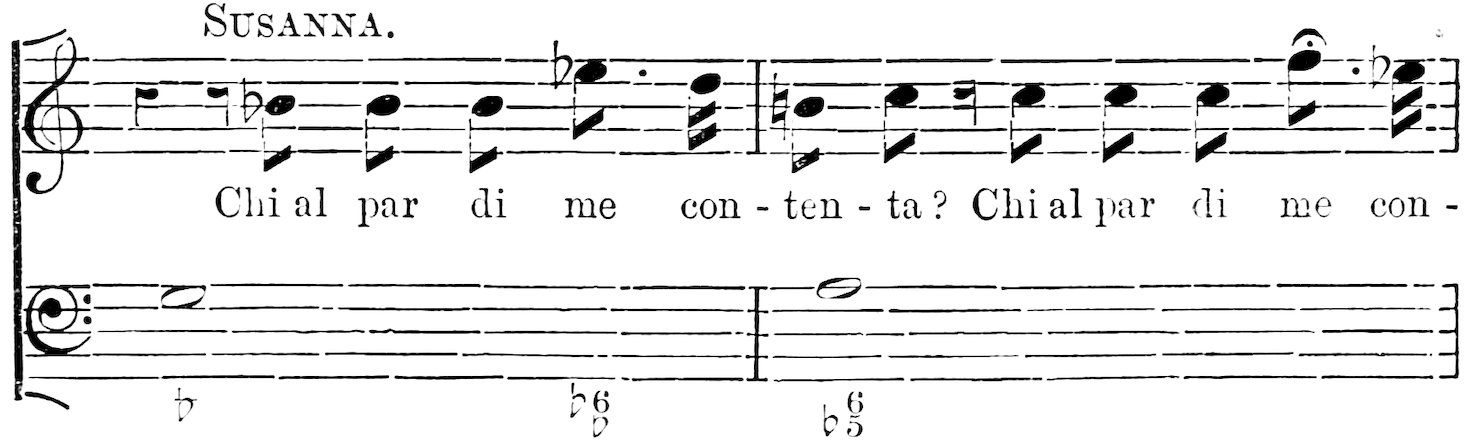
Susanna. Chi al par di me contenta? Chi al par di me con-
292
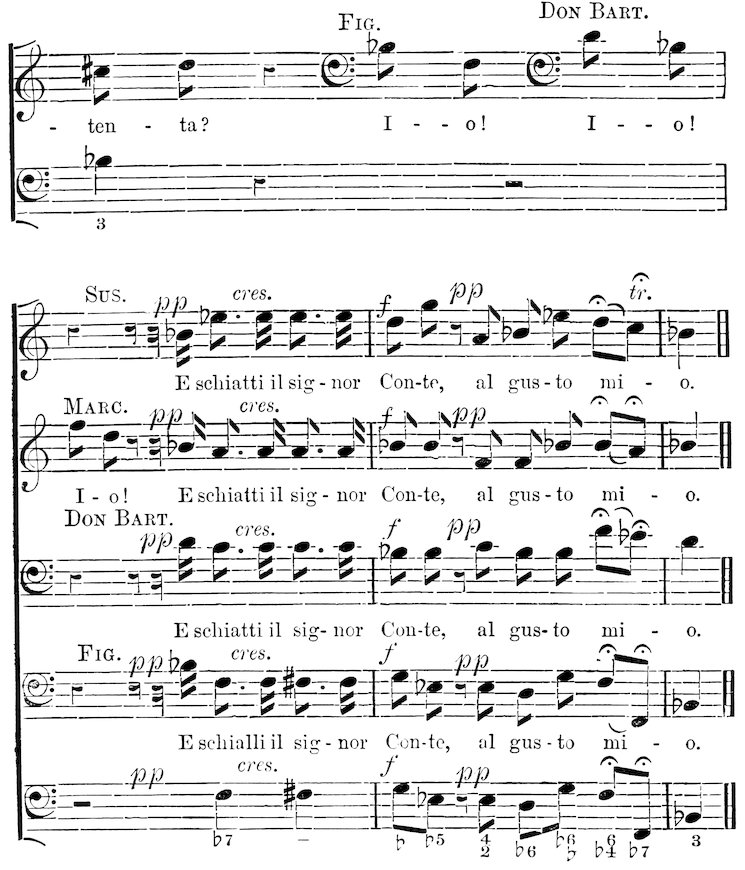
-tenta? I o! I o! E schiatti il signor Conte, al gusto mio. I o! E schiatti il signor Conte, al gusto mio. E schiatti il signor Conte, al gusto mio. E schiatti il signor Conte, al gusto mio.
This seems simple enough—and is simple enough. So simple, that, in the mouths of four commonplace singers, it might very easily pass for a graceful little harmonised cadence, at the close of a passage of ordinary recitative. But, Mdlle. Lind did not regard it in that light. Ably supported by her colleagues, she sang it in conscientious accordance with the indications furnished by Mozart, in the score: that is to say, with gradually increasing interest, from the beginning of the solo passage culminating in a pause of moderate length upon the dotted quaver, F; in extreme piano, from the part at which the voices first join in four-part 293harmony, with a crescendo to the forte indicated at the word “Conte”; in extreme piano, again, from that part to the end, with a long pause on the antepenultimate D; and, on the penultimate, C, one of those wonderful shakes which she alone could execute—prolonged, to a degree which made it seem as if the supply of breath were simply inexhaustible—beginning pianissimo, yet ever diminishing in tone, to the gentlest warble, which, nevertheless, was heard, with perfect distinctness, to the remotest limits of the enormous salle—no hazy tremolo, of uncertain intonation, but a rapid alternation of C, and D, in perfect tune throughout, and growing ever fainter and fainter, till it faded into the final B flat with a ravishing charm too subtle for description.
The effect it produced was electrical. It lingers in our memory, as we write of it, as clearly as if we had heard it, not five and forty years ago, but yesterday. No one had ever heard the passage so interpreted before—indeed, it was manifestly impossible that it could ever have been so interpreted upon any previous occasion within the memory of man; for, this was the first time that Mdlle. Lind had ever sung the part in Italian, and the place of the recitativo secco was supplied, on the German stage, by spoken dialogue. No wonder, then, that the audience were spell-bound! The burst of applause was overwhelming. Cries of delight, of admiration, of astonishment, were heard on every side. Yet, after all, what right had any one to feel surprised? The singer had simply availed herself of the opportunity provided for her in the text. But, what a genius was needed, for the creation of the opportunity, on the one hand, and, on the other, for the intuitive perception which enabled the interpreter to seize upon it!
294