Book 5 — CHAPTER III. THE CONTRACT WITH MR. LUMLEY.
Reading edition
The view from the Drachenfels answered all the bright expectations that had been formed of it; and, after supplementing it with an afternoon at Königswinter, and a pleasant day at Cologne, Mdlle. Lind proceeded to Hanover, where she was engaged for four performances at the Court Theatre, and a concert. The success, on each occasion, was that to which all concerned had so long been accustomed, that it was now looked for as a matter of course. But, of far greater importance than any amount of local enthusiasm was the fact, that, during this visit to Hanover, Mdlle. Lind was brought into immediate relations with the then Crown Prince and Princess—afterwards King George V. and Queen Marie—who, amidst the heavy trials destined afterwards to fall upon them, never forgot the friendship with which they then learned to regard her; a friendship which remained undiminished until the day of her death, and which, even since then, has been most touchingly alluded to by Her Majesty, Queen Marie.
After fulfilling this engagement, and singing once at a concert at Bremen, Mdlle. Lind proceeded to Hamburg, where she was engaged for a series of twelve “Guest-performances” at the Stadt Theatre, supplemented by a benefit in aid of the “Theatrical Orchestra Pension Fund,” another for herself, and a concert for the poor.
During this visit, she did not reside in Hamburg itself, having accepted an invitation to the house of her friend, Consul Arnemann, at Nienstädten, near the neighbouring township of Altona. Here she spent many pleasant weeks with her host and hostess and their family, who had invited another friend—Mdlle. Mina Fundin—to keep her company, and had also sent a pressing invitation to Mendelssohn, in the hope that he would be able to take Nienstädten on his way to England, whither he was 226bound, in August, for the purpose of producing his Elijah at the Birmingham Festival. This project, however, failed entirely. Though Mendelssohn would have been pleased indeed to have availed himself of so pleasant an opportunity for refreshing himself with a brief rest, before his heavy work began, it was quite impossible for him to do so. He was working beyond his strength, as he himself well knew; and let the consequences be what they might, there was no help for it.
During her second season at Hamburg, Mdlle. Lind’s performances were received with even greater enthusiasm than those of the previous year. Indeed, if a local journal of the period may be trusted, her horses were again unharnessed, after the concert on Aug. 1, and her carriage drawn home, as at Vienna, by the admiring crowd. She prolonged her visit at Nienstädten—with interruptions—for some considerable time, after the termination of her engagement at the theatre. Like Mendelssohn, she had, for some time past, been working far beyond her strength, and the fatigue was now beginning to tell upon her with serious effect. She herself saw this very plainly; and her project for retiring from the stage was forced into greater prominence, just at this time, by the inroads that excessive fatigue was making upon her health and strength. Indeed, one can only look on in wonder at the amount of work she was able to accomplish, without actually breaking down. But it had to be continued, for the present at least, whatever the sacrifice might be.
In the meantime, the correspondence with Mendelssohn was not allowed to languish. Towards the end of July, he wrote thus:—
“Leipzig, July 23, 1846.
“My dear Fräulein,
“As usual, I come to you, to-day, asking a favour. I mean, that I am anxious to know how matters stand, with regard to your travelling arrangements, both now, and in the future—and I hope you will explain them to me. In your last letter, you told me that you were going to Switzerland, with the Wichmanns, on Aug. 1. Does this plan still hold good? And, is it true, or not, that you will be at Frankfort in September? Also, are you going straight from Hamburg to Berlin, to fetch the Wichmanns? All this I want to know. And it is because I want to know this, that I ask you to tell me of your plans, both before and after your journey to Switzerland and Vienna; and whether you still adhere both to the one and the other intention. The reason is, that, since 227my return from the Rhine, I have lived the life of a marmot. I was rather frightened, when, on coming back, I saw the amount of work that lay unfinished, and compared it with the time that remained to me. Then, I made up my mind not to write to you until my Oratorio was quite complete;[78] but, for the last few days I have not been well (you will find it out, sooner or later), so now I shall not be ready till August, and I dare not delay my letter so long as that, or it will be brought to you while on the back of some mule or other, to some cow-herd’s hut.
“Madame Arnemann has written me a very friendly letter, and invited me to Nienstädten. As yet, I have not been able even to thank her for it; and yet, how gladly would I have accepted the invitation! But I cannot get away from here before the middle of August; and, even then, I must make haste, in order to reach England in time. To-day, however, I really will write to Madame Arnemann, or she will be vexed—and with good cause.
“Is it true that you have been singing the ‘Regimentstochter’ in German? If so, I should have liked to have been one of the audience. And, do you know that the Geijers have lately been here? and, that they invited me to go to Sweden, to feast on a roasted reindeer? (I can get rice-milk at your house!) And, that Fräulein Geijer sang ‘Vorwärts so heisst des Schicksals Gebot’ to me again? and the song, by Lindblad, in C major.
“But, I will leave off, for to-day. My letter is tiresome, and stupid, and will continue so to the end. Only, grant my requests. And tell me all about yourself, and how you are getting on, and whether you are having much music, and whether you are in good spirits, and in first-rate voice?
“We are all well, at home, and often remember you.
“Your friend,
“Felix Mendelssohn Bartholdy.”
Mendelssohn’s letters were always welcome; and we have felt it necessary to present them to our readers without any abbreviation; but the events which took place between this period and the beginning of September need no detailed record. It was a time of rest, much needed, and hardly earned. We shall, therefore, resume our history, with the return to a more active Art-life, in the autumn.
Soon after the middle of September, Mdlle. Lind, accompanied 228by Mdlle. Louise Johansson, arrived at Frankfort, where the business of the season began.
She had by this time acquired a thoroughly methodical and business-like way of keeping records, and one of her first acts, on arriving at Frankfort, was the purchase of a thick and sturdy memorandum-book, a square bulky volume, of quarto size, labelled, “Annotation-Book of Jenny Lind,”[79] and filled with ruled “sermon-paper,” in which she entered every one of her engagements, from that time forward, up to the moment of her marriage, in America, in the year 1852.
The value of this document to her biographers may be imagined. Henceforward we shall no more have to send to Berlin, or to Vienna, for official lists of the various performances with which we are concerned. It is true that, up to this date, such lists have been furnished to us through the intervention of Mr. Goldschmidt, with never-failing courtesy, by the officers in whose charge the archives of the different theatres are placed. The information for which we have asked, whether at Berlin, Vienna, Stockholm, Copenhagen, Hamburg, or elsewhere, has never once been refused to us, and as much care has been bestowed upon the verification of a date as if the welfare of the theatre itself had depended upon its correctness. For this we tender our best and most sincere thanks; but henceforth every date, in whatever country, will be given on the authority of Mdlle. Lind’s own handwriting, and the advantage of this is manifest.
The first entries in the book are:—
“Frankfort a/M. 1846.
Sonnambula Sept. 25
Norma „ 28
Figlia „ 30
Figlia Oct. 2
Sonnambula „ 5
Vestale (50 Louis d’or for the members of the chorus) x „ 7
Figlia (benefit for the orchestra pension-fund) x „ 10
We subjoin a fac-simile of the first page. The little cross means that the performance was given wholly, or in part, for charitable or benevolent purposes, and the number of such crosses in a single page is sometimes very remarkable. In the present case fifty Louis d’or of the proceeds, on Oct. 7, were given to the chorus, and on the 10th the whole was devoted to the “Orchestra Pension Fund” of the Frankfort Stadt Theatre.
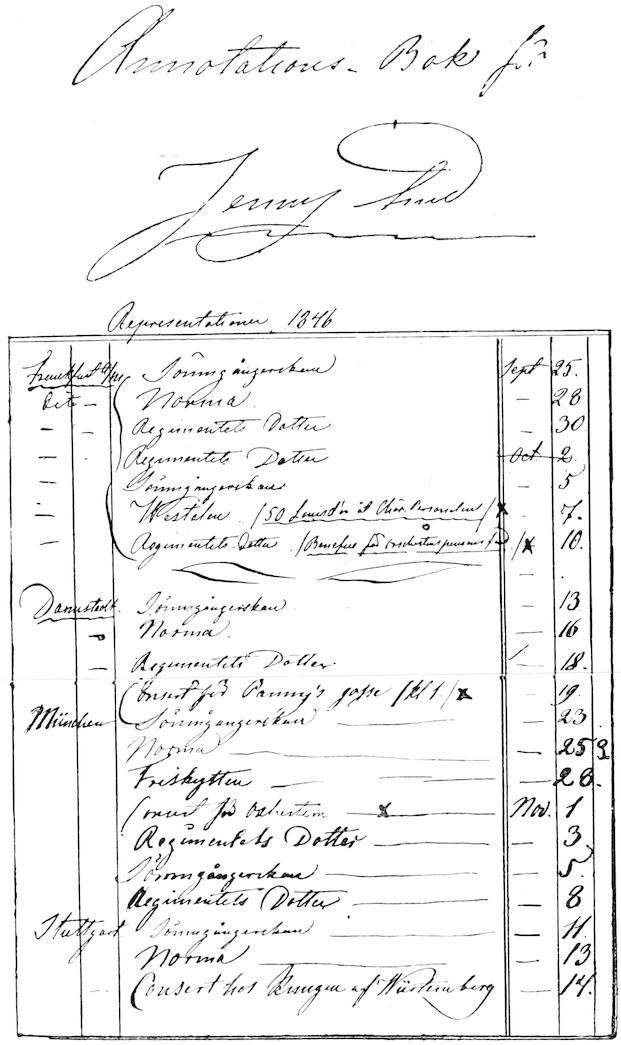
FACSIMILE PAGE OF ENGAGEMENT BOOK. [To face p. 228.
229The performances were crowned with the usual success, and followed by the usual demonstrations of enthusiastic admiration; but this visit to Frankfort was memorable for reasons quite unconnected with its individual triumphs, for it was here that the idea of an engagement at Her Majesty’s Theatre, in London, first took a definite and palpable form.
Some of her London friends—including Mrs. Grote, who herself mentions the fact in the MS. “Memoir” from which we have so frequently quoted—had “urged Mr. Lumley to make efforts in this direction,” and he had, in fact, “made more than one tentative to obtain the services of the celebrated songstress for Her Majesty’s Theatre.” Hearing of this—as no doubt he did—Mr. Bunn, looking at the circumstance from his own point of view, put the worst possible construction upon it, and took it for granted that his correspondent was cognizant of all that took place—which was not true. She did not know of it, until the period affected by Mr. Bunn’s contract had long been overpassed. It was not until long after that date that Mr. Lumley made her a definite and tangible offer for Her Majesty’s Theatre; and, when the offer came, she refused even to think of it. She was so terrified at the penalties, the law-suits, and the disgrace with which Mr. Bunn had threatened her, that her dearest and most trusted friends could not persuade her to entertain the idea of appearing at an English theatre under any circumstances, or upon any terms whatever.
And yet her destiny seemed to be weaving a net round about her, from which no way of escape was visible. She was brought, apart from her own will entirely, under the steadily increasing influence of English friends. Mrs. Grote was most anxious that she should come to London. Her brother, Mr. Edward Lewin—of whom more will be said in a future chapter—saw no insurmountable difficulties in the way of an engagement at Her Majesty’s Theatre. Mr. Lumley was unceasing in his endeavours to induce her to rescind her decision; and, while she was still in Frankfort, the musical correspondent of one of the most influential art journals in England turned aside from his travels, in the hope of hearing her sing, and begged an introduction to 230her, from a quarter whence he well knew that it would be favourably received.
The following letter from Mendelssohn, which arrived in Frankfort almost simultaneously with Mdlle. Lind herself, will explain the situation exactly:—
“Leipzig, Sept. 23, 1846.
“My dear Fräulein,
“If you will do me a real favour, and if you are not too much occupied and worried during your stay in Frankfort, let me beg of you to receive the bearer of these lines, Mr. Chorley (an acquaintance of mine of long standing, and a great lover of music), with your usual kindness, and to sing him one of my songs.[80]
“He is an excellent listener, and you will make him very happy if you grant my wish. I believe he is going to Frankfort solely on this account, so that I have really no choice but to come to you with this new request.
“Many thanks for your last letter, which I only received after I had left London, and at the moment of starting for Ostend.
“I have so much to say about England, and your journey thither, that I really do not know how I am to write it. In any case, everything depends upon the way in which one establishes oneself there; or, rather, upon the way in which you establish yourself, for you have the whole thing entirely in your own hands, and English lovers of music are expecting you, in a frame of mind, and speaking of you, in terms, which please me very much indeed—a thing which very seldom happens—when I hear you spoken of. So you can manage it exactly as you will; though, for that very reason, you alone are in a position to decide upon it.
“Till we meet again, merry, happy, unchanged,
“Felix Mendelssohn Bartholdy.”
Thus prepared for Mr. Chorley’s visit, Mdlle. Lind received him when he called, a few days later, with the friendly courtesy which she felt it no less a pleasure than a duty to extend to the friends of those with whom she was herself on terms of intimacy. He repeated his visit more than once, heard her sing in La Figlia del Reggimento, and afterwards in La Sonnambula and Die Vestalin, and wrote, on Oct. 4, to Mrs. Grote, describing, in the most enthusiastic terms, the pleasure he had felt in hearing her sing. “And now let me tell you,” he says, “how thoroughly, with my 231whole heart, I like her as a singer, more, by twenty times, than I had expected.... I was really delighted to find that I am not past the old thrill, or the old beating of the heart, and that I could not go to bed till I had written a note (in horrible French) to say ‘Thank you.’”
On the same day (Oct. 4th) he also wrote to Mendelssohn, to thank him for “the very very intense pleasure” that had made him “laugh and cry like a child again,” after “a fear of disappointment” which he “hardly liked to describe,” ending his letter with the words, “She says she will not come to London,”[81]—from which it is evident, that, if he did not endeavour to persuade her to come, he had, at least, discussed the subject with her.
The next engagement was at Darmstadt, where Mdlle. Lind sang three times at the Court Theatre,—in La Sonnambula, Norma, and La Figlia del Reggimento. The memory of the previous performances in Sept. 1845 were still green and flourishing, and the success of the second visit was greater than that of the first.
In the meantime, Mr. Lumley had not been idle. He had now abundant hope—having gained the all-powerful support of Mendelssohn—and the engagement of Mdlle. Lind was a matter of such vital importance to him that he could not afford to let the subject drop. Since the close of the previous season, the affairs of Her Majesty’s Theatre had been in the utmost possible disorder. The company, with Mesdames Grisi and Persiani at their head, had revolted, and there was no one to take their place. Mr. Lumley’s friends saw, in the proposed engagement, his only chance of escape from absolute ruin, and urged him to leave no stone unturned that might help to bring the matter to a successful issue. By their advice, he followed Mdlle. Lind from Frankfort to Darmstadt, and there again presented himself to her, armed, this time, with a letter from Mendelssohn, whom he had seen in Leipzig, and to whom he had taken a letter from herself.
Feeling sure that the missive with the delivery of which he was entrusted was a very valuable one, and not at all likely to be written in opposition to his own interests, Mr. Lumley lost no time in presenting it in person; and thus it ran:—
232
“Leipzig, October 12, 1846.
“My dear Fräulein,
“I intended to write to you on the day on which your first letter arrived; but a few hours afterwards came your second letter, and Mr. Lumley, who brought it. All that he said to me, and all that passed through my mind in connection with it, and the different thoughts that crossed each other hither and thither, made it impossible for me to write to you until to-day; and I told Mr. Lumley that, if he should be coming here again after his journey to Berlin, I would meanwhile think it all carefully over, and would then tell him whether I could advise you to go to London or not.
“Upon that—i.e., upon my advice—he seems to set great store, and I have already told you in my former letter that the whole success of his undertaking depends upon your coming.
“In short, I can only repeat what I then wrote—I should like you, as far as is humanly possible, to arrange, as completely as one could wish, for your own comfort, and, when that has all been settled, I should like you to go there.
“I should have strongly urged Mr. Lumley—at least, on his return here—to speak clearly and exactly about money matters; because that is a very serious point, in England; and because you could, and ought, to make such terms as no one else could at this moment, since you are the only one upon whom alone the whole thing depends. But—do not be angry with me!—I had not the courage to do this: not even for you, though I know that you understand that kind of thing even less than I do—in other words, not at all. But it is such a very sore point with me, and I rejoice so much when I have nothing to hear or say about it, that I could not bring the words to my lips. And, at last, I thought, ‘It is not my province,’ and so, after all, I let it pass.
“Therefore I can only repeat, it must all be as is just and right to you.
“Nevertheless, you will certainly meet with such a reception there, that you will be able to think of it with pleasure throughout the whole of your future life. When the English once entertain a personal liking for anyone, I believe that no people are more friendly, more cordial, or more constant; and such a feeling you will find there. For, as I told you before, I have noticed that they entertain this true feeling there, not only about your singing, but about your personality, and your whole being, and upon this last they even set more store than upon the singing itself. And this is as it should be.
“In my opinion, therefore, it cannot for a moment be doubted 233that you will be received there as you deserve—more warmly, enthusiastically, and heartily, perhaps, than in all your former experience: and you have experienced a great deal in that way. You will therefore give your friends great pleasure if you go there; and I, for my part, should be very glad indeed if you were to go.
“Insist upon all possible conditions that can in the least degree make things agreeable to you, and insist upon them very firmly, and strictly, and clearly. Do not forget anything that may be pleasant for you, and have nothing to say to anything that may be unpleasant. Going to London, and singing there, can, in itself, be nothing but pleasant—of that I am firmly persuaded. Everything else depends only upon the manner in which this is done, and all that you have in your own hands.
“I am selfish, too, in my advice; for I hope that we shall there meet in the world again. While still in England, I had half promised to return there next April; had I only known that you would be there at that time, or would be going there, you may imagine how much more willingly I should have settled it. Mr. Lumley, also, in the kindest manner, proposed that I should compose an Opera for him next May, and I could only answer, that, on the self-same day on which I succeeded in getting a good libretto, on a good subject, I would begin to write the music; and that, in doing so, I should be fulfilling my greatest wish. He hopes soon to be able to procure such a libretto, and has already taken some decided steps with regard to it. God grant that some good results may follow. From Madame Birch-Pfeiffer, I have not heard a single word, for a long time. In the meantime, I have music-paper and finely-nibbed pens lying on the table—and wait.
“But, apart from this, I hope, as I have told you, to visit London again next spring, and what a pleasure it will be to me to witness there the most brilliant and hearty reception that can possibly fall to an artist’s lot! For I know full well that that is what your reception will be, and it will be great fun for me that you yourself will be the fêted artist.
“For myself, I am doing well; but, during the three weeks that have elapsed since I returned here, I have done scarcely anything but rest, so tired was I—and still am, sometimes—with the work that preceded the journey to England, and the journey itself. The performance of my Elijah was the best first performance that I have ever heard of any one of my compositions. There was so much go, and swing, in the way in which the people played, and sang, and listened. I wish you had been there. But I have now fallen back into the concert trouble, 234and can neither get true rest, nor quietness here. So I have built myself a grand castle in the air; namely, to travel, next summer, with my whole family, in my favourite country—which, as you know, is Switzerland—and then to study uninterruptedly for two months on one of the lakes, living in the open air. If God gives us health, we will carry out this plan; and when I think of such a quiet time in the country after all the hurry and bustle, and all the brightness of a London season, and remember how dear both of them are to me, and how well they please me, I almost wish that the spring were already here, and that I was taking my seat in the travelling carriage.
“And now, to-day, I have still a request to make. Write to me, at once, when you have come to a decision concerning England; and tell me everything, with all the details: for you know how much it all interests me. Before all things, then, write to me, from time to time; and think kindly of me, sometimes.
“As for myself, you know that I am, and remain,
“Your friend,
“Felix Mendelssohn Bartholdy.”
The result of Mendelssohn’s advice will be most clearly manifested by a letter which Mr. Lumley wrote to him after his interview with Mdlle. Lind—a letter which is all the more interesting, inasmuch as it treats, also, of the long hoped-for libretto in such sort as to show that the manager had already begun to look upon it as “a matter of business.”
“Darmstadt, Oct. 17.
“Dear Mr. Mendelssohn,
“I am delighted to tell you that your letter has had its effect; and that the lady has signed an engagement.[82]
“Your letter charmed her so much. It was a most pleasing picture—her countenance, when reading it. No sun could have infused more joy into a beautiful landscape, than your letter did on her.
“To give her peace of mind, I added clauses to the engagement, which, if known by persons not intimately acquainted with her charming character and feeling of honour, would perhaps incur for me the charge of folly. But, I know I can depend on her honour; and I am perfectly happy and contented on that head. I have prepared the engagement wholly in her favour; but I proposed to her to add anything else that you might think advisable, and I added a clause to that effect.
235“She would not enter into the question of money; but I am quite sure you will be satisfied that I have done everything right in that way.
“I need not tell you how truly grateful I am to you. The English, as a nation, will owe you a debt of gratitude; for I look upon the engagement of Lind as a new era in the progress of Art in England. Her success will be transcendent. Independently of her great genius, she has that purity and chastity of manner which none but a really good person can possess, and which, in England, will gain her partisans on all sides. I say ‘on all sides,’ because, even with the vile, there is that in real goodness and virtue which commands admiration.
“Pray remember me most kindly to Madame Mendelssohn, and to her mother, and permit me to send my love to your children, not forgetting the baby, and that beautiful boy Carl, who, though suggestive of the pictures of Raphael, and Correggio, reminds us that there is an Artist far above the greatest of human artists, and that the real is frequently more beautiful than the ideal.
“My joy on the completion of the affair is not unsullied. I am fearful that she may, for a time, at least, tease herself with fears, which, though entirely groundless, may equally torment her. I will venture to entreat you to assure her of the absolute certainty of her great success to give her encouragement.
“I shall lose no time in occupying myself, immediately, with the libretto for our grand affair; and I do not despair of providing you with a libretto which shall give you pleasure and ensure your valuable aid.
“It is of importance that this affair of Lind should be kept private for the present. I shall lose no time in occupying myself about the ‘affaire Bunn.’
“I need not say that it will give me great pleasure to hear from you.
“Yours most truly,
“B. Lumley.”[83]
Without wearying our readers with a literal transcript of the “Lumley Contract,” with its endless circumlocutions and technical legal phraseology, we may briefly say that it provided:—
(1)
An honorarium of 120,000 francs (£4800) for the season, reckoned from April 14th to August 20th, 1847.
(2)
A furnished house, a carriage, and a pair of horses, free of charge, for the season. 236
(3)
A farther sum of £800 if Mdlle. Lind wished to spend a month in Italy before her début, for the purpose of studying the language, or for rest.
(4)
Liberty to cancel the engagement, if, after her first appearance, she felt dissatisfied at the measure of its success and wished to discontinue her performances.
(5)
Mdlle. Lind was not to sing at concerts, public or private, for her own emolument.
So, the question of appearing at Her Majesty’s Theatre was decided at last; and, when Mdlle. Lind left Darmstadt, for Munich, she had bound herself to the most important dramatic engagement, and prepared the way for the most solid artistic triumph that ever had been, or was ever destined to be, associated with her name.
237