Book 8 — CHAPTER VIII. THE “METHOD.”
Reading edition
Our readers will naturally expect us, in summing up our history of Mdlle. Lind’s performances upon the stage, to furnish them with some technical remarks upon the timbre and compass of her voice, and the “method” by aid of which she cultivated it.
The voice was a brilliant and powerful Soprano, combining the volume and sonority of the true Soprano drammatico—to which class of voices it unquestionably belonged—with the lightness and flexibility peculiar to the more ductile and airy Soprano sfogato, with the characteristic tenuity of which it had, however, nothing in common.
Its compass extended from B below the stave, to G on the fourth line above it—in technical language, from b to G̿; that is to say, a clear range of two octaves and a sixth, as shown in the subjoined diagram:—
[Audio content is not currently supported on your device. [MusicXML]
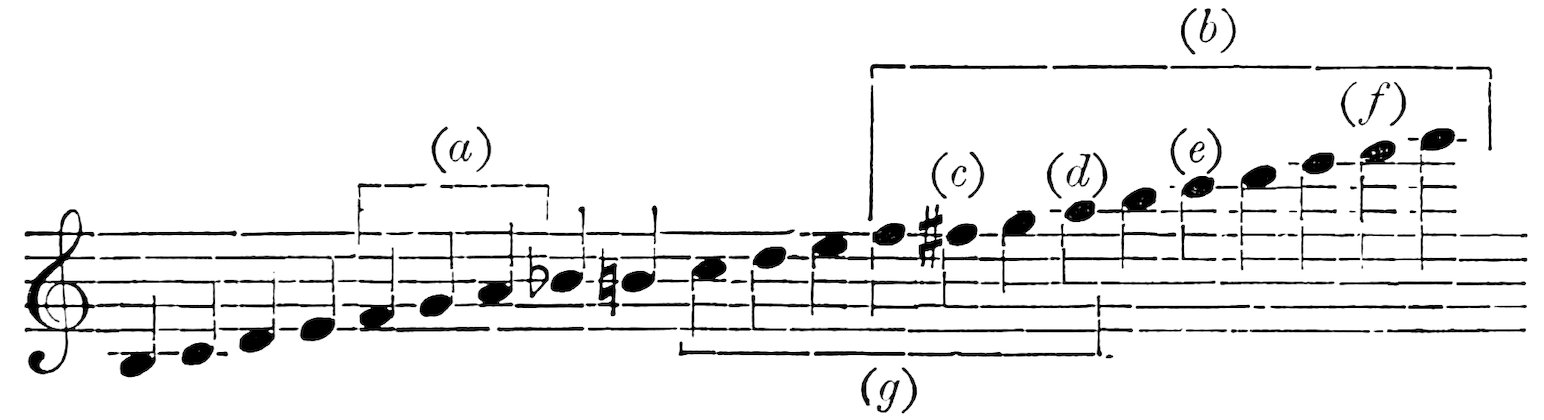
(a) The veiled notes in the middle register. (b) The brilliant head-voice. (c) The F♯︎ which forms so striking a feature in Mendelssohn’s Elijah. (d) The ringing upper A, used with such thrilling effect in the opening movement of Casta diva. (e) The upper C forming, with the above-mentioned A, the initial passage in the Tanzlied aus Dalekarlien. (f) The F in alt, used by Mozart, in Non paventar. (g) The six natural notes (C, D, E, F, G, A) in the youthful voice, to be presently described.
356The various registers of this extended compass were so skilfully blended into one, by the effect of art, that it was impossible for the most delicate or attentive ear to detect their points of junction. In fact, after the completion of its cultivation under the guidance of Signor Garcia, the entire voice became one homogeneous whole, so even in its calibre, that the notes were avowedly sung without a thought as to the best way of “placing” them.
Certain regions, however, possessed marked æsthetic qualities, very clearly distinguishable, though they could be modified, at will, in accordance with the demands of the passages into which they were introduced. For instance, three notes of the middle register (the F, G, and A, shown at (a) in the diagram), were invested, in piano passages, with a veiled tone of ravishing beauty—as in the long-drawn A, in the middle register, which forms the opening note of Casta diva. These three notes were more seriously injured than any other region of the voice, by the hard work and faulty method of production that had been forced upon Mdlle. Lind before her journey to Paris. It is well known to every experienced Maestro di Canto, that more voices are injured by the attempt to sing these three important notes in the lower instead of in the middle register, than by any other error of production whatever; and there can be no doubt that it was this error that caused so much trouble to Mdlle. Lind, who, notwithstanding the beautiful tone by which the notes in question were afterwards characterised, assured Fröken Signe Hebbe[127] that she believed that they “never became quite right.”
Of the F♯︎ so much admired by Mendelssohn, the A above it, brought prominently forward in a syncopated passage in the same slow movement of Casta diva, and the same A, with the C above it, used as the first two notes in the Tanzlied aus Dalekarlien, we have already spoken in former chapters.
It was remarkable that these exceptionally high notes, though brilliant beyond description, when used at their full power, could be reduced to a pianissimo as perfect as that of the veiled tones of the middle register. The pianissimo, indeed, was one of the most beautiful features of Mdlle. Lind’s singing. It reached to the remotest corner of the largest theatre or concert-room in which 357she sang; it was as rich and full as her mezzo forte; yet it was so truly piano that it fell upon the ear with the charm of a whisper, only just strong enough to be audible. The reader will not have forgotten that Her Majesty regarded this pianissimo as one of the most beautiful characteristics of Mdlle. Lind’s singing, and that, in the letter we have quoted at page 324, Chopin spoke of its “charm” as “indescribable.”
A wholly different effect—though bearing a certain sort of analogy to this—was produced in the Norwegian Echo Song by a peculiar tightening of the throat, which Madame Goldschmidt once tried to explain to the writer, though the process was so purely subjective that she said it was almost impossible to describe it in words. The effect produced so nearly resembled that of a natural echo, reverberated from the opposite wall, that it never failed to mystify an audience before which it was presented for the first time.
The notes, C, D, E, F, G, A, marked (g) in our diagram, were noticed by Mdlle. Lind, at a very early period, as the best notes of her voice. And judging, from their position in the scale, that her voice was intended by Nature to develope into a Soprano of exceptional height, she practised these notes, with the semitones between them, more diligently than any others, with the full determination to extend the process until the tone of the remaining portions of the voice became as rich, as pure, and as powerful, as that of the six notes which she regarded as forming the fundamental basis of the whole. How fully she succeeded in carrying out this intention we know already; and it is scarcely too much to say, that it was to this firm resolve, and the clear foresight which prompted it, that her ultimate success is mainly to be attributed.
Mdlle. Lind’s voice was not by nature a flexible one. The rich sustained tones of the soprano drammatico were far more congenial to it, than the rapid execution which usually characterises the lighter class of soprano voices. But this she attained also, by almost superhuman labour. Her perseverance was indefatigable. Among the Cadenze with which she was accustomed to embellish her favourite Airs was one adapted to a Movement from Beatrice di Tenda, introducing a scale passage ascending chromatically to the upper E flat, and then descending in the same manner. She once, while at the zenith of her career, told Fröken 358Signe Hebbe that she had practised this passage all her life, but that it was only quite lately that she had succeeded in satisfying herself with it; adding, that she never allowed herself to indulge in singing such difficult passages before the public, until she had thoroughly mastered them, but preferred simplifying them to running the risk of an imperfect rendering of the notes.
Another remarkable feature in Mdlle. Lind’s singing was the shake, which she delivered, at will, either with unapproachable brilliancy, or in the form of a whisper, more like the warbling of a bird than the utterance of a human voice.
Though it is necessary that a perfect shake should always begin with, and lay the metrical accent continuously upon, the written note, it is notorious that most shakes fail through want of attention on the part of the singer to the upper auxiliary or unwritten note. The general tendency is to let this note gradually flatten, until, in very bad cases, the distance between the two notes is diminished from a tone, to little more than a semitone. So well is this fact known, that the late Mr. Cipriani Potter once told the writer how he had been taught, in his youth, to separate the notes so widely that “a cocked hat could be thrown between them.” Mdlle. Lind devised a cure for this corrupt delivery of the shake. In teaching, she began by impressing the upper note upon the ear, as the most important, both as to strength and duration, at this early stage of the process; leaning, as it were, upon it, and slurring up to it from the lower interval. She employed for this purpose, first, the leap of a fifth, then that of a fourth, and so on, until she reached the semitone, continuing the shake exercise between the two intervals, whatever their distance, for some time, before proceeding from the wider intervals to a lesser one; always adhering to the upper note as the most important one; and always making beginners practise it with extreme slowness.[128]
The following exemplification of this particular exercise, written, by herself, a few years ago, for the guidance of a young vocalist, has been found among her music:—
[Audio content is not currently supported on your device. [MusicXML]

359

At a later period of instruction, the notes marked (a) and (b) were to be omitted, and the succession of intervals blended into one continuous exercise, thus:—
[Audio content is not currently supported on your device. [MusicXML]
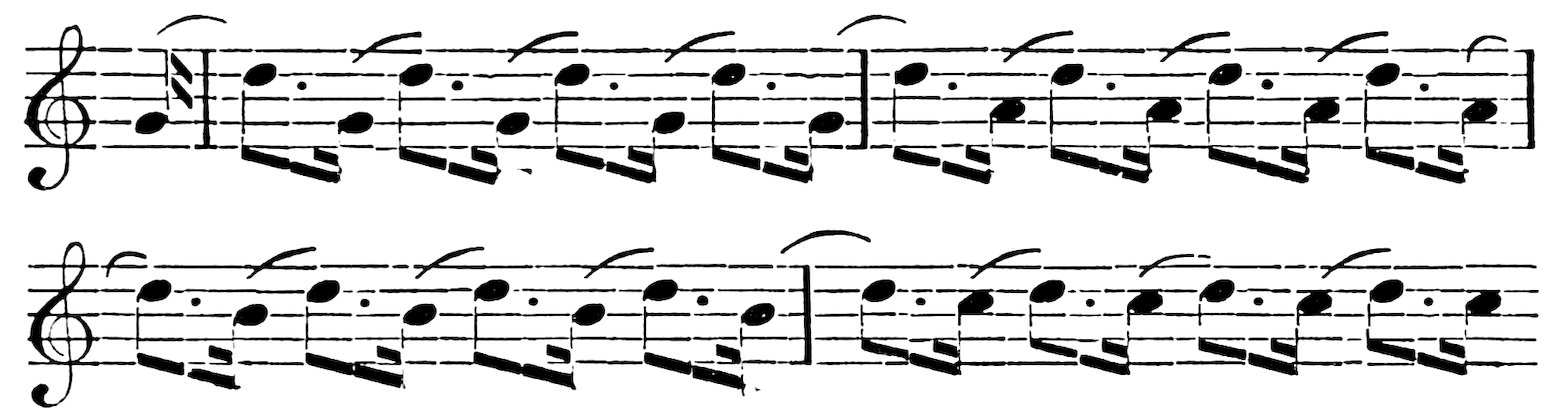
But it was not until after considerable advance had been made, that the exercise was allowed to be sung with any degree of quickness.
When, at last, after diligent practice, the perfect shake was attained, it was sung with the rhythmic accent on the real or written note, thus:—
[Audio content is not currently supported on your device. [MusicXML]
[Audio content is not currently supported on your device. [MusicXML]
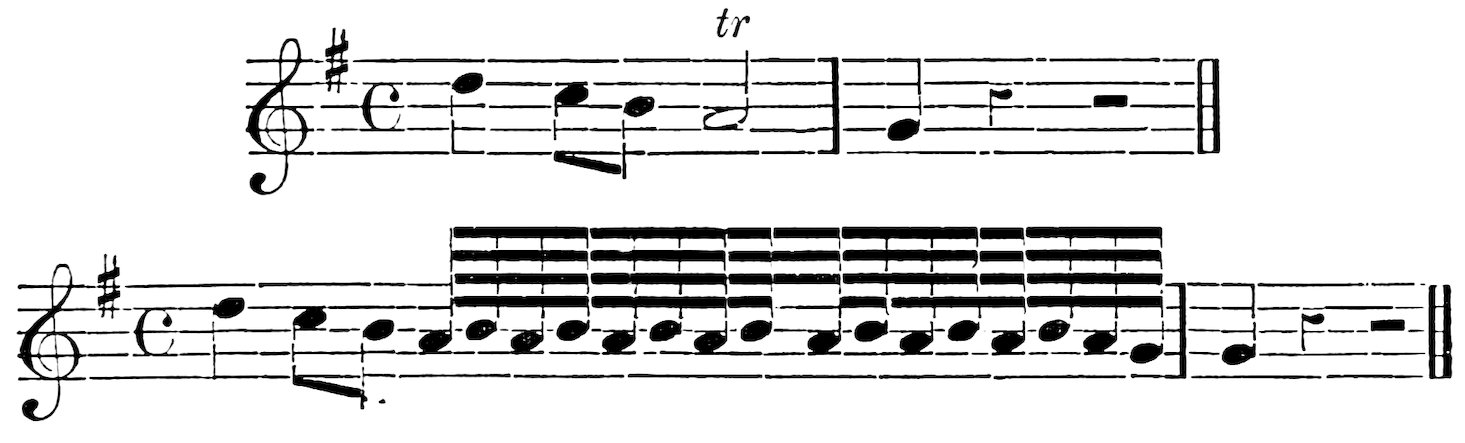
not thus:—
[Audio content is not currently supported on your device. [MusicXML]

The various effects we have here attempted to describe would have been impossible, but for that skilful management of the breath of which we have before had occasion to speak when treating of Mdlle. Lind’s studies under the guidance of Signor Garcia. Her chest had not the natural capacity of Mdlle. 360Alboni’s, or Signor Rubini’s; but she renewed her breath so rapidly, so quietly, so cleverly, that the closest observer could never detect the moment at which the lungs were replenished; and, by the outside world, her extraordinary sustaining power was attributed to abnormal capacity of the lungs. The apparent ease with which she attained this difficult end was due to an artfully-studied combination of the processes technically termed “costal,” and “clavicular[129] breathing”; in the first of which—used only after the completion of a distinct phrase of the vocal melody—the lower part or “base” of the lungs, freed from the last remains of the previous breath, is refilled, to its utmost capacity, without undue precipitation, yet with sufficient rapidity to answer all practical purposes; while in the second—used for the continuation of phrases too long for delivery within the limits of a single inspiration—the lungs are neither completely emptied, nor completely refilled, but replenished only, by means of a gentle inhalation, confined to that portion of the organ which lies immediately beneath the claviculæ, or collar-bones. The skill with which these two widely different processes were interchanged, when circumstance demanded their alternate employment, was such as can only be acquired by long and unwearied practice, untrammelled by prejudice either for or against any special method whatever; and it is not too much to say, that it was to the sustaining power, acquired by this careful management of the breath, that Mdlle. Lind owed her beautiful pianissimo, and that marvellous command of the messa di voce which enabled her to swell out a crescendo to its utmost limit, and follow it, without a break, by a diminuendo which died away to an imperceptible point, so completely covering the end of the note that no ear could detect the moment at which it faded into silence.
And no less complete was Mdlle. Lind’s command over the difficulties of articulation than over those of vocalisation pure and simple. Her delivery of the difficult—we had almost said, impossible—passage in the grand Scena from Der Freischütz—Täuscht das Licht des Monds mich nicht![130]—though so clear and 361distinct that not a syllable lost its full meaning, was nevertheless so soft and smooth that it could scarcely have been surpassed in Italian. We do not hesitate to say that she was the only great singer by whom we have heard this famous crux surmounted without a trace of harshness in the delivery of the words. On one occasion Madame Birch-Pfeiffer left her, alone, practising the word zersplittre (“to shiver to pieces”), on a high B flat, in the opening Recitative in Norma; and, returning several hours afterwards, found her still practising the same word. And she continued to practise it, until she succeeded in pronouncing it quite perfectly on the high note, though few even of the best German vocalists attain a better pronunciation than zersplättre. But she never erred in the delivery of even the most difficult word in any language whatsoever. So perfect was the mastery she exercised over larynx, throat, lips, tongue, teeth, soft palate, each and all, that never a syllable was stifled at its birth, never a vowel-sound corrupted in its passage through the longest groups of mingled leap, arpeggio, or scale. It was this high quality that lent so potent a charm to the complicated “divisions,” the rapid passages of fioritura of which Lablache, in describing them to Madame Grisi, said that “every note was a pearl.” The purity of the vowel-sound, by which the pearls were strung together, secured their perfect equality of tone and timbre; and, whether the most rapid notes were sung legato, or staccato, they either ran on velvet, or rang out sharply and clearly as the touch of a mandoline. The technique, in either case, was absolutely faultless, and its perfection was entirely the result of hard work, indefatigable practice, unwearying study. To the end of her career, she never sang in the evening without preparing for the performance by practising for a long time, earlier in the day—generally, a mezza voce, to avoid fatiguing the voice unnecessarily, but, never sparing the time or trouble. And herein lay the secret of her victory over difficulties which tempt so many less courageous aspirants to despair.
Undoubtedly, the “method” thus diligently cultivated was, in many points, subjective. Mdlle. Lind felt, but could not always explain, the principles upon which she worked. We possess, however, a letter written by her to Fräulein von Jaeger, which enters into some particulars connected with our present subject of consideration, so curiously interesting, that we cannot refrain 362from publishing them, though the communication bears a date far later than that at which the purely narrative portion of our work comes to a close.
“Ems, June 8, 1855.
“And what is my good Gusti doing? Is she working as industriously as ever at her singing?
“The chief thing that I have to say, to-day, concerns that part of Friedrich Schmitt’s ‘Singing-school’ of which you wish for an explanation.[131]
“I do not think you have rightly understood the point. Read the paragraph again, and it will surely become clearer to you.
“Naturally, he does not mean that you are to attack a note twice; but that, before you sound the note, the larynx must be properly prepared in the position in which the forthcoming sound lies, whether high or low. The result of this is a firm attack; and, as soon as you have sounded one note, you must spring so nimbly on all those above—or below it—that no rift can be detected between the sounds; and, in this way, the completion of the phrase is accomplished without a break. For instance, the notes
[Audio content is not currently supported on your device. [MusicXML]
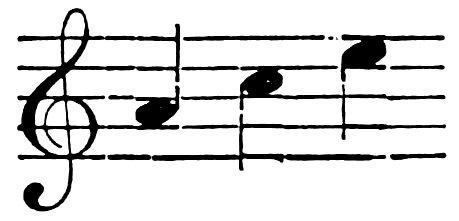
must so hang together that they make one whole; and this results from binding and striking them, at one and the same time—if I may so express myself—though it is almost impossible to explain this clearly in words. But I have often spoken to my Gusti about this, and shown it to her. It lies in the flexibility of the larynx, and must therefore be practised. Sing your exercise, then, so that this flexibility of the throat may be quickly developed. The attack of the single notes will thus be improved; and the string of notes will follow.”
Madame Goldschmidt is quite right, when she says that “it is almost impossible to explain this clearly, in words.” No one knew, better than she did, that the best ‘Singing-schools’ that ever were published are useless without the aid of a teacher; for until she found a teacher in Signor Garcia, she wandered daily farther and farther from the true path, until, in the end, her 363voice but narrowly escaped from utter destruction. When once the truth was pointed out to her, her quick perception and unerring musical instinct enabled her to grasp it at a glance; and, when once she began to practise upon true principles, the difficulties she had formerly experienced with regard to the method of voice-production were at an end.
On one point she always insisted very strongly. She had an innate hatred of the contortions with which so many vocalists of inferior order disfigure their features when delivering the passages they wish to render most impressive. She was never satisfied with a song, unless the singer “looked pleasant.” She regarded singing as a beautiful gift of Nature; a gift for which those who possess it should feel truly thankful, and proclaim their thankfulness by the expression of their features. She had a horror of careless articulation, even in speaking. And she felt firmly persuaded that the practice of singing, on the true “method,” tended to the invigoration of the body, and especially of a weak chest. She even thought that the lives of many persons with a tendency to consumption might have been prolonged, if they had learned to breathe, and sing, in the right way—an opinion which is held by many medical authorities of highest reputation, and the correctness of which is undoubtedly proved by recorded facts.
So deeply penetrated was Madame Goldschmidt with love for her Art, and faith in its ennobling influence, that, to the end of her life, she took the keenest interest in promoting its instruction, upon the true and well-tried principles of the pure Italian School.
The following letter to the late Mr. H. C. Deacon, in whose method of instruction she felt great confidence, is one of the last she wrote upon the subject:—
“Wynd’s Point, Colwall, Malvern, July 31st, 1885.
“Dear Mr. Deacon,
“It was very kind of you to let me know about the Examinations.[132] I am glad to hear that my sheep did not badly. If —— would put her mind into her work she might become a singer.
364“I can but do my best; and, with my enormous experience, and a life’s study, I ought to be able to bring out singers.
“Singing is as much moral and mental as it is mechanical. It is the combination of those qualities which alone can form the master and pupil.
“I hope you and Mrs. Deacon are better, and that you will now have some rest.
“Yours sincerely,
“J. L. Goldschmidt.”
We can scarcely close our present chapter more profitably than by presenting our readers with a summary of the work performed by Mdlle. Lind, in connection with the Operatic Stage, between her first appearance in Der Freischütz, on the 7th of March, 1838, and her last, in Roberto il Diavolo, on the 10th of May, 1849—a period of little more than eleven years, during which she appeared in 30 Operas, 677 times.
365
Operas. Stockholm. Berlin. Vienna. Munich. Hanover. Darmstadt. Hamburg. Copenhagen. Frankfort. Stuttgard. Carlsruhe. Weimar. Nuremberg. Mannheim. London. The English Provinces. Edinburgh. Glasgow. Dublin. Total.
La Sonnambula (Bellini) 28 11 7 2 1 9 4 1 1 1 1 22 6 1 1 2 98
Lucia di Lammermoor (Donizetti) 56 4 1 1 1 12 1 1 1 78
Norma (Bellini) 34 14 3 1 2 1 8 3 3 2 1 3 75
Roberto il Diavolo (Meyerbeer) 60 2 11 73
La Figlia del Reggimento (Donizetti) 18 2 6 3 4 2 1 1 1 17 4 1 2 62
Der Freischütz (Weber) 42 5 1 1 1 1 51
Divertissement National (Berwald) 27 27
Das Feldlager in Schlesien (Meyerbeer) 10 13 23
A May Day in Wärend (Berwald) 21 21
Die Zauberflöte (Mozart) 18 18
Il Don Giovanni (Mozart) 5 5 1 2 13
Le Nozze di Figaro (Mozart) 8 1 4 13
Marie (Hérold) 11 11
La Vestale (Spontini) 6 3 1 10
Les Huguenots (Meyerbeer) 7 2 1 10
Die Schweizer Familie (Weigl) 10 10
Euryanthe (Weber) 5 4 9
La Straniera (Bellini) 9 9
Il Turco in Italia (Rossini) 9 9
L’Elisir d’Amore (Donizetti) 5 3 8
I Puritani (Bellini) 5 1 6
Ferdinand Cortez (Spontini) 6 6
Jag går i Kloster (Berwald) 6 6
Le Château de Montenero (Dalayrac) 6 6
Armida (Gluck) 5 5
Anna Bolena (Donizetti) 5 5
La Gazza Ladra (Rossini) 4 4
I Masnadieri (Verdi) 4 4
The Elves (Van Boom) 4 4
Semiramide (Rossini) 3 3
Number of performances in each city 418 56 31 9 2 2 28 7 9 5 3 2 2 1 81 11 2 2 6 677
Total number of Operas 30 Total number of performances 677
366