AUSTRO-HUNGARIAN DIRIGIBLES.
Reading edition
Military.
Date of order.Name.Make.Type. Capacity in m³.H.P. Speed. m.p.h. (k.p.h.)Remarks.
1909 M 1 Parseval P.L. 4 n.r. 2300 70 27 (45)
1909 M 2 Lebaudy-Juillot 6 s.r. 4800 100 23 (37) Wrecked 1911 but repaired
1910 M 3 Körting (K.W. 1) n.r. 3600 150 30½ (49)
1912 M 4 Zeppelin 22,000 450 47 (75) Building.
Military Dirigible Pilots.
Cajanek, V. Grebenz, K. Hauswirth, J.
Heller, S. Hofstätter, E. Macher, M.
Tauber, F. Tepser, G.E. von. Weiss, H.
Private.
Date of commencement.Name.Make.Type.Capacity in m³.H.P.Speed m.p.h. (k.p.h.)Remarks.
1910MANNSBARTH-STAGLMann-Sl.n.r.820030040 (65)
1912BOEMCHER IIBoemcher II275025 (40)
Two Renners and a Boemcher I have ceased to exist.
Private Dirigible Pilots.
Adrario, K. Baumann, F. Becker, T. Berlepsch, F.F. von. Cassinone, A. Fürst, A.
Hoffory, W. Hinterstoisser, F. Kaiser, K. Mannsbarth, F. Nowy, V.
Richter, von. B. Stagel, H. Stratmann, W. Wagner, E. von. F. Zborowski, J.
BOEMCHER II. (1912-13.) Non-rigid.
Building.
Length, ? feet (? m.) diameter, ? feet (? m.) volume, 77,000 c. feet (2,750 m³.)
Gas bags.—
Motor.—
Speed.—25 m.p.h. (40 k.p.h.)
Propeller.—
LEBAUDY-JUILLOT 6=Military M II. (1910.) Semi-rigid.
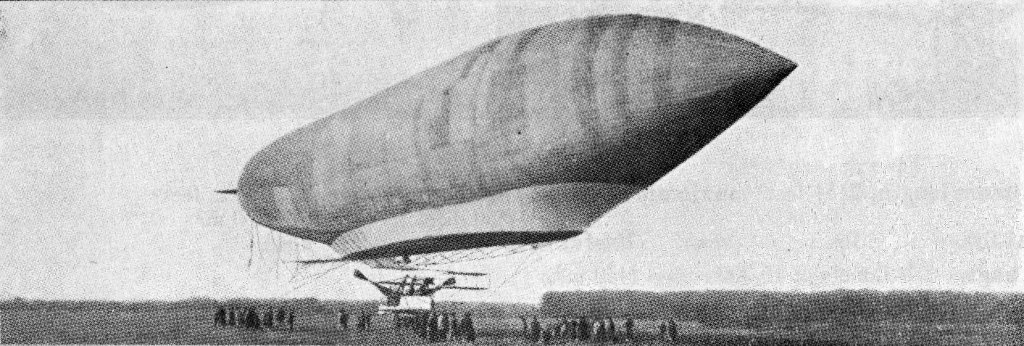
Length, 229¾ feet (10 m.) diameter, 36 feet (11 m.) volume, 170,000 c. feet (4,800 m³.)
Gas bags.—Austro-American Rubber Co.
Motor.—100 h.p. Mercedes.
Speed.—27 m.p.h. (45 km.)
Propellers.—Two 2-bladed.
Remarks.—Built by the Austrian Daimler works to Lebaudy-J. designs. Sister to the Russian Lebed.
KÖRTING-WIMPASSING (K-WI). Non-rigid=Military. M III. (1911.)
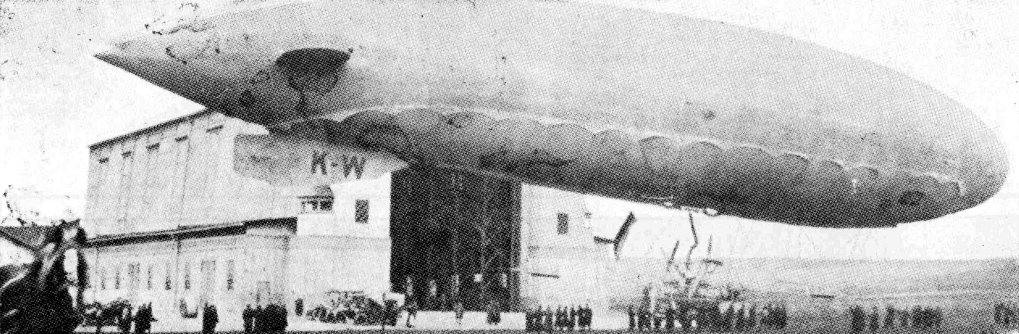
Maximum length, 213¼ feet (65 m.) maximum diameter, 34½ feet (10.50 m.) volume, 127,150 c. feet (3,600 m³.)
Total lift.— lbs. ( kgs.) Useful lift, lbs. ( kgs.)
Gas bags.—2 ballonets of 15,900 c. feet (450 m³.)
Motors.—2 Körting, of 75 h.p. each (= 150 h.p.)
Speed.—30½ m.p.h. (49 km.) Made on trials March, 1911.
Propellers.—Two 4-bladed. Diameter, 9¾ feet (3 m.)
Steering.—Parseval style. This ship is generally an adaptation of the Parseval type. Accommodates 8 people. Completed 1911. Military airship.
Remarks.—
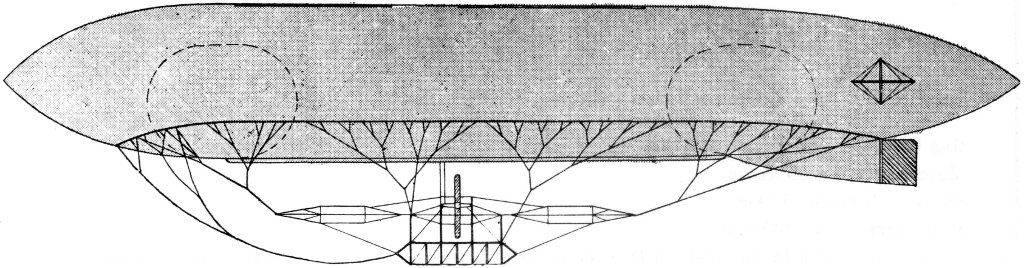
Uniform Dirigible Scale.
MANNSBARTH. Non-rigid (1911). (Alias STAGL MANNSBARTH.)
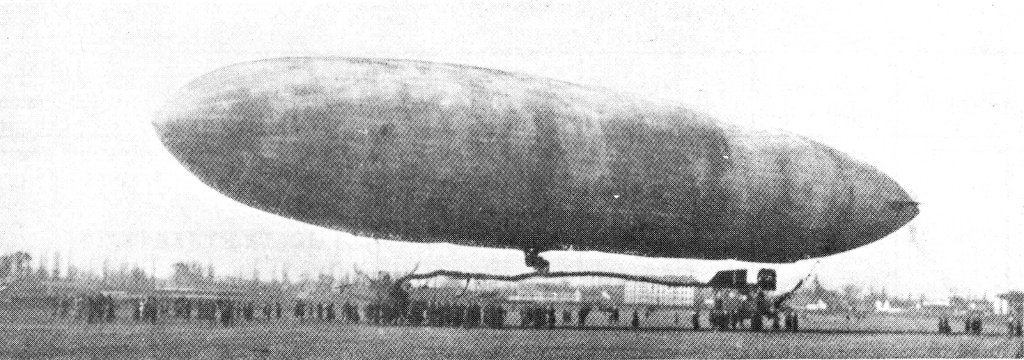
Maximum length, ? feet (? m.) maximum diameter, ? feet (? m.) volume, 289,600 c. feet (8,200 m³.)
Total lift.— lbs. ( kgs.) Useful lift, lbs. ( kgs.)
Gas bags.—Divided into 4 compartments. Ballonet in each.
Motors.—2 of 150 h.p. each (= 300 h.p.)
Speed.—40 m.p.h. (65 k.p.h.)
Propellers.—3. Diameter, 13 feet (4 m.) Also 1 helice.
Steering.—Helice used as elevator. Rudder aft. Forward and after ballonets also used as elevators, Parseval style. Completed 1911.
Remarks.—Built for Government, but not taken over.
PARSEVAL P.L. 4. Non-rigid. = MILITARY M I. (1909.)
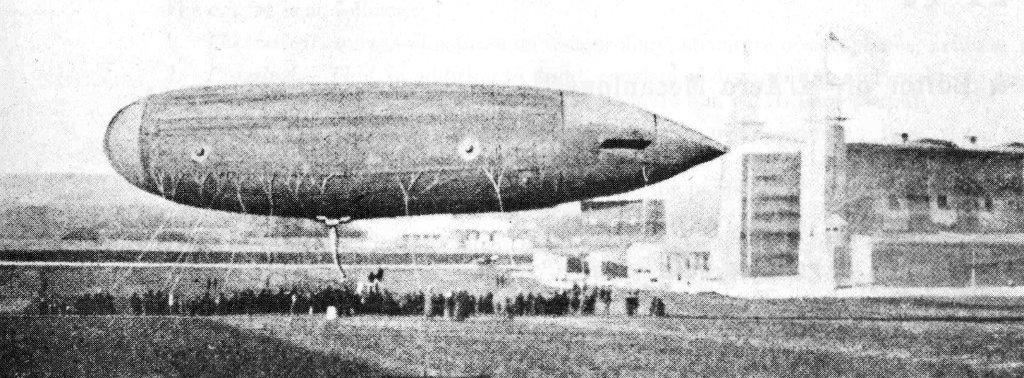
Maximum length, 164 feet (50 m.) approx. diameter, 28¼ feet (8.60 m.) volume, ? c. feet (2,300 m³.)
Total lift.—5,730 lbs. (2,600 kgs.)
Gas bags.—Rubbered fabric by Austrian American Rubber Co.
Motor.—70-100 h.p. Mercedes Daimler. 1,200 r.p.m. at 70 h.p.
Speed.—27 m.p.h. (45 km.) made on trials.
Propellers.—Parseval type, semi-rigid, chain driven, 3-bladed. Diameter, 11½ feet (3.50 m.)
Steering.—Parseval system.
Remarks.—Built by the Austrian Motorluftschiff Gesellschaft to the Parseval type C design (see Germany). Taken over by the Austro-Hungarian Army, December, 1909. Has flown 6½ hours. Has risen to 1,150 metres and subsequently flown 1½ hours. Carries 4 persons, about 400 lbs. (180 kgs.) ballast, and fuel for 12 hours. Station: Fischamend.
BELGIAN.
(Revised by M. BRACKE, Aeronautical Engineer & Editor of "L'Aero Mécanique.")
Aerial Societies:—
Aero Club Belgique.
Aero Club of Hainault.
La Ligue Nationale Belgique.
Delta Club (Kites).
Ae. C. de Flanders.
Ae. C. du Littoral.
Ae. C. de Liege-Spa.
Aerial Journals:—
La Conquête de l'Air. (214 Rue Royale, Brussels) bimonthly, 5 francs p.a.
L'Aero Mécanique (Brussels edition). Chemin de St. Denis, Casteau, Mons., Belgium, 2.50 f.
L'Aviation Industrielle et Commerciale (monthly), Chemin de St. Denis, Casteau, Mons., 1.50 f.
Flying Grounds:—
Berchem.
Brasschaet (Military).
Camp de Casteau. (Aviation Industrielle & Commerciale).
Etterbeek, near Brussels.
Kiewit.
St. Job (private property Baron de Caters.).
BELGIAN AEROPLANES.
Military Aeroplanes.
At the end of 1912 the military air force consisted of three 50 h.p. Gnome H. Farman 1911 military, used for instructional purposes, and twenty-four 70 h.p. Gnome H. Farmans (model 1912 military), for war work:
The military school is at Brasschaet, near Antwerp. Major Campion in command.
The course is as follows:
1. Theoretical course.—Lectures on meteorology, structure of aeroplanes, aviation motors, etc.
2. Practical.—This, in addition to flight, consists of dismounting and replacing parts of aeroplanes and aerial motors, all general repairs, erecting hangars and aerial photography.
The school possesses nine hangars, of which three are Bessonneau type, three wooden, and three metal.
For 1913 the sum of £20,000 is to be expended for purchase of aeroplanes and the establishment of aerial squadrons at Antwerp, Liege, and Brasschaet.
These are organised into six squadrons of four units each. The full complement of each squadron is eight aviators, fifteen to 20 mechanics, etc., and six citizen soldiers.
The question of hydro-avions for the Congo is under consideration.
AVIATORS.
(The number against any name is, unless otherwise stated, the Ae. C. Belgique pilot certificate number.)
Military.
Broune, Lieut. (37) Cozic, R. (23) Dhanis, Lieut. (35) Heinter Poorten (47)
Lebon, Lieut. (36) Moulin, E. (45) Movtens, Lieut. (19) Nelis, Lieut, (in command) (28)
Robert, V. (47) Sarteel, Lieut. (26) Sournoy, J. (46) Tocy, Lieut.
Private.
Allard, E. (4) Armand, C. (22) Baugniet, Edmond (18) Boel Bracke, A. Camille, Amand (22) Christiaens, Joseph (7) Crombez (25) De Caters, Baron (1) De Heel, Emile (24) D'Hespel, Comte Joseph (15) De la Hault, Adhemar De Laet, E. (31) De Laminne, Chev (9) De Jonckeer (44)
Depireux, Isidore (20) De Petrovsky, Alexandre (11) De Ridder, Alphonse (13) De Roy, W. (41) Descommines Deudeuner, A. (43) Dolphyn (40) Doneryos, J. (33) Duray, A. (3) Dutrieu, Mdlle. H. (27) Fischer, Jules (12) Frenay, Fernand (21) Hanciau, P. (34) Hanouilleo, P. (42) Hasen
Lamblotte, F. (29) Lanser, Alfred (16) Lescart, F. (30) Mestagh, G. (39) Michez, S.R. (32) Olieslagers, Jan (5) Olieslagers, Max Orta, José Peeters Pickard Stellingwerff, J. (49) Tyck, Jules (8) Van den Born, Chas. (6) Verschaeve, Fernand (17) Verstraeten, Léon (14)
The following Belgian aviators have been killed:—
Kinet, Daniel (2) Kinet, Nicolas (10) Verrept, John (38)
BEHUEGHE
(Bron), in Herseun. Built in 1912. A monoplane that flew very well at camp of Casteau Aerodrome during May—October. Motor.—25. h.p. type Morane. New designs in wing construction, landing chassis, etc.
A. BRACKE
(formerly Bracke, Missyon & Co.), Casteau, Mons. In 1910, constructed the first aeroplane built by a Belgium firm—a monoplane with planes at 120. This machine has not been duplicated: but the firm have since built machines to private specifications. The only firm which has in Belgium the speciality of aeronautical patents.
DE BROUCKERE,
23 rue Joardens, Brussels. Biplane. H. Farman. type. Built in 1911, modified in 1912.
DE LA HAULT
Adhémar de la Hault, 214 rue Royale, Brussels. In 1906, built a flapper of novel design. This was followed in 1910, by a machine on monoplane lines with one fixed plane and two flapping wings. This failed to fly, and in August, 1911, was altered into a biplane. It did not succeed, however. M. Hault is still pursuing the ornithopter question.
HAREL I. Biplane.
Length.—49¼ feet (15 m.) Surface.—344½ sq. feet (32 m².) Weight.—771 lbs. (350 kgs.), flying order. Warping wings. Monoplane tail. Motor.—50 h.p. Gnome, mounted just under and forward of the upper wing. Tractor.—1 Chauviere. Elevator placed 1 in front and 1 in rear, H. Farman style. Rudders, 2 in rear. Completed May, 1911. For further details see Conquete de l'Air, July 1st, 1911. Property of M. Van der Stegen.
WILLIAMS. Biplane.
Motor.—70 h.p. E.N.V. Generally of headless Voisin type on a Farman body. Completed 1911. Has flown fairly well.
BELGIAN DIRIGIBLES.
Military.
1910.
1. LA BELGIQUE II (late I) 4,000 m³.
1911.
2. LA BELGIQUE III
Note.—La Belgique I was built in 1909 and re-built 1910.
Private.
VILLE DE BRUXELLES 6,000 m³.
LA BELGIQUE II. (No. 1 rebuilt.) Military.
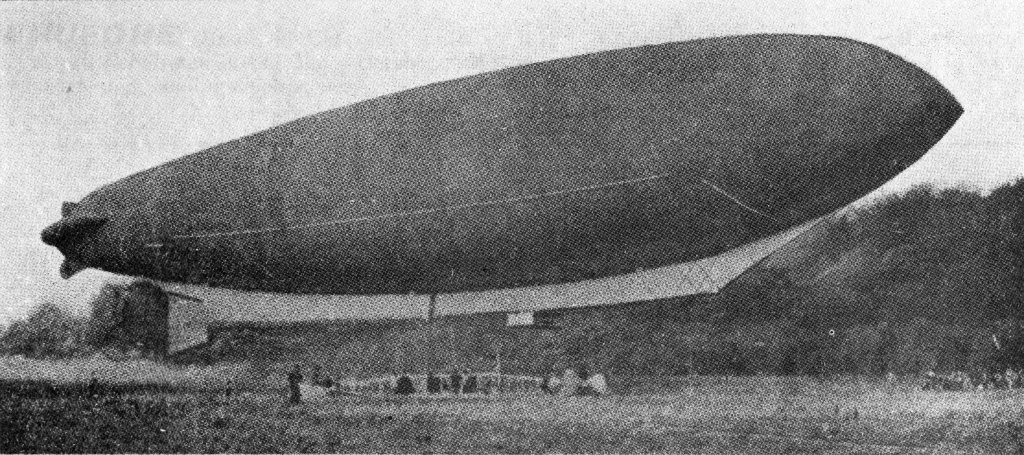
Length, 226 feet (64.8 m.) maximum diameter, 35 feet (10.75 m.) capacity, 141,300 cubic feet (4,000 m³.) total lift, 9,921 lbs. (4,500 kgs.)
Gas bag.—Rubber proofed Continental fabric. Ballonet, filled by a separate motor giving 7.5 inches of water pressure. Warm air can be pumped in if required. Ballonet, 28,250 c. feet (800 m³.)
Motors.—2, each of 60 h.p., Vivinus, 4-cylinder, 112×130.
Propellers.—1 in front of the car. 285 revolutions per minute. Wood construction.
Speed.—25 miles per hour. 40 km. per hour.
Planes.—Horizontal: a gas tube bent horizontally round the tail. Vertical: vertical fins on the tail, and a long vertical keel under the gas bag.
Car.—A girder, square in section, tapered at both ends. Built of tubular steel. Length, 82 feet (25 m.)
Miscellaneous.—Built by L. Godard, France, 1909. Crew, 3 men. Accommodation for 1 passenger. Fuel for 10 hours. Greatest height attainable, 3,280 feet (1,000 m.)
Table of weights.—
Gas bag, complete with ballonet, valves, planes,lbs.kgs.
suspension, etc1,951885
Propellers (2)275½125
Blower3315
3 h.p. motor for blower3315
Motors (2) complete with gearing and shafting1,410640
Car992450
Fuel for 10 hours738½335
Ballast826¾375
1 passenger (or ballast)15470
Crew (3)463210
Guide ropes, etc220100
Miscellaneous8840
About 7,1653,250
Remarks.—Reconstructed in the winter of 1909. There are two noteworthy innovations in connection with the ballonet. (1) The ballonet can be warmed by the motor. (2) In case of real emergency air can be pumped direct into the gas bag. Experiments of the utmost importance to all airships are in progress with a view to ridding the gas of this air cheaply and quickly.
LA BELGIQUE III. Military.
Presented 1910 to the Belgian Government by H.M. the King of the Belgians. 4,500 m³. Practically same as II, but has 3 propellers. Motors.—Two 100 h.p. Germain.
VILLE DE BRUXELLES.
(Formerly known as LA FLANDRE.)
(Astra type.)
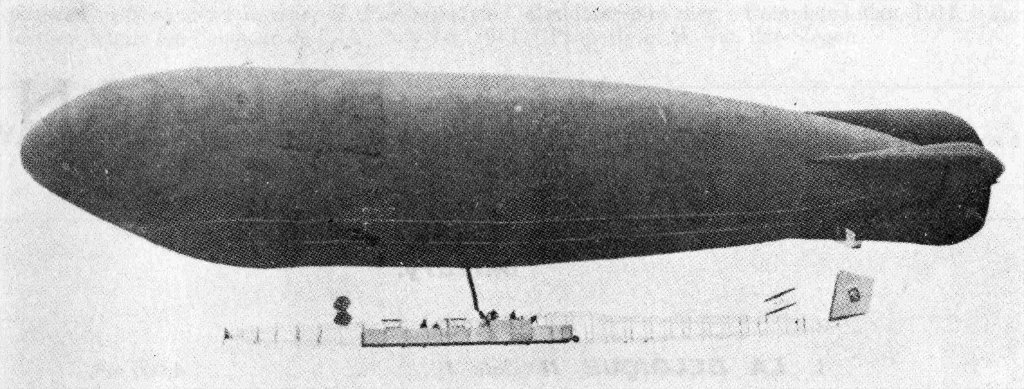
Maximum length, 256 feet (78 m.) maximum diameter, 41 feet (12.4 m.) volume, 212,000 c. feet (6,000 m³.)
Total lift.—15,763 lbs. (7,150 kgs.) Useful lift, ? lbs. ( ? kgs.)
Gas bags.—Continental rubbered fabric, yellow. Ballonet, 16,146 c. feet (1,500 m³.)
Motors.—2 Pipe motors of 100 h.p. each, placed in line with each other in the fore and aft line, and with clutches and the necessary gearing in between them.
Speed.—35 m.p.h.
Propellers.—3, namely: one at the fore end, driven by the two motors when coupled together, and two placed above and on either side of the centre of the car, for use when only one motor is running. Chauvière propellers.
Steering.—Vertical steering by means of a large double aeroplane fixed above the car, about a third from the front. Horizontal steering by means of a double vertical rudder above the rear end of the car. Stability is secured by the usual Astra pear shaped stabilising gas bags, with fins of rubbered cloth spread between the inner edges of these shapes.
Remarks.—The distinctive feature of this ship is the arrangement of the propellers. Both motors can be coupled either on to the front propeller or on to the two rear propellers, or on to all three together, but they are actually intended only to drive the front one. On stopping either motor the other is connected to the two rear propellers, which are designed for a slower speed of translation than the front one, with the result that the running motor does not find itself overloaded as it would if the same propeller had to serve both for one and for two motors.
BRAZILIAN.
AVIATORS.
Garos, Queiroz, Robert, Henri, Santos-Dumont, Versepuiz.
There are possibly one to two aeroplanes in Brazil, but the well-known aviators live in France. Little or nothing seems doing in Brazil as yet.
BRITISH.
Aerial Societies:—
Royal Aero Club.
Aerial League.
Aeronautical Society. (Premier Society, founded 1866.)
Brooklands Aero Club.
There were once a great many local aero clubs, but the majority of these have ceased to exist and with one or two possible exceptions all the rest are moribund.
Aerial Journals, etc.:—
Aeronautical Journal. Quarterly. 53, Victoria St., London, S.W.
Aeronautics. 3d. monthly. 27, Chancery Lane, London, W.C.
The Aero. 6d. monthly. 20, Tudor St., London, E.C.
Flight. 3d. every Saturday. 44, St. Martins Lane, London, W.C. (Official organ of the R. Ae. C.)
The Aeroplane. 1d. weekly, 166, Piccadilly, London.
All the World's Aircraft. 21/-. Annual. 100, Southwark Street, London, S.E. and 5, Queen Victoria Street, London, E.C.
In addition, the Car Illustrated and the Motor devote considerable space to aerial matters.
Principal Flying Grounds:—
Aldershot.—Army school.
Brighton, Shoreham Aerodrome. Aero school.
Brooklands.—Bristol school.
Camber Sands, Rye, Sussex.—At low tide moderately hard sand and soft places. Area two miles by one mile.
Dagenham (Aeronautical Society).
Dartford Marsh.—Vickers school.
Dunstall Park, Wolverhampton.
Eastbourne. Aerodrome School.
Eastchurch, Sheppey.—(R. Ae. C.) 350 acres. Sheds. Members only. R. Naval school.
Filey.—Blackburn school.
Hendon.—Grahame-White, Blackburn, Bleriot, Deperdussin, Temple and Ewen schools.
Lanark.—Deperdussin school.
Liverpool (Melly school).
Llandudno & North Wales.—Aerodrome.
Mapplin Sands, Essex.—(Foulness). Very hard sand at low tide. Area ten miles by four miles. Property of War Office. Flying forbidden in winter.
Salisbury Plain.—Bristol school. Vast space available. Plenty of fairly smooth ground. Army school.
Shoreham.—(See Brighton).
Upavon. Central flying school (R. Flying Corps.)
BRITISH MILITARY AVIATION.
Royal Flying Corps.
In 1912 the Royal Flying Corps was instituted. It consists of two wings, navy and army, with a central flying school at Upavon, Salisbury Plain.
The staff is as follows:—
Commandant: Paine, Capt. G.M., M.V.O., R.N. Secretary: Lidderdale, Asst. Paymaster J.H., R.N. Medical Officer: Lithgow, Capt. E.G.R., R.A.M.C. Quarter-Master: Kirby, Hon. Lieut. (Qr.-Mr.), V.C. Instructor in Theory and Construction: Cook, Lieut.-Col. H. R., R.A. Instructor in Meteorology: Dobson, G., Esq. Instructors in Flying: Fulton, Capt. J. D. B., R.A. Gerrard, Capt. E. L., R.M. Shepherd, Lieut. P. A., R.N. Trenchard, Mt. Maj. H. M., D.S.O., R. Sc. Fus. Salmond, Capt. J. M., R. Lanc. R. Inspector of Engines: Randall, Eng.-Lieut. C. R. J., R.N.
Royal Aircraft Factory.
This is situated at Farnborough. Mervyn O'Gorman is superintendent. There are large sheds. Some B E biplanes have been built here, but the principal object of the factory is understood to be repairs and maintenance.
Naval Wing Royal Flying Corps, Aeroplane Section.
There is a special Air Department at the Admiralty with Captain M. F. Sueter, as Director, Commander O. Schwann and Lieut. C. L'Estrange-Malone, as Assistants, Eng. Lieut. G. W. S. Aldwell, as Eng. Inspector.
Officers are graded Flying Officers, then Flight Commanders, thence to Squadron Commanders.
The flying school is at Eastchurch, Sheppey. Commander Sampson, S.C., in command. There are at present four air stations: (1) Isle of Grain, (2) Calshot, (3) Harwich, (4) Yarmouth.
At the end of March, 1913, the total number of aeroplanes including those on order, school machines, etc., was about 32; of which about 16 were effective for war purposes or available at short notice.
These machines were as follows:—
7 monoplanes ( = 1 Bleriot, 2 Deperdussin, 1 Etrich, 1 Nieuport, 2 Short). 15 biplanes ( = 1 Avro, 2 Bristol, 1 Breguet, 1 Caudron, 2 H. Farman, 1 M. Farman, 5 Short, 2 Sopwith). 10 hydro-avions ( = 1 Astra, 1 Avro, 2 Borel, 1 Donnet-Leveque, 1 H. Farman, 1 M. Farman, 3 Short).
The personnel is as follows (number after names is the R. Ae. C. brevet number):—
Squadron Commanders.
Gerrard, Capt. F. L., R. M. (76) Gordon, Capt., R. M. (161) Gregory, Lieut. (75) L'Estrange-Malone, Lieut. C. (195) Longmore, Lieut. Sampson, Com. C. R. (71) Shepherd, Lieut. P. A. (215)
Flight Commanders.
Courtney, Lieut. I. T. (R. M.) Grey, Lieut. Spencer (117) Risk, Capt. C. E., R. M. (303) Seddon, Lieut. J. W. (296)
Flying Officers.
Those marked * are under instruction, not yet graded.
*Agar, Lieut. A.W.S. Babington, Lieut. J.T. (408) Bigsworth, Lieut. A.W. (390) *Bobbett, Boatswain H.C. (334) Bowhill, Lieut. F.W. (397) *Brodribb, Lieut. F.G. (481) Courtney, Lieut. I.T., R.M. Courtney, Lieut. C.L. (328) *Davies, Lieut. R.B. (90)
*Edmonds, Lieut. G.H.K. *Fawcett, Capt. H., R.M. *Gaskell, Lieut. A.B. *Hathorn, Lieut. G.H.V., R.M. Hewlett, Sub. Lieut., F.E.J. Kennedy, Lieut. J.B. *Maude, Lieut. C.E. *Noyes, Asst. Paymaster, C.R.F.
Oliver, Lieut. E.A. (425) *Parker, Asst. Paymaster E.B. (415) Rathbone, Lieut., C.E., R.M. Ross, Lieut. R.P. (422) *Sitwell, Lieut. W.G. Travers, Lieut. J.L. Vernon, Lieut. H.D. (404) Wildman-Lushington, Lt. G.V., R.M.A.
The following R.N. officers and men are aviators employed in various duties at the Admiralty, at the Central Flying School or at Eastchurch:—
Aldwell, Eng. Lieut. G.W.S. Andrews, J.C. (372) Ashton, Ldg. Seaman Batemad, Able Seaman P.E. (446) Briggs, Eng. Lieut. E.F. Brownridge, Carp. Collins, Art. Eng. J.V.
Cresswell, Lieut. T.S., R.M. (420) Deakin, A. (333) Gerrard, Capt., R.M. (76) L'Estrange-Malone, Lieut. C. (195) Lidderdale, Asst. Paymaster H.J. (402) O'Connor, Art. Eng. T. (280) Paine, Capt. G.M. (217)
Randall, Eng. Lieut. (81) Schwann, Com. O. (203) Scarff, Art. Eng. F.W. Shaw, Shipwright D. (465) Shepherd, Lieut. P. (288) Susans, F. (380) Wells, Staff. Surg. H.V.
The following have privately secured pilot certificates in the years mentioned but are not employed in the R.F.C. for aeroplane work. Some of them, however (D), are employed in the airship section:—
1911.
Bower, Lieut. J.A. (161) Clark-Hall, Lieut. (127) Leveson-Gower, Com. Williamson, Lieut. (150) Williamson, Lieut. H.A. (160)
Naval. 1912.
Blatherwick, Lieut. G. (450) Brown, Com. A M.T. (345) Edwards, Lieut. C.H.H. D Freeman Williams, Lt. F.A.P.(202) Head, Lieut, G.G.W. (191) Hooper, Sub. Lt. C.W.W. (382) Johnson, Capt. C.D. D Masterman, Com. E.A.D. (Ae.C.F.) Prickett, Lieut. C.B. (381) Trewin, Asst. Paymaster (294) D Usborne, Lieut. N.F. (449) Wheeler, Mid. N.F. (370)
Naval. 1913.
D Boothby, Lieut. F.L.M. (Ae.C.F.) Brady, B.J.W. (394) Brown, Lieut. A.C.G. (398) Dobie, Lieut. W.F.R. (448) Fitzmaurice, Lieut. R. (447) Freeman, S.T. (393) Littleton, Sub. Lieut. H.A. (405) Picton-Warlow, Lieut. W. (451) Ross, Lieut. R.P. (422)
Army Wing Royal Flying Corps, Aeroplane Section.
The Army wing has its headquarters at S. Farnborough, its constitution being as follows:—
1st squadron (airships or kites) see Dirigible Section. 2nd squadron (aeroplanes) base at Montrose. 3rd squadron (aeroplanes) base at Salisbury Plain. 4th squadron (aeroplanes) base at S. Farnborough. (Four more aeroplane squadrons pro.)
An aeroplane squadron nominally consists of 18 aeroplanes (9 in service, 9 remounts). At the end of March, 1913, the total number of aeroplanes, including those on order, school machines, etc., was about 110, of which about 50 (including some monoplanes not in use) were effective for war purposes or available at short notice.
The total of 110 was thus made up:—
22 monoplanes (= 2 Bleriot, 4 Bristol, 5 Deperdussin, 4 Howard-Flanders, 1 Martinsyde, 6 Nieuport). 86 biplanes (= 4 Avro, 22 B.E. type,[A] various makers), 2 Breguet, 2 Caudrons, 30 Farman (various types), 6 Short—and about 20 Avro or Farman or Short not delivered.
Squadron Commanders.
Brooke-Popham, Capt. H.R.M. (108) Burke, Capt, C.J. (46) (Ae.C.F. 260) Carden, Lt. A. D. (239) Cook, Lt.-Col. H. R. (42) Fulton, Major J. D. B. (27) Raleigh, Capt. G. H. (196) Trenchard, Major H. M. (270)
Flight Commanders.
Allen, Capt. C. R. W. (159) Beor, Lt. B. R. W. (R.A.) (185) Becke, Capt. J. H. W. (236) Connor, Lt. D. G. (54) Fox, Lt. A. G. (176) Higgins, Major J. F. A. (R.A.) (264) Longcroft, Lt. C. A. H. (192) Reynolds, Lt. H. R. P. (R.E.) Salmond, Capt. J. M. Webb-Bowen, Capt. T. I. (242)
Flying Officers.
Abercromby, 2nd Lt. R. O. (134) Allen, Lt. D. L. (318) Anderson, Lt. E. V. (247) Atkinson, Lt. K. P. (267) Barrington-Kennett, Lt. B. H. (Adjutant) (43) Beatty, Capt. W. D. (89) *Birch, Lt. W. C. K. (375) Board, Capt. A. G. S. (36) Boyle, Lt. the Hon. D. G. Burchardt-Ashton, Lt. A. E. Burroughs, Lt. J. E. G. Carmichael, Lt. G. I. (316) *Chinnery, Lt. E. F. (211) Cholmondeley, Lt. R. (271) *Christie, Lt. A. (R.A.) (245) Conran, Lt. E. L. (342) *Corbalis, Lt. E. R. L. Darbyshire, Capt. C. (257) Dawes, Lt. L. (228) Dawes, Capt. G. W. P. (17) *Gill, Lt. N. J. (174) Glanville, Lt. H. F. (307)
Gould, 2nd Lt. C. G. S. (282) Harvey, Lt. E. G. *Harvey-Kelley, Lt. H. D. Herbert, Capt. P. L. W. (244) Holt, Lt. A. V. (312) Hubbard, 2nd Lt. T. O. B. (202) Hynes, Lt. G. B. (R.A.) (40) James, Lt. B. T. Joubert, de la F. Lt. P. B. (280) Lawrence, Lt. W. MacDonnell, Capt. H. C. (273) MacClean, Lt. A. C. H. *Mapplebeck, Lt. G. W. C. (386) Martyn, Lt. R. B. Mead, Sergt. J. (475) Mellor, Capt. C. (155) *Mills, Lt. R. P. (377) Moss, Bt.-Major L. B. (241) *Musgrave, Capt. H. (R.E.) *Mulcahy-Morgan, Lt. T. W. *Noel, Lt. M. W. (416) Pepper, Lt. J. W. (98)
*Picton-Warlow, Lt. W. (451) Playfair, 2nd Lt. P. H. L. (283) *Pretyman, Lt. G. F. (341) Porter, Lt. G. T. (R.A.) (169) Pryce, Hon. Lt. W. J. D. (Qr.-mr.) *Read, Lt. A. M. (336) *Rodwell, Lt. R. M. Roupell, 2nd Lt N. S. (237) Shepherd, Capt. G. S. (215) Soames, Lt. A. H. L. Small, Lt. F. G. D. (429) *Small, Lt. R. G. (343) Smith-Barry, 2nd Lt. R. R. (161) Stopford. Lt. G. B. *Todd, Lt. E. (185) Thompson, Lt. A. B. Tucker, Capt. F. St. G. *Vaughan, 2nd Lt. R. M. Wadham, 2nd Lt. V. H. N. (243) Waldron, Lt. F. F. (260) Wanklyn, Lt. F. A. (284)
Reserve.
Ashmore, Major E. B. (281) Bell, 2nd Lt. C. G. (100) De Havilland, 2nd Lt. G. (53) Hartree. 2nd Lt. A. (214)
Henderson, Col. D. (118) Marks, Lt. C. H. (83) Pizey, 2nd Lt. C. P. (61) Salmond, Capt. W. G. H.
Smith, Lt. S. C. W. Unwin, Lt. E. F. Warter, 2nd Lt. H. de V. (107)
Special Reserve. (2nd Lieuts. on probation.)
Biard, H. C., de la F. (218) Busteed, H. R. (194) Charteris, R. L. (197) Cutler, H. D. (189) Davies, E. K. (22) *Fuller, E. N. (325) Fuller, H. C. (Ae. C. F.)
Gibson. W. E. (129) Hammond, J. J. (32) Humphreys, G. N. (390) Lerwill, F. W. H. Metford, L. S. (146) Perry, E. W. C. (130) Rickards, G. B. (400)
Sippe, S. V. (172) Spratt, N. C. (339) Ware, D. C. Wilson, C. D. (Ae. C. F. 136) *Wilson, C. W. (329) Young, D. G. (207)
The following have qualified privately, R. Ae. C. brevets, but are not at present employed in the Aeroplane Section:—
1910.
Gibb, Lt. (10) Snowden Smith, Lt. (29) Watkins, Lt. H. E. (25) Wood, Capt. H. F. (37)
1911.
Blacker, Lt. (12) Cross, Lt. (151) Dickson, Capt. (Ae. C. F. 260) Harford, Lt. (152) Harrison, Capt. (158) Hoare, Capt. (126)
Hooper, Lt. (149) Hutchinson, Capt. Steele (143) Manisty, Lt. G. (135) Pitcher, Capt. (125) Sebag-Montefiore, Lt. (93) Smeaton, Lt.-Col. (115) Strover, Lt. E. J. (145)
1912.
Agnew, Capt. C. H. (240) Alston, Capt. R. C. W. (255) Ashton, Lt. A. E. B. (201) Bannerman, Major Sir A. (213) Boger, Capt. R. (335) Borton, Lt. A. E. (170) Boyle, Capt. M. (241) Brodigan, Lt. F. J. (200) Broke-Smith, Capt. D. W. (204) Bulkeley, Lt. H. T. (246) Carfrae, Lt. G. T. (188) Chamier, Capt. J. A. (340) Cordner, Capt. R. H. L. (277) Ellington, Capt. E. L. (305) Empsom, Lt. J. (387)
Fielding, L. H. C. (212) Fletcher, Lt. (229) Hanlon, Lt. D. R. (311) Jones, Lt. B. T. (230) Lewis, Lt. D. (216) Mackay, Lt. M. E. (177) Mackworth, Lt. J. D. (209) Martin-Barry, Lt. (Ae. C. F.) McCudden, Capt. J. H. (269) Miller, Capt. G. R. (313) Murray, Lt. R. G. H. (320) Nicholas, Capt. C. P. (266) Penn-Gaskell, Lt. L. de C. (308) Percival, Lt. D. (226)
Pollok, Lt. R. V. (379) Powell, Capt. D. W. (389) Price, Capt. C. L. (299) Rawson, Lt. K. (249) Reilly, Lt. H. L. (252) Ridd, Corporal F. (227) Roger, Capt. R. (335) Stott, Capt. J. N. J. (373) Styles, Lt. F. E. (338) Thomas, Staff-Sergt. (276) Trevenon, Lt. B. J. (230) Weeding, Capt. (182) Winfield-Smith, Lt. S. G. (187) Worthington-Wilmer, Lt. F. M. (254)
1913.
Archer, Lt. R. H. (434) Bayly, Lt. C. G. G. (441) Bruce, Sergt. W. R. (467) Bourke, Lt. U. J. D. (479) Cameron, Major N. J. (478) Chidson, Lt. M. R. (471) Crogan, Lt. F. J. L. (460) Harrison, Lt. Hawker, Lt. L. G. (435)
Hordern, Lt. L. C. (440) Hosking, Lt. C. G. (472) Hunter, Sergt. Kemper, Sergt. K. (444) Lee, Lt. C. F. (431) Maclean, Lt. L. L. (427) Marshall, Lt. R. (470) McMullern, Lt. J. D. (436)
Merrick, Major G. C. (484) Mitchell, Lt. W. G. S. (483) Read, Lt. W. R. (463) Rees, Lt. Col. W. B. (392) Stafford, Sergt. W. G. (438) Street, Sergt. E. J. (439) Thomas, Sergt. Major Vagg, Sergt. H. R. (443)
The above figures are mainly taken from The Aeroplane, 1st May, 1913.
* = under instruction; not yet graded.
BRITISH AVIATORS—PRIVATE. PRIVATE AVIATORS.
(The number against any name is, unless otherwise stated, the R. Ae. C. pilot certificate number).
To end of 1911.
Abbott, C. R. (101) Aitken, A. H. (56) Anderson, J. A. (164) Archer, Ernest (Ae. C. F. 214) Ballard, F. M. (151) Barber, H. (30) Barnes, G. A. (16) Blackburn, H. (79) Bowens, R. G. (39) Boyle, Hon. Alan (13) Bretherton, John (136) Breton, J. (136) Brown, H. B. (109) Chataway, J. D. (167) Challenger, G. H. (58) Chambers, C. F. M. (168) Cockburn, G. B. (5) Cockerell, P. (132) Cody, S. F. (9) Conway-Jenkins, F. (74) Crawshay, R. (133) Colmore, G. C. (15) Dacre, G. B. (162) Darroch, G. R. S. (59) Dolphin, W. H. (82) Dunkinfield-Jones (138) Ducroq, M. (23) Dyott, G. M. (114) Driver, E. F. (110) Egerton, M. Hon. (11) England, Gordon (68) Esterre, C. R. (Ae. C. F. 259) Ewen, W. H. (63) Fleming, H. R. (69) George, A. E. (19) Graham-White, Claud (6) (Ae. C. F. 30) Gresswell, C. H. (26)
Grey, W. H. de (107) Halse, E. (131) Hamel, Gustav (64) (Ae. C. F. 358) Harding, Howard (Ae. C. F. 213) Harrison, Eric (131) Hewlett, Mrs. (122) Higginbotham, Gerald (96) Hilliard, W. M. (102) Hubert, Charles (57) Hotchkiss, E. (87) Houdini, Harry Hucks, B. G. (91) Hunter, A. (137) Johnston, St. Croix, P. G. (41) Johnstone, W. Barnley (103) Kemp, R. C. (80) Keith-Davies, E. King Knight, Archibald (60) Lawrence, W. (113) Longstaffe, J. L. (140) Loraine, Robert (Ae. C. F. 126) Low, A. R. (34) Macdonald, L. F. (28) Maron, Louis (62) Martin, J. V. Mrs. (55) Macfie, R. (49) McArdle, W. E. (Ae. C. F.) M'Clean, F. K. (21) Mellersh, O. S. (155) Melly, H. G. (Ae. C. F.) Moorhouse, W. B. R. (147) Morrison, O. C. (46) Moore-Brabazon, J. (1) Noel, Louis (116) Ogilvie, A. (7)
Pashley, Cecil L. (106) Pashley, E. C. (139) Paterson, C. E. (38) Paul, E. A. (Ae. C. F.) Percival, N. S. (111) Petre, H. A. (128) Philpott, R. W. (81) Pixton, H. (50) Prentice, W. R. (67) Radley, J. (12) Rawlinson, A. (3) Raynham, F. P. (85) Roe, A. V. (18) Salmet, H. (99) Sassoon, E. V. (52) Santoni, L. Singer, A. M. (8) (Ae. C. F. 24) Slack, R. B. (157) Smith, S. E. (33) Smith, W. W. (Ae. C. F.) Spencer, H. (124) Somers-Somerset (Ae. C. F. 151) Sopwith, T. (31) Stanley-Adams, H. (97) Stark (Ae. C. F. 110) Stocks, Mrs. C. de B. (153) Thomas, J. H. (51) Travers, J. L. (86) Turner, C. C. (70) Turner, L. W. F. (66) Valentine, J. (47) Watt, W. O. (112) Weir, J. D. (24) Weston, John (Ae. C. F.) Wickham, R. F. (20) Woodward, G. A. T. (Ae. C. F.)
To end of 1912.
Barnwell, R. H. (278) Beech, A. C. (Ae. C. F.) Bendall, W. (180) Bettington, A. V. (326) Birch, E. (322) Brock, W. L. (285) Cheeseman, W. E. (293) Featherstone, W. (384) Fowler, F. H. (221) Gates, R. T. (225) Garne, T. (173) Geere, A. E. (310) Gill, R. W. R. (258) Hall, H. W. (332) Hall, J. L. (291) Hardman, W. L. (323)
Harrison, W. J. (275) Hawker, H. G. (297) Hedley, W. S. (274) Hewitt, V. (302) Higginbotham, V. C. (317) Holyoake, R. G. (268) James, J. H. (315) James, H. H. (344) Kershaw, R. H. (248) Lister, R. A. (250) Nesham, H. P. (219) Nevill, M. R. (223) Manton, M. D. (231) Meredith, C. W. (193) Merriam, F. W. (179)
Parr, S. (184) Payze, Arthur (337) Potet, A. (224) Prensiel, G. (198) Simms, R. H. (261) Stodart, Dr. D. E. (321) Summerfield, S. (292) Sutton, E. F. (295) Sweetman-Powell, H. (251) Taylor, V. P. (376) Tremlett, L. A. (208) Wood, V. G. (171) Wynne, A. M. (314) Wright, H. S. (331) Yates, V. (306)
1913 (Brevets from 400 onward).
Andreas, F. G. (477) Barron, J. C. (480) Hodgson, W. P. (433) Kehrmann, J. C. (420) King, R. A. (482) Lane, H. T. G. (418) Lawford, E. H. (442)
Macandrew, H. E. W. (401) Macneill, W. (Ae. C. F.) McNamara, J. C. (445) Minchin, F. R. (419) Muller, P. M. (432) Temple, G. L. (424)
Thompson, A. B. A. (452) Tower, H. C. (466) Rainey, T. H. (474) Russell, A. L. (406) Stewart, H. (473) Strain, L. H. (476)
The following British aviators have been killed:
1910. Rolls, Hon. C. (2) 1911. Benson, R. Cammell, Lieut. (45) Grace, Cecil (4) Napier (104) Oxley, H. (78) Ridge, T. (119) Smith, V.[B]
1912. Allen, D. L. (183) Astley, J. H. D. (48) Bettington, Lt. C. A. (256) Campbell, Lindsay (220) Clark, Miss J. Fenwick, R. C. (35) Fisher, E. V. B. (77) Gilmour, Graham (Ae. C. F.) Hardwick, A. Hamilton, Capt. P. (194) Hotchkiss, Lieut. Loraine, Capt. (154) Petre, Edward (259) Parke, Lieut. W. (73) Wilson, St. Serg. (232) Wyness-Stuart, Lt. A.
1913. Arthur, Lt. Desmond (233) Berne, Paym'st'r (R.N.) England, G. (301) Macdonald, L. F. Rogers-Harrison, Lieut. L. C. (205)
BRITISH AEROPLANES
A
AIRCRAFT FACTORY.
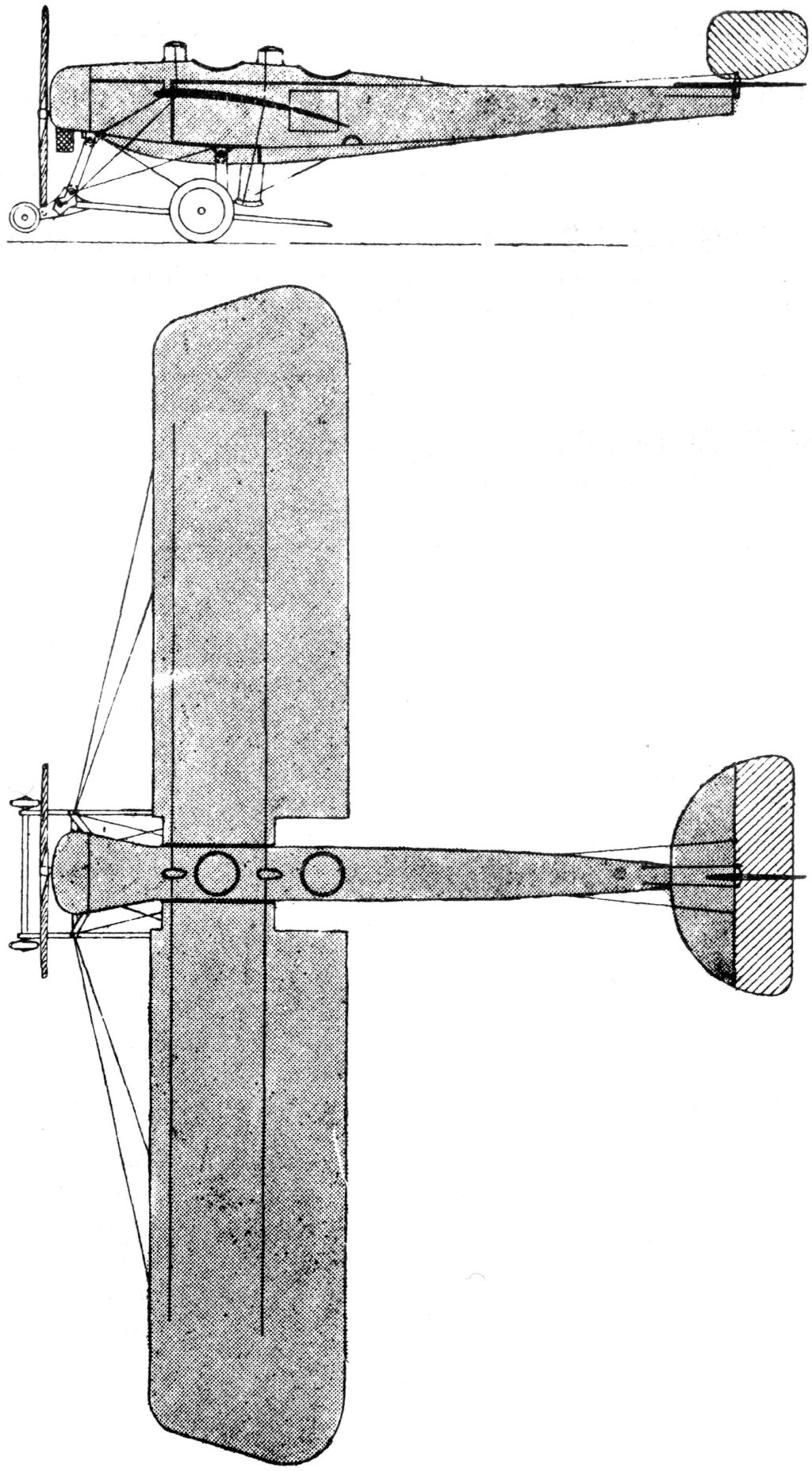
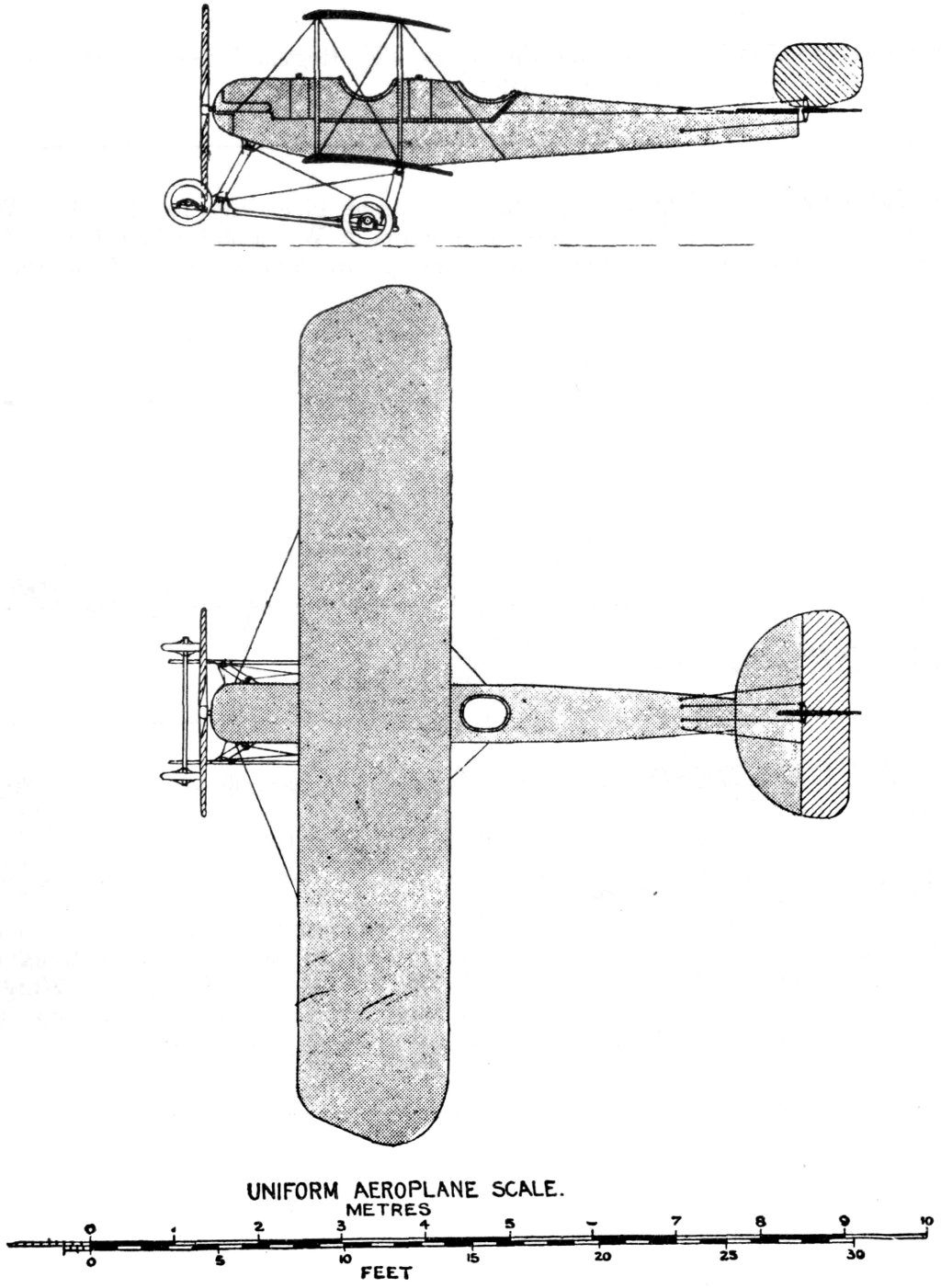
Royal Aircraft Factory, Farnborough, near Aldershot. For a long time this establishment had been engaged in dirigible construction and repairs. In 1911 it was decided to expand it in connection with the Royal Flying Corps. Its precise functions are somewhat uncertain. Its nominal main purpose is the repair, etc., of Service Aircraft. During 1912, however, it turned out several machines to a design of its own, known as the "B.E." This design was at one time regarded as confidential; but subsequently duplicates were built by private contractors, and the design illustrated below, published by the Advisory Committee for Aeronautics.
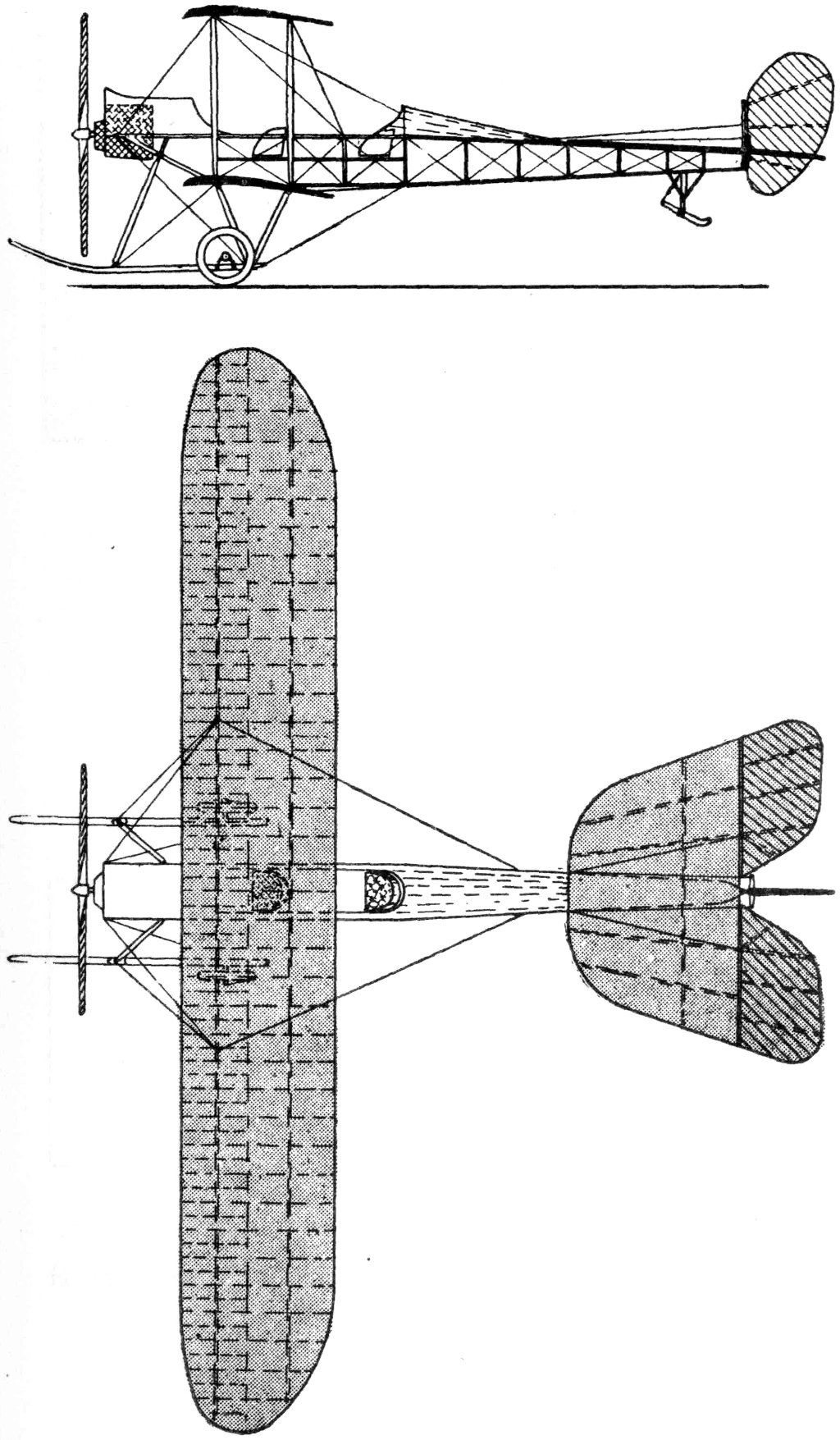
B.E. type. R.A.F. Uniform Aeroplane Scale
Length, 29½ feet (9 m.)
Span.—36¾ feet (11.20 m.)
Area.—374 sq. feet (34¾ m².)
Weight.—
Motor.—75 h.p. Renault and others.
Speed.—
AERO'S Ltd.
St. James' Street, Norwich Union Buildings, Piccadilly, London, S.W. Established 1912 for the sale of all parts and accessories; also for the sale of second hand aeroplanes and motors of all makes. Does not construct at present.
AIRCRAFT MANUFACTURING Co., Ltd.
47, Victoria Street, London, S.W. Works: Hendon, London, N.W. This company established in 1912, holds all the British rights for the H. & M. Farman types. It constructs in England all Farman types at its own works. (See Farman, French).
AVRO. Aeroplanes.
A. V. Roe & Co., Clifton Street, Miles Platting, Manchester; also Shoreham, Sussex. A. V. Roe designed his first machine, a biplane, in 1906. It was the first British machine to leave the ground. He then experimented with triplanes in Lea Marshes, where he managed to fly with only 9 h.p. in 1908-9. In August, 1910, built Roe III, and in September, Roe IV, also triplanes (see 1911 edition for full details). In 1911 he abandoned triplanes for the Avro biplane. School: Shoreham.
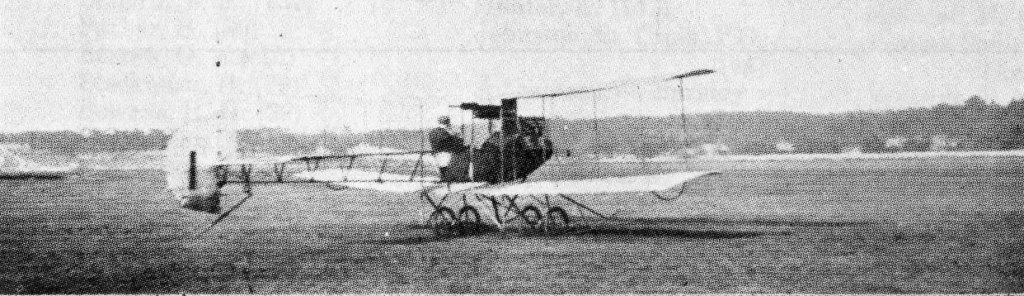
Photo, Alan H. Burgoyne, Esq., M.P.
Type D (1911).
Model. D 1911-12. 2-seater biplane.E 1912. 2-seater biplane. F 1912. Totally enclosed mono. G 1912-13. Totally enclosed biplane. E 1912-13. Hydro-biplane.
Lengthfeet (m.)31 (9.45)29 (8.84)23 (7)29 (8.84)33 (10)
Spanfeet (m.) 31 (9.45)36 (11)28 (8.50)36 (11)47½ (14.50)
Areasq. ft. (m².) 279 (26)335 (32) 158 (14½) 335 (32)478 (34½)
Weightempty lbs. (kgs.)800 (363)900 (482)550 (249)1191 (540)1740 (789)
fully loaded, lbs. (kgs.)...1300 (589)800 (363)1700 (771)2700 (1224)
Motorh.p.35, any make50 Gnome40 Viale60 Green100 Gnome
Speedm.p.h. (km.)48 (78)61 (97)65 (105)61.8 (100)55 (90)
Number built during 1912several6111
Remarks.—Of the above, 4 of the 50 Gnome E type were purchased by the British Royal Flying Corps, and one by the Portuguese Government; the other went to Windermere on January, 1913, for hydro experiments. Climbing speed of this type is 440 feet per min. (134 m.) Dual control fitted. D type are no longer being built. Climbing speed of F type, 300 feet per min. (91.5 m.) Gliding angle, 1 in 6. G has a gliding angle 1 in 6.5. On October 24th, 1912, made British record to date, 7'31½" (=450 miles). The hydro. was delivered to the British R.F.C. naval wing early in 1913.
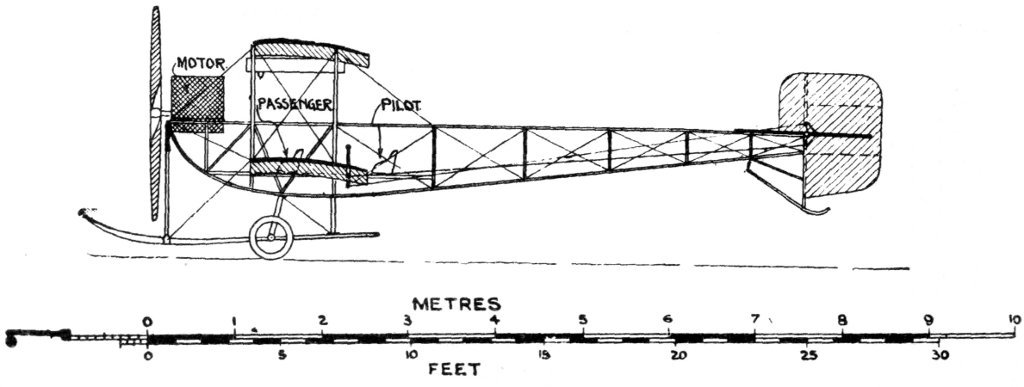
Uniform Aeroplane Scale
Avro. Type D (1911-12).
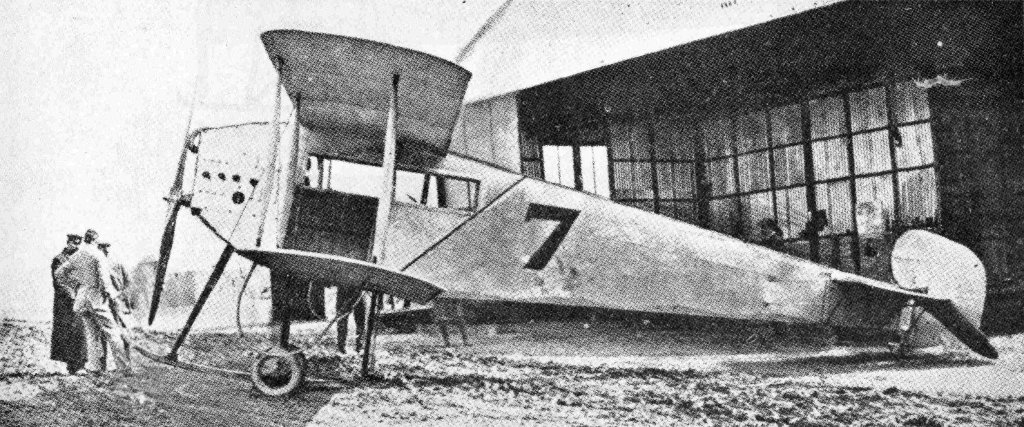
E type Standard 50 h.p. Avro Biplane.
No suitable photo available.
The machine is on usual lines. The first had a single float, but now two floats are used.
E type 100 h.p. Avro Hydro-biplane.
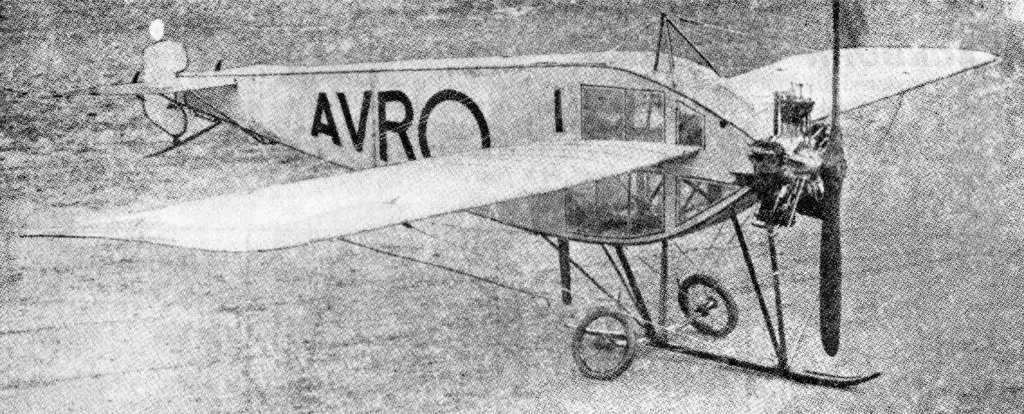
F type Enclosed Avro Mono.
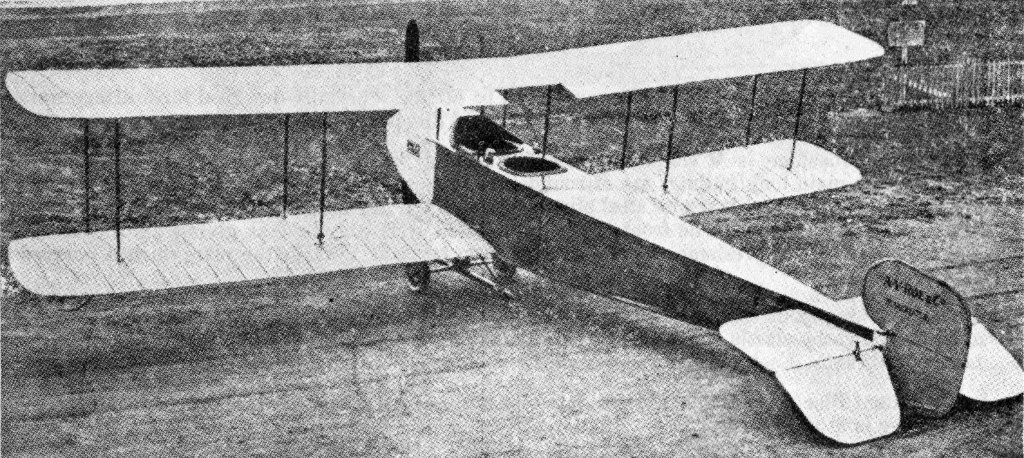
G type Enclosed Avro Biplane.
B
BLACKBURN Aeroplanes.
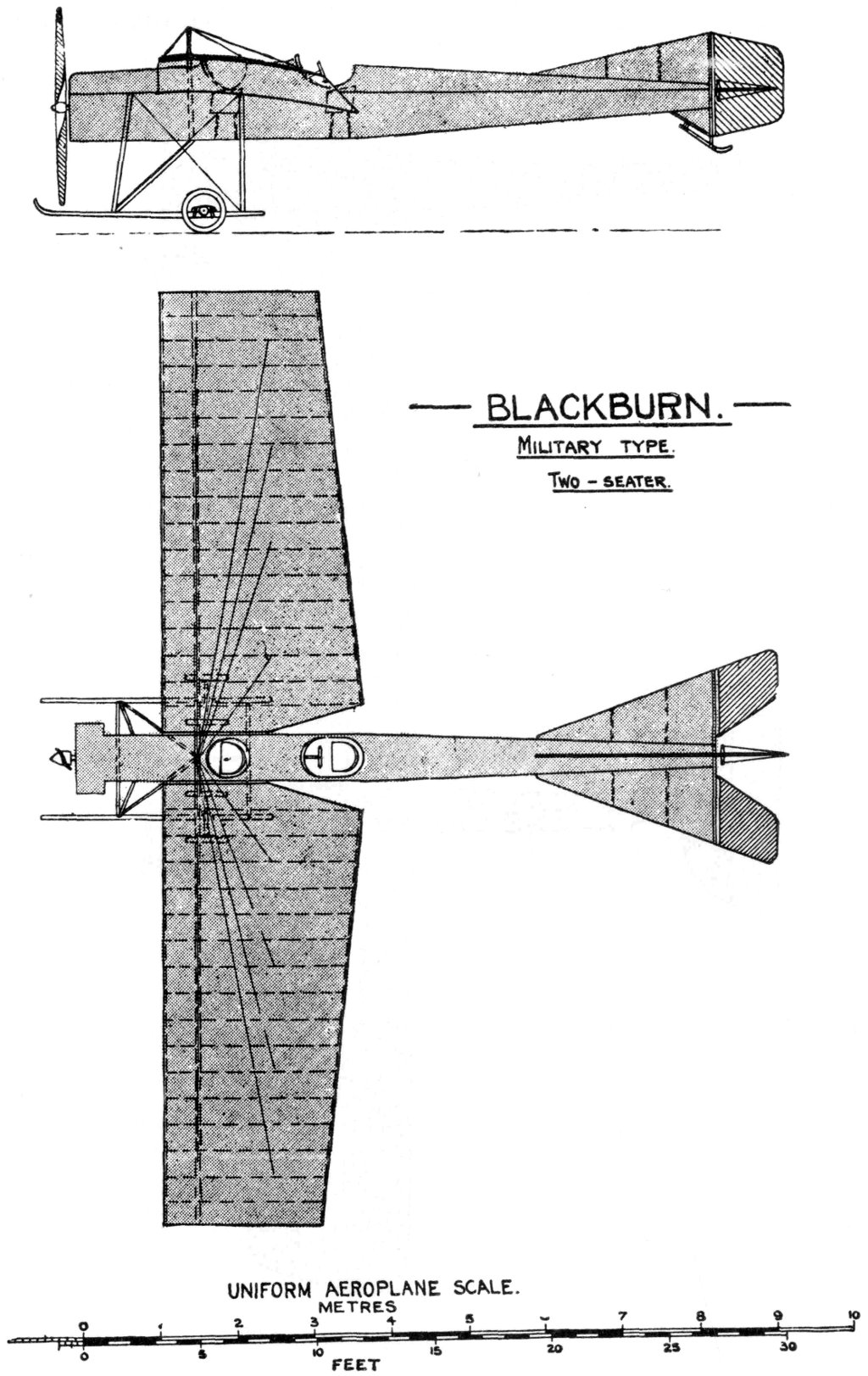
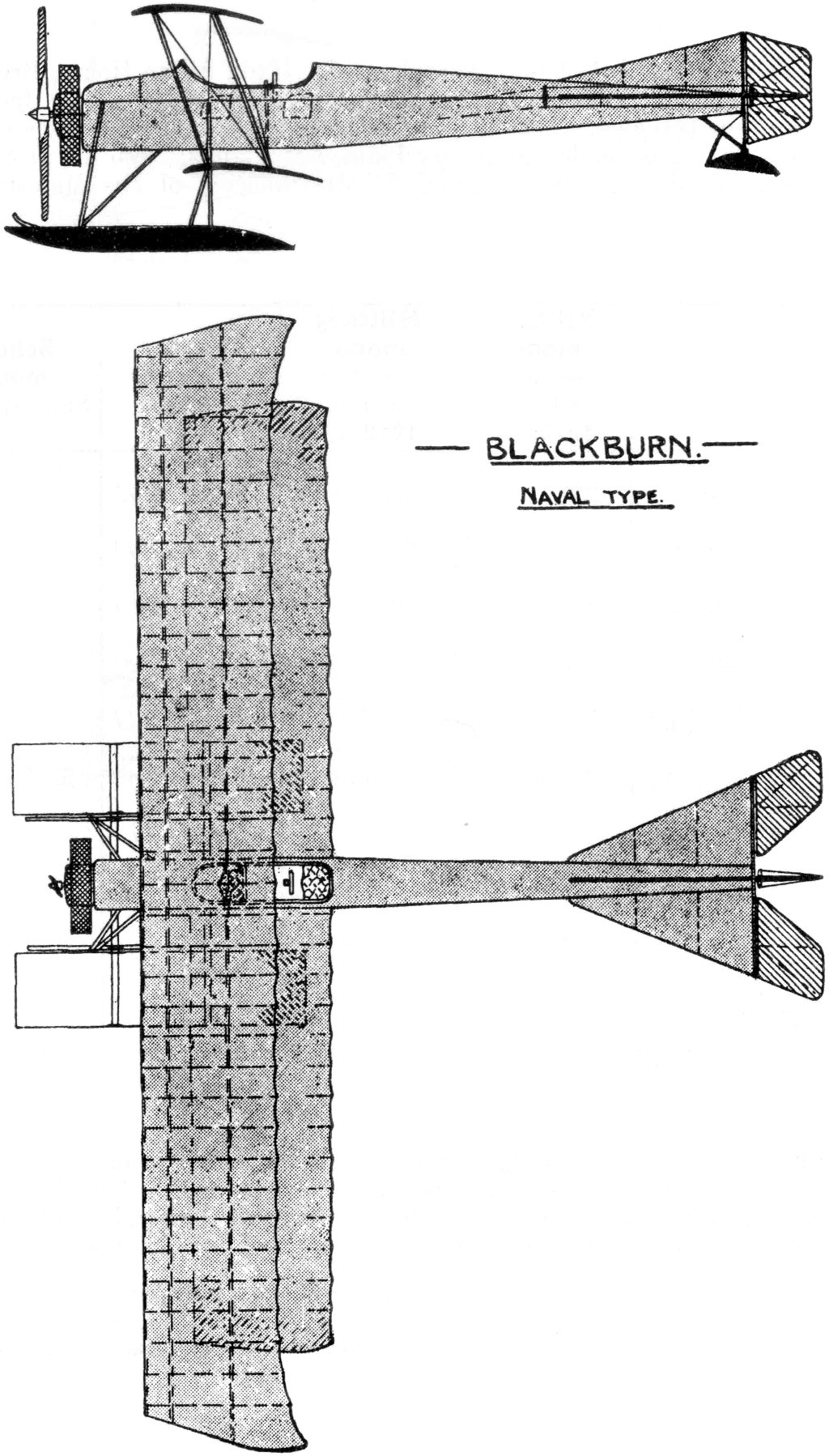
Blackburn Aeroplane Co., Balm Road, Leeds. Blackburn produced his first machine early in 1910 (see 1911 edition for details). In the latter part of that year he designed the machine which ultimately developed into the Blackburn military. In 1911 other types were produced, all being fitted with the patent Blackburn triple control. School at Filey Hucks has been the principal Blackburn flyer. The type has also been very successfully flown by naval officers. Capacity of works: about 24 a year.
1912-13. Military. 2-seater.1912-13. Military. 1-seater.1913. Hydro-biplane. 2-seater.
Length 32 feet (9.75 m.) 25 feet (7.60 m.) 33 feet (10 km.)
Span 40 feet (12.20 m.) 32 feet (9.75 m.) 44 & 36 ft. (13.40 & 11 km.)
Area 276 sq. ft. (26 m².) 195 sq. ft. (18 m².) 410 sq. ft. (38 m².)
Weight(total) ... 750 lbs. (340 kgs.) 1250 lbs. (507 kgs.)
Motorh.p. ... 50 Gnome. 80 Gnome or 100 Anzani
Speed 55-65 m. (90-105 km.) 60 m. (97 km.) 65 m. (105 km.)
Notes.—Petrol for 5 hours (higher endurances can be fitted). Specially designed for military work—all steel construction. All parts unwelded to admit of rapid displacement. Clear observation provided for.
Fuselage.—The fuselage is V shaped and constructed of weldless steel tubing in the form of a lattice girder. The main longitudinals are of round section; cross members, oval section. Connections are not welded but made with strong steel clips so that should any member become damaged a new one can be readily arranged. The front portion is covered with sheet metal giving additional strength and reducing the head resistance. Stream line form tapering towards the rear which is covered with fabric.
Chassis.—Two long skids connected up to fuselage by metal struts. Each skid borne by a pair of wheels, axle held down by elastic shock absorbers. On the axle of the wheels are fitted steel springs which take side thrust. Each pair of wheels held by radius rods forming a bogie.
Control.—Patent Blackburn triple, independent or simultaneous on hand wheel, but special foot control for rudder is fitted if desired.
In 1912, five machines were built, of which two were of the mil. model. Others, non-military models (see last edition.)
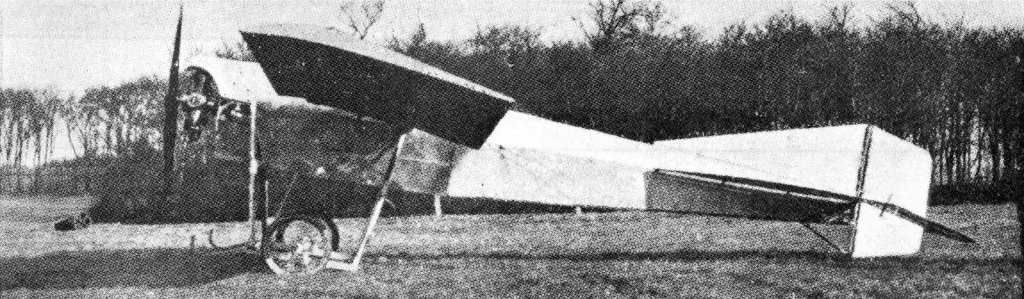
Military monoplane.
BRISTOL.
The British & Colonial Aeroplane Co., Ltd., Filton House, Bristol. Founded 1910. Capital (1913), ? Have very extensive works (area. ? sq. feet) on the outskirts of Bristol, employing over 300 men, where they manufacture to their own designs practically every type of flying machine. Flying grounds: Salisbury Plain, Brooklands. 105 Royal Aero Club certificates won on Bristol machines during 1912 (of which 86 were officers of His Majesty's Forces).
Military mono. 2-seater 80hp 1912-13. Military mono. 2-seater. 50h.p. 1912-12.Tractor biplane 1913.School mono. Side by side.
Lengthfeet (m.) 28¼ (8.60) 23-2/3 (7.20) 27¾ (8.47)
Spanfeet (m.) 42-1/3 (12.90) 39-1/3 (12) 34-1/3 (10.44)
Areasq. feet (m².) 221 (20.6) 226 (22) 370 (34.4)
Totalmachine, lbs. (kgs.) 1719 (771) 1323 (600) 1764 (800)
weightuseful lbs. (kgs.) 710 (322) 551 (250) 1200 (544)
Motorh.p. 80 Gnome 50 Gnome 70 Renault 50 Gnome
Speedmax. m.p.h. (km.) 73 (118) 62 (100) 70 (112)
min. m.p.h. (km.).........
Endurancehrs. 4 3-4...
Number built during 1912.........
Notes.—Monoplane: Box section fuselage convex on bottom side to minimise resistance. Mounted on 2 wheels and 2 skids with smaller wheels attached at the forward end. Bristol tractor. Biplane: Box section fuselage, convex on top and bottom sides. Mounted as monoplane. Bristol tractor. This machine is the latest production of the Bristol Co., and has proved an exceptionally successful flyer. Designed by M. Coanda.
80 h.p. monoplane.
70 h.p. biplane. Uniform Aeroplane Scale
BLERIOT Aeronautics.
Belfast Chambers, 156, Regent Street, London, W. School: Hendon. British office of the Bleriot firm (see France).
BRITISH BREGUET CO.,
1, Albemarle Street, Piccadilly, London, W. Works and offices: 5, Hythe Road, Cumberland Park, Willesden, London, N.W. Established 1912. Constructs in England Breguet models, some of which are beginning to vary in detail from the originals (see France).
BRITISH CAUDRON.
(See Ewen.)
BRITISH DEPERDUSSINS.
British Deperdussin Aeroplane Co., Ltd., 39, Victoria Street, Westminster, London, S.W. School: Hendon.
Chairman: Admiral The Hon. Sir E. R. Freemantle, G.C.B., C.M.G.
Managing Directors: Lieut. J. C. Porte, R.N., D. Laurence Santoni.
Secretary: N. D. Thompson.
This firm handles the French models of Deperdussins, but has in addition a special hydro-aeroplane of its own, of which one was built in 1912. Details of this special machine are:—Length, 27 feet 10 inches (8.50 m.) Span, 42 feet (12.80 m.) Area, 290 sq. feet (27 m².) Weight, total, 1,800 lbs. (816 kg.); useful, 1,250 lbs. (566 kg.) Motor, 100 h.p. Anzani. Speed, 67 m.p.h. (110 k.m.) Other models sold by the firm are of French type exactly (see France).
BRITISH DONNET-LEVEQUE.
Handled by Aeros, Ltd., 39, St. James' Street, Piccadilly, London, S.W. Company forming March, 1913 (see France). Works and school at Shoreham.
BRITISH FARMANS.
(See Aircraft Co.)
BRITISH HANRIOTS.
Hewlett & Blondeau, Omnia Works, Vardens Road, Clapham Junction, London, S.W. Construct all types of Hanriot machines (see France), also build to private specifications, and deal in accessories generally.
BRITISH NIEUPORTS.
Company forming 1913. Representative: M. Bonnier, 2, Goulders Green Crescent, London, N.W.
C
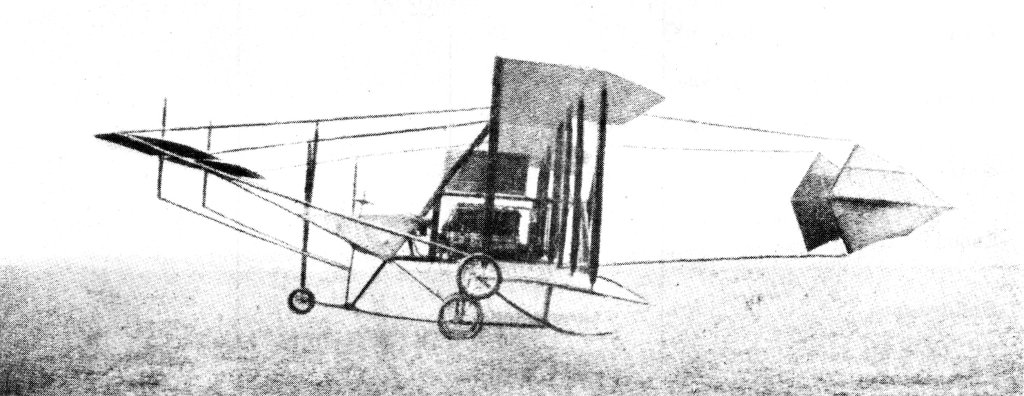
CODY.
Cody flying school, Farnborough. Cody commenced experiments with kites in very early days on behalf of the British Admiralty. Subsequently built the first British Army dirigible, and an experimental Army aeroplane. In 1909, his direct connection with the Army ceased. A Cody I was built in 1908. A Cody II was completed June 1910. The special features of both were: very strong construction, great size (II had area of 857 sq. feet), ailerons. Later types, except that warping is substituted for ailerons, do not differ very materially except in minor details. All wood construction.
1911. 4-seater biplane.1913. 4-seater biplane.Model. May, 1912. Monoplane.
Lengthfeet (m.) 38 (11.60) 38 (11.60) 38 (11.60)
Spanfeet (m.) 43 (13) 43 (13) 43½ (13.25)
Areasq. feet (m².) 484 (44¾) 483 (44¾) 260 (19)
Weighttotal lbs. (kgs.) 1900 (862) 1900 (862) 2400 (1088)
useful lbs. (kgs.) 1000 (453) 1000 (453) 700
Motor 60 Green, later a 100 Green 120 Aust. Daimler 120 Aust. Daimler
Speedmax m.p.h. (km.) 70 (115) 75 (120) 83 (135)
min m.p.h. (km.) 47 (75) 47 (75) 58 (95)
Number built to end of last year 1 1 1
Remarks.—The 1911 is the famous Cody, which, as a 60 h.p., won both Michelin 1911 prizes, and completed the Daily Mail circuit. As a 100 h.p. it won the 1912 Michelin cross-country. By the end of 1912 it is said to have flown a total of 7000 miles. The 1913 is practically a duplicate with a more powerful engine. Special features of the biplanes, maximum camber to lower plane. Both planes equal span. Very strong landing gear. Propeller chain driven: 1¾ to 1 gearing. In February, 1913, four biplanes were ordered for the British Army.
Cody lists a mono. for 1913 a trifle longer than the above; also five variations on the biplane of from 35 to 160 h.p., which can be built if required.
Biplane.
COVENTRY ORDNANCE.
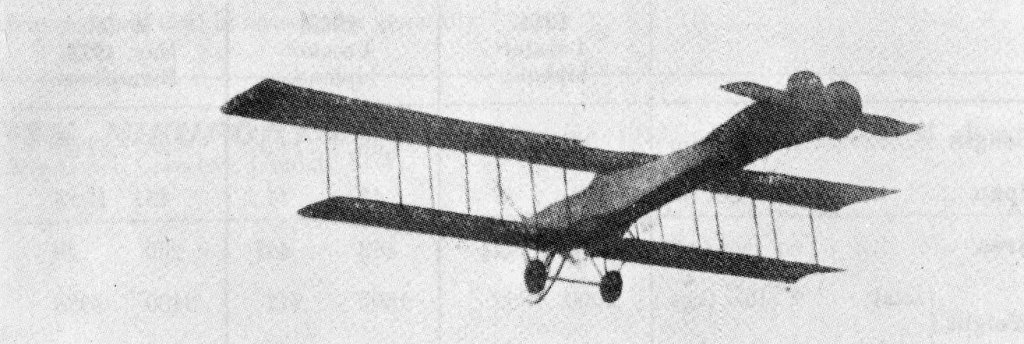
The Coventry Ordnance Works, Ltd., Coventry. London office: 28, Broadway, Westminster, S.W. Established 1912. Capacity: 50 machines a year without difficulty.
1912. Model 10.
Lengthfeet (m.) 29 (8.80)
Spanfeet (m.) 56 (17)
Areasq. feet (m².) 630 (58)
Weighttotal lbs. (kgs.) 1900 (861)
useful lbs. (kgs.) 800 (362)
Motorh.p. 100 Gnome
Speedmax. m.p.h. (km.) 60 (97)
min. m.p.h. (km.)...
Endurancehrs....
Number Built during 1912 2
Remarks.—Experimental machines.
D
DUNNE.
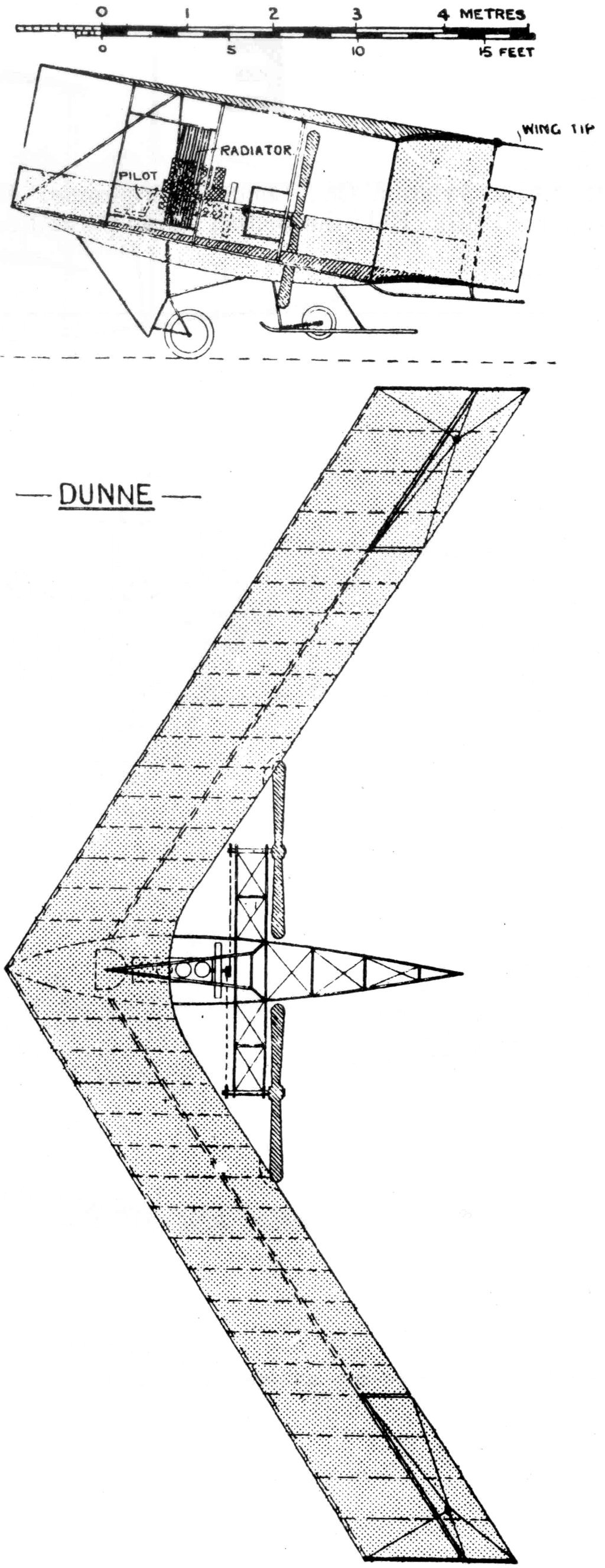
The Blair Atholl Aeroplane Syndicate, Ltd., 1, Queen Victoria Street, London, E.C. School: Eastchurch. In 1906 Lieut. Dunne was employed by the British Army authorities for secret aeroplane experiments. He had at that time patented a monoplane of < type. In 1907 Dunne I was tried on the Duke of Atholl's estate in Scotland, but failed to fly, being smashed on the starting apparatus. Dunne III, a glider, 1908, was experimented with successfully by Lieut. Gibbs. In the same year Dunne IV, a larger power driven edition made hops of 50 yards or so. Early in 1910 the War Office abandoned the experiments. Dunne II, a triplane of 1906 design, was, by consent of the War Office, assigned to Prof. Huntingdon, who made one or two short flights with it at Eastchurch in 1910. At the same time the above syndicate was formed, and Dunne V, built by Short Bros., was completed in June, 1910. In 1912-13 the Huntingdon, modified, was flying well.
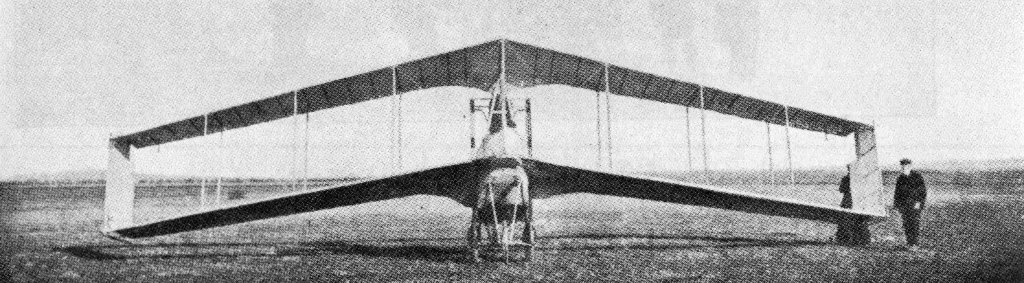
Model and Date.50 Gnome. 1912-13 single-seat mono. D 7.1912-13 2-seater mono. D 7 bis.1912-13 biplane. D 8.1912-13 biplane. D 9.
Lengthfeet (m.) not given ... ... ...
Spanfeet (m.) 35 (10.66) 35 (10.66) 46 (14) 45 (13.70)
Areasq. feet (m².) 200 (18.5) 200 (18.5) 552 (51) 448 (42)
Weighttotal lbs. (kgs.)1050 (476) 1200 (544) 1700 (771) 1693 (768)
useful lbs. (kgs.) 359 (161) 528 (239) 414 (187) 509 (231)
Motorh.p. 50 Gnome 70 Gnome 60 Green 80 Gnome
Speedm.p.h. (km.) 60 (95) 60 (95) 45 (70) 50 (80)
Number built during 1912 1 1 1 5 b'lding ('13)
Notes.—Biplane D 3 is identical with the original pattern Dunne V, except that it has only one propeller instead of two. It has been flown completely uncontrolled in a 20 m.p.h. wind, carrying a R. Ae. C. observer as passenger.
Original Dunne biplane D5.
E
EWEN.
The W. H. Ewen Aviation Co., London Aerodrome: Hendon. Also works at Lanark, Scotland (opened February, 1913). Hold the British rights for and construct at their works Caudron aeroplanes (see France).
F
FERGUSON.
J. B. Ferguson, Ltd., Belfast.
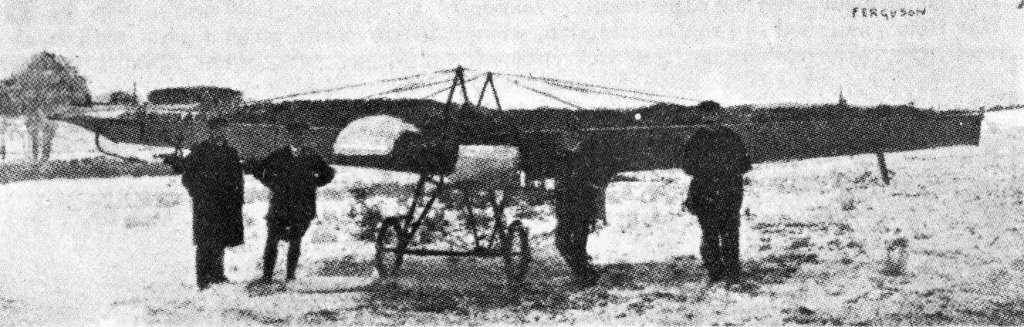
This machine first appeared in 1910. Owing to an accident to Mr. Ferguson it was laid up for a long time. About the end of 1912 it re-appeared. Principal details:—
Span.—40 feet (12.20 m.) Area.—230 sq. feet (21 m².) H.P. 40.
G
GRAHAME-WHITE.
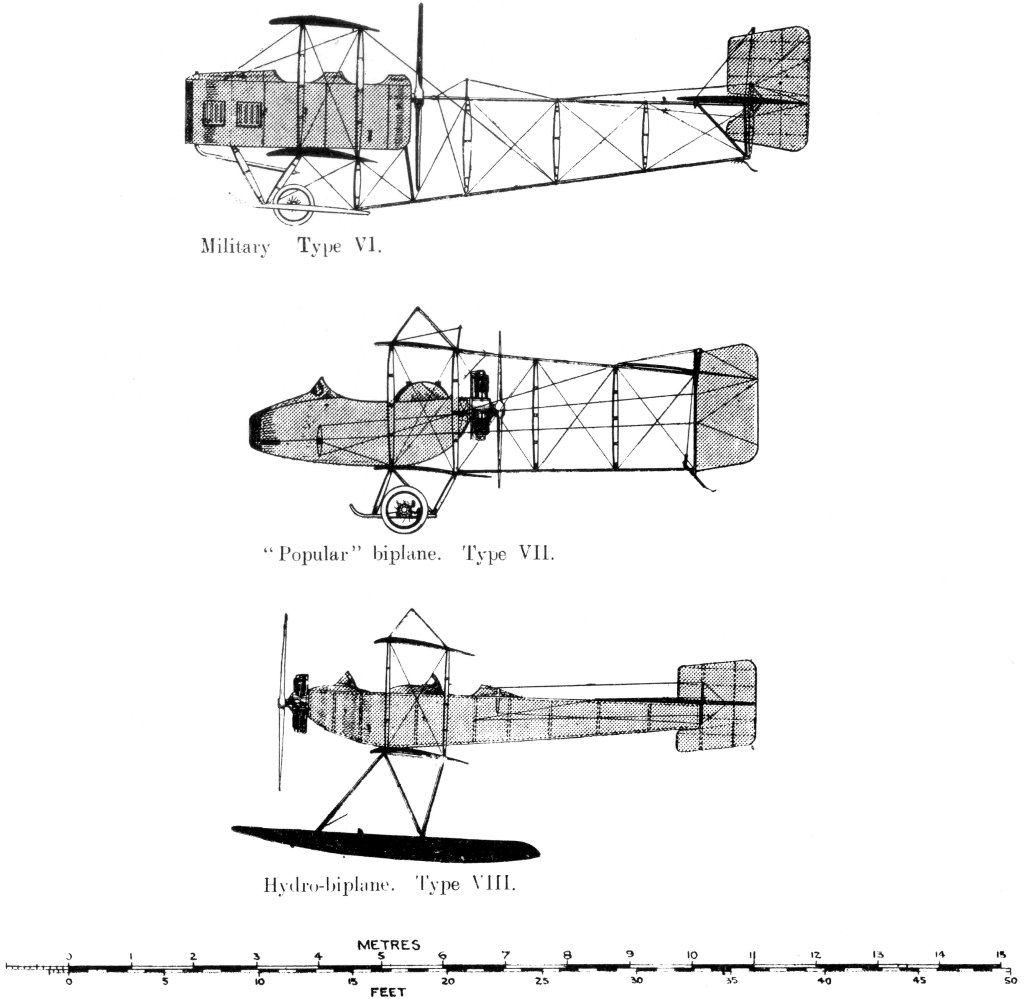
The Grahame-White Aviation Co., Ltd., 166 Piccadilly, London, W. Works and Flying Ground: Hendon. Founded by C. Grahame-White, the well-known aviator, who in 1909 commenced operations with a school at Pau. Later this was removed to England, and a general agency for the sale of aeroplanes, etc., established. This developed, and early in 1911 the firm was handling a special British agency for the U.S. Burgess type known as "The Baby." The Hendon Aerodrome was acquired, and a factory established, which has grown continually ever since. In April, 1912, a monoplane to special design was completed. By the close of the same year biplanes of advanced design were constructed. Capacity of the works, March, 1913, was equal to 150 machines a year if necessary.
1913. Military biplane. Type VI. 2-seater.1913. "Popular" biplane. Type VII. 1-seater.1913. "Popular" biplane. Type VII. 2-seater.1913. Tractor hydro-biplane. Type VIII. 2-seater.1913. Monoplane. Type IX. single-seat.
Lengthfeet (m.) 33¼ (10.10) 20-5/6 (6.40) 26-5/6 (8.22) 25 (7.60) 21 (6.40)
Spanfeet (m.) 42 (12.80) 29-1/6 (8.85) 38 (11.60) 42½ (13) 32 (9.75)
Areasq. feet (m².) 435 (40½) 230 (21) 475 (44) 380 (35) 208 (19)
Weighttotal lbs. (kgs.) 2200 (997)...... 850 (385) ...
useful lbs. (kgs.) 750 (340) 450 (204) ...
Motor 120 Aust. Daimler 50 Gnome 50 Gnome 80 Gnome 50 Gnome
Speedmax. m.p.h (k.p.h.) 70 (110) 60 (95) 50 (80) 65 (105) 65 (105)
min. m.p.h (k.p.h.) 55 (90) 50 (80) 40 (65) 50 (80) ...
Endurancehrs. 6 4 4 4 4
Number built during 1912 1 ... ... 1 ...
Also built with a 90 Aust. Daimler. Designed to carry a gun on the bow. Very good view. Very strong landing carriage. Also built with a 35 Also built with a 60 Also built with a 35 Anzani. Two main floats with 12½ ft. track. Floats are 15 ft. long, 2 ft. wide, 1 ft. 3 in. deep.
H
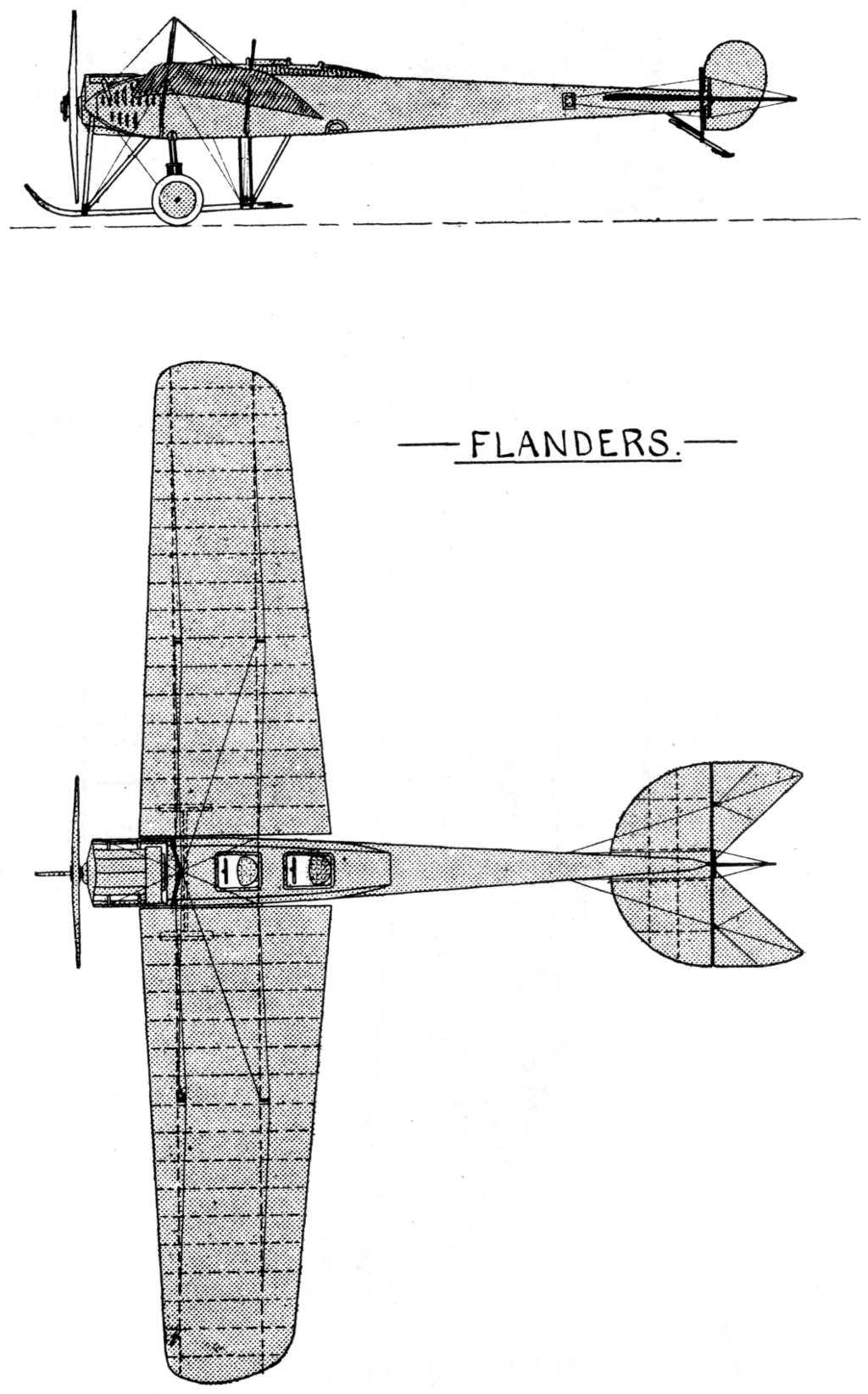
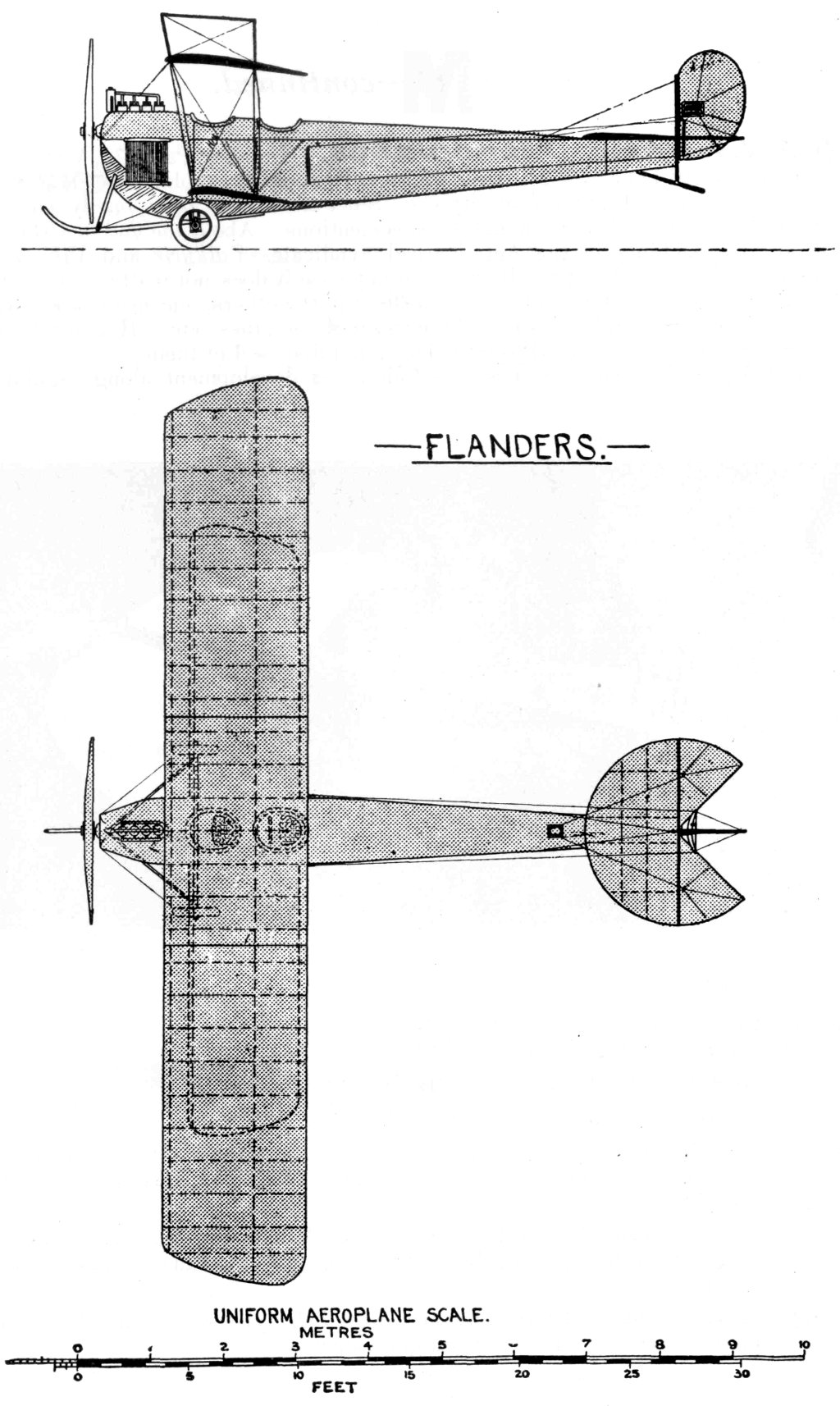
HOWARD-FLANDERS.
L. Howard-Flanders, Ltd., 31, Townsend Terrace, Richmond, Surrey. School: Brooklands. Established February, 1912, by Howard-Flanders, whose connection with aviation dates from the pioneer days. Richmond Works opened April, 1912. Capacity of the works at end of 1912 was sufficient to turn out from 25 to 35 machines a year.
F 4 1912. 2-seater military monoplane. B 2 1912. 2-seater biplane. S 2 1913. single-seat monoplane. F 5 1913. 2-seater monoplane. B 3 1913. 2-seater monoplane.
Lengthfeet (m.) 31½ (9.50) 31½ (9.50) 28 (8.50) 31 (9.45) 31 (9.45)
Spanfeet (m.) 40 (12) 40 (12) 35 (10.70) 39 (11.90) 40 (12)
Areasq. feet (m²) 240 (22) 390 (36) 190 (17¾) 250 (23) 390 (36)
Weighttotal lbs. (kgs.) 1850 (839) 1500 (680) 1180 (535) 1600 (726) 1650 (748)
useful lbs. (kgs.) 500 (227) 450 (204) 350 (159) 600 (272) 600 (272)
Motorh.p. 70 Renault 40 A.B.C. 80 Gnome 80 Gnome 80 Gnome
Speedmax m.p.h. (km.) 67 (108) 56 (90) 82 (132) 70 (115) 68 (110)
min m.p.h. (km.) 41 (66) 38 (61) 45 (73) 42 (68) 40 (65)
Number built during 1912 4 1
Remarks.—F 4 climbing speed 1000 feet (305 m.) in 3½ minutes, 1500 in 5½ mins., 2000 in 8 mins. B 2 climbing speed 200 feet (61 m.) per minute. The four F 4 type were bought by the British Army during 1912.
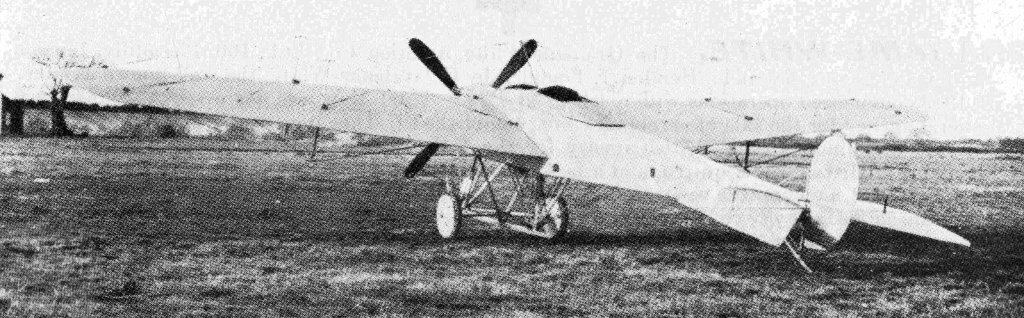
Monoplane.
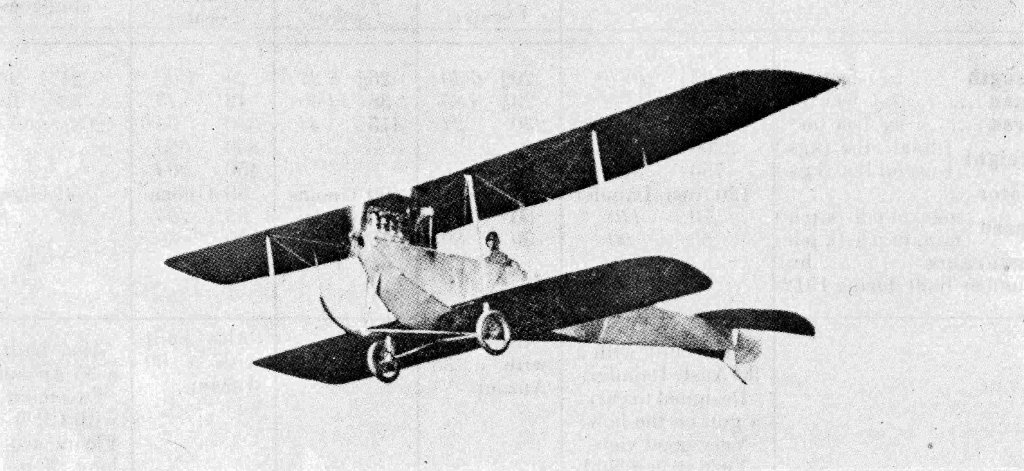
Biplane.
HANDLEY-PAGE Monoplanes.
Handley Page, 72, Victoria Street, S.W. Works: 110, Cricklewood Lane, N.W. Flying ground: Hendon. Established at the end of 1908. In June, 1909, it was turned into a Limited Liability Co. Since then it has been busily employed in producing its own machines, also others to inventor's specifications. About the end of 1911 the firm bought up and sold all the machines of the Aeronautical Syndicate—Valkyrie and Viking types. It is doubtful whether any of these V type still exist—in any case it does not matter. Four were presented to the R. Flying Corps. Of these one was smashed up, the others, one army and two navy, were used to teach mechanics to take down and re-assemble engines, etc. Handley-Page also bought up the Radley-Moorhouse machines (Bleriot copies), and disposed of them.
The 1912-13 Handley-Page type is as follows—a development along regular lines of the original H.P. machine:—
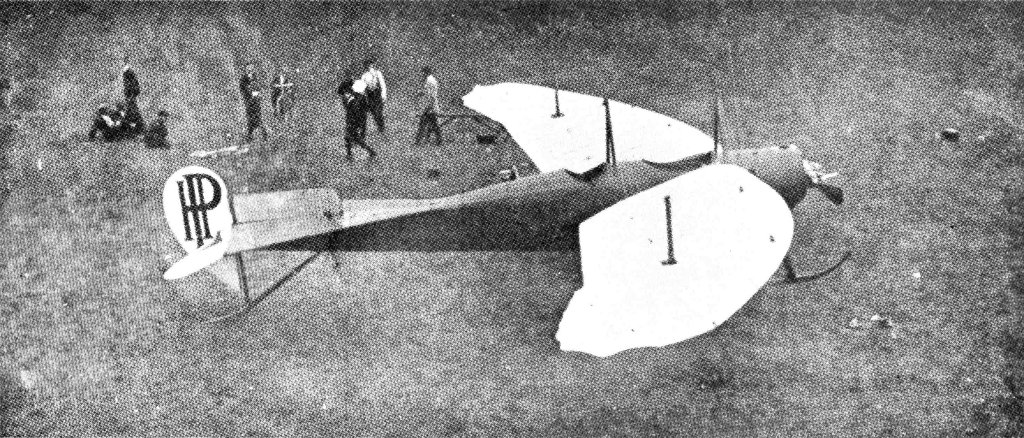
Handley-Page V.
Length, 27½ feet (8.40 m.) span, 42½ feet (12.95 m.) area, 240 sq. feet. (22¼ m².)
Weight.—Total, 1300 lbs. (590 kgs.) Empty, 800 lbs. (363 kgs.)
Motor.—50 h.p. Gnome. Speed. 55 m.p.h. (90 km.)
Remarks.—The fixed tail area is 32 sq. feet. Body is entirely enclosed, stream line form. The passenger sits behind the pilot. Mounted on wheels and one long skid forward. Full description and details, Flight, 26th October, 1912.
Principal pilots have been the late E. Petre (who made in it the only flight through London), the late Lieut. Parke, R.N., S. Pickles, and L. R. Whitehouse. The machine has been flown with two passengers, in addition to the pilot.
Military work.—During 1912 five biplanes of the B.E. type were ordered by the British War Office. Several monoplanes were ordered by foreign governments.
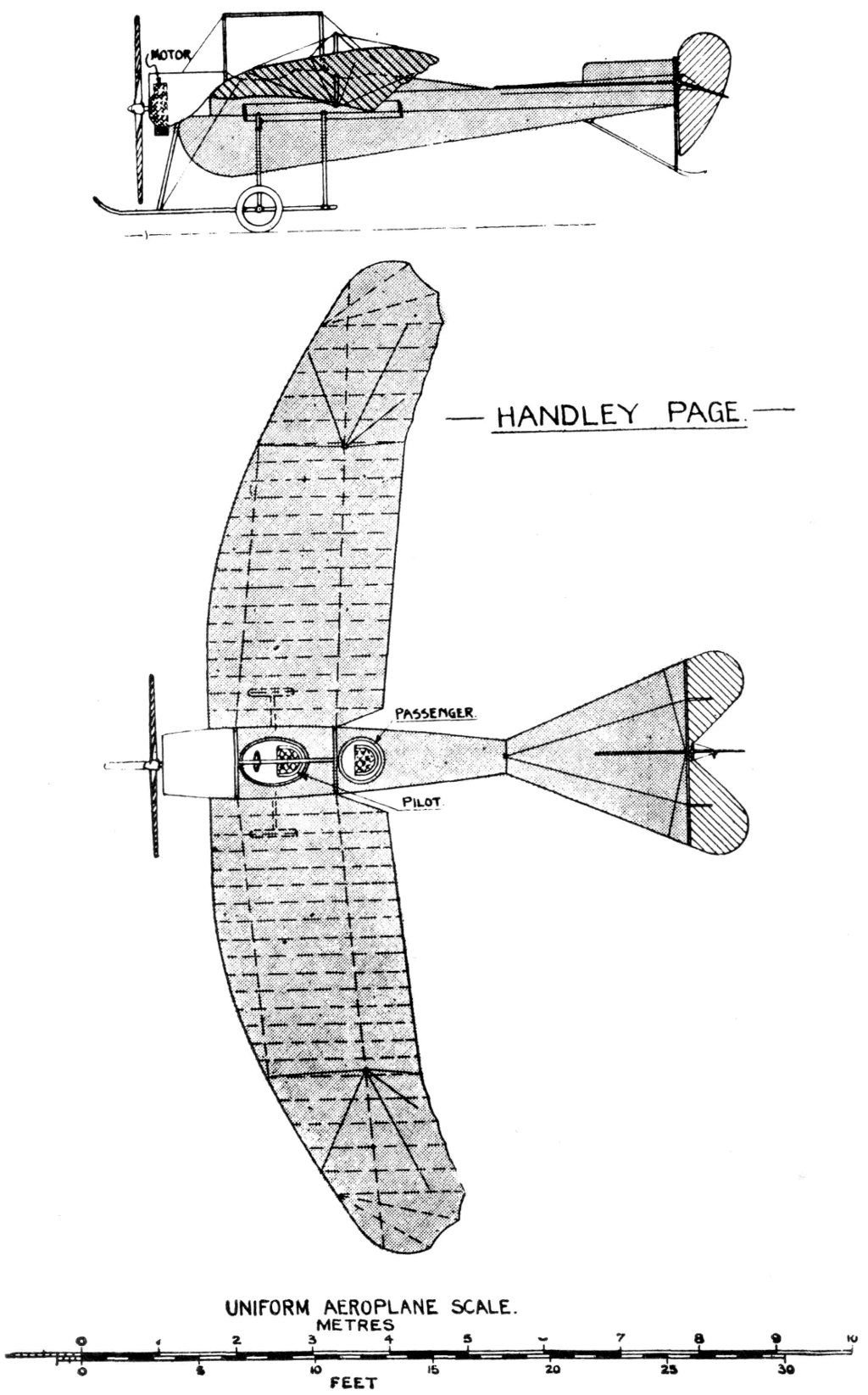
Uniform Aeroplane Scale
L
LAKE FLYING Co.
Windermere. Established 1911, by E. W. Wakefield, with a view to hydro-aeroplane experiments. The first machine was a Curtiss type built by A. V. Roe, which flew in November, 1911. In 1912, a special biplane generally of Farman type but with more camber to the planes, was built.
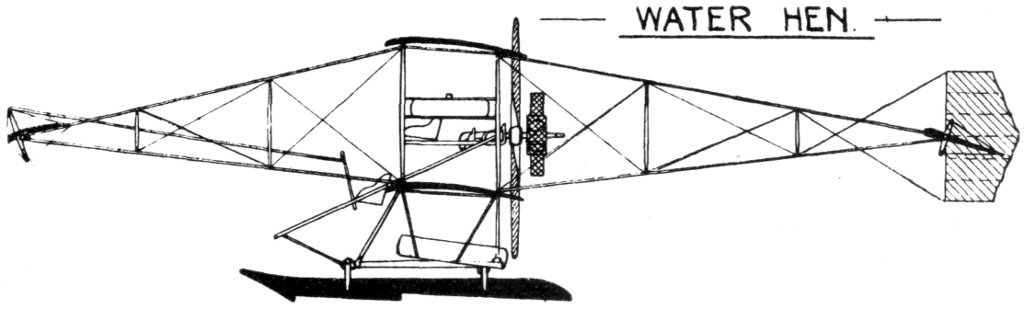
Length.—36½ feet (11 m.) Span.—42 feet (12.80 m.) Area.—270 sq. feet (25 m.²) Motor.—Gnome.
Speed.—45.33 m.p.h. (72.54 k.p.h.)
The single float is 6 feet wide, flexibly connected. Balancers mounted on a spring board. Water rudders for steering at slow speed. Fuller details see Flight, December 7th, 1912. Early in 1913, an Avro was purchased for further experiments.
M
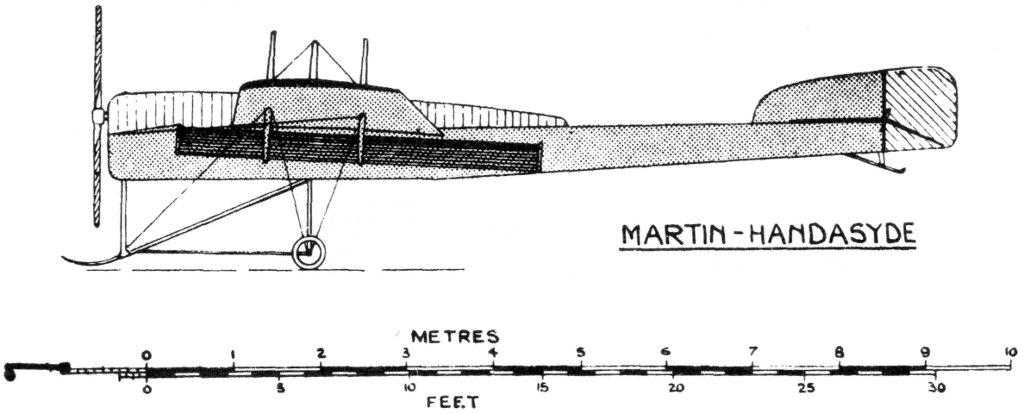
MARTINSYDE.
Messrs. Martin & Handasyde, Brooklands, Weybridge, Surrey. Output capacity: about 20 per annum.
Model and date.1912. Mono. 2-seater.1913. Mono. 2-seater.
Lengthfeet. (m.) 35½ (10.75) 35 (10.65)
Spanfeet. (m.) 42½ (12.95) 42¾ (13)
Areasq. feet (m².) 290 (27) 285 (26½)
Weighttotal lbs. (kgs.)... 1212 (550)
useful lbs. (kgs.)... 551 (250)
Motorh.p. 65 Antoinette 80 Laviator
Speedmax m.p.h. (km.) 63 (102) 78 (125)
min m.p.h. (km.)......
Number built during 1912 ......
Notes.—Wood construction. Landing: wheels and one skid. Controls: warping wings and rear elevator. Triangular body. The two models are very nearly identical.
Uniform Aeroplane Scale
P
PIGGOTT.
Piggott Bros. & Co., Ltd., 220, 222 & 224, Bishopsgate, London, E.C. This well-known firm of shed makers built a novel biplane in May, 1910 (details Flight, May 21st, 1910), and in 1911 a monoplane with enclosed body (Flight, April 1st, 1911). In 1912, both were disposed of, and the firm is not proceeding with its experiments. It has, however, a staff of skilled mechanics and a great deal of floor space for the construction of aeroplanes to specifications.
PLANES.
Planes, Ltd., 6, Lord Street, Liverpool. Works: Duke Street & Cleveland Street, Birkenhead. Not building at present. In October, 1910, the firm produced a biplane, designed by W. P. Thompson, fitted with a special pendulum stabilising device. This was followed a year or so later by a monoplane.
R
RADLEY-ENGLAND.
This is not an aeroplane firm, but a special hydro built by two well-known aviators for the Daily Mail competition. Length, 22 feet. Span, 50 feet. 2 floats, 15 feet long by 1 foot 5 inches wide. Pilot in starboard float. Weight, with petrol for 12 hours, 1,380 lbs. Motor, 150 h.p., made up of 3—50 h.p. Gnomes, but two Greens to be fitted for competition. One 4-bladed propeller in rear. Speed, 60 m.p.h., with 100 h.p.
S
SANDERS.
This firm appears to have ceased to exist.
SHORT BROS.
Works and flying grounds: Eastchurch, Isle of Sheppey, Kent. London office: Queen's Circus, Battersea Park. Took up construction at a very early date. Wright agents in 1909. Have built numerous biplanes and monoplanes to specifications. Produced their own first machine (see 1911 edition) in 1910.
S 41. 1913. Hydro Biplane. S 45. 1913. Military Tractor Biplane. S 38. 1913. Military Nacelle Biplane. S 34. Standard School. 1911-12. 1-seater, mono. 1911-12. Tandem tractor biplane.
80 h.p. 2-seater. 100 h.p. 2-seater. 160 h.p. 4-seater. 70 h.p. 2-seater. 80 h.p. 2-seater. 160 h.p. 4-seater. 50 h.p. 2-seater. 80 h.p. 3-seater. 50 h.p. 2-seater. 70 h.p. 2-seater.
Lengthfeet (m.) 35 (10.67) 39 (11.90) 45 (13.70) 35-1/2 (10.80) 35-1/2 (10.80) 40 (13.70) 35-1/2 (10.80) 35-1/2 (10.80) 42 (12.85) 42 (12.85) 25 (7.60) 35-1/2 (10.80)
Spanfeet (m.) 40 (13.70) 50 (15.25) 50 (15.25) 42 (12.90) 45 (13.70) 50 (15.25) 52 (15.85) 52 (15.85) 46-1/2 (14.20) 46-1/2 (14.20) 29-1/2 (9) 42 (12.90)
Areasq. feet (m².) 390 (36) ... ... ... ... ... ... ... ... ... 186 (17) ...
WeightMachine lbs. (kg.) 1200 (545) 1700 (764) 2000 (909)1080 (490) 1100 (500) 1890 (860) 950 (432) 1050 (480) 1100 (500) 1150 (523) ... 850 (385)
Useful lbs. (kg.) 771 (350) ... ... ... ... ... ... ... ... ... ... ...
Motorh.p. 80 Gnome 100 Gnome 160 Gnome 70 Gnome 80 Gnome 160 Gnome 50 Gnome 80 Gnome 50 Gnome 70 Gnome 50 Gnome. 70 Gnome.
Speedmax (m.p.h.) 65 (105) 60 (97) 74 (120) 60 (97) 70 (113) 74 (120) 42 (68) 58 (94) 39 (63) 48 (78) ... 58 (94)
min (m.p.h.) 50 (80) 50 (80) 56 (90) 50 (80) 50 (80) 56 (90) 35 (57) 39 (63) 34 (55) 38 (61) ... ...
Endurancehrs. 4 5 6 5 5 6 4 5 4 5 5 5
Number built during 1912 ... ... ... ... ... ... ... ... ... ... ... ...
Remarks.--Floats are two long pontoons. Subsidiary floats at tips of lower plane. Small tail float with water rudder. W.-t. compartments to floats. Tandem seated, pilot in front. The observer's seat can accommodate two if necessary. Tandem seats, pilot in front. Fittings for maps, etc. Specially designed for reconnaissance. Tandem seats, pilot in front. An extra passenger can be accommodated. Solely designed for school work. Seats side by side. No longer built, but still in existence.
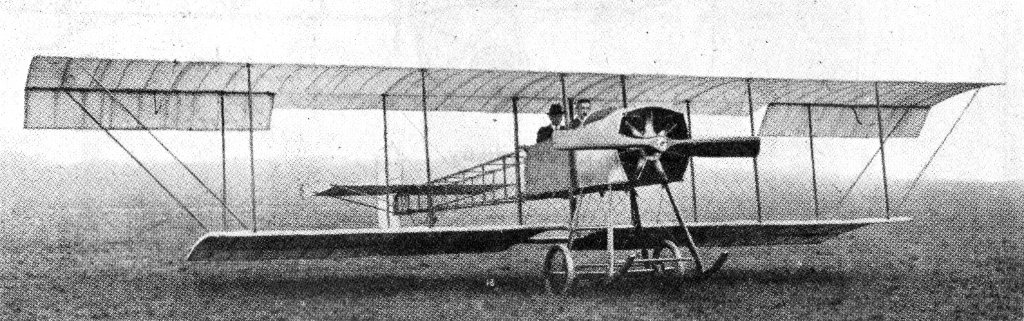
Old 1911-12 Tractor biplane.
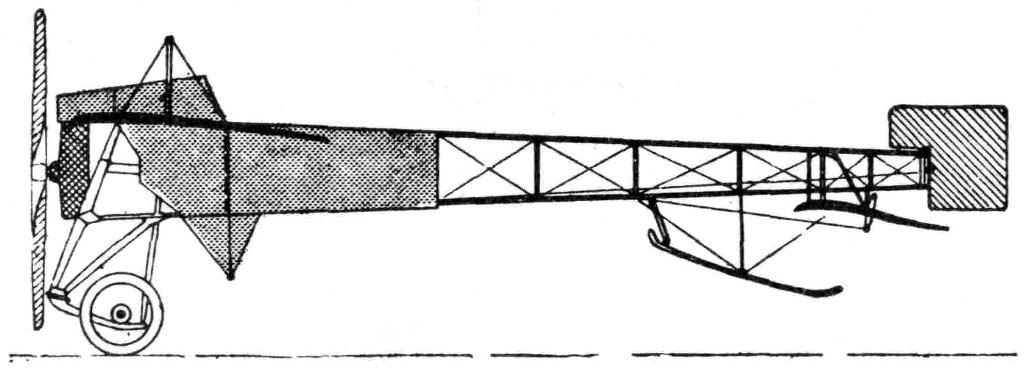
Old 1911-12 mono.
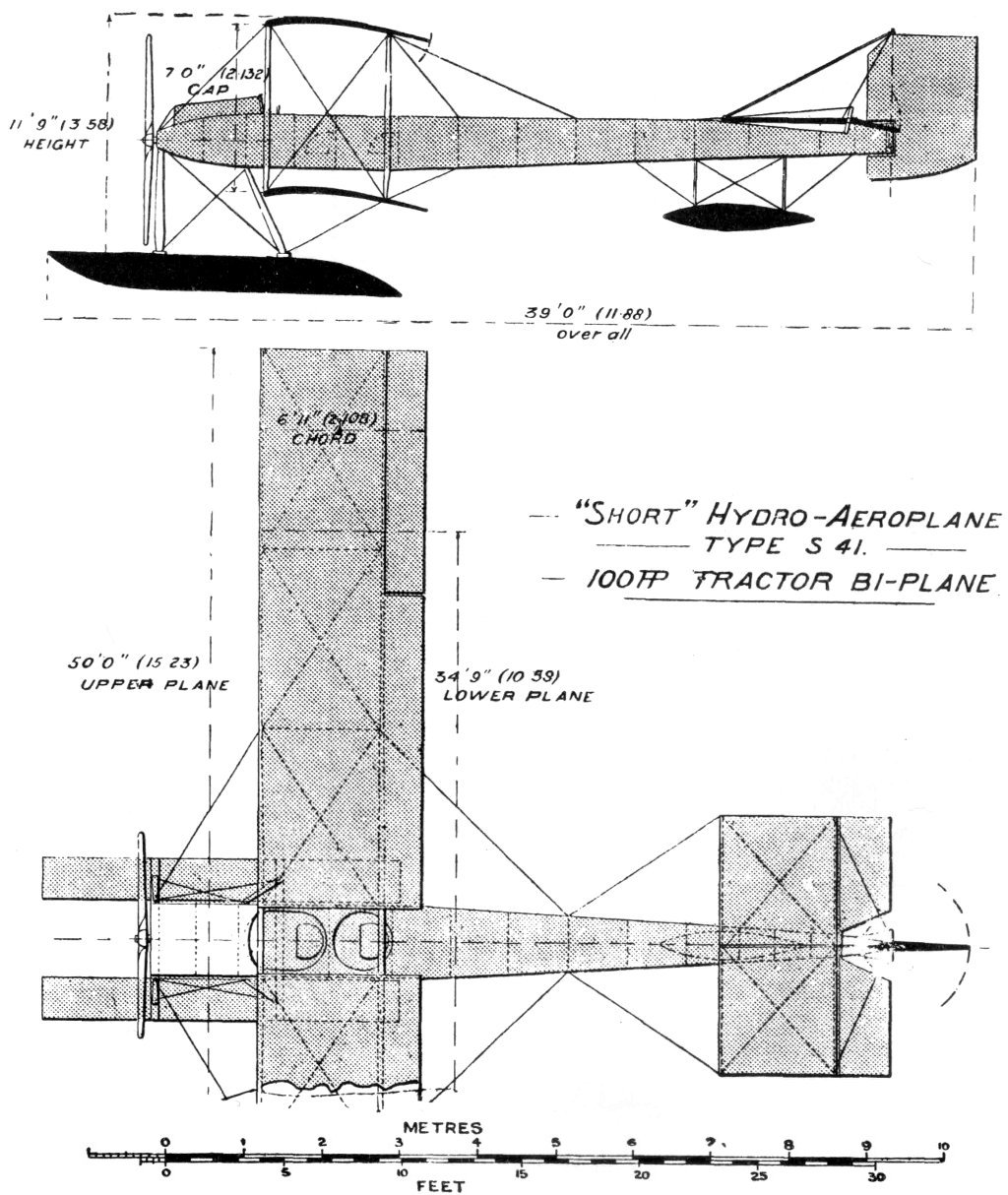
Uniform Aeroplane Scale
Short. Hydro.
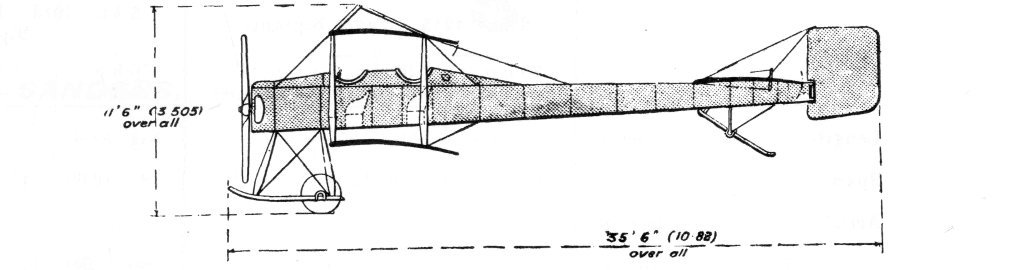
Short. S. 45 type.
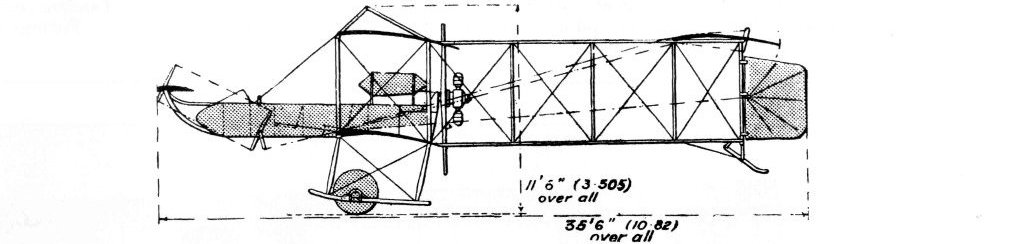
Short. S. 38 military.

Uniform Aeroplane Scale
SOPWITH.
Sopwith Aviation Co. Works: Canbury Park Road, Kingston-on-Thames. School: at Brooklands. Established by T. O. M. Sopwith, the well known aviator at Brooklands, Autumn of 1911, where during 1912, a 70 h.p. tractor biplane and a 40 h.p. biplane was turned out.
Floor area of the Kingston works in March, 1913, was 30,000 sq. feet with electric power plant. Works manager: F. Sigrist. General manager: R. O. Cary. Output capacity: at full pressure about 50 machines a year.
Model and Date. 1913. Bat boat hydro biplane. 1913. Tractor biplane 3-seater. 1913. School biplane. 1913. Armoured warplane.
Lengthfeet (m.) 30-1/3 (9.20) 29 (8.85) 29 (8.85) 29' 7-1/2" (9)
Spanfeet (m.) 41 (12.50) 40 (12.20) 40 (12.20) 50 (15.25)
Areasq. feet (m².) 422 (39) 365 (34) 400 (37) 552 (51)
Weighttotal lbs. (kgs.) 1700 (771) 1750 (794) 1200 (544) 2000 (907)
useful lbs. (kgs.) 500 (227) 750 (340) 400 (181) 800 (362)
Motorh.p. 90 Austro-Daimler 80 Gnome 50 Gnome 90 Austro-Daimler
Speedmax. m.p.h. (km.) 65 (105) 74 (125) 48 (78) 65 (105)
min. m.p.h. (km.) 42 (68) 40 (65) 35 (60) 38 (61)
Endurancehrs. ... ... ... ...
Notes.—Wood construction. Carriage wheels and skids. Control: balanced ailerons.
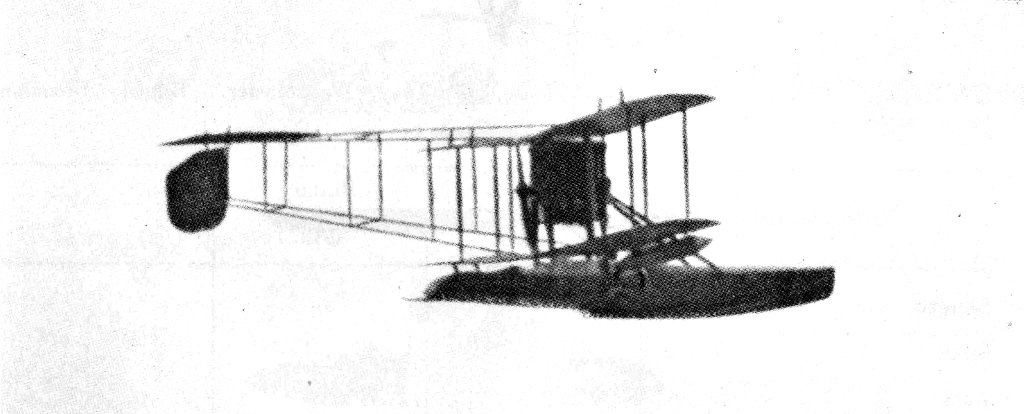
Sopwith. Flying boat.
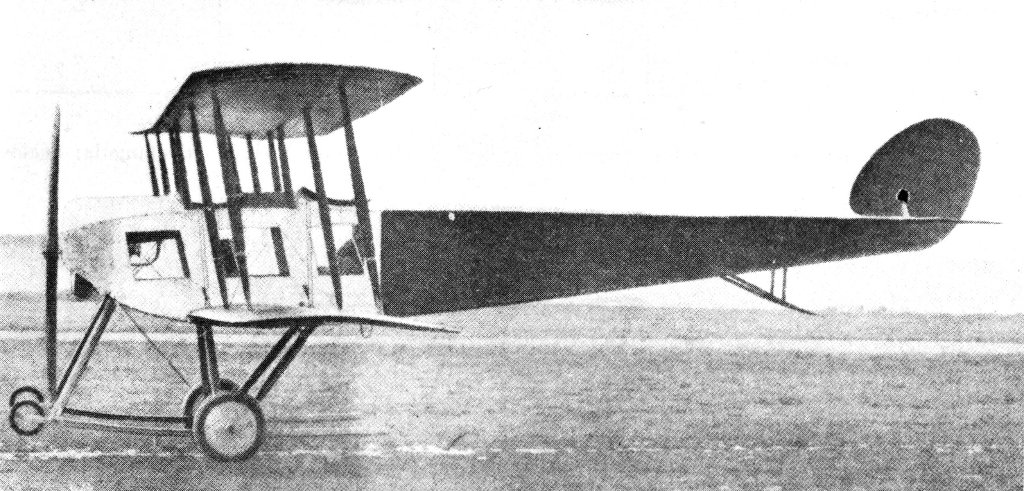
1913. Tractor biplane.
V
VICKERS.
Vickers, Ltd., Vickers House, Broadway, Westminster. School: Brooklands. Seven pupils qualified during 1912.
Model and date. Monoplane. 1912-13. 2-seater. Military biplane. 1913.
Length feet (m.) 25 (7.60) ...
Span feet (m.) 34-1/2 (10.50) 40 (12.20)
Area sq. feet (m².) 220 (20) 385 (35)
Weight {total, lbs. (kgs.) 730 (331) ...
{useful, lbs. (kgs.) ... ...
Motor h.p. 80 Gnome 80 Wolseley
Speed m.p.h. (km.) 70 (115) ...
Endurance hrs. 3 ...
Number built during 1912 ... ...
Notes.—Steel construction. Landing shock absorbing: 2 wheels and 1 skid. Rectangular enclosed body. Controls: warping and rear elevator.
Monoplane climbs 300 feet a minute fully loaded.
Biplane is armed with a Vickers R.C. automatic gun in the bow.
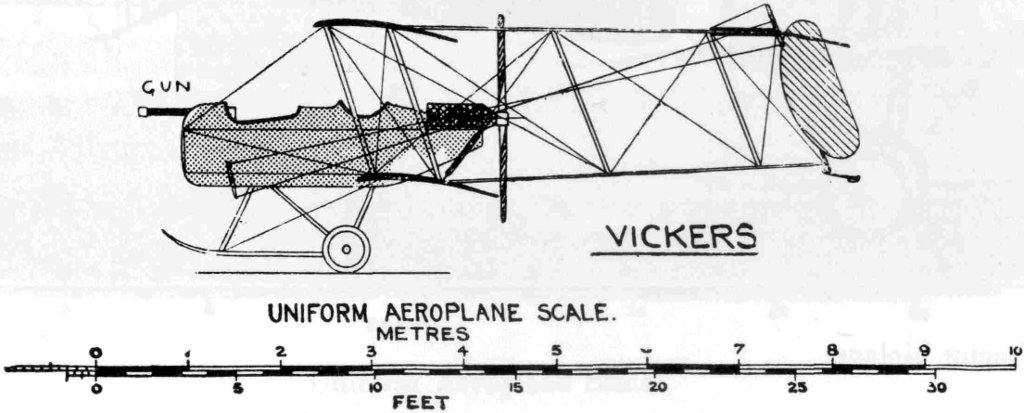
VICKERS. Uniform Aeroplane Scale
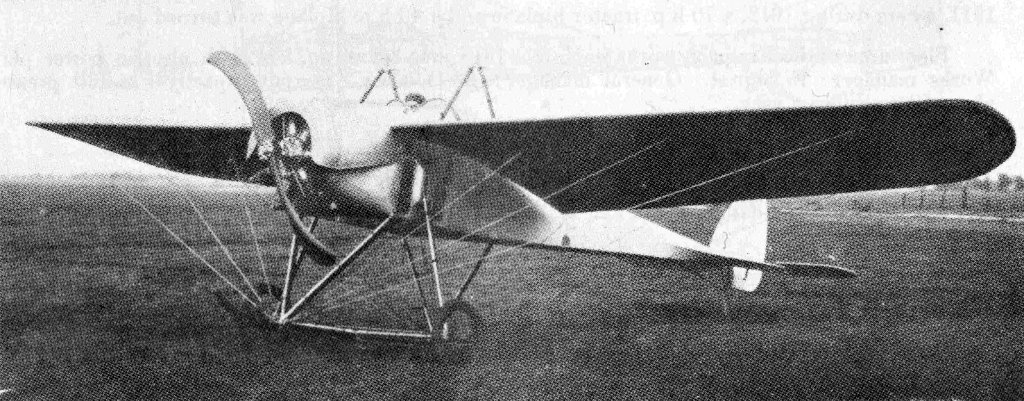
Vickers. Monoplane.
Vickers. Armed biplane.
W
WHITE.
J. Samuel White & Co., Ltd., shipbuilders and engineers, East Cowes, Isle of Wight. London office: 28, Victoria Street, S.W. This well-known firm of torpedo craft builders, etc., formally opened an aviation department on 1st January, 1913, with Howard T. Wright as general manager and designer.
1913. Navy 'plane.
Lengthfeet (m.) 30 (9.15)
Spanfeet (m.) 44 (13.40)
Areasq. feet (m².) 500 (46-1/2)
Weighttotal lbs. (kgs.) 2000 (907)
useful lbs. (kgs.) 650 (295)
Motorh.p. 160 Gnome
Speedmax. m.p.h. (km.) 70 (115)
min. m.p.h. (km.) 35 (57)
Number built ...
Remarks.—Hydro-biplane, with Howard T. Wright patent aeroplanes to give wide range of speed. Two patent hydro floats, 21 feet (m.) long, three steps on each.
Uniform Aeroplane Scale