ITER SEPTIMUM ANTONINI AUG. VII. (continued 2)
Reading edition
A little way out of the city northward, we passed by a Roman camp, called Brill, I suppose Bury hill, in Ogilby’s maps called Beauty’s bank: the Roman road called Stone-street causeway, goes directly north-east from hence through this country, and by Darking church-yard in Surrey; TAB. LXXXII.then falls into the Hermen-street at Woodcote.
St. Roc’s hill is a fine elevation, with a spacious circular camp on the top, of a round form, a castrum æstivum, belonging to Mantantonis. Here is a foundation of a chapel, or a beacon, perhaps both: the reader may gather an idea of the view here from TAB. XLIII.plate 43. At Midhurst is a fine old seat called Cowdrey, belonging to the Browns viscount Montacute: it stands in a valley incompassed with lawns, hills and woods, thrown into a park, the river running underneath. It is a large house of stone, consisting of one court: the hall is cieled of Irish oak after the ancient manner; Mida.the walls painted with architecture by Roberti, the statues by Goupé, the stair-case by Pelegrini: the room at the end of the hall is of Holbein’s painting, where that famous old artist has described the exploits of Henry VIII. before Bulloign, Calais, his landing at Portsmouth, his magnificent entry into London, &c. In the other rooms are many excellent pictures of the ancestors of the family, and other history-painting of Holbein’s, relating to their actions in war. The whole circuit of rooms above stairs are stately and well furnished, adorned with many pictures: there is a long gallery with the twelve apostles as big as the life; another very neat one, wainscotted with Norway oak, where are many ancient whole-length pictures of the family in their proper habits, which is a very elegant notion: there are four history pieces; two copies of Raphael’s marriage of Cupid and Psyche; several old religious and military paintings from Battle-abbey. The road to Midhurst to us appeared Roman, and therefore strengthens the supposition of its being Mida.
St. Roc’s hill is upon the chalky down running east and west: north of it to Farnham it is sandy, full of erica; but the valleys are rich, warm and woody. The heaths between Farnham and Godalmin are full of barrows. Ferndon hill in the way to Godalmin is very steep northwards, and of an hour’s descent; which you rise to insensibly: it runs east and west.
Calleva Atrebatum.
TAB. XLIV. 2d Vol.
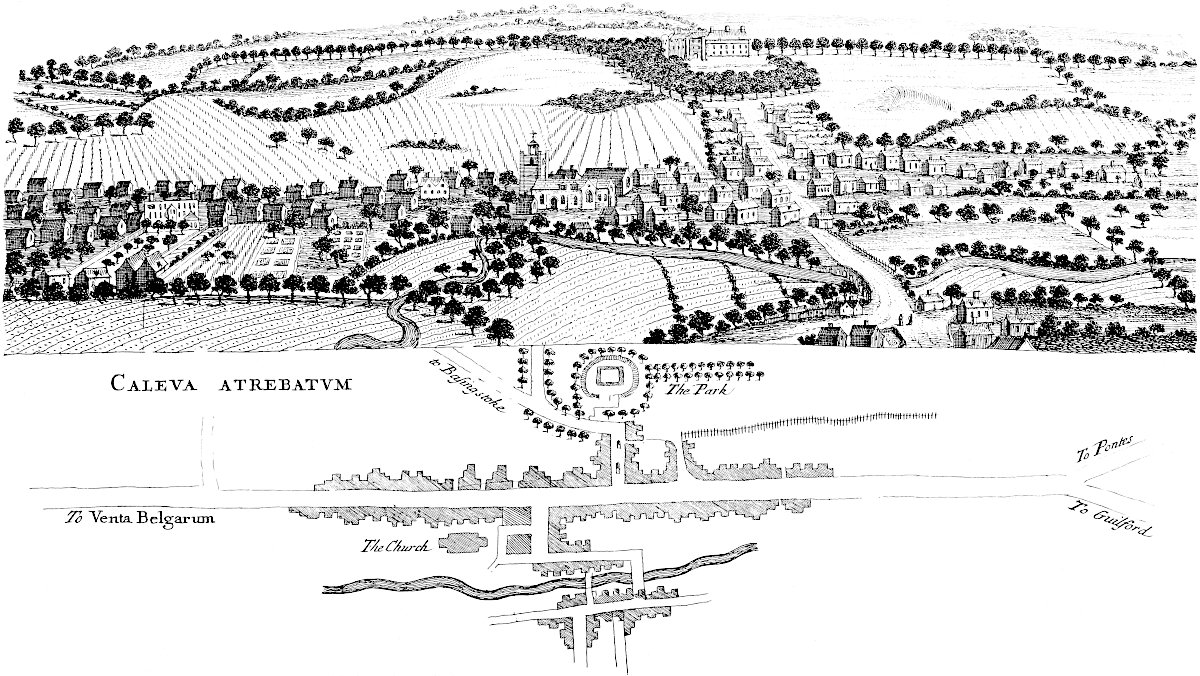
At Farnham is the bishop of Winchester’s palace, a magnificent ancient structure of the castle-form, deeply moted, and strongly walled about, with towers at proper distance: it stands upon the edge of a hill, where is a fine park. One large and broad street of the town, below hill, fronts the castle; the main of the rest of the town consists of a long strait street crossing it at right angles, which is the Roman road coming from Winchester: the river runs parallel to it on the south: this is a fine rich soil with much sand in it, and has an extraordinary propriety for the growth of hops. This place I take to be the Caleva Atrebatum;[140] which because it is a notion of my own advancing, it requires that I should a little enlarge upon it, and propose it to your discerning judgement. This has been hitherto matter of dispute among antiquaries, and I think cannot otherwise be settled than in fixing it at this place: it will make this VIIth journey of Antoninus and some more very clear, that otherwise labour under insuperable difficulties: therefore this I propose to be the true scheme of that journey.
ITER VII. a Regno Londinium M. P. XCVI. sic
Regnum Ringwood
Trausantum Southampton XX
Venta Belgarum Winchester X
Caleva Atrebatum Farnham XXII
Pontes Stanes XXII
Londinium London XXII
———
toto, XCVI.
We have no difference in the copies, but in the sum total at top, which is owing only to a transposition of the letters C and X. therefore all we have to do is to find out the towns; the particular numbers being indisputably right, and rightly cast up in the Suritan edition; and all the places that admit any question, are only Calleva and Pontes, which in this manner mutually prove one another, as being absolutely conformable to geography, and the nearest way one should chuse to go at this day, and having from Southampton a Roman road accompanying all the way. This summer I rode through Winchester and Farnham, through Alresford and Alton, and observed in many places signs sufficient of that nature; though it is horridly out of repair, and even in the midst of summer very bad, notwithstanding such plenty of materials every where to mend it: this has obliged coaches and horsemen frequently to make excursions for their ease and safety. Mr. Aubury likewise pronounces it a Roman road long since in his manuscript collections. Between Farnham and Alton the bank is visible, in several places between Alresford and Alton: the right reverend author of the additions to Camden takes notice of it. The distance is twenty two miles, as in the Itinerary; but to Wallingford, where Mr. Camden places it, it is thirty; to Henley somewhat more: beside, from the one you must cross the Thames three times, from the other twice in the way to London; a thing the Romans would certainly avoid, if possible: but from Farnham by way of Stanes is the direct road, and distances correspondent as before.
44·2d.
Prospect of Farnham Sep: 16. 1723. Caleva atrebatvm
Stukeley del.
E. Kirkall sculp.
Calleva is again mentioned in the XIIIth and XIVth journeys, both which I have already corrected; and they mutually confirm one another, and take away all difficulties when they are considered together. Lastly, Calleva is mentioned in the XVth journey of Antoninus: I shall exhibit it in this form, which I conceive to be its original one. We have cleared all the other parts of it before, where it differs from this in the printed copies.
ITER XV. a Caleva Atrebatum, Iscam Dumnoniorum M. P. CXXXXI. sic
Caleva Atrebatum Farnham
Vindoma Silchester XV
Venta Belgarum Winchester XXI
Brigæ by Broughton XI
Sorbiodunum Old Sarum VIII
Vindogladia Boroston XII
Ibernium Bere regis XIIII
Durnovaria Dorchester IX
Moridunum Seaton XXXVI
Isca Dumnoniorum Excester XV
————
CXXXXI
Perhaps the last X in the sum total was corrupted into a V after the station was dropped out. The first part of it here establishes the site of Calleva in respect to Venta Belgarum; as in the XIIIth and XIVth journeys in respect to Spina; so that it is proved from different points of a triangle, and as it were by mathematical demonstration.
I imagine the occasion of over-sight in this matter is owing to Mr. Camden’s settling the Atrebates in Berkshire; and his authority, no doubt, with every one is of the greatest weight deservedly: yet I suppose his only reason for it is because he thought Wallingford the Calleva Atrebatum, as having some resemblance to his supposed Gallena. In his Roman map he has set these Atrebates partly north of the Thames in Oxfordshire, where himself puts the Ancalites, and partly south, where rightly he fixes the Bibroci in Berkshire: this is in my judgement too far northward. I doubt not but the Bibroci inhabited Berkshire intirely to the Thames, as I proved in a former letter; to which we may add, that if, as he says, this country was called by the Saxons Berrocscyre, there can be no difficulty in asserting the word derived from Bibroci. The Atrebates came undoubtedly from Gallia Belgica, where were a people of the same name upon the sea-coasts; and if we place them here in Surrey about this their capital, they may with some propriety with Mr. Camden be said here in Britain to live over-against their own country, where Ptolemy places them in the maritime parts upon the Sein; but not if he sends them up to the top of the Thames: nor is it probable they should have penetrated so far up the country, even beyond their brethren the Belgæ, by all allowed the most powerful colony of transmarine people at that time. The Segontiaci as well as Bibroci, on this side the Thames, would confessedly oppose such passage; therefore, if we give Sussex to the Regni, we must reserve Surrey for these Atrebates, and Farnham their capital; and this is agreeable to Ptolemy, who places them next the Cantii.
A little without Farnham eastward, the road divides into two branches with an acute angle: one goes to Guildford and Darking, where it meets the Stane-street coming from Chichester; the other to Stanes, which I prosecuted to Farnborow, probably a station or inn, or camp to secure the road over this wild country; for it is deep sand from Farnham to Egham: but where in particular the Roman road went is not easy to define, because of the extraordinary sandiness of the whole country:[141] but at Frimley, near here, about sixteen year ago, an urn with Roman coins and intaglia’s was found: Mr. Titchburn had them. This is directly in the way to Farnbarow. I suppose there was a Roman way from Silchester through Stretley, Hartley row, Harford bridge, which signifies trajectus militaris, but from the mooryness of the soil is quite worn away. I take this road to be a continuation of that coming from the Bath by Marlborough;[142] but at Stanes I saw our road very evidently go through the fields west of the bridge, and directly over-against it;TAB. LVI. for it must be understood that the Romans drew a road, as I said before, under the Icening-street, and parallel to it, which went from Regnum to London. This is what we have been upon, and composes this VIIth Iter: From thence it passed through Colchester to the sea-coasts of Suffolk. Now between Stanes and London it is notorious, being the common road at present, till you come to Turnham green:[143] there the present road through Hammersmith and Kensington leaves it; for it passes more northward upon the common, where to a discerning eye the trace of it is manifest; then it goes over a little brook called from it Stanford-bridge, and comes into the Acton road at a common, and a bridge, a little west of Camden house, so along Hyde-park wall, and crosses the Watling-street at Tyburn, then along Oxford-road. But of this part of it, going to Old-street, north of London, I spoke before.
84
Prospect of Stanes Sept. 16. 1723. Pontes 16 Sep. 1723.
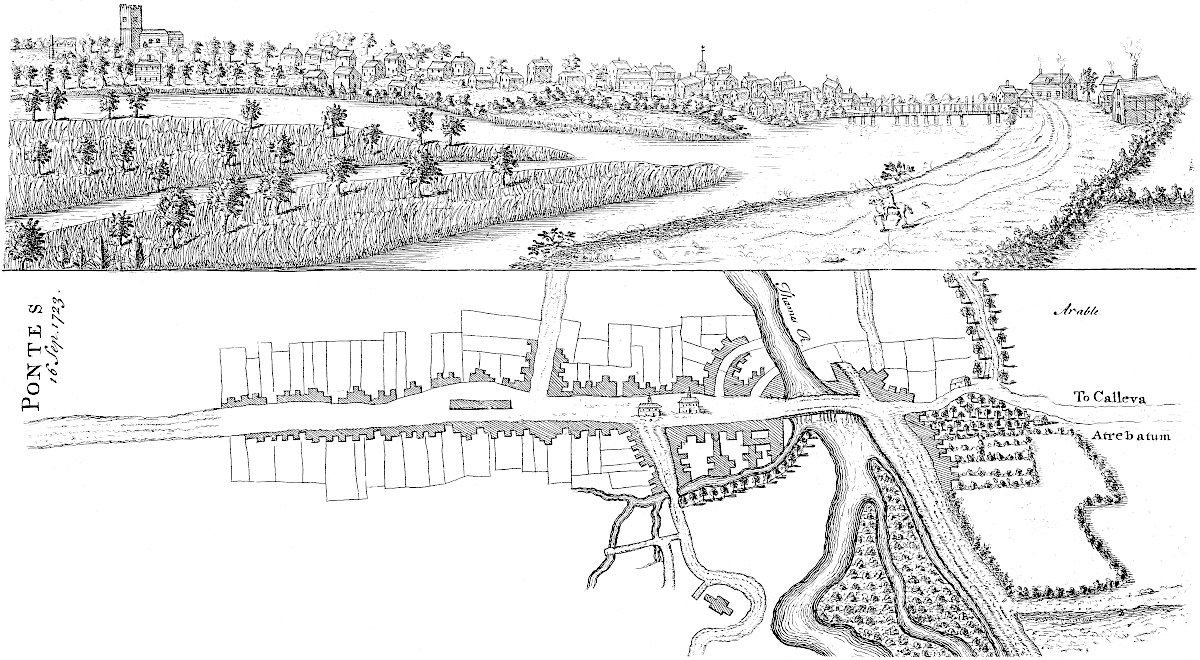
Between Oxford-street and Stanes, this Roman road was originally drawn through Brentford, which undoubtedly was a mansion between them; and this is a very strait line: I rode the broken part of it between Acton road and Turnham green: it is still a narrow strait way, keeping its original direction, but full of dangerous sloughs, being a clayey soil and never repaired: it butts full upon Stanes bridge, and then beyond it passes forward in a strait line through gardens and yards into the corn-fields, where its ridge is still left, the highest part of all the field, though they plough close to it on both sides; and it is now a road for three quarters of a mile; then it enters a narrow lane, and at last degenerates into a foot-path toward Thorp-lea, in the way to Farnham; the common road leaving it all this while in the way to Egham. So that undoubtedly Stanes was the Pontes.Pontes of Antoninus;[144] the distances of 22 miles on both sides answering the fact, and the TAB. LXXXIV.Itinerary; with which I shall at present conclude mine in the words of the poet,
Hic labor extremus, longarum hæc meta viarum.Virg. Æn. III.