ITER ROMANUM. V. (continued 2)
Reading edition
In Snarford church some fine monuments, in alabaster, of the family of St. Paul’s. Return we now to Lindum.
Sol medium cœli conscenderat igneus orbem Cum muros arcemque procul & rara domorum Tecta vides, modo quæ Romana potentia cœlo Æquavit————Virg. Æ. viii.
A mile north upon the Foss is a tumulus of hard stone, called the Castle.
From hence I determined to proceed to London all the way on the Roman road, which perhaps has not been so scrupulously travelled upon for this thousand years: the intent, which I executed, was to perform the whole sixth journey in Antoninus his Itinerary; of which I shall give as complete an account as can be expected, considering how totally most of the stations here are erased, and that I was resolved so far to imitate an ancient traveller, as to dine and lie at a Roman town all the way if possible, and sometimes in danger of faring as meanly as a Roman soldier: nor could I always readily say,
Longum iter hic nobis minuit mutatio crebra, Mansio sub noctem claudit ubique diem.
Add to this, that the whole was new to me; that I had almost every place to find out; that I was alone, and had no other guide than what Mr. Gale has pointed out to us, who is the first that hit upon the true notion of this road: and I doubt not but the reader’s candour will overlook the errors or imperfections of this simple narration, of what I could observe myself, and fish out from the uncouth relations of the country people, who, for one half of the way, had never heard of enquiries of this sort since any memory, and were too apt to be morose upon that occasion, thinking I had some design upon their farms in my inquisitiveness.
20·2d.
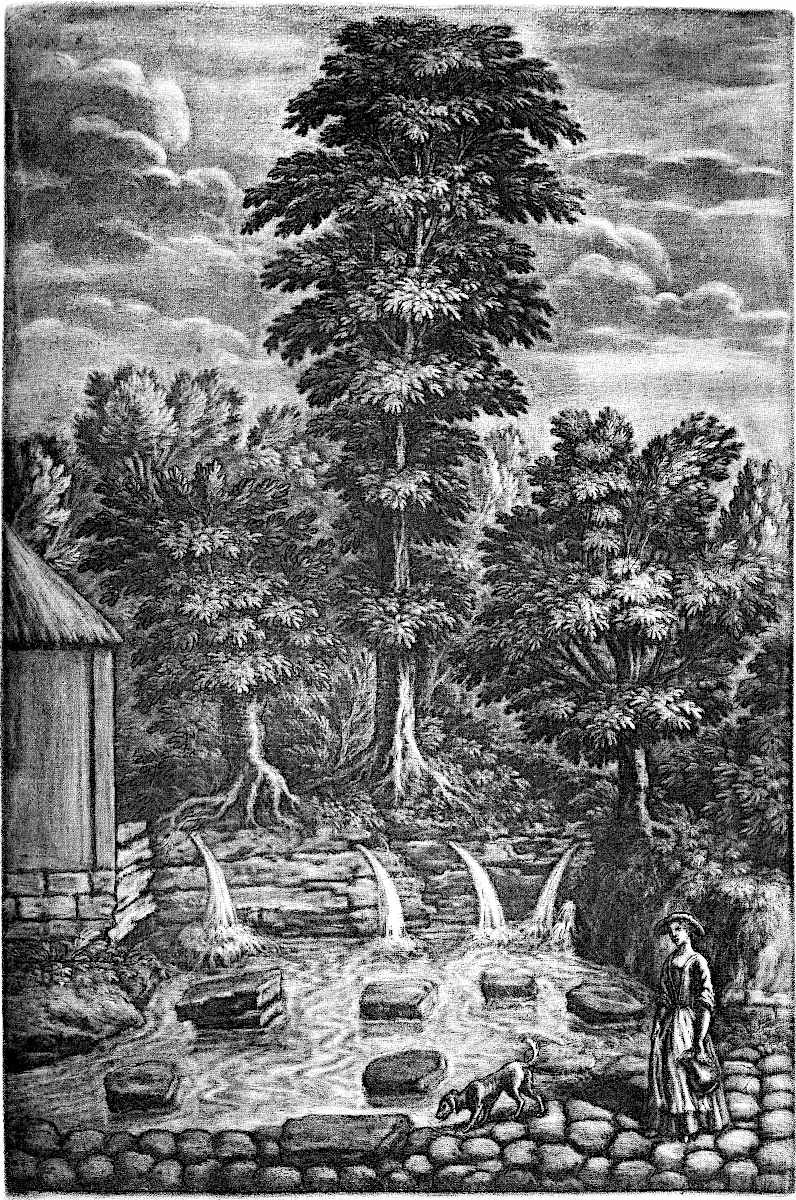
Syfer Spring at Caster in Lincolnshr. July 26. 1724. (a Roman Work.)
Stukeley delin.
E. Kirkall fe.
21·2d.
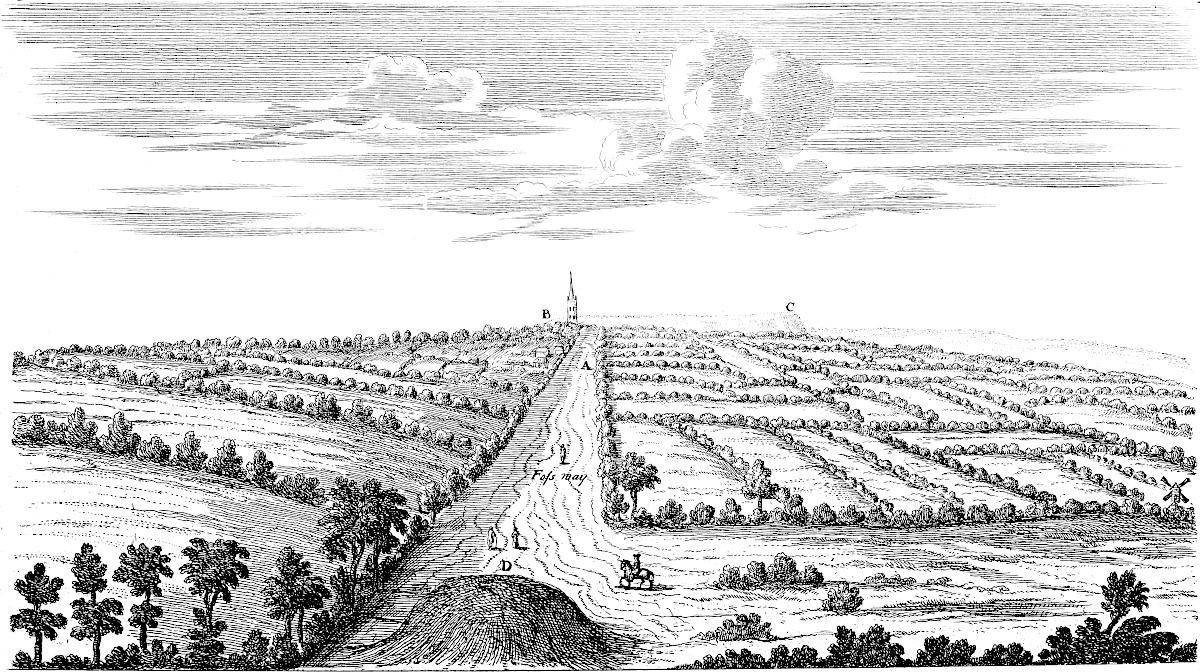
Prospect of Crocolana from Potter hill. Sept. 7. 1722. A. Brough the Roman City. B. Newark. C. the cliff by the Trent. D. Potter hill.
Stukeley delin.
E. Kirkall sculp.
ThisFoss road. journey proceeds from Lincoln upon the great Foss road, as it tends to the Bath quite through Nottinghamshire and Leicestershire (but most terribly defaced) till it meets with and crosses (having gone sixty miles) the great Watling-street coming from Chester, and going to Dover, at High-cross in Warwickshire: hence to London, about ninety miles more, I went upon this Watling-street, which completes that journey of the Itinerary.
I apprehend the Foss is the name transmitted through the British, which comes from digging, as being an artificial road; whence they are often called dikes, a word of contrary significations, as the Latin altus.[89] Descending southwards, where the Foss parts with the Hermen-street below Lincoln, by the abbey without the most southern gate, and passing over the river Witham by Bracebridge, before it comes to Lincoln; I soon perceived myself upon the Foss road, by its strait ridge carried over the barren moory ground, by a mill near Stickham. Hard by lies a stone cross of good height, of one piece, vulgarly called Robin Hood’s Whetstone upon the Foss, and is called sometimes the three-mile stone. The elevation of the road is still preserved, the common road going round about: it is much overgrown with goss, and the moor but thinly so; its strait length easily distinguishable for that reason: it butts a good deal to the east of Lincoln. Between Bracebridge and its union with the Hermen way, some pavement is left of flag-stone set edgewise: the road beyond the moor goes through the inclosures of Hikeham and Thorp, then enters Morton lane, very pleasantly set on both sides with woods full of game.[90] And so journeying to the space of about twelve Roman miles, I found Collingham on my right hand: there is a high barrow or tumulus called Potters hill, where they say was a Roman pottery: it stands upon an eminence commanding a prospect both ways upon the road. Half a mile farther is Brough, the undoubted Crocolana.Crocolana of the Romans: it is three miles North of Newark. Great plenty of wild Saffron grows hereabouts; whence I once thought the name came, signifying the saffron field, from the Celtic word, a field or inclosure (lhan.)TAB. XXI. 2d Vol. In the later times of the empire, when they shortened words, it was called Colana; and some critic restoring Croco to it, doubled the second syllable; whence it is found in Antoninus his Itinerary, Crococolanum: but I judge Mr. Baxter’s derivation of it is right, ericetum pulchrum: the ground is very woody and pleasant, and full of goss or heath, in Welsh grûg. From Colana, Collinghams, two miles off, probably had their name,[91] springing up from its ruins, as well as Newark, the Saxons approaching nearer the water side; the Trent and the Foss road being neglected, which supported the Roman town by travellers chiefly. Collinghams stand upon a mere or rivulet, abounding with springs called the Fleet, running into the Trent. The lands at Collingham belong to Peterborough church; probably the gift of some king:[92] they have a report, that one arch of South Collingham church came from Brough, which is probably true of the whole: they say Collingham was a market-town before Newark; and that Brough was a famous place in time of the Danes, who destroyed it in Edmund Ironside’s days. Danethorp is hard by, the seat lately of lady Grey.
At Brough no Roman token visible, but the remarkable straitness of all the roads and by-lanes thereabouts: the city has been most perfectly levelled by the plough, so that the mark of ridge and furrow remains in the very road: the hedge-rows were planted since. Were it not for many distinguishing tokens, one may be apt to conclude as Floras did, laborat annalium fides ut Veios fuisse credamus. They say here was a church upon a place called chapel-yard, and a font was once taken up there. The old landlady at the little ale-house, which is the only house there, till Thomas Cope’s and another were lately built, says, that where her fire-place is, the cross once stood; and that the whole is fairy ground, and very lucky to live on. There have been many Roman coins dug up here, and all the way between it and Newark:[93] I bought a large brass Faustina junior, lately found in the corn-field over-against the ale-house: in digging too they find great foundations, for half a mile together, on each side the road, with much rusty iron, iron ore and iron cinders; so that it is probable here was an eminent Roman forge. Across the road was a vast foundation of a wall, and part still remains: out of one hole they showed me, has been dug up ten or fifteen load of stone; so that it should seem to have been a gate: the stones at the foundation are observed to be placed edgewise, and very large ones, but not of a good sort: this was the method the Romans justly thought most convenient, in this springy soil; for the springs rise here, all about, within two foot of the surface. They told me some very large copper Roman coins have been found here, and silver too, and many pots, urns, bricks, &c. they call the money Brough pennies. The earl of Stanford is lord of the manor, and all is copy-hold, probably originally in the crown. The country people have a notion that the Foss road is the oldest in England, and that it was made by William the Conqueror. This is all that I could learn of this city, which I thought no contemptible gleaning from the shipwreck of time; for
Jam seges est ubi Troja fuit——
is true of all the stations of this whole journey, more or less; and I was glad when any part of the harvest might be applied to the gathering of antiquities. From hence the road goes extremely strait to Newark between hedge-rows, having the steeple before us as a visto: but, much to their disgrace, it is in very ill repair; nay, in some places they dig the very stone and gravel out of it to mend their streets.
Newark.
Newark was certainly raised from the neighbouring Roman cities, and has been walled about with their remains: the northern and eastern gate, still left, are composed of stones seemingly of a Roman cut; and not improbably the Romans themselves had a town here; for many antiquities are found round about it,[94] especially by the Foss side, which runs quite through the town. My friend the reverend Mr. Warburton, of this place, gave me a coin or two dug up here; and likewise this further information, that lately a gentleman (Mr. Holden) digging to plant some trees by the Foss road side, discovered four urns lying in a strait line, and at equal distances: they were soon broke in pieces by the workmen, imagining to find treasure therein: in one there was only a rude piece of brass, about the bulk of a small walnut, half melted down, with a bit of bone and some of the ashes sticking in the surface thereof, amidst the other burnt bones and ashes: he conjectured that it was a fibula belonging to the habit of the dead: there were square earthen beads in others, which seem to be British: in another was a small brass lar about an inch and half long, but much consumed by rust: he told me likewise a pot of Roman money was found at Carlton-scrope near them. There are two fine stone crosses at Newark: the market-place is a spacious square: the church is very large and handsome, with a very high steeple.[95]
90
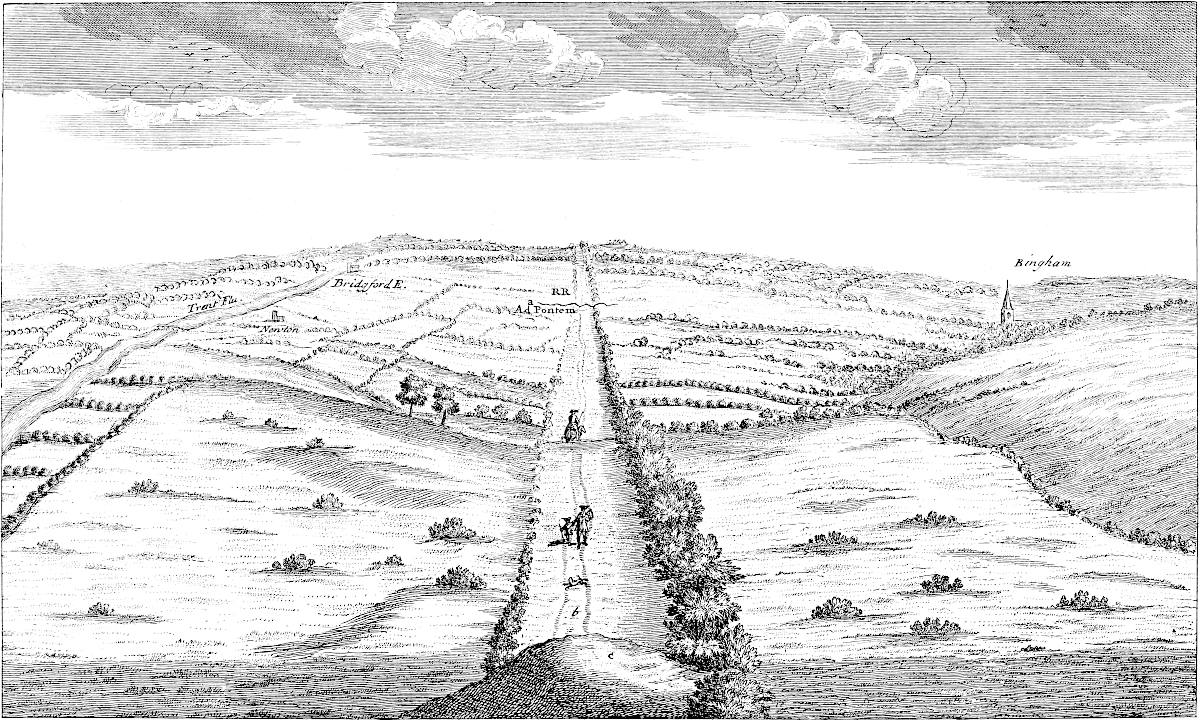
A Prospect of Ad Pontem upon the Eminence. A Mile South on the Foss. Sep. 7. 1722.
W. Stukeley delin.
E. Kirkall sculp.
a. Old work Spring. b. the Foss c. a Tumulus RR. the Roman City.
From Newark the Foss passes by Queen’s Sconce, one of the great forts erected in the civil wars, and so along the Trent side by Stoke, famous for a battle, and an inn called the Red inn. We arrived, at about six miles distance south of Newark, to the station of the Romans called Ad Pontem.Ad pontem. East Bridgford lies near a mile to the right upon the river Trent:TAB. XC. doubtless there was the bridge over the river, which created the denomination, in the Roman times, as being the passage from the eastern parts to those beyond the Trent: and as to this particular station upon the road, perhaps a bridge was the sign of the inn, that travellers might know where to turn out for that purpose, for I cannot suppose here was a bridge at the road. At Bridgford they told us there were formerly great buildings and cellars on the right as you descend to the Trent, and a quay upon the river for vessels to unlade at.[96] The Roman station upon the Foss I found to be called Boroughfield, west of the road: here a spring arises under the hedge, called Oldwork spring, very quick, running over a fine gravel; the only one hereabouts that falls eastward, not directly into the neighbouring Trent, towards Newton. Hereabouts I saw the Roman foundations of walls, and floors of houses, composed after the manner before spoken, of stones set edgewise in clay, and liquid mortar run upon them: there are likewise short oaken posts or piles at proper intervals, some whereof I pulled up with my own hands. Dr. Batteley tells us of oak very firm, found at Reculver, under the Roman cisterns: the earth all around looks very black: they told us that frequently the stones were laid upon a bed of pease-straw and rush-rope or twisted hay, which remained very perfect. Houses stood all along upon the Foss, whose foundations have been dug up, and carried to the neighbouring villages. They told us too of a most famous pavement near the Foss way: close by, in a pasture, Castle-hill close, has been a great building, which they say was carried all to Newark. John Green of Bridgeford, aged 80, told me that he has taken up large foundations there, much ancient coin, and small earthen pipes for water: his father, aged near 100, took up many pipes fourscore yards off the castle, and much fine free-stone: some well cut and carved: there have been found many urns, pots, and Roman bricks; but the people preserved none of them; and some that had coins would by no means let us see them, for fear we were come from the lord of the manor. About a mile farther is a tumulus upon an eminence of the road beyond Bingham lane, a fine prospect to Belvoir castle, Nottingham, the Trent, &c. whence I took a small sketch of the road we had passed, regretting the oblivion of so many famous antiquities.
In my journey forwards, upon the declension of a stiff clayey hill, near the lodge upon the wolds, an inn under a great wood. The pavement upon the road is very manifest, of great blue flag-stones laid edgewise very carefully: the quarries whence they took them are by the side of the hill: this pavement is a hundred foot broad, or more; but all the way thence it has been intirely paved with red flints, seemingly brought from the sea-coasts: these are laid, with the smoothest face upwards, upon a bed of gravel over the clayey marl, which reaches beyond Margidunum; that we may well say,
O quantæ pariter manus laborant! Hi cædunt nemus, exuuntque montes. Hi ferro scopulos trabesque cædunt, &c.Stat. Sylv. iv.
This pavement is very broad, and visible where not covered with dirt, and especially in the frequent breaches thereof. They preserve a report still, that it was thus paved all the way from Newark to Leicester, and that the Foss way went through Leicester shambles: the yard of the lodge in the wold is paved with these same stones plundered from the road. June 15, 1728, Mr. L. Hurst, of Grantham, told me he saw at Mr. Gascoign’s, a goldsmith in Newark, a large gold ring weighing 42s. lately brought him by a countryman, which he found upon the Foss-way. There was a seal upon the gold; a fox (he thought) engraved under a tree. Afterward I bought the seal: it is a wolf under a tree. Perhaps Norman. AD PONTEM.
Margidvnvm.
TAB. XCI.
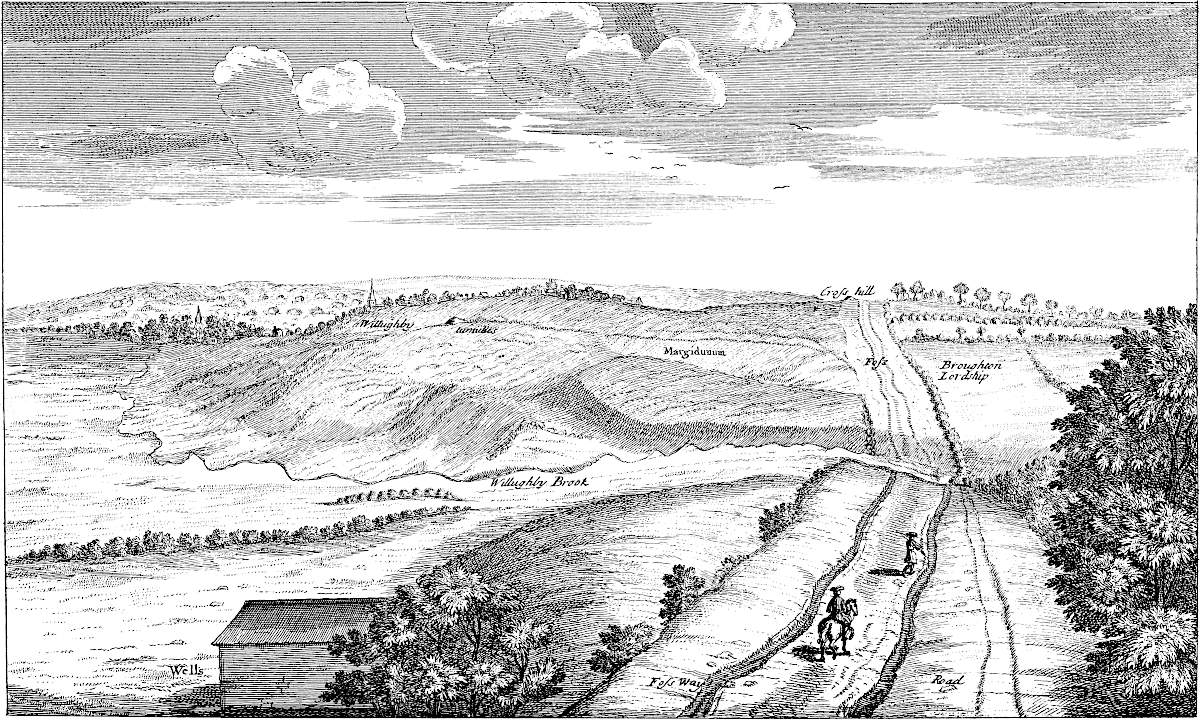
Willughby brook is the next water. When arrived over-against Willughby on the wold on the right, Upper and Nether Broughton on the left, you find a tumulus on Willughby side of the road, famous among the country people: it is called Cross hill: upon this they have an anniversary festival: the road parts the two lordships; but the name of Broughton set me to work to find the Roman town, among the people getting in harvest. After some time I perceived I was upon the spot, being a field called Henings, by which I suppose is meant the ancient meadows: this is upon the brow of the hill overlooking Willughby brook, rising in Dalby lordship, and playing in pretty meanders along a valley between corn-fields, with a moderate water unless raised by rains. Here they said had been an old city, called Long Billington: it is often called the Black field in common discourse, from the colour and excessive richness of the soil, so that they never lay any manure upon it. Here is a place called Thieves, and on the other side of the valley a place called Wells, near where now a barn stands: and all this length they say the city reached, and that there was a church on the top of Wells; but the city was mostly on Willughby side; for the land on the other side in Broughton lordship is poor, whilst this is luxuriant to the last degree; so that a farmer once happening to set his sheep-fold here, it rotted the corn upon the spot; and often he has been forced to mow the blade before it spindled (in their way of talking.) The soil is perfectly black, though all the circumjacent land be red, especially north of the valley upon the edge of the hill, and where most antiquities are found; which certainly was the true place, whence the Roman name, signifying a marly hill. Richard Cooper, aged 72, has found many brass and silver coins here: there have been some of gold. They have a notion of great riches being under ground, and a vulgar report that one balk, or mere, (i. e. a division between the ploughed fields) has as much money under it, as would purchase the whole lordship: but people have been frighted from digging it by spirits; and several pleasant stories are told thereupon. They have likewise a tradition that the city was destroyed by thieves, perhaps from the place so called. Many Mosaic pavements have been dug up: my landlord Gee of Willughby says, he has upon ploughing met with such for five yards together, as likewise coins, pot-hooks, fire-shovels and the like utensils, and many large brass coins, which they took for weights, ounces and half-ounces, but upon trial found them somewhat less. Broad stones and foundations are frequent upon the side of the Foss: several found at Wells. The ground naturally is so stiff a marl, that at Willughby town they pave their yards with stones, fetched from the Foss way even to the slope of their pits, for the cattle to drink at. At Over and Nether Broughton, and Willughby too, the coins are so frequent, that you hear of them all the country round. There is a fine prospect from Wells hill every way, whence I drew a little view of the place.TAB. XI. In Willughby town is a handsome cross of one stone, five yards long: in the time of the reforming rebellion the soldiers had tied ropes about it to pull it down; but the vicar persuaded them to commute for some strong beer, having made an harangue to show the innocence thereof. Richard Cooper likewise told me of a pot of Roman money found at Wilford near Nottingham.
91
Prospect of Margidunum from Wells hill by ye Barn upon Foss Sept. 8. 1722. Nobilissimo Principi Duci Kingstoniæ &c.
W. Stukeley delin.
E. Kirkall sculp.
To face Nether Broughton
11
CROSSES
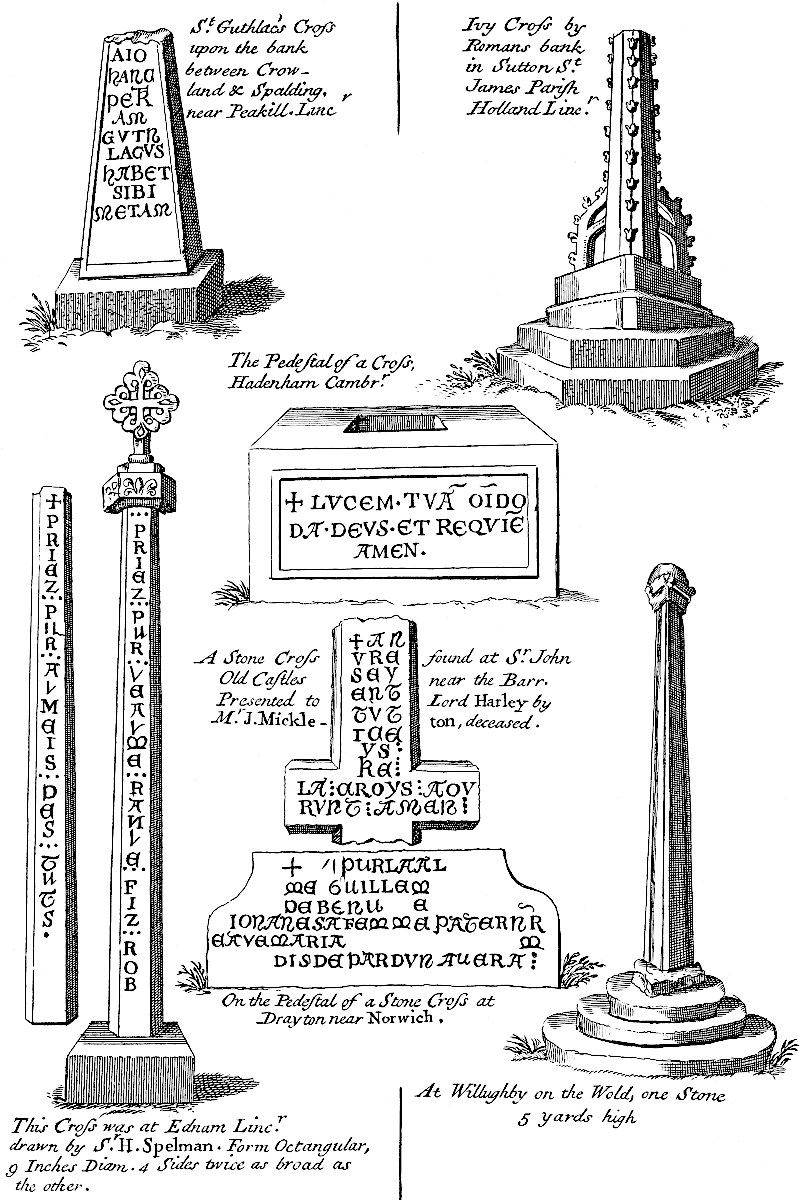
Stukeley delin.
E. Kirkall sculp.
See transcription
So much for Margidunum, of which we may say,
Nunc passim vix relliquias vix nomina servans.
In passing forwards towards Leicester, between here and the river Wrek, I found the Foss road began to be very obscure, not only where it has been ploughed up in some places, but where it goes over a grassy common: the reason is, travellers have quite worn it away, because of the badness of the roads; and the negligence of the people so far from repairing it, that they take away the materials. Moreover, you are oft in danger of losing it through the many intersections of cross roads; and sometimes it is inclosed with pastures, or passes under the sides of a wood: therefore upon every hill-top I made an observation of some remarkable object on the opposite high ground, which continued the right line; so that by going strait forwards I never failed of meeting it again. I observed too, that at such a time of the day exactly, the sun was perpendicular to the road; for it continues the same bearing throughout: this I tried by the compass soon after I left Lincoln, and when I came to High-cross, where it crosses the Watling-street, and at intermediate places; finding it always butted upon the same degree, to surprising exactness. At Abketilby in the vale of Belvoir, and thereabouts, in the quarries is a vein of rag-stone wholly made of shells, covered with a thin vein of good hewing stone: this is in one corner of that great vale, under the Lincolnshire Alpes.
Shipley-Hill Br barrow.
At Cossington (just before I came to the river Wrek, parting the counties) is a vast barrow, 350 foot long, 120 broad, 40 high or near it: it is very handsomely worked up on the sides, and very steep: it seems to have lost some of its length at both ends, especially the northern, a torrent running close by: it stands exactly north and south, upon the very edge of the ings; and in wet times it must be almost incompassed with water: they call it Shipley hill, and say a great captain called Shipley was buried there. I doubt not but this is of great antiquity, and Celtic, and that the intent of it is rightly preserved by the country people; but as to the name of him I can say nothing. On the top are several oblong double trenches cut in the turf, where the lads and lasses of the adjacent villages meet upon Easter-Monday yearly, to be merry with cakes and ale. I observed upon the Foss, all along, that in almost every parish were such like tables, for the same purpose; and such a one I formerly found at Rowldrich stones in Oxfordshire. Near this place, at Radcliff, so called from the road, it seems that the Foss road passes over this brook, and filling up its cavity, made it necessary to cut a new channel, that the road might run strait, and like the Roman terminus give place to nothing. Having passed the river, it proceeds over the meadows: just beyond them is a large round tumulus, which I suppose Roman: then the road goes strait through Thumarton, and ends full upon the east gate of Leicester. But before we speak of this station, we must with the Itinerary make an excursion to take in Vernometum.
Vernometum.
TAB. XXII 2d Vol.
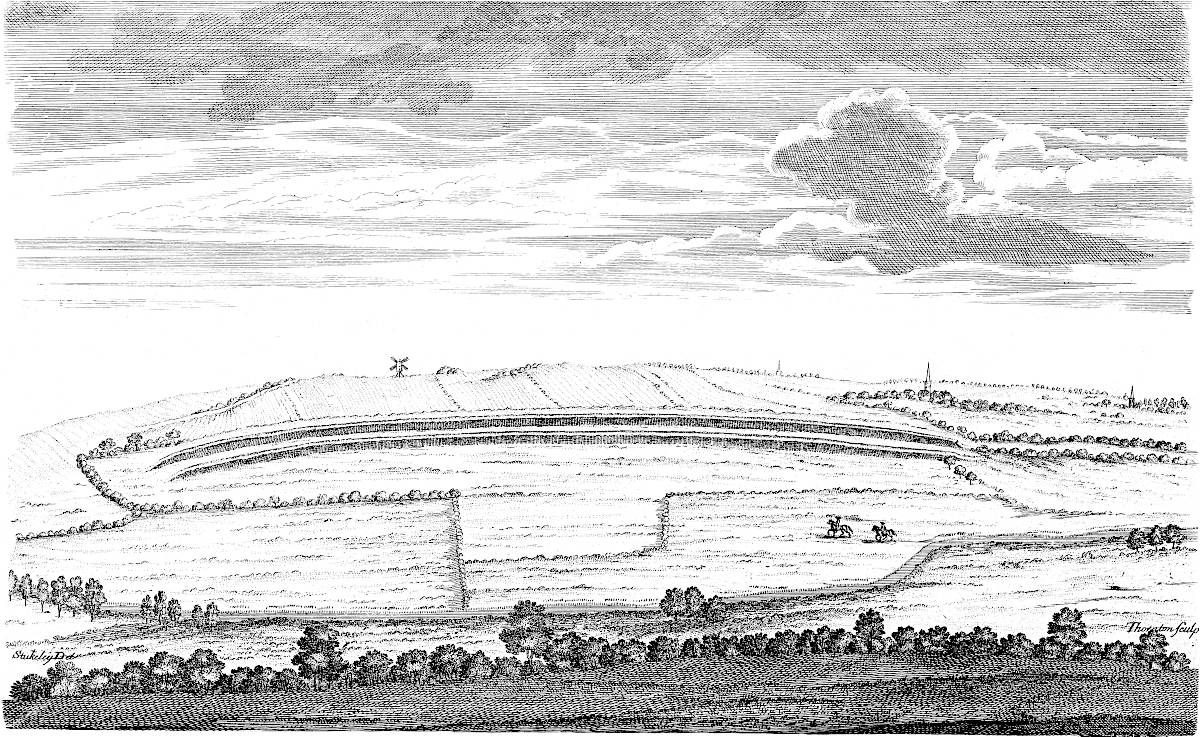
There seems to be no Roman way between Ratæ and Vernometum;[97] but coming from Margidunum, you turn out of the road by Sison over-against Radcliffe before mentioned. This place is Borough, or Erdborough, i. e. the earthy camp, in Gartre hundred east of Leicester. It is a very great Roman camp upon a very high hill, the north-west tip of a ridge of hills, and higher than any other part of it, of a most delightful and extensive prospect, reaching as far as Lincoln one way: the fortification takes in the whole summit of the hill; the high rampire is partly composed of vast loose stones piled up and covered with turf: it is of an irregular figure, humouring the form of the ground, nearly a square, and conformed to the quarters of the heavens: its length lies east and west, the narrowest end eastward: it is about 800 foot long, and for the most part there is a ditch besides the rampire, to render the ascent still more difficult to assailants: the entrance is south-west at a corner from a narrow ridge: here two rampires advance inwards, like the sides of a gate, for greater strength: within is a rising hill about the middle, and they say that vaults have been found thereabouts. Antiquarians talk of a temple, which possibly may have been there, and in the time of the Britons: thus the old Fanum of Apollo at Delphos was in a concavity on the top of a hill. The name of Vernometum signifies a sacred plain, as they tell us from authority. It contains about sixteen acres: several springs rise from under the hill on all sides, and I observed the rock thereof is composed intirely of sea-shells: they frequently carry away the stones that form the rampires, to mend the roads with. The town itself is now but a small village. There is another Roman castle southward near Tilton, but not so big as Borough hill: a petrifying spring near it, and a Roman road, as thought, called Long Hedges. I am not without suspicion that the true name is Verometum, and must be sought for somewhere near a river.
Ratæ Coritanorum.
TAB. XCII.
Leicester is the Ratæ Coritanorum of the Romans. The trace of the Roman wall quite round is discoverable without difficulty, especially in the gardens about Senvy gate: there was a ditch on the outside, very visible in the gardens thereabouts: it is 2500 Roman feet long, and as much broad towards the south-east, 2000 Roman feet broad to the north-west: this was repaired by Edelfleda, a noble Saxon lady, anno 914. but the stories in Mr. Camden, of the piles it stood on, and the indissoluble tenacity of the mortar, seem meant of the Roman work. The streets run in the manner we observed of Camboritum, the length of the city being from north-west to south-east. There is a Roman musive pavement in a cellar, in part remaining, of a person standing by a deer, Cupid drawing his bow, delineated in differently-coloured small stones as usual.[98] The old work called Jewry wall is composed of rag-stone and Roman brick:TAB. LV. several fragments and foundations are in all the houses hereabouts of this building, whatever it were, as well as in the adjacent church,TAB. XXIII. 2d Vol. which seems to be built in the very area of it, and out of its ruins. Not far off is a place called Holy Bones, where abundance of bones of oxen have been dug up, the exuvia of their sacrifices: this is however a most noble piece of Roman antiquity, and I lament it should be so much abused. Many Roman coins are found at Leicester: at the entrance into White Friers a pot full dug up about five years ago, and many great foundations. At St. Mary de Pree’s abbey they dug up a body, about three years ago, which they supposed to be cardinal Wolsey’s: in this abbey is nought worth seeing, but a pleasant terrace-walk, supported by an embattled wall, with lunettes hanging over the river and shadowed with trees. The little remains of the old building are new modelled by later hands, and scarce to be distinguished: it was made a dwelling-house since the Dissolution; and that is now spoiled of floors, roof, and windows; and the naked walls are left to daily ruin and pillage: the spot of the abbey is turned into a garden: they show us a place in it, where has been much search for the famous cardinal’s body; but it did not seem to me a likely place. The church, though wholly erased, did not probably come out so far toward the river: indeed there is thorough work made of all the religious houses at Leicester, and scarce one stone left in its original site. St. Margaret’s church was a bishop’s see in the time of the Saxon kings. Within the castle is a collegiate hospital, founded by Henry earl of Lancaster, who with his son Henry duke of Lancaster lie buried in the chapel: the church was very fine, demolished in the Suppression. Here, say some, was buried Richard III. this castle was built by Simon de Montfort. There is a very pretty arch reaching across the river, called Bowbridge, at Black Friers, under which they have a notion that king Richard III. was buried; which seems to allude to the British romance that tells of king Lear being buried here. Half a mile southward from Leicester, upon the edge of the meadows is a long ditch called Rawdikes:Rawdikes a Br. cursus. upon view of the place I found it to be a British cursus. King Charles I. when besieging Leicester, lay at the vicarage-house at Elston;TAB. XXIV. XXV. XXVI. XXVII. 2d Vol. and during the storm of the town, when his men took and pillaged it, he stood, as they report, upon the banks of this Rawdikes. About February 1721–2. a tesselated pavement was found the other side the river, about Wanlip, with coins of Constantine, broken urns, a human scull, &c. a foundation by it, doubtless of the house that covered it.
Prospect of Burrow hill from the Leicester road. Sept. 8. 1722. Vernometvm.
Key found at Burrow Hill T. Lyus Delin. from Revd. G Ashby’s Museolum at Barrow Suffolk. 1791
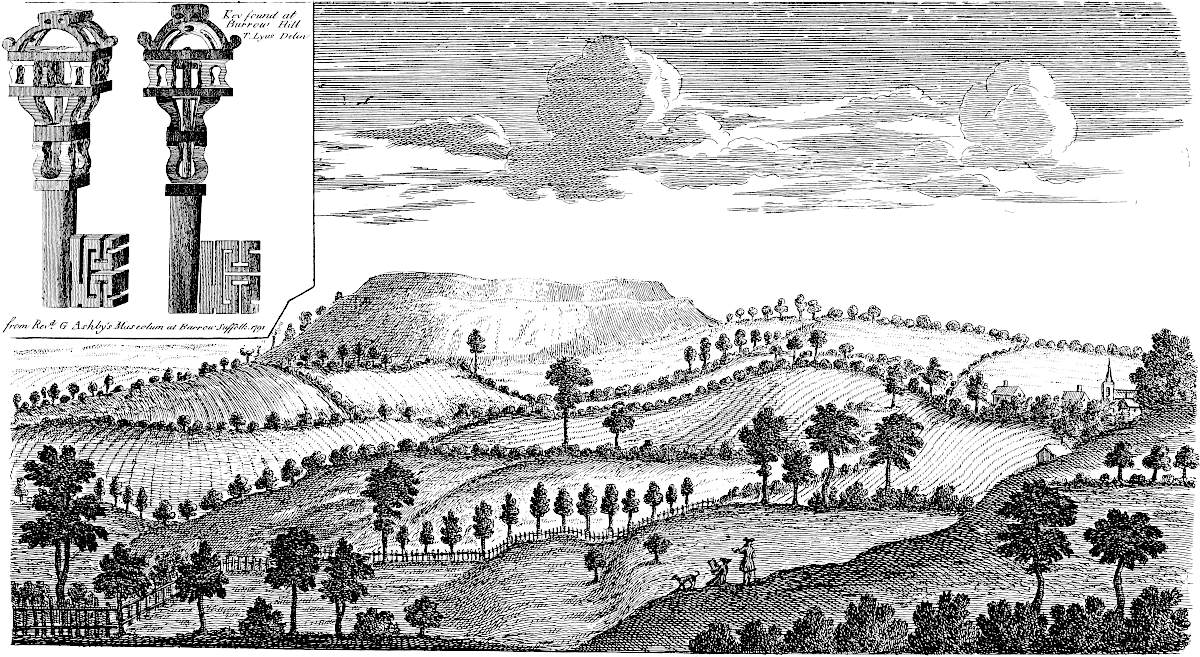
Stukeley delin.
E. Kirkall sculp.
Willo: Cheselden Chirurgo peritissimo, Amico Tab. dd. W. Stukeley.
92
RATÆ Coritanorum. 8. Sep. 1722.
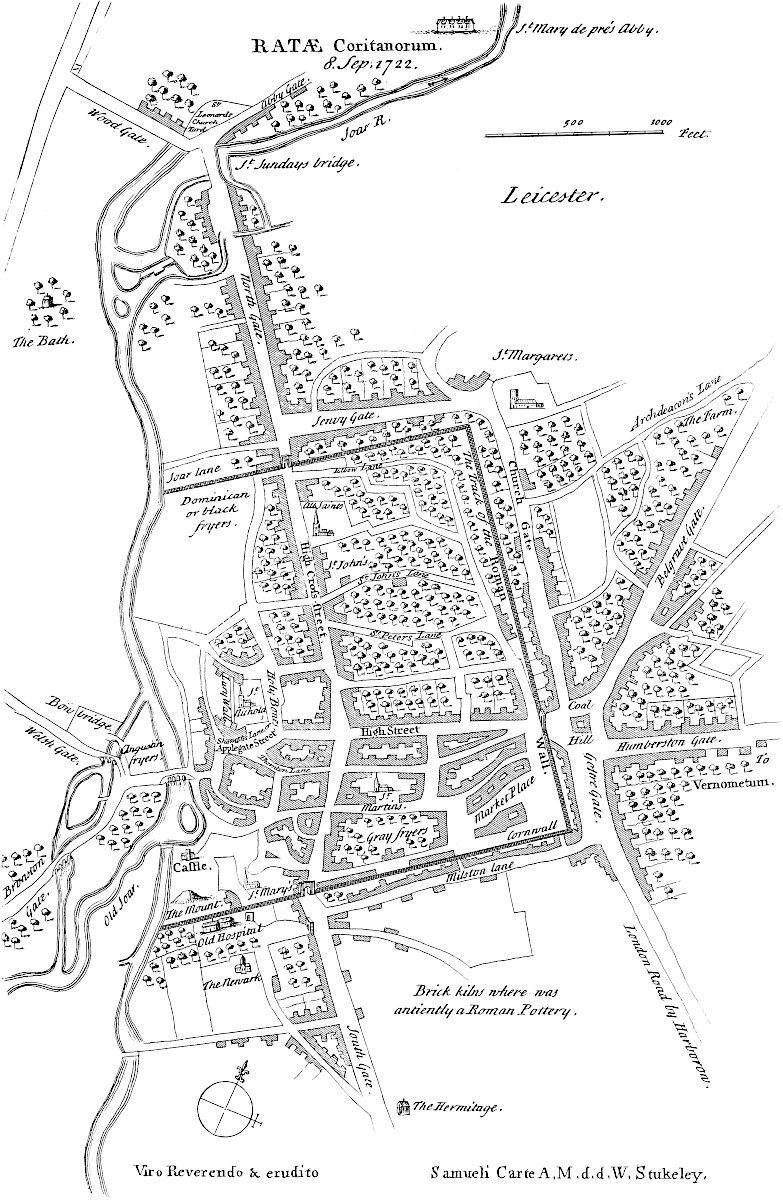
Stukeley delin.
55
The Roman Building commonly called the Temple of Janus at Leicester.
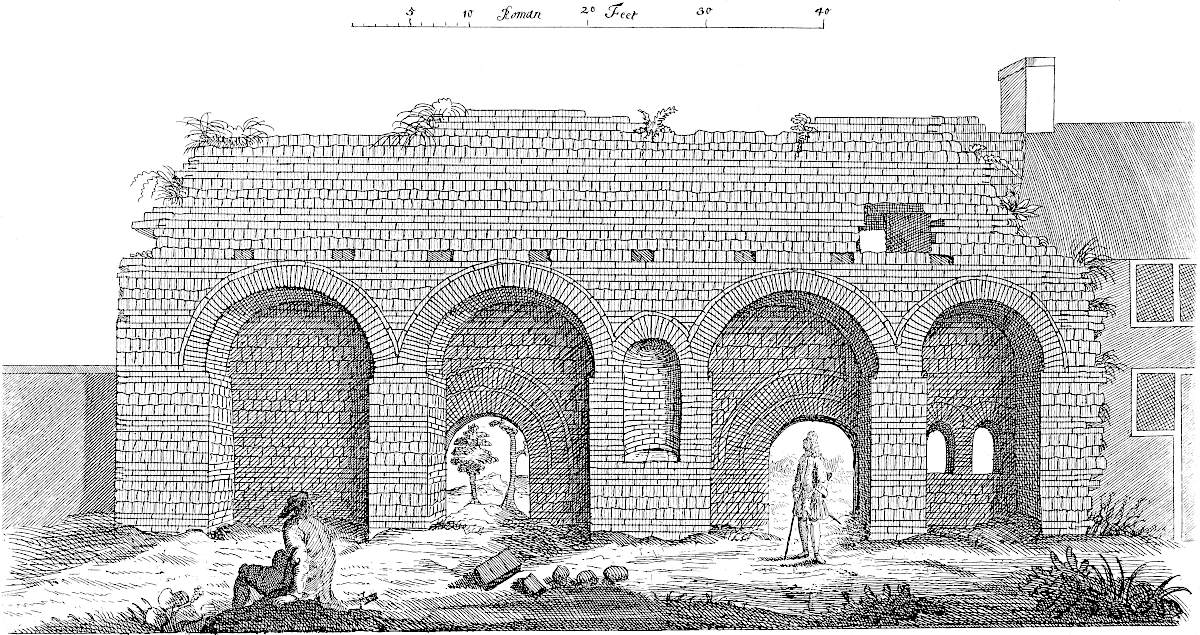
Ne tantam Ruinam absorbeat Inimica Ætas aq. forti fecit. Ws. Stukeley & Sami Gale Ar. consecratā voluit. 1722.
23·2d.
The west side of the roman building at Leicester Sept: 8. 1722.
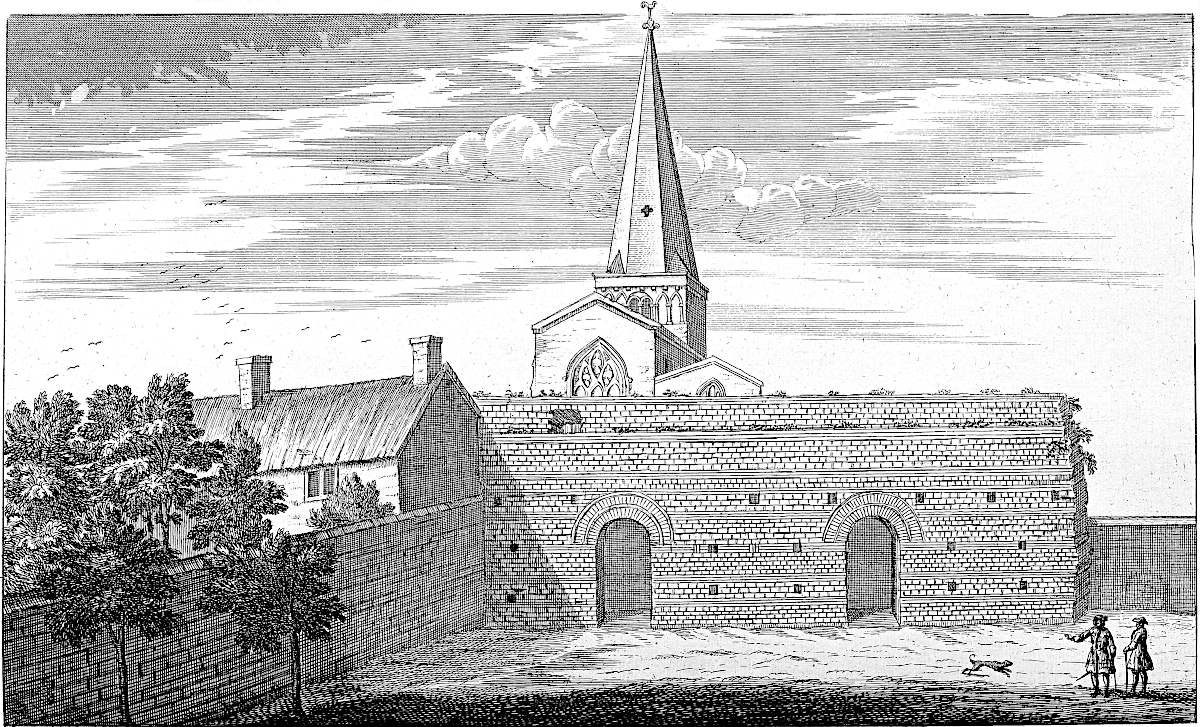
Stukeley delin.
E. Kirkall sculp.
24·2d.
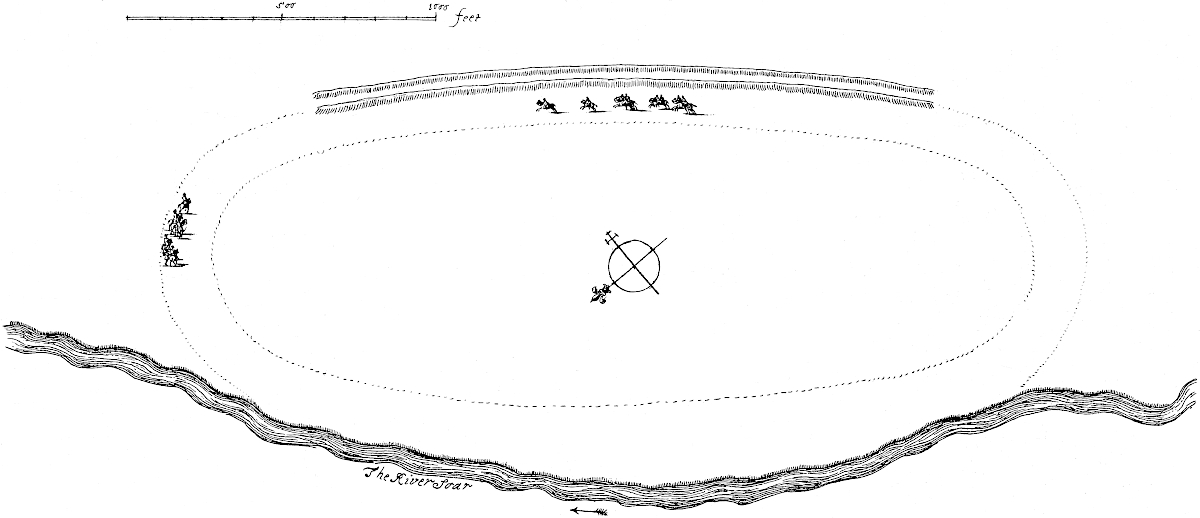
Stukeley delin.
E. Kirkall sculp.
25·2d.
A Prospect of the British Cursus near Leicester, call’d Raw Dikes from the hills above. September 10. 1722.
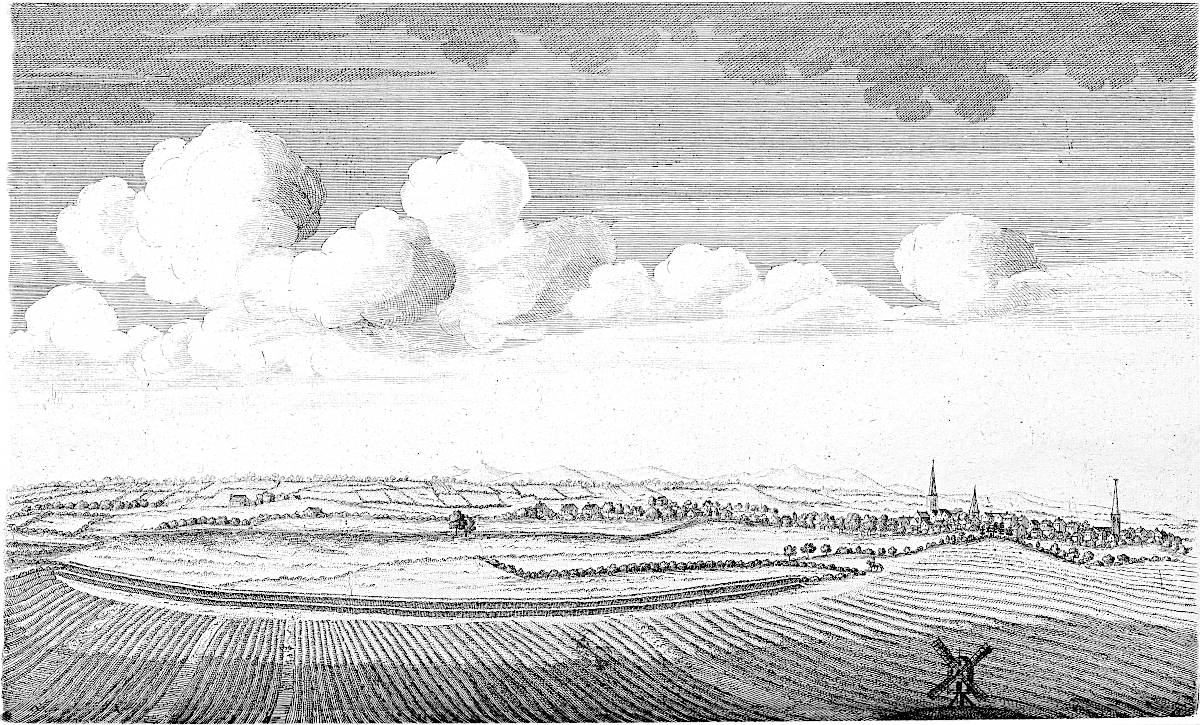
26·2d.
The Side View of the British Cursus at Leicester Sep. 10. 1722.
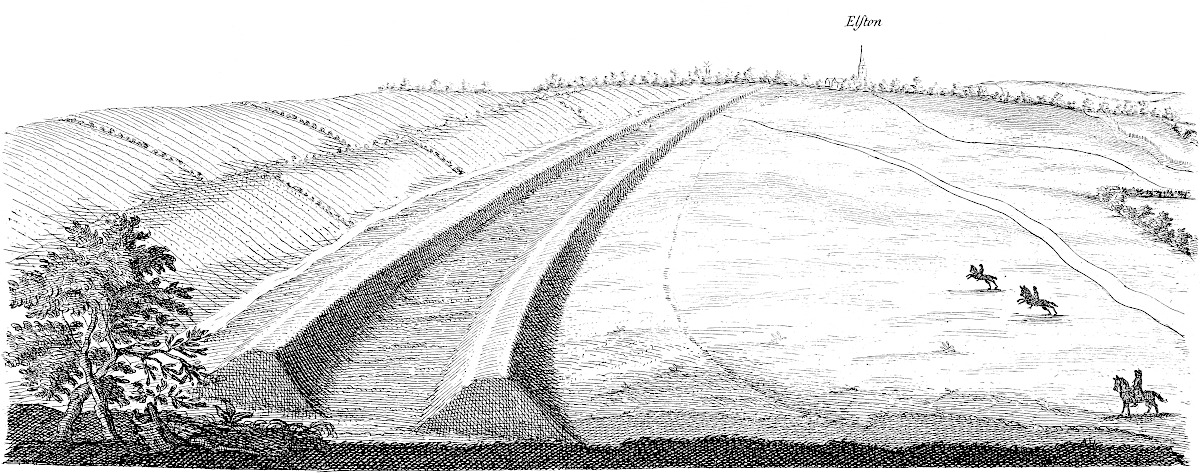
Stukeley del.
I. Vder. Gucht Sculp.
27·2d.
A Prospect of the British Cursus at Leicester call’d Rawdikes from the other side of ye River by the Foss road Sep. 9. 1722.
Soon after you go from Leicester, taking the Foss at Bronstongate, you come to some inclosures and troublesome gates across the road: here they have fenced it out into a narrow scantling, scarce the breadth of a coach, to the shame as well as the detriment of the country, suffering so scandalous an incroachment. I travelled by Narborough on the west side of the river, and a very wet journey under foot for one that was resolved to keep upon the road: sometimes I rode half a mile up to the horse’s belly in water upon the Roman pavement. The river Soar running near its east side, it is carried over many bogs, quags, and springs, for miles together, with a visible pavement of great round coggles by Sharnford, so called from the causeway: approaching High-cross it enters inclosures again, and is crossed by some more lakes scarce passable. Just upon the edge of Leicestershire and Warwickshire, at High-cross, I met the Watling-street, my future conductor.
Benonis.
TAB. XCIII.
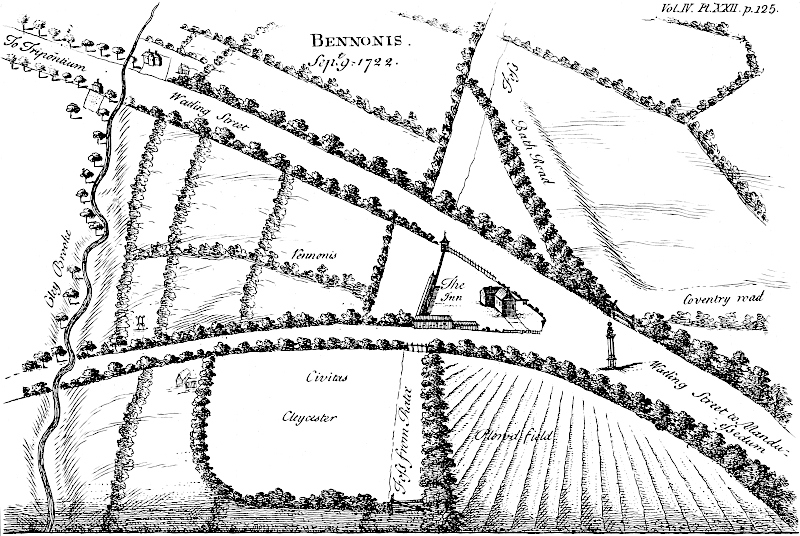
Benonis stands in the intersection of the two great Roman roads that trathe kingdom obliquely, and seems to be the centre of England, and highest ground; for from hence rivers run every way. The Foss went across the back-side of the inn, and so towards Bath. The ground hereabouts, the site of the ancient city, is very rich; and many antiquities, stones, Roman bricks, &c. have been dug up: Roman coins were found when they ploughed the field west of the cross.[99] Much ebulus grows here, sought for in cure of dropsies. Claybroke lane has a bit of an old quick-set hedge left across it, betokening one side of the Foss: the bearing of the Foss here is exactly north-east and south-west, as upon the moor on this side Lincoln. In the garden before the inn was a tumulus lately taken away: under it they found the body of a man upon the plain surface, as likewise under several others hereabouts upon the Watling-street. Foundations of houses have been frequently dug up along the street here, all the way to Cleycester. Here is a cross of handsome design, but of a mouldering stone, through the villainy of the architect, one Dunkley, built at the charge of the late earl of Denbigh, and the gentlemen in the neighbourhood: it consists of four Doric columns regarding the four roads, with a gilded globe and cross a-top upon a sun-dial: on two sides, between the four Tuscan pillars, that compose a sort of pedestal, are these inscriptions.
Vicinarum provinciarum Vervicensis Scilicet & Leicestrensis ornamenta Proceres patriciique auspiciis Illustrissimi Basilii comitis de Denbigh hanc columnam statuendam curaverunt in gratam pariter & perpetuam memoriam Jani tandem a serenissima Anna clausi.
A. D. MDCCXII.
Si veterum Romanorum vestigia quæras, hic cernas viator. Hic enim celeberrimæ illorum viæ militares sese mutuo secantes ad extremos usque Britanniæ limites procurrunt, hic stativa sua habuerunt Vennones & ad primum abhinc lapidem castra sua ad stratam & ad fossam tumulum Claudius quidam cohortis præfectus habuisse videtur.
Cloudbury-hill, two thorn-bushes upon a tumulus on the Foss, supposed the sepulchre of one Claudius. The city probably was of a square form, humouring the crossing of the roads, and had consequently four streets and four quarters. Many foundations are dug up along all the roads. It commands a charming prospect to Ratæ, Vernometum, Coventry, &c. and quite round. You go through a gate by the cross to regain the Foss: at the length of a pasture it meets the true old road.
93
Bennonis. Sept. 9. 1722.
Stukeley del:
I. Vder. Gucht Sculp.
Thomæ Bacon Ar Relliquias Romanas dd. Ws. Stukeley.
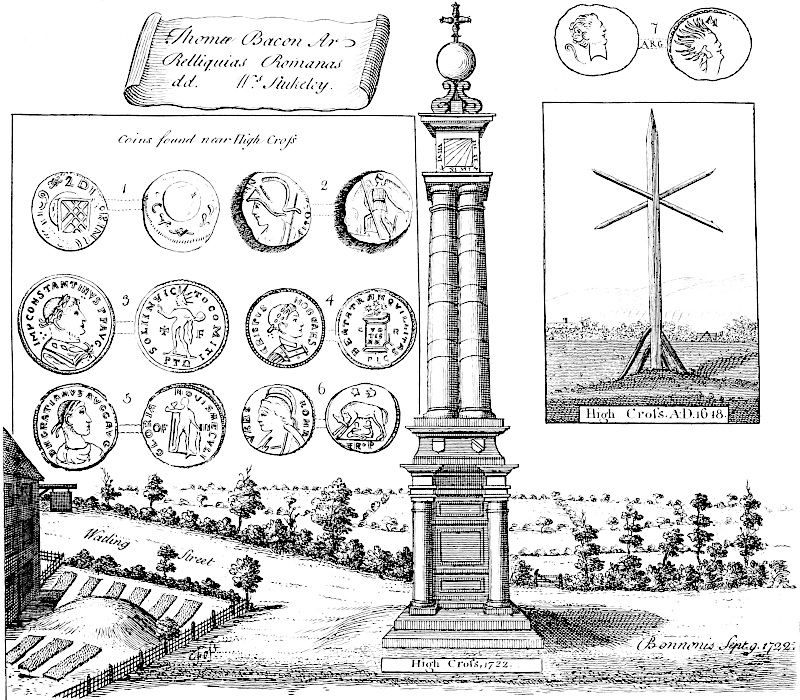
Coins found near High-Cross High Cross. A.D. 1618. High Cross, 1722. Bonnonis Sept. 9. 1722.
Watling-street.
TAB. LVI.
Being now got upon the Watling-street, I made this remark of it, that it is the direct road to Rome: for take a ruler, and lay it in a map of Europe from Chester through London and Dover, and it makes a strait line with Rome: so the great founders had this satisfaction when they travelled upon it, that they were ever going upon the line that led to the imperial Capitol. Our antiquarians are much at a loss, after torturing of words and languages, to find out the reason of the name of this street, which is so notorious, that many other by-roads of the Romans, in different parts of the kingdom, have taken the same, and it became almost the common appellative of such roads. My judgment of it is this: it is natural to denominate great roads from the places they tend to, as the Icening-street from the Iceni: the Akeman-street is said to come from Akemancester: in Wiltshire, and other places, the way to Exeter they call the Exeter road, though a hundred mile off: so the London road is every where inquired for as the most remarkable place: thus Watling-street, tending directly to Ireland, no doubt was called the Irish road, that is the Gathelian road, Gathelin-street; whence our present word Wales from Gauls, warden from guardian, &c. Scoti qui & Gaidelii says ogygia extera. Whether there be any thing in the story of Gathelus, as founder of the Irish, I do not concern myself at present; but their language is called Gaothela: so Mr. Camden says the true genuine Scots own not that name, but call themselves gaoithel, gaiothlac, as coming from Ireland; and that they glory in this name: and there is no dispute but this is the ancient appellative of the Irish,[100] which the learned Mr. Edward Lluyd has turned into Gwydhelians: and this name, which has superseded that which the Romans gave it, (whatever it was) seems to show there was such a road in the ancient times of the Britons, as the track of the trade between Ireland and the continent; yet it must be owned nought but Roman hands reduced it to the present form.
Hence-forward we turn our course upon the Gathelin-street directly for London along with the Itinerary. The road is now altogether between hedge-rows, very clayey and bad, full of lakes and mires, through the intolerable negligence of the inhabitants: here and there they have stupidly mended it, by making a ditch in the middle of the road to raise a bank of earth; for which they ought rather to be punished than commended.
I turned out of the road to the west, through some inclosures, to see Cester-over, induced by the name. I found a house in a little square deeply intrenched upon the side of a hill, but the earth rather thrown outward than inward as a vallum, and the level within much lower than the field around it. I perceived it was a religious house; some part of the building left; and without the ditch a fine chapel, built of brick with good stone coins and mullioned windows, converted into a barn: and a-cross a valley hard by I saw dams, or stanks, for fish-ponds. The people within could give me no manner of intelligence, having but lately come thither. I fancied it to have been a nunnery, and that it was called Sister-over, to distinguish it from other neighbouring towns; as Church-over, Browns-over, &c. but afterwards I learnt from other hands that there is a close called Old-town, where they dig up foundations, being very rich land (said to have been a city) lord Brook possessor.
Tripontium.
TAB. XCIV.
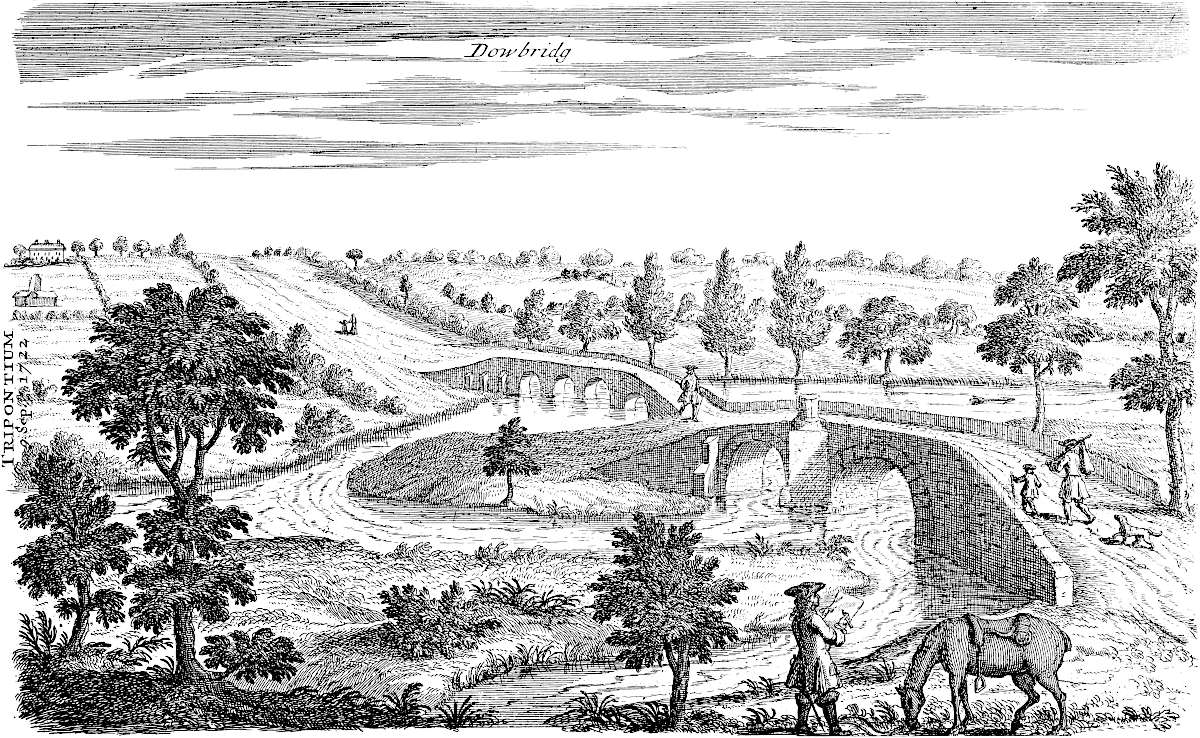
Thence passing a rivulet, from Bensford bridge[101] I came to Tripontium, placed in a sweet little valley, but the sides pretty steep: the road on the opposite hill looks perfectly like a perspective scene at the play-house. This is the next Roman station, which is rightly placed at Dovebridge upon the Avon, running by Rugby to Warwick. The stream here divides into two, with a bridge over each: upon one a stone inscription, very laconic, showing the three counties that repair it. The first syllable of Tripontium has relation to the old British word tre, a town or fortification: the remainder is generally thought to signify a bridge; but it is not to be imagined the Romans would make a bridge over this rill, or one so eminently large as to denominate the town: indubitably it comes from the British word pant, a little valley as this is, and remarkably so; which the Britons pronouncing broad, created the Latin Tripontium. Here are no manner of remains of antiquity, but the distances on each hand ascertain this the place: hard by antiquities have been found both at Cathorp and Lilburn, one on the north, the other on the south of the river; so that the Roman city stood on both sides. Castle hills, a place at Lilburn, where are some old walls: Camden speaks of it. Mr. Morton has treated largely on this station, to whom I refer the reader. The neighbouring Newton probably succeeded it, and then Rugby.
Yet rolling Avon still maintains its stream, Swell’d with the glories of the Roman name. Strange power of fate, unshaken moles must waste, While things that ever move for ever last!
With this reflection of the poet leave we the name of Tripontium, made immortal in the imperial Itinerary.
94
Johi Bridges Ar. Romanæ Stationis in Comitatu Suo. delineationem d.d. Ws. Stukeley.
Dowbridg TRIPONTIUM 9 Sep. 1722
Stukeley delin.
E. Kirkall sculp.
When we mount the next hill there is a lovely prospect as far as Watford-gap, four miles off, a great vale or rather level meadow lying between, a-cross which the road is drawn: and hereabouts the ridge of it is very high for miles together: the nature of the way, on both sides being stoney, has spared it. Several tumuli upon the road; bodies found under them: this shows the Romans did not travel upon them on horse-back. Watford-gap is a convenient inn for antiquaries to supply the mansion of Tripontium, which I think proper to advertise them of: it has a pleasant prospect of the road northwards: it is a high hill, and a rock of stone six foot under the surface, which is softish; then a bed of clay; under that a blue hard stone of good depth: below this rock it is springy, and at the bottom by the meadows are many quick springs. At Legers Ashby near here has been another old town, as they say, destroyed by the Danes: there are great ditches, causeways, and marks of streets. Catesby owned the town, who hatched the powder-plot. I went out of the road through Norton to see a great camp calledBurrow hill. Ro. camp. Burrow hill, upon the north end of a hill covered over with fern and goss: here is a horse-race kept; and the whole hill-top, which is of great extent, seems to have been fortified: but the principal work upon the end of it is squarish, double ditched, of about twelve acres: the inner ditch is very large, and at one corner has a spring: the vallum is but moderate: a squarish work within, upon the highest part of the camp, like a prætorium. They say this was a Danish camp; and every thing hereabouts is attributed to the Danes, because of the neighbouring Daventre, which they suppose to be built by them: the road hereabouts too being overgrown with dane-weed, they fancy it sprung from the blood of the Danes slain in battle, and that, if upon a certain day in the year you cut it, it bleeds. As to the camp, I believe it to be originally Roman; but that it has been occupied by some other people, and perhaps the Danes, who have new modelled it, and made new works to it. Consult Mr. Moreton, who has discoursed very largely about it. Much cotyledon and ros solis grow in the springs hereabouts: the stone is red and sandy, and brim-full of shells. I saw a fine cornu ammonis lie neglected in Norton town road, too big to bring away, and where they have fresh mended the Watling-street with this stone; it was an amusement for some miles to view the shells in it. Hereabouts the road is overgrown with grass and trefoil, being well nigh neglected for badness, and the trade wholly turned another way, by Coventry, for that reason. Between the head of the Leam and this Avon isArbury Hill. Ro. camp. Arbury hill in view, another Roman camp, upon a very high hill; notoriously made for a guard between the two rivers.
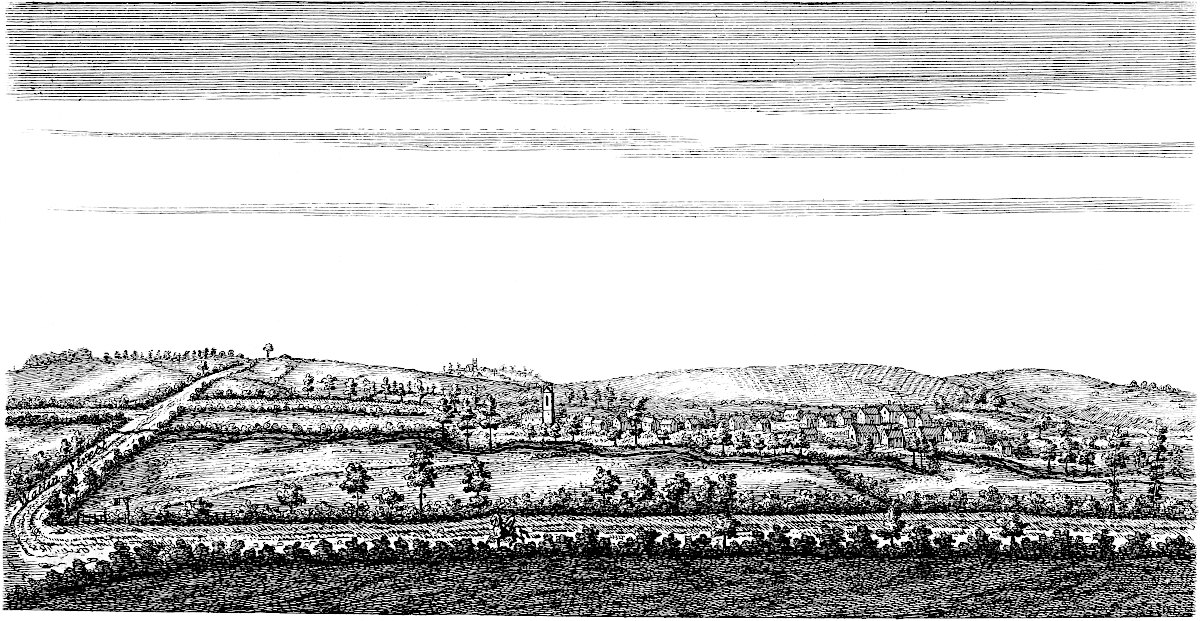
The next station the Watling-street leads us to is Weedon on the street; beyond dispute Benavona.Benavona, as surely it ought to be wrote, being situate on the head of the Aufona, running to Northavonton, or Northampton.TAB. XXVIII. 2d Vol. This too affords but little matter for the antiquary. The old town seems to have been in two pastures west of the road, and south of the church, called Upper Ash-close and Nether Ash-close, or the Ashes; in which are manifest vestiges of the ditch and rampart that surrounded it, and many marks of great foundations: they show you the site of king Wolfhere’s palace, the Saxon kings of this province having their seat here. The Ashes was the Roman castrum: here was a chapel of St. Werberg, daughter of king Wolfhere, abbess to the nunnery in this place: there has been dug up abundance of very fine stone, and many Roman coins. Now Weedon consists of two parishes, and has been a market-town. There is a large Roman camp a little higher toward the river-head, southward a mile, as much from Watling-street, called Castledikes.Castledikes, probably one of those made by P. Ostorius Scapula, proprætor under Claudius. Roman coin and pavements have been found there. I visited the place: it is of a very pleasant and healthful situation, being in a wood on the top of a dry hill: probably it was a Roman villa, afterwards rendered Saxon: a house stands by it. Another of these camps of Scapula I mentioned before, at Guildsborough. At Nether Hayford, on the other side the road, anno 1699, a Roman Mosaic pavement was found, of which Mr. Moreton gives us a drawing, but in too small a compass.
Lactorodum.
Towcester is a considerable town between two rivulets; but what its Roman name, time has envied us, the Itinerary passing it by. Lactorodum is the next station, being Old Stretford, on the opposite side of the Ouse to Stony Stretford: many Roman coins have been found in the fields thereabouts, and queen Eleanor’s cross stood a little north of the Horse-shoe inn, pulled down in the rebellion; which shows that the town was on this side the bridge in the time of Edward I. Mr. Baxter says, the name imports the ford over the water. My friend Browne Willys esq; who lives in the neighbourhood, has inquired into the antiquities of this place, and gives us an account of them in his curious Treatise of Burroughs, which it is to be wished he would continue. A little on this side Stretford, to the west, upon very high ground stands Whaddon hall, Mr. Willys’s seat; it has a most delicate prospect: this manor formerly belonged to the lords Grey; one, a knight of the garter, lies buried in the church. Spencer the poet lived here, and the learned duke of Bucks. Here is the original picture of Dr. Willys: I saw many of his MSS. letters, consultations, lectures, and other works unprinted.
Still higher stands Stukeley, a very large parish, on the same sort of soil as that in Huntingdonshire. This is the oldest church, and most intire, I ever saw, undoubtedly before the Conquest, in the plain ancient manner, being a parallelogram of four squares: two are allotted to the church; one covered by the steeple, which stands between it and the choir, carried across the church upon two round arches; one square to the choir, which is vaulted over with stone: the windows are small, with semi-circular arches, and few in number: at the west end are three arches, the door in the middlemost: the whole of a very good manner of symmetry.
28·2d.
Prospect of Benavona July 6th. 1725.
Stukeley delin.
Fletcher sculp.
Thus far we have gone through Northamptonshire and Bucks: now we enter Bedfordshire, and arrive at Magiovinium.Magiovinium, or Dunstable. The road hither from Fenny Stretford is deep sand (and comes from Salinæ, or sandy) till you arrive at the bottom of the chalk-hills, or chiltern, which arise very steep on this side, as being north-west, conform to my assumption, p. 4. The town stands upon this chalk; whence its Roman name, importing the white town:[102] it consists of four streets, intersecting at right angles, but oblique to the cardinal points, because such is the direction of the Icening and Watling-street, which here meet. In the centre stood one of those beautiful crosses of queen Eleanor; but fanatic zeal has robbed the town of this ornament. This being a high situation, and no running water near, they are forced to draw up their water, from very deep wells, by machinery of great wheels. Kingsbury, the royal seat over-against the church, is now a farm-house. The church is composed of many parts tacked together, some very old: it was part of the priory: arch-bishop Cranmer was the last prior here. In Dunstable church is this inscription,
Hic iacent Nicholaus Lane quondam presidens frat’nitat’ sci Johannis Baptiste De Dunstable qui obiit ii die mens’ Decembr anno Dm Mo CCCCo lir Et Agnes ur. eio quorum animabus propicietur Deus amen.
Maiden Bower. British.
I visited Maiden-Bower,[103] mentioned by Mr. Camden, but cannot think its name has any relation to that of the town: though Roman coins have been found here, I am persuaded it is a British work, like that at Ashwell, at like distance from the Chiltern, and of like form, but more circular: it stands upon a plain, but not far from the edge of a lesser eminence of these hills, about a little mile from Dunstable: the rampire is pretty high, but very little sign of a ditch; nor do I think there ever was much more: it incloses about nine acres: the ground round it is ploughed: this chalk yields good wheat. Between here and the town is a long barrow called the Mill-hill, no doubt from a mill which was afterwards set upon it; the ends of it ploughed somewhat: it stands east and west: I have no scruple in supposing it Celtic. Tumuli British.A high prominence of the Chiltern overlooks all, called the Five Knolls, from that number of barrows, or Celtic tumuli, round, pretty large, and ditched about upon the very apex of the hill. Close by are two round cavities, as often observed in Wiltshire. The Icening-street runs under the bottom. These chalk hills have frequently veins of strong clay intermixed, and the like between these hills and the sand more northward. This great tract of chalk comes from the eastern sea, and traverses the kingdom much in a like direction with the Icening-street.
At Woburn is some fullers earth. There was a noble abbey, now the seat of the duke of Bedford; in it several valuable works of Inigo Jones left, particularly a curious grotto.
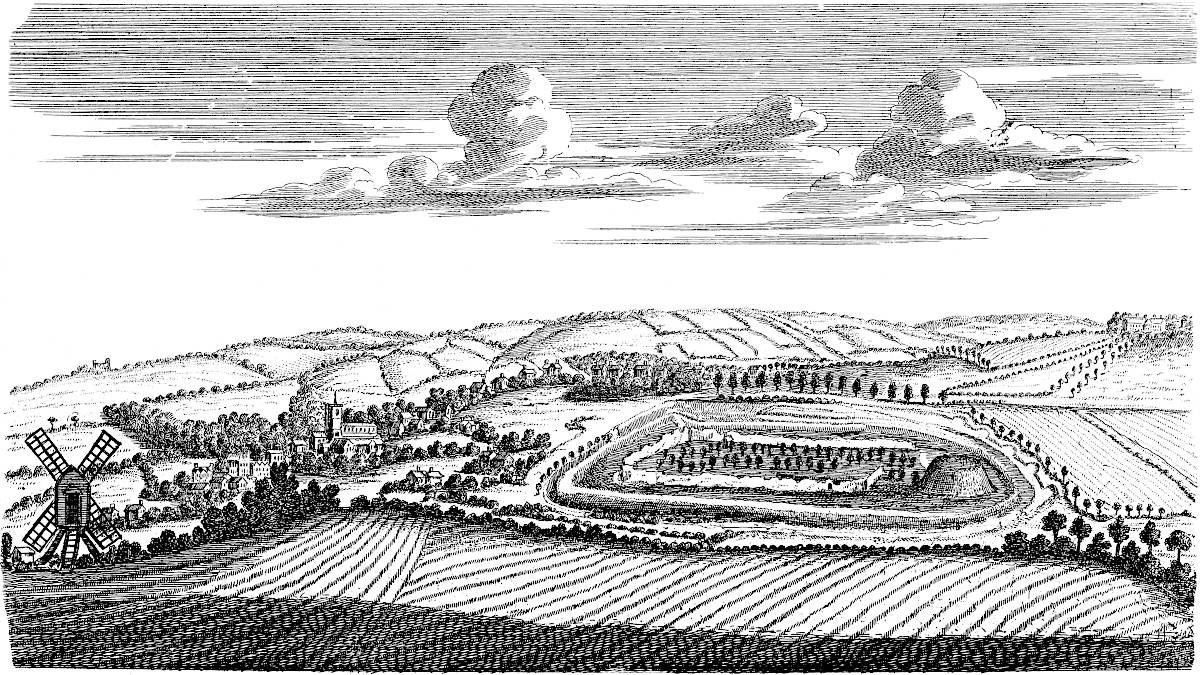
From Dunstable the Itinerary leads us out of the road, going strait to Verolam, and takes in another station by the way, Durocobrivis.Durocobrivis; which demonstrates it was made not so much for travellers, as for the soldiery or officers that were to visit the garrisons, therefore comprehends as many as could conveniently be taken into that route. About this station antiquaries have been much divided, when it certainly ought to be placed at Berghamsted, commonly Barkamstead, in TAB XXIX. 2d Vol.Hertfordshire, which well suits the assigned distances from Magiovinium, and the subsequent Verolanium, and has evidently been a Roman town, as its name imports; and probably the castle there stands upon a Roman foundation. It is certain Roman coins are frequently dug up there: my friend Mr. Browne Willys has a Roman coin, found there: young Mr. Whitfield, brother to the major at St. Alban’s, has many Roman coins, great and small, found in the castle at Berghamsted. The inside, within the walls where the lodgings were, is about two acres: the entrance was not at the corner, where now, but in the front of the south side: many chimneys remain in the wall, of the lodgings which extended quite round, leaving a spacious court within; and all the windows looked inward: the ground of the court is distinguishable, being good soil, and there they find the Roman coins; the rest is rubbish and foundations; so that the Saxon castle was made upon the Roman: the chapel seems to have stood against the west wall, where be signs of a stair-case: the walls are of flints gathered from the highlands, very thick, and laid with strong mortar. This town fully answers the distance in the Itinerary, and remarkably the import of the name, according to Mr. Baxter’s derivation, though he erroneously places it at Woburn, civitas paludosi profluentis; for here is a large marsh, or bog, wherein the ancient British oppidum was placed: it is most sweetly surrounded with high, hard, and pleasant ground all around, full of hedge-rows, pastures, and arable: the castle was set very judiciously in the north side, upon a piece of dry ground, incompassed with springs, by the Saxons made exceedingly strong. The town is upon the south side of the marsh, stretching itself a good length in handsome buildings, and a broad street: the church is a large handsome building, a monumental effigies of a knight and a lady; upon his coat a bend or belt, and in the sinister chief a martlet; a lion his crest under his feet: it is full of chapels and monuments old and new. This town has been an old corporation; the kings of Mercia resided here; Wightred, king of Kent and Mercia, anno 697, held a parliament here; and here king Ina’s laws were published: all which further confirm its being the place we assert.[104]
Near is Ashridge, an abbey, now the seat of the duke of Bridgewater; a park finely wooded, especially with tall beech-trees full of mast. Hereabouts I observed many great stones composed wholly of little pebbles; others, of larger pebbles or flints petrified together exceeding hard. Near Ricmeresworth, at Moor park, Mr. Styles, digging a hill away, found veins of sea-sand with mussels in them, and many other curious particulars.
Verolanium.
TAB. XCV.
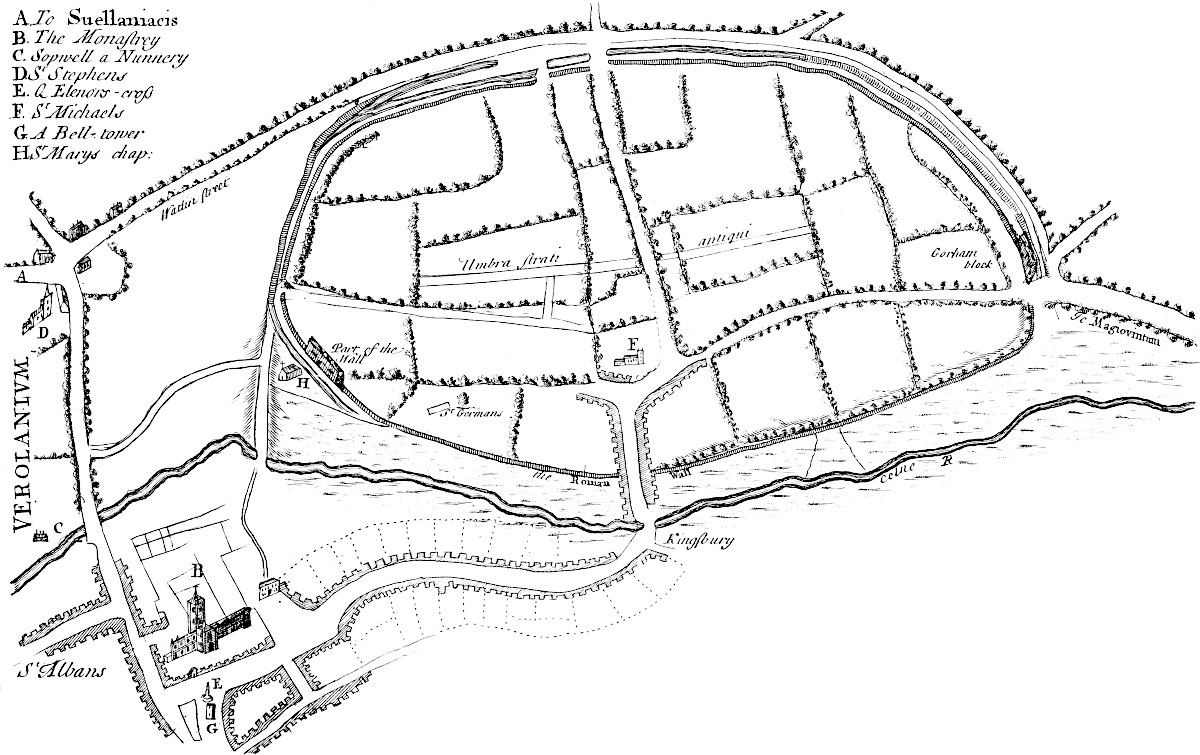
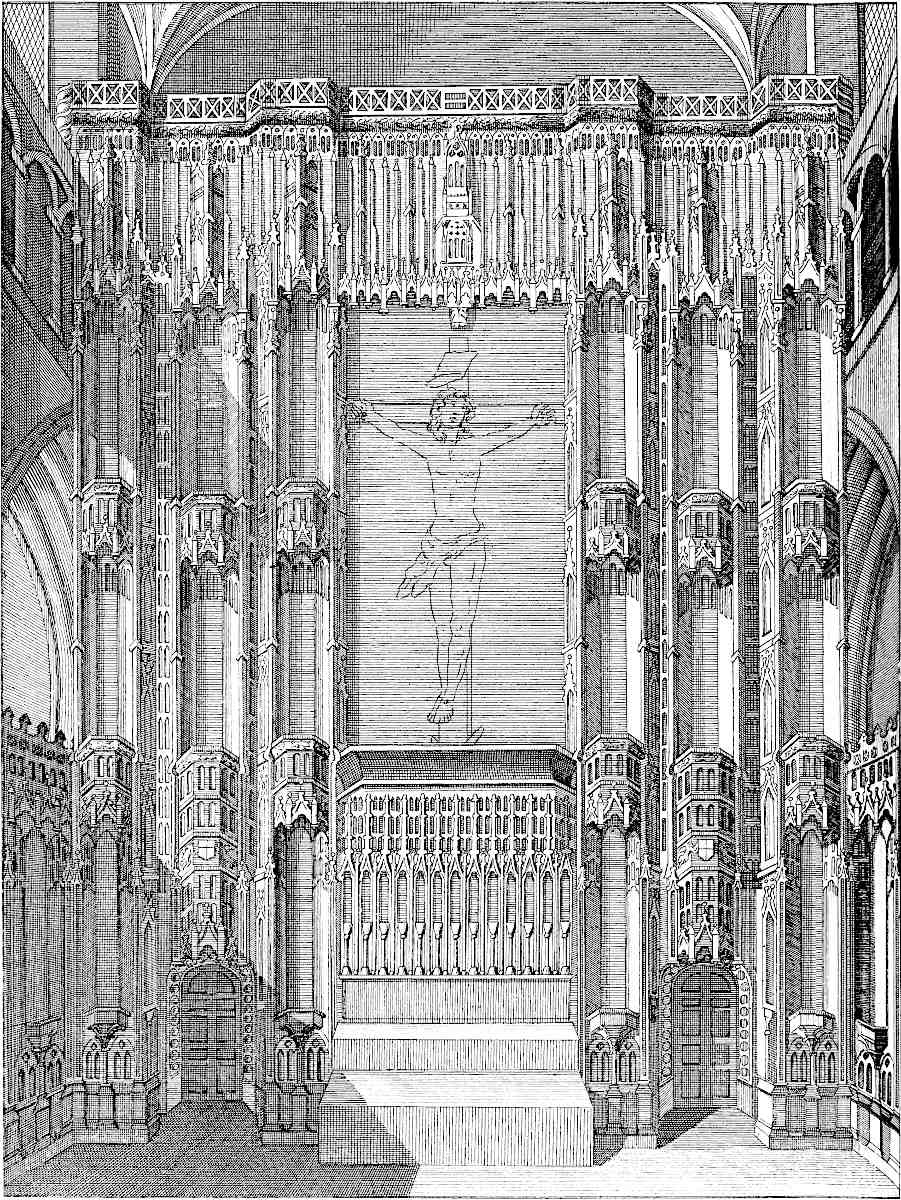
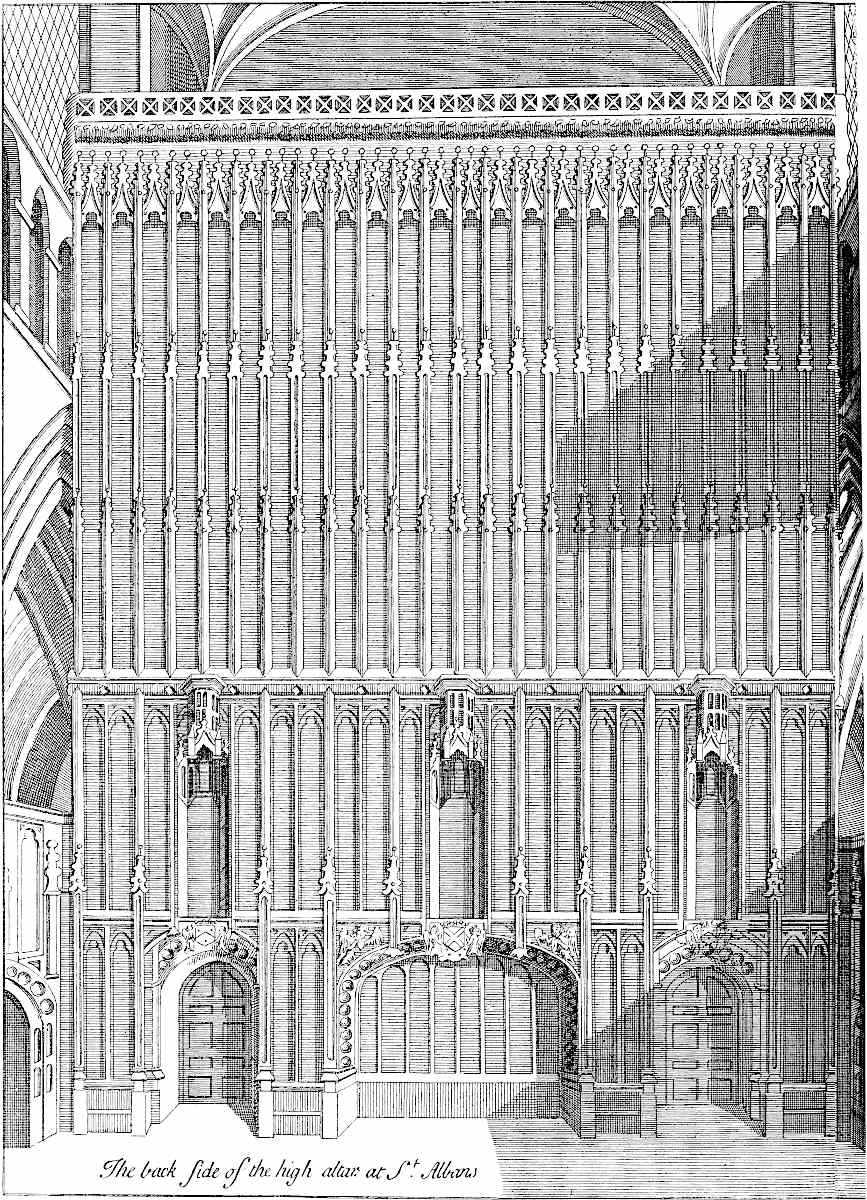
We come again into the Watling-street at Verolanium. I need say little here, after Mr. Camden, Chancey, Weaver, and others. This was the famous municipium of the Romans, destroyed by Boadicia. The form of the city is depicted in plate 95. in one part the ditch is double, but irregularly formed. I imagine the outermost was the only fence of the first city, which Boadicia destroyed before the walls were built, and these reduced it into a more square form; to which the inner ditch belonged. In some measure the track of the streets is visible, when the corn first comes up, or is nearly ripe: three years ago good part of the wall was standing; but ever since, out of wretched ignorance, even of their own interest, they have been pulling it up all around, to the very foundations, to mend the highway; and I met hundreds of cart-loads of Roman bricks, &c. carrying for that purpose, as I now rode through the old city, though they may have stone cheaper, because of the prodigious strength of the mortar, so that they cannot get up one whole brick in a thousand. The composition of the Roman wall is three foot layers of flint, and one foot made up of three courses of Roman brick: there are round holes quite through the wall, at about eight yards distance, in that corner still left by St. German’s chapel: another great piece of the wall is left by the west gate, called Gorham Block; it is always twelve foot thick. I saw a little brass lar, or genius alatus; another curious antiquity, of a brass knife-handle with odd faces and figures on it, now in possession of Sir Robert Cornwall, baronet; a little urn of white earth two inches and quarter high: part of a great wine-jar, 20 inches high, two foot diameter, in St. Michael’s vestry; another such in St. Alban’s church. In St. Michael’s church sleeps the great naturalist Bacon, who first revived the experimental way of philosophy: his mansion-house or manor was at Gorhambury, hard by, where is a statue of Henry VIII. and several things worth seeing: it is now the seat of my lord Grimstone. Infinite are the antiquities of all sorts that have been, and frequently are, dug up at Verolam. When I was making an ichnography of it, I could have taken several pecks of remainders of Mosaic pavements out of a little ditch near St. German’s chapel; and there is one or two intire yet under ground. As you walk along the great road that runs north and south through the city from St. Michael’s church, you see foundations of houses and streets, gutters, floors, &c. under the hedge-rows. The ancient part of the monastic church and the steeple are intirely built of Roman brick, fetched by the abbots from the old city. March 1718–9 a Mosaic pavement was found. The Roman bricks are generally eighteen inches long, twelve broad, one and a half thick. I measured one in the south-wall of the school-house, by the east end of the abbey church, twenty-three inches long, three thick, which probably was made for hypocausts. Upon the walls of old Verulam grows the bee orchis, a very curious plant. Many are the monuments, brasses, tombs, and inscriptions, in the abbey church: the vault of Humphry duke of Glocester was lately discovered: the high altar is a curious piece of Gothic work, which I have represented in two plates. Hard by is Sopwell nunnery, TAB XXX XXXI.where they say Henry VIII. was married to Anna Bolen: part of it is standing. But to say any thing particular of religious antiquities, would be too tedious: they have lately been working hard at pulling up the old foundations of the abbey, and it is now levelled with the pasture, when three years ago one might make a tolerable guess at the ichnography of the place. In the heart of the town of the adjoining corporation stood another of queen Eleanor’s crosses, which they likewise intirely demolished, not considering that such kind of antiquities invite many curious travellers to come thither. This very year they pulled down the stone tower or gate-house on the north side of the abbey, within a month after I had taken a sketch of it. In St. Peter’s church I found this old inscription on a stone,
EDITHE : LE : UINETER : GIST : ICI : DIEU : DE SA : ALME : EIT : MERCI.
I shall add no more, than that my notion of the derivation of this town, and several others compounded of like words, is, a fair habitation, Vrolân, as it justly merits.
29·2d.
Prospect of Berghamsted 14. Sept. 1724. Dvrocobrivis.
Stukeley delin.
E. Kirkall sculp.
95
Verolanivm
Martino Folkes Ar. observantiæ ergo d. W. Stukeley
Stukeley delin.
Parker Sculp.
To Suellaniacis
The Monastrey
Sopwell a Nunnery
St Stephens
Q. Elenors-cross
St Michaels
A Bell-tower
St Marys chap:
30
Stukeley d.
The high Altar at S
t
.
Albans. 28. Dec 1720.
31
Stukeley d.
The back side of the high altar at St. Albans
The Watling-street seems to have passed directly through the Roman city, a little southward of St. Michael’s church and St. Mary’s chapel, so by St. Stephen’s: nevertheless there is a road round about, without the south side of the city-walls, for those that had no occasion to go through the city: it goes by St. Julian’s, once an hospital; then by Colney-street and Radway; thence almost disused, and scarce known but from its straitness: it continues direct, but very narrow, the hedges having incroached upon it on both sides, till we arrive at our next station, Suellaniacis.Suellaniacis, upon Brockley hill, a little south of Elstre, and near Stanmore. From this eminence, where Mr. Philpot’s summer-house stands, is a sweet prospect across the Thames into Surrey: this is by Kendale wood, where formerly they found an old flint wall laid in terrace-mortar as they call it, meaning its strength, so hard that they could not possibly dig it up with pick-axes: they found an oven in the same place. Mr. Philpot, when digging his canal and foundations for his buildings, which are upon the site of the old city, found many coins, urns, and other antiquities. They have a proverb here,
No heart can think, nor tongue can tell, What lies between Brockley-hill and Penny-well;
meaning the coins found thereabouts. In the wood over-against the house, great quantity of Roman bricks, gold rings, and coins, have been found in digging; many arched vaults of brick and flints under the trees: the whole top of the hill is covered with foundations. Pennywell is a parcel of closes across the valley beyond Suellaniacis, where foundations are discernible: here likewise they say was a city: two or three years ago they dug privately, in hopes of finding treasure at this place. I am of Mr. Baxter’s opinion, that the name of this station has some reference to the famous British king Suellan, or Cassibelan, general of the Britons against Cæsar, and that his town was in this neighbourhood; which I shall consider more particularly upon another occasion. By the road side is a barrow lately dug away.
Hence the road goes through Edgworth; and so at Paddington, by Tyburn, it crosses the other Roman road, called now Oxford-street, which was originally continued to Old-street, going north of London one way; the other way it proceeds by the back side of Kensington, and through an unfrequented path, till it falls into the present great road to Brentford, Stanes, &c. and it is a Roman road all the way, going pretty nearly east and west: therefore our Watling-street must cross it with an oblique angle; and by observation I found it to be about forty-five degrees. Higden takes notice the Watling-street ran to the west of Westminster, over the Thames, so through the middle of Kent: from Tyburn I judge it goes over part of Hyde-park,[105] and by May-fair, through St. James’s park, to the street by Old Palace-yard called the Wool-staple, to the Thames. Here has been an old gate; one part of the arch is still left, but not Roman. On the opposite side of the river is Stane-gate ferry, which is the continuation of this street to Canterbury, and so to the three famous sea-ports, Rutupiæ, Dubris, and Lemanis. This Oxford road was originally carried north of London, in order to pass into Essex, because London then was not considerable; but in a little time became well nigh lost; and Holborn was struck out from it, as conducting travellers thither, directly entering the city at Newgate, originally called Chamberlain’s gate, and so to Londonstone, the lapis milliaris from which distances are reckoned: and hence the reason why the name of Watling-street is still preserved in the city, though the real Watling-street goes through no part of it, but through Southwark; or, if we please, we may call this a vicinal branch of the Watling-street.
57
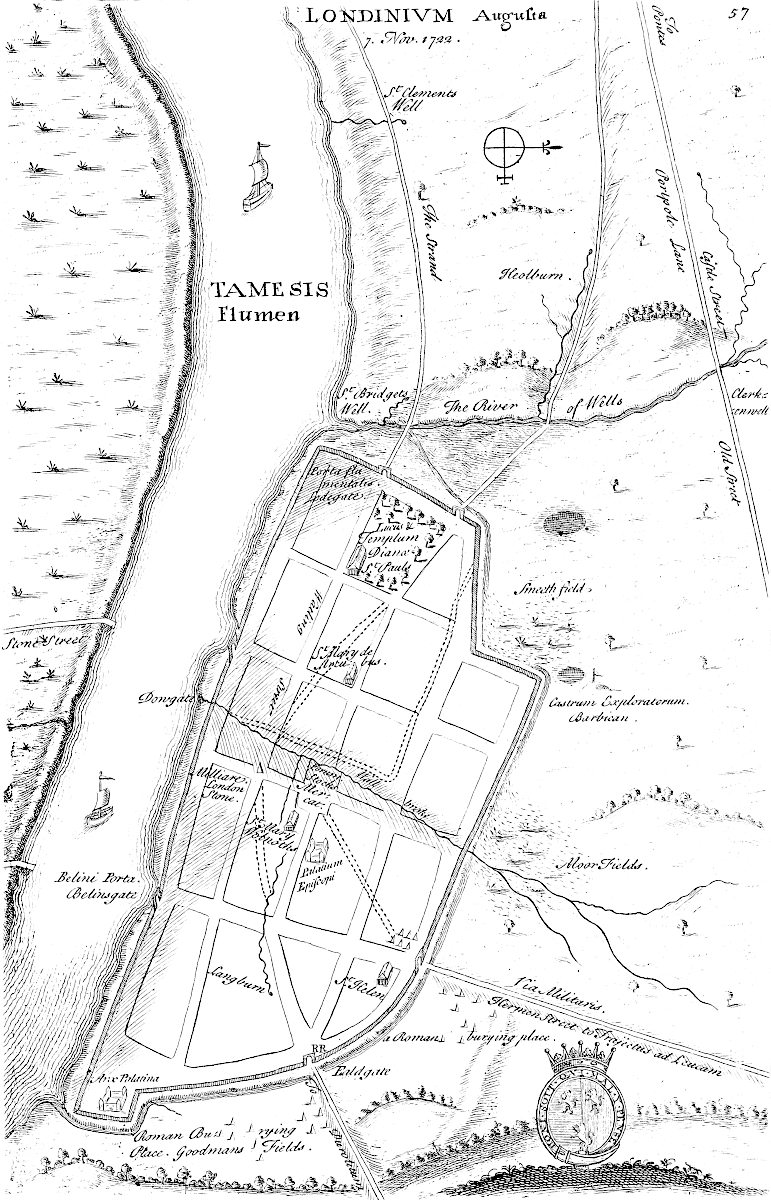
Londinivm Augusta 7. Nov. 1722.
Illustrissimo Comiti Penbrokiæ Moecenati Eximio Sacra Tabula.
Stukeley delin.
Londinium.
TAB. LVII.
According to method I should speak of Londinium here: but because the great deal that may be said thereupon will make a discourse by itself, we content ourselves at present with giving the plan of it, as we suppose it might appear in the times of the Romans; and so continuing our tour into Kent, will finish the whole continuation of the Watling-street with what few memoirs I could pick up at that time.
As Old-street went on the north of London, so the proper Watling-street we have been upon, since High-cross in Warwickshire, went on the south; from Stane-gate ferry across St. George’s fields, so south of the Lock hospital to Deptford and Black heath: a small portion of the ancient way pointing to Westminster abbey is now the common road on this side the nearest turnpike; but the continuation of it is quite lost since the bridge was made, and all roads meet at that centre as so many radii. When London became considerable, the ferry over-against it, from being better attended, rendered that at Stangate almost useless; so passengers went through the city by Canon-street, Watling-street, and Holborn: hence so little appears of it between Tyburn and the Lock hospital; and probably its materials were long since wholly dug away to mend the highways. Upon this way in Southwark many Roman antiquities have been found, particularly a Janus of stone, in possession of Dr. Woodward: but our business shall be to prosecute the end of the second journey and the whole third and fourth of Antoninus.
From Shooters hill the direction of the road is very plain both ways: a mile westward from the bottom of the hill you find vestiges of it just upon the common: some part of the agger is left, made of gravel near at hand: from the top of Shooters hill you see it butts upon Westminster abbey, where it passes the Thames; and this demonstrates its original direction, and that it was begun from the east; for the turn of the river at Greenwich intercepts it, though not observed in maps: so the way is forced to deflect a little southward there, and then recovers its point: beyond that hill it is very strait as far as the ken reaches. On Black heath a vast tumulus, now used as a butt for archers, hereabouts in great request till Henry the VIIIth’s time: and hence the name of Shooters hill.
It is to be noted that in the second journey of Antoninus, Madviacis, Maidstone, and Durobrovis, Rochester, are transposed; therefore in the whole between London and Rochester it is twenty-eight miles, as in both the next journeys called twenty-seven, (but more rightly the former:) so that, as the Watling-street leads directly over Shooters hill between London and Rochester, and seeing the whole distance is answerable to fact, we need be in no pain for finding out the intermediate station, Noviomagus.Noviomagus: doubtless it was about Wellend or Crayford,[106] as Mr. Somner judges, where the respective distances on each side point it out: notwithstanding, as to matters of antiquity, we have nothing to say. So with good reason Dr. Plot settles Pennocrucium at Stretton in Staffordshire, because it is upon this same Watling-street, and answers the distances, though no Roman antiquities are there discovered; and the like must we do of other places. No doubt there were two stations between London and Rochester, though only one mentioned in the Itinerary: Northfleet. Ro. town.Northfleet seems to be the other, where many antiquities are found. I heard much talk of an old town at Plumsted, nearer the Thames, and to which they say the river came up originally: if true, perhaps this was the Noviomagus, and the Trinobantum, or Trenowydh of the Britons, i. e. the town of the Novii or Novantes, of which their old writers make a din, and would affix it to London: they say there are much ruins there. East of Crayford, all along upon the heath, as well as on the other side from Shooters hill, the ridge of the Watling-street is very visible; but beyond Dartford the common road leaves it quite on the south side, which induced me to follow the Roman: it becomes a lane presently, and passes in a very strait line, for five or six miles, through little valleys, woods, and inclosures; and about that distance I lost both it and myself in a wood by Southfleet; which obliged me to endeavour again to recover the great road: by the quantity of ground I went for that purpose, I guess this is a branch of the main road directly to Maidstone, for the convenience of such as intended to go strait to Lemanis by Durolenum. The soil from London to Dartford is gravel, but the highest ground has sand: beyond to Rochester it is chalk full of flints and gravel: the flints lie in strata, very black, and squeezed flat like mortar in the course of a wall; and above the chalk is pure sand.
Durobrivis.
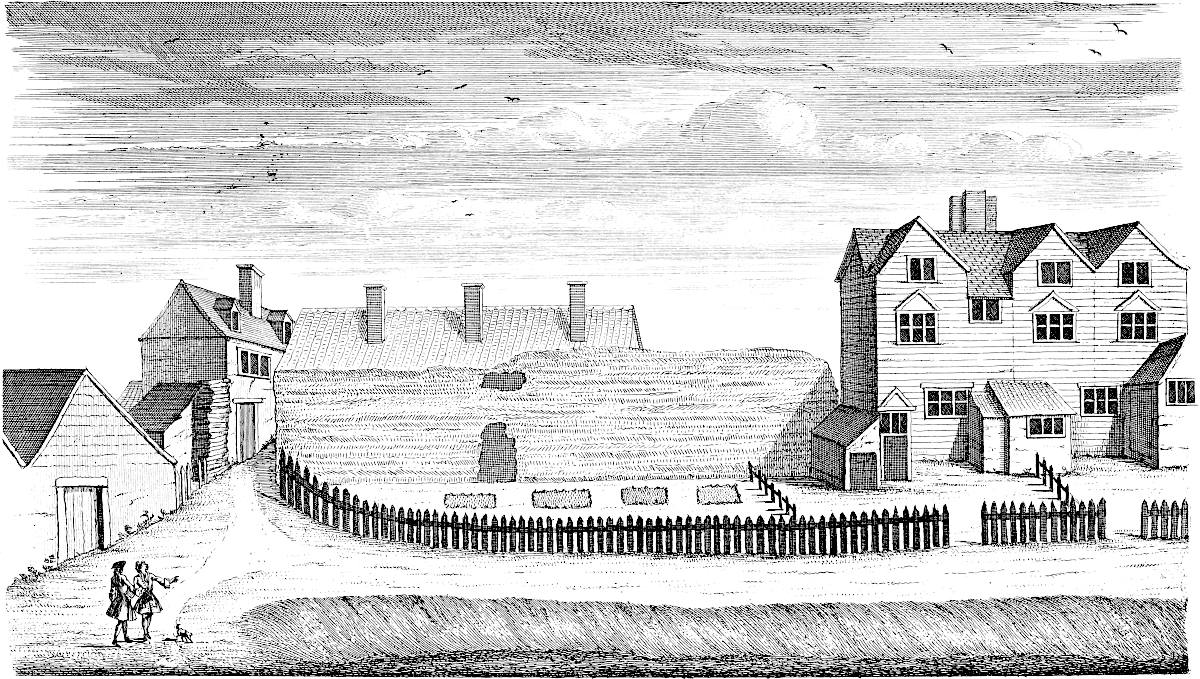
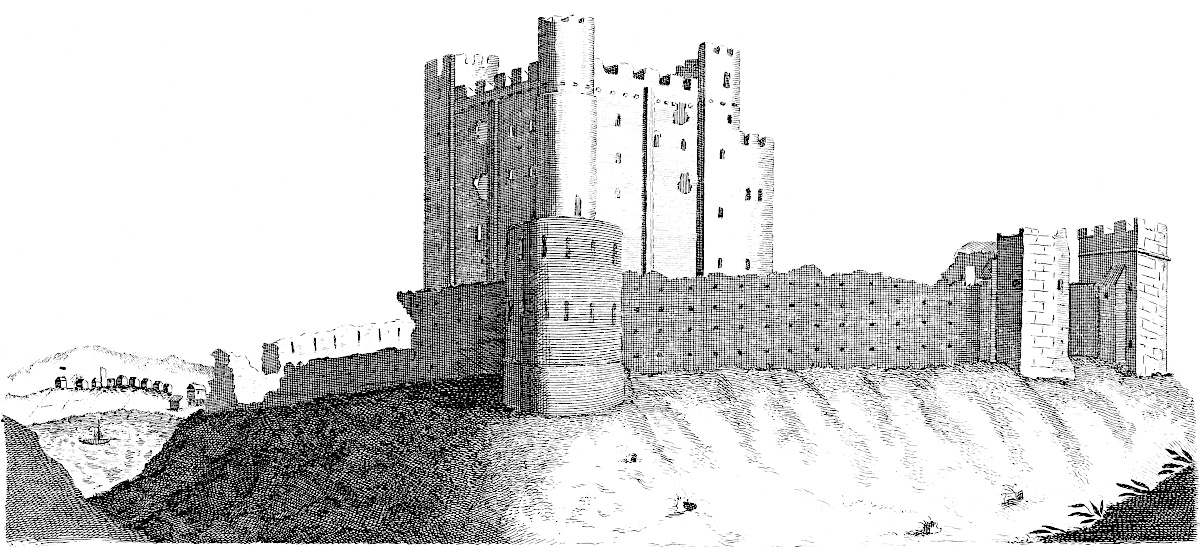
The river Medway at Rochester is very broad and rapid, foaming most violently: there is a stately bridge built across it: below bridge lie about fifty of our biggest first rate men of war unrigged, such as the Royal Sovereign, Britannia, Barfleur, &c. The Roman city was very strong, being walled about and ditched:[107] near that angle below the bridge, TAB. XXX. 2d Vol.incompassed by the river, is a large piece of Roman building of the wall, made of rubble-stone laid sloping side-ways, here and there Roman bricks: houses are built upon it, and it is broke through for a passage; in the inside much flint. Dr. Thorp has great numbers of antiquities found hereabouts. This city stands in an angle of the river: it seems to have been of a square form, the Watling-street running directly through it: most of the walls still remain, but repaired. TAB. VI.The castle was built out of one angle by William the Conqueror, which together with the cathedral has altered the regular ground-plot of the city, as at Lincoln: the walls of the great tower now left are four yards thick. The body of the cathedral is of the original structure before the Conquest, repaired by bishop Gundulf an architect, who likewise built the castle: the great tower is now called Gundulf’s tower. The chalky cliff under the castle-wall next the river is a romantic sight: the rapidity of the river wastes it away; and then huge tracts of the wall fall down: in some places you see the bottom of the broad foundation, and which in others is carried down to the water. On the north side of the north-west tower of the church is Gundulf’s effigies.[108] The front of the church is of the old work, but a new window put in the middle. The eastern gate of the city was pulled down not long ago: I saw many of the stones distributed among the adjacent buildings, being of a Roman cut.
Vaginacis.
TAB. XXXI. XXXII. XXXIII. XXXIV. 2d Vol.
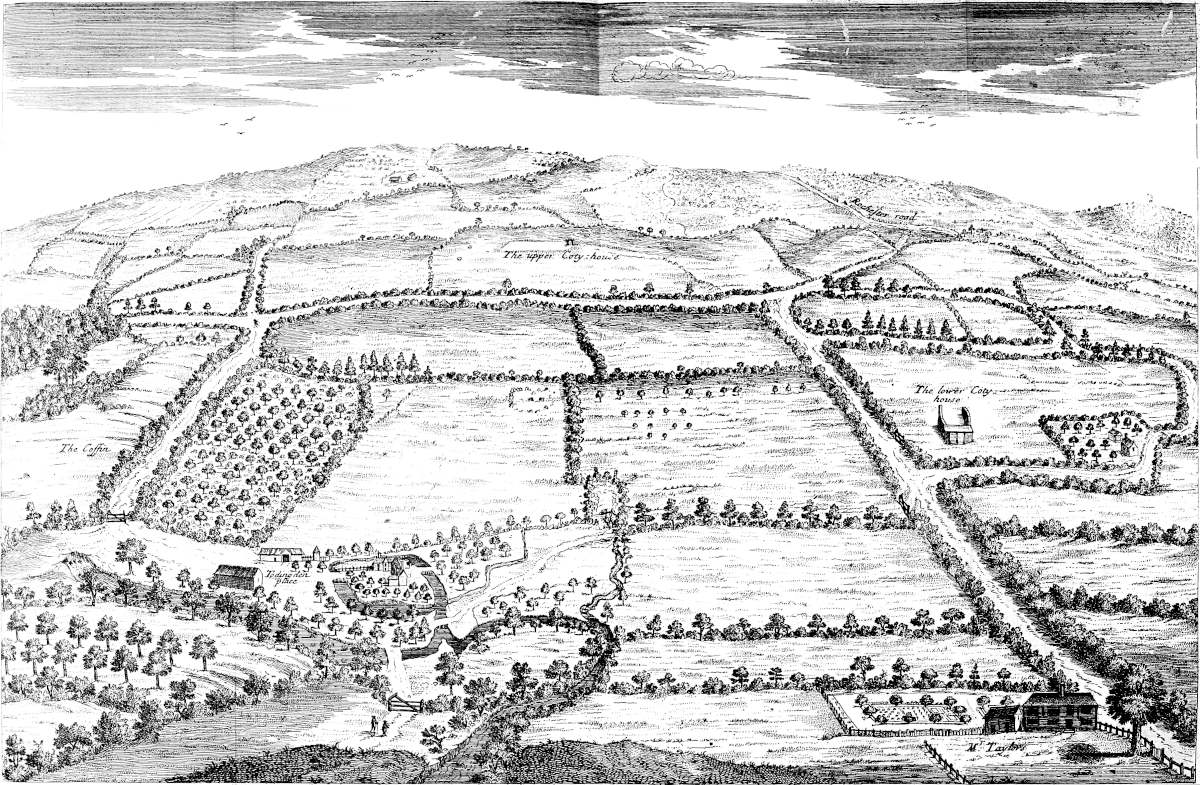
We must now, according to the Itinerary, leave the Watling-street, and go to Maidstone. The road hither passes by that famous British monument called Kits-coty-house. It cannot be disputed but that Maidstone is the next Roman station. Mædwæg I apprehend signifies the meadows upon the river Vaga, which are here beautiful: whether the Latin word be Madviacis, or Vagniacis, I see no difficulty in forming it from the British.[109] The archbishop of Canterbury had a palace here, founded by John Ufford, finished by Simon Islip: a college or hospital was erected by A. B. Boniface, and a chantry by Thomas Arundel, now the free-school. About 1720, they dug up several canoos, made of hollowed trees, in the marshes of the river Medway above Maidstone: one is used for a boat to this day. I saw, in the hands of Dr. Dodd, a British coin of electrum, found at Addington near Malling, anno 1720, in the foundation of a stone wall: on the concave side a British horse, rude enough; the convex was plain.
30·2d.
Stukeley delin.
Toms Sculp.
A Piece of the Roman Wall at Rochester 7. Oct. 1724.
6
Rochester Castle 4 Oct. 1722.
Dno J. ohi Elwill Bar.
tto
dd.
W. Stukeley.
31·2d.
A Prospect of Kits Coty:house Kent Oct: 15. 1722.
E. Kirkall sculp.
Illustrissimo Heneagio Comiti Winchilsea Animi fortitudine & eruditione singulari plusquam titulis nobili, Antiquitatem hanc D. Ws. Stukeley.
32·2d.
Kits Coty house 15. Oct. 1722. The N. E. Prospect.
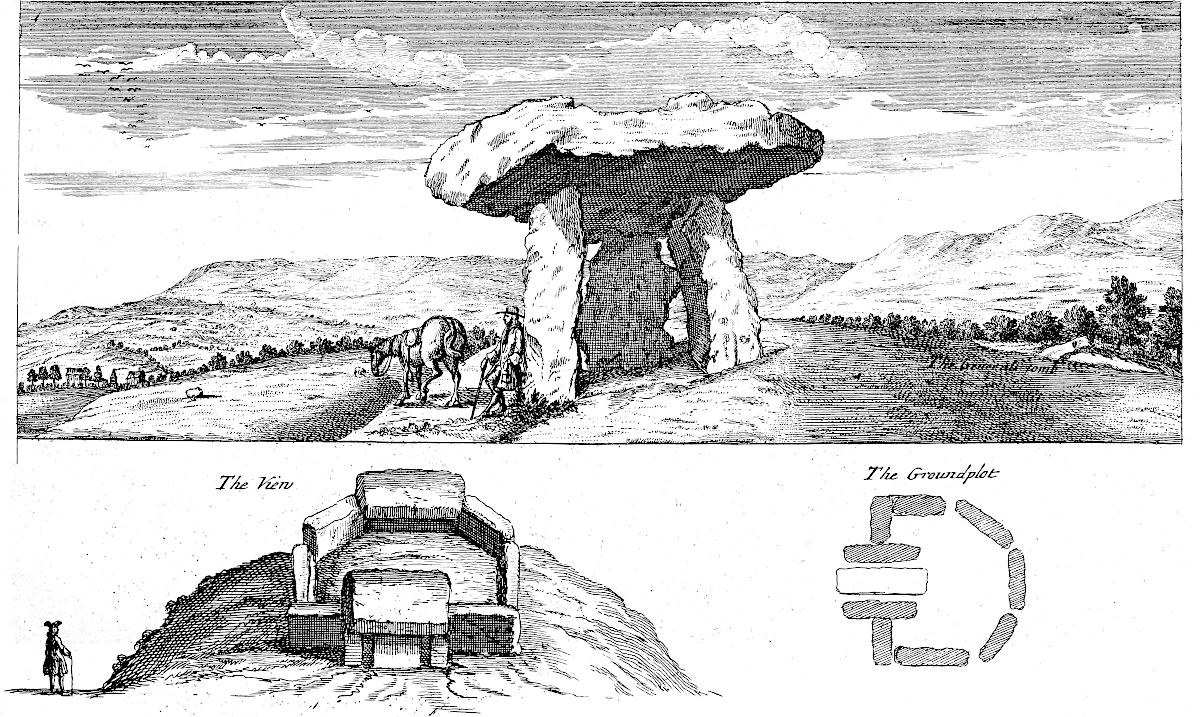
The lower Coty house
Stukeley delin.
E. Kirkall sculp.
33·2d.
A Prospect of the Country from Kits Coty house 15 Oct. 1722.
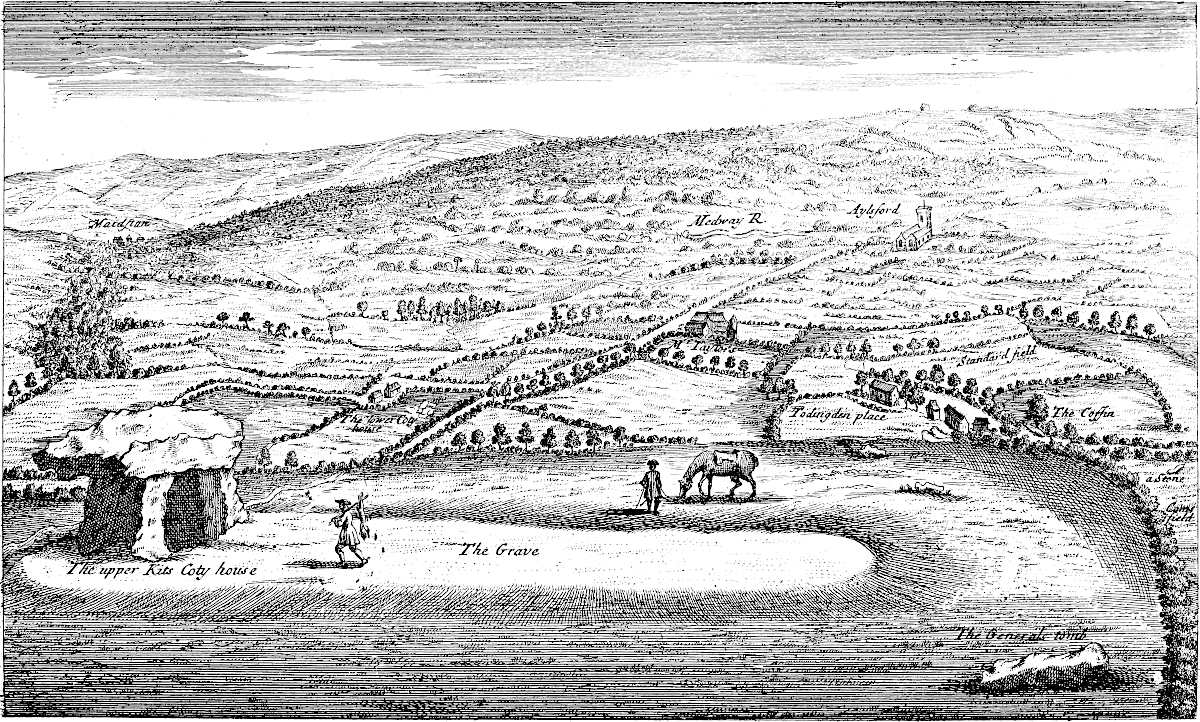
34·2d.
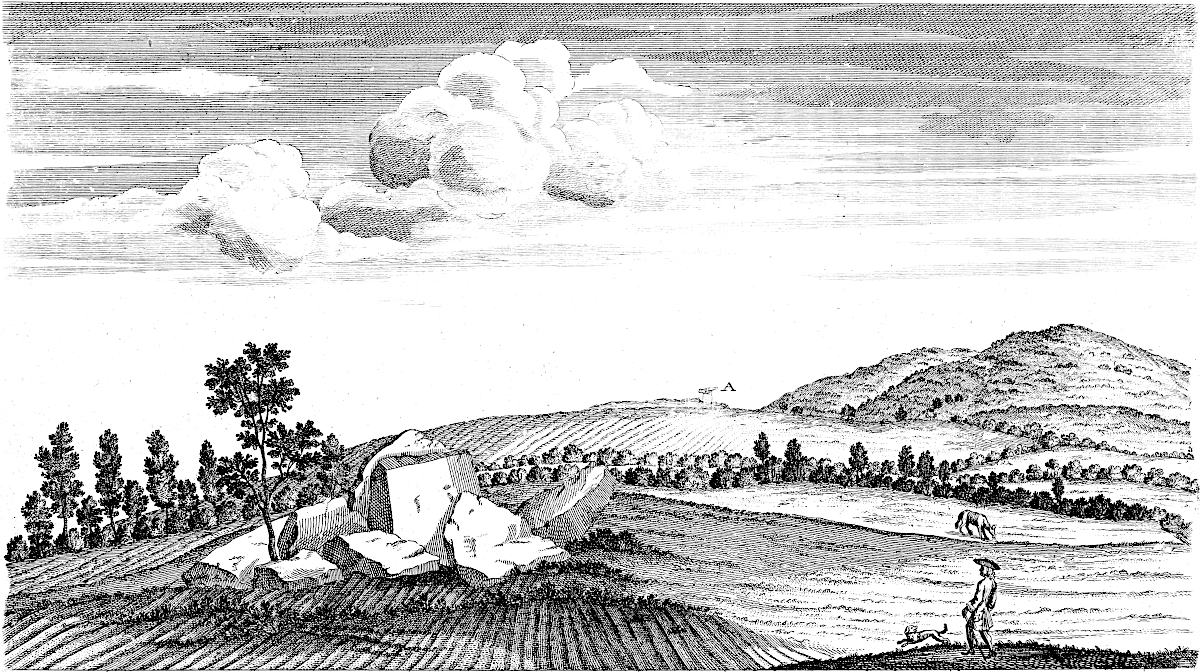
View of the Ruins of the Lower Coty house. A. The Upper Coty house.
27
Dno. Samueli Lennard Barr. to Tabula Votiva.
Stukeley delin.
E. Kirkall sculp.
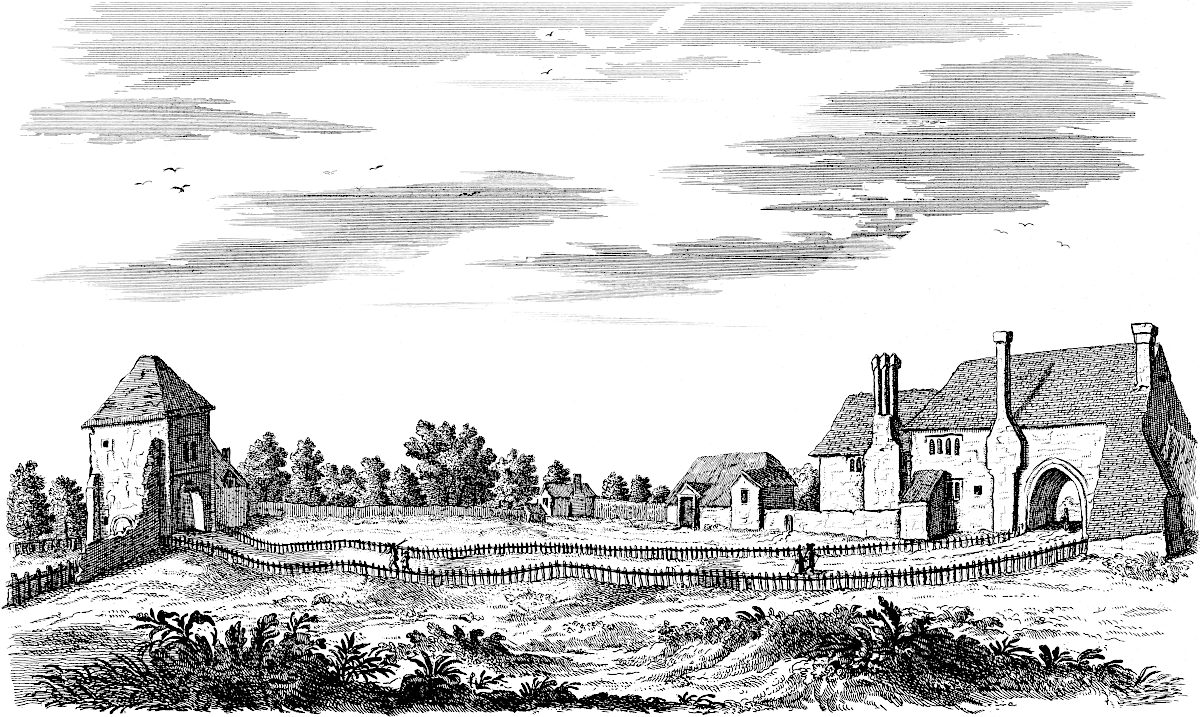
5 Oct. 1722. Prospect of the Remains of Feversham Abby where K. Stephen was buried.
Durolenum.
From thence the Itinerary leads us to Durolenum. The learned Talbot first guessed it to be Charing; and to me he seems to be in the right. It is upon a spring of the river Len. The present name is derived from the British Caer, as they called all Roman towns in after-times: anciently it was wrote Cering with a Saxon termination, intimating the meadows it stands upon. Roman antiquities are found all about, but nothing I have yet met withal, that particularly fixes the spot the Roman city stood upon. Near is a manor called Broughton; Chart[110] is the name of the hundred, from two little adjoining villages: but at this place the distances answer well, and the roads in many parts appear: that from hence to Canterbury passed by Chilham; so over the river Stour by Sharnford, which retains the British name of a causeway. The archbishops of Canterbury had a castellated palace at Charing, probably given them by some of the first Saxon kings, as a royal demesne of theirs: there are large ruins of it still left. Here was a chantry founded by Sir John Burley. All the ground upon the river Len at the bottom of the great ridge of hills is sand, sometimes exceeding white; between that and the bottom of the hills it is flinty: the hills themselves are pure chalk. All Kent consists of large tracts of ground gradually rising from the east to a western ridge steep that way, so succeeded by another of like manner; but any of these tracts are made up of little hills and short valleys, quite of a different nature from those on the west side of the island: and Mr. Camden has observed this before us, as to the northern part of the island, p. 533. Britannia. We may gather an idea of the natural reason of it from what we spoke at first, of the ground hardening upon the instant of the earth’s rotation.
After we have made this excursion with Antoninus, to take in these two stations, which seems to have been done to conduct travellers the nearest way to the portus Lemanis, we return again to Rochester, that we may finish the progress of the Watling-street.
Feversham.
From Rochester the Watling-street continues very strait to Canterbury, by Feversham, whither I went to visit the remains of the monastery founded by king Stephen, and where he was buried with his family. At present nothing left but TAB. XXVII.two gate-houses, and they of mean structure: the hall was standing intire within this forty year; but now the whole monastery is level with the ground, and converted into orchards, so that I could not so much as guess at the place where the church was. They have a report still, that at the dissolution of abbeys they took up the coffin of lead wherein the king was buried, and sold it: as for his corpse, they threw it into the Thames. Here king Ethelstan enacted laws, anno 903. At Newington.Newington seems to have been another station: many Roman coins and antiquities have been found Ro. town.there. Vide large accounts thereof in Burton’s Itinerary, p. 181. and Casaubon’s translation of Antoninus Philos. Beyond Broughton, which seems to have been another,[111] you come to a very high hill, steep on the west. The Watling-street here first presents the tower of the cathedral in its line, and both together make a fine show:
Apparet rursum moles operosa viarum, Consurgit stratis agger ubique suis.
Durovernum.
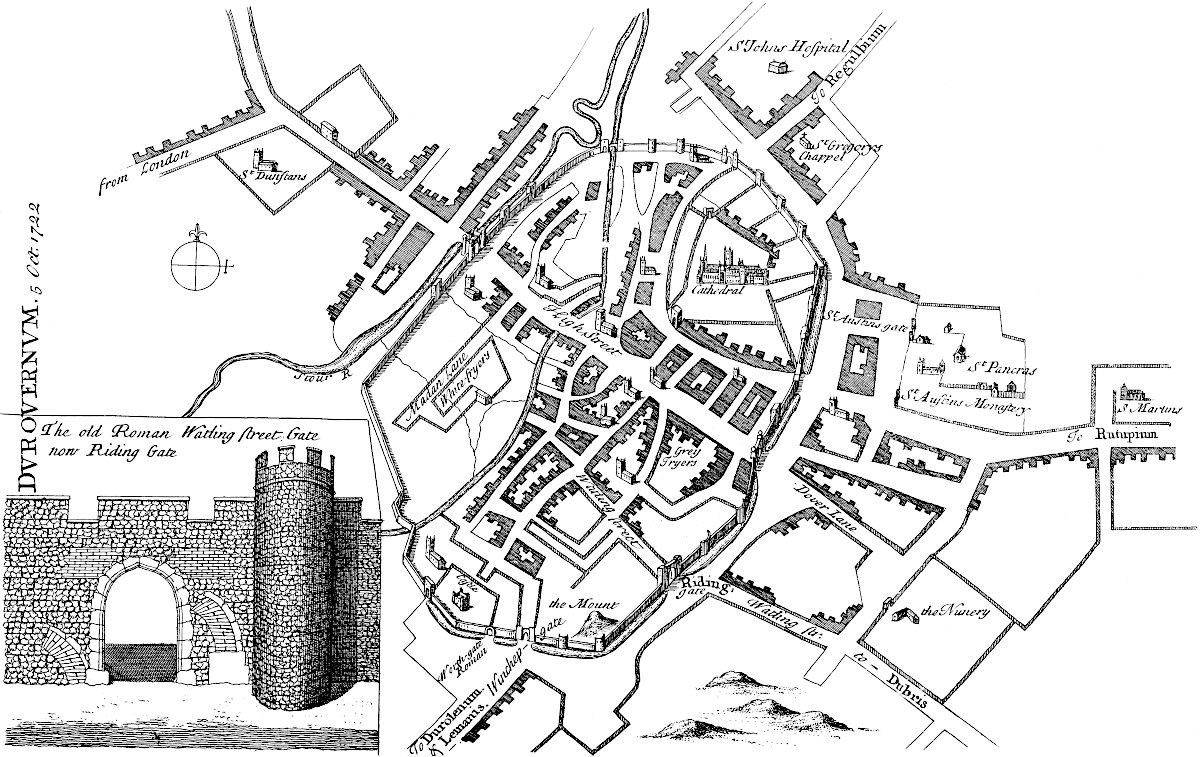
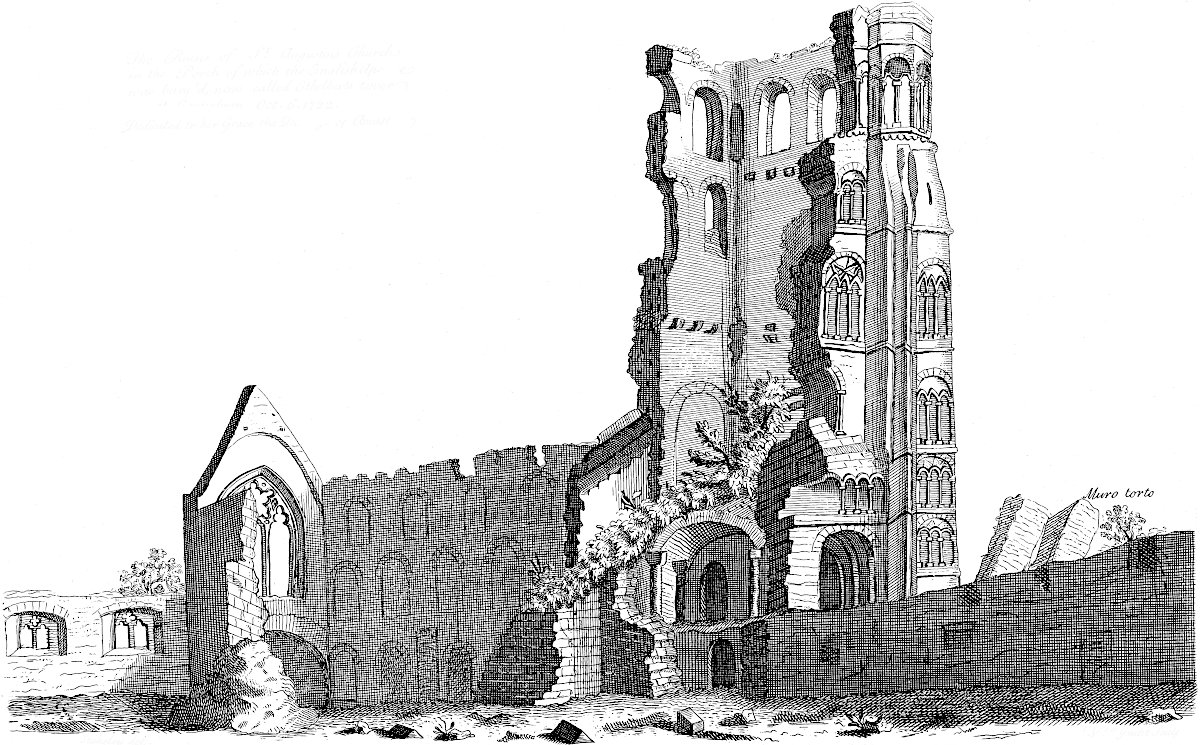
Canterbury is deservedly famous for religious as well as Roman antiquity, being the place where christianity first made its entrance among our Saxon ancestors. Here are many remains of Roman buildings, many made of TAB. XCVI.Roman materials in the Saxon times: many antiquities found in digging about the hop-grounds; your lordship has quantities of them. The city is strongly walled about, and many lunettes or towers at due intervals; a deep ditch close underneath, and a great rampart of earth within. The original ground-plot here, as in many other cities, is spoiled by churches built in the middle of streets. To the south is an old obscure gate, called TAB. LIV.Worth gate, partly walled up: it is under the castle. This is intirely a Roman work: the semi-circular arch is of Roman brick, beautifully turned; the piers of stone; the thickness of it is three Roman feet. I suppose this the original gate of the Roman city, and from hence went the road which presently divides itself into two: the one goes by Chilham to Durolenum, over the river at Sharnford, as we said; the other goes in a very strait line, by the name of Stone-street, to the port of Lemanis. The castle built here in William the Conqueror’s time, extending its limits beyond this gate, was the occasion of blocking it up; and so Winchup gate was built a little further eastward, to supply its use. The castle is much of the same form as that at Rochester, and the walls of the same thickness. A little further within the walls is a very high mount, called Dungeon hill: a ditch and high bank inclose the area before it: it seems to have been part of the old castle. Opposite to it without the walls is a hill, seeming to have been raised by the Danes when they besieged the city. The top of Dungeon hill is equal to the top of the castle, and has a fine prospect over the city and country. The materials of the city-walls are chiefly flint. Next to this, where the Watling-street comes,[112] is Riding-gate, built by a mayor of the city, but evidently in the place of the Roman one; for there is part of the Roman arch, and the pier of one side, still visible, but much lower than the present gate: and in a yard close by is part of the arch of a postern, or foot-gate, by the side of it: these arches are of Roman brick, and there are in the wall here and there some more fragments of the Roman work. The draught of it I have given in the plate of the city ground-plot, 96. Hence the Watling-street passes directly to Dover, over Barham downs. Next to East-gate is another gate, opposite to what they call St. Ethelbert’s tower: this is the way to the port of TAB. XXV.Rutupium. Here is the famous monastery of St. Augustin, the first metropolitan, built, as they say, near the palace of the converted king Ethelbert: two gates remain next the city, and both very stately: perhaps one belonged to the palace, the other to the monastery, which doubtless as magnificent as richly endowed; and such its ruins demonstrate, and the great compass of ground it took up, incircled with a very high wall. Great vying was ever here between the religious of St. Austin and of Tho. à Becket, both very rich and contentious. At the west end of this church, as I conjecture, were two great towers: half of one is still remaining, called TAB. XXIV.Ethelbert’s tower: all the whole stones and pillars about it are skinned off as far as they can reach; and every year a buttress, a side of an arch, or the like, passes sub hasta. There is part of the other standing, if it can be so said, that is only not fallen; I call it muro torto: it is a vast angular piece of the tower, about thirty foot high, which has been undermined by digging away a course at bottom, in order to be thrown down; but it happened only to disjoint itself from the foundation, and leaping, as it were, a little space, lodged itself in the ground in that inclining state, to the wonderment of the vulgar who do not discern the meaning of it, though the foundation it came from is sufficiently visible: thus happening to be equally poized, it is a sight somewhat dreadful, and forbids a too near approach on any side, with the apprehension of its falling that way. Under St. Ethelbert’s tower is the porch where St. Augustin and his six successors, as Bede tells us, were interred: the arched roof is left, but ready to fall: the pavement is gone, in the middle of which was an altar. The adjacent close is full of religious ruins and foundations, one great part turned into a stable near the almery: all over they are busy in pulling it up, to sell the stones; which generally pays the rent, and yet the tenants of such places thrive never the more. TAB. XXV.In one corner of this field are the walls of a chapel, said to have been a christian temple before St. Augustin’s time, and reconsecrated by him to St. Pancras: a great apple-tree and some plum-trees now grow in it: the lower part of it is really old, and mostly made of Roman brick, and thicker walls than the superstructure: there is an old Roman arch on the south side toward to altar, the top of it about as high as one’s nose; so that the ground has been much raised: the present east window is a pointed arch, though made of Roman brick, later than St. Austin’s time: near it a little room, said to have been king Ethelbert’s pagan chapel: however it be, both these and the wall adjoining are mostly built of Roman brick: the breadth of the mortar is rather more than the brick, and full of pebbles; but the mark of the devil’s claws, there observed by the vulgar, is fantastical. The garden and orchard adjoining seem to lie in their ancient form: there is a large square mount close by the wall, which it equals in height, and gives a prospect into the fields. Your lordship has a huge water-pipe dug up among many other antiquities in a Roman bath discovered at Canterbury: it is five inches and a half diameter at the smaller end, seventeen long, seven in diameter at the broad end: they were fastened into one another with strong terrace cement. The great number of other antiquities of all sorts, found at and about this city, make part of your fine collection.
96
DVROVERNVM. 5 Oct. 1722
Stukeley delin.
I. Harris sculp.
Collegæ charissimo Johi Gray M. D. Civitatē svā dd. W. Stukeley.
24
The Ruins of St. Augustins Church in the Porch of which the English Apostle was bury’d, now called Ethelberts tower at Canterbury Oct. 6. 1722. Dedicated to her Grace the Dutchess of Ancaster.
Stukeley delin.
I.V.der Gucht Sculp.
25
A View in St Austins Monastery Canterbury
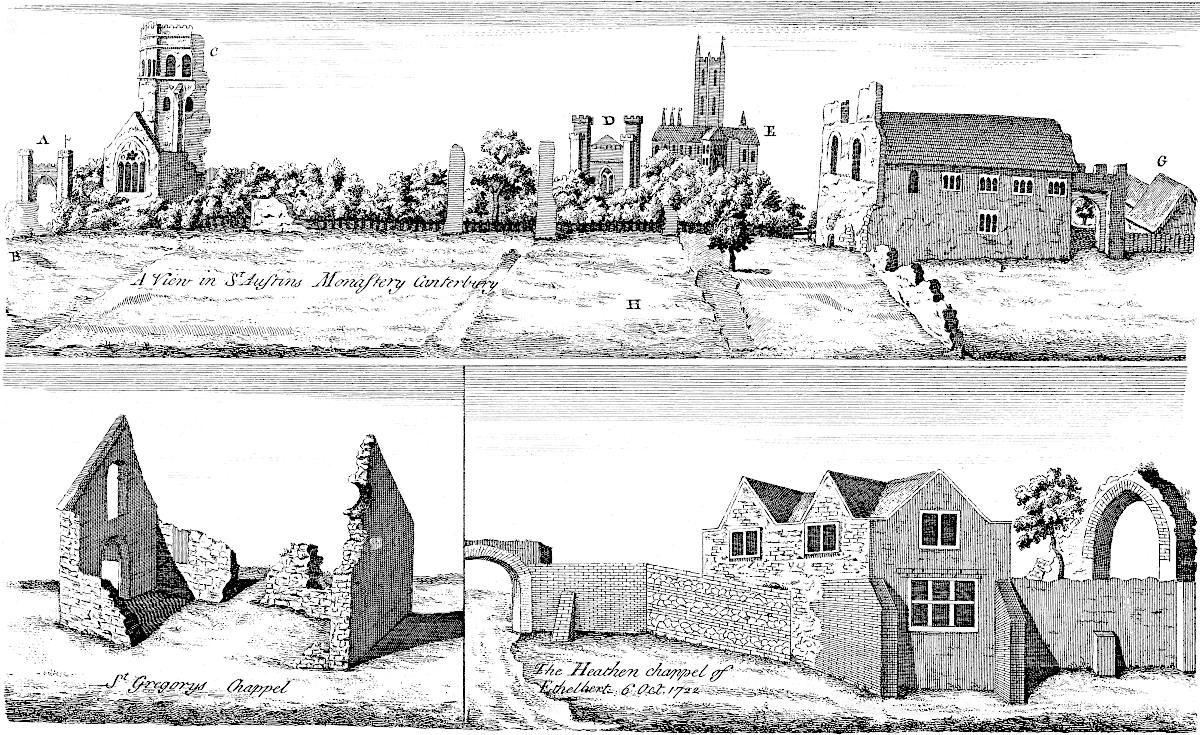
St Gregorys Chappel
The Heathen chappel of Ethelbert. 6 Oct. 1722
Stukeley delin.
Harris sculp.
Eastward of this, and farther out of the city, is the church of St. Martin, said to be the christian place of devotion, where king Ethelbert’s queen used to go, and St. Austin’s first see: it is built, for the most part, of Roman brick: in the middle is a very large old-fashioned font, supposed that where the king was baptised. North of the city is a very small remnant of St. Gregory’s chapel, founded probably by Austin to the honour of his patron.
The cathedral of Canterbury is very stately, but neither in length, breadth, nor height, especially in front, equal to Lincoln, in my judgement: it is intirely vaulted with stone, and of a very pretty model of building, but much too high for its breadth, as all Gothic buildings were. I believe they got this ill taste from building upon the old foundations, the ancient churches being much narrower and lower than in the succeeding times: when greater riches flowed in upon them, they carried their walls and roofs to an unseemly height. The place where Thomas à Becket’s shrine stood, is sufficiently known by the mark of the devoted knees quite around it, which have left deep impressions in the hard coarse marble. The Black Prince has a noble monument of brass: that of Henry IV. is a good tomb, and there is a pretty chapel hard by, to say mass for him. There is an old picture of arch-bishop Becket’s martyrdom, as called; and upon the wall an old painting of the siege of Jerusalem, in our old habits. Here are several monuments of the bishops. The metropolitan chair is of grey marble, standing behind the high altar: the cloysters are pretty good, and a very large chapel near them, called Sermon-house, wainscotted with Irish oak. The reason of the ancient name of this British city seems intimated in this verse of Virgil,
Divinosque lacus & averna sonantia silvis.Æn. iii.
The poor derivation of the commentators thereon ought to be referred to Tuscan original, to which our Celtic is a-kin.
Rutupiæ.
TAB. XXXV. 2d Vol.
Leaving Canterbury,[113] I journeyed to find out Rutupiæ. At Wingham I saw a very large barrow, of Celtic make, by the road side, called the Mount: upon enquiry I found there were several more in the parish, and that a lane here is called Port-lane; doubtless the Roman road, for here the common road goes more southward. The Roman city and port without peradventure was the place now called Stonar, or Stanar, as they pronounce it, from the stony foundations I chuse to think; over-against Sandwich, or rather half a mile lower upon the river coming from Canterbury, and almost incompassed by it. This river at first discharged itself into the sea by Ebbesflete, north of the Roman city, till the sand, pouring so directly upon it, obliged the stream to slide under the cliff by Richborough castle, and so by Sandwich: then, coming in obliquely by the weight of its waters, it maintains its passage. I conceit the etymology of Rhutupium, about which the learned contend much, is to be sought for in this Ebbesflete; and that this water was originally called Ube, or Tyvi: rhyd tyf or tyvi, is the passage over it: the Saxons called it Reptacester, a contraction only from Rhutupicester: and so our Ebbe at present came from them; Ruptimuth anciently. Hence you see far into the isle of Thanet and Ramsgate cliff, named from the Romans, thrusting its chalky promontory into the sea. This was the chief port for the Roman navy.[114] At present there is only a farm-house or two, standing on an elevation in the marshes: they informed me that here had been a great city, and that they can discover all the streets when the corn is on the ground; and those streets are nothing but pure gravel laid very deep: innumerable stones and foundations have been dug up, but now mostly evacuated; and no doubt Sandwich was built out of it. The river runs close by it, with difficulty preserving its current to the sea; but no doubt originally it was an open beach, or port: perhaps the city itself was an island. The old mouth of the river is now filled up by the astonishing quantity of small pebbles thrown into this bay by the roll of the ocean: you see here a hundred acres of this flat ground covered over with them six or seven foot deep, and looking blue like the water. I fancied the people that lived here, in like danger with those that travel the sandy deserts of Africa, or Arabia. Here are two elevations, where they say two churches stood: upon one, where an elder-tree grows, much rubble and stone is left, but no part of any building; nor is it easy to distinguish what it was originally.
35·2d.
View of Portus Rutupiæ from Sandwich. 7. Oct. 1722.
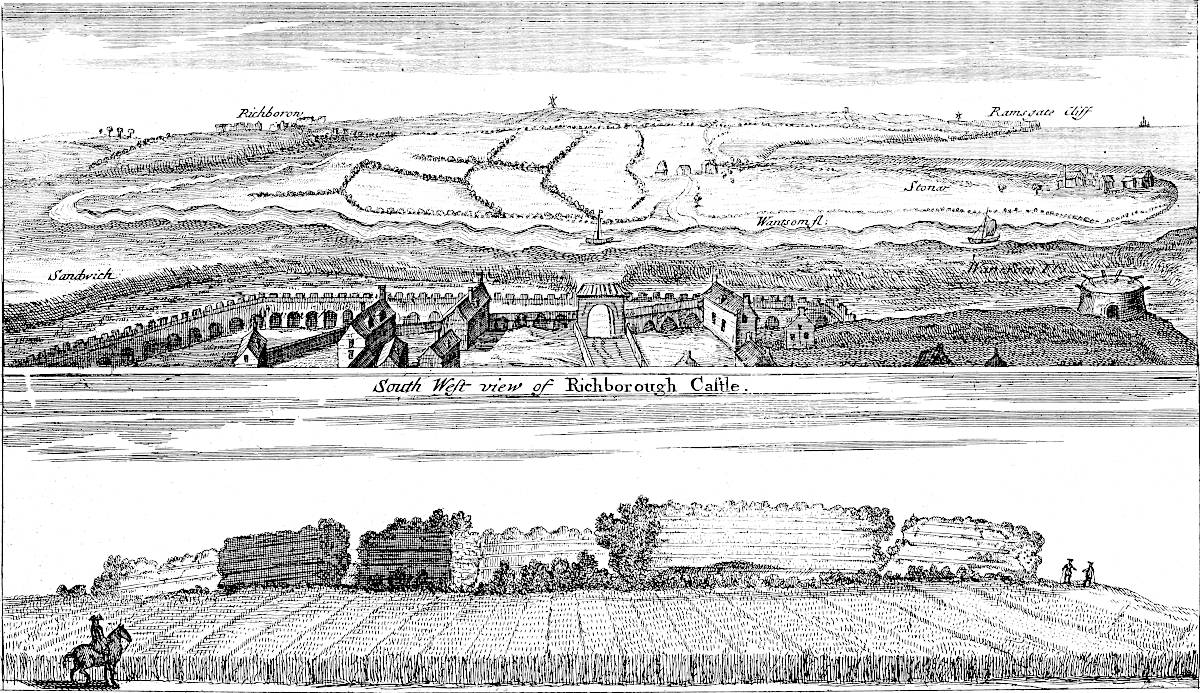
Stukeley delin.
E. Kirkall sculp.
South West view of
Richborough Castle.
97
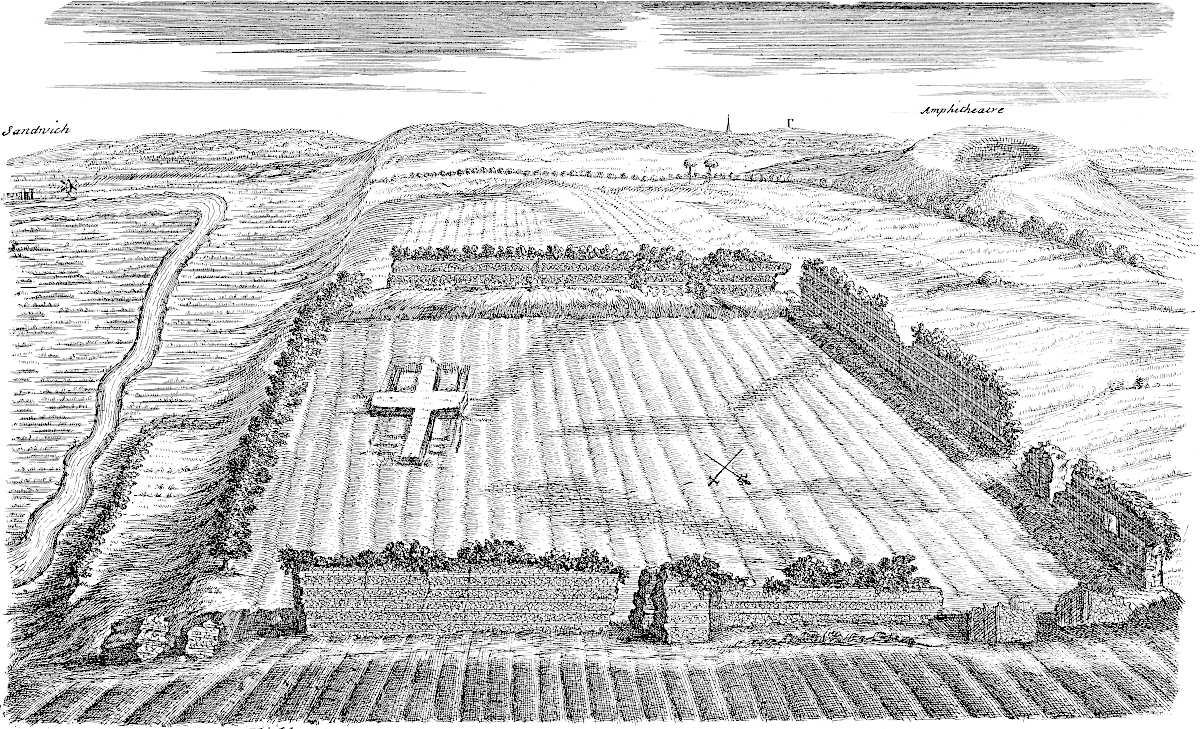
Stukeley delin.
Richborow
Castle of the Romans 7 Oct. 1722
. Auspiciis Doctissimi D. Tancred Robinson M. D. &c.
36·2d.
The Remains of the Castrensian Amphitheater at Richborough Castle. Oct. 7. 1724.
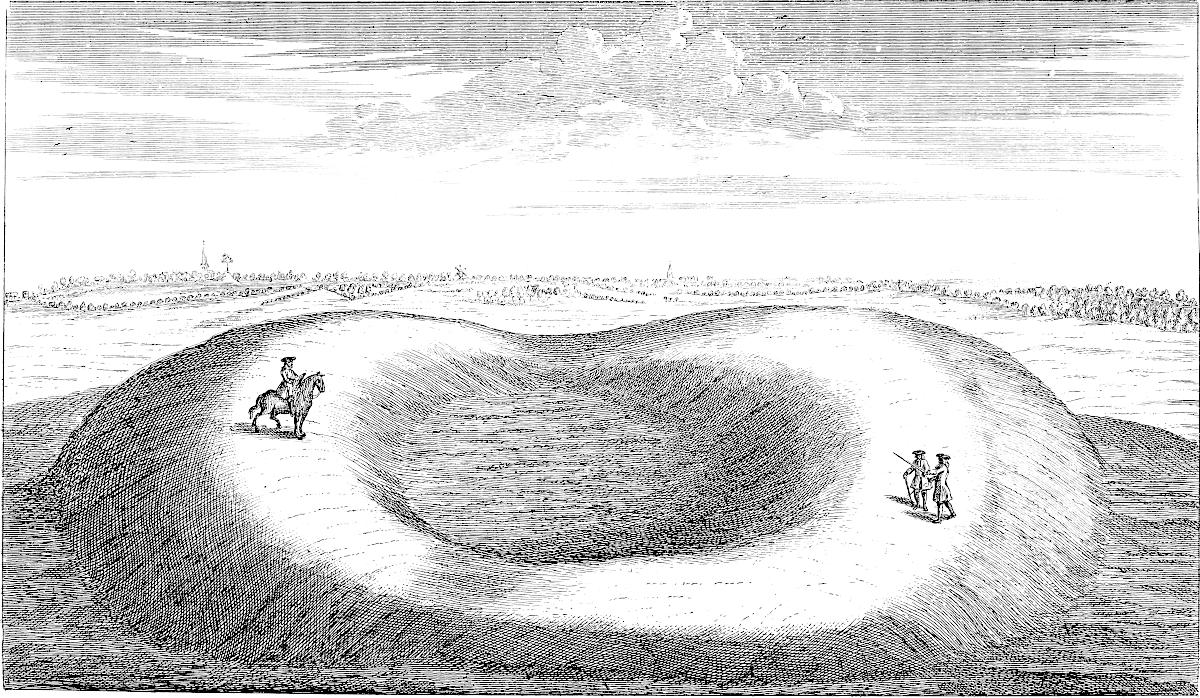
Stukeley delin.
E. Kirkall sculp.
TAB. XCVII.Richborough castle, as now called, was the fort as it were to this city, and station of the garrison, which was to watch and defend the port and sea-coast hereabout; or rather one of those castles built upon the littus Saxonicum, in the time of Theodosius: it is a mile off Stanar and Sandwich, situate upon the highest elevation near hand, and being the only small part of a bold shore in all this bay: the river runs at the foot of it,
———— arvaque & urbem Littore diductam angusto interluit æstu.Virg. Æn. iii.
It is a most noble remnant of Roman antiquity, where in later times of their empire the Legio II. Aug. was quartered: the walls on three sides are pretty intire, and in some places still about twenty-five or thirty foot high, without any ditch: the side next the sea being upon a kind of cliff, the top of the wall is but level with the ground: beside, at the east angle the wall descends to another slope just upon the river, which seems to have been in the nature of an outwork, or gradual ascent into the castle: the ground on the inside is pretty much raised. In the middle of the north-east side there is a square work jutting out from the wall, which seems to have been an oblique[115] gate to enter at, for those that came from the water side; and it is not unlikely that gap on the north-west side was another gate: it was a square CV. paces one way, CL. the other; according to the Roman method of making camps, a third part longer than their breadth. There is a foundation within, which has caused many words among the Kentish antiquaries; seems to have been a Pharos, or lodging for the commanding officer, a prætorium: there are foundations of several apartments, the walls monstrously thick and strong. It is manifest to any one that seriously contemplates the ruins of the walls in divers places, that this castle was destroyed by great violence and industriously; I guess, by the Saxons immediately after the Romans left the island, when they could more boldly make descénts upon the coast: the reason why, is evident from the intent of these castles: upon the eastern corner, especially, great piles of wall lie one upon another like rocks: in other places cavities are hewn out of its thickness, that would make good lodging-rooms: the manner of the composition of the walls is seven courses of small hewn stone, which take up four Roman feet: then two courses of Roman brick, which are white, like the brick in the isle of Ely. I observe all the brick about Sandwich to be of the same colour, made of whitish clay. The walls are twelve foot thick: the inward body thereof is made of flint and excessive hard mortar. Sandwich bears directly south. Dr. Holland talks of a carved head over one of the gates; but I could find no such thing now. In the way thither, upon an eminence is the carcass of a castrensian Amphitheatreamphitheatre made of turf; I suppose, for the exercise and diversion of the garrison: the soil of it is gravel and sand, and has been long ploughed over,TAB. XXXVI. 2d Vol. that we need not wonder it is so level. There are three Roman tumuli before Sandwich west gate; one a windmill stands on: it is not easy to assign which Contentus was buried under:
Contentum tellus quem Rutupina tegit. Auson.
South of Sandwich, as we go along upon the sea-shore, are six large and broad Celtic tumuli, equidistant: the second from the town has been dug away, to raise a little fort upon the road: they all stand in a line east and west.[116] This flat coast is fenced against the ocean by the sand-downs, which in Lincolnshire we call meals: but within the memory of man, as they told me, the sea has commenced a new method of guarding against its own violence, by covering the shore, for a great depth and height, with the pebbles afore mentioned; which is an odd mutation in nature; and it is observable that these pebbles come from the south. I rode from Sandwich as far as Hithe, upon the brink of the shore or cliff, in sight of France all the way; and nothing could be more entertaining in this autumnal season, when the weather is generally clear, serene and calm. Much sea tithymal grows here, and a very pretty plant, papaver cornutum flore luteo, rock samphire feeding upon petroleum, a most excellent pickle, and many more.[117] The murmur of the ocean has a noble solemnity in it, as Homer says, when latinised,
Eructante salo raucam dant littora vocem.
More copiously expressed in Virgil,
Et gemitum ingentem pelagi, pulsataque saxa, Audimus longe, fractasque ad littora voces. Exsultantque vada atque æstu miscentur arenæ.Æn. iii.
which is an exact idea of this place. By listening attentively I observed this noise of the ocean is by fits, at short but equal intervals; which I believe gave occasion to that fancy of the ancients, that every tenth wave was the largest; of which Ovid has a distich.
Sandown castle is composed of four lunettes of very thick arched work of stone, with many port-holes for great guns: in the middle is a great round tower, with a cistern at top; underneath an arched cavern, bomb-proof: a foss incompasses the whole, to which there is a passage over a draw-bridge. Deal castle and Walmer castle are of the same nature, all built by Harry VIII. to guard this naked level coast: moreover, lines are drawn along between castle and castle, and at proper intervals round bastions with a ditch and parapet of earth, where cannon may be planted, as in the infancy of fortification. These are what Camden calls Rome’s works, and fancies to be remnants of Cæsar’s ship-camp: the neighbours with as little truth affirm they were thrown up by Oliver Cromwell, for reduction of these castles: one is close by the north side of Deal, and two between Deal castle and Walmer castle. At Walmer castle the cliff begins for about half a mile southward with a gentle rise to a hill, whereon is a tumulus: then the shore is plain again in a valley till you come to Kings-wold, which is half a mile’s space. TAB. XXXVII. 2nd Vol.Between Walmer castle and Deal I take to be the spot where Cæsar landed in his first expedition, because it is the first place where the shore can be ascended north of Dover, and exactly answers his assigned distance of eight miles: probably in his second expedition, when he came with many more ships, and had a perfect knowledge of the country, he went a little farther in the downs, whereabouts now is Deal, a town lately sprung up from the mariners. As for his sea-camps, it is vain to expect a sight of them; they are many ages since absorpt by the ocean, which has so long been exercising its power, and wasting the land away. Even since Harry the VIIIth’s time it has carried off the sea-ward esplanades of the three castles, and one half of two of the three circular forts. Indeed, of late years, the providential ejectment of those pebbles has put a stop to it in some measure; and it is amazing to see how it by degrees fills up these fosses and trenches, and sometimes flies over the banks a good way up into the land, with a power well expressed by the poet,
Aut vaga cum Tethys Rutupinaque littora fervent.Lucan. vi.
But of this affair of Cæsar’s I reserve to myself another opportunity of speaking, when I shall expresly treat of his expedition hither. At Deal castle is a very good well, though close by the sea.
37·2d.
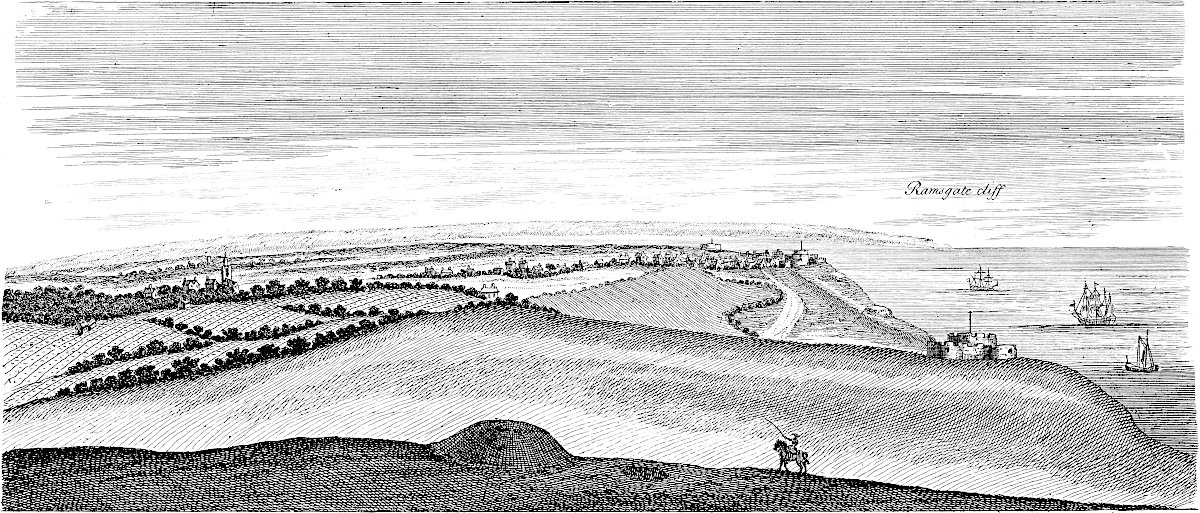
Stukeley delin.
Toms Sculp.
A Prospect towards Deal from y
e
Barrow South of Walmer Castle.
38·2d.
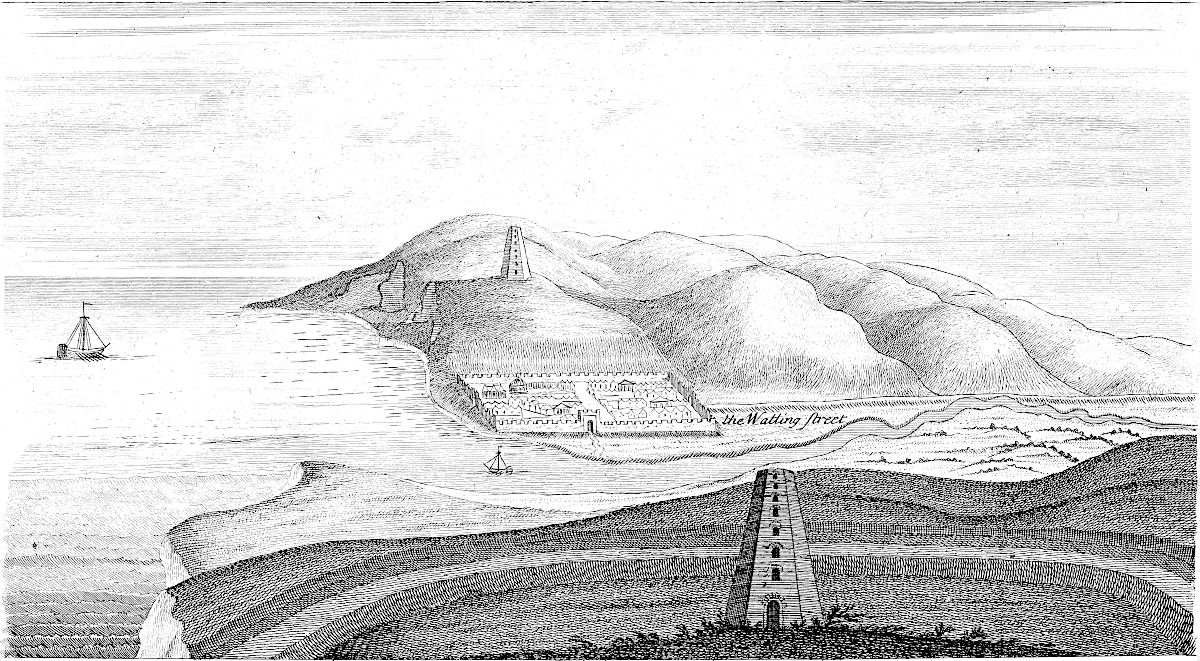
Stukeley delin.
Toms Sculp.
The Appeareance of the Roman
DVBRIS
Now my journey lay intirely upon the edge of the cliffs, whose precipicious height, with the noble prospect at sea, and most awful roaring of the waves, filled the mind with a sense of Nature’s majesty. About St. Margaret’s on cliff, near the light-houses, I saw in two places a great number of little tumuli, of unequal bulk, close by one another; and the like I found frequently about Barham downs, and between Hardres[118] and Chilham, and other places. I know not that such have ever been taken notice of: the people say they were burying-places of the Danes; probably digging into them might give us some satisfaction. I believe them Celtic, because I saw many sorts of them, and such as appear on Salisbury plain.
Dubris Portus.
Dover is a most romantic situation: it is a great valley, and the only one about this coast where water is admitted inwards of the cliff, here very high; and a running brook discharges itself into the sea:[119] the water formerly came a good way higher up, and made a large port; and they have found anchors above the town. TAB. XXXVIII. 2nd Vol.The Roman city of Dubris was to the south of the river: the Watling-street enters it at Bigin gate, coming very strait from Canterbury over Barham down, where it is very perfect:[120] butting directly upon the great tower of the cathedral, it bears a little more northerly than north-west. This city was an oblong square, and some of the walls are left: the churches are of a very antique make: that of St. Martin is collegiate, founded by Wightred king of Kent; it is a venerable ruin: the east end seems to have terminated in three semi-circular works: it was built in form of a cross, as to its main body. Much remains of the priory, now a farm-house. The maison dieu over-against it is become a store-house: here the knights Hospitallers or Templars lodged, coming into, or going out of, the kingdom. The piers that form the haven, or large bason, are costly and great works: above is a fort with four bastions of modern date. The broad beach which lies at the mouth of this great valley, and was the harbour in Cæsar’s time, is very delightful: it is no little part of the diversion, in walking there, to observe the odd produce of the ocean thrown up under your feet, and the sea-plants that grow there; theTAB. XXXIX. XL. 2d Vol. umbelli, star-fishes, many curious fossils and shells; the eringo, sea-lungs, sea-weed, or ood as called, &c. One long street here is named Snare-gate, from the most tremendous rocks of chalk hanging directly over the houses; as Cnarsborough in Yorkshire, says Mr. Camden, p. 715.