ITER DUMNONIENSE. VI. (continued 2)
Reading edition
In Corry lane, over-against St. Paul’s church, is a little old house called King Athelstan’s, said to have been his palace, built of large square stones, and circular arches over the doors: it seems indeed to have been originally a Roman building, though other later works have been added to the doors and windows: over the door in the street is a very small niche crouded into the wall, as if it had been converted into a religious house: in the yard a winding stone stair-case is added. One arch of South-gate seems to be Roman. No doubt the walls of the city are upon the Roman foundation for the most part, and great numbers of antiquities have been found here. In digging behind the guild-hall in Pancras-lane, they found a great Roman pavement of little white square stones eight foot deep. A pot of Roman coin of two pecks was dug up, two years ago, near St. Martin’s church: I saw some of them in Dr. Musgrave’s possession, of Gordian, Balbinus, Philippus, Julia Mæsa, Geta, Gallienus, and the like. Mr. Loudham, surgeon in this city, has many of them among his curious collection of antiquities, manuscripts, &c. Mr. Reynolds the schoolmaster is a great collector and preserver of such learned remains. St. Mary Arches church, and St. Stephen’s Bow, by their names seem to have been built out of Roman temples.
75
MORIDVNVM Aug. 20 1723.
Stukeley del.
A.
Seaton.
B.
Salt pans.
C.
Watch tower.
D.
Portland.
74
Prospect of Exeter 19 Aug. 1723. ISCA Dumnoniorum.
Stukeley del.
TAB. LXXIV.
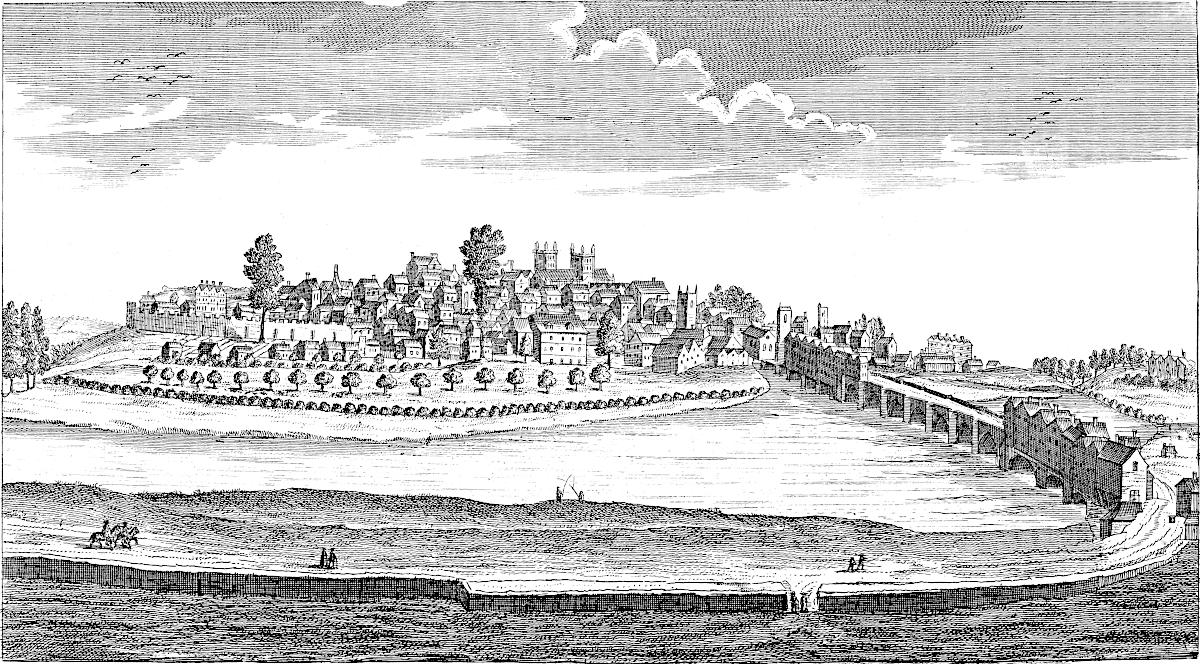
The bridge over the Isca is of great length, and has houses on both sides and both ends; a considerable void space in the middle: there is a church upon it with a tower-steeple. In the Guild-hall are the pictures of general Monk, and the princess Henrietta Maria, born at Bedford-house, a palace in this city, during the civil wars. The composition of the stone of this country is intirely made of little black pebbles, incrusted in a sandy matter of a red colour and mouldering nature.
Moridunum.
TAB. LXXV.
Leaving Exeter, my farthest western longitude at present, I steered my course back again along the sea-side, inwrapped in contemplation with the poet,
Undæ quæ vestris pulsatis littora lymphis, Littora quæ dulces auras diffunditis agris! Virg.
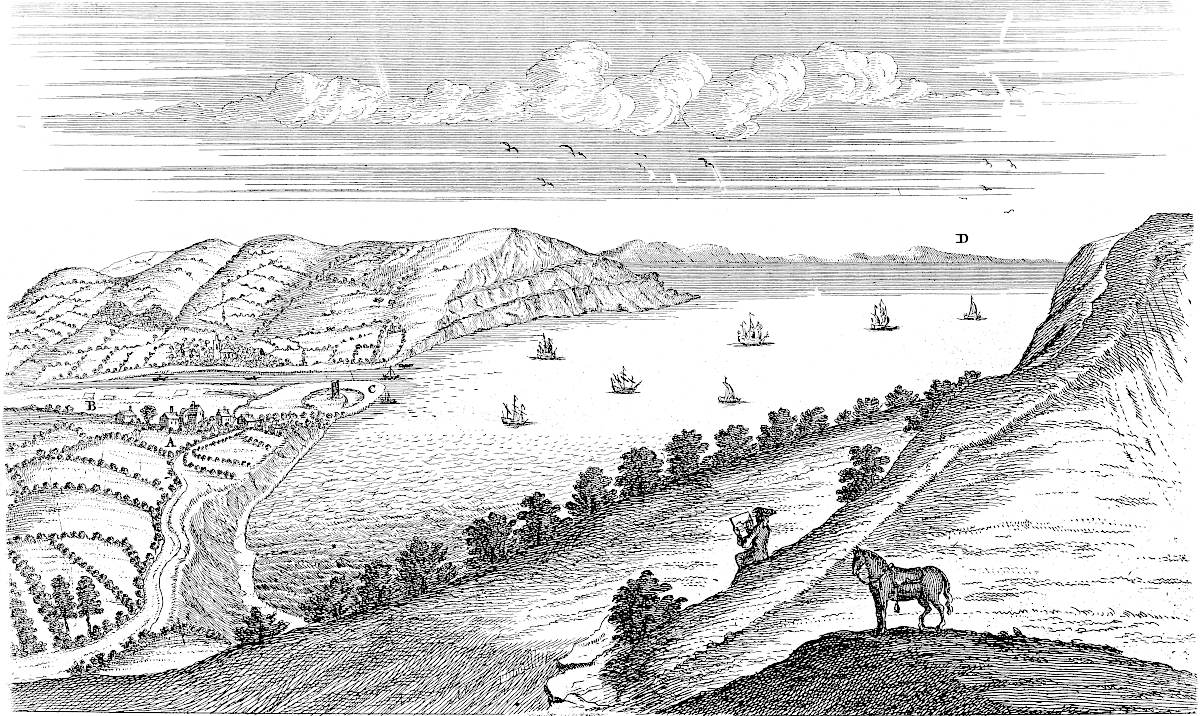
Nor could I think myself alone, when so much new entertainment was presented to me every minute. Much rock-samphire grows upon these cliffs. The Roman road seems to have crossed the Otter at Hertford. At Woodbury is a camp. I passed by Sidmouth, and came to Seaton, a little village upon the mouth of the river Ax. This Mr. Camden conjectures to have been the Roman Moridunum, and with reason: it has been a great haven and excellent port, of which they still keep up the memory: the river runs in a large valley, having high ground on each side: the shore is rocky, high and steep, consisting of the ends of hills which here run north and south: the ground at bottom under the rocks is marly; the waves wash it down perpetually, undermining the strata of stone, which from time to time fall down in great parcels. At present this haven mouth, which is a good half-mile over, is filled up with beach, as they call it; that is, coggles, gravel, sand, shells, and such matter as is thrown up by the roll of the ocean: so that the river water has but a very narrow passage on the east side under the cliff. The beach was covered over with papaver luteum corniculatum, now in blossom: the people in the isle of Portland call it squat maw, i. e. bruise herb, and use it in that case, no doubt with good success, where both intentions are answered, of dissolving the coagulated blood, and easing pain. On the west side, near Seaton, upon a little eminence is a modern ruined square Pharos built of brick; they remember it sixteen foot high; and two guns lie there. They say there were formerly many great foundations of houses visible nearer the sea than the present town, but now swallowed up; and in all likelihood there stood the Roman city. More inward toward the land, beyond the great bank of beach, is a marsh which the sea has made, landing itself up when its free flux was hindered: this is full of salt-pans, into which they take the sea-water at high tides. When they dig these places they find innumerable keels and pieces of vessels, with nails, pitch, anchors, &c. six or eight foot deep, because it was formerly part of the haven: anchors have been found as high as Axminster, and beyond it, though now there is no navigation at all: so great a change has Time produced in the face of Nature, upon these confines of the two great elements always opposing each other.
Sic volvenda ætas commutat tempora rerum. Lucr. V.
Half a mile off, upon higher ground,Honey-Ditches. a Camp. on the western side is a castle in a pasture, but formerly tilled, called Honey Ditches: it is moted about, and perhaps walled; for they dig up much square stone there. The place is an oblong square, containing about three acres: I guess it to have been the garrison of the port. Just by the present haven-mouth is a great and long pier or wall, jutting out into the sea, made of great rocks piled together to the breadth of six yards. They told me it was built many years ago by one Courd, once a poor sailor, who, being somewhere in the Mediterranean, was told by a certain Greek, that much treasure was hid upon Hogsdon hill near here, and that this memorial was transmitted to him by his ancestors: Courd, upon his return digging there, luckily found the golden mine, which enriched him prodigiously; so that at his own expence he built this wall, with an intent to restore the harbour. The people hereabouts firmly believe the story, and many have dug in the place with like hopes; and as an argument of its truth, they say some of his family are still remaining, that live upon their estate got by him.
A mile higher on the same western side of the river is Cullyford, where was the ancient road from London to Exeter passing over at Axbridge, which is now a stony ford, with two bridges that trathe valley and the river, once a haven. Here have been many inns and houses, and a considerable town. They talk of great stone vaults being found; so that it probably arose from the destruction of Moridunum, as Culliton adjacent, from it. Further, it was a corporation, and they now keep up their claim by an annual choice of a mayor, who has a mace too, but I suppose not of great elegance.
Londinis.
Lyme.
TAB. LXXVI.
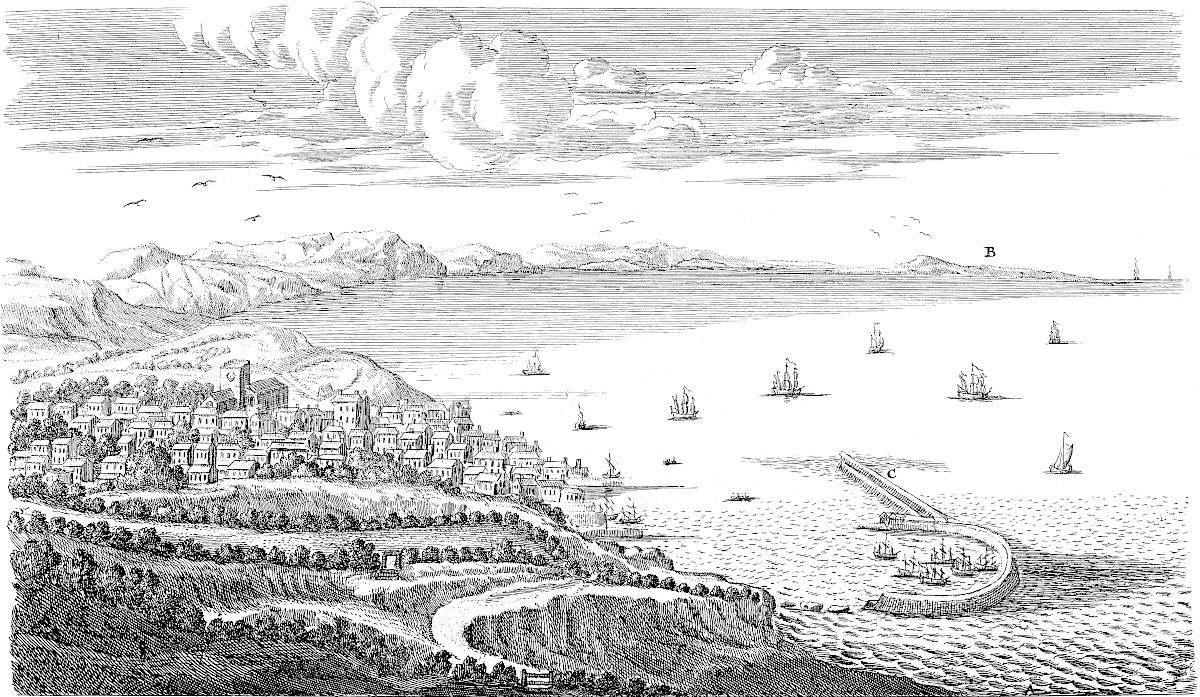
Lyme lies upon the sea-side, in the cavity between two mountains, the Londinis of Ravennas according to Mr. Baxter. Here is a bold stony shore, the ridges of the hills jutting out into the sea; but broken off continually, and wasted away, by the waves as before: the ground too is clay and stone. Their method of opposing its violence is to throw out a wall of huge dry stones, which by time gathers the beech, and consolidates to a greater breadth. Besides, here is a great artificial pier, called the Cobb, extended to the length of 1000 foot with a bow into the ocean, where ships lie secure from the impetuous surges. Here are two little forts, one with five, another with three guns. A large sort of sea horse-tail grows plentifully upon these clayey cliffs; and many little springs issue thereout in the face of the briny deep, which loosen the earth, and hasten its continual downfall. I took notice that the declivity of the hills, with the veins of stone and different strata of earth in these cliffs, is ever north-west, just as is the appearance of the Isle of Portland hence, and with the same angle. The town of Lyme has a pretty good appearance. A small river runs in a rocky alveus through the middle of it into the sea. Most of their buildings are of a rag-stone, blue, not very durable. The duke of Monmouth landed at this place just by the pier with only twelve men: many of his party were executed on the spot afterwards, their limbs hung up in the town. Before that time the duke of Tuscany came here on shore in his visit to Britain. This is called Lime-Regis.
Here entering Dorsetshire, I journeyed along the coast, in view of the ocean, and Portland isle growing more and more distinct, till I came to Bridport, a large town upon a little river. Ascending a high hill, I found myself upon the great downs of chalk like those at Salisbury, and, much to my surprize, infinitely fuller of Celtic barrows than your lordship’s celebrated plains. What matters of that sort I discovered shall be referred to another discourse. A little north of Bridport I found the great Icening-street.Icening-street of the Romans going to Dorchester, which I accompanied with no small pleasure. I imagine it goes a little farther up the country than I had travelled, and hereabouts may properly be said to begin, probably meeting the Foss at Moridunum. The road from Moridunum westward through Exeter I think ought not to be denominated either from the one or the other, because of a different direction, which with reasonable allowance I esteem essential: but this road we are upon, which is the parallel and sister to the Foss, from Seaton to Yarmouth in Norfolk, extends to the like quantity of 250 Roman miles. In this place it is called the Ridge-way, both as it rises in an artificial ridge, and as it takes a high ridge all the way between here and Dorchester, having many valleys on both sides. The composition of the road is wholly of flints gathered off the lands, or taken from near the surface: these were laid in a fine bank, and so covered with turf. As I road along I found it frequently makes great curves to avoid passing over valleys, and industriously keeps on the highest ground, and commands the prospect of the country every where: it goes to Aggerdon.Eggardon hill, as they tell me, north of Bridport; and here I suppose is a camp, whence the whole hundred is denominated: whether from this camp, or from this road, it is plain the old Latin word is retained, agger; therefore aggerdon, as it ought to be wrote, is the hill intrenched, or the down where the high road runs.
76
Prospect of Lyme 21 Aug. 1723. LONDINIS.
Where the Duke of Monmouth Landed
Portland
The Peer.
Stukeley del.
77
Dvrnovaria Aug. 22. 1723
Stukeley del.
78
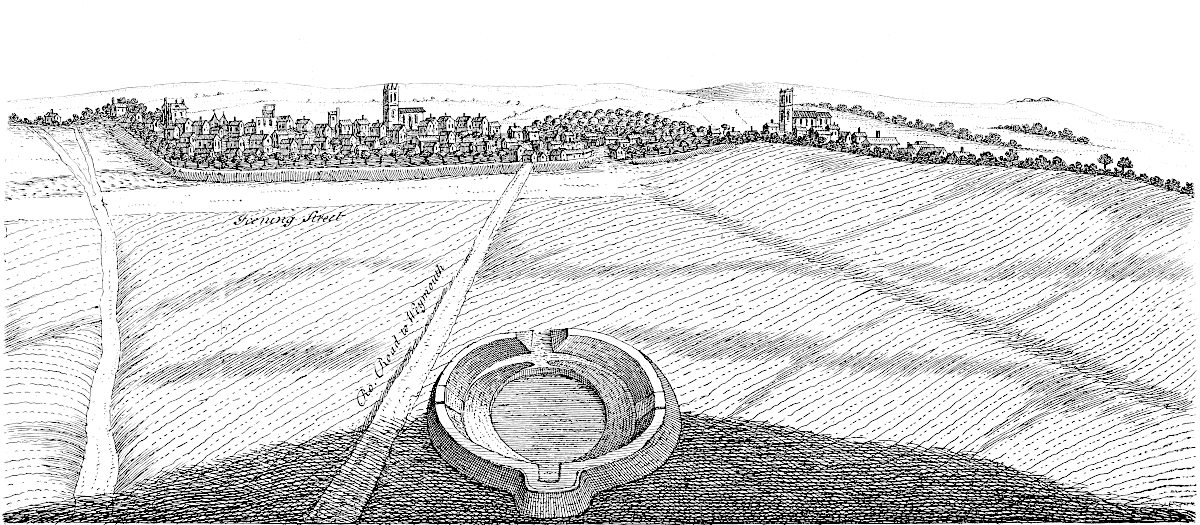
Augst: 22. 1723 Prospect of Dorchester from the Amphitheater.
Stukeley del.
The Icening-street derives its name not from beginning, but ending, at the Iceni, via ad Icenos. They say hereabouts it was cast up in a night’s time by the devil, referring to a supernatural agent the effect of Roman wisdom and industry. It enters the city of Dorchester by the north of Winterburn at West-gate. In divers places they have mended it where wore out, by a small slip of chalk and flints, with a shameful and degenerate carelessness; so that we may well pronounce the Romans worked with shovels, the moderns with tea-spoons: besides, it is mostly inclosed and obstructed with perpetual gates across it, to the great hindrance of travellers, to whom public ways ought to be laid open and free; and the authors of such nusances may well be declared sacrilegious. An endless fund of Celtic as well as Roman inquiries hereabouts, and no where less regarded.
Durnovaria.
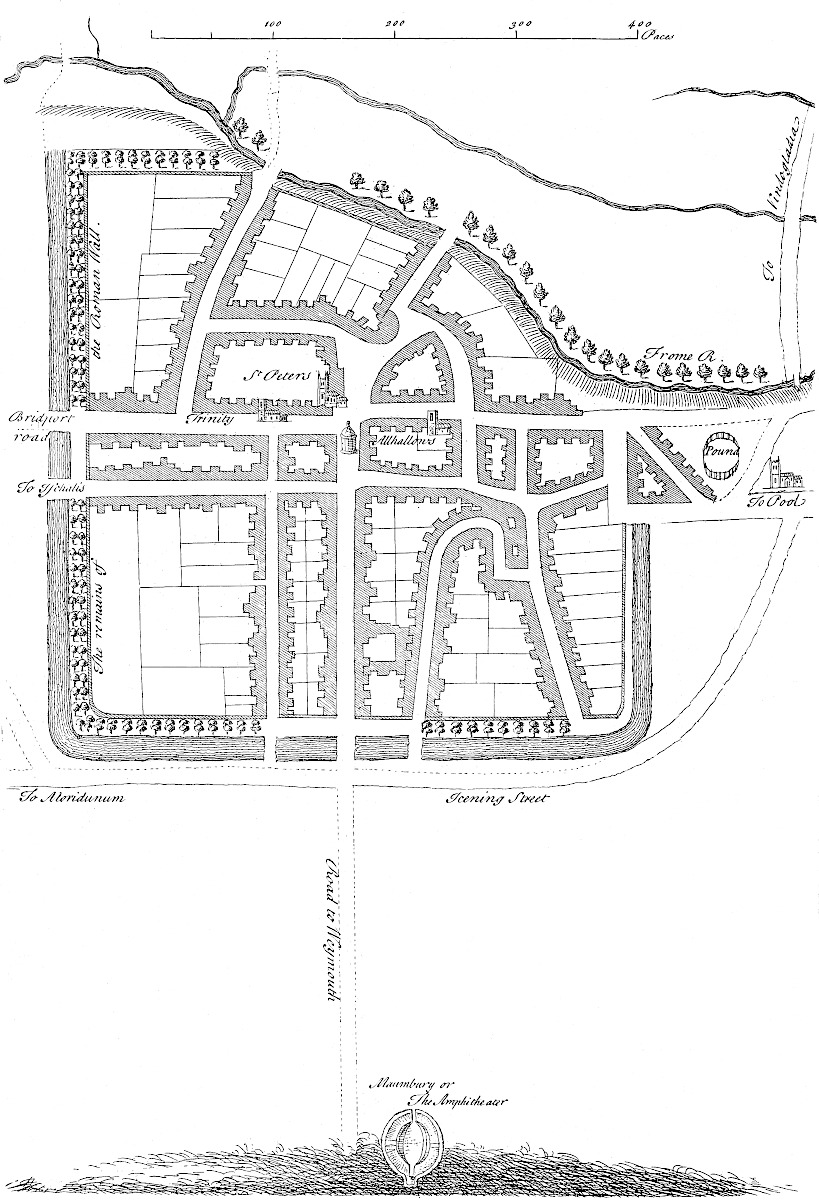
Dorchester, the Roman Durnovaria, meaning the passage over the river, is a good regular town, standing conformable to the four cardinal points, with the river on its north side: TAB. LXXVII.it had four gates in the middle of each side, was encompassed with a strong wall and ditch, if not two; for so it seems, though now levelled into arable, to which the inhabitants hereabout are extremely prone. On the west side great part of the old Roman wall is standing, twelve foot thick, made of rag-stone, laid side by side and obliquely, then covered over with very strong mortar: the next course generally leans the contrary way: now and then three horizontal ones for binding, for much flint is used withal. I saw the foundation of it in a saw-pit laid upon the solid chalk: it is yet twelve foot high, broke through and battered every where, as if the sight of it was obnoxious: this is a strong manner of building, and very expeditious. Much more of this wall remained within memory. It would surprise one to think why the very ruins of it should be pulled down, which must be done with great labour, and frequently a mud wall erected in its place. The foundations appear quite round the town; but eastward a street is built upon it, and the ditch filled up: it is still called The Walls; for that way the town is swelled out into a considerable village, with a church and handsome tower, called Fordington, corruptly Farington. Here are three churches in the town beside it. TAB. LXXVIII.On the south and west side, without the walls, a handsome walk of trees is planted, looking pleasantly into the fields; but the sort of them being common sycamores, are incommodious by harbouring flies. The winding of the river on the north spoils the square of the town that way; and there is an area of a castle, out of the ruins of which the grey friers built their convent: but now all the works are wholly obliterated, religious and military. The banks of the river here are steep, for the town stands on high ground. Beyond the river are meadows and warm sandy lands; on this side, the fine chalky downs, pleasant for riding, and profitable in excellent grain. The air must needs be wholesome and pure, the climate warm, and a sufficient distance from the sea; so that we need not wonder if the Romans were fond of this place. The level of the old city was much lower than the present; for antiquities, which are found in great number, always lie deep. Some farmers were levelling another great barrow; but the people of Fordington rose in arms and prevented them with a laudable animosity. All this land is of the prince’s fee. I took notice of a particularity in the stone they use here: it is fetched from a quarry southward in the way to Weymouth; a flag-stone, rising in large dimensions, but not very thick: the superfice of it is curiously and regularly indented or waved, like a mat made of cables, and that very regularly: it much resembles the face of the sands upon the sea shore, just after the tide is gone off: it is very convenient for paving, and those natural undulations prevent slipperiness, being nevertheless level enough: they make fences for their grounds with it in many places, setting them up edgewise in a pretty method. The Roman money dug up here are called dorn-pennies, or king Dor’s money: the reverend Mr. Place, living here, showed me a great collection of them. Much opus tessellatum has been found. As this town, so Wareham below from its ford derives its name. In Lincolnshire we call them still warths.
From Dorchester many Roman roads disperse themselves, beside the Icening-street, passing directly over the meadows to Walton: one goes by the amphitheatre southward to Weymouth; another by Poundbury, Stretton, to Yeovil and Ischalis; another probably to Wareham.
Poundbury a Ro. Camp.
Poundbury, I am intirely persuaded, was a camp of Vespasian’s, when he was busy hereabouts in the conquest of the Belgæ, therefore ancienter than the adjacent Roman city: the situation, the bulk, and the manner of it, so much resembling that by Ambsbury, engages me into that sentiment: it stands half a mile west of Dorchester, upon the brink of the river, which is very steep, in form square: the rampart high, but the ditch inconsiderable, except at the angle by the river; the reason is, because standing on high ground, they dug the earth clear away before it, and threw it intirely into a vallum; so that its height and steepness, wherein its strength consists, is the same as if a regular ditch was made in level ground. The chief entrance was on the south side: there seems likewise to have been an entrance next the river, but made with great art; for a narrow path is drawn all along between the edge of the precipice and the vallum, so that it was absolutely impossible to force an entry that way: beside, I observe, beyond the camp, for a long way, a small trench is cut upon the said edge, which seems designed to prevent the ascent of cavalry, if they should pass the river: the ground of the camp rises in the middle, as was usual among the Romans in their choice. There is a tumulus too, which I imagine is Celtic, and extant before the camp was made: this levelled a little might serve for the prætorium. A very good prospect from hence all around. The name is taken from its inclosure as a pound; for here they call a circle of stones round a tumulus, a pound.
Maiden Castle. a Ro. Camp.
The other camp, called Maiden Castle, was undoubtedly the Æsiiva of the Durnovarian garrison:[134] it is of a vast extent, and prodigiously strong, apparently of much later date than the foregoing, its manner savouring of inferior times of the empire: it has every where a double ditch of extraordinary depth, and a double rampire, in some places treble or more: it takes in the whole summit of a great hill: within it seems as if two camps, a ditch and vallum running across, with each its entry of very perplexed work; several ditches with cross entries lapping over one another, as we may well express it; especially westward, where their number may be affirmed half a score. Certainly, for healthful air and prospect, a most delightful place;
Heic Veneris vario florentia serta decore, Purpureo campos quæ pingit avena colore. Hinc auræ dulces, hinc suavis spiritus agri. Virg.
and, for sight of barrows, I believe not to be equalled in the world; for they reach ten miles. What further remains to be said of Dorchester, is the noble amphitheatre, of which your lordship first gave me the hint; therefore most justly are you intitled to the following description of it.
61
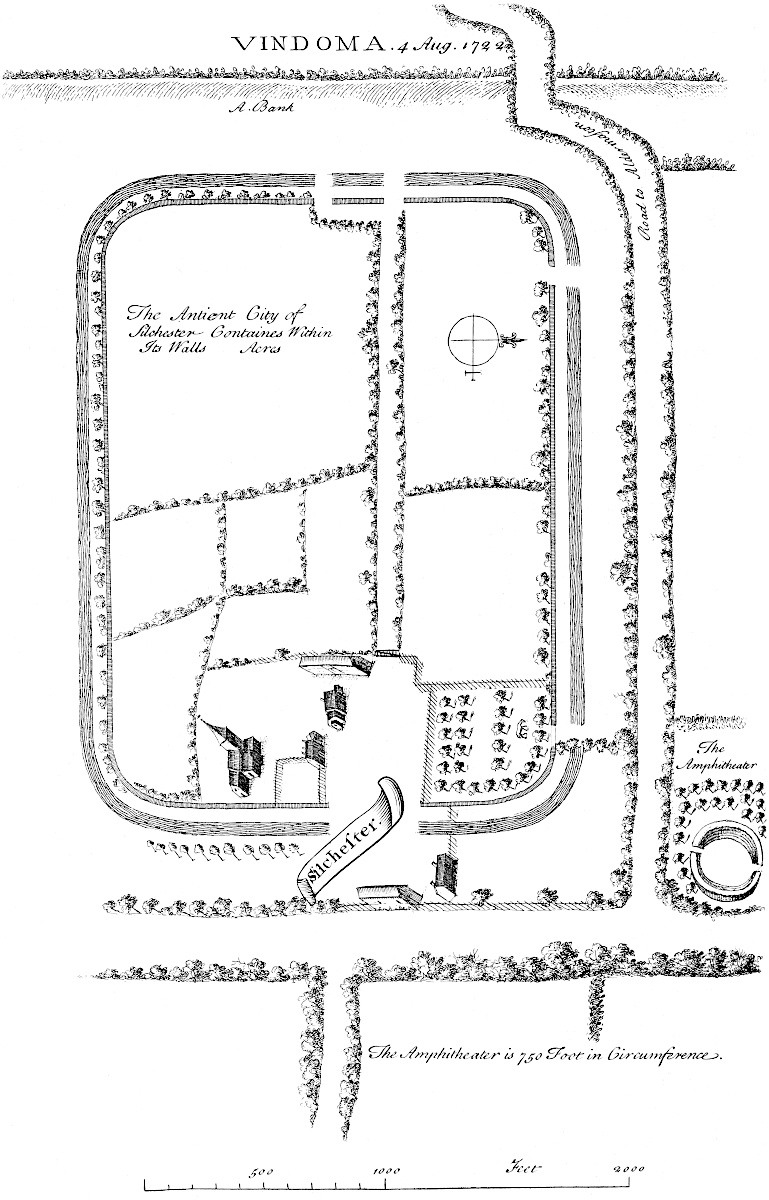
VINDOMA. 4 Aug. 1722
Stukeley Designavit.
Peritura Moenia Stylo renovavit
Ger. Vander Gucht
.
Of the ROMAN AMPHITHEATRE at Dorchester.
THERE was no kind of civil edifice, or public work, more frequent among the Romans, in Italy or the conquered provinces, than such as related to sports and games; for that brave and wise people both judged and found that method well calculated to bring over the nations to their own language and customs, being agreeable contrivances that seemed rather pleasure and delight than compulsion. Such were theatres, circs, amphitheatres, stadia, and the like. There were three amphitheatres in the city of Rome; that of Vespasian, the Castrense, and of Statilius Taurus: and, though we find them not so particularly taken notice of elsewhere in historians, yet we behold the things themselves, whose immense bulk and weighty materials have generally so long out-faced time and weather. We may affirm, there was scarce any colony or free city, of considerable note, in their extensive empire, that wanted these places of public pastime; and scarce any province now, where their footsteps at least are not visible, and many almost intire, particularly what we are now treating upon, amphitheatres: yet I believe it will appear a novelty to most people, when we shall talk of such curious antiquities in Britain. TAB. LXI. XCVII.But since this time twelve-months, I have seen three, one at Silchester, another at Richborough castle in Kent, and this at Dorchester in Dorsetshire. I have been told of one with six tire of seats, three mile off Redruth in Cornwall. Sir Christopher Wren is the first person that I know of who gave this hint of inquiry, in discovering this, many years ago, in his journeys to the isle of Portland, when he began to build St. Paul’s cathedral. Great pity it is that he did not take an exact description of it at that time, when in greater perfection, before the gallows were removed hither by an unlucky humour of the sheriff; since when the parapet at top is on that side much beaten down, by the trampling of men and horses at executions; but especially because his great skill might have done it exact justice, and by means of his pen it might have shared in the duration of his works. In defect of such illustration, I hope the reader will accept of my mean endeavours to preserve so valuable a piece of architecture, which, notwithstanding the damage above mentioned, and that the area of it has been ploughed up these many years, will still give a spectator a fine notion in the structures of this sort abroad, deservedly the admiration of travellers; and will present a person of understanding, the pleasure of observing the noble and great genius of the Romans in every production of their hands. Nor does the meanness of its materials debase, but rather inhance, its value and its art; for, though less costly and lasting than stone and marble, of which others are generally built, yet for the same reason less liable to rapine, and the covetous humour of such as plunder them for other uses: therefore I believe, in the main, it is as perfect as most abroad, if not so alluring to the eye; whence we may suppose it has so long escaped common observation, though close by a great town and road.
An amphitheatre is properly a double theatre, or two theatres joined together. A theatre is a semicircle wherein are the seats of the spectators; the apparatus of the actors, or scenes, filling up the diameter before it. But if we would be more exact, we shall observe, it is half as long again as the radius; for they cut off the fourth part of a circle, then the rest became the form of their theatres. Now two such as these joined together, throwing away the scenic part, constituted an amphitheatre; taking its name from circular vision, and because the seats were continued quite round, the faces of the people being all directed to the centre of its excentricity: so its use required, different from that of the theatre, where the company look all one way toward the stage. But then, as Lipsius takes notice in discoursing upon this topic, the lines, at the ends where they are conjoined, must be drawn outward a little, approaching more to strait lines, than it becomes a true oval, well expressed by Cassiodorus; “for, (says he) the area includes the figure of an egg, which affords due space for combatants, and more advantage to spectators to see every thing by its long curvity or relaxed circle.” These were not put in practice at Rome till the end of the commonwealth, and appropriated to the hunting and fighting of wild-beasts, to gladiators and the like; and at last to sea engagements, represented in gallies floating upon the water, which they introduced for that purpose. First of all, they made them pro tempore of timber, being two theatres, each fixed upon a wonderful axis, and so contrived, that when they pleased they could turn both together, with all the people on their seats, and make an amphitheatre; of which Pliny, xxxv. 15. speaks with a note of astonishment, as it really was. This was done by C. Curio, one of Cæsar’s party. It is worth while to read the great naturalist’s descant upon it. This I suppose gave occasion to the building of regular amphitheatres, of which Cæsar made the first in the Campus Martius, but of wood, when he was dictator. The first of stone was erected in Augustus his time, by Statilius Taurus, in the place of the former, which was the only one till Vespasian, whose work was the monstrous Colissæum, but finished by his son Titus. This has afforded materials for many public buildings in Rome, and still boasts its immense ruins, as one of the greatest prodigies of the imperial city.
Vitruvius mentions nothing of amphitheatres; therefore he probably published his book before that of Taurus was built: as for Cæsar’s, it belonged not to masonry, being carpenter’s work; in which he was a very great master, as in every thing else: so that we must form our notions of these things from the works themselves, and the ruins that time has spared. The parts of an amphitheatre are these: the arena or space within, the scene of action; the euripus, or river that generally encompassed the verge of it; the podium, or parapet at bottom; the itinera, or viæ, which were the walks between certain series of seats; the ascensus, steps or stairs; the pulpita or tribunalia, a sort of covered chair of state, where the emperor, his legate, the prætor or chief magistrate of a city, sat; the cathedræ, where the senators, foreign ambassadors, and great personages, sat; the gradus, or common seats; the præcinctiones, which I suppose balustrades; the aditus or vomitoria, being the passages from the stairs withinside to the seats, a metaphorical name, from the people pouring themselves through them with violence; the cunei, which were the space of seats comprehended between two of those passages, so called from their wedge-like shape; the porticus, or galleries within, partly for magnificence, and partly for convenience: all these particulars are easily apprehended from inspection of schemes and sections of these works in many authors. Some of them could not, others need not to be in our work; therefore I shall occasionally enlarge upon those pertinent to this subject, as they fall in our way in the description.
50
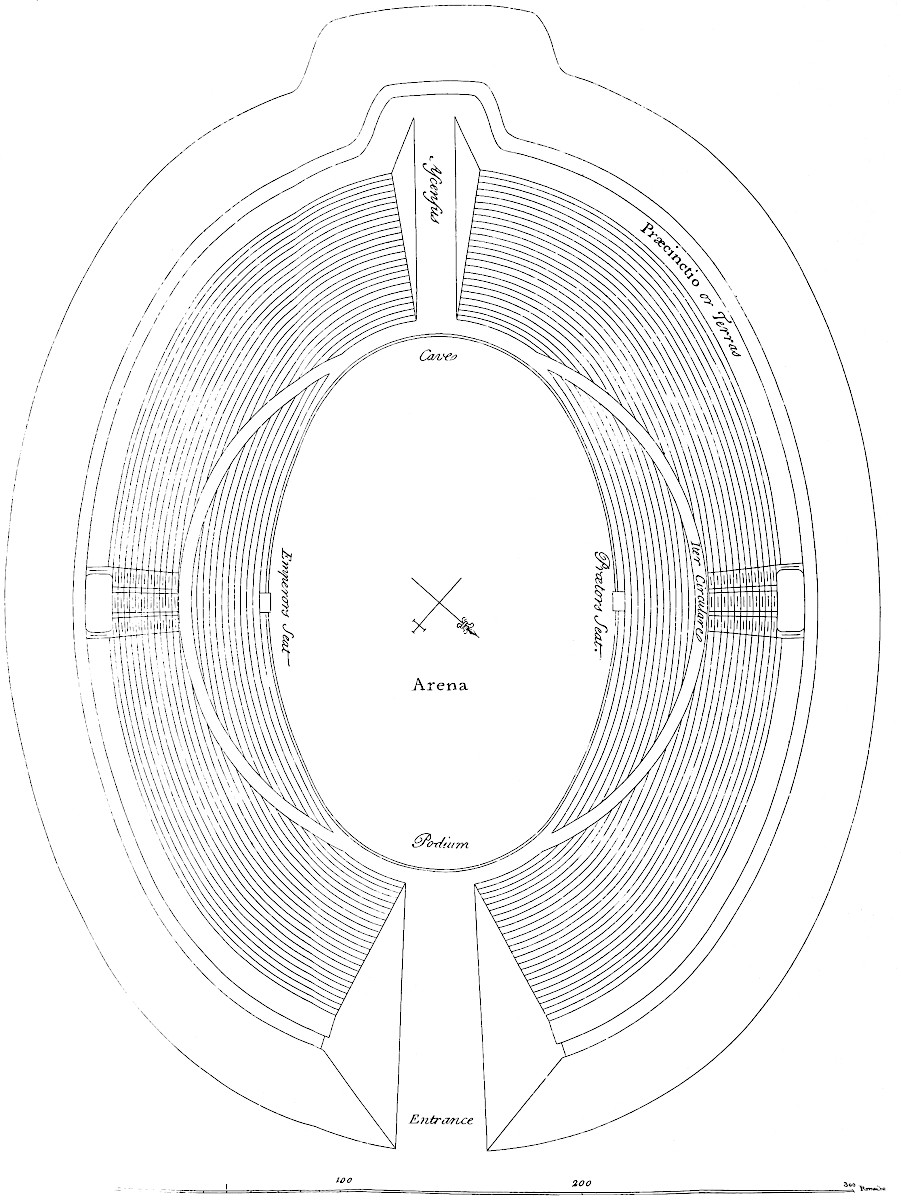
The Geometrical Groundplot of the Roman Amphitheatre at Dorchester Aug. 22. 1723.
Stukeley designr.
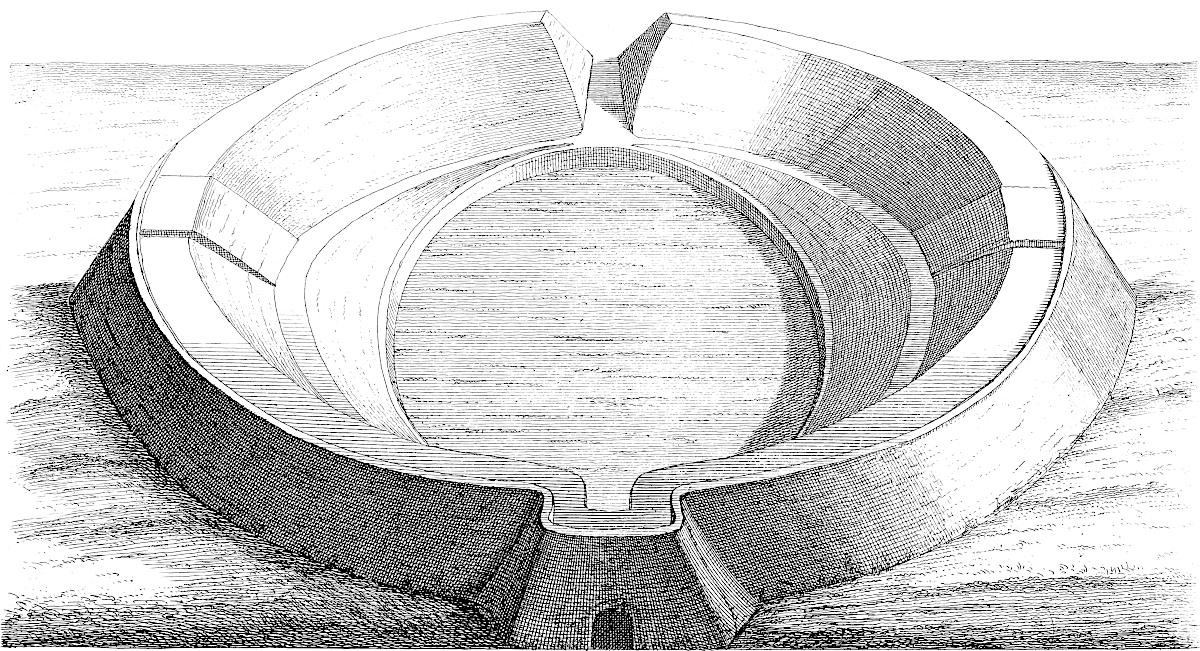
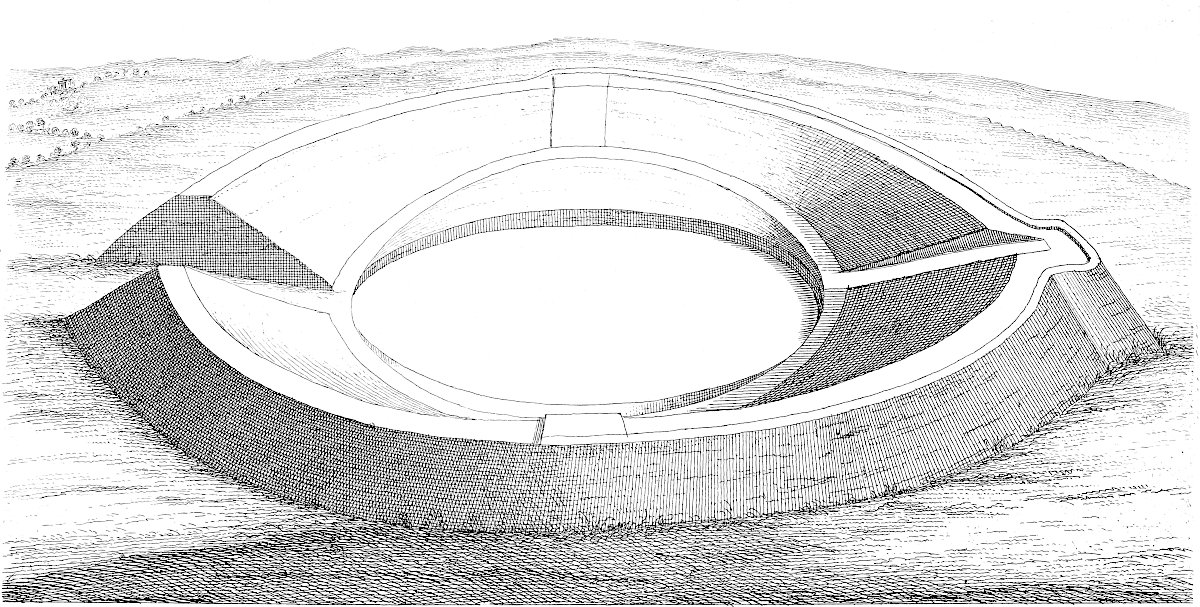
TAB. LXXVII.The amphitheatre at Dorchester is situate on a plain in the open fields about a quarter of a mile (being just 300 of my paces) or 1500 foot south-west from the walls of the town, delicately ascending all the way, close by the Roman road running from thence to Weymouth. The vulgar call it Maumbury, but have no notion of its purpose, though it is a common walk for the inhabitants, and the terrace at top is a noted place of rendezvous, as affording a pleasant circular walk, and a prospect of the town and wide plain of corn fields all around, much boasted of by the inhabitants for most excellent grain. Westward of the town we see the Roman camp called Poundbury, and southward the most famous one Maiden castle, both before described. More southerly all the hill-tops, as far as the eye reaches, are covered with an incredible number of Celtic barrows. It stands upon the very edge of that part of the fields which declines gently northward, or toward the town, upon a chalk, and which without doubt at first was perfect down, like that of Salisbury plain, or the neighbouring downs in the way to Bridport. One may in fancy imagine the beauty of its prospect, and the pleasantness of the walk hither upon that fine carpet, when all was in its first perfection; but at present it is ploughed up to the very skirt of the amphitheatre, both within and without: TAB. LXXVIII.so foolishly greedy are the country people of an inch of ground, that they have levelled several barrows lately in the neighbourhood, which cost more than the spot they covered will pay in fifty years. This work of ours is raised of solid chalk upon the level, without any ditch about it. I have endeavoured to delineate, as exactly as I could by mensuration, the true and original ground-plot thereof, or architectonic design upon which it is formed, from what is left by the injuries of age, of the plough, of men and beasts; and that in its first and genuine scale the Roman foot, which is about an eleventh part less than ours. The TAB. L.plate No 50, represents the amphitheatre as covered with the subsellia, and as in its primitive perfection; for we may well suppose age has diminished it on all dimensions: and in truth it requires a great deal of thought and judgement to attempt to measure it. It is obvious thence to observe, in the general, its conformity with other works of this sort abroad, as far as its different materials will allow; and the great judgement of the architect in varying his scheme thereto, so as fully to answer the proposed end. It is to be noted that half this work is above, and half below the surface of the ground, asTAB. LIII. visible in a section; so that great part of the matter was dug out of the cavea in the middle; for it is a solid bed of chalk, and the rest fetched from elsewhere. I believe the method of building it, was to join solid chalk cut square like stones, and that mortar made of burnt chalk was run into the joints; and probably all the outside was neatly laid with scantlings of the same, but with the natural turf on: so that it is not much inferior in strength to those of stone, though infinitely less expensive; but for use and convenience there is very little difference; and as to beauty, as far as relates to the seats, and what was visible on the inside, our work no doubt was very handsome, and even now is a very pleasant sight. It is observed of most amphitheatres abroad, that they are placed without the cities for wholesomness, and upon elevated ground for benefit of the air, and perflation; a thing much recomended for theatres in Vitruvius; as that of Bourdeaux, 400 paces without the city. Besides, this is very artfully set upon the top of a plain, declining to the north-east; whereby the rays of the sun, falling upon the ground hereabouts, are thrown off to a distance by reflection, and the upper end of the amphitheatre, for the major part of the day, has the sun behind the spectators.
When you stand in the centre of the entrance, it opens itself with all the grandeur that can be imagined: the jambs are wore away somewhat, and the plough encroaches on its verge every year, especially the cheeks below: never did I see corn growing, which of itself is an agreeable sight, with so much indignation as in this noble concavity, where once the gens togata, and majesty of imperial Rome, used to show itself. The conjugate, or shortest diameter externally, is to the longest as 4 to 5; that of the area within, as 2 to 3: this is the same proportion as of the amphitheatre at Lucca, which is 195 brachia in length, 130 broad: a brachium is about 23½ of our inches: it is 25 high. In ours therefore the two centres upon the transdiameter, or longest that form it, are 100 feet distant: the ends of the oval are struck with a radius of 60 feet set upon each of those centres. The centres that describe the side-lines are formed by setting off 85 feet on each side the diameter, from the centre of excentricity. Thus from these four centres only the whole is delineated, and that most easily and naturally; whence I suspect Desgodetz, in laying down his plot of the Coliseum, has without necessity employed no less than eight centres, which is an operation of great perplexity: but still we except the circle in the middle, which so remarkably distinguishes this from all other works, and which gives so great a beauty to the scheme: this is that artful contrivance supplying the place of portico’s, stair-cases, vomitoria, and all the costly work in the grander amphitheatres, for ready conveyance of the spectators in and out to their proper places: it is described from the common centre of the whole, and in the ground-plot is a true circle; but upon the place becomes a walk of eight foot broad, gradually ascending, from the ends upon the long diameter, to its highest elevation in the middle upon the short diameter, where it reaches half-way up the whole series of seats of the spectators, who marching hence distribute themselves therein from all sides without hurry and tumult. On the top is a terrace twelve feet broad at least, beside the parapet outwardly five feet broad, four high. There are three ways leading up to this; at the upper end of the work, over the cave, one; and one on each side upon the shortest diameter, going from the elevated part of the circular walk: horses very conveniently, several a-breast, may go upon this, and frequently do, ascending by the ruin of the cave, but not on the outward steep. The parapet is now three or four foot high, but much ruined on that side next the gallows since last year, at an execution: not only so, but I saw a mixen heap laid under it on that side; and some vile fellow had been digging down part of the amphitheatre to lay among it for compost. There is some enormity, if one examines this work in mathematical strictness without proper judgement: because it stands on a declivity, some parts of the out-side are higher than others, not only as to the same side, but as to the same part on different sides: the plain on which it stands, declines to the north-east: hence the outer side of the work is higher there than in other places; therefore in my sections and ground-plot I endeavour to reduce it to a medium, and the measure which seems to have been the primary intent of the architect.
52
A view of Dorchester Amphitheatre from the South West.
Stukeley Del. Aug. 1723.
53
The Side View of Dorchester Amphitheater.
Stukeley delin.
51
A View of Dorchester Amphitheatre from the Entrance.
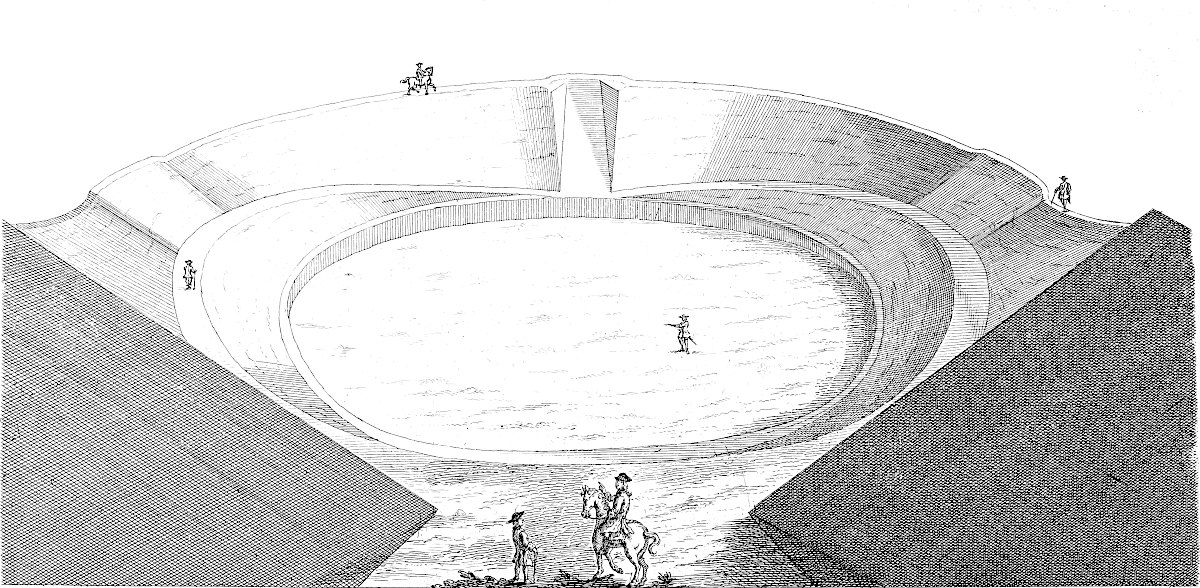
The cave, or receptacle of the gladiators, wild beasts, &c. I suppose to have been at the upper end, under the ascent to the terrace, being vaults under that part of the body of the work: whether they were of the same chalk, or timber, or whether they were arched with brick or stone, or what other matter, I cannot say; but the ruin thereof seems to be the reason of the present deformity at that end; so that it is not easy to guess at its original profile. We may observe that the parapet and terrace go back there, and, taking a new sweep, fall beyond the line of the outer oval; for two reasons, as I conceive: 1st, Because by that means there is a greater length obtained for the ascent to the terrace, which makes it more gradual and easy: 2dly, Thereby more space is procured for the apartments of the prisoners under ground. TAB. LIII.By the section lengthwise, it is easily understood that I suppose a passage quite through, or subterraneous gallery upon that end of the longest diameter,TAB. XLII. 2d Vol. under the ascent to the terrace, from the out-side into the area: this must open at the bottom of the podium, as was practised in other works of like nature, with a squarish door, as Varro tells us, de re rustica. “The door (says he) ought to be low and narrow, of that sort which they call a cochlea, as is wont to be in the cave where the bulls are shut up for fight.” The entrance to this place might be from without-side the amphitheatre: here is no want of room for the door within; for the level of the area was at least twelve feet lower than the podium, like our pit at the play-houses; and it is probable there was a descent of the whole level this way, to draw off the rain into some subterraneous passage: the podium in the castrensian amphitheatre is monstrously high. Our area, no doubt, is exceedingly elevated by manuring, ploughing, and ruins: yet it preserves a dish-like concavity, through innumerable injuries; for the descent from the entrance is very great, and you go down as into a pit. I conjecture the middle part of the area is now ten foot lower than the level of the field: but the field itself, especially about the entrance, is much lowered by ploughing, because the end of the circular walk there, which should be even with the ground, is a good deal above it. The dens and caves of the wild beasts at the great circ in Rome were only of earth and wood, till Claudius the emperor built them of marble. This ruin at the upper end is very considerable; for it has so filled the arena thereabouts, that the cattle plough up to the very præcinctio. On the out-side is a large round tumour, a considerable way beyond the exterior verge, and regular in figure, which certainly has been somewhat appertaining to the work: I could wish that a careful person had liberty of digging into it. Moreover, this podium had a parapet of earth, if not a balustrade, as was usual in others: behind this, upon the lowermost seat, was the place of the senators and chief persons, who often had chairs or cushions: this was the best place for seeing and hearing, as being nearest the arena; whence Juvenal says,
—————— generosior & Marcellis, Et Catulis Paulique minoribus et Fabiis & Omnibus ad podium spectantibus.———
So Suetonius, in Augusto, says, the senate made an order, that the first or lowest seat at public spectacles should be left for them: probably this was broader than any other seat, with a greater space between the podium and next seat, for more ease. The chair of state for the prætor was on one side, and probably another opposite to it for the emperor, or his legate, which was reserved empty, for state, in their absence; or for the editor of the shows, who was generally thus distinguished: and it is remarkable that a little prominence is still left in these very places. These were set in the middle of the podium, on each side, upon the shortest diameter, and were covered with canopies like a tabernacle. This podium had, for greater safety, grates, nets, and lattice work of iron, or more costly metal, supported by pillars, and the like: beside, there were rollers of wood or ivory length-wise, which hindered the beasts from climbing up, by their turning round, as is particularly described by Calpurnius. And, moreover, in greater amphitheatres, there was a ditch full of water under it, called euripus, first introduced by Julius Cæsar. In the early times of these buildings, the people sat all together promiscuously; but after the emperors, the places were distinguished according to the degrees of quality, senators, knights, or common people. The knights seats were next to the senators, fourteen deep in number; so that gradus quatuordecim became a phrase for the equestrian order. We may suppose these two degrees filled all the seats in our amphitheatre under the circular walk or ascent. The common people possessed the remainder, or the whole concavity above the circular walk, taking the best places as they came first: but the uppermost seats were reserved particularly for the women; and one reason of their distance was, I suppose, because the gladiators were naked. And that no routs and confusions should disturb the order of these solemnities, there were proper officers appointed, that took care none should presume to sit out of the seats suitable to his degree.
I imagine the terrace at top in our work was designed for the men of arms: for they are by no means to be excluded, seeing one of the primary intents of these diversions was to inure them, as well as the people, to blood and murder. Hence, before they went upon any great expedition, or foreign war, these feasts and butcheries were publicly celebrated: and in my opinion, the two rising plots, that are squarish on each side upon the shortest diameter, were for the officers. These are above the level of the walk, or terrace, and might possibly have a tent set upon them for that purpose. I call them pavilions: they are of a handsome turn, and capable each of holding two dozen of people commodiously: their side-breadth is fifteen foot; their length, i. e. north and south, twenty: they are somewhat nearer the upper end, not standing precisely upon the shortest diameter, and four foot above the level of the terrace. I considered with care that seeming irregularity of the terrace on both sides the lower end; for it is higher within side than without, yet so as to produce no ill effect below, either within or without, but the contrary. I find it is a master-piece of skill, and am surprised that it has not been more defaced in so long time. The matter is this: the work standing on a declining plain, this artifice was necessary to render its appearance regular; for when you stand in the centre within-side, the whole circuit of the terrace seems and is really of one level: but on the out-side the verge of the north-easterly part is sloped off gradually toward the entrance where the declivity is, conformably with it; whence the whole exterior contour appears of an equal height too: and this could not otherwise have been obtained, since within it was necessary to keep a true level, without regard to the outer plain. As to the seats, which I have supposed in plate 50, they were contrived to be twice as broad as high: their height was but a small matter more than a foot, and their breadth not above two feet and a half; half that space being allotted for the seat of the lowermost, and the other half for the feet of the uppermost. The declivity of these gradus is justly made within an angle of thirty degrees, the third part of a quadrant: but this is more exact at the ends; for in the middle, or towards the shortest diameter over the elevated part of the circular walk, the upper series of seats has a somewhat more obtuse angle; the reason of which is obvious, to overlook the breadth of the circular walk. This is most plainly seen in the sections, and is done with judgement, because by that means the upper edge of the amphitheatre is in a right line with the declivity. As to the disposition of these seats, their method is as new as curious: it is so contrived, that the circular walks cut the whole breadth in two equal parts upon the shortest diameter; therefore an equal number of seats is above and under it: hence the middle seat at each extremity is in the same level with the elevated part of the walk. Though these seats in other amphitheatres abroad were made of stone or marble, yet they were generally covered with boards, because more wholesome; and that sometimes covered with cushions for the better sort. Dion Cassius tells us, this piece of nicety was first brought in by Caligula, who gave cushions to the senators seats, that they might not sit upon the bare boards, and Thessalic caps to keep them from the sun. The vulgar had mats made of reeds. I think we may well infer from hence, that the seats in our amphitheatre were covered too with plank, if not made wholly of it. The præcinctiones, or, as Vitruvius sometimes calls them in Greek, diazomata, which commentators make a difficulty about, to me seem only balustrades, because he orders them to be as high as the breadth of the walk along them: beside that upon the podium, here might possibly be one upon the inner edge of the terrace which separated between the soldiers and the women.
The area in the middle was commonly called arena, from the sand it was strown over with, for the better footing of the combatants, and to drink up the blood: this again by intervals was fresh strown, or raked over, to prevent slipperiness; for if, instead thereof, the pavement had been brick or stone, it would have proved highly inconvenient. Hence this word became a common appellation of an amphitheatre, and most of those beyond sea are still called arena. As for the present name of Maumbury, perhaps it comes corrupted from the old British word mainge, signifying scamnum, scabellum, the same as our bench, from the multitude of seats therein; the remains of which in former times might very plausibly give occasion to such an appellation. Or is it not equivalent to the heathen bury, from the memory of these pagan sports therein celebrated? as our ancestors used to call heathenism by the general name of maumetry, corrupted from mahometism: of this my friend Robert Stephens, esq; J. C. first gave me the hint. Thus in Trevisa’s translation of Polychronicon, XIV. 18. p. 175. “Julianus had commaunded that crysten knyghtes sholde do sacrefyce to mawmettes,” meaning heathen idols. Or is it from the old-fashioned games of mummings, so frequent among us, derived from Mimus or Momus? The Mimi were frequently introduced into all shows, at theatres, amphitheatres, circs, &c. Or perhaps in the same sense it is to be understood as in Oxfordshire they call land maum, consisting of a mixture of white clay and chalk, Plot’s hist. p. 240. The area was originally about 140 feet diameter the shortest way, 220 the longest; wherein it falls not much short of the compass of the most considerable ones. The famous amphitheatre at Verona but 233, and 136; and the vast Colisæum at Rome is but 263, 165; but, I believe, as reckoned by a larger measure, the French foot. That at Perigusium is less than ours, being 180 one way, 120 the other. I find the amphitheatre at Silchester is of the same dimension with ours here, and built of the same materials and form, as far as I could discern, but more ruinous.
These places, though of absolute necessity open at top, where usually sheltered from rain in some measure, and from the sun effectually, by great sail-cloths spread along the top from masts and ropes, which were managed by the soldiers of the marine affairs, who were more skilful in such work: a fashion first invented by Q. Catulus when he was Ædile. The places where these poles were let through the cornices of the upper order, and rested on corbels, are still visible in the great amphitheatres. This probably was done in ours by masts and poles fastened into the ground without-side, and leaning along the outside bank; which would give them a very advantageous turn in hanging over the top of the theatre; for the slope of the agger externally is with an angle of forty five degrees, being half a right angle, the most natural and commodious for beauty and force to oppose against the side weight: or they might erect them in the solid work on the top of the terrace, seeing it has abundantly strength enough. But in the particularity of these modes no certainty is at this time to be expected. However, by the situation of the place, the architect has taken great care, according to Vitruvius his rules about theatres, to obviate the inconvenience of the sun-beams as well as possible; and that in three respects. 1st, As he has set it upon a plain declining northwards, and upon the higher part of the plain; upon the very tip where the declivity begins. 2dly. By taking the bearing of it exactly, I found the opening, or entrance thereto, is to the north-east precise: hence it is very plain and easy to conceive, that from nine o’clock in the morning till sun-set, in the longest day of the year, the sun will be on the backs of the spectators, upon the upper or south-west half of the building; which contrivance is worthy of notice: and that this is not done upon account of the city of Dorchester lying that way, but as a thing essential, is plain from the like in the amphitheatre of Silchester, which opens upon the same point, though directly the farthest from the city. 3dly, The breadth of the opening or entrance, level with the surface, and opposite to the falling beams of the sun, must produce a very great rebatement of the heat thereof, reflected into this vast concave, and prove a convenience the other amphitheatres are wholly destitute of: and this purpose is so much regarded, that, if we consider it with a scrupulous eye, we shall find that the western side of this upper half of the terrace and the pavilion there is somewhat broader, and nearer the upper end of the long diameter, than the eastern. In the midway of the terrace between the pavilions on both sides and the cavea, are still to be seen two round holes, which seem to be places where they set poles to oppose against those others leaning on the out-side that bear the sail-cloths. The section or profile of this work is contrived with exquisite judgement in proportioning its parts; for the eye of a man standing at the most retired part of the terrace next the parapet is in the right line of the declivity within side; of a man standing in the middle of it, his eye sees the heads of the spectators sitting under him on the upper subsellia, even with the line of the circular walk; the eye of him standing on the edge of the terrace, sees the heads of those on the lowermost subsellia, even with the edge of the podium, and commands the whole area: therefore we may conclude none were permitted to stand on the circular walk, for that would have obstructed the sight, but it was left open for passage. I took notice before, that on both sides, the terrace at the top of the lower half seemed to me narrower than that at the other and principal half: whether so originally, and for sake of any advantage to be had in this respect, and that the meanest of the people stood here, or that it has happened to have been more wasted away since, I cannot be positive; but I judged it not material enough to be regarded in the scheme: for, in the main, I found the breadth of the side of the work, or solid, taken upon the ground-plot, is equal to half the longest diameter of the area, or a fourth of the whole longest diameter. Its perpendicular altitude, from the top of the terrace to the bottom of the area, is a fourth of the longest diameter of the area.
In the middle of each side we may observe a cuneus, or parcel of the seats, of near thirty feet broad, just over the most elevated part of the circular work, and reaching up to the terrace, which swells out above the concavity of the whole, and answering to the rising ground in the middle of the terrace, which we call the pavilions, and have assigned for the seats of the officers among the soldiery. This is upon the shortest diameter, and over the tribunalia of the emperor and prætor; and consequently cuts each side of the upper series of seats above the circular walk into two equal parts. I have guessed only at these reasons for it, which I leave to better judgements. One might possibly be, to give a greater beauty to the range of seats over the circular walk by its break, which is a thing not practised at all in other amphitheatres, unless we suppose this effect produced by their vomitoria: or is it not more necessary here, because of the circular walk, which causes the series of seats above them to be broader at the extremity than in the middle, and therein different from the aspect of common amphitheatres? Or was not this division useful in distinguishing the great length of that series into separate compartments for two different sort of plebeians? Or is it necessary to distribute the three orders of people; the senators under the circular walk to the podium, whose place in general was called orchestra; that half of the upper seats on the upper or south side of this protuberant part, to the equestrian order; that on the lower or north side, to the people or vulgar? But there seems to be another likely reason, that every seat here was divided into two (at least some part of it) in the nature of steps, as was practised in particular places of all other amphitheatres: and perhaps there were three of these ranges of steps, one in the middle, and one on each side: that in the middle was for the officers to ascend from the circular walk to their tribunals, or tents, set upon the raised part of the terrace, whilst the common soldiers went up by the ascent over the cave, at the upper end. The steps on each side led to the respective halves of the upper series of seats above the circular walk. All which uses to me appear convenient and necessary for ease, regularity, and decency. In the upper or south-west half of the internal slope have been some deformities, caused by the inner edge of the terrace in some places cut or fallen down, which spoils the curve a little: and, as the lower terraces diminish gradually from the pavilions to the entrance, that on the western end has received great damage over and above; for the inward verge of it has been thrown down intirely: as for that north-easterly half of the terrace, which we said was narrower, more exposed to the sun, and for that reason allotted to the last rabble, we leave them to scramble up with somewhat more labour over the whole series of the seats at that end, which we may reasonably judge were last filled by the spectators.
These noble buildings, which were of a fine invention, and well calculated for their uses, were most frequently called, from their hollow figure, cavea; of which there are many quotations to be had out of the old poets, and other writers: and originally it was inherent to theatres; in which sense commonly used by Cicero and others, but at length passed chiefly to amphitheatres, as the greater works. The matter of some was brick, as that near Trajecto in the Campania of Italy; another at Puteoli; others stone, and others solid marble; as that famous one at Capua, another at Athens, and that at Verona. The amphitheatre which is still in part to be seen at Pola in Istria, was of stone and wood too; for the whole frame of the seats was made of timber, the portico’s only, or external part, of stone. The wit of man could not find out a fitter scheme for commodiousness of seeing and hearing: and in some respect, I conceit, they had an eye to the form of their harps, fiddles, and such instruments of music, as modulate sounds in a roundish cavity: the oval turn thereof, and the solidity of the materials, had all the requisites of receiving and returning the vibrations of the air to greater advantage. Vitruvius advises, in this case, that the place, as well as the stuff, wherein these buildings are set, and of which they are composed, must not be what he calls surd, such as deaden the sound, but make smart repercussions, and in just space of time; which is of great consequence in the philosophy of echoes: for if the voice strike upon a solid that is not harmonious in its texture, that is, whose parts are not of a proper tone or tenseness, not consentaneous to the vibrations of musical notes; or if this solid be too near, or too far distant, so that it reverberates too quick, or too slow, as a room too little, or too great; all the main business of hearing and sounds is disturbed. Vitruvius is very large upon this head, to whom I refer the reader. Now I suppose the ancients learnt by experience and trial, as well as by reasoning upon the nature of things, that such a capacity and compass, and of such extent, was best for this end: whence we find, that all their amphitheatres are much about the same bulk, and executed upon nearly the same proportions. A thing of this kind deceives the eye without strict consideration; for it is bigger than it seems, and a person in the middle of it, to one upon the terrace, looks lesser than one would imagine. It is true indeed, that ours is not made of so solid materials as brick, stone or marble; but yet it is possible there may be as much an error in one extreme as the other, and nature affects a mediocrity. One shall scarce doubt that a convallis, or proper convexity between two mountains, will give as fine an echo as any artificial work that can be contrived. I can say, however, in favour of the subject we are upon, that in effect it has a very fine and agreeable sound, (as I purposely several times tried) and seems to want nothing of the compactness of matter, or closeness of the place, though doubtless much deficient in the original depth, which would improve it. An echo here is not to be expected, the return being too quick; but after the voice you hear a ringing, as of a brass pot, or bell; which shows the proportion well adjusted: and perhaps, if we consider the great numbers of the stair-cases and openings, or what they call vomitoria, in the other amphitheatres, for the people to come in and go out at, which are intirely wanting here; we may not be far to seek for the reason of it, or scruple thinking ours to be the better model: the sides being perfectly uniform, and free from those frequent apertures, seem better adapted for the rolling, concentring, and retorting the voice. It is not unlikely that some may think the great gap and discontinuity of our entrance an obstacle in the case; but to such I would propose a quære, Whether that single break, which bears so small a proportion to the whole, in account of those best skilled in the doctrine of acoustics, be not by far more inconsiderable in that point, than the multiplicity of those other passages which we see in all drawings of this kind? Or whether again it be not a real advantage to the sound? as is the hole in the sounding-board of a fiddle, harp, harpsichord, or the like instrument; or when two holes are made, as frequently; but, if there were twenty instead thereof, probably it would be injurious, though of less bulk when all put together. Perhaps the air intirely pent up in this great hollow, without any collateral aperture, may be obstructed in the varieties of its necessary motions and reflections, so as to delight the ear: and I must profess myself of this opinion, which seems confirmed by Nature’s abhorrence of such figures, in the constant outlets of valleys some way or other. It is certain, whatever effect the entrance has as to the sound, it must be highly useful in cooling the place, in admitting the breezes of the north-easterly air from over the meadows to refresh them; and the side of the opposite hill beyond the town, diversified with hedge-grows, presents a beautiful scene to the better spectators: nor is the present town deficient in contributing to the landscape: for, as you advance from the arena toward the entrance, the two handsome towers of the churches appear very agreeably at each cheek of the entrance.
But we have reason to content ourselves with the plain matter of fact, and need not enter into a dispute, whether necessity or choice determined the Romans here to use the present materials, or whether the entrance was originally of the manner we see it: it is certain, that in all the places where I have seen these amphitheatres, the Roman walls that incompassed the towns are still left, built with ranges of brick, stone, flint, and indissoluble mortar; so that ignorance of building cannot be laid to their charge. Nor is this practice wholly confined to our island, and without parallel; for there is now in France an amphitheatre, not improperly to be reckoned of this sort, whereof Lipsius gives us a large account: it is at a place called Doveon, near Pont du sey, upon the river Loire, as you go from Anjou to Poictou; a place where the Druids are said to have had a seat: this is cut out of a mountain of stone, but of a very soft kind, and, I suppose, not much better than our chalk: it is not near so big as ours, and much inferior in beauty and convenience: here are chambers hewn out of the rock for the caves; and the area is but very small. The seats of the theatre of Bacchus at Athens are still visible, cut out of the natural rock. It is not much to be doubted, that in many places in France, and other provinces of the Roman empire, where the same chalk is the soil, there are such as ours, though as little regarded: and we may reasonably think, in the beginning of the commonwealth, before art, luxury, and magnificence had got to its highest pitch, that the Romans themselves were contented with such of grassy turf. The people of Rome originally stood at the games. Cicero, de Amicit. c. 7. says, stantes plaudebant in re ficta. So Tac. Annal. XIV. 20. “If you look back to customs of antiquity, the people stood at the shows; for if they had been accommodated with seats, they would have idled the whole day away at the theatre.” Valer. Max. XI. 4. says, “it was ordered by the senate, that no one should set benches for shows in the city, nor within a mile of it, or should see the games sitting, that the manly posture of standing, the peculiar note of the Roman nation, should be observed even at diversions.” If any one had rather think, that ours never had any seats, but that the people stood upon the plain grassy declivity, I shall not be ato it, and the rather because it is your lordship’s opinion: yet it seemed to me, viewing the sides very curiously, when the sun shone upon them with a proper light and shade, that I could see the very marks of the poles that lay upon the slopes, whereon the benches were fastened. Ovid, de arte amandi, speaking of theatres, says the seats were turf.
In gradibus sedet populus de cespite factis, Qualibet hirsutas fronde tegente comas. On grassy seats of turf the people sate, And leaves of trees Thessalic caps supply.
This of ours seems to be a better method than that in the amphitheatre at Pola; and, if it is readily owned much inferior to those at Rome, yet even those were exceeded by the noble Greek architects, especially by that most admirable theatre near the temple of Æsculapius in Epidaurus, of which Pausanias, an eye-witness of both, speaks in argolicis: “for, though it is not so big as some others, yet for the art of it, the nicety of its constituents, and for beauty, who dare contend with Polycletus, who was the architect of it?” says he.
As it is not my intent to write a complete history of amphitheatres, or further than what is necessary to our present purpose, and to give a clear understanding of our work; so I forbear saying any thing of the manners, times, qualities, and circumstances, of the games here practised, but suppose them much the same in all points with those used at Rome, and other places, and with suitable grandeur and magnificence; whether in relation to hunting or fighting of wild beasts, of the same or different kinds, with one another, or with men; of the gladiators, wrestlings, of the pageants called by the ancients pegmata, whence our word seems derived; of the showers of saffron water to refresh the spectators; of the gods these places were dedicated to, and their festivals: the whole of these matters, by those that have a mind to make themselves acquainted therewith, is best learnt from authors who have largely and professedly handled the subject; such as the learned Lipsius before quoted, Donatus, and many more Pitiscus will inform us of in his Lexicon. It is not to be questioned, that the Romans, who had so firmly settled themselves here for the space of 400 years, were for elegance and politeness much upon the level with those of the continent. But amongst other shows and diversions of beasts, we may safely imagine that our British bull-dogs bore a part, since the Romans brought them up for the use of the Italian amphitheatres. Claudian speaks of them thus,
Magnaque taurorum fracturi colla Britanni.
But see a large and learned account of them from ancient authors in Mr. Camden’s Britannia, Hampshire, pag. 119.
I shall give the reader a plain calculation of the number of people, that might commodiously be present at the solemn sports and diversions, made generally upon holy-days and great festivities of their gods. The people hereabouts told me, that once they executed a woman for petit-treason, in the middle of the area, by burning; which brought all the country round to the sight, and filled the whole place: they by a gross guess supposed there might be 10,000. But if we allow a foot and half for each person sitting, and the number of seats, as I have delineated it, 24; then one side of the building spread in plano will form a conic frustrum 440 feet long at top, 280 at bottom; taking the medium number 360, multiplying it by 24, it gives us 8640 feet; from which take off a fourth part, to reduce it to single places of a foot and half, there remain 6480 places on one half of the amphitheatre; double this for the other side, and you produce 12,960 single places for spectators upon the whole range of seats. For fear of exceeding the truth, I omit all that might occasionally stand on the terrace at top, the ascent up to it, and on the entrance.
It would be vain to talk of the exact time, or the persons concerned in building this amphitheatre: but my friend Mr. Pownall of Lincoln, before spoken of, has a silver coin of Philippus, ploughed up in the very place. imp. m. jul. philippus aug. ℞ lætit. fundat. a Genius with a garland in his right, the helm of a ship in his left hand: the legend of the reverse, I must own, seems strongly to intimate he made or repaired this work, or that some solemn sports were here performed in his time; notwithstanding his melancholy and cynical nature, which Sext. Aurelius gives us an account of, or that he was a christian. He reigned about A. D. 240. yet I chuse to think it is of a higher date. Tacitus tells us, so early as the time of Agricola in Titus his reign, they began to introduce luxury among the Britons; for he exhorted them privately, and publicly assisted them, to build temples, places of public resort, and fine houses; and by degrees they came to those excitements to debauchery, portico’s, baths, and the like, of which we frequently find the ruins. Therefore we may suppose amphitheatres were not forgotton; and probably this was not later than that time, so near the southern coast, (which among the Britons themselves was the most civilised) so rich and fine a country: for Titus his father Vespasian, partly under Claudius the emperor, and partly under Aulus Plautius his lieutenant, conquered all the parts hereabouts (as we mentioned in the beginning of this letter) where he fought the Britons thirty times, subdued two of their most potent nations, took above twenty of their towns, and the whole Isle of Wight. No doubt but the people, inhabitants of this country, the Durotriges, and the town of Dorchester, Durnovaria, were included in his conquests; and they, whatever reign it was in, for their entertainment, erected this noble work; of which, in comparison of our modern bear-gardens, and places of prize-fighting, I shall venture to give it as my sentiment,
Hunc homines dicant, hos statuisse feras.
7 Nov. 1723.