ITER DUMNONIENSE. VI.
Reading edition
Ipse locis capitur patriis & singula lætus Exquiritque, auditque virûm monumenta priorum. Virg.
To my Lord PEMBROKE.
I Have sometimes in travelling been apt, within my own mind, to make a comparison between the excellence of the study of Philosophy, and that commonly called Antiquity, that is, ancient history. The beauties and the advantage of natural inquiries I cannot but be highly sensible of; yet I must needs give the preference to the latter, as it more nearly concerns the rational part of the creation, for whom the whole was made: it is a comment upon the wonderful volumes of divine wisdom, and the conduct of providence in the management of its supreme workmanship. God has given us indeed a large manuscript of his power, and other adorable attributes, in his wide-extended products, the furniture of the world; but in man, a more correct epitome of himself; a delegated immaterial particle of his spirituality, a self-moving principle of free agency, from the very fountain of all existence. As he is the great master-wheel and primum movens; so we are the subordinate executors of his mighty purposes, by his direction and superintendence carrying on the regular government and unseen operations thereof. Whoever declaims against this, ought to be looked upon as one of a poor, narrow way of thinking, and who does not deserve so much as that noble faculty of the soul, reminiscence or memory, which is the same to a single man, as ancient history is to the whole community: such a one no more claims the name of a scholar, than he that knows but the letters of the Alphabet, or whose study consists only in Gazettes. It is the knowledge of antiquity that can give us a maturity in judgement, either in persons or things; and how unfit such a one is, that is destitute of it, in the executing the great offices of life, I need not inculcate.
But nothing I can say in favour of this subject, can be so great a panegyric to it, as your lordship’s illustrious name prefixed. The glorious ardour for this kind of learning, that kindled in your younger years, and that through a long cultivation of it has produced a boundless extent of knowledge, with the deepest penetration, the strongest judgement, the fire of the soul, and all sublimest qualities which the world admires in your lordship; bears down all opposition to the study of antiquities, wherein you preside most worthily; wherein no one dares to be rival, or hopes to be equal. We see the fruits of it in the best-chosen library of ancient authors, in the best collection of most ancient coins, statues, busto’s, and learned marbles, which the world can show. You, my lord, by treading in the steps of the great Arundel, have brought old arts, Greece and Rome, nay Apollo and all his Muses, to Great Britain: Wilton is become tramontane Italy.
Every part of learning is your lordship’s province, and sure of your protection. But I have a particular happiness in laying before you the following account of this summer’s journey, because the greatest part of it was by your own direction, and as excursions I made whilst at your lordship’s most delightful seat at Wilton. I shall begin with what I observed in my tour about it, and proceed to my more western perambulation through a country pregnant of antiquities, and the greatest curiosities in the world.
The Belgæ, the ancient inhabitants of this country, were a brave and warlike people, when on their original continent; and we have no reason to think, after transplantation on the British soil, they abated aught of their courage and valour, natural to its inhabitants. These were one of those powerful nations, whose conquest gave opportunity to the emperor Vespasian highly to signalize his conduct when he first made a figure in arms. Hence it is that we find so many camps hereabouts, from the sea side to the midland parts; many of which were made by him, and others by his undaunted opposers. The road from Wilton to Shaftesbury, called the Ten-mile Course, is a fine ridge of downs, continued upon the southern bank of the river Nader, with a sweet prospect to the right and left, all the way, over the towns and the country on both sides: a traveller is highly indebted to your lordship for adding to his pleasure and advantage, in reviving the Roman method of placing a numbered stone at every mile, and the living index of a tree to make it more observable; which ought to be recommended as a laudable pattern to others: thus C. Gracchus planted a stone at every mile, with the distance inscribed, says Plutarch; and thus Rutilius, Itinerar. II.
Intervalla viæ fessis præstare videtur, Qui notat inscriptus millia crebra lapis.
Between No 5. and 6. is a pretty large camp, calledChiselbury. Chiselbury, upon the northern brow of the hill: it is single ditched and of a roundish form: before the chief entrance is an half-moon, with two apertures for greater security: there is a ditch indeed goes from it downward to the valley on both sides, but not to be regarded. This I imagine relates not to the camp; for I observed the like across the same road in many places between little declivities, and seem to be boundaries and sheep-walks made since, and belonging to particular parishes. I fancy this name imparted from some shepherd’s cot, anciently standing hereabouts, in Saxon Ccsol. It seems to be a Roman camp, but of later date. At the end of this course, when you come to the great chalk-hill looking towards Shaftesbury, are three or four Celtic barrows, one long and large, pointing east and west: in this hill is a quarry of stone, very full of sea-shells. Not far off, in the parish of Tisbury, near Warder castle, is a great intrenchment in a wood, which was probably a Br. oppidum.British oppidum, and near the river before mentioned.
Returning, we see upon the highest eminence that overlooks Wilton, and the fertile valley at the union of the Nader and Willy, the famous King-barrow, as vulgarly called: it is a round Carvilii tumulus.tumulus, of a most ancient form, flat at top, and without any ditch. Your lordship rightly judges it in situation to be one of the highest barrows in England, being, by exact observation from the water-level and calculation, at least four hundred foot above the surface of the ocean. This, questionless, is a Celtic tumulus: and the very name, inherent through long revolutions of time, indicates it to be the grave of a king of this country of the Belgæ, and that Wilton was his royal residence, which for goodness of air, of water and soil, joined with the most delightful downs all around it, must highly magnify his judgement in choice of a place second to none for all the conveniences and delicacies of life. If we reflect a little upon the matter, it appears a supposition far from improbability, that this is the very monument of Carvilius mentioned by Cæsar, who, joining with the other kings along the country on the sea-side from hence to Kent, attacked his sea-camp on the Rutupian shore: and this was to make a diversion to the great Roman general, pressing hard upon Cassibelan; for, as the late learned and sagacious Mr. Baxter observes in his Glossary, where should Carvilius live, but among the Carvilii? as Segonax, one of his confederates, among the Segontiaci; that is, Segontium, or Caersegont, as the Britons call it; which is now Silchester. And it seems to have been the fashion of that time for kings to be denominated from the people or place they governed; as Cassibelan was in name and fact king of the Cassii; and many other instances I might bring of like nature. Where then should Carvilius live, but at Carvilium, now Wilton; or where be buried, but in the most conspicuous place near his palace? and no other barrow competitor to leave any doubt or scruple. It is natural to suppose that the very spot where his residence was, is the same where king Edgar’s queen spent the latter part of her life in a religious house she built near your lordship’s seat, being a hard dry soil, gravelly, and incompassed with two fine rivers, which in early times added much to the security of the place, and much sought for by the Britons. We took notice, when with particular pleasure we visited his tumulus, and paid our respects to the illustrious manes of the royal defunct, that, among other views of great distance, we could see Long-barrow beyond Stonehenge, and all the long ridge of Martinsal hill, St. Ann’s hill, and Runwayhill beyond that; upon which goes the great Wansdike, which I take to be the northern boundary of the Belgic kingdom. I question not but one purpose of this interment was to be in sight of the holy work, or temple, of Stonehenge. Here then may we conclude rest the ashes of Carvilius, made immortal by Caæsar for bravely defending his country; now resting in the possessions of a successor, master of both their great qualities; who, when wielding the British trident, in a fleet infinitely superior to Cæsar’s, could assert a more universal empire. In you, my lord, the memory of Carvilius flourishes again, in your eminent love for your country’s honour, and in your care for preserving his monument, and adorning it with fresh verdure; by planting four trees round its edge,[125] and introducing it as a terminus, in one of the visto’s, to the admirable equestrian statue of M. Aurelius, in the middle of the principal star of your park. Thus, according to ancient usage, was the tumulus of Diomedes planted with the platanus brought from Asia for that purpose; as Pliny informs us in book XII. cap. i.
41
Chlori Imp. Castrum vulgo Clorendon Aug. 25. 1723.
Stukeley del:
A.
Icening Street.
B.
Old Sarum.
C.
New Sarum.
D.
Clarendon Park.
E.
Ford.
67
View from Harnham hill Aug 26. 1723.
Stukeley del.
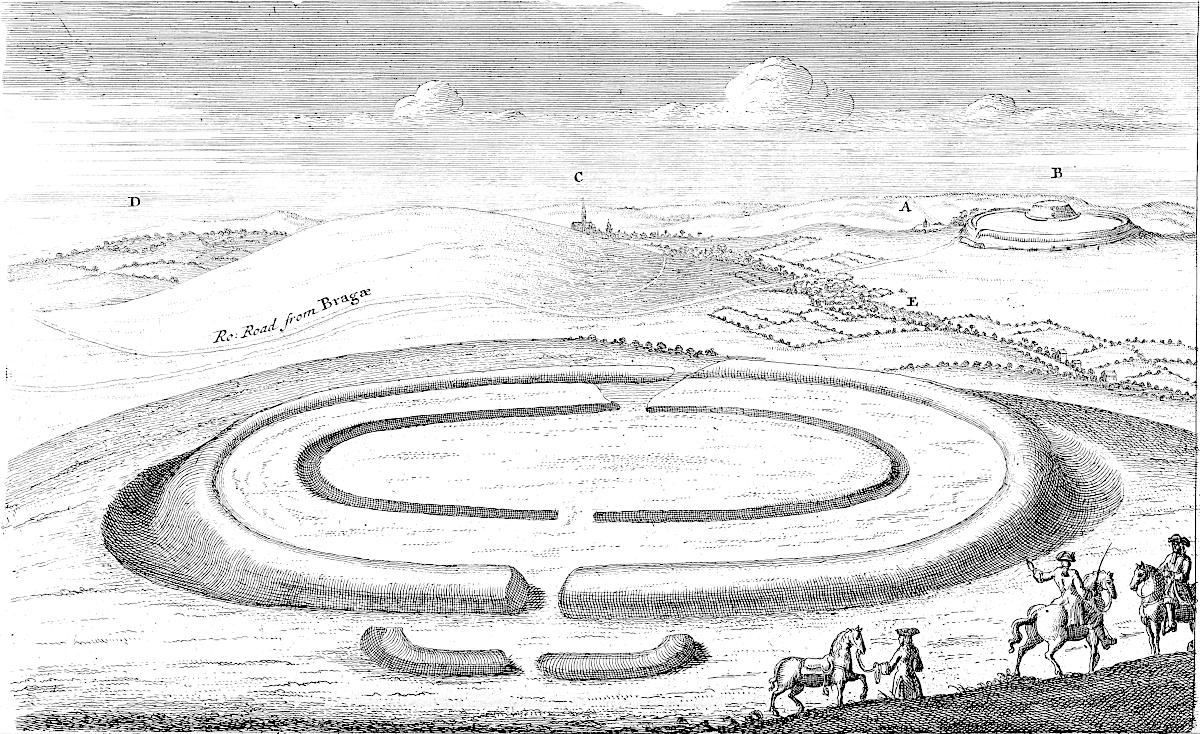
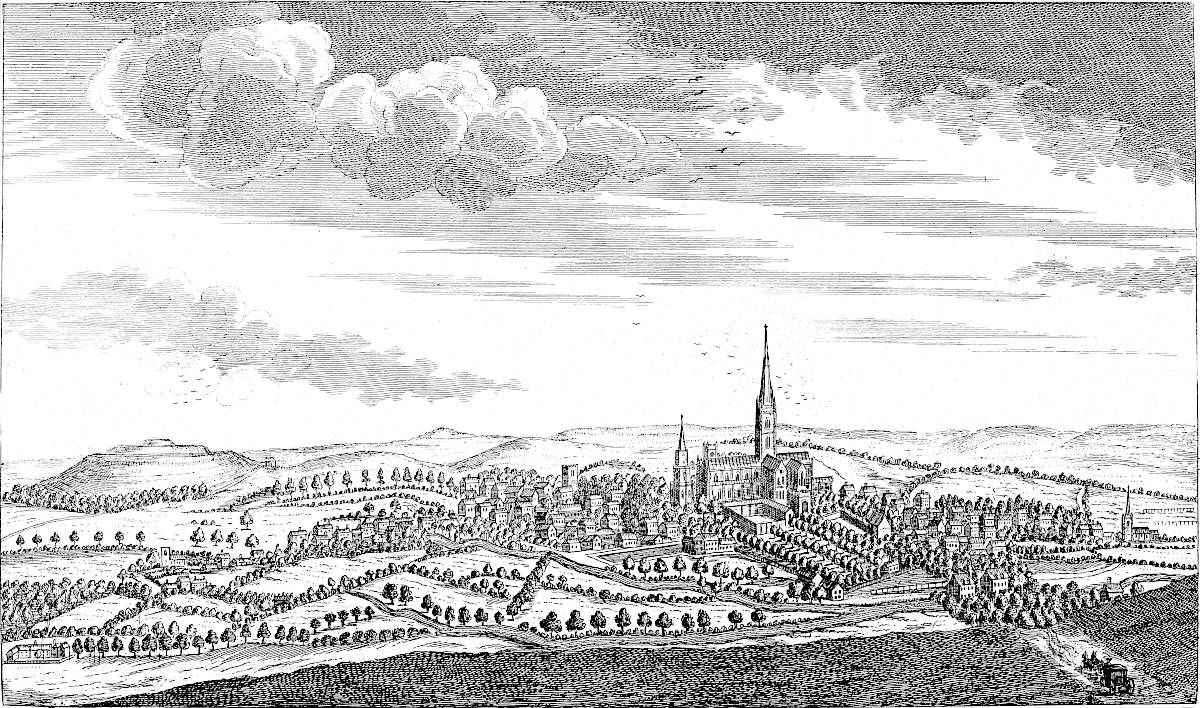
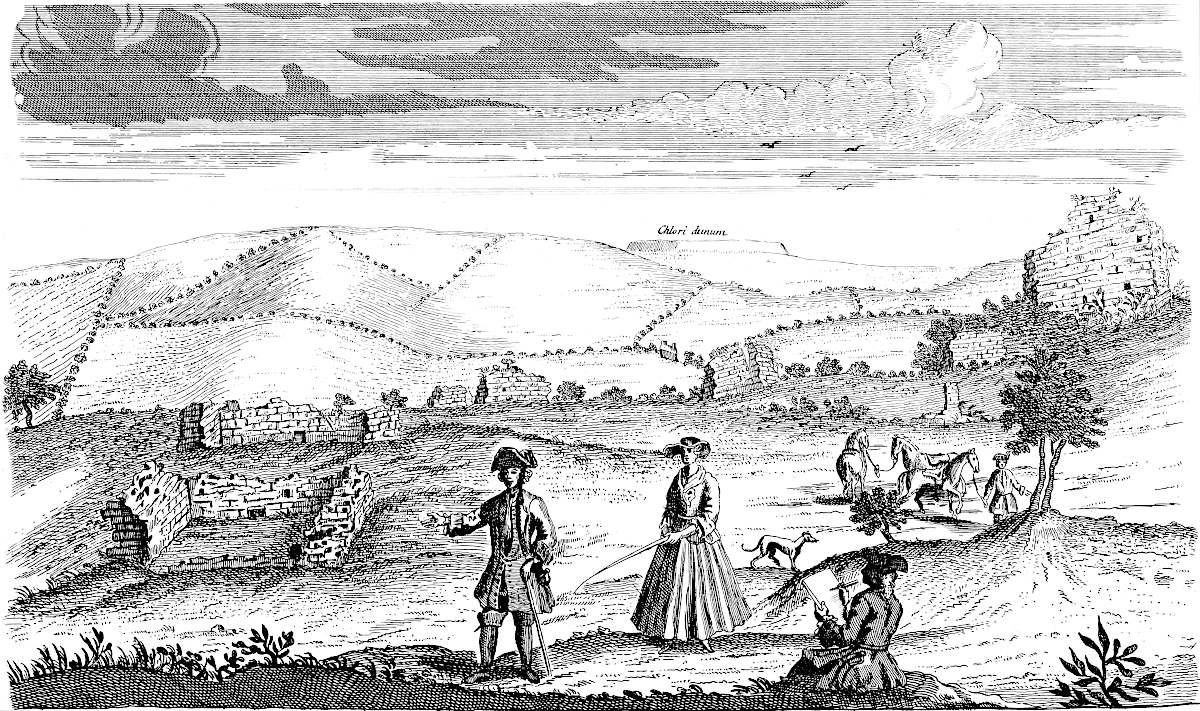
From hence riding along the hare-warren and end of the park, we are entertained with the landscape of no less than five rivers, four retaining the old British names: the villages on each side of them are so thick, that they seem to join and form long cities in woods. About the union of these rivers are three cities and three cathedrals within a triangle, whose sides are less than three miles; Wilton, Old and New Sarum. The Nadre signifies a snake or adder, metaphorically drawn from its winding current: it rises by the end of the Ten-mile course above described, and passes by a pleasant village belonging to your lordship, Chilmark, famous for its quarries; of a very good stone, white, and that rises in any dimensions: there is now a single stone, lying over the mouth of the quarry like an architrave, full sixty foot long, twelve foot thick, and, as the workmen have assured me upon examination, perfectly without flaw: sometimes here are found great petrified oyster-shells. The Willy rises about Warminster, taking in a little brook, the Dyver, passing under ground, runs by Yarnbury. Ro. camp.Yarnbury, a vast Roman camp, where some think is Vespasian’s name; a great semi-circular work at the entrance: several Roman coins have been found here. Not far off is a ditch called Chiltern, which seems to be some division of the hundreds. There is another camp on the other side the Willy: then it runs by Grovely, a great wood of your lordship’s: it admits another stream coming on the west side of Stonehenge from Orcheston, remarkable for a long kind of grass, which without good proof I should scruple relating, for it is commonly twenty-five foot in length, much coveted by cattle; by Mr. Ray called gramen caninum supinum longissimum: he says they use to fatten hogs with it. This Willy, that gives name to Wilton, passes chiefly on the north side of the town, makes the canal before the front of the house, and then joins the Nadre, coming on the south side of the town and through the gardens, at the end of the avenue. The Avon arises from under the great ridge of hills that divides Wiltshire into north and south, crowned with the Wansditch: it passes southward through innumerable villages to Amsbury.Ambsbury, the pagus Ambri famous for a monastery built by one Ambrus, which the monks and fabulous writers have wrested into Ambrosbury; then for a celebrated nunnery of noble-women, great numbers of whom, against the institution of Nature and Providence, were here veiled: it is now the seat of my lord Charlton, built by Inigo Jones, and deservedly to be admired: some new works are added to it under the direction of my lord Burlington, possessor of his spirit, and a noble collection of his designs. The famous old city of Sorbiodunum may be said to stand upon this river: it meets with the other two just before it passes through Salisbury, and beyond it receives the Bourn, which has dropped its proper name: but I guess it to have been Colin or Colinity, the same as Clun; for at its fountain-head is Colinburn: all these rivers are called burns, Willyburn, Adderburn, &c. below Salisbury enters another, I suppose called Ebbesburn. From Harnham hill we have a view of TAB. LXVII.both Sarums: the old city, with its high-crested triple fortifications, threatens all the circumjacent country: the new justly boasts of its lofty spire, as wonderful for the slenderness of its foundation, as its great height, being 450 foot, making one of the visto’s to the front of Wilton-house. To the east is Chloridunum.Clarendon, which your lordship first observed, from old writings, ought to be called Clorendun, from the famous Roman campTAB. XLI. half a mile off the park near the Roman road: this was made or repaired by Constantius Chlorus, father of Constantine the Great; it was he that slew Allectus, after he had basely murdered the valiant Carausius. Constantius lived at the neighbouring Sorbiodunum: he was of British extract, the husband of Helena, a famous British princess. This camp therefore, properly written, is Chloridunum, being a beautiful fortification of a round form upon a dry chalk hill: within is a circular ditch, having two entrances answering to the entrances of the camp, and leaving a large space between it and the vallum. I suppose this ditch was a lesser camp before, inlarged by Chlorus, for keeping his legions as in a summer-camp before the city: this they did by carrying away all the earth of the old vallum to the new; for it is evident the present rampart is of much larger quantity than could be taken out of the subjacent ditch. TAB. IX.Chlorendon park is a sweet and beautiful place: here king John built him a palace, where several Parliaments have been held: part of the building is still left, though they have been pulling it down many years: it is chiefly of flint, and was a large place upon the side of a hill, but no way fortified. This palace of king John answers directly to the front visto of Wilton house over the length of the great canal, and is called the King’s Manor: they say here is a subterraneous passage to the Queen’s Manor. Between the camp and the park runs a Roman road, which has not been taken notice of, from Sorbiodunum to Winchester full east and west.
As we go from Wilton to Stonehenge, between Grovely wood and Woodford runs a ditch across the plain, with a high rampart southward: the ditch is broad, and goes east and west. I take it to be one of the boundaries of the Belgæ, which I call the third: the reason will hereafter appear. On the east side of the Avon, by Great Dornford, is a very large camp covering the whole top of a hill, of no determinate figure, as humouring the height it stands on: it is made intirely without any ditch, the earth being heaped up very steep in the nature of a parapet, when dug away level at the bottom. Aukbury. Br. oppidum.I doubt not but this was a camp of the Britons, and perhaps an oppidum, where they retired at night from the pasturage upon the river, with their cattle: within it are many little banks, carried strait and meeting one another at right angles, square, oblong parallels and some oblique, as the meres and divisions between ploughed lands; yet it seems never to have been ploughed: and there is likewise a small squarish work intrenched, no bigger than a large tent: these to me seem the distinctions and divisions for the several quarters and lodgements of the people within; for I have, upon the downs in Dorsetshire, often remarked the like, of too small a compass to be ploughed fields. This camp has an aspect very old; the prominent part of the rampart in many places quite consumed by time, though the steep remains perfect; one being the natural earth, the other factitious: it certainly has so much of the manner of Vespasian’s camp, as induces one to think it an imitation. I know not whether we ought to derive the name of it from the British Og, signifying the hurdles and pens they fence their cattle in with, which perhaps stood upon those meres, or little banks, to distinguish every man’s property. Vespasian’s camp is within sight of it, a little higher up the river, and on the other side: it is a famous camp, properly and by universal consent attributed to him, called the Walls. Vespasian’s camp.Walls; well chose, being a high piece of ground at a flexure of the river, which closes in an end and a side of it: the other side has a broad and very deep valley along it, and at the other end is the entrance: the whole hangs over the town of Amsbury: the manner of this camp too consists mostly in a rampire, but much more operose than that last mentioned; the form oblong: the road to the town goes quite through it: it is high in the middle, and has a barrow inclosed, but partly level; this I suppose originally Celtic, on account of its vicinity to Stonehenge, therefore elder than the camp. The east side of Vespasian’s camp is sufficiently guarded by the precipice of the river. Further northwards, in the road from Ambsbury to Marlborough, is the remain of another round camp, extremely old, and almost obliterated: this is between Collinburn and Burbich, upon a rising ground, seemingly British: and on the west side of the river Avon, over-against it, is another, called too Cheselbury.Cheselbury, and said to have a fair prætorium in it. These camps so contiguous, with a river between, seem still remains of Vespasian’s conquests; and that he got the country by inches.
9
Stukeley delin.
Ruins of King Johns Palace at Clarendon Aug. 3. 1723.
44
Prospect of Martinsal hill, a Roman Camp 6 July 1723.
A Prospect in Somersetshire 19. Aug. 1723.
Stukeley del:
a.
Mountagu hill.
b.
a Camp.
c.
the Foss Road.
Martinshal Hill. Ro. camp.
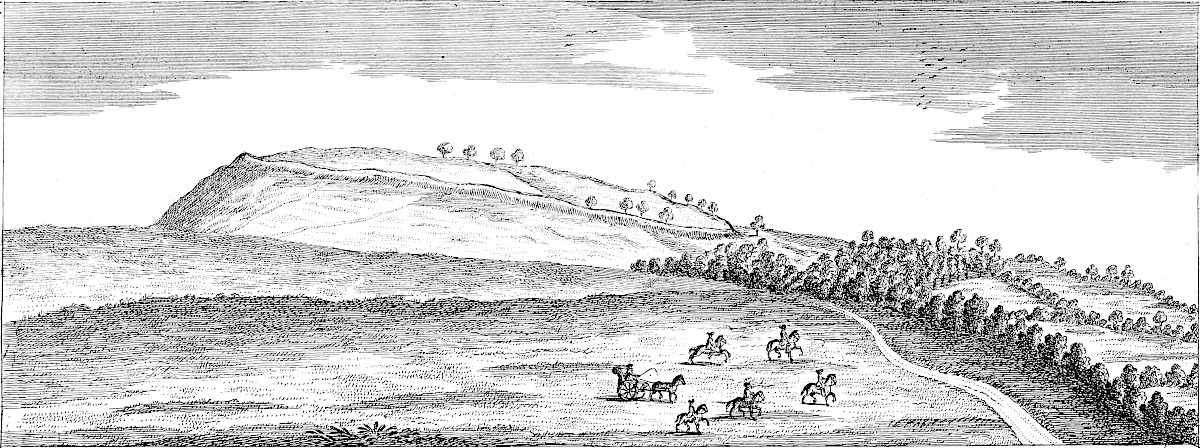
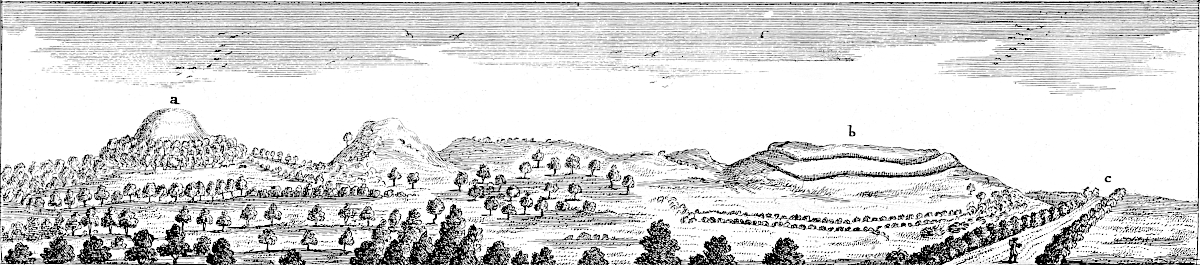
North of these is Martinsal hill, a vast stationary Roman camp, upon a high hill steep to the east, which is seldom observable. I measured it quite round, in company with lord Hertford and lord Winchelsea: it is conspicuous at a great distance, and within sight of all the camps in the country. I take it to haveTAB. XLIV. been made when the Romans were thoroughly possessors of the kingdom, and one of their chief fortresses, whence they might give or receive signals all around, in case of distress, by fire or smoke. On two sides the precipice is dreadfully steep. Lord Winchelsea has a brass Alexander Severus found here; on the reverse, Jupiter fulminans, with PM. TR. P. COS. On the west side, upon the top of the hill, without the camp is a round pit full of good spring water, always to the brim but never overflowing in the driest summers; which at those seasons is of greatest service to the country round, and thousands of cattle are driven every day from a considerable distance to drink there. I am told there is another such upon the top of Chute hill, south east from hence, very high, and no water within some miles of it. So provident has Nature been in subliming, by some unknown powers, the liquid element to these barren heights, that every part of her works should not be without its graces and use. The prospect from Martinsal must needs be exceeding fine. Salisbury steeple, twenty miles off, bears south-west and by west: the port of this camp is north-east.
Martinalia.
I take the name of this hill to come from the merriments among the northern people, called Martinalia, or drinking healths to the memory of St. Martin, practised by our Saxon and Danish ancestors. I doubt not but upon St. Martin’s day, or Martinmass, all the young people in the neighbourhood assembled here,[126] as they do now upon the adjacent St. Ann’s hill upon St. Ann’s day. The true word is Martinsheil, heyl signifying health; and the Germans call a bowl, or drinking-vessel, schale: likewise hali in the Saxon signifies holy; whence our hallow; and the Washeyl bowl at Christmass, full of spiced ale, which they carry about, singing of carols in the streets. Monsieur Keysler speaks of these matters largely in his Antiquitates Septentrionales, p. 358. and that the German gilds, or societies, were obliged to keep drinking festivals to St. Mary, St. Martin, St. Nicholas, &c. p. 487. he says, at a village in tractu Albino, the married women upon St. Martin’s day pay 4 d. to the questor: and the Spring upon this hill still further favoured their ceremonies. So beneficial a bason in heathen times merited divine honours; and the people, not willing to part with a holy-day, blended their rites into christian. The English took the opportunity of the day after this great festival of St. Martin, much observed by the Danes, to commit that universal massacre upon them drunken, which totally extirpated them. This was anno 1002, upon the 13th of November, the feast day of St. Brittius, says Chron. Joann. Alb. Petriburg. on Hock Tuesday, which Spelman says had its denomination thence.
In the fields about Chute are bones dug up very plentifully, in a place called Blood-field especially: they likewise found there a stone coffin with a skeleton inclosed, and an arrow or spear-head of brass, as described to me: there was a horse found buried about three yards from the body. Whether this was Roman or British, I cannot affirm: I am inclinable to think the latter: but it seems that a battle was fought here between them.
Barbury. Ro. camp.
Full north from hence, upon the Barbury hills, the next ridge overlooking the north part of Wiltshire, is another camp, called Barbury, in the parish of Ogburn St. George. The noble lords late mentioned assisted in measuring it: it is double ditched quite round, the inner very deep, and rampart high, of a circular form; an entrance upon the east, and another on the west diameter, which is 2000 Roman foot long: at the west the inmost rampire retires inwards a little, to make a port with jambs: eastward the outer ditch turns round with a semi-circular sweep, leaving two passages through it obliquely to the main entrance, like our modern half-moons: both these methods I have often seen practised.[127] This mighty camp stands on one of the western eminences of this ridge, running east and west; very steep to the north and west, separating the high ground or downs from the fertile country below, which belonged to the Dobuni, and lies under the eye like a map, as far as the Welsh hills beyond the Severn; whose lovely prospect would naturally animate the Britons in its defence, as the Romans in its conquest: it is indeed a fine scene of woods, towns, pastures, rivers and valleys. A little beyond, upon the same ridge, is Badbury.Badbury camp; and the whole is well planted with stout camps and frequent, the eye-sore and terror of the plain: hence you see Martinsal camp and many more.
Ro. road to Bath. via Badonica.
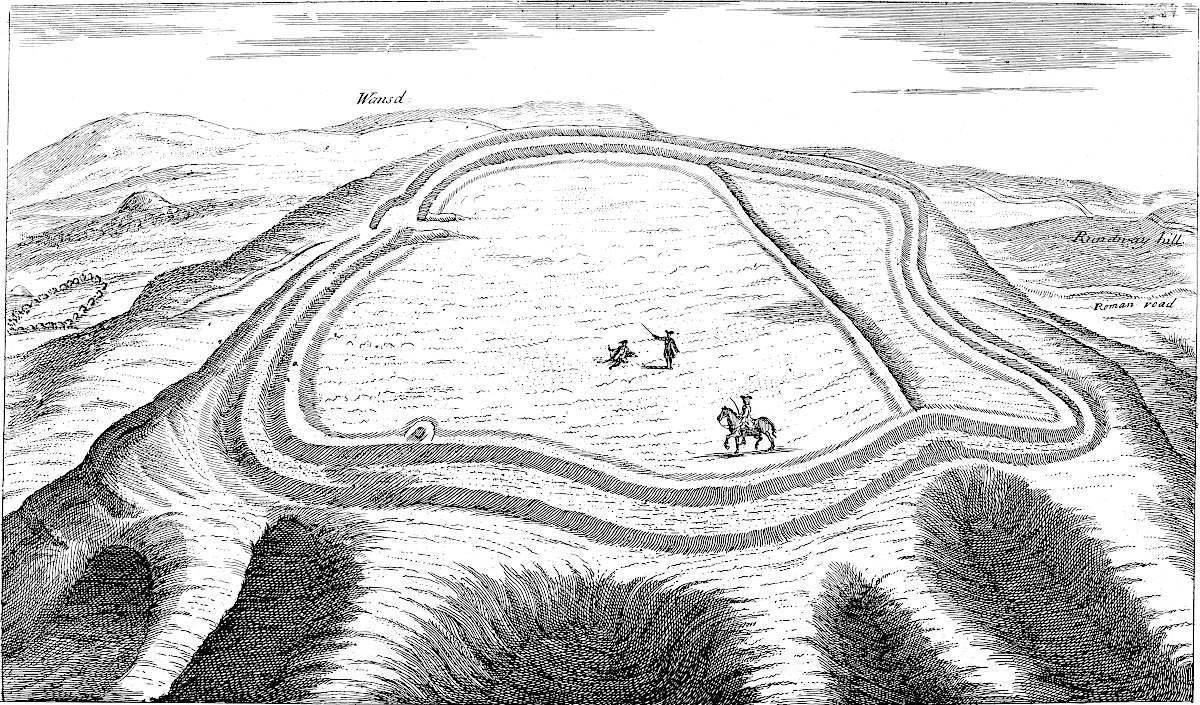
Having recited these matters as preliminary, I shall begin my journey from Marlborough, the Roman Cunetio. I forbear speaking of the infinite number of Celtic monuments I have found in this country, designing them for a particular treatise, to be honoured with your lordship’s illustrious name; and from Marlborough pursue the Roman road, which we have before traced from Newbury hither, and lately discovered its whole progress toward the Bath, which for distinction sake we may call Via Badonica: its course is east and west: it goes hence all along the north side of the Kennet river, between it and the high grounds; and is the present road, but highly wants a Roman hand to repair it. When we have rode about a mile, over-against Clatford, at a flexure of the river, we meet with several very great stones, about a dozen in number, which probably was a Celtic temple, and stood in a circle: this form in a great measure they still preserve. I guess the Romans buried them in the ground under their road, because directly in its passage: the materials throughout have since been worn away, or sunk into the ground, being in this place meadow, and so has restored their huge bulk to day-light. Hence it proceeds directly up to the famous Overton hill, where I first discovered its ridge, when surveying the beautiful circle of stones there, belonging to the majestic temple of the old Britons at Abury: this ridge is a little to the north of the present road, somewhat higher up the hill; it points directly east and west, one end to Marlborough, the other to Silbury hill: and this shows a defect in our maps, which place Abury too much to the south: it is perfect for some space over the down; but upon descending the hill westward, they have ploughed it up, and found several Roman coins near it, some of which I have by me.[128] At the bottom, by the corner of the hedge, it meets again the common road near the White-hart ale-house; and so they go together above West Kennet to Silbury-hill: this was the post and coach road to the Bath, till, for want of reparation, they were forced to find a new one, more northward upon the downs, and farther about, through the town of Abury: when on the south side of Silbury hill, it goes very strait and full west through the corn-fields on the south of Bekhamton, where it is sufficiently known by the name of the French way; for what reason I cannot imagine. They have of late endeavoured to exclude travellers going upon it, by inclosing it at both ends with ditches; but the badness of the lower road has defeated their purpose, and made people still assert the public right. Beyond Bekhamton it again enters the downs, and marches up the hill in a very plain ridge, and beautiful to behold; the pits and cavities whence the earth was taken, on both sides, being conspicuous all the way: besides, the Romans have defaced a druid’s barrow, and another Celtic one near, which saved them some labour: a proof they were there before the Roman road; but this is not a proper place to enlarge upon it. When it has gained the summit of the hill, it leaves Oldbury. Ro. camp.Oldbury castle a little to the north: this is a great and strong TAB. XLII.Roman camp on the north-west point of the hill, overlooking Calne: the precipice on those two sides is altogether inaccessible, falling down in narrow cavities or ribs, as it were the great roots of a tree, with an odd and tremendous aspect; and that way there was need but of very slender work for its security: but on the other sides it is double ditched, having but one entrance to the east, and that fortified with a return of the outer ditch and inner rampire, very artificially: there is a ditch likewise across the middle, as if it had been inlarged with an additional intake westward: it is in the main of a squarish form, and has a very fine prospect. On the northern limit, in the highest part, seems to have been a prætorium. On this hill, which is wholly a chalky down, with a most delicate turf (and softer to walk upon than a Turky carpet) about a foot or two under the superficial earth, they dig great quantities of flints to mend the highways withal: one would imagine they had been spewed out of the hardening chalk at the creation, as extraneous bodies, though of greater specific gravity than itself.
42
Oldbury Castle 11 Iuly. 1723.
Stukeley del.
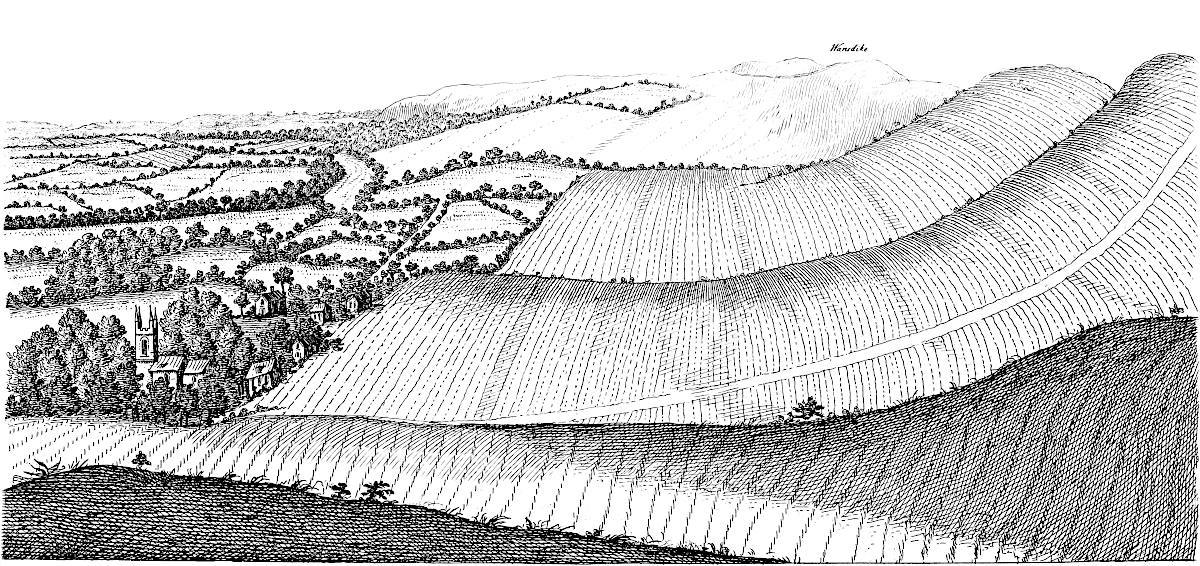
Return we to the Roman road, which proceeds across another valley, and so towards Runway hill, the highest in all these parts. This was famous for a battle in the late civil wars; and they oft find the bullets, when digging for the pebbles as afore mentioned; and below the hill they plough up the bones of the slain: but much more is Runway eminent for two mighty works of antiquity, this Roman way, and Wansdike. The most lovely prospect here will tempt even a hasty traveller to cast his eyes about him, and see all the country far beyond the Bath, and so proportionably quite around. I am not doubtful that it takes its name from the Roman way, which here has an unusual and the most curious appearance of any I have seen. I took pleasure in examining the particularity of it more than once; and it is a masterstroke of skill to conduct it down the north side of this long and steep hill (as I have so often remarked to be the condition of northern heights) to render it easy, or even practicable. When from the top of this hill you look towards Marlborough, which is full east, you may discern that the road curves a little northward, not discernible but in the whole: the reason is to be attributed to the river Kennet, thrusting it out somewhat that way; otherwise the true line should have lain a little more to the south of Silbury. To the right you see Wansdike.Wansdike, creeping all along from south of Marlborough (about two mile) upon the northern edge of the great ridge of hills, parting North and South Wiltshire, till it descends St. Ann’s hill; and makes several right angles to humour the edges of the other hills: the vallum is always on the south side, and the higher ground behind it: then it mounts up to the highest apex of Runway hill. But the method of the Roman road is this: it goes along the northern side of this hill, preserving itself upon the level, being cut like a terrace-walk, with a parapet before it next the precipice; and that winding in and out, as the curvatures of the hill require: it passes just by Calston lime-kiln, and is defaced by it; for the workmen make no scruple to dig through it for their materials, and this practice has been so old as to denominate the town lying beneath. Soon after, it meets with the Wansdike, descending the hill just by the gibbet: here it enters full into it, and very dexterously makes use of it, all along to the bottom, on a very convenient shelf, or spurn of the hill: at the place of union is a flexure of the Wansdike, so that the Roman road coincides with it directly; and in order to raise it from a ditch into a road, the Roman workmen have thrown in most part of the rampire, still preserving it as a terrace to prevent the danger, and the terror of the descent on one side.
I shall mention, upon another occasion, some other observations I have made long since, that overthrow the notion of those that imagine Wansdike was cast up by the Saxons, as a limit of the West Saxon and Mercian kingdoms, or that its name is derived from their god Woden: but here we have a most incontestable proof that it was in being before the Roman times; and its very name shows it, signifying, in the old British language, the division dike, guaban, distinctio, separatio: it is indeed the work of the Belgæ, their fourth and last boundary. These two, the Roman road and Wansdike, go together after this manner, till they enter the inclosures a little north of Hedington town below Runway hill. At Calston is a most famous spring, or cataract of water, coming out of the chalk-hill, and much talked of. Wansdike was made by the people of the south, to cover their country, as the mode of it sufficiently testifies, and, as we said before, was the most northern bounds of the Belgic kingdom. When from the top of these hills you view the Roman road, towards the west you see it butts full upon the Bath, or that great chink between Lansdown and the banks of the river Avon going to Bristol.
Verlucio.
TAB. LXVIII.
I had no sooner traced out this road, but I found a fair opportunity presented of setting the antiquaries right, as to part of the XIVth journey of Antoninus his Itinerary, in which they have hitherto been much perplexed. I found no manner of difficulty in settling Verlucio at Hedington; Hedda’s town, Heddan genitivo. This town is but small at present, lying at the bottom of this great hill in a rich marly country. The inhabitants are not surprised when you inquire for antiquities; they assert it to have been a very old and great city: infinite quantities of antiquities are found here: handfuls of coins brought home every time they plough, (madam Whitlock has many) and the streets and foundations of houses found for a great length, sufficiently evince it.[129] Reuben Horsal, clerk of Abury, told me, he had seen a gallon of Roman coin taken up at a time in Hedington field, in an urn covered with a stone. I suppose its original name was Verolucio, as Verolanium, &c. and then it signifies, in the old Celtic, the white habitation, vrô llug; llug denoting splendid, as Lugdunum, a white hill; the same as the Greek Λευκος albus: if lug imports pure water, then it must relate to Calston spring, breaking forth like a cascade: if we take the word gloyii, limpidus, it is all one. It must be noted, that both the XIIIth and XIVth journeys of Antoninus his Itinerary are abominably corrupted, and want a healing hand as much as any throughout: and being both one journey by a different route, I shall undertake thus to restore them.
68
Prospect of Hedington. 18 July 1723.
Verlvcio
Stukeley del.
ITER XIII. Ab Isca Callevam M. P. CXXXIX. sic
Isca leg. II. Aug. Caerleon
Burrium Usk IX
Blescium Old town XI
Ariconium Kenchester XI
Glevum colonia Glocester XXXV
Durocorinium Cirencester XIV
Cunetio Marlborough XIX
Spinas Newberry XV
Vindoma Silchester X
Caleva Atrebatum Farnham XV. toto CXXXIX.
In the copies the sum total is set down CIX. miles; when, if you cast up the particulars, it amounts to no more than XC. so that no less than nineteen in the original is lost: this shows plainly that some station is dropped out, and geography itself indispensably demonstrates it. Mr. Fulk was sensible of some deficiency, by his adding Gobannium, though thereby he hit not the white: in truth, both stations and numbers are wanting; for it is notorious that the distance between Ariconium and Glevum, places sufficiently known, and about which we have no contest, is much too little, when set down only XV. mile; and XX. must unavoidably be added. Though I am as cautious as any man living in laying hand upon these venerable remains, and altering them; yet, where nature and reason absolutely require it, I have not the least fear in adding two stations, which are quite slipped out from the original: between Cirencester and Newberry it is evident Cunetio must be interposed, or the distance heightened to twice as much: the truth is, one station is intermitted, Cunetio: and the like between Spinas and Calleva; for Vindoma, or Silchester, must be added, beyond which is our Calleva, or Farnham; all in a strait line, and upon a Roman road from Aricomum. Cast up the whole account, it comes to CXXXIX. instead of CIX. then all the difficulties that have hitherto obscured this journey, vanish: they that compare William Harrison’s first copy with the others of this journey, will not be surprised at the effects of negligent transcribers, when, out of seven names in other books, he has missed two; and so frequently in other journeys. In the next place I offer this as the true reading of the fourteenth journey of Antoninus.
ITER XIIII. Alio itinere ab Isca Callevam M. P. CIII. sic
Isca leg. II. Aug. Caerleon
Venta silurum Caerguent IX
Trajectus Old-bury IX
Abone Henbury IX
Aquæ solis Bath VI
Verlucio Hedington XX
Cunetio Malboro X
Spinas Newberry XV
Vindoma Silchester X.
Caleva Atrebatum Farnham XV toto CIII.
This journey leads us to Calleva another way. Mr. Gale has observed Trajectus and Abone transposed. The sum total here likewise is invariably in all copies CIII. when the particulars amount but to ninety-eight; whence we likewise infer a station is dropped out, as before, viz. Silchester, with the number X. annexed. Now it happens that number was not lost, though the station was; but was erroneously placed to Marlborough, being XX. instead of X. seeing the distance between the Bath and Marlborough is notoriously too much. Setting then X. mile to Cunetio, its real distance from our Verlucio, Hedington; it remains further to correct the number annexed to Verlucio, XX. for XV. the letter X being easily corrupted into an V. then we answer the distances on all hands, having a Roman road accompanying us, and complete the sum total set at top precisely CIII. and restore the whole to its ancient purity. When we reflect a little, that, take the matter how we will any other way, the difficulties are unsurmountable, I am thoroughly satisfied in these corrections.
Much rusty old iron is dug up at the quarries by Brunham, probably of the Romans: it is a mile off Hedington.
Upon the hedge of the hill which overlooks Hedington, as it bends a little southward, is another pretty little Roman camp, in an angle of the hill, of a square form, and as if not finished, or made for but a small time of abode upon an expedition; for neither vallum nor ditch of any great strength: it is situate on a very convenient promontory, or rather peninsula of high ground, the steepness whereof is a guard to three sides of it; the other has the slender vallum made chiefly of the surface of the earth thrown up a little. From the edge of these hills is an indefinite prospect over the country of the Dobuni, the Belgæ, and Durotriges: the descent to it, as being on the west side of the hill, is very steep. I think this place is called Bagdon hill.
Punctuobice.
TAB. LXIX.
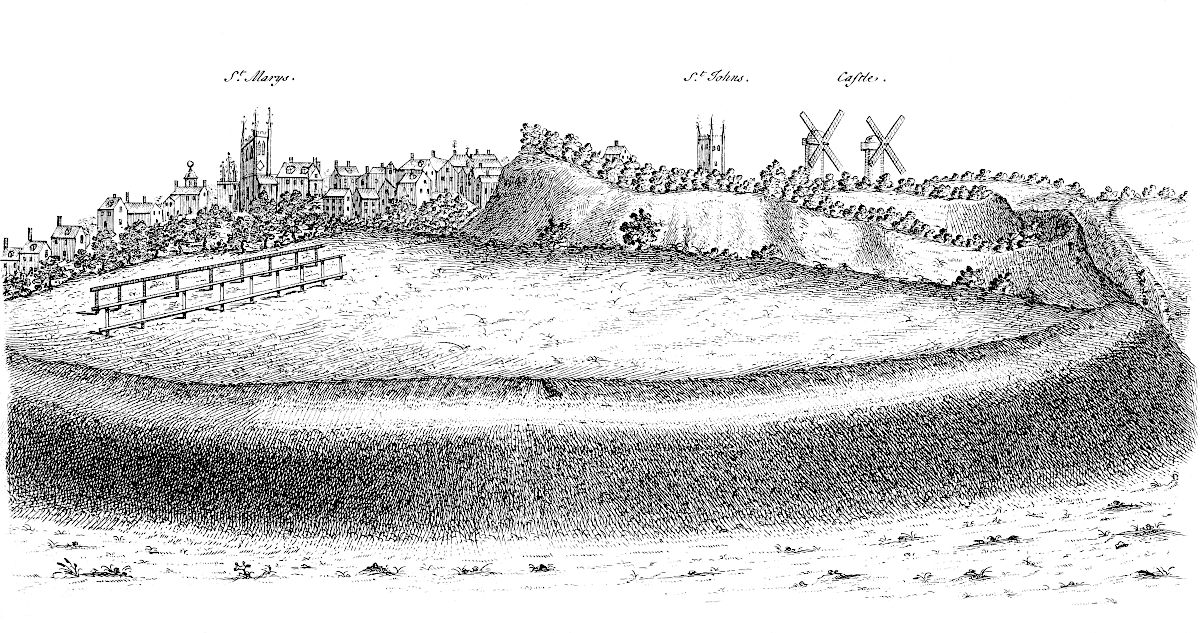
Under it, to the left, is the Devises: this I take to be the Punctuobice of Ravennas, which he mentions by parcels thus: Leucomagus, Bedwin, (Cimetzone for) Cunetione in the ablative case, Marlborough; Punctuobice, the Devises: then he begins a new period of cities in Wales, Venta Silurum, &c. I suppose here is a remnant of the former part of the word Punctuobice in Poulsholt, a little village hard by; Potern another, Potern-wood, and the name of the hundred Potern, taken, in the first times of their division, from such a corrupt appellation of this place: the last syllable bice subsists in the present name Devises, vulgarly vies. This town is excellently situated, about two miles from the bottom of the hills, which keep off the eastern winds, and in a rich soil.[130] Under the hill at Runway is an excellent spring, which the inhabitants have not yet found means to convey thither, though it runs but a little way off the town, where they want water. It is a very large old town, consisting chiefly of two long parallel streets; the houses for the most part of timber, but of a very good model: they value themselves for one of the best weekly markets in England, and for being tenants to the king. It was inclosed by the Romans with a vallum and ditch, which I presently found out: they have made a road of the ditch in most parts round the town; but in several places both that and the vallum are visible enough, and it took in the castle: this castle was Roman originally, finely chosen upon a natural fortification, but in after-times made in a manner impregnable by Roger a bishop of Salisbury; though now it is ignobly mangled, and every day destroyed by people that care not to leave a wall standing, though for a fence to their garden. Here are two churches; the choir of St. Mary’s, of a very old model; the steeple, choir, and both wings of St. John’s, the same, to which parcels have since been tacked all round, and new wide windows put in with pointed arches, instead of the ancient narrow semi-circular ones. Just out of town is a pretty plain, called the Green, with another handsome church and steeple, suburbs to the old town. Here William Cadby, a gardener, dug up his collection of gods, which he carried about for a show: they were found in a garden, in a cavity inclosed with Roman brick: the Venus is of an excellent design; and the Vestal Virgin, as they call it, a fragment of Corinthian brass; it is of very curious drapery: Vulcan is as lame as if made at a forge: the rest equal in designing with the lares of the Ostiaques, and not at all mended in the plate published by Dr. Musgrave: he had several coins found thereabouts, and a brass Roman key which my lord Winchelsea bought. Roman antiquities are found here every day. My lord Winchelsea has one brass Probus; on the reverse, Victoria Germ. with a trophy: and a great fund of such antiquities is to be met with all around the country. At Calne incredible numbers of Roman coin dug up; so at Studley, in the way to Bath, once a seat of the Saxon kings: I have seen and bought some of these: my lord Winchelsea has many found there.
69
Pvnctvobice. July 17. 1723.
From hence towards Trubridge is Steeple-Aston, upon the bottom of the downs of Salisbury plain: it is a most excellent church and tower of stone, and had a famous spire of lead upon it, but twice thrown down by thunder and tempest, which absolutely discouraged the inhabitants from setting it up again.
Return we to the Roman Bath road, which we left at Hedington; whence it goes much as the common road to Bath, and all along upon the south division of Chipenham hundred: I could discern its bank now and then upon the road, though much worn away and defaced in defect of necessary repairs: it passes the Avon at Lacock, where has been a great religious house, so by a chapel south of Haselbury: then it descends a hill for two miles together, till it meets, over-against Bathford, the Foss-way, which comes in a strait line hither through Cirencester, from Benonis or High-cross in Warwickshire, where I left it last year: then our road goes round the crook of the river by Walcot to the Bath. This turn it is that swells the distance between Bath and Verlucio to XX. Roman miles, as we before corrected it. The Wansdike runs still not far off this road, but a little north of it through Spy park; so by Ditchbridge, which has its name from it; then to the Shire stones, at the division between Gloucestershire, Wilts, and Somerset. As to the nature of the soil, when we have left the chalky downs at Hedington, it is intirely sand to the river Avon, whence the name of Sandy lanes: from thence to the Bath it is rocky. There is a vast descent from the Downs quite to Bath, and every great ridge is very steep westward.
Aquæ Solis.
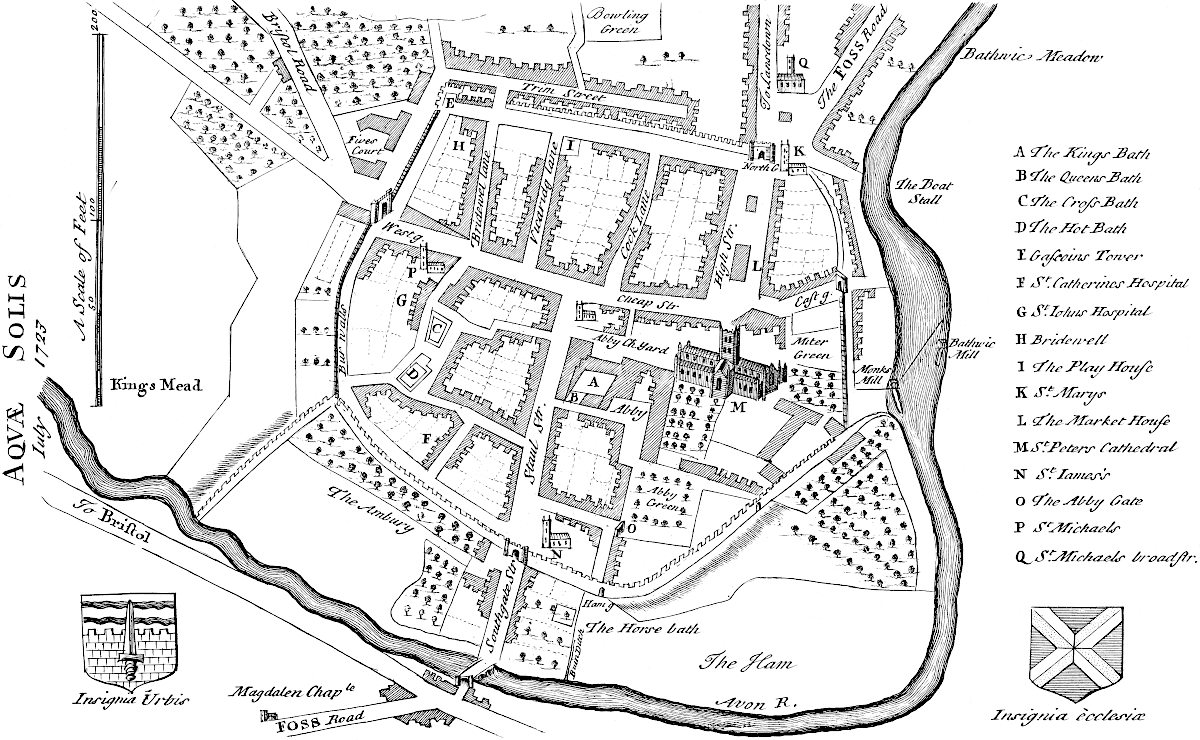
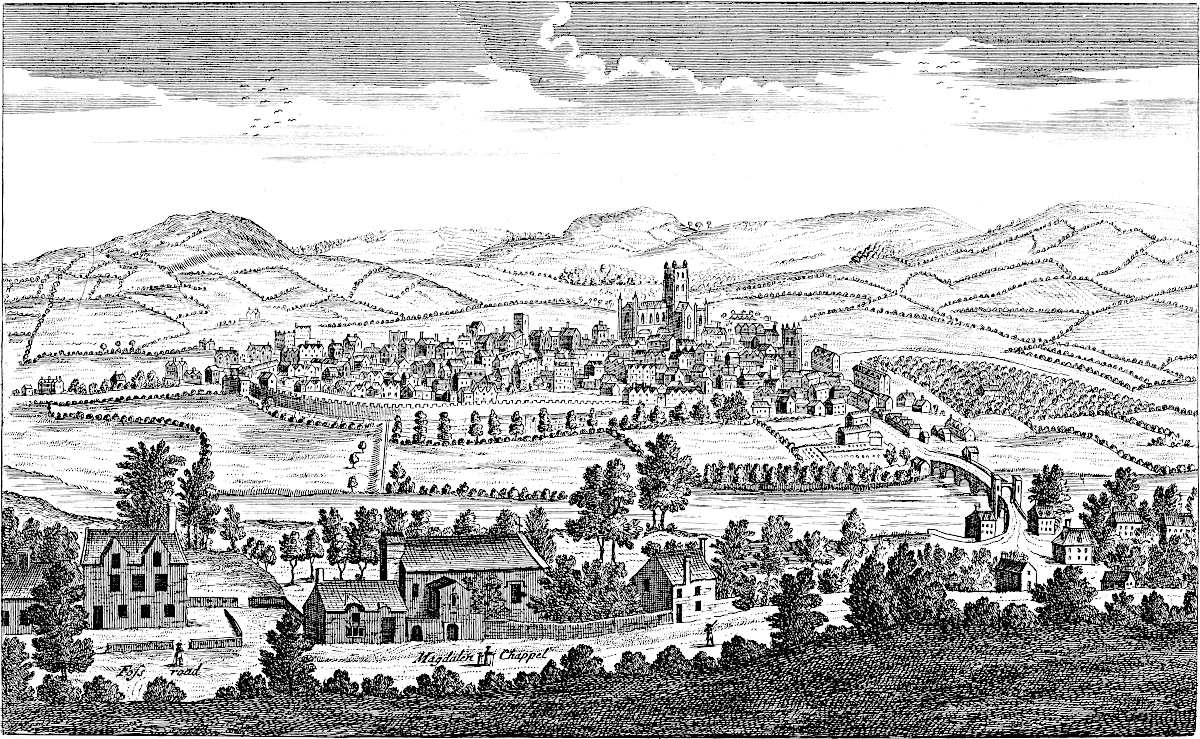
The Bath is a place so celebrated, and so well known, that I need say but little upon it; nor can much be expected from the small time I rested here:TAB. LXX. LXXI. its history and antiquities have been copiously handled by several gentlemen of our own faculty. It is indeed a spot of ground which we Britons may esteem as a particular boon of Nature: it lies in a great valley surrounded with an amphitheatrical view of hills; and its situation on the west side of the island does not a little contribute to its pleasures; for such is ever less subject to violent and enormous alterations of the air by winds and tempest, heat and cold: but the Romans were prudently induced to make a station here, by the admirable hot springs, so wonderful in themselves, and so justly regarded. The walls round the city are for the most part intire, and perhaps the old Roman work, except the upper part, which seems repaired with the ruins of Roman buildings; for the lewis holes are still left in many of the stones, and, to the shame of the repairers, many Roman inscriptions: some sawn across, to fit the size of the place, are still to be seen, some with the letters towards the city, others on the outside: most of those mentioned in Mr. Camden and other authors are still left; but the legend more obscure. The level of the city is risen to the top of the first walls, through the negligence of the magistracy, in this and all other great towns, who suffer idle servants to throw all manner of dirt and ashes into the streets: these walls inclose but a small compass, of a pentagonal form: four gates on four sides, and a postern on the other: from the south-west angle has been an additional wall and ditch carried out to the river; by which short work the approach of an enemy on two sides is cut off, unless they pass the river. The small compass of the city has made the inhabitants croud up the streets to an unseemly and inconvenient narrowness: it is handsomely built, mostly of new stone, which is very white and good; a disgrace to the architects they have there. The cathedral is a beautiful pile, though small; the roof of stone well wrought; much imagery in front, but of a sorry taste. Here they suppose (with probability) stood the Roman temple of Minerva, patroness of the Baths.[131] Before it was a handsome square area, but lately deformed with houses encroaching: on the south side are the justly-renowned hot springs, collected into a square area called the King’s Bath. The corporation has lately erected a pretty handsome building before it, called the Drinking-room, for the company to meet in that drink the waters drawn hither by a marble pump from the bottom of the springs, where it is near boiling hot. This water is admirably grateful to the stomach, striking the roof of the mouth with a fine sulphureous and steely gas, like that of the German Spa or Pyrmont: though you drink off a large pint glass, yet it is so far from creating a heaviness, or nausea, that you find yourself brisker immediately, by its agreeable sensation on the membranes of the stomach: at first it operates by stool, and especially urine: it is of most sovereign virtue to strengthen the bowels, to restore their lost tone through intemperance or inactivity, and renews the vital fire by its adventitious heat and congenial principles. Hither let the hypochondriac student repair, and drink at the Muses’ spring: no doubt the advantages obtained here in abdominal obstructions must be very great. The King’s Bath is an oblong square; the walls full of niches, perhaps the Roman work: there are twelve on the north side, eight on the east and west; about four larger arches on the south: at every corner are the steps to descend into it, and a parapet or balustrade with a walk round it: in the middle is set an aukward timber-work, like a cross, adorned with crutches, the trophies of its wonderful cures: around that emerge the boiling springs very plentifully: upon the south wall is the fanciful image of king Bladud, with a silly account of his finding out these springs, more reasonably attributed to the Romans: they no doubt separated them first from common springs, and fenced them in with an eternal wall. The people have a notion, and probable enough, of subterraneal canals of their making, to carry off the other waters, lest they should mix and spoil the heat of these. It is remarkable that at the cleansing of the springs, when they set down a new pump, they constantly find great quantities of hazle-nuts, as in many other places among subterraneous timber. These I doubt not to be the remains of the famous and universal deluge, which the Hebrew historian tells us was in autumn, Providence by that means securing the revival of the vegetable world. In this bath the people stand up to the chin, men and women, and stew, as we may properly call it; for the most part, in the way of gallantry, and as at a collation. I should judge the method used at Buxton preferable, where the sexes go in separately and privately, where they have liberty to swim about and stir the limbs, and exercise the lungs; whence the whole body will better receive the full force and benefit of the warmth: and this will more effectually put the humours in motion, that should be exterminated at the opened pores: this exercise of the solids sets the glands to work, and every secretion is promoted. Many are the diseases and calamities which here find a happy period, when judiciously applied, which, as a traveller, I need not discourse upon. This brings innumerable people to the salutiferous streams; especially in the summer time, which likewise seems an error owing to custom and fashion; for I doubt not they are equally, if not more beneficial, both internally and externally, in winter than summer. The carrying the water to distant places to drink, seems only a splendid fallacy.
70
Aqvæ Solis Iuly 1723
Stukeley delin.
Parker Sculpt.
See transcription
71
Aquæ Solis Iuly 21. 1723. From the top of the Southern hill.
Stukeley del.
Cl. Richardo Mead M.D.
tab. d.d. W
s
.
Stukeley
.
I observe the whole country hereabouts is a rock of good lime-stone, which is the minera of the water’s heat and virtue: but how that comes to be calcined; by what refined chymistry of Nature sulphur and steel are mixed with it; by what means it acquires and conserves with so much constancy this equable and mighty focus, together with the reason of fountains in general; I profess, in my sentiments, is one of the great arcana in philosophy hitherto inscrutable.
Behind the southern wall of the King’s Bath is a lesser square, called the Queen’s Bath, with a tabernacle of four pillars in the midst: this is of more temperate warmth, as deriving its water at second-hand from the other. There are likewise pumps and pumping-rooms, for pouring hot streams on any part of the body; which in many cases is very useful, to dissolve sizy concretions about the joints and the like, and recovers the natural elasticity in the relaxed fibres of the solids. The area before this bath and front of the cathedral, is in the centre of the pentagon, upon which the city is formed. Why the Romans made it of this unusual figure, I cannot tell: nothing appears from the manner of the ground and situation; but I observe the same of Aix in France. One would be apt to suspect they had a regard to the sacred symbol and mystical character of medicine, which in ancient times was thought of no inconsiderable virtue: this is a pentagonal figure, formed from a triple triangle, called by the name of Hygeia, because to be resolved into the Greek letters that compose the word. The Pythagoreans used it among their disciples as a mystical symbol, denoting health; and the cabalistic Jews and Arabians had the same fancy: it is the pentalpha, or pentagrammon, among the Egyptians; the mark of prosperity. Antiochus Soter, going to fight against the Galatians, was advised in a dream to bear this sign upon his banner; whence he obtained a signal victory. This would make one believe a physician had a hand in projecting this city. Dr. Musgrave thinks it was Scribonius, who accompanied Claudius hither.
In the south-west part of the town are two other baths, not to be disregarded: for in any other place who would not purchase them at the greatest price? The Hot bath is a small parallelogram, not much inferior in heat to the King’s bath: it has a stone tabernacle of four pillars in the middle. The Cross bath, near it, is triangular, and had a cross in the middle; which now is a very handsome work, in marble, of three Corinthian pillars, erected by the lord Milford, in memory of king James the Second’s queen conceiving, as it is said, after the use thereof. Hard by is an hospital built and endowed by a bishop of this see. The water in these two places rises near to the level of the streets, because I suppose in this part of the town the earth is not so much heightened. On the south side of the cathedral are some parts of the abbey left, and the gate-house belonging to it. Not long ago, by money contributed, they made a cold bath, at a spring beyond the bridge, that nothing of this sort might be wanting for the benefit of the infirm.
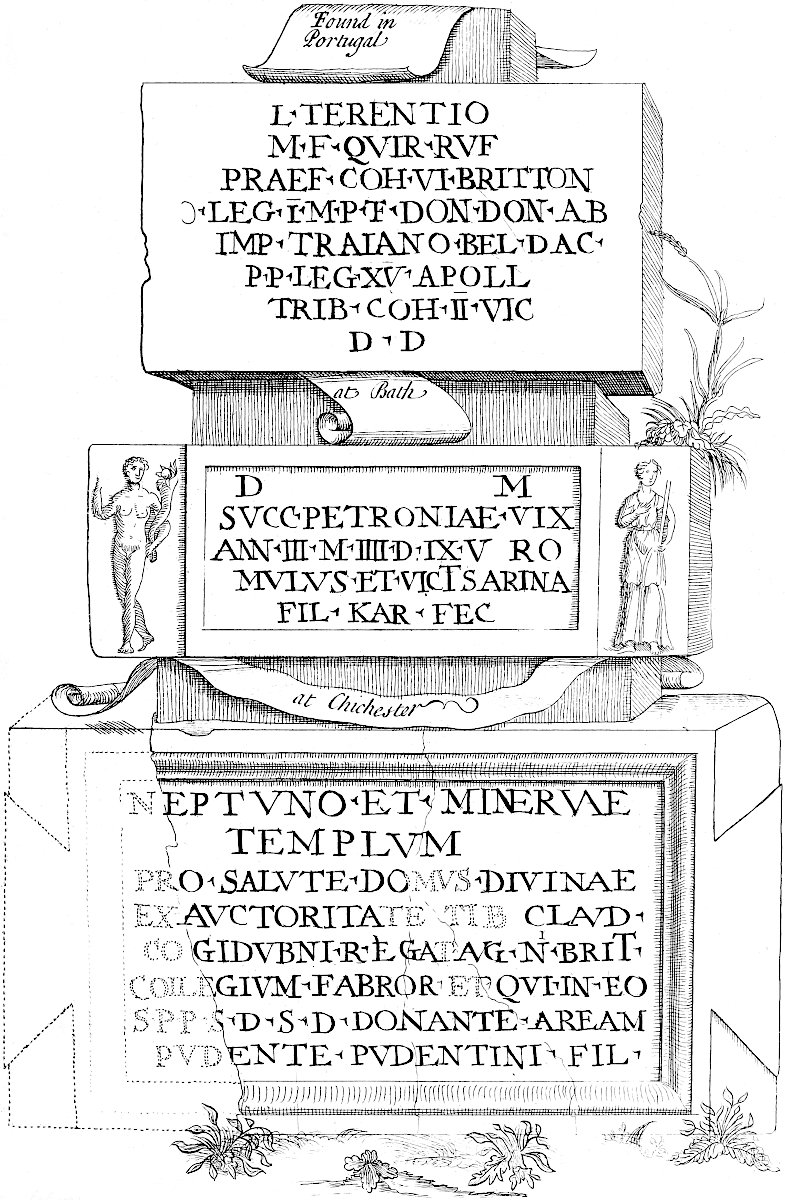
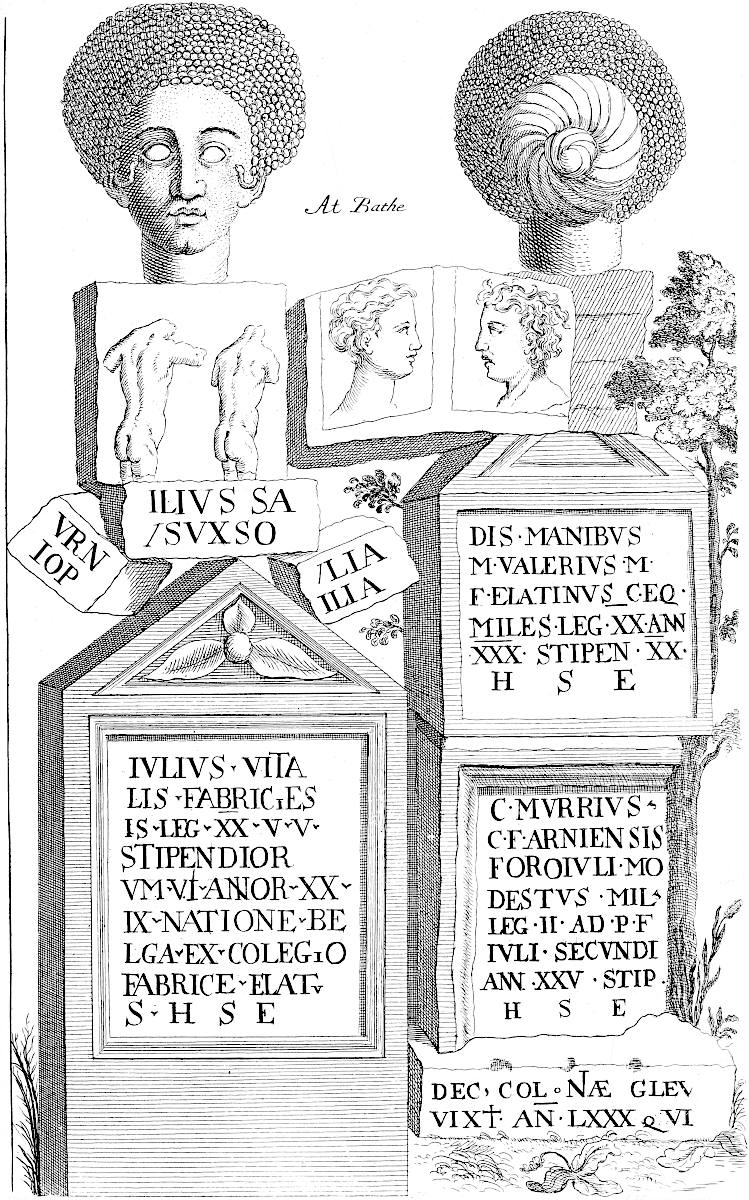
Since Mr. Camden’s time two inscriptions have been set in the eastern wall of the cathedral, fronting the walks: but this is as imprudently done as those in the city-walls; for, besides the rain and weather, they are exposed to the boys, who throw stones at them: one is that of Julius Vitalis, published by Dr. Musgrave; the other, which he calls a basso relievo of Geta, seems to have been the top of a monumental stone over some common horseman. TAB. XLIX.Harrison’s house, they say, is built against some basso’s and inscriptions. In the 49th plate I have given the whole TAB. XLI. 2d Vol.stone and inscription, now in the wall near the north gate.
At Walcot has been a camp, and many Roman antiquities are frequently found. Lord Winchelsea has an urn, a patera, and other things, found in a stone coffin, wherein was a child’s body, half a mile off the Bath.
Riding upon Lansdown, I saw the monument, lately erected by lord Lansdown, in memory of his grandfather Bevil Granvile, slain here in a battle with the parliament forces. Hence, it being a north-west precipice, is a prospect of Bristol, the Severn, &c. This road seems to be the Ricning-street, called Langridge, going to the passage over the Severn, the ancient Trajectus and so along the east side of the Severn, and into Yorkshire. The ground hereabouts is very red, covering a solid rock of stone, which lies in thin layers parallel to the horizon, with as much exactness as if hewn for courses in a wall: this stone is full of little shells; and of this sort is the monument of Julius Vitalis: between the strata are crystallizations or fluors of petrifying juices: all the stone in this country abounds with curious fossils. As you walk along a new paved road, it is very common to find very great cornua ammonis, two foot diameter, laid in among the rest; and, though formed with such admirable curiosity, yet the country people walk carelessly over them, as I observed, whilst a horse will startle at so unusual an appearance: the first I saw in the Foss road, going up the hill south of Bath, I took for the image of the Sun, which I remembered to have seen prints of, as it was in basso relievo in the city-walls, with his hair flowing round like rays; and this was well enough represented in a stone that had been worn a little: but I was soon undeceived, when I found great numbers of the same sort further on.[132]
49
Roman Inscriptions Honorabili Johĩ Clerke Baroni Scaccar. in Scotia tab. d.d. Ws. Stukeley.
Stukeley f.a.f 1723
See transcription
41·2d.
At Bathe.
Stukeley delin.
I. Harris fecit.
See transcription
The Weddings. Br. Temple. From the Bath I went to visit the famous Celtic temple called the Weddings, in company with John Strachey, esq; who lives near there, a person well versed in natural history and antiquities, and fellow of the Royal Society. I shall describe this memorable curiosity upon another occasion. In the way hither, about Twyfordton, I found a Marsbury field.fallow field with but little quantity of earth upon the rock: this was as full of fossil shells as possible, let into a softish stone, which had preserved their very natural colour of blue and white as perfectly as at first. Near Stanton Drue, in a trivium, is an old elm-tree made infamous for the bloody trophies of judge Jeffrys’s barbarity, in the duke of Monmouth’s rebellion; for all its broad-spreading arms were covered over with heads and limbs of the unfortunate countrymen. In Chu parish is Bowditch camp.Bowditch, a large camp on a hill trebly fortified, whence you may behold the isles of Flatholm and Steepholm in the sea. I suppose the word means the circular form of the place. Here is a petrifying spring. This country abounds with coal-pits: the slates that lie upon it, and have not received their due quantity of sulphur, so as to make perfect coal, are most curiously marked with impressions of plants, capillary ones especially, and more particularly those of fern; all which grew in exceeding plenty in this country, and gave their forms to this soft matter at the Deluge. This is indeed a rock, and full of springs, very bad road for travelling, short and steep valleys, narrow lanes, intricate, dark and hard: so no wonder harts-tongue, liver-wort, maiden-hair, navel-wort, and the like moist plants, thrive here. The ground in these valleys is very rich: much wood grows upon it; though in some roads you ride upon the superfice of a rock lying flat in great slabs, as if artificially placed with good joints. Many wood-plants grow about here, such as wood-sorrel, strawberries, tutsan or park-leaves, &c. The neatness of the houses even of the poorer sort of people is remarkable, being generally whited over, and with pretty little gardens, which in pure and unartful nature is a necessary adjunct in the happiness of life.
Camps.
There is a camp overlooks Stanton Drue, called Mizknoll; another at Elm, two miles west from Frome: in 1691 a pot of Roman coin found there, most of Constantine junior: it is upon the end of a precipice, and severed from the rest of the hill by a vallum on one side only: south of it runs a rivulet. Masbury castle upon Mendip hills, half a mile from the Foss, a mile north of Shipton-Mallet, of a round form, 150 paces diameter: the two entrances opposite: the environing ditch on one end laps over with a semi-lunar turn, rendering the passage to it oblique. Hereabouts are many camps, whose ditches are hewn out of the solid rock: that above Bristol has four trenches, as many vallums, and but one entrance: one would think it impregnable to any thing but hunger. A camp cut out of the rock at Churchill with a single trench. There is a cave equal to that of Ochey-hole at Dolebury. These are from information of Mr. Strachey.
In this county of Somersetshire are three remarkable hills, that make an exact triangle twelve mile each side, much talked of by the country people; Camalet castle, Glassenbury torr, and Montacute. They have a notion that king Arthur obtained from some saint, that no serpent or venomous creature should ever be found in this compass, though frequent all around it. I shall rehearse to your lordship what occurred to me at the places. All this country, though to the eye very pleasant with woods and prospects yet is very disagreeable to travel, for the reasons I just mentioned.
Colomeæ.
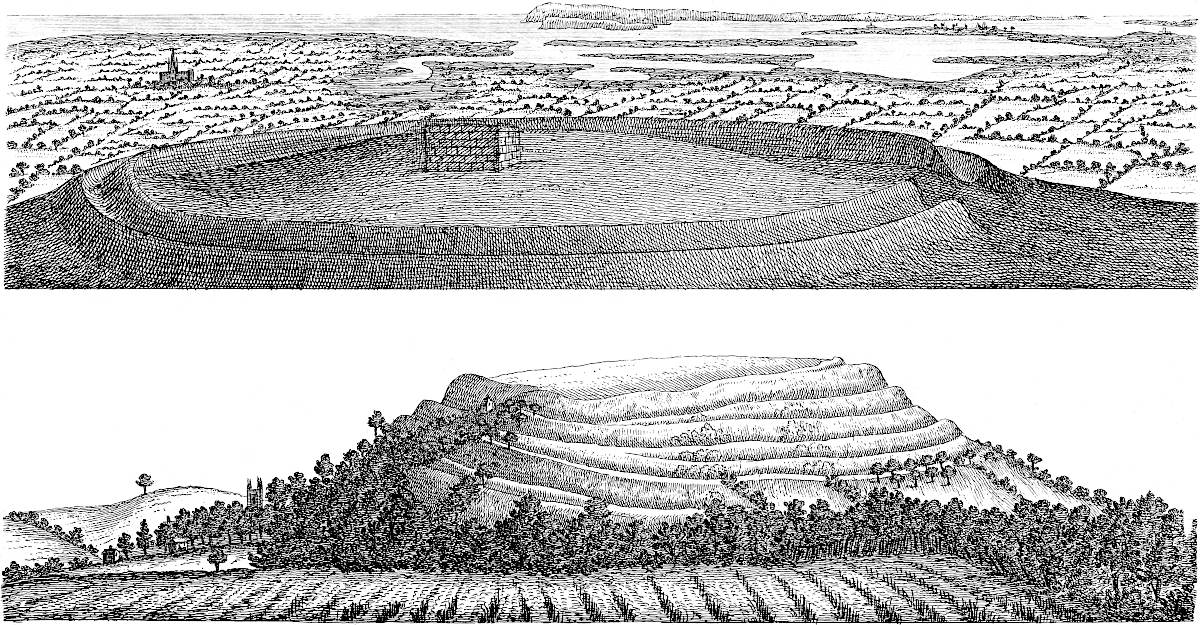
Camalet is a noted place, situate on the highest ground in this county, on the edge of Dorsetshire. TAB. XLIII.The country people are ignorant of this name, which has generally obtained among the learned: they call it Cadbury castle, from the village of North-Cadbury, in which it is: this caution is useful to those that go to enquire for it. Hereabouts rise the rivers of Somersetshire, which run into the Severn sea westward; and that in Dorset, which goes eastward, through Sturminster, into the southern ocean. It is a noble fortification of the Romans, placed on the north end of a ridge of hills separated from the rest by nature; and for the most part solid rock, very steep and high: there are three or four ditches quite round, sometimes more: the area within is twenty acres at least, rising in the middle: its figure is squarish, but conforms to the shape of the hill. There is a higher angle of ground within, ditched about, where they say was king Arthur’s palace: it was probably the prætorium and might be king Arthur’s too. who lived in this place: the country people refer all stories to him. The whole has been ploughed over since the memory of man, and much stone has been taken from the surface, which has altered it. The rampart is large and high, made chiefly of great stones covered with earth, and perhaps, in some parts where it was necessary, laid with mortar: here is only one entrance from the east. It is not unlikely there were buildings erected in the later British times, being of so great strength, and a perfect watch-tower, surveying the country round to an incredible distance. The prospect is woody, and very pleasant; here and there little hills, lofty and steep, peeping up with their naked heads: you reach all the Mendip hills and Black-down in Devonshire. In this camp they find many pebble-stones exactly round, half a peck at a time; whereas there are none such in the country: they suppose them stones to sling withal, fetched from the sea, or perhaps shot in cross-bows. Roman coin in great plenty has been found here, and all the country round: I saw vast numbers of Antoninus and Faustina, about that time and after. The entrance here is guarded with six or seven ditches: on the north side, in the fourth ditch, is a never-failing spring, called King Arthur’s well: over it they have dug up square stones, door-jambs with hinges, and say there are subterraneous vaults thereabouts. Selden, in his notes on Polyolbion, writes it was full of ruins and reliques of old buildings. At top they told me many pavements, and arches have been dug up, hand-grindstones, and other domestic or camp utensils. They say there is a road across the fields, that bears very rank corn, called King Arthur’s Hunting-causeway.
43
Prospect From St. Roc’s hill Sept. 15. 1723.
Stukeley del.
Prospect of Camalet Castle.
15. Aug. 1723.
33
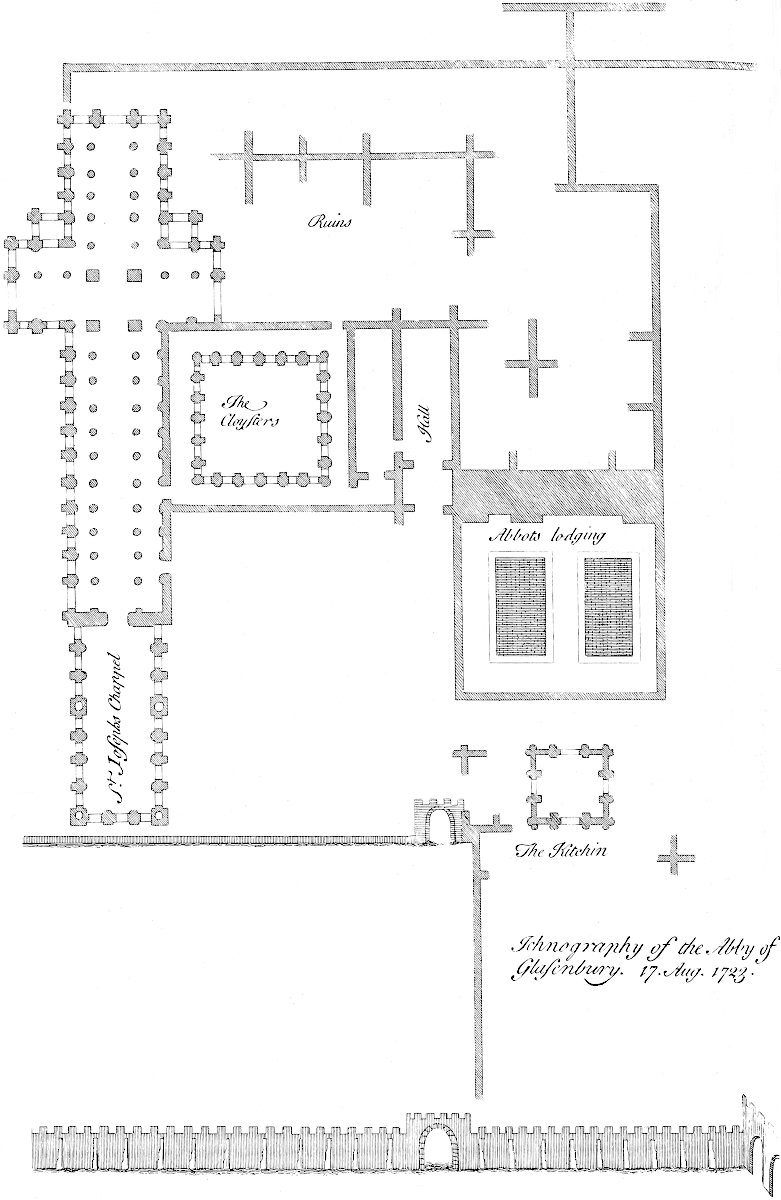
Ichnography of the Abby of Glasenbury. 17. Aug. 1723.
The Street
I. Vdr. Gucht Scul.
Stukeley delin.
Cadbury.The church and tower of Cadbury is neat and small, built of stone. In this place they call walnuts Welsh-nuts. To the southward, on the opposite hill, corpses have been dug up: there was lately an urn full of Roman money found at Wincaunton. A little above Sutton, toward Beacon-Ash, in inclosing ground, half a peck of the same coin was found; I saw some of Tetricus. Roman pateras, a knife, and other antiquities, taken up thereabouts, sent to madam Thyns, now in lord Winchelsea’s custody. Many are the British stories told of Camalet, of the knights of king Arthur’s round table, of the solemn justings and tournaments there, &c. It seems, when the castle for its security was turned into a city, this was the Colomeæ of Ravennas, (as Mr. Baxter has corrected it) in the later times of the Romans; unless Quincamel, not far off, can better put in its claim, to which this might be the garrison. At Long-Leat, in my lord Weymouth’s library, is a piece of lead weighing fifty pound, one foot nine inches long, two inches thick, three and an half broad, found in the lord Fitzharding’s grounds near Bruton in Somersetshire, and was discovered by digging a hole to set a gate-post in: upon it this memorable inscription, which I suppose was some trophy; communicated by lord Winchelsea.
IMP DVOR AVG ANTONINI ET VERI ARMENIACORVM.
Hence let us go, as in pilgrimage, to the famous Glassenbury; for it is a very rough and disagreeable road, over rocks and the heads of rivers: but that is much alleviated by the many natural curiosities such places afford: several times I saw gilded ivy grow in the hedges, as yellow as gold; great plenty of viorna, purging-thorn, prim-print, and the banks every where over-grown with fox-gloves. Kyneton village, for half a mile together, is paved naturally with one smooth broad rock, the whole breadth of the road; so that it looks like ice. Great quarries of stone hereabouts, of the slab kind: all the uppermost layers are incredibly full of sea-shells, and would make admirable pannels to wainscot a virtuoso’s summer-house, grotto, or the like, and of any dimensions; not inferior, in true value, to those brought from Italy, but too cheap. I frequently took notice that the course of the vein of the stone quarry runs north-east and south-west.
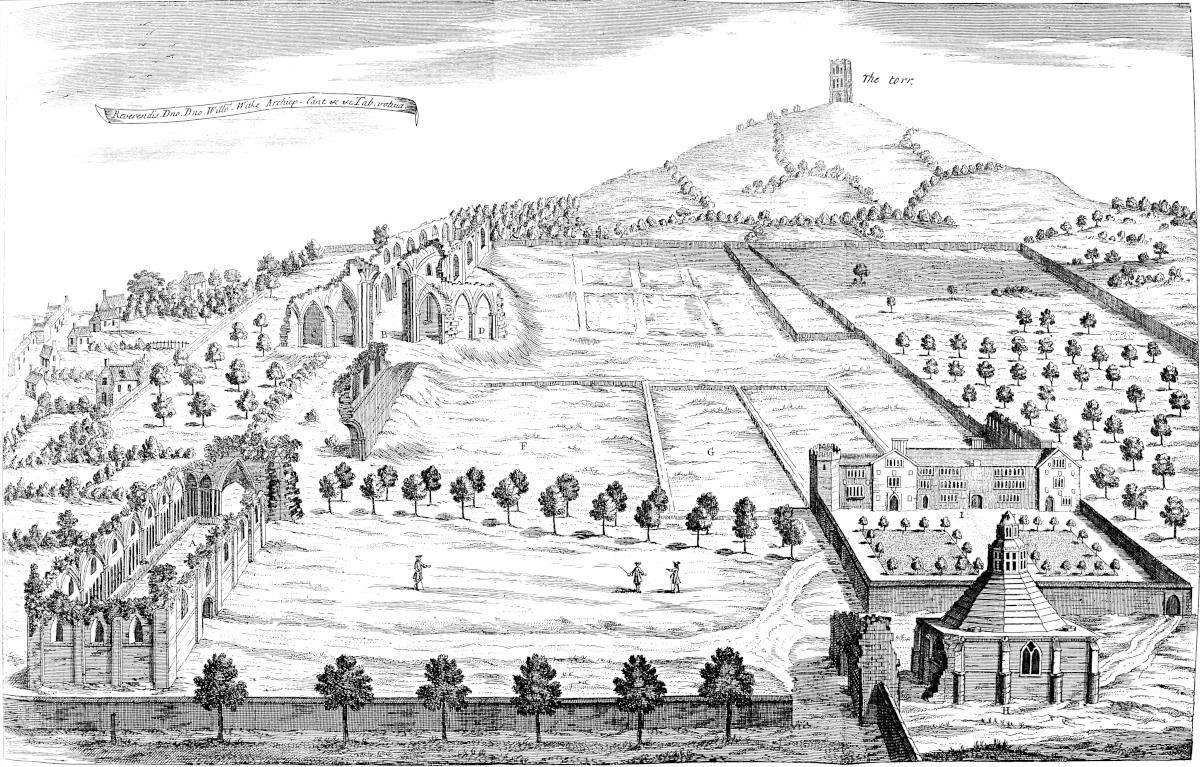
Crossing the Foss road at Lyteford you enter upon a flat moorish country, full of artificial cuts and drains, like the levels in Lincolnshire. Not far before I came to Glassenbury, I observed a great bank, crossing the road, which seemed to be a Roman road. I guess there was a Roman road went from Bristol, through Axbridge, Bridgewater, Taunton, parallel to the Foss, and nearer the ocean. I have been told, between the two last places it is very fair, and paved with stone. With much labour I climbed to the top of the Torr, hanging over the town of Glasenbury TorrGlassenbury. This hill, with that called Werial hill, is a long rib of elevated ground in the midst of this vast level or isle of TAB. XXXVII.Avalon. I observed, in its several breaks or gradations, a steepness westward. Here upon the narrow crest of the Torr, which is much the highest, the abbots built a church to St. Michael, of good square stone: the tower is left, though ruinous; and it is an excellent sea-mark: it probably cost more to carry the stone up to this apex, than to erect the building. There is a spring half way up it. It is certainly higher than any ground within ten miles of the place. They say here is a passage hence under ground to the abbey.
Glasenbury.
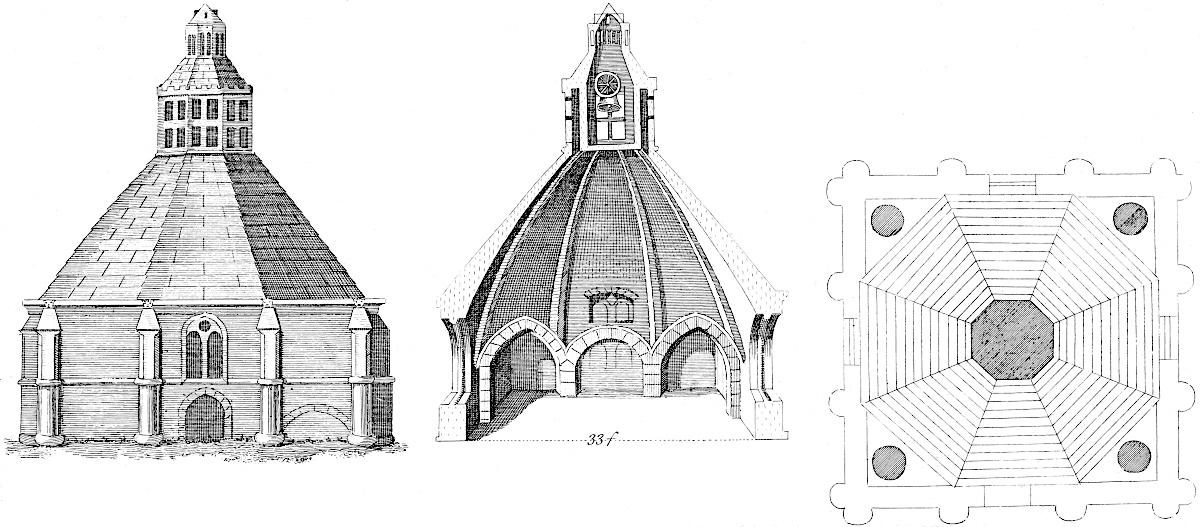
This great monastery in superstitious times held the first place for fame and sanctity. Here the christian doctrine first found admittance in Britain, or early tradition has amused us: it is not unlikely the fact may be true, TAB. XXXIII.though the persons and circumstances invented: however, it is not to be doubted but king Ina built their church; as one of the most ancient, so the most wealthy and magnificent, loaded with revenues by the Saxon kings, and perhaps the British before them. Truly the abbot lived in no less state than the royal donors: no wonder, when his revenue was equivalent to 40,000l. per ann. he could from the Torr see a vast tract of this rich land his own demesnes, and seven parks well stored with deer belonging to the monastery. It is walled round and embattled like a town, a mile in compass: as yet there are magnificent ruins; but within a lustrum of years, a presbyterian tenant has made more barbarous havock there, than has been since the Dissolution; for every week a pillar, a buttress, a window-jamb, or an angle of fine hewn stone, is sold to the best bidder: whilst I was there they were excoriating St. Joseph’s chapel for that purpose, and the squared stones were laid up by lots in the abbot’s kitchen: the rest goes to paving yards and stalls for cattle, or the highway. I observed frequent instances of the townsmen being generally afraid to make such purchase, as thinking an unlucky fate attends the family where these materials are used; and they told me many stories and particular instances of it: others, that are but half religious, will venture to build stables and out-houses therewith, but by no means any part of the dwelling-house. The abbot’s lodging was a fine stone building, but could not content the tenant just mentioned, who pulled it down two or three years ago, and built a new house out of it; aukwardly setting up the arms and cognisances of the great Saxon kings and princes, founders, and of the abbots, over his own doors and windows: TAB. XXXVII.my friend Mr. Strachey had taken a drawing of it very luckily just before, TAB. XXXIV.which I have put in its proper place, plate 37. Nothing is reserved intire but the kitchen, a judicious piece of architecture: it is formed from an octagon included in a square; four fire-places fill the four angles, having chimneys over them: in the flat part of the roof, between these, rises the arched octagonal pyramid, crowned with a double lantern, one within another: there are eight curved ribs within, which support this vault, and eight funnels for letting out the steam through windows; within which, in a lesser pyramid, hung the bell to call the poor people to the adjacent almery, whose ruins are on the north side of the kitchen: the stones of the pyramid are all cut slaunting with the same bevil to throw off the rain. They have a report in the town, that king Henry VIII. quarrelling with the abbot, threatened to fire his kitchen: to which he returned answer, That he would build such a one as all the timber in his forest should not burn.
TAB. XXXVI.
The church was large and magnificent: the walls of the choir are standing, twenty-five fathom long, twelve broad: there is one jamb at the east end of the high altar left: hereabouts were buried king Edgar, and many of the Saxon kings, whose noble ashes ought to have protected the whole: two pillars of the great middle tower are left next the choir: on the north side is St. Mary’s chapel, as they told me; the roof beat down by violence, and a sorry wooden one in its place, thatched with stubble to make it serve as a stable: the manger lies upon the altar and niche where they put the holy water. St. Edgar’s chapel is opposite to it; not much left of it, beside the foundations: the north and south transepts are quite demolished. They say king Arthur was buried under the great tower. A small part of the south side wall of the body of the church remains, which made one side of the cloysters; and the arch at the west end, leading to the chapel of Joseph of Arimathea, the patron and asserted founder of the whole. This they say was the first christian church in Britain. The present work is about the third building upon the same spot:TAB. XXXV. it is forty-four paces long, thirty-six wide without: it is so intire, that we could well enough draw the whole structure, as in plate 35. the roof is chiefly wanting: two little turrets are at the corners of the west end, and two more at the interval of four windows from thence, which seem to indicate the space of ground the first chapel was built on: the rest between it and the church was a sort of anti-chapel. Underneath was a vault now full of water, the floor of the chapel being beaten down into it: it was wrought with great stones. Here was a capacious receptacle of the dead: they have taken up many leaden coffins, and melted them into cisterns. Hence is the subterraneous arched passage to the Torr, according to their notion. The roof of the chapel was finely arched with rib-work of stone: the sides of the walls are full of small pillars of Sussex marble, as likewise the whole church; which was a little way of ornamenting in those days: they are mostly beaten down: between them the walls are painted with pictures of saints, as still easily seen. All the walls are overgrown with ivy, which is the only thing here in a flourishing condition; everything else presenting a most melancholy, though venerable aspect. On the south side the cloysters was the great hall. The town’s people bought the stone ofTAB. XXXVII. the vaults underneath to build a sorry market-house, contributing to the ruin of the sacred fabric, and to their own: what they durst not have done singly, they perpetrated as a body, hoping vengeance would slip between so many: nor did they discern the benefit accruing to the town from the great concourse of strangers purposely to see this abbey, which is now the greatest trade of it, as formerly its only support; for it is in a most miserable decaying condition, as wholly cut off from the great revenues spent among them. There are many other foundations of the buildings left in the great area, but in the present hands will soon be rooted up, and the very footsteps of them effaced, which so many ages had been erecting. Though I am no encourager of superstitious foppery, yet I think, out of that vast estate, somewhat might have been left, if only to preserve old monuments for the benefit of our history. The abbot’s hall I have been told was curiously wainscoted with oak, and painted with coats of arms in every pannel. The mortar of these buildings is very good, and great rocks of the roof of the church lie upon the ground, consisting chiefly of rubble stone untouched by the fanatical destroyers, who work on the hewn stone of the outside, till a whole wall falls when undermined a little. Throughout the town are the tattered remains of doors, windows, bases, capitals of pillars, &c. brought from the abbey, and put into every poor cottage.
37
The Prospect of Glasenbury Abby.
Stukeley del.
A.
S
t
. Josephs chappel.
B.
The Abby Church.
C.
S
t
. Marys chappel.
D.
Edgars chappel.
E.
The high Alter.
F.
The Cloysters.
G.
The Hall.
H.
The Abbots kitchin.
I.
The Abbots Lodging.
34
The Orthography Section & Groundplot of the Abbot of Glasenburys Kitchin. Aug. 17. 1723.
Celeberrimo Viro Humfredo Wanleio d.d. W. Stukeley.
36
A Prospect of the Ruins of Glasenbury Abby Aug. 17. 1723.
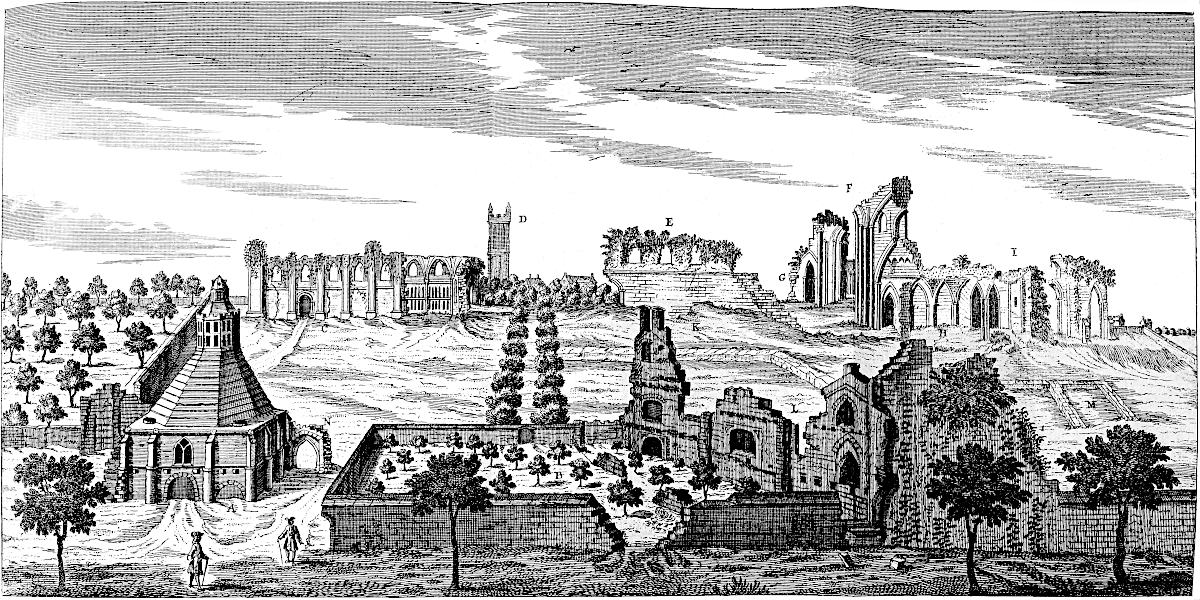
Stukeley del.
E. Kirkall scul:
A.
The Abbots Kitchin.
B.
His Lodgings.
C.
S
t
Iosephs Chappel.
D.
The Town Church.
E.
the Abby Church.
F.
the Tower.
G.
S
t
Marys Chappel.
H.
Edgars Chappel.
I.
the Choir.
K.
the Cloysters.
L.
the Hall.
M.
the Monks Lodgings.
N.
the Almery.
35
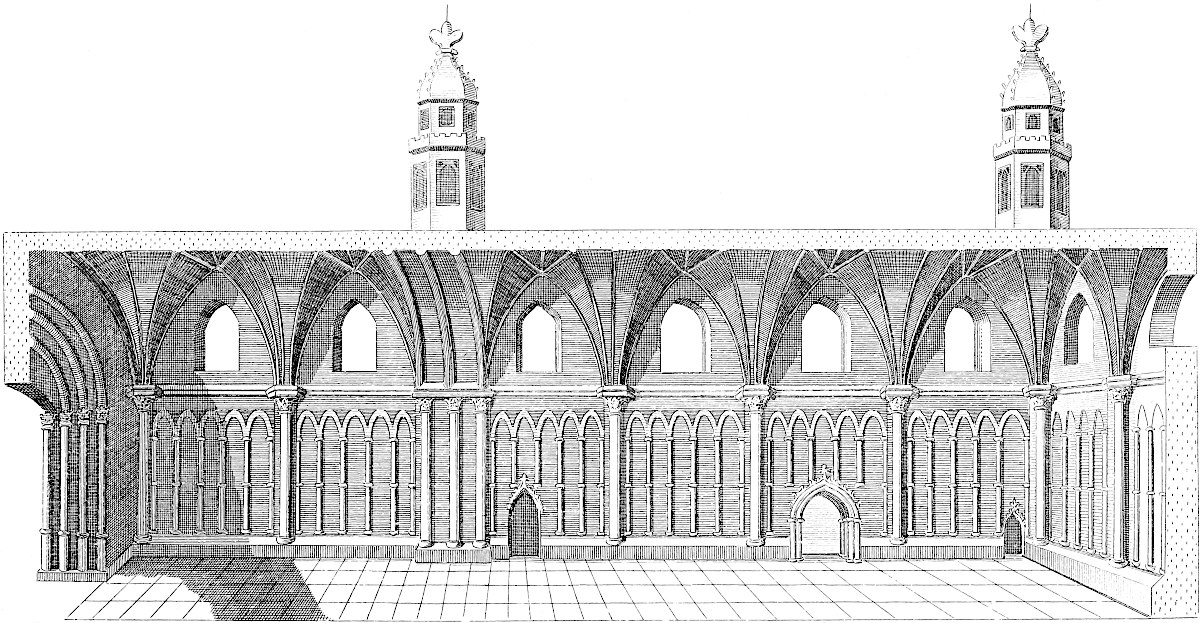
The Inside Section of St. Joseph of Arimathea’s Chapel at Glasenbury. Tho. Tanner D.D. Sacra Tabula.
G. Vder. Gucht. Scul.
Stukeley delin.
In the town are two churches; the upper a handsome fabric, with a fine tower of good design, adorned with figures in niches: at the east end of the church-yard is a curious old tomb inscribed with ancient English letters, but so worn with trampling on, that I could make little out of it, except the name of the interred Alleyn. The George inn is an old stone building, called the Abbot’s inn, where chiefly the pilgrims were lodged that came strolling hither, and idling their time away for sanctity: stone and timber are liberally bestowed on it: a coat of arms of the kings of England, supported by a lion and a bull, over the gate, and many crosses: the bed I lay in was of large timber, with great embossed gilt pannels, and seemed to have been the abbot’s.
When I left this place, I passed through a great gate built across the road under the abbey wall, with a lesser portal by the side of it; which I suppose was some boundary of the abbey-lands, and part of their extravagance; for the abbot’s revenues being inconsumable in their way of life, they prodigally threw it away in building, as one method of perpetuating their name: another they had which was very useful, the making great and high causeways, along this moory country, for facilitating travelling and commerce; the remains of which I saw here and there, and wished they had been in better repair. I passed by the side of Werial hill, where grew the famous hawthorn that blossomed at Christmas; I suppose, an early blooming white-thorn: but that it so strictly observed Christmas day to an hour, nay a minute, as they here assert, I believe no more than the vulgar derivation of the hill, with more of the dregs of monkery. Somerton is an old town, that gives name to the whole county, once the royal seat of the West-Saxon kings: the steeple is octangular: probably it was a Roman town. I saw a camp upon a great copped high hill on the right hand, as I travelled. At Ilchester town end I fell into the Foss road again.
Ischalis.
TAB. LXXII.
This station of the Romans is situate on the south side of the river Ivel, or Yeovil, the Velox of Ravennas. Pillbridge, a little lower, seems to retain the name: it is the Uzella of Ptolemy. I perceived immediately that this place had been originally encompassed with a wall and ditch, and traced out the manifest vestigia thereof quite round: it was an oblong square 300 paces in length, 200 in breadth, standing upon the oblique points of the compass, conform to the Foss way, which passes through the town exactly from north-east to south-west: the north-east side of the city lay against the river, where I saw foundations of the wall here and there, and took up several Roman bricks in searching for it in the gardens: the ditch on the north-west side is become a road, called Yard-lane, as going behind the yards and gardens: then it runs through the friery garden; for the religious had extended their bounds beyond the city, and turned the road on the outside: then it goes along the road on the back of Mr. Lockyer’s garden: it is now visible between the Yeovil road and the southern angle; then runs through another garden, being for the most part levelled by the gardener, who showed me the track of it, and had by times, in digging, taken up remainders of the wall, with many coins, bricks, tiles, and other antiquities. I bought some coins of him, among which the brass one of Antoninus Pius depicted in the plate; on the reverse, Britannia sitting on a rock with a military ensign. Sir Philip Sydenham has a great quantity of coins found here, and the minister of the parish gave many to the learned Mr. Coke of Norfolk. This gardener showed me many square paving bricks in the floor of his house, and told me he dug up a great brass coin, as big as half a crown, under the foundation of the wall, which doubtless would have discovered to us the area of its building. Crossing the Sherburn and Limington road, we find the ditch again, turning up to the river-side, on the eastern angle, conformable to the scheme; where it is again inclosed into gardens and pastures: the occupier of the gardens there informed me too, that he had frequently dug up the like antiquities, together with the foundations of the wall. The quickset-hedge that fences in the garden stands on the edge of the ditch, and observes its turn at that angle of the city: by the new mill it meets the river. In all the gardens hereabouts, by the Borough-green, they find foundations of old houses; and some run across the present streets, now visible above ground. This ditch, when perfect, admitted the water of the river quite round. Mr. Lockyer’s house is built upon subterraneous arches. They say here have been sixteen parish-churches, and foundations are to be found all the town over; and that the suburbs extended southward, especially on the Yeovil road, which formerly had a gate: it is not to be doubted but that there were gates at the passage of all the other streets. They say the bishop of Bath and Wells has a manuscript relating to the ancient state of this town. They have the same tradition as in many other places, that the old city was set on fire by matches tied to the tails of sparrows, let fly from a place called Stannard-cross hill. As soon as I came into the inn, (the Swan) I saw a great parcel of the little stones of a tesselated pavement, found but two days before, in a garden over the way near the river: a croud of people came immediately out of curiosity to see it, and tore it up: I saw some of the remainder in situ, about two foot deep, laid in strong mortar upon a hard gravelled floor: I made the owner melancholy with informing him what profit he might have got by preserving it, to show to strangers. The Foss-way retains its name, and makes the principal street: the pavement thereof, or the original ford across the river, may be seen on the west side of the bridge, made with great flag stones. Upon the bridge is an old chapel, called Little St. Mary’s: at the foot of the bridge within the town is another, called White-chapel; both converted into dwellings. Foundations of houses, chimney-pieces, and the like, have been dug up in the meads on the west side the town, and on both sides the river, with stone coffins and other funeral apparatus. The head of the mayor’s staff or mace is a piece of great antiquity in cast brass: there are four niches with four images, two kings, a queen, and an angel: it seems to have been the crosier of some religious house: round the bottom is wrote, in two lines, + JESU DE DRUERJE + NEME DUNETMJE. In the northern angle beyond the old ditch of the city, towards the river, have been some bastions and modern fortifications, of the time of king Charles I.
72
ISCHALIS 17. Aug. 1723.
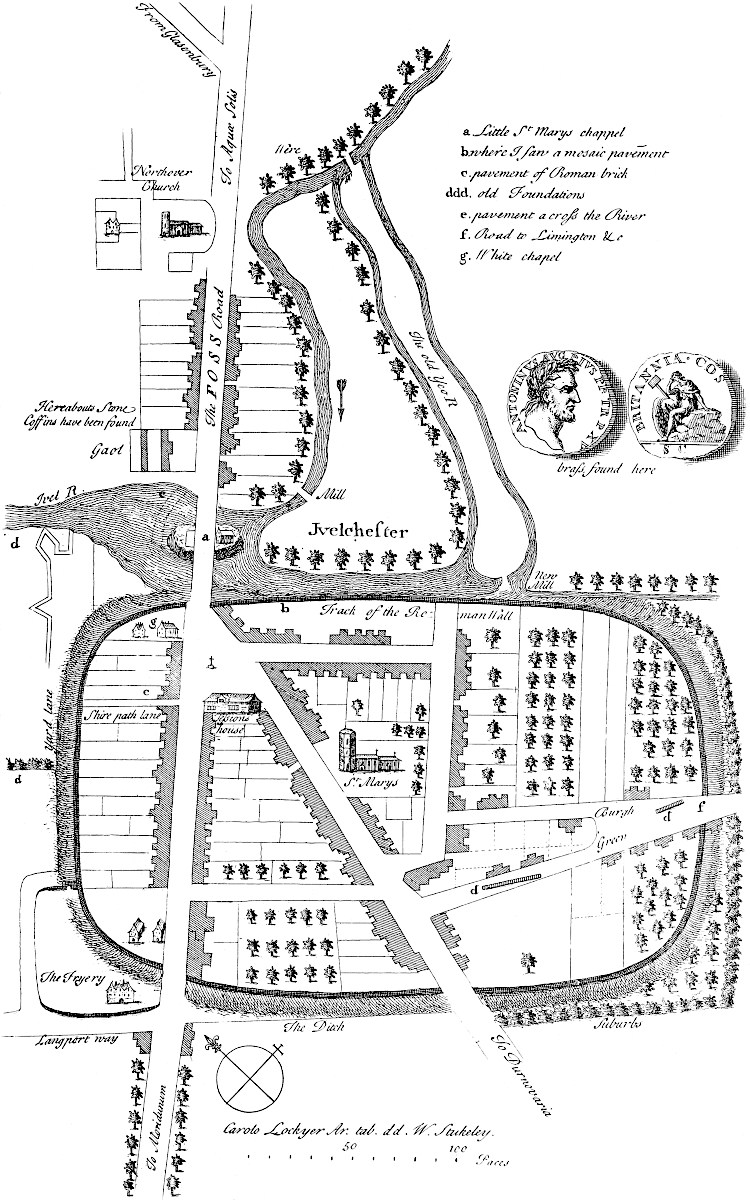
Stukeley del.
I. Vder. Gucht Sculp.
See transcription
Beyond the river is a village adjoining, called North-over, with a church; at Mrs. Hoddle’s, hard by, I saw a grey-hound bitch, from whose side a skewer of wood seven inches long had worked itself out from the stomach: we have some such rare cases in medicinal histories. They talk of a castle standing where now is the gaol, and that the tide came formerly up hither, though now it reaches not beyond Langport. West of this, some time since, they dug up some bones in a leaden case, as big as a band-box, laid in a hollowed stone; and near it, under a tree, was a vault of stone, where a body was found lying at full length. Langport is moted about, as they tell me, and probably was a Roman town. These were all the remarkables I met with at Ischalis, where I staid but half a day.
Foss road.
Hence I continued my journey along the Foss, which I observed paved with the original work in many parts: it is composed of the flat quarry-stones of the country, of a good breadth, laid edgewise, and so close that it looks like the side of a wall fallen down, and through the current of so many ages is not worn through: a glorious and useful piece of industry, and, to our shame, not imitated; for small reparation from time to time would have preserved it intire, and where it is so much wanted in a dirty country. As I rode, on my left hand I saw the pleasant view of Montacute hill, a copped round eminence incompassed at bottom with a broad verge of wood, so that it looks like a high-crowned hat with a fringed hat-band: here has been a castle and chapel at top, and below it a religious house built by the earl of Moriton in the time of William the Conqueror.[133] Another hill near it, much of the same figure. Between them and the Foss, upon the same hilly ridge, is a Roman camp called Hamden-hill. Ro. camp.Hamden hill, with a double ditch about it; to which leads a vicinal Roman way from the Foss through Stoke. The Foss is very plain and strait hither, and to Petherton bridge near South Petherton, once the palace of king Ina:TAB. XLIV. here was formerly a wooden bridge, but ruinous, where two children were drowned, as they say; whereupon their parents rebuilt it of stone, and caused their effigies to be cut upon a stone which lies at the foot of the bridge. In a field not far off, two years ago a pot full of Roman coin, to the quantity of six pecks, was dug up. Beyond this the Foss grows intricate and obscure, from the many collateral roads made through the badness and want of reparation in the true one; yet it seems to run through Donington, which stands on a very high hill, and, when mounted, presents us with a vast scene of Devonshire. I suppose this Foss went on the east side of Chard, and so by Axminster and Culliton, to Seaton or Moridunum, where properly it begins; whence if we measure its noble length to the sea-coast in Lincolnshire, at Grimsby or Saltfleet, where I imagine it ends, it amounts to 250 Roman miles in a strait line from north-east to south-west. Your lordship presented me with an oyster, found a little northward of Axminster, where the very fish appears petrified with its cartilaginous concretion to the shell, all in their proper colours.
Chard.
The street of Chard runs directly east and west, where formerly was kept a large market on Sundays. Beyond this to Honiton is a very bad road of stones and sand, over brooks, spring-heads, and barren downs. From the hill-tops about Stockland I first had sight of the southern ocean; a most solemn view, a boundless extent of water thrown into a mighty horizontal curve. Beyond Honiton the scene of travelling mended apace, and the fine Devonshire prospects entertained the eye in a manner new and beautiful; for here the hills are very long and broad, the valleys between proportional, so that the vastly-extended concavity presented an immense landscape of pastures and hedge-rows distinct, like a map of an actual survey, and not beyond ken: these are full of springs, brooks, and villages, copses and gentlemen’s seats; and when you have passed over one hill, you see the like repeated before you, with Nature’s usual diversity. They told me of a great kairn, or heap of stones, on Black down, called Lapper-stones; probably a sepulchral monument.
Isca Dumnoniorum.
TAB. LXXIII.
Exeter is the famous Isca Dumnoniorum of the Romans, the last station this way in Antoninus his Itinerary; pen cair of the Britons, the capital: it is a large and populous city, built upon a pleasant eminence on the eastern bank of the river Ex, or Isca when latinised. I suppose the original word signifies no more than waters, like the French eaux, a collection of them, or several rivers, or branches of rivers, running parallel; and that whether it be wrote Ax, Ex, Ix, Ox, or Ux; of which many instances all over England. This river is navigable up to the city, but the tide comes not quite so high. The walls take in a very great compass, being a parallelogram of 3000 Roman feet long, 2000 broad; having a gate on every side: it lies oblique to the cardinal points of the compass, and objects its main declivity to the south-west. What adds to its wholesomeness and cleanliness, is that the ground is higher in a ridge along the middle of its length, declining on both sides: further, on the south-west and north-west sides it is precipicious: so that, with the river, the walls, the declivity of ground and ditch without side, it was a place of very great strength, and well chose for a frontier against the ancient Corinavii: it was built with a good omen, and has been ever in a flourishing condition. The walls are in pretty good repair, having many lunettes and towers, and make a walk round the city, with the advantage and pleasure of seeing the fine country on the opposite hills, full of wood, rich ground, orchards, villages and gentlemen’s houses. The beauty of the place consists mainly of one long street, running the length of the parallelogram, called High-street, broad and strait: the houses are of a very old, but good model, spacious, commodious, and not inelegant: this street is full of shops well furnished, and all sorts of trades look brisk. The people are industrious and courteous: the fair sex are truly so, as well as numerous; their complexions, and generally their hair likewise, fair: they are genteel, disengaged, of easy carriage and good mien. At Mr. Cole’s the goldsmith I saw an old ground-plot of this city in queen Elizabeth’s time: there has been since a vast increase of buildings within and without the city: the situation renders it of necessity clean, dry and airy. The soil hither from Honiton was rather sandy than stony, whence it must needs be very healthful; and it is of a convenient distance from the sea. They drive a great trade here for woollen manufacture in cloths, serges, stuffs, &c. all along the water-side innumerable tenters or racks for stretching them. Here is a good face of learning too; many booksellers’ shops: I saw a printed catalogue of an auction of books to be sold there. I saw the coloss head of the empress Julia Domna dug up near Bath, in Dr. Musgrave’s garden, which his father calls Andromache: the head-dress is like that of her times, and her bust at Wilton; nor is the manner and carving despisable: the graver has not done it justice. It is the noblest relique of British antiquity of this sort that we know: it is twenty-one inches from the top of the attire to the chin, and belonged to a statue of twelve foot proportion, set upon some temple or palace originally. In the same place is the inscription of Camillus published by him: I saw his library, a very good collection of books, coins and other antiquarian supellex; likewise a treatise, ready for publication, of the original gout, which he wrote thirty years ago, before his other two. The doctor had made this distemper his particular view through his long practice; and this country remarkably abounds with patients of that sort, which he attributes in a great measure to the custom of marling the lands with lime, and the great use of poor, sweet cyder, especially among the meaner people.
73
Isca. S. Sidwels Dvmnoniorvm. 19 Aug. 1723
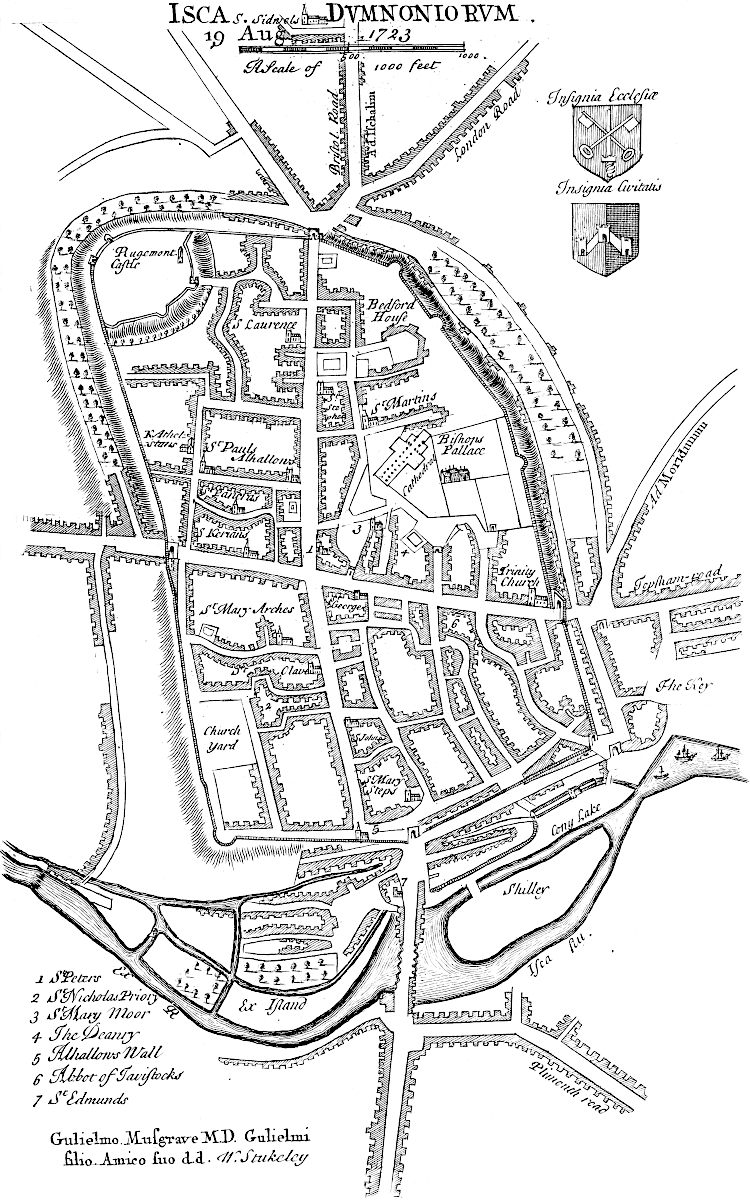
Stukeley delin.
Parker sculp.
See transcription
In the northern angle of the city, and highest ground, is Rugemont castle, once the royal residence of the West-Saxon kings, then of the earls of Cornwall: it is of a squarish figure, not very large, environed with a high wall and deep ditch: there is a rampire of earth within, equal in height to the top of the wall at present, and makes a terrace-walk overlooking the city and country. In the morning, the air being perfectly serene, and the sun shining, I observed from this place all the country southward, between the sea and Exeter, covered with a very thick fog; the west side of the city and country beyond it very clear. In this place is the assize-house and a chapel. In the wall of this castle is a narrow cavity quite round, perhaps for conveyance of a sound from turret to turret. Dr. Holland supposes this to have been a Roman work originally; and it is not unlikely that it was their prætorium, or garrison. Beyond the ditch is a pleasant walk of trees, and a little intrenched hill, called Danes castle.
The cathedral is a good pile of building: two old towers stand on the north and south transept of the most ancient part: the organ is remarkably large; the diapason pipes fifteen inches diameter, and set against the pillars of the church: the west front of the church is full of old statues. Many religious foundations in the city are converted into streets and houses, full of numerous families and thriving inhabitants, instead of lazy monks and nuns. King Edward I. in the Saxon times founded the monastery of Exeter, anno 868: Athelstan enlarged it for the Benedictines in 932: Edward Confessor translated those monks to Westminster, and made this an episcopal see; not Edward III. as Mr. Camden says. Leofricus a Briton was the first bishop, and founder of the cathedral: he was chaplain to king Edward the Confessor, anno 1046: he gave his lands at Bampton in Oxfordshire to this church: he has a monument in the southern transept. Warewast, the third bishop, began to build the choir, 13 Henry I. Bishop Brewer created the dean and prebends in the time of Henry III. Bishop Quivel built the body of the church to the west end, 13 Edward I. he instituted the sub-dean and singing-men. Bishop Grandison lengthened the cathedral by two arches, and is buried in a little chapel in the west end: bishop Lacy began the chapter-house; bishop Nevil finished it: bishop Courtney built the north tower, or rather repaired it, and gave that large bell called Peter: the dean and chapter built the cloysters. St. Mary’s chapel, at the end of the choir, is now turned into a library: this, I suppose, is what bishop Leofric built. The bishop’s throne in the choir is a lofty Gothic work. Here are many monuments of bishops in the cathedral.
The present deanery, they say, was a nunnery. The monastery of St. Andrew at Cowic was founded by Thomas Courtney earl of Devon; a cell to Bec abbey in Normandy: it was dissolved in the time of Edward III. Roger Holland, I suppose duke of Exeter, lived in it in the time of Edward VI. St. Nicholas’ priory was a cell to Battle abbey: St. John’s was of Augustine friers: Polesloe, a mile off, dedicate to St. Catharine, a nunnery of the Benedictine order: Marsh was a cell to Plympton: Cleve was a monastery of Black canons; St. James’ priory, of Cluniac monks: Grey friers, without South-gate, were Franciscans; Gold-hays, without West-gate, Black friers: the Bear inn was the abbot of Tavistock’s house; the Blacklion too was a religious house; Lathbier another, near the new river below Radford mount. Thus had these holy locusts well nigh devoured the land.