ITER ROMANUM. V.
Reading edition
Salve magna parens frugum Britanica tellus, Magna virum! tibi res antiquæ laudis & artis Ingredior. Sanctos ausus recludere fontes, Antiquum repeto Romana per oppida cursum. Virg. Nam quid Britannum cœlum differre putamus. Lucret. vi.
To my Lord WINCHELSEA.
THE journey I here present your lordship is intirely Roman; for I went from London full northward to the banks of the Humber, upon the famous Hermen-street road, passing through Lincoln: then coasting about a little, at Lincoln again I took the Foss way to its intersection of the Watling-street in Warwickshire: upon that I returned back to London, and pursued it to the sea-coasts of Kent: likewise some part of the Icening-street, as it crosses the others, where it lay not too far out of my main route, was the subject of my enquiry: so that in this account is somewhat of all these four great roads of Britain, which our old monkish writers make a considerable harangue about, but are scarce able fully to distinguish them, and of the reason of their names say but little to our satisfaction: but the ways themselves, as drawn quite a-cross the island in different directions, are sufficiently manifest to a traveller of common sagacity. Though my discoveries herein are mean enough, yet I reckon this an happy æra of my life, because, the very day before I undertook it, I had the good fortune to be known to your lordship, and at the end of it enjoyed the pleasurable repose of your delightful seat at Eastwel, but what is more, your own conversation: since then your many favours, like all other felicities in life, give me uneasiness in the midst of joy, as sensible of my own little merit. I have no hope indeed of retaliating; and I know that great minds like yours imitate Providence, expecting no return from its beneficiaries: but it is consentaneous to human nature to endeavour at it, and offer tokens of gratitude, however unequal. The delight you take in rescuing the monuments of our ancestors, your indefatigable zeal in collecting them, your exquisite knowledge in the Greek, Roman, and British antiquities, and especially your great love for those of your own country, which you continually commit to writing in your private commentaries, add a reputation to these studies, and make the Muses hope for a sunshine, when men of your lordship’s noble birth entertain them with that familiarity and condescension which was one great glory of the Augustan age.
Roman roads.
For arts military and civil, that became a most wise government, the Romans beyond compare exceeded all nations; but in their roads they have exceeded themselves: nothing but the highest pitch of good sense and public spirit could prompt them to so immense a labour: it is altogether astonishing to consider how they begirt the whole globe,[50] as it were, with new meridians and great circles all manner of ways; as one says,
Magnorum fuerat solers hæc cura Quiritum Constratas passim concelebrare vias.
As well as use, they studied eternity in all their works, just opposite to our present narrow souls, who say, It will serve our time well enough. For this reason they made few bridges, as liable to decay; but fords were laid with great skill and labour, many of which remain firm to this day without any reparation. No doubt but the Romans gave names to these roads from the commanders under whose government and direction they were laid out, as was their custom elsewhere: but because they generally held their posts here but for a short time, and perhaps scarce any finished one road intirely; therefore, whilst each endeavoured to stamp his own name upon them, so it fell out that they were all forgotten. The present appellatives seem to be derived either from the British or Saxon: William the Conqueror calls them Chemini majores in confirming the laws of St. Edward about these four ways. All misdemeanours committed upon them were decided by the king himself. Though there was no need of paving or raising a bank in some places, yet it was done for a perpetual direction; and every where I suppose stones were set at a mile’s distance, many of which are still left. Of these four celebrated ways, the Foss and Icening-street traverse the kingdom from south-west to north-east, parallel to one another: the Watling-street crossed them quite the contrary way, with an equal obliquity: the Hermen-street passed directly north and south: and besides these are very many more. I purpose not to give a full history of them here, any farther than I travel upon them, reserving that till I am better able.
Hermen-street.
Somewhat on the Hermen-street is said already in my first letter about Lincolnshire, where it divides itself into two, which we may call the old and the new branch. TAB. LVI.Here I design to search it up to its fountain-head. As to its name, we have no reason to seek any farther than the Saxon language, where Here signifies an army; Hereman, a soldier or warriour:[51] the Hermen-street then is the military street, in the same propriety the Romans used it. It begins at Newhaven, at the mouth of the river Ouse in Sussex, and passes on the west side the river through Radmil, probably taking its name thence; so through Lewis by Isfield: then it seems to pass over the river at Sharnbridge, as we may guess by its name, and so proceeds to East Grinsted, but I suppose lost in passing through the great woods: then through Surrey it goes by Stane-street, Croydon, Stretham, and, by its pointing, we may suppose was designed originally to pass the Thames at the ferry called Stangate by Lambeth, where it coincides with the Watling-street. Of this I can say nothing yet, having not travelled it. There I apprehend the road went before London became very considerable; but when the majesty of the place suddenly arose to great height, this road, and all others directed this way, deflected a little from their primitive intention, to salute the Augusta of Britain, destined to be the altera Roma; and this has rendered them all obscure near the city. It is generally thought the Hermen-street goes hence through Bishopsgate, and along the northern road; but I apprehend that to be of much later standing than the original one, which goes more on the west. By the quotation I mentioned in my first letter, when upon this road, out of Mr. Gale’s Itinerary, of Lowlsworth near Bishopsgate, it seems as if it was done in Lollius Urbicus his time. The original one perhaps passes through unfrequented ways near Enfield and Hermen-street, seeming to retain the old name: on the eastern side of Enfield chace, by Bush hill, is a circular Br. camp.British camp upon an eminence declining south-west; but our ancient road appears upon a common on this side of Hertford by Ball’s park, and so passes the river below Hertford; then goes through Ware park, and falls into the present road on this side Wadesmill,[52] and so to Royston. Here must have been several stations upon it, but I see no hope of ever retrieving their names: that Hertford is one is reasonable to think, it having been ever in the royal demesne, and passing a river at a proper distance from London: but in the assignment of Durocobrovis here, I take leave to dissent from Camden and other learned men; it by no means answers the distances in the Itinerary, or the import of the name; the Red Ford, or the Ford of Harts, are fancies without foundation: either trajectus militaris is the meaning, or it is the passage of the river Ard, now the Beane: Ardley at the spring-head of it: ardh in British is altus.
Icening-street.
At Royston the Icening-street crosses the Hermen-street, coming from Dunstable going into Suffolk: this about Baldock appears but like a fieldway, and scarce the breadth of a coach, the farmers on both sides industriously ploughing it up: between Baldock and Icleford it goes through an intrenchment, taking in the top of a hill of good compass, but of no great elevation: it consists of a vallum only, and such a thing as I take to be properly the remains of a British oppidum: it is called Wilbury. Br.Wilbury hill, and is said to have been woody not intirely beyond memory: this street, quite to the Thames in Oxfordshire, goes at the bottom of a continued ridge of hills called the Chiltern, being chalk, the natural as well as civil boundaries between the counties of Hertford and Bedford, very steep northward. Ickleford retains the name of the street, which at this place passes a rivulet with a stoney ford wanting reparation. Near Periton church has been a castle of Saxon or Norman times, with a keep. These high chalk hills, having a fine prospect northward, are covered with a beautiful turf like the Wiltshire downs, and have such like barrows here and there, and indeed are but a continuation of them quite a-cross the kingdom. Near Hexton is a square Ro. camp.Roman camp upon a lingula, or promontory, just big enough for the purpose: it is very steep quite round, except at a narrow slip where the entrance is; double ditched, and very strong, but land-locked with hills every way, except to the north-east, and that way has a good prospect: under it is a fine spring: it seems made by the Romans when they were masters of all the country on this side, and extending their arms northward. On High downs is a pleasant house by a wood, where is a place called Chapel close: in this wood are barrows and dikes, perhaps of British original. Liliho is a fine plot of ground upon a hill steep to the north-west, where a horse-race is kept: from under it goes the Icening-street by Stretley to Dunstable. North of Baldoc we visited the camp by Ashwel, taken notice of in Camden, called Harbury Banks. Br.Harbury banks: it is of a theatrical form, consisting wholly of an agger: though Roman coins have been found in it, I am inclinable to think it is earlier than their times. Between Calcot and Henxworth, two miles off, several Roman antiquities have been dug up this year; many in the custody of my friend Simon Degg, esq; he gave me this account of it: some workmen, digging gravel for the repair of the great northern road, struck upon some earthen vessels, or large urns, full of burnt bones and ashes, but rotten: near them a human skeleton, with the head towards the south-east, the feet north-west: several bodies were found in this manner not above a foot under the surface of the earth, and with urns great or small near them, and pateras of fine red earth, some with the impression of the maker on the bottom: there were likewise glass lachrymatories, ampullas, a fibula of brass, six small glass rings, two long glass beads of a green colour, and other fragments.
Salinæ.
Northward still upon a high sandy hill, by the bank of the river Ivel, is a Roman camp called Chesterton: under it lies the town called Sandy, or Salndy, the Salinæ of the Romans in Ptolemy, where great quantities of Roman and British antiquities have been found, and immense numbers of coins, once a brass Otho, vases, urns, lachrymatories, lamps. Mr. Degg has a cornelian intaglia, and a British gold coin dug up here, Tascio upon it. Thomas Bromsal esq. has a fine silver Cunobelin found here, of elegant work; others of Titus, Agrippina, Trajan, Hadrian, Augustus, Antoninus Pius, Faustina, Constantius Chlorus, Constantinus Magnus, Carausius, Alectus, Tetricus, and many more.[53] His great grandfather, high-sheriff of this county, preserved the invaluable Cottonian library from plunder in the time of the commonwealth, whilst it was at Stratton in this county, about anno 1650. The soil here is sand, perfectly like that on the sea shore. I imagine a Roman road passed by this place westward from Grantchester by Cambridge.
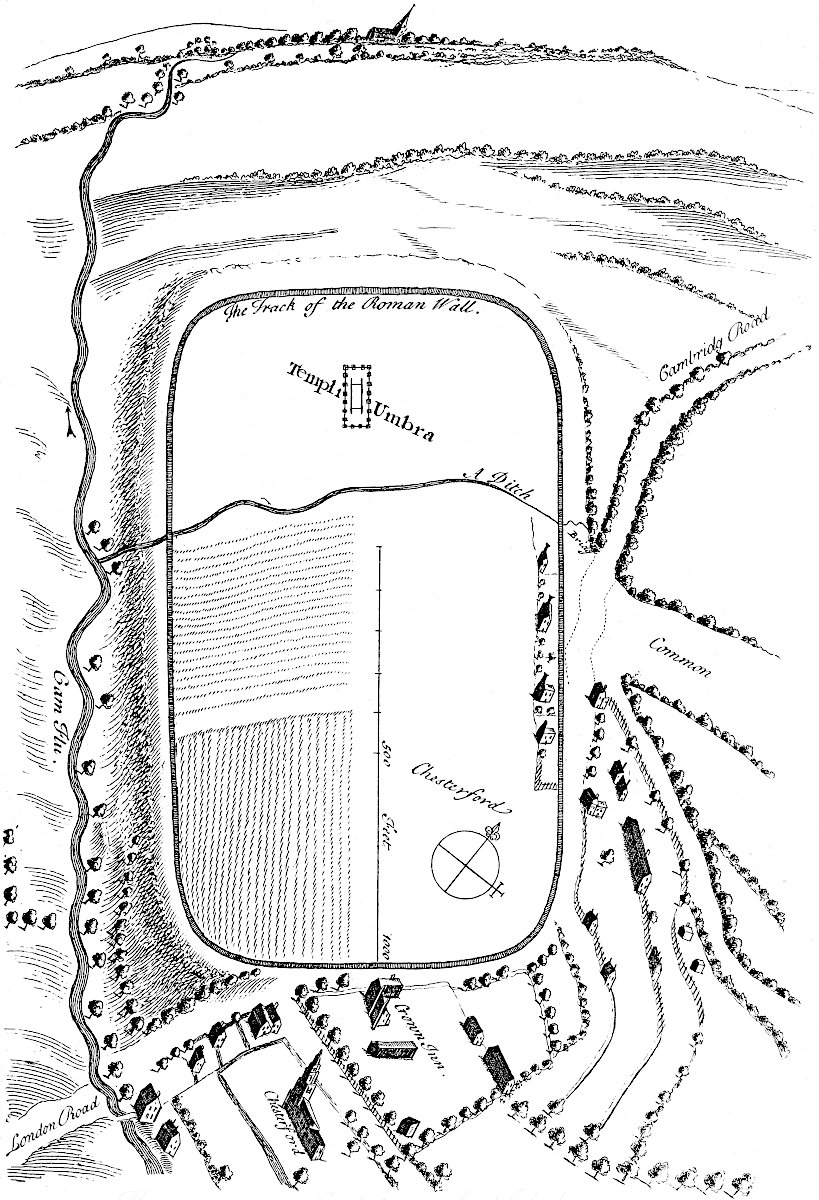
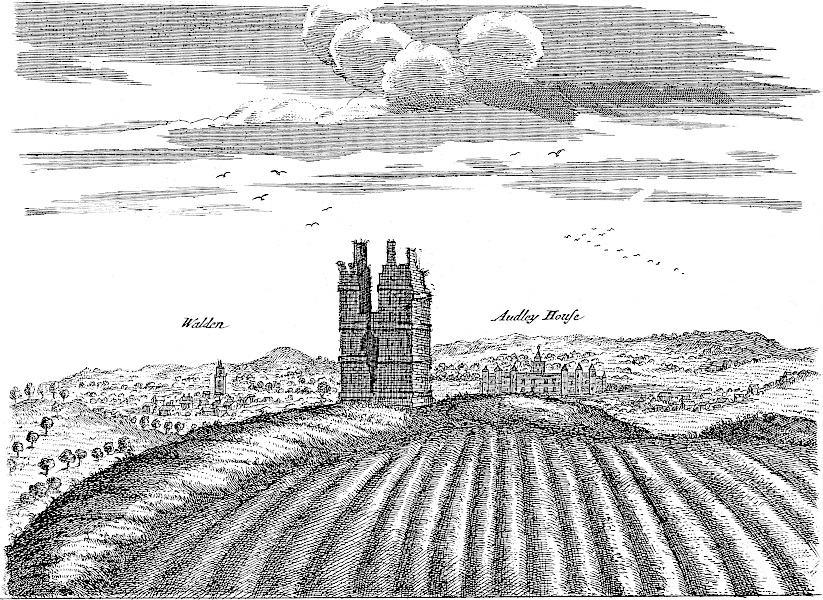
Return we to Royston again. Going upon the Icening-street the other way, just upon the edge of Cambridgeshire, we come to Chesterford upon the river going to Cambridge, near Icleton and Strethal. Camboritum.In July, 1719, I discovered the vestigia of a Roman city here: the foundation of the walls is very apparent quite round, though level with the ground, including a space of about fifty acres: TAB. LIX.great part of it serves for a causeway to the public Cambridge road from London: the Crown inn is built upon it:[54] the rest is made use of by the countrymen for their carriages to and fro in the fields: the earth is still high on both sides of it: in one part they have been long digging this wall up for materials in building and mending the roads: there I measured its breadth twelve foot, and remarked its composition of rag stone, flints and Roman brick: in a little cottage hard by, the parlour is paved with bricks; they are fourteen inches and an half long, and nine broad. In the north-west end of the city,[55] the people promised to show me a wonderful thing in the corn, which they observed every year with some sort of superstition. I found it to be the foundation of a Roman temple very apparent, it being almost harvest time: here the poverty of the corn growing where the walls stood, defines it to such a nicety, that I was able to measure it with exactness enough: the dimensions of the cell, or naos, were fifteen foot in breadth, forty in length; the pronaos, where the steps were, appeared at both ends, and the wall of the portico around, whereon stood the pillars. I remarked that the city was just a thousand Roman feet in breadth, and that the breadth to the length was as three to five, of the same proportion as they make their bricks: it is posited obliquely to the cardinal points, its length from north-west to south-east; whereby wholesomeness is so well provided for, according to the direction of Vitruvius. The river Cam runs under the wall, whence its name; for I have no scruple to think this was the Camboritum of Antoninus, meaning the ford over this river, or the crooked ford: in Lincolnshire we called a crooked stick, the butchers use, a cambril.[56] They have found many Roman coins in the city or Borough field, as they call it: I saw divers of them. In this parish, they say, has been a royal manor: not far off, by Audlenhouse, upon an eminence is a great Roman camp.Roman camp called Ringhill; a hunting tower of brick now stands upon it. Beyond this the Icening-street goes toward Icleworth in Suffolk, TAB. XLV.parting the counties of Cambridge and Essex all the way; and almost parallel to it runs a great ditch, viz. from Royston to Balsham, called Brentditch, where it turns and goes to the river below Cambridge, there called Flightditch. I imagine these to be ancient boundaries of the Britons, and before the Roman road was made, which naturally enough would have served for a distinction by the Saxons, as at other places, had their limits lain hereabouts. Two miles both ways of Royston is chalky soil:[57] about Puckeridge it is gravelly. On Bartlow hills there is a camp too, castle camps, and Roman antiquities found: I am told of three remarkable barrows thereabouts, where bones have been dug out. At Hadstok they talk of the skin of a Danish king nailed upon the church-doors.
59
Camboritvm. 21. Aug. 1722.
Thomæ Bawtre Conterraneo Suo Tabula votiva.
Stukeley delin.
45
The Hunting Tower in the Ro. Camp near Littlebury Aug. 21. 1722.
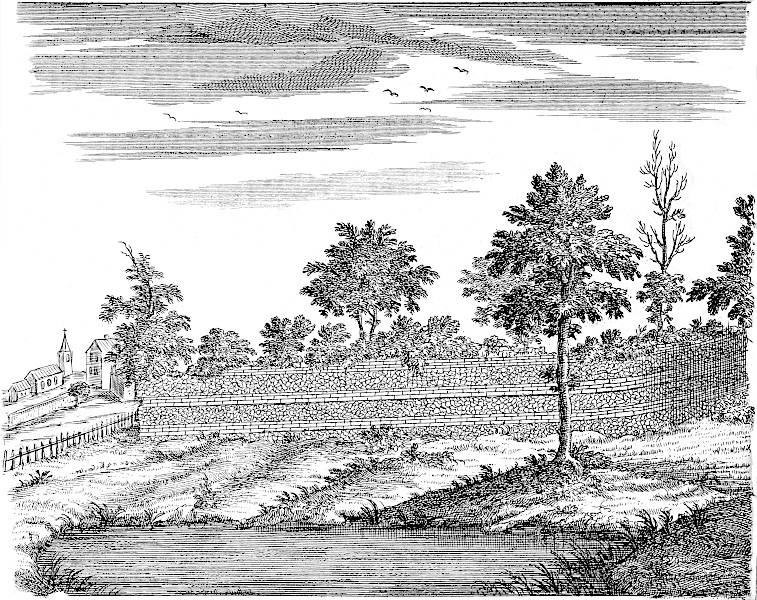
View of Silchester Walls from the N.E. corner Aug. 5. 1722. Ro. Brick & Flint.
Stukeley delin:
E. Kirkall sculp:
& Amico Peregrino Bertie Ar. vovet.
Now we shall take along with us the Itinerary of Antoninus in his fifth journey; for after he has gone from London toward Colchester, and part of Suffolk, he turns into this Icening-street at Icianis, which seems to be Icesworth beyond St. Edmundsbury; from whence to this Camboritum is thirty-five miles: from thence to Huntingdon is just twenty-five, as they are noted; but it is to be supposed that the Itinerary went along the Icening-street to Royston, then took the Hermen-street; for so the miles exactly quadrate.
Royston. Ro. town.
Royston, as being seated upon the intersection of these two roads, no doubt was a Roman town[58] before Roisia[59] built her religious house here, and perpetuated her own name upon the Roman, which is now lost; and this very year they found Roman coins near there: but there seems to be the stump of her cross still remaining at the corner of the inn just where the two roads meet. The Hermen-street now coincides all the way with the common northern road. At Arminton, denominated from it, passes another branch of the river going to Cambridge in Armingford hundred; so by Caxton, which was probably a baiting-place: there are some old works without the town. A red clay begins now. Anno 1721, near this road my lord Oxford, digging canals at Wimpole, found many bodies, and pieces of iron rusty, the remains of some battle. Wimpole is now improved and honoured with his residence, and the noble Harleian library.
Durocinonte.
At Godmanchester, or Gormanchester, on this side Huntingdon river, the name chester ascertains the Roman castrum to have been; nor is there any dispute of it, however critics vary about its name, whether Durosiponte or Durocinonte; whether there was a bridge, a ferry, or a ford, in most ancient times: no doubt but the Romans inhabited both sides of the river, and probably rather at Huntingdon, being a much better situation; therefore, as to antiquities here found, I hold myself more excusable if at present I have nothing to say. Mr. Camden tells us Roman coins have been frequently ploughed up at Gormanchester, and Henry of Huntingdon says it has been a noble city: but I took notice of a wooden bridge over a rivulet between the two towns, which ought not to be forgot, as a grateful and public charity, having this inscription.
ROBTUS COOK EMERGENS AQUIS HOC VIATORIBUS SACRUM DD. 1636.
In Huntingdon is the house where Oliver Cromwell was born: though it is new-built, yet they preserved that room in its first state.[60]
Stukeley.
From hence the Hermen-street goes in a strait line through Great and Little Stukeley, so called from the soil, and most anciently written Styvecle, signifying a stiff clay.[61] I should be ungrateful to my ancestors, not to mention that hence they had their name and large possessions in both towns, and many others hereabouts. I have the genealogy of them from Herebert be Styvecle, mentioned in Madox Hist. Scaccar. cap. xiv. fol. 382. mag. rot. 12. H. II. rot. 6. Cant. & Hunt. which shows that they had lands here before. His descendants of this place have been high sheriffs of the counties of Huntingdon and Cambridge more than thirty times, and knights of the shire in parliament more than forty times: but I remember Lucan says,
————perit omnis in illo Nobilitas, cujus laus est in origine sola.
In Great Stukeley church is a font of a very ancient make, and in the north aile a monumental brass of Sir Nicholas Styvecle: the legend round the verge of the stone was kept for some time in the town chest, when it was taken off being loose, but now lost: the effigies being in the same condition, we carried it to be hung up in the hall now belonging to James Torkington esq; whose ancestors married the heiress of the family, and now enjoys the estate.
17
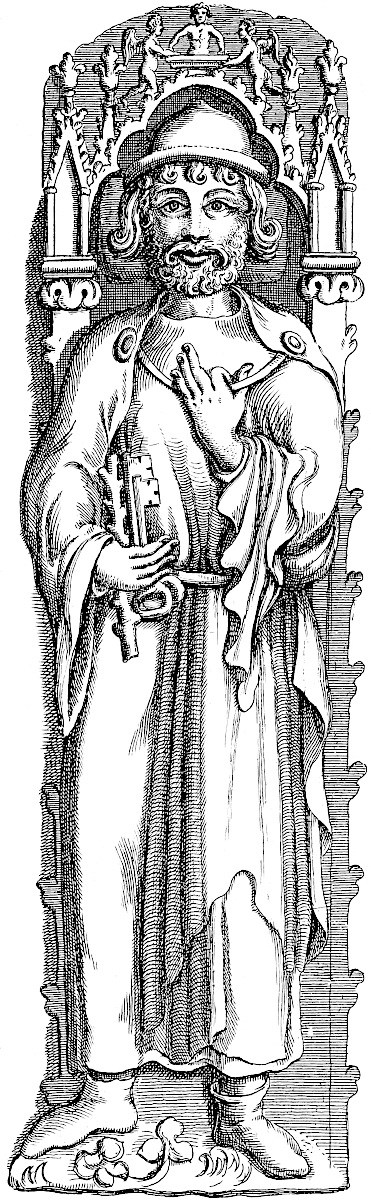
Inclytus Ailwinus Totius Angliæ Aldermanus Fundator Abbatiæ de Ramsey, (In Lapide. 1719.)
& Amicissimo S. Gale Ar. D.D.
W. Stukeley delin.
E. Kirkall sculp.
The Hermen-street hence becomes notorious by the name of Stangate; whence we may conjecture that it was originally paved with stone: a mile beyond Little Stukeley it turns somewhat to the right, and then proceeds full north and south: near Stilton some parts appear still paved with stone: it passes through great woods between the two Saltrys, where was a religious foundation of Simon Silvanect II. earl of Huntingdon and Northampton; among whose ruins lie buried Robert Brus, lord of Anandale in Scotland, and of Cleveland in England, with Isabel his wife, from whom the Scottish branch of our royal family is descended. Near the road-side Roman urns have been dug up. I thought it piety to turn half a mile out of the road, to visitConington. Conington, the seat of the noble Sir Robert Cotton, where he and the great Camden have often sat in council upon the antiquities of Britain, and where he had a choice collection of Roman inscriptions, picked up from all parts of the kingdom. I was concerned to see a stately old house of hewn stone large and handsome lie in dismal ruin, the deserted lares and the genius of the place fled: by it a most beautiful church and tower; in the windows is fine painted glass, but of what sort I know not: a poor cottage or two seem to be the whole town, once the possession of the kings of Scotland.[62] From those woods aforementioned, standing on high ground, you see all over the level of the fens, particularly that huge reservoir of water called Whitlesey-mere, full of fish, and a very pleasant place in summer time, where the gentry have little vessels to sail in for diversion: upon this hill Sir Robert Cotton, digging the foundation of a house, found the skeleton of a fish twelve foot long. A little to the right lies Ramsey.Ramsey, famous for a rich abbey, where every monk lived like a gentleman: there is little of it left now, but a part of the old gate-house. TAB. XVII.In the yard I saw the neglected statue of the famous Alwyn the founder, called alderman of all England, cousin to king Edgar: I take this to be one of the most ancient pieces of English sculpture which we knew of: the insignia he has in his hand, the keys and ragged staff, relate to his office. Anno 1721 many pecks of Roman coins were found there. Probably from the name we may conjecture it was a Roman town. Near it is Audrey causeway: at the south end of it, in the parish of Willingham, a camp of a circular form, large, called Belsar’s hills, thought that of William the Conqueror, or his general Belasis, when busied in the reduction of the isle of Ely, or Odo Balistarius. A Roman pavement found at Ramsey.
Stilton, or Stickleton, analogous to Stivecle, is famous for cheese, which they sell at 12d. per pound, and would be thought equal to Parmesan, were it not too near us. Beyond here the road is perfect, with a ridge upon the open fields, for a long way together: it goes pretty near north and south about Stangate; but now it takes a turn to the left a little, to avoid the vast fens full before our view. I cannot but take notice of the great stones, set at every mile from Grantham hither by Mr. Boulter, which he designed to have carried on to London. Any thing that assists or amuses travellers is most highly commendable: hence the good understanding of the ancients prompted them to set their funeral monuments by the road side, not crouded round their temples: they knew the absurdity of filling the mind with ideas of melancholy, at such times as they approached the sacred altars: there nought but what is beautiful and great ought to appear, as most besuiting the place where we seek the Deity. With them Mercury was the god of ways, and the custos manium. I have often wondered that the cheap and easy method of setting up posts with directions at every cross road is so little practised; which methinks deserves to be enforced by a law: it would teach the carpenters that make them, and the country people, to read, with much more emolument to the public than some other methods now in vogue: of other uses I need say nothing. All the country between Huntingdon river and Peterborough river is clay, sand, and gravel; but beyond that to the Humber is stone. At Gunwath ferry over Peterborough river is a new bridge, where boats too pay a toll; such is the modern way of encouraging trade and navigation. The people of Peterborough are ato having their river made navigable, out of an absurd notion that it will spoil their trade.
Durobrivis.
TAB. XIII. 2d Vol.
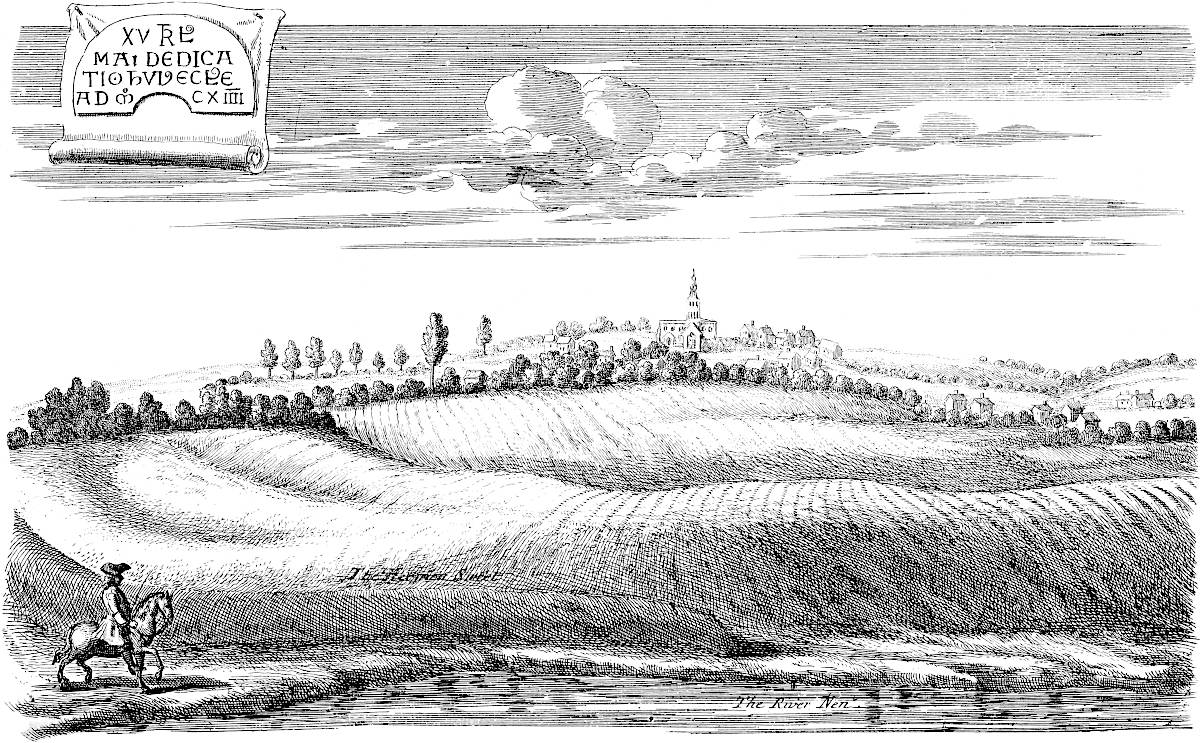
The imperial Itinerary makes 35 miles between the last station, Durocinonte, and Durobrivis;[63] but a decimal too much is put into the number, for 25 is full enough: it is indeed 25 measured miles from Huntingdon river to the Nen at Caster: there is no dispute but Chesterton by Caster is the place. Dornford retains somewhat of the old name, where the road traversed the river by a bridge (of brass, the common people say.) At Chesterton on this side is a large tract of ground, called the Castle field, with a ditch and rampart around it:[64] the Roman road runs directly through it, and still retains its high ridge. I observe every where near the fenny country great precaution and strength employed; which seems owing to the incursions of the Britons from that part, who, no doubt, retired into these fastnesses as their last refuge, when the Roman arms shined all around them: and that reason must induce the Romans very early to think of draining the country, and rendering it provincial, which was the only means of preventing that inconvenience. The Hermen-street beyond the river runs for some space along the side of it upon the meadow, then turns up with an angle, and proceeds full north. Caster[65] is above half a mile from it, upon the hill. I espied a bit of the foundation of the wall of the Roman castrum in the street to the north-west corner of the church, under the wall of the house where the minister lives: it is easily known by the vast strength of the mortar, built of the white slab-stone of the country: this castrum then went round the church-yard, and took in the whole top of the hill, facing the mid day sun. Underneath it lay the city; for below the church-yard the ground is full of foundations and Mosaics: I saw a bit of a pavement in the cellar of the ale-house (the Boot.)
———varias ubi picta per artes Gaudet humus, suberantque novis asarota figuris. Stat. Silv.
13·2d. over the Quire door in Castor chh.
Prospect of Castor, Durobrivis. 11. July. 1724.
Stukeley delin.
E. Kirkall sculp.
They know of many such: particularly at Mr. Wright’s, and in the landlord’s garden, is an intire one untouched. Roman coins are found in great abundance: I have before me a long and particular catalogue of many I have seen of all times, from the consular to the later emperors, in brass and silver, but think it a nauseous formality to print them: a few I will repeat of the silver.
M. poblic ℞ — nus imp.
Ant. III. vir leg. VI.
Sabin l. titur. the rape of the Sabins.
Augustus divi fil. imp x act.
Cæsar Augustus pater patriæ. Augusti f. cos. design. princ. juvent. [exergue] Cl. Cæsaris
Augustus Cæsar a comet. idus jun.
Cæsar l. juli l. f. a chariot drawn by cupids.
Hadrian Cos. III. Ægyptos, a recumbent figure with the sistrum.
Theodosius virtus romanorum tr. p. s.
Silanus l. f. roma.
These among more are in the possession of Monsieur Baillardeau.[66] In the ploughed fields between the town and the river, toward Ford-green, they are often found, with earthen pipes, bricks, and all sorts of antiquities: in that field is a tract running quite through, whereon corn grows very poorly, which is nothing but a street or road laid with a deep bed of gravel: the vulgar have a foolish story about it, as at other places, and say that lady Kyneburg cursed it; by whom they mean the abbess that built a religious house here, which stood eastward of the church: some part of it is still left. This meadow is called Norman-gate field, or more properly Dorman-gate, some corrupted memorial of the ancient name of the town, which extended itself hither; and foundations are found all about here, and innumerable coins, which they call Dorman pence: part of this is Berrysted, where antiquities are dug up every day. Higher up toward Peterborough is Mill-field: Mosaic pavements are there dug up, and other things; and seems to have been a little citadel belonging to the town. Part of the church is of an ancient fabric, but new modelled: there is a curious inscription upon a stone over the choir door thus: (the letters are raised.)
XVo. KLs MAI. DEDICATIO HVIs ECLEs A. D. M.o CXIIII.
it is wrong transcribed in Camden. The steeple stands in the middle of the church: the tower is a fine piece of ancient architecture with semi-circular arches; I judge the spire of later date. The square well by the porch no doubt is Roman; it is curbed with hewn stone: though it stands on a hill, yet the water is very high: at the east end of the church is a very old cross. Mr. Morton is very copious upon this station, in his curious history of Northamptonshire; the inquisitive reader will consult him: I only recite such things as I saw, and fear being tedious upon such places as admit of no doubt among antiquaries. A little higher up the river, near Wansford bridge,[67] a gold British coin was found, in the possession of Mr. Maurice Johnson, J. C. Anno 1720, at Thorp, the seat of Sir Francis St. John, by Peterborough, a Mosaic pavement was found: this was undoubtedly a villa of some great Roman. In the garden here are some fine antique statues of marble, but suffering more from the weather, in this moist situation, than from age: in the middle is a Livia of coloss proportion, the wife of Augustus: in the four quarters are Diana, Amphion, an orator, a gladiator: upon the terrace, an admirable Hercules killing Hydra: in the court are two equestrian figures in copper, Henry IV. of France, and Don John of Austria: within the house over most of the doors are placed busts, Bassianus, Caracalla, &c. these antiquities were of the Arundel collection.
Hence I travelled upon the Roman road all the way to Stanford. As it rises from the water-side of Peterborough river, and passes over the corn-fields, it appears in a lofty ridge called Norman-gate, i. e. Dorman-gate; only here and there they have dug great holes in it for its materials: it goes forwards to Lolham bridges, by the name of Long-ditch, which we treated of before, being its oldest and directest road, full north and south. In the reign of Nero all the southern part of the island was conquered, and the Brigantes were fast friends; so that in his time we may conclude the Hermen-street was made as far as Sleford by Catus Decianus the procurator, as we suggested in the first letter. But now our journey is by the left-hand new branch, and which goes out of the other with an angle in the parish of Upton, called the Forty-foot way: almost at Southorp, it is inclosed in a pasture; but beyond that you find it again, going by Walcot inclosures, then through Bernack fields, winding a little to the left hand till it enters Burleigh park: its true line from Walcot corner would pass through Tolethorp wood, but the river below Stanford was too broad; so it passes through Burleigh park, where its gravel is transferred to make walks in the gardens: at Wothorp park-wall it appears again with a very high ridge and agreeable sight, descending the valley to Stanford river, which it passes a little above the town between it and Tynwell; then rises again upon the opposite hill, entering Lincolnshire, with its broad and elated crest, till it goes to Brigcasterton: it is composed all the way of stone, gravel, and hard materials, got near at hand: the common road leaves it intirely from Peterborough river to Brigcasterton, crossing it at Wothrop park-wall.[68]
Brigcasterton. Ro. town.
TAB. XIV. 2d vol.
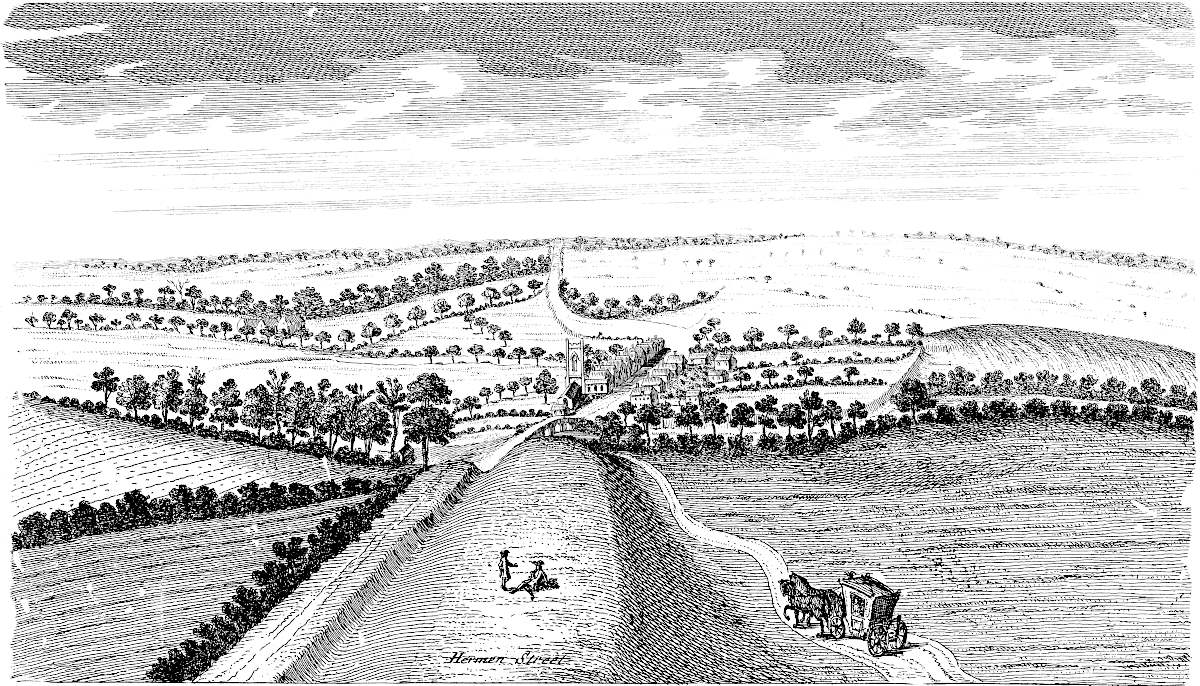
Brigcasterton happened most convenient for a station, being ten miles from the last, or Durobrivis; but the Itinerary mentions not its name; for the distances between them, and likewise to Lincoln, impugn Mr. Camden and such as place Causennis here: however, it was fenced about with a deep mote on two sides, the river supplying its use on the other two; for it stands in an angle, and the Romans made a little curve in the road here on purpose to take it in, as it offered itself so conveniently, then rectified the obliquity on the other side of the town: it consists of one street running through its length upon the road: this great ditch and banks are called the Dikes. I saw many coins that are found here; and one pasture is called Castle-close at the corner: they say the foundation of a wall was dug up there.[69]
14·2d.
Prospect of Brig casterton from the Hermen Street S. of the Town. 13. July 1724.
Stukeley delin.
E. Kirkall sculp.
20
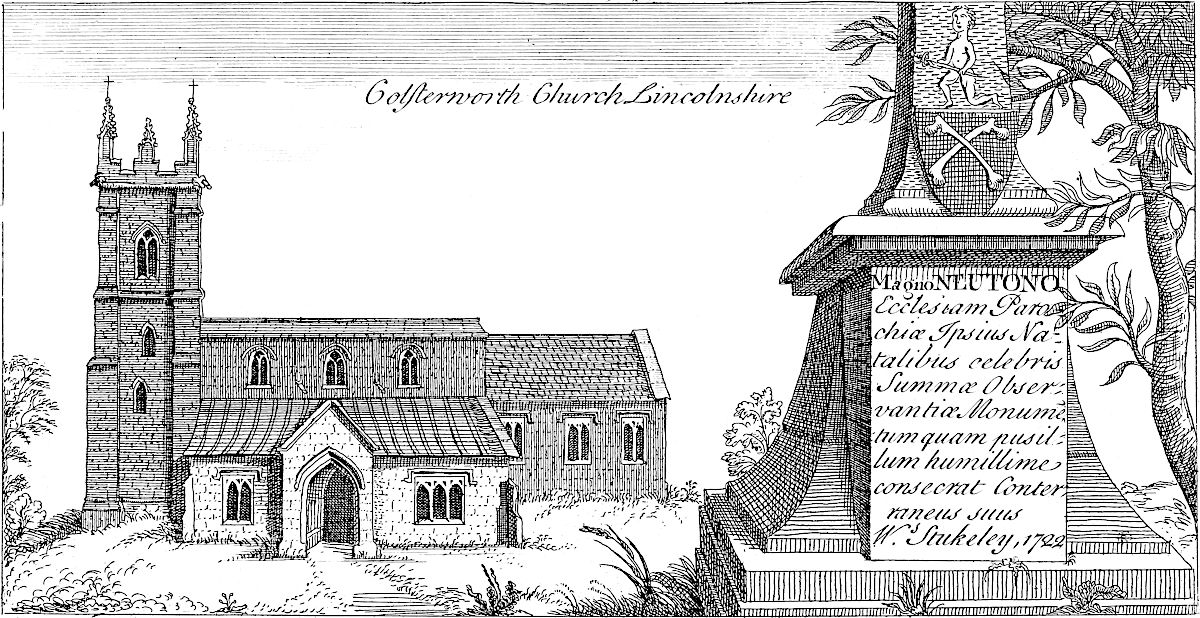
Colsterworth Church Lincolnshire
Stukeley Fecit
See transcription
Colsterworth.
TAB. XX.
Hence the road goes by Stretton, then leaves a little on the left hand Colsterworth, highly memorable for being the birth-place of that vast genius Sir Isaac Newton, the darling of Nature, who with a sagacity truly wonderful has penetrated into the secret methods of all her great operations; of whom Lincolnshire may justly boast: and we may say of him, with Lucretius, I.
Ergo vivida vis animi pervicit, & extra Processit longe flammantia mœnia mundi, Atque omne immensum peragravit mente animoque.[70]
On the north wall of the chancel is this monument. Heic jacent Gulielmi Walkeri particulæ obiit 1 aug. anno domini 1684. ætat. 61.
Causennis.
Thirty lesser miles from Durobrivis you come to Paunton,[71] which must needs be Causennis: it is indeed twenty seven measured miles, the Hermen-street accompanying. This village is at present under the hill where the road goes near the spring of the Witham, to which I suppose its name alludes, as the present to pant avon: both signify the valley of the river in British: perhaps the most ancient name of the river was Cavata; whence that part of the country that is watered by it assumed the name of Kestevon,[72] importing the river Cavata, Cavaut avon; as Lindsey from Lindum: the present name Witham, or Guithavon, signifying the separating river, as it principally divides these two. Many Roman coins are found here, and all the neighbourhood round, and Mosaic pavements, Roman bricks, urns and the like, of a curious composition. Mr. Burton speaks of a musive pavement.
Ancaster. Ro. town.
TAB. XV. 2d Vol.
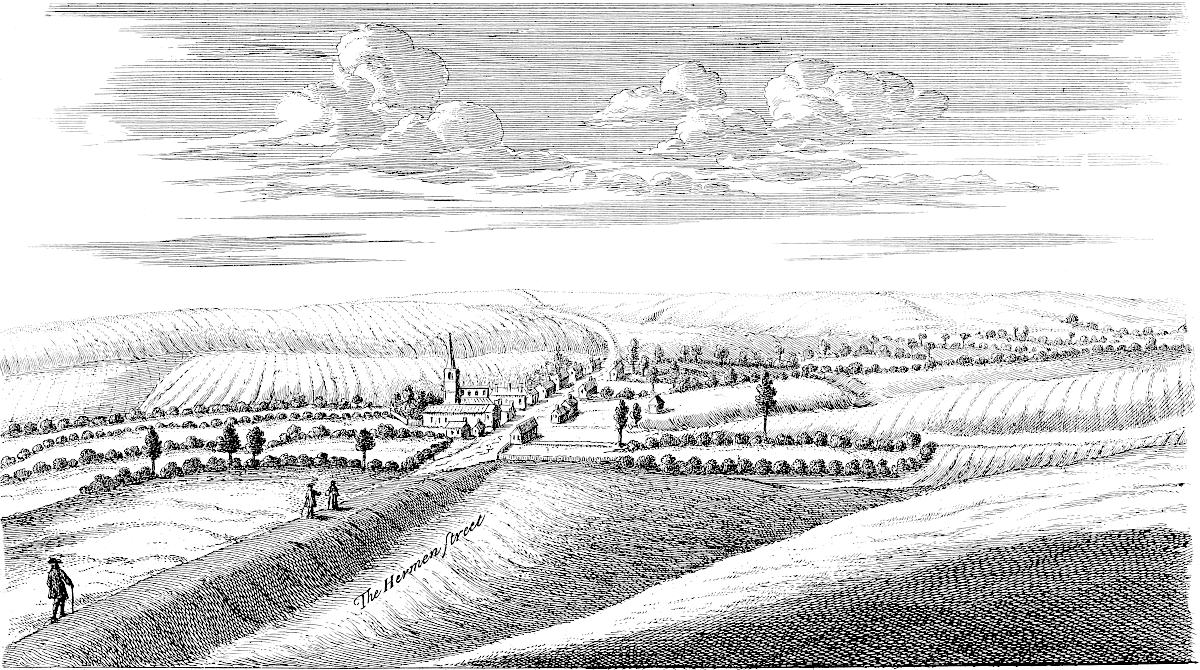
The Hermen-street, now called High-dike road, goes along the heath, which preserves it from being worn away; and it is a sight highly entertaining. The next town it comes to is Ancaster:[73] what was its Roman name I know not; but it has been a very strong city, intrenched and walled about; as may be seen very plainly for the most part, and perceived by those that are the least versed in these searches. The bowling-green behind the Red-lion inn is made in the ditch: when they were levelling it, they came to the old foundation. At this end of the town, where a dove-cote stands, is Castle close, full of foundations appearing every where above ground: the ditch and rampire encompass it. Here are prodigious quantities of Roman coins found; many people in the town have traded in the sale of them these thirty years: they are found too in great plenty upon all the hills round the town, especially southward, and toward Castle-pits; so that one may well persuade one’s self, that glorious people sowed them in the earth like corn, as a certain harvest of their fame, and indubitable evidence of their presence at this place. After a shower of rain the school-boys and shepherds look for them on the declivities, and never return empty. I saw an Antoninus Pius, of base silver, found that morning I was there: likewise I saw many of Faustina, Verus, Commodus, Gallienus, Salonina, Julia Mæsa, Constantius Chlorus, Helena, Maximiana Theodora, Constantine the Great, Magnentius, Constans, Tetricus, Victorinus, &c.[74] The town consists of one street running north and south along the road: there is a spring at both ends of the town, and which, no doubt, was the reason of their pitching it at this place; for no more water is met with from hence to Lincoln. There is a road on the west side of the town, which was for the convenience of those that travelled when the gates were shut. On a stone laid upon the church wall I read this inscription, in large letters of lead melted into the cavities.
PRIEZ: PUR LE: ALME SIRE: JOHN COLMAN CHIVALER
In the church-yard are two priests cut in stone. This has been a populous place; for here are great quarries about it, and the rock lies very little under the surface. Mr. Camden speaks of vaults found here; and W. Harrison, in his description of Britain, II. 17. mentions Mosaic pavements.[75] The road seems to bend somewhat in this part, which I conjecture was with an intent to take in the springs.
15·2d.
Stukeley delin.
E. Kirkall sculp.
Prospect of Ancaster. Iuly 20. 1724.
Hunington.
Ro. camp.
A mile and half off to the west, in the parish of Hunnington, upon a hill surveying a lovely prospect, both toward the sea-coast, and into Nottinghamshire, is a summer camp of the Romans, or a castrum exploratorum, of a square form and doubly trenched, but of no great bulk: the entrance seems to have been on the east side. Not long ago, in this place, have been dug up, in ploughing, bits of spears, bridles and swords, and two urns full of coins: I saw a large brass one of Agrippa, and Julia daughter to Augustus, with many more, in possession of the Rev. Mr. Garnon of North Witham: his daughter gave me a score of them at Newark, Dec. 1728. Mr. Banks, 1735, digging for his new house at Ancaster, found much Roman antiquity.
All the way from this road, upon Ancaster heath, we have a view of the sea, and the towering height of Boston steeple. A little further we come to a place, of no mean note among the country people, called Byard’s Leap, where the Newark road crosses the Roman: here is a cross of stone, and by it four little holes made in the ground: they tell silly stories of a witch and a horse making a prodigious leap, and that his feet rested in these holes, which I rather think the boundaries of four parishes: perhaps I may be too fanciful in supposing this name a corruption of vialis lapis. I mentioned before, that here I apprehended the Roman road from the fen country passed down the hill toward Crocolana. Upon our road there are many stones placed; but most seem modern, and like stumps of crosses, yet probably are mile-stones: it would be of little use to measure the intervals; for one would find that the whole distance between two towns was equally divided by such a number of paces as came nearest the total. Over-against Temple-Bruer is a cross upon a stone, cut through in the shape of that borne by the knights Templars, and I suppose a boundary of their demesnes: some part of their old church is left, of a circular form as usual. Bruer in this place signifies a heath. The Hermen-street hereabout is very bold and perfect, made of stone gathered all along from the superficial quarries, the holes remaining. I observed, whenever it intercepts a valley of any considerable breadth, whose water must necessarily drain past it, there is an intermission left in the road; for otherwise their work would be vain: and the ends of the road are flaunted off neatly for that purpose, laying perhaps a small quantity of solid materials to vindicate the track, and not hinder the voidance of the rain: it goes perfectly strait from Ancaster to Lincoln full north, butting upon the west side of Lincoln town. A tumulus some time upon the centre of it: it is notorious from hence that the intent of these roads was chiefly to mark out the way to such places in the march of their armies; for there can be no need of a causeway for travellers, the heath being so perfectly good; and that our English word highway is hence derived, and applied to public ways. When we come to the towns upon the cliff side, they have ploughed up this barren ground on both sides the road, and basely lowered it for miles together, by dragging the plough a-cross it at every furrow; so that every year levels it some inches, and, was it not a public road, it would soon be quite obliterated. Here are six villages on the left hand, at a mile distance each, and a little off the road, which make an agreeable prospect. Just descending Lincoln hill, I saw the true profile of the road broke off by the wearing away of the ground: it is about thirty foot broad, made of stone piled up into an easy convexity: there is likewise generally a little trench dug in the natural earth along both sides of the road, which is of great use in conducting the water that falls from the heavens into the vallies upon the long side of the road both ways, and prevents its lodging and stagnating against the side of their work: the turf that came out of those trenches they threw upon the road to cover it with grass: thus had they all the curious and convenient ways for beauty, use, and perpetuity.[76]
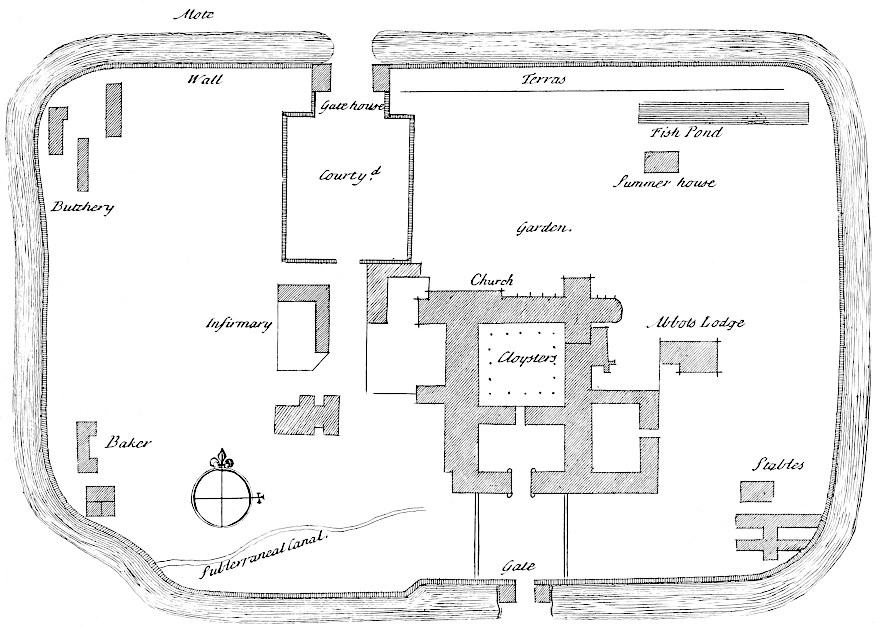
Below the hill the Hermen-street meets with the Foss, which now united march directly up to the city, across a great vale where the river Witham runs, by Mr. Baxter thought the Victius of Ravennas: Mr. Leland calls it Lindis. As it descends towards Boston, it is besieged, as it were, by religious houses, planted at every mile; such as Nocton priory, founded by Robert D’arci, lord of the place, 1164. now the elegant seat of Sir William Ellys, bart. Kyme priory, founded by Philip and Simon de Kyme, knts. to which the Tailboyses added, who married the heiress; Barlings abbey, founded by Ralph de Hay, and his brother Richard; Stanfield, the seat now of Sir John Tyrwhit, bart. Bardney abbey built by king Ethelred, who was buried here anno 712. much added by Remigius bishop of Lincoln; Tupholm, founded by Rob. de Novavilla; Stikeswold priory of the Benedictine nuns; TAB. XXVIII.Kirksted abbey, by Hugh de Breton, whose ichnography is discoverable from its ruins; Revesby abbey, by William de Romara.
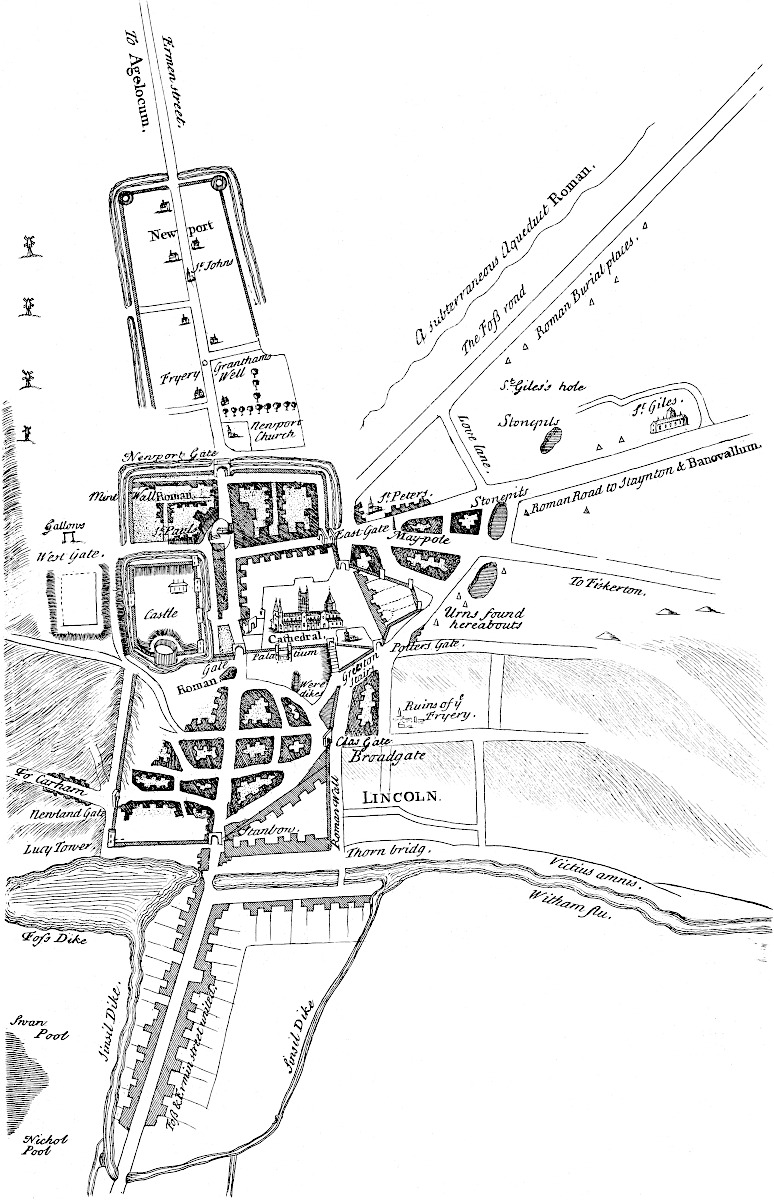
I think it not worth while, in a Roman journey, to dwell upon these places, and haste up hill to Lincoln,[77] a great and most famous city of theirs, graced with the title and privilege of aLindum. colony; therefore called Lindum colonia; a bold and noble situation upon a TAB. LXXXVIII.high hill, which we may think no less than five cities united into one; of all which I shall give a short account in their order, as to what I observed, without transcribing such matters as the reader will find better delivered in authors. My business is to illustrate the 88th Plate, which I made by pacing as I walked about the city, intended to give the idea of the place as formed originally by the Romans, and of their roads leading to and from it. 1.Below the hill, and westward of the city, the river throws itself into a great pool, called Swan pool from the multitude of swans upon it. All around this place the ground is moory, and full of bogs and islets, called now Carham, which means a dwelling upon the car, that is, the fen. Now here, without question, was the British city in the most early times, where they drove their cattle backwards and forwards, and retired themselves into its inaccessible securities; and from thence I apprehend the name of caer, signifying a fortification or inclosure in all the most ancient languages, came in this country to be retained in these morasses: this was its name as a dwelling, or a collection of native inhabitants; but the pool in their language was called lhyn, and that denominated the Roman city Lindum, being the hill hanging over this pool. From this Carham you have a pleasant view of the west front of the cathedral. The shape of the pool is thought very much to resemble a 2.map of England, when you survey it from the top of the cathedral. The Romans, pleased with this notable eminence, placed their city upon it, which they first built in the form of a large square, the southern wall standing upon the precipice or edge of the hill, and wanted no other external fence: quite round the other three sides they carried a deep trench too, which still remains, except on the south-east angle. This city was divided into four equal parts, by two cross streets that cut it quite through upon the cardinal points: the two southern quarters were taken up, one by the castle, the other by the church which Remigius built; but, when Alexander the bishop projected a structure of much larger dimensions, they carried the sacred inclosure beyond the eastern bounds of the city, and so built a new wall farther that way, as it is now, with battlements and towers. The north and south Roman gates of this part of the city remain; the one intire, the other pulled down about fifteen years ago by Mr. Houghton: the northern, called Newport gate,TAB. LIV is the noblest remnant of this sort in Britain, as far as I know. Upon the first sight of it I was struck with admiration, as well of its noble simplicity, as that hitherto it should not have been taken notice of: it is a vast semicircle of stones of very large dimensions, and, by what I could perceive, laid without mortar, connected only by their cuniform shape. This magnificent arch is sixteen foot diameter, the stones four foot thick at bottom: from the injuries of time, but worse of hands, it is somewhat luxated, yet seems to have a joint in the middle, not a key-stone: on both sides, towards the upper part, are laid horizontal stones of great dimensions, some ten or twelve foot long, to take off the side pressure, very judiciously adapted. This arch rises from an impost of large mouldings, some part of which, especially on the left-hand side, are still discoverable: below on both sides was a postern, or foot passage, made of like stones; but against that on the left side is a house built, and when I went down into the cellar I found a chimney set before it. The ground here in the street has been very much raised, and the top of the wall is of a later workmanship: it is indeed a most venerable piece of antiquity, and what a lover of architecture would be hugely delighted withall. They that look upon a gate among the vestiges of the forum of Nerva at Rome, will think they see the counterpart of this; but, of the two, this has the most grandeur in aspect: the drawing supplies any further harangue about it. From this gate eastward, some part of the old Roman wall is to be seen by a pasture, made of stone and very strong mortar: thereabout too are some arches under ground. The west gate toward the gallows was pulled down, not beyond memory: that on the south side, which I spoke of, still shows one jamb from between the houses, and two or three stones of the same make as the former, just above the springing of the arch: if you go up stairs in the adjoining house within the city, you may see the postern on the east side, which is big enough for a bed to stand in. I doubt not but there is, or was, another answerable on the other side; but this street is much contracted from its original breadth by the subsequent populousness of the place; and the ground here, being upon the edge of the hill, is much worn down, as the first is heaped up, from the condition of former ages. But by Newport gate before described, is another large and curious remnant of Roman workmanship: this is called the Mint wall, and stands in a garden in the north-west quarter of the city: it is still sixteen foot high, above forty foot long, and turned again with an angle: on the left-hand side behind it are houses built and marks of arches. What it was originally cannot now be affirmed; the composition of it is thus: upon squared stone of the common sort, but a little decayed through age, is laid a triple course of Roman brick, which rises one foot in height; the bricks seem to be a Roman foot long, and our seven inches broad: above this three courses of stone, which rise about a foot more; then three layers of brick, as before; upon that twelve courses of stone, then brick and stone to the top: the scaffold-holes are left all the way: the mortar is very hard, and full of little pebbles.
28
RELIGIOVS.
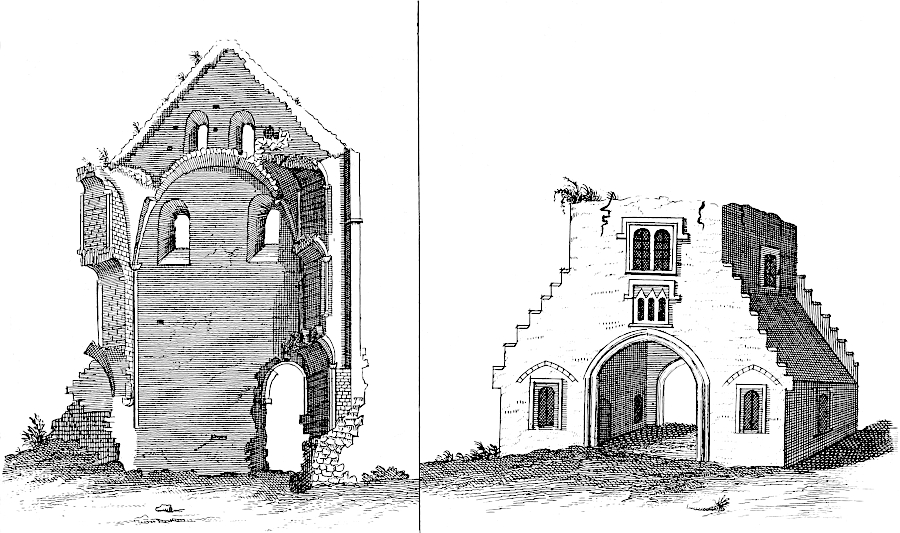
Remains of the Church at Kirsted Abbey Linc. 1716.
The Gate house of Tupholm Abbey Linc.
The Ichnography of the Monastery of Kirsted Linc.
Stukeley delin.
88
LINDVM Colonia. 4 Sep. 1722.
Josepho Banks Jun. Ar. Tabulam D.D. Ws. Stukeley.
Stukeley del.
54
Worth Gate (a Roman Work) Canterbury 6. Oct. 1722.
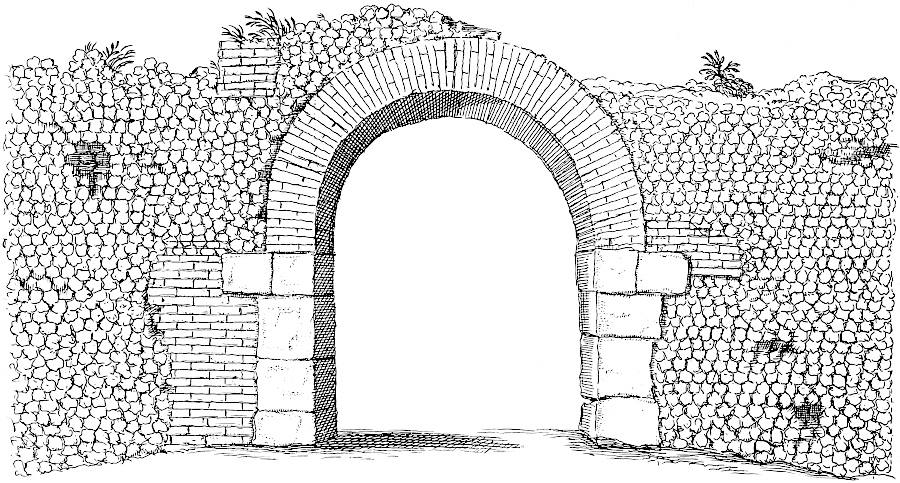
Newport Gate at Lincoln Sept. 3. 1722. The Arch of Roman Work
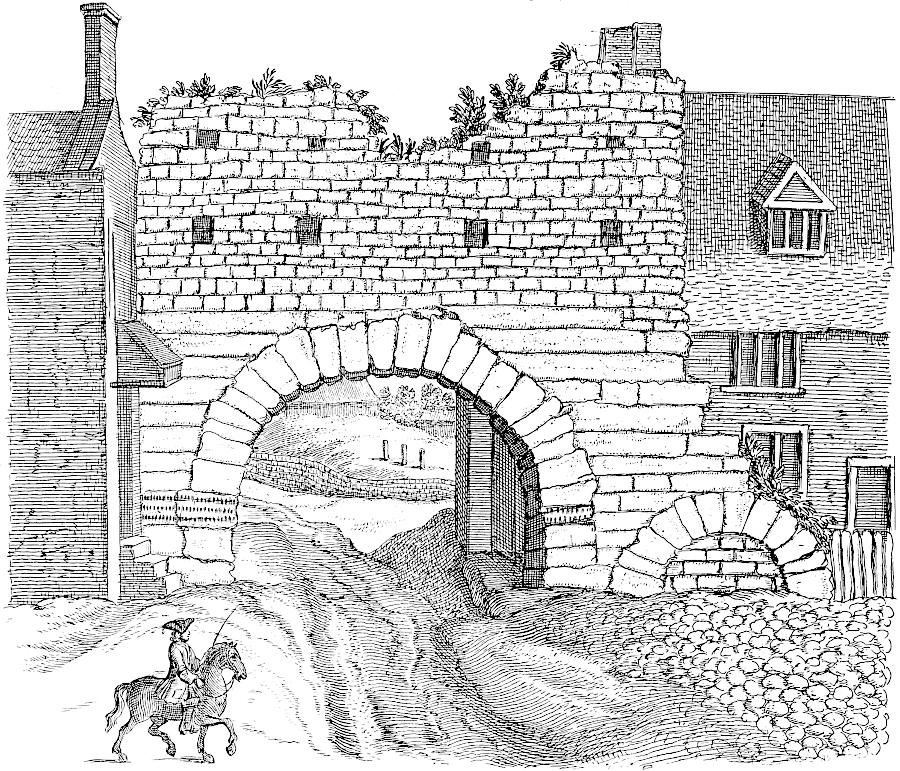
Stukeley delin. & Amicissimo Conterraneo Mauritio Johnson Ar. Interioris Templi J.C. offert.
3.
But this city being happily seated for navigation of the river, and the chief thoroughfare to the north, soon increased to that degree, that the Romans were obliged to add another to it as big as the former: this they did southward upon the declivity of the hill, and so tallied it to the other, that the new side-walls answered in a parallel to the old, and the most southern lay upon the river. Eastward the ditch without is turned into a broad street called the Beast-market, and there below Claskgate a great part of the old Roman wall is left, made of stones piled sideways, first with one direction, then with another, as was a common method with them: one piece of it is now eighty foot long, eighteen high; a little bit of it lower down is twelve foot long, as much high: between that gate upwards and the old city-wall, by the Greestone stairs, is the old ditch to be seen, much talked of, but not understood: it is called Weredyke. The people have a notion that the river came up here, and that these stairs were a landing-place from the water-side, and denominated from I know not what Grecian traders: but this is utterly impossible in nature. To the west the ditch and foundation of the wall is still left, though many times repaired and demolished in the frequent sieges this town has sustained, especially in the wars of Maud the empress: at the bottom of it, towards the water, is a round tower called Lucy tower, and famous in her history. This then was the state of this place in Roman times: the Foss and Hermen-street entered the city at Stanbow, or the stoney arch; there they parted: the Hermen-street went directly up the hill, and so full north through Newport; the Foss, according to its natural direction, ascended it obliquely on the eastern side without the ancient city, and so proceeded to the sea coast north-east.
4.
But still here were two more great additions to the length of this city, and which stretched it out to an enormous bulk; the first northwards above the hill: it is called Newport, or the new city, 500 paces long. This I apprehend to have been done in the reign of the Saxon kings: it lies on both sides the Hermen-street, and was fenced with a wall and ditch hewn out of the rock: at the two farther corners were round towers and a gate, the foundations of which remain: there were several churches and religious houses in this place; and I suppose it was chiefly inhabited by Jews, who had settled here in great numbers, and grown rich by trade: there is a well still called Grantham’s well, from a child they ludicrously crucified and threw into that well.
5.
[78]After the Norman conquest, when a great part of the first city was turned into a castle, I apprehend they added the last intake southward in the angle of the Witham, and made a new cut, called Sinsil dike, on the south and east side, for its security. The city then being of this huge compass, gave occasion for that prophecy, as they call it, and fancy to have been fulfilled in the year 1666:
Lincoln was, London is, and York shall be The fairest city of the three.
It is observable that the Normans could not well pronounce Lincoln, but called it Nichol, as we find it in some old writers; and to this day a part of swan pool is called nichol pool: in some places of Lincolnshire the vulgar pronounce little, nickle, and some other words of that sort. Though this place is much declined since those times, yet of late it begins to flourish again very considerably. The meaning of grecian stairs I suppose borrowed from the Normans, importing only stone steps (grees) as they appear at this day, a commodious descent from the minster yard. Within this two years, two new churches, large and fair, have been built at the charge of the inhabitants, and a great many handsome dwelling-houses: trades and manufactures too reflourish.
64·2d.
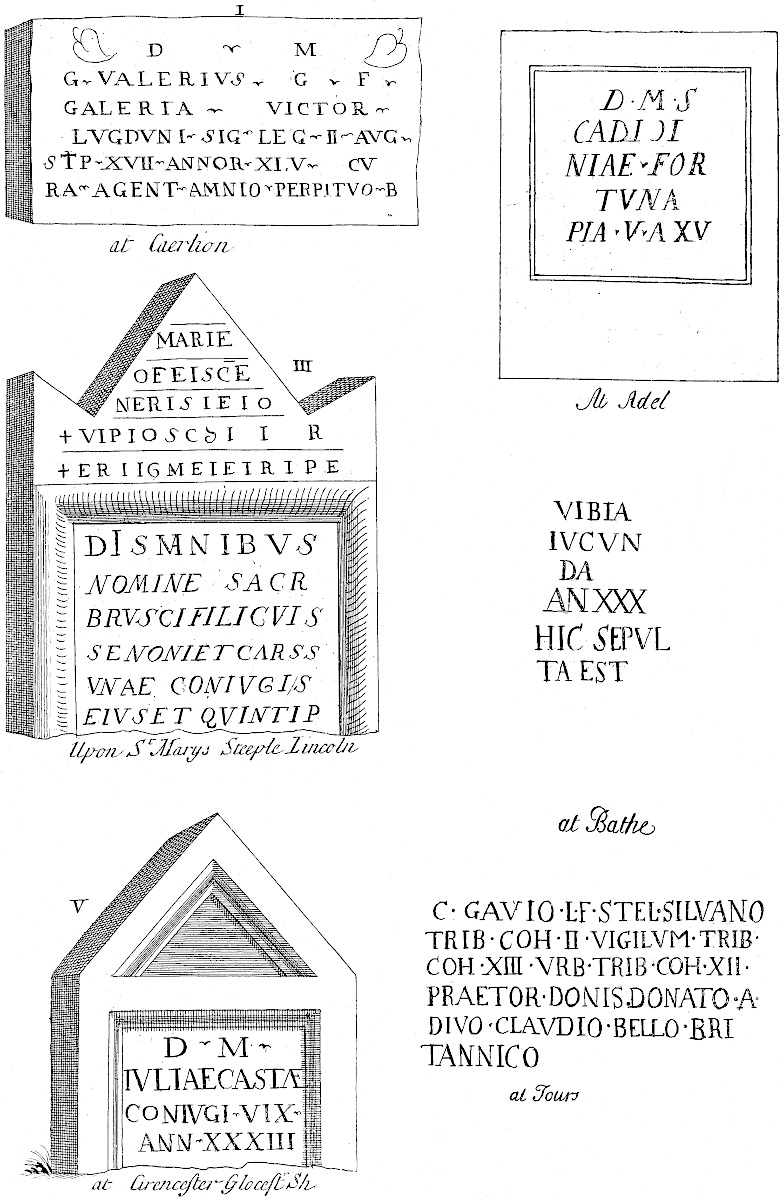
Roman Inscriptions
Stukeley delin.
I Harris Sculp
See transcription
[79]In this last part of the city, on both sides the Roman road, were many funeral monuments of the old Romans; some of which they now dig up, and doubtless much more when they first built upon this ground. I saw a pit where they found a stone with an inscription, this summer: through age and the workmen’s tools it was defaced, only small remains of D. M. & VIX. ANN. XXX. such letters as showed its intent, with carvings of palm-trees, and other things: this is behind the house where the lord Hussey was beheaded for rebellion in the time of Henry VIII. the great bow window through which he came upon the scaffold was taken down this year: it stands over-against another stone building, of an ancient model, said to be the palace of John of Gaunt, duke of Lancaster, who lived here in royal state, and had the privilege of coining: his arms are here carved in stone. Upon the steeple of St. Mary’s church they have placed in the wall an ancient monumental stone, with this imperfect inscription:
DIS MANIBVS NOMINI SACRI BRVSCI FILI CIVIS SENONI ET CARIS UNAE CONIVGIS EIUS ET QVINTIE.
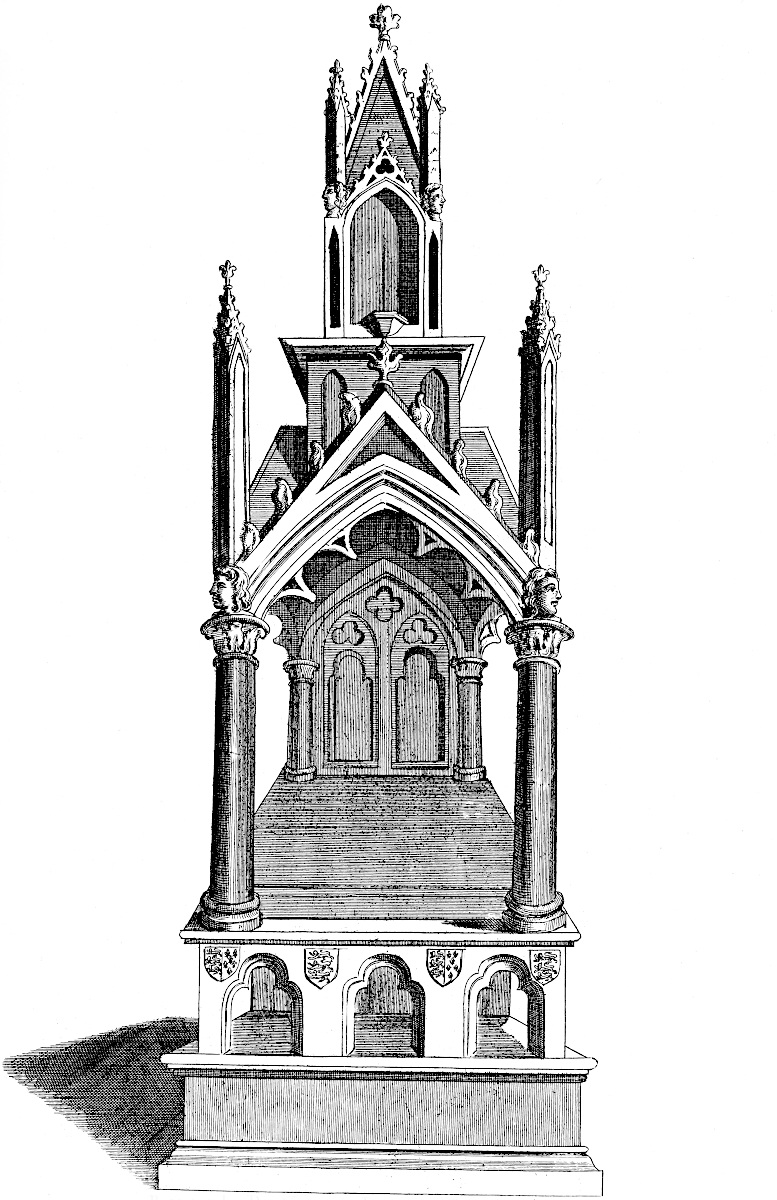
There is another obscure inscription upon the upper part of the stone, but has been added since, and is christian. Upon the church-wall lies an old stone by the conduit, which Leland takes notice of, and says is Ranulf de Kyme. Immense are the Roman antiquities dug up about this famous colony: nor has the perpetual turning up the ground exhausted them. The late Dr. Primrose had a great collection: I remember to have seen a fine glass urn in his possession, now with Martin Folkes, esq; found near Newport gate; also a very large silver seal of one of the Quincys earls of Lincoln, now with Nevil King, esq. Wm. Pownal, esq; has many coins very well preserved, particularly a Carausus with his wife on the same coin, which is a great rarity. I am in hopes he will some time favour the learned with an accurate account of this place, as it highly deserves. Upon the Roman road eastward are some barrows: many urns, and the like, have been dug up about them, especially near the stone pits, with earthen aqueducts, and all kinds of antiquities. Mr. Pownal showed me a brass armilla, found with a corpse which possibly was British.[80] Upon the road going to Staynton, is an hospital of St. Giles, built by Remigius; and behind it are great cavities in the rock under ground, which people fancied to be Roman catacombs, and affirmed they had seen earthen and brazen pots, inscriptions and the like, with many other strange stories: to search this matter thoroughly, provided with torches, we traced them to the utmost corners, but found them only quarries. Let us now survey the cathedral. It is far more magnificent than any I have yet seen: there are two great gate-houses or entrances to it from the west: the lower part of the front, and of the two towers, are of Remigius his building, as is easily discoverable by the colour of the stones, and by the manner of architecture: but Alexander built the additions upon it, the body of the cathedral, the choir and St. Mary’s tower, which once had a very lofty spire upon it; a prodigious work for a single man, and that not the only one, as appears by what we have mentioned of him. St. Hugh the Burgundian built the east end, orTAB. XXIX. St. Mary’s chapel, where he had a shrine; and the chapter-house cieled with a beautiful stone roof, one pillar in the middle. The cloysters and the library are fine: here are many books and manuscripts, and an old leaden inscription of William d’Agincourt, cousin to Remigius, already printed. Here are many bells, particularly one remarkably large, called Tom of Lincoln, which takes up a whole steeple to itself; probably consecrated to that great champion of the church, St. Thomas of Canterbury, the first cathedral mentioned in Bede; I suppose an humble building, and contained within the ancient walls. Two Catharine-wheel windows, as called, at the ends of the larger transepts, are remarkably fine for mullion-work and painted glass. Here are great numbers of ancient brasses and monuments: one I have engraven from a drawing procured by Browne Willys, esq; TAB. XVI.Tab. 16. the stone only is left near the west door. To set down the particularities of the church would require a volume. South of it, upon the very brow of the hill, is the bishop’s palace, built by Robert de Chesney, who gave two great bells likewise: bishop Bek and other successors enlarged it to a magnificence equal with the cathedral: it stands just south of the Roman wall; a very expensive work, for the foundations of it reach, as it were, below hill: over this hung many large bow windows of curious workmanship, looking over the tops of the lower city into Nottinghamshire: the kitchen had seven chimneys in it: the hall was stately: the gate-house remains intire, with coats of arms of the founders. This palace was ruined in the time of the civil wars: good part of it might be handsomely rebuilt without an extravagant expence.
In Leland’s time one of the stone crosses of queen Eleanor was here standing in the market place: it were endless to enumerate the religious houses, gates, and old buildings, that croud up every part of the streets. Here were originally fifty two churches. I never saw such a fund of antique speculations in any town in England: I heard continually of coins and urns found all the country over, as at Cathorp, Methringham, Nocton, &c. I found this inscription on a stone in the stable wall of the Rein-deer inn.
+RANDOLF: DE: BORTON: GYT: ICY: DEUI: DE: SA: ALME: AYT: MERCY: AMEN.
This castle of William the Conqueror’s is a large place, and exceedingly strong with walls, ditches, keep, and towers: over against it westward is an intrenchment made by king Stephen.
Through the whole length of Lincolnshire, from north to south, in a strait line runs a ledge of hills, that is, from Stanford to Winteringham: the Romans, observing this, carried their road upon it, and left the original stem of Fokingham. This high ground is similar all along, having a steep descent westward, overlooking Nottinghamshire, and is a rock of rag-stone quite through; the stone is white, and rises in strata, thicker as deeper: the surface is heathy. The river Witham, which rises on the west of this ridge, must have run into the Humber, had not Nature, by her propensity of drawing it eastward, as her declivities generally run, broke it off in the middle by that great valley under Lincoln, and made a passage for it into the estuary. Hence it is that the stone upon this western cliff is full of sea-shells; for, when the great and universal deluge had carried those inhabitants of the ocean into the mediterranean parts, by the weight of their shells they were unapt to retire again along with the waters, so were intercepted against this cliff, and received into the nascent stone.[81] A remarkable antediluvian curiosity I procured for the repository of the Royal Society, from these parts; being the real skeleton of a crocodile, or some such animal, inclosed in a broad flat stone. But now it is time to proceed.
29
The Shrine of St. Hugh the Burgundian Bishop of Lincoln. In the South Isle of the Cathedral there behind the Choir.
Reverendo Doctissimoque Laurentio Echard dicata.
Stukeley delin.
E. Kirkall sculp.
16
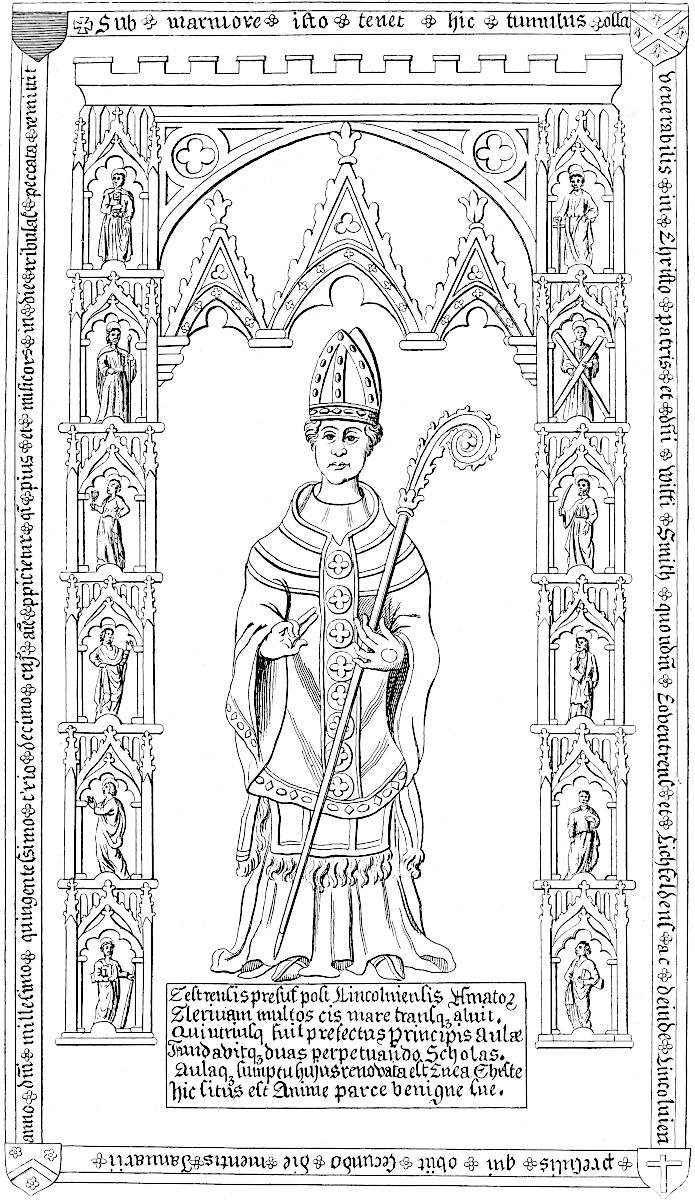
See transcription
87
AGELOCVM. Sep. 1722.
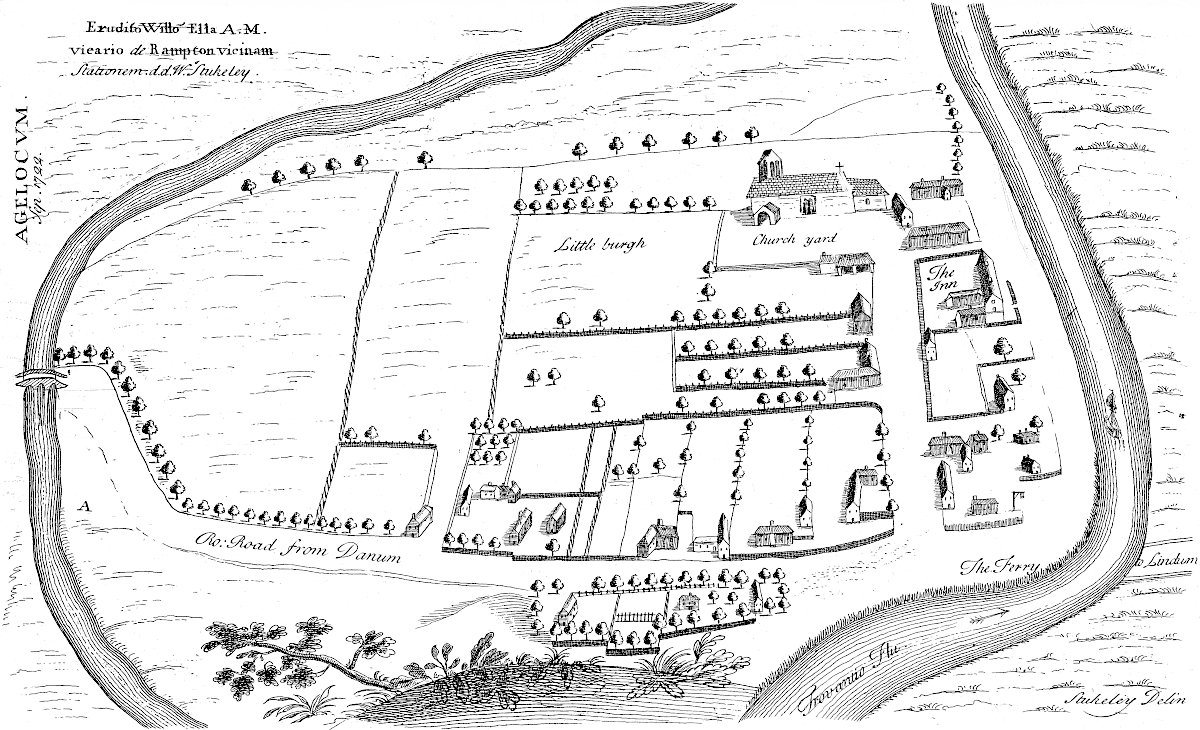
See transcription
The Hermen-street going northward from Lincoln is scarce diminished, because its materials are hard stone, and the heath on both sides favours it: three miles off, near a watering-place, a branch divides from it with an obtuse angle to the left, which goes towards Yorkshire. We suppose the Romans at first had an erroneous idea of the island of Britain, and thought its northern parts in a more easterly longitude than by experience they found; and thus in Ptolemy’s maps the length of Scotland is represented running out enormously that way: but when Agricola, in his conquests northward, had discovered that mistake, and that the passage over the Humber was very incommodious for the march of soldiers, he struck out this new road, as another branch of the Hermen-street, by way of Doncaster, from thence observing its natural direction northward. When we turn ourselves here, and look back to Lincoln, we see the road butts upon the western spires of the cathedral: and when from thence you survey the road, it is an agreeable prospect; your eye being in the middle line of its whole length to the horizon. I had a mind to pursue this branch through Lincolnshire as far as the first station, Agelocum: this ridge is likely to be of an eternal duration, as wholly out of all roads: it proceeds directly over the heath, then descends the cliff through the rich country at bottom, between two hedge-rows, by the name of Tilbridge lane. When you view it on the brink of the hill, it is as a visto or avenue running through a wood or garden very strait, and pleasanter in prospect than when you come to travel it; wanting a Roman legion to repair it. You pass through Stretton and Gate-Burton, so called from the road, and by a ferry cross over the Trent, which lands you at
Agelocum.
TAB. LXXXVII.
Littleborough, Agelocum, or, as by later times corrupted, with a sibilus, into Segelocum.[82] This is a small village three miles above Ganesborough, just upon the edge of the water, and in an angle. Agel auk, frons aquæ, is a pertinent etymology: it seems only to have been environed with a ditch, and of a square form, and the water ran quite round it; for to the west, where White’s bridge is, a watery valley hems it in: so that it was a place sufficiently strong. The church stands upon the highest ground. The Trent has washed away part of the eastern side of the town. Foundations and pavements are visible in the bank. Mr. Roger Gale, passing by, once found an urn there, with a coin of Domitian’s: great numbers of coins have been taken up in ploughing and digging: they called them swine-pennies, because those creatures sometimes root them up, and the inhabitants take little care to save them. I saw a few there: the reverend Mr. Ella, vicar of Rampton hard by, has collected several, and some valuable, such as the following, of which he sent me an account.
A consecration piece of Vespasian. Cos. IIII.
IMP CAES NERVAE TRAIANO AVG GER DAC PMTRP COSVPP ℞ SPQR OPTIMO PRINCIPI. The mole at Ancona.
IMP CÆS NER TRAIANO OPTIMO AVG GER DAC ℞ SENATVS POPVLVSQ ROMANVS. Fortune sitting with a cornucopia in one hand, a rudder in the other, FORT RED SC.
IMP CAES. &c. as the second. ℞ SPQR. a genius sitting on trophies, with a spear in the left hand, a victoriola in its right.
IMP CAESAR TRAIANVS HADRIANVS ℞ PONT. MAX. TRP. Britannia sitting with a shield, a spear in her left hand, a laurel in her right, the right foot upon a rock BRITANNIA SC.
CONSTANTINVS AVG. ℞ SOLI INVICTO COMITI. Another, ℞ ALEMANNIA DEVICTA.
Several of those struck about Constantius’s time with a galeate head on one side, and URBS ROMA ℞ a wolf suckling Romulus and Remus: others, CONSTANTINOPOLIS: many more, of Aurelius, Faustina, Gallienus, Tetricus, Victorinus, Carausius, Constantine, Constantius, Crispus, Allectus, and the lower Empire. About forty years ago, when the inclosures between the town and bridge were ploughed up, abundance of these coins were found, many intaglias of agate, cornelian, the finest coral-coloured urns and patera’s, some wrought in basso relievo, the workman’s name generally impressed on the inside of the bottom: a discus with an emperor’s head embossed. In 1718, they dug up two altars, handsomely moulded, which are set as piers in a wall on the side of the steps that lead from the water-side to the inn: on one is the remnant of an inscription, LIS ARAM DD. these are of the course grit-stone. Many very little coins are found here, like flatted pease; they call them mites. Mr. Hardy has a large urn with the face of a woman on the out-side. In this same field near White’s bridge are great foundations of building: coins are often found too at the lowest edge of the water, when the tide is gone off, and in dry seasons. On the east side of the river has been a camp. Returning by Tilbridge lane, upon the top of the heath is a spring, which they say flows and abates with the tide in the Trent, though five miles off: the like is reported of divers others hereabouts.
From the place where the roads branch out, before spoken of, I proceeded on the Hermen-street, northward, to Spittle on the street. There are milliary stones set upon the road all the way: it is very delightful riding, being wholly champaign, or heath. Of these stones I believe some are Roman, others later crosses, perhaps to supply their place: some tumuli scattered here and there. This place no doubt was a mansion, because a little beck runs through it, arising hard by: and it is ten miles from Lincoln; a convenient distance. I took the bearing of the road just north and south. Here is an hospital, said to be founded 1308, and great foundations all around, some of which are probably Roman. At present the village consists of two farm-houses, a chapel, an inn, and a sessions-house: three or four tumuli near the town. Upon the chapel is a silly Latin inscription:
fui anno domini 1398 dom. dei & pauperum
non fui 1594
sum 1616
Qui hanc Deus hunc destruet.
16·2d.
The Scite of the Roman town at Wintringham. 24. Iuly 1724. Abontrvs.
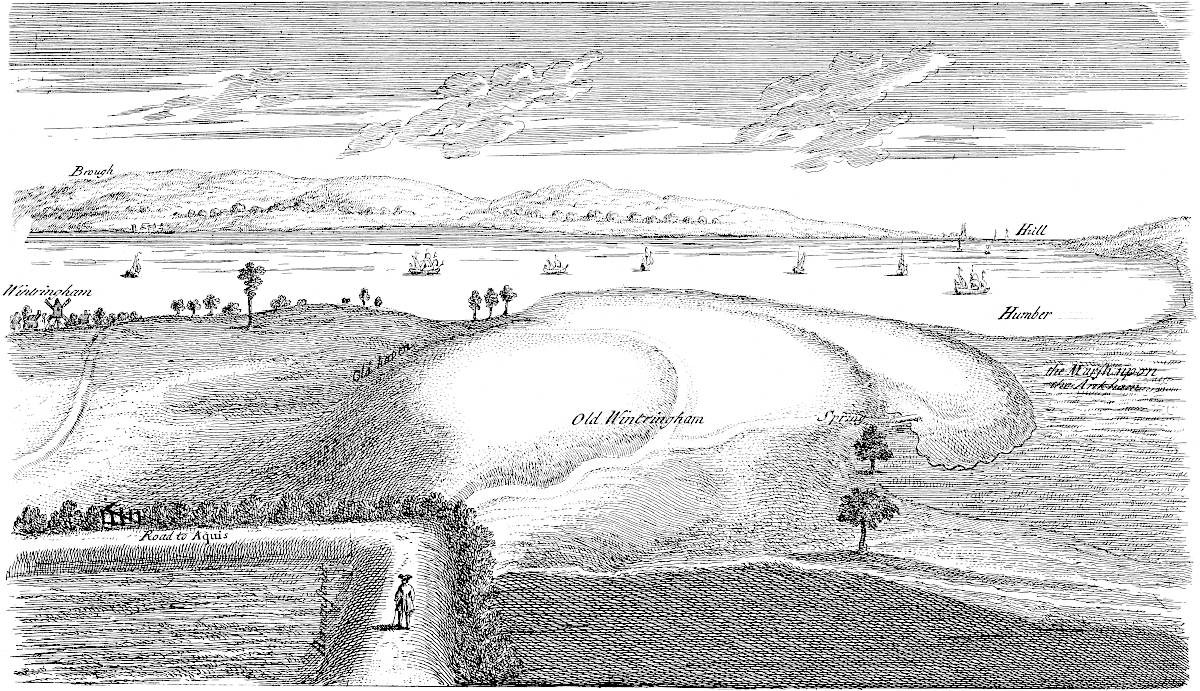
Stukeley delin.
Upon the sessions-house,
Hæc domus odit, amat, punit, conservat, honorat, Equitiam, pacem, crimina, jura, bonos. 1620.
Underneath, a coat palè of six, on a bend three annulets, with the arms of Ulster: over the door, Fiat justitia 1619. All this whole country is a quarry just beneath the surface. Beyond Spittle woodland begins: by Broughton, a vein of deep sand well planted with coneys. At all these towns upon the Roman road, coins and antiquities are found; Hibberstow, Gainsthorp, Broughton, Roxby, &c. at Sandton has been a Roman pottery: between Scalby and Manton is a Roman camp: in Appleby is a place called Julian’s Bower: at Kirton, John of Gaunt had a seat: twenty-nine towns round about held of him in socage. I take Broughton to be another station, because of its name, and that a brook runs through it; so that the interval between Lincoln and Wintringham is conveniently divided into three parts, ten miles each, by Spittle and Broughton, the whole being thirty Roman miles. Thornholm, a mitred priory: there is but another in England, Spalding. Risby and Gokewell, two nunneries; some small remains of both. To the left is Normanby, where the late duke of Buckingham was born, and whence his title.
We kept the road all the way, though sometimes it passes over little bogs, and at last about Winterton is inclosed: it terminates in some arable, where it is well nigh lost a mile south of Wintringham Ro. town.Wintringham. Upon a rising ground at the end of the Roman road, a little to the right, and half a mile east of the present Wintringham, stood the old Roman town, of which they have a perfect knowledge, and ploughed up great foundations within memory: TAB. [i XVI]. 2d Vol.it is now a common, skirted by the marshes upon the Humber: the soil hereabouts is clay. This site of Old Wintringham, as called, was almost inclosed with water in its first condition, having only a slip of land towards the Roman road as an entrance: the valley westward between it and the town is now called the Old Haven, where three elm-trees stand: the east is bounded by the mouth of the Ankham, which I suppose is ang in British, broad, avon, river, from its broad marshes. The city was ploughed up six years ago, and great numbers of antiquities found, now lost; great pavements, chimney-stones, &c. often breaking their ploughs: in several places they found streets made of sea-sand and gravel. It is a peninsula between the Humber and Ankham, and had most opportunely a fine spring on the east side, which no doubt was embraced by the Romans: it is likewise a great rarity in nature, arising so near the sea in a clayey marsh: there is stone-work left round it, and an iron ladle to drink at, which is done frequently by travellers, as with a religious necessity. Several intakes have been made beyond this city in memory of man, which drives the Humber farther off, and increases the marsh: it is half a mile between it and old town. The old haven-mouth is called Flashmire. This place is over-against Brough, the Roman town on the Yorkshire shore; but it is rather more eastward: so that with the tide coming in they ferried over very commodiously thither, and even now they are forced to take the tide. Buck-bean trefoil grows upon all the bogs hereabouts. The bearing of the end of the Roman way is precisely north and south, as at Lincoln; so that it is a true meridian line from the west end of the cathedral. The present Wintringham is a dirty poor place, but still a corporation; and the mayor is chosen only out of one street, next the old town, where was a chapel: the bell of it now hangs in a wooden frame by the pillory, and makes a most ridiculous appearance. Here is still a ferry from a small creek kept open by some freshes; it was ill judged of travellers to desert the old Roman way and ferry, and turn the road to Barton, (where the Humber is much broader and very dangerous) for no other reason but because it is somewhat nearer and over-against Hull: but the saving three miles riding does not compensate for the time or hazard of so uncouth a passage. I am persuaded the old name of this station was Abontrus, the same as the name of the river, whence they have formed the mimic Wintringham. Here is a vast jaw-bone or rib of a whale, that has lain time out of mind, like that at St. James’s. Wintringham church stands on the end of the Lincolnshire Alpes. Well may the Humber take its name from the noise it makes: my landlord, who is a sailor, says in a high wind it is incredibly great and terrible, like the crash and dashing together of ships. The Roman way beyond the Humber at Brough is continued in Yorkshire; but of its progress that way I can say nothing at present, this being the northern boundary of my expeditions.
From the termination of the Hermen-street, just by the knoll of old Wintringham, and the hedge on the side of a common, a lesser vicinal branch of a Roman road goes directly west to Aukborough, passing over Whitton brook. All the ground hereabouts terminates at the Humber in longitudinal ridges going north and south, and all steep like a cliff to the west, plain and level eastward. Aukborough I visited, because I suspected it the Aquis.Aquis of the Romans, in Ravennas, and I was not deceived; for I presently descried the Roman castrum.[83] TAB. XVII. 2d Vol.There are two little tumuli upon the end of the road entering the town. The Roman castle is square, three hundred foot each side, the entrance north: the west side is objected to the steep cliff hanging over the Trent, which here falls into the Humber; for this castle is very conveniently placed in the north-west angle of Lincolnshire, as a watch-tower over all Nottinghamshire and Yorkshire, which it surveys. Hence you see the Ouse coming from York, and downward the Humber mouth, and all over the isle of Axholm. Much salt-marsh is gained from all these rivers, though now and then they reclaim and alter their course. Then they discover the subterraneous trees lodged here at the Deluge in great abundance, along the banks of all the three rivers: the wood is hard and black, and sinks like a stone. Here are likewise other plentiful reliques of the Deluge in the stones, viz. sea-shells of all sorts, where a virtuoso might furnish his cabinet: sometimes a stone is full of one sort of shell, sometimes of another; sometimes, of little globules like the spawn of fishes: I viewed them with great pleasure. I am told the camp is now called Countess Close, and they say a countess of Warwick lived there; perhaps owned the estate;[84] but there are no marks of building, nor I believe ever were. The vallum and ditch are very perfect: before the north entrance is a square plot called the Green, where I suppose the Roman soldiers lay pro castris: in it is a round work, formed into a labyrinth, which they call Julian’s Bower. The church is of good stone, has a square tower, but the choir ruinous, excluded by a wooden partition: between it and the way to the marshes, a good spring rising out of the cliff. I dare say no antiquary ever visited this place since the Romans left it; for the people were perfectly ignorant of any matters we could inquire about; and as to finding coins, &c. they would make us no other answer than laughing at us: but I heard since, from other good hands, that they have been found here in great numbers.
17·2d.
Prospect of Aukborough Aquis of the Romans 24. July 1724.
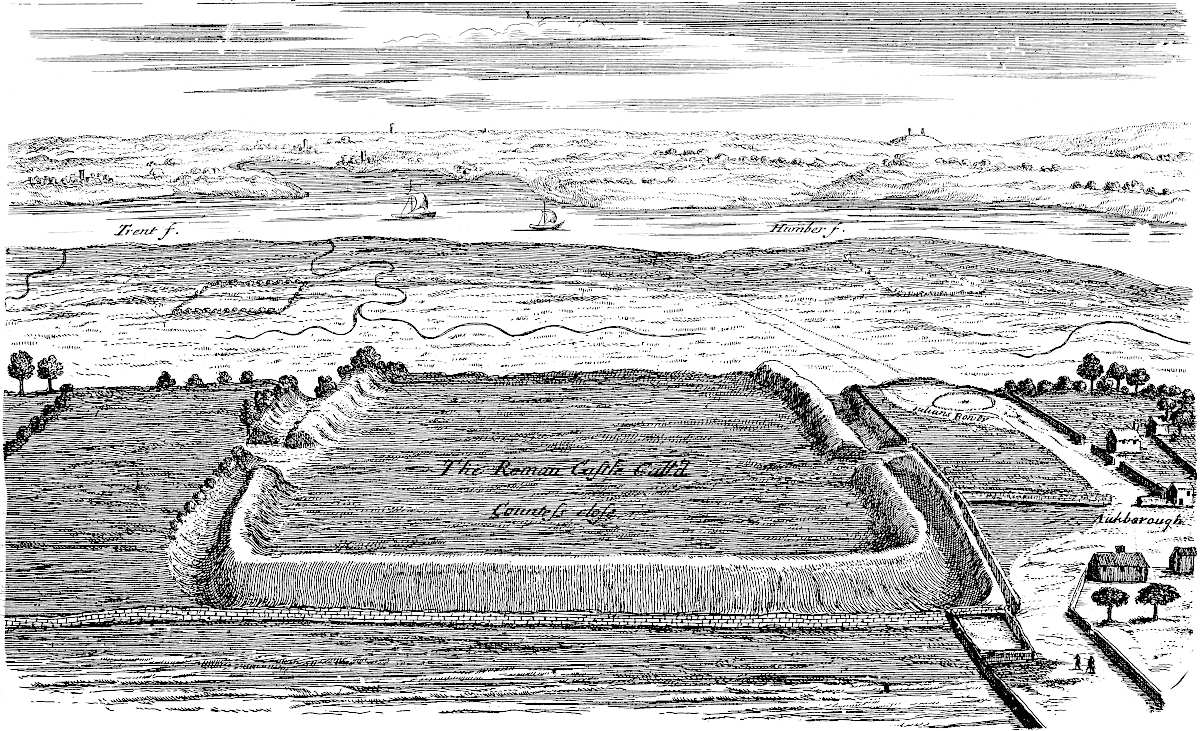
Stukeley delin.
E. Kirkall sculp.
Julian’s Bower.
Because I have frequently found these places called Julian’s Bower, both at Roman towns and others, but especially very common in Lincolnshire, I considered what should be the meaning of them, and shall here give my thoughts about it. They are generally upon open green places, by the side of roads or rivers, upon meadows and the like near a town: the name often remains, though the place be altered and cultivated; and the lovers of antiquity, especially of the inferior class, always speak of them with great pleasure, and as if there were something extraordinary in the thing, though they cannot tell what: very often they are called Troy town. What generally appears at present is no more than a circular work, made of banks of earth, in the fashion of a maze or labyrinth; and the boys to this day divert themselves with running in it one after another, which leads them by many windings quite through and back again.
Upon a little reflection I concluded that this is the ancient Roman game; and it is admirable that both name and thing should have continued through such a diversity of people; though now it is well nigh perished, since the last age has discouraged the innocent and useful sports of the common people, by an injudicious and unnecessary zeal for religion, which has drove them into worse methods of amusement. I imagine too this was a practice of the ancient Britons, many of which were of Phrygian extract, coming from the borders of Thrace; therefore derived it from the same fountain as the Romans: this was upon their maii campi; but I shall not speak of them here: and the Turks, I apprehend, learnt it hence; for it is their diversion too. As to the name bower, it signifies not an arbor, or pleasant shady retirement, in this place; but borough, or any work made with ramparts of earth, as camps and the like: and it is my thoughts, many works, which have been taken for camps, were only made for this purpose; whereof two I met with in this journey, that at Ashwel, and Maiden Bower near Dunstable. The name of Julian undoubtedly refers to Julus the son of Æneas, who first brought it into Italy, as is admirably described by Virgil in his V. Æneid. and kept up by the Romans with great pomp and annual festivity: Augustus was particularly fond of it, and took it as a compliment to his family. That they call these places Troy town, proves the same. Hear the poet:
Hunc morem hos cursus atque hæc certamina primus Ascanius, longam muris cum cingeret Albam Rettulit, & priscos docuit celebrare Latinos. Quo puer ipse modo, secum quo Troia pubes. Albani docuere suos, hinc maxima porro Accepit Roma & patrium servavit honorem: Trojaque nunc pueri Trojanum dicitur agmen. This game long since, this martial exercise Ascanius brought, when Alba’s walls he rear’d. Whence the old Latins celebrate the same, As he a lad, with him the Trojan youth. The Albans taught it theirs: from them great Rome Learnt it, and to their country’s honour call The game Troy town, the boys the Trojan band.
I conceive this game was of two sorts; that performed on foot; that on horse-back, or in chariots: the intent of both was to exercise the youth in warlike activity, for it was a sort of mock fight: that on foot was the Pyrrhic dance. Suetonius says, lusus ipse quem vulgo Pyrrhicum appellant Troja vocatur. If we carry it up to its first original, we must affirm it was invented by the Corybantes, Idei dactyli, Curetes, whose institution, when confirmed among the Romans, was continued by the priests called Salii, dancing in armour, and clashing their weapons together with some sort of concert. Likewise the real soldiers had the same festival, which they called armilustrium, celebrated on the 19. Octob. of which Varro gives us an account de lingua Lat. Suetonius mentions it in Tiberio, c. 72. This, whether performed on foot or horse-back, by children, priests or soldiers, was manifestly the same thing: their gestures, turnings, returnings, knots and figures, their assaults, retreat, and the like, were aptly represented by mazes and labyrinths; which very comparison Virgil uses.
Ut quondam Cretâ fertur labyrinthus in altâ, Parjetibus textum cæcis iter, ancipitemque Mille viis habuisse dolum, qua signa sequendi Falleret indeprensus & irremeabilis error. Such was in Crete the labyrinth of yore, In crooked tracks immur’d, a thousand ways Doubtful and dark: whence the return obscure, Inextricable, in endless mazes lost.
It is likely these works of ours, made in the turf, were cast up, in order to teach the children the method of it. That on foot is elegantly described by Claudian de VI. consul. Honorii, v. 622.
Armatos hic sæpe choros, certaque vagandi Textas lege fugas, inconfusosque recursus, Et pulchras errorum artes, jucundaque Martis Cernimus: insonuit cum verbere signa magister. Mutatosque edunt pariter tot pectora motus, In latus allisis clypeis, aut rursus in altum Vibratis. grave parma sonat mucronis acuti Murmure, & umbonum pulsu modulante resultans Ferreus alterno concentus clauditur ense. Here have I seen the armed rings revolve In artful flights, in order then advance, Attack, retire in all the forms of war, Their eye still on the signal of the chief; Then face about, ringing their brazen shields Against their corslets, or uplifted high Threaten the ecchoing skies; whilst steely blades Harsh murmur, and the clanging targets sound Alternate struck, the martial concert close.
The equestrian games of this denomination required more room and apparatus for spectators: therefore probably they fenced in a larger space of ground, of a circular or oval form, with a vallum, to keep the spectators at proper distance, and upon which they might more commodiously behold the sport. This I suppose was provided for by those bowers or burroughs mentioned, where there was no ditch behind; for that would be dangerous, if the people crouding one another, as is natural on those occasions, should thrust the outermost from such an elevation: so that they were a larger sort of amphitheatres, or circs: and this seems expressly intimated by the great Mantuan in those verses,
Munera principio ante oculos circoque locantur In medio ———— Et tuba commissos medio canit aggere ludos.
These games on horseback he thus describes:
Olli discurrere pares, atque agmina terni Diductis solvere choris, rursusque vocati Convertere vias, infestaque tela tulere. Inde alios ineunt cursus aliosque recursus Adversis spatiis, alternosque orbibus orbes Impediunt, pugnæque cient simulachra sub armis. Et nunc terga fugâ nudant; nunc spicula vertunt Infensi, factâ pariter nunc pace feruntur. They ride by pairs: the martial cavalcade Triple battalions form, which open first With adfront, and show of dreadful fight. Then new careers they take, wheeling about In various circles and self-ending orbs, In all the mazy arts and forms of war; Now turn their backs, and now afresh attack: At length in peaceful order all march off.
It seems that our tournaments, so much in fashion till queen Elizabeth’s time, are remainders of these warlike diversions; and the triple order, by which they were conducted, may possibly be imitated in some degree by the common figure in dancing, called the hedge, or the hay; both which I suppose are derived from the Saxon hæg, perhaps from the Latin agger.
We passed by the spring of old Wintringham and the Marsh at the mouth of the Ankham, which is a vast tract of land left by the sea; and came to Feriby sluice, a stately bridge of three arches, with sluices for voidance of the water into the sea, but now broken down and lying in dismal ruins by the negligence of the undertakers: whence travellers are obliged to pass the river in a paltry short boat, commanded by a little old deaf fellow with a long beard: into this boat you descend, by the steep of the river, through a deep mirey clay, full of stones and stakes; nor is the ascent on the other side any better, both dangerous and difficult. This, with the hideous ruins of the bridge, like the picture of hell gates in Milton, and the terrible roar of the water passing through it, fitly represented Virgil’s description of Charon’s ferry: nor would a poet wish for a better scene to heighten his fancy, were he to paint out the horrors of the confines of hell.
Hinc via Tartarei quæ fert Acherontis ad undas. Turbidus hic cœno vastaque voragine gurges Æstuat, atque omnem Cocyto eructat arenam. Portitor has horrendus aquas & flumina servat Terribili squallore Charon, cui plurima mento Canicies inculta jacet ————Æn. vi. Hence the way leads to Fereby forlorn, Where Ankham’s oozy flood with hideous roar Tears up the sands and sluices ruin’d vaults. A squalid Charon the dread ferry plies In leaky scull, whose furrow’d cheeks lie deep With hoary beard insconc’d———
When we had mounted the precipice again from the water, and paid our naul to the inexorable ferryman, we had several clayey lakes to ride over, unpassable in winter. Two roads[85] lead you to the town, a sorry ragged place, where upon the stocks is wrote, Fear God, honour the King. The church is set respecting no points of the compass, and just under the side of a precipice, so that you may almost leap from it upon the steeple: when we climbed the hill, it was a long while before we could find the way to Barton; and scarce could the people direct us to it, though but two miles off: at length, after wandering some time backward and forward, we hit upon the road, and, as men escaped the Stygian pool, with pleasure surveyed Barton, riding all the way through corn-fields, overlooking the Humber and Hull. Barton from hence makes a pretty prospect, having two churches, several mills, and the houses pleasantly intermixed with trees. This hill is wholly chalk, and answered on the opposite shore by another of the same nature. This is at present the passage across the Humber to Yorkshire, and we pleased ourselves at this time only with the distant view of it, and the neighbouring Hull: we could see the flag upon the castle.
Barrow. British temple.
At Barrow we were surprised with a castle, as the inhabitants call it, upon the salt marsh: upon view of the works I wondered not that they say it was made by Humber when he invaded Britain, in the time of the Trojan Brutus; for it is wholly dissonant from any thing I had seen before: but after sufficient examen I found it to be a temple of the old Britons, therefore to be referred to another occasion. A little eastward hence we visited Thornton college, a great abbey founded by William le Gros earl of Albemarle 1139, the gate-house is very perfect; a vast tower, TAB. XVIII. 2d Vol.or castle, wherein all methods of Gothic architecture for offence and defence are employed: there is a great ditch before it, across which a bridge with walls on each hand, and arches that support a broad battlement to defend the access: before it two low round towers: this stands oblique to the building, like the bridge at the tower-gate, the better to keep off assailants by arrows shot through many narrow loop-holes: there was a portcullis at the great gate, and behind it another gate of oak: there are no windows in front: over it are three old clumsy statues in as ordinary niches: a woman seeming a queen, or the virgin Mary: to the right, a man with a lamb; I suppose, St. John baptist: to the left, a bishop or abbot with a crosier: the lamb is introduced in several other places: in the battlements above the gate are the figures of men cut in stone, as looking down: on both sides this tower goes a strong wall embattled, supported by internal arches, with towers at proper distances: along the ditch within the gate are spacious rooms and stair-cases of good stone and rib-work arches. Upon taking down an old wall there, they found a man with a candlestick, table and book, who was supposed to have been immured. When you enter the spacious court, a walk of trees conducts you to the ruins of the church: part of the south-east corner is left between the choir and transept, and behind that some of the chapter-house, which was octagonal: the whole plan of the church is easily discoverable, and round about it the foundations of a quadrangle, and lodgings, to the south of which now stands a dwelling-house, which I suppose was the abbot’s lodge: here are great moats and fish-ponds, subterraneous vaults and passages; the whole monastery being encompassed by a deep ditch and high rampart, to secure the religious from robbers, because near the sea. A mile east of Thornton are the ruins of another great castle, called Kelingholme. In Goswel parish northward is Burham, a chapel now become a farm-house, which belonged to the monastery: in the same parish, near the Humber, is Vere court, which belonged to the ancient family of that name. Good land hereabouts, well wooded: they find Roman coins all about. Two miles west of Thornton is a great Roman camp, called Yarborough. Ro. town.Yarborough, which surveys the whole hundred denominated from it, and all the sea-coast. Vast quantities of Roman coins have been found here: Mr. Howson, of Kenington hard by, has pecks of them, many of Licinius.[86]
18·2d.
Inside view of Thornton College gate house July 26 1724
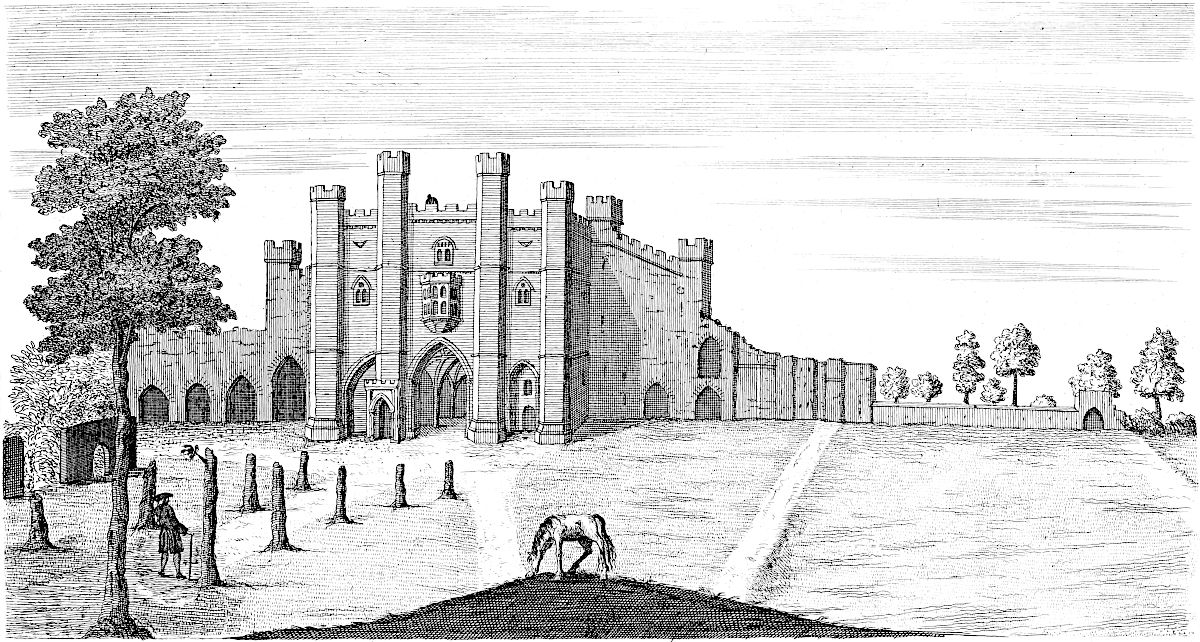
Stukeley delin.
I Harris Scul.
19·2d.
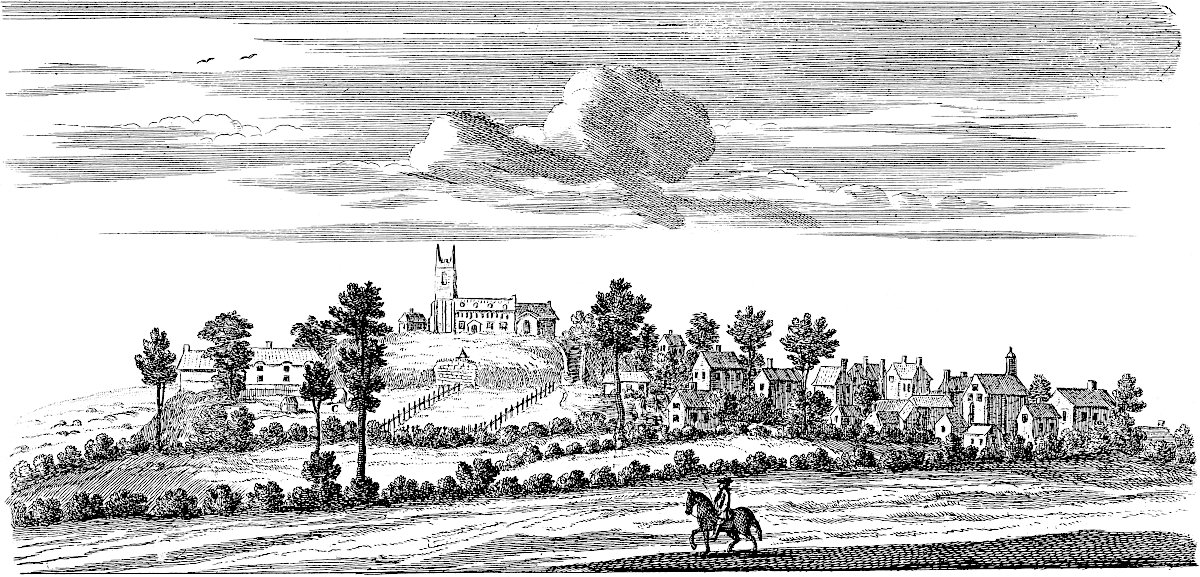
Stukeley del.
E. Kirkall sculp:
Prospect of Caster Lincolnshr: July 26 1724. A Roman Town. A. a piece of the Roman wall of the castle. B. the Spring. C. another piece of the Roman wall.
Hence we journeyed to Caster, upon another ridge of the downs, running north and south, slaunting off eastward to the sea, and steep all the way westward, reaching from the Humber to the Witham below Lincoln: a vein of sand again, and alike stocked with rabbets, answering to that on the other side the Ankham at Sandton, but a little more southward. From the hill just above Caster you have an admirable prospect both east and west; this way to the mouth of the Humber, the Spurnhead promontory, the Sunk island, and the whole country of Holderness in Yorkshire; that way, all the sea-coast of Lincoln stretched out in a long bow, jutting into the sea, full of creeks and harbours: south and west the whole county of Lincoln lies under the eye; but the height of Lincoln minster particularly pleases, which is here seen by the edge of the cliff south of Caster, and presents a very romantic landscape.
Caster. Ro. town.
The town of Caster is half way down this western steep; and in nothing more, that I have seen, did the Romans show their fine genius for choice of a station, than this:TAB. XIX. 2d Vol. there is a narrow promontory juts forward to the west, being a rock full of springs, level at top; and on this did they build their town. One may easily guess at the original Roman scheme upon which it was founded, and now in the main preserved: this whole town takes in three squares of full 300 feet each, two of which are allotted to the castle, the third is an area lying to the east before it, between it and the hill, which is still the market-place: the streets are all set upon these squares, and at right angles: at each end are two outlets, going obliquely at the corners to the country round about, two above, two descending the hill thus distributed: the north-east to the Humber mouth, south-east to Louth, north-west to Wintringham, south-west to Lincoln. What is the meaning of this place being called Thongcaster,[87] among some others in England, I know not; one in Kent: but it gave occasion to the same fanciful report of its original, as queen Dido’s founding Carthage upon as much ground as she could incompass with an ox’s hide cut into thongs; and a person in the town told me there was an history of the building Caster in Virgil, and offered to show it me. I should not have thought this worth mentioning, had not Mr. Camden spoke of it, as if he believed it to be true: but there can be no doubt that this castle was built long before Hengist’s time; for I saw enough of the old Roman wall to evince its founders: one great piece stands on the verge of the church-yard; another by a house: there are more behind the school-house in the pastures, and I have met with many men that have dug at its foundations in several other places: it is built of white rag-stone laid sometimes sideways, sometimes flat, in mortar exceedingly hard, full of pebbles and sand; nor is it mixed to any fineness: so that I conjecture it was the method of the Romans to pour the mortar on liquid, as soon as the lime was slaked: thus the heat and moisture, struggling together, created a most strict union or attraction between the lime and stone, the motion favouring their approximation; and the lime, no doubt, being made of the same stone, promoted a more intimate union between the cement and the hard materials by similitude of parts. I suppose this narrow tongue of land was thus encompassed with a wall quite to the market-place, objecting only its end to the plain before the hill, the rest standing upon the stoney precipice. From under theTAB. XX. 2d Vol. castle-walls almost quite round rise many quick springs; but Syfer spring is most famous, having now four fluxes of water from between the joints of great stones laid flat like a wall; and joined together with lead, probably first by the Romans, for it is under their wall; shaded over with trees very pleasantly: this is the morning and evening rendezvous of the servant-maids, where consequently intelligence is given of all domestic news: they say, within memory it ran much quicker, so that the water projected three or four foot from the wall; others say, that originally it ran in one stream like the sheet of a cascade. Syfer spring, no doubt, is the Saxon syfer, pure, clean, as the stream here deserves to be called. There is a place by the fold, south-west of the church, still called Castle-hill, where many bodies have been dug up. I am inclinable to think the meaning of Thong-castle to be fetched from Thane Degen, Saxonicè, miles, præfectus, analogous to the Latin comes.[88] Here it is likely our Saxon ancestors placed a garrison of troops to secure this country, as they conquered from the Roman Britons. In the church is a monumental effigies, in stone, of a knight of the name of Hundon; another, of a lady; another, of a knight of St. John of Jerusalem, cross-legged.